
Elderly Sugarcane Farmers Face a Glut: Can’t Sell, Yet Must Keep Growing
At around 7am, 65-year-old Sister Zhen walked into the sugarcane field, propped her scratched-up phone against a stalk, connected to the neighbour’s Wi-Fi and opened Douyin. She muttered the steps under her breath: ‘Tap the plus, swipe left, go live.’ The camera pointed straight ahead. At the centre of the screen, two pieces of cardboard hung from a sugarcane stalk, reading: ‘Sugarcane, 1–2 yuan a stalk — Lanhe Town, Shunhe Village; the streamer is an elderly person.’ It was a trick her son had only taught her a week earlier. Streaming this way for a full day, without showing her face or saying a word, was enough to attract kind-hearted visitors and help clear her unsold sugarcane.

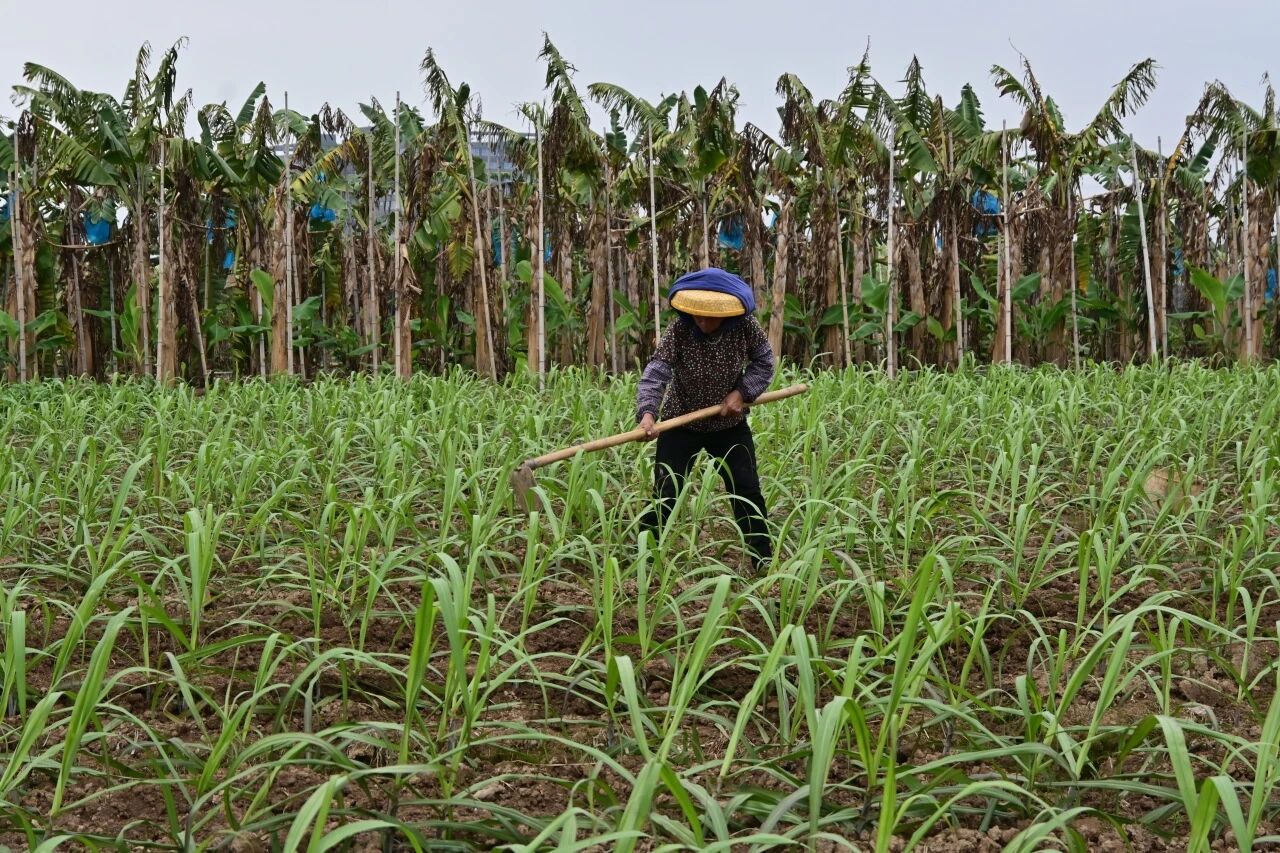
In late March in Nansha, Guangzhou, the spring rain fell and stopped again and again. The air grew muggier by the day, thick with the sweetness of decaying sugarcane leaves. Endless fields of black-skinned sugarcane stood like needles thrust into the soil, a sight that pierced the heart. Afraid of missing the spring ploughing window, farmers handed their sugarcane over to buyers for free, desperate just to get the fields cleared in time. Every mu given away for nothing meant a loss of more than 6,000 yuan.
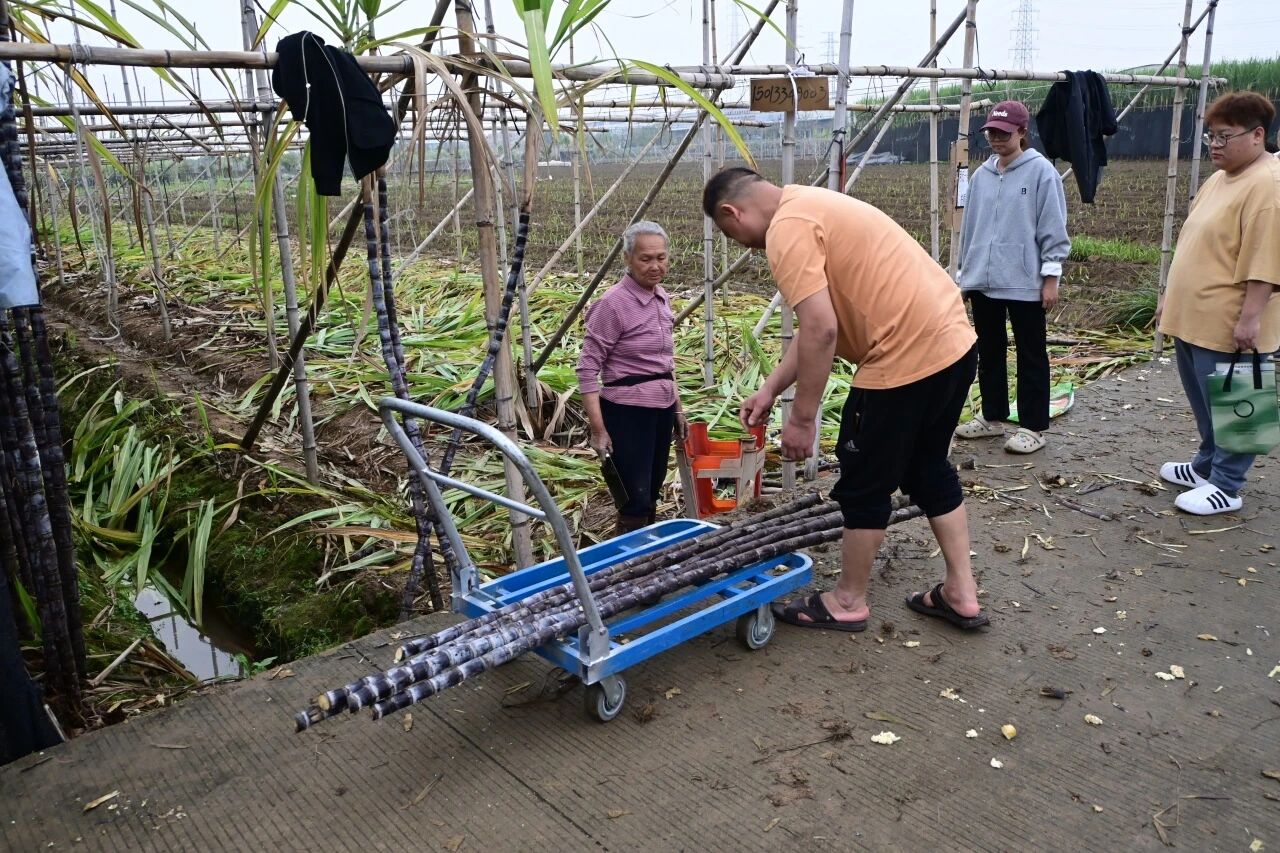
Most of the local sugarcane farmers were over 50. Many of them, like Sister Zhen, were powerless against the unsold stock. All they could do was hang signs at the field edges and along the roads — “One yuan a stalk, sugarcane to support local farmers” — and keep watch by their crops. News of Nansha’s unsold sugarcane drew tourists who came to buy and cut stalks. At 1–2 yuan a stalk, a single mu could fetch around 3,000 yuan, helping farmers recover nearly half their costs.
Many other farmers were out cutting sugarcane day after day, starting at 6am and working until dusk. They heaved over 50 kg of cane on ageing shoulders, shifting 2,000 kg a day for just over 400 yuan in pay — only after toiling for over a fortnight could they claw back the loss on a single mu.
And yet, on the fields already turned over for spring ploughing, patches of tender green sugarcane leaves had begun to sprout once more. ‘What else can we plant?’ The old farmers had no other choice. ‘Let’s take another gamble this year.’
I. Sugarcane Farmers Forced to Set Up Street Stalls
But this year’s market caught everyone completely off guard. After the last cold spells of 2025 passed, Nansha’s black-skinned sugarcane entered its peak eating season, yet not many fields had actually begun to harvest. She waited from the Western New Year all the way through to the Lunar New Year, but across both holidays not a single buyer came to ask her price. How was the market doing? Sister Zhen had no idea. Most sugarcane farmers are elderly, and they rely mainly on word of mouth from acquaintances for information. They have no sales channels either, so they can only wait. But by March, plenty of sugarcane still had no one asking about it.
Normally, Sister Zhen loads vegetables from her plot onto a tricycle and sells them at nearby markets. Hers is an old, battered tricycle with a seat that is more than half worn through. Since December, she has been cutting the thinner, shorter stalks from her field and hauling them to markets across Nansha and Shunde. She has a dark, weathered face, loose trousers, and legs that do not quite meet — she walks with a slow, swaying gait. If the chengguan come to cause trouble, she dares not argue. Sometimes they confiscate her scales and sugarcane, and she does not go back to reclaim them, afraid of being fined. Sugarcane can be sold by the stalk, so she does not need the scales. If things go well, she might make over 100 yuan in a day. But a single mu produces more than 2,500 stalks, and with no buyers at all, no amount of hard street selling will clear the stock.
Sister Zhen has a son and a daughter. Her son and his wife work in Tanzhou, Zhongshan, and look after their children. Her daughter suffers from a mental illness and has no job. At 20 yuan a dan, the elderly couple would not just see a year’s hard work go to waste — they would lose more than 10,000 yuan. They live in hardship. The clothes they wear were gifts from friends. Their shoes were bought on Pinduoduo — 8 yuan a pair; she bought two pairs. The pair she is wearing already has holes in it, both big toes poking through. The other pair has been worn for half a year, the heels worn away, but she has not thrown it out. If she accepted this price, relying only on her pension of six or seven hundred yuan a month, they could not even settle the debts they had run up on last year’s pesticides and fertiliser. She turned down the only sugarcane broker who had offered a price this year.
II. No Chance Even of a Price Enquiry
Chen Shun wanted to wait until the cane grew a little better so he could command a higher price. He waited all the way through to New Year’s Day, then started to feel anxious. He called a sugarcane broker he knew and eventually sold those 2 mu at 70 yuan per dan. The year before last, black-skinned sugarcane of that quality could fetch over 100 yuan a dan. Half a month later, another mu was settled at 60 yuan per dan. During the Spring Festival, 7 mu were sold off gradually at 40 yuan per dan — factoring in 1,500 yuan per mu for rent and labour, that price barely covered costs.
After last year’s Spring Festival, the price of black-skinned sugarcane rose considerably. But this year, prices offered by sugarcane brokers fell from 40 yuan per dan to just 5 yuan. Anything of even slightly inferior quality could not be given away for nothing — no one would collect it. Chen Shun’s last 7 mu of sugarcane remained unsold as late as March.
“Endless fields of sugarcane without even a chance to sell.” A village official in Yansha Village, Lanhe Town, explained that by late March, farmers in the village had registered over 500 mu of unsold sugarcane, of which more than 400 mu was black-skinned. Chen Jiao, a villager in her sixties, grows over ten mu of black-skinned sugarcane. Her husband passed away many years ago, and her children come to help in the fields on weekends if they do not have overtime. The land requires rent, and busy seasons mean hiring labour — costs exceed 7,000 yuan per mu. Last year, when the market was good, a year of hard work could bring in 100,000 yuan. But this season, no one came knocking. “Not a single person came to ask the price.”
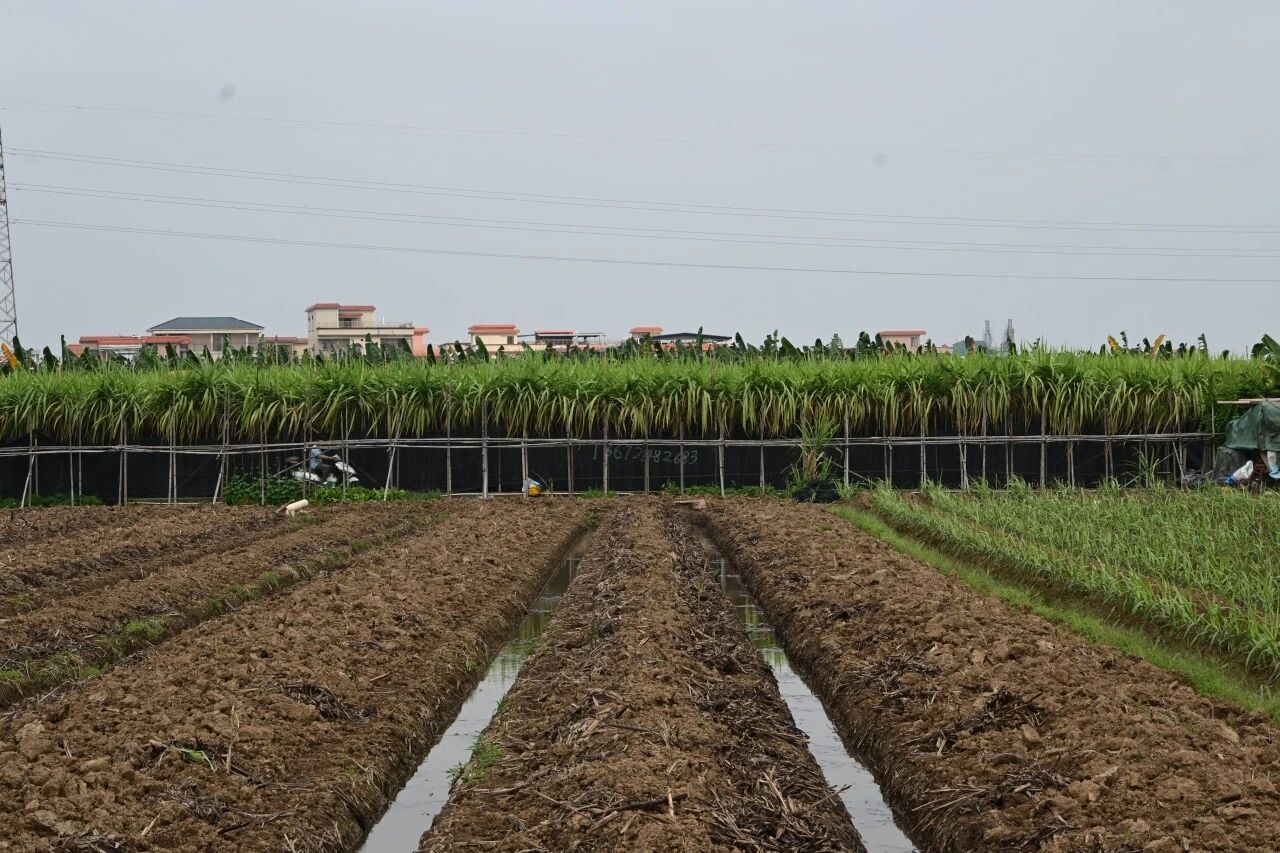
In Nansha, every patch of sugarcane is wrapped in black curtains. Usually from around the sixth lunar month onward, as the cane grows tall and the sun becomes fierce, the stalks need to be shielded from light to prevent them from turning red. Black-skinned sugarcane in top condition has a glossy, deep-black skin. Farmers also write their phone numbers on the curtains. After the Mid-Autumn Festival, if a sugarcane broker or buyer takes an interest, they will call to arrange a purchase, and some will book ahead. Once a section of sugarcane is reserved, the farmer will write the word “Sold” on the curtain.
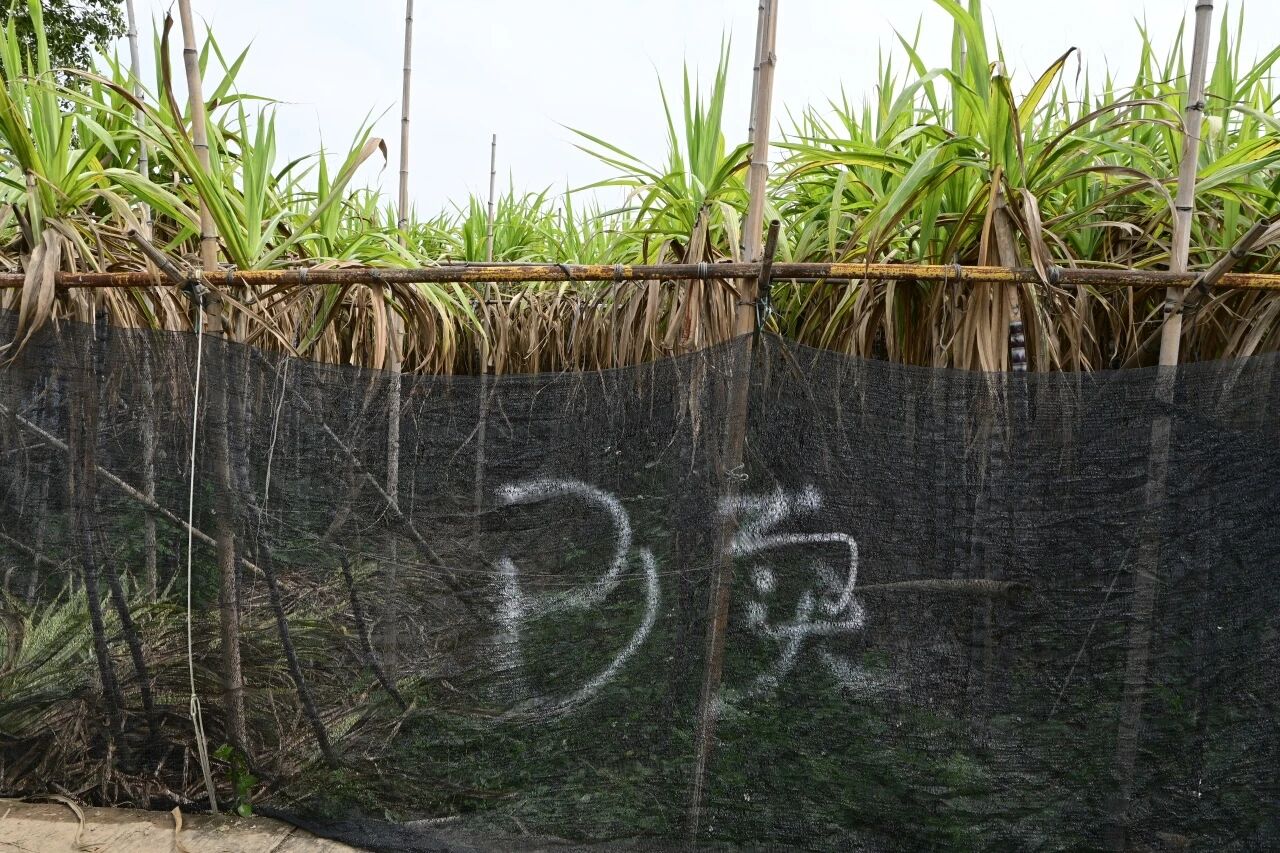
Chen Jiao had also put her number up early, but no one had come forward to arrange a purchase. The growing cycle for fresh-eating sugarcane in Nansha is about a year. For local sugarcane farmers, “spring ploughing” begins as early as the previous winter. For a new crop of black-skinned sugarcane to mature by year-end, March is the absolute deadline. To avoid missing the spring planting window, Chen Jiao gave away the earliest-planted, soon-to-be-off-season cane to brokers at rock-bottom prices — even for free — pressing them to cut it down as soon as possible. “A little later and it would be too late to plant.”
There is a local saying: “Sugarcane past Qingming is deadlier than a snake bite.” As the Qingming solar term approaches, rising temperature and humidity make improperly stored sugarcane highly prone to mould and reddening, producing a neurotoxin called 3-nitropropionic acid.
“Black-skinned sugarcane that is past its season will be of poorer quality,” the village official explained. Yellow-skinned sugarcane can be sold all year round; it is the black-skinned variety they are most anxious to clear. To that end, government offices, schools, hospitals and concerned members of the public have joined efforts to help farmers. But judging by feedback from village officials across the area, these efforts are mostly a drop in the ocean, far less effective than wholesale purchases: a single truck load from a sugarcane broker can shift 35 tonnes — four mu worth — while even a thousand tourists may not be able to clear one mu. The local government has also introduced a sugarcane-removal subsidy: for every mu of sugarcane cleared by a broker or another farmer, several hundred yuan in incentives are paid out. The scheme runs until 5 April.
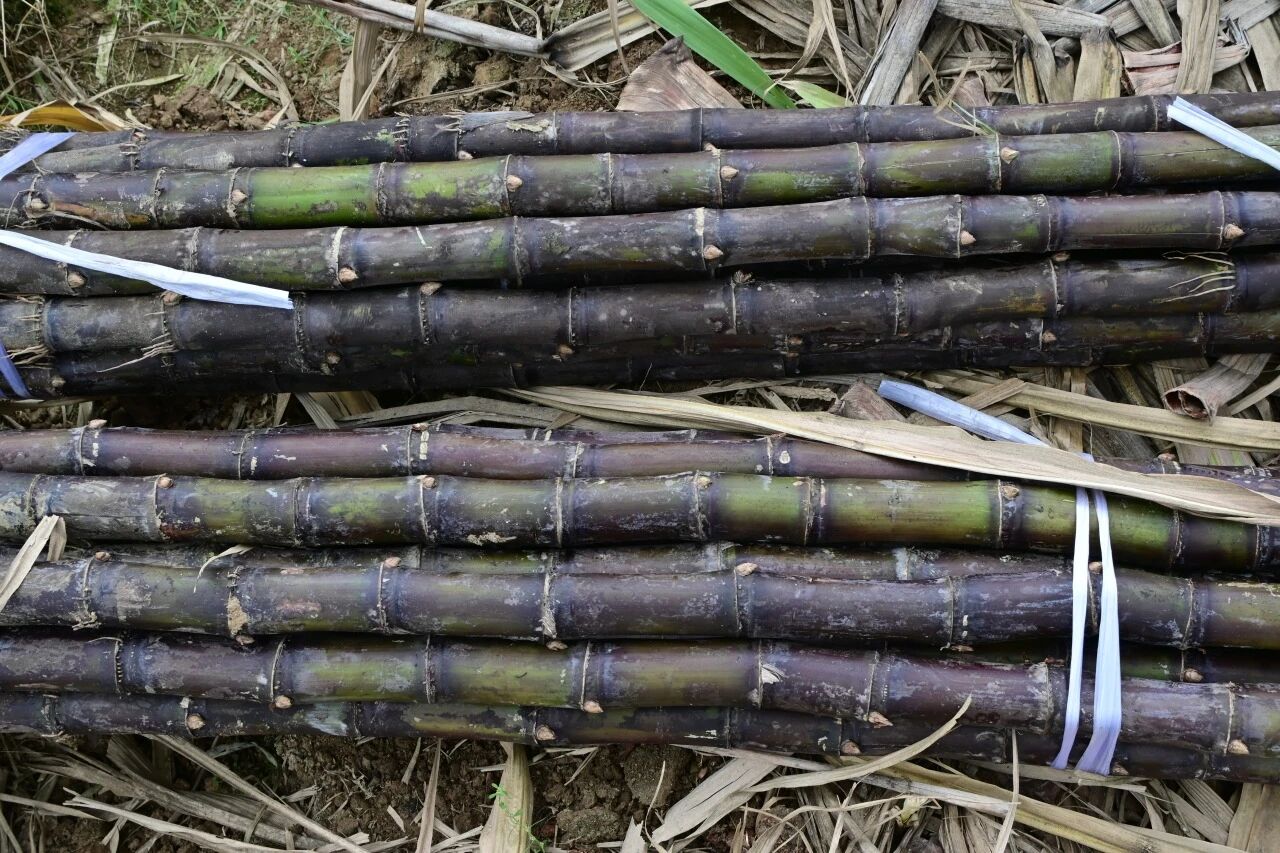
To clear the land as quickly as possible, Chen Shun had people clear 5 mu before mid-March for just 1,000 yuan per mu. “If we end up clearing it ourselves in the end, we’ll still have to pay for the labour.” Of the last two mu, his wife Auntie Huang keeps watch at the edge of the field every day, calling out to passing tourists. At first, 2 yuan a stalk; now it is down to 1 yuan.
Auntie Huang had previously worked at a frozen meat processing plant. In 2025, the same day as her fiftieth birthday brought something else: the factory’s dismissal letter. “Once the age on your ID reaches 50, the factory lets you go.” She lost her income, and their youngest daughter had just started senior high school and been placed in the “top stream”. It was anxiety that drove her to become a sugarcane farmer.
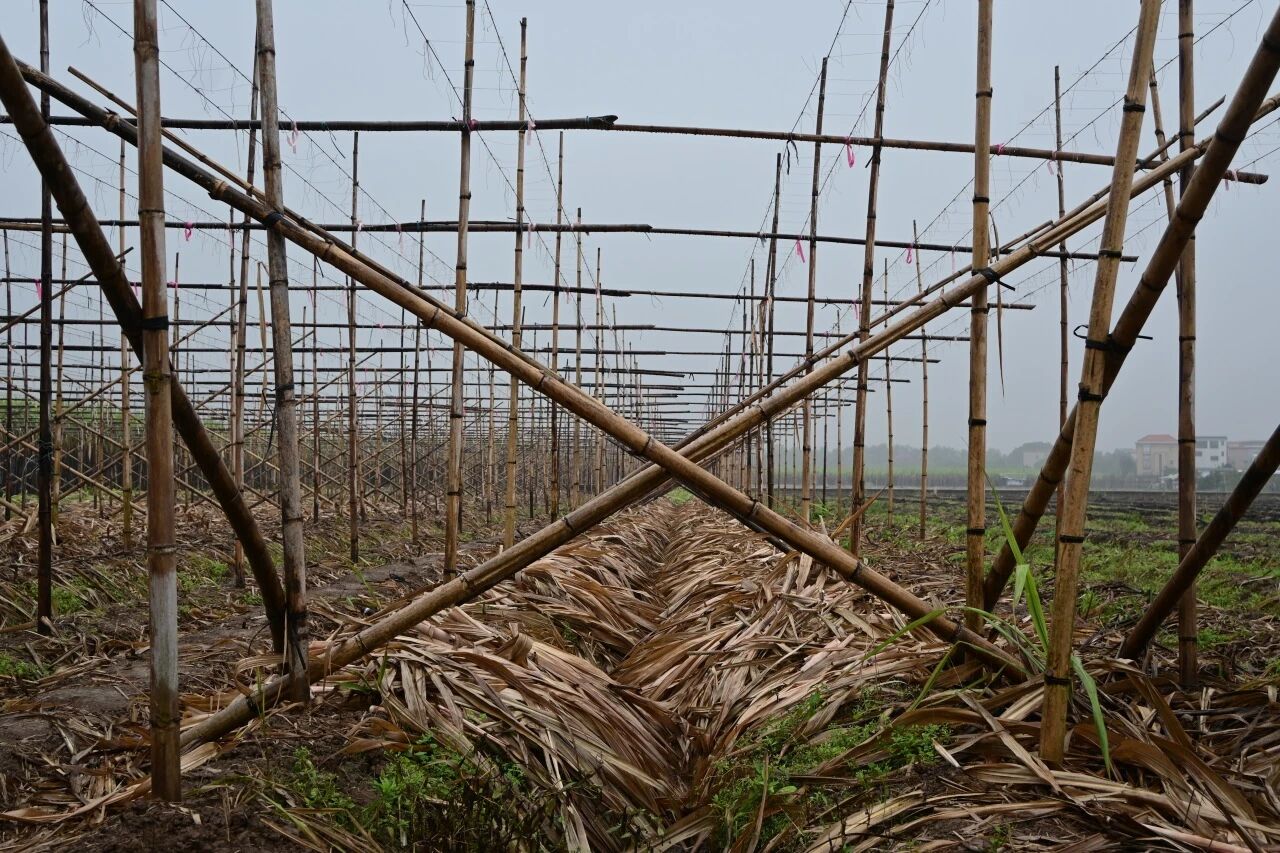
After a year of working with the cane and the soil, she had this to say: “Growing sugarcane, every single step is exhausting.” Beyond the plastic-film mulching, the earthing up, and the constant rounds of fertiliser and pesticide, growing fresh-eating sugarcane also requires erecting bamboo frames and raising them.
Sugar cane that leans this way and that is no problem for milling. But fresh-eating sugarcane has to grow straight and even in thickness to command a good price. So every year around the fifth lunar month, as typhoon weather begins to increase and the cane reaches about a metre tall, farmers must set up bamboo frames across the fields.
They drive poles as thick as a bowl rim half a metre into the ground, then brace them at an angle with more poles and lash thinner bamboo across the top. Finally, they string the ropes. Two thick ropes run along each row, boxing in the cane; thin ropes then divide the middle, creating neat square sections that each enclose two stalks, guiding the cane to grow tall and straight and preventing it from toppling in the wind. After that, every time the cane gains a little height, the five lowest leaves must be stripped off, and then the topmost bamboo frame and rope net are raised a little higher. Black-skinned sugarcane can grow up to 4 metres tall, so the frame and netting need to be raised about six times.
III. Even the Cane Cutters Are Elderly
In previous years, the cutters would start getting work after the Mid-Autumn Festival. Cane cutting begins before 6am, and most cutters have to be up at four or five in the morning. Every team has a foreman who liaises with the sugarcane broker on locations, quantities and prices. Brokers, in turn, build long-term working relationships with the cutting teams through the foreman.
A team numbers over a dozen, with distinct roles when the cutting starts. The vanguard each take a row, severing the base of each stalk with an iron spade, levering the cane out of the soil and trimming off the roots. The spades used are custom-made — about a metre long, with a narrow, flat-bladed head, sharp at the cutting edge. The dug-up cane is generally thrust back shallowly into the soil; the frames and netting are still up, and ropes at the top hold the stalks upright so they will not topple.
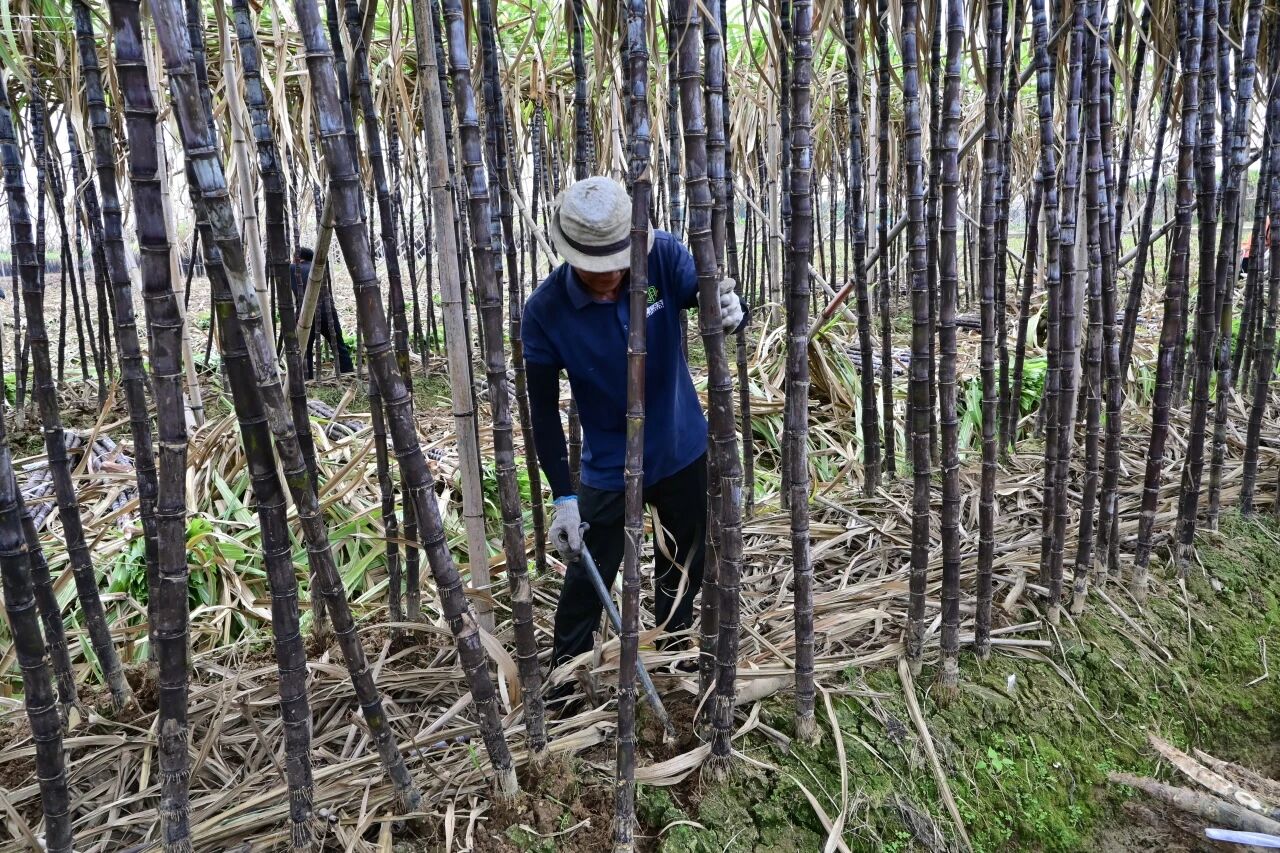
Once the cane is out, the whole team springs into motion like an assembly line. One group pulls the trimmed stalks free and shaves the leaves from either side of the crown. Another group turns iron stools upside down and stacks the stalks one by one into the groove formed between the legs at either end. Twelve to fourteen stalks make a bundle, and a bundle weighs over 50 kg. Once stacked and tied, each bundle needs binding at four points to hold firm; the tail leaves are finally trimmed by half. This is “tail-on” sugarcane — it keeps better and can withstand long-distance transport.
Sugarcane leaves slice the skin. Farmers who dress thinly to beat the heat find their hands and necks scored with cuts. The marks are shallow and do not draw blood, but they swell and redden. Sunlight, dust, grit and sweat set them stinging raw.
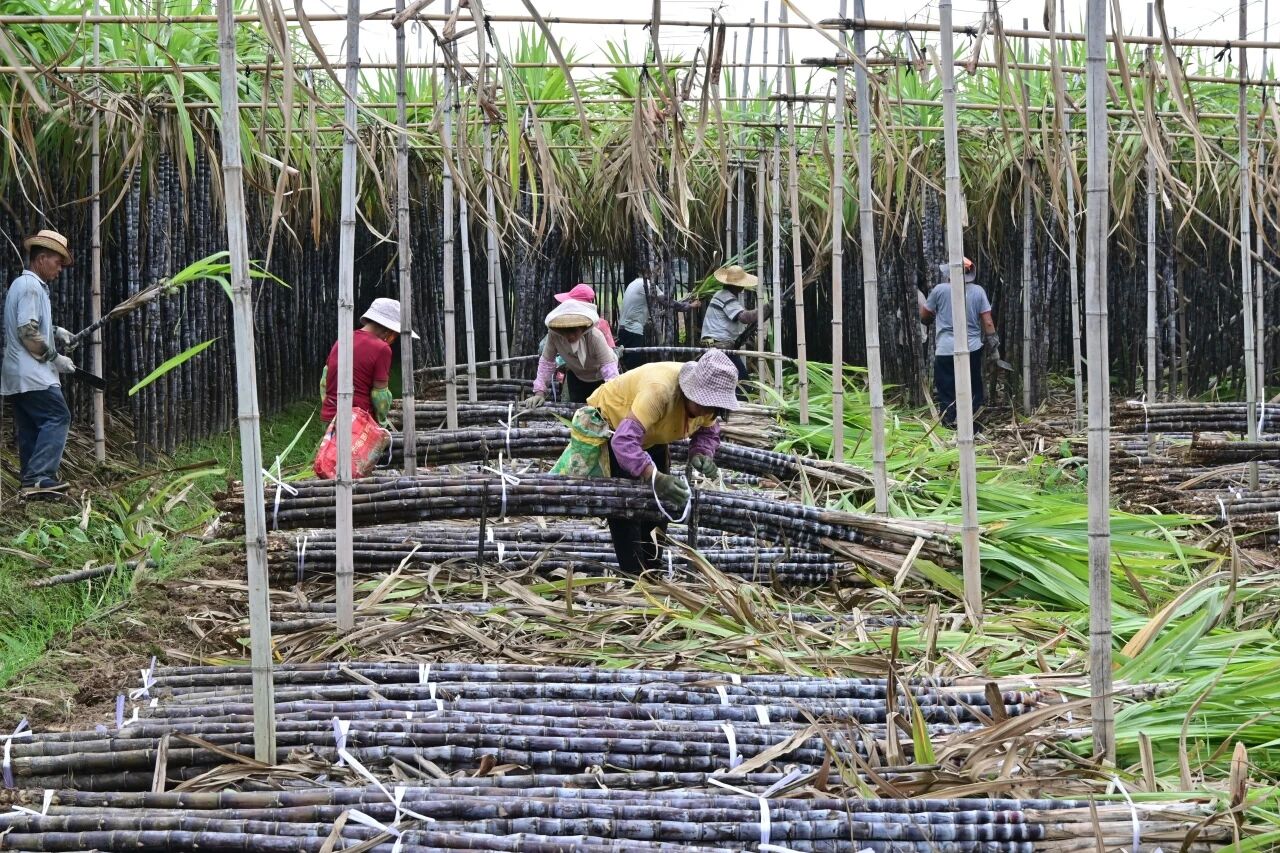
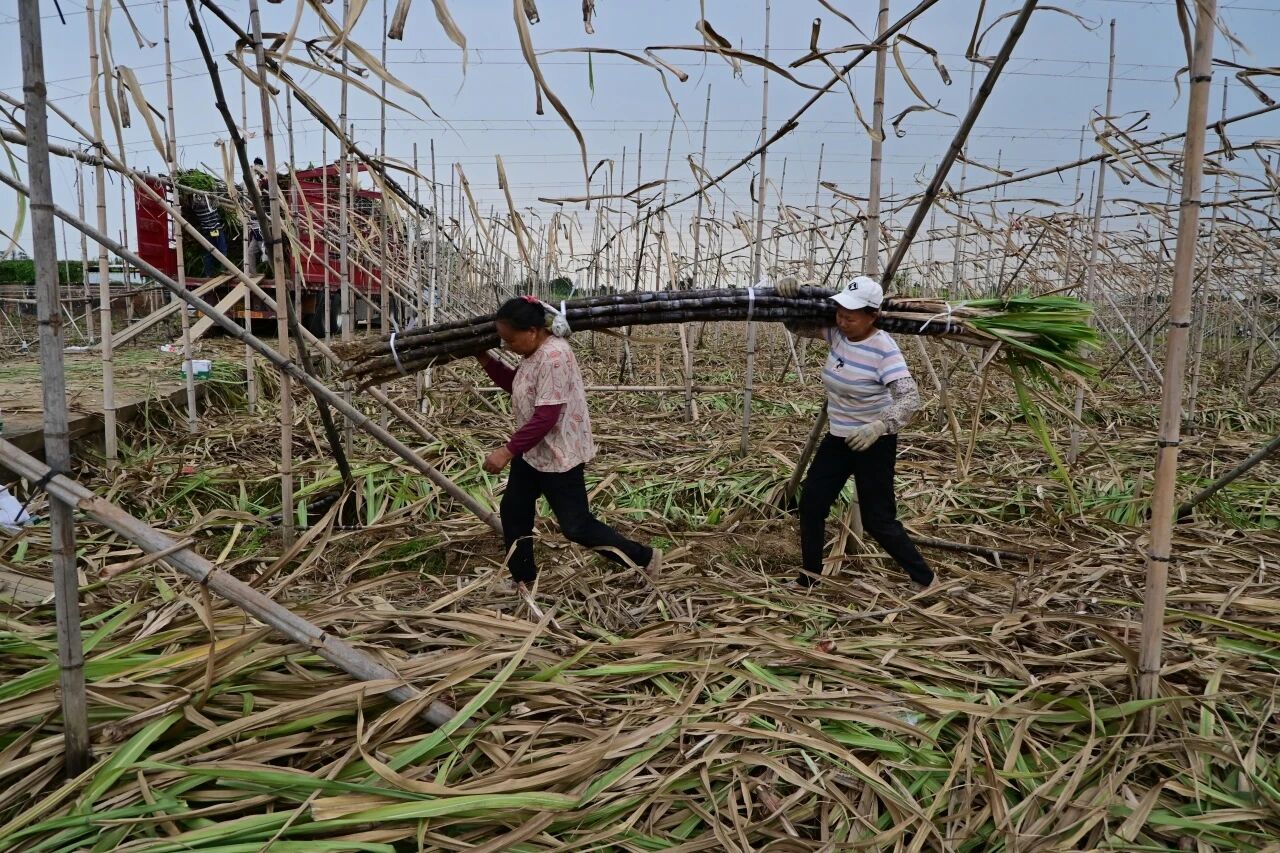
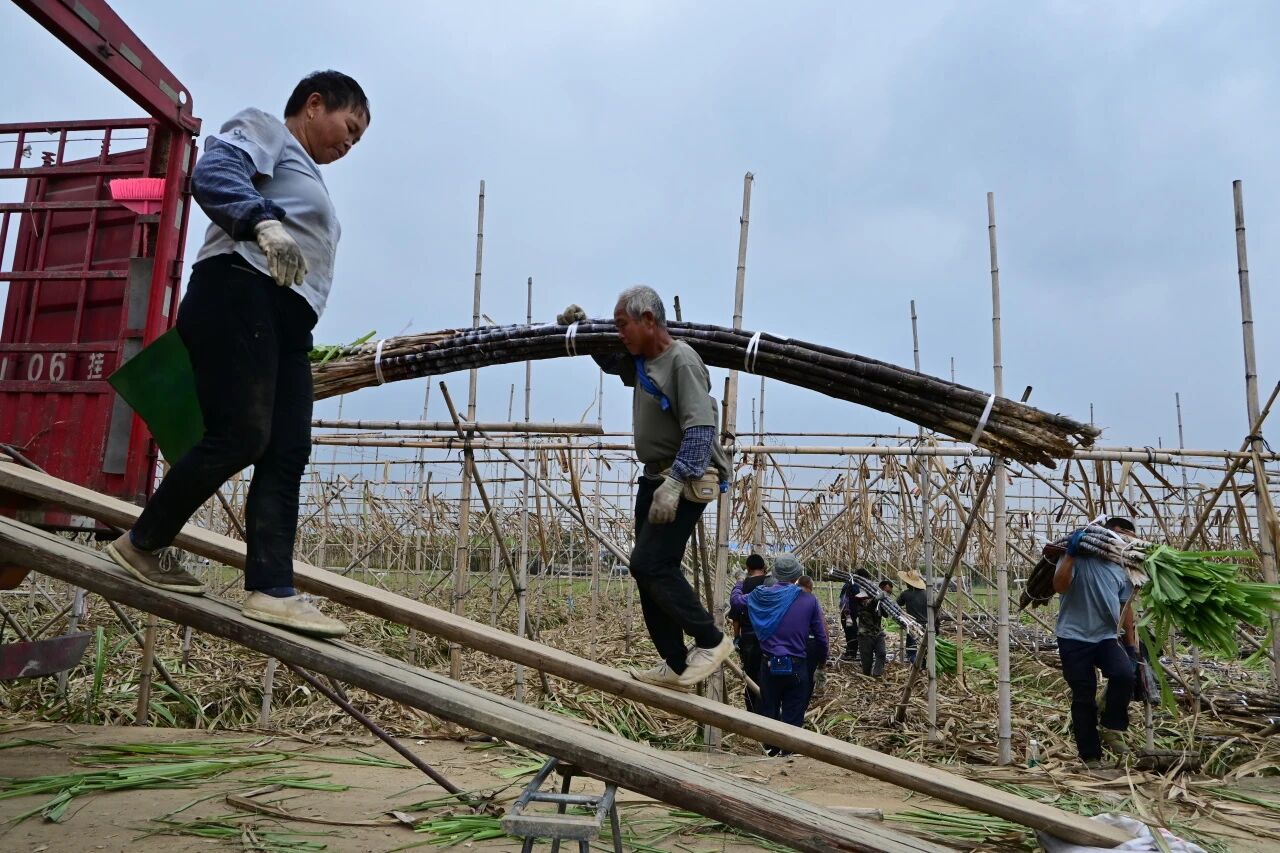
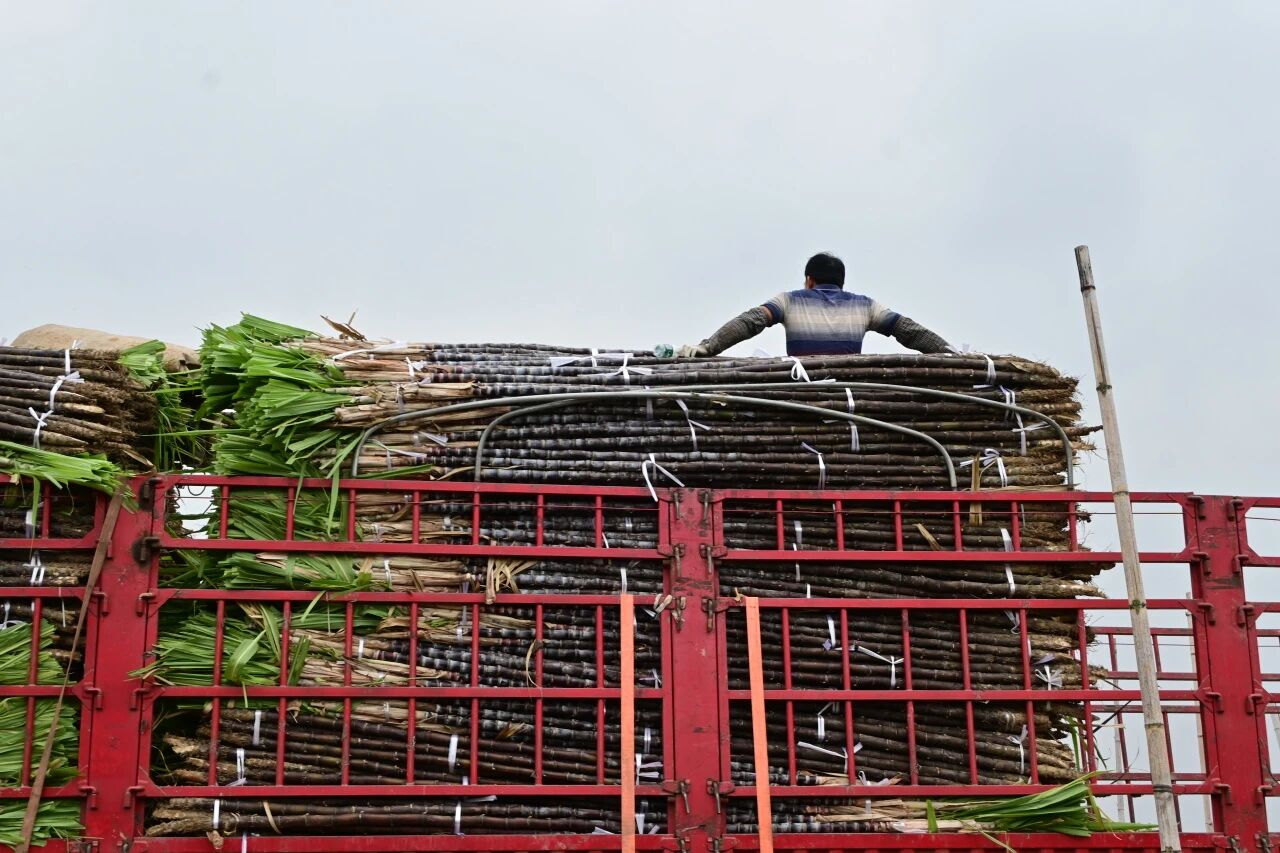
The hardest task is carrying the bundles onto the truck. A bundle is far too heavy for one pair of hands, so two lift from either side while a third tucks their head aside and shoulders the middle. The cane is rigid; laid bare on the shoulder it digs in painfully, so farmers pad their shoulder with a folded cloth, a woven polypropylene sack, or a torn piece of cardboard.
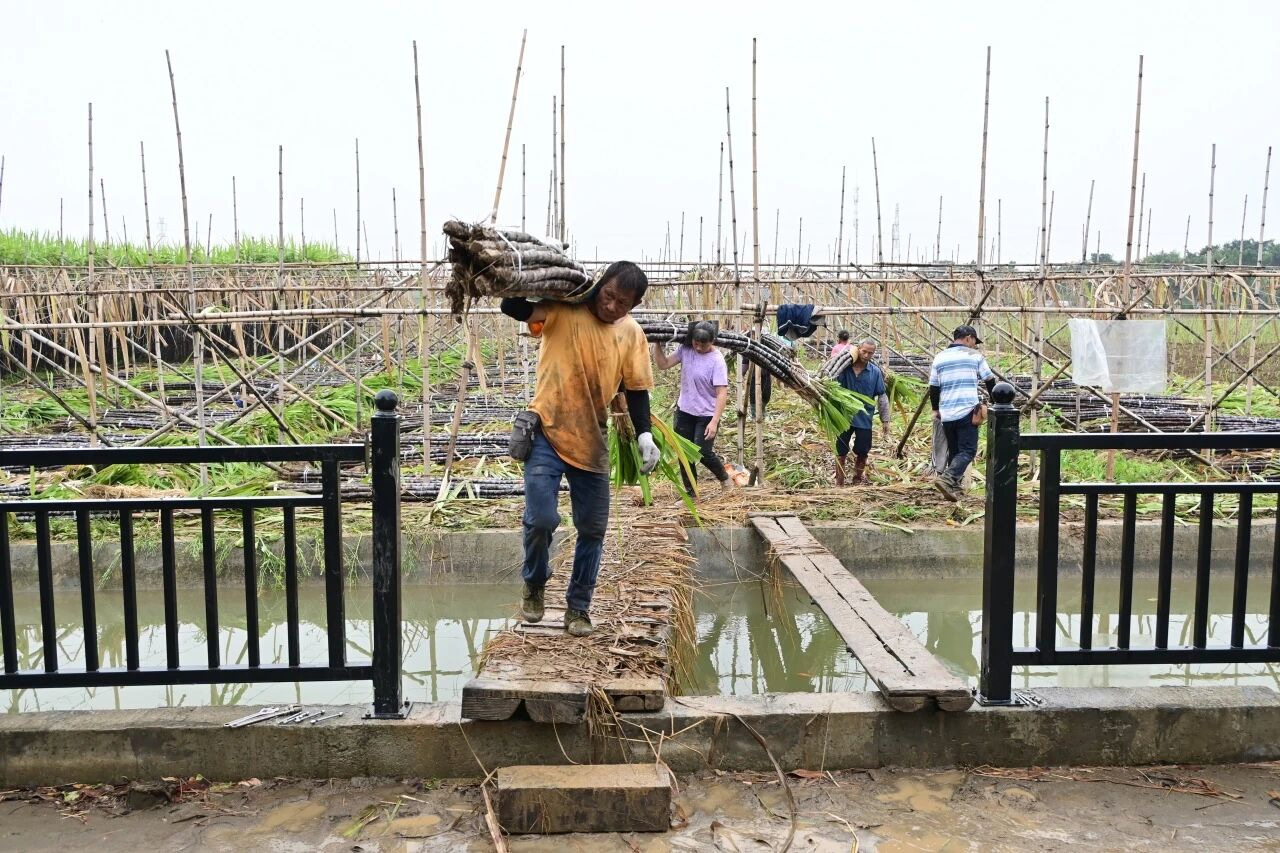
The field is uneven and pitted, making every step treacherous. Plank gangways must be laid from the field to the roadbed, and from the road up to the truck bed. Crossing the gangway is the most strenuous part — the long cane pressing down on these elderly backs squeezes every ounce of weight from their faces.
On 24 March, in Shajiao Village, Lanhe Town, a sugarcane broker hired 17 cutters to work roughly 4 mu. A buyer from Anhui purchased the cane at 15 yuan per dan, and the buyer also pays the brokers and the cutters: 1.1 yuan per dan for the broker, 11 yuan per dan for the cutters. Uncle Wang, 47 this year, is the youngest in the team. Their average age is over 55; the eldest is 72. Uncle Wang says that nearly every year a cutter collapses at the edge of the field. Long hours, grueling intensity and blistering heat can all be fatal.
Rainy weather is the most dangerous. If work has already begun and rain comes mid-shift, the broker will not agree to stop — the shipment must go out on schedule. The field turns to mud, the road goes slick, and crossing a rain-soaked plank gangway demands extra vigilance.
A few years ago, Uncle Wang’s eldest brother was carrying cane onto a truck when he fell from the plank gangway, suffering a comminuted fracture of three toes on his right foot. Medical bills ran to 40,000 yuan, and he can never do heavy labour again. It was only with Uncle Wang’s help in confronting the broker that he secured 20,000 yuan in compensation. Permanent steel pins were set in his foot, and his brother once asked Uncle Wang anxiously: “With these in me, will I never be able to fly on a plane again?”
Lunch is on the cutters themselves — usually a shared meal at an open-air food stall, with the bill split evenly. The women sit together drinking tea; the men sit together drinking Jiujiang Shuangzheng, a rice-aroma baijiu under 30% ABV. Four liang down the belly and their brows unfurrow, the exhaustion seeming to lift entirely.
Finishing time depends on the day’s quota. At best they wrap up before dark; at worst, past 8pm or even later. On Uncle Wang’s day, their quota was 35 tonnes, and they could finish before 6pm. After that single day, the broker earns 770 yuan and each cutter takes home 450 yuan. Aside from selling sugarcane, it is the most important source of their annual income.
IV. The Inertia of 30 Years’ Continuous Cropping
A village official in Shangni Village explained that in previous years, the village’s cutters were extremely busy over the Spring Festival, but this year most of them were idle at home. There is not much sugarcane in the village, plenty of pre-booked cane has yet to be harvested, and some buyers have asked for a price cut — a few would rather pay a breach-of-contract penalty than collect the cane at all.
The main reason fresh-eating sugarcane has gone unsold this year is oversupply. Last year, Yunnan, Guangxi, Fujian, and parts of Guangdong including Qingyuan, Zengcheng and Shaoguan all expanded planting and increased output markedly. Several village officials noted that fresh-eating sugarcane from Yunnan and other areas is of better quality, and that this year the market favours yellow-skinned sugarcane, while Nansha grows mainly the black-skinned variety. In such fierce competition, Nansha’s fresh-eating sugarcane has fallen behind.
Sister Zhen recalls that since marrying into the village forty years ago, she has grown rice on this land for only about a decade; ever since, it has been black-skinned sugarcane and bananas. The elderly couple has just over 4 mu, and income from rice and vegetables falls far short of what bananas and sugarcane bring in.
“When the market is good, one mu of bananas and sugarcane can yield over 10,000 yuan in profit a year,” said a village official from Lü Village in Lanhe Town. The village has over 2,000 residents and just over 1,500 mu of cultivated land — less than one mu per person on average. Those working these fields today are mostly middle-aged and elderly people over 50, and of those already drawing a pension, most receive six or seven hundred yuan a month. The pressure of daily life drives farmers to pin their hopes of earning more on their limited land, and as a result, rice is the first crop to be ruled out.
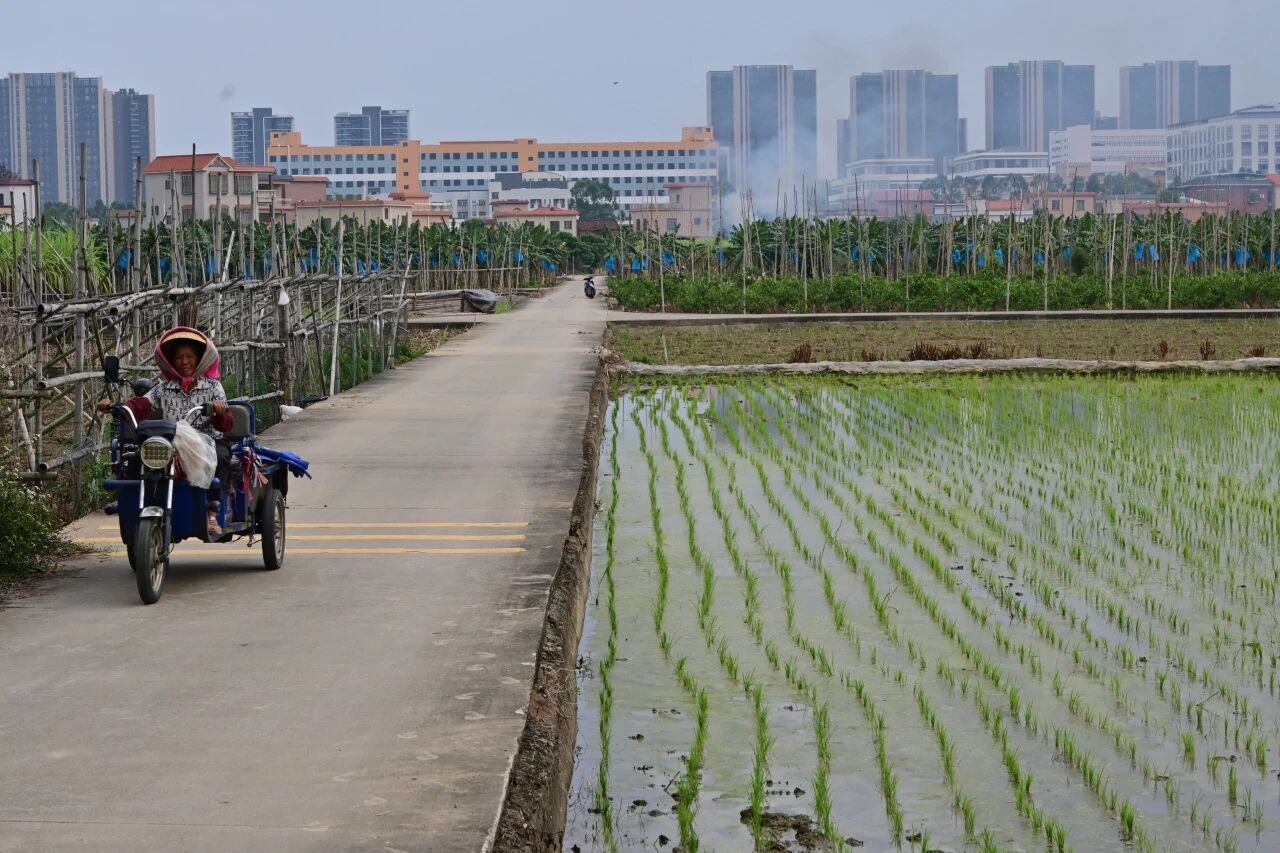
Continuous cropping leads to soil degradation and increased disease. Years of growing sugarcane and bananas have taken a toll on both quality and yield. In recent years, many of the bananas grown by local farmers suffered reduced yields or total crop failure from yellow leaf disease. “The quality of the sugarcane has dropped too — the internodes are shorter, the thickness uneven, nothing like what you see in the newly expanded plantings across Yunnan and Fujian.”
Uncle Wang has been growing sugarcane in Shajiao Village for nearly 20 years. He has observed that ten years ago, four to five bags of fertiliser per mu (100 jin, or 50 kg, per bag) was all it took before the cutting season arrived; now it takes at least 10 bags. Yet excessive chemical fertiliser worsens the soil in turn — “apply more and the cane still won’t grow.”
In recent years, a bag of chemical fertiliser has risen to over 300 yuan, so fertiliser alone costs more than 3,000 yuan per mu. To guarantee quality and yield, sugarcane farmers must keep buying the best fertilisers and pesticides. He estimated that once rent, bamboo frames and labour are factored in, the cost per mu exceeds 8,000 yuan — even if the land is their own and no hired help is needed, it still costs at least 6,000 yuan.
V. No Choice, Only Sugarcane
Nansha has roughly 90 square kilometres of cultivated land, nearly two-thirds of it concentrated in the three northern towns of Lanhe, Dongchong and Dagang — the very heart of Nansha’s sugarcane and banana country. The Special Plan for Cultivated Land Protection in Nansha District (2021–2035) notes that income from grain cultivation is markedly lower than from cash crops, and that low farmer enthusiasm for growing grain keeps the problem of non-grain land conversion acute.
A village official in Yansha Village explained that policy requires cultivated land to be used for food crops and non-grain crops such as cotton, oilseeds, sugar crops and vegetables; sugarcane falls under the sugar crop category. But growing fruits of higher economic value — bananas, papayas, guavas, citrus — all count as “non-grain conversion” and are not permitted under the policy.
In recent years, Nansha has stepped up its crackdown on non-grain land conversion. A public report from late December 2022 showed that in under two months, Lanhe Town had completed 86 rectification cases covering 237.41 mu of non-grain conversion, with the combined completion rate for non-agricultural and non-grain land rectification exceeding 30%. Once bananas and other such crops were cleared out, the only option left for local farmers was sugarcane.
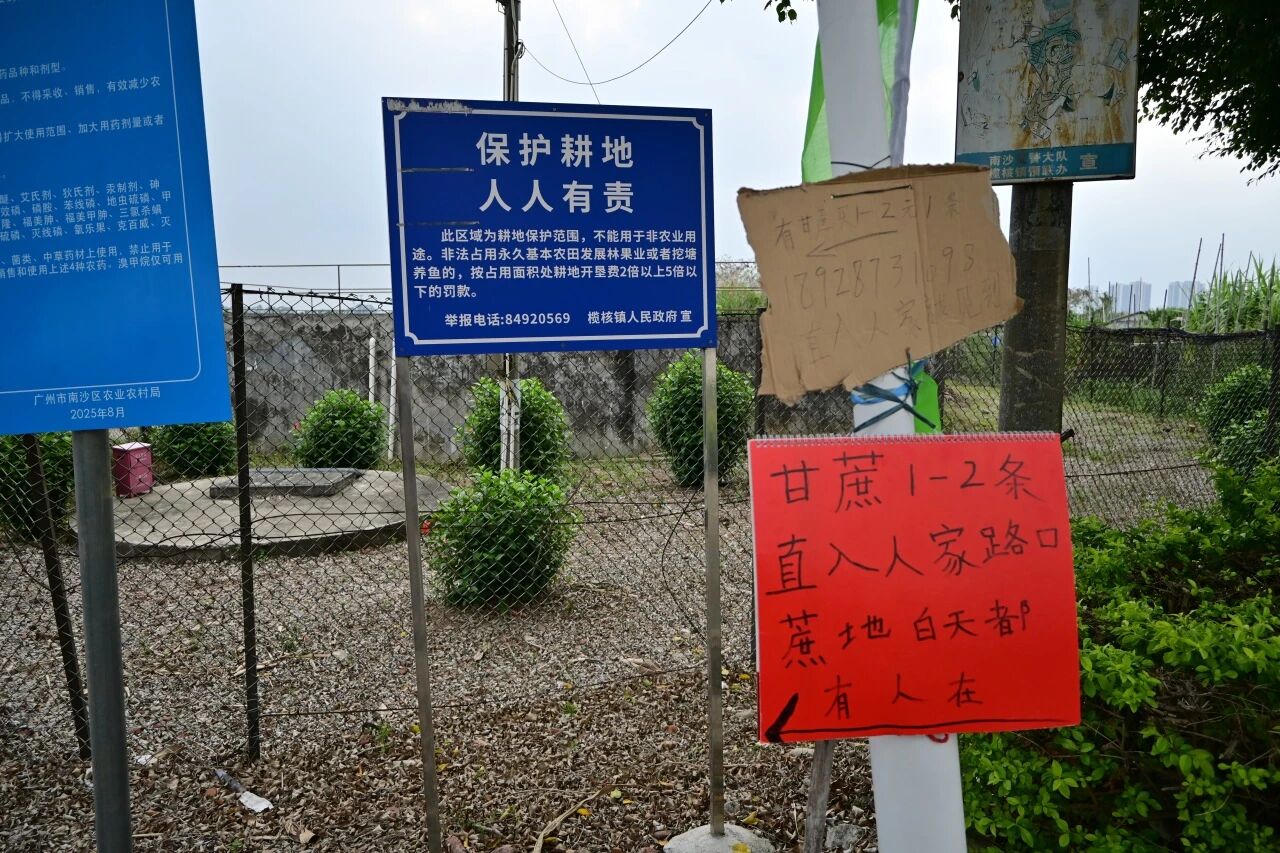
“Once the bananas were cleared out, the sugarcane area has grown year on year,” a village official in Yansha Village disclosed. In 2025, the village’s sugarcane area exceeded 3,400 mu. Public reports show that Lanhe Town’s fresh-eating sugarcane area was only 13,800 mu in 2022, rising to 17,000 mu by 2025. The weight of “food security” bears down on ageing farmers, and they have chosen to refuse rice — the least rewarding crop — picking sugarcane instead from the government’s “approved crop list”.
Protecting food security cannot rest on the shoulders of farmers alone. A village official from Lü Village recalls that when the non-grain conversion rectification was rolled out across the towns and villages, it met opposition from the majority of residents. The government also encouraged farmers to grow other items on the “approved crop list”, such as vegetables, but vegetable growing is low-margin and demands that farmers pour all their time into the land.
Farmers grow bananas and sugarcane not only out of nearly 30 years’ cropping inertia but also because it leaves them more off-season time to take on odd jobs. After cutting the cane, Uncle Wang heads to other provinces to help fellow sugarcane farmers erect their frames. Chen Shun has paid rent on 4 mu but does not intend to work it; once spring ploughing is done on his other plots, he will head back to a construction site. Sister Zhen and her husband are frail, so they usually pick some vegetables and set up a stall on the street.
Even with this year’s unsold stock, many still choose to keep growing — they rely on sugarcane to plug the losses and keep their households going.
March is nearly over, and the livestream has indeed brought Sister Zhen plenty of custom. Some have driven over from Shunde and cut more than 100 stalks each. Her husband helps cut cane in the field; customers usually want only the middle sections of the stalks, so he hacks off the top 30 centimetres with their leaves, saving them as propagation stock for next season.
This year, they will keep growing sugarcane. She has no wish to use those virus-free seedlings — to her, that would undeniably be another hefty expense, especially since this year she already has to buy fertiliser on credit.

All interviewees appear under pseudonyms
Editor: Xiaodan