
Who Is Making Us Speed Up? A Discussion Between Fresh Grocery E-Commerce Warehouse Pickers and Consumers
Today, fresh grocery e-commerce platforms such as Alibaba’s Hema, Meituan Xiaoxiang, JD’s 7Fresh and Pupu are increasingly winning people’s favour. These platforms let you order all kinds of everyday essentials from the comfort of your home with just a few taps on your phone, delivered within 30 minutes.
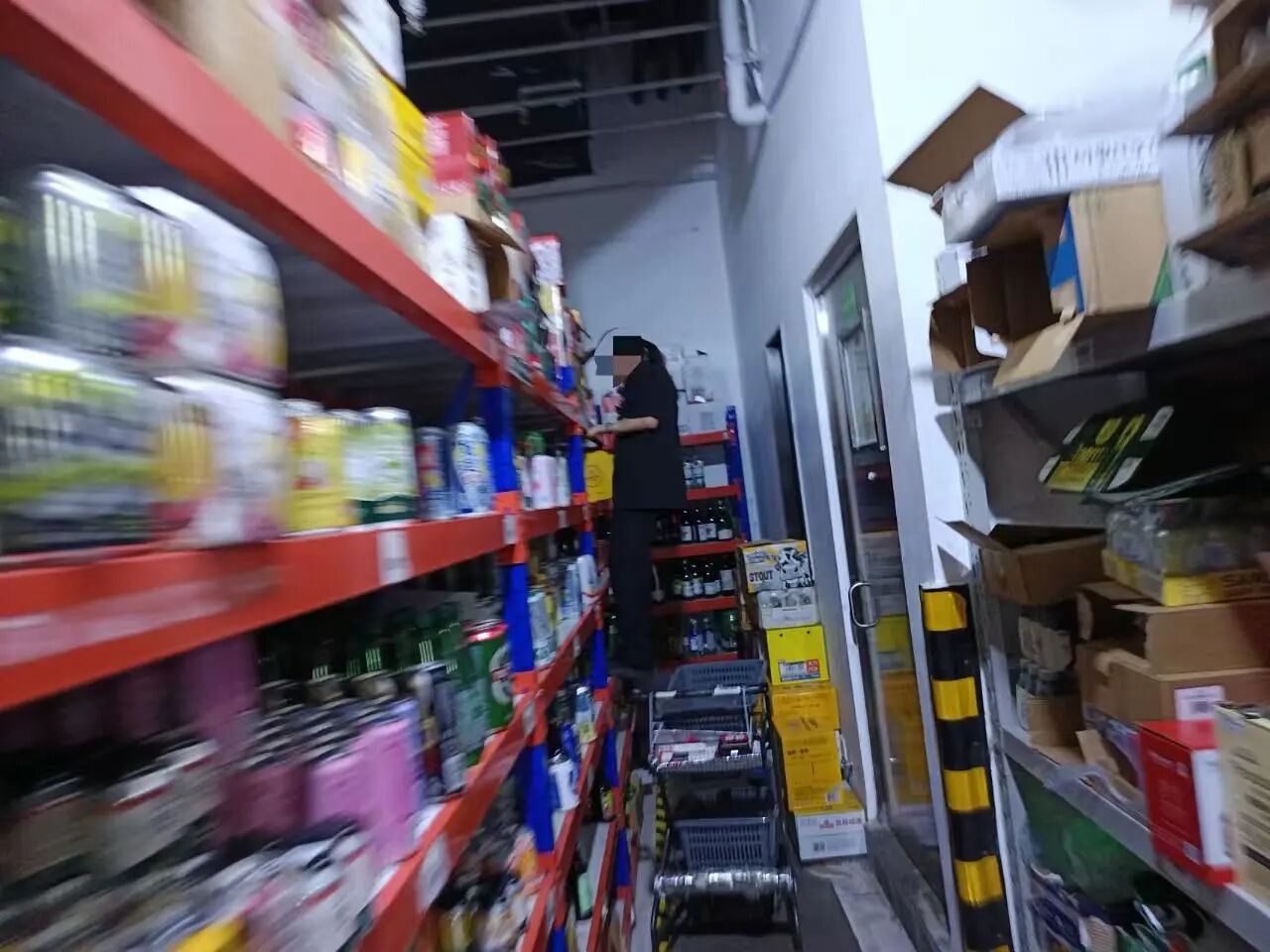 ●A warehouse picker pushing off the shelves with both feet to climb higher and find products, in order to save time. Photo by He Siqi
But you may not know that behind the convenience of “30-minute delivery” lies a relay sprint between delivery drivers and warehouse pickers. Last month, Foodthink published The Myth of 30-Minute Delivery in Fresh Grocery E-Commerce Begins with a Picker’s Three Minutes, which meticulously describes the high-pressure working conditions that trap pickers in a web of algorithms, data metrics and piece-rate pay.
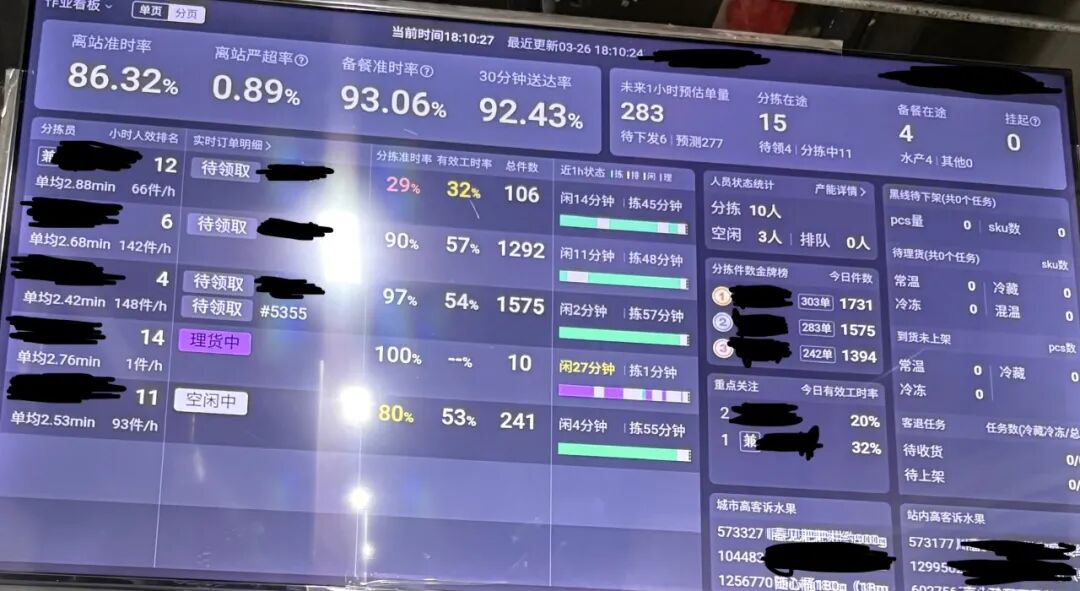
● In the forward warehouse of a fresh grocery e-commerce platform, a large monitor hangs from the ceiling, displaying station-wide statistics such as the on-time rate and the 30-minute delivery rate. Every second of every person seems to be held accountable for these figures. Image source: Yakou
What is particularly encouraging is that the comments section of that article became a rare space for exchange between consumers and workers.
Many of the descriptions of working conditions in the article resonated with other pickers and delivery drivers, who left messages about their own situations: working hours beyond imagination, piece-rate pay as low as 0.01 yuan, health ruined by the demands of the job, and management through fines rather than support. These real accounts are a reminder — a reminder of what kind of world we are living in.
Many consumers expressed empathy for the hard labour of pickers and delivery drivers. Some acknowledged that the convenience consumers enjoy is paid for in other people’s bodies and time. Others argued that the three-minute time limit imposed by the platforms is not a demand from consumers but the result of inter-platform competition, and that consumers themselves should not bear responsibility for the pickers’ predicament. Still others called for a collective boycott of platforms that excessively exploit their workers.
Some consumers write “no rush” in their order notes, hoping to ease the pressure on pickers and delivery drivers, but others point out that the rules and time limits are set by the platforms, and such gestures cannot genuinely improve workers’ conditions. We can, however, take concrete actions — such as off-peak ordering and reducing our reliance on online platforms.
The focus of these discussions initially centred on the relationship between consumers and workers, but ultimately moved beyond that binary opposition. A wider, more diverse range of facts, perspectives and possibilities for action unfolded within this space of exchange. Below is a selection of comments drawn from the discussion section.
Disc
ussion
One
What Is the Cost of Convenience?
What is the cost of convenience? This question may seem like an unreasonable demand placed on consumers, but it is not an accusation — it is an invitation: an invitation to ask who profits and who bears the burden. Beyond the harm done to workers — the excessive plastic packaging, the hygiene and food-safety issues, the various traffic accidents caused by delivery drivers — are consumers not also living with the consequences?
@觀宸奕: I used to work at Meituan’s Xiaoxiang. No Social insurance, and exhausting to the point of breaking. Rest was forbidden on weekends and statutory public holidays — if you wanted time off, it had to be Monday to Friday, so you basically got four days off a month. Going over time meant getting shouted at; most of the time you had to finish picking two orders within three minutes. Some orders were all frozen goods, and you’d freeze half to death searching the cold store for products. Resignation had to be given 30 days in advance, with no provision for settling pay on the spot, and before your last day you still had to be put on the Roster. Working hours were basically eight to twelve hours a day. However long you stayed, Xiaoxiang Supermarket’s staff app only ever counted 11 hours a day, yet the Rosters scheduled shifts well beyond 11 hours. After 11 hours, the extra time didn’t count, but you still had to wait to clock out — otherwise you’d be marked absent. You were effectively forced to work for free, earning only a few pennies in commission.
@A: I did it for two years. My back and legs ached every day. Fifteen hours of work, base pay for only eleven. If you didn’t agree, you could just leave. They kept cutting pay, too: when it was quiet, they wouldn’t put you on a shift; when it was busy, they wouldn’t let you rest.
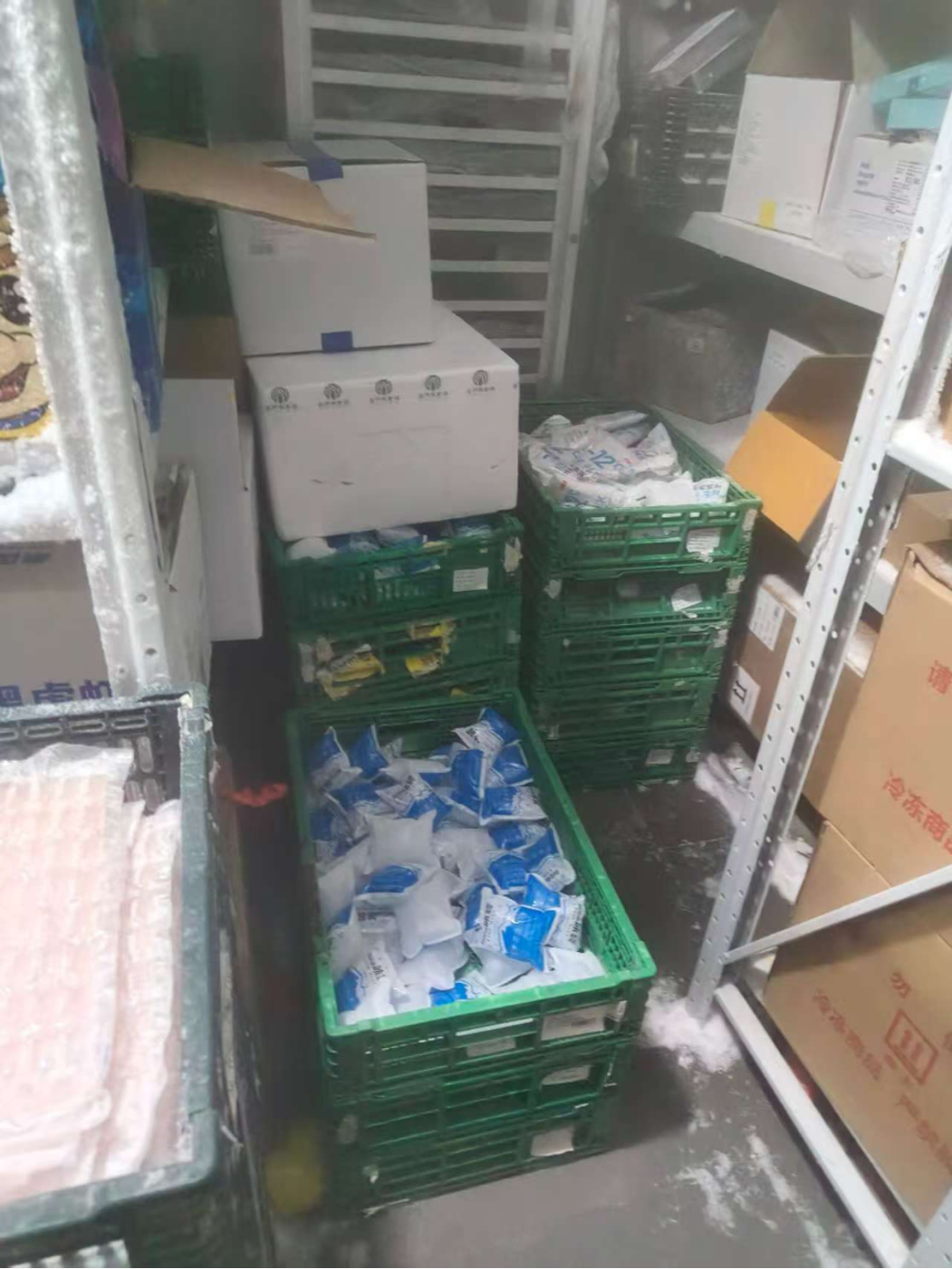
● The temperature in the cold store is typically below −20 °C, and many warehouse pickers are reluctant to go in to pick goods. Photo by He Siqi
@Quella Lin: I did some part-time work and want to share my experience: one shift was seven to eight hours, from 4 p.m. to midnight, averaging 25,000–30,000 steps a day (and I was only part-time — I can’t imagine how full-timers manage Rosters of ten or eleven hours!). A customer complaint about produce not being fresh meant a 10-yuan deduction. When picking fruit and vegetables quickly, you had to check every item with extra care; soft fruits like blueberries, strawberries and loquats took a long time. Cracked eggs, even when not caused by the rider, meant a 20-yuan deduction. After three consecutive days I caught a mild cold. You’d run back and forth between the frozen section, the chilled section and the ambient-temperature section — in the ambient area there was only a fan and you’d be drenched in sweat, then you’d dash into the chilled or frozen section and freeze half to death. That’s exactly why staff turnover is so high — they’re always recruiting.
@弗兰克: Sigh — people aren’t machines. You can’t expect them to work at peak precision at all times. Real-time performance metrics measured down to the second make it all too easy to make mistakes under pressure, even to forget about safety. I spent a while doing delivery driving, and the countdown timer on the order page was enough to make anyone anxious. What I dreaded most was restaurants stalling on meals and high-rise lifts that took forever to arrive.
@热情华夫饼: You often see delivery scooters on the road with an external subwoofer bolted on, blasting music at full volume. A friend and I once speculated that it might be a way for delivery drivers to assert their presence in urban spaces. But then I heard a driver who does this explain himself: the tight delivery schedules mean he has to run red lights frequently, and playing music loudly ensures that cars at junctions notice him from far enough away to reduce the chance of a collision.
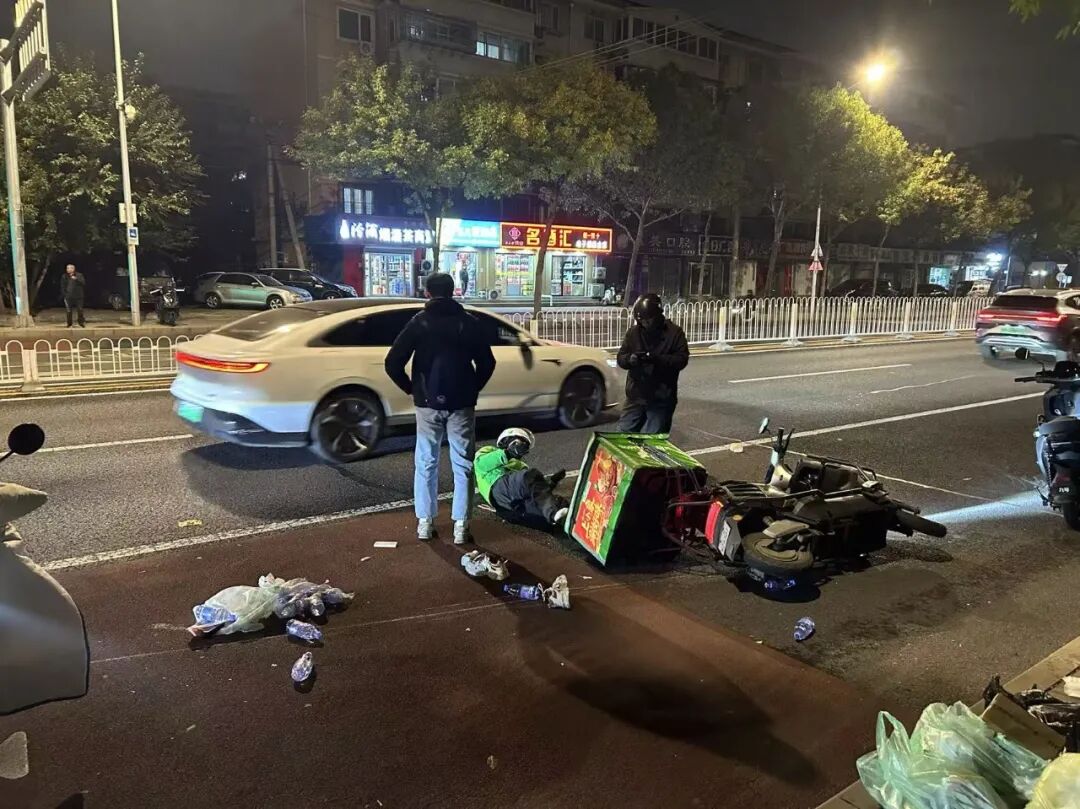
● A Xiaoxiang Supermarket delivery driver was travelling too fast and carrying too heavy a load. Despite emergency braking, the scooter skidded forward and collided with an electric scooter crossing the road. The bottled water being delivered spilled across the ground. Image source: Foodthink
@来去之间: The major online supermarket platforms in China are Meituan’s Xiaoxiang, Alibaba’s Hema, JD’s 7Fresh, and Pupu Supermarket from Fujian. All of them target 30-minute delivery to the customer, so the picking stage in the forward warehouse gets squeezed into just a few minutes — Xiaoxiang’s forward warehouse, for example, allows only three minutes for picking. That leaves roughly 25 minutes for the delivery rider, yet the dispatch system typically assigns five to seven orders per rider, all expected to be delivered within those same 25 minutes. The moment a delivery rider finishes an order — whether stuck in a lift or waiting at a traffic light — if they haven’t returned to the forward warehouse before the time limit expires, the system immediately dispatches new orders to them. That is why you see such reckless, chaotic driving on the roads.
@蒹葭: Warehouse pickers on fresh grocery e-commerce platforms live in a constant state of high pressure constructed by algorithms, data metrics and piece-rate pay. Mispicks and missed items are an inevitable structural problem — and for every courier, scrapes and collisions are nearly unavoidable, too. My uncle is one of them. He has done this work for well over a decade, through several rounds of technological change. He always eats like a whirlwind. Before I’ve even picked up my chopsticks, he’s already finished. He’s actually quite a reserved person by nature. But last year, on a rainy day, he collided with someone while making a delivery. He broke his femur and is still recovering at home. Low educational qualifications and a lack of voice in public discourse reduce this whole group to a silent underclass, crushed between the weight of daily life and the demands of the algorithm.
@凛冬廿九星眠: Honestly, hygiene in most stores is about the same, but still so many people love it when the shop peels their durian for them or cuts a watermelon in half.
@Anonymous: I’ve never used a grocery app. I’ve disliked them ever since the day they appeared, because of the environmental impact. I reuse plastic bags over and over when I buy groceries, but fresh grocery e-commerce platforms deliver a pile of non-recyclable plastic with every order.
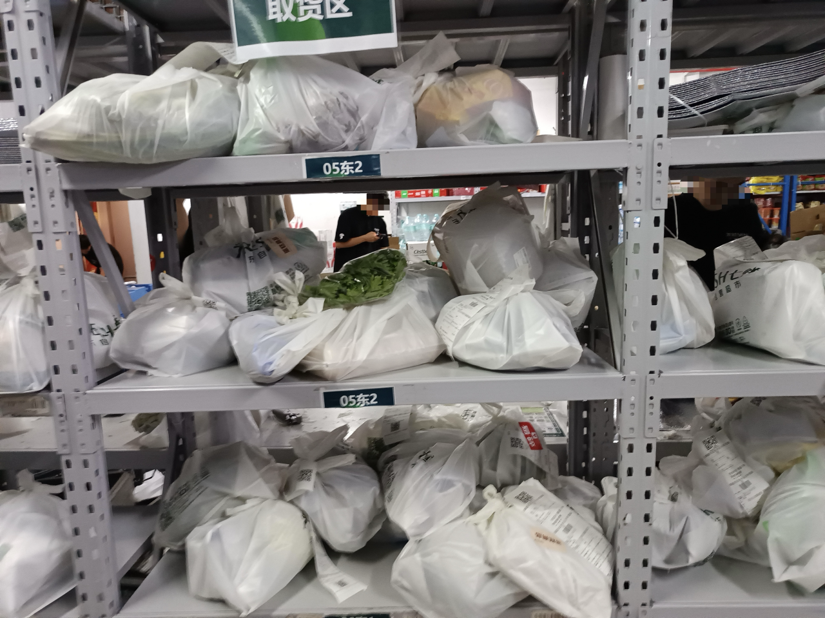
● Shelves stacked with goods wrapped in plastic bags. Photo by He Siqi
@信啊信Rui: If you get rid of the platforms, the delivery riders and pickers lose their jobs. If you keep them, you end up with all the problems described above. So where exactly does the fault lie? I can’t make sense of it, no matter how I think it through.
@来去之间: They’ve been killing off physical stores. Have you noticed how fewer and fewer offline supermarkets there are?
@H.L: This article reminded me of the supermarket near my home. It opened a little over five years ago and, in its boom period, had about ten staff. Now it’s just the owner and maybe one or two others — wages have to be paid, even if they have to sell everything to manage it. Since the year before last, the owner has effectively been working at a loss, but he’s trapped: you can’t climb off a tiger you’re riding. The investment is sunk into every corner of the business — close to two million yuan in total — and if he stopped, he couldn’t sell up. I asked the other woman who runs the till whether she was his wife, and he said no chance — his wife works in Shenzhen to help put food on the table. If they both ran the shop, they’d be finished.
In contrast to the struggling community supermarket, online delivery platforms are thriving, and warehouse pickers and delivery riders are pushed to the limits of speed by the system’s algorithms. Walking in to say hello, having a bit of a chat, popping in at any time to buy something — that easy, everyday convenience turns out to be a heavy, extravagant remnant of old street life.
● Markets and small food shops, brimming with everyday life and human warmth, are facing enormous disruption from fresh grocery e-commerce. Photo by Tianle
Discussion Two
The 3-Minute Deadline: Rushing for the Customer, or Spending the Picker’s Labour?
Warehouse pickers are required to pick every item in an order within three minutes, then pass the baton to the delivery rider, who continues racing against the clock. Yet customers who have enjoyed “30-minute ultra-fast delivery” are saying, time and again, that they are in no rush to receive their items. In that case, why do the platforms insist on pushing for ever-faster speeds?
@哇塞: What exactly is everyone in such a rush for? Hurrying through the junior-high curriculum while still in primary school, cramming a quarter’s KPI into a single month, working overtime when the hours never run out, one day off a week alternating between six- and seven-day work weeks — who demanded 30-minute delivery, really? Would it not be better if everyone simply slowed down?
@6: As a consumer, those life-or-death three minutes are probably just a moment when I have let my mind wander without even noticing. From what I recall, Xiaoxiang is indeed fast, but really, if it were a little slower — five minutes, ten minutes — the difference to the consumer’s experience would not be all that great, would it? What I care about is mainly the quality and getting the right quantities. After all, I believe most people are still willing to understand one another. Forging humans into machines and turning machines into people is a warped value system. Even if we slow down a little, surely the sky will not fall.
@云淡风轻: On behalf of every warehouse picker on the front line at Xiaoxiang, Hema, and 7Fresh, I want to say thank you. Thank you for your understanding, because I am also part of this system. Thank you truly — if everyone felt the way you do, our work would be so much easier.
@露mio: Why do we let algorithms squeeze us? Sigh — I am being squeezed too. Hearing someone speak up for me suddenly makes my heart ache.
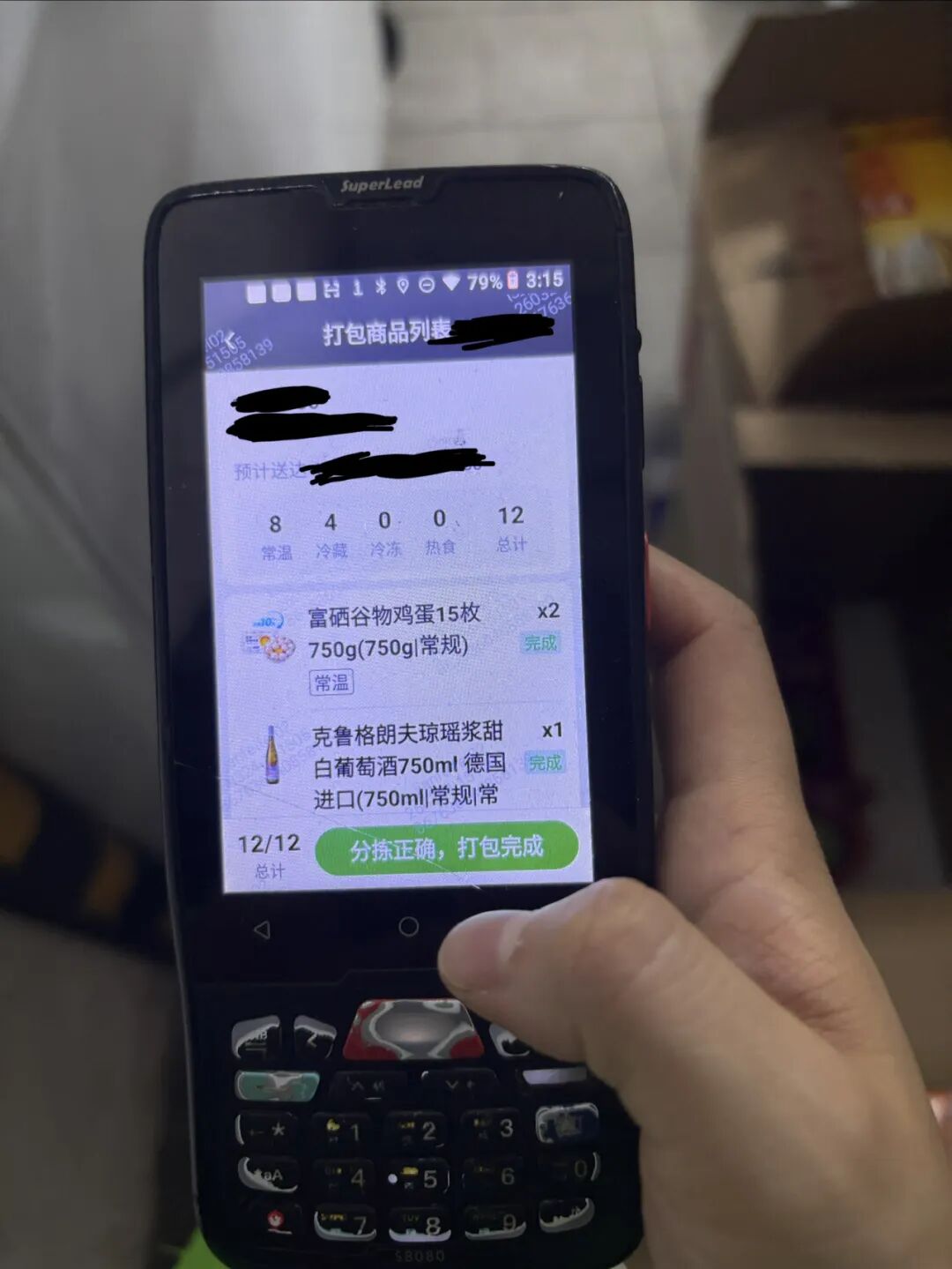
●The PDA (handheld device) in the warehouse picker’s hand is always urging them to hurry. Photo by Yakou
@星星观察员: All this exploitation has zero bearing on consumers — please take note. It is plainly the fault of platform capital, squeezing customers and workers from both ends. Consumers have no obligation to understand how a platform operates. The rules are the platform’s own creation, yet it falls to consumers to judge whether they are reasonable?
@cora: Why must everything be picked within three minutes? The way the platform operates is truly exploitative of its workers. If a customer is in a great rush, logically they should not place an order at all — they should go downstairs and buy it themselves. If they are willing to wait for someone to deliver to their door, that means they can wait.
@15432: If only there were an option between urgent and not urgent — maybe everyone could breathe a little easier.
@来去之间: The platform will not give you that chance to breathe. Its system is packed with performance targets; your pressure is their performance target.
@L.: That is precisely what capitalists do — squeeze their workers. Even if customers are not in a rush, compress the delivery time to the absolute minimum and labour productivity reaches its peak. The same work might once have required paying forty people; by tightening the time limits, you may only need to pay thirty. And with competition between platforms, when goods and prices are roughly the same, consumers will naturally choose the faster one.
@暮夏之后: Honestly, as a customer I truly do not mind those ten-odd minutes. What I buy is fresh produce — it is not something I eat immediately. Even when it arrives, do I not put it straight into the fridge and take it out when I need it? This 30-minute delivery requirement was set by the platform to seize market share, and then they go all out squeezing ordinary workers.
@瑞年: I have been using these services since the Pupu days, and later both Pupu and Xiaoxiang — several years now! I have never once filed a complaint! I always place my orders after 8 p.m., and there are more bargains then! On rainy days I even leave a note for the rider: drive safely, no rush! A comment above puts it well: Since you chose to order online and wait at home, you need to accept waiting — you must be able to wait! Those who file complaints because a delivery ran late — you truly do need to go out and buy it yourself.
@G: Saying you are not in a rush is of no use. The platform’s algorithm does not care whether the rider lives or dies — the delivery must arrive on time.
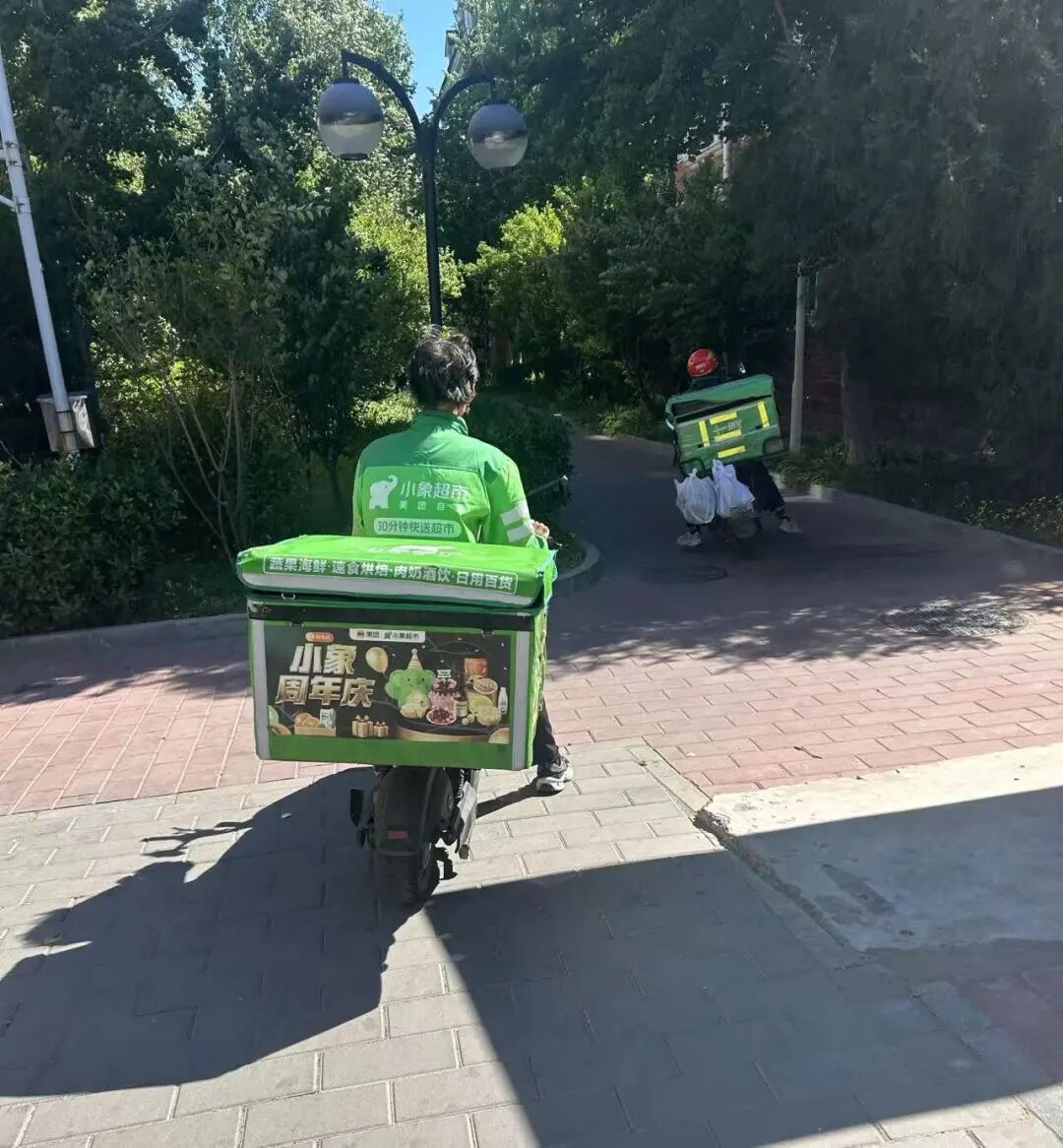
●A Xiaoxiang warehouse picker making a delivery within a residential estate. Image source: Foodthink
@海盐柠檬: Recently, Xiaoxiang Supermarket and Hema delivery started appearing near my workplace. I have ordered a few times, and it really is convenient — I place an order for the food I need before leaving work, and on my way out I just collect it and take it home. What impressed me most was how fast they deliver, especially Xiaoxiang Supermarket: twenty minutes after ordering, it is already at the door. It was only after reading this article that I learned what those twenty minutes mean and what they carry. I do not need it that fast. An hour I can accept; two hours I can accept too.
Disc
ussion
Three
Behind Complaints: Bodies at the Limit and a Platform in Hiding
When a customer notices a problem with their order and files a complaint, that is a perfectly legitimate request. However, understanding the system more deeply can help us think about this beyond a simple binary: bodies running at breakneck speed inevitably make mistakes — so what is the real root cause behind them? The ones punished by complaints are the warehouse pickers and delivery riders. Can the platforms that encourage complaints stop hiding and take responsibility?
@Lzx: Yesterday I worked five and a half hours and racked up seven customer complaints. Absolutely unbelievable.
@麦子: At the end of 2023 I worked a short-term part-time shift at Xiaoxiang Supermarket. Once I got an order with 89 items — I finished picking in four minutes and nearly collapsed from exhaustion. Another time, one order had nine items that included both food and toilet cleaner. I forgot to pack the toilet cleaner separately and got nine complaints filed, resulting in a deduction of ninety yuan. I only earn eighty yuan for four hours of part-time work in the first place. I was miserable for two days. Then, on the evening of the second day, the site manager helped me lodge an appeal and it was accepted — the deduction was reduced to ten yuan. It was terrifying. I had originally thought, “I don’t feel like going for a run in the evening — at least I can run around at Xiaoxiang and earn some money.” I was so naive. Since then, I have not dared even think about complaints.
@尤利西斯: If you receive your order and notice an item is missing, and you contact the store manager directly — does that still count as a complaint?
@麻麻雷: It still counts, because that means the order had a problem, and the warehouse picker or delivery rider is expected to take responsibility for it.
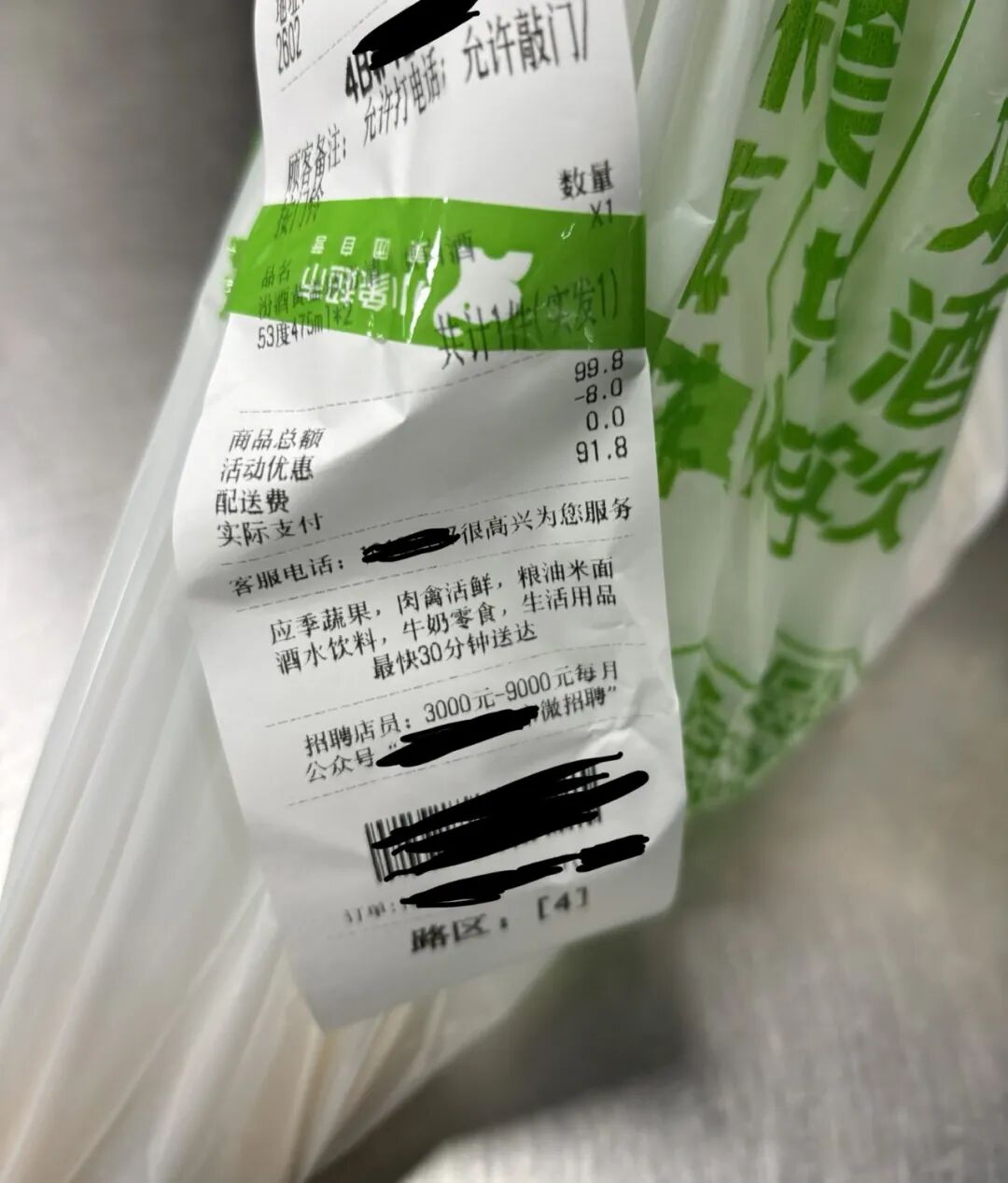
●On the receipt the customer receives, the warehouse picker’s name appears after the order number. Photo by Yakou
@哦喔: If a customer complains about a product and the reason is valid, the warehouse picker still has to bear that complaint. On top of that, pickers face pressure from two other sides. First, they cannot exceed the three-minute picking time limit — if they regularly do, the site manager will have a word with them, because the site’s fulfilment rate must be maintained. Second, if you have just finished picking and tap “packing” immediately, the rider will complain, and the rider site manager will complain too. But if you do not tap it early enough, the site manager will say you are over time.
@1: Picking at Xiaoxiang is relatively better — the penalty per customer complaint is around ten yuan. But for delivery riders, a single customer complaint basically costs them fifty to three hundred yuan, while they average just over three yuan per order. One complaint can wipe out several days’ earnings.
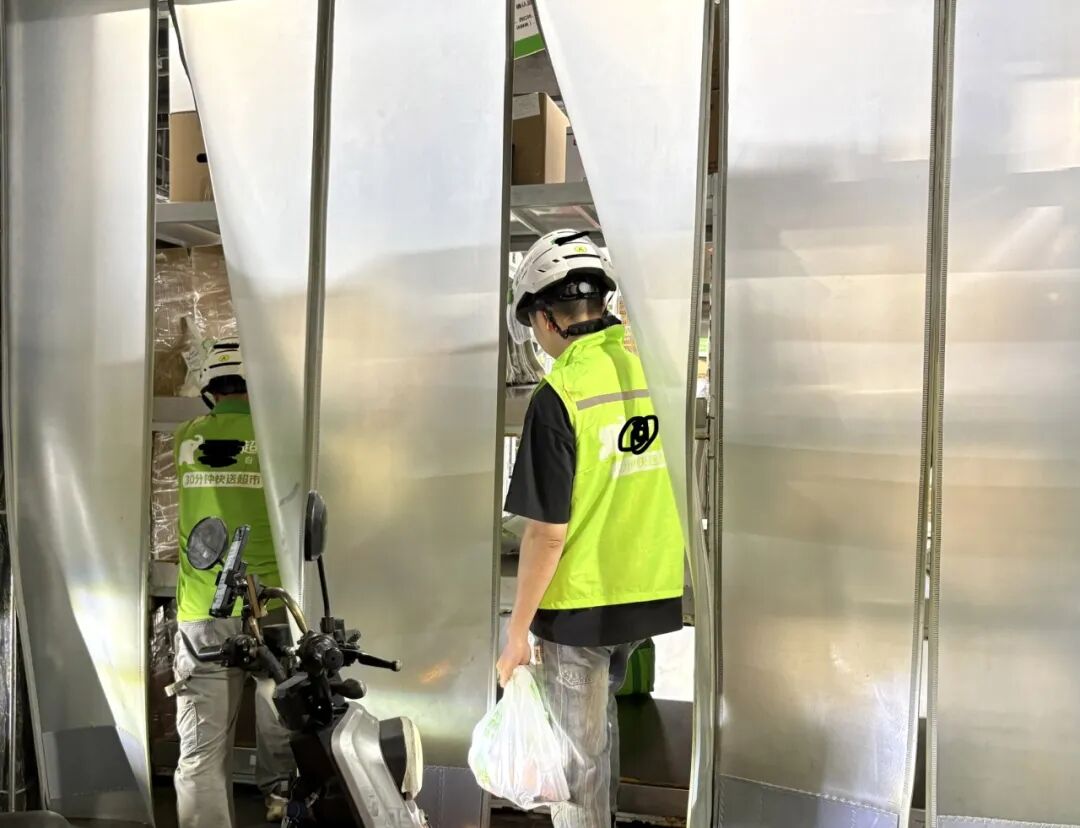
●Delivery riders waiting for the warehouse pickers to finish packing. Photo by Yakou
@Freya: Reading this makes me a little sad. I rely quite a lot on Hema and Dingdong, and I had no idea there was such cruelty behind the convenience. A few days ago, a delivery rider spilled the container on the way to my door — some of the sauce from the chopped-chilli steamed fish head had sloshed out. He kept apologising and insisting on paying for it. I told him not to worry, that I would just transfer it to a bowl at home. I thought that was the end of it. Then the next day, on the delivery platform, I saw that he had left a message in the chat at the time, begging me not to leave a bad review or request a refund, because he would face a serious performance penalty…
@宇宙督查员: I have also filed a complaint for receiving the wrong item. Although they were different types of products, their packaging really did look inexplicably similar, and I was quite annoyed — how could they get even that wrong? Next time, I will try to be more patient and understanding about these things. Faced with the platform’s oppression and alienation of people, what can we actually do?
@范范: Over the past year I have been ordering from Pupu and Xiaoxiang regularly — especially since there is a Pupu right downstairs from our home. I have seen their part-time job adverts posted around. I had no idea the picking step could be so disheartening. The algorithm itself is not designed to exploit workers, but the people in charge use it to enforce “time management”, making every single “accident” an impermissible event. Anyone who regularly uses time-management apps to plan their day knows how impossible that really is. But the author should not feel guilty about past complaints — it is the capitalists who have linked complaints directly to the lives of workers. I have filed complaints myself, twice — for example, when I received stale vegetables or when the weight was short. A consumer’s needs deserve to be met too.
Discussion Four
Is Xiaoxiang Supermarket the Only One Like This?
The previous article was about Xiaoxiang Supermarket, which falls under Meituan, but this picture is by no means unique to it. E-commerce platforms are locked in competition with one another, and none can afford to stay unscathed. Within these vast systems, warehouse pickers — whichever platform they work for — can scarcely escape a fate of sheer exhaustion.
@WR: This must be about competing with other platforms. Consumers may sympathise with how hard warehouse pickers and delivery riders have it, but when they choose which platform to order from for online delivery, they always gravitate toward the one with better deals and better service (faster delivery, fewer mistakes). As a result, platforms that allocate time reasonably lose their edge in this rat race, while those that squeeze their workers’ time to buy customer satisfaction are the ones that win favour.
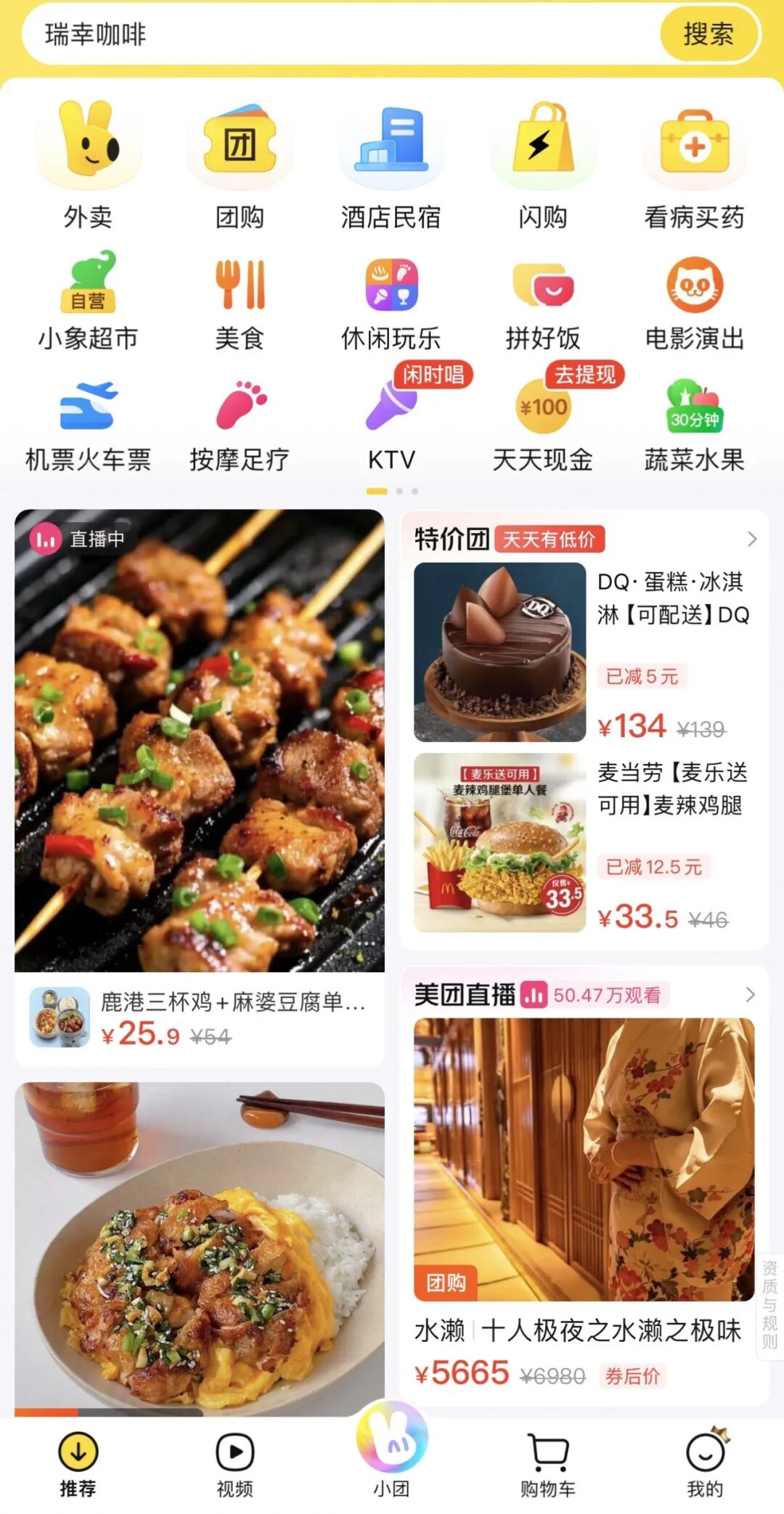
●Open the homepage of the Meituan app and the Xiaoxiang Supermarket entry is impossible to miss — in the first column, second row, directly below Food Delivery. As competition in the food-delivery market intensifies and regulation grows ever stricter, Xiaoxiang Supermarket’s ability to tap into and satisfy online demand for fresh produce has become a new weapon for sustaining Meituan’s traffic advantage in local commerce. Image source: Screenshot from the Meituan app
@油菜花: This article really hit home. Last year I struggled to find work and ended up going for a part-time interview at Pupu Supermarket — their model is essentially the same as Xiaoxiang’s. On interview day, I could feel the tension and pressure bearing down on the pickers. They were racing against the clock, memorising product locations and zone codes for addresses, all represented as codes. Even once you are proficient, you have to pick several orders simultaneously, several bags dangling from each hand, many of them heavy — it is literally a job of “brain plus brawn”, and it is truly exhausting for young women. I asked myself whether I could really do it. In the end, I did not go back.
@初到海拉鲁: I usually buy groceries through Ele.me. Before, I would place one order of 20–30 items and it would arrive in an hour and a half. Last year it was cut to one hour, and this year it is under fifty minutes. So that is what the industry has come to.
@观花: Last week I bought soy products, yoghurt and fruit from Chaoshifa on Taobao Flash Purchase. After I hit send, three minutes later I saw the status had already changed to “calling for a rider”. I said to my dad: “Surely platforms don’t need to race each other this hard! If I happen to be short a piece of ginger while cooking and need it urgently, they won’t even deliver a single piece — I have to walk downstairs to the little vegetable stall in the courtyard and buy it myself. What I order from them is stuff I don’t need in a hurry. There’s no need to rush over here like that.”
@We十: I ordered mineral water through Duoduo Maicai and it arrived at the pickup point the next day. At least Duoduo Maicai sends a van out, even if the distance is a bit far — they have a small trolley on the vehicle. And some site managers will bring the order right to your door.
@jam: Even Duoduo Maicai needs warehouse pickers to sort the items, you know. A large item pays six and eight fen per piece.
@纯情女大声: I am a Xiaoxiang Supermarket user, and at one point I went to apply for a part-time job there out of curiosity. During every peak hour, they blast fast-paced music in the warehouse to keep workers going. I know Pupu provides trolleys for their pickers, but the Xiaoxiang store I worked at had none — pickers were often huffing and puffing, lugging heavy items through the aisles between shelves. Their time is compressed into that three-minute window, and the PDA in each person’s hand is their lifeline within the system.
●A warehouse picker filling a hand trolley with picked items. Photo by Yuyang
@黄映红: I did a part-time job as a warehouse picker at Walmart — thirty fen per item. Sometimes an order was just one or two items, but you still had to pack it all up before you could take the next one. No matter how few items an order had, you had to finish within ten minutes. Sometimes you spent ages looking for something and could not find it (the shop was out of stock), and then you had to phone the customer to confirm a different brand or size. It averaged out to a mere ten to fifteen yuan an hour.
Discussion Five
Besides Ordering Fewer Heavy Items, What Else Can Consumers Do?
Most people agree that the platforms should bear responsibility for these appalling working conditions, but as ordinary consumers, we also want to do something to help improve the situation. From small individual actions to organised boycotts, we are far less powerless than we imagine.
@水瓶春天: So that is how it works. I was wondering why Xiaoxiang always delivers so fast! But three minutes is simply too little time — if you order a lot, it definitely isn’t enough! It would only be fair to increase the time allowance according to the number of items. Without reading your article, we consumers really had no idea how the system operated. So next time, I will order fewer items per order and add a note saying I am not in a rush, asking the rider not to speed — would that help?
@来去之间: That won’t work. Once an order is placed, it circulates only within the system. If you phone the rider and say there is no time to deliver and that they can mark it as received and deliver it slowly, the system monitors call records. If the rider actually dares to mark it as received, they are fined on the spot. And if the rider does mark it as received but you have not received the goods, and you call the rider or customer service, then the moment the rider answers the phone, a whole day’s work is gone — a 300-yuan fine!
@棘草籽: Today I still have to buy a jug of mineral water on Hema, guilty as ever — it seems the only thing I simply have to buy on a fresh-food platform. I never buy more than two jugs at a time. Previously my concern was that delivery riders would struggle to carry them up the stairs; I only now realise that bulky items are also a heavy burden for warehouse pickers. If you must use a platform, are there any strategies to make things a little easier for the pickers? For example, ordering off-peak? Putting fewer items in each order? But as long as the platforms refuse to acknowledge workers’ conditions, whatever small gestures consumers make are a drop in the ocean.
@芽口: Peak hours are 4:30 to 7:30 p.m. — try to place your orders outside that window. Avoid putting too many heavy items in a single order. And make more of an effort to shop in person, reducing your reliance on fresh-food supermarkets.
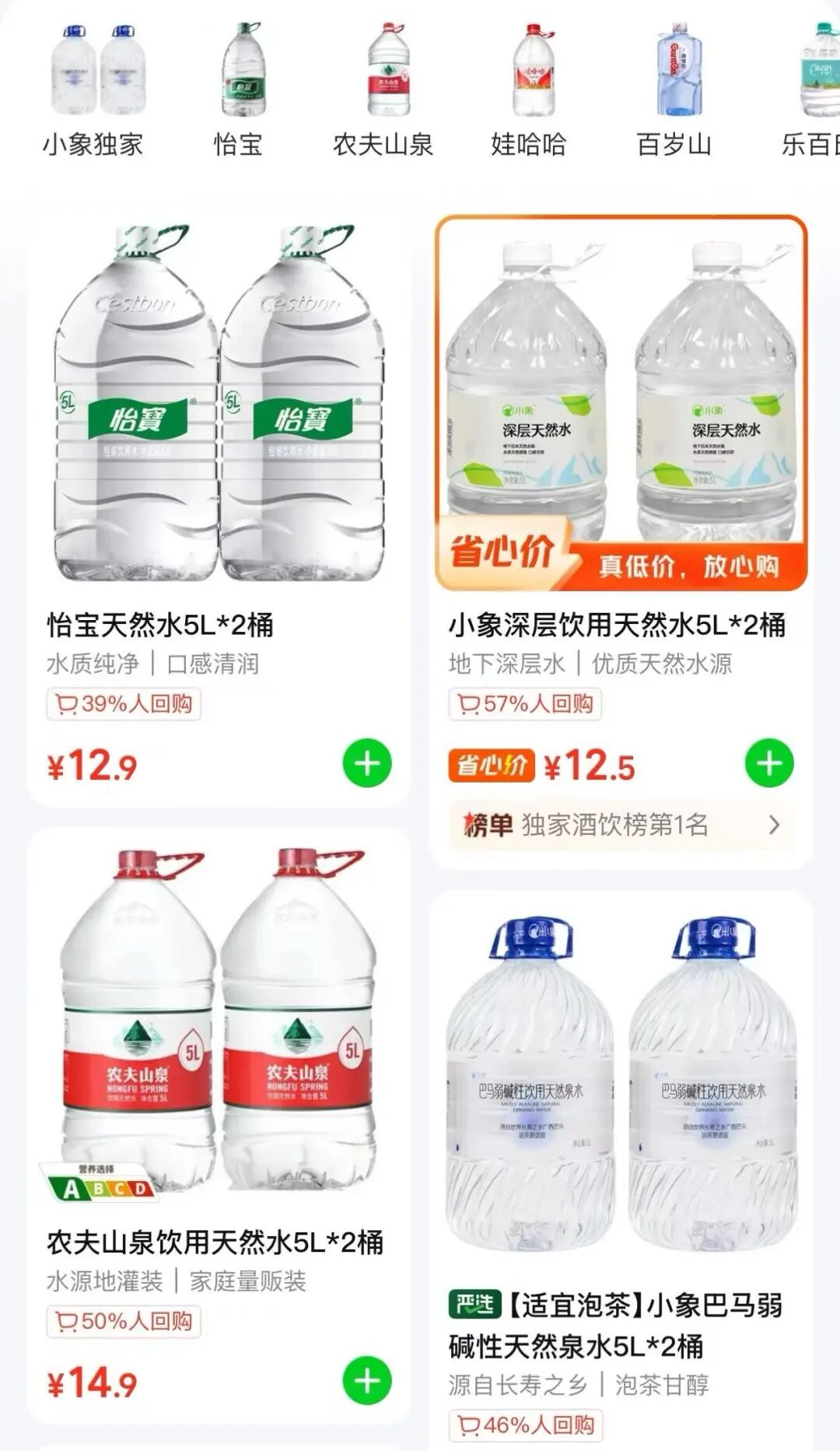
●Because they have to run while carrying heavy items, the orders warehouse pickers dread most are those containing jugs of mineral water. Image source: Screenshot from the Xiaoxiang Supermarket page
@偷菠萝油的女鬼: My only act of resistance is to avoid ordering from the platforms as much as I can.
@yyyyyyyyyyyy: In reality, cutting back on online shopping and spending more in physical stores is what would actually support the economy. Otherwise, all the brick-and-mortar shops shut down, and with no competition left, online e-commerce prices will just keep climbing.
@旺财来福: I remember the day before Chinese New Year’s Eve — someone ordered from Dingdong Maicai because most delivery riders had already gone home to be with their families, and the handful left were running themselves ragged. People who had placed orders kept pestering them in the Dingdong group chat, and once they received their deliveries, they kept complaining. Actually, there is a supermarket just a ten-minute walk from my home — if you are in a hurry, you could just cancel the delivery and walk over yourself. Before takeaway existed, surely everyone managed to live. Once there was a typhoon too, and someone posted on their Moments about an order that took over two hours to arrive. I had already checked the weather forecast and stocked up on frozen dumplings and instant noodles at home.
@殷羽sama: Consumers should join forces and boycott the platforms that exploit warehouse pickers and delivery riders beyond every limit. There should be an anonymous rating system where workers can score these companies. Those that abuse their staff, withhold pay, or foster high-pressure cultures would all receive low scores, causing their standing in society’s assessment to drop. Must it always take someone dying before the public starts boycotting a particular brand?
Compiled by Yakou
Edited by Yuyang
Layout by Xiaoshu