
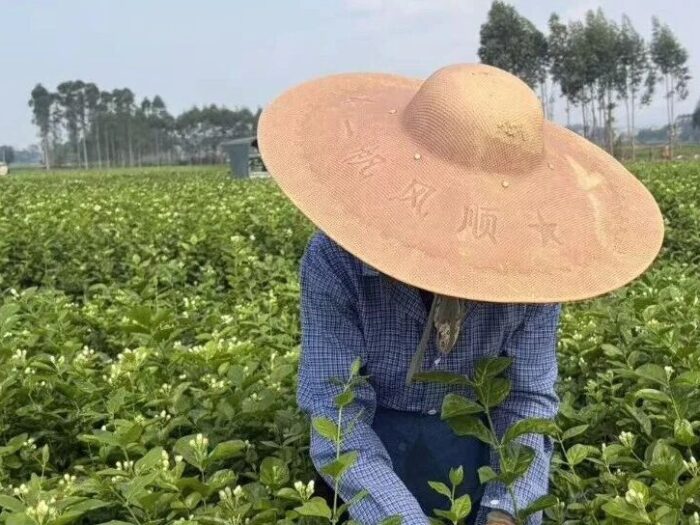
Auntie Huang in Hengzhou’s jasmine flower fields, Auntie Lu in Yingde’s tea gardens—both rely on decades of practised hand-and-eye judgement to know which flower to pick, which leaf to pluck. This experience cannot be written into machine instructions, yet is always classed as “requiring little technical skill.”
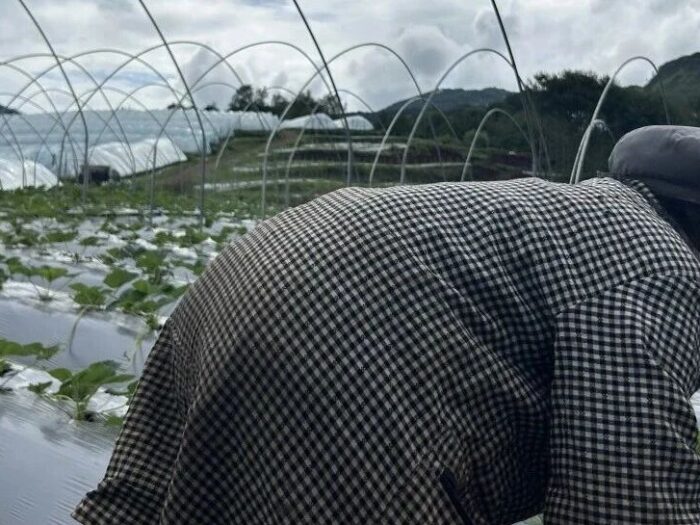
In the polytunnels of Mashu Town, nearly all the workers are women in their fifties and sixties – 27-year-old Lu Yinghong is the exception. She once dreamed of standing at the lectern; in the end, between pinning runners and weeding, she earned a limited autonomy.
After her immune system collapsed at fifty, Kouzi came to Villains’ Valley and, over five years, built a self-sufficient solo farm entirely by hand – with health indicators now better than they were twenty years ago.
After eleven US years, Chen Xi quit Beijing and leapt into a Dong village in Qiandongnan — cabin, rice. Three years: barely a few dozen jin. Seven years on, Zhaoxi She stably grows nine heritage rice varieties. ‘The land taught me to give myself time — seven years, just entering our own summer.’
Suying, Huirong, and Qiuhua have spent over a decade in domestic work in Beijing, cooking for others every day yet unable to answer what they themselves love to eat. In a charity kitchen in Wangjing, they sit around together, trying to voice their own preferences.
Pension unreliable, weather erratic, only six or seven women in the village left to climb the mountain. Through layer upon layer of loss – peeling, boiling, drying – Yang Xiuying of Hengyang, Hunan spent an entire shoot season earning back the self-assurance of not depending on her children.
At Villain’s Valley, I grow fruit without spraying chemicals. Two bayberry trees burst with red fruit—”rivers of blood”—only for a parcel to Shenzhen to be dismissed by my son as sour and small. That hands-on season led to a cliff-edge quitting of buying fruit from outside.
Xian Zi, a post-2000 graduate student at China Agricultural University’s Science and Technology Backyard in Quzhou, built an organic fertiliser plant with villagers to turn chicken manure that livestock keepers pay to clear back into field fertiliser – but found the barrier not technology, only reality’s “input and output” ledger.
In 1995, my nan set up this sold-by-weight condiment stall at Yijing Market in Wuzhou. Since mum took over, she remembers each regular’s usual soy-sauce brand — and from dawn opening to late-night spice repacking, one busy stretch lasts twelve hours.
Oil-lamp cake, jin baoyin and roasted flour – the harvest festival children in hungry years once longed for all year. Now snacks are drenched in free sugars and refined oil. Back to the kitchen: roselle drink, yoghurt, dried pumpkin, nut toffee and jerky – sweetness and fragrance need no additives.


