A “Manure Yard” Proprietor Comes to the Village

Foodthink Says
At one of China Agricultural University’s Science and Technology Backyards in Quzhou, the daily routine of Xian Zi, a post-2000 graduate student, revolves not around clean lab benches, instruments and reagent bottles, but around the smell of composting piles and working day after day with chicken and cow manure.
The knowledge she gained at university tells her that organic fertiliser can improve soil and aid water and nutrient retention. But the reality behind it is this: livestock manure, which ought to be returned to the land, has become waste that needs to be disposed of. Livestock keepers must pay to have it cleared away, and this waste is turned into expensive products – quite literally “carving patterns into shit” – while the open-field farmers who actually grow grain can neither afford nor find reliable organic fertiliser.
So she became the “manure yard” proprietor, partnering with villagers to set up an organic fertiliser plant, determined to rebuild the broken integrated crop–livestock cycle. After more than a year of operation, the pressure on them only grew. Xian Zi discovered that the obstacle has never been technology, but the hard ledger of reality: the input and output of raw materials – who, exactly, is going to pay for it?
The following is Xian Zi’s own account.
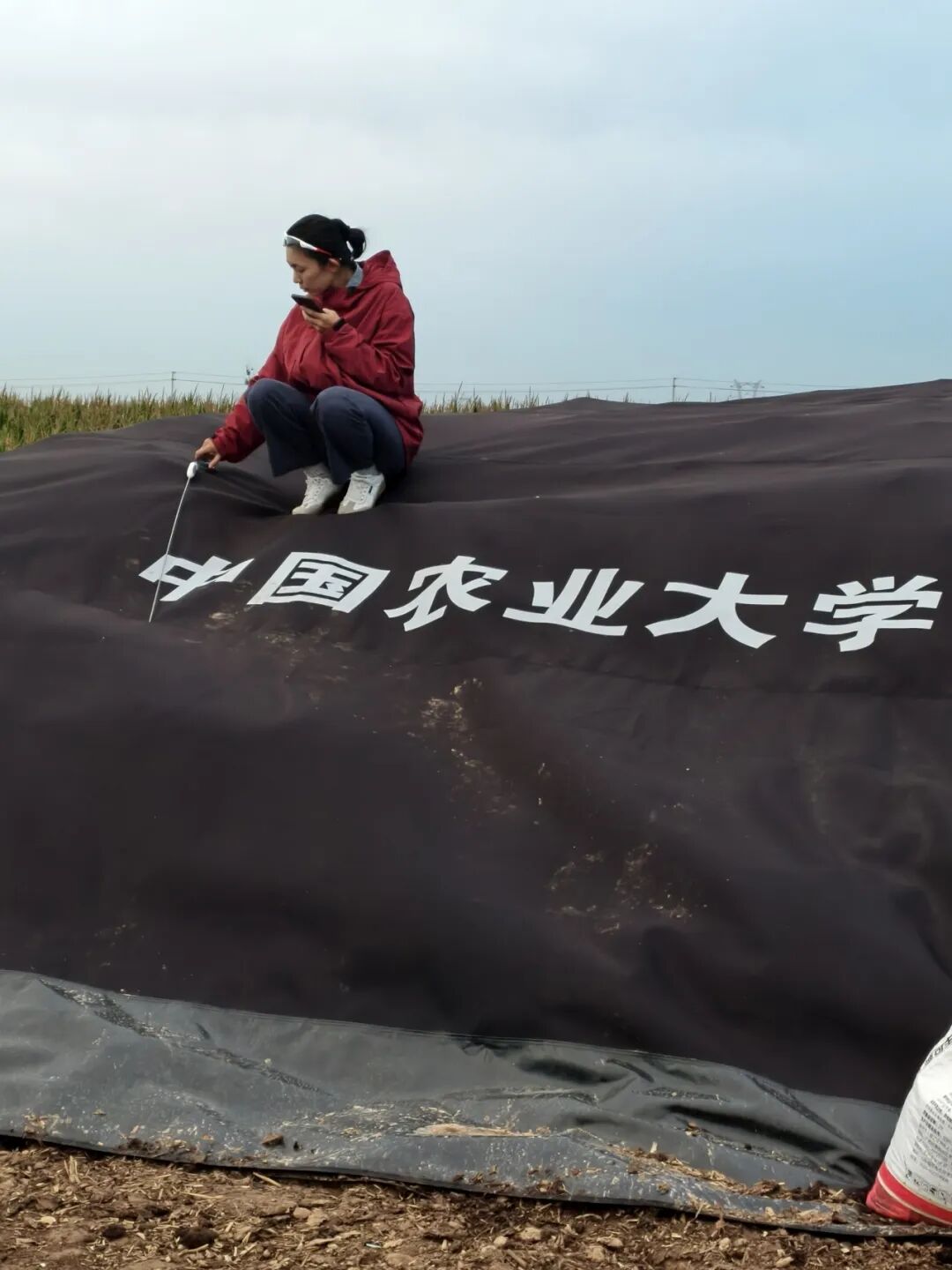
◉ “Manure yard” proprietor Xian Zi takes the temperature of a compost pile.
Manure Yard Proprietor
My hometown is in Yili, Xinjiang, where the county has both crop farming and livestock rearing, but the two operate in isolation from each other. When I went home for winter break in my first year at university, I noticed that many large-scale cattle farmers couldn’t deal with their cow manure – they had to spend a lot of money having it shovelled away and dumped somewhere, and some even poured it straight into the river, causing serious pollution. Yet the crop farmers needed organic fertiliser and had no idea where to get it. Some would cart in cow manure, but without proper maturation it could scorch the seedlings and cause other problems.
I studied plant nutrition as an undergraduate at China Agricultural University, and I saw this as both pollution and a waste of resources. In my third year, I joined a biology competition under Professor Feng Gu, who mentioned that in Xinjiang the hair, hides, and blood from slaughterhouses are all going to waste – they would make excellent raw materials for organic fertiliser. That was when the idea first took root that I might go back home to make organic fertiliser myself.
That is why I chose to do my master’s at the China Agricultural University Science and Technology Backyard in Quzhou. The Science and Technology Backyard is a model that integrates agricultural research, technology-based services, and the training of new talent. At the Backyard, students put down roots on the production front line, eating, living, and working side by side with the farmers.
My speciality is organic fertiliser. Unlike chemical fertiliser, which directly supplies mineral nutrients such as nitrogen, phosphorus, and potassium, the core value of organic fertiliser lies in its ability to systematically improve soil quality and ecological function.
Healthy soil can help farmers solve all sorts of problems. Last autumn, during the harvest, north China was hit by unusually heavy rain – Quzhou saw rain for a solid month, causing the maize to mould in the field and delaying wheat sowing. To ensure a good stand of seedlings, farmers had to sow several extra jin of seed per mu. If the soil were in good basic condition, they wouldn’t have needed to sow so much seed. When extreme weather such as drought or waterlogging strikes, the enhanced water and nutrient retention of the soil means crops survive far better than they would under conventional chemical-fertiliser farming. In short, organic fertiliser helps farmers save costs and boost returns in all sorts of ways – benefits that are very hard to quantify in the short term.
It was only because I studied and lived at the Science and Technology Backyard that I met Uncle, who is now my business partner. One morning last March, I went out for a run. Uncle, my neighbour, drove past and asked if I wanted a lift. I had barely reached the village entrance and was already tired, so I got in.
Uncle asked what I studied. I said organic fertiliser. His eyes lit up – he said he had been wanting to do that too. His day job is landscaping, but business has been pretty poor over the past couple of years. Uncle may not have much formal education, but he is a remarkably quick learner. Once he got into organic fertiliser, he was always asking me about the techniques.
Uncle and I hit it off straight away and decided to get on with it. First, we visited chicken farms, manure drying yards, and organic fertiliser plants in the surrounding area. Last year we started running our experiments, exploring both the technology and a viable business model.
At first, we used the membrane composting technique. Thanks to the help of Professor Li Yangyang at China Agricultural University, we sourced an ePTFE (expanded polytetrafluoroethylene) selectively permeable covering membrane – also known as a molecular membrane or nanomembrane. Its advantage is that it selectively lets water vapour and carbon dioxide pass through into the air, “trapping” odorous substances such as ammonia and hydrogen sulphide. The downside is that the equipment is prohibitively expensive: the membrane alone costs 50 yuan per square metre, and a unit capable of handling 200 cubic metres sets you back 70,000 yuan. The theoretical lifespan of the membrane is eight years, but from what I have observed, after just one year of being battered by solar radiation, oxidation, and the like, it is already past its best – I doubt it will last more than a few years.
So we switched to windrow composting. Windrow composting involves blending raw materials such as chicken and cow manure with bulking agents like crop straw, adjusting the carbon-to-nitrogen ratio and moisture content, and piling everything into open, elongated windrows. The piles are turned regularly to supply oxygen, enabling aerobic microorganisms to break down organic matter and convert it into humus. The key difference from membrane-covered composting is precisely the absence of that ePTFE membrane, and with it the semi-enclosed system that regulates temperature, retains moisture, conserves nitrogen, and blocks odours. During the process, the windrows do smell of dung – hardly pleasant for the operators – but both capital and running costs come down dramatically.
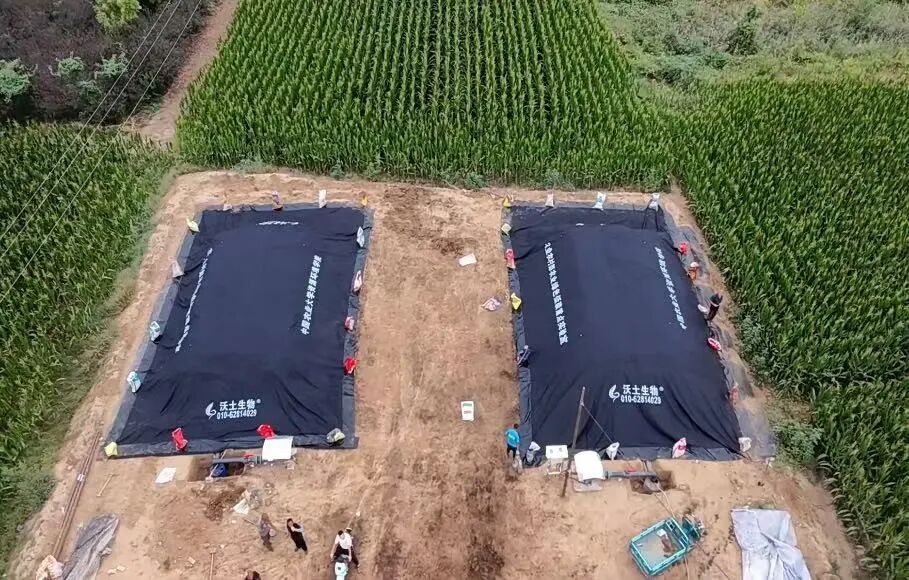
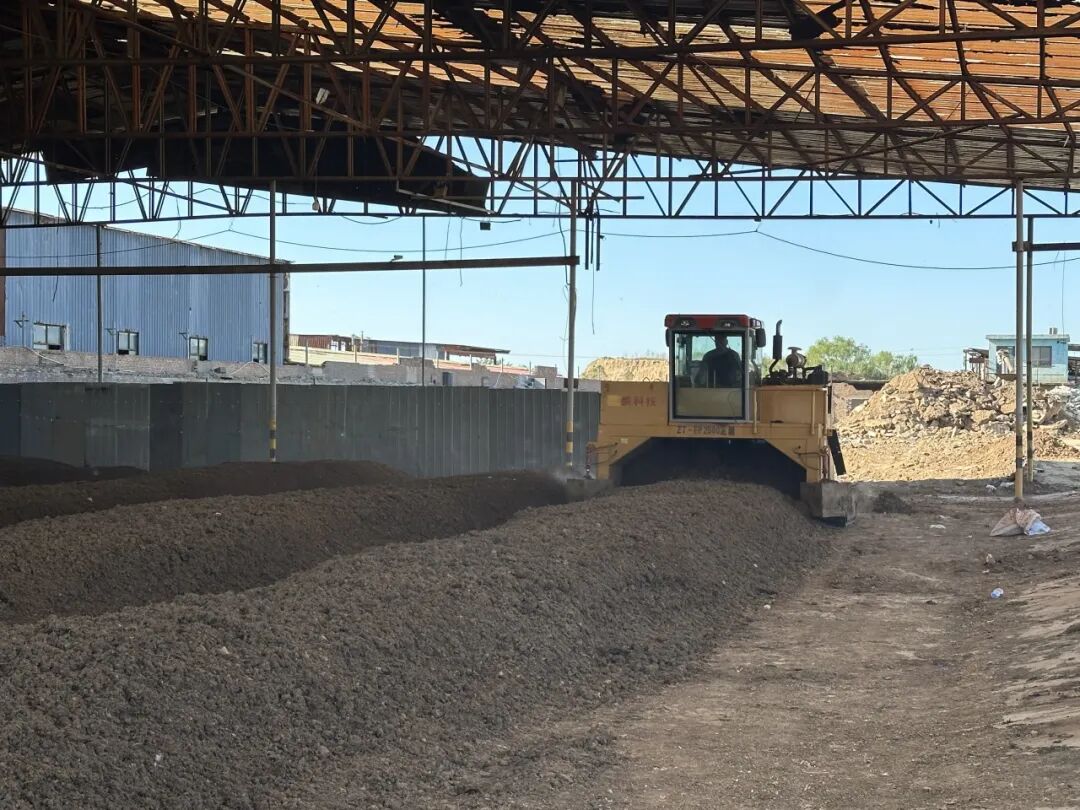
◉ Costly membrane composting (top) versus the cheaper windrow method (bottom).
We trialled various ratios of chicken and cow manure, together with common local agricultural waste such as crop straw, maize cobs, and spent mushroom substrate. From summer through to winter, we composted 800 tonnes of material and finally worked out the formulations and fermentation methods.
Why Bother “Carving Patterns into Shit”?
The organic fertiliser industry is in a bit of a mess these days. When Uncle and I went on our site visits, we found that the problem isn’t just in Quzhou – across the whole country the organic fertiliser industry is a mixed bag, and bad money driving out good is rife. To cut costs, many factories throw in all manner of junk – industrial fly ash, for instance, to bulk up the weight on the scales, even though it is loaded with heavy metals. You might not notice when you buy it; people might even think it looks good – fine, dark, a nice product. But once it goes on the field, trouble follows: seedlings have died.
When it comes to organic fertiliser, farmers all know it is a good thing, and since they know we students are involved in making it, they trust the quality. They struggle to find organic fertiliser they can rely on, and they don’t know how to use it properly either. But the biggest deterrent by far is that they simply think organic fertiliser is too expensive.
The trend among many organic fertiliser plants nowadays is “carving patterns into shit”: on top of basic manure, they add humic acid, amino acids, functional microbial inoculants, biostimulants such as alginic acid and chitosan, secondary and trace elements, and new materials like biochar, upgrading the product into a bio-organic fertiliser or soil conditioner with a blend of functions – improving soil, promoting growth, building stress tolerance, and boosting efficiency. But all those extras push the price above 500 yuan a tonne.
We want to keep the process simple, no fancy gimmicks, and push the price down as far as we can. Think of it this way: they sell boutique goods; we sell everyday essentials. The one precondition, of course, is that quality must be assured – no heavy metals, no antibiotics.
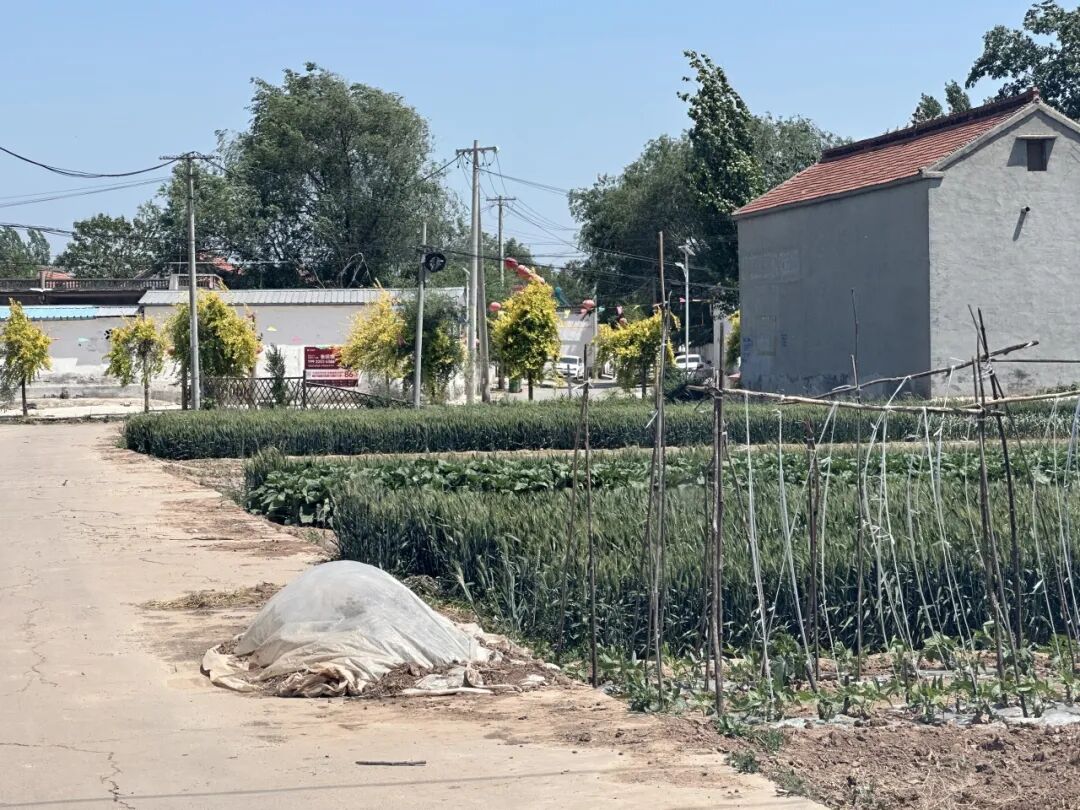
◉ In Quzhou, you can often see farmers making their own simple compost heaps at the field’s edge. As long as the material ratios and moisture content are right, organic fertiliser is free for the picking. Photo: Ling Yu
In the past, smallholder farmers could actually achieve the integrated crop–livestock cycle on a single-farm basis. Back in the little county town where I grew up, one farming family grew quinoa. They would compost cow manure themselves, cart it onto their own fields, and the quinoa they produced was good both in yield and in quality.
But as chemical fertiliser spread and livestock farming scaled up, the integrated crop–livestock cycle was broken. Quzhou itself is a major laying-hen county, yet there aren’t many organic fertiliser plants here, so they cannot absorb all the chicken manure produced within the county. Some livestock keepers simply dump it wherever, causing odour, wastewater, and other pollution.
In recent years, national policy has encouraged using agricultural waste for composting – at its core, the aim is to rebuild the integrated crop–livestock cycle over a wider area.
But it was only after I actually threw myself into it that I understood: the reason the organic fertiliser industry cannot take off has nothing to do with technology. The technical barrier is not high. Rebuilding the integrated crop–livestock cycle is not hard because of fermenting manure and crop straw properly – the difficulty lies in the “input and output”: in are the raw materials, out are the sales.
Rebuilding the Integrated Crop–Livestock Cycle
This March, we rented a site and began large-scale production. The pressure hit us all at once.
First comes the site. We rented an abandoned chicken farm at 120,000 yuan a year, and we process the manure waste from 400,000 chickens every day. The chicken manure is collected free of charge for now – we bought a truck and hired a driver to haul manure from nearby chicken farms each day. We also hired workers to turn the piles and carry out repairs around the site. On top of that come water, electricity, microbial inoculants, and all sorts of miscellaneous costs. Every single day I watch the money pour out.
Manure waste has a high moisture content, and crop straw is bulky – hauling them is like carting water and air. What’s more, gathering crop straw from the fields is a real hassle, and it still has to be shredded on top of that. These days we would rather use maize cobs and spent mushroom substrate. Even if people let us collect these raw materials for free, the transport and labour costs on their own are already a huge burden.
In truth, if we want to rebuild the integrated crop–livestock cycle, we cannot rely on organic fertiliser plants like ours alone. Last year I went to an organic fertiliser conference, and peers in the trade told me that an organic fertiliser plant can’t really be called a for-profit operation – it is essentially a government environmental project, because what it handles is society’s waste.
If there were a policy-level coordination mechanism, designating organic fertiliser plants as collection points for agricultural waste – everyone brings their waste to us and we handle it – with part of the transport costs borne by the livestock farms or the government, then we could actually stay in operation.
What we want to explore is a county-level circular model, which is still very rare anywhere else in the country. The organic fertiliser plants I have seen tend to produce bagged, pelletised organic fertiliser so they can widen their transport radius – shipping across provincial borders is no problem. But I want to work in a satellite-station format, serving livestock farms and farmland within a 20-kilometre radius. Beyond that, transport costs become too prohibitive.
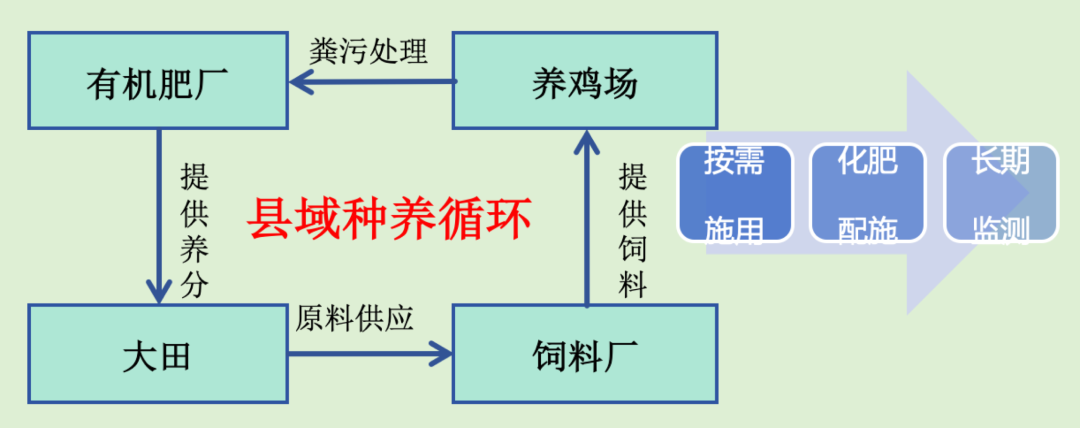
◉ A schematic of the county-level circular model.
But the question is whether you can source both raw materials and a market within those 20 kilometres – will livestock keepers be willing to hand over their manure? Will farmers be willing to use it? Each household has its own thinking.
So That Crops Can Afford to Eat Organic Fertiliser Too
Now sales are keeping us up at night, too.
Wheat harvest is almost here. These past few days we’ve been busy promoting organic fertiliser to large-acreage farmers. A farmer only needs to pay just over a hundred yuan to buy a tonne of organic fertiliser – and at that price, spreading is included as well. It’s practically a giveaway. And still, hardly anyone wants to buy.
The batch we produced last year cost roughly 260 yuan a tonne. To break into the market, we set the promotion price at 250 yuan a tonne when we went out to farmers. Professor Zhang Weifeng from China Agricultural University also chipped in 150 yuan per tonne as a subsidy. That way a farmer only needs to pay 100 yuan for a tonne of fertiliser, and we even include a spread-to-field service.
This year, our price for open-field farmers is 240–260 yuan a tonne (scaled by distance), and Professor Zhang still subsidises half the cost, so in practice the farmer only pays just over a hundred yuan. That price includes the spreading service – we don’t just help get the fertiliser onto the field, we also offer advisory input: telling them what the soil is like this year, how much fertiliser they’ll need, and how much organic fertiliser is appropriate within their budget.
But we can’t rely on Professor Zhang’s subsidy indefinitely. I’d like to see the point where, once our operations stabilise, applying one tonne of organic fertiliser per mu at a delivered-to-field cost of 200 yuan becomes feasible.
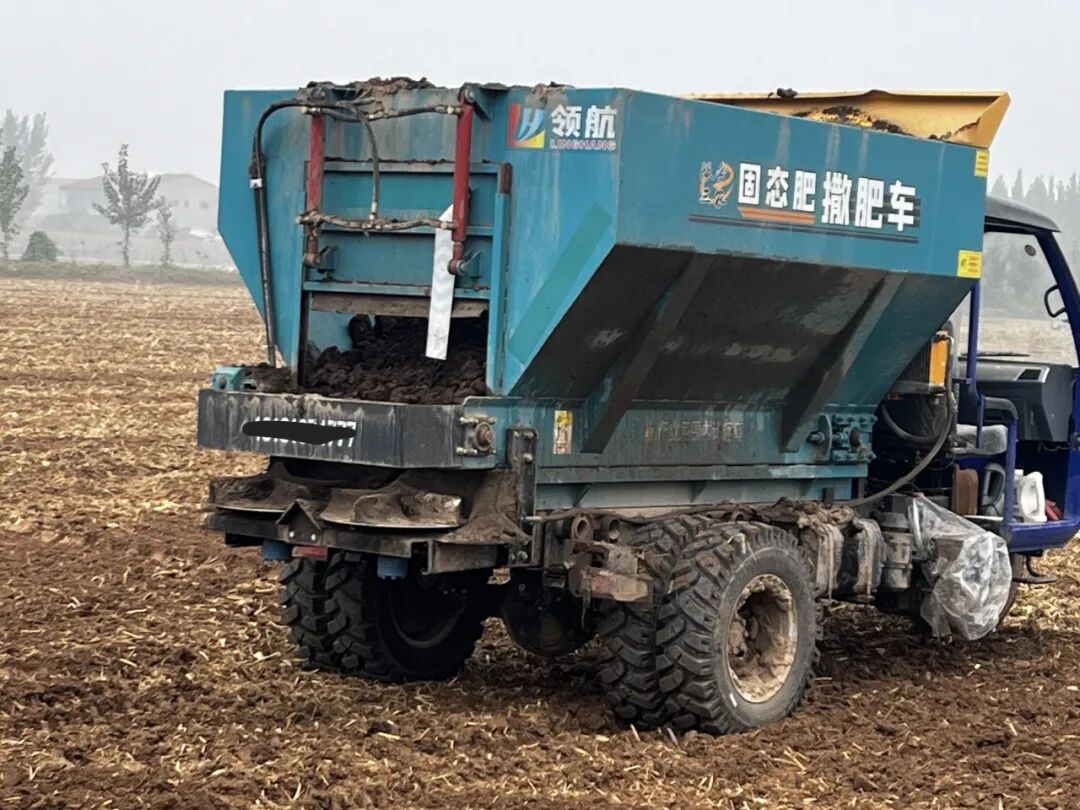
◉ Xianzi’s “bulk-sale” compost for open fields, suited to short-radius transport and broadcast by a spreader vehicle.
In truth, even this is still a bit steep for farmers – especially those growing grain. Organic fertiliser is normally sold to growers of vegetables and cash crops, since those crops command high output value and demand particular soil fertility, so those farmers are willing to spend the money.
Very few organic fertiliser plants set grain growers as their target market. Using organic fertiliser on grain crops adds an extra step to the production process and bumps up costs, yet the yield uplift on grain is not all that great. Organic fertiliser is not the kind of thing that pays off overnight. In the first year the farmer’s net gain is minimal – it might even be negative. Only as the soil builds up season after season do profits start to climb.
I applied our own organic fertiliser across an experimental plot of nearly 400 mu. By early March, when the wheat was greening up, the plots with organic fertiliser were looking strong. The greening-up assessment showed those wheat plants had essentially all met the Class I seedling standard – robust tillering, deep-green leaves, and vigorous root activity. The farmers who bought the fertiliser ran their own comparison tests too. They said you can dig into the soil and see that the compaction has eased a little, that the ground has become looser.
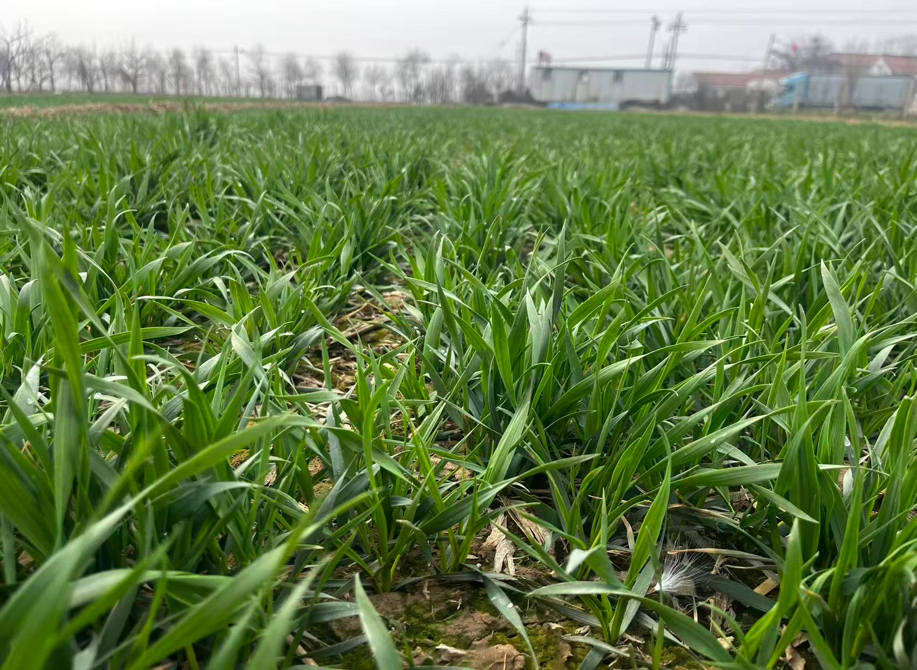
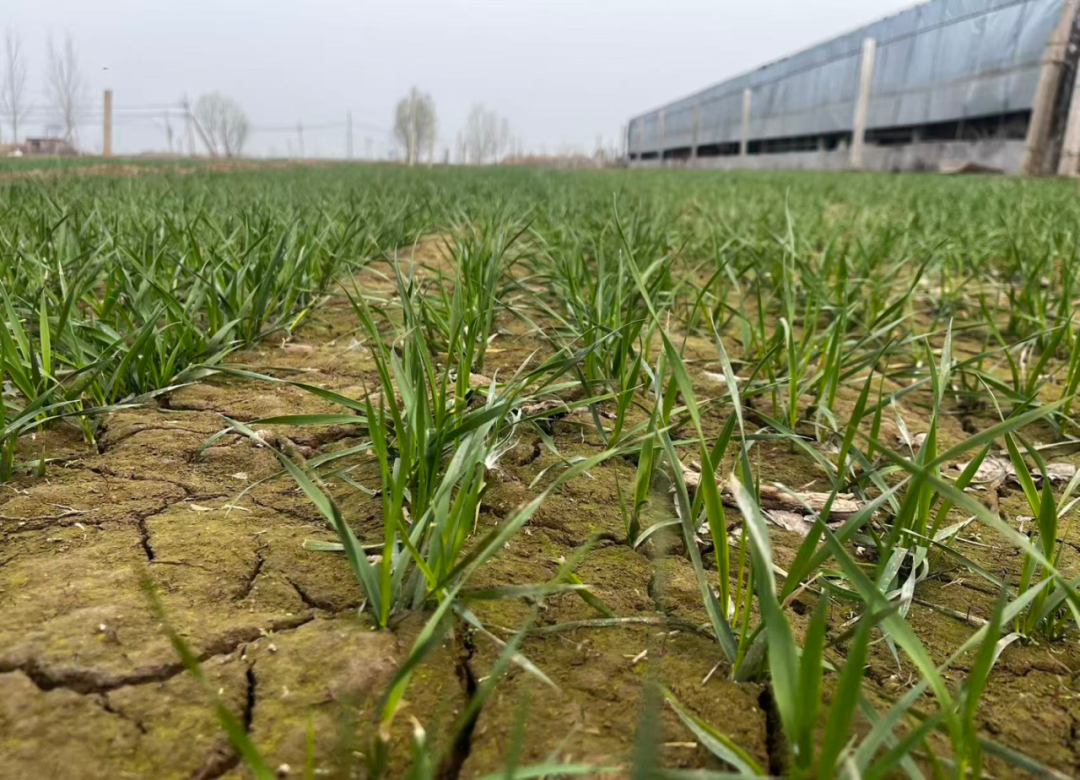
◉ Comparison trial of wheat plots with organic fertiliser applied (left) versus chemical fertiliser only (right).
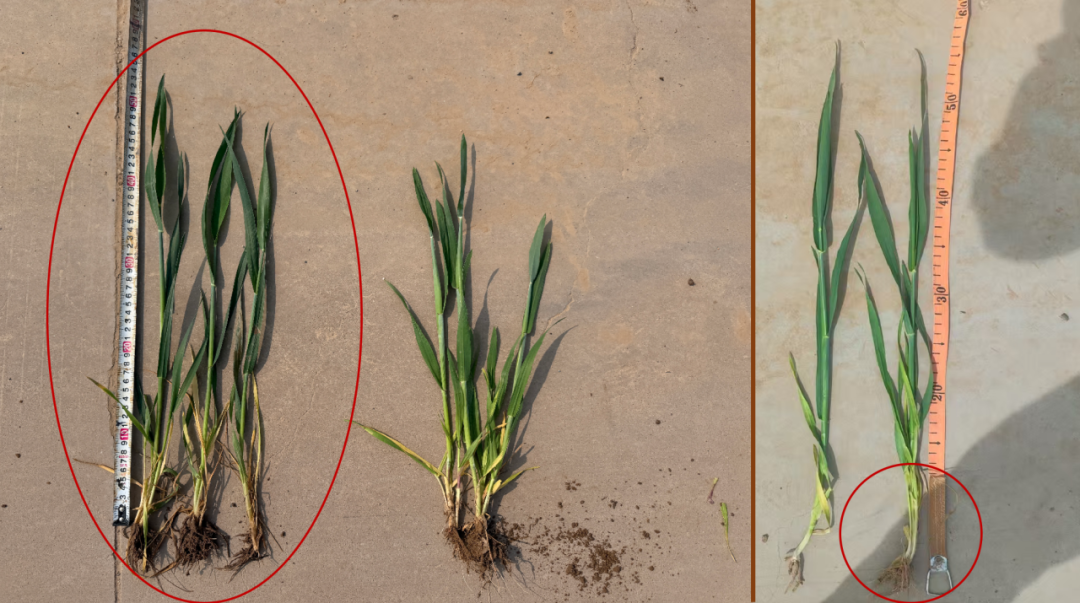
◉ The trial found that applying organic fertiliser (shown in the red circles) promotes wheat plant growth and root development, thereby improving both yield and quality.
But many farmers – especially smallholders – are reluctant to spend money and time on organic fertiliser; they take the easy route wherever they can. Even the smallest-scale farmer, once the fields are sown, heads off to do migrant work. Farming isn’t their entire source of income. For those who see farming as a profession, organic fertiliser is the better choice.
So That Nurturing the Soil Can Earn Money
Farmers know that using organic fertiliser is good for crops and soil – it’s just that their budgets don’t stretch to it.
We’ve grown used to taking and taking from the land. With land transfers these days, some people treat a plot like a single-use item – one season, and the following year, whoever wants it can have it. There’s very little awareness of soil conservation. In the end all you do is run the land into exhaustion. It’s unsustainable.
Now the northeast has rolled out policies to protect black soil and ban its resale. I think in future, nurturing the land will become a business that can actually make money – and one that simply must be done.
But for now, our goal this year is just to survive and get the plant into a steady, orderly operation.
The plant has been running for just two months now. Capacity is still low – roughly 400 tonnes a month – and we’ve stockpiled close to 800 tonnes of fertiliser so far. We plan to sell to large grain growers once the wheat harvest is done and the next maize crop is sown.
As the grain planting season approaches, we produce open-field fertiliser in bulk. The composting process is a bit rougher because we’re going for volume. As long as quality is assured, for open fields that’s perfectly adequate.
I still plan to differentiate products for different customer groups. For the rest of the season, I’ll make fertiliser for vegetables, with more additives such as humic acid – that improves quality and lets us command a higher price.
Since setting up the organic fertiliser plant, we’ve all been under enormous pressure. We need to harden the yard surfaces soon, completing ground paving and waterproofing before the rainy season hits. That will eat up nearly 400,000 yuan more. I’ve even been looking into student entrepreneurship loans – at least the interest rates are low.
However hard things get, we pull together and push on. Uncle sends a flood of voice messages in the group chat every day, discussing things, sharing ideas, forwarding lots of techniques he comes across.
I’m quite lost about the future, too – I don’t know whether this will work. I could just stop caring, sit tight, graduate and walk away. But I’m already in it. I can’t leave Uncle in the lurch and make a clean exit on my own – that would be terribly disloyal.
– This is the 813th original piece from Foodthink –
Foodthink
author
Yang Ruoxianzi
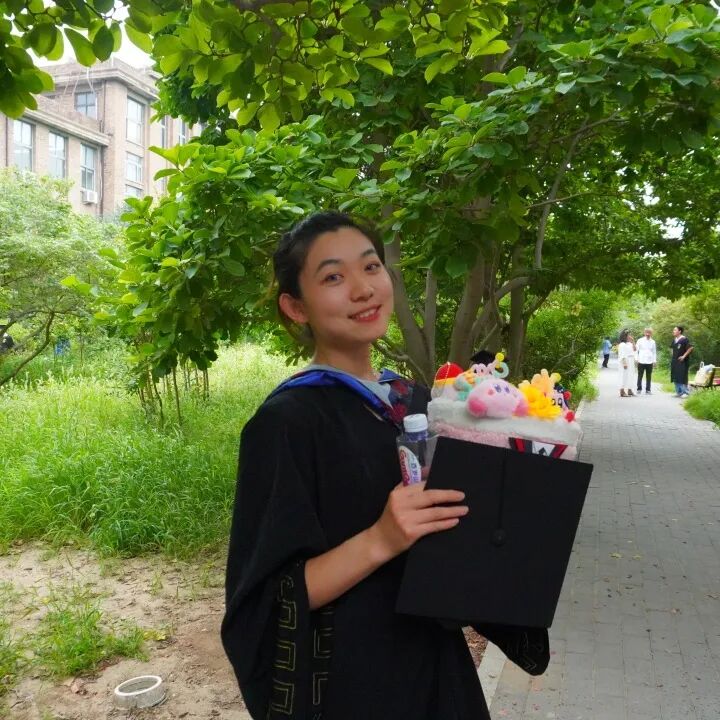
A 2024-entry graduate student at China Agricultural University, from Ili, Xinjiang. Main research focus: county-level integrated crop–livestock cycles and functional regulation of organic fertiliser.
Unless otherwise noted, all images are provided by the author.
Told by: Xianzi
Compiled by: Lingyu
Edited by: Xiaodan
Layout: Xiaoshu
▼
Click the image to read related articles.