Tea Factories Grow Ever More Automated—Why Are Women Still Indispensable?

Foodthink Says
Hengzhou in Guangxi and Yingde in Guangdong are two of China’s major tea-producing regions, celebrated respectively for jasmine flowers and black tea—and both suffered severe flooding, in 2022 and again this year. Once the floodwaters subsided, the team from the social enterprise Yue Lai Yue Hao headed there in August to carry out research. They met a group of resilient, hardworking women tea farmers and factory workers, and in the process came to see the gendered details woven into the labour behind every tea drink.
We can weigh a basket of tea leaves, calculate the price of a bag of jasmine flowers, and use a platform discount coupon to have a limited-edition seasonal milk tea delivered to our door. But out in the tea gardens and flower fields, how is the “hardship” of a day’s labour to be measured, understood, and felt?
After the Flood: The Labour Hasn’t Ended
In July 2026, flooding in Hengzhou, Guangxi, drew many Chinese people’s attention for the first time to the country’s largest jasmine flower production and processing base.
Chunlai Village in Hengzhou was fortunate—the damage was not severe. When we arrived a month after the floods, the flower fields and tea factories had already resumed production. Only the jasmine market opening prices flickering on the “Hengzhou Digital Jasmine” mini-program reminded us that this was the worst flooding since the jasmine industry took root here.
The mini-program was recommended to us by Xiao Ma, who works at a local jasmine flower factory. “It really is just like the stock market!” we could not help exclaiming as we studied yesterday’s fluctuating data. In ordinary times, the farm-gate price for jasmine flowers is just 2–3 yuan. On 12 July, the market opening price reached 40 yuan per jin (a jin being roughly 500 g), with a peak of 50 yuan per jin; by 18 August, the opening price was 28 yuan per jin. By 30 August, the price had fallen back to 14 yuan per jin. And as of today, the day of publication (28 September), it has climbed back to 25 yuan.
Beyond this official mini-program, jasmine flower prices from various townships and collection points are also updated in real time across livestreams and WeChat groups in Hengzhou.
But rising prices cannot simply offset the damage to the fields themselves. Jasmine flowers spared from total crop failure have been picked in succession; households whose fields were completely destroyed watch the price surge and fall with nothing to do but wait to replant, while those still with flowers to harvest try to minimise their losses amid the price swings.
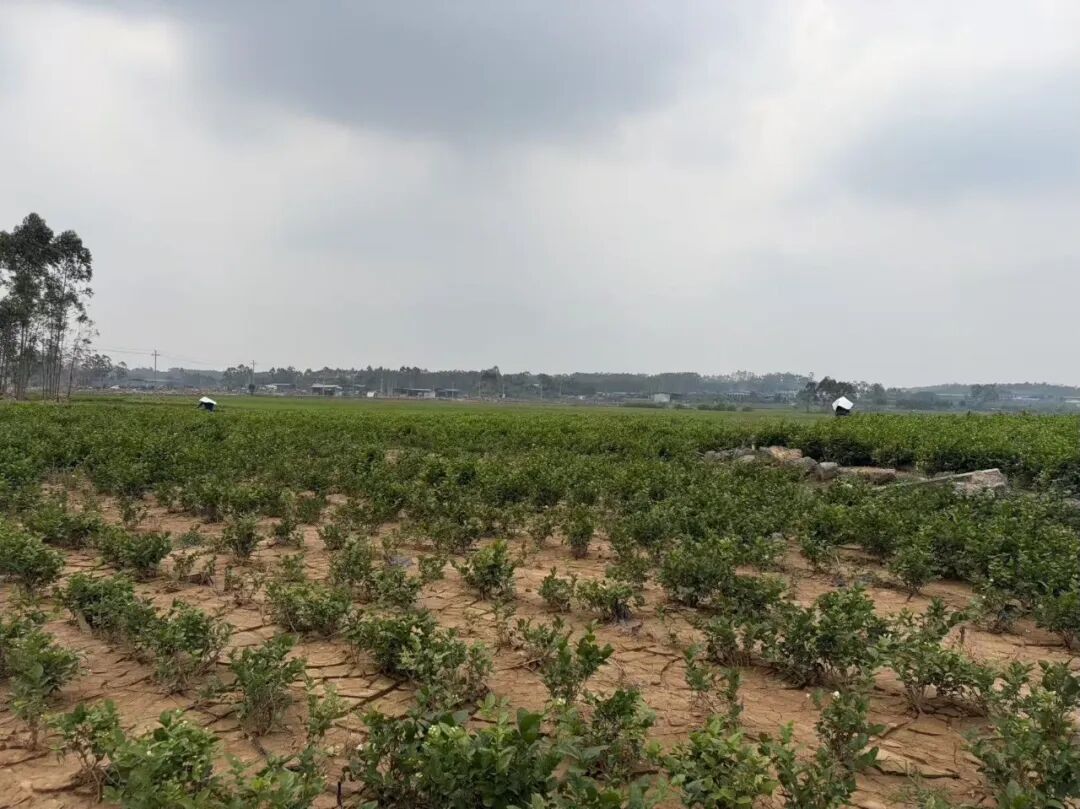
◉ Jasmine flower fields in Chunlai Village, their yields reduced, after the flood.
Auntie Huang, whose fields suffered less severe damage, belongs to the latter group. But with reduced yields, a higher price does not mean a higher income—merely a smaller loss than those who suffered total crop failure.
Past nine in the morning, the sun in Hengzhou was not yet fierce. Auntie Huang, ever warm and forthcoming, led us into her flower field. She walked ahead picking, and we followed behind, learning to seek out those white buds not yet fully open among the green leaves and branches.
“Can I pick this one?” “What about this one?” We held up buds that looked virtually identical, asking about each in turn. Auntie Huang would take a single glance and reply: “This one, yes.” “This one, no.”
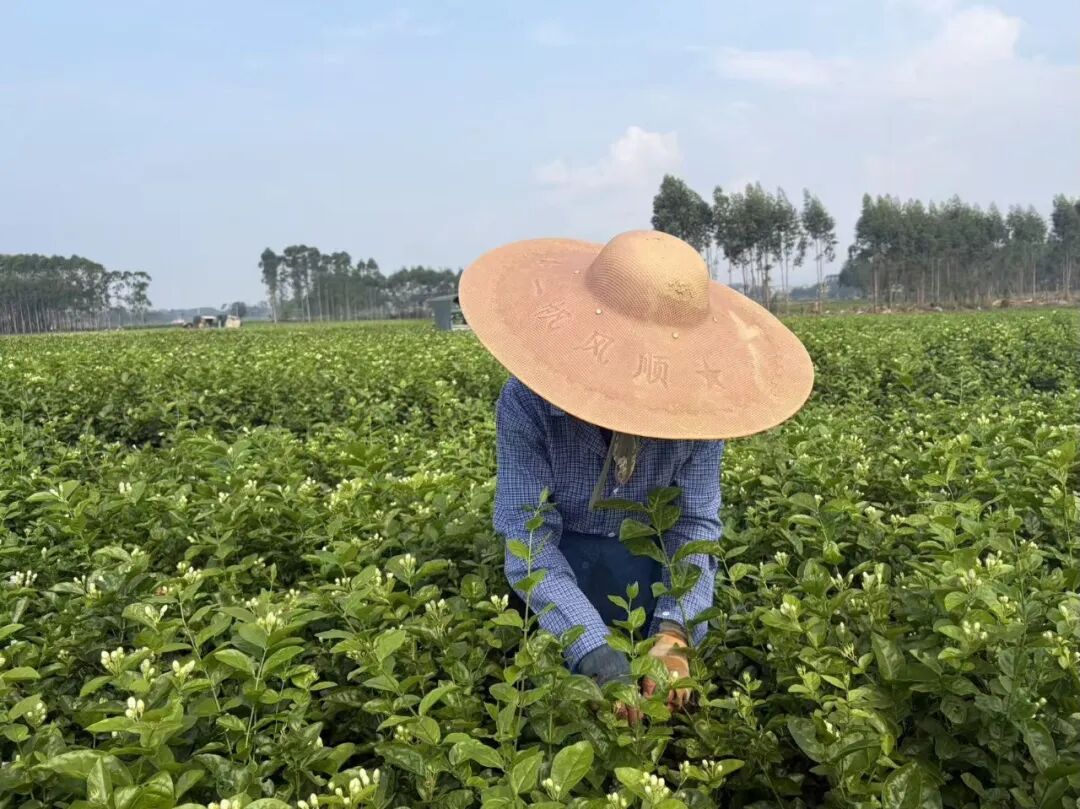
◉ Auntie Huang in the flower field: a yellow headscarf printed with cartoon bears wrapped around her head, topped with a white baseball cap and a straw hat layered on top; cloth gloves cover her hands, leaving only her fingertips exposed to touch and pluck the buds.
Her hands never stopped; she answered as she dropped the right flowers into her bag. Auntie explained that deciding whether to pick is not just about how white the bud is—it also requires judging size and how open it has become. Some flowers have not yet reached the right stage and need until three or four in the afternoon to grow larger and become more suitable for picking. For someone stepping into a flower field for the first time, the subtle differences between buds demand repeated scrutiny; but for her, “this one, yes, that one, no” has become an almost thoughtless judgement—the moment they see them, the right buds have already landed in the basket.
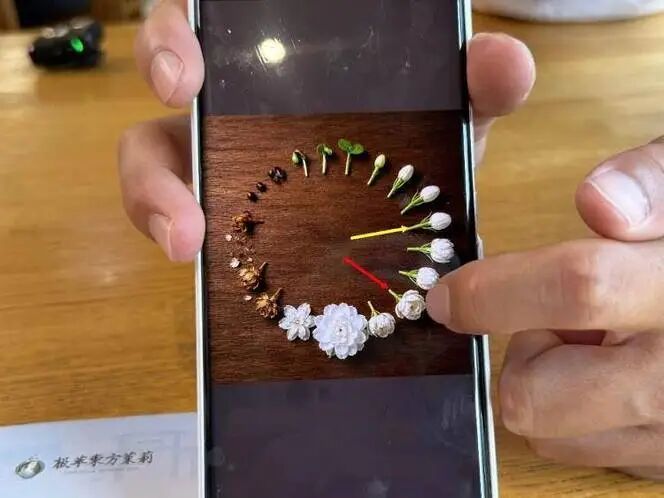
◉ Jasmine flowers at different stages of growth. The yellow arrows indicate the stage at which flower farmers pick them; the red arrows mark the optimal stage for scenting. Image source: CCTV.com
Bending down, looking up, rising again—she laments her bad back: others can pick four or five jin an hour, but she manages three at most. After the flood, jasmine prices rose, yet yields shrank drastically. She pushes herself to pick more, but “this is all I’ve managed. You see how hard it is for us farmers.”
After the flood, what she faces is far more than just a diminished field. While picking flowers, Auntie Huang also cares for her two granddaughters. “When my daughter has time, she looks after them; when she doesn’t, I have to,” she says. Sometimes she travels alone to Nanning to help her daughter mind the children.
The judgement of buds, honed over countless pickings, has gradually become a kind of bodily memory. Auntie Huang needs only a glance—her hand is already reaching for the next. This fluency began in childhood, at her grandmother’s house, and has stayed with her to this day.
Between Flowers and Buds and Leaves
An Undervalued Form of Labour
Six hundred kilometres away, in Yingde, Qingyuan, Guangdong, Auntie Lu, aged seventy, is also picking tea. She turns her thin, sun-darkened wrists with practised dexterity; thumb and forefinger lift, pinch, snap, release, and the buds and leaves part from the tea bush. Among clusters of vivid green buds and leaves, all you can hear is the crisp “snap, snap” of the plucking.
Yingde is a major tea-producing area in Guangdong. In 2025, the regional public brand of Yingde Black Tea reached a value of 5.178 billion yuan, becoming the number-one black tea brand in the country for the first time. Official data also show that by December 2025, Yingde’s tea gardens cover 186,500 mu, with an overall output value of approximately 10.2 billion yuan. The city is home to over 880 tea enterprises, supporting 155,000 workers—yet Yingde’s permanent resident population is under 950,000. Behind these numbers lie the labour and livelihoods of many rural families in Yingde, spanning the entire industry chain from tea cultivation and picking to processing and sales.
Some local tea companies operate through contracts with tea farmers. The factory sets cultivation standards and procures fresh leaves collectively. Lüyi Tea Factory, where Auntie Lu works, is one such example: after signing contracts with farmers, the farmers handle day-to-day cultivation, maintenance and picking. Tea-picking is labour-intensive and highly reliant on manual work, and processing different grades of black tea imposes varying requirements on the selection of fresh leaves. Older women like Auntie Lu are the backbone of tea-picking labour.
During the tea-picking season, Auntie Lu gets up at six each morning to eat breakfast, then walks for over half an hour to reach the tea garden. At midday she rests only briefly—barely over half an hour—before carrying on. Fresh tea buds are light and soft; despite working without pause all morning, Auntie Lu manages just sixteen jin. Summer is the off-season, and the fresh leaves she picks that day fetch a procurement price of only two yuan per jin—earning her thirty-two yuan for the whole morning. Procurement prices for tea fluctuate considerably; both the season and the picking standards affect the price, and during the spring tea season it can reach ten to fifteen yuan per jin.
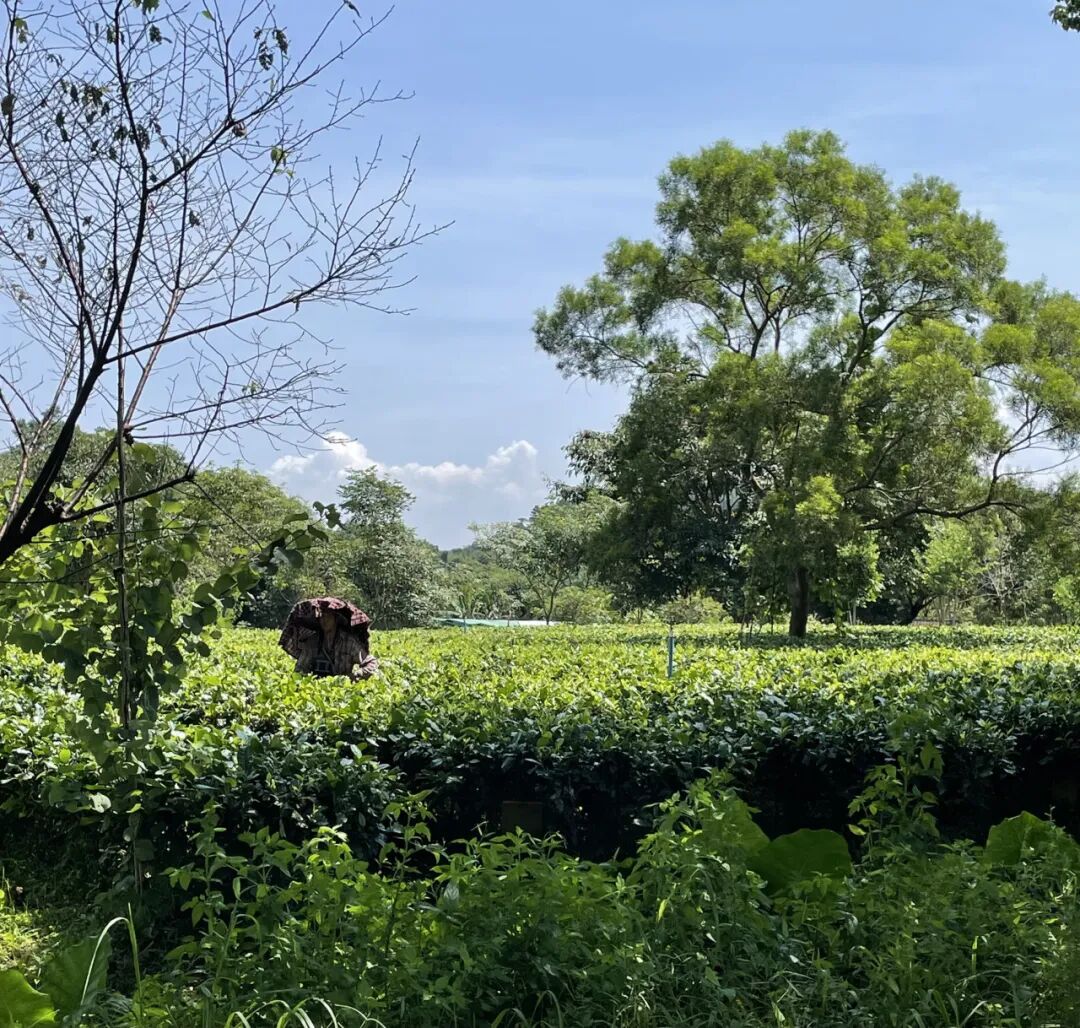
◉ Auntie Lu in the tea garden.
This is already her twentieth year picking tea at this factory, and Auntie Lu is rather proud of herself: her eyes are still clear, and her back has never given her trouble. She credits her sturdy back to all the ginger tea she drank after giving birth forty years ago—cupping her hands as if holding a bowl, she makes a series of gestures mimicking tipping her head back to drink.
Factory managers describe the job as “flexible” and “free”—tea is paid “by the jin, more work, more pay”. When things get busy, the women often work until it is so dark that they “can’t see a thing” before they stop.
But this “flexible” job is also a hardship the young are no longer willing to endure. “Young people nowadays simply can’t take it anymore,” explains Sister Xu, a local.
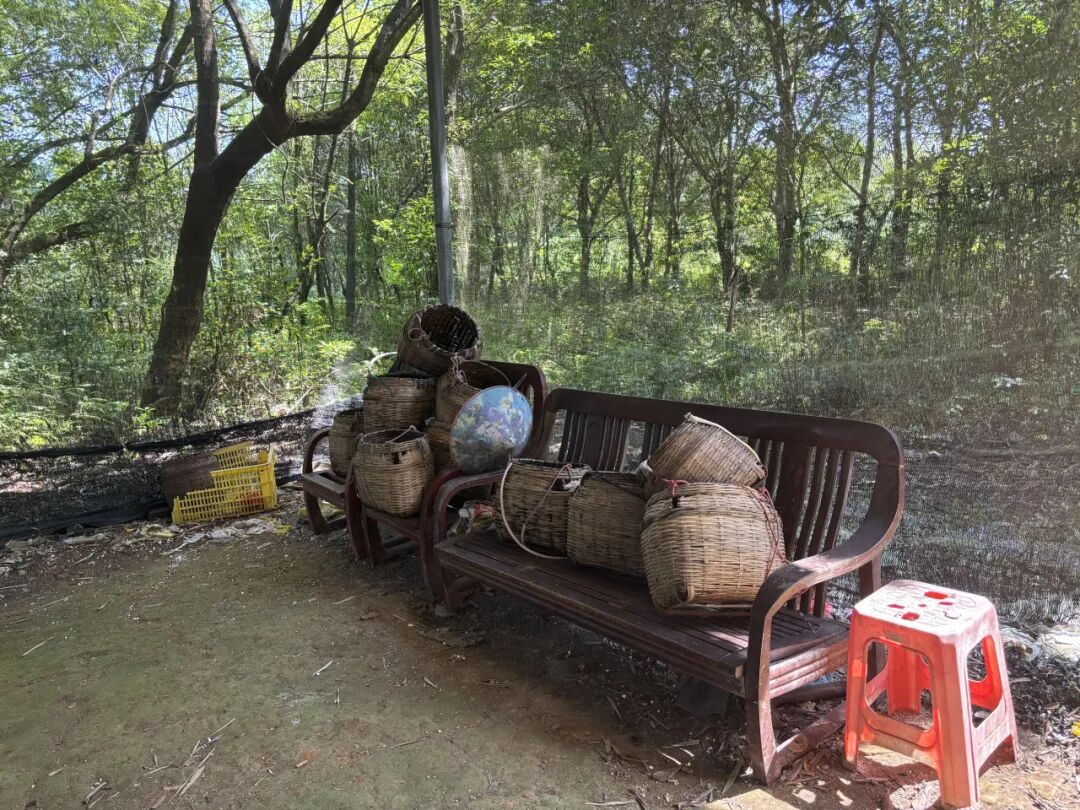
◉ A workers’ rest area in a tea garden in Yingde.
Hands in the Gaps Between Machinery: Whose Experience Counts as Skill?
The tea gardens and factories we visited in Yingde and Hengzhou differ in management style and labour processes, but what deserves attention is that women are overwhelmingly assigned to roles considered to require “little technical skill”—and yet these very jobs depend on long-accumulated experience and judgement, and are if anything even harder to replace with machines.
For instance, at Jixiang Tea Factory in Yingde, Sister Chen, aged fifty, has been working on the factory floor for over a decade. Her task is to collect and carry tea leaves between the different processing stages—withering, rolling, fermentation, and firing. During the busy picking season she lives in the dormitory, yet can only ever “assist” the skilled workers. And in the workshop, every single “skilled worker” responsible for judging the thickness of spreading, the duration of withering, and the degree of fermentation is a man.
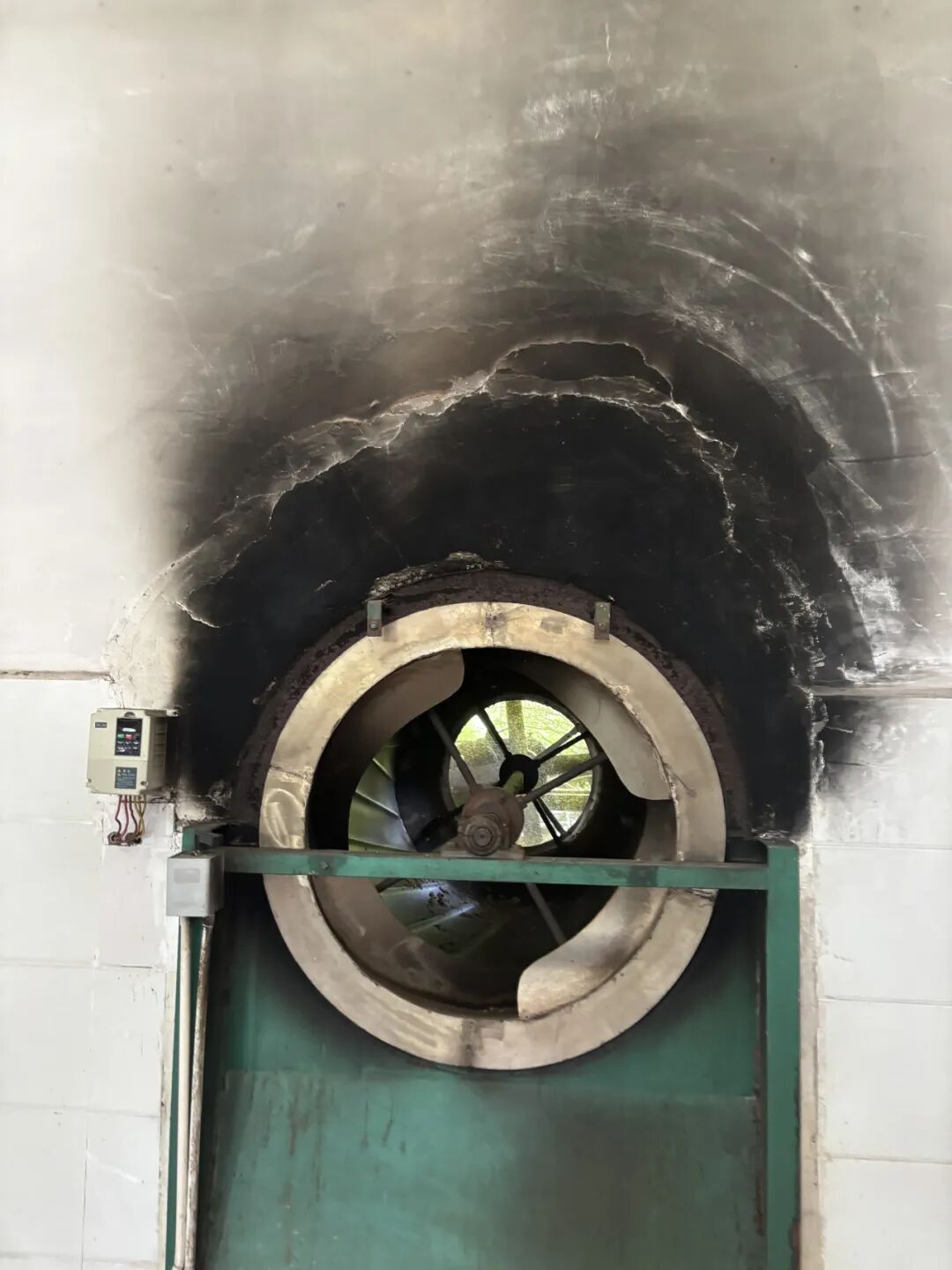
◉ Tea-firing equipment at Jixiang Tea Factory.
This division of labour is not confined to Jixiang Tea Factory.
Lüyi Tea Factory, where Auntie Lu works, is already highly automated: the number of workers required on the production line has dropped from over thirty to six. Yet all six workers who bear the title of “master” are men. They have also undergone specialist training at a tea research institute and are responsible for “assessing the tea”—inspecting whether the fresh tea leaves delivered from the fields meet the required standards.
The managers explain that the work is “quite strenuous”: a basket of fresh tea leaves weighs several dozen jin, and it takes human strength to lift the whole basket and tip it into the withering trough or the machine. ‘This step still calls for physical labour.’
And yet carrying tea between the various workshops and machines at Jixiang Tea Factory is precisely what Sister Chen has been doing for years. If she has the same physical strength, why can she not become a “master” and can only assist?
‘And what about the tea pickers here?’ we asked. We received the expected answer, yet one that struck us as contradictory: ‘Seventy to eighty per cent are women.’ ‘Why is that?’ The manager seemed taken aback that we were pressing him on something so obvious, blurting out that men could go and work elsewhere, without having to toil from dawn to dusk baking in the sun.
The manager acknowledged it was “physical labour” too, yet at the same time described it as “mechanised” and “not requiring much brainwork”.
The manager’s verdicts shape the women’s view of themselves. On many of the finer technical points, Sister Chen concedes that she cannot make the call on her own.
And yet, when it comes to what makes a “good tea”, Sister Chen can answer without hesitation: you know the moment you taste it—a good tea has “no off-flavours”. After years of work, the people in the factory have developed their own set of criteria for judging quality, ones that never appear on any written specification.
Perhaps most tellingly, at Yexiang Tea Factory in Hengzhou, final quality control rests with the owner, a “master” who is the third-generation family inheritor of the local Intangible Cultural Heritage item “The Craft of Making Floral Tea”. His personal involvement is regarded as the guarantee of Yexiang Tea Factory’s fine flavour.
Yet day after day the master works alongside four quality inspectors to conduct sensory evaluations and sorting—all four inspectors are women, and yet none of them counts among the “masters”.
Meanwhile, machines are moving into these very domains once reserved for “masters”.
In the exhibition hall of Yexiang Tea Factory in Hengzhou, we traced the full production chain from jasmine flower picking and procurement, through fresh flower conditioning, flower sifting, blending, flower scenting, temperature control, removal of spent flowers, and final separation. The hall presents the company’s history, illustrates the tea-making process with models and diagrams, and houses spaces for receiving visitors and study trips—there is even a bubble tea counter where you can place an order. Jasmine flowers freshly plucked from the branch are here set within a narrative of machinery, efficiency and technology, transformed into a product for display, explanation, and consumption.
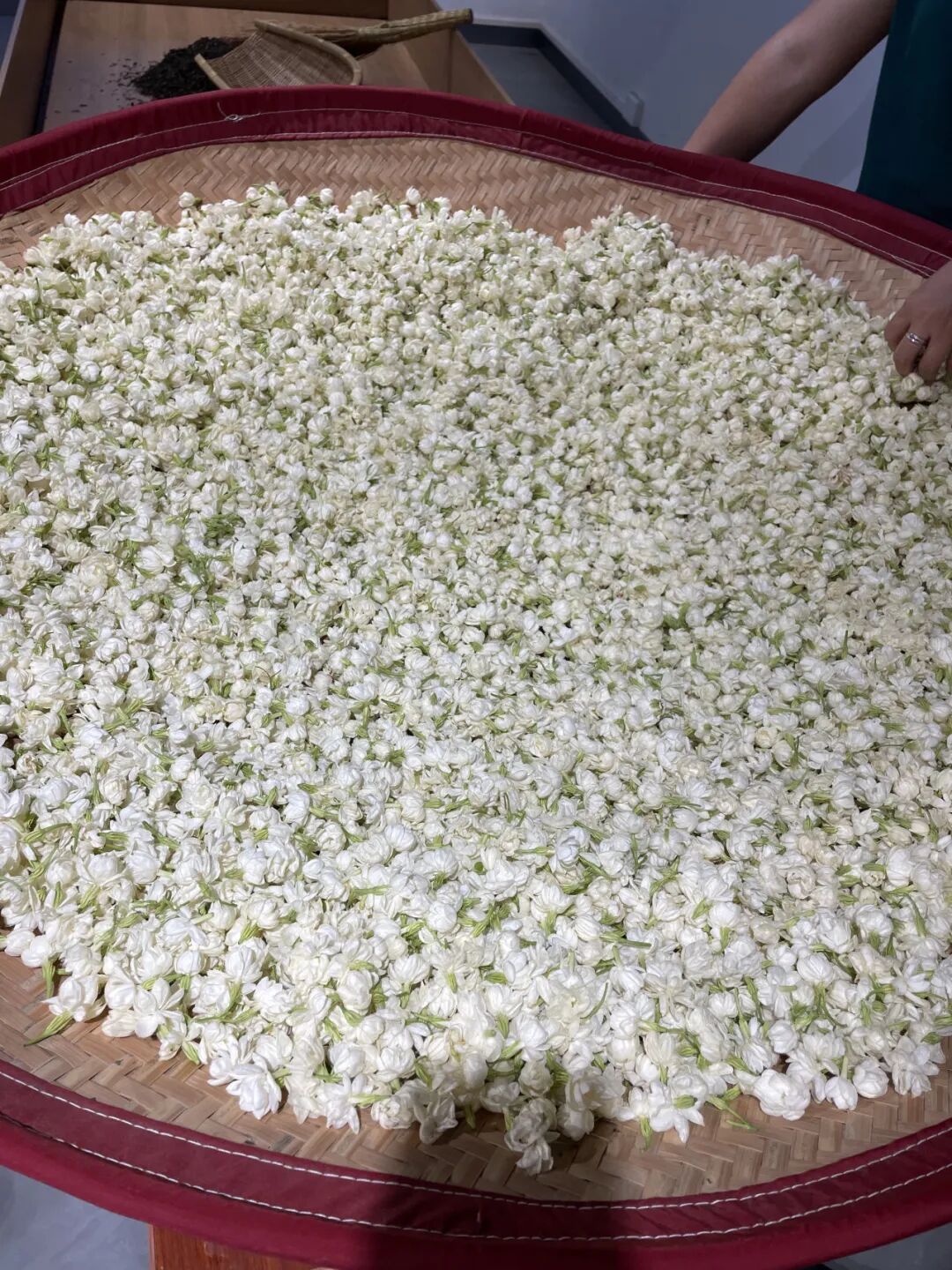
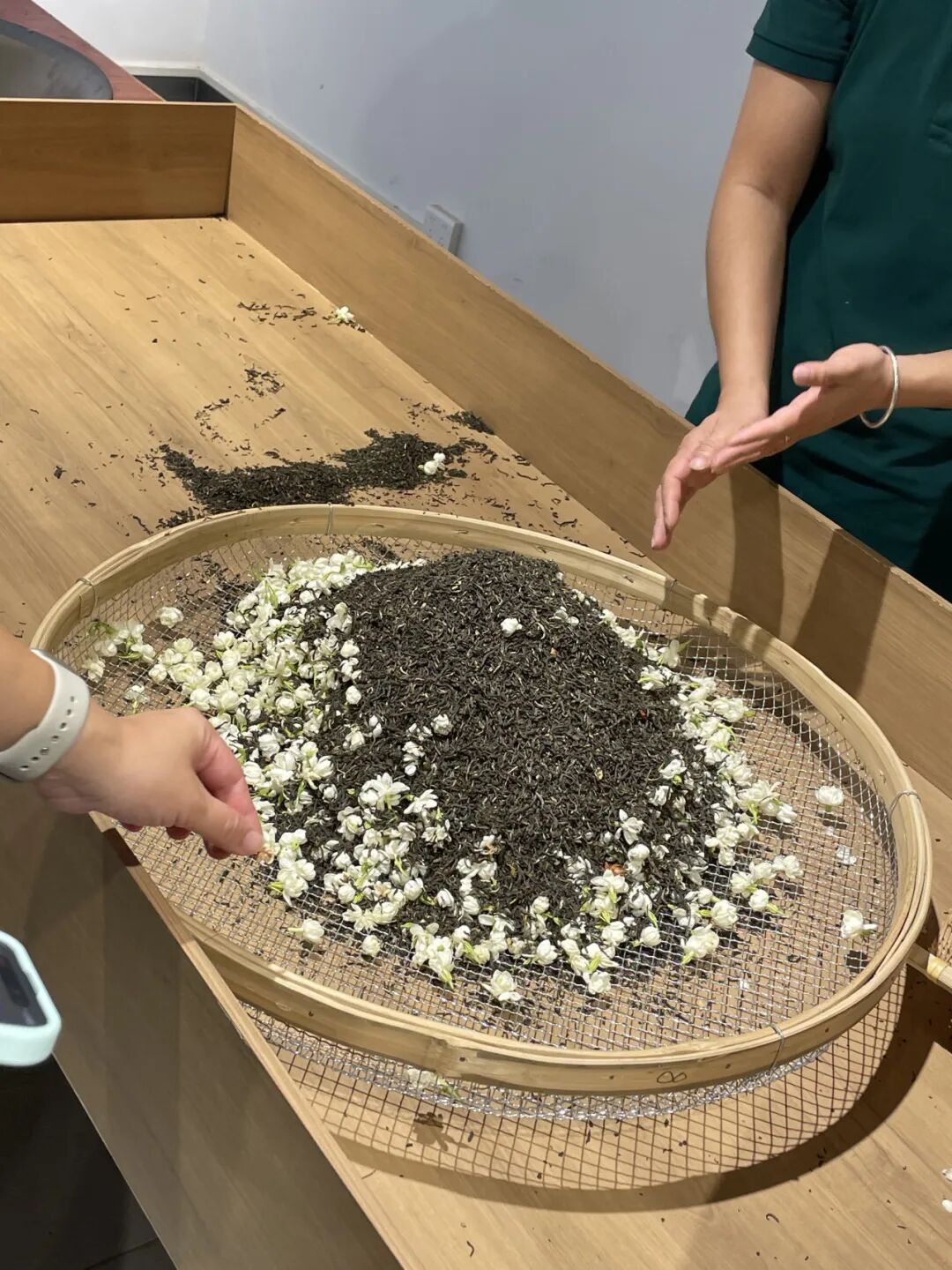
◉ Diagram of flower scenting.
‘The tea you are drinking now is one of our innovation products launched this year—the Clean Gardenia-and-Orchid flavour. It can only be made from leaves picked in the early morning, and it took the master adjusting the processing techniques repeatedly over several years to achieve this fragrance.’
In the reception room of Lüyi Tea Factory, where Auntie Lu works, a staff member introduced the tea to us. We tasted a cup, and indeed it carried the distinctive clean sweetness that the promotional materials promise.
Beyond the glass, neat rows of vivid green tea bushes stretch under the blazing sun, pruned flat with the rows evenly spaced; automated integrated irrigation-and-fertilisation units stand at regular intervals among them. Lüyi Tea Factory claims to possess a “smart ecological tea garden” spanning 3,000 mu and employing over a hundred workers. Automation, standardisation and scale define its production landscape. The keywords on the factory’s display board leap out: “central intelligent tea factory”, “digital precision control”, “scaled supply chain”…. Along the corridor of a demonstration workshop lined with invention patent displays, the manager told us that for over a decade the entire production process has run automatically according to pre-set programmes, and the workforce required has fallen from more than thirty to the current six male workers.
To push further towards an unmanned production process, Lüyi Tea Factory has now begun to “distil” its veteran masters. ‘We record the experience and operational data from the six masters at every processing step, build models from them, and ultimately we can achieve IoT big-data production processes.’
But even as the masters are “distilled”, picking in the tea fields still cannot be replaced. Staff explain that when faced with buds and leaves growing at uneven rates, machines still cannot match the precision of hand-picking—”you still need your eyes to find them”. The sharp eye, the feel in the hands, and the picking speed that Auntie Lu is so proud of, honed over decades, cannot yet be replicated by a machine.
The jasmine fields in Hengzhou are no different. Auntie Huang’s judgement of a bud’s size and how far it has opened comes from the same long accumulation of experience. Such experience is hard to write into a machine’s operating instructions, and it is rarely called “technology”.
It carries no patent certificate, and is seldom singled out as “technology” or “artisan craftsmanship”. But when the flowers bloom again the following year, the aunties still walk into the flower fields, guided by this experience.
“Is It Hard Work for You?”
We asked the aunties: ‘Is it hard work for you?’
Yet they often begin by talking about their bodies.
In Yingde, Auntie Zhong, aged 79, makes a gesture of pinching something between her fingers and placing it in her mouth, saying that when picking tea you can absorb ‘many good things’ from nature. In her telling, the tea garden is not merely a place of labour but one that makes the body stronger. Another tea factory worker also believes that, in the countryside, there is no air conditioning and people sweat constantly, so women workers “rarely have underlying health conditions”.
Yet their labour has never been confined to the tea gardens. Beyond picking tea, some look after grandchildren, some tend the family plot at home, and others care for sick relatives. Auntie Zhong’s husband passed away over a decade ago, and she raised her grandchild single-handedly; another woman worker in her seventies helps look after her daughter-in-law, whose health is poor.
A basket of fresh tea leaves, a sack of jasmine flowers—these can all be weighed. How many jin were picked, how much was earned, how many pairs of hands the machines have replaced—all have clear figures. But human labour cannot always be measured in this way. How many times have backs bent under the blazing sun; how many years must a pair of hands practise before knowing which bud or leaf to pluck, which flower bud to take; how much housework still waits and how much worry still weighs once they leave the garden for home—these forms of labour resist any single yardstick.
Perhaps the question is not simply “how hard is tea-picking”. For these aunties, picking tea is only one thread in a long life of labour. “Hardship” is not necessarily the first word they reach for when describing themselves.
And yet we can still press the question: what gets called technology, and what counts as labour? And what offerings made year after year go unseen precisely because they are so ordinary?
On the Hengzhou Digital Jasmine mini-programme, jasmine flower prices across twelve markets in Hengzhou, Shijing and beyond still tick over every ten minutes. This AI-driven, full-industry-chain service platform—which claims to be “cultivating smart agriculture over the long term”—was developed under the lead of the Hengzhou Municipal Government. It aggregates flower-price information, enabling jasmine growers to trade online in real time amid the price “sprint”. Yet no dataset can predict when the next flood will come, or when prices will plummet once more. In the flower fields, hands that can hardly be priced will, with their own experience and wisdom, endure the next rainy season.
– This is Foodthink’s 846th original piece –

This article was collectively researched and written by the social enterprise Yue Lai Yue Hao, and is a spin-off from the research project “Gendered Impacts of Climate Hazards on Workers in Speciality Agriculture”.
Research and writing team members: Xu Xinyi, Zhang Yinan, Wang Shuzhe, Ma Jinyu, Sun Jingjing, Zheng Shiyin
All tea factory names, personal names and references to villagers in this article are pseudonyms.
Unless otherwise stated, all photographs in this article were taken by the authors.
Editors: Pei Dan, Tian Le
Layout: Xiao Shu
Scan the QR code to tip and support original food writing
▼

▼
Click on the image to read related articles
▼
Click on a keyword to browse more article collections
Seeds | Farming Techniques | Policy | Fermentation | Nutrition | Fruit | Fisheries | Events | Jobs | Food Delivery | Wet Markets | Livestock Farming | Food Talk | Talks | Book Club | Harvest Festival | Smallholder Stories | Climate Change | Rural Development | Cooperative Economy | Urban Farmers | Food Safety | Digital Tech | Biodiversity | Pandemic & Food | False Solutions | Agroecology Internship Programme
Beijing | Hebei | Shanghai | Guangdong | Guangxi | Henan | Sichuan | Jiangxi | Xinjiang | Shaanxi | Hong Kong | Chongqing | Zhejiang | Jiangsu | Guizhou | Taiwan | Inner Mongolia | Philippines | Canada | Russia | Mexico | Italy | United States | United Kingdom | Germany | Netherlands | Thailand | Sweden | Japan