A Full-Time Gig Worker’s Mooncake Factory Days

The Mooncake Factory: Where My Gig Life Began
My hometown is in Chaoshan. When people think of Chaoshan, many picture first the overseas Chinese hometown culture depicted in A Love Letter to Grandma. Many others assume Chaoshan people are born entrepreneurs—even if you’ve been working away from home for years, those around you seem to take it as a given that you’ll go back once you reach a certain age and inherit the family business. The truth, though, is that not every family in Chaoshan has a business to run. There are plenty of ordinary workers like me, stuck in the middle. As my father puts it: “Make salt and it’s not salty; make vinegar and it’s not sour.” This old saying captures a life lived somewhere in between.
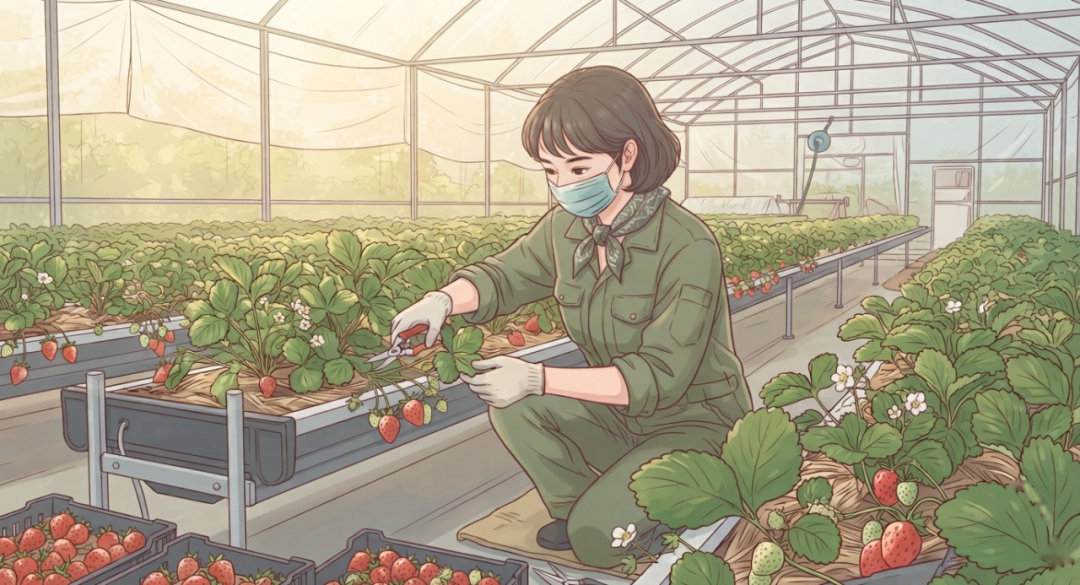
I’m thirty this year, juggling three gig jobs at once in Guangzhou: patient companion, social media operator, and museum guide. I’ve also worked as a strawberry pruner, an extra, a cinema receptionist, and so on. These earnings barely cover my daily expenses, but gig work offers no security, and after a while the anxiety sets in—I’m always thinking of picking up another gig.
I recently found my fourth job. With the Mid-Autumn Festival drawing near, the supermarket downstairs was hiring mooncake tasters. Before starting, I’d imagined customers sampling premium branded mooncakes, but what the supervisor handed me was a few plump, unpackaged bulk mooncakes. When I could make out the brand name on the packaging, my mind suddenly went blank—it was the very mooncake factory where I’d worked back home three years ago.
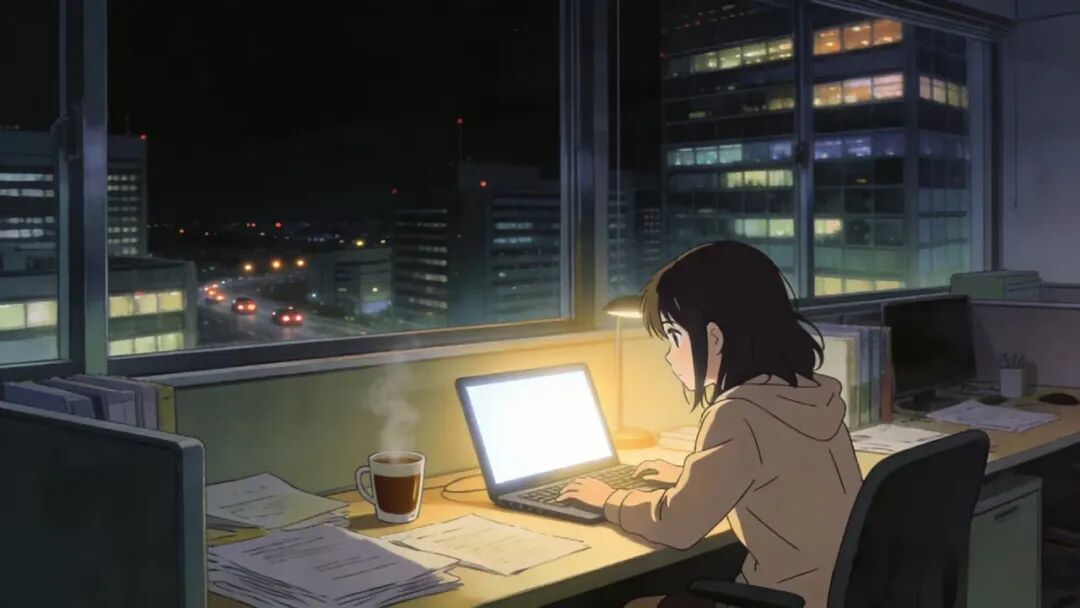
In the spring of 2023, I still had a full-time job in Guangzhou. One evening, while working overtime in a brightly lit office building, I received a message on my phone: my mother was ill. I froze. All the pent-up emotions of a wage slave burst out, and I collapsed at my desk, sobbing.
Not long after that, I returned to Chaozhou and became a full-time daughter for three months. First, I stayed in hospital with Mum for over a month, and after she was discharged, I took her to regular outpatient appointments. Her condition gradually improved; by summer, it had stabilised considerably.
But when I tried to find work back home, I discovered that securing a full-time position was near impossible at such short notice. I happened to scroll past a job listing for a mooncake factory, and with the idea of trying some “light physical work”, I walked through the factory gates, planning it as a temporary stopgap. I never imagined then that this would become the starting point of my life as a gig worker.
Dusting the Moulds at the Mooncake Factory
The factory sits at the very back of a suburban industrial park, boasting an annual output in the tens of millions yet looking as unassuming as a small workshop. The mooncake department occupies the second and third floors, housing five production lines in total—one per workshop. Step inside and the first thing that greets you is the conveyor line. Follow it along and you reach the oven section; open a door and it leads through to the packaging area. In other words, the whole space is laid out like a loop.
It was 45 days before the Mid-Autumn Festival. The supervisor held a morning briefing every day, laying out the day’s quota—say, seven thousand lotus seed paste with salted egg yolk, five thousand dried tangerine peel and red bean, plus a thousand laobing, the traditional Chaoshan lard pastries. For a single production line, the daily target hovered between 10,000 and 20,000 mooncakes.
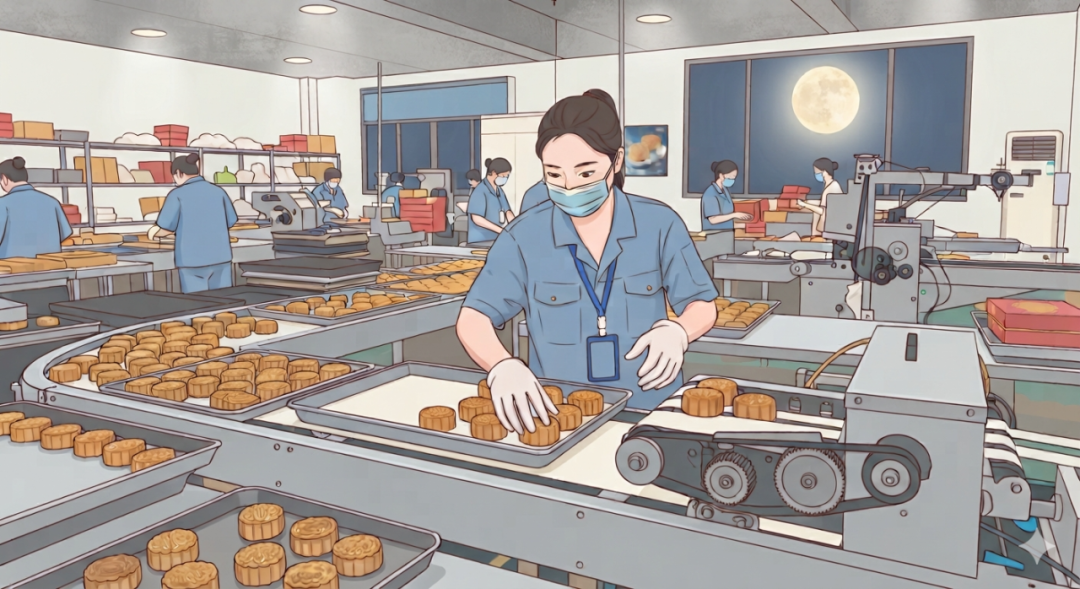
My main job was dusting the moulds—applying flour so that the mooncake mould wouldn’t stick when it pressed down. It sounded simple enough, but in practice it was exhausting. Usually two people handled the dusting, meaning each of us worked through seven or eight thousand pieces a day. At roughly twenty per minute, there was no stopping except for meals. Even the loo had a time limit: back within ten minutes, no exceptions. The facilities were in a corner downstairs, so I was always tearing up and down the stairs in a flap, still having to leave enough time to sanitise myself before re-entering the workshop.
Sometimes the shift was nearly over and we were still far behind on the count. The supervisor would crank the conveyor line up to full speed, and all we could do was push through flat out—no time even to grab a drink. In the next workshop, there was a third-year student from a teacher-training college who’d come to do the work alongside her mum. After a month, she’d lost seven jin (about 3.5 kg). One day I clocked off, glanced at my phone, and couldn’t believe the battery was still at 98%. I couldn’t help but marvel: even a small city has its own “fast pace”.
After half a month of dusting the moulds, the supervisor shifted me to the automatic oil-brushing station. It was the last stop before the pastries went into the oven, and my task was to catch the baking trays. I even christened myself “the Tray Catcher”. Hat, face mask, and uniform buttoned up tight, I stood beside the ovens in the sweltering heat. But the tray-catching lasted only a day before they called me back to the dusting. I breathed a sigh of relief: “I’d rather be back at the moulds!” The rack that held the baking trays was a little too high for me—I was far too short to reach the top shelf.
The Birth of a Mooncake
How is a mooncake made? I’d never thought to find out. Mooncakes used to mean nothing more to me than they do to most people—warm times spent with loved ones around the Mid-Autumn Festival. But then came those days of solid, hands-on work on the factory floor alongside my fellow workers, and the whole process of making a mooncake became etched into my memory.

The birth of a mooncake is one seamless process. First, flour, sugar, oil, and water are poured slowly into the dough mixer, where repeated folding and kneading transforms them into a smooth, pliable pastry skin. Next, the pastry skin and fillings are fed into their respective hoppers on the mooncake machine. As the machine closes gently, the filling is neatly tucked inside the pastry skin, then evenly cut into uniformly sized little balls.
Then comes the mould-dusting stage I know so well. The floured dough portions glide along the conveyor belt to the moulding station, where a gentle press gives them their rounded shape. At this point, water is sprayed over the mooncake’s surface, they’re placed on baking trays, and given a first bake to set the shape. Once out of the oven, a layer of egg wash is brushed on for a second bake—and with that, the mooncake is complete.
The filling machine, moulding machine, and tray-feeding machine are the essential equipment behind mooncake production. The filling is wrapped first, then the shape is pressed out; a worker places the formed mooncakes into the tray-feeding machine, which automatically arranges each one into its baking tray. Even though machine automation has greatly freed up human hands, that doesn’t mean the hard work simply vanishes. Loading the fillings and pastry skins, adjusting machine parameters, dusting the moulds, placing baking trays and spraying water, boxing them up—all these steps still require people.
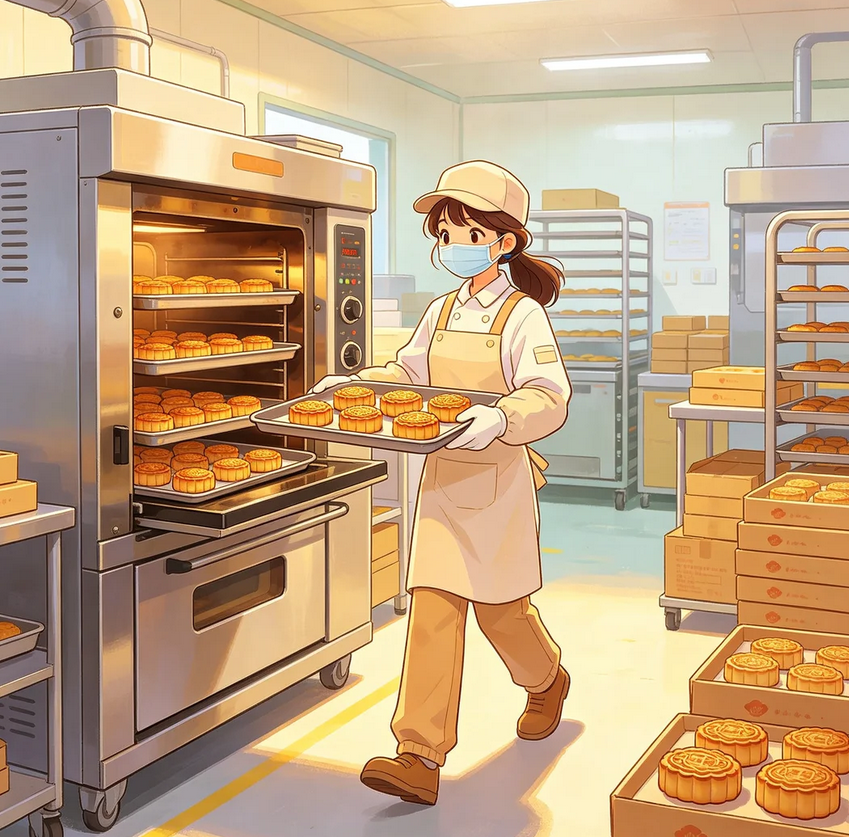
There are many schools of mooncake, and the most commonly cited framework is four major schools and ten categories. Among these, Teochew-style and Cantonese-style mooncakes aren’t all that different. Traditional flavours common to both include lotus seed paste with salted egg yolk, fruit, dried tangerine peel and red bean, black tea, green tea, mung bean paste, and five-nut filling, among others—all of which I’ve made on the factory floor.
Different fillings take turns rolling down the production line, and we simply go with the flow—today this one, tomorrow that one; finish one, and there’s always another waiting.
Mooncakes Machines Can’t Wrap
Chaoshan also has a mooncake called laobing, whose core technique still depends entirely on the handmade craft. In particular, the “lamination” step—the very soul of the pastry—is one that machines still cannot replace.
The classic laobing filling is black bean paste, dense and silky-smooth, perfectly suited to a cup of tea and the Mid-Autumn moon on a festival night. The pastry skin is made with lard and demands repeated folding and rolling to build up many delicate layers: the dough is rolled flat, wound up, flattened again, then rolled once more into a crisp pastry with clearly defined strata. It crumbles at the faintest brush of a fingertip, the outer skin soft and crumbly yet never hard, warm and mellow in flavour, fine and gentle. A machine, however, kneads with uniform force, over-developing the gluten, which turns the pastry skin hard and tough and robs it of that light, “crumbles-at-a-touch” flakiness.
Being rather a “high-maintenance” mooncake, laobing always takes the final slot each day. The old master would shut off the conveyor line and teach us, hand over hand, how to wrap laobing.
Perhaps I had grown so used to the assembly-line rhythm during the day that the sudden slowdown left me not quite knowing what to do with my hands. Mercifully, the chatter swelled back—one person saying this, another chiming in—and the mood warmed a little again.
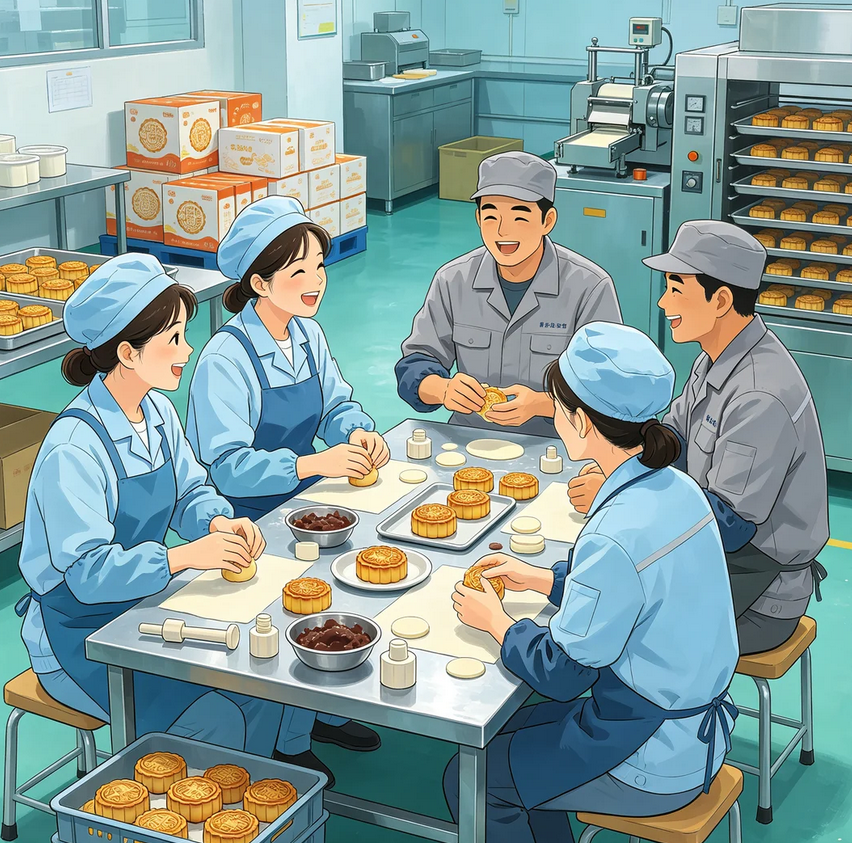
The old master asked me whether making mooncakes was fun. The supervisor jumped in: “Just look at that deadpan look of hers, the one you’d get from someone who has lost all desire to live—you tell me how fun it is.” Not only did I look like I had lost all desire to live, I was clumsy into the bargain, and they ribbed me for being “a hopeless craftsman.” The old master simply couldn’t bear to watch the ugly lumps I was shaping and had to take me through it one-on-one. Luckily, I pick things up reasonably well—after wrapping a few more, I found that practice makes perfect.
When I finally wrapped a laobing that could pass for perfect, don’t let my blank face fool you—inside I was screaming: “Hooray, a natural delivery! And what a handsome, plump, beautiful baby cake it is!”
The Odyssey Period at the Mooncake Factory
How would you describe the sheer exhaustion of working at a mooncake factory? I, who normally lie awake for ages struggling to nod off, was somehow conking out within seconds every single day. Sometimes I’d doze off before even getting a reply out to my evening messages, and at lunch break I could fall asleep sitting right there on the locker-room floor. Those were the best nights’ sleep I’d had in nearly a decade. I once told a friend, brimming with excitement: ‘Tiring, sure, but my fellow workers are hilarious—I reckon I can make it till the Mid-Autumn Festival.’
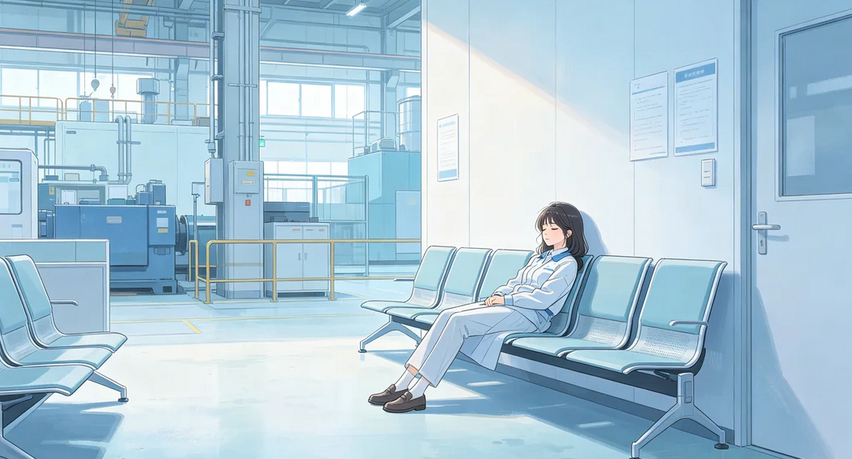
The work was fulfilling. But during those weeks at the mooncake factory, I felt like a fawn lost in the forest, wandering the whole day long with nothing to do, nothing to want. To put it in the parlance of the day: I had entered my Odyssey period.
When the machines in the workshop were running at full throttle, the noise was deafening, and I often couldn’t make out a word of what my colleagues were saying. One time the supervisor said “Inspection complete”, but in all that racket I heard “The police are here”. I caught the scent of gossip instantly and pressed him: ‘Where are the police? What’s happened? Has a machine hurt someone, or is there a fight?’
He laughed so hard he crouched down on the floor. ‘You are the biggest gossip in the whole place,’ he said. ‘They all say a degree student has turned up in our workshop—she looks refined but her personality is completely abstract. And they’re saying you’re the Rain God, since it’s been pouring every single day since you arrived.’ I so badly wanted to ask what exactly was so abstract about me. All I’d done was pretend to be a relative of the boss, hadn’t I? At first the others were half-sceptical, but the more I embellished, the more convincing it got, and for one brief moment I actually caught them looking up in awe.
The days slipped by one after another, and in the end I never made it to the Mid-Autumn Festival. One pre-dawn, I didn’t even bother to clock out—I just scarpered. The streetlamps picked out my faint, quiet sense of being dead inside. That day I’d worked fifteen hours, from eight in the morning right through to midnight, and I’d heard the stretch ahead would be fourteen-hour days on average.
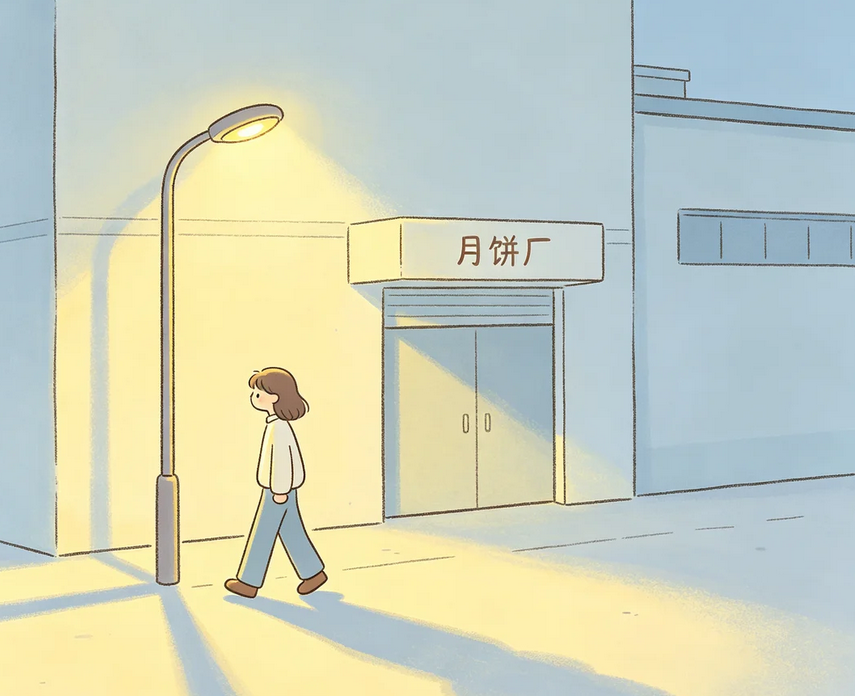
The supervisor asked: ‘Why didn’t you stick it out until Mid-Autumn? Orders pile up, they’d set up early and late shifts, people are rushing round the clock to meet the demand, and then we wouldn’t have to work overtime.’ The truth is, the supervisor was a genuinely decent person, but I simply couldn’t go on any longer. I can barely fathom how the full-time employees manage to keep it up, day in and day out.
Among the workers, there were two girls from a vocational nursing school who’d come together over the summer break to earn a bit of pocket money. The pair of them would brag about their three-year friendship to anyone who’d listen, utterly convinced it would last forever and be indestructible. They’d also ask me what the world was like in your twenties, and whether, once they reached the age I was now, life would feel a little freer. I’d mumble something vague: ‘A bit freer, I suppose, but new constraints come with it.’
Monkey Bro was the team leader, which counted as a supervisory role in the mooncake department. On my first day, he taught me how to dust the moulds, and when new workers joined other workshops, he’d go across to guide them too, though he mostly stayed on our side. He said he’d been a Wu Bai fan for twenty years and hoped to catch a Wu Bai concert in his lifetime. I said: ‘That can’t be so hard to pull off, surely?’ He smiled and said: ‘At my age there are so many ties. You’re still young—whatever it is you want to do, go and do it.’
Hearing such a reflection, I didn’t know for a moment what to say. Everyone longs for freedom, yet everyone has their own real life to face.
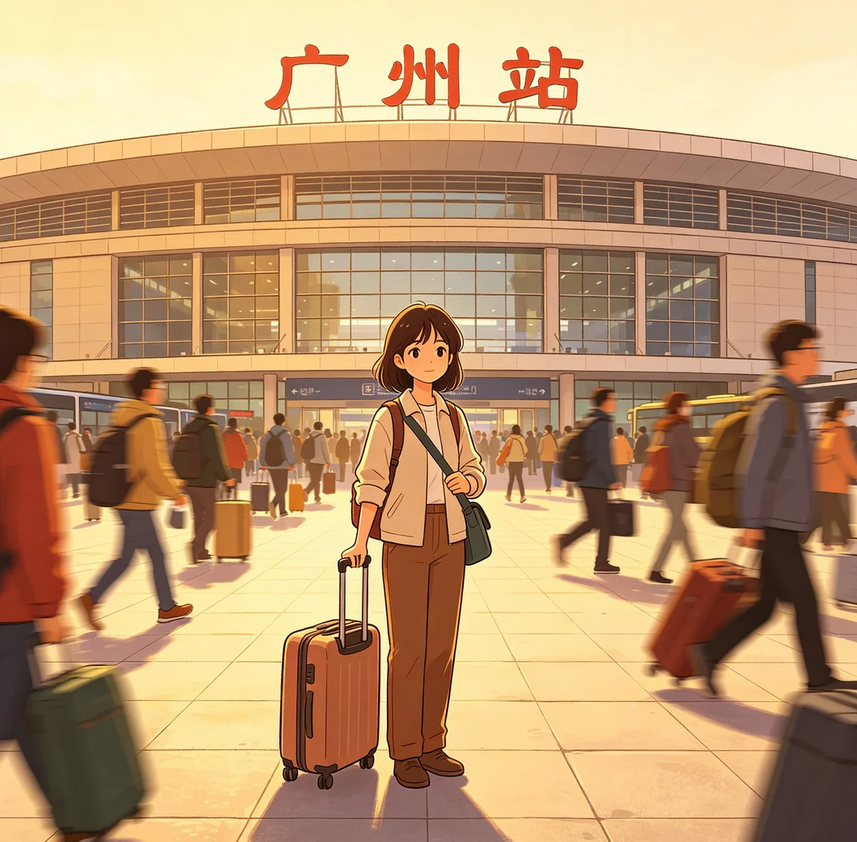
After leaving the mooncake factory, I chose to head back to Guangzhou. Since then, apart from joining a tutoring company that went bust within a year, I’ve essentially been making a living through odd jobs. Whether my present way of life is a good thing or a bad one, I couldn’t say. Perhaps being stuck in between could also be described as a kind of equanimity toward life.
– This is Foodthink’s 845th original piece –
Foodthink
Author
Huang Yang
A small-town girl who keeps a koi called Huang Xiaoyu. Between four odd jobs, she occasionally writes a little fiction.
All images in this article were created by Road using AI.
Editor: Yuyang
Layout: Xiaoshu
Scan the QR code to tip and support original Foodthink content
▼

▼
Click the image to read related articles
▼
Click the keywords to access more article collections
Seeds | Agricultural Technology | Policy | Fermentation | Nutrition | Fruit | Fisheries | Events | Jobs | Food Delivery | Market | Livestock | Food Talk | Sharing Sessions | Reading Groups | Harvest Festival | Smallholder Stories | Climate Change | Rural Development | Cooperative Economy | Urban Farmers | Food Safety | Digital Technology | Biodiversity | Pandemic & Food | False Solutions | Ecological Agriculture Internship Programme
Beijing|Hebei|Shanghai|Guangdong|Guangxi|Henan|Sichuan|Jiangxi|Xinjiang|Shaanxi|Hong Kong|Chongqing|Zhejiang|Jiangsu|Guizhou|Taiwan|Inner Mongolia|Philippines|Canada|Russia|Mexico|Italy|United States|United Kingdom|Germany|Netherlands|Thailand|Sweden|Japan