Barrelling Through Fresh Food Supermarkets Like a Delivery Rider

Foodthink Says
Whether people say “flexible employment is a perk”, or “supermarket order picking is paid weight loss”, there is always a romanticised fantasy about gig work. In reality, however, unstable employment relationships often subject gig workers to far harsher exploitation, inflicting far more serious harm on their bodies.
In this conversation, two order pickers explain: although they work themselves to the bone every day for fresh produce e-commerce platforms, risking injury in the process, some of them are bound to their store by nothing more than a “pure business cooperation relationship”.
Xiaoxiang and Freshippo are no longer places to shop — they are factories thrumming with labour and the noise of machines. Order pickers are guided by algorithms, barrelling through the sales floor like delivery riders, existing in a different parallel universe from the customers brushing past them.
Picking items for online customers — a task that looks so simple — in fact involves all kinds of hardship that no one outside sees. Even so, order pickers still feel an impulse to huddle together, to find solace in one another, to coax a little warmth out of their transient lives.
These experiences are happening for real, every single day, in some fresh produce warehouse in a corner of the city. No one has the right to reduce gig workers to mere objects for their romantic imaginings.
– Order Picker –

Yakou | Dual order picker at Freshippo and Xiaoxiang. No full-time job — gig work that calls on both mind and body. I have recently returned to fieldwork and creative writing. In a world full of regret, this is one small light no one can take away.
Zhigu | I worked as an order picker at Freshippo for three months. The sorting work was the first thing that made me feel pain right down to my toe bones — hence the name Zhigu.
“Barrelling Through the Supermarket Like a Delivery Rider”
Yakou: At Xiaoxiang, you’re just in a warehouse, picking your own orders. But at Freshippo, especially on the sales floor — the supermarket area — customers are shopping too, so sometimes you need to deal with them. There are moments when I’m rushing to pick items and a customer will come up and ask me a question. I deliberately try to avoid them. If I sense that someone is looking for something and about to open their mouth to ask me, I’ll dart off to pick something else instead. I wonder if you’ve had a similar experience working on the sales floor?
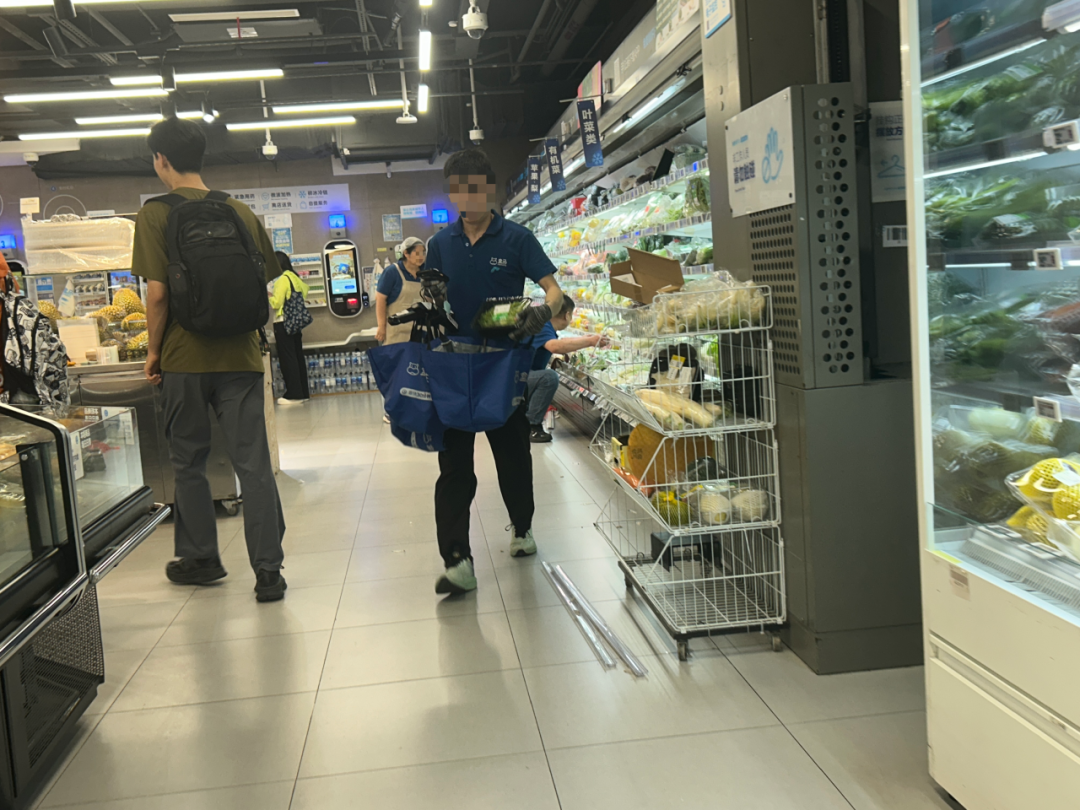
◉ If you visit Freshippo often, you may have noticed, if you look closely, a group of people darting briskly between the shelves and the crowds — those are the order pickers. Photo: Yuyang
Zhigu: My state of mind on the Freshippo sales floor is one of complete disregard for the in-store customers — to me they are simply obstacles to steer around. I make no eye contact with any of them. But even so, there are still people who grab hold of me to ask questions. If I’m busy at the time, I simply refuse outright. Sometimes, to try and explain, I’ll say, “We handle online orders, and we’re really pressed for time”, and I’ll casually show them the countdown on the PDA — the one I never actually look at. I can feel the customer’s bewilderment, almost a silent judgement: “Isn’t your job essentially about serving customers? And you’re telling me you’re too busy?”
But there’s nothing I can do about it. Later I reflected that it is really Freshippo mixing different business operations into the same space — we all live in parallel spacetimes. I only need to be accountable to my data. My task is to find the items I need to pick in the supermarket, and the demand for high efficiency does not allow me to inhabit the supermarket as an offline space. I barrel through the supermarket, very much like a delivery rider barreling through traffic — this life-and-death race against the clock is simply part of the job. In my objectives there is nothing but the order and the route; I cannot afford to register what is happening around me.
So I hope consumers can understand: stopping an order picker in the store to ask them something is really the same as pulling over a delivery rider on the road to ask for directions. More than once I’ve bumped into a customer, and I am genuinely sorry every single time, but the feeling in the moment is very much a delivery rider’s: I’m sorry, but I have to keep running. Sometimes I feel as though my soul has left my body — especially when there’s an order backlog. My heart races and all I can see are the orders in my hands. The store schedule can be light one day and heavy the next, and the sales floor often saddles me with an hour’s worth of backlogged orders to clear. In that hour you have to pick like a madwoman — sometimes there are only two of us picking on the entire sales floor, and all you can do is barrel through, running flat out.
“Freshippo Feels Like a Factory”
Yakou: Customers browsing Freshippo on the sales floor could hardly imagine what it is like in the back-of-house. Down there, Freshippo feels like a factory.
My overall feeling about working in the back-of-house is that during peak hours it is incredibly hectic — it seems like everything is in motion. The overhead conveyor chain stretches all the way from the sales floor into the back-of-house, and there is always something moving overhead. The rumble of the conveyor chain, the thud of order pickers running, the clatter of packers setting things down, the grinding of various machines, the whir of fans, the rush of air from the air conditioning — it all pours into your ears.
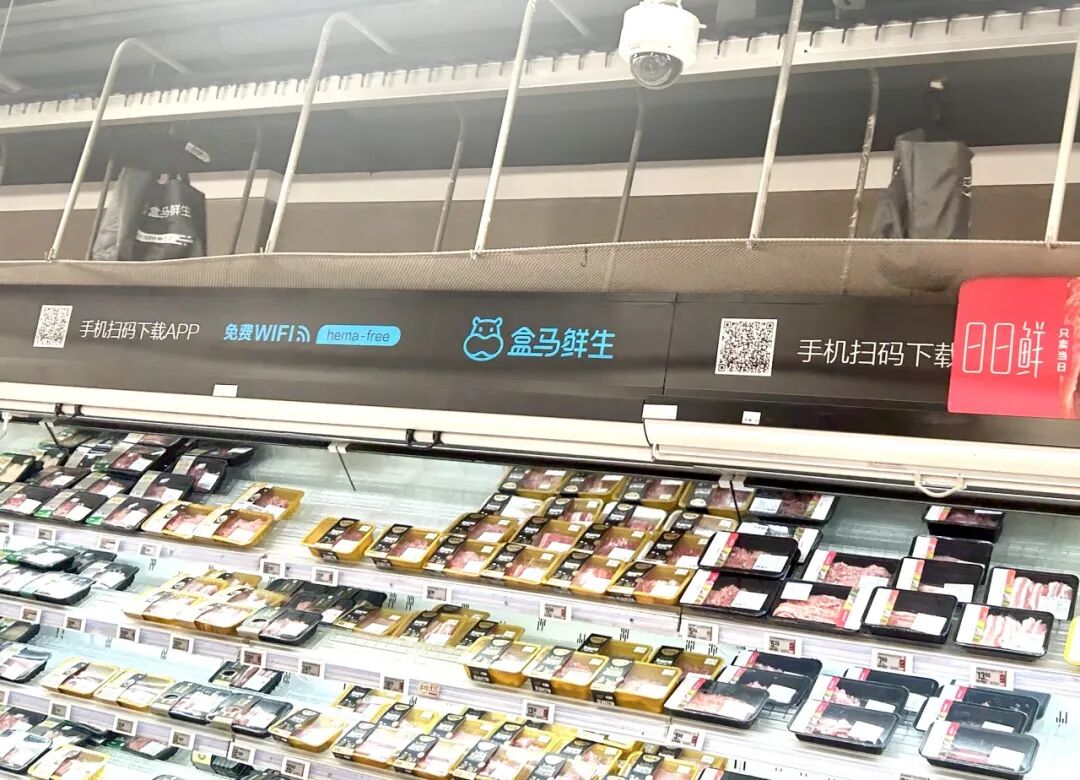
◉ Above the shelves in a Freshippo supermarket, an overhead conveyor chain sweeps fabric bags swiftly along, running from the sales floor all the way to the back-of-house warehouse that customers never see. Photo: Yuyang
Yakou: The moment you step into the back-of-house, you are hit by a strong smell of dust — probably from all the boxes and machinery. Spend an afternoon or an evening in that warehouse and your eyes start to feel really uncomfortable, because it is quite dim and completely enclosed. I had a similar experience working at Xiaoxiang.
Zhigu: When I first started working on the sales floor, I would occasionally venture into the back-of-house, and I always thought the people there moved at an impossible speed. Once I had grown used to the back-of-house rhythm myself and came back to the sales floor, I was still moving very fast — especially around customers, where I would be darting past them constantly. Everyone had fallen into this super-fast rhythm and learned how to keep from falling over in all sorts of positions.
There is another very distinctive sound in the back-of-house — the banging of freezer doors. There are lots of commercial freezers, and people yank the doors open, grab what they need in a flash, then let the doors swing shut on their own, so there is this constant back-and-forth of bangs. Then there is the sound of slapping through the thick curtain when going in and out of the cold storage: “SMACK!” going in, “SMACK!” coming out.
The mechanical hum of the conveyor belt is almost always on — I actually recorded a little clip of it because I felt it was a sound unique to that environment. All kinds of fans are running constantly too, including the extraction fans in the ambient zone and the dedicated fans for the cold storage. Once at our place, a cold-storage fan suddenly burst, letting out a piercing screech — I thought my ears were about to give out. There was this strange experience: the place seemed like it was about to explode, and you had no idea whether it really would, but you had already started picking that order, so you had no choice but to carry on.
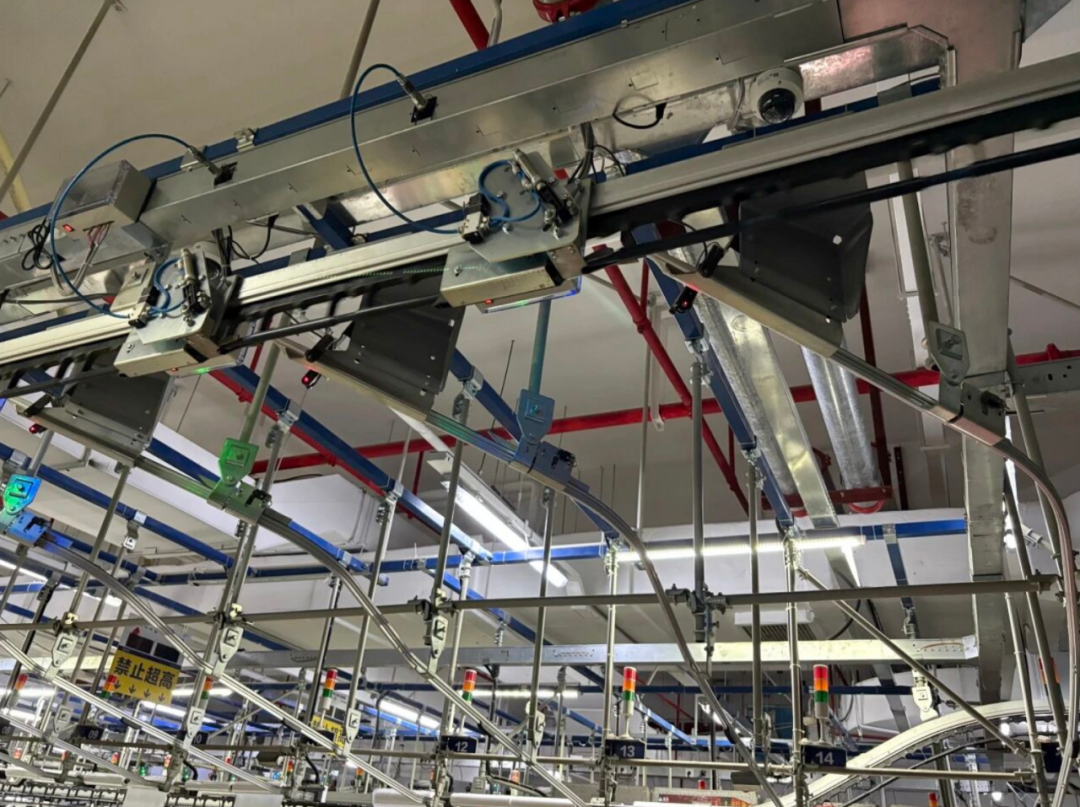
◉ Various conveyor machinery in the back-of-house warehouse. Photo: Yakou
Yakou: You mentioned earlier that a staff member who was very kind to you is deaf. Does Freshippo have any particular hearing requirements when recruiting, or are there dedicated positions for hearing-impaired employees?
Zhigu: I am not sure. In the back-of-house, I have seen two or three employees with hearing impairments. Back-of-house work actually requires very little talking, and among the few highly efficient “top pickers” I mentioned, two were hearing-impaired colleagues — they were very efficient and very capable. But on the sales floor, it does make a difference. When they used to work out there, whenever communication was needed, people would not just assume they could not speak — they would get shouted at because of it, and they even encountered situations that carried a threat of physical confrontation.
Yakou: From that angle, order picking is like an assembly line that barely requires verbal communication. I told you last time — a friend of mine said that the employees at certain supermarkets or McDonald’s are rather like assembly-line workers disguised as service staff.
Zhigu: This job feels more like a fusion of platform labour and factory management. The factory side is that managers put direct pressure on you, telling you exactly what to do, with strict attendance requirements and all sorts of rules and regulations. But order pickers also carry another layer of pressure. I have noticed that very few people get fired outright — it is more to do with how the system prices your work: if you pick fewer orders, you barely earn enough to live, so you just leave on your own. That is really the logic of a lot of platform labour, very similar to delivery riders — pick fewer, earn less, grab the next order when it comes through, then randomly stop somewhere to rest. Doing order picking at Freshippo gives you the feeling of having suffered under both the platform and the factory at the same time.
Yakou: Another thing I thought of is hygiene. When we are picking, we toss everything into the same reusable bag, which means everything else picks up that smell too. I find it rather unhygienic. Some customers buy pre-cut fruit — in that case, there is a risk of bacterial contamination as well. Some bags smell pretty bad. I initially thought they should not be used, but the staff member next to me said they might have held aquatic products before and could still be reused.
Zhigu: Yes. And it is not just that — when packing, everything goes into the same packing crate, and those crates genuinely stink. The water packs and ice packs all smell too. They slap these ice packs directly onto the original packaging of every fruit and vegetable, so whatever you receive has this smell clinging to the surface. It is so bad that every single time I finish packing, I have to go and wash my hands. I think it is actually a serious hygiene issue, but at the store I worked at, every single order was handled that way.
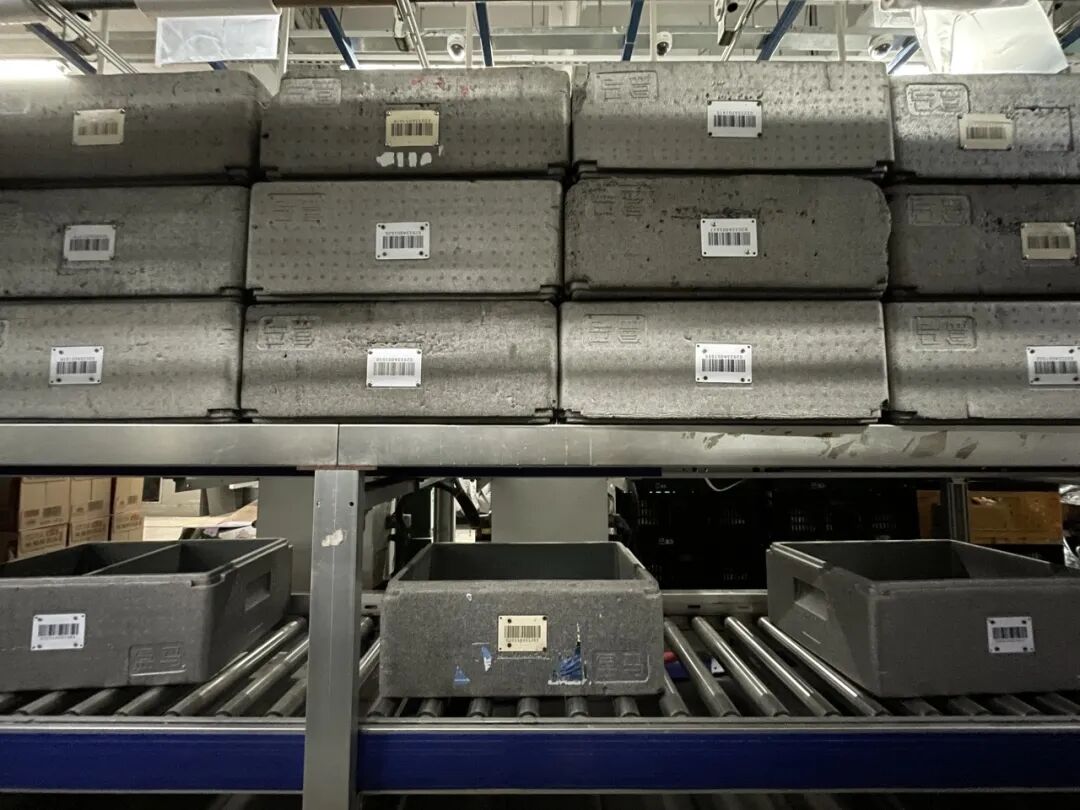
◉ The packing crates used to transfer goods on Freshippo’s packing conveyor. Photo: Zhigu
Zhigu: I find it really ironic — people say they prefer shopping online because it feels cleaner, that wet markets are dirty. They really ought to know: it is just that fresh produce platforms have the means to hide the dirty bits away.
Yakou: Exactly. Even though we are darting around right next to the customers, no one is actually going to lean in and sniff what our reusable bags smell like.
Injury Is Inevitable
Zhigu: Do all the frozen items have to be fetched from the frozen storage room?
Yakou: Yes, because you have to dash in and out in a very short window to grab stock, and all that constant switching between cold and warm makes you quite prone to getting ill. I think that is probably why I fell ill back then.
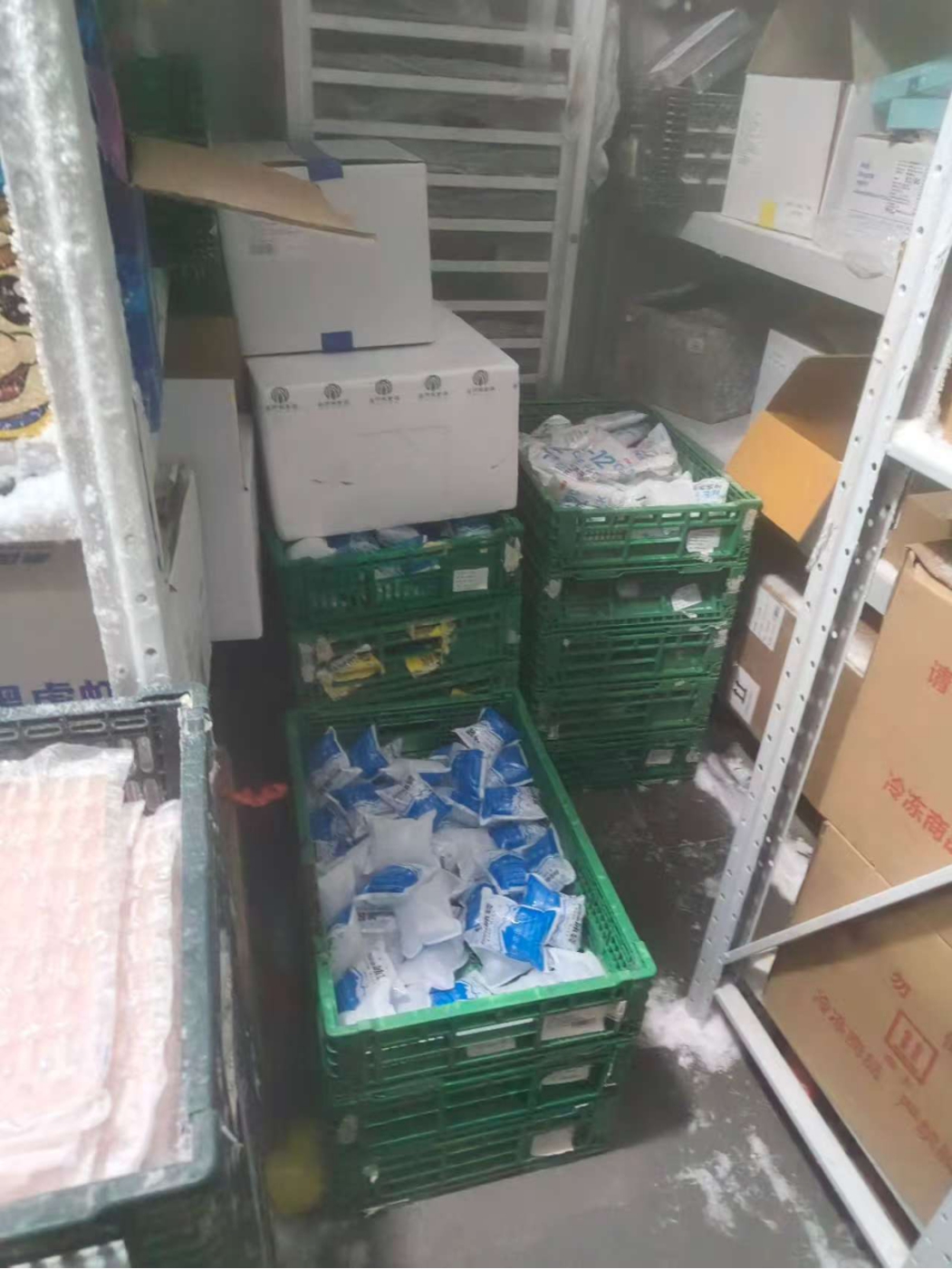
◉ The frozen storage room in the back-of-house is bitterly cold, and many order pickers are reluctant to go in and pick from it. Photo: He Siqi
Zhigu: At my Freshippo store, if you are lucky, you might not need to step into the frozen storage room once in one or two hours of a whole day.
There are lots of commercial freezers in there, and most of the frozen goods — ice cream lollies, dumplings and so on — are kept in the freezers, so you just open the door and grab what you need. But once you have to go into the frozen storage room to find an item, you will usually be stuck in there for quite a while; two minutes is perfectly normal. The storage locations in the frozen storage are completely inaccurate, so most of the time you are rummaging through boxes and shelves in sub-zero air, and you may have to haul boxes down from the shelf above your head. Sometimes a box comes crashing down on you — it is pretty chaotic.
Yakou: That sounds agonising. Spending two minutes in the frozen storage is sheer torture.
Zhigu: So I used to tap “Find Item” on the PDA. I felt they had no right to expect me to spend that long searching in there, and it was not my fault the storage locations were not tidied up. Once you tap “Find Item”, the floor supervisor (the manager) is the one who comes to look for it.
Yakou: You mentioned earlier that there is water on the floor. Doesn’t that pose a safety risk?
Zhigu: I am constantly worried about falling over. Because the very first day I started, I knew that if you fall, you bear the consequences entirely on your own — the place will offer no support whatsoever, and you might even lose your job outright because of it. I also worry it could affect my ability to work and move around in the future. I am extremely careful while I work, but I still fell once.
As for the floor getting slippery from water, I actually managed to stay on my feet countless times. Even though I was lugging something heavy and had to power through a wet, slippery patch and come to a halt, that was something of a lucky break. The one time I genuinely fell, it was because I had to sprint into the cold storage room at full speed. There was a thick, floor-length curtain hanging at the entrance, and on top of that the temperature difference had made the floor especially slick. I caught my foot on the curtain and went flat on the ground, landing on my knee.
Yakou: Did you get injured?
Zhigu: Just bruising, nothing serious afterwards. When I talked to other staff about similar experiences, a young lad suddenly rolled up his trouser leg to reveal a bleeding gash. He said the picking area is littered with crates, and if you fall you can easily slash yourself on the edge. That time he even split his trousers — the tear in the fabric was the same size as the wound underneath. As he was talking, a middle-aged woman who had been working there for years piped up from the side: “A little scratch like that is nothing.” Her arms were covered in bruises of every shade, and she added casually that she too had fallen flat on the ground once coming out of the cold storage, said in a perfectly matter-of-fact tone. Several of the veteran workers had been through something similar. I was thinking to myself: surely everyone gets injured, so why does no one seem to be bothered by it?
Yakou: That reminds me of when I was at Xiaoxiang. The floor in the cold storage was more slippery than outside, and my veteran trainer specifically warned me to be careful. Another major safety hazard at Xiaoxiang was climbing the shelving. The racks are tall, so if you need to reach something on the very top, you either fetch a stool (which is a waste of time) or step on the bottom shelf and stretch upwards, or just pull the top shelf down towards you. But if you do not get a firm grip, the entire box comes crashing down. I am not sure whether the back-of-house at your Freshippo has the same problem?
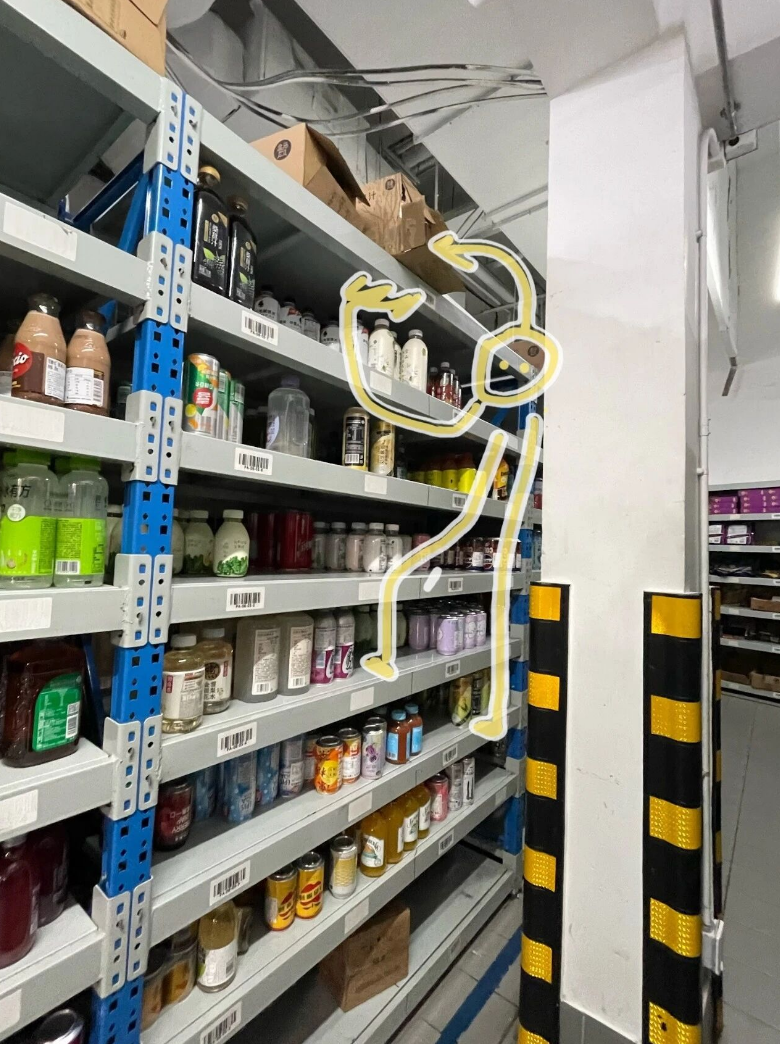
◉ An illustration of an order picker running up to reach a high shelf. Photo: Zhigu
Zhigu: I laughed when I read your piece about climbing the shelving — turns out everyone does it. The veterans make it look effortless: one hand hooks onto the rack, one foot steps up, they grab the item and hop straight back down — the whole sequence is fluid as water. At first, I had to set down the heavy bag I was in the middle of picking, put the PDA on the shelf, and free up both hands before I could start climbing. I have actually come to the point where I do not even consider climbing the rack a major safety hazard any more, because it has become a routine part of what I do. Actually, saying it out loud makes it sound more dangerous.
Yakou: If you lower the racks, it probably means you need more of them. If you cut off the top tier, you need a larger storage footprint. For the company that means higher rent costs; for the order pickers the running range grows too, so if the time limit stays the same, the problem is still there.
Zhigu: I feel the company has not given this a thought at all. They simply assume everyone can manage it, and in reality everyone is pushing themselves to the breaking point just to get the job done. The things I finally felt I had “gotten through” are things that many of the people who left either could not or did not want to get through.
I used to keep saying to the veteran workers, “How did this one fall again?” or “That’s not reasonable.” They would not engage with me at all, just saying it was perfectly normal — get used to it and it is fine. Now I notice my own words are starting to sound like theirs…
The job posting says none of this, but in practice you have to: walk that many steps a day; have strong enough leg muscles; be in good physical shape; have a stomach that can go without food and not miss a beat; be able to climb the shelving; have all kinds of stress tolerance… Fail at any one of those and you simply cannot keep going.
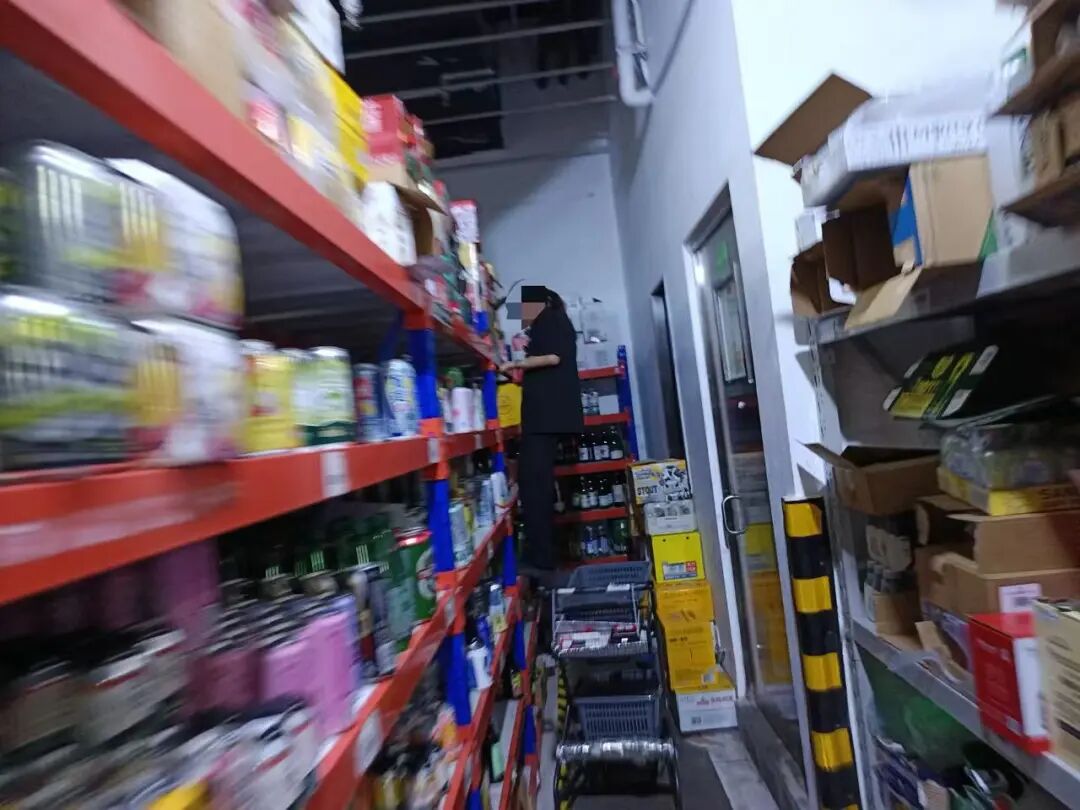
◉ A JD 7FRESH order picker climbing up to fetch stock from a high shelf. But driven by the same pursuit of efficiency and market share, different platforms force order pickers into the same dangerous movements. Photo: He Siqi
Yakou: Yes, but what all this brings is very direct physical damage. I think it could easily be classified as a work-related injury — it simply never gets written into the contract.
Zhigu: What makes me really uncomfortable is that the way people get injured in order picking is different from working in a factory. In a factory, if your hand gets pulled into a machine, it is obviously a work-related injury — whether you get compensated or not is another matter, but at least it is unambiguous. In order picking, though, I think injury is virtually inevitable for everyone. Yet the narrative is always that you tripped while running, you were not paying attention, you bumped into something. The risk is pushed entirely onto the individual, and it does not look like the kind of direct, dramatic harm anyone would notice.
One person told me they had fallen while running and the doctor said their ligament was on the verge of tearing completely if they had waited any longer — but they just kept going and carried on with shifts. And then there was someone who, while running around taking orders, grew more and more lame, their efficiency dropping lower and lower, until one day they simply vanished.
I myself once had a slight hairline fracture in my ankle. The longer I did order picking, the more that spot started to hurt, then another part of the ankle, then the next, until it felt like every joint was at its breaking point. One colleague developed blisters on the soles of her feet; she burst them and carried on working.
This intensity has already crossed the limit for a great many people — it is just that everyone’s weakest link is different: for some it is the joints, for others the respiratory tract, for others still the stomach and intestines. But at this intensity, no injury can heal in time, and the long-term risks are always there.
“Pure Business Cooperation Relationship”
Yakou: I would like to talk about work agreements next. I am asking because when I signed my agreement with my Freshippo store, I noticed it shares some similarities with Xiaoxiang Supermarket. I actually signed a contract with an outsourcing company, and it says that my relationship with the dispatch company is a “pure business cooperation relationship” between “equal civil subjects”. If anything happens, the Civil Code applies rather than the Labour Law. Xiaoxiang says the same thing.
At Freshippo, we are required to buy commercial insurance. I asked my supervisor, and they said it would not be deducted from my pay, though I am not entirely sure about the details. The agreement also states that there is a six-month “business observation period” — if I am found not to meet the requirements, the agreement can be terminated. It sounds a bit like a probation period, doesn’t it? But with a different name, and six months is incredibly long. What is your agreement like?
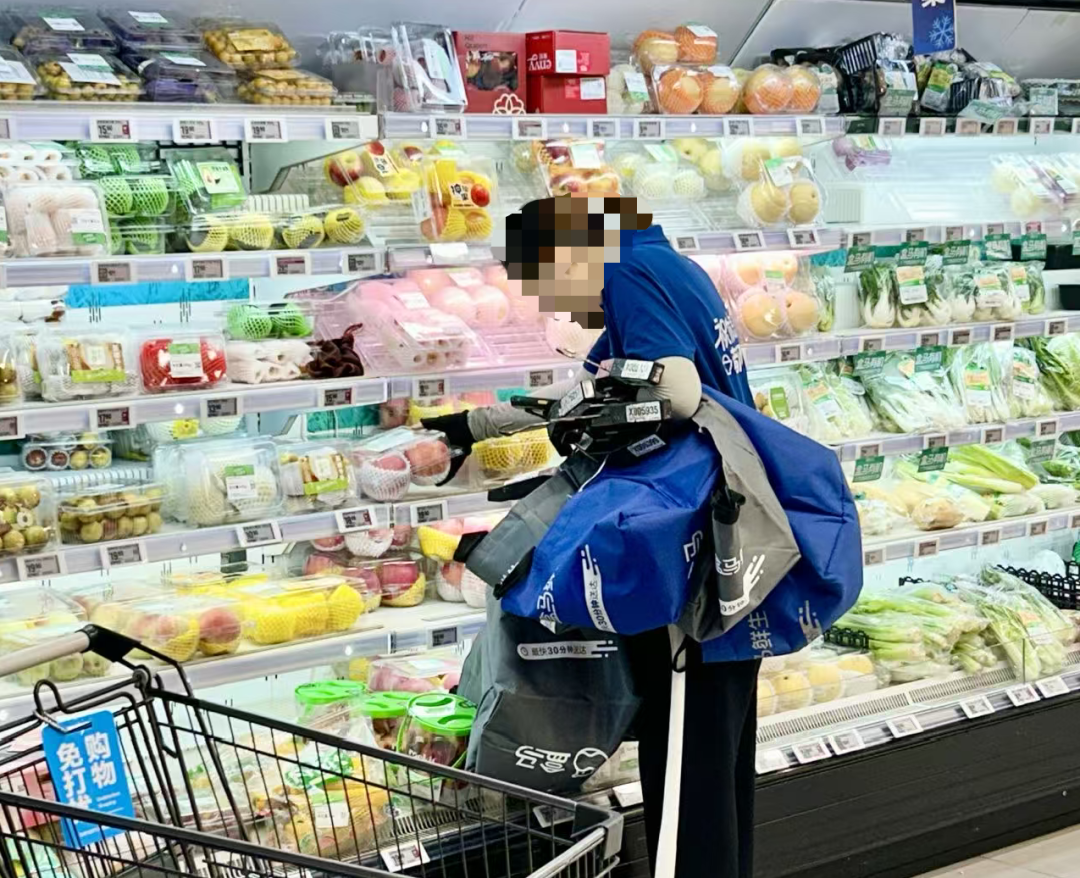
◉ An order picker carrying four to five bags at once while picking. Photo: Yuyang
Zhigu: My agreement is the same in nature as yours — it is written as a contract for work and service outsourcing. The contract explicitly states it is an “equal commercial cooperation relationship that does not constitute any form of employment, labour, or labour dispatch relationship”. The clause before that says “Party B is an independent contractor and Party A does not exercise labour management”, yet the very next sentence requires me to undertake to follow all of Freshippo’s work arrangements, abide by work standards, and diligently complete tasks such as picking and packing. It is genuinely absurd — on the one hand I promise to complete picking and packing tasks for Freshippo, and on the other I promise that no employment or labour relationship exists between us.
At my Freshippo store there are two types of contract: a crowdsourcing contract and a tripartite contract. Only veteran workers who have been there a good while get upgraded to a tripartite contract, which is meant to give them a bit of protection — it includes triple pay on public holidays, though there is no weekend supplement. I am on a crowdsourcing contract, not even a tripartite one. It is rather like a Meituan Crowdsourcing delivery rider, except not only are my start and finish times fixed and I cannot choose which days I work — I can barely take a day off at all.
Yakou: How long do you have to work before you get upgraded to a tripartite contract?
Zhigu: For part-time staff, it would never happen at all. Only full-time workers have a chance, and even then only a very small number. Everyone I have seen who got one had been there more than six months.
Going back to the insurance you mentioned — on my side, the commercial insurance is deducted straight from my pay, thirty-five yuan a month. Your supervisor said it is not deducted from yours, which probably means each store works with a different staffing agency and they each set their own rules. Anyway, they told me it comes out of my wages.
Yakou: That is actually quite similar to what happens with delivery riders — the insurance is deducted from the money they are already owed.
Zhigu: My agreement does not mention a business observation period. New starters here have a protection period during which you can earn a reasonably decent wage. I have seen people coast through a whole month without being let go.
Yakou: Is the protection period one month?
Zhigu: This period keeps changing. One moment it is a month, then it becomes fifteen days — no advance notice, they just change it. Before I left, it changed again: now during the protection period, pay follows a tiered rate structure. Originally, within those thirty days you only had to meet a slightly lower target than everyone else to receive the protection period wage. Then it became: pick this many on day one, that many on day two, day ten, day twenty… the target keeps going up all the way to day thirty, forming a staircase.
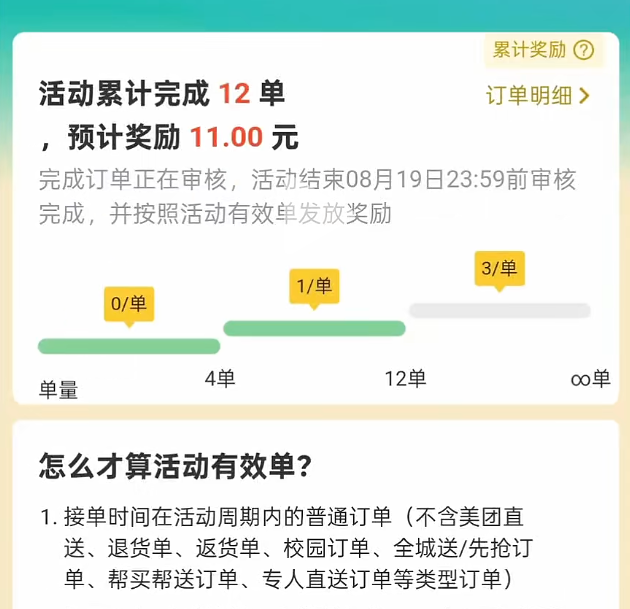
◉ In the previous article, Yakou and Zhigu discussed the tiered pay model that fresh food e-commerce platforms impose on order pickers, where different order volumes correspond to different pay tiers — effectively a disguised form of wage reduction. Tiered pay has become widespread in platform gig work. Foodthink found in earlier research that delivery riders also face tiered pay structures in their wages and heat allowances. Photo: WeChat Channels @文冉旭
Warmth in Motion
Yakou: I think the atmosphere created by different working models is quite different. Overall, at Freshippo — at least on the sales floor — I feel more willing to ask colleagues for help. For instance, if I cannot find stock, I will go and ask a stock clerk or the floor supervisor. I worry about being judged, but I still go and ask, and the veteran colleague who trained me really stressed that you must speak up and ask.
Whereas at the Xiaoxiang where I used to work, you could get through an entire afternoon without saying a single word and finish all your work on your own. Something that unsettled me at Xiaoxiang was that when you cannot find stock or accidentally knock something over, very few people come to help spontaneously. I also did not dare to ask others for help, so I started wondering: if someone else were in the same situation, would I go and help them?
At Freshippo, something happened that really warmed me. That day I picked up an order with quite a lot of items — over a dozen, and fairly heavy — and I was really struggling to carry the bags. Just as I was continuing to pick, another order picker suddenly walked over, handed me a bag, and said, “This bag is too full — you can swap it for another one,” and even showed me how to request a different container on the machine. These were things the person who first trained me had never taught me, yet they saw my predicament and came to show me voluntarily.
I was incredibly grateful, because I had not asked them for help at all — I had not even noticed them. Of course, this is not to say that Xiaoxiang’s staff are bad or selfish. It is simply that the working atmosphere at Xiaoxiang makes people carry quite a strong sense of competition while on the job.
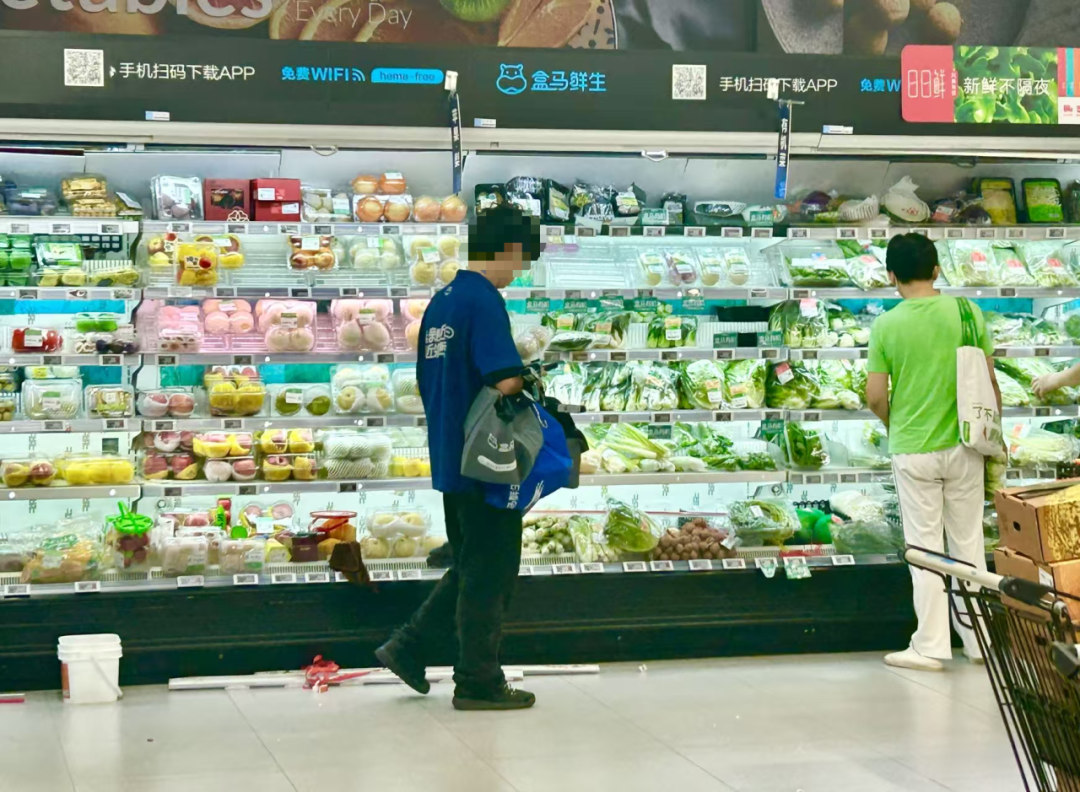
◉ An order picker searching for stock on the Freshippo sales floor. Photo: Yuyang
Zhigu: We certainly do have to cooperate with others; communication among sales-floor staff is very common. The back-of-house also requires communication, so you cannot completely immerse yourself in your own little world. It is a bit the opposite of what you might think: from my experience, relations among sales-floor staff feel a touch colder, while the back-of-house is warmer.
Why? On the sales floor, the whole supermarket space is vast, and order pickers are a bit like personal shoppers — each working independently within that large space. There is a degree of freedom; you can listen to music, and you do not need to interact much with colleagues. Everyone is working in parallel.
Moreover, staff turnover differs between the sales floor and the back-of-house: pay on the sales floor is lower, so turnover is higher; the back-of-house has many veteran workers who have been there over six months, their relationships are closer, a lot of them have become friends, and they still make plans to go out together in their spare time. The bonds are tighter, and helping each other is far more common.
When I first started on the sales floor, everyone seemed to be doing their own thing. No one spoke to me; even going to ask a question filled me with dread, as though I were wasting their time, and no one ever came over to help. But the moment I moved to the back-of-house, I found that whenever someone noticed I could not find something, they would immediately react and come over to ask what I was looking for.
The friendliest person to me was a Deaf colleague who cannot speak in full sentences but would signal me with some sort of sound. Sometimes they would simply grab my PDA to see what I was searching for, and then help me find it. I did not know how to thank them — all I could do was keep smiling, and they would smile back and walk away.
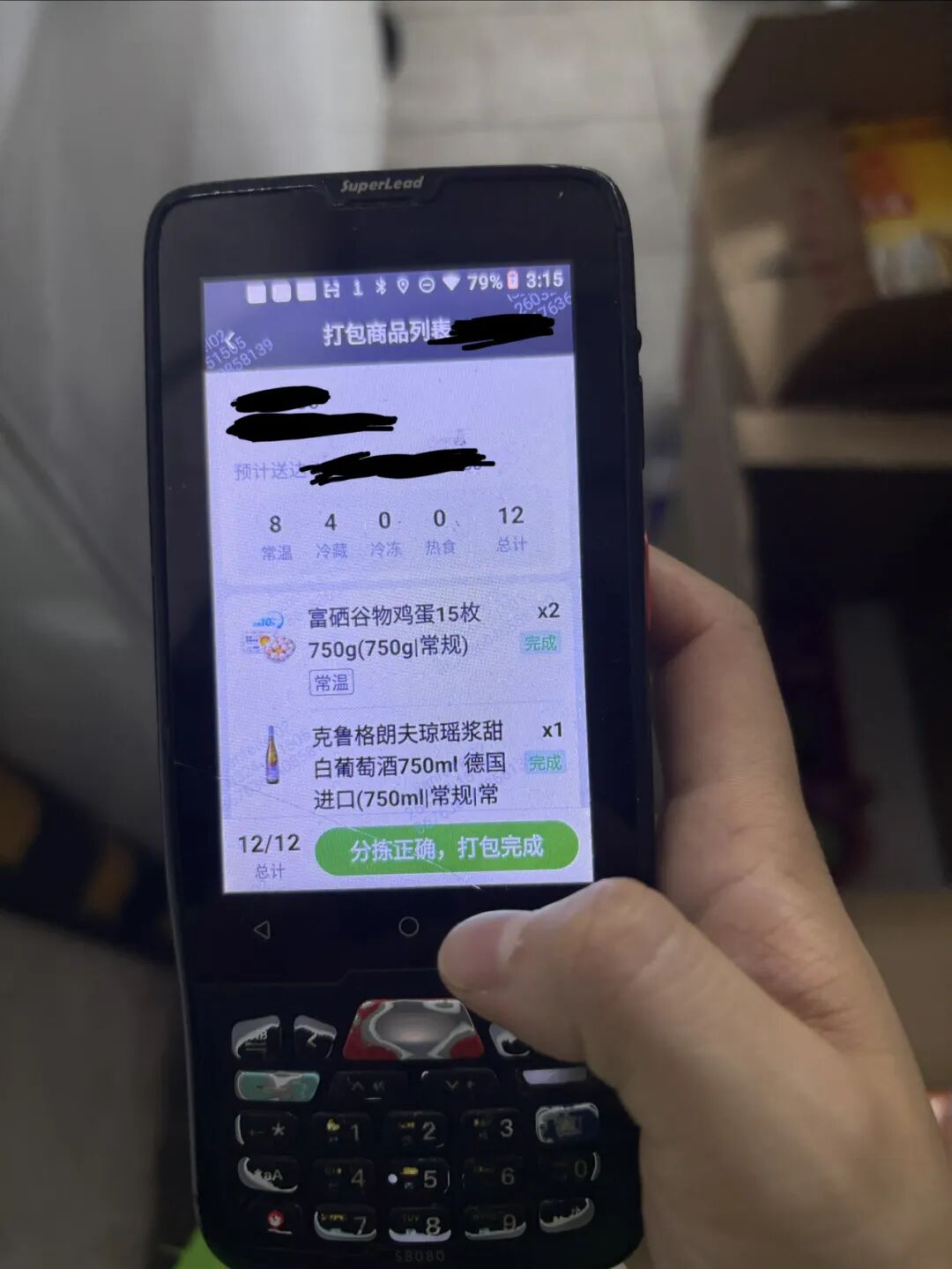
◉ In a fresh food supermarket, the PDA is like a conveyor belt in a factory: it dictates the speed and direction of an order picker’s body and of stock movement, guiding them through tens of thousands of steps. Photo: Yakou
Zhigu: When I first arrived in the back-of-house, the warmth almost made me faint. In reality, the efficiency demands in the back-of-house are even higher than on the sales floor: on the sales floor, picking one item might take an average of over twenty seconds, whereas in the back-of-house it is only ten to twelve seconds. Those fifteen-odd seconds they give up to help me is a significant efficiency loss, yet they are still willing to do it — it really struck me. The sales floor, on the other hand, where people are constantly walking past so many places and could easily glance over on the way, rarely has anyone stepping in to help voluntarily. I find that rather odd.
Later, because I was the one shuffled back and forth between the two areas, whenever the sales floor was short-staffed I was moved back there. By then I had become a “veteran”, so I started going over to ask the newcomers what they were looking for. After a while, I noticed that once those former newcomers themselves became “veterans”, they too started going over to ask others. So after several cycles of new faces on the sales floor, it actually grew warm again, and people started asking each other, “What are you looking for?” So I think it is not as absolute as it seems: as long as someone is willing to help, those who have been helped will consider helping others in turn.
Yakou: You mentioned just now that back-of-house colleagues make plans to go out together and build friendships — something I have always been curious about: nowadays so many jobs have high turnover. In that context, do people still become friends with colleagues, or is it even possible to build a relationship outside the workplace?
Zhigu: I never joined them on any outings. What I do know is that the people involved are basically the more outgoing, proactive veterans who take the initiative to stay in touch. At first I was quite surprised, because my expectation of this place was that everyone was a gig worker, no one knew how long they would stay — a feeling of being alone, working in a big city. But there really are connections among them, and I think that is rather lovely. I suppose it ultimately comes down to whether both sides are willing to build a friendship.
– This is the 844th original article by Foodthink –
After reading these two conversations with fresh food e-commerce order pickers,
what are your thoughts?
You are welcome to leave a comment below.
And we would love to hear from more order pickers — share your labour experience with us.
Editor: Yuyang
Layout: Xiaoshu
Scan the QR code to leave a tip and support Foodthink’s original knowledge
▼

▼
Click the image to read related articles.
▼
Click a keyword to browse more article collections.
Seeds | Farming Techniques | Policy | Fermentation | Nutrition | Fruit | Fisheries | Events | Recruitment | Food Delivery | Wet Markets | Livestock | Food Talk | Sharing Sessions | Book Club | Harvest Festival | Smallholder Stories | Climate Change | Rural Development | Cooperative Economy | Urban Farmers | Food Safety | Digital Technology | Biodiversity | Pandemics & Food | False Solutions | Agroecology Internship Programme
Beijing | Hebei | Shanghai | Guangdong | Guangxi | Henan | Sichuan | Jiangxi | Xinjiang | Shaanxi | Hong Kong | Chongqing | Zhejiang | Jiangsu | Guizhou | Taiwan | Inner Mongolia | Philippines | Canada | Russia | Mexico | Italy | United States | United Kingdom | Germany | Netherlands | Thailand | Sweden | Japan