Online Grocery Order Pickers Speak Firsthand, Bursting the “Lose Weight on the Company’s Dime” Myth

Foodthink Says
When a customer places an order on Xiaoxiang Supermarket, Hema (Freshippo), JD 7FRESH, or another such platform, somewhere in the same city an order picker must break into a run—darting and weaving between cramped, narrow shelves to pick and pack the items, then hand them over to a delivery rider.
Many people believe that being an online grocery order picker is a new kind of job where you get to “lose weight on the company’s dime”. Some media outlets have even jokingly called supermarket picking the “most powerful weight-loss product” in online grocery—a “mental massage parlour” where white-collar workers can keep their heads down and sprint without a care for workplace etiquette, a “tidying-and-packing mini-game” where working people switch off their brains through sheer physical labour, “the best Hyrox for office workers”…
Compared with these romanticised portrayals, Foodthink, through conversations with order pickers and commissioned pieces, has already found that pickers work under sustained high pressure built by algorithms, data, and piece-rate pay—keeping the platforms running at peak efficiency at the expense of their own health.
So what is the reality? In this article, two order pickers speak to each other in dialogue, sharing experiences that refuse to be simplified.
– Order Picker –

Yakou | An order picker at both Hema (Freshippo) and Xiaoxiang. Not a full-timer—she takes on odd jobs that blend mental and physical labour. She has recently returned to fieldwork and creative projects; this is the one glimmer in an imperfect world that cannot be taken from her.
Zhigu | Worked as an order picker at Hema (Freshippo) for three months. The sorting work was the first thing in her life that hurt all the way down to her toe bones—hence the name Zhigu (Toe Bone).
The True Labour Intensity of Order Picking
Zhigu: I pick orders at an integrated store-warehouse Hema (Freshippo) in the Yangtze River Delta, working as a time-slot worker—so, part-time. “Integrated store-warehouse” means the entire store is divided into the front-of-house supermarket—the area where customers browse and shop normally—and the back-of-house warehouse.
Yakou: I’m usually based in the Pearl River Delta. Earlier this year I went to work for a few days at Meituan’s Xiaoxiang Supermarket, also doing order picking. Xiaoxiang only has a back-of-house warehouse—there’s no front-of-house at all. After that, I spent a few days at Hema (Freshippo) too.
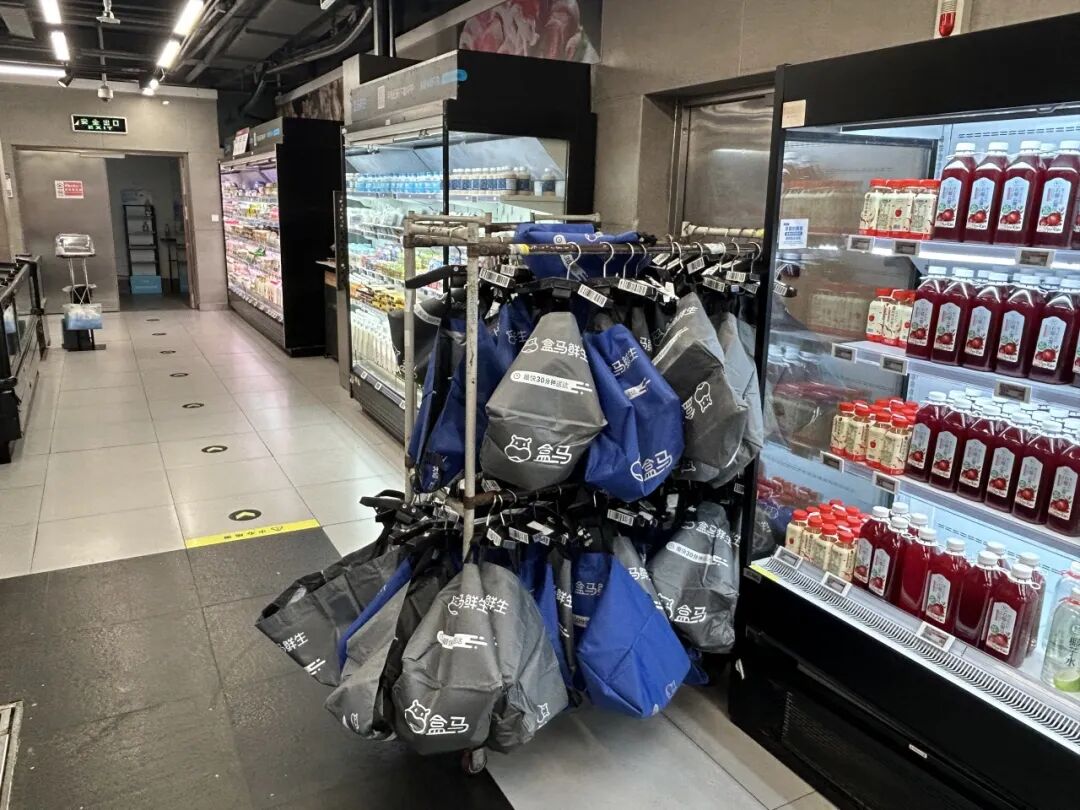
◉ If you visit a Hema (Freshippo) store often enough, you might notice a pile of cloth bags tucked away in a corner. Those are the bags order pickers use to sort items in the front-of-house supermarket. Image credit: Yuyang
Zhigu: When I chat with colleagues, I find that quite a few of them see order picking as a temporary stopgap. Some are looking for other work and haven’t found it yet, so they take this job for a while and leave the moment they get an interview elsewhere—they don’t want their employment gap to be completely income-free. Others have been cooped up at home; their families want them out and working, so they took this job.
I’ve seen lots of people online saying they want to come here to lose weight, and I’ve encountered it in real life too. One new colleague said she’d come to lose weight, that she didn’t mind the hard work—but she was so exhausted she quit after just a few days. It feels like around one-fifth of the questions people ask online about this job are some version of ‘Can I lose weight doing this?’ Bizarre.
Yakou: Do people really turn up with that expectation?
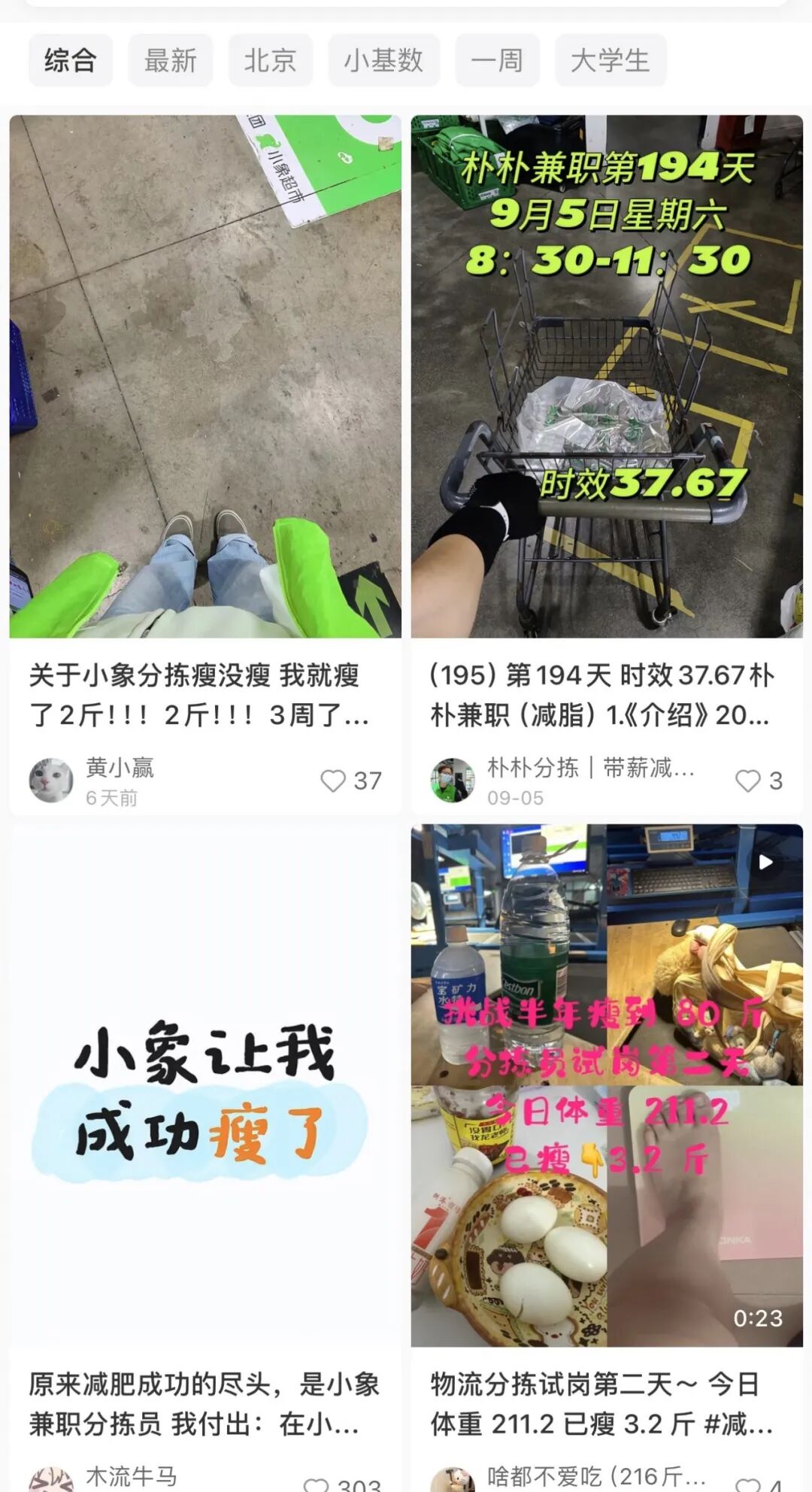
◉ Posts about losing weight through order picking, shared on Xiaohongshu (RED). Image credit: Xiaohongshu (RED) screenshot
Zhigu: I don’t know. But even the people who came didn’t expect the physical demands to be this heavy. I work six days a week, with a fixed seven-hour shift from afternoon to evening, no breaks in between. Those seven hours don’t include any rest or meal time whatsoever. I walk around twenty thousand steps a day.
When I was still new, I reported in the group chat that I was stepping out to eat, and when I came back I got shouted at—they said no meal time had been scheduled for this shift. I said, “How was I supposed to know there’s no time to eat dinner between 3 p.m. and 10 p.m.?” The answer I got was: “Time-slot workers don’t get meal breaks. Come back once you’ve finished eating.” I fired back, “So should I have finished my dinner before 3 p.m.?” In the end I managed to secure a meal break by citing stomach pain. I was essentially the only picker who ever ate dinner on the job.
Yakou: At Xiaoxiang, I asked the store manager the same thing. I said I needed to eat, and they looked taken aback—no meal time, they said. I asked, “What about the others?” They said the others don’t eat.
Zhigu: Yes, it’s extreme. Full-timers work six days a week and basically hardly eat at all. And full-time shifts are twelve hours long—either 6 a.m. to 7 p.m. or 9 a.m. to 10 p.m. Full-timers do get a rest period. For instance, a 6 a.m.-to-7 p.m. shift spans thirteen hours in total, but they’re paid for twelve, with one hour of break time in between.
Yakou: Is that one-hour break at a fixed time, or do people find their own?
Zhigu: You find your own time. You can only eat when orders are slow. If you go during a rush, you get told off—”Why are you eating right now? You’re causing an order backlog.”
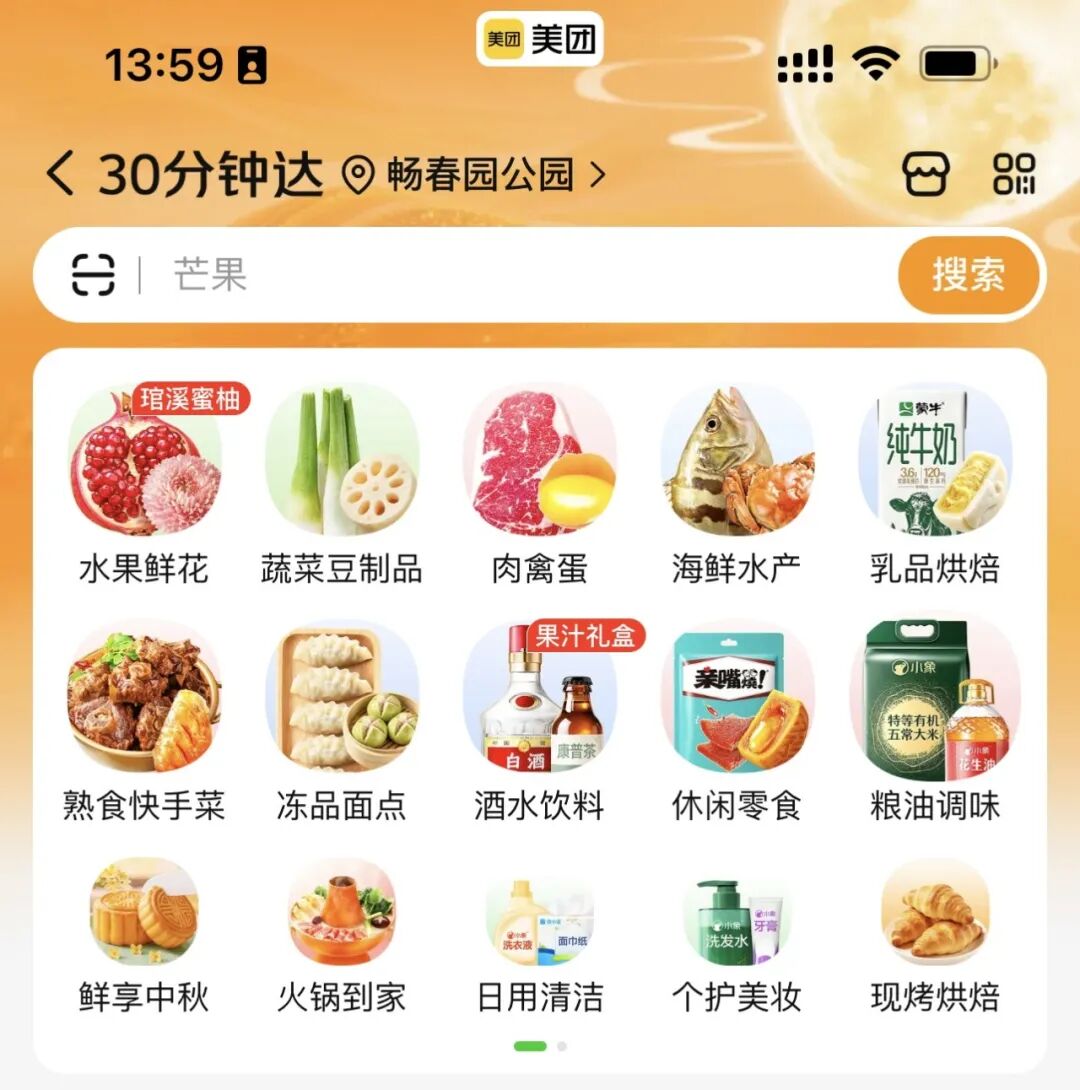
◉ Whether it’s Xiaoxiang or Hema (Freshippo), both advertise their ’30-minute delivery’ speed—a speed that depends on the increasingly strict control the forward-warehouse model exerts over order pickers. Image credit: Meituan app screenshot
Yakou: Several times I’ve stepped into the back-of-house area and seen people eating between tasks. The Hema (Freshippo) store I work at has a tiny rest corner in the back-of-house warehouse—a long table and a few chairs. When things aren’t too busy, you’ll see order pickers sitting there eating their packed lunches or bread, or sipping bubble tea.
Zhigu: I sometimes eat in the staff break room. It’s got canteen-style tables, a water dispenser, a sink, dish soap, a microwave, and a fridge. But the people eating in there are mostly not order pickers—they’re staff working at the supermarket stalls. They almost always bring their own packed meals to eat there.
Yakou: If you go to the toilet, does that time count as work time?
Zhigu: For a toilet break, you tap “Short Break” on the PDA and then head off on your own. We work inside a shopping mall, so we just go to the mall’s toilets. Most people are back within ten minutes. If you’re gone for a while, the veterans notice and assume you’re slacking off.
If you happen to be out during an order backlog—after all, you can’t see the real-time order volume while you’re in the toilet—and the status board or a supervisor spots your status set to “Short Break”, they’ll @ you straight in the group chat: ‘xx, have you had long enough on the toilet? Get back here and pick orders, quickly.’
No Rest Between Orders
Yakou: At the Hema (Freshippo) store I work at, the gap between orders can sometimes be quite long—there are even stretches of five minutes or more without a single order coming through. When there are no orders, most people just scroll through their phones, and some even play games. I also saw someone wearing headphones for the entire shift, which surprised me, because when I was at Xiaoxiang, that would have been completely out of the question.
Zhigu: It’s different between the front-of-house and the back-of-house. In the front-of-house, you constantly need to communicate with the people at the supermarket stalls. You often can’t find something and have to ask the stall workers for details before you can go to the right spot, so you’re always talking to people. You can wear headphones all day and nobody says a word—you can listen to music or podcasts on your own.
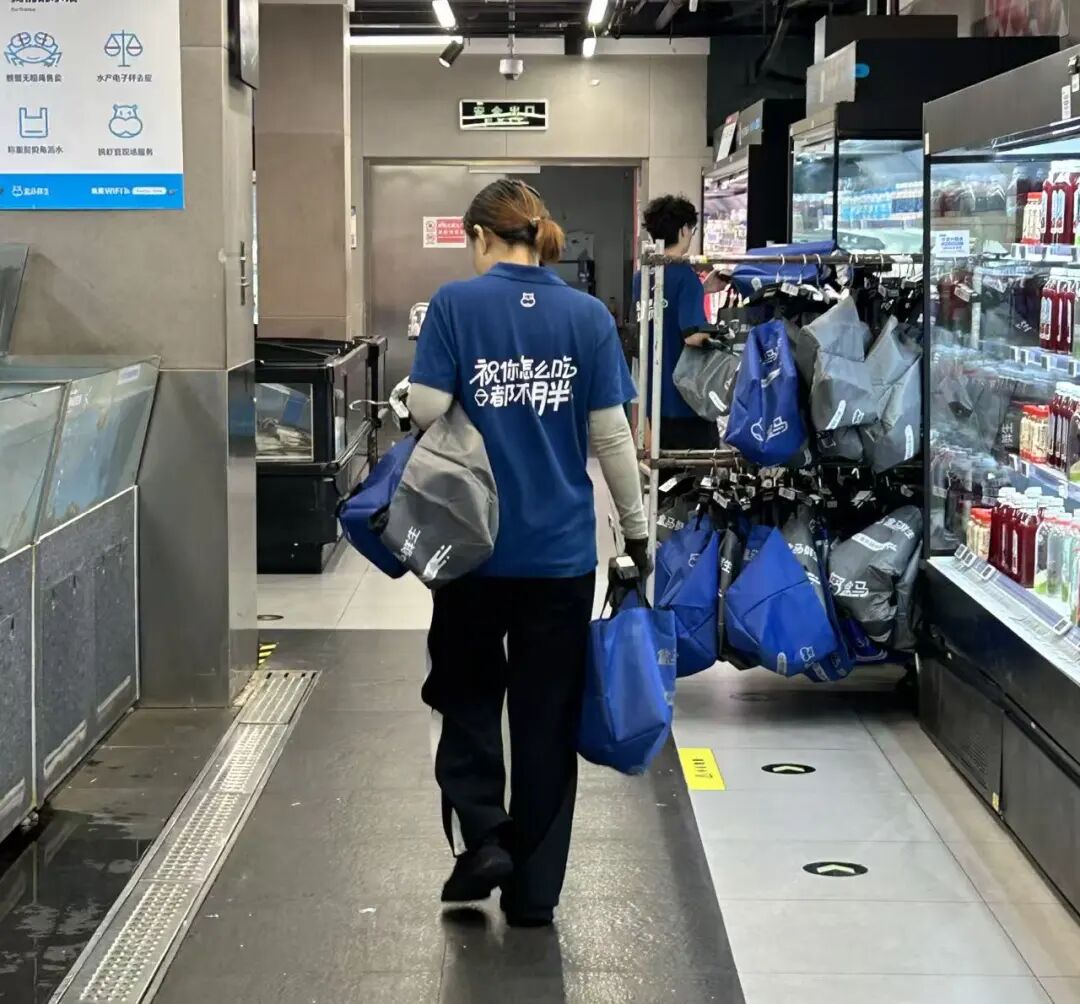
◉ Hema (Freshippo) order pickers stride briskly through the front-of-house supermarket, sorting items at a pace far faster than that of customers or regular shop staff. Image credit: Yuyang
Zhigu: The back-of-house is quite different, though. The space where I work is very cramped, and the manager at the status board can see every single seat at a glance. Perhaps my store is a bit unusual, but some of the longer-tenured veterans will give you a look of quiet judgement if they see you sitting while everyone else is accepting orders, or if your PDA flashes with a new order and you don’t take it. Because of that, I don’t dare turn orders down either—generally, if an order comes in, I accept it.
Sitting down between orders—I don’t even consider it a rest. I’m just filling time. Even going to the toilet means going quickly and coming straight back. One night, there was a massive order surge, with the backlog building for over an hour. The moment an order came in, it was dispatched straight to your terminal; as soon as one finished, the next was already there. For two solid hours, there was not a single second of a pause. I desperately needed the toilet, and I needed a break. After just one hour of non-stop running, my legs start to ache. If I could rest for just five minutes, they’d manage to keep going. So I tapped “Short Break”, but I was so tired I couldn’t even stand up—I wanted to sit for just ten or fifteen seconds first. But the moment I did, my boss @’d me in the group chat and told me to “open fire” (go back online and start accepting orders).
Yakou: You said the gaps between orders don’t count as a rest, and I completely agree. When I was at Hema, there was a bit of time between orders, but it felt more like being “on standby”—the moment an order came in, you had to be on your feet and picking, and you couldn’t really do anything else besides boredly scrolling your phone. It certainly wasn’t a proper rest.
When I was at Xiaoxiang, there were basically no gaps between orders at all—no chance to catch your breath. They even created a concept called the “effective working-hours rate” to measure this. A low rate usually comes down to one of two things: first, you took a longer break, in which case the station manager might come looking for you; second, to avoid exceeding the delivery time limit, we tap “Picking Complete” before we actually pack the order, and from that moment the system counts the wait as a rest period. So if packing takes a long time, the effective working-hours rate drops accordingly. But I’m clearly still working—so it’s absurd.
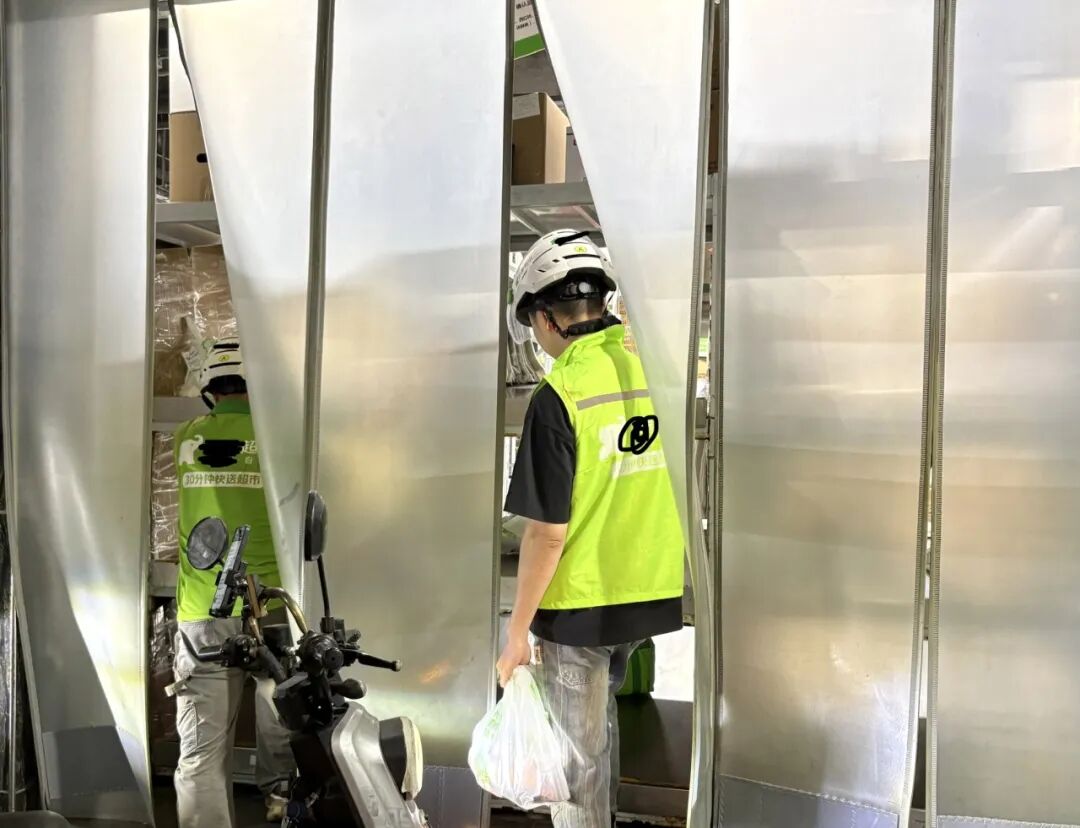
◉ Delivery riders waiting for orders outside a Xiaoxiang Supermarket. To reduce the risk of exceeding the delivery time limit, order pickers often press “Packing Complete” before they’ve actually finished packing. Once they do, the delivery rider receives a pick-up notification for that order, and the time pressure that vanished from the picker’s end is passed straight on to the rider. Image credit: Yakou
Zhigu: You mentioned earlier that as soon as one order ends, a new one comes in—it sounds essentially like the order backlog situation I described at Hema. If every order is dispatched directly to the picker’s terminal, doesn’t that create a pile-up? And wouldn’t a pile-up affect their 3-minute dispatch target?
Yakou: There is a pile-up, but it’s usually cleared within a short time. Xiaoxiang’s peak-hour forecasting seems more reliable—they specifically schedule part-time workers for peak periods. Outside peak hours, order volume drops noticeably and staffing is reduced accordingly, which suggests they have a forecasting algorithm that allocates different numbers of workers to different time slots based on the data.
Zhigu: How extraordinary—you have no rest breaks at all. I think I’m starting to understand why the per-order rate at Xiaoxiang feels so low, yet people say the pay is decent enough. It’s because you’re effectively working every single second. The workload is genuinely enormous. How many steps do you walk in a day?
Yakou: I don’t track my step count—I just know I’m always walking. My sense is that it’s harder at Xiaoxiang. At the front-of-house in Hema, there is an opportunity to sit down, and when I’m waiting for an order I sometimes wander about. The feeling is genuinely quite different.
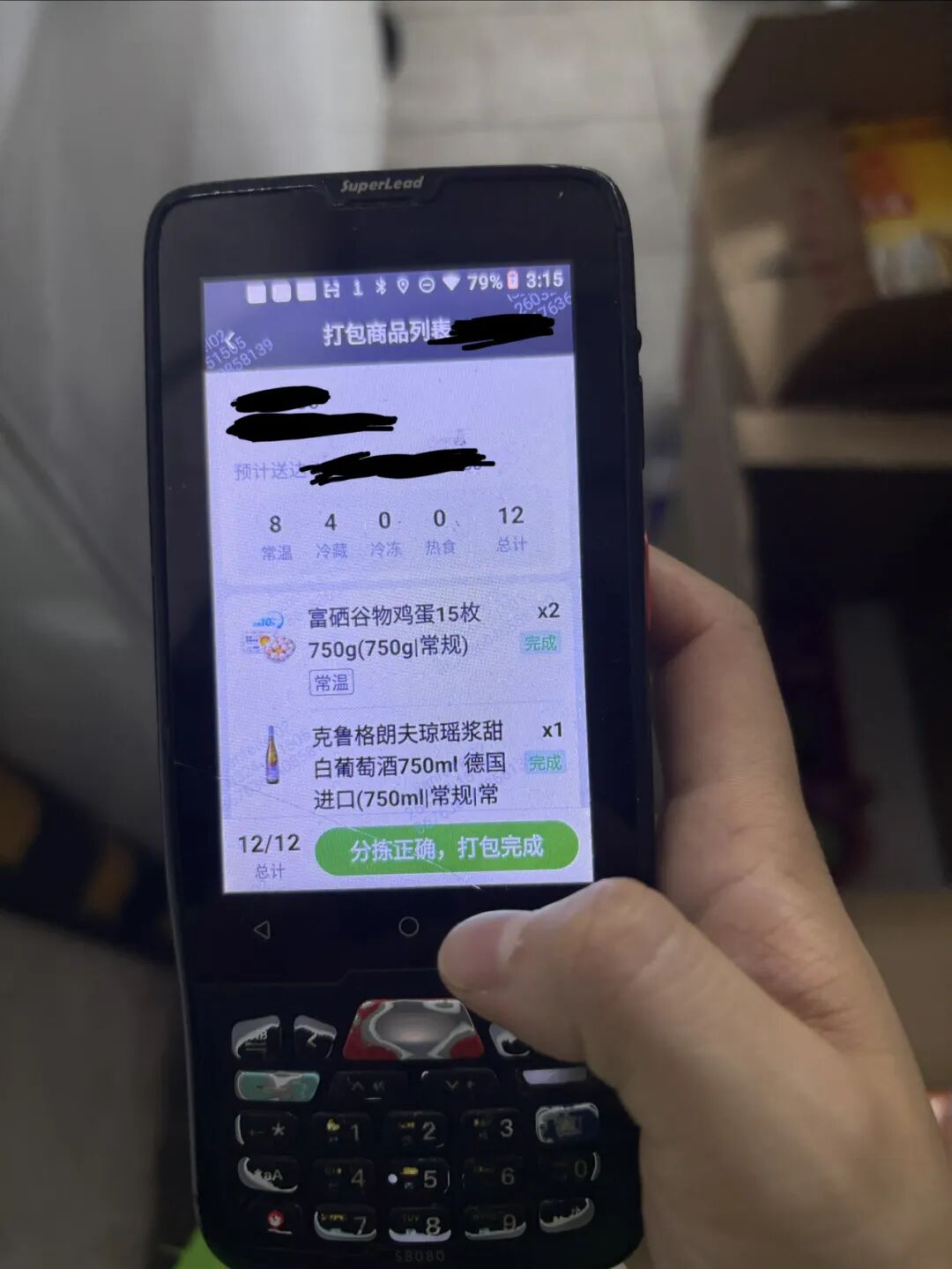
◉ In a fresh-food supermarket, the PDA (handheld terminal) is like a conveyor belt on a factory floor, dictating the speed and direction of both the pickers’ bodies and the goods they move, guiding them through tens of thousands of steps. Image credit: Yakou
Tiered Pay Structure: An Upgraded Version of Piece-Rate Pay
Zhigu: Our part-time pay works like this: if you average a certain number of items picked per hour over the course of a day, you get a base rate of ¥20.50. The threshold is calculated by dividing your total items picked in a day by the number of hours worked.
Yakou: Do you know how full-time pay is calculated?
Zhigu: I don’t know the exact figures, because the full-time staff don’t know them either. Our store has never disclosed its pay structure—even under piece-rate pay, employees are never told how many items they need to pick to earn a certain amount. In the early days, it was pure piece-rate—say, a few mao per item. More recently, full-time workers are paid by tier: you need to pick a set number of items per hour to qualify for a tier, and each tier corresponds to a specific hourly rate.
But you’ll never know exactly where the threshold for a given tier sits—whether you need to pick 700 items, 710 or 720 to reach the next pay tier, you simply have no way of knowing. All you can see is how much you earned the previous day, and from that figure you make a rough guess, supplemented by what you piece together from conversations with others.
Yakou: It’s actually the same at Xiaoxiang. I remember it clearly—I went to ask the store manager how pay was calculated, and they showed me a table on their phone. It was tiered: pick a certain number of items per hour, you get one hourly rate; pick more, and you get another. They said that table wasn’t supposed to be shared.
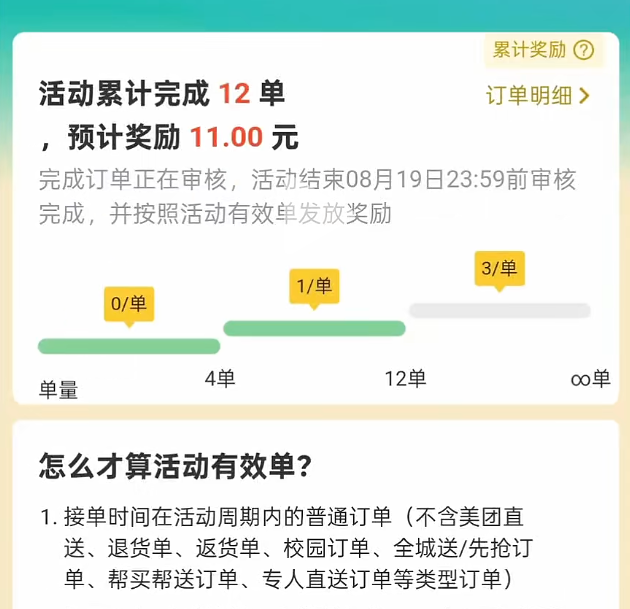
◉ Tiered pay structures have become widespread in platform-based gig work. Foodthink’s earlier research found that delivery riders face similar tiered structures in terms of wages and heat allowances. Image credit: WeChat Channels @文冉旭
Zhigu: Hema (Freshippo) is the same—apparently only management can access it, and even they can’t share it. Going back to the example I gave earlier, which isn’t exactly precise, but say you pick 400 items in a day and earn ¥120 to ¥150, yet you have to hit 700 items to reach ¥200. The gap in between is enormous, and most people probably get stuck somewhere between 500 and 600, which effectively means the company is pocketing part of your labour for free.
This tiered pay structure might not look like a direct pay cut, but that’s exactly what it is. I felt it clearly during my time there. It started as pure piece-rate, and once they switched to tiers, a lot of people left. And it creates a sense of incentive, as though you should be pushing yourself to reach the next tier. If you don’t make it, you start blaming yourself—maybe you were on the toilet too long today. But the truth is, if you can’t pick fast enough, you just can’t, and most of the time that’s a purely objective reality.
Yakou: Piece-rate pay constantly encourages you to work faster and faster. For the company, the quicker you pick, the more they profit. For the worker, there’s also this feeling that picking faster is earning more for yourself. To earn more, you keep speeding up, and the company keeps raising the standard based on everyone’s average speed, or the speed that the fastest people can sustain. In effect, you’re feeding data back to the company so it can adjust the targets, which makes it harder for slower pickers to earn enough.
It’s a very clear survival-of-the-fittest mechanism, but the one who benefits most is the company, not the workers. Even if you work fast, you’ll keep pushing closer to your physical limits, growing more exhausted, and one day you’ll be replaced by someone younger and nimbler than you.
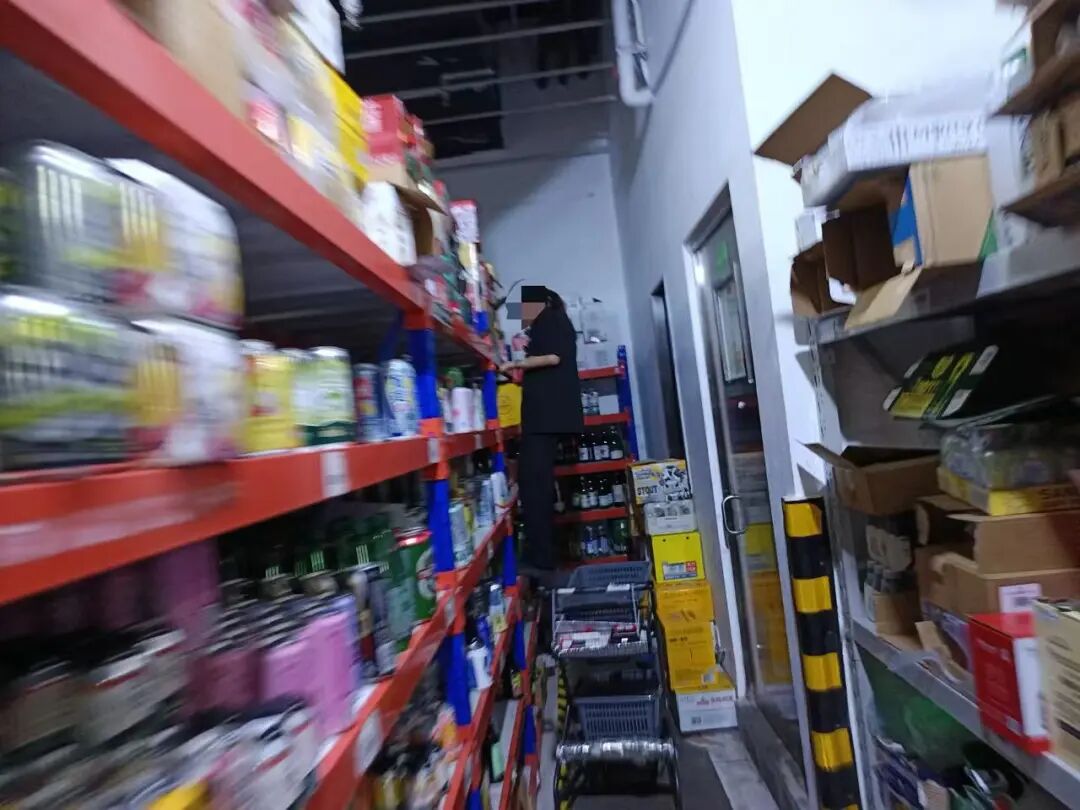
◉ Warehouse shelves are typically marked “No Climbing”, yet under the very real pressure of exceeding the delivery time limit or hitting performance targets, order pickers are forced to take the risk of climbing to reach stock. Image credit: He Siqi
Zhigu: I’ve felt the same way. For a while, the company raised the picking quota for part-time workers, and after the adjustment I couldn’t meet the target half the time. At the front-of-house, I couldn’t meet it every single day—it was outrageous. When the company changed the standard, they didn’t really know whether anyone could actually hit it. They just felt too many people had been meeting it and the payout was getting too high, so they raised the bar.
On top of that, the company’s obsession with speed transfers costs onto the workers. It happens all the time: say it’s a holiday, and the company fears an order surge so they schedule extra staff, but no surge materialises. Most of the time there are no orders and everyone’s just standing around. Nobody earns enough, so each worker is effectively absorbing the company’s costs—yet you still can’t leave.
Our Efficiency, Your Performance
Zhigu: The “monitor” at Hema (Freshippo) is the management role closest to the order pickers. Unlike Xiaoxiang, Hema doesn’t have a large screen showing everyone’s real-time efficiency—the spreadsheets and data all sit on the monitor’s computer. The monitor decides whether it’s peak hour and how to allocate staff, chases you to pick faster when there’s an order backlog, prompts the packers when they’re about to exceed the delivery time limit, and handles “stock lookup” requests on the PDA (handheld terminal). Basically, the monitor ensures that picking runs smoothly and coordinates all manner of things.
Above the monitor sits a role called the “supervisor”. Supervisors also take on monitor duties, and additionally handle staffing matters such as recruitment and scheduling—somewhat similar to the station manager at Xiaoxiang.
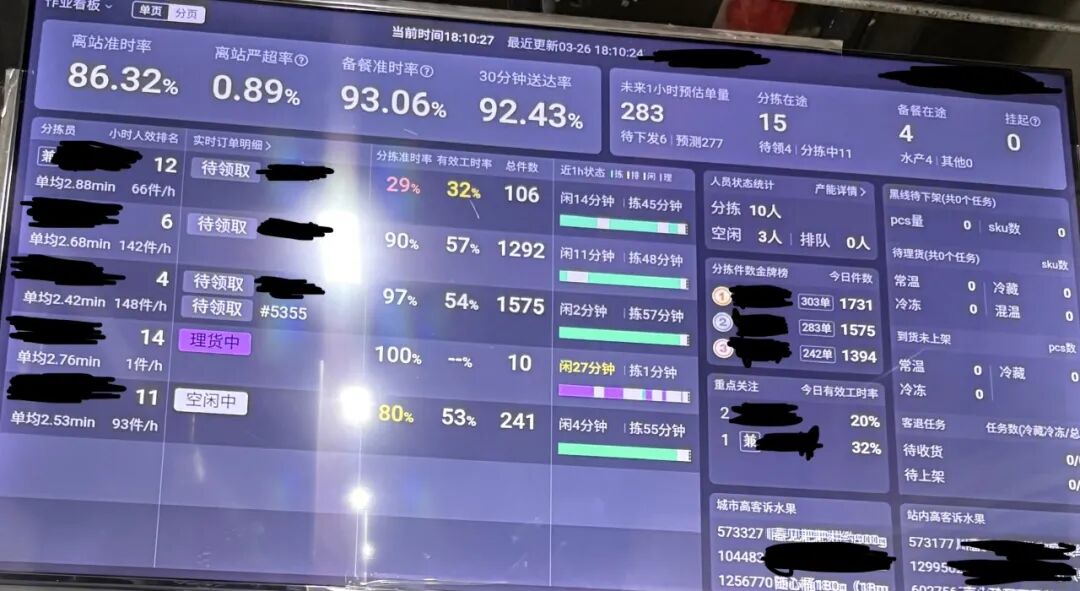
◉ At Xiaoxiang Supermarket, data generated by everyone rushing around the warehouse is updated in real time on the large screen. Image credit: Yakou
Yakou: Could you walk me through the general structure at Hema, from headquarters down to individual stores? How does competition between stores work?
Zhigu: As far as I understand, below headquarters are the regions, and below the regions are the individual stores. At regional level, there’s both cross-regional store management and a division between production and non-production lines. At store level, operations are split into online and offline business: the online side is headed by the store-warehouse manager, beneath them is the supervisor, beneath the supervisor is the monitor, and the monitor oversees the order pickers and packers.
Stores definitely compete with one another. One thing you can feel is when they start telling us off—that usually coincides with wherever their own stakes are highest. An order backlog, for example, affects metrics like the 12-minute dispatch rate; if the dispatch rate drops too low, they’ll get a telling-off from their own superiors in their group chats.
The average efficiency of order pickers is another competition metric. Supervisors will tell people off—they’ll @-mention a newcomer and say, “Do you realise you’re dragging down half our store’s efficiency? Pick up the pace!” And they’ll @-mention a veteran and say, “You’ve been here for ages—how are you holding us back so much?”
Yakou: You mentioned the 12-minute dispatch rate earlier—that’s a requirement set by Hema. What happens if it’s not met?
Zhigu: It might affect the performance figures of the supervisor and the monitor—essentially, an efficiency metric is calculated for the whole store. But it’s not something we order pickers are held to, because the 12-minute dispatch isn’t just about picking; it also covers packing and the steps that follow.
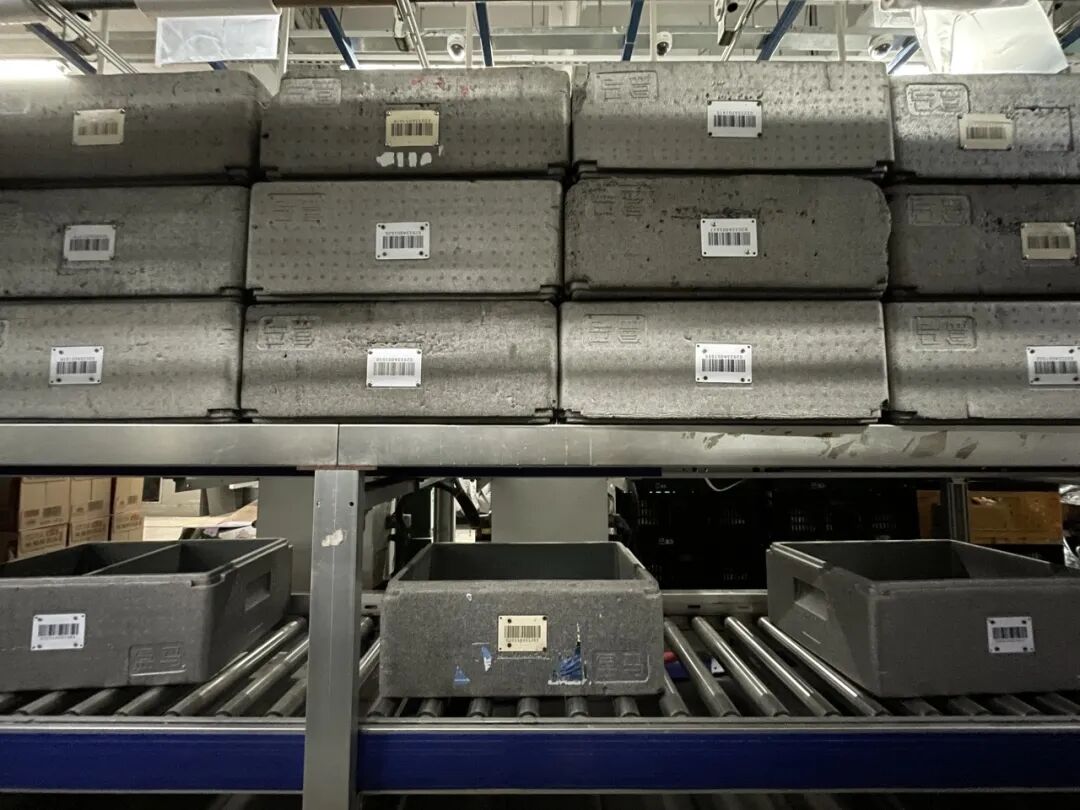
◉ Crates used to transfer goods along the packing station at Hema. Image credit: Zhigu
Yakou: At Xiaoxiang, if I don’t meet the efficiency target, they still let me clock off on time—they just calculate my pay at a lower hourly rate, something like ¥13 an hour. But at Hema, when I went for an interview, the supervisor said that if my average picking volume didn’t meet the requirement, they might have me clock out first but then carry on working until my average pick count reached the target. They said it was for my own good, because I’d get the standard hourly rate rather than a reduced one. I haven’t actually experienced it myself, so I’m not sure whether that’s how it works in practice.
Zhigu: We’ve had situations like that—extending shifts—but it’s different from what you described. Once your shift is extended, you don’t just have to make up the shortfall from before; you also have to meet the picking target corresponding to the extra time, so working overtime is basically never worth it. I’ve seen someone fall short, get given extra time, and still not meet the target in that additional stretch—so they ended up working a whole extra thirty minutes. It sounds like the two systems might work quite differently on that front.
Is Picking a Game of Free Running?
Yakou: At Hema (Freshippo), we don’t have a big screen showing everyone’s real-time efficiency and stats the way Xiaoxiang does, but we can see our rankings on the PDA system. Whenever I see whoever’s in first place, I wonder—how do they manage it? Their efficiency is several times mine. I find it hard to imagine reaching that level even once I’m fully proficient. You’d count as a fast picker yourself, so I’m curious—how do you do it?
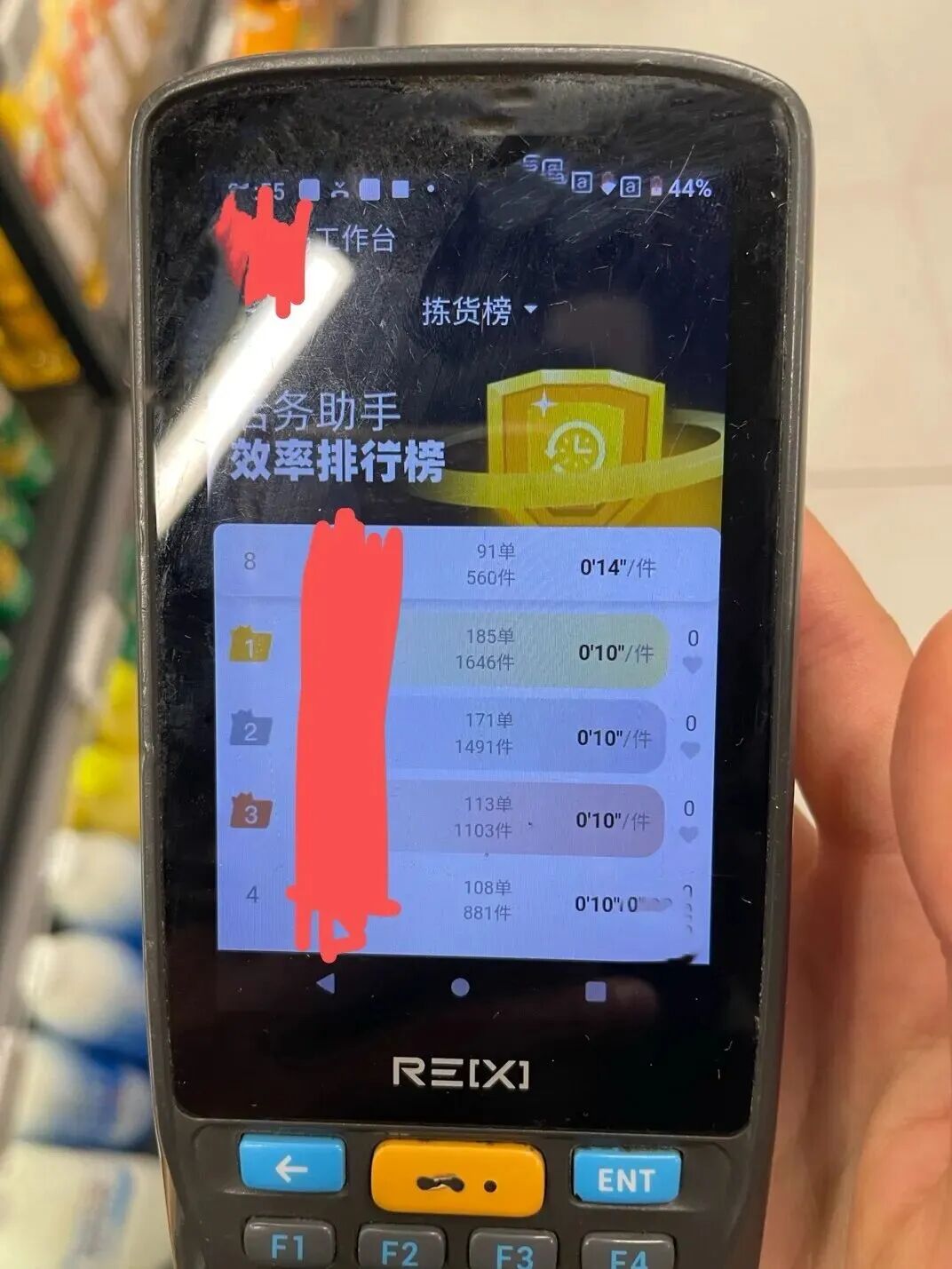
◉ The efficiency leaderboard on the PDA. Image credit: Zhigu
Zhigu: Let me start with back-of-house. Once you’ve been in the warehouse long enough to know the layout, efficiency really does improve. For example, in back-of-house it takes an average of ten to twelve seconds to pick one item. If something can’t be found and you waste two minutes on it, your efficiency basically can’t recover—it can halve outright. Experienced pickers, if they can’t find something, will just tell the monitor, “Scan this one for me first”, and their efficiency won’t be affected. Sometimes an item isn’t at its bin location because a stock clerk has moved it to the next one over, or hasn’t had time to shelve it yet and it’s still in a box to the side, or it’s in the topmost or bottommost box.
Yakou: I used to get lost looking for stock a lot. At first I’d stubbornly keep searching—sometimes four or five minutes—until I could see I was well past the time limit and still couldn’t find it. A veteran worker training me told me I absolutely had to ask, and that’s how I learned to go to the monitor. But there’s still a bit of a mental barrier for me. The monitor is busy, and sometimes I feel like they won’t give me a friendly look.
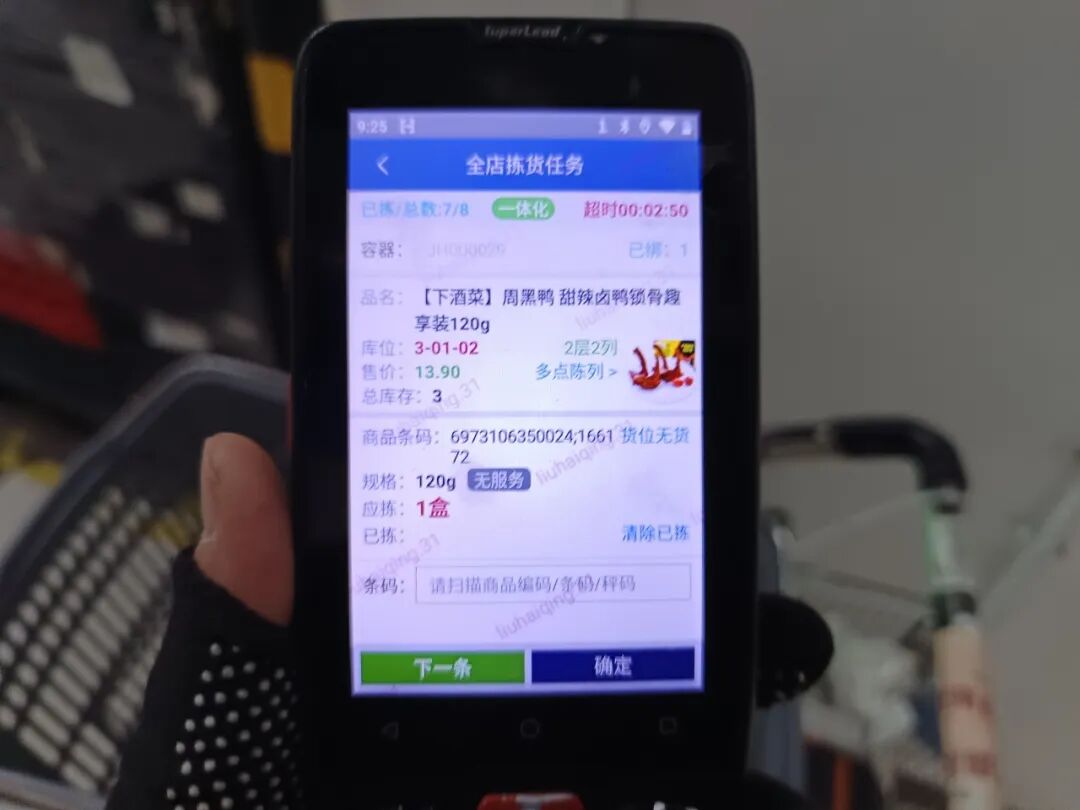
◉ The top-right corner of the order picker’s PDA screen constantly shows how long they have been exceeding the delivery time limit. Photography: He Siqi
Yakou: If they can’t help and aren’t familiar with the spot either, they’ll say, “Isn’t it right here?”—or just nudge something with their foot to show me where it is. That puts so much pressure on me. Sometimes I’d rather search a bit longer myself and only ask for help when I truly can’t find it. Once I got used to it, it eased off a little. If I’d learned these tricks sooner, I wouldn’t have wasted so much time on certain orders.
Zhigu: I was the same at the start. The monitor where I worked was pretty sharp-tongued too—they’d say, “Isn’t it right here? Have you got no eyes?” So at first I’d double- and triple-check everything before daring to ask. But eventually I just stopped caring. If I can’t find something and ask, I get a telling-off; if my efficiency is low, I get a telling-off; either way I’m getting a telling-off. So I decided: once the inability to find something is actually hurting my efficiency, regardless of whether I’ve overlooked it myself, I just go straight to them for help. Then, after a while and once I’d got more skilled, I became more confident in my judgement—this is definitely not my fault, the item genuinely isn’t there.
Yakou: Speaking of asking the monitor—I remember one time I was picking in the front-of-house and couldn’t find an item. As it happened, the monitor was next to me looking for something else, so I asked them. They gave me this really dismissive eye-roll and pointed with a finger, but I still couldn’t see it. They then physically shoved me in that direction, and I felt really disrespected. They shoved me with real anger in it. I was a bit angry too, but I was in a rush to finish the order, so I didn’t say anything.
Zhigu: The pressure from the monitor is genuinely intense. When you say eye-rolling, I can picture it immediately—the monitor where I worked loved eye-rolling. I’d say, “It’s really not there”, and they’d say something like, “I don’t believe you.” It happened a lot. But there were also satisfying moments later on—when I genuinely couldn’t find it and kept insisting it wasn’t there, and they followed me over to look, and no amount of searching turned it up… when they had to eat their own words, I did find it pretty satisfying.
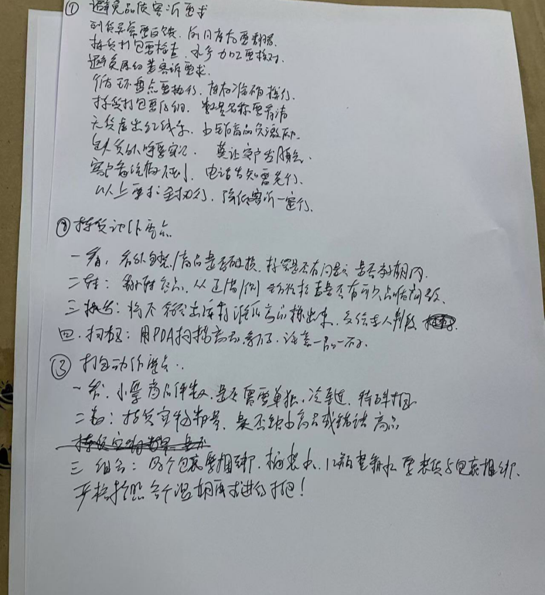
◉ This image shows JD Seven Fresh making order pickers copy out packing standards by hand. Many people mistakenly assume that order pickers just need to keep to themselves and focus on running orders. In reality, the store’s control over order pickers is extremely direct, heavy-handed, and unsparing. Image credit: He Siqi
Yakou: My picking efficiency was very low at the start, but I could see it improving day by day. Especially on the third day, I was like an addict—after every one or two orders I’d check my ranking and see if my score per hour had changed. But I wasn’t really bothered about the pay. During that beginner period, efficiency didn’t seem to affect wages much. I was just in this sort of gamer mindset, hoping to climb the rankings, and I found it really unsettling that I felt that way.
Zhigu: I check the rankings too, mainly depending on my mood. When I’m bored, I’ll suddenly go on a sprint through a few orders—feeling like I’m in great form and wanting to see if my ranking will climb. It really is like playing a game. But when I’m tired, I just don’t care at all and completely check out. Sometimes the supervisor looks at this ranking. They have a more detailed spreadsheet that shows each person’s efficiency and rank for the day in that role, and they post it straight into the group chat, @-mentioning whoever’s at the bottom and giving them a telling-off. Sometimes they’ll say things like, “Bring out your competitive drive” or “Show some competitive spirit”—and every time I hear that, it makes me want to slack off even more.
Is there a regular “top picker” at the store? It doesn’t seem to be fixed, but there’s a core group that consistently stays in the top five—all veteran workers who’ve been there the longest. They have more experience and read the situation more accurately in different circumstances. Another category are the loud ones who, from far away, spot that an item is out of stock and just shout across to the monitor, “This one’s gone, look it up for me.” They’ve effectively advanced the process ahead of time, which gives them a slight edge in efficiency. Unlike me—I usually walk all the way up to the monitor before saying “look up stock”, and that gap makes a difference. Some people who care about efficiency will even rush over to scan the item themselves.
Generally, the people who reach the very top tend to be one of two types: those who desperately want to earn money, and younger workers with stronger stamina.
Yakou: Actually, everyone still tries their best to push their efficiency up.
Zhigu: Yes, and it’s not purely about climbing the ranking—it’s more about earning money. The people who want to earn the most have the highest efficiency. Some people aren’t really clear on exactly how many points or which tier they need to hit, don’t bother calculating it, and don’t worry about whether they’re effectively working for free. But as long as there’s an order they grab it immediately, skip breaks whenever they can, pay no mind to anything else, and work flat out—under those conditions, efficiency naturally comes out high.
– This is Foodthink’s 843rd original article –
Editor: Yuyang
Layout: Xiaoshu
Scan the code to tip—support original food knowledge
▼

▼
Tap the image to read related articles
▼
Tap a keyword to browse more article collections
Seeds | Farming Techniques | Policy | Fermentation | Nutrition | Fruits | Fisheries | Events | Recruitment | Takeaway | Wet Markets | Livestock | Food Talk | Sharing Sessions | Reading Groups | Harvest Festival | Smallholder Stories | Climate Change | Rural Development | Cooperative Economy | Urban Farmers | Food Safety | Digital Technology | Biodiversity | Pandemic & Food | False Solutions | Agroecology Internship Programme
Beijing | Hebei | Shanghai | Guangdong | Guangxi | Henan | Sichuan | Jiangxi | Xinjiang | Shaanxi | Hong Kong | Chongqing | Zhejiang | Jiangsu | Guizhou | Taiwan | Inner Mongolia | Philippines | Canada | Russia | Mexico | Italy | United States | United Kingdom | Germany | Netherlands | Thailand | Sweden | Japan