
At 74, Grandmother Scales Eight Hills – Just to Earn 3,000 Yuan for Her Old Age

My grandmother Yang Xiuying is 74, weighs under 40 kg and stands barely 1.5 metres tall. Before the Qingming Festival, she had already been going into the mountains every day to dig and gather bamboo shoots, making her way over all seven or eight small hills nearby, working for more than a month without a break. Once home, she busied herself making dried bamboo shoots, not daring to rest for even a moment. She needed to earn a year’s pension from the shoots.
I. Into the Mountains
A little after six, the sky barely light, Grandmother skipped breakfast. She changed into her worn grey top and trousers, pulled on her rubber boots, and called on Grandmother Deng Lian, seventy and from the same village. This mismatched pair – one tall, one short, both with silver hair – shouldered their woven polypropylene sacks and a machete and set off.
Our home sits at the foot of a great mountain whose ridge cuts down from the north-east to the south-west. Beneath the main peak trail one ridge after another, each scattering winding stretches of bamboo groves. Many of these groves are not on flat ground but grow in unruly clumps along valleys, streams and crevices between rocks. Every spring, the bamboo produces what is the richest “fruit” of the mountains. Grandmother says, “At Qingming they go wild; by Guyu they stop. Once Qingming arrives, shoots poke up everywhere, growing in utter chaos.” And so, too, do the mountain folk’s footsteps fall into disorder.
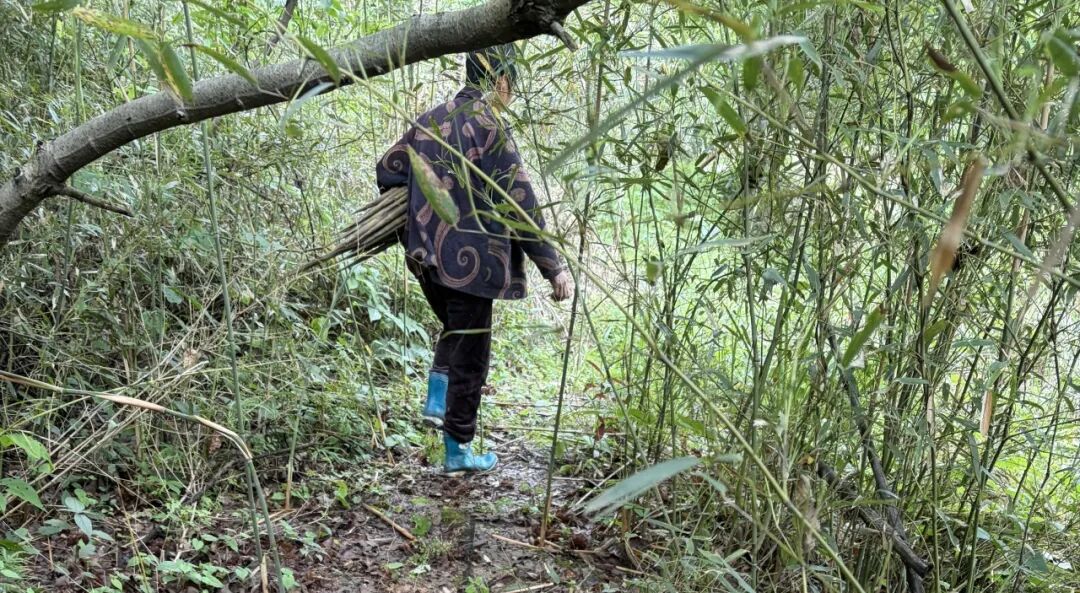
◉ Grandmother on the mountain path.
For the May Day holiday, I went home and followed Grandmother and my aunt into the mountains twice.
From the outside, those little mounds are nothing but dense thickets of mixed trees and scrub – you cannot find a path for love nor money. But this is no obstacle to Grandmother at all; she knows every entrance and exit. She ducks into a fold of the hillside and there, somehow, is a footpath. She carries a mental “spring shoot” map: Boluo Ridge gets its small shoots earliest; the grove by the little pool at the east end of the village is flat and easy to pick; Bazao Mountain has shoots, but you have to wriggle through brambles to reach them; the steep slopes above the pools hold fewer shoots, but bigger ones.
In the hills there are practically no proper paths, and ups and downs are unavoidable. Following her in, I am in my twenties and simply cannot keep up with a seventy-four-year-old. On near-vertical slopes she grips branches and vines, takes one stride and she’s up. Her hands move fast, too – finding and cutting shoots in one fluid motion – and she sweeps through a small grove in under ten minutes. While I am still dawdling among the bamboo, she has already crossed several groves.
The hardest part is not finding the shoots but carrying them out of the valley. In a day, one person can gather 100 to 150 kilograms of fresh shoots, entirely by hand. The first time I tried, I hoisted just one bundle and nearly buckled under the weight, grinding my teeth to haul it out. Grandmother, though she had cuts on her fingers, carried three sacks; my aunt carried four. The whole way out, we gripped the woven polypropylene sacks on our shoulders with one hand and grabbed at branches with the other, picking our feet along the slick mud and inching forward.
Carrying shoots downhill is not just exhausting – it is dangerous. In Grandmother’s words, “it’s easy to get hurt.” The terrain is rough and treacherous: you climb up and down slopes by gripping bamboo branches and vines, and with all the weight piled on one side, balance is nearly impossible. It was only on those two outings with Grandmother that I learned what she means. I lost my footing, slid, and landed square on a sharpened bamboo stump, slicing myself open. I had to pretend it was nothing, haul the sack, and keep walking – deal with the wound once I got home.
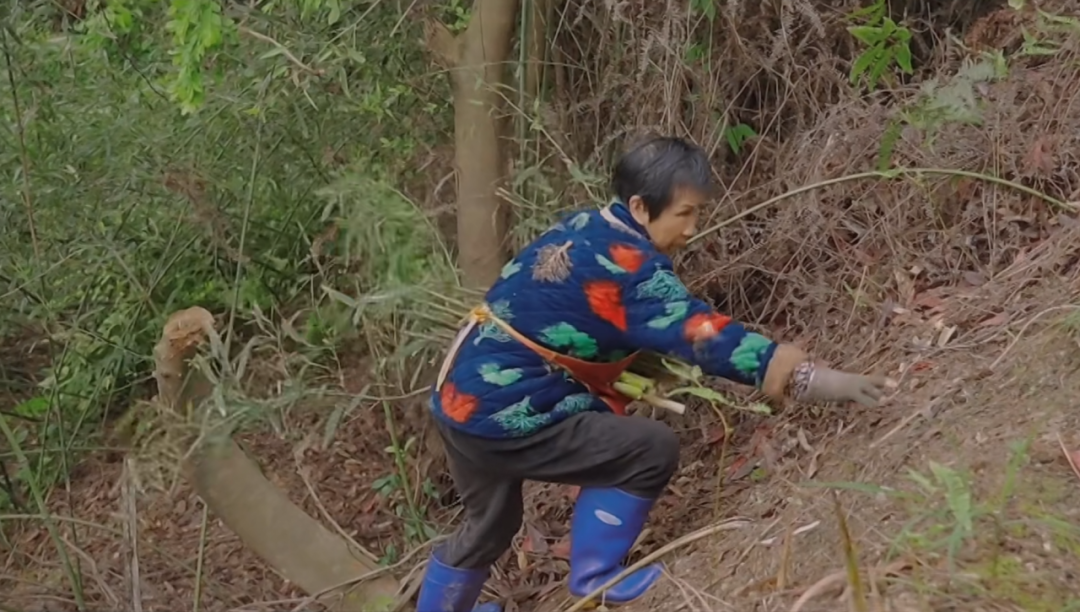
◉ Climbing down the slope, gripping bamboo branches.
No amount of skill or care can prevent the bumps and bruises. In 2022, while gathering shoots, Grandmother took a bamboo branch to the palm of her right hand. She hid it from the family, dressed the wound roughly, and kept going. Last year, Grandmother and Grandfather were digging large shoots on the back hill when it rained; Grandfather slipped, broke a bone and ended up in hospital. But he refused to spend the money, took a few cheap tablets and insisted he was fine. This year, Grandmother was hurt again. Up on the hill, while trimming shoots, she sliced off a small strip of flesh from the index finger of her right hand. She wrapped it in a scrap of cloth and carried on working; the next day she was back up the mountain.
That day, the three of us filled eight woven polypropylene sacks. Add Grandmother Deng Lian’s shoots, and the boot and back seat of our little car were packed solid – three hundred and fifty to four hundred kilograms in all. My aunt, who had carried the most on that trip, complained of aching legs. The next day, all three of us sat at home rubbing liniment into one another’s bruises.
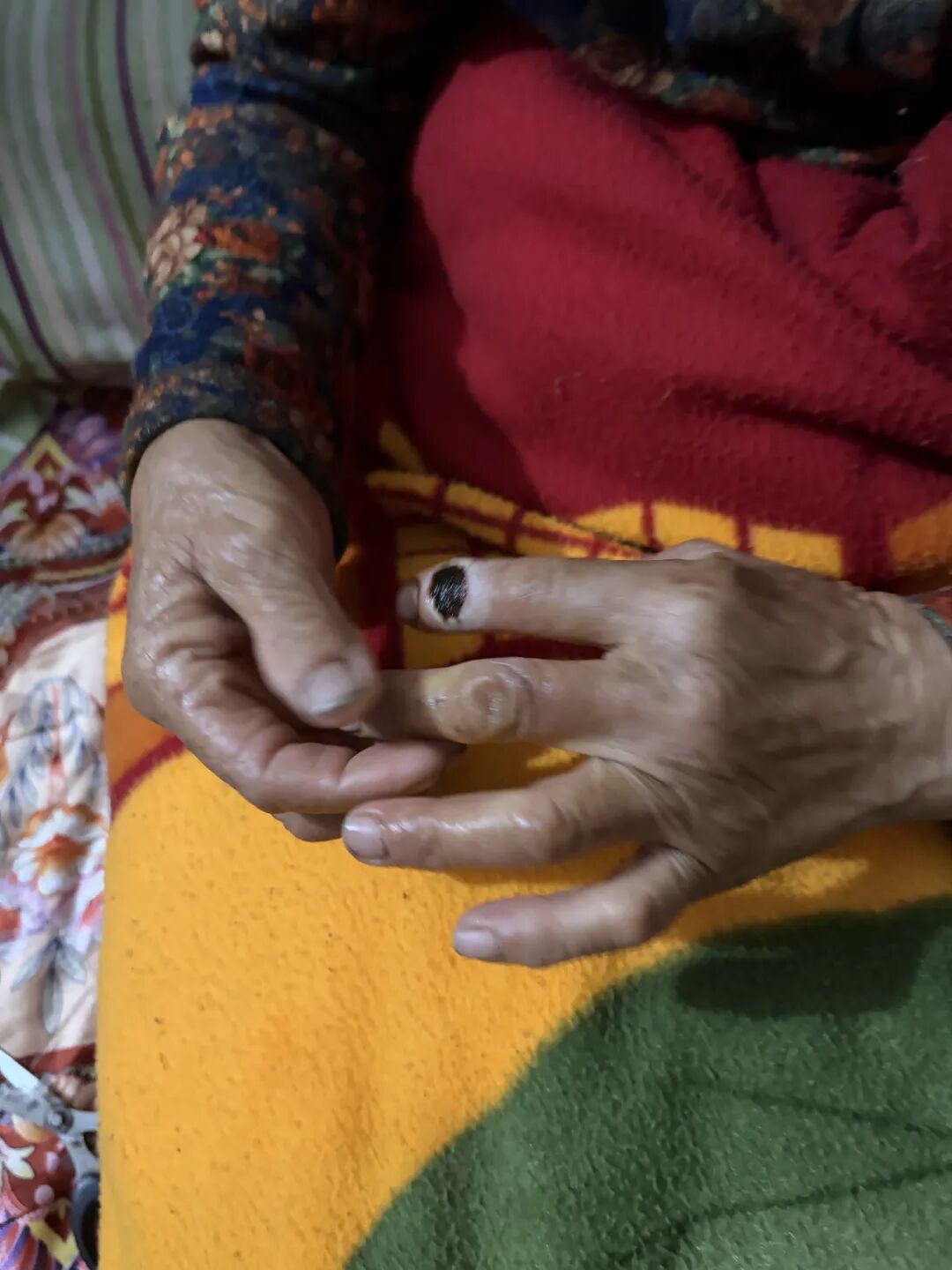
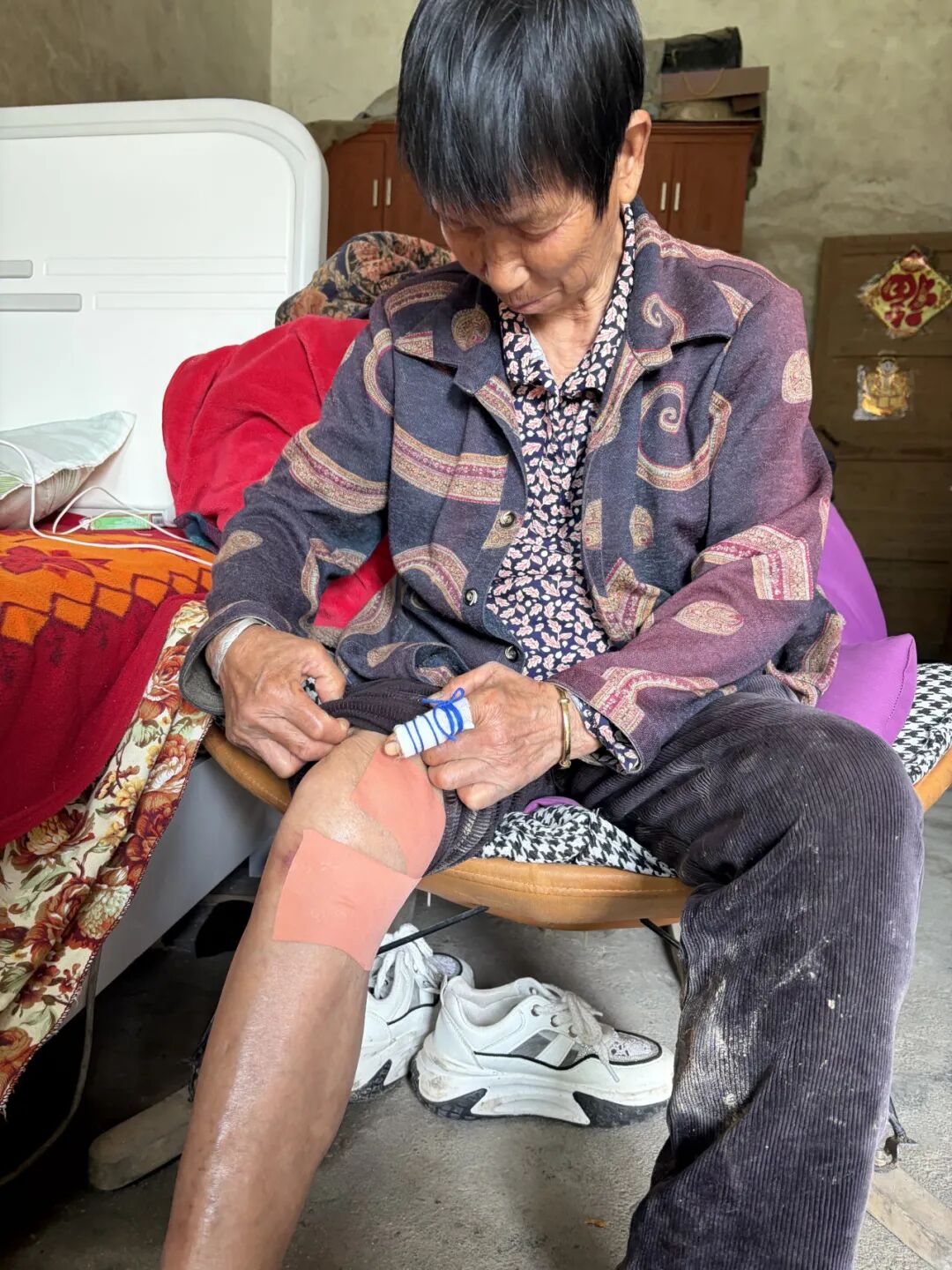
◉ Grandmother’s hands and legs are injured from gathering shoots.
That was my one day of “experiencing.” Grandmother and Grandmother Deng Lian have been at it like this for over a month now. Everyone in the village says the two of them are tireless at finding shoots; meanwhile, some of the younger uncles decide that wriggling through thickets is simply too much effort and give up altogether.
Money Must Be Found
It was only in recent years that selling bamboo shoots became Grandmother’s main source of income.
In years past, Grandmother and Grandfather also grew a few acres of rice, peanuts and sweet potatoes. After deducting the cost of seed, fertiliser and labour, they cleared four or five thousand yuan a year. The year Grandfather turned eighty and Grandmother seventy, the children settled on an old-age allowance and began sending the two of them living expenses every year. After that, Grandmother largely stopped farming, growing only enough to feed themselves; the surplus small-scale produce brought in a few hundred yuan.
But the old-age allowance was far from reliable. For the first two years, each child sent 6,000 yuan. Then Grandmother’s eldest daughter fell gravely ill, grandchildren got married, a construction site began withholding wages … Grandmother, understanding her children’s hardships, accepted two-thirds less, so what she actually received came to only five or six thousand yuan a year.
But expenses could not be trimmed. Social obligations run deep in the village; funeral and wedding banquet gifts alone approach ten thousand yuan a year. Mother finds the pressure crushing and often quarrels about it. Grandmother and Grandfather insist on attending, and some of the gift money that ought to have come from Father they have fronted themselves – all told, two or three thousand yuan a year still comes out of the elders’ own pocket. On top of that, old age brings a steady stream of minor ailments, and since the village clinic was shut down, they must travel to town for treatment; these scattered medical costs have added another one or two thousand yuan a year.
Grandmother has to find the money herself.
She tried growing maize, but harvesting it proved too heavy a load for her body; in the end she sold it at a mere 1.6 yuan a kilogram, bringing in less than a few hundred yuan. Grandfather’s health was worsening year on year, and the heavy manual work of rice and peanuts was no longer possible for him. Grain prices were low, and seed, fertiliser – everything cost money. They also tried raising a few more chickens and ducks, but the coop was cramped, larger numbers quickly led to illness, and managing them was difficult.
Besides, “the weather’s gone bad on us too” – this is something Grandmother has said time and again in recent years. Rainfall has become wildly uneven; winters have turned bone-dry while springs bring far too much rain. These shifts in the weather make crops harder and harder to tend. She grumbles: plant peanuts and the peanuts die; plant sweet potatoes and the sweet potatoes die; even loofah – the fruits are on the trellis and the vines still rot. Last autumn and winter, she toiled watering the oilseed rape to keep it alive, but this spring Hengyang, Hunan saw almost a month of rain and the rape stalks rotted entirely; many seedlings and crops in the field were ruined too. Pest damage has grown more severe. Last autumn, a single turning of the soil revealed that insects had eaten more than half the sweet potatoes and peanuts. When the loofah in the garden ripened, she reached the point of having to set out multiple sticky insect traps. This year, when she planted sweet potatoes, she began applying insecticide to the soil the moment she set out the seedlings.
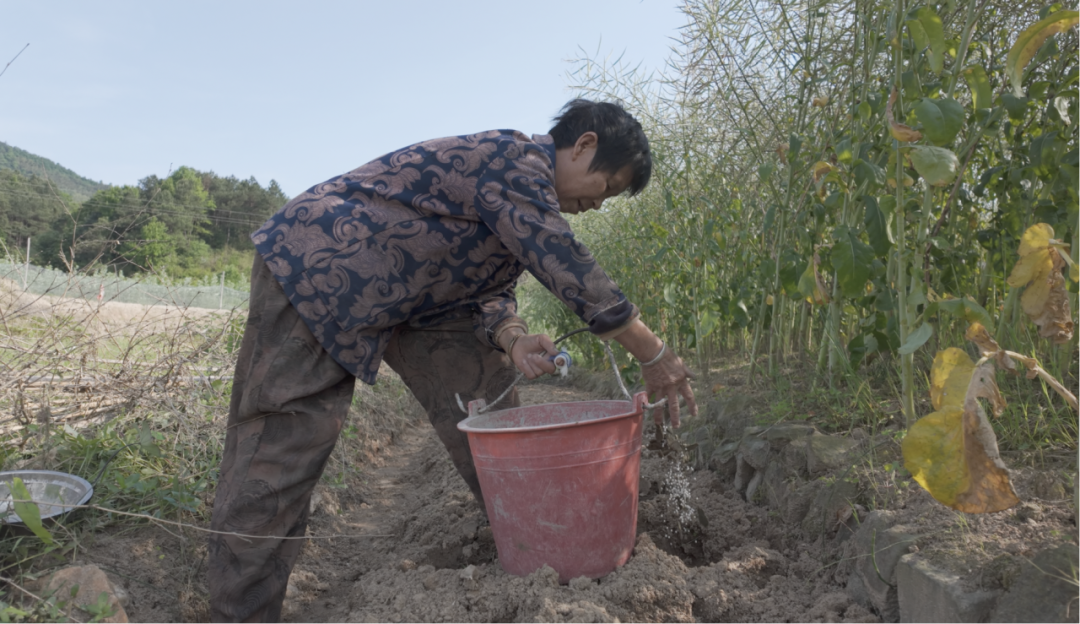
◉ Grandmother planting sweet potatoes; beside her, the oilseed rape that lodged this year and yielded a poor harvest.
In the end, she chose bamboo shoots. Shoots grow wild, nurtured by the earth and sky – there is no need to buy seed, fertiliser or pesticide, no worry about irrigation. It all comes down to whether you are willing to put in the hard work. Grandmother says, “Gathering shoots is already a good deal – no capital required, just labour.”
By the numbers, in the past four or five years Grandmother has earned just under 10,000 yuan selling dried bamboo shoots – enough to earn the admiration of many of the younger uncles in the village. In 2025, dried shoots from the large shoots sold at 20 yuan a kilogram; she sold over 50 kilograms, bringing in just over 1,000 yuan. A relative, Uncle Yang, mindful of her hard work, bought 15 kilograms at 30 yuan a kilogram. Dried shoots from the small shoots sold at 24 yuan a kilogram, earning over 1,700 yuan. The year’s total income from shoots was around 3,000 yuan. In 2024, Grandmother’s total income from shoots was approximately 2,800 yuan. The year before that, it was 2,000 yuan.
Grandmother says the rise in her shoot income over the past few years is really her daughter’s doing – otherwise, 20 kilograms of dried bamboo shoots a year would have counted as a good haul. My aunt helps Grandmother for around ten days at a time, but lets her keep all the money. Once you factor in per-head cost-sharing and vehicle expenses, it really doesn’t add up to much of a profit.
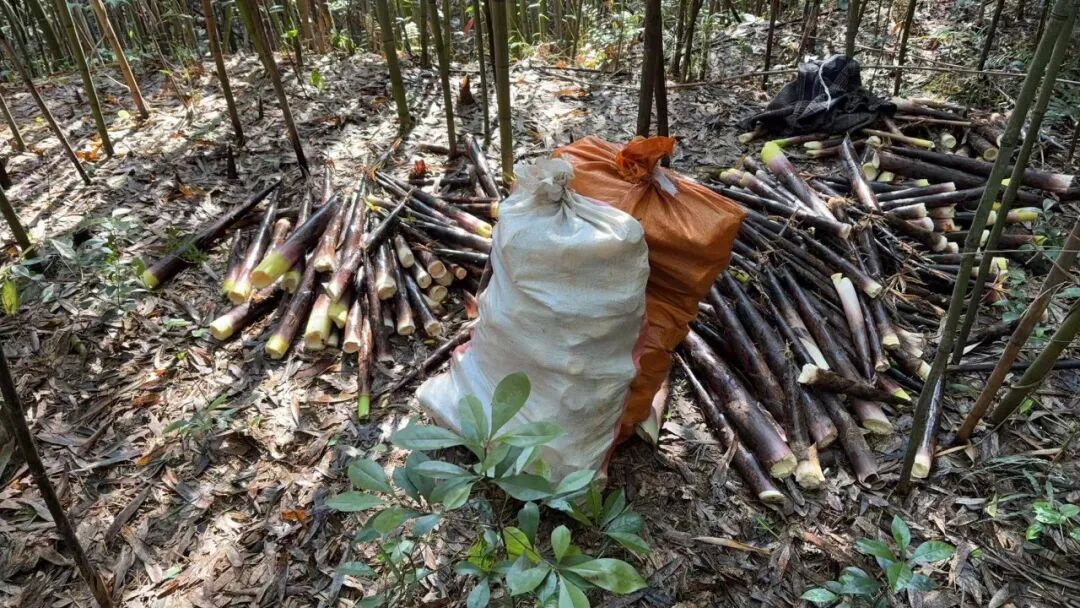
◉ Shoots gathered on the mountain are packed into woven polypropylene sacks and carried down.
Loss
But shoots gathered home with all that effort still face a long, laborious processing phase and a great deal of shrinkage loss.
The old saying goes, “One basket of shoots, two baskets of husks.” Peeling is the first step: you twist off the shoot tip, tear it open, roll back the outer shell, then carefully pick away the pale inner skin. After a full day of this, your fingers swell terribly.
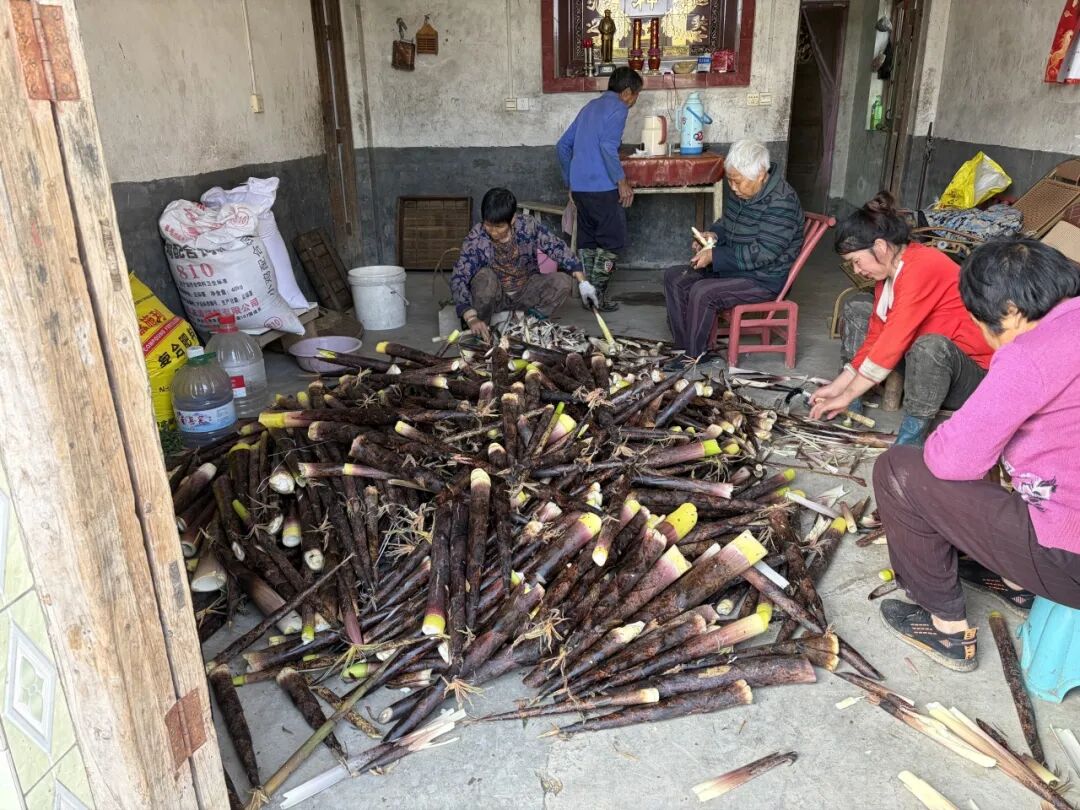
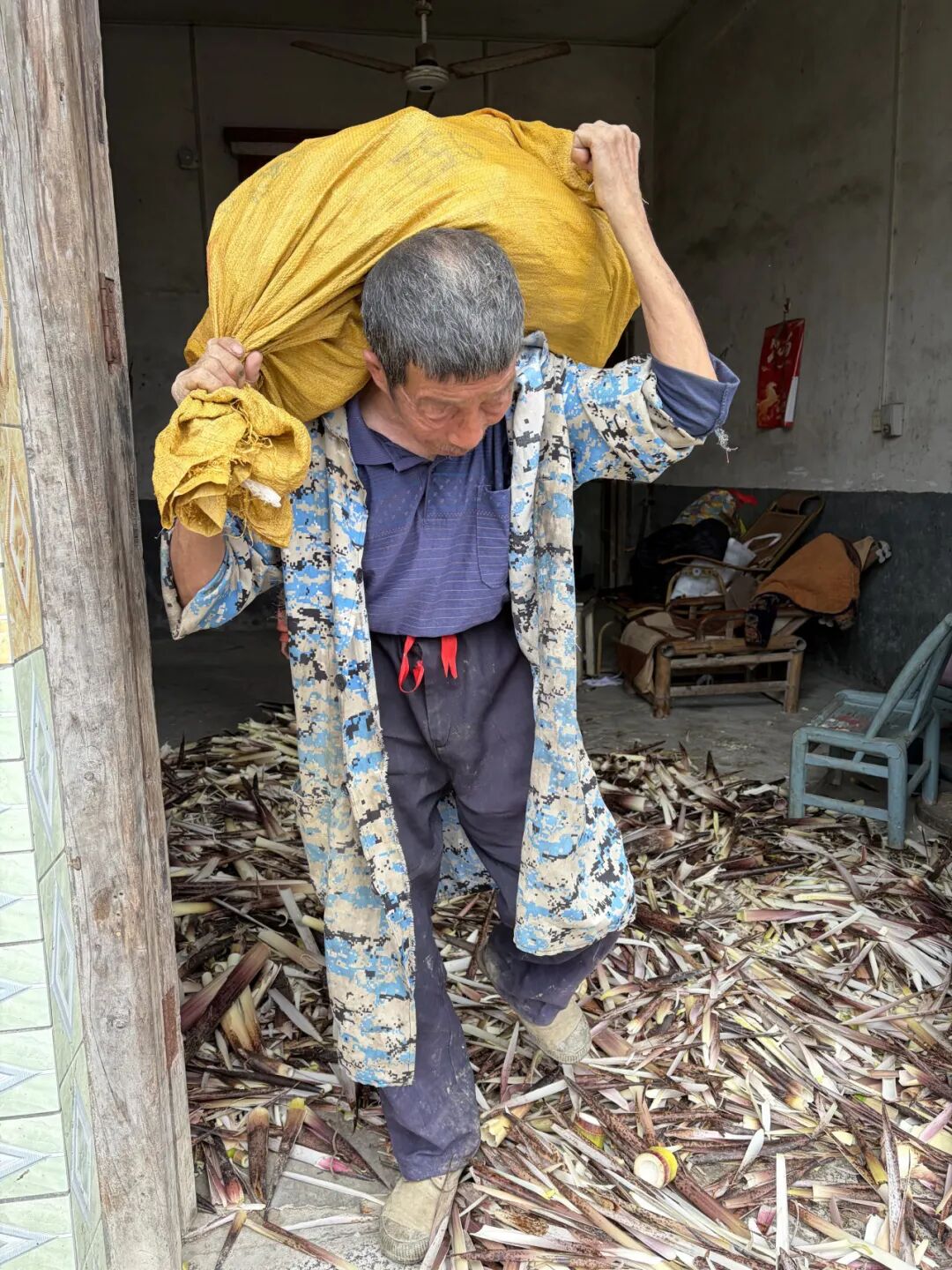
◉ Peeling shoots.
Peeled shoots then go into a large pot and boil for over an hour, until they turn yellow and are cooked right through. While still hot, they are quickly plunged into cold water, then laid out one by one on a drying rack and turned over at intervals. On sunny days, two days under the sun will do. Cloudy days bring trouble – you have to dry them over firewood instead, turning them again and again. All told, turning fresh shoots into dried shoots keeps you on your feet for several hours a day.
Grandmother says that 50 kilograms of fresh shoots, once peeled, leave roughly 15 kilograms of flesh. Five kilograms of flesh, sun-dried, yields at most half a kilogram of dried shoots. The smaller shoots shrink even more drastically. On Labour Day we gathered 200 to 250 kilograms of fresh shoots; Grandmother said they’d yield under 10 kilograms of dried shoots, fetch one or two hundred yuan, and when you split that between three people and a whole day of scrambling through the hills – carrying, hauling, trimming, boiling, sunning, turning, gathering – the hourly rate simply defies the maths.
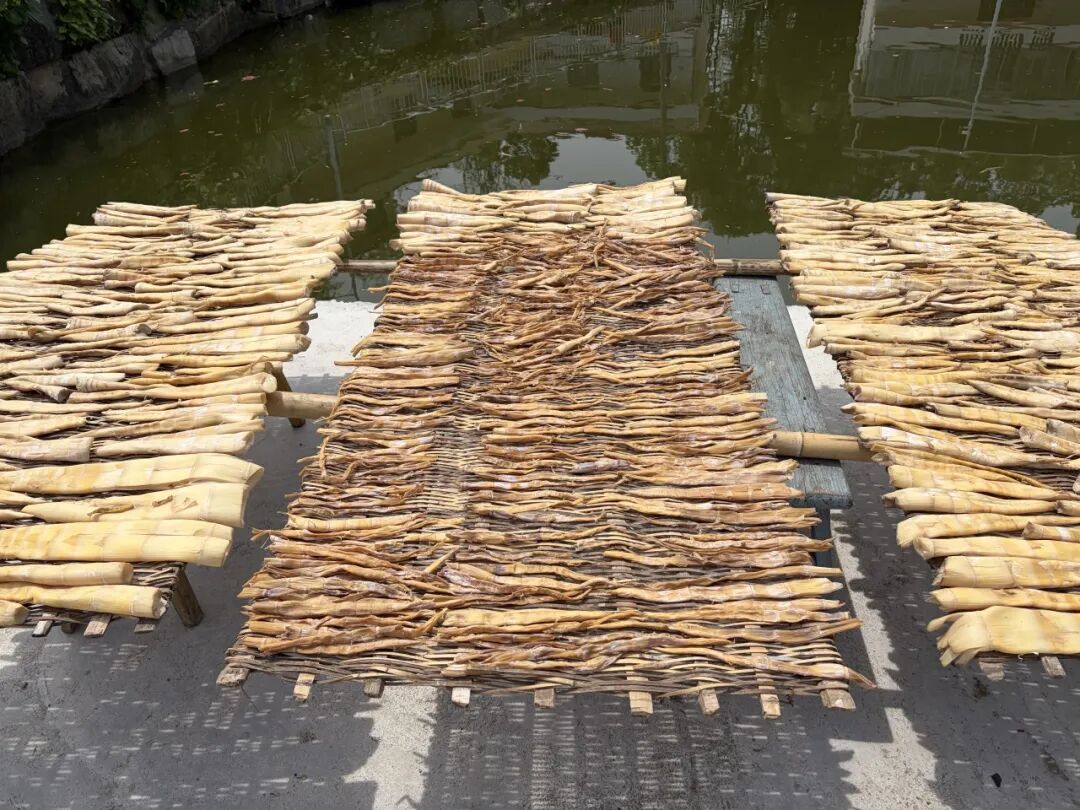
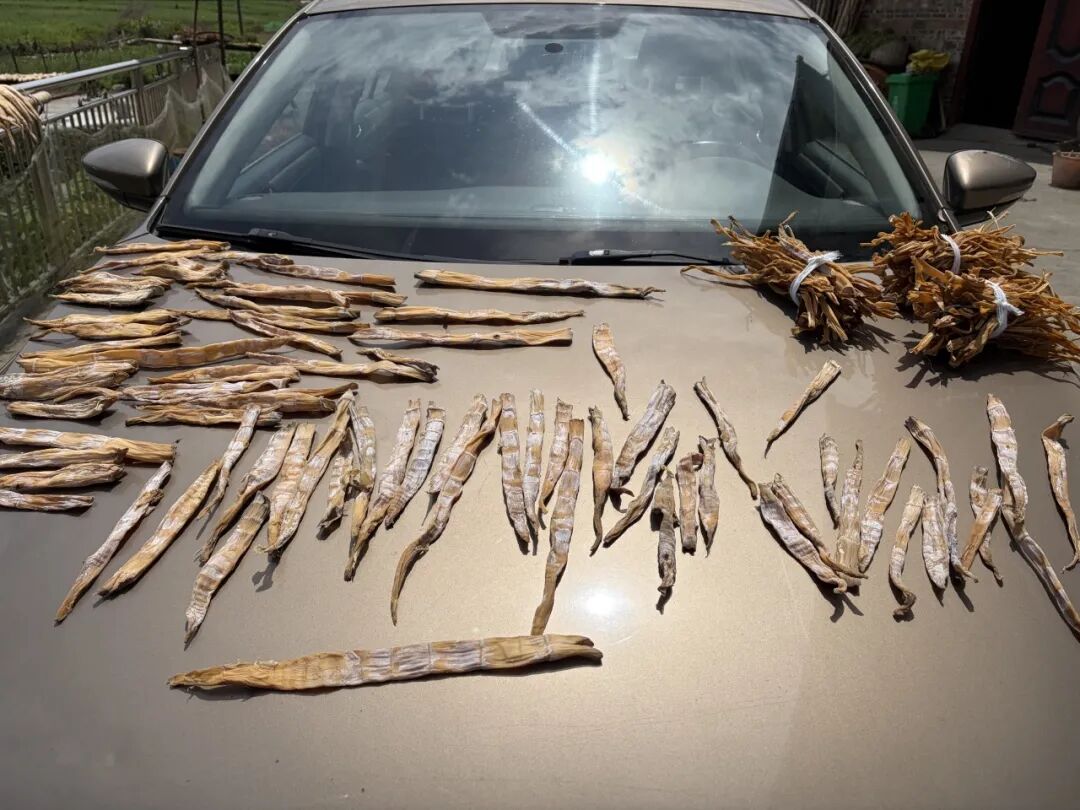
◉ Sun-drying means keeping a constant eye on the sky. If a downpour comes out of nowhere and you haven’t brought the shoots in, all your earlier work is for nothing.
On e-commerce platforms, dried bamboo shoots sell at an average of around 60 yuan a kilogram, free delivery included. That price is a world away from Grandmother and the other women – they don’t even know where the parcel depots are, let alone how to get a shipping discount. Some in the village have connections to sell directly to relatives, friends or restaurants at 40 yuan a kilogram. But those without contacts can only sell to buyers at a lower price.
Grandmother mainly works with a regular buyer in the village, Boss Chen. He drives his little three-wheeled motorbike into the village to collect – wild mountain produce, farm goods, medicinal herbs – and they’ve been trading together for over a decade. The price of dried bamboo shoots has fluctuated between 16 and 30 yuan a kilogram these past two years. Once he has the goods, he trims the tough old bases, sorts them by tenderness and says that when the market is good, they can fetch around 44 yuan a kilogram.
Sometimes Boss Chen’s offer is low, and Grandmother holds back, waiting for a better price. But her options are growing ever fewer. In recent years, far fewer buyers come to the village. She used to go to town herself to sell retail, but many people have left, and there are fewer customers now. On top of that, the rural bus service to the village was suspended last year – there’s no regular coach any more. Walking to town takes over an hour, and hiring a motorcycle taxi costs 12 yuan one way, making the round trip a considerable expense.
If no buyer ever comes, the mountain produce might as well rot in your hands. In 2025, Grandmother’s dried shoots were forced down to 16 yuan a kilogram. Even at that price, the buyer was reluctant. Grandmother, too angry to stand for it, held out until winter and had her daughter drive her into town to find another trader.
At first, the woman running the shop offered 22 yuan a kilogram. Then she rummaged through the dried shoots, said the quality wasn’t great and they’d been stored too long, and offered only 20 yuan a kilogram. Grandmother didn’t dare wait any longer; that day she sold 23 kilograms and took home 460 yuan. Beaming, she took me off to buy pork and spare ribs, saying she’d cook us something special. The next day she sold the remaining twenty-odd kilograms of dried shoots, too, and at last that weight off her mind was gone.
Ageing
Gathering shoots – a job of “low return, high intensity, high patience” – is something the men in the village are largely unwilling to take on. But the women embrace it gladly, each hoping for an income of her own, unwilling to wait on her husband for money.
“In the countryside, where can you find work that brings in over two thousand yuan?” Grandma Deng Lian tells me with a sigh.
No one can help Grandma Deng Lian; she must see through everything herself, from climbing the mountain to gather shoots to processing them into dried bamboo shoots. Over these past few years Grandfather’s health has been slipping too, and Grandmother no longer lets him help with household or farm work; the lion’s share of the labour now rests on her shoulders.
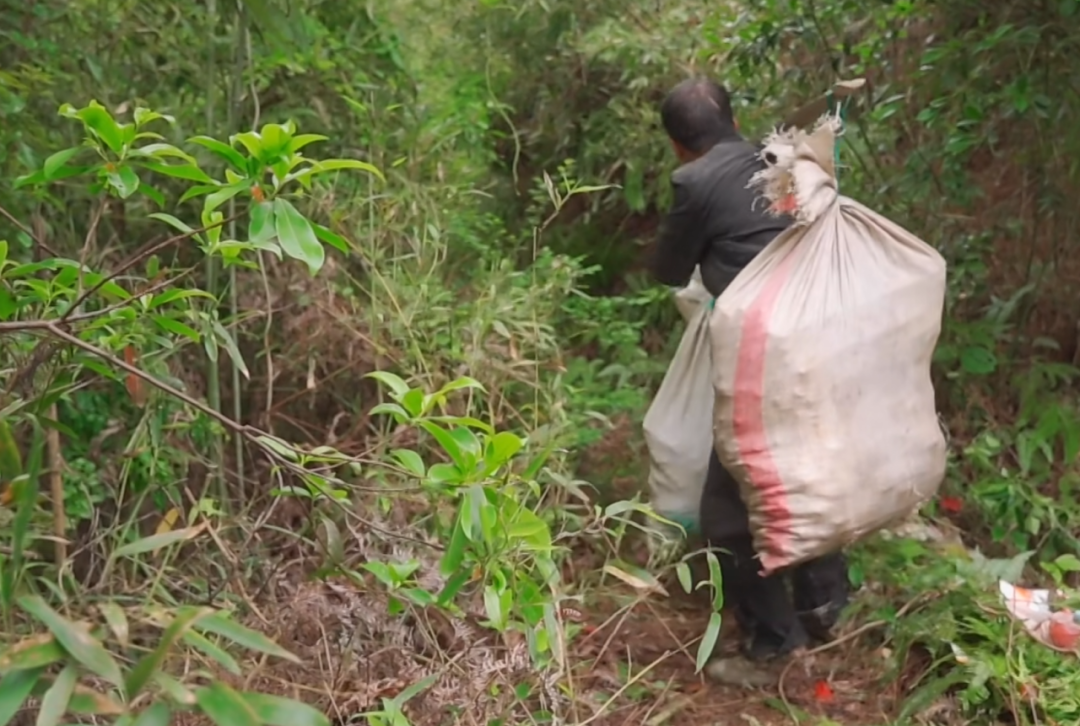
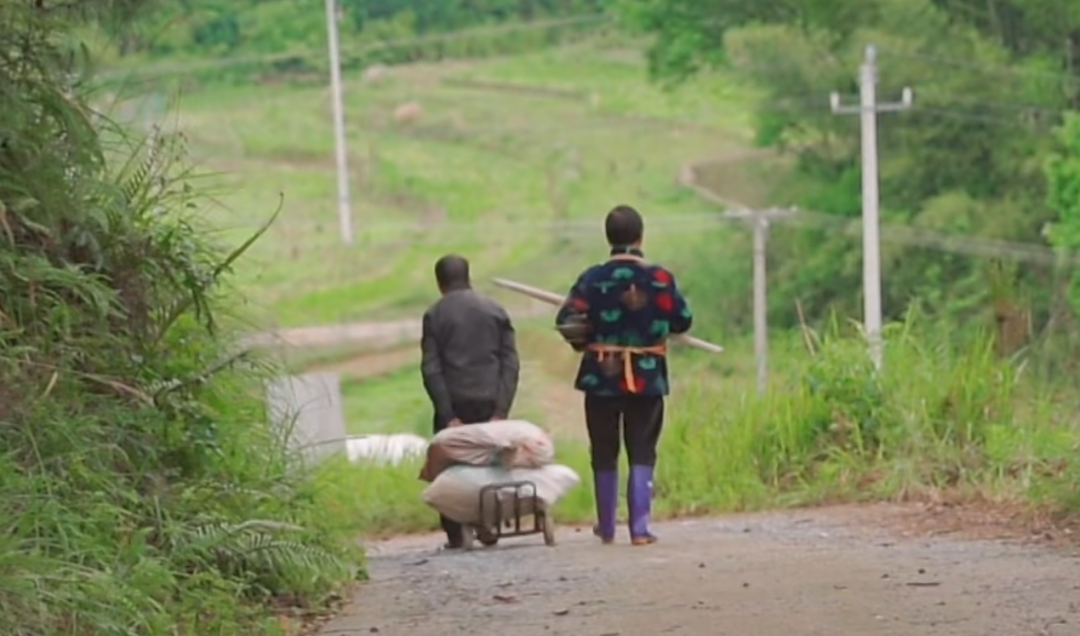
◉ During the 2022 shoot season, Grandfather could still lend a hand with a bit of the carrying. Now the bulk of the farm work falls on Grandmother alone.
But Grandmother is ageing, irreversibly, and so is the entire village.
The old passenger coach, once packed shoulder to shoulder on market days, now sits with more than half its seats empty. Houses in the village grow ever more stylish, yet one after another the doors shut for good. Streetlights have been installed, but the neighbours who used to sit outside chatting into the evening are gone. In the second half of last year the village’s scheduled coach service was suspended for heavy losses, as if drawing a quiet rest for the elderly left behind in this village.
Our village team – thirty-odd households in total – now has only about ten permanent residents, and just seven or eight families still working the fields. A decade or so ago, heading up the mountain to gather small wild shoots was a lively affair: over a dozen middle-aged and older women, with children in tow, would chatter their way up the slopes. Grandmother always had four or five companions on every outing, but one by one they left. Neighbour Grandma Yang passed away in the spring; the last few rounds of shoots we’d gathered together hadn’t even had time to dry before they all moulded.
Nowadays only six or seven women in the village team still climb the mountain to pull up shoots. The eldest is Grandma Da, aged eighty-four, though she only picks a few on the odd occasion when she happens to pass by. The youngest is Axi, a stay-behind mother in her forties. The core three are Grandmother, Grandma Deng Lian, and Axi.
Fortunately, over these past few years my aunts have come back home. Poor health means they can no longer travel out to labour on building sites. Back under their mother’s roof, these daughters take some of the farm work off ageing Grandmother’s shoulders from time to time.
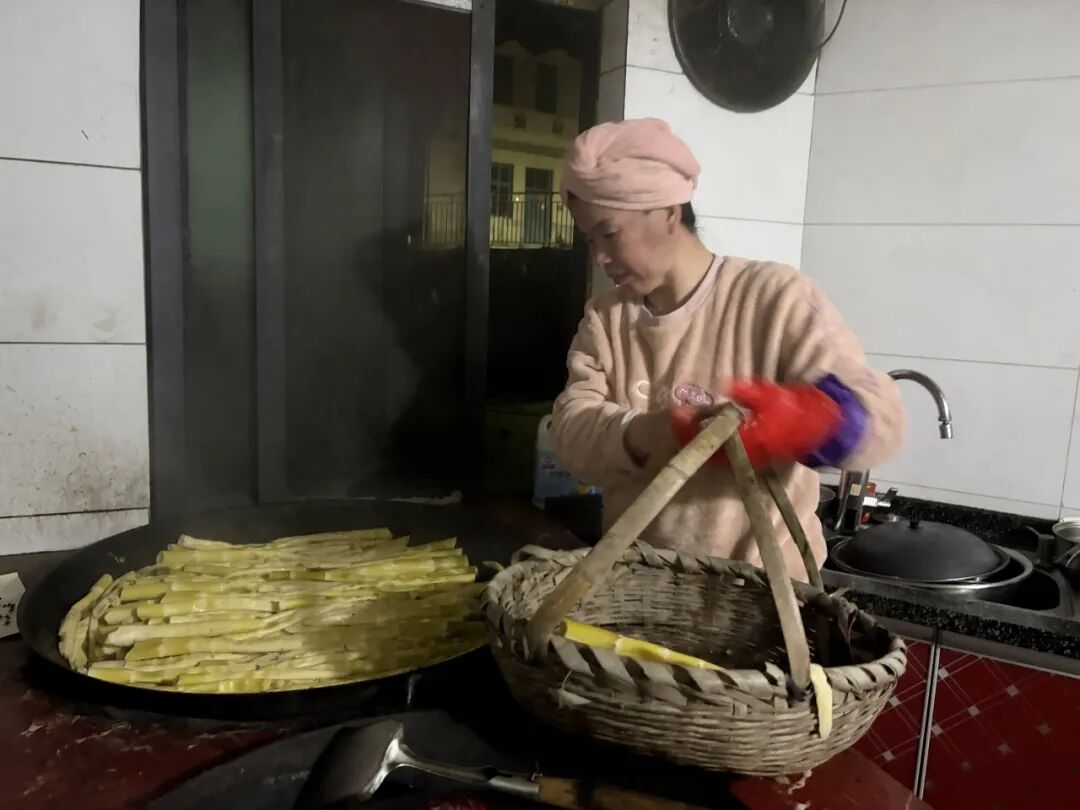
◉ Auntie helping boil the shoots.
Dignity
These shoots are money – but not only money. For Grandmother, they also mean dignity.
Grandmother, Yang Xiuying, has always been a stubborn, proud rural woman. There were nine siblings in her family; theirs was an outsider surname in the village, the household especially poor, and none of the girls were sent to school. She managed just two days of class, recognising fewer than two characters, before her maternal grandfather called her home – after all, even a girl of seven or eight was useful labour for gathering pig fodder and cutting firewood.
In her youth she would set off before dawn and cross the high passes – scaling Leizu Ridge, over 600 metres high – to reach Hengnan County in search of grass, firewood and shoots, not returning until after dark. She told me she was one of the few village girls who could occasionally come back with a small bundle of shoots. That bundle, once peeled, yielded barely half a kilogram of flesh, but it was a rare treat at the family table. The stripped-back shells were kept aside to feed the pigs, and everyone treasured what little there was.
Grandfather was drawn to her in part by that same tireless endurance. In his younger days he kept the village work-point records and served as weigher, and noticed that the small-framed Grandmother always brought back the biggest load of fodder – remarkably capable, he thought. After they married, for the first few years the household sold mostly peanuts and sweet potatoes, and it was always Grandmother who negotiated the prices. In those days dried bamboo shoots were mainly kept for the family table at festivals and holidays. The older generation all loved stir-fried pickled shoots with pork, and Grandmother’s shoots were always the most popular.
It was Grandmother who held up the whole household, its big matters and its small. When she was young, Grandfather was conscripted to build railways and haul timber – a pittance of a wage, and years away from home – so Grandmother tended just over half an acre of land single-handed, earning work-points and raising three children all at once. Later still, she shouldered the responsibility of looking after me and my brother too. Never having gone out for wage work became the great regret of her life. “If only I’d had an education, if only I’d learned to read, I’d have built a little business of my own. I’m no worse than anyone else.”
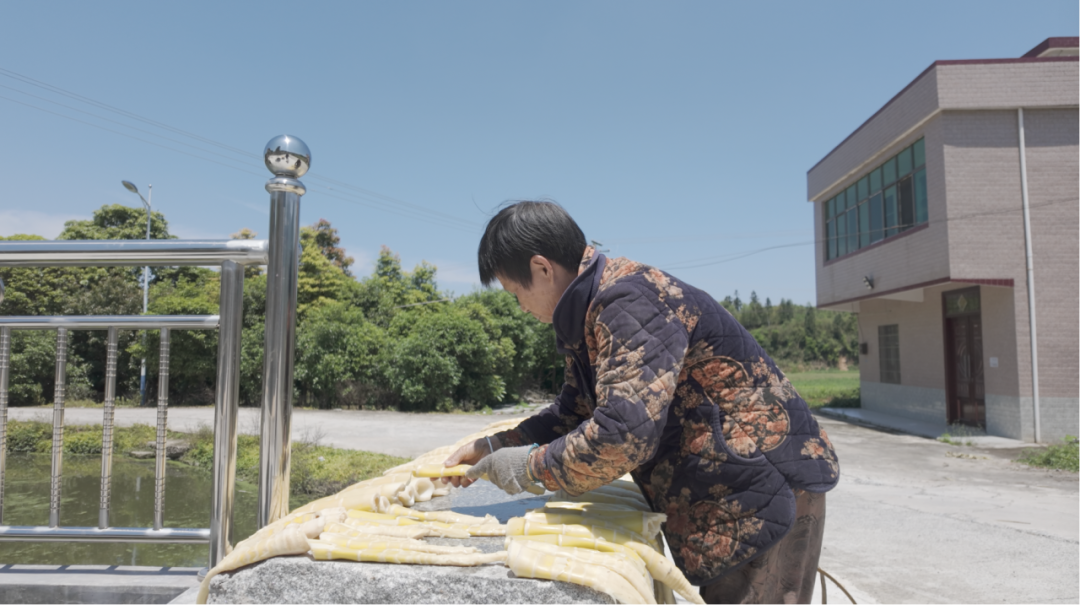
◉ Grandmother drying shoots, making do with whatever the weather and terrain allow.
Time is unmerciful. Through my high-school years, university and into work, Grandmother stayed in that same small mountain village. All she had to trade was experience and familiar labour, for a pittance. With the passing years her ailments multiplied – years of stomach trouble, a bile duct excision, anaemia, cerebral atherosclerosis… Last year Grandmother fell ill; the bill came to over three thousand yuan. Stubborn as ever, she paid a thousand or so of her own money, refusing to take a penny from her children.
In these mountain towns and rural villages caught up in development, everything is shifting. The villages are left behind by the cities, the old left behind by the young. But Grandmother still climbs the mountain, year after year, to gather shoots.
Those little dried bamboo shoots are the story of her whole life – the forest wisdom built up season upon season, giving her income and a quiet sense of self-assurance. They are the one thing she can proudly offer younger kin and visiting relatives – “something of her own”. She never spares an effort to send every caller away with some dried shoots or sweet potato vermicelli.
Some relatives gratefully accept her gifts of wild mountain produce, praising how lovely her goods are; others find it a nuisance. Still, every year she sets some aside. These past few years she has also learnt to pickle shoots: fresh little shoots, blanched in boiling water, tucked into a glass jar with a little brine, sealed up for the better part of a year, so that when her children and grandchildren come home for the Spring Festival there will be pale, tender shoots to enjoy.
End of the Shoot Season
A full shoot season lasts roughly forty-five days, traditionally falling between the Qingming and Xiaoman solar terms; this year it ran from early April to late May.
The shoot season falls in two phases. First come the “big shoots” in the nanmu bamboo groves before Qingming – tips barely a few centimetres above the soil, yet the shafts plunge deep underground. The bamboo roots are tough, unyielding to hand-pulling; they must be dug out with a hoe, a test of keen eyesight and physical strength. Digging up a single big shoot takes nearly twenty minutes. On rainy days it is harder still: most of a sack brought back is yellow mud, heavy as stone. As the big-shoot season draws to a close, small shoots erupt across the hillsides – first the velvet shoots, then water bamboo shoots, then hemp-shell shoots. The thickness of the flesh varies from one species to the next: hemp-shell shoots, though not as tender to eat, have a thick cut of meat, making them the most worthwhile to gather and sell.
Apart from days of heavy rain and tending the fields, Grandmother has been working the mountain for just over a month. Each trip means at least two or three hours foraging through the undergrowth, and when she emerges she is carrying bulging woven polypropylene sacks on her back.
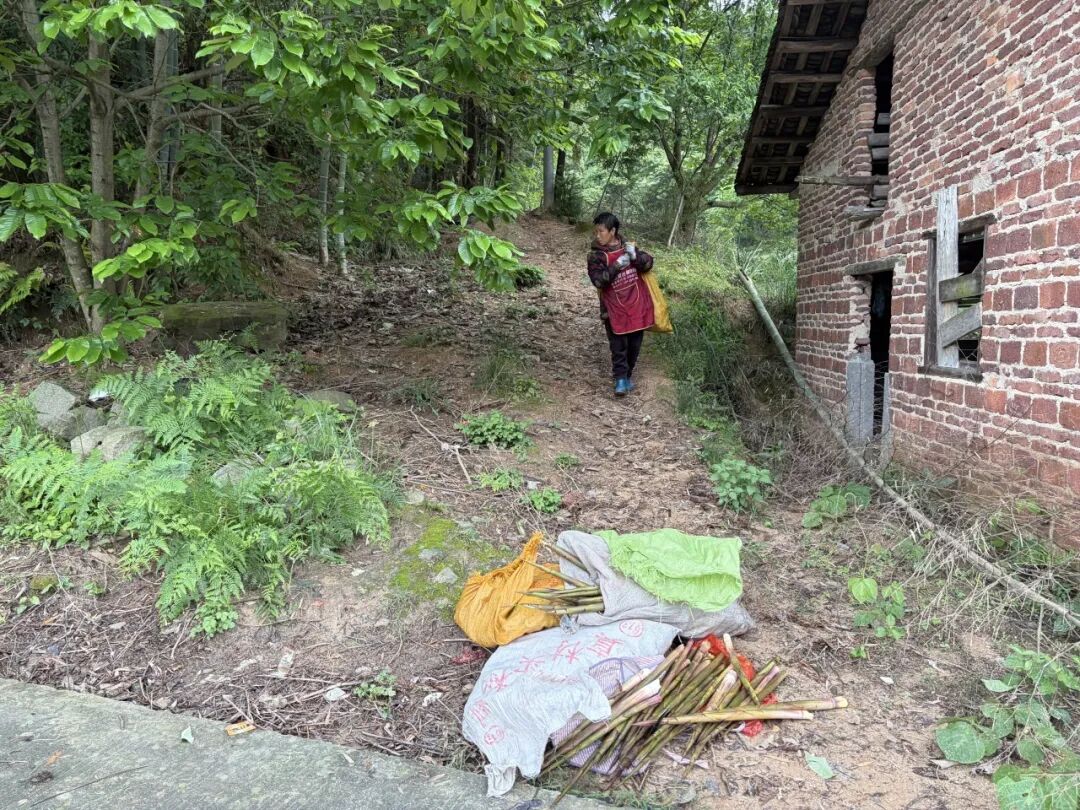
◉ Grandmother with her harvest – several sacks full of shoots.
My holiday ended and I returned to work, and then the skies opened again at home with a torrential downpour. Grandmother said the rain came down as if poured from the sky – thank goodness the shoots were nearly dry by then.
At the time she had solemnly sworn to me she was done – finished with it all.
But two weeks later, on the 15th and 16th of May, she was up the mountain again – out at five in the morning, back down by eight – lugging back tens of jin of fresh shoots, enough to fill two bamboo drying racks. She said she wanted to pickle some in the jar before the rain came back, so that when I returned they would be ready to eat.
From late March to the 16th of May this year, the long shoot season has ended. It was no “bumper harvest” for Grandmother. She told me that the scant rain last winter had killed off a fair stretch of the mountain bamboo, so this year’s shoots were not really plentiful. The quantity gathered fell short of last year’s.
The end of the shoot season does not mean the end of the labour. After dark, Grandmother is still working over the shoots: under the lamplight she gathers the dried ones up, straightening each in her palm, tying them into neat little bundles, sorting them by type, and setting aside the very best – for the children to eat when they come home for the New Year.
Outside, the night rain falls in sudden gusts. The shoots left among the deep, brooding mountains will grow into new bamboo groves, round after round. Next year the forests will send up fresh shoots once more, waiting for those who come to gather them.
– This is Foodthink’s 815th original article –

Foodthink
Author
Dusty Zhang Qiuqiu
A village girl working in the city – a plant-and-food enthusiast, devotee of the lazy life – collecting fragments of existence and writing a little about the stories right at her doorstep.
About the “She and the Land” Column
This year has been designated the UN’s International Year of Women Farmers, and Foodthink has launched the “She and the Land” column, shining a light on women within agriculture and food systems. We will walk into fields, markets, fishing harbours, pastures, kitchens, laboratories and city streets to see the women who are often overlooked yet always present – they participate in production, research, cooking, distribution and care, supporting our daily lives with their labour, experience and wisdom. They are tillers of the soil and essential builders of the countryside and its food systems. Through interviews, writing and workshops, we hope to tell their stories, to recognise how women’s participation shapes our food systems, and to invite you all to explore together: for the women who labour in food and farming, how does a fairer, more dignified future take root?
Unless otherwise stated, all images are provided by the author.
Editor: Xiaodan
Layout: Xiaoshu
Scan to tip – support original food knowledge
▼

▼
Click the image to read related articles.
▼
Click a keyword to browse more article collections.
Seeds | Farming Techniques | Policy | Fermentation | Nutrition | Fruit | Fisheries | Events | Recruitment | Food Delivery | Market | Livestock | Food Talk | Sharing Sessions | Book Club | Harvest Festival | Smallholder Stories | Climate Change | Rural Development | Cooperative Economy | Urban Farmers | Food Safety | Digital Technology | Biodiversity | Pandemic and Food | False Solutions | Lianhe Creative Programme | Ecological Agriculture Internship Programme
Beijing | Hebei | Shanghai | Guangdong | Guangxi | Henan | Sichuan | Jiangxi | Xinjiang | Shaanxi | Hong Kong | Chongqing | Zhejiang | Jiangsu | Guizhou | Northeast China | Taiwan | Inner Mongolia | Philippines | Canada | Russia | Mexico | Italy | United States | UK | Germany | Netherlands | Thailand | Sweden | Japan







🌟🌟🌟Star us so you won’t miss updates
“Like” “Share” “Wow” “Comment”
▼ Spread delicious food knowledge