Dams That Fell, People Lost, Harvests Lost

Editor’s Note
Guangxi’s flood rescue operations are still ongoing. In the core disaster area of Hengzhou in Nanning, floodwaters have swept across jasmine, rice, sugarcane and banana plantations as well as fish and pig farms—yet as recently as the past two years, Heng County was still strengthening farmland irrigation infrastructure. Amid the “new-style tea beverages” boom, many farmers expanded their jasmine cultivation, and the losses are now even greater. Extreme disasters have become the norm, and climate change has been written into the 2026 national No. 1 Document. How do we move from “flood control” to building resilience? What can be prevented, and what cannot? Both rural and urban areas need better solutions.
The Rain Was Enormous!
Can the Reservoirs Hold?
On the morning of 6 July, Zhong Luyan, a villager in Zhongtuan Village, Hengzhou, Nanning, received a loudspeaker warning broadcast from the village. She saw village committee members knocking on doors one by one, notifying residents that a nearby reservoir would open its sluice gates to release water and urging them to take care. Zhong judged that the reservoir near her village was small, and that her home and farmland sat at a high point on the hillside—still safe enough, she figured—and chose to stay and observe. Before long, news came of a dam breach at Liulan Reservoir, more than ten kilometres away. Yunbiao Reservoir, five kilometres from Liulan and also on the upper reaches of the Yu River, began overtopping at the same time.
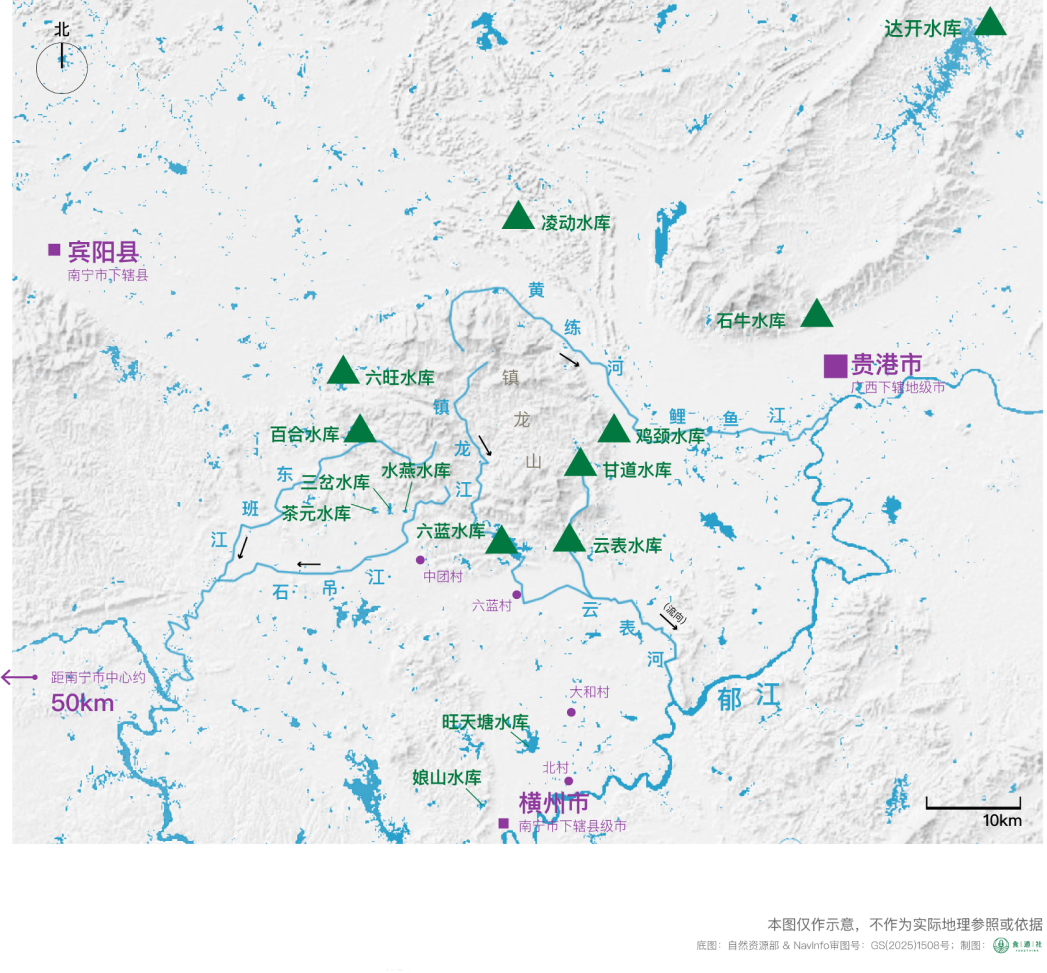
◉ Reservoirs in distress within the Yu River basin, a tributary of the Xi River. Liulan and Yunbiao Reservoirs drain into the Yu River via the Zhenlong and Yunbiao Rivers respectively; both originate in Zhenlong Mountain, the area where this rainfall was most concentrated. In addition, floodwaters from the Dongban and Shidiao Rivers and the Huanglian–Liyu River system have flowed into the Yu River from the west and east respectively. Image source: Foodthink
Zhong Luyan was “lucky”—the reservoir’s discharge did not reach the jasmine fields on her hillside; only a few strips of farmland were flooded. The phones of the many other Hengzhou farmers we tried to contact were out of service due to signal loss. Online calls for help indicate that the entire Zhenlong Township in Hengzhou City was cut off, and as of the morning of 9 July, communications had still not been restored.
Dahua Village and Beicun in Hengzhou Town, further from the dam breach, saw their residents’ homes hold for now, but floodwater stood up to three metres deep. The jasmine and rice fields of more than a thousand villagers—nearly ten thousand mu in total—were all submerged.
Since 3 July, the influence of this year’s Typhoon No. 10, Maysak, has brought historically rare widespread and persistent torrential rain to Guangxi. Over 77% of the region’s townships experienced heavy to extreme downpours. According to Xinhua News Agency, as of 11:00 on the morning of 9 July, Nanning had evacuated and relocated 64,500 residents—of whom 54,500 in Hengzhou City and 9,321 in Binyang County were due to be moved. In total, 375,000 people across the region were affected, with 39 confirmed dead and 9 missing; 12,900 hectares of crops were damaged.
The most dramatic event of the floods was, without question, the breach of Liulan Reservoir’s dam body on the morning of the 6th.
Liulan Reservoir sits on the Yunbiao River, a tributary of the Yu River, in Liulan Village of Jiaoyi Town. It is the largest medium-sized reservoir in Hengzhou City, providing irrigation and domestic water supply to 170,000 people across 46 administrative villages in four townships, with a stable irrigated area of 157,300 mu. It also serves as a key backup water source for Hengzhou’s urban area. According to public records, the reservoir underwent systematic renovation in both 2009 and 2023, with media reports placing cumulative investment at over 400 million yuan.
Yet at 10:00 that morning, the dam body tore open a gap fifty metres long in an instant, and floodwaters surged downstream towards villages and contiguous farmland. Villages were swallowed by several metres of muddy water; the ground and first floors of countless homes were entirely submerged; roads, power and communications were widely cut off. Entire villages were reduced to islands reachable only by water, cut off from the outside world. A local villager interviewed by Ifeng said that the most terrifying thing was that even after the reservoir discharged, the water did not recede.
At 11:30, Nanning’s flood-control emergency response was raised from Level III to Level I.
Hao Nan, founder of Zhuoming Xinyuan, analysed that the sheer volume and unceasing duration of rainfall were the key factors aggravating the disaster this time in Guangxi. He drew a comparison with the devastating rainstorm that hit Zhengzhou, Henan, still fresh in many people’s memories—the “7·20” disaster—where calm weather preceded a sudden burst of short-duration, extreme downpour. In this Guangxi event, however, prolonged heavy rain had already saturated the soil and pushed river channels to the limits of their capacity to absorb flow. Right at the critical threshold where water-control infrastructure was about to give way, another wave of even more intense, extreme rainfall struck in the final hours. “This is the kind of rain that kills,” he said. “It’s like being beaten on a boxing ring—already wobbling, barely able to stand—when suddenly a few more heavy blows come crashing in.”
Analysis showed that this typhoon followed an unusual path, and the torrential rain did not dissipate even after landfall. According to statistics, in the 24 hours from 08:00 on 5 July to 08:00 on 6 July, southern and eastern Guangxi experienced torrential and extreme downpours. Eight districts and counties—including Binyang County in Nanning, Qinnan District in Qinzhou, and Qintang District in Guigang—recorded rainfall exceeding 400 millimetres, with Luwei Town in Binyang County recording a staggering 713.3 millimetres.
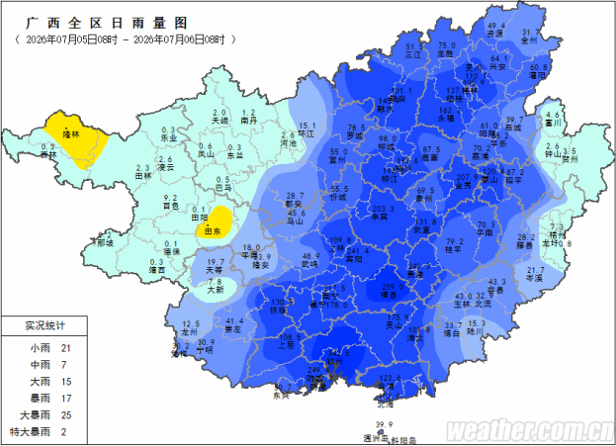
◉ Daily rainfall map for Guangxi (08:00 on 5 July 2026 to 08:00 on 6 July 2026). Image source: Guangxi Zhuang Autonomous Region Meteorological Bureau
The Pearl River Water Resources Commission disclosed that in just two days since 4 July, 77 rivers across the Xi River main stem and its tributaries—the Liu, Yu and Gui Rivers, among others—in the Pearl River basin had experienced above-warning-level floods. On a single day alone, the water levels of 40 small and medium-sized rivers breached their highest on record since measurements began.
Under the unrelenting rainfall, by 9 July at least 12 reservoirs in and around Hengzhou had reported distress situations—including overtopping, in which floodwater rises above the “design flood level” at which an engineering structure can reliably fulfil its flood-control function, as well as several dam breaches and outright failures. Beyond the nine reservoirs reported on the evening of 7 July in Nanning and Guigang cities, including Liulan and Yunbiao Reservoirs, flood-discharge notices were also issued for Sancha Reservoir, Niangshan Reservoir and Wangtiantang near Hengzhou City, with severe downstream flooding.
Hao Nan explained that a reservoir’s “design flood level” is a critical safety boundary. If a danger arises while the water level is still within the design flood level, it usually reflects a problem with the structure itself. But once the water exceeds that level—beyond what the engineering was designed to bear—the structure can no longer guarantee safety.
“We used to rely on a network of reservoirs to handle a once-in-a-century event, but that flood defence standard no longer holds. A ‘once-in-a-century’ event could now come every five to ten years. Extreme precipitation records will keep being broken—not just here, but everywhere else in the future as well,” Hao Nan stated firmly.
So what is to be done? He recalled being struck by words a water-resources expert once said: “We need to shift from ‘flooding must not happen’ (because we are too afraid of it) to ‘we are not afraid of flooding’.”
“Small floods belong to the people; big floods must be given back to the water,” another senior water-resources expert explained to Foodthink the approach to above-design-standard floods: when extreme rainfall triggers flooding beyond a structure’s design capacity, inundation becomes unavoidable, but a series of measures to build resilience in exposed systems—including strengthening the capacity to absorb impact, to recover and rebuild quickly, and to adapt to change—can reinforce risk management.
He went on to say that the water-resources system currently focuses mainly on “flood control” in addressing flood hazards, but risk prevention and resilience-building measures already go beyond that scope. To adapt to climate change, “there is still so much the water-resources sector can do.”
Agricultural Irrigation Systems
Built at Great Cost, Tested by Calamity
It is not only water-control infrastructure—agricultural irrigation systems too must now reckon with climate resilience. This flood and waterlogging, triggered by extreme precipitation, has dealt a blow not only to villages and farming households but also to Hengzhou’s agricultural industry built around the Liulan Irrigation District.
When Foodthink called, Liang Dongcai, a villager in Beicun, Hengzhou Town, Hengzhou City, Guangxi Zhuang Autonomous Region, had just finished a full day of patrol duties and finally sat down to an evening meal. On 5 July—the day inland flooding struck Guangxi—he had not slept at all, spending the whole night helping evacuate injured villagers.
In the low-lying areas around Liang Dong’s home, floodwater stood over three metres deep, seeping into many villagers’ houses. Beicun, where he lives, saw two natural villages affected, with more than 100 homes and over 2,000 residents impacted. The more than 6,000 mu of jasmine and over 2,000 mu of paddy fields cultivated in the village were all submerged. Liang Dong’s own jasmine fields were among them.
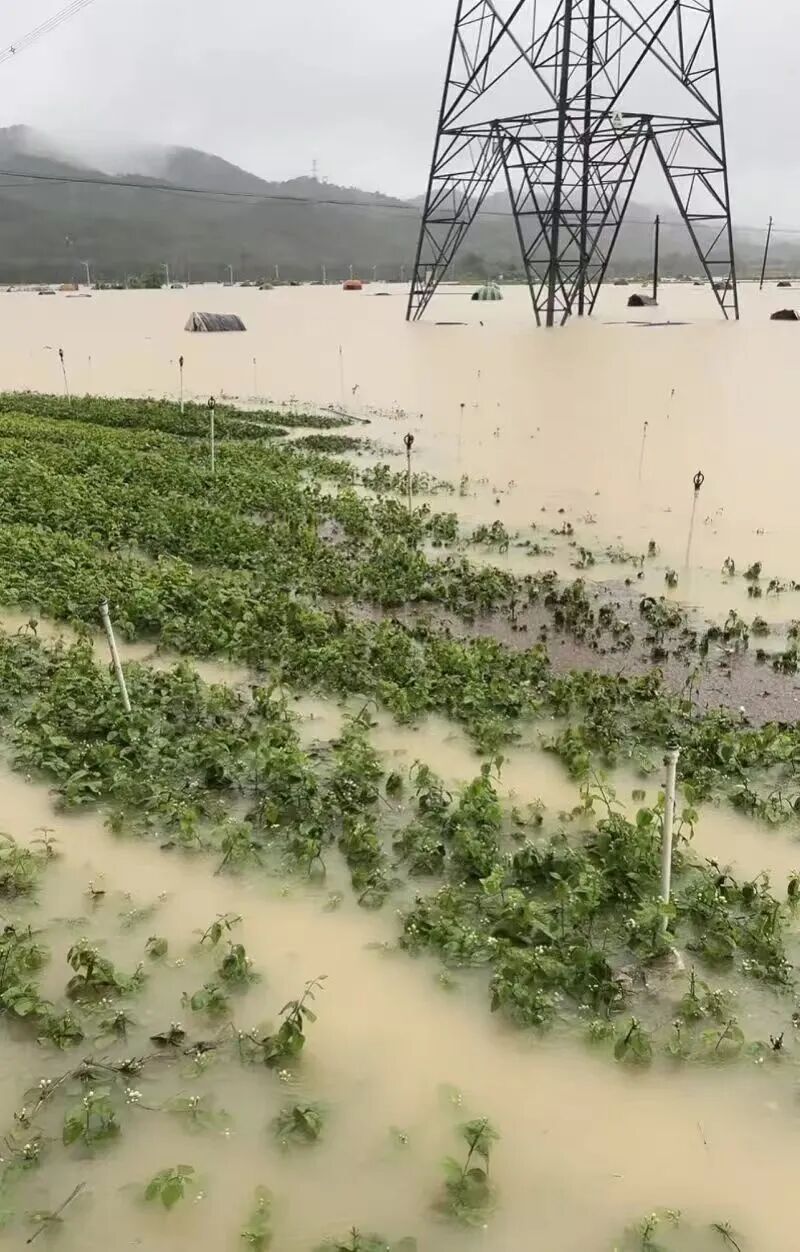
◉ Villagers in Chaoyang Dadong, Hengzhou Town, photograph flooded jasmine fields on 6 July. Image source: Southern Metropolis Daily
In late 2023, a modernisation and renovation project for the Liulan Irrigation District broke ground with a total investment of 382 million yuan. In the spring of 2025, Hengzhou City suffered severe spring drought. Reservoir storage dropped sharply, jasmine fields ran dry across vast stretches, and flower bud yields fell. To protect the local pillar jasmine industry, the renovation work was fast-tracked, and large numbers of concrete-lined canal sections were brought into service in late 2024 and throughout 2025.
The key focus of the project was concrete lining of 60 kilometres of main and branch canals across their entire length, straightening the channel routes to reduce water losses during irrigation and ensuring that, in the dry season, reservoir water could reach the jasmine fields quickly and directly. According to the official approval documents for the renovation, the district’s drainage ditches were designed to a once-in-five-year light rainfall standard—sufficient only for routine field drainage under normal light-rain conditions. The entire renovation addressed agricultural irrigation needs alone, with no flood detention or flood diversion facilities to cope with extremely severe floods.
“There’s no saving them now—just endless water everywhere. It’s a crushing feeling. Such beautiful jasmine, drowned like that,” Liang Dong said. He explained that jasmine plants might survive a week at that water level, but beyond seven days the trouble deepens: root rot would kill the entire plant.
Jasmine is a perennial shrub that, under normal care, can be harvested continuously for more than a decade. If the plants die, everything must start from scratch next year.
For now, he can do nothing but focus on disaster relief. He does not know what he will do once the water recedes. “When the disaster is over, what can I even go and do?”
The roughly six mu of jasmine grown by Xie Shunxiong, a village-committee member in Dahua Village, Hengzhou Town, was almost entirely wiped out. From 4 July, torrential rain had fallen on the village without let-up for two full days and nights. Floodwater stood two to three metres deep and had still not receded by the night of 9 July.
Dahua Village sits close to the Yu River. By the time the floodwaters discharged downstream along the river channel and reached the village, their force had somewhat abated, so Dahua was not among the hardest-hit areas. Residents’ homes were largely spared inundation, but the low-lying jasmine fields nearly all gave way.
In the flat, low-lying jasmine fields along the Yu River banks, an external flood backwater effect set in. Water from the farmland was meant to drain into the Yu River, but the river’s level was now higher than the drainage outlets, so the water could not flow out—and even began to seep backwards. All it could do was keep pooling in the fields. Xie Shunxiong could only lead villagers in operating pumps, but it made little difference: the pumped water had nowhere to go. The rain kept falling, and all they could do was wait for it to stop.
The double-petaled jasmine Xie Shunxiong grows has a long flowering period, with two peak seasons each year—May and June, then August and September. If the floodwater recedes soon enough and the plants survive, the jasmine can send out fresh shoots in just over a month, and they might still catch the harvest window. If the root systems die, however, they will have no choice but to leave the village: either heading to unaffected orchards nearby to harvest papaya latex, or taking temporary factory work in Guangdong.
Based on previous years’ market prices, a single mu of jasmine could earn Xie Shunxiong 30,000 yuan a year. This flood, he estimates, has cost him nearly 100,000 yuan. Dahua Village has 1,500 households and 6,700 residents in total. He says the average loss per household is around 80,000 yuan.
“After the disaster, we will push hard for subsidy policies,” Xie Shunxiong said. “You absolutely must raise this suggestion—please, give the farmers some support.”
In his role on the village committee, Xie Shunxiong has gone out at dawn each morning these past few days to inspect the damage, recording the losses of subsistence-allowance and Five Guarantees households, checking bridges and roads for damage, and often not getting a meal until eight or nine at night.
When he spoke about the situation in the village, he paused for a long time. “The sight was too awful to bear. Even now, just speaking about it, I am deeply distressed. Over 6,000 people in my village have been affected—how can I not feel ashamed?” After Xie Shunxiong finished, he hung up in silence.
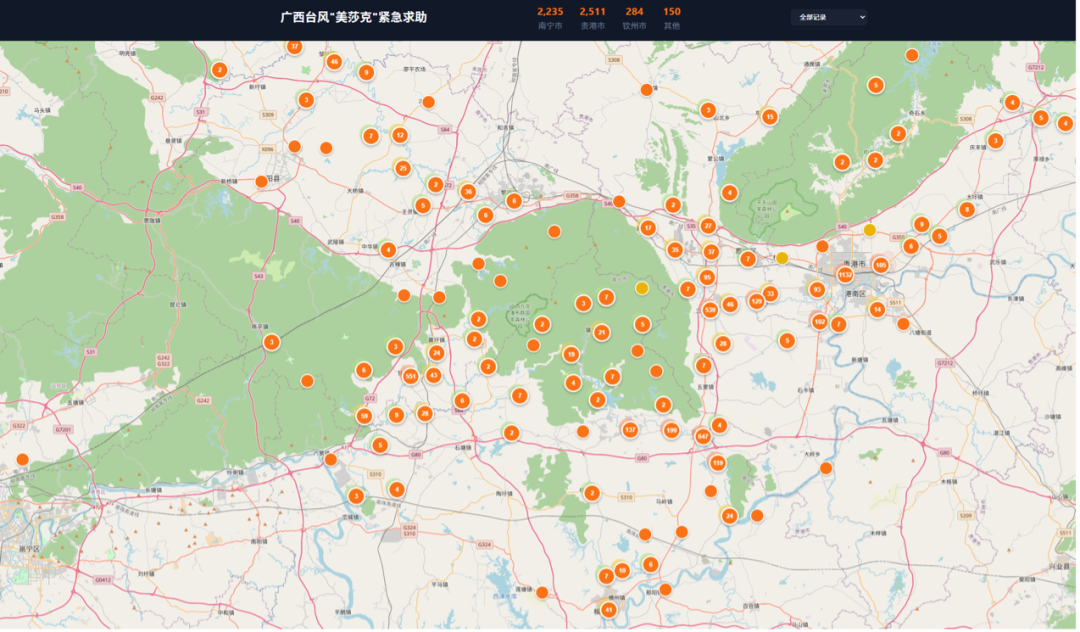
◉ At 20:27 on 9 July, the Kuai Qiuzhu (SOS Help) information-aid map mini-program showed a dense cluster of distress calls across the Nanning–Guigang area. Image source: interviewee
The Last Disaster That Broke the Flower Farmers
Villager Zhong Luyan in Zhongtuan Village runs an ecological jasmine farm, and she has felt that Hengzhou’s weather has grown strangely unpredictable over the past two or three years—last year more than any: “It feels as though typhoons have become far more numerous, far more frequent, and the downpours last so much longer. Nothing like the natural weather of before.” Last April, she witnessed a sight she had never seen in Hengzhou before, something resembling a “dust storm”: gale-force winds swept across the farmland, whipping up a haze of grey dust.
“Before, when summer got hot, there would be a quick shower that was over in ten or twenty minutes. Once the sun came back out, we could pick jasmine straight away. Now it’s so different. As soon as a typhoon hits, we can’t pick flowers for days on end,” she said.
Foodthink consulted agricultural insurance specialists and found that there are mainly two types of insurance relevant to the jasmine industry. The first is jasmine rainfall index insurance, covering the flowering period from late April to late October each year; under the policy terms, a claim is triggered only when cumulative rainfall days during the flowering period exceed 95. The second is jasmine cultivation income insurance, which pays out when the actual per-mu income over the entire flowering period falls below the target per-mu income stipulated in the policy.
The concentrated short-period torrential rain and inland flooding that struck Guangxi this time did not, by the literal definition, meet the meteorological threshold for a rainfall index insurance payout. Meanwhile, jasmine cultivation income insurance was only written as its first policy in March this year, covering a pilot plot of just 10 mu, still firmly in its early pilot stage.
Several farmers told Foodthink they were unaware of any jasmine-related insurance products and had never purchased any.
Professor Yi Fujin of the School of Public Affairs, Zhejiang University, who has long researched agricultural policy and risk management, said: “Agricultural insurance in practice depends heavily on the specific policy contract. It is not the case that every risk is covered. If you genuinely wanted to include all risks, premiums would almost certainly be very high.” He also stressed the importance of how the local government communicates with the insurance company in the aftermath of a disaster.
Against the backdrop of overproduction and persistently depressed flower prices the year before, the flooding that struck during the peak flowering season was, for Hengzhou’s jasmine growers, frost on top of snow.
Xie Shunxiong has been growing jasmine for more than 30 years. Back then, jasmine was a flagship crop in Hengzhou. Tea merchants from Fujian would bring their tea leaves to the region, where the flowers were used in the traditional yin-zhi scenting process. Beyond local processing, Hengzhou’s jasmine was also shipped to other parts of the country for use in potted plants, essential oils and fragrances.
From 2023 to 2024, the new-style tea beverage industry underwent rapid expansion, with products built on jasmine tea bases seeing explosive growth. This directly drove up the price of fresh jasmine flowers in Hengzhou. Liang Dong told Foodthink that around 2023, flower prices suddenly surged to over 40 yuan per jin. Each household could pick at most 70 to 80 jin a day, with a minimum of 20 to 30 jin.
In Dahua Village, where Xie Shunxiong lives, the highest annual income per household reached over 100,000 yuan, while even the lowest exceeded 30,000 yuan. “Jasmine yields a lot of volume. As long as the price doesn’t fall below 10 yuan, the farmers won’t lose much. Rice only goes for 3 yuan a jin, but one jin of jasmine is worth three jin of rice.”
These flower prices drew many new farmers into the market. They contracted farmland previously used for sugarcane and watermelon and switched it over to jasmine, hoping to ride the wave. Liang Dong himself had once considered expanding his own planting, but in practice, it was mostly the better-capitalised large-scale growers who had the means to contract land and scale up quickly. Official statistics show that in 2024, Hengzhou City had 129,900 mu of jasmine under cultivation, with a total fresh flower output of 109,200 tonnes. For 2025, the city publicly announced that planted area had grown to 180,000 mu, with annual fresh flower production reaching 130,000 tonnes.
Hengzhou has also developed a dedicated seasonal labour market for jasmine picking. Each flowering season, large numbers of seasonal pickers from Guizhou, Yunnan and other provinces arrive in Hengzhou, renting rooms in the various villages and working alongside local labourers to meet the intense demands of fresh flower harvesting.
“Too many people are growing jasmine now—it’s far outstripping market demand. In the past two years, the tea bosses haven’t been able to sell their tea either,” Liang Dong said. From 2025 onwards, jasmine prices began to fall. Over the past two years the average price hovered around 20-something yuan per jin; by early this year it had dropped to the low teens, and on rainy days it sinks to just 5 or 6 yuan per jin.
In the first half of 2026, flower prices have yet to climb back to the highs of 2024, and the flood has disrupted the single most important earning period of the year for jasmine growers.
Beyond Jasmine, More Crops Destroyed
Farming hit by the flood was by no means limited to jasmine cultivation.
Staple crops of rice and maize were inundated across vast areas, and late-season rice seedlings already in the ground were swept away by the floodwater. Sugarcane, Guangxi’s core sugar crop, suffered widespread lodging, with waterlogged and rotting root systems. Guangxi’s bananas, now at the peak of their flowering stage, also toppled and became submerged. The video creator “A Bao Talks Farming” estimated that more than 10,000 mu of banana plants had been destroyed across Guangxi.
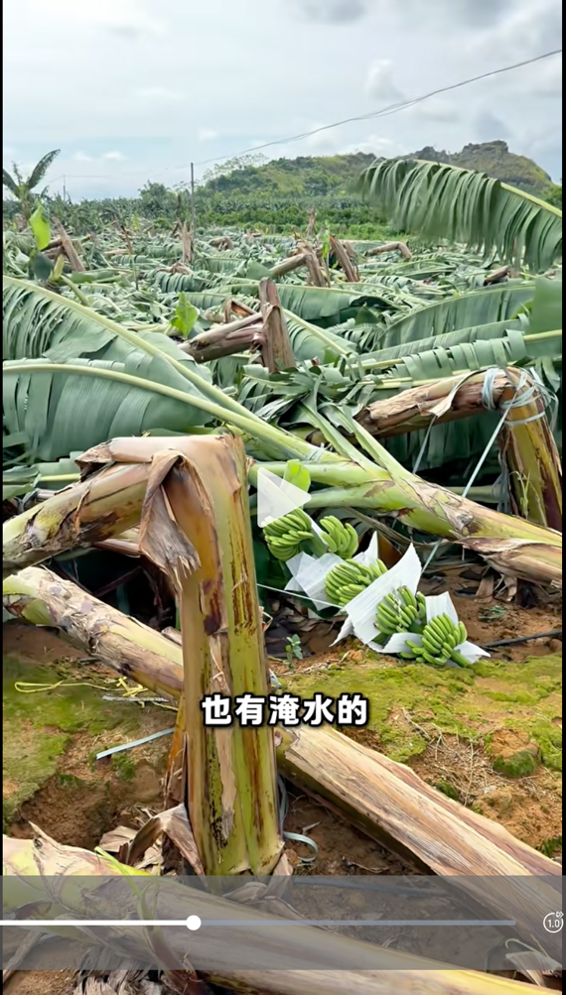
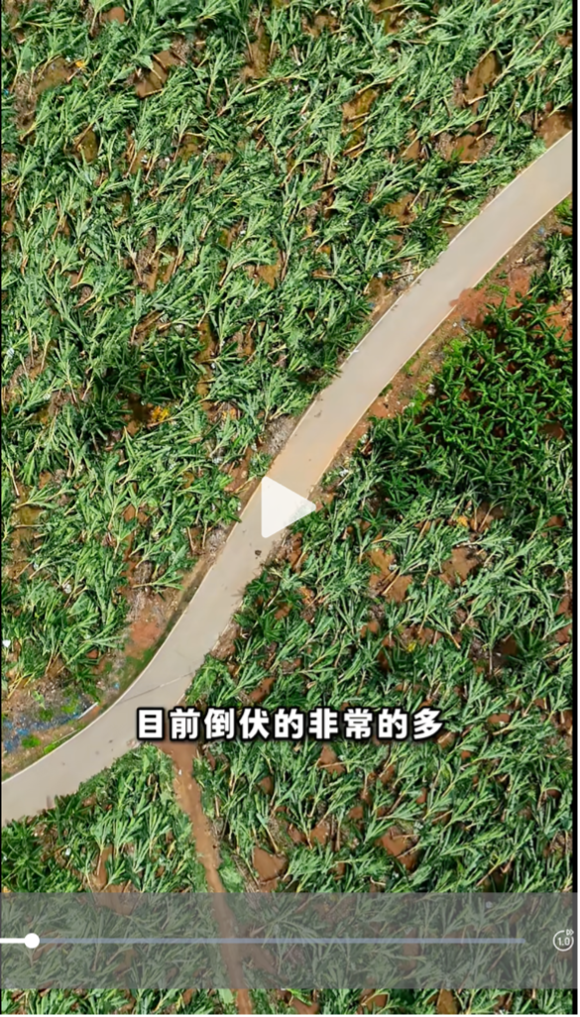
◉ Banana plants lodged in long rows. Image source: “A Bao Talks Farming”
Snake farming is another specialty breeding sector that boosts local incomes in Hengzhou, with annual output valued at several hundred million yuan at its peak. During this flood, roughly 800 to 900 snakes escaped from a serpent farm in Dengwei Village, Yunbiao Town, Hengzhou City. Farms across multiple locations were extensively submerged, and the majority of captive snakes drowned in their enclosures. Several pig farms were also struck; one farm in Yunbiao Town had all 16,000 of its pigs swept away. In one Hengzhou cattle shed, 19 head of cattle drowned, costing an individual farmer approximately 200,000 yuan.
Fish farming also suffered heavy losses.
The village road in Liangshan Village, Wutang Town, Nanning was only passable again on the afternoon of 6 July. When Qing Shoubai entered the village, he was met with utter devastation. The ground was blanketed in mud, making it nearly impossible to advance. He owned a 15- to 16-mu ecological pond that the previous day had merged with the neighbouring fish pond into one vast expanse of water. “I used to watch the news on television and see places flooded elsewhere, and I always felt so sorry for them, but honestly, once it happens to you, it’s an entirely different feeling. That helplessness—it’s almost impossible to describe.” He found himself utterly unable to do anything and could only manage a bitter laugh.
His pond had been stocked with bighead carp, silver carp, grass carp and other species. He had been farming for about three years when the flood scattered the fish into the nearby river, and he had no idea how many remained. On the road, he ran into the farmer whose pond sat next to his. The man looked even more exhausted and worn than he felt. His pond was several times larger than Qing Shoubai’s, with around 500,000 or more yuan invested in it.

◉ At 2 a.m. on 8 July, electricity was finally restored at Qing Shoubai’s farm. Image source: interviewee
Qing Shoubai has been involved in inland aquaculture since 2011, and he considers himself far from someone lacking in experience with extreme weather—he had been monitoring the typhoon’s movements ever since the warning was issued. In previous years during the storm season, clearing the drainage outlets in time would have been enough to prevent flooding. “This time there was absolutely no way—it was too fast.” he said. “”When you face something like a once-in-a-century event, all your experience amounts to nothing.”
He had been determined to practise ecological aquaculture and pay off the pond rent on time. Over the years, he had scraped through on borrowed money from friends and relatives, holding on until the last two years, when he finally glimpsed a light at the end of the tunnel. But this flood has pressed him down once again.
Just before ending the call, he told Foodthink he was going back out to the fields tonight. The water was slowly receding, but some people sneak in to electrofish while the floodwater is still up. He intended to go and stop them.
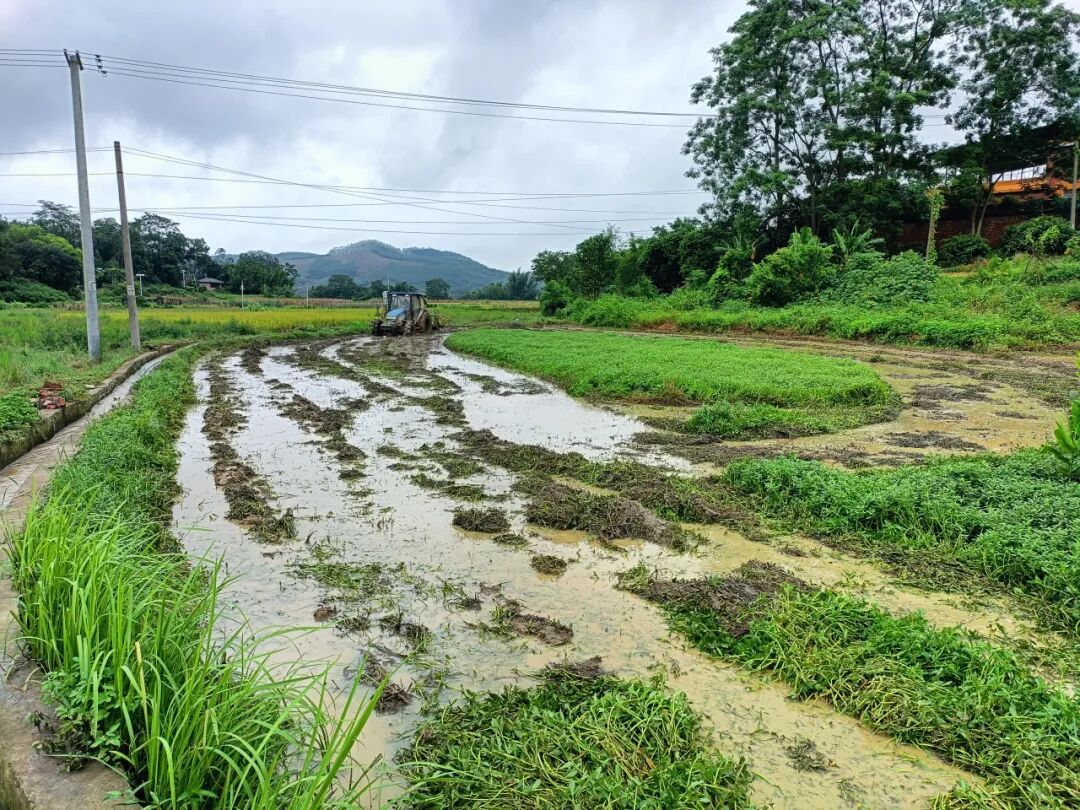
◉ Rice paddies submerged beneath floodwater in Qing Shoubai’s village. Image source: interviewee
– This is Foodthink’s 822nd original article –

Foodthink
author
Lin Qiuming
Freelance writer, focused on the people caught in the margins of society—and on cervical spine health.
Editor: Pei Dan
Graphics: Foodthink
Layout: Ming Lin
Scan the QR code to tip and support original food writing
▼

▼
Click the images to read related articles
▼
Click a keyword to browse more article collections
Seeds | Farming Techniques | Policy | Fermentation | Nutrition | Fruit | Fisheries | Events | Jobs | Delivery | Market | Livestock | Food Talk | Sharing Sessions | Book Club | Harvest Festival | Smallholder Stories | Climate Change | Rural Development | Cooperative Economics | Urban Farmers | Food Safety | Digital Technology | Biodiversity | Pandemic and Food | False Solutions | Ecological Agriculture Internship Programme
Beijing | Hebei | Shanghai | Guangdong | Guangxi | Henan | Sichuan | Jiangxi | Xinjiang | Shaanxi | Hong Kong | Chongqing | Zhejiang | Jiangsu | Guizhou | Taiwan | Inner Mongolia | Philippines | Canada | Russia | Mexico | Italy | United States | UK | Germany | Netherlands | Thailand | Sweden | Japan