Deep in the Taihang Mountains, Bao La Waits – But Niu Lai Never Comes

Editor’s Note
In the hit film Niu Lai, Niu Lai and Bao La are best friends growing up together. But deep in the Taihang Mountains, in the habitat of the North China leopard, the relationship among leopards, cattle and people is far more complex. It was through the wildlife conservation organisation Mao Meng that the author of this piece came to Leyi Village in Shanxi, only to find that the bitter “leopard-eats-cow” conflicts reported in the news and seen in so many other villages are hardly an issue here. Because there are fewer and fewer cattle farmers left.
The author has conducted field research in the mountains for two consecutive years. What she has seen is that when the cows no longer come, it is not only Bao La who has lost her best friend – the mountain village and its people, too, are facing new changes.
One evening last summer, I drove up to Leyi Village in Heshun County, Shanxi Province. Suddenly, a cascade of sound drifted towards me – notes rising and falling, like jade beads striking one another. I looked out the window. On the green hillside bathed in the glow of the setting sun, scattered flecks of brown and white came into view. Uncle Yang, a cattle farmer, was herding his twenty-two cows home from the mountains, treading to the rhythm of cowbells.
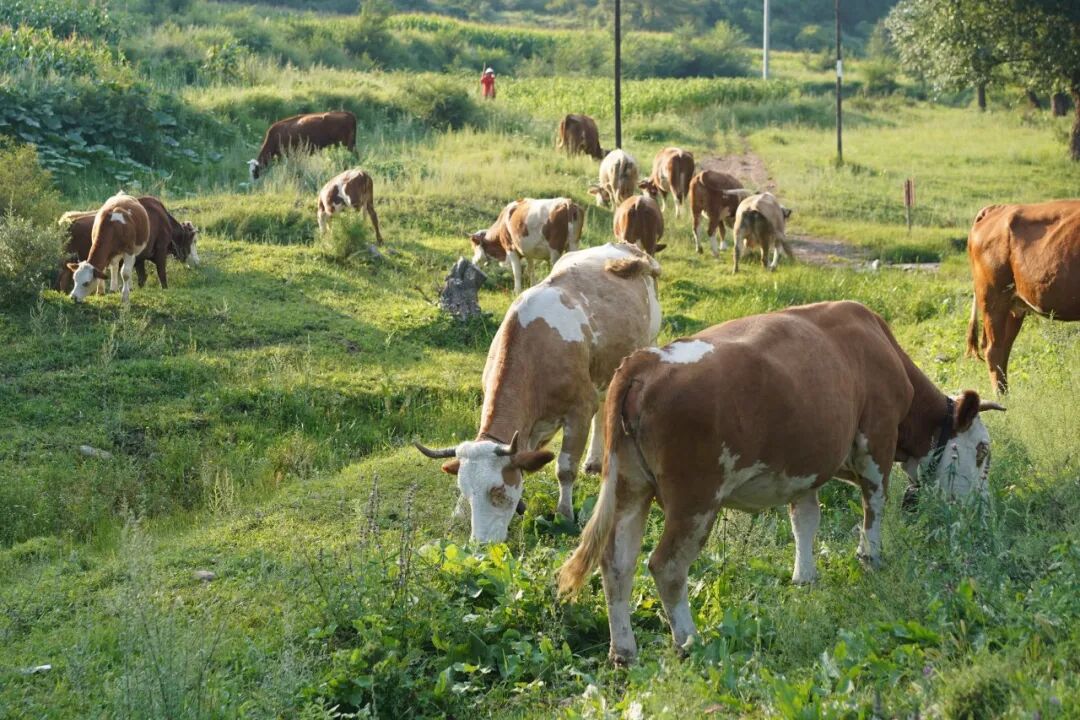
This is a rather secluded river valley deep in the Taihang Mountains. Cars must climb the mountain switchback road to the summit, then wind back down, turn by turn, to the valley floor. The surrounding forests are also home to North China leopards. At its peak, the village had more than two hundred cattle; of the forty-odd households, more than half kept them. For a county that only shed its “impoverished county” label in 2019, cattle farming is one of the pillar industries.
This summer, when I came back to see him after a year apart, Uncle Yang’s cowshed stood empty. He was not the only one who had walked away. Over these past two years, one household after another had sold all their cattle at low prices. Now only three cattle-farming households remain in the entire village. As the story of Niu Lai unfolds on cinema screens, the sound of cowbells in this small mountain village has grown ever more sparse.
Where Do the Cows Come From?
Leyi Village is not suited to crop farming, but it is well suited to keeping cattle.
The village sits in the middle reaches of the Taihang Mountains. Apart from summer, all three other seasons feel like winter; the annual average temperature is just 9.4 °C. The elders in the village say that once past the Autumn Equinox, the nights turn cold and two duvets are needed for a sound night’s sleep, while in the depths of winter, temperatures can plummet to minus twenty degrees. In this climate, with steep mountains, sharp slopes and thin, poor soil, maize can be grown only once a season. Even wheat, commonly cultivated across northern China, cannot be raised here – let alone any cash crops.
As for keeping cattle, according to the village elders’ recollections, it dates back at least to the collectivisation period. “Nothing about this place is good – except the air.” The mountains are rich in plant diversity; when the cattle browse on it all, they get better nutrition and grow healthier.
Many of the village elders began their life with cattle in the early 1980s. Uncle Yang, now 75, witnessed the transition when the village’s collectively owned cattle were distributed under the Household Responsibility System: the whole village gathered to draw lots. The cattle were graded by condition into first, second and third class, with prices set accordingly. Whichever lot you drew, you paid three or five hundred yuan and led that cow home.
The local “plain” yellow cattle had originally been kept mainly for ploughing. Once the beef-cattle industry took off, they were all replaced with imported Simmental beef cattle. But in those early days of marketisation, the true worth of beef cattle had yet to reveal itself. For most households, keeping cattle was not a deliberate choice but a natural inheritance – Grandfather herded cattle, Father herded cattle, and so I herd cattle too. One cow becomes two, two become three. Uncle Yang says, “After all, our old-timers’ cattle require no capital.”
As the domestic beef-cattle market developed, villagers began to taste the rewards. Several told me that around 2021, when prices were at their peak, a mature cow weighing eight or nine hundred jin (around 400–450 kg) could fetch thirty thousand yuan apiece, and a young calf of three or four hundred jin was worth fifteen thousand. Compared with growing maize, which brings in just 1,200 to 2,000 yuan per mu (roughly a sixth of an acre), the profit from beef cattle is considerable.
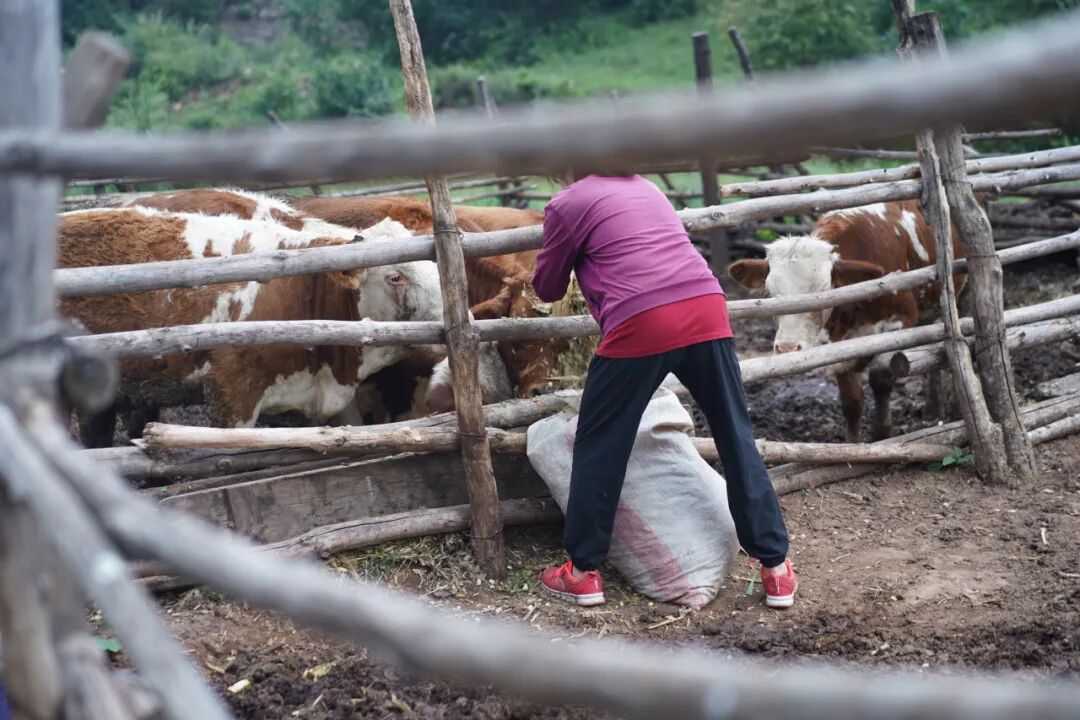
◉ A cattle farmer replenishes feed in the cowshed.
There were also newcomers to cattle keeping during those years, such as Sister Lan, now 50. When I first met her, she was out in the hills in an outdoors-style sun hat and a brightly coloured sun-protection top, driving her cattle along – looking rather “fashionable” among the herders. She was the new generation of cattle keepers, drawn in by the “bull market.” Before returning to the village to keep cattle in 2021, she had lived in the provincial capital for thirty years, running her own stall in the clothing wholesale market.
The cattle Sister Lan keeps now were neither passed down from her ancestors nor bought outright – they were “borrowed” from a large livestock company. She calls this arrangement “contract rearing,” a “borrow a cow, return a calf” contract. Five years ago, when a breeding cow averaged thirty thousand yuan on the open market, she used her property deed as collateral, paid a deposit of twenty thousand yuan per ten head plus a five-thousand-yuan “placement fee,” and “rented” thirty breeding cows in two instalments. Over the course of several years, she must care for the cows, breed calves and raise them to a specified weight, returning the calves to the company as “interest.” Only after repaying the agreed number of calves do any surplus cattle become her own profit. When the contract expires, Sister Lan returns the twenty cows from the first instalment, and the company returns her deposit.
Neither Sister Lan nor her husband had ever kept cattle before, and the early days were riddled with mishaps. After hauling dozens of cattle back from the farm, they realised they needed to build an enclosure. With help from neighbours, they threw one together in a flurry of activity. Just when they thought everything was sorted, one morning they went to the shed and froze – every last cow had wandered off into the hills to graze. It took a tremendous effort to round them all up again.
“A lot of people were having a laugh at our expense,” she said. But she did not shrink back. From being too timid at the outset to even approach a large cow, to later learning to assist with calving herself, Sister Lan and her husband gradually became skilled cattle keepers, looking forward to this new venture bringing fresh hope to their lives.
Yet 2021, the year Sister Lan entered the trade, was close to a historic high for beef-cattle prices – after which they crashed. Between 2023 and 2025, a mature cow that once commanded twenty to thirty thousand yuan saw its price plummet to six or seven thousand, meaning a single jin (half a kilogram) of beef fetched less than ten yuan.
“It’s not that there’s no income – it’s that ‘cow eats cow’ has eaten it all up.” “Cow eats cow” means that the money from selling a calf goes straight back into buying feed. Today, Sister Lan’s borrowed cows and the calves they have produced total more than forty head, and daily feeding costs run at around five hundred yuan. The feed and fodder costs over a single winter alone “eat up” five or six calves’ worth. After five years of hard graft, Sister Lan has “saved not a penny.”
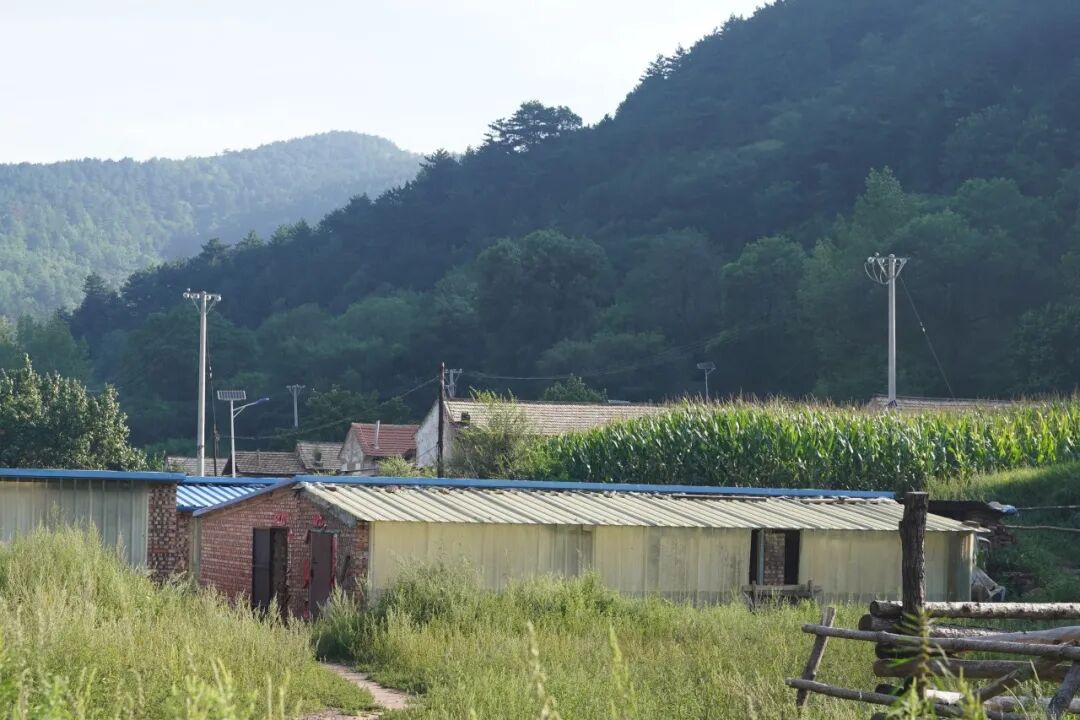
◉ When winter is harsh, the cattle are moved from the open-air cowshed into the roofed shed shown here.
Dead Cows Fetch More Than Living Ones
Uncle Gui claims to have been dealing in cattle since the age of seventeen, having witnessed the highs and lows of the market. Rough-featured, he carried a world-worn swagger that set him apart from the other villagers. He took a hard drag on his cigarette and said, “Look around – we used to have two hundred head in this village. Now there’s barely any left.” Leyi Village today has only three cattle-keeping households, with just over seventy head between them.
In recent years, Uncle Gui has transitioned from cattle dealer to “cattle broker.” The distinction is this: a cattle dealer buys cattle from farming households and resells them to feedlots, pocketing the margin; a cattle broker acts as an intermediary between the two, bringing dealers to meet farmers and view their animals. If a deal goes through, the broker earns a commission of one hundred yuan per head. In his view, market swings affect a cattle broker far less – whatever the final price, his commission is set in stone.
Cattle farmers, however, are far less composed. Many free-range keepers were forced to sell off their entire herds during the downturn, taking a loss on every head. “Once you see everyone else selling, you panic, and you rush to sell too.” “Say a cow was worth ten thousand yuan – he’d let it go for six thousand just to get it off his hands.”
During the price trough, the bizarre phenomenon of dead cows fetching more than living ones even emerged.
A local manager at China Life Property & Casualty Insurance told me that since 2020, government-subsidised insurance for beef-cattle farming has spread across rural areas, offering compensation for cattle that die from non-natural causes. The Heshun County government has been propping up the beef-cattle industry, and local insurers have rolled out targeted support programmes. Under the beef-cattle policy, the individual only bears 20 per cent of the premium: for a five-hundred-yuan premium per head, the government pays four hundred and the farmer pays one hundred.
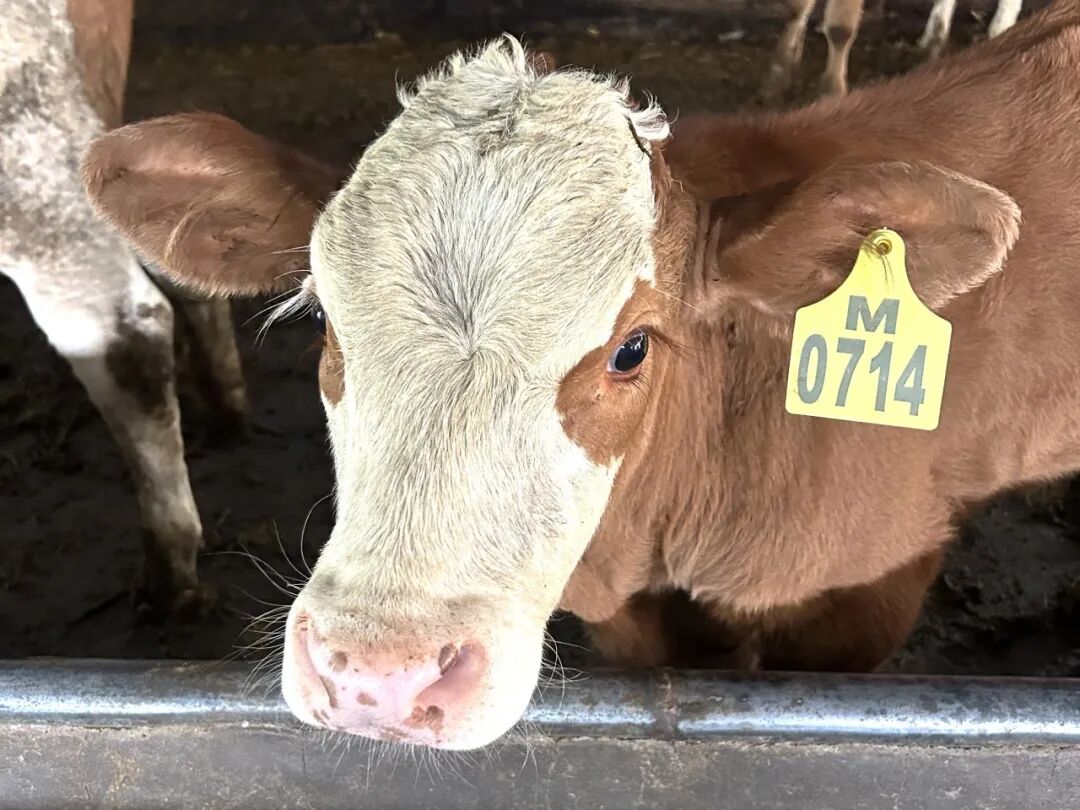
◉ In the past, insurance claims relied on the ear tag – the bright yellow tag punched through a cow’s ear, bearing a number made up of letters and digits, equivalent to a cow’s identity card. Once a death was reported, insurance staff would visit the site, match the ear tag to the animal’s policy details, and process the payout.
Compensation is calculated mainly on the animal’s weight. Typically, a calf can claim between three and five thousand yuan, while a mature cow can claim between eight and ten thousand. This means that when the market is poor, a living cow might not fetch seven thousand yuan – yet after an “accidental” death, the payout could exceed ten thousand.
As the market rocked, so did people’s scruples. Both Sister Lan and Uncle Yang had heard of insurance fraud: some would lose a calf but claim against a mature cow’s ear tag; others would go so far as to “take a bad cow and deliberately let it die to collect the insurance.” The Farmers’ Daily once featured scholars’ research on the issue: between late 2023 and mid-2024, in regions that had aggressively expanded beef-cattle insurance, the mortality rate among insured cattle could be twice the normal 3 per cent benchmark, reaching 6.11 per cent.
From early 2025, “face scanning” began to replace the ear tag. Insurance workers came to the village, used a mobile app to capture the facial features of every insured cow, and enrolled each one in a database. Bovine facial recognition pinpoints an animal’s identity with precision, thereby ruling out duplicate claims or claims filed for cattle that were never insured.
Once the insurers had plugged the loophole, cattle keepers found themselves facing a new predicament. In mountain cattle keeping, non-natural deaths encompass not only disease but also falls in landslides, venomous snake bites, and attacks by leopards and other wild animals. Yet if a cow dies in the hills where there is no phone signal, the carcass must be carried out to a spot with reception before bovine facial recognition can be performed. In the summer heat, a dead cow not found in time may rot beyond identification – and without a carcass at all, no claim can be filed.
But this is not what worries Taihang cattle keepers the most.
Ageing People, Cheap Cattle
If falling cattle prices are the universal reason cattle keepers quit, then ageing only deepens the mountain village’s predicament.
Last summer, I first met Uncle Yang out herding. He held a whip in one hand and a mucking-out shovel in the other, lean but wiry, a grazing herd behind him. He noticed my gaze and flashed a broad, beaming smile; I could not resist raising my camera to capture the moment.
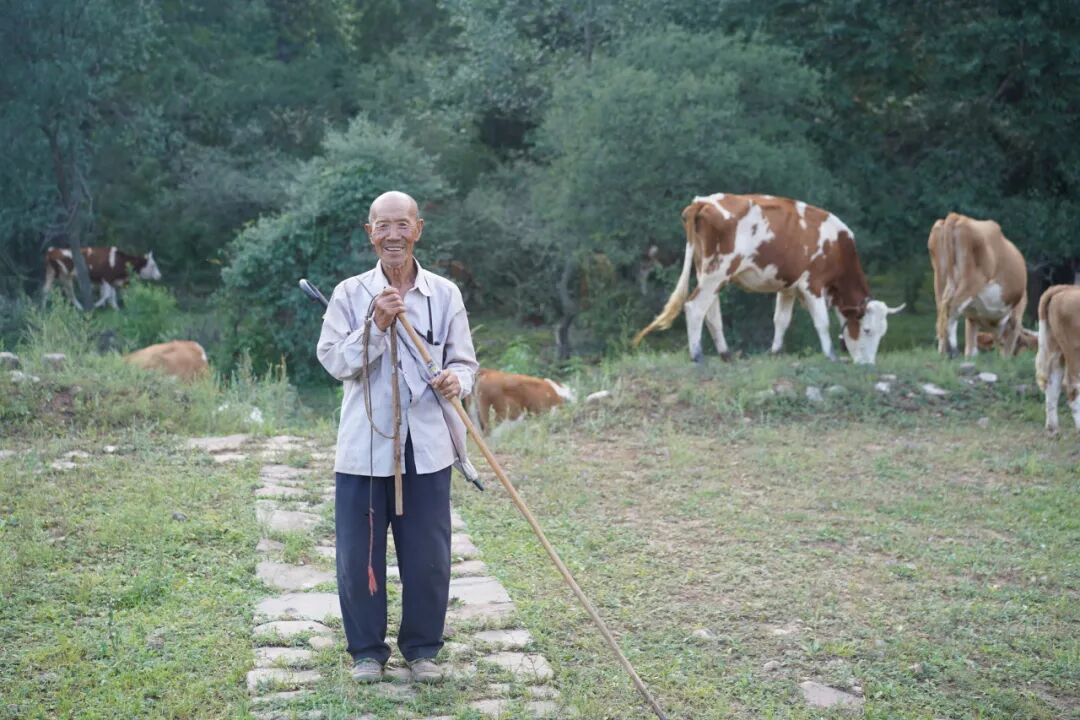
A year later, when I saw Uncle Yang again, he had taken to a walking stick and his frame looked slightly stooped. He told me his leg pain was so bad he could no longer climb into the hills, and his wife had hurt her lumbar spine in a fall, confined to bed and needing round-the-clock care. So he was forced into “retirement.” Last year he sold all twenty-two head for 140,000 yuan – just over six thousand apiece – and that was the end of more than forty years spent herding cattle.
Uncle Li, one of the remaining three cattle keepers in Leyi Village, is 72 this year. “Three more years at most,” he told me, “and I’ll be done.”
The village elders recalled that every year on the eleventh day of the seventh lunar month, Sitou Village – about fifteen li from Leyi – held a temple fair. It had once been the largest trading market in the area, drawing people from far and wide who drove their own livestock and brought produce to sell. Sister Lan’s grandfather had been a cattle broker, matching buyers with sellers. The two would hide their hands beneath a lapel or inside a sleeve, pinching each other’s fingers to silently signal a price; once the pinching agreed on a number, the deal was done.
In those days, selling a cow meant relying on a pair of feet – driving cattle all the way to Xiyang, seventy kilometres away. Today, cattle dealers come knocking at the door, and keepers can complete a trade without leaving the house, spared the long trudge. But smallholders have grown more dependent on the dealers, especially as young people from the townships pour out in droves – in the village, anyone under 55 now counts as “young and able-bodied.” With small herds and little access to information or connections, the elderly can barely reach the downstream market; all they can do is wait passively for a dealer to come and buy.
If a dealer cannot get a cow from one household, he simply moves on to the next. “Whatever price they name is the price.” Cattle keepers have less and less room to negotiate.
A Livelihood, and a Way of Life
Up at five to muck out the cowshed, top up grass and feed for the calves; out of the shed by six, driving the adult cattle into the hills to graze – walk them to roughly the spot you need, then turn back; home by seven or so for breakfast, then off to tend the fields; rest a while after lunch, and at three or four it’s back up the mountain to mind the herd; drive the cattle in before dark, eat supper; ready to sleep by nine or so – this is a typical day for a herder in Leyi Village. That unyielding rhythm of labour is how they have, over years of practice, learned to live alongside the mountains and the cattle.
On a summer afternoon last year, I followed Auntie Xiu into the hills to mind the cattle. We passed the cattle pen on the ridge behind the village and walked further in. When we came upon a stone urn, Auntie Xiu told me it was a Mountain God. She knelt and knocked her head to the ground three times, murmuring a prayer that the Mountain God would see us safely through. I knelt with her and knocked my head three times too.
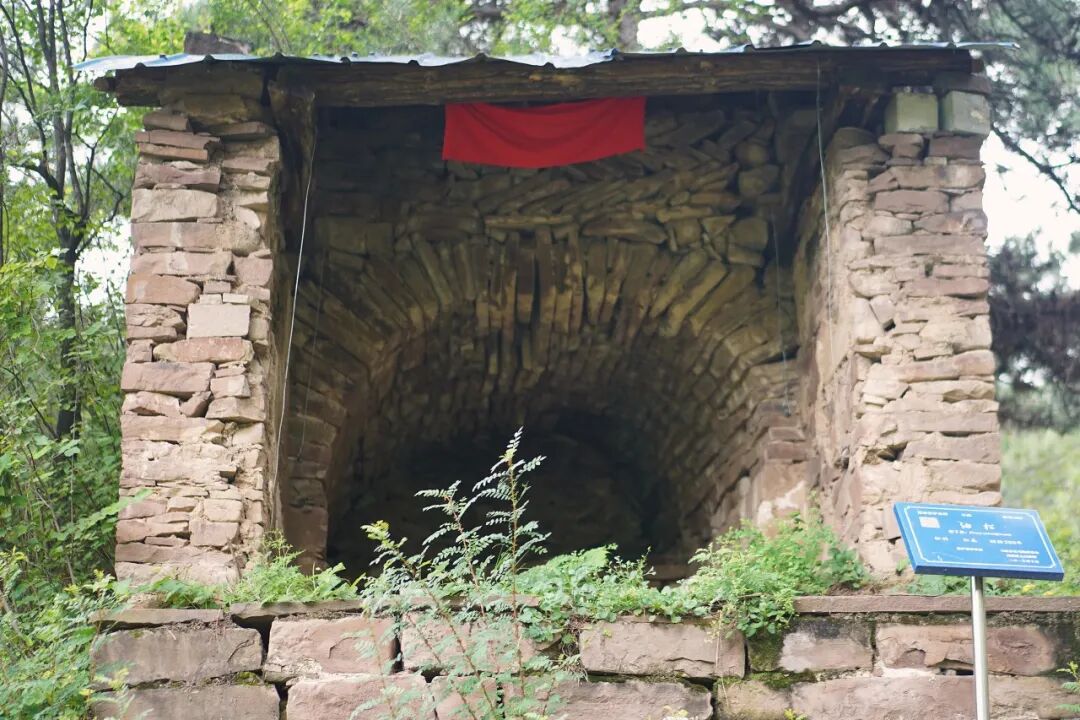
◉ A “Mountain God Shrine” on the Herding Path
Before any cattle came into view, the cowbells reached us first. Auntie Xiu listened for a moment and said these belonged to the Zhus – each household’s bells sound different.
We reached a relatively open clearing among the trees. Auntie Xiu said there was no need to go further – we could wait here for the herd to come back. She found a flat rock and sat down. Before long, two other herders from the village appeared, and they settled together and began to chat.
This clearing along the herding route served as Auntie Xiu and the others’ improvised common ground; conversation sprang up here of its own accord. Uncle Yang told me that one ridge runs into the next, and sometimes herders from different villages would meet up in the hills – when they did, they’d settle in for some dǎo xiē dǎo xiē (a local dialect term for lingering and chatting).
The deeper you go into the hills, the worse the signal becomes, until the phone you scroll short videos on all day turns into a useless brick. Only the walkie-talkie crackles to life occasionally, thick with static – a mode of communication unique to mountain herders. Across the silent hills, they pass the news back and forth through the radio.
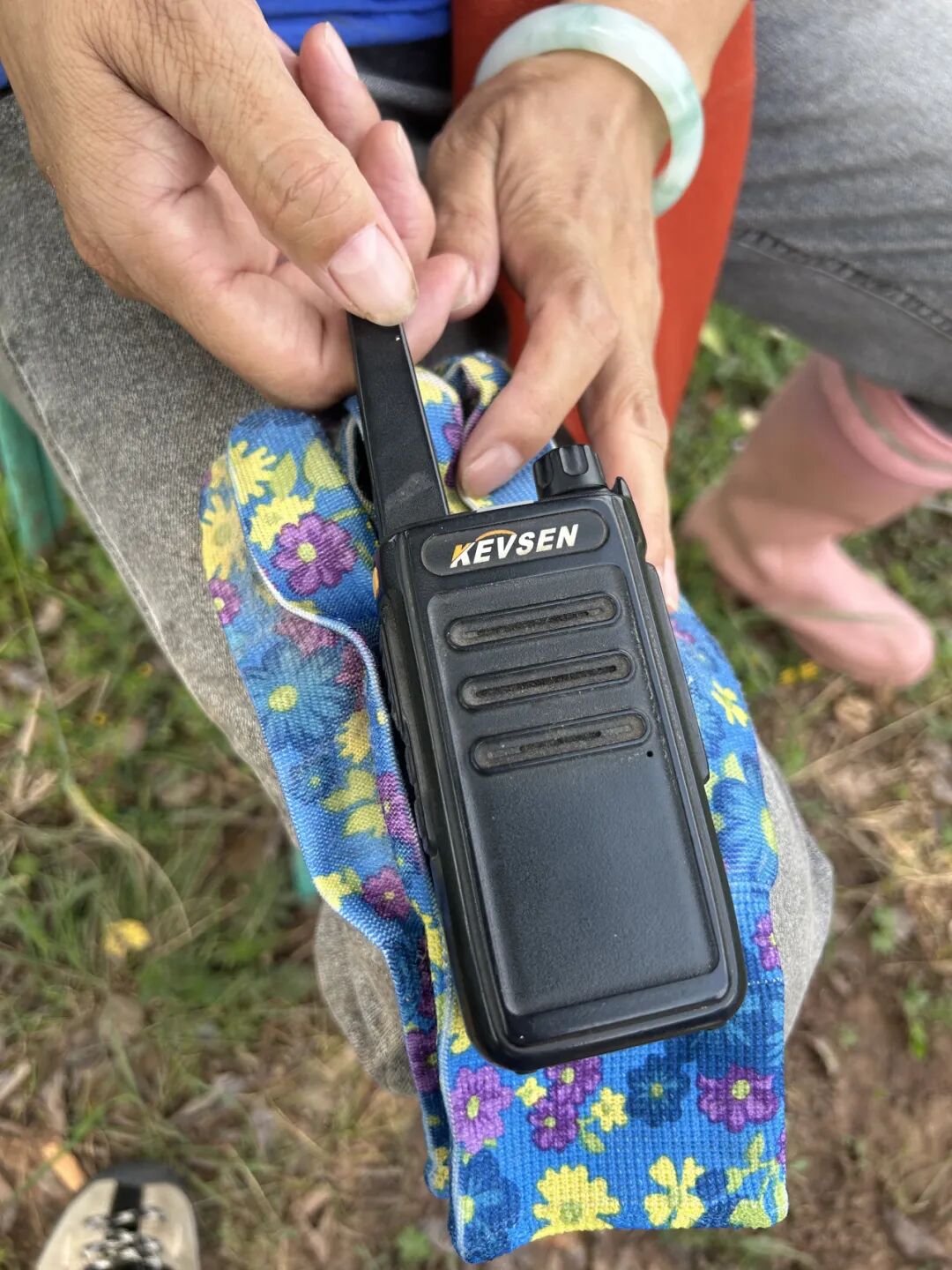
◉ Sister Lan bought a walkie-talkie for herself and gifted several to her fellow herders in the village, so they could keep in touch
While waiting for the herd to return, I asked Auntie Xiu whether she worried the cattle might scatter off into the mountains. She said no: ‘If one of them finds a good patch of grass, she’ll call the others over – “The grass here is lovely, come and eat with me!”‘ Auntie Xiu trusts the cattle. Deep in the hills, if you lose your bearings, ‘just follow the cows, and you’ll always find your way out.’
Even as a small child, cattle were woven into Auntie Xiu’s life. She would lead the rope at the front, and her father drove the cow forward with his whip from behind. ‘Cattle are so gentle. You can stroke their head, stroke their face, and they never get cross. When you brush their coat, they close their eyes with such contentment.’ As she recounted these scenes, Auntie Xiu’s whole face lit up.
“When I was little, I loved cattle so much” – but now, at fifty-five, cattle have left Auntie Xiu weary. ‘I don’t fancy them anymore. Too tiring. The sight of them just makes me feel irritable.’ When I visited her home again this summer, there were no cattle left.
Herding cattle is more than just a way of making a living.
An elderly man in the village has an intellectual disability and struggles to care for himself; his younger brother attends to his daily needs. Yet a companion of mine told me she once caught a glimpse of this old man wielding a whip and driving cattle with a sure, effortless hand. In that instant, she was startled to see, in him, a vitality quite unlike anything in his everyday life.
While I was staying in the village, a pregnant cow wandered into the hills and did not return for three days. The villagers searched every day, fearing she would calve in the wild and the calf would be taken by leopards. One day, as I climbed the mountain, I suddenly saw a herder driving a cow back down, and at her heels a newborn calf pressed close, its reddish-brown patches rich and full, its white markings clean as snow. The moment the calf blinked up at me behind its white lashes, I felt something sacred in the sheer fact of being alive.
I do not know whether, for herders who have kept cattle for generations, a newborn calf still stirs the same emotional chord. But I think – for a village grown so few in people and ageing so fast – the arrival of a new life, at the very least, brings a thread of change.
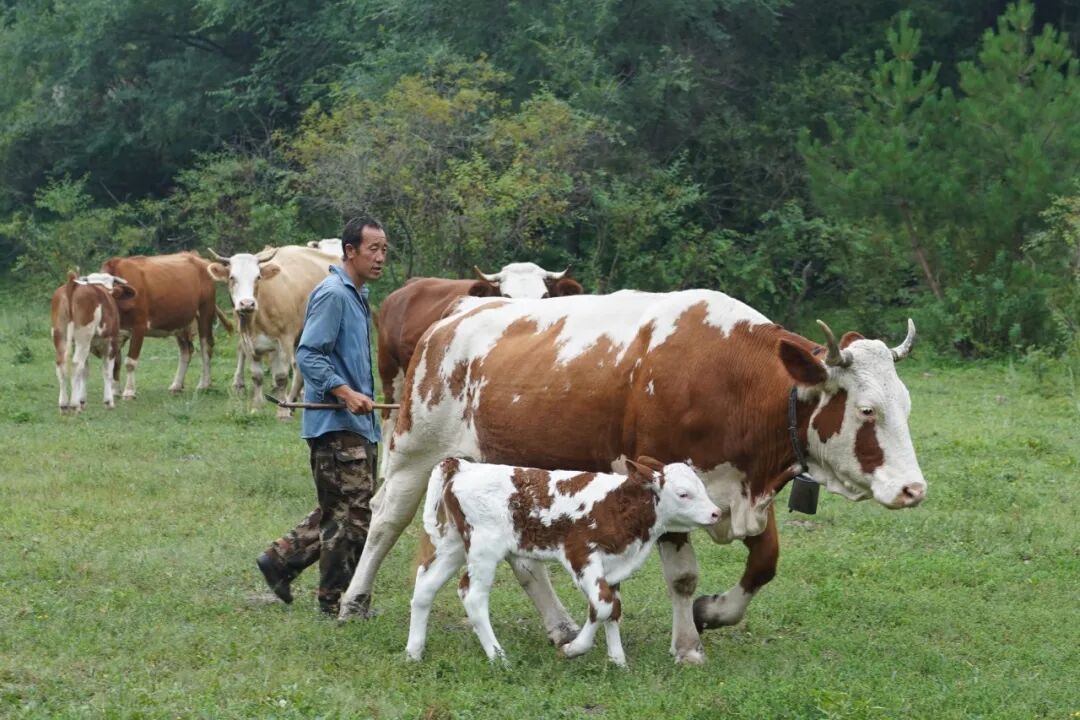
◉ A herder brings back the mother cow and her newborn calf
Those Who Stayed and Those Who Left
After several years of a bitter winter for the industry, cattle prices have finally begun to recover this year. The herders tell me, with barely contained joy, that a young heifer weighing 150 to 200 kilograms can now fetch six or seven thousand yuan, while young bulls are clearing ten thousand.
From 2026, China has imposed a 55% tariff on above-quota imported beef and reduced the annual total import quota. On top of that, the keepers who were crushed by the downturn and walked away have, in effect, cleared the way for a price recovery for those who remained. But the broader structural forces behind market rises and falls are something a small mountain village can scarcely perceive. What drives people to leave or stay is usually something far more concrete.
Sister Lan’s five-year “lease” is nearly up, but she has yet to finish paying the ‘interest.’ She wants to wait until ‘the calves that are due to be born have been born.’ Even after the contract is fulfilled, she still means to keep raising cattle – not out of any love for them, but because ‘once you’ve raised a whole lot of them, they become like children. You’ve watched them grow from tiny calves into what they are, and you simply can’t bring yourself to let go. You just can’t.’
Sister Lan entered the trade at the peak of cattle prices in 2021. This year’s modest uptick means only a slightly smaller loss for her. But she has grown accustomed to a life alongside cattle and wants to keep at it, treating it as “a proper calling” – she has no wish to change trades. ‘When the two of us can still run about, we head out and mind the herd. When we can’t, as long as we can still hold a shovel and pitch some feed, scatter a little corn, they’ll eat. Even if we don’t keep many, ten or eight will be enough to see us through.’
Once he sold every last cow, Uncle Yang felt as though a whole slice of life had been carved out. Every morning he used to go to the cowshed; every evening he topped up the feed. While feeding them, he would talk to the cattle, running his hands over their heads in slow, tender strokes. Now he has hours on end on his hands and no idea what to do with them.
If his leg didn’t ache, he really wouldn’t have wanted to sell. ‘The moment you sell them, you feel happy. But once someone loads them up and drives off, you start aching inside. It’s just like when our girl gets married off – you’re happy at the ceremony, but once she’s gone, your heart simply won’t settle.’
‘You think and think, day after day, for about a month, then another month. You work it out in your mind, and slowly, you stop thinking about it.’
– This is Foodthink’s 835th original article –
Foodthink
Author
Yan He
I have worked in publishing, written articles, and done a little sociological research. Through words, I hope to thread connections between people.
All people mentioned in this article are pseudonyms.
All photographs by the author.
Editor: Pei Dan
Layout: Xiao Shu
Scan to tip and support original food knowledge
▼

▼
Click on the image to read related articles
▼
Click a keyword to explore more article collections
Seeds | Farming Techniques | Policy | Fermentation | Nutrition | Fruit | Fisheries | Events | Jobs | Takeaway | Market | Livestock | Food Talk | Talks | Book Club | Harvest Festival | Smallholder Stories | Climate Change | Rural Development | Cooperative Economy | Urban Farmer | Food Safety | Digital Technology | Biodiversity | Pandemic and Food | False Solutions | Agroecology Internship Programme
Beijing | Hebei | Shanghai | Guangdong | Guangxi | Henan | Sichuan | Jiangxi | Xinjiang | Shaanxi | Hong Kong | Chongqing | Zhejiang | Jiangsu | Guizhou | Taiwan | Inner Mongolia | Philippines | Canada | Russia | Mexico | Italy | United States | United Kingdom | Germany | Netherlands | Thailand | Sweden | Japan