Tianxingzhou’s Watermelons: This Year, Ripening Has Been Especially Hard

On a midstream island that flourishes with the waters and is drowned by them, how do the watermelon growers live alongside ever more erratic weather—or are they simply left to be forgotten, and to be moved?
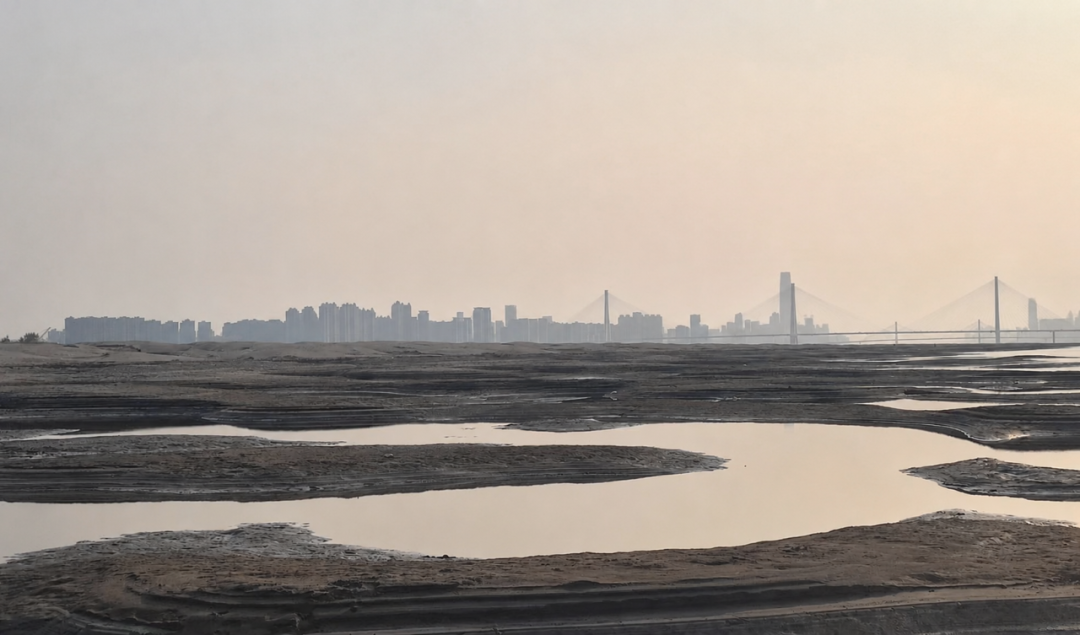
◉ The river-sand path, November 2022
What lies at the end of the sandbar?
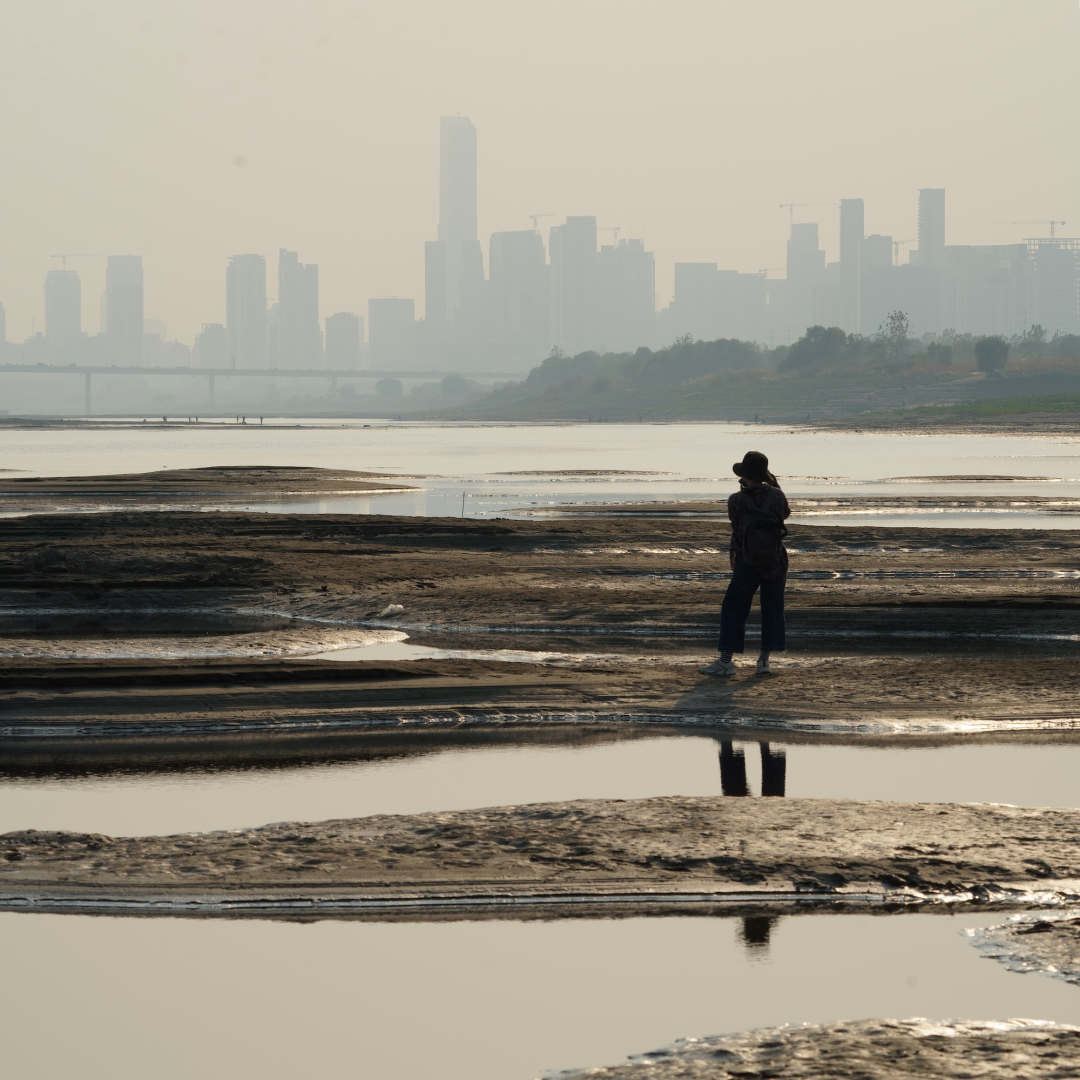
That day, the sandbar was hemmed in by high-rises, and a grey-yellow haze rose off the river. In November 2022, I set foot in the middle of the Yangtze. It was the dry season; the water had receded from the side away from the shipping channel, revealing fine, soft riverbed gravel. Shallow hollows held standing water, and birds’ footprints appeared beside the puddles. A frog carcass had dried out in the open, and wild grasses were pushing through the sand. At the far end of the sandbar—a temporary shore that surfaces only for a season—lay a stretch of lush, verdant land.
That was Tianxingzhou.
Each winter, for a while, Wuhan residents can walk out to this small island on the outskirts of Hongshan District. In summer, the river-sand path is swallowed up. Year after year, the river lays down silt, and this sandy soil became the foundation for growing watermelons; combined with the unique river-encircled microclimate, it has forged Tianxingzhou’s century-old identity as the “Melon Isle”. But the water has repeatedly topped the embankments (crest elevation: 28.5 metres) or, when a breach is opened for flood diversion, been deliberately channelled onto the island, forcing its people to leave time and again.
This year, as watermelon growers in Henan, unable to fetch a decent price, scramble to load their melons onto ‘big lorries’ and feed them into the wholesale transport network, Tianxingzhou’s watermelons long ago departed from the wholesale market, turning instead to premium direct-to-consumer sales. There is even a Guaboyuan (Melon Expo Garden) here whose melons have graced a Ministry of Foreign Affairs banquet. Yet the island’s designation as a flood diversion area, the inconvenience of getting across, and unsettled land-use plans all constrain both production and sales, and fewer and fewer local growers are still tending their melon fields.
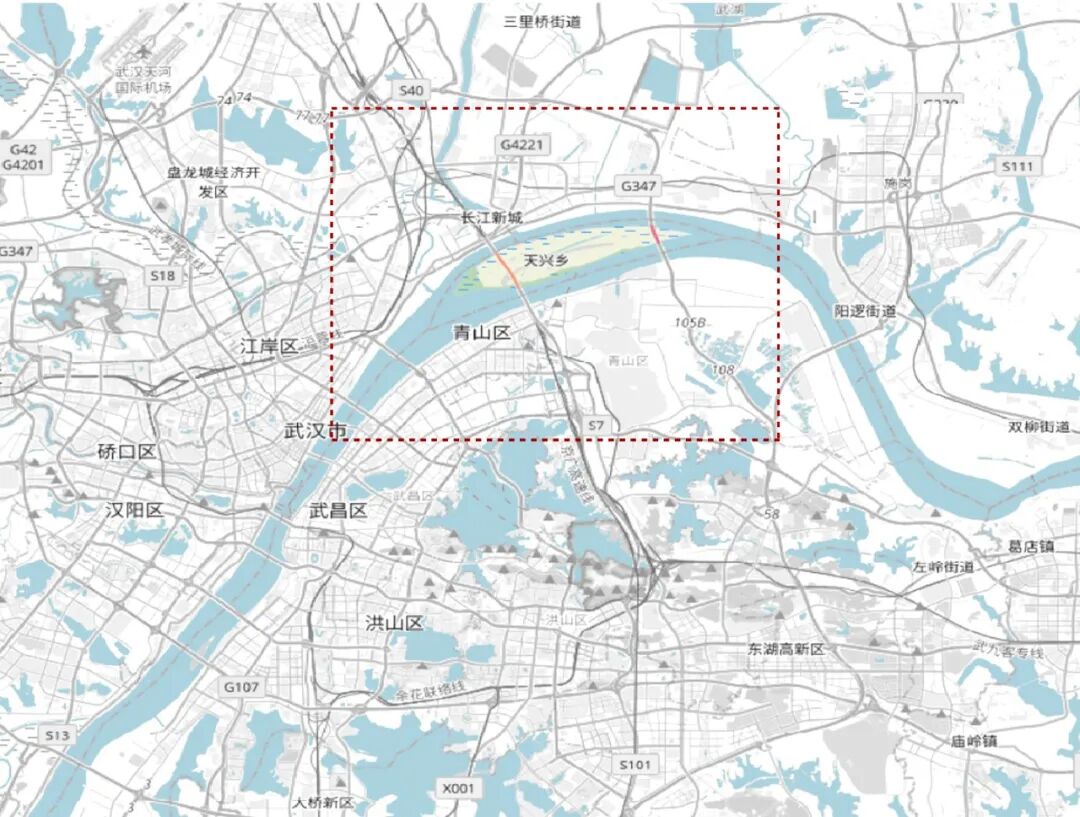
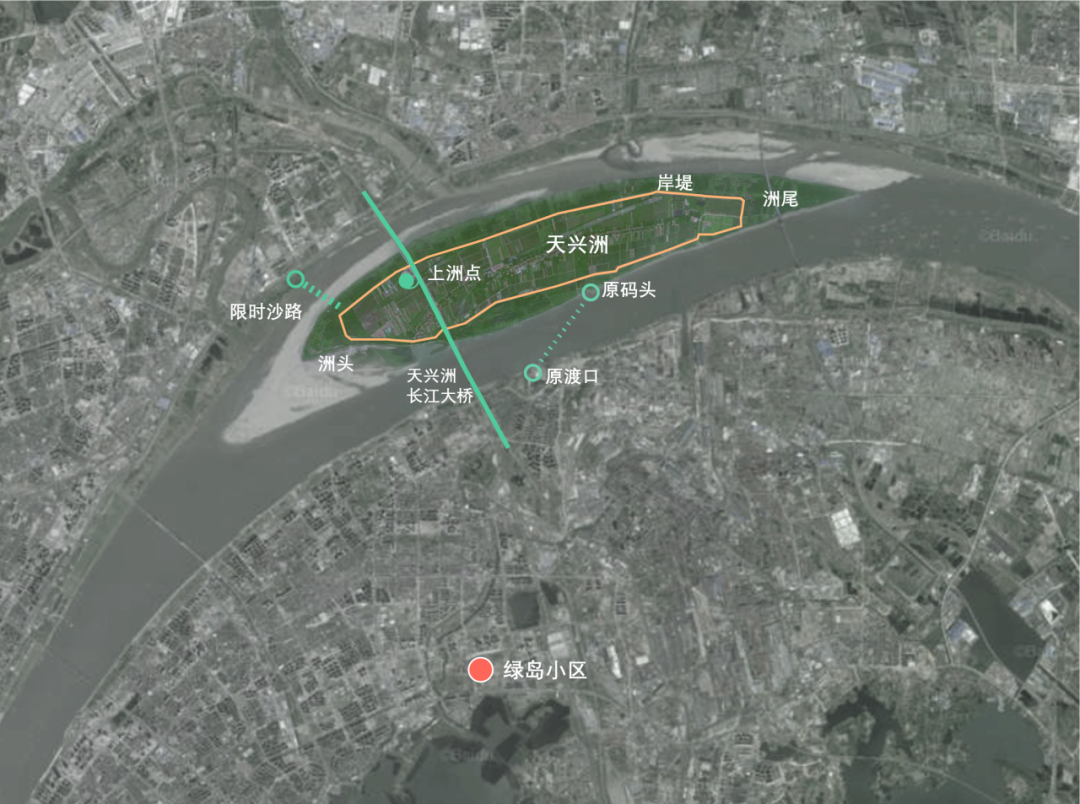
◉ Left: Location map of Tianxingzhou. Right: Route to the island. Maps made by the author.
I followed the growth of this season’s watermelons, wanting to know: with climate change intensifying ever more sharply, what has the relentless succession of rains over the first half of the year done to Tianxingzhou’s watermelons? Who still stays on the island to grow melons? And how is the experience of melon-growing here preserved and transformed?
After the Floods, a Fleeting Isle
The Yangtze’s floods have always threatened Tianxingzhou. In 1954, after the island was submerged (water level: 29.73 metres, the highest on record), it was designated a flood diversion area. In the 1960s, Tianxingzhou suffered three levee breaches; in 1970, accumulated waterlogging caused a disaster; and in 1983 (water level: 28.11 metres), 1995 (water level: 27.79 metres), and 1996 (water level: 28.66 metres), floods struck again.
In 1998, Wuhan was hit by the second basin-wide mega-flood of the 20th century on the Yangtze. The highest water level at Wuhan Gate reached 29.43 metres (warning level: 27.30 metres). Throughout the 93-day flood season, the level at Wuhan Gate remained above the warning threshold for 73 consecutive days, and the city weathered eight flood peaks. In the Hubei Daily, flood coverage held the front page for over two months on end. The following year, Tianxingzhou was struck by floods once more.
To spare local residents from flooding, after the 1998 flood season the central government put forward the policy of ‘levelling polder embankments for flood passage, returning farmland to the lake, and relocating residents to new towns and villages,’ requiring that certain flood storage and diversion areas and villages in low-lying areas not rebuild in situ, but instead adopt nearby relocation or resettlement at alternative sites, so as to restore their flood storage and diversion function.
In 1999, Tianxingzhou was designated a “single-retreat” civilian polder, operating under the principle of “retreating the people but not the farmland”: should a major flood occur, the land the villagers till must take on the duty of carrying floodwater, yet during non-flood periods, villagers may still farm and live on the island. The government encouraged residents to move away; schools and hospitals on the island were relocated one after another, and most residents were resettled in the Lüdao residential compound on the opposite bank. Only a small number of elderly residents still live on Tianxingzhou.
After that, Tianxingzhou was once planned as an ecological oasis. Yet thousands of mu (≈ 667 m²) of basic farmland remain on the island. The protection of basic farmland and the arable-land red line clash with the policy of returning polders to the river. In a public response from the Hongshan District government in 2026, the special plan was still being drafted and reviewed.
To the few households still growing watermelons, it is their view that since the Three Gorges Dam began operations, floods have come less frequently than in the past. After 1999, Tianxingzhou carried out flood diversion in 2002 (water level: 27.76 metres) and 2020 (water level: 28.77 metres); in 2016 (water level: 28.37 metres), non-flood-duty personnel were evacuated from the island.
What worries them still more is the weather. This year’s early-spring cold snap, April severe convective weather, and the heavy rains that fell one after another in May have disrupted the watermelons’ growth rhythm time and again. And driven by urban-renewal needs and unresolved land-ownership issues, the residents of the Lüdao residential compound are now being told to move yet again.
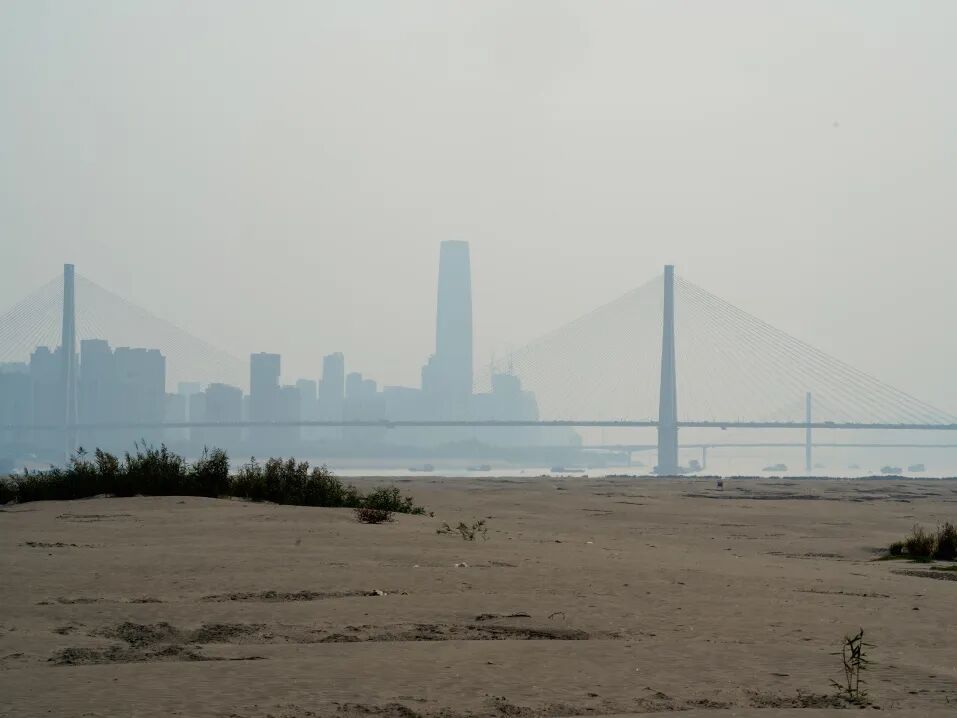
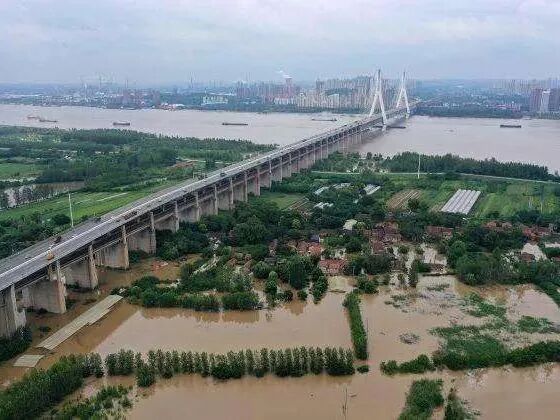
◉ Left: The river-sand path during the dry season (photographed by the author; click to enlarge). Right: 11 July 2020 – a breach is opened for flood diversion on Tianxingzhou. Image source: The Paper
Farming Like Migratory Birds
In early May this year, I took a taxi to Tianxingzhou. The island stretched out in vast tracts of farmland; weeds choked the front yards of some houses, and hardly anyone seemed to live there. After getting out of the cab, I dialled Peng An’s number: “How do I get to you?”
“Walk towards the sun, and you’ll see us,” he said.
Peng An is in his forties. Two or three times a week, he crosses the river like a migratory bird, shuttling between the Lüdao residential compound and Tianxingzhou. In the morning, he and his wife Yuzhen, who married into the family from elsewhere, take the demand-responsive bus across. The earliest bus departs at 7:10 a.m. and takes twenty to thirty minutes. The shuttle is crammed—every passenger heading to Tianxingzhou for work. Yet even the first bus is too late for farmers. More often, Peng An and Yuzhen ride an electric scooter in the morning, a journey of forty-odd minutes; by the time they arrive, the dew on the fields is still cold.
The Peng family grows open-field watermelons. Each mu (≈ 667 m²) of land carries three long ridges, but only one ridge is planted with melons. The sun beats down directly, and the leaves lie flat against the plastic mulch film and the ridges, pressed to the earth. Lean in close, and beneath the yellow melon blossoms you can see tiny fruits cloaked in white fuzz. These are the ovaries beneath the female flowers, yet to be pollinated—once fertilisation succeeds, they will swell into watermelons.
Yuzhen and I crouched at the edge of the ridge, doing the vine training: we “fished” the tangled melon vines out, teased them apart, and spread them to either side of the ridge, leaving room for vine extension and fruiting. At the same time, we turned the upper surfaces of the leaves face-up to catch more sunlight.
Yuzhen said any tiny fruit growing at the third leaf along the vine must be pinched off. At this stage, the vine hasn’t grown strong enough yet; fruit that sets now will likely be hollow or thick-skinned. Only fruit growing beyond the tenth leaf can be kept. She counted along the vine until she found one worth keeping, plucked a male flower, and gently touched it to the centre of the female flower just above the tiny fruit—completing the hand-pollination. After that, if the tiny fruit didn’t wither and drop, it counted as “fruit set”.
“Once the fruit has set, if the temperature’s high, the watermelon swells like a balloon—every day it looks different,” she said.
The sun was so fierce it made my head spin; after crouching for a while, I had to stand and turn my back to the light to catch my breath. Yuzhen kept on hunching over, shuffling forward. “My back aches,” she said. “I fell ill the year before last and I’ve been on medicine ever since. Now I can’t manage more than an hour or two before I’m done for—ah well. You young people have it tough too, though. My daughter’s still fast asleep at home.”
Few local watermelon growers still tend their fields like Peng An and Yuzhen. They say farming doesn’t pay. This one ridge alone needs at least 500 yuan in fertiliser; add the plastic mulch film and hiring a tractor to plough, and the outlay runs into several thousand yuan. Costs rise every year, yet the selling price hasn’t budged in years. Yuzhen said, “We earn what we can when we can; if we’ve got the time, we come up and ‘add a bit of extra labour’.” Because their plots are small and the returns modest, they skip finer tasks such as lateral vine pruning. Pruning side vines reduces the energy the foliage diverts from fruiting, concentrating nutrients in the developing melons, which improves the fruit-set rate and fruit quality and keeps yields stable.
Besides farming, they take on all manner of odd jobs on other days, earning a “steady” hundred or two hundred yuan a day. Peng An has done brick-hauling, house moves, and rebar-breaking. “When there’s work, I work; when there isn’t, I head over to the island and farm,” he said.
Among the watermelons, they also grow broad beans, peppers, and potatoes. Once the melons are harvested, they follow with radishes and cabbage. The produce is mainly for their own table; some goes as a neighbourly gift, and only the surplus is sold to help make ends meet. By keeping inputs low and outputs modest, they keep the risks of melon-growing within what they can bear.
“If I could find a good job, I’d stop growing melons,” Peng An said.
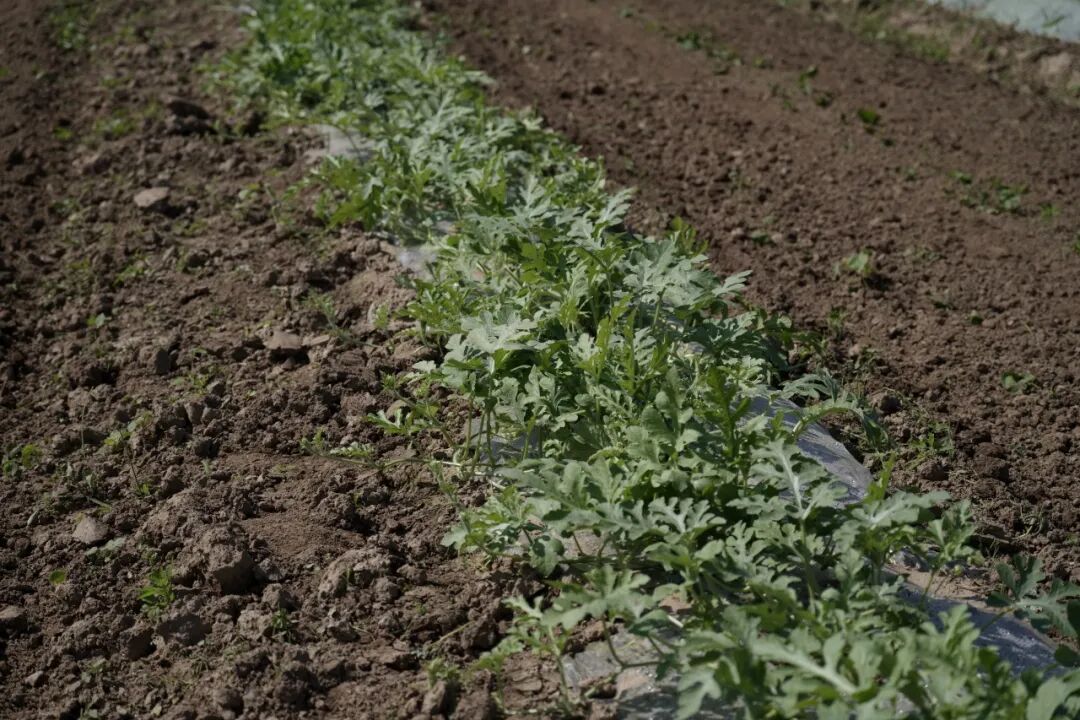
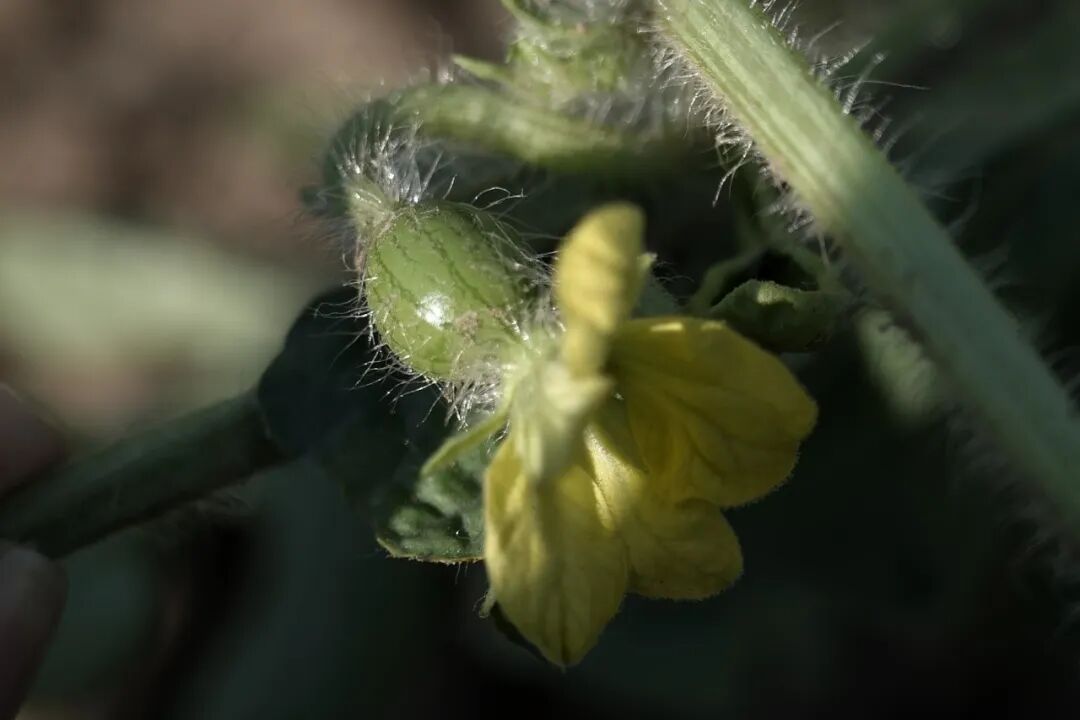
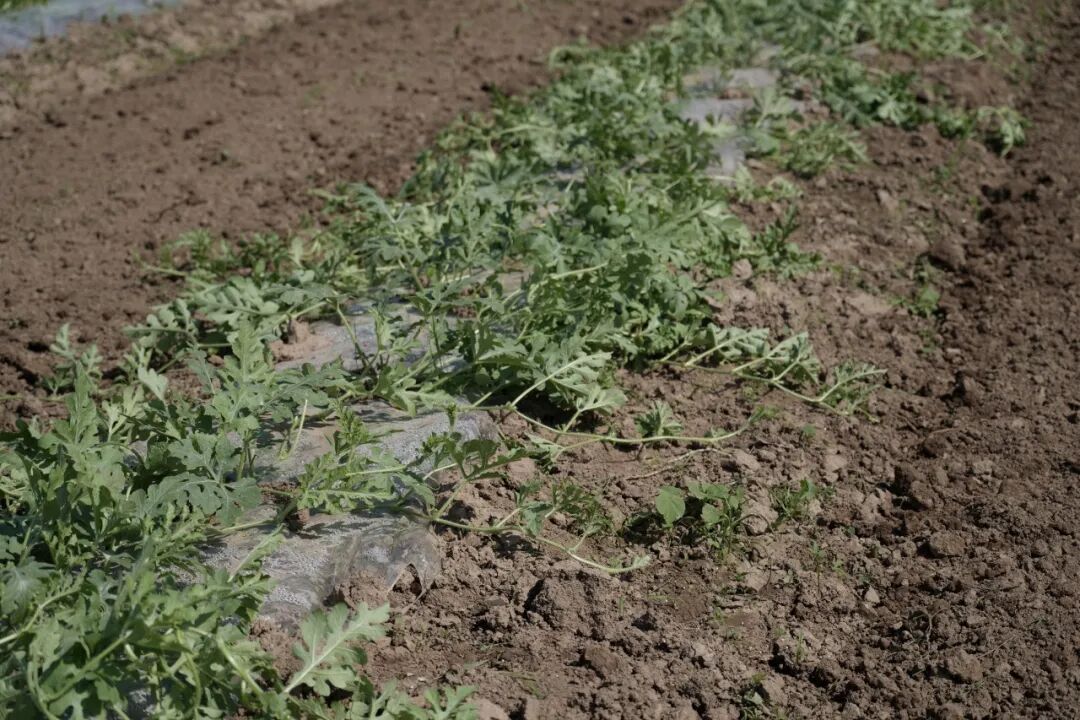
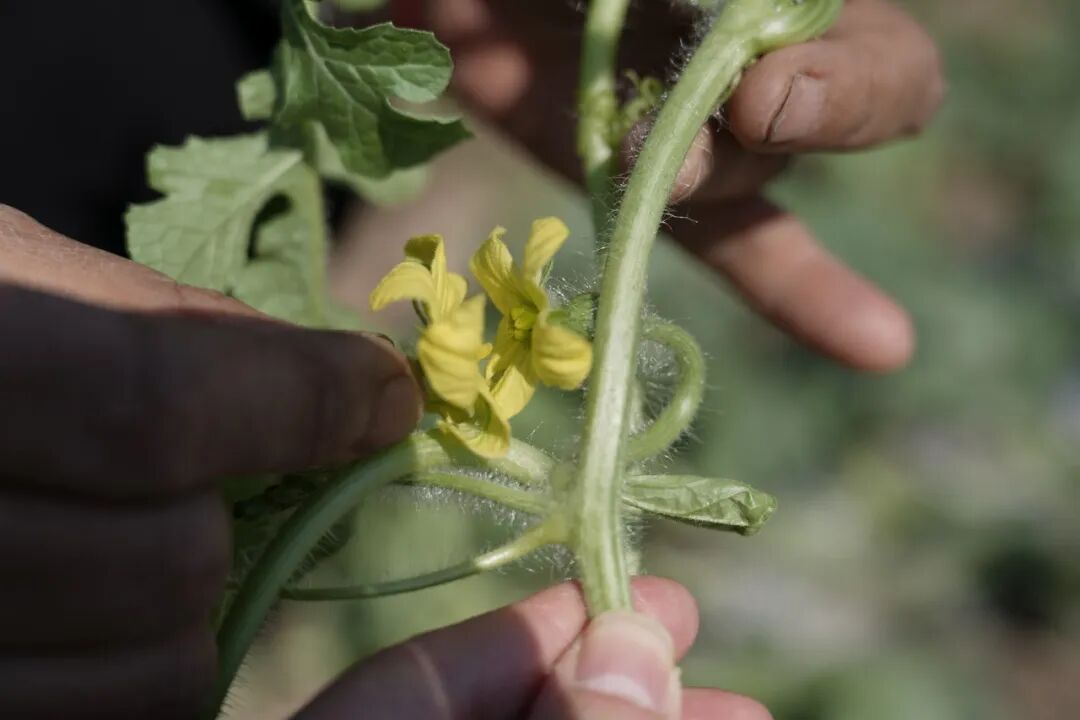
◉ Top left: Before vine training. Bottom left: After vine training. Top right: Tiny fruit. Bottom right: Pollination. (Click image to enlarge.)
A Melon Season Gone Awry
Peng An said, “This year the melons are late.” In early May, the watermelons had only just begun to set their tiny fruits; at the same time last year, each one was already two or three jin (500 g). When Yuzhen and I were doing vine training in the field in May, she noticed one vine growing shorter than the others and pointed it out to me. “The hail last month beat it up—there was wind and hail, and it was right when the melons were flowering.”
Peng An attributed the delayed melon season to the several cold spells and rainy days this past early spring. Research has also shown that low temperatures delay vine extension, flowering, and fruiting in watermelons.
Besides the Peng family, Guiying’s open-field watermelons had also been affected by the rain. Guiying, who turned sixty this year, had married into a family on Tianxingzhou from elsewhere when she was young.
In mid-May, I visited Guiying. A single half-day downpour left more than seven mu (≈ 667 m²) of her fields knee-deep in water. She pulled on a raincoat and went out to dig channels, racing to divert the water into the drainage ditches as quickly as she could. If the young melon plants sat in the water too long, once the sun came out and baked them, they would not survive.
From a distance, the vines and leaves looked lush and verdant, a green carpet blanketing the ground. To my untrained eye, everything seemed to be growing well. But Guiying crouched down, parted the leaves, and pointed at one small, misshapen fruit. “Look at this one—it’s done for,” she said. “Too much rain. Once a tiny fruit touches the mud, the stomata on its surface get clogged, and it can’t set as a melon.”
“Everything that grows depends on the sun—without the sun, nothing works at all. You try to battle the sky, battle the earth—can you ever win? Here on Tianxingzhou, all it takes is a couple of heavy downpours, two days, three days, and the fields turn white with waterlogging. We who farm check the weather forecast every single day,” she said.
A watch hut had already been set up beside the melon fields. “In about ten more days, we’ll be ready to welcome customers who come to pick their own.”
Contrary to what the forecast had promised, it suddenly began to rain again on the field. Guiying leapt up and, arms raised, shoved the pooled water off the shelter’s roof.
Besides the watermelons, the tomatoes and golden melons (Jintong watermelons) Guiying had planted this year were all lacking in flavour—”not up to taste,” as she put it.
Wu Ping, a large-scale grower and the owner of Guaboyuan (Melon Expo Garden), summed it up: Tianxingzhou’s unique sandy soil, river water, and mist give its melons and fruits their distinctive flavour. The sandy soil warms quickly and drains well; the rising and falling of the river leaves behind silt and nutrients; and the early morning dew nourishes the leaves and rinds. Only when the water is neither too much nor too little will a watermelon be crisp and sweet.
But this year the rains were too heavy. Watermelons crave sunlight and fear waterlogging—their root systems are especially sensitive to changes in soil moisture and cannot tolerate low temperatures.
A watermelon crop runs from early spring through summer: seedlings are raised after the new year, and the last melons come off the market in mid-to-late July. But this year, on 8 April, much of Hubei was hit by hail, thunderstorm-force winds, and heavy rainfall; Wuhan recorded the earliest severe downpour since weather observations began. From 16 to 19 May, Hubei experienced the strongest regional rainstorm of the year; on 24 May, Wuhan issued a red alert for heavy rain once again. Persistent overcast skies and insufficient sunlight are not conducive to the accumulation of sugars and flavour in the fruit.
On top of all this, when watermelons were transplanted around International Women’s Day on 8 March, multiple rounds of cold air and overcast rain swept through Wuhan, stunting the seedlings’ growth, and so this year’s maturation and market debut were pushed back as well. Peng An recalled that in early June, when the heat was at its peak, a batch of his melons could fetch 3 yuan per jin (500 g). But most of the melons only ripened during the plum-rain season. “Melons that ripen on overcast days are poor quality. Customers called me asking for melons, but I didn’t sell—let them rot in the field.” Guiying’s family was the same: they relied on repeat customers for long-term business and would rather not sell at all than damage their reputation. This year, both Peng An and Guiying’s fields yielded just over 4,000 jin (500 g) per mu (≈ 667 m²), and less than half of that was sellable.
Peng An and most of the other melon growers wanted just one thing: “good weather”—meaning one rain shower followed by five or six days of sun. No nonstop downpours, no weeks of drought. The last three years had been poor. Last year’s drought meant the vines couldn’t grow either, and the melon quality was poor. Other growers told me they had lost money last year and simply given up this year. “Growing open-field watermelons is gambling!”
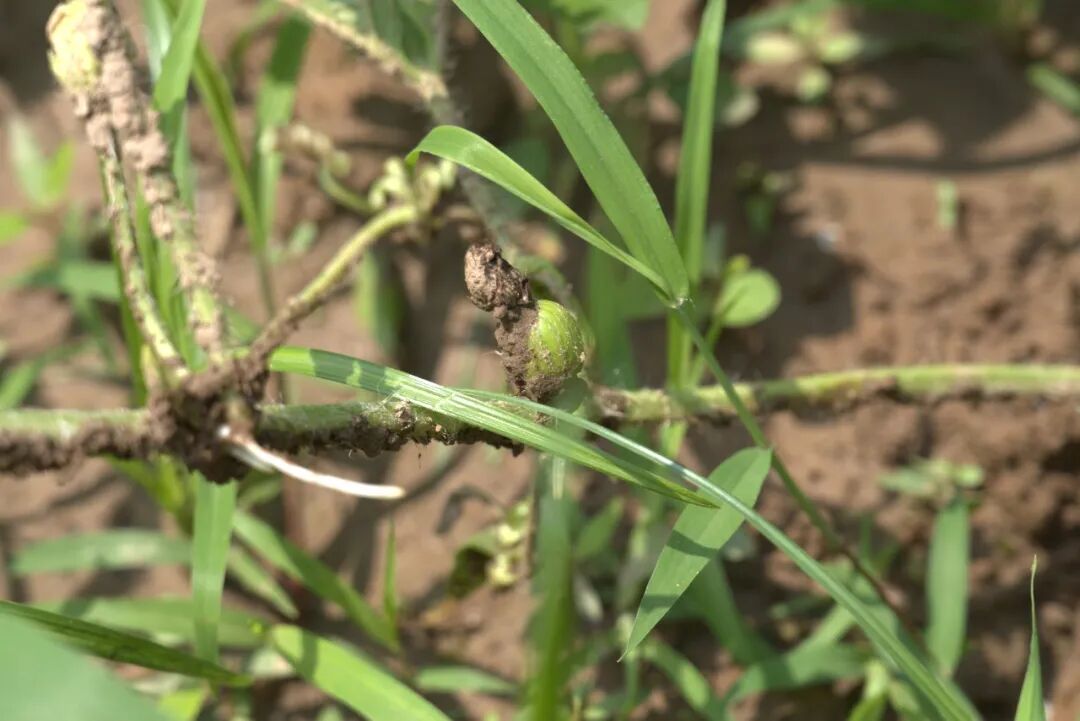
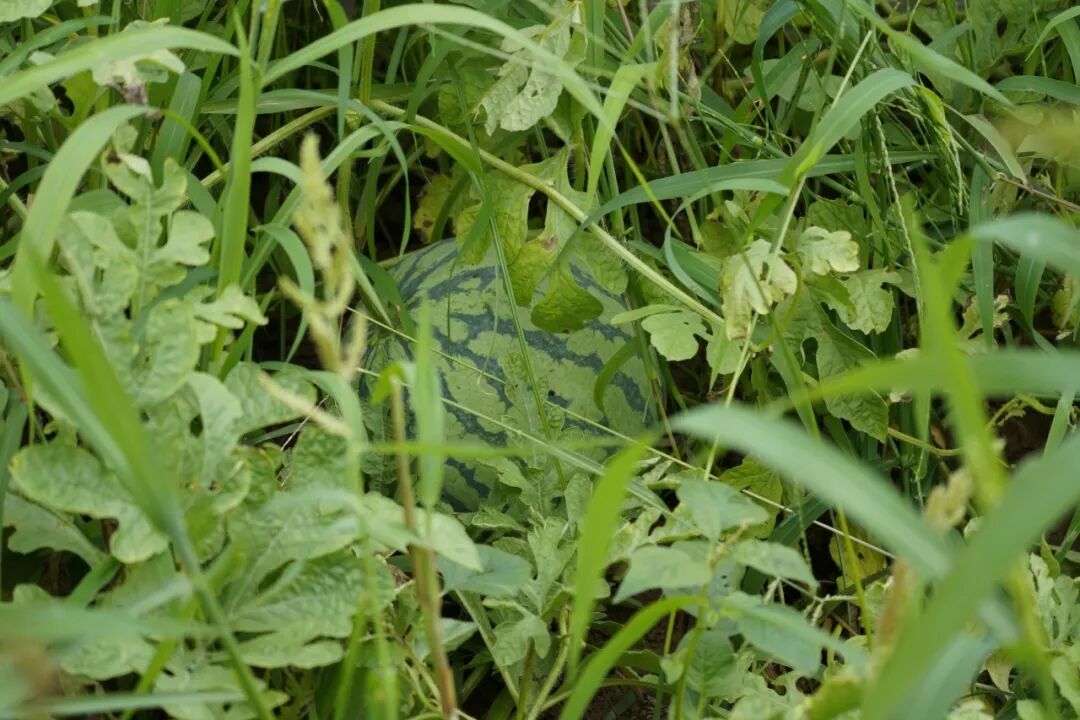
◉ Left: Mid-May – tiny fruits caked in mud in Guiying’s field. Right: After the plum rains arrived – unsold watermelons in Peng An’s field.
Polytunnel Watermelons
In my mind, Guaboyuan (Melon Expo Garden)—with its three hundred-odd mu (≈ 667 m²) of standardised, technology-driven, large-scale growing—stood in “opposition” to the smallholder farmers who ‘live by the weather.’ But the reality dispelled my assumptions. In early June, right in the watermelon harvest, I came to Guaboyuan at the downstream end of the island, only to find a handful of melons scattered beneath the watch hut.
In 2015, Wu Ping, originally from Shandong, and his partners leased the land at the downstream end of the island, erected polytunnels, set up a planting cooperative, and named it ‘Guaboyuan (Melon Expo Garden).’ He had been drawn to the mid-river island’s unique soil and water conditions. ‘The first bite told me it was unlike anything else. Take Tianxingzhou watermelons to Shandong and plant them there—work yourself to the bone and you still can’t grow them,’ Wu Ping said. Through collaboration with the Academy of Agricultural Sciences, he has trialled 101 watermelon varieties over the years.
In 2018, Tianxingzhou watermelons grown at Guaboyuan featured on the dinner menu of the Ministry of Foreign Affairs’ Hubei global promotion event. Wu Ping recalled that the weekend after the news made the papers, residents who made a special trip to the island snapped up every last melon. At the entrance to Guaboyuan stands a signboard inscribed by Academician Wu Mingzhu, the watermelon specialist: ‘A century of melon-growing on this isle, renowned throughout Jingchu.’
Polytunnels do have their advantages. Wu Ping explained that from the opening of the female flowers to full ripeness, a watermelon needs 1,000 degree-days of accumulated temperature. Polytunnels let each melon gain more accumulated temperature per day, enabling it to ripen and reach the market earlier—and command a better price. On top of that, they shield the crop from everyday wind and rain. He grows two crops of melons a year; over nine years, that is eighteen harvests. Because of his scale, he can buy organic fertiliser at 48 yuan per bag, whereas the market price runs 80 to 100 yuan. ‘There’s no protection with open-field watermelons—whatever you plant, you lose money,’ he said.
But polytunnels cannot hold back floods or the extreme weather that catches you off guard. A higher-investment, larger-footprint rigid structure often means a heavier loss. Over the past few years, Wu Ping has rebuilt the polytunnels three times over.
To start with, he put in 2.8 million yuan. Unexpectedly, the very next year Tianxingzhou was flooded; of the 400 polytunnels, only 17 survived—the rest had been swept away. ‘I sat by the riverbank and wept, with the water right beneath my feet. Everyone tried to talk me out of despair.’
After the flood, he rebuilt the polytunnels. A year later, a heavy snowfall struck. That morning, as he walked across the fields, the tunnels creaked and groaned; he watched them buckle and collapse one after another—too fast to rescue any. All but one, a lone holdout, had fallen.
The third blow was a bout of freezing rain in 2024—the first he had ever encountered in his life. ‘The forecast said freezing rain. I thought—rain, right? What’s there to fear? Wrong!’ Freezing rain falls as rain, but the moment it hits the polytunnels it freezes; before long, the entire structure is locked in ice. ‘You can’t budge, you just watch it get crushed under the ice. That bloody freezing rain—it ruined me again.’
By Wu Ping’s estimate, the three disasters together caused cumulative losses exceeding five million yuan. ‘The weather is brutal. Back in 2016, the rain just kept falling—on and on and on, nonstop for more than twenty days. The water rose, and that was the end of it. Same with the snow—just kept falling, falling, falling.’ They cannot purchase crop insurance; insurers refuse to underwrite policies here, citing the island’s status as a ‘special crop zone.’
As he sees it, weather forecasts can only report short-term conditions. Farming demands constant reinvestment in the land; before sowing, he must first judge whether the coming year is fit for growing melons.
To my surprise, he brought up a set of agricultural proverbs passed down by word of mouth on Tianxingzhou—’On New Year’s Day, watch the winds: easterly winds bring dragons, northerly winds bring floods, westerly winds bring insects, southerly winds bring drought.’ ‘The first day of the year is the year’s weather forecast,’ he said. This year on New Year’s Day, from dawn through noon, winds from every direction blew in turn; only in the afternoon did the wind settle into a southwesterly. By his reckoning, that meant a volatile first half of the year followed by a dry, rain-scarce second half. Besides reading the winds on New Year’s Day, there are the “two insects and a bird”: the height of magpie nests on the island, the white trails left by snails climbing trees, and whether bedbugs swarm the sandy banks—all used to predict whether floods will come.
‘You can’t explain any of it rationally. I don’t know what causes it either—just watch and see.’ As far as he is concerned, the weather this first half of the year has borne his reading out.
On the strength of these judgements, he cut his watermelon acreage drastically this year and switched to maize. Though maize fetches no premium, the harvest can cover his land rent and the wages of his three workers, and he can also claim agricultural subsidies. A local grassroots official pointed out that Tianxingzhou is not a grain-producing area, so subsidy conditions vary by crop; to qualify for agricultural subsidies, maize must be planted over an area greater than 30 mu (≈ 667 m²).
‘I don’t intend to grow melons next year either,’ Wu Ping said. ‘In ’97 there was a strong El Niño, and the next year the great flood of ’98 came. This year is another strong El Niño—next year will most likely bring endless rain and overflowing rivers.’
Polytunnels have not given Wu Ping greater climate resilience, but that does not mean he will give up. On the contrary, he wants to expand his operation and plans to apply for a geographical indication for Tianxingzhou watermelons.
“Growing Melons: The Hardest Part Is Still the Selling”
Every Wuhan local remembers biting into a Tianxingzhou watermelon on a day hot enough to melt the furnace. “Back then,” one resident recalled, “in the first half of summer we’d eat the round Tianxingzhou melons—thick rind, lots of juice, crisp texture. In the second half, we switched to the long ones: Ningxia stone melons.”
Historical records show that watermelon cultivation on Tianxingzhou began in 1919. By 1969 to 1972, the area planted with watermelons had reached thirty per cent of the island’s total arable land. From the 1960s through the 1980s, as a designated cash-crop zone during the planned-economy era, Tianxingzhou watermelons were in fierce demand. In summer, two or three hundred trucks from major work units would queue up for miles to buy melons as staff welfare. At its peak, Tianxingzhou watermelons commanded a price at least twenty per cent higher than comparable varieties.
By the 1980s and 1990s, growers in Wuhan’s outskirts began erecting polytunnels, harvesting multiple staggered crops per season so that melons could reach the market in succession. Premium and early-maturing varieties from elsewhere kept flooding into Wuhan. Tianxingzhou’s open-field watermelons, arriving later, found their traditional bulk buyers—work units—gone. Sales came to rely on melon brokers or growers hauling produce into the city themselves, and a glut of unsold fruit followed.
Though residents could still pick up Tianxingzhou watermelons at wet markets and roadside stalls in the early 2000s, the decline was already beyond reversal.
In 2007, the district government imported new varieties to revive Tianxingzhou’s watermelon industry. Yet by the following year, the wholesale price of Tianxingzhou melons still hovered at 0.6 yuan per kilogram—far below the 2.2 to 2.6 yuan per kilogram commanded by melons from their place of origin in Zhejiang.
By late August this year, several traders at the Baishazhou Fruit Wholesale Market in Wuhan told me that locally grown watermelons had long since stopped entering wholesale channels. What fills the market instead are melons from Ningxia, Gansu, Hainan and beyond. “This year the wholesale ceiling is 2 to 2.5 yuan per jin (500 g),” one trader said. “Last year we still fetched 3 yuan.” He pointed at a pile of Gansu melons: “These cost a few mao a piece, and no one will touch them.”
In the traders’ view, supply and demand set the price, and sales this year had been worse than usual. I asked whether it was because Wuhan’s summer had been cooler than normal. “I think everyone’s purse is just empty,” said one trader.
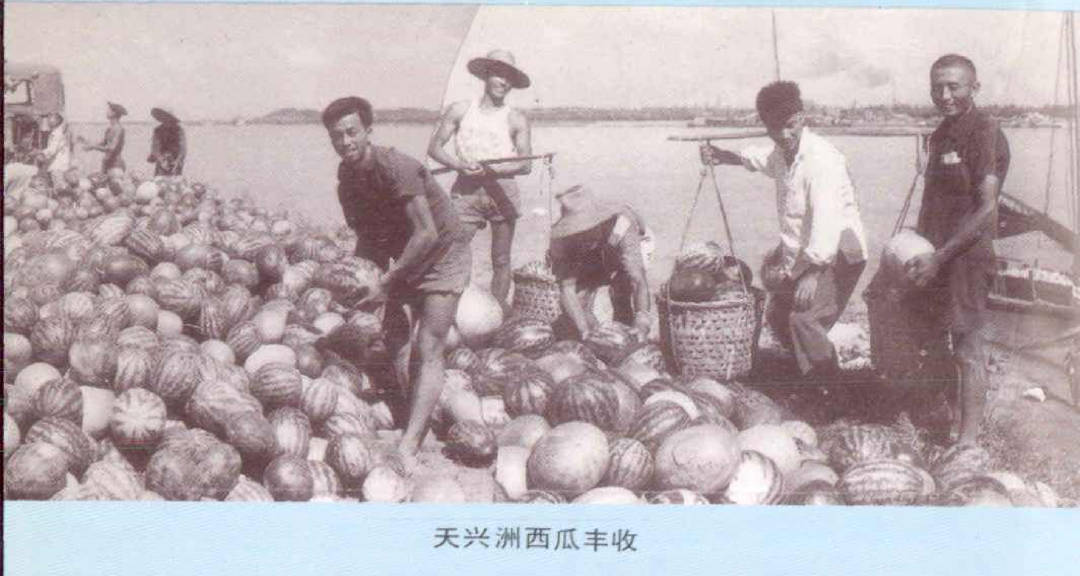
◉ A bountiful Tianxingzhou watermelon harvest. Image source: Wuhan Municipal Gazetteer: Agriculture, Wuhan University Press, published 1991
Tianxingzhou watermelons ripen later, so by the time they reach the market, melons from elsewhere have already flooded in. Besides, fewer people grow melons now, and fewer brokers come to collect them. For the remaining growers, the more realistic path lies in group purchases by regulars and agritourism—customers who want a genuine Tianxingzhou watermelon come to the island and pick it themselves.
That means footfall and online marketing through social platforms have become vitally important. Today, what decides who can keep a foothold on the land long-term is the knack for tapping networks and the ability to market and sell. Wu Ping runs five regular-customer groups with over two thousand “melon-eating bystanders”—by his observation, most are urban middle-class buyers. He also has large clients on long-term contracts.
Even the growing practices are changing. The older generation used oilcake fertiliser, chicken manure, duck manure, quail manure, pig manure—each family’s melons tasted different. The younger growers lean on peptide fertiliser, horse manure, woody fertiliser… Wu Ping believes that because modern presses extract oil from soybeans far more thoroughly, soybean oilcake no longer carries much residual oil; he has switched to woody organic fertiliser and adds fermented soybean fertiliser to boost the aroma.
Guaboyuan (Melon Expo Garden) has pushed Tianxingzhou watermelon prices beyond anything the veteran growers could have imagined. Under the tasting guidance of melon specialists, one “Rainbow melon” variety once fetched 18 yuan per jin (500 g). Through scaled-up operations, varietal trials, farm-culture-tourism pick-your-own experiences, and media publicity, Tianxingzhou watermelons have transformed from a market-stall “staple melon” into a “boutique melon” aimed at a particular slice of consumers.
Yet even with the market reopened and the value elevated, the weather remains a variable no grower can control.
In April 2024, the vehicle ferry linking Tianxingzhou to Qingshan district was suspended and, as of yet, no resumption notice has been issued. The only public transport to the island is a demand-responsive bus service running every two hours. In November that same year, vehicles from outside Tianxingzhou were placed on a booking system, capped at three hundred per day. For an agriculture that depends on city footfall, the transport squeeze has brought yet another sales headache.
A prolonged, ambiguous in-between state: that is the condition of the melon fields on Tianxingzhou, and of Tianxingzhou itself within Wuhan’s urban expansion. The old order of production and daily life is endlessly interrupted and suspended, while new ties reassemble in the gaps. Amid the river’s swelling and receding, the normalisation of extreme weather, and the uncertainty of urban policy, smallholders barely sustain their bond with the land through migratory farming, growing for their own table and for gifts, selling through acquaintances, and running small-scale pick-your-own ventures. As the suspension drags on and “temporary” becomes the everyday, transition is no longer a passage toward some fixed destination—it has become their life.
“My mind is never really still—it’s always roiled by something,” Guiying said.
– This is Foodthink’s 837th original article –
Foodthink
Author:
He Wu
Perched by the waterside, recording stories of climate change, birds, cities and the people who live between them.
About the Lianhe Creation Programme
To understand the realities of food and farming today, and to empower more people to grapple with the complexities behind food-system issues, Foodthink and a network of charitable and media partners jointly launched the Lianhe Creation Programme in 2024 and 2025, supporting media creators and researchers in conducting fieldwork across the food and agriculture space and funding the completion of publicly accessible content.
After multiple rounds of interviews by a panel of judges, the Lianhe Creation Programme supported 18 creative projects in 2024 and supported 20 creative projects in 2025. Several of the commissioned works have now been completed and published:
“A Cleaner Called A Mei Just Wants a Proper Meal | The Worker’s Table”
“In Malaysia, Chinese Traders Want Only Grade-A Durian”
“Fake Meat Drives Out the Real: Herders, Dinner Tables, and the Amazon”
“Melons Promise Sweetness; Growing Them Promises Bitterness”
‘From the Gaoshan Yao to the “Chosen Mushroom Foragers”: the Termite-Mushroom Frenzy’
“Ma Lan Has No Lunch Companion in Shenzhen”
‘Why Did the Sweetness of Childhood Disappear?’
‘Why Can Guizhou Not Do Without Sour Soup, and Sour Soup Not Do Without Guizhou?’
‘Who Drove the Wet Market Away?’
‘Will Fresh Produce E-Commerce Kill the Wet Market?’
‘When Drones Become the New Farm Tool: Who Defines “Scientific Farming”?’
“A Braised Goose in a Qiaopi Remittance Letter, Worth a Hundred Thousand Yuan”
‘”Don’t Sell Yet—the Boss Hasn’t Arrived.”‘
“In Search of Musang King: Flavour and Business in Malaysia”
All names in this article are pseudonyms
Unless otherwise credited, all photographs are by the author
Editor: Pei Dan
Layout: Xiaocun
Scan the QR code to tip—support original food writing
▼

▼
Click the image to read related articles
▼
Click the keywords to explore more article collections
Seeds | Farming Techniques | Policy | Fermentation | Nutrition | Fruit | Fisheries | Events | Recruitment | Food Delivery | Wet Markets | Livestock Farming | Food Talk | Sharing Sessions | Book Clubs | Harvest Festivals | Smallholder Stories | Climate Change | Rural Development | Cooperative Economics | Urban Farmers | Food Safety | Digital Technology | Biodiversity | Pandemic and Food | False Solutions | Agroecology Internship Programme
Beijing | Hebei | Shanghai | Guangdong | Guangxi | Henan | Sichuan | Jiangxi | Xinjiang | Shaanxi | Hong Kong | Chongqing | Zhejiang | Jiangsu | Guizhou | North-east | Taiwan | Inner Mongolia | Philippines | Canada | Russia | Mexico | Italy | United States | UK | Germany | Netherlands | Thailand | Sweden | Japan