Meituan has funded environmental organisations dedicated to monitoring food-delivery plastic pollution, yet their critical voices have gradually faded. Two veteran environmental advocates compare this to the 2004 Asia Pulp & Paper (APP) case, noting that the balance of power between businesses and public-interest organisations has quietly reversed.
Ren Yingying of Lianxiang Farm was invited by the German Federal Ministry of Food and Agriculture to the GFFA in Berlin. The position paper she co-drafted demands breaking multinational corporations’ control over seeds, land and supply chains, promoting agroecology, and safeguarding smallholder farmers’ land and policy-participation rights.
Meituan, a major generator of food-delivery plastic waste, has begun funding environmental organisations working on plastic reduction. Spanning fundraising ethics to corporate PR tactics, Shan Shui Conservation Center co-founder Sun Shan and freelance environmental writer Ma Tianjie ask whether public-interest organisations can hold their independence against polluter funding.
Bunong woman Langheng has guarded a 2,282-hectare community forest in Cambodia for years, yet chainsaws devour the woodland in secret after dark. REDD+ is designed to convert forest carbon into community conservation funding, but “additionality” hurdles and profiteers bypassing consent make it ever harder for indigenous peoples to defend their land.
For four decades, Benedikt Haerlin – Head of the Berlin office of the Future Agriculture Foundation – has been deeply involved in the anti-GM agenda, from driving the EU’s first GM Directive to launching a global advocacy campaign, covering key milestones such as mandatory labelling, Golden Rice and CRISPR/Cas9.
Mycorrhizal fungi are the living threads of the soil, sustaining its water and crop health. Sequencing by Agroscope confirmed that intensive agriculture has reduced their keystone species to near zero — yet restoring these underground networks is far more complex than scattering an inoculant across the soil.
The Monsanto biography Empire of Seeds uses data to debunk the GM myth. Chinese scholars and practitioners—Tian Le, Guan Qi, Xu Zhun, Zhou Mujun among them—discuss: GM has neither reduced pesticide use nor raised yields. Can farmers and consumers re-engage with breeding and food networks?
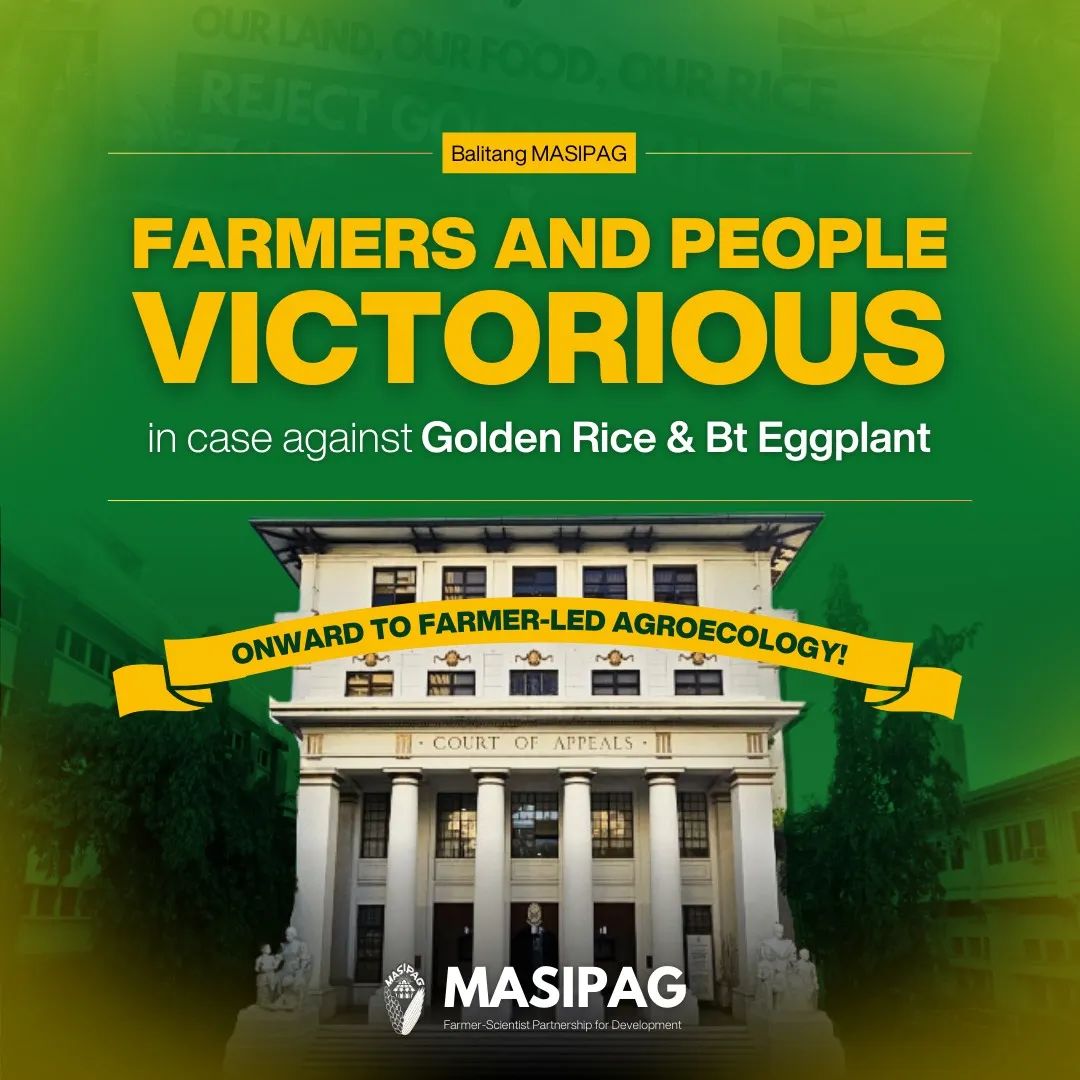
The Supreme Court of the Philippines has ruled Golden Rice commercialisation unconstitutional, revoking all Biosafety Permits. Farmers and scientists led by MASIPAG have fought for over twenty years: from table safety to tenant farmers’ freedom to breed their own rice seeds, free from seed company control.
From the Green Revolution to carbon credits, Bayer and IRRI’s schemes have consistently placed hidden costs on smallholders. Yet farmer networks such as MASIPAG in the Philippines and DDS in India are rebuilding a different emissions-reduction foundation through local varieties and agroecology.
From a Berlin hydroponic workshop to the successive closures or bankruptcies of infarm, AeroFarms and others, vertical farming’s fundamental flaws in crop variety and energy consumption are impossible to ignore. Industrial designer A Liang also charts a path for low-tech hydroponics back to communities.