The Anthropologist Who Learnt to Sell Fish at a Wet Market | New-Book Excerpt & Event Preview

Editor’s Note
Not long ago, in Foodthink’s “Eat Well” story-submission column, we received a great many fresh observations and shares about wet markets. But what do wet markets mean in the eyes of an anthropologist?
To understand the vitality and the challenges facing China’s wet markets, anthropologist Zhong Shuru once took on the role of a “fishmonger” — on tropical island evenings, pulling on rubber waders and hauling and selling fish amid the stench of the sea, “embedding” herself in the everyday market-stall life of the town. She also set out from a fish stall in Hainan to more than fifty cities across the country, visiting over two hundred wet markets, using her feet, her hands, and (of course) her taste buds to experience their flavour and vitality, their toil and harvest, their livelihoods and businesses, their human bonds and wild frontiers, their transformations and unease. All these observations and reflections on food, space, social structure and the smoke-and-fire of daily life, gathered around wet markets, have finally crystallised into her new book — Chinese Wet Markets.
In this new-book reading selection, let us follow Professor Zhong back to where her fieldwork began, and together experience the real, vivid everyday life of the market.

On the evening of 14 August 2026 in Shanghai, and the evening of the 22nd in Beijing, the publisher Guangqi Publishing will host a new-book sharing event; on the morning of the 22nd, Professor Zhong will also visit the Beijing Organic Farmers’ Market for a live-stream as she browses. For registration and bookings, please see the event details at the end of this article.
*The content of this article is excerpted from the “Prologue” of Chinese Wet Markets. Thanks to the publisher, Guangqi Publishing, for granting permission.
On this tropical summer’s night a faint breeze had stirred, yet the air felt somehow even thicker, more viscous. The complex fish stink of the wet market, mingled with sweat, had seeped into the fibres of my T-shirt and no amount of washing would shift it. At eight o’clock, having just finished a day selling Spanish mackerel at Yefeng Market, I dragged my exhausted body back towards the rented room. With every step, water and sweat sloshed around inside my rubber waders, making a squelching sound.
I vanished into the rush of passers-by; no one paid me the slightest attention. My dress, combined with the thick “market smell” clinging to me, meant that at that moment I was a fishmonger through and through. No one, I suspected, would guess my real identity: that of an anthropologist conducting fieldwork in a wet market.
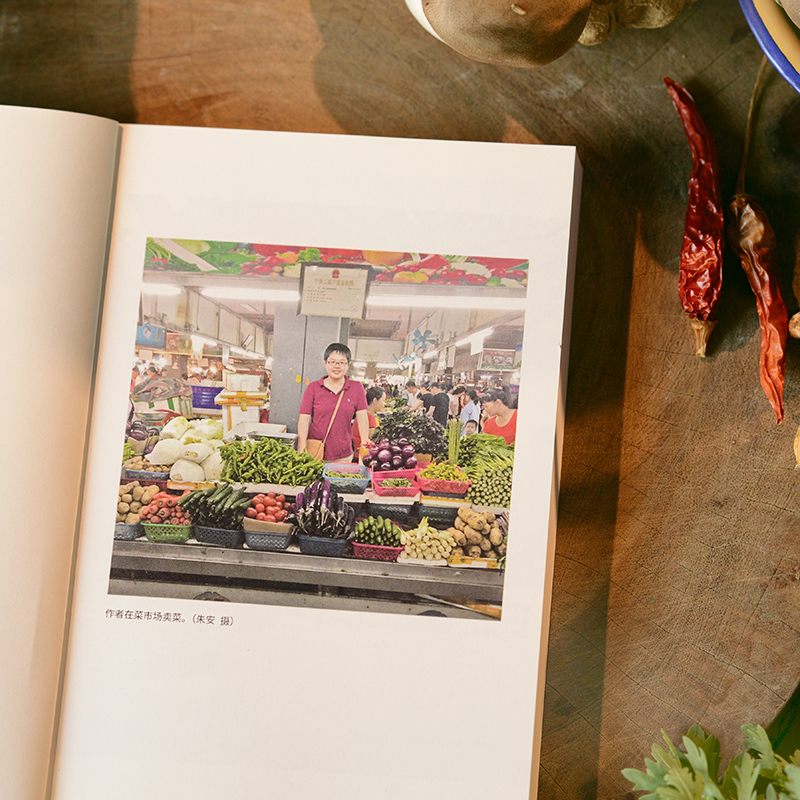
◉ The author selling vegetables at the wet market.
In June 2016, having only just completed my doctoral qualifying exams and before I had quite come round, I flew from Texas in the United States to my native Hainan to begin fieldwork — little expecting that I would stay fourteen months. My friend Xiaogua offered to let me stay at her place, saving me money. I was deeply touched, but really did not want to impose on her for that long.
The sun over Y City blazed like fire in summer. I searched for rooms in a fever, while on every street everyone walked with brisk, purposeful strides. Still a stranger keeping my distance, I wished I had an extra leg so I could stride fast and hide myself, dissolve into the crowd. I had never realised before that so many handshake buildings were tucked away in the central district. Local Y City homeowners would rent out entire buildings to agents from the Northeast who ran small guesthouses, at thirty or fifty yuan a night. A few ran them themselves: the family lived on one floor, and the remaining five or six were partitioned into tiny rooms of around ten to fifteen square metres, let at monthly rents of seven hundred to a thousand yuan to members of the ant tribe doing manual work in the neighbourhood.
I, too, became one of the ant tribe, and in my scrabbling way tried to feel the city’s most mainstream pulse.
With Xiaogua’s help, I finally settled on a small street-facing room with a balcony. Compared to the second-floor room above a restaurant I had initially booked, reeking of cooking fumes and never seeing sunlight, this place was simply beyond reproach. Out the window, I could stretch out and touch a red sandalwood tree four or five storeys high, its leaves rustling morning and evening in a duet with the sea breeze — though I later discovered that this tree was also the rats’ express route into my room. I never liked the feeling of drifting, yet the path of study had kept me wandering ever since, and this year-plus of fieldwork seemed no more than a waystation. Even so, one still has to settle into life.
My lodgings were only a ten-minute walk from Y City’s largest wet market: follow a straight, tree-lined avenue for a few blocks and you were there. That was why I had resolved to stay here. Buying everyday necessities was easy too — shops of all kinds ringed the market. For several days I was a worker ant, scurrying back and forth, hauling home the things I needed to survive. The tropical noon sun was vicious; mop bucket, washbasin, sleeping mat — two hands could not hold it all, and every few steps I had to stop, inching my way home. Only once I had a single-burner stove, a wok and an LPG cylinder installed did my mind begin to anchor. As long as there is a tiny kitchen to feed yourself, there is energy. In the days that followed, in a kitchen that had not even got an extractor fan, I repeatedly practised practice theory. The names for seafood are bewilderingly complex; knowing them cannot rely on words alone. You need your sense of smell, touch and taste to sharpen your synaesthesia — the locals call it guo du bu wang: “once it passes through your belly, you never forget.” In that little kitchen, I cooked flatfish gifted by my market-stall friends and invented fish balls from Spanish mackerel so fresh they could make your eyebrows fall off. On rare evenings when I gave myself a holiday, two swimming crabs steamed from the market became a snack for watching the football. Old friends Liu You and Lin Li visited Y City, and my tiny kitchen in no way limited my standard of hospitality — to this day they still often talk about what we ate in Y City, especially the giant mantis shrimp heavy with roe.
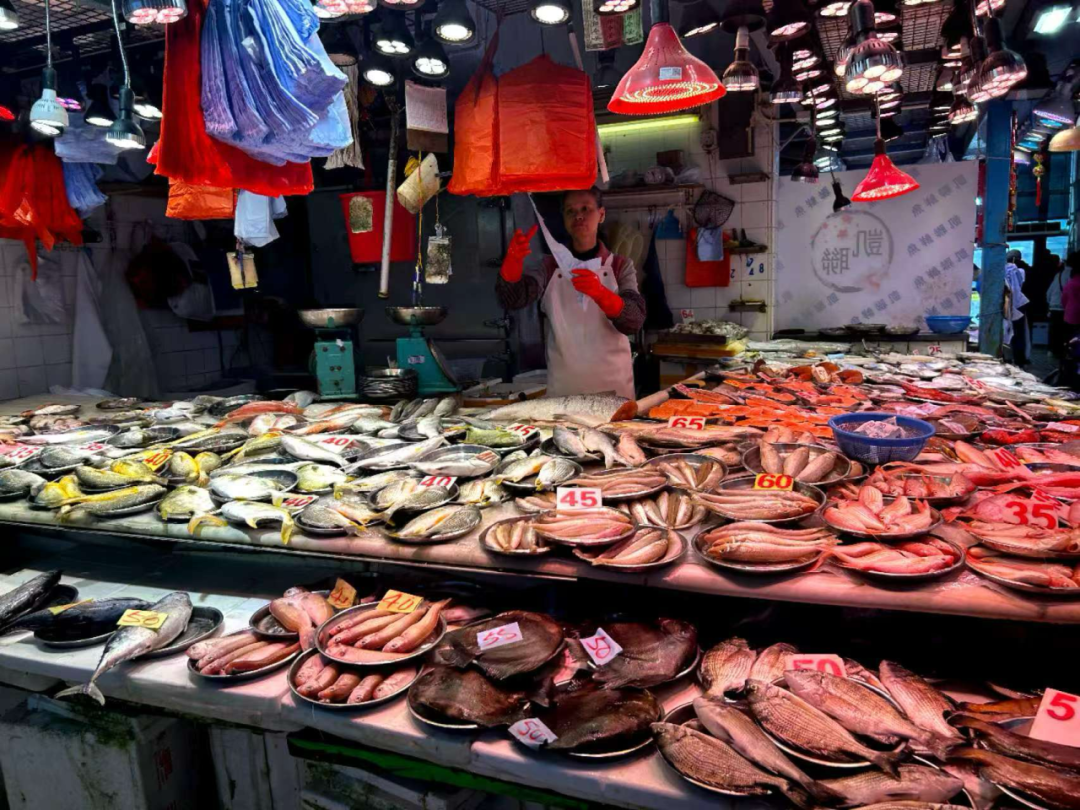
◉ Sea fish at Tai Po Market, Hong Kong, in summer.
My landlord and landlady were locals who lived on the ground floor with their two daughters; neither held a proper job. The landlord doubled as caretaker and handyman for the whole building. The second floor where I lived somehow squeezed in four rooms. The corridor was dim, with puddles from hanging washing and discarded cigarette butts strewn about. In the year and more I lived there, I only ever met the occupants of the room next to mine.
The first group were four young women who had come to Y City to work. They waited tables at a nearby restaurant, which rented the room as staff accommodation. Two tenement bunks packed into roughly fifteen square metres, a suffocating press. Their room had no outside window, and for air they often left the door open. Even without looking deliberately, you would catch glimpses of them lying in bed, scrolling on their phones. One day, all four simply vanished — perhaps the restaurant had gone under, too.
Soon a kind auntie from Hunan moved in, taking casual work wherever she could find it. She was in her fifties, very warm, and we sometimes swapped fruit. Her son was ill and needed money, so she went looking for work everywhere she could. Her room was piled high with collected scraps, and picking through rubbish for saleable items was another of her livelihoods. One day she said her son’s condition had worsened and she had to return home; she might not come back after this.
Some time later, a middle-aged couple from Jiangxi became my neighbours. They had run a barbecue stall at the night market, having taken it over wholesale from a fellow villager who had simply given up. They headed out late and returned early, threading skewers under the shade of a ground-floor tree as they set up for the evening — the moment we would nod a greeting. Later they rented a shopfront on a busy street at five thousand yuan a month, yet still could not escape the “harassment” of the urban-management officers. Enforcement was much stricter than before: previously, even if a street barbecue cart was impounded, a fifty or a hundred would usually win it back. But because of the “twin-city improvement” drive, the officers dared not accept the money, and the carts were seized for good.
The street had the languorous quality of the tropics, with no clear boundary between day and night. By daylight, some thirteen shoe repairers from Jiangxi lined up beneath the shade of the trees at the crossroads, waiting for business. All fellow villagers, they knew each other well and quietly observed an unspoken rule: the pitch spots were not fixed — everyone shifted one position along each day. Beside the shoe stalls, in the afternoon, some “masters” would appear. Compared to the cobblers, they were celebrities: soon a crowd would cluster around them, in and out, as they spat words and predicted or dissected, with great passion, the winning numbers for the week’s private lottery draw.
Only when night fell did Y City truly wake. The open-air food stalls were first to sense the heat ebbing, hauling out their pink and bright-yellow plastic deck chairs, which were quickly filled by ravenous diners. Once people had finished their home-style Hainanese dishes, Sichuan hot pot or a plate of Northeastern food and felt like carrying on, they could stay on the same street — for barbecue, stir-fried rice noodles and Hainan ice jelly, the roving vendors would appear from every direction. Some clever late-night operators simply took over the evening’s open-air stalls after midnight, solving the venue problem perfectly and splitting the rent. Every night in a barbecue joint, a different story unfolded: drunkenness, laughter, and quarrels.
The bright clink of wine bottles had barely hit the ground before the dawn cry of roving vendors caught it. Outside my window, every morning a few vendors would pass, balancing shoulder poles and woven bamboo baskets laden with sea fish. Their finest stock was reserved for the early risers. After eight o’clock, when the urban-management officers came on shift, the game of cat and mouse began. Sometimes you would pick out your fish but before you could pay, the vendor would break into a run. That said, after several mornings of standing on the roadside watching the whole thing play out, I noticed the roving vendors and the officers were not always at daggers drawn — rather, theirs resembled a commensal relationship. Without the roving vendors, the officers would most likely not exist at all.
* * *
In the early weeks of fieldwork I was in a phase of giddy “culture shock”, finding novelty everywhere, even on a different market street each day. The old fishing harbour was a stone’s throw from my lodgings: slurp a bowl of rice noodles at dawn and you could walk there before digestion was done. The harbour was about to be relocated; the waterfront had been fenced off with wire mesh, and against the backdrop of the five-star Peninsula Hotel on the other side, it looked more desolate and run-down than ever. The shopkeeper next door said, “You’re only just getting here — the liveliest days are long past.”
In the small hours, at three or four o’clock, the fishing boats came home and the sea-land trade was frantic and full of life. I was not in a rush, knowing I would need to make many more visits before the relocation. This was Y City’s oldest fishing harbour. In the pre-dawn air, the dirty water and stinking offal from the night’s trading mingled with the briny sea and erupted into a fish reek even I could hardly bear. With the move imminent, the state of cleanliness was a worry: fish guts strewn everywhere, dead fish and rubbish in the potholes, the ground stained a dirty black. By eight or nine in the morning, only three or five retail fish stalls remained. The stallholders wore conical bamboo hats, floral fitted long sleeves (to keep off the sun), and rubber waders — the typical get-up of a fisherwoman.
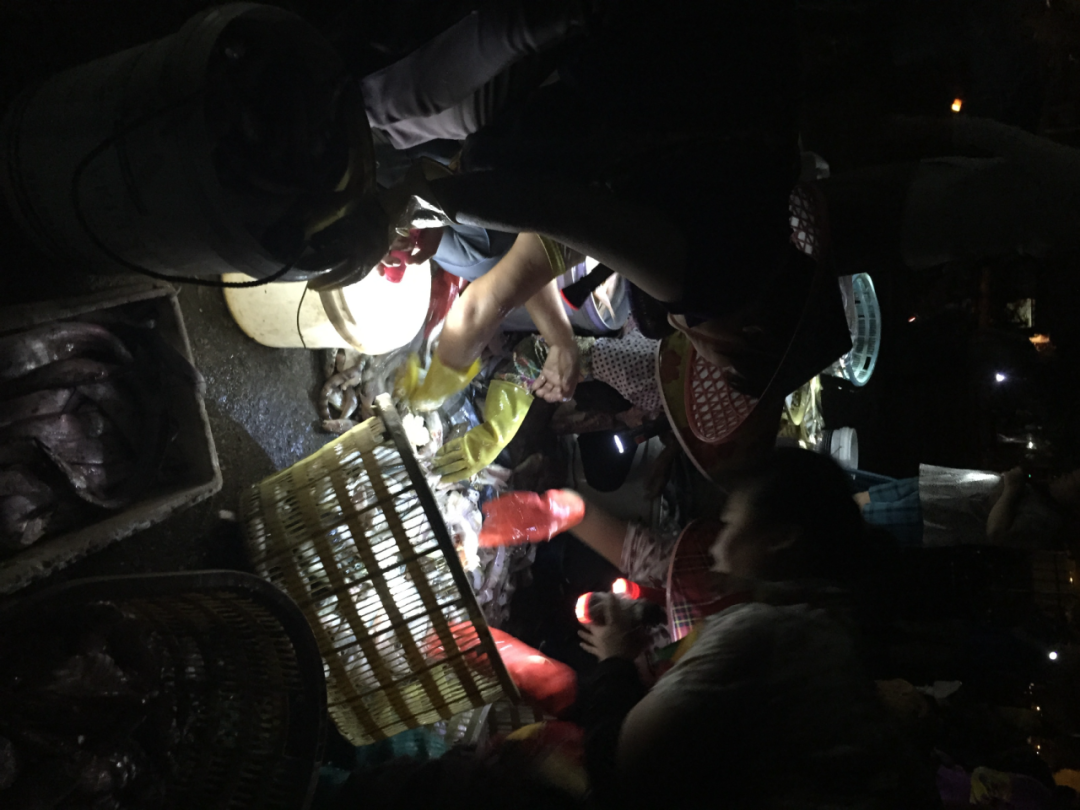
◉ Hainan’s harbour wakes at midnight; before dawn, fisherwomen sort the catch, torches clamped between their teeth.
Out in the field, I had been mistaken for all manner of things — a journalist was one. Two fisherwomen running stalls thought I was a reporter and rushed to grab my arm and complain. They were sisters-in-law — the wives of two brothers — and one had cut her hand on a fish only days before, a bandage still wrapped around her fingers. The more voluble of the two had a fierce need to be heard; she spoke in a rush, and in that moment I regretted not having improved my woeful Hainanese dialect sooner. Her Mandarin was about as good as my Hainanese — the worse I looked, the harder she talked. I nodded along, desperate and helpless. Mercifully, the younger one spotted the impasse and stepped in, easing the awkwardness. As it turned out, they were deeply unhappy about the harbour’s relocation.
The old fishing harbour was a natural deepwater port, sitting in the very heart of the city centre, and was to be demolished to make way for tourism. The new harbour would be over forty kilometres from town and artificially constructed, prone to silt buildup — not easy to work, and for the city’s seafood traders it would mean a steep rise in transport costs, dealing a heavy blow to their trade. They did wholesale business as well as retail, and once relocated, retail would probably be impossible to sustain. The veteran fishermen collectively petitioned the government not to relocate, to no avail. So they hoped I could write about it for them, raise their voices, help save the old harbour.
In the field, anthropologists must navigate many such requests, yet over-promising is strictly off-limits. Once I candidly acknowledged my student status, they were not terribly disappointed, and I breathed a sigh of relief. The sisters-in-law fell to murmuring between themselves: life is hard for Hainan’s women, women are worn out. In the fieldwork that followed, I heard this refrain again and again, and in the rhythm of their days came to grasp the weight of it.
For the first two months of fieldwork, I spent most of my time simply observing the wet markets across Y City. I tramped through every one of the thirty-odd markets, large and small. Some suburban markets were remote — a round trip could swallow an entire day. As I walked and watched, I seized every chance to find someone willing to chat. I followed no fixed interview guide at first; only, by being present and letting fragments of conversation drift in, did I try to start assembling a vast, tangled map in my head. I am no “social butterfly” — my usual gambit is to buy something at a stall, then strike up a conversation, a tactic that has never failed me — except in one regard: my weight. Everything I lug home from the market each day has to be eaten, after all!
Yefeng Market, the closest to my lodgings, was Y City’s most celebrated and oldest market — and my intended primary field site. But my first encounters there left me completely at a loss. The market had over three hundred stalls, and the two busiest zones were sea fish and live seafood. Local residents preferred sea fish; they considered lobster, abalone, and other live seafood to be food for tourists. It was only later I learned that most of Y City’s live seafood came from aquaculture farms in Zhanjiang or from the Huangsha Aquatic Products Market in Guangzhou. Guangdong tourists who travelled the long way to Y City were, in all likelihood, eating seafood from home. Mornings saw the sea fish section buzzing while the live seafood zone lay quiet; by lunch and dinnertime, tourists would file in shoulder to shoulder through the seafood section. Walking the market aisles, I was naturally taken for a tourist. Several times I was tugged aside by “seafood touts”, who asked whether I wanted to buy seafood to have cooked.
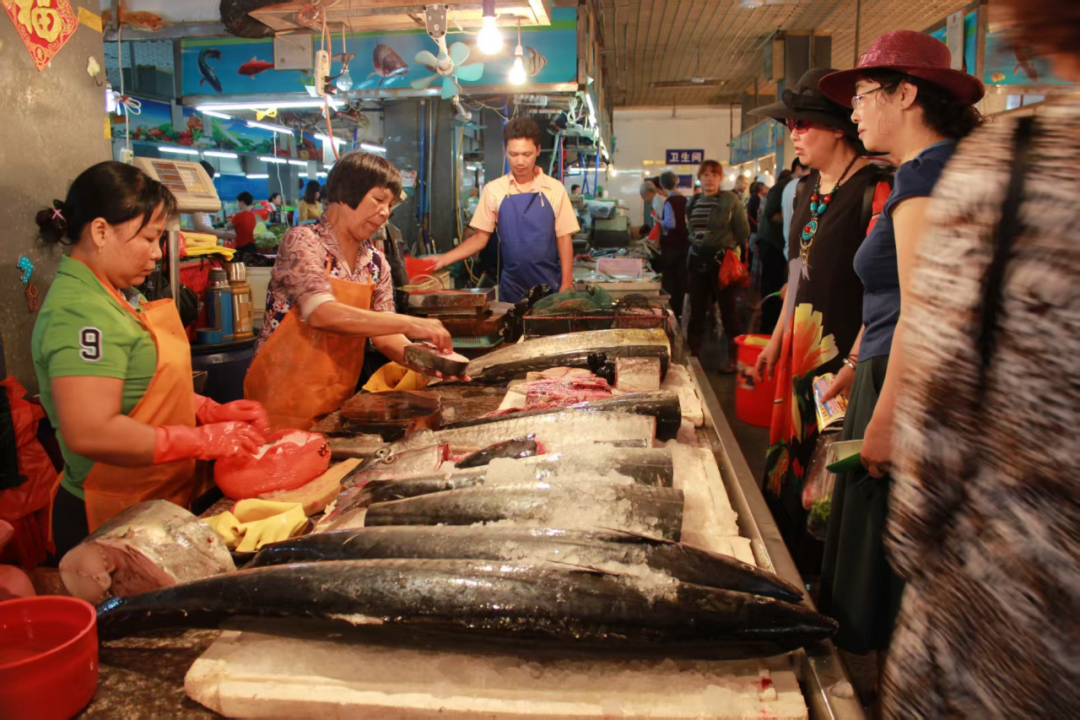
◉ Fish stalls at Yefeng Market (Hainan, 2016)
In this market, the air held, beyond the peculiar wet-market smell of fishy tang, meaty aroma, soil, and green leaves, what seemed a faint current of tension. At first glance, trust between people ran low. Y City’s seafood merchants were “notorious” for fleecing tourists; I saw visitors from out of town bring a spring balance to weigh their purchases, some gripping a bag of prawns they had just packed and squeezing it again and again, trying to drain out every last drop of water, others challenging the weight face to face. On such occasions the sellers would feign indignation: “These shells are heavy to begin with! There is a public scale at the entrance — if you do not believe me, go and weigh them yourself!” The average tourist, faced with that barrage, fell silent. The seafood sellers could read their customers; encountering someone who lacked vigilance and looked like an easy mark, they would work with practised speed — before the customer could react, they would weigh the seafood together with its little basket, a full two liang short per jin. Yet when facing a customer who glued their eyes to the scale, the sellers kept a perfectly straight face: a simple tare was all it took to pass.
The aunties selling abalone from little plastic basins were swift on their feet; no matter how fast I walked, they would catch up. “Miss, would you like some abalone? Ten yuan for three,” one said. She told me she sourced them from a seafood shop outside the market — abalone at sixty yuan a jin, roughly twenty to the jin. Selling at ten yuan for three, she pocketed only a few yuan per jin. My gut told me not to take that at face value, because the gross margin on seafood is nowhere near that thin. She went on: “Business is tough. The steps I walk around this market each day — that’s enough to carry me all the way back to my hometown. I would rather not do this any more.” And yet every time I wandered through Yefeng Market I still ran into her, and once watched her quarrelling with another abalone seller over a customer. The more I watched these little dramas, the more questions multiplied in my mind.
Early in fieldwork, I weathered coldness, refusal, and mockery almost every day. My advanced degree and my identity as a young woman created nothing but further obstacles in the wet market. To stallholders, someone who buys nothing, brings no profit, is if anything of dubious provenance — worthy of the highest suspicion. The buy-something-then-chat gambit did not work at Yefeng Market. Their business was too brisk: a perfunctory nod or two and they waved me off, their attention already turning to the next customer.
But as I kept appearing at Yefeng Market, the shopkeeper at the little general store near the entrance recognised me and grew intensely curious. After a few words of chat, I casually asked how much a stall cost per month. She went rigid on the spot. At last, out came the suspicion she had been harbouring; she turned the question back on me — “Boss, are you here to do business?”
At the time I had short hair and looked sharp, efficient; she thought I meant to set up wholesale at the market or rent a stall to compete with them. I hastily stated my purpose, introducing myself as a graduate student interested in market consumption, there to conduct a social survey and understand ordinary people’s lives. Finding a way to express my anthropological intent as honestly and precisely as possible was a conundrum. In those first two months I had rehearsed the explanation in countless encounters, and almost no one grasped what I was actually doing. Aimless wandering with no commercial interest simply could not be filed under any category in their mental map. Perhaps they also could not see what knowledge there could possibly be in the everyday wet market.
I also suffered the Waterloo of my personal shopping history. After my interview attempts had borne no fruit, I decided to satisfy my appetite first. From the stall of a young man from Zhanjiang I picked out two horse-dung sea urchins, all poised to taste this delicacy of the earth with reverent delight. But the moment I cut open the first urchin, I froze: nothing but foul mud-water inside — no roe at all. I told myself it was just bad luck. The second was the same. It struck a deep wound in my affection for sea urchins, and at last I understood why the seafood processing shops could only make steamed egg custard with sea urchin — because beyond the empty shell, there really was very little substance to find.
I went back to the young man from Zhanjiang to demand an explanation. He said all the sea urchins here were like that, and the ones I had bought at other stalls would have been no different. Still fuming, I asked him where he sourced them. He replied with contempt: “I can’t tell you that, and it’s none of your business.” That answer roused the “dignity” of the anthropologist in me. Digging to the bottom of things is, after all, a core technique of the discipline. If he would not tell me, could I not investigate for myself? One day I would know exactly who had stolen my sea urchin roe — this was a dual pledge I made to myself as both consumer and researcher.
The bustle of Yefeng Market, for me, was initially locked behind a bolt. The wall of distrust between stallholders and the sea urchin incident also made me realise that the transaction chains, the cooperation and competition, the business strategies, the everyday lives of the stallholders — all of it behind the bustle — was, in truth, as opaque as mist. Participant observation was reaching its limits; I could not reach deeper information. It was time to step further in …
How did Professor Zhong come to “camp out” at a fish stall in the market?
In the end, was the “sea urchin thief” caught?
Why do Chinese people love browsing the wet market so much? Do young people still go?
How have Chinese wet markets stood firm amid the wave of the “supermarket revolution”?
What social structures and everyday wisdom does the wet market weave together?
Join Professor Zhong in her new book and explore the resilience and vitality of China’s wet markets!
Chinese Wet Markets
Author: Zhong Shuru
Guangqi Publishing | Published July 2026
Ten years, more than fifty cities, over two hundred wet markets …
Based on panoramic observation and fieldwork in urban wet markets across the country,
this book explores the history of wet markets, stallholder communities, the supply chains behind them, food-consumption culture, urban public administration, and more.
– Table of Contents –
– About the Author –

Associate Professor in the School of Tourism Management at Sun Yat-sen University; PhD in Anthropology from Texas A&M University in the United States.
She has long studied wet-market culture, sustainable food systems, and food tourism, and through research and practice continues to explore how food can serve as a medium to reconnect people with food, nature, society, and place.
– Event Preview –

All images in this article are illustrations from the book.
Layout: Xiaoshu
Scan to tip and support original food-knowledge
▼

▼
Click the image to read related articles.



▼
Click a keyword to explore more article collections
Seeds | Farming Techniques | Policy | Fermentation | Nutrition | Fruit | Fisheries | Events | Careers | Takeaway | Wet Markets | Livestock | Food Talk | Sharing Sessions | Book Clubs | Harvest Festivals | Smallholder Stories | Climate Change | Rural Development | Cooperative Economics | Urban Farmers | Food Safety | Digital Technology | Biodiversity | Pandemics and Food | False Solutions | Agroecology Internship Programme
Beijing | Hebei | Shanghai | Guangdong | Guangxi | Henan | Sichuan | Jiangxi | Xinjiang | Shaanxi | Hong Kong | Chongqing | Zhejiang | Jiangsu | Guizhou | Taiwan | Inner Mongolia | Philippines | Canada | Russia | Mexico | Italy | United States | United Kingdom | Germany | Netherlands | Thailand | Sweden | Japan