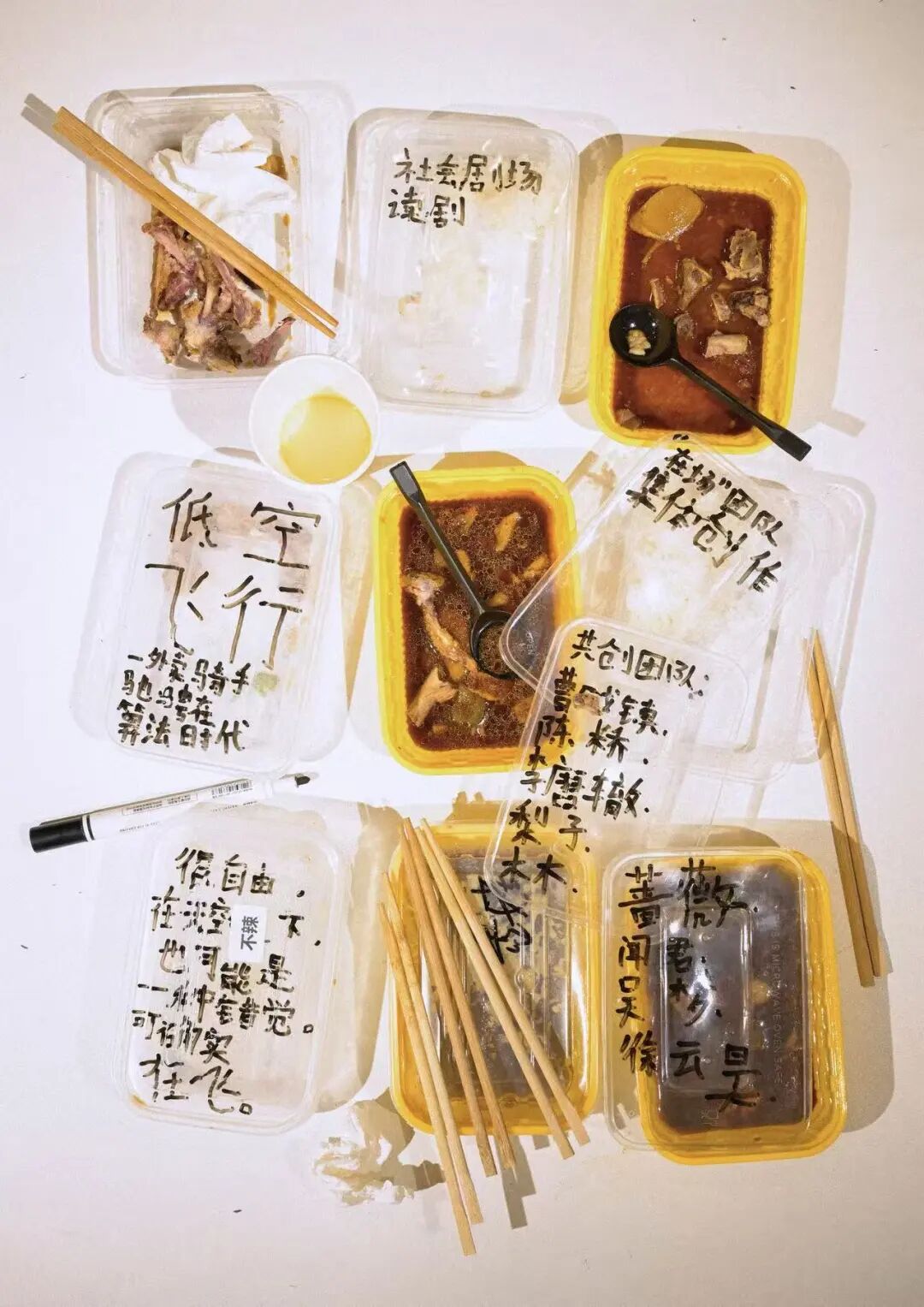
Bringing Riders on Stage: A Theatre Group’s Low Altitude Flight Experiment

“When a food delivery hovers at the low altitude of our age, we look up, ask, and no longer pretend we see nothing.”
In March this year, a young creative collective decided to bring the stories of food-delivery riders to the theatrical stage. After months of refinement, the production – entitled Low Altitude Flight – is finally set to meet its audience in late November.
In our times, food delivery and its riders are undoubtedly among the most widely discussed topics in the public sphere. Why did the “Zaichang” theatre group choose to engage with this subject through theatre? As a work of social theatre with a documentary impulse, what preparations did they make? What confusion did they encounter during the creative process? Facing the majority of urban audiences who are still ordering takeaways, how do they intend to tell the riders’ stories? Do they themselves order food delivery in everyday life? And how has theatre brought about any change in their actions?
On these questions, the troupe members held a round-table discussion, drawing on their respective life experiences and reflections on their creative practice.
– Discussion Guests –
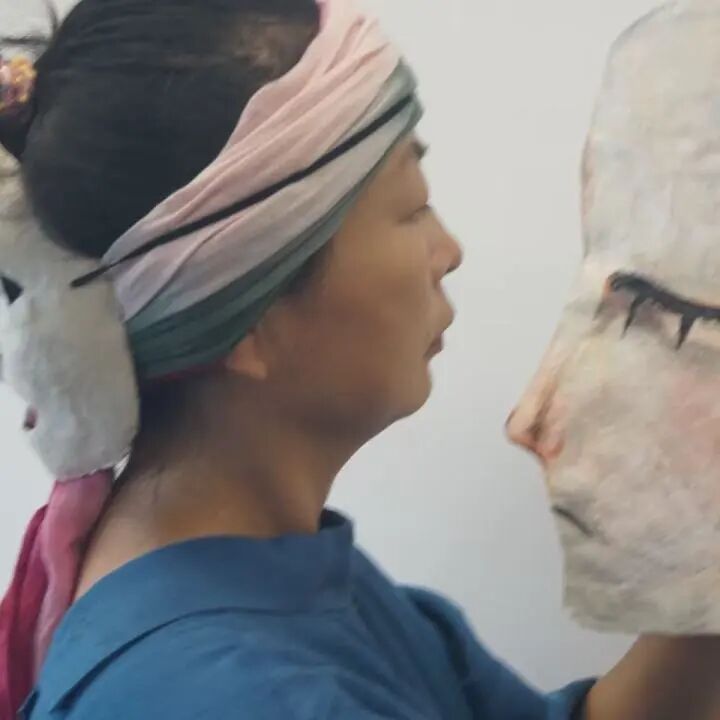
Wu Meng | Artist and theatre practitioner; core member of Caotai Ban, an independent theatre company in Shanghai. Her work spans stage direction, performance art, painting, photography, moving image, and feature-length documentary. Works include Bianxing Huayuan (Metamorphosis Garden), I Am Being Chased by Life, and The World Tumbles Through My Life.
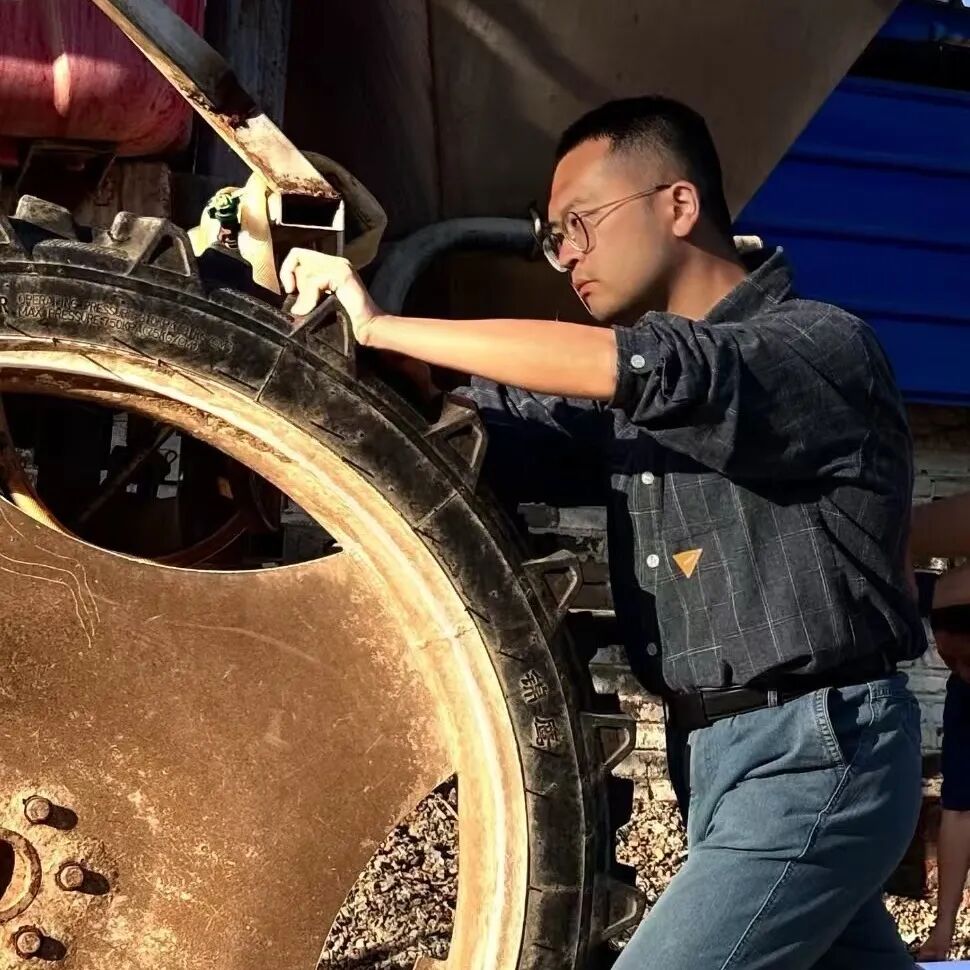
Li Tangzhe (Xiao Ta) | Educator and writer. As an activist working with delivery riders, he and fellow campaigners founded the Qishou Youhuashuo volunteer group, and have organised events and research initiatives on riders’ New Year’s Eve dinners, rider nutrition and health, and riders’ intimate relationships.
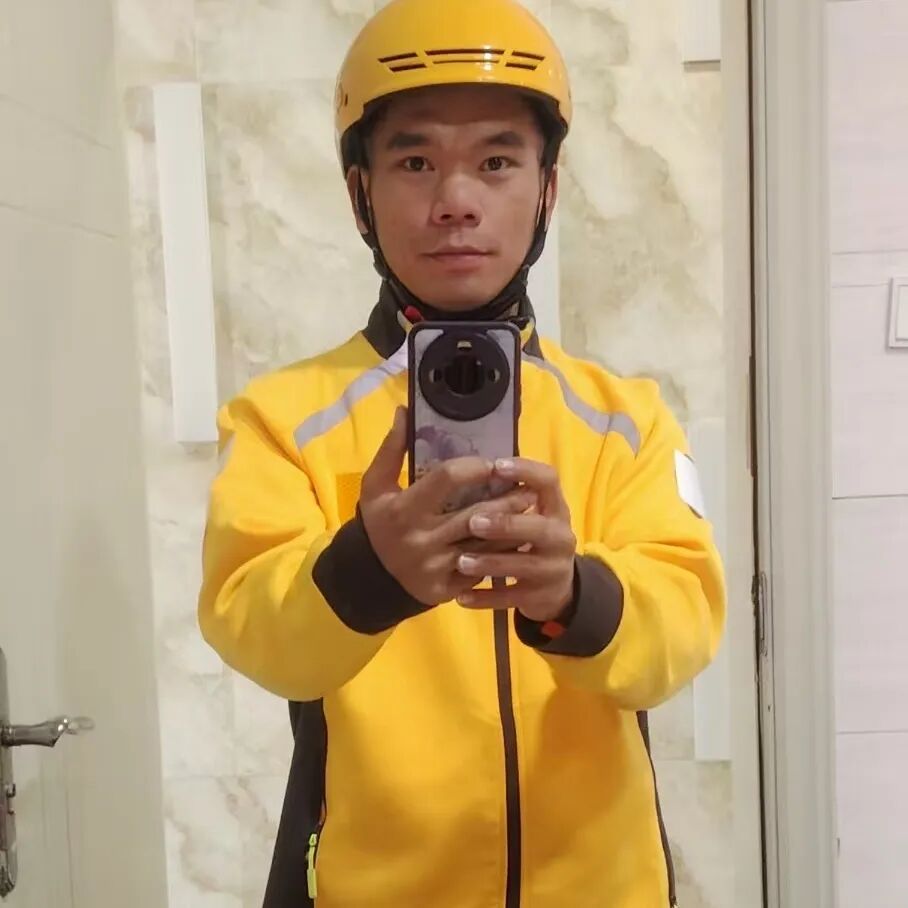
Xiao Cao | Food-delivery rider, more than five years on the road. Enjoys theatre, running, and reading.
Ju En | Party B workhorse; member of the Zaichang theatre group
Chen Qiao | For now, without an identity, and no longer wishing to carry one.
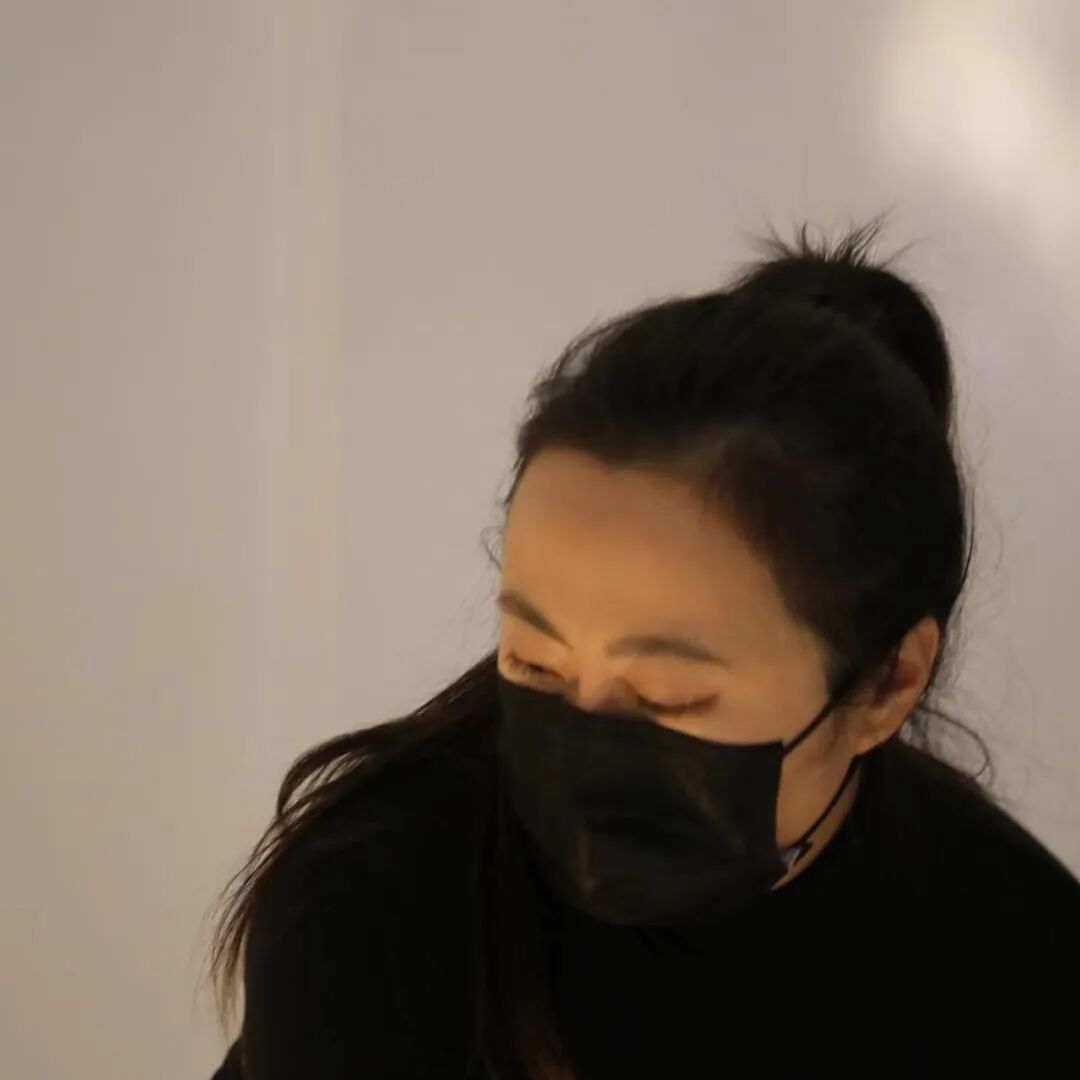
Qiangwei | Theatre practitioner and creator. Artistic practice spans performance, moving image, film, sound, and installation art, among other media.
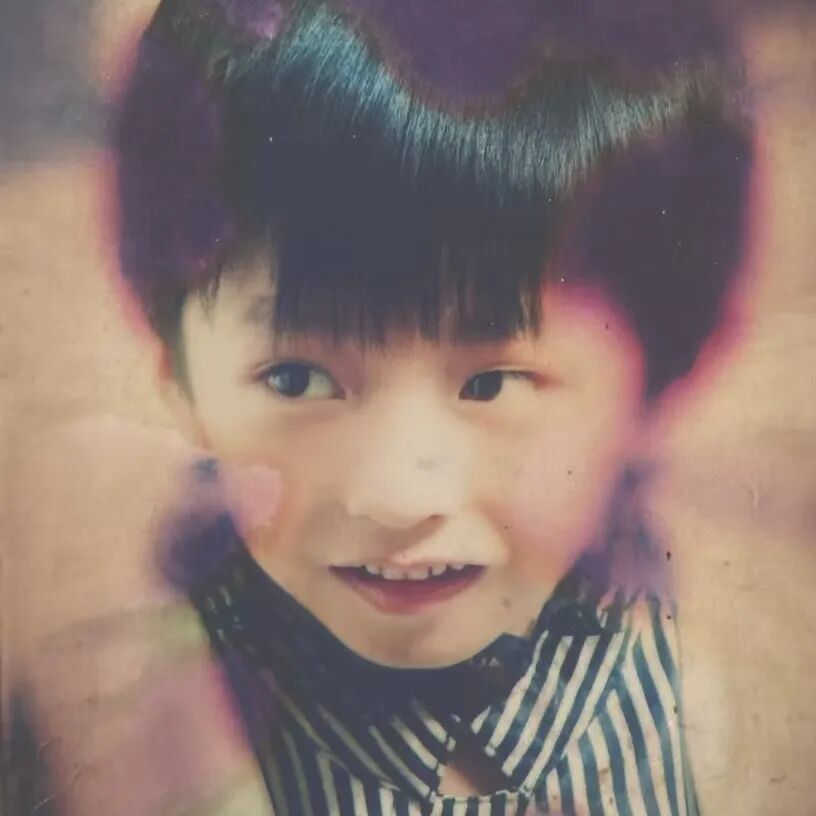
Xiao Cai | A drifter who has just descended from the mountain!
Into a Rider’s World

In our times, there are already films, television, news, documentaries, and various other art forms and media telling the stories of food-delivery riders. But on the theatrical stage, such works remain remarkably rare. What drives the “Zaichang” theatre group to create a piece about food-delivery riders?
Wu Meng: The person in our troupe who has consistently focused on riders is Xiao Ta. I got to know him around the time the pandemic was drawing to a close.
During the pandemic, the team I was part of kept creating theatre, telling many stories from that period – Clam Island, Homeland, and others. At every performance the audience wept, utterly undone; even many male audience members in their forties and fifties cried while watching, which was rarely seen in theatres before. Sometimes I truly feel it had little to do with what was being performed. What audiences needed was a public space where they could talk about their own lives, their own existence, their own small moments.
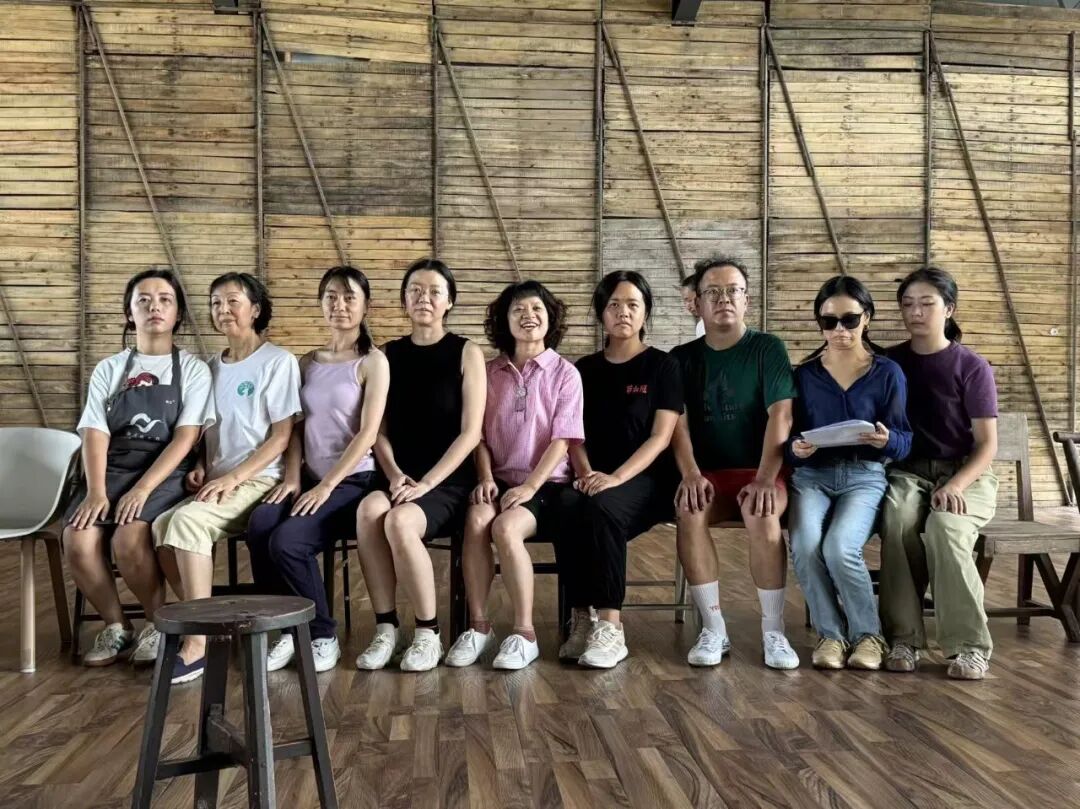
◉ Rehearsal photograph from the play Homeland.
Wu Meng: But the old creative habits – simply making the audience feel warm – seemed to be missing something. We are very close to the audience at a live show, yet we always feel very far from them. Emotionally, I could sense that the old works could no longer reach the most conflicted point of society, but why – I couldn’t put my finger on it right away.
I knew that Xiao Ta and his peers were doing things related to riders – writing articles about them, organising riders’ New Year’s Eve dinners and other events. For reasons I couldn’t quite name, I wanted to understand what they were actually doing. I didn’t know why I felt drawn to this particular area, but I simply went to meet them, talked with them, shadowed their work, joined in their filming, and in my spare time read more, immersed myself in anything rider-related. Only gradually did I unravel why I wanted to do this.
What I’m drawn to is that state of particular contraction – of both people and society – during a certain kind of moment, especially the plight of food-delivery riders under the system and the algorithm. And it is not only riders. Over these past two years, creating work alongside young friends, I’ve become increasingly aware of how work involution weighs on them. Everyone is so tired; the exhaustion is palpable. The way we allocate our time, the way we make sense of the world and of meaning – everything has changed compared to before. So I thought: let me start from riders’ labour and slowly see how young people and urban workers actually survive today.
So do you feel that the involution, the acceleration, or the subjection to algorithms that riders face resonates with the general condition of our society today?
Wu Meng: Because the social form we now live in is organised by algorithms and big data, and the job of food-delivery rider is the most directly and visibly affected by it. The link between food delivery and our way of life has grown ever tighter – the more exhausted we are, the more we order takeaway; the more we order takeaway, the more this business model monopolises our lives. Per-order pay for riders keeps falling, delivery windows keep shrinking, and society as a whole is caught in this vicious cycle.
Xiao Cai: All my classmates who graduated from junior high, vocational schools, or technical colleges have flooded into grassroots industries – security, cleaning, doorman work, food delivery. Before that I went back to the mountains to farm, because I’d simply been unable to keep going in urban labour. I wanted to explore whether it might be possible to find a balance in life’s value through self-sufficiency, through living off the land – to know what people like us, young as we are, ought to do, how we can find our place in this era. As for food-delivery riders, what I actually pay more attention to is their self-identity as young individuals.
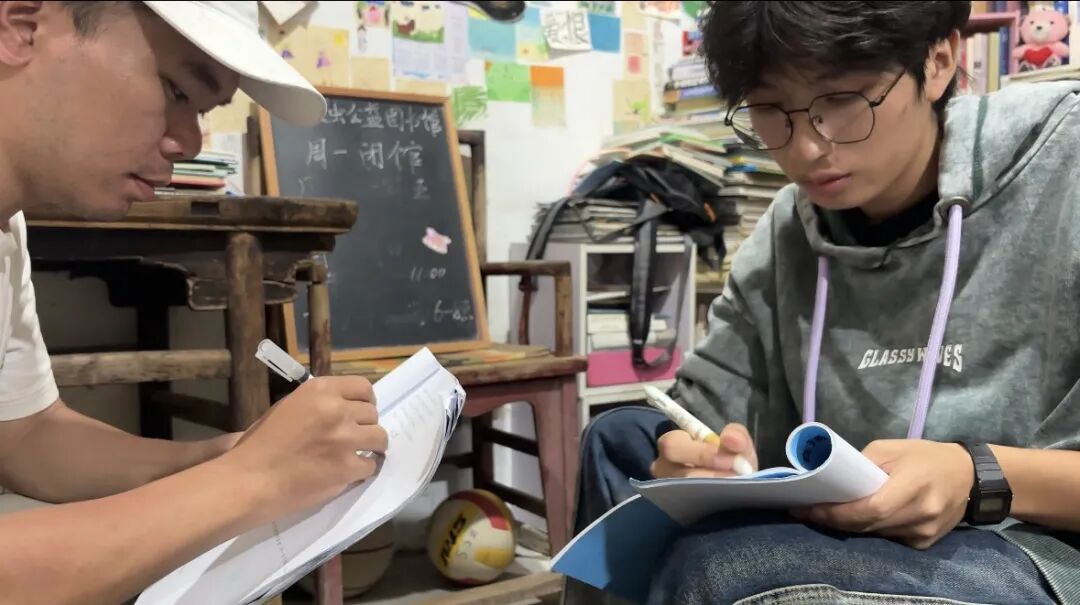
◉ Xiao Cao and Xiao Cai rehearsing in the children’s library at a rural theatre festival.
Chen Qiao: The role I play is Time. At first, when I received the script, I honestly didn’t know how to perform this role – it’s far too abstract. But as we slowly rehearse, I find myself watching everyone’s performance from the stage, and when they move closer to their characters, I can feel that they truly place themselves inside the role and say what the character wants to say. That sense of being present is genuinely extraordinary.
Qiangwei: Although our subject is food-delivery riders, each of us has our own predicaments in our own lives, and those predicaments share something in common – and each person’s predicament also overlaps with the predicament of every character on stage. Take Xiao Cao: he plays a food-delivery rider, and his actual job is also food delivery. During rehearsals, when I hear him deliver certain lines, I am moved myself. Those are lines that no amount of professional training could ever replace – they must come from a voice like his to be true.
I think often the magic of theatre lies in its ability to help you lay bare those things we struggle to put into words – whether tenderness or rage, or parts we simply cannot speak aloud. Theatre can express so many things on our behalf.
Yes – if social experience is polyphonic, then the experience of food delivery is indeed one of the most active voices in that chorus, carrying enormous energy that needs to be expressed. Wu Meng mentioned earlier that Xiao Ta has been documenting riders’ labour and daily life. Could you tell us what you first set out to focus on?
Xiao Ta: I started doing rider-related research in 2020 – things like riders’ intimate relationships, career transitions, and their nutrition and health. What we found at the time was that riders were very similar to ride-hailing drivers in that both groups had issues with excess weight and obesity. Compared to ride-hailing drivers, riders eat even more irregularly, because our mealtimes fall precisely when food-delivery riders are busiest. Very often a rider’s breakfast is just a bun grabbed from a shop, or no breakfast at all; lunch doesn’t begin until after two o’clock, and dinner typically becomes a late-night snack.
Later, during my interviews, I came to know riders’ deeper personal life histories – there are so many fascinating stories worth sharing, and that was also one of my original motivations for joining this production.
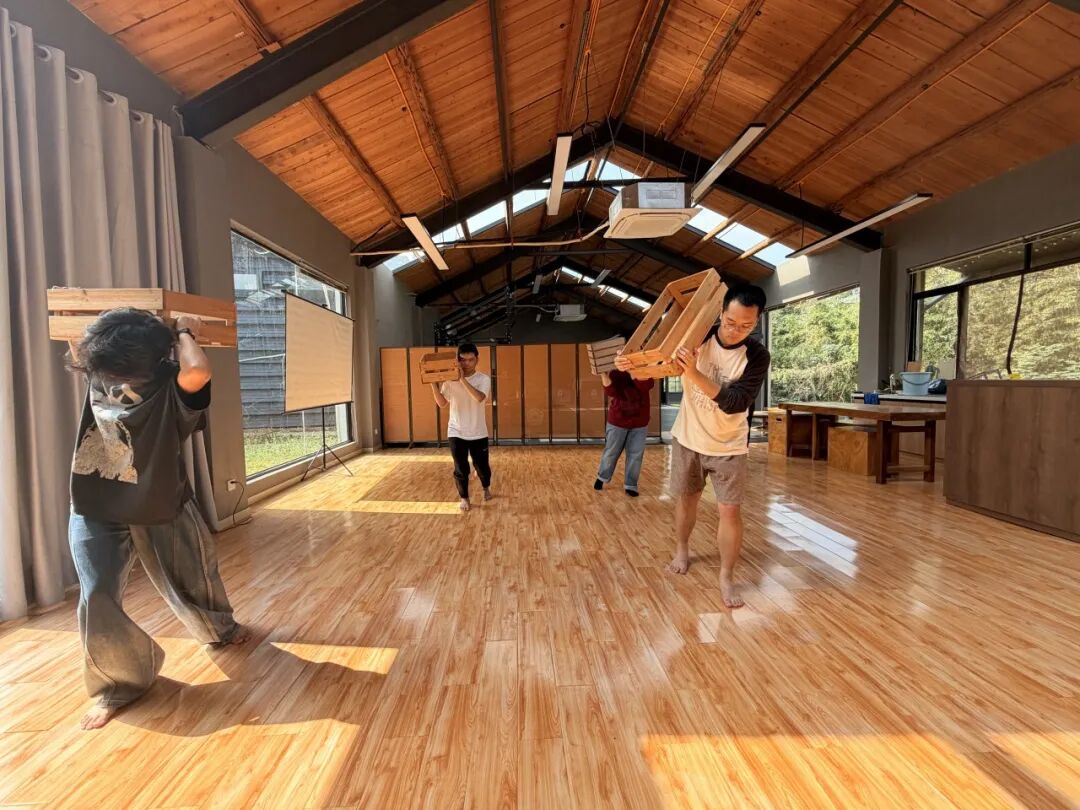
◉ Everyone rehearsing at the troupe’s space in the Fengxian countryside.
Can We Go Without Ordering Takeaway?
You have both just spoken from the perspectives of art and social observation about what first drew you to riders’ lives. So in your everyday lives, do you order takeaway? And how do you feel about the act of ordering takeaway?
Wu Meng: My daughter’s school is very far from our house, so we rented a tiny flat near it. I noticed that I order most of my takeaway in that little flat. At home, I basically never order takeaway. There’s a sense of being home, and in that setting, cooking for yourself feels like the natural thing to do. You know when to go shopping, where to buy your groceries – all of that is familiar, and life flows easily. But in the little flat, the whole person is in a state of flux. The location is rather remote, there aren’t many people around, and if it’s just one or two eating, there’s no point making anything elaborate. Sometimes I just think – order takeaway, get it done, and that’s the day sorted.
I feel that too – when you have your pots and pans, your rice, oil, and salt all in order, and you know where to get your groceries, cooking feels a little less daunting and you don’t keep reaching for the takeaway app. Does Ju En usually order takeaway?
Ju En: I’m the type who orders quite often. If I finish work at six and it takes me twenty minutes to get home – which is already much faster than for most people – arriving at half past six and starting to cook means I wouldn’t eat until seven thirty. Add washing up and tidying, and it’s eight thirty, maybe nine. By then I have no energy left – I just collapse on the sofa. And I never finish work at six anyway. But if I order takeaway in advance to the house, I can eat at half past six and have a long stretch of time all to myself. The pull of that time is enormous.
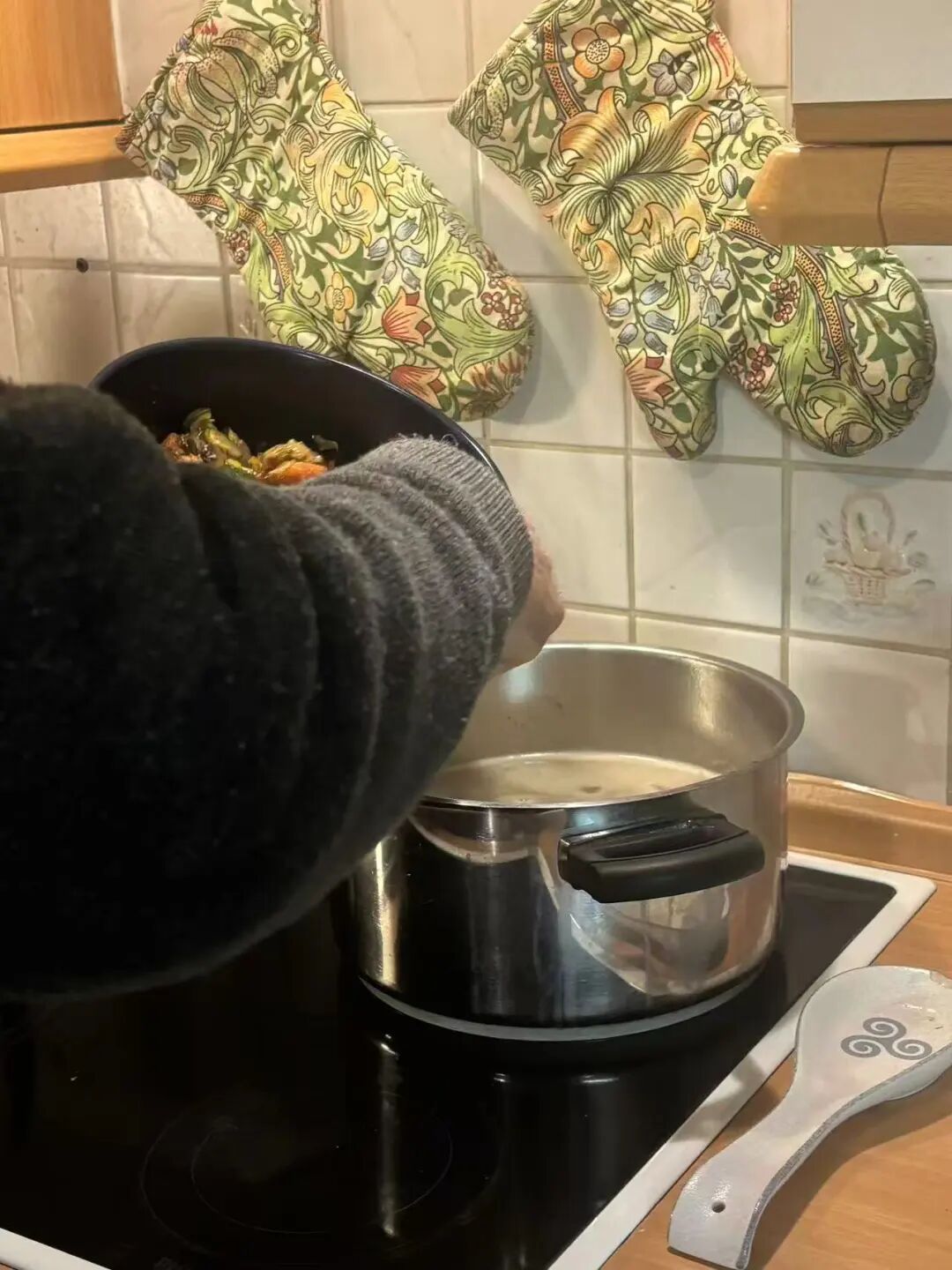
◉ Ju En cooking.
Qiangwei: People truly adapt and change as their circumstances shift. For a long stretch, I lived abroad, where there was no such cheap, convenient takeaway system. During those years I essentially broke the habit of ordering takeaway and cooked almost everything myself. A lot of things really are forced out of you.
Indeed – ordering takeaway is intimately tied to our state of life and the rhythm of our work. Does creating theatre bring any changes to your own lives?
Ju En: Before the production entered rehearsals, we had a co-learning phase where we researched and discussed a great deal. The platforms’ battle for the takeaway market – the subsidy wars between them, for instance – actually led to an oversupply of riders. Now that the tide of those subsidy wars has receded, many riders can no longer earn the high incomes they did at the start, and picking up orders has become ever harder.
I used to think that if people didn’t order takeaway, riders would have no income and lose their jobs. But now I’ve come to realise that the more dependent we become on takeaway, the stronger the platform’s grip on daily life – it pushes riders to deliver ever faster and drives sellers’ prices ever lower.
A ¥15 takeaway delivered in fifteen minutes – what kind of meal could that possibly be? Does a rider’s job actually improve as more orders come in? If a profession brings nothing but convenience while making everyone’s situation worse, does it still need to exist? The more I chase bargains by ordering takeaway, the deeper the power imbalance grows, and the food gets worse. So gradually, I stopped wanting to order takeaway.
Eating Well Starts with Theatre
Could you tell us a little about the working model of the Presence theatre group?
Wu Meng: We work collectively. Every week we meet in Qibao, Shanghai, to read scripts and co-learn together. What feels different about this collective process compared to before? The young members often feel exhausted. I grew up in that young state myself, but I wasn’t in a prolonged state of exhaustion and discomfort the way they are. They also arrive very late.
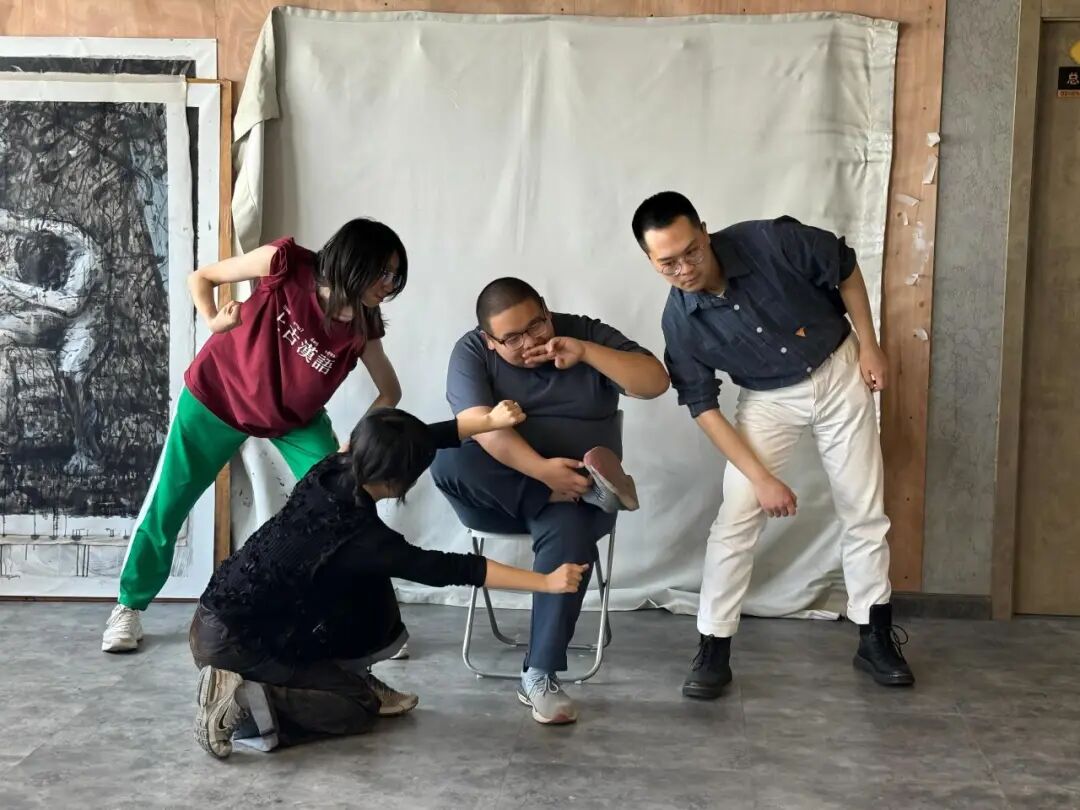
◉ Group members at a script reading in Qibao.
Among the Chinese households you’ve researched, how common is excess nutritional intake? Are there also differences along gender lines?
Wu Meng: So when we began creating together this time, I brought everyone to our farm in the Fengxian countryside. I have a small plot there – a vegetable garden, eight metres by eight. Two days each week, we gather there for intensive rehearsals. Really, it isn’t just for rehearsals – it’s also to help everyone bring their lives and their creative work more fully together.
We also cook together – everyone makes their own signature dish. My lazy version of braised pork belly is dead simple, but it comes out delicious every time. While cooking, we talk about what our parents are good at making, and the conversation naturally extends to family life. I love this state of creation. Theatre is merely a means; creation is a process; food is the medium that ties our lives together and helps us break free from the exhaustion of everyday life.
Can I take it that, as creators of theatre – whether as writers or performers – you are not in a particularly secure position when it comes to portraying riders’ working-class lives? That you yourselves also face burnout, anxiety, and the drain of internal conflict? That the troupe is itself a network of action, each person supporting the others?
Xiao Ta: Yes, I’m in full agreement with Meng Jie. Living well together, supporting one another, and potentially making a good piece of theatre – these two things are equally important. Perhaps, to some extent, it helps us resist the so-called neoliberal work ethic, the way work erodes the boundaries of personal life.
I know that feeling well – if someone has been in a state of burnout for a long time, they have no desire to disrupt their existing routine or attempt changes that will drain what little energy they have. Is there anyone in the group who’s particularly good at cooking?
Xiao Ta: Xiao Cai’s cooking is really, really good.
Xiao Cai: When I was up in the mountains, I cooked all the time – there’s no takeaway service out there! For me, cooking has simply become a habit.
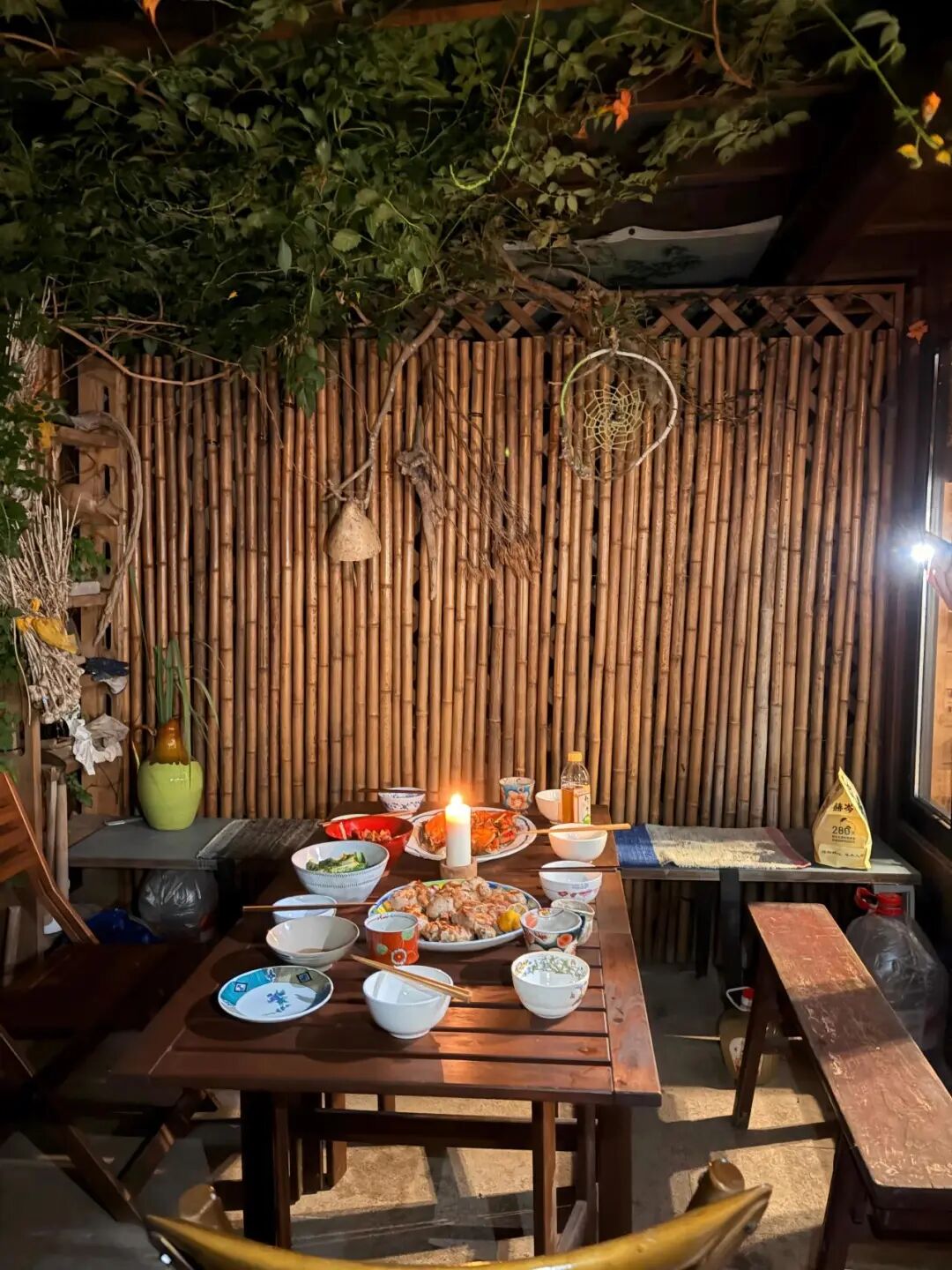
◉ The meal Xiao Cai cooked for the group.
Wu Meng: He’ll put several different types of chilli in a single dish, added at different stages of cooking – some are stir-fried first and set aside, then stirred back in at the end. It doesn’t make the dish especially hot, but it elevates the whole flavour. There’s another woman on our farm who’s a brilliant cook herself, and even she came up to ask Xiao Cai how on earth he made his dishes after tasting them.
Chen Qiao: As our director, Wu Meng really does so much for all of us. Every day she’s thinking about what to feed us, whether we’re sleeping well, how to get from the city to the farm, whether we arrive too late, whether we’re safe – all of these things weigh on her mind. I even sense a Gaia-like quality in her, the great Earth Mother. She brings us hawthorn jam made by her own mother, and I feel those small details let me glimpse the life behind her work. They move me deeply.
Do Creators Have the Right to Speak for Riders?
What uncertainties do you encounter during the creative process?
Ju En: Our very first question was: apart from Xiao Cao, none of us are riders – so what right do we have to hold a discussion about riders? That question has loomed over us from the very beginning. We need to work out what our relationship with riders actually is, and from what perspective we create. Are we essentially telling riders’ stories, or telling our own? That is a question we must address right from the start.
Chen Qiao: Some friends see the title and worry on my behalf, thinking it’s perhaps too grand. But I’ve let go of those misgivings now. If this creative process lets us care about a community, that is enough for me.
I tried being a rider myself for a few days, though every single one of my deliveries ran late. But the moment I got on an electric scooter and hit the street, I realised there were so many riders all around – it was as if my eyes had suddenly opened onto a rider’s world. Now, when I cycle along the road, I notice far more riders beside me. Once I spotted two blind riders talking to each other in sign language, and I stood there watching for ages. Just that experience seeped into me gradually, and the process itself was profoundly important – a lived experience of life.
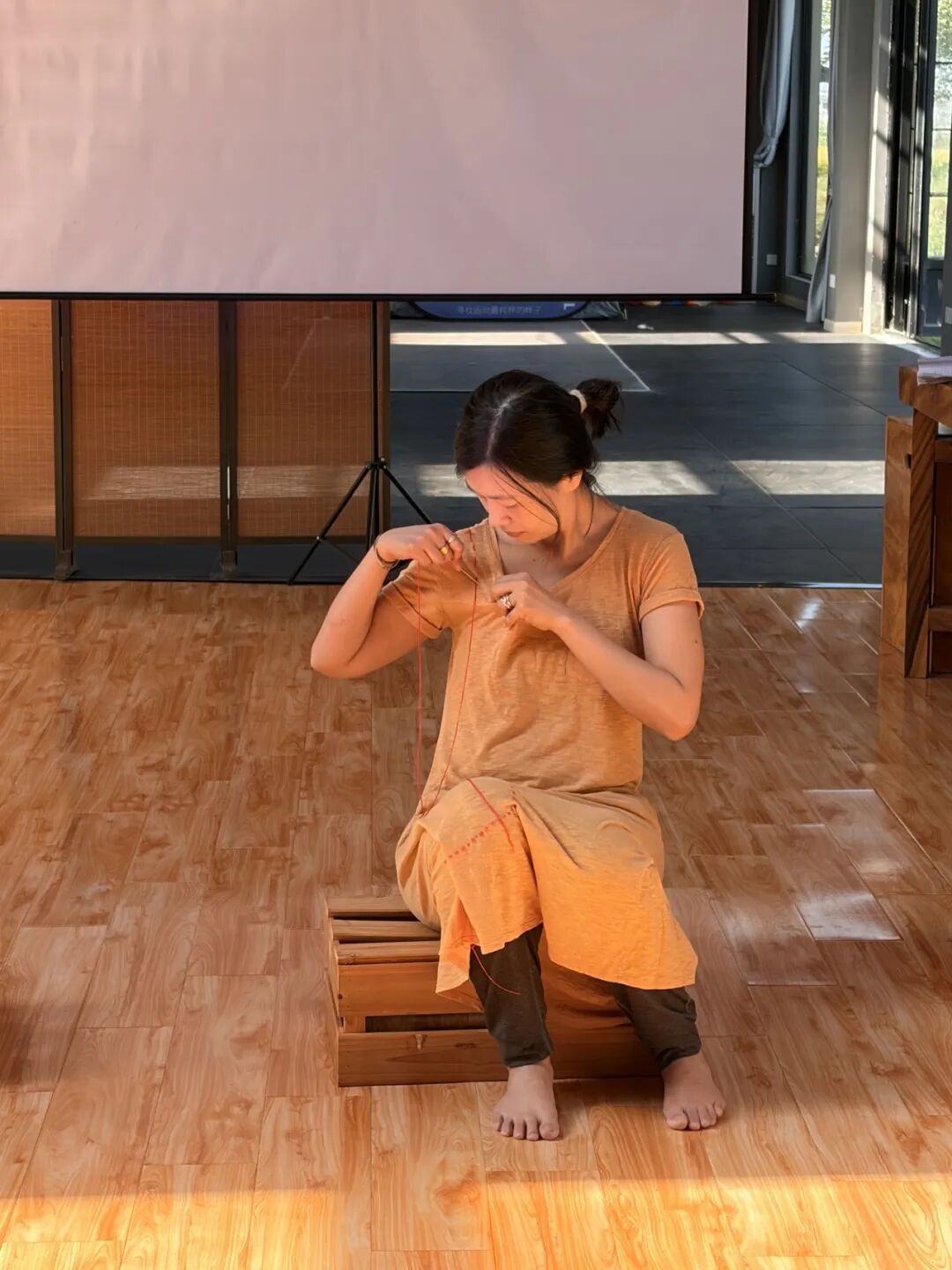
◉ Chen Qiao in rehearsal.
Chen Qiao: But once, a ride-hailing driver said something to me that really hit hard. He said: “Even if you go out delivering takeaway, unless you’re on this survival line the way we are, you won’t truly end up here.” So I feel that without a lived experience of my own, it’s hard for me to judge their situation.
I once wanted to pair up with Xiao Cao, the rider in our troupe, and go creating together – to deliver takeaway alongside him and step into his life. But I found that Xiao Cao has his own rhythms and routines, a little world spinning and orbiting on its own, a system unto itself. When I watch him perform from the sidelines, I feel that for him this job is far more complex than we imagined. Of course, there is exploitation, there is squeezing; he works gruelingly hard. But it also gives him pride, a life he can hold in his own hands.
Ju En: I think my feeling is a little different from Chen Qiao’s. Right now I believe I can fully empathise with riders – truly feel what they feel.
I’m on the contractor side of things – constantly being hammered by the client, revising documents, redrafting reports. Ride-hailing drivers and delivery riders are the contractors providing services to me. The world is one big cycle, and everyone is suffering. In terms of income, working hours, and mobility, the people inside the office buildings and the people outside are actually the same.
On the other hand, take flexible employment – I’m on an outsourced contract myself right now. We’re a foreign-invested company, and they say the overseas headquarters approve too few permanent positions each year, so first they place you with an outsourcing firm, promising you’ll be converted to staff after the probation period. Our line of work is exhausting too – over ten hours a day is the baseline, and the client can summon you at any time.
It’s so exhausting that turnover is enormous, and those who can’t bear it get filtered out. So the whole point of outsourcing is to screen for hardy, overworked labourers willing to juggle multiple roles – companies get half a year of high-intensity output without paying severance or benefits. Outsourced white-collar workers are no different from crowdsourced delivery riders. As more and more people look for work and the floor keeps dropping lower, companies don’t even consider terms and conditions anymore.
Did you only begin to reflect back on the nature of your own work after getting involved in the riders’ theatre project?
Ju En: Because if we want to discuss riders’ situation, we have to see ourselves honestly. Wu Meng mentioned that burnout runs very deep among us. I used to think it was a personal shortcoming of mine, but now I see it differently: we are workers who objectively invest enormous amounts of time, yet receive none of the compensation we deserve. And that sense of exhaustion just grows stronger.
I even went through Meituan’s financial reports year after year, calculating what it would cost if Meituan paid social insurance contributions for its riders, and what proportion of revenue that would represent. I wanted to know: if a company is clearly profitable, could it possibly become a conscientious takeaway business? But as we crunched the numbers, we came to realise it isn’t a question of lies versus truth – it’s a question of who holds the voice and who holds the power.
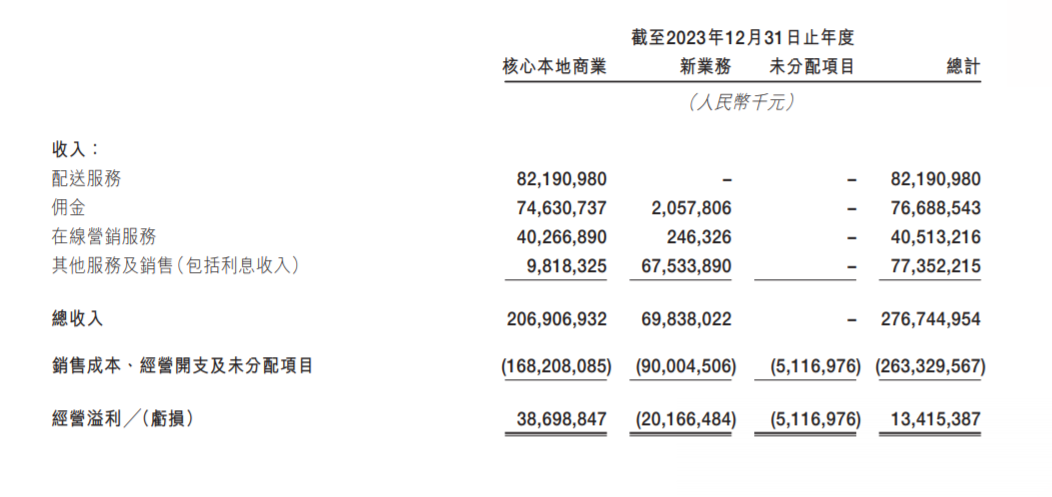
◉ Meituan’s annual revenue, costs, and profitability across its business segments for one fiscal year. Source: screenshot from Meituan’s 2023 Annual Report.
Southern Weekly once ran a report doing this kind of arithmetic: if Meituan paid social insurance contributions for 1.2 million riders, it would incur an additional cost of ¥21.6 billion. But when we read Meituan’s annual reports closely, we found that a large share of overall profits was channelled into investing in new business segments, aimed at further market expansion. On top of that, R&D on new technologies such as drones and autonomous delivery vehicles burned through enormous sums – in 2024, Meituan’s R&D spending reached ¥21.1 billion.
Ju En: For them, anything they think will help corporate growth, they’re happy to invest in – even if it might go entirely at a loss. Those projects are actually hugely overpriced. But that same money, in the hands of workers, is solid, hard cash. Yet whether or not you pay riders, they’ll still work for you, so there’s no need. And they’re unwilling to pay social insurance either.
Xiao Cao: The maths is simple enough for us. Per-order rates have dropped noticeably from before. In Shanghai now, the minimum is around ¥4 per order – it used to be ¥7 or ¥8. Just think how much they’ve cut it. Even if they do introduce social insurance and the platform agrees to cover part of it, most riders are still on the fence.
Wu Meng: Let me add something – we really owe Xiao Cao a debt of gratitude. Since the project began back in March, he’s attended every single one of our activities, from rehearsals to performances, and the most recent rehearsal cycle alone stretched past twenty working days. I know in his heart he feels it’s gone on too long. I was wondering whether we could offer him some compensation – by my calculation Xiao Cao earns over ¥300 a day, so could we make up ¥200 daily? But what I didn’t anticipate was that this isn’t just about money. Because Xiao Cao is a crowdsourced delivery rider – his working hours are tied to his dispatch volume and his income, all determined by the platform’s algorithm. So the loss he suffers is impossible to quantify.
So in the process of creating theatre, you’ve ended up touching the very real problem of algorithms. It’s the same for ride-hailing drivers – if you don’t drive enough hours, the platform either cuts your dispatches or feeds you poor-quality orders.
Should There Be Hope?
Ju En: The other question sparked an even bigger debate – whether to include hope. Because our work is built on real, found material, we eventually realised that when it comes to structural problems, there is nothing we can do about them. You get this sense of futility.
Some feel that even if reality doesn’t offer much hope, shouldn’t we still give the audience a glimmer? A piece of work needs to hand people something they can grip; it can’t just have everyone watching it, weeping, saying “how awful,” and that’s the end of it. But others feel that stopping right at the point of cruelty carries more tension.
Wu Meng: I was chatting with Chen Qiao during rehearsal about the character Time, and I shared my own feelings with her. When you face a problem that massive – a systemic problem – as individuals, or as a small team like ours, there simply isn’t anything we can do to address any of it. So what do you do? I hope the character Time can dig deep enough to take a proper look at the period we’re living through.
There have actually been quite a few films and reports about takeaway delivery in recent years – starting with Renwu Magazine’s 2020 report, and Foodthink has since observed a series of films, including Xu Zheng’s Against the Flow and another film called Another Day Full of Hope. Could you talk about what information or feeling you most want your work to convey to its audience?
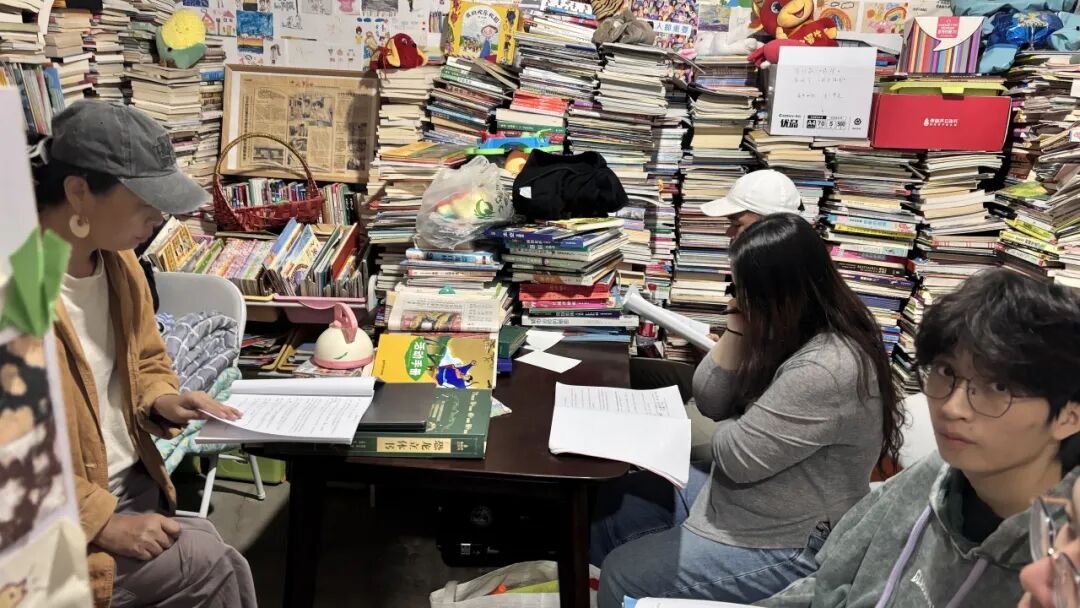
◉ The company learning together in a co-learning session.
Ju En: I think what we must not do is impose our will on another community, and we need to guard against self-pity, against getting lost in our own emotions and talking only to ourselves, and against narcissism – the sense that because you’ve touched a social issue, you must be doing something terribly meaningful. Personally, I don’t think theatre can change other people all that much. Its power is very faint, and the audiences in small-venue theatres are tiny. All we can do is explore sincerely.
The content of this piece comes from real materials the company discovered while exploring a question. The pain, the anxiety, the language itself – all of it is genuinely real language, not some imagined overlay forced onto the subject. But it isn’t just a collage of materials, either; Wu Meng did a great deal of work reconnecting all these fragments so they resonate with one another.
Wu Meng: We’re really creating in the mode of documentary theatre, so the characters are essentially composites drawn from the real lives of our participants, or several of our participants. A lot of the stories come from the people we interviewed – I’d say the level of truthfulness is basically 95 per cent or higher.
Actually, as we interviewed riders one by one, it suddenly struck me that while we were observing their lives, they were observing us too. It’s a process of mutual looking. Because they can actually access the capillaries of this city, Shanghai, far better than most people.
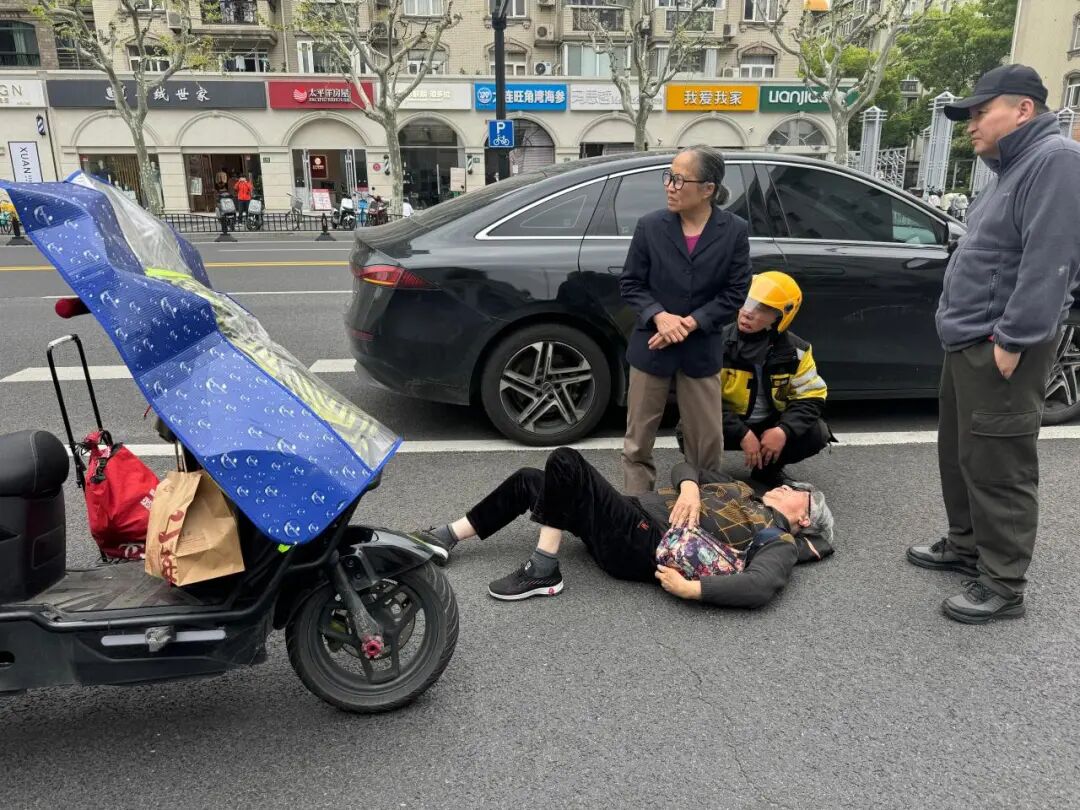
◉ One of the company’s interview subjects, involved in a traffic accident on a street in Shanghai.
As someone who works and lives in a big city, I really want to see how this piece presents the rhythm of urban life from the riders’ perspective – I’d love to look at the place I live from a different angle.
Wu Meng: This time I think we touched on that aspect a little, but not extensively. There are reasons for that on various fronts, but since we want to follow this topic long-term, we’ll keep trying. So whether it’s hope or despair, we’ll slowly work our way towards realising these ideas.
Last week, during our last full-run-through rehearsal, I was genuinely moved by Xiao Cao. He’s usually completely unmoved, no fluctuation in emotion at all, and what he said on stage that day was something we deliberately poked him to bring out. We know that’s not right, but we still wanted to nudge him – so seeing him say those words up there on stage, I was truly touched. I’m actually quite confident about where the play stands now. We still have some time until mid-November, everyone in the company is working hard, and there are ten more rehearsals to go. I think we can make this play work.
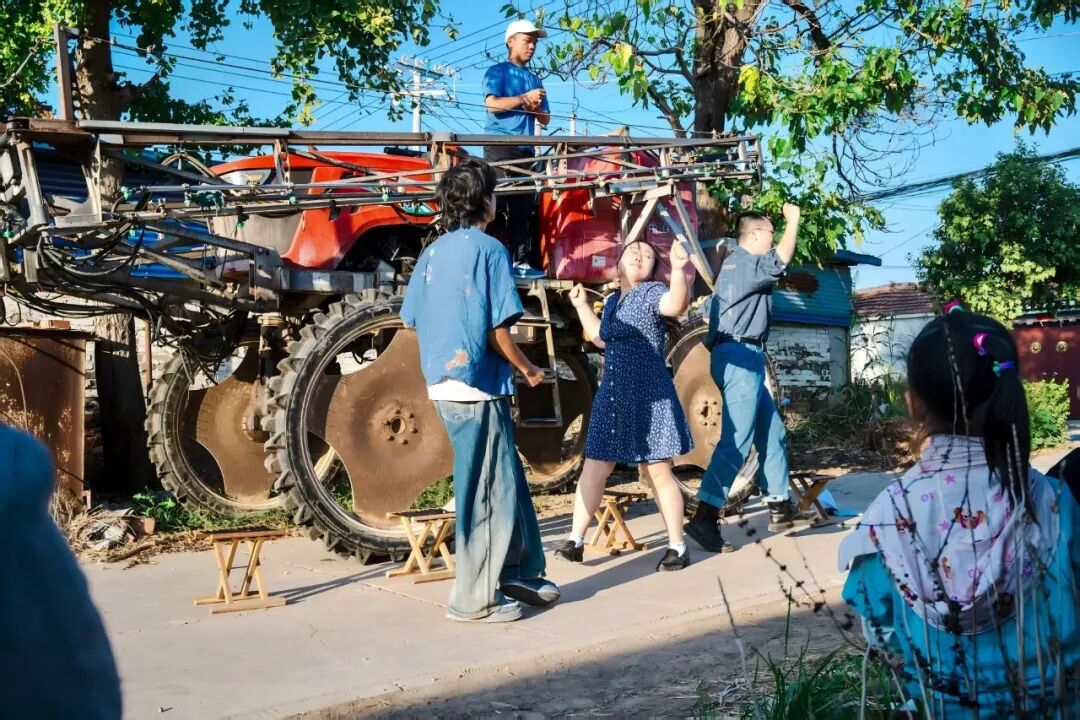
◉ At a rural theatre festival in Weifang.
– Performance –
Low Altitude Flight
– Collective Creators, Zaichang (On the Scene) –
Cao Chengzhen, Chen Qiao, Cui Rui, Ke Yi, Li Tangzhe, Lizi, Mu Mu, Qiangwei, Qiushuang, Ju En, Wu Meng, Xu Yunhao, Zhao Tianle
– Music –
Xia Jie’s album Renting a Room for Love
– Original Support –
Huoli Ke Sports City, Letian Family Farm, Caotai Ban
– Partners –
Foodthink
*The play will meet its audience for the first time in Shanghai in mid-November. For performance details, please watch for upcoming posts from Foodthink.
– This is Foodthink’s 853rd original article –
– About Zaichang (On the Scene) –
Scroll down to read
Zaichang (On the Scene) is a theatre group – or it can be more than just a theatre group; if it can, we hope it becomes a starting point for action. When a takeaway parcel hovers in the low altitude of the era, we look up, we ask, and we stop pretending we can’t see a thing.
The group’s membership is cross-disciplinary: riders and workers sit alongside writers who do social research and young anthropologists. This means the creation of Low Altitude Flight doesn’t rely solely on stage experience but is rooted in fieldwork, interviews, and sustained social observation. Here, theatre is not just performance – it is a site for research, documentation, and action.
Low Altitude Flight is the phase result of a long-term project – a documentary theatre project initiated by Wu Meng and Li Tangzhe.
From March 2026, the project launched an initial three-month period of co-learning. During this co-learning phase, a series of talks and theatre workshops were organised, including: The Riders Are Here at the Caotai Ban Cultural Station; The Long Transition: What Are Today’s Work Problems?, speaker: Hannah (scholar); The Business Model of Meituan’s Platform Economy and the Sociotechnical Questions of Platform Algorithms, speaker: Zheng Yuyang (MA, Peking University); Convenience: One of Capitalism’s Core Values, speaker: Christopher Connery (University of California professor);
Screening of the documentary theatre piece World Factory, speakers: Zhao Chuan and Wu Meng (theatre directors); A Brief History of AI: From Early Artificial Intelligence to Large Language Model Agents (LLM Agent), speaker: He Tiancheng (AI industry professional); Riders’ Chat, speakers: Yu Wenjin, Cao Chengzhen, Chen Zibo, and others.
Main participants in the co-learning phase included: Aisha, Cao Chengzhen, Chen Qiao, Gu Suyong, Ke Yi, Li Tangzhe, Qiushuang, Ren Yanqi, Ju En, Wu Meng, Xiao Yu, Xu Yunhao, Zhao Chuan, Zhao Tianle, and more than twenty online participants. The co-learning also encompassed a series of interviews with riders. Interviewers included: Cao Chengzhen, Chen Chen, Jiang Yunyi, Li Tangzhe, Liz, Shen Meng, Xia Jie, Xia Pingchang, Xiao Chen, and others.
Our sincere thanks go to every participant and every interviewee.
Unless otherwise noted, all images are provided by the Zaichang (On the Scene) theatre group.
Editor: Yuyang
Layout: Xiaocun
Scan the QR code to tip and support original Foodthink content
▼

▼
Click an image to read related articles
▼
Click a keyword to browse more article collections
Seeds | Agronomy | Policy | Fermentation | Nutrition | Fruits | Fisheries | Takeaway | Events | Careers | Markets | Livestock | Food Talk | Talks | Book Clubs | Harvest Festival | Smallholder Stories | Climate Change | Rural Development | Cooperative Economy | Urban Farming | Food Safety | Biodiversity | Pandemics and Food | False Solutions | Agroecology Internship Programme
Beijing | Hebei | Shanghai | Guangdong | Guangxi | Yunnan | Henan | Sichuan | Jiangxi | Xinjiang | Shaanxi | Hong Kong | Chongqing | Zhejiang | Jiangsu | Guizhou | Taiwan | Inner Mongolia | Philippines | Canada | Russia | Mexico | Italy | United States | United Kingdom | Germany | Netherlands | Thailand | Sweden | Japan