You Come to Yunnan to Eat Mushrooms – Yunnan People Search the Whole Country for Mushrooms

Editor’s Note
People love eating Yunnan’s wild mushrooms, but more and more out-of-province mushrooms are being swept into the label ‘Yunnan wild fungi.’ Our author, Li Ruijun – nicknamed Junjun, convener of the Slow Foraging Network – has found that climate change–driven declines in Yunnan’s wild mushroom yields are pushing ever more traders to source mushrooms from other provinces, bring them to Kunming, and sell them at five times their origin price. A supply chain of wild foraging and cross-regional sourcing is stretching further and further afield.
What does this mean for consumers, on the one hand, and for the growing regions, on the other?
An Old Kunming Local Buys Out-of-Province Mushrooms
My laodie – the Yunnan dialect word for grandfather – is seventy-six and hasn’t been out mushroom foraging in two years.
This summer in Kunming it rained and rained, only clearing up after the Start of Autumn. Once the sun had shone for two days, I told him to go and pick some mushrooms. He waved his hand. ‘No – I won’t find any.’ That afternoon, he went to Mushuihua Market and spent his own money “picking” two bags of “local” green russula. Mushuihua Market is the largest wild mushroom trading hub in the country, handling ninety per cent of all wild mushroom transactions in Yunnan and seventy per cent nationally. You can find virtually every common edible wild mushroom in Yunnan right there.
But the market is a treacherous place. I told the old man time and again not to go to Mushuihua – if you don’t know how to pick, you’ll never get good mushrooms. He went anyway. It wasn’t until after two stir-fries that he smacked his lips and said, ‘These mushrooms – they’ve got no mushroom flavour this year!’
I found it hard to explain. ‘Those green russula probably aren’t local,’ I said.
My laodie, a bona fide “old Kunming” through and through, was flabbergasted: ‘Where on earth could you get green russula outside Yunnan?’
But in my two years in this industry, out-of-province green russula really are quite plentiful.
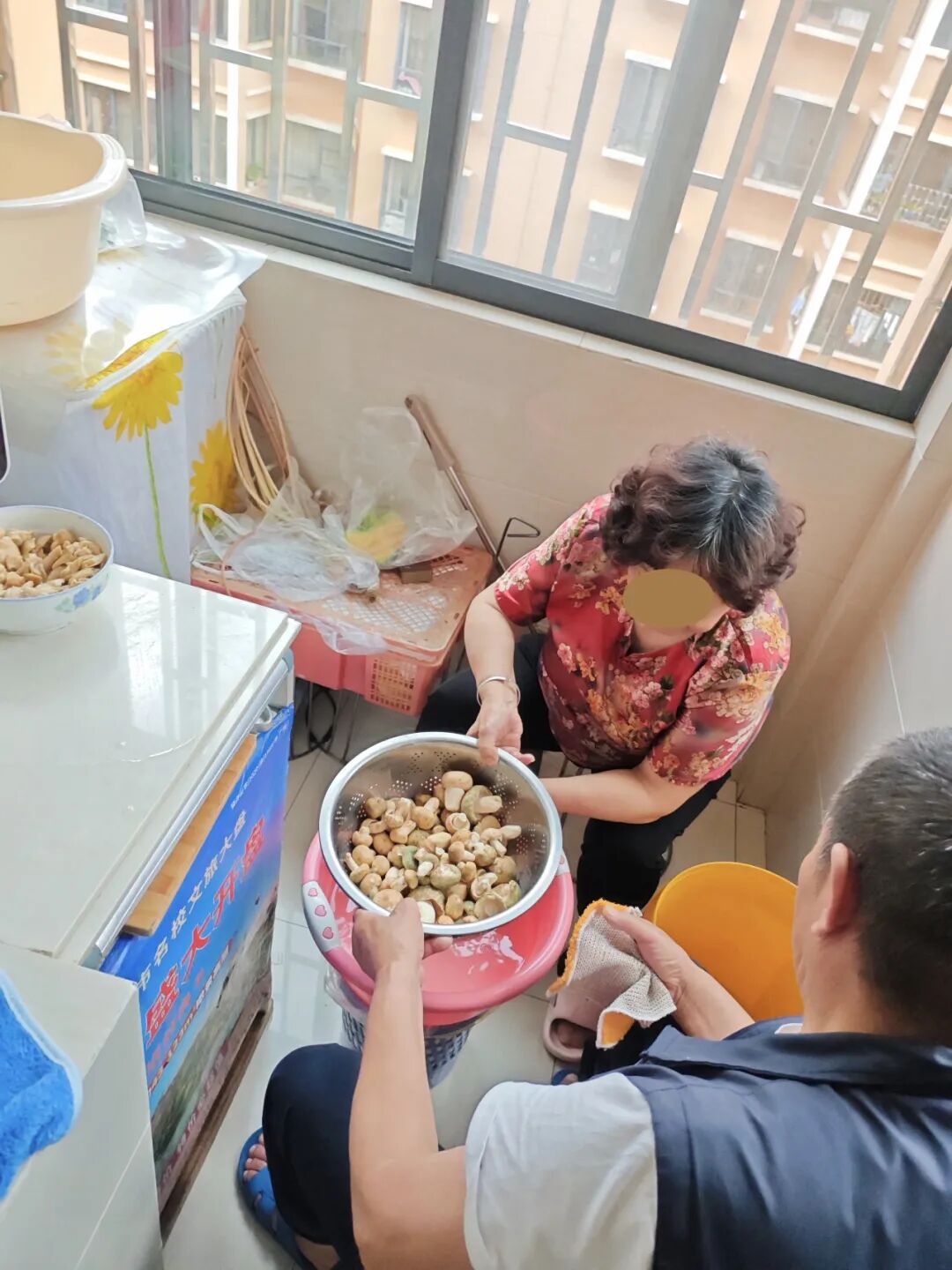
◉ Green russula bought by my laodie.
Green russula, boletes, and matsutake (Tricholoma matsutake) from Sichuan, Guizhou, Hunan, Hubei, and even further afield are all being shipped into Yunnan. There is even a saying circulating in the trade: ‘Out-of-province mushrooms hold up more than half of Mushuihua’s business.’
First Encounter with Out-of-Province Mushrooms
I go by Junjun. In 2020, a thesis project led me – as if by accident – into the wild mushroom trade, and into Kunming’s Mushuihua Market, a place where ‘the mushrooms are wild, and the people even wilder.’
In July 2024, on a chance visit, I saw green russula from Hubei for the very first time.
It was the pre-dawn hours at Mushuihua, and the market was brighter than daylight. Overhead lights blazed down as everyone circled through the piles of mushrooms – rummaging, haggling, hauling – waiting for the right moment to snag a good batch. Around that time, a hefty “Matsutake King” over 15 cm long had emerged in Jianchuan, Dali, sending ripples through the trade. I tracked down the origin wholesale merchant who had posted the ‘King’s’ unearthing in their WeChat Moments, followed the trail, and headed overnight to the Mushuihua wild mushroom trading hub for a stakeout.
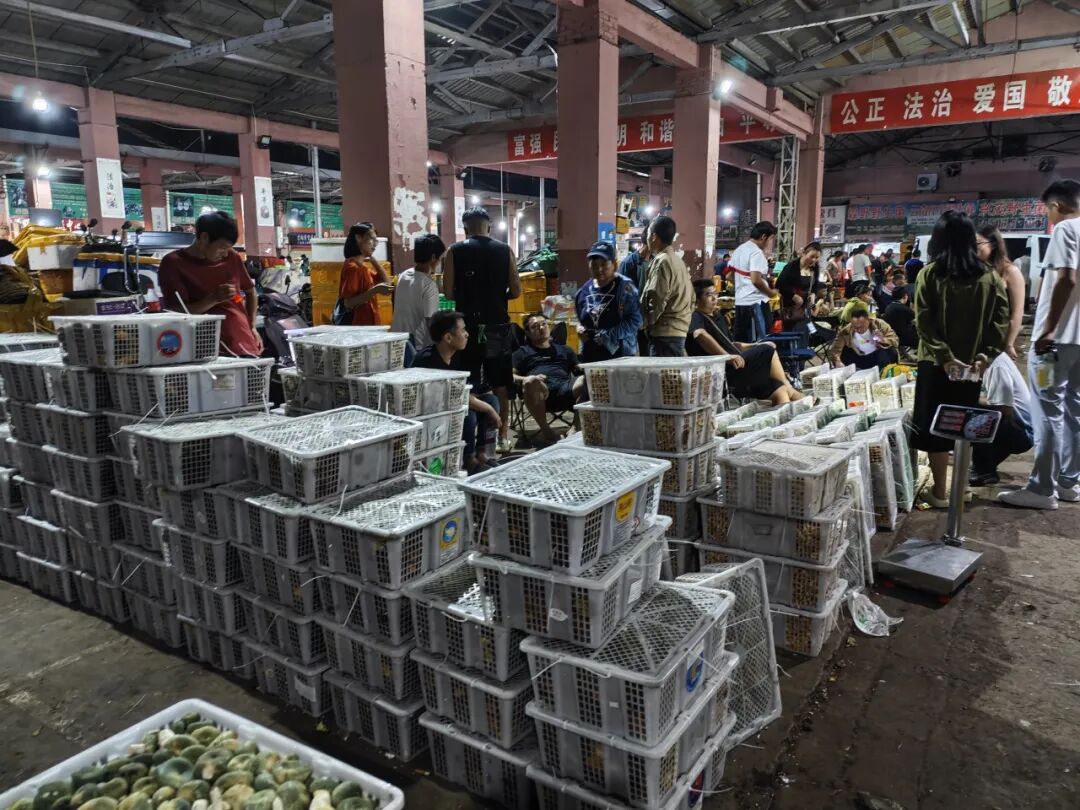
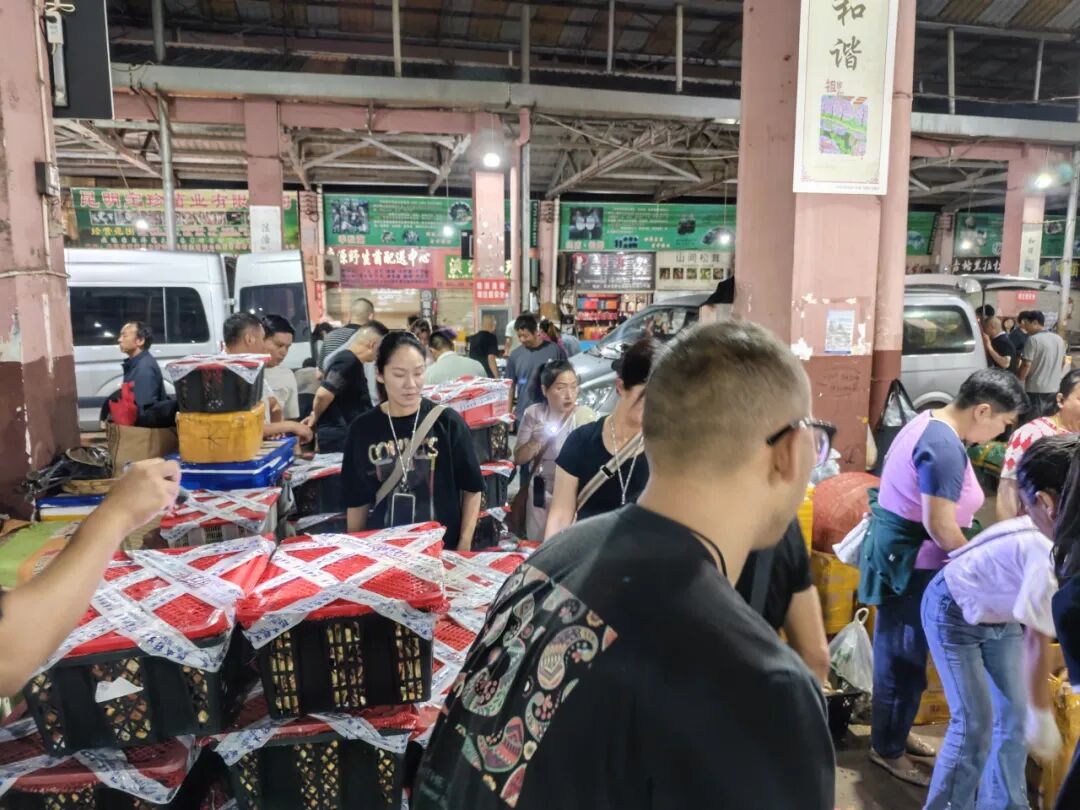
◉ The market at nearly three in the morning is still teeming with people, torches in hand, checking mushrooms.
The “King” had been bought by the niece of a Dali wholesaler. She was about my age and had been in the trade for ten years; I called her Ling-zong. Three generations of her family were in mushrooms – origin, wholesale, retail, processing – with every basic operation handled by family. Her aunt held court at the stall, where towering stacks of unsorted batch were piled up, waiting for her uncle to escort the “Matsutake King” all the way from Dali into position. The buyers who came to the stall were all regulars – just a quick sweep of the torch over the top and sides of the baskets, a nod, and the mushrooms were whisked away. Her aunt, meanwhile, made a couple of marks in a well-thumbed little notebook – species, name, quantity – then settled back on her little stool to keep holding the fort.
I’d been sitting diagonally opposite the aunt’s stall, trimming the stem bases off two baskets of black boletes. Utterly bored, running out of steam, I made my excuses and headed off to the loo.
The toilets were in a corner of the market, at the dead end where the vehicle lanes converged. It was nearly three in the morning. On a normal night, vans would unload in the lanes, stopping briefly and moving on; even with goods piled up, you wouldn’t notice the lane was tight. But if a refrigerated truck pulled in and a few little hand carts were parked alongside, then I’d want to know who was so lacking in spatial awareness to be blocking the passage.
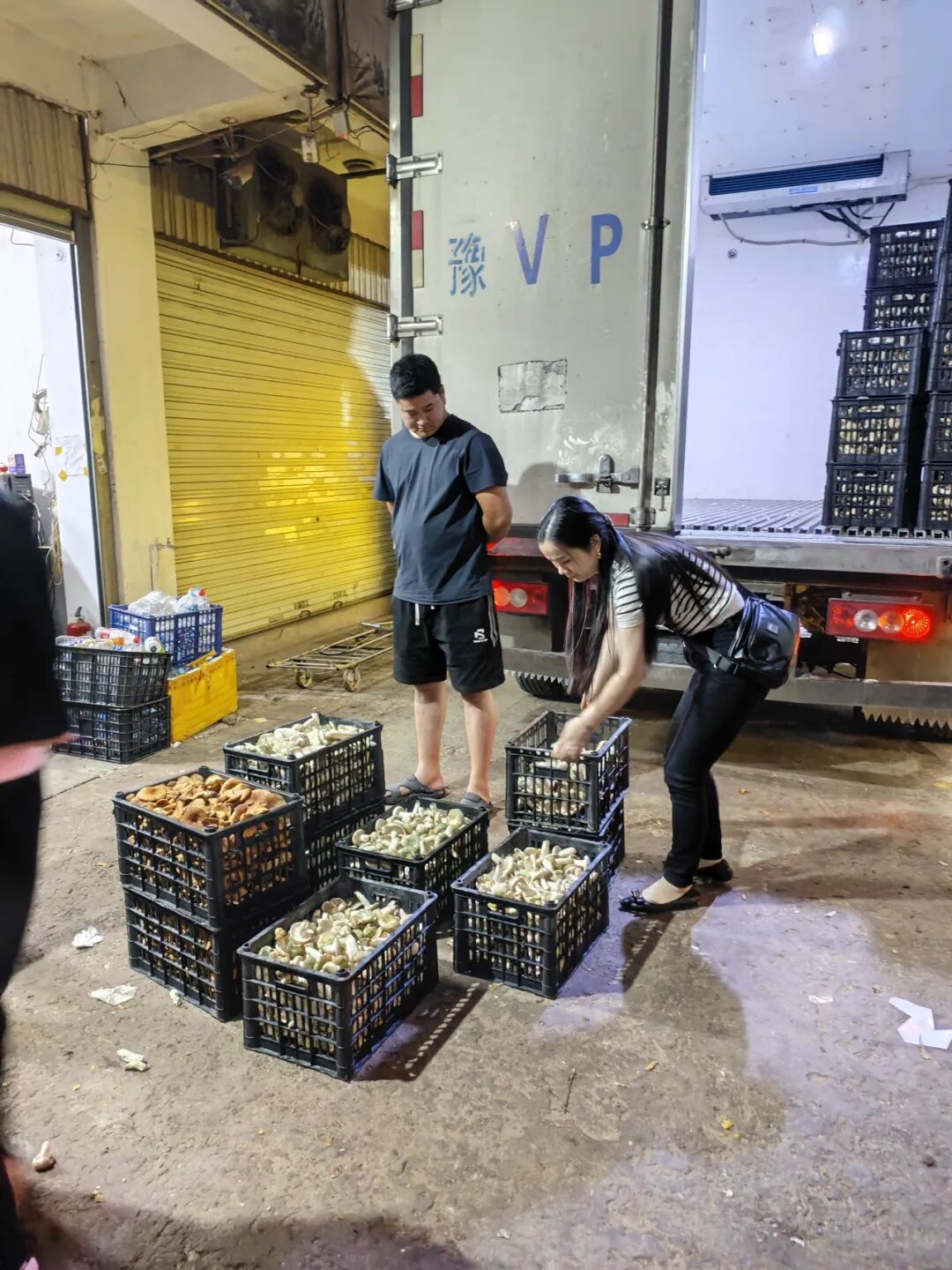
◉ Green russula and milky russula from Hubei, transported in by a truck with a Zhengzhou licence plate.
This is where I spotted it: a vehicle with a Yu (Henan) plate had pulled in, unloading basket after basket of green russula and milky russula. I sidled up to watch, asking in the local dialect where the goods were from. ‘Hubei,’ the female stallholder replied – her accent was Yunnan, so she must have been the buyer taking delivery. That was the first time I ever knew Hubei had green russula. The pile was neatly stacked, the top layer looking fresh and clean – pale green caps, long, slender white stems. I couldn’t say what felt off, but something was jarring. The goods came from strangers, so I resisted my habit of picking up mushrooms to examine them and simply took a photo.
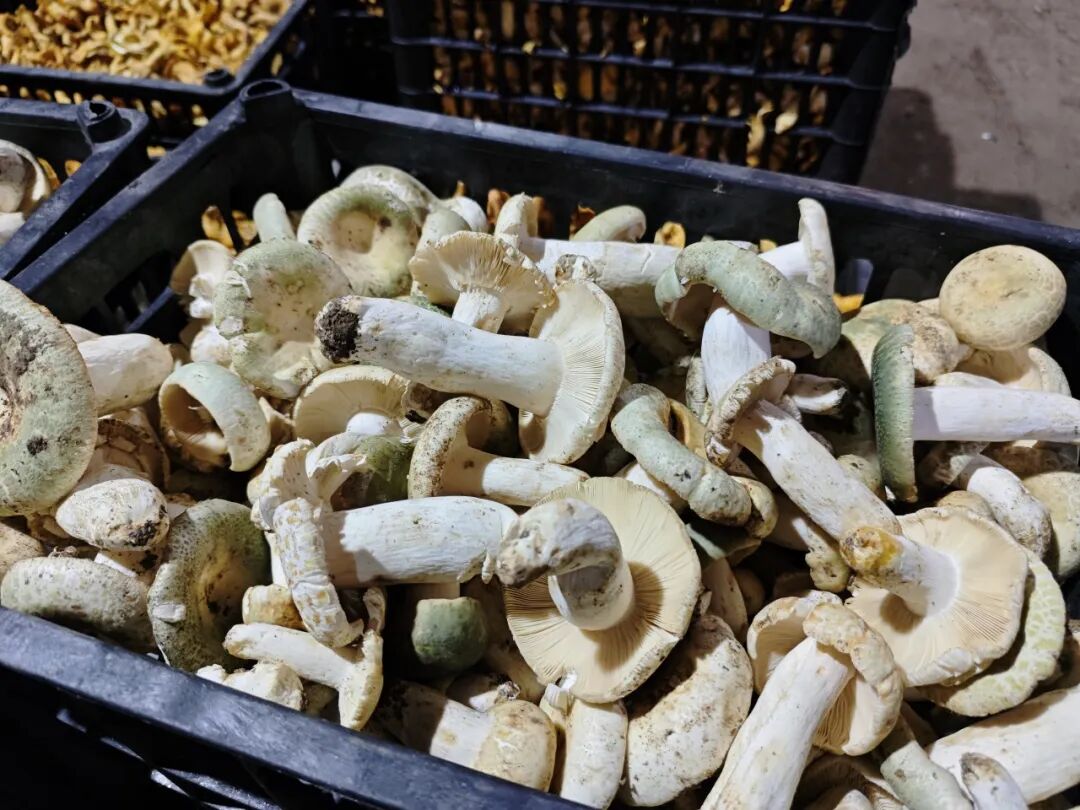
◉ Out-of-province green russula. Photo: Junjun
Back at the stall, little Ling mentioned that her uncle had already put the Matsutake King on the plane… In the end, I only caught sight of that Matsutake King in a food influencer’s vlog – sliced into sashimi, delivering its final moment of glory in a Black Pearl–rated restaurant.
I never expected those Hubei mushrooms, glimpsed by chance, would become the thread running through my two years of watching this trade.
Under the Rain, Yunnan’s Mushrooms Won’t Come
Back to that bag of green russula my laodie brought home – it had that same familiar jarring quality. The “local green russula” in old Kunming parlance comes from central and north-eastern Yunnan. These growing areas are dominated by mixed conifer–broadleaf forest, with soils mostly red lateritic earth. Green russula found by locals typically have short, stout stems; the stem bases are caked with red soil, and even after washing, traces of reddish-yellow mud remain.
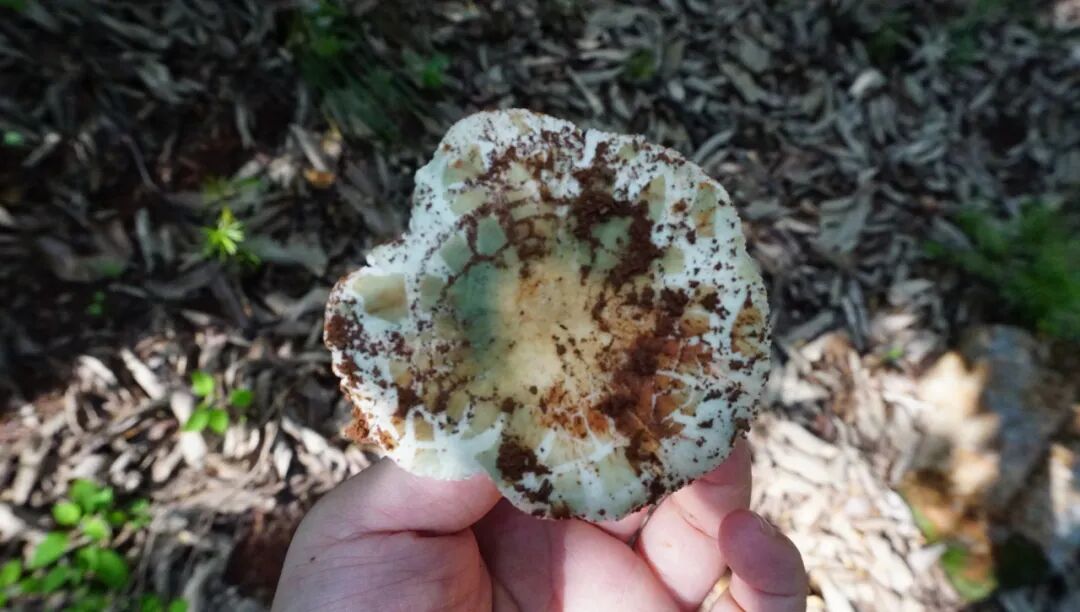
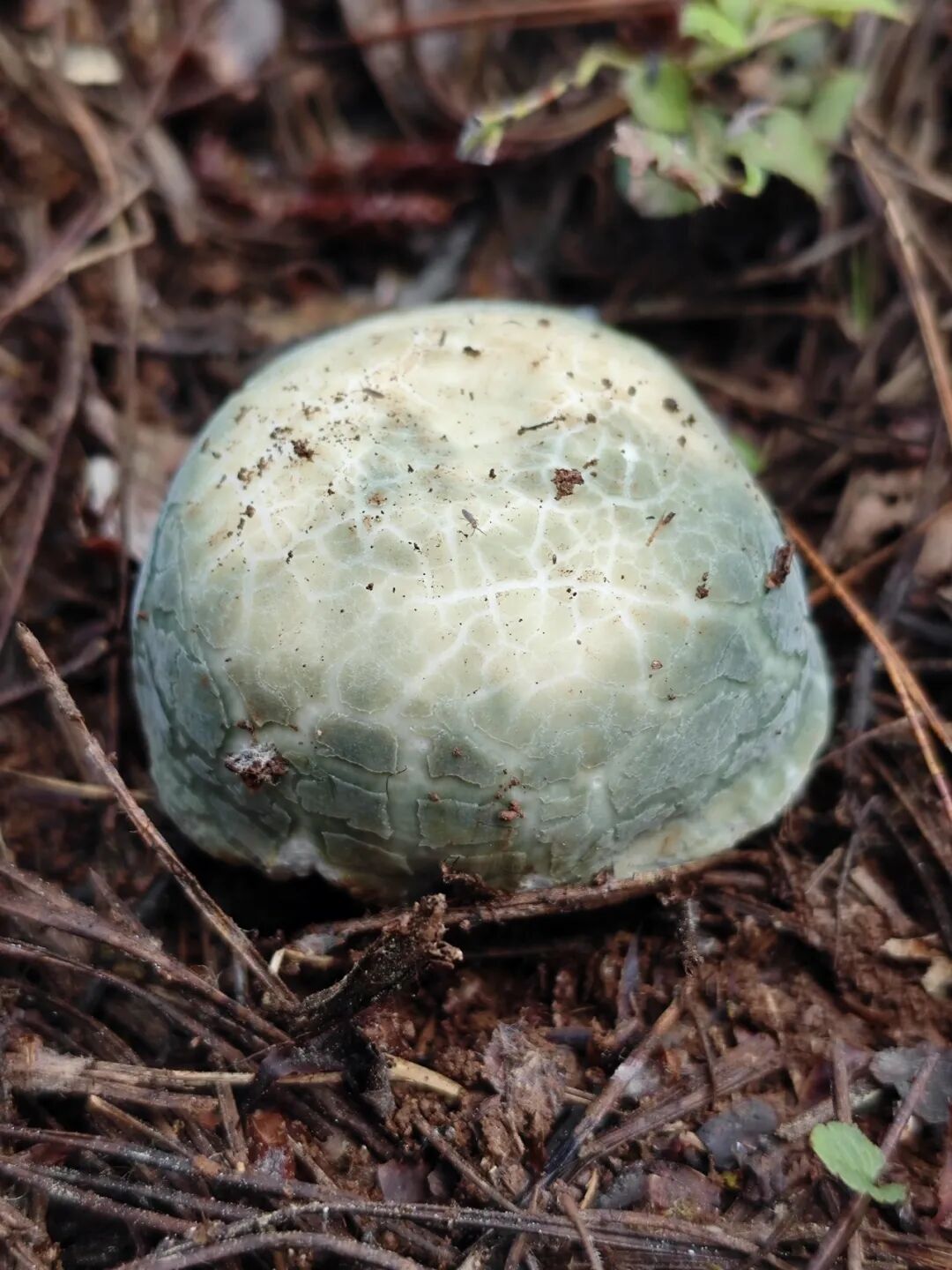
◉ Local green russula.
But in the bag my laodie brought home, the proportion of long-stemmed mushrooms was strikingly high. Sellers say this is just a matter of mushrooms growing to different stages. But look closely: the stems are thin and elongated, barely any soil clings to them – and what there is is dark brown; the caps are virtually free of mud. Most people can’t taste the difference between local and out-of-province, but old Kunming locals can still pick up on the mushroom flavour. My laodie said the mushrooms that day were “watery”, “soggy”, “woody”, and ‘tasteless.’
I asked what he’d paid that day – just over a hundred yuan for a big bag – almost certainly not local mushrooms. The unspoken rule at Mushuihua is: you may not know the goods, but your money will. After all, in August 2025, local green russula hit an all-time high, selling at four to five hundred yuan per kilogram at the peak of the season (usually no more than a hundred yuan per kilo). This was the most everyday mushroom a Kunming person could think of – at a price that beggared belief. And it sold out fast; by September, you couldn’t find it any more.
High prices because there’s a shortage of mushrooms. By early May, when first-flush mushrooms started arriving, at Mushuihua Market, local mushrooms from around Kunming were almost entirely absent. Only red blue-staining bolete from the first flush showed up; stallholders said it came from Wenshan, Jianshui, and Pu’er. Wenshan lies in south-eastern Yunnan and gets its rains earliest every year. I asked casually about the price: eight hundred yuan per kilogram…
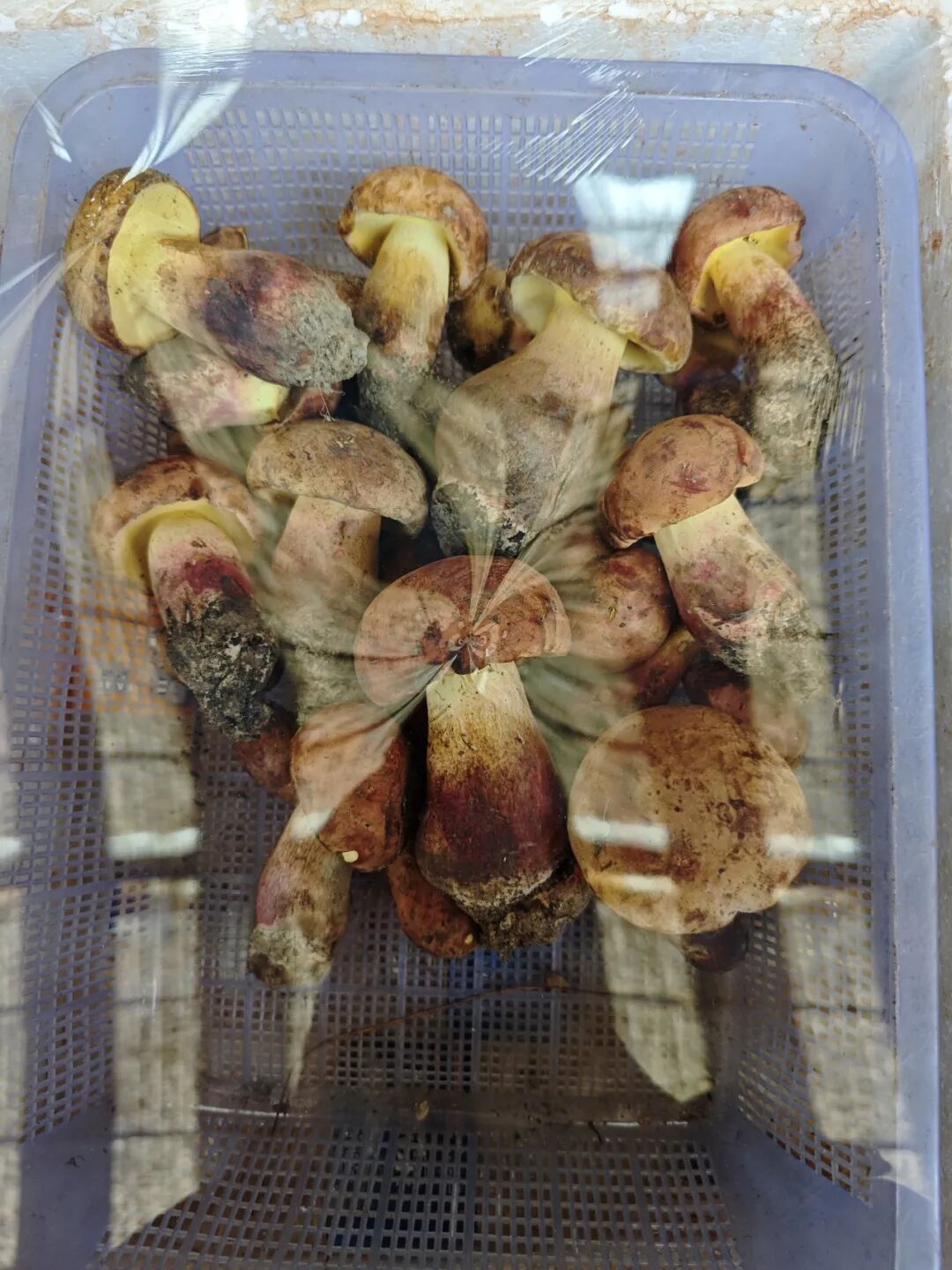
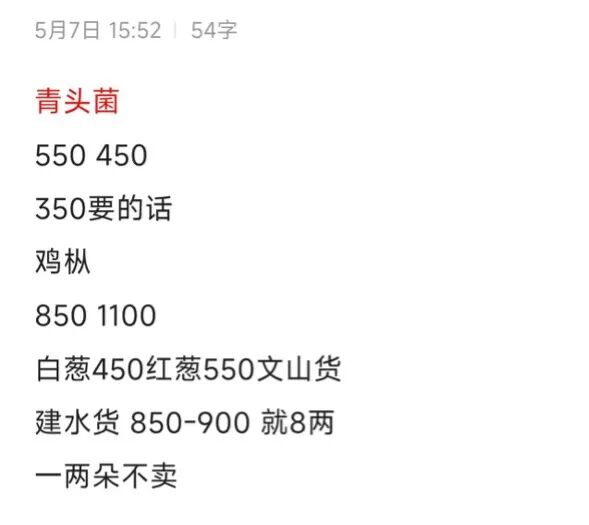
◉ First-flush red blue-staining bolete from Wenshan (left); local mushroom prices I recorded at the market (right).
‘One rotten mushroom, and it costs that much! Why don’t they just rob you blind?’ Talking about the wild mushroom market in Yunnan these past two years, Brother Xu – a wholesaler at Mushuihua Market for over thirty years – was still brimming with guihuo (Kunming dialect for “frustration”).
Brother Xu comes from Yao’an in Chuxiong, a place where there’s nothing but mountains and mushrooms. ‘He can’t do a single thing except sell mushrooms,’ he always says. Although I call him “big brother”, he’s a year older than my father and was already in Kunming trading mushrooms before I was born. When I saw him again this June, three tonnes of pine-milk bolete were piled up outside his shop, and a dozen or so workers were helping him sort through them. ‘At this time of year, I used to take in ten tonnes a day,’ he said. Conditions this year were similar to 2025 – blue-staining bolete, green russula, termite mushroom, and other local varieties had never dropped in price from the first flush all the way through to the end of the season.
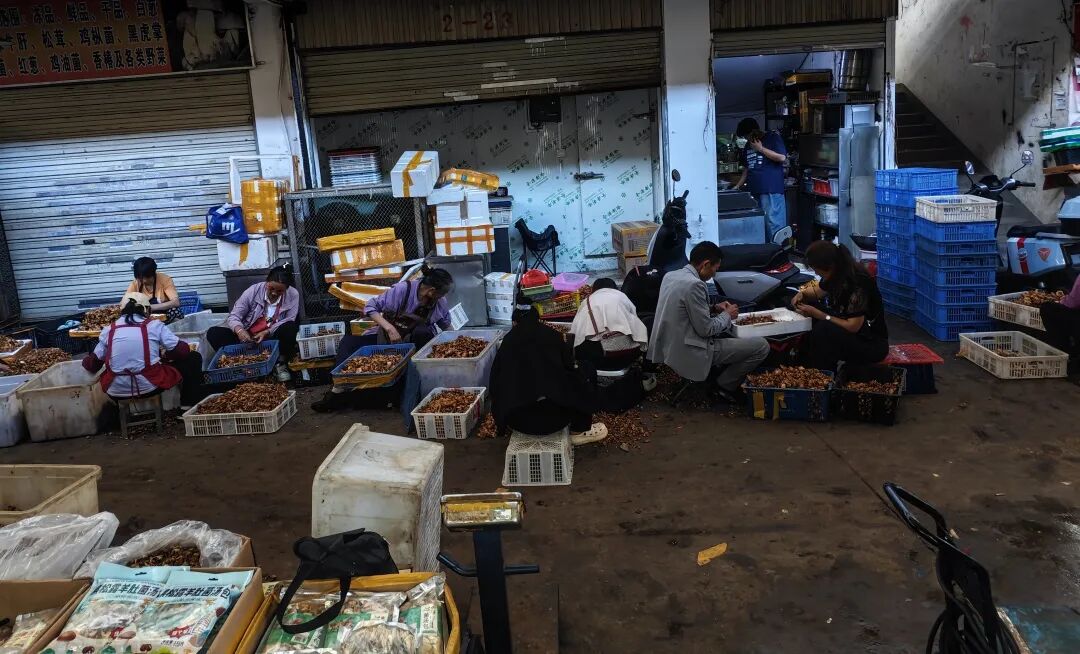
◉ Outside Brother Xu’s shop, people sorting through pine-milk bolete. As a traditional wholesaler, he has always worked on a model of high volume and low prices to move large quantities from the growing areas. Two cold-storage units stand beside his shop. The sky-high prices of these past two years have wiped out his advantage.
How many Yunnan mushrooms are there? A Pu’er-based fungal observer found that in 2025, the most common wild mushroom in Pu’er – milky russula – barely showed up at all. In normal years, local villagers would forage more than they could carry in a big basket; last year, the moment they carried the mushrooms down the mountain, they were sold off locally. The entire mushroom season produced less than a fifth of a normal year’s yield. Boletes also dropped noticeably; red russula had a shorter fruiting period and was rarely to be found.
On one livestream call, a wholesaler asked a friend at the origin what on earth was going on. ‘They genuinely aren’t coming up,’ came the reply. Beyond Brother Xu’s home area, I asked friends in Pu’er, Honghe, and Anning, and several traders at the market – all told me the same thing: ‘The mushrooms just aren’t fruiting.’ Quality was poor, volumes wouldn’t pick up, and prices wouldn’t come down.


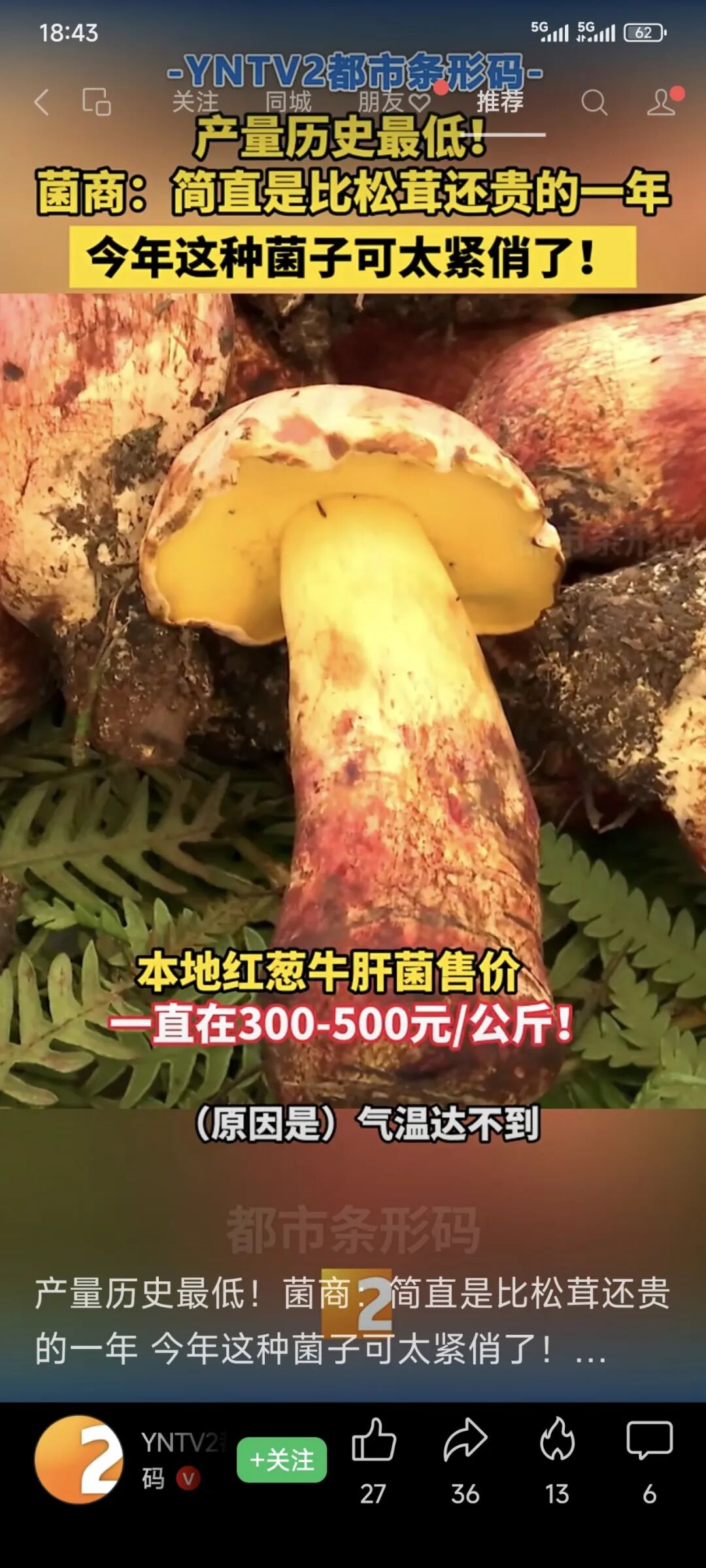
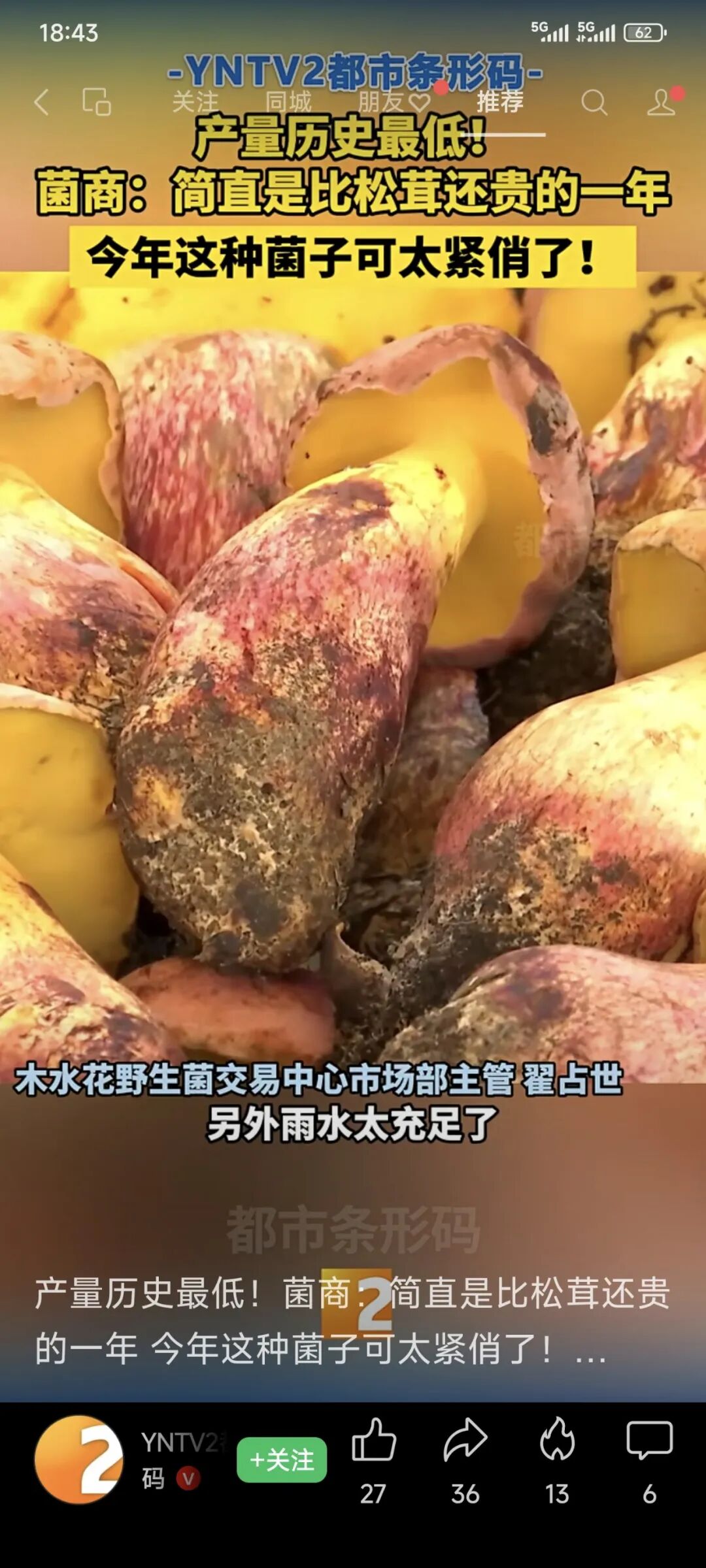
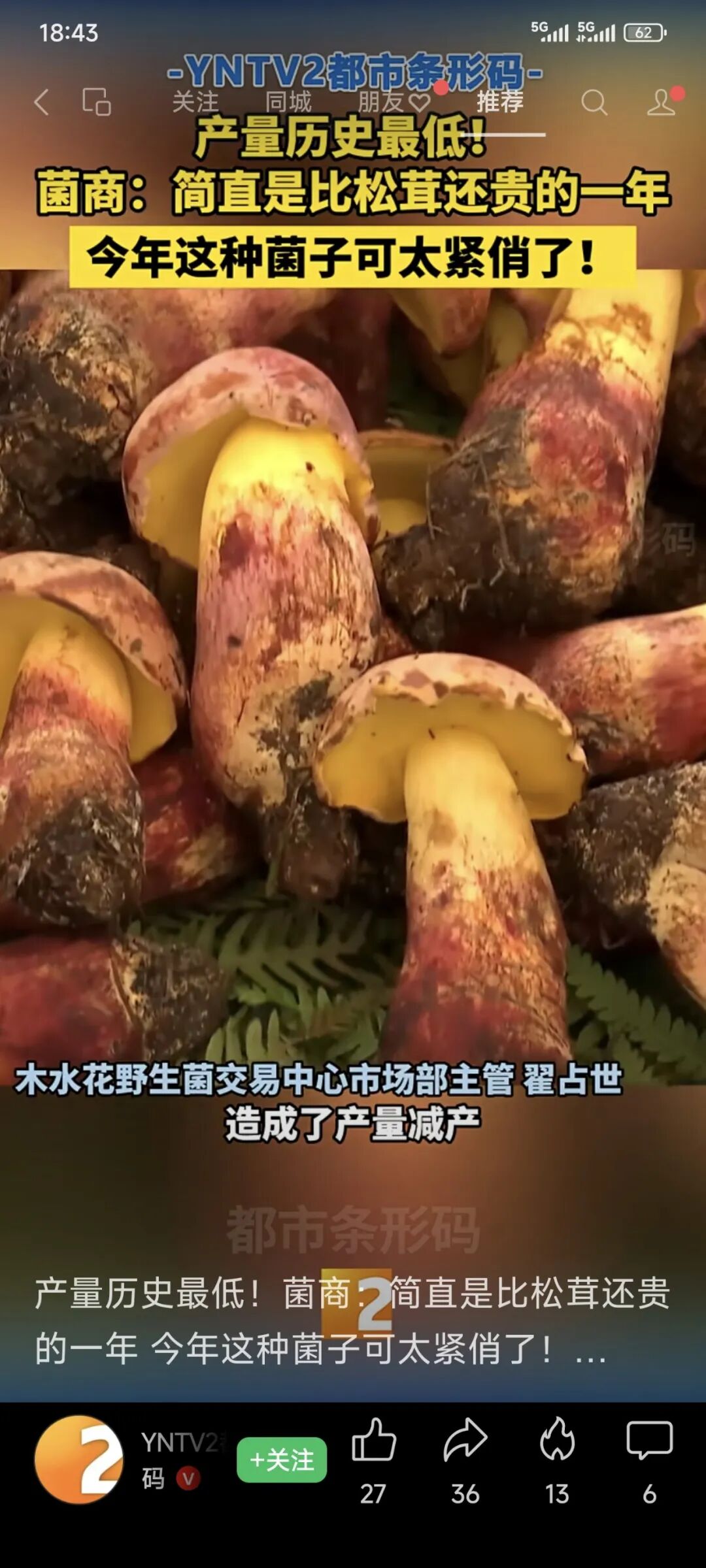
◉ In 2025, a Mushuihua Market spokesperson confirmed that the mushrooms weren’t fruiting and rain made foraging difficult.
The reason mushrooms were scarce was rain. And rain dragged down their quality too.
In late June 2025, a weather forecast predicting ‘seventy-one days of rain in Kunming over the next ninety days’ nearly broke the city. That stretch should have been the peak of the second wave of mushroom season. In Brother Xu’s home county of Chuxiong, unbroken overcast rain and extreme downpours left villagers unable to go up the mountains, and mushroom yields plummeted.
The 2025 Yunnan Province Climate Bulletin showed that the province’s average annual precipitation was 16.9 per cent above the long-term norm. In Chuxiong, average rainfall in May 2025 was 140 mm and in June, 262.2 mm – both more than seventy per cent above ideal levels. The June rainfall recorded at the urban weather station alone reached 865.3 mm.
More rain does not necessarily mean more mushrooms, or better ones.
As one study based on environmental data from 125 counties across Yunnan has shown, the province’s complex vertical climate zones and sharply defined wet and dry seasons – with rainfall and heat arriving in sync – provide the ideal conditions for wild mushrooms to flourish. In May, when the mycelium is gearing up to break through the soil, sunlight and warmth are plentiful and conditions shift between wet and dry. By June, July, and August – the peak months when mushrooms erupt in unison – temperature and rainfall stay within the right band without dramatic swings. Large day–night temperature differences, with a three-day dry spell broken by a single rain shower – few places can replicate this combination. Foragers have summed it up: “Three days of sun, one shower of rain” – that’s what makes mushrooms fruit.

◉ In 2025, a buyer in Pu’er describing peak-season mushroom production.
Now rain is dragging down mushroom quality. Back to that blue-staining bolete from Wenshan I spotted earlier – pick one up, give it a smell, a touch: it feels faintly damp, and a gentle squeeze yields a certain “pao ruǎn” quality (dialect for hollow inside and soft), yet that hallmark scallion fragrance of blue-staining bolete isn’t nearly as pronounced – a trait that shows up precisely when the rains have been too heavy.
Even the matsutake – the most run-of-the-mill variety at Mushuihua this year – has suffered badly. With all that rain and humid air, insects have bred in the humus, and the matsutake’s scent draws them in. “In some places the infestation rate hits ninety per cent – you see it yourself and don’t dare pick one,” an industry insider familiar with matsutake-growing regions told me.
Rain Brings in Out-of-Province Mushrooms
The fewer local mushrooms there are, and the higher the price, the bigger the opening for out-of-province stock. Talking about the 2025 wild fungi market in Yunnan, Brother Xu – over thirty years in the trade – said it had been the most out-of-province-heavy year of his career. “Throughout July and August, about two-thirds of the market was held up by out-of-province mushrooms.”
Affected by climate change, the delicious bolete – what everyone knows as white bolete – fruited this year in Hanzhong, Shaanxi, eastern Inner Mongolia, and Outer Mongolia.
In fact, from the “old-timers” I’ve learned that Laos’s red russula, Myanmar’s termite mushrooms, Korean matsutake, Mongolian boletes, Xinjiang’s field mushrooms, Hunan and Hubei’s saffron milk caps and green russula, and Guangxi and Guangdong’s clustered termite mushrooms – all circulate in this market where every region shows off its speciality. But the amplifying effect of climate change has made everything more pronounced.
Some Yunnan mushroom traders make a specialty of scouring other provinces, buying up stock at rock-bottom prices and shipping it back to Yunnan to sell as local mushrooms. “I’ve got a friend who went from Sichuan all the way through to Xinjiang – mushrooms everywhere. He got in touch with me to find a buyer, then had locals collect up the mushrooms and dried them in those machines that dry raisins. Logistics are so advanced now – they just ship straight from the origin. A trip that’s half holiday nets you a profit on the side; you see that kind of one-in, all-profit deal and just walk away?” the same industry insider told me.
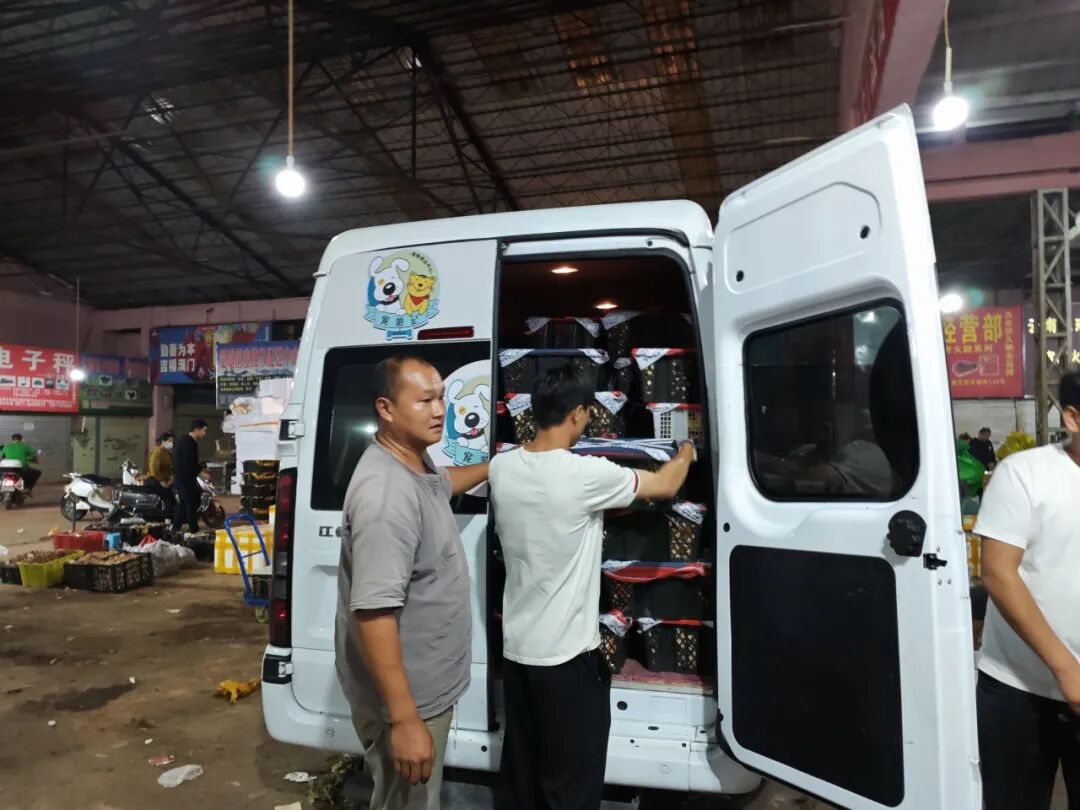
◉ A “pet shuttle van” delivers mushrooms from western Yunnan.
Their secret to getting rich? Geographic disparity.
Based on environmental differences, Yunnan roughly falls into three wild fungi growing zones: the high-altitude mid-Yunnan region (Lijiang, Shangri-La), the mid-altitude central region centred on Chuxiong (ideal for bulk mushroom production), and the warmer southern Yunnan region (Wenshan, Honghe, Pu’er, and the like). Layer the south-west monsoon on top, and fruiting times stagger across the zones.
By Brother Xu’s reckoning, Wenshan, Jianshui, Simao, and Xishuangbanna get their rains early, so first-flush mushrooms hit the market by May and take it over. Chuxiong and Yao’an – Brother Xu’s home turf – fruit later; great waves of mushrooms break through en masse around the Dragon Boat Festival, after which the overall market price plummets. The second and third waves ebb slowly until autumn brings the season to a close.
Fruiting time and region dictate a trader’s strategy. For instance, the latitudinal belt stretching east–west through Chuxiong, at comparable altitude, is the province’s richest zone in both species diversity and yield. Brother Xu’s home sits right there. In the old days, his only edge was volume – at peak season he’d fill all three cold stores to capacity.
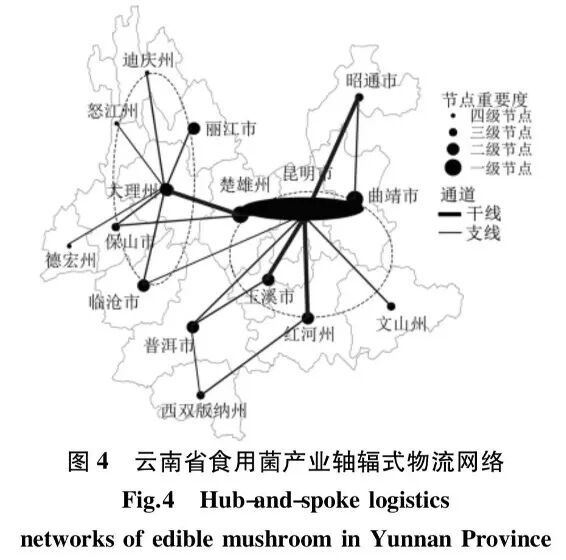
◉ Yunnan’s edible fungi logistics network. Source: Zhang Xue et al., “Research on the Logistics Network of Yunnan’s Edible Fungi Industry,” 2017, Regional Research and Development
Scarcity drives value. During peak season, demand for mushrooms is enormous; shortages send prices soaring, sending every middleman in the market scrambling to fill the gap. When rain overwhelms one origin, middlemen race to buy the same variety from wherever else it fruits. Brother Xu leans on his supply-chain connections to lock down the best stock – only by having what others don’t can he sustain the reputation for quality he’s built over the years.
Blink and the gap closes; the moment supply for that variety outstrips demand, you’re back to eating losses.
So suppliers who read the market ahead of time stockpile early, freezing decent-looking mushrooms in advance. But the downstream market still favours fresh goods – you simply can’t fool a consumer’s palate.
In the past, it was local mushrooms that kept prices in check – wait for the next rain and they’d erupt in force. That was what let old-timers like Auntie Ling’s aunt ride the trade with steady hands. Now, out-of-province mushrooms have become the go-to option for chasing the wind. More and more wild fungi traders scour the entire internet – from personal networks to social media – hunting for stock. Spot an opportunity, ship a load of out-of-province mushrooms in, and ride the wave.
Brother Xu can’t scale his volume, and he can’t compete with these people. No wonder he’s brimming with guihuo. Local traders can no longer leverage their established channels and knowledge of the solar terms to seize an edge, and ordinary consumers struggle to tell where a mushroom grew or how good it truly is.
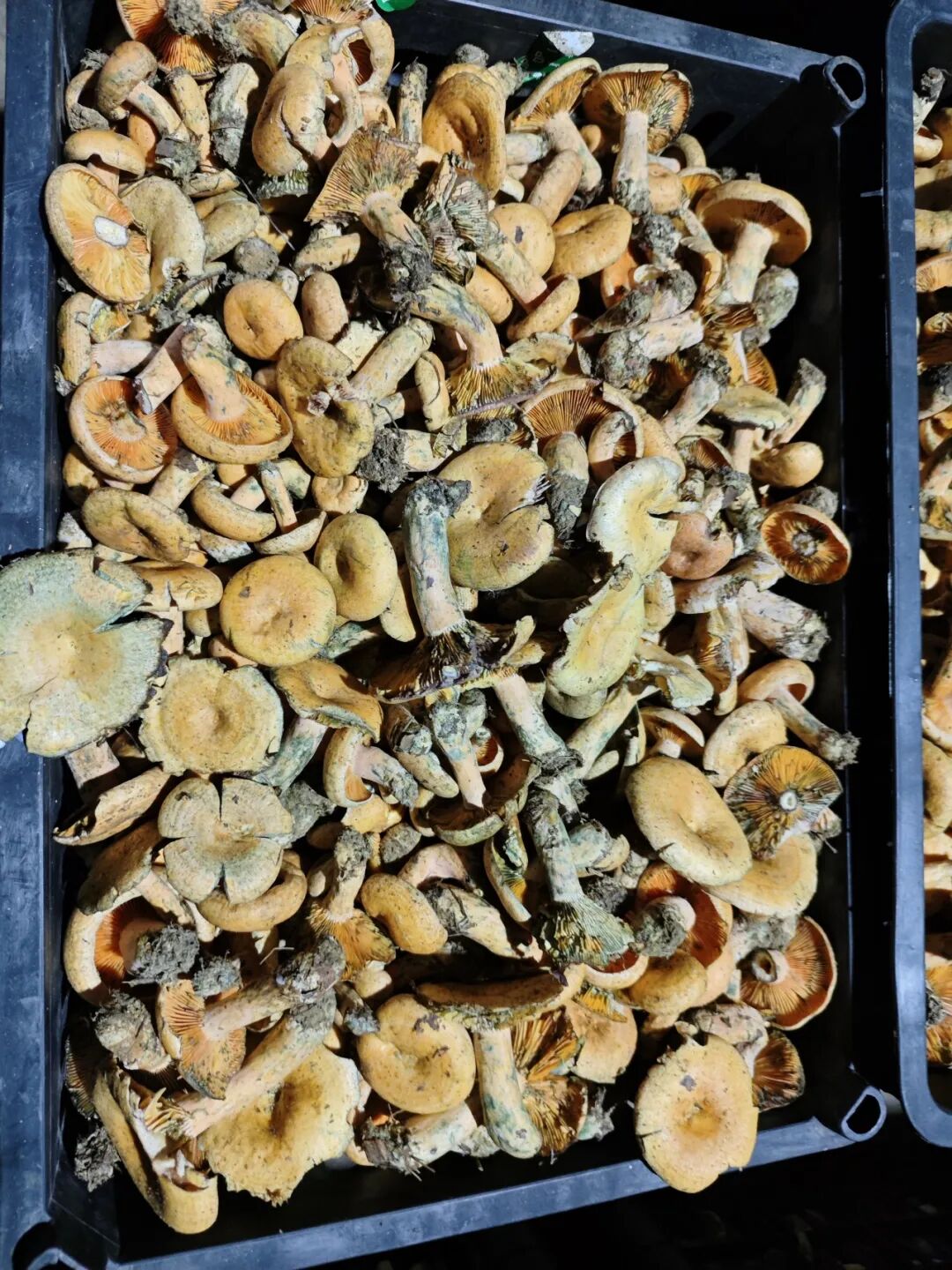
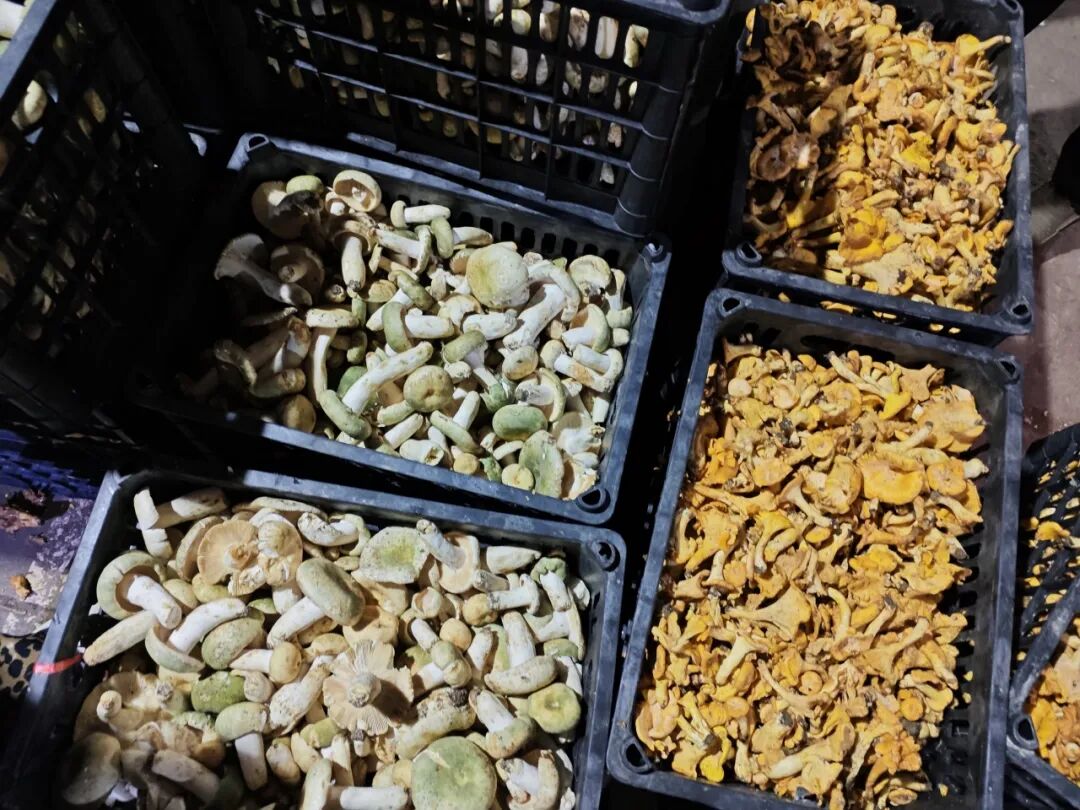
◉ Out-of-province copper-green mushroom (left); out-of-province green russula and chanterelles (right).
Cheap and Surplus?
But out-of-province mushrooms can only claim the mid-to-low-end market in the end. Multiple middlemen confirmed that the out-of-province mushrooms entering Yunnan in 2025 met standards on appearance and freshness yet still lacked a certain “Yunnan flavour.” High-end restaurants continued to favour the increasingly rare local fungi.
Green russula from Guizhou, Hubei, Shaanxi, and other provinces – in bulk – filled what had been the “mid-market.” The “local” green russula my laodie bought likely came from exactly these places. As a non-standard commodity with no unified spec for grade, quality, or freshness, the reputation of “Yunnan wild fungi” rests almost entirely on quality itself. How far cross-regional sourcing disrupts the industry’s equilibrium – nobody knows yet.
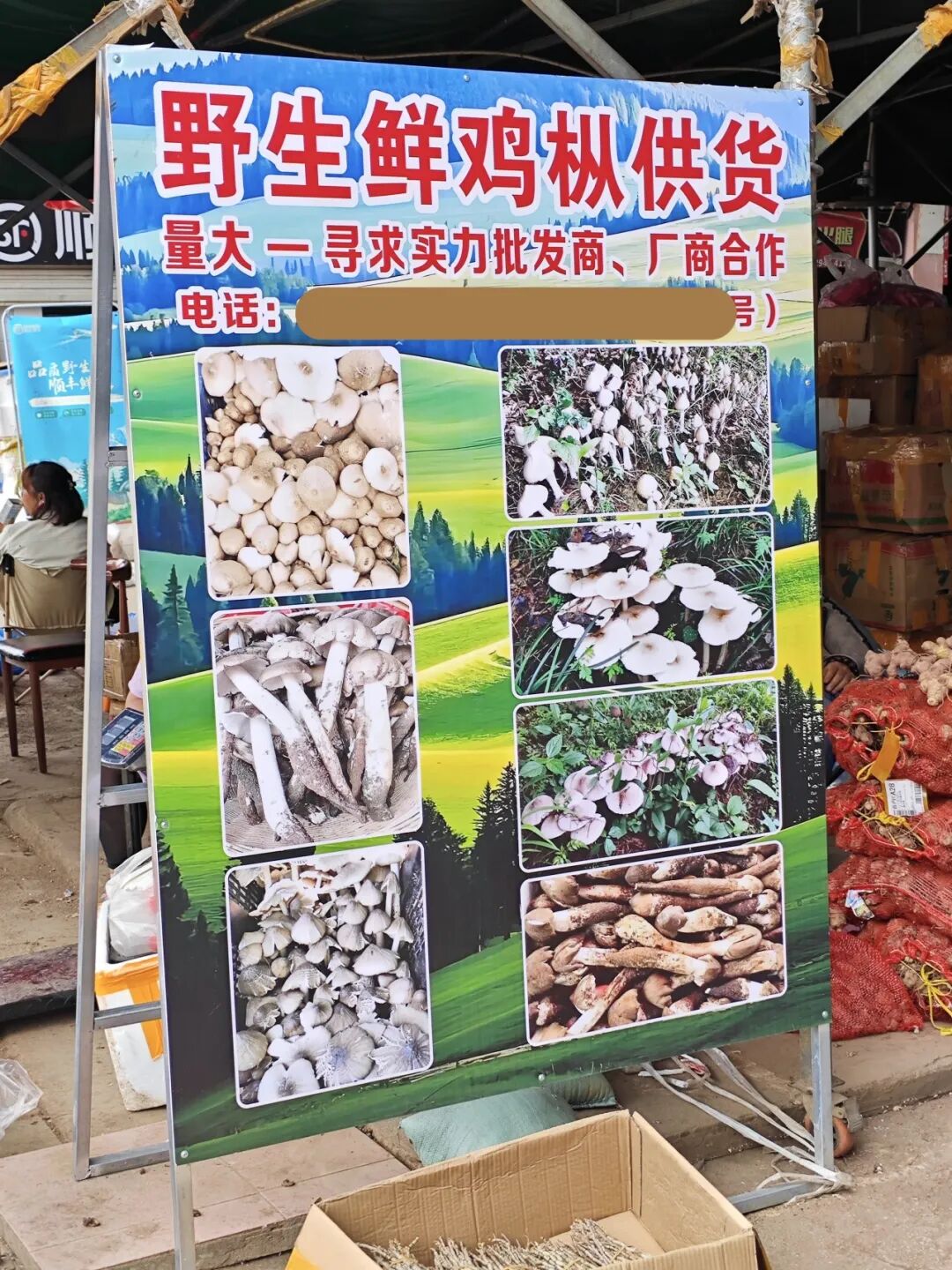
◉ A termite mushroom sales advertisement from Hubei.
At the very bottom, battered, insect-ridden fresh wild fungi that don’t meet “commodity” standards get processed instead – turned into seasonings, dried slices, sauces, and hotpot base – and channelled into what traders call the “low-end market.”
For all the talk of “the mushrooms not coming up,” the statistics show Yunnan’s overall wild fungi output has actually risen in recent years. In 2020, wild edible mushroom production in the province stood at 227,500 tonnes; by 2025 it had reached 408,500 tonnes, with output value surpassing 30 billion yuan. Neither Brother Xu nor I can explain why.
One simultaneous trend may be relevant: as Yunnan mushrooms grow ever more popular, over-foraging is worsening across the province – and well beyond it. This unsustainable harvesting also damages the growing habitats themselves.
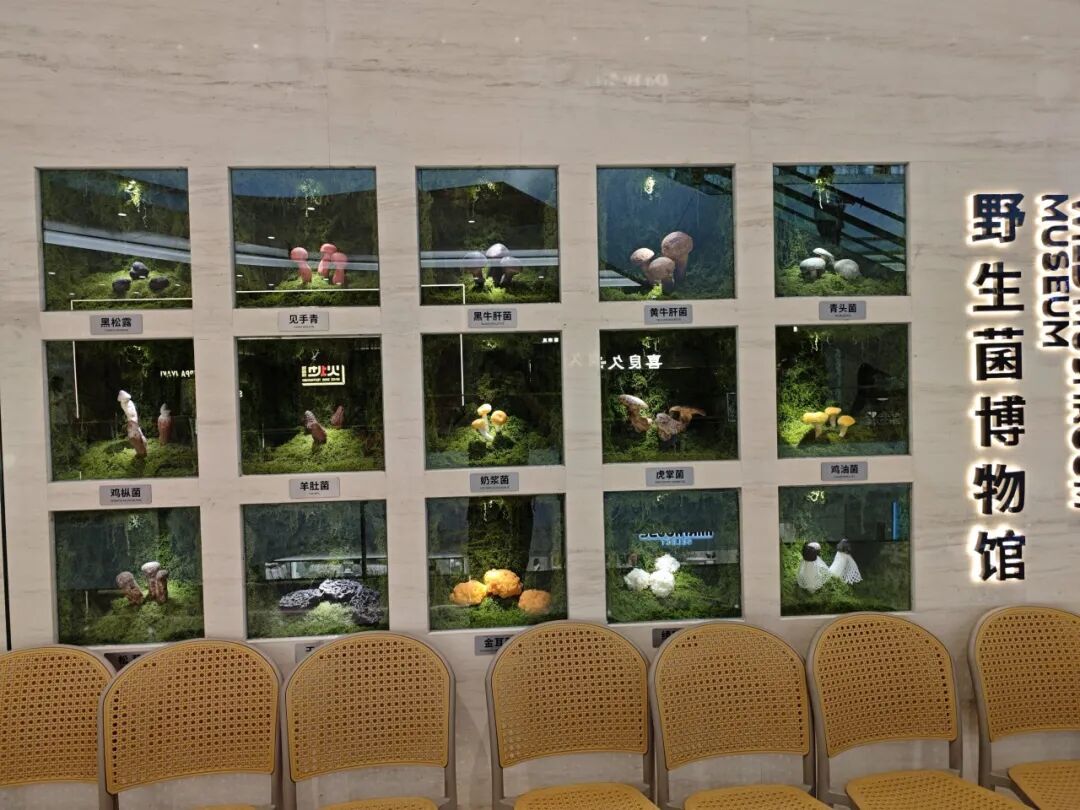
◉ A Yunnan wild fungi hotpot restaurant at MixC in Wenzhou introducing the region’s mushroom varieties.
Foragers pick without regard for maturity – see a mushroom, grab it – and a flood of low-quality fungi flows into the low-end market. Take the mushroom hotpot craze sweeping the country, for instance: it doesn’t rely much on the mushrooms’ flavour in the first place, and often has cultivated mushrooms mixed in.
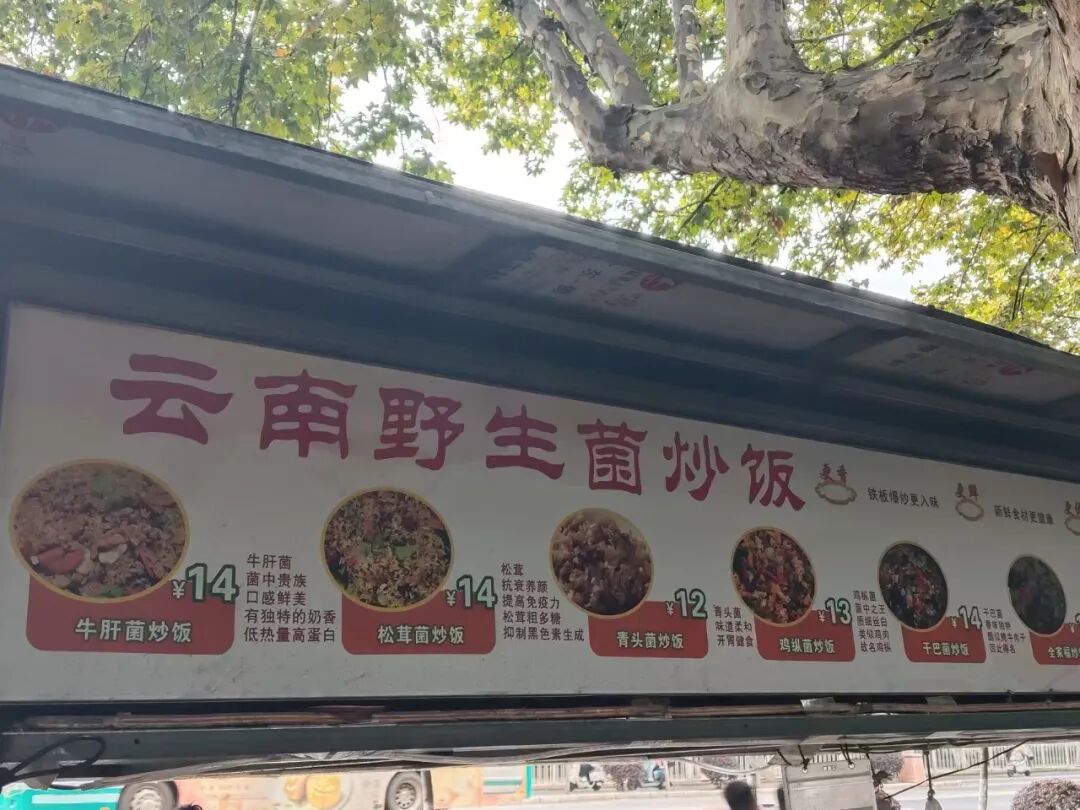
◉ Wild mushroom fried rice from the snack street outside Kunming University of Science and Technology. Photo: Tianle
As more and more people crave that taste of “Yunnan mushrooms,” government and commerce keep stoking nationwide demand. Yet consumers can hardly tell where the mushrooms on their plate came from, whether a foraging patch is nearly depleted and won’t yield next year, or whether the quality actually matches what they imagined. I can’t help asking: is this the consumption ecology that the industry and its customers most want?
– This is Foodthink’s 859th original piece –
Foodthink
Author:
Junjun
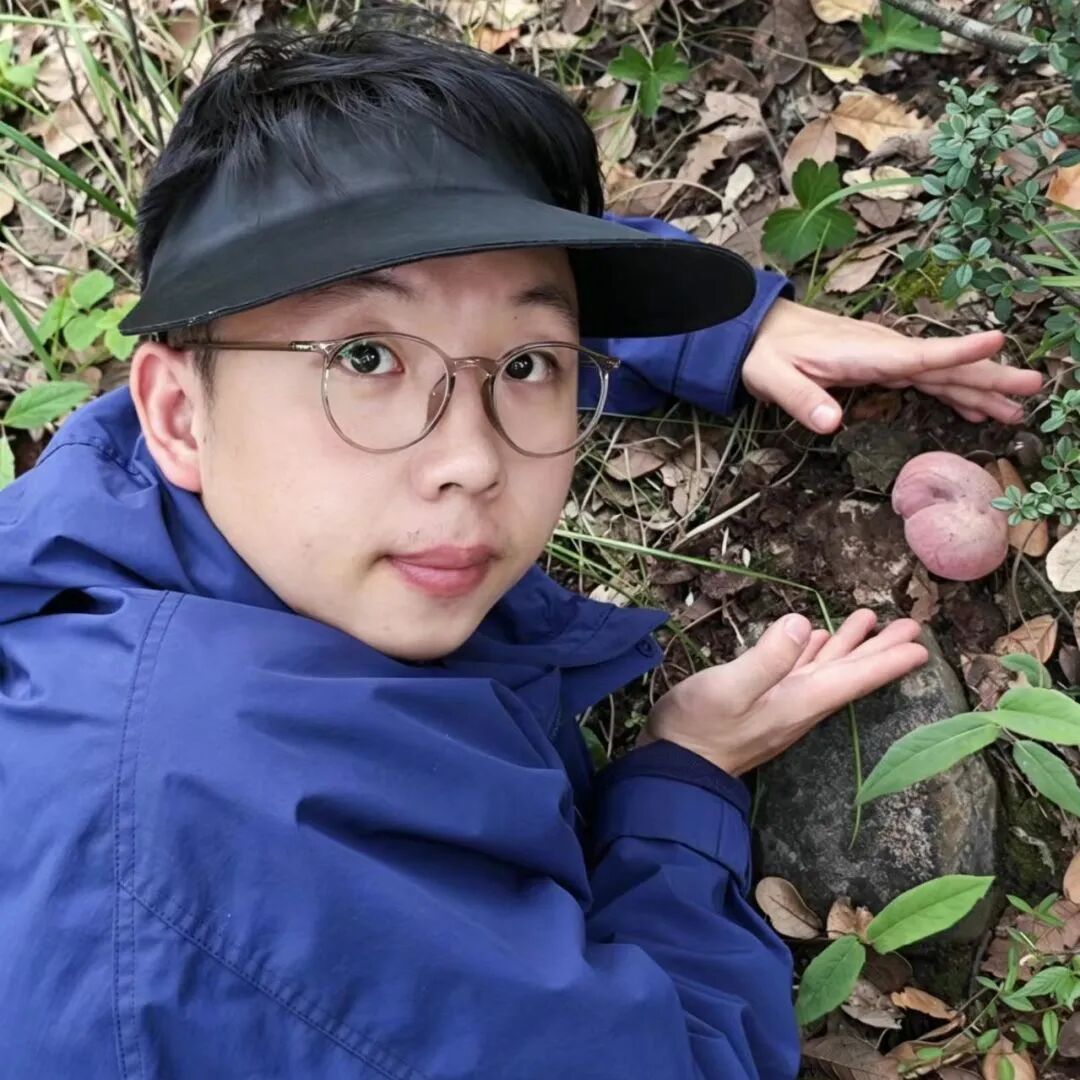
Convener of the Slow Foraging Network; drawn into the wild fungi trade by doing off-the-books work for a truffle dealer. Long focused on sustainable wild fungi foraging. (WeChat official account: mancaiwangluo)
About the Lianhe Creative Programme
To understand the current state of food and agriculture, and to support more people in exploring the complexities behind food-system issues, Foodthink has partnered with multiple charitable and media organisations to jointly launch the Lianhe Creative Programme in 2024 and 2025, supporting media creators and researchers to conduct fieldwork in food and agriculture and funding them to complete public-facing content.
Following multiple rounds of interviews conducted by the judging panel, the Lianhe Creative Programme supported 18 creative projects in 2024 and supported 20 creative projects in 2025. Several of the funded works are now complete and publicly available:
“Cleaner A-Mei Wants a Proper Meal | The Worker’s Table”
“In Malaysia, Chinese Merchants Want Only Grade-A Durian”
“‘Fake Meat’ Drives Out the Real: Herders, Tables, and the Amazon”
“Watermelons Stay Sweet; Growing Them Stays Bitter”
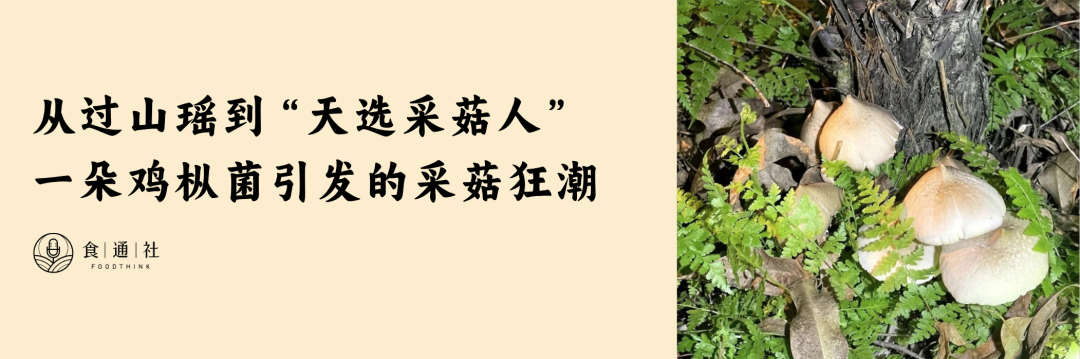
“From the Guoshan Yao to ‘Chosen Mushroom Pickers’: A Termite Mushroom Sparks a Foraging Frenzy”
“Ma Lan in Shenzhen, Without a Meal Buddy”
“Why Has the Sweetness of Childhood Disappeared?”
“Why Can Guizhou Not Live without Sour Soup – and Sour Soup Not without Guizhou?”
“Who Drove Out the Wet Market?”
“Will Fresh-Food E-Commerce Make Wet Markets Disappear?”
“When Drones Become the New Farming Tool: Who Defines ‘Scientific Farming’?”
“The Braised Goose in a Qiaopi: 100,000 Yuan a Bird”
“‘The Boss Hasn’t Arrived – Don’t Sell Just Yet.’”
“In Search of Musang King: Malaysia’s Flavour and Business”
“Tianxing Island Watermelons, Extra Slow to Ripen This Year“
“People, Birds, and Melons: Twenty Years after Wuhan’s Floods”
Unless otherwise noted, all photographs were taken by the author.
Editing: Pei Dan
Layout: Xiaocun
Scan the code to tip – support original food writing
▼

▼
Click on an image to read the related article.
▼
Click a keyword to explore more article collections.
Seeds | Farming Techniques | Policy | Fermentation | Nutrition | Fruit | Fisheries | Events | Jobs | Food Delivery | Wet Markets | Livestock | Food Talk | Sharing Sessions | Reading Groups | Harvest Festival | Smallholder Stories | Climate Change | Rural Development | Cooperative Economy | Urban Farmers | Food Safety | Digital Technology | Biodiversity | Pandemic and Food | False Solutions | Ecological Farming Internship Programme
Beijing | Hebei | Shanghai | Guangdong | Guangxi | Henan | Sichuan | Jiangxi | Xinjiang | Shaanxi | Hong Kong | Chongqing | Zhejiang | Jiangsu | Guizhou | Northeast China | Taiwan | Inner Mongolia | the Philippines | Canada | Russia | Mexico | Italy | the US | the UK | Germany | the Netherlands | Thailand | Sweden | Japan