An Art Experiment Ended by a Chicken Thief

In late August, Xu Lingni (a pseudonym) discovered that the 10 chickens and 2 geese kept on the hillside had gone missing.
It was a chicken-keeping cooperative founded by staff and students at Sichuan Fine Arts Institute, based at the Huxi Campus in the western suburbs of Chongqing. The campus, set between hills and water, is known for preserving its original pastoral landscape. The members had fenced off a coop on the hillside. Before heading home for the summer holidays, the president, Xu Lingni, had installed an infrared camera. Footage she later posted on Xiaohongshu captured a chilling scene: in the dead of night, several men strode into the coop with torches, smoking, and emerged with a chicken or two flapping in each of their hands.
The scene left the cooperative’s staff and students heartbroken. Xu Lingni said she had barely slept those days. In the end, she decided to call the police.
It was not the first time something had happened to the chickens.
Last summer, two of the five chickens had already been lost. One died of illness, one went missing. Open the co-op’s Xiaohongshu page and you will find obituaries for individual chickens appearing here and there on the timeline. Some died from animal attacks, others from hypothermia brought on by torrential rain. While the students find healing in raising the chickens, they must also bear the grief of watching such fragile little lives slip away. Rebuilding genuine bonds—between people and nature, between people and animals, and even between people themselves—is the core of the chicken-raising co-op as an artistic process.
“The path has not been smooth. We have endured farewells and losses this past summer, and come to understand more deeply that coexisting with life means accepting uncertainty.” This is what the cooperative’s publicly posted recruitment notice said in September 2025.
Only this time, the mass theft of the chickens and geese went beyond what the faculty and students had in mind when they spoke of “uncertainty.”
The chicken theft first went viral online, drawing widespread public attention. Chongqing police investigated through the night and eventually established that seven workers from a summer construction project on campus had taken the chickens and geese and already consumed them off-site. The workers involved were temporarily detained, and the construction project manager has paid 7,000 yuan on their behalf to cover the cost of raising the birds and compensation for the students’ emotional distress.
An even greater blow followed. The incident reignited calls questioning whether poultry should be kept on campus at all, and the university decided to ban chicken-keeping. This meant the end of the cooperative — the first university chicken-keeping cooperative in the country, which had been running for a year and a half.
Tilling Chickens
The cooperative’s full name is the Happy Chicks Feeding Co-operative. It forms an integral part of the Yuyuan Plan. Yuyuan was once a corner piled with construction debris. Six or seven years ago, Jin Lipeng, a lecturer at the School of Experimental Art, led students in using building waste to lay paths and construct planting beds. He hoped to transform barren ground into a nurturing bed for healing—healing both nature and people.
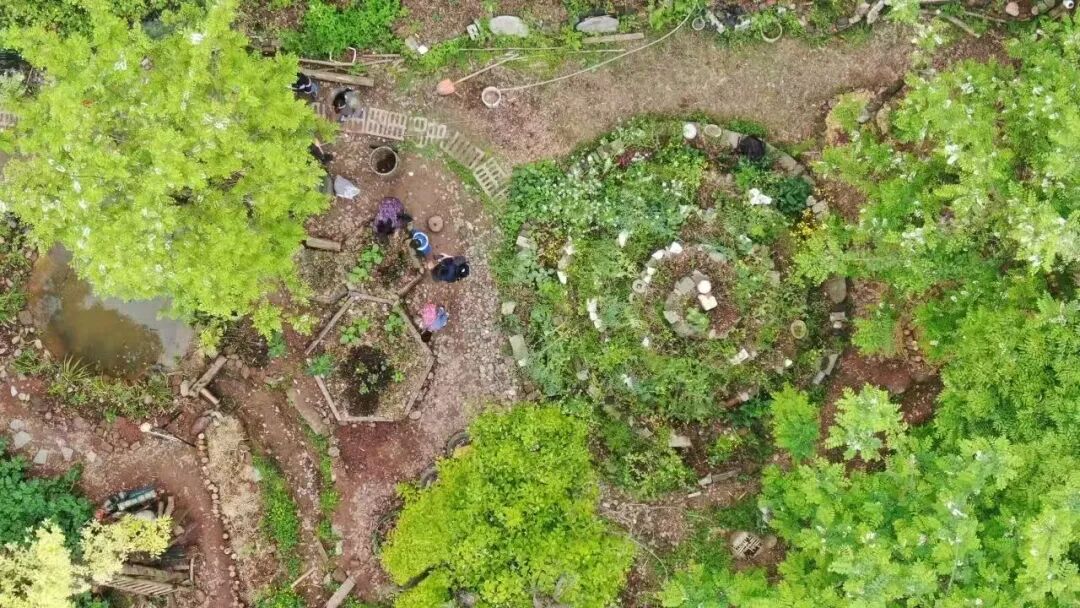
◉ Yuyuan from above. Photograph: Xiaoshu
Jin Lipeng has long been engaged in ecological art education and is concerned with how to respond to the ecological crisis through direct action. To this end, he and his students stand before parcel lockers to discuss where their food comes from and what effect it has on their bodies. They visit waste sorting stations to observe the enormous volume of takeaway containers, ask a maintenance worker to lift the lid of a septic tank and explain the blackwater system, follow the cleaners to identify wild greens… He hopes to awaken students’ embodied awareness of food, the environment, and climate change, then let that knowledge flow between people through collective labour.
Before the Healing Garden Project existed, the school canteen sent several hundred kilos of raw food waste to the waste station every day, mixed in with unsorted plastics, to be compacted and then hauled dozens of kilometres away to an incineration plant. Seeing nutrients that could have returned to the soil being pointlessly burned, staff and students began composting at the Healing Garden, their home base. Over the years, approximately 40 tonnes of food waste have been turned into fertiliser. Through the hands-on process of composting, students come to understand the soil and the cycle of matter.
But this composting cycle still seemed to be missing something. Last spring, Jin Lipeng supervised a graduate student’s graduation project on the ‘Mobile Chicken Coop.’ Its core concept, ‘Forage Chickens,’ is rooted in Permaculture: chickens play multiple roles in an ecosystem—breaking up soil, controlling pests, and weeding—converting food waste into manure for composting, and providing eggs. In short, having identified the many shortcomings of the long-chain industrial food system discussed earlier, ‘Forage Chickens’ became the solution that Jin Lipeng and his students set out to put into practice within the campus.
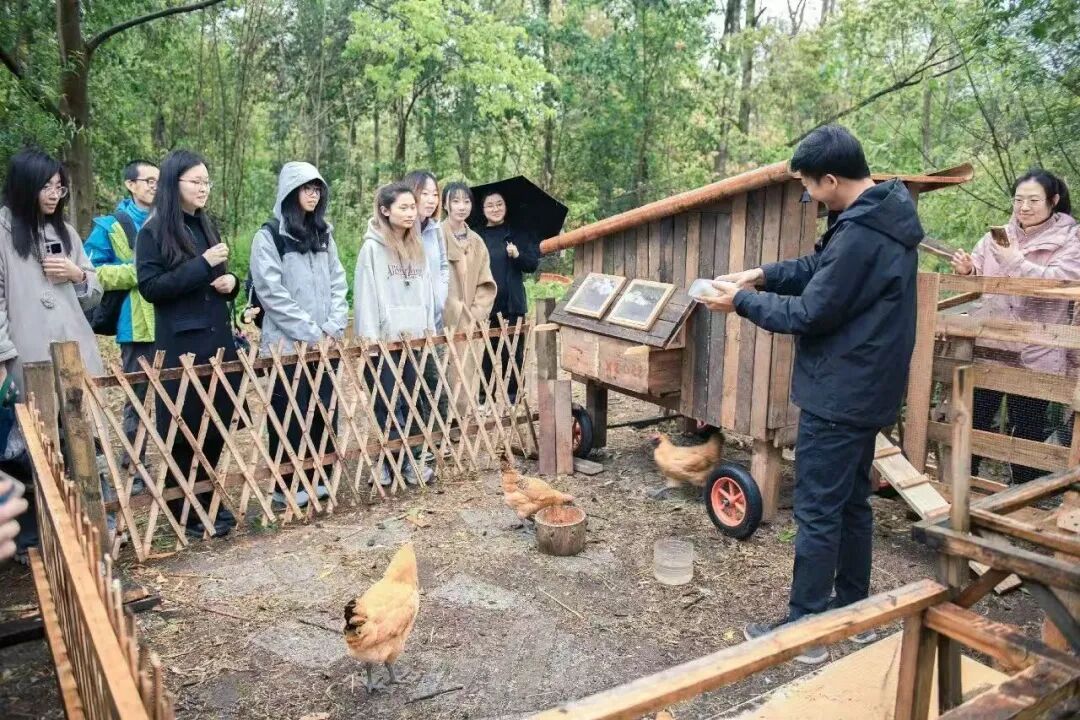
◉ Graduate student Deng Jun and Lü Miao, a fellow student in the furniture design programme, collaborated to produce the main components of the coop, then assembled it together with participants through a workshop. Image source: WeChat official account “Eco-Art Action”
The five Chongqing red-crested, black-skinned chickens that a student had bought for a graduation project thus became the first birds on campus. At the time, undergraduate Xu Lingni was involved in the Healing Garden activities and got to know this flock. She has always been especially fond of small animals. As a child she dreamed of opening a zoo, and her current career ambition is to work with a non-profit organisation protecting wild animals, even though this has nothing to do with her sculpture degree. She began looking after the chicks on her own initiative, paying out of pocket for grain and taking them to the vet.
Last summer brought another ordeal. In August, Chongqing’s temperature exceeded 40°C for days on end. People tried to stay indoors with the air conditioning on full. The teachers and students who had no choice but to go out and look after the chicks were confronted with a stark scene: the art gallery’s massive air-conditioning system ran nonstop, its hum unrelenting; the campus pond, depleted of water, required large quantities of tap water to be topped up. It made them reflect: as climate change intensifies, how long can a way of getting through the summer that relies so heavily on artificial systems really last?
That summer, one chicken died of heatstroke and another went missing. Of the remaining three, two soon disappeared as well. Worried that the last one was too lonely, Xu Lingni went to the wet market and bought another chicken. Unexpectedly, as soon as she brought the new one home, one of the missing chickens turned up.
The coop was back to a flock of three. A few days later, when Xu Lingni opened the coop, she found six unfamiliar pullets among them. After enquiring around, a cleaner told her she had bought them, left them in the coop, and intended to fatten them up for meat. The students discussed it and bought the six birds. Around the same time, a student out shopping came across a ring-toss stall selling chicks, felt sorry for them, and brought one back to the coop.
They named this chick ‘Tricycle.’ But Tricycle was too young, and the older chickens had no interest in it. So it wandered down the hill on its own, foraging, and accidentally swallowed rat poison. Xu Lingni took it to hospital for a stomach pumping and surgery, then nursed it at home for some time afterwards. The medical bill—around seven or eight hundred yuan—was covered by a crowdfunding effort among the students.
To help Tricycle fit in with the group, Xu Lingni bought a barred chicken and a Five Black chicken. She kept all three in a large cage, hidden in a classroom, for nearly a week, and only released them back up the hill once they had grown accustomed to one another.
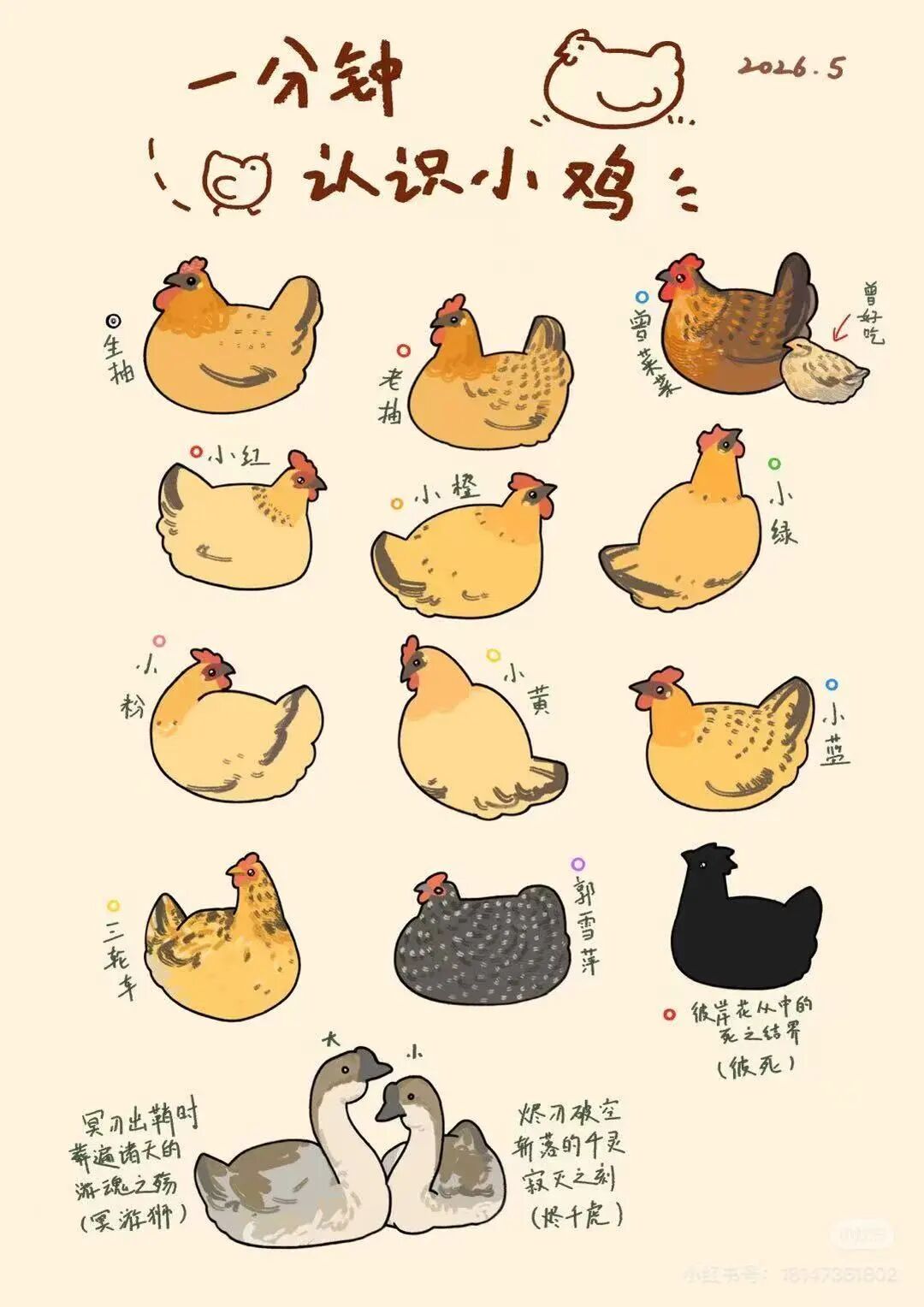
◉ Xu Lingni’s hand-drawn chick guide. Each chick has its own name. Image source: Xiaohongshu, ‘Sichuan Fine Arts Institute Happy Chick Feeding Cooperative’
This is where all the chickens at the time of the incident came from. Apart from the Five-Black, which may have blended into the darkness and gone unnoticed, the other ten were all stolen.
Healing Chickens
By then, as the flock kept growing, there were so many eggs they could not eat them all, and an increasing number of students were drawn to the chicks. Jin Lipeng, who had long been interested in questions of labour, proposed setting up a chicken-keeping cooperative. He asked Xu Lingni whether she would be willing to serve as president, and she agreed on the spot.
None of them had a clue how to run a cooperative. So they researched online and, drawing on common sense, established the rules: members rotated through caring for the chicks and selling creative products; design, writing, and social media management were divided among them. In June this year, they also sent a student with strong spoken English to attend an international conference and share the cooperative’s practices. Member benefits included free eggs and the option to purchase chick-themed creative products at cost price.
All the core members of the cooperative are women. Finding healing in caring for the chicks was probably the main reason they joined, and it is also why the project has won over so many students. One girl developed an especially strong emotional attachment to the chicks, often buying feed out of her own pocket; members sometimes caught her holding a chick and crying. ‘So the theft was a severe blow to her, and she was far from the only one who was emotionally shaken,’ Xu Lingni said.
Some have said that before joining the co-op, they had hardly any social life. After joining, they have friends, things to do, and life feels more meaningful. “Raising chickens is a form of labour. Through the labour itself, she makes friends, and in the process of being with the animals, she transforms.” Xu Lingni sees this as what sets the co-op apart from other hobby clubs built around singing or dancing.
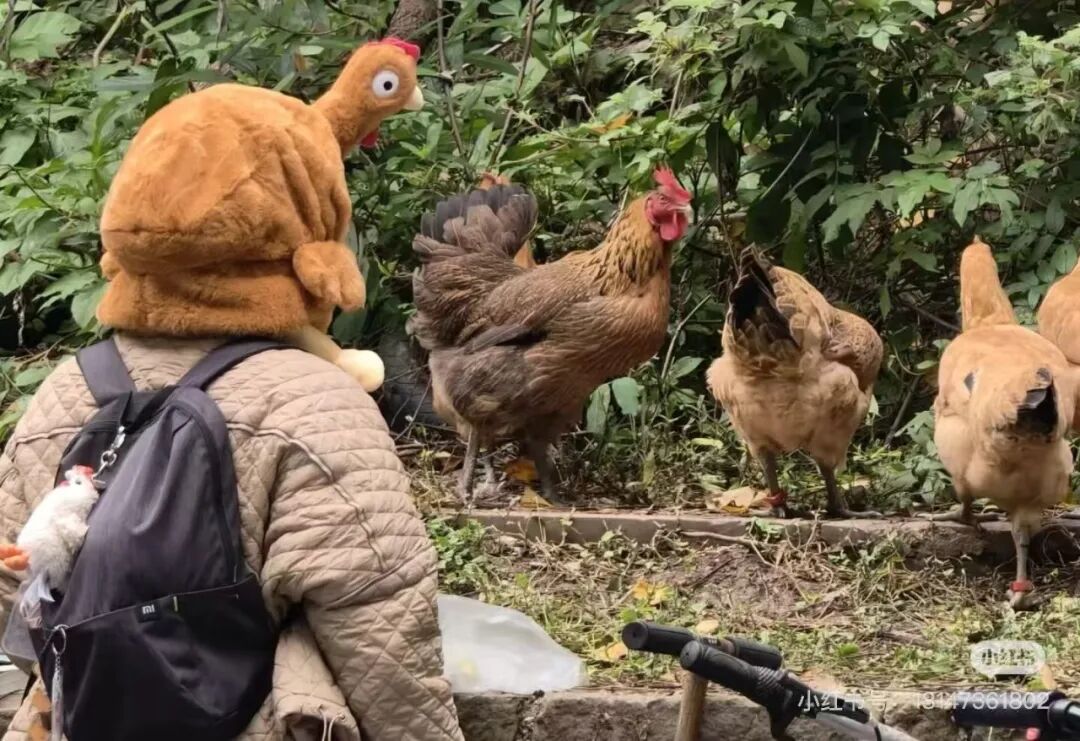
◉Many students have found healing in caring for the chicks. Image source: Xiaohongshu, “Sichuan Fine Arts Institute Happy Chick Feeding Cooperative”
Xu Lingni also frankly admits that she doesn’t share Teacher Jin’s lofty ideals. She simply began feeding the chicks because she likes them, and it was only through caring for them that she gradually came to understand permaculture, climate change, and other topics that may seem distant but are in fact deeply personal.
Every morning at eight or nine, the first group of members on shift arrives to feed the chicks. Their food is a blend of various ingredients—Teacher Jin brings in leftover vegetable trimmings and fruit peels from the canteen, while students purchase grain and shell powder for calcium supplementation. After the 12 o’clock break, the second group heads up the hill to clear away the chicken droppings, which, along with any uneaten kitchen scraps, are composted on site. The resulting organic fertiliser is used to grow the vegetables that the chickens and geese feed on, as well as some ornamental plants.
“University students generally have no idea where eggs come from, where our food waste goes after meals, or why rubbish is incinerated. Plastic waste from food deliveries piles up in our dorms. Delivery riders are very likely to suffer heatstroke in hot weather. But students lack sufficient awareness of the connection between all of this and drought, extreme heat, and carbon emissions.” When introducing the project to the public, Xu Lingni said, “We do these things so that people can feel the pressure and causes of climate change in a very real way, and that through community-supported agriculture on campus, we can mount a small act of resistance.”
On good days, the cooperative collects eight eggs a day; on bad days, just one or two. Most of the hens are Red-Crested Black-Feathered, which lay relatively few eggs. The Five-Blacks, the smallest of the flock, lay almost every day, though the eggs are all small.
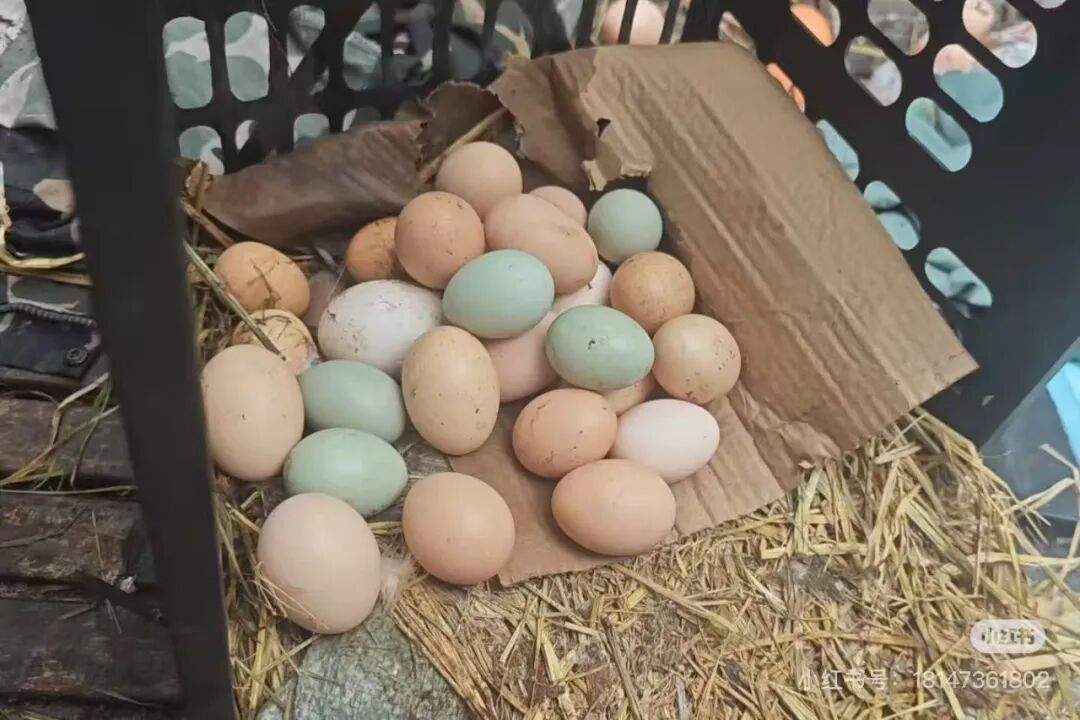
◉Named eggs — an important asset of the co-op. Image source: Xiaohongshu, “SFAI Happy Chick Feeding Co-op”
Xu Lingni rents a flat off campus and has a fridge at home, so she can keep the eggs fresh. Once she has a batch, she calls out in a WeChat group of several hundred people and then rides her e-bike to deliver them. Most students live in dormitories where they can’t cook, so the main buyers are teachers and local residents. ‘Our eggs are really good — boiled plain, they don’t have that eggy taste,’ Xu Lingni says. She’s a very picky eater and can clearly tell the difference from regular eggs.
Each egg sells for 1.5–2 yuan — quite a premium price for the Chongqing suburbs — so they don’t sell well. Xu Lingni did the sums: in total, she had made just over 500 yuan from egg sales.
Risk Chickens
In October 2025, the students registered a Xiaohongshu account to share their daily chicken-keeping life. A few close-ups of chicken heads, chicken bottoms, and fluffy feathers easily racked up hundreds of likes — proof that even netizens are being healed by the chickens. Many became fans of the little chicks, enviously commenting that Chuanmei is truly a free and romantic place.
Some people object. The most common complaint is students complaining that the chickens and geese drop droppings on the path. Someone commented under a post on the Yuyuan WeChat official account about two geese strutting along, pooping as they went, even dropping one at the entrance of the dormitory building. ‘A lot of students walk while looking at their phones and step right in it, then carry it into the dormitory with them.’
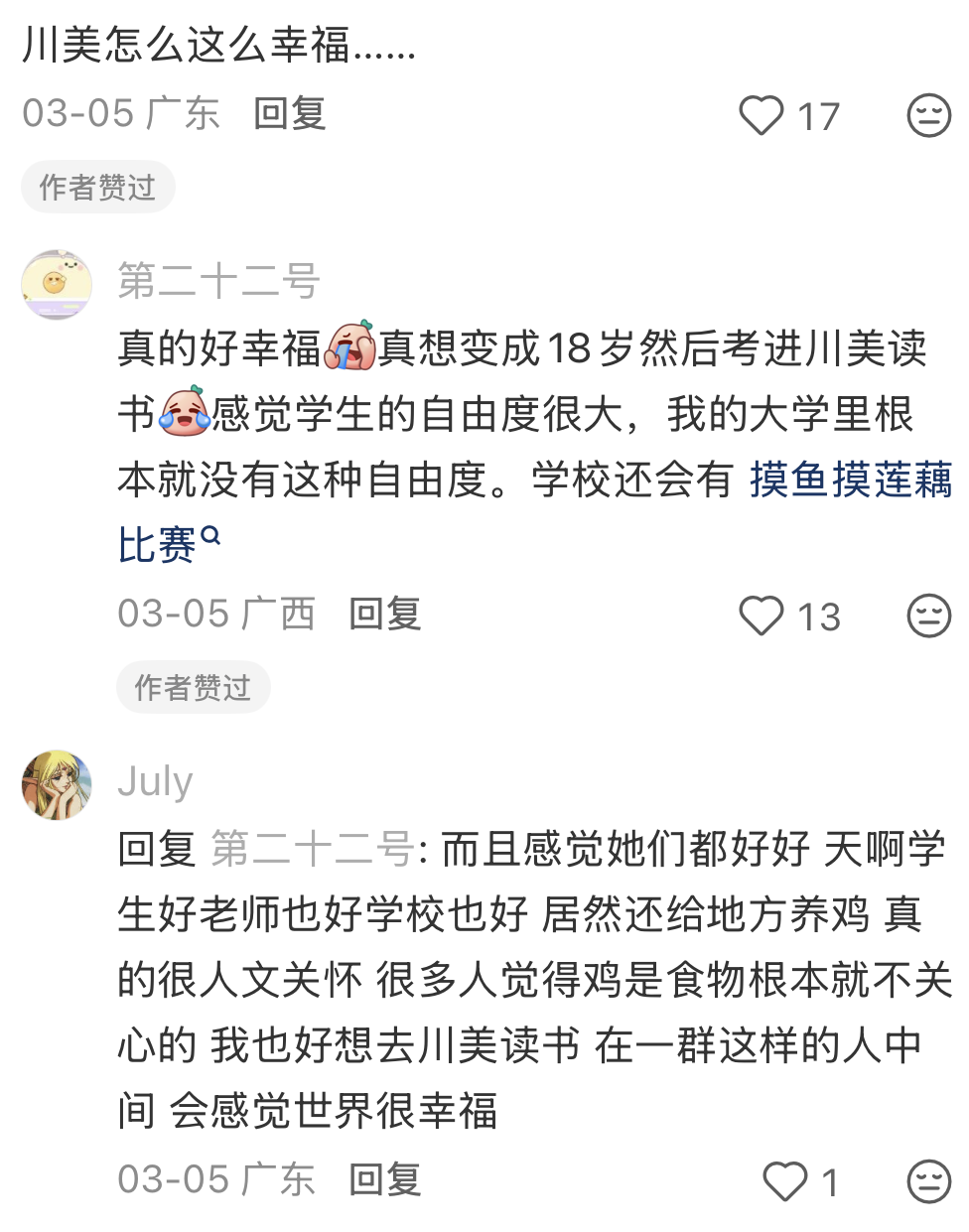
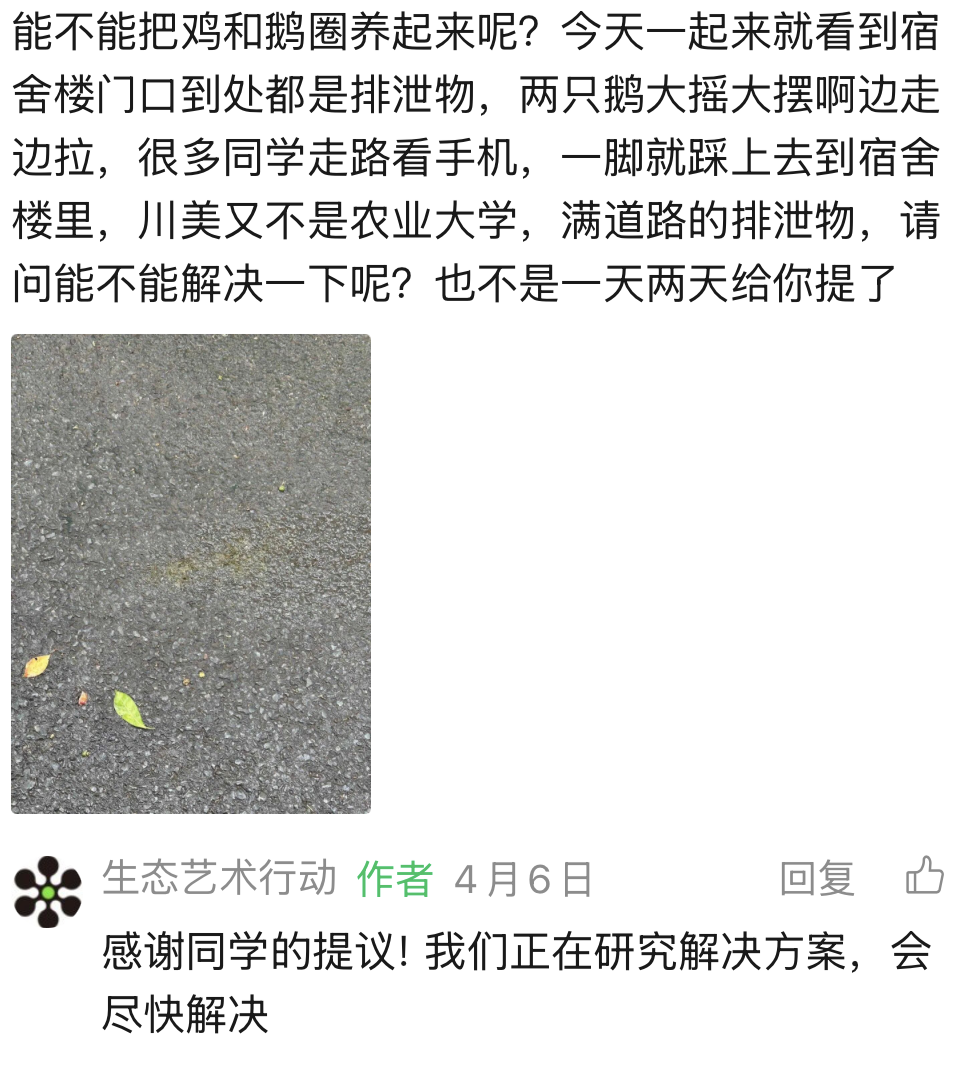
◉When it comes to keeping chickens on campus, there are those who love it and those who find it a nuisance. Photo credit: Xiaohongshu “Sichuan Fine Arts Happy Chicks Feeding Co-op” (left), WeChat public account “Eco-Art Action” (right)
“But wild birds drop their droppings on the path too,” Xu Lingni said.
Can chickens actually be kept on campus? The only relevant regulation I can find is the *Chongqing Central Urban Area Prohibited Livestock and Poultry Farming Zones Demarcation Plan*, published in 2022, which designates cultural, educational, and scientific research zones as areas where livestock and poultry farming is prohibited. However, the document defines the threshold for prohibition as “livestock and poultry farms with an annual average inventory of 200 or more head in pig-equivalent units,” while encouraging small-scale backyard farmers (those with fewer than 20 head in pig-equivalent units) to utilise manure and wastewater locally for resource recovery.
The dozen or so chickens and geese kept on the Sichuan Fine Arts Institute campus as an art experiment clearly don’t reach the scale of a farm, yet they aren’t quite backyard farming either. Foodthink has learned that members of the campus community have complained about the chickens not only to the university but also to relevant departments of the Chongqing municipal government. But on the matter of managing this kind of grey area, the university has historically adopted an open and tolerant stance, while requiring that staff and students maintain proper fencing and separation.
So the co-op bought taller fencing and, using old fence panels, enclosed the chickens within the hillside. But the students never locked the gate. “Everyone is free to come and go, because this is a community project on campus. If a student wants to play with the chicks, they can walk in at any time,” Xu Lingni said.
As for potential external threats, the co-op had its own security measures — they bought two goslings and raised them to size, hoping they’d serve as guards for the chicken coop. “They bite quite hard. Once I was wearing a raincoat and walking up the hill, and they didn’t recognise me, so they just went for me,” Xu Lingni said. The students had only thought of stray cats, weasels, and the like as potential intruders — they never imagined a burglar. The two geese were, of course, stolen too.
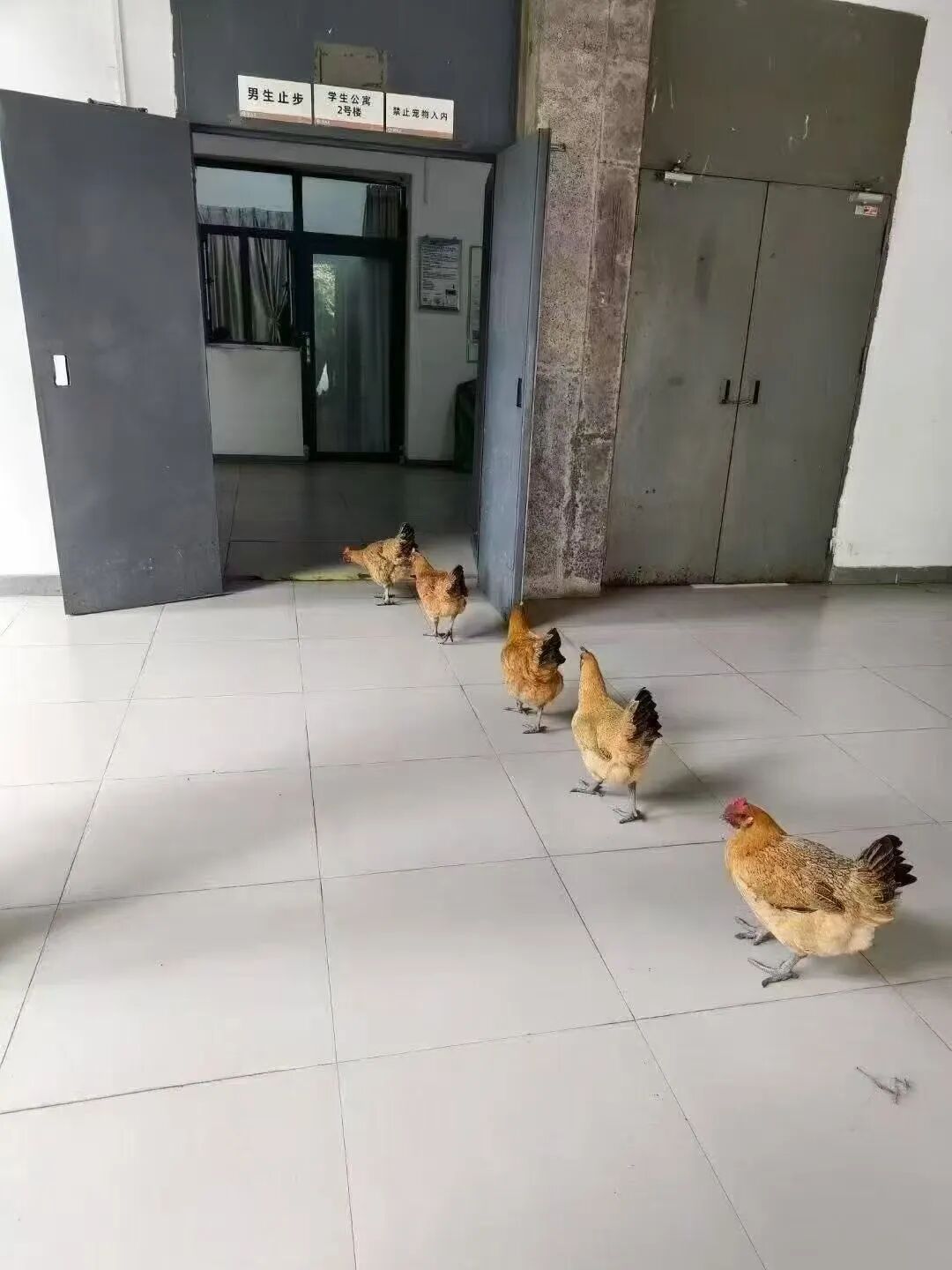
◉This image, ‘Chicks Queuing to Enter the Dormitory’, has been widely shared online, with interpretations starkly divided: supporters find the chicks adorable and see the school as genuinely caring, while opponents argue that poultry should not be kept on campus. Source: Xiaohongshu account ‘CAFA Happy Chicks Feeding Cooperative’
For Jin Lipeng, who has to liaise with the university administration, the issues at stake are far greater than chickens dropping droppings everywhere: raising poultry on campus, in close proximity to students and staff, raises the question of how to guard against safety and hygiene risks.
Jin Lipeng’s doctoral research focuses on animal ethics and contemporary art. He has long been concerned with industrialised farming and is himself a vegetarian. He has written critically about how industrialised farming not only threatens animal welfare but also poses crises for the environment and human health. As early as 2012, he created the large-scale art installation <em>Chicken Plan</em> as an artistic response to the industrialised harm inflicted on farmed animals. Since then, he has continued to use artistic practice and teaching to expose issues invisible to the general public, such as antibiotic dependency and the loss of natural behavioural instincts in poultry populations under intensive farming conditions.
In his view, the belief that industrialised farming systems are more hygienic, safe, or healthy than free-range poultry keeping is a widespread misconception.
“Professor Jin is a bit idealistic; I tend to think more practically,” says Xu Lingni. “Only by ensuring the chicks are alive—and living healthily and safely—can we demonstrate the value of the cooperative.” She spends half an hour each day climbing the hill to check the chicken coop, and well before the winter and summer breaks she starts planning who will be on duty, how to keep the coop warm or cool, and how to prevent avian flu during peak season. The vice president’s mother happens to work as a dormitory supervisor at an agricultural college, and she also helps members find veterinary students to ask what medication the chicks should take when they fall ill.
Chicken Merch
Although the eggs barely bring in anything, this is the Fine Arts Institute after all, and the cooperative’s main income comes from selling chick merchandise. The cooperative’s Xiaohongshu account has nearly 6,000 followers and 120,000 combined likes and saves. Members have developed merchandise including fridge magnets, canvas tote bags, and silk scarves. Some students have even used the chicks as models for their graduation projects, which the cooperative then turns into products. All the chicken-themed merchandise is spread so densely across the table that a two-wheeled cart pushed with one hand is enough to move it all for sale. Responding to enthusiastic enquiries from online followers, they have also started selling by post.
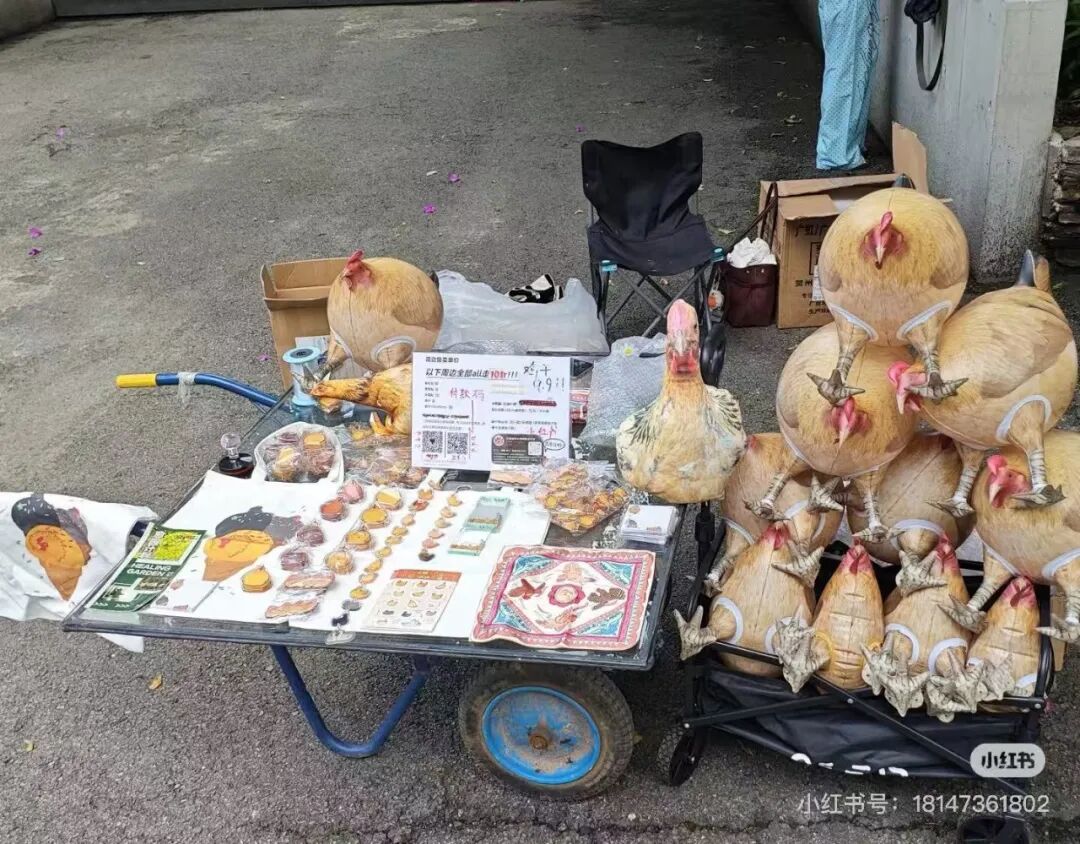
◉The cooperative even made a modest profit from the chicken merchandise. Image source: Xiaohongshu, “CAFA Happy Chickens Feeding Cooperative”
It’s clear the cooperative’s chicks have become a small internet sensation. Not only did they recoup their investment quickly, but the chick-themed merchandise has netted a profit of 1,000–2,000 yuan to date. Of course, this has been built on Xu Lingni’s self-exploitation as president—she designed most of the merchandise herself but takes no cut.
The modest profit wasn’t enough to satisfy her. ‘If even one or two chicks needed surgery, the money would be gone in no time.’ Still, she wasn’t overly worried. ‘Our project is therapeutic in nature. The students see the chicks as belonging to all of us, and if needed, they’d all do their best to look after them.’
This is why, after the theft came to light, students posted furiously—’Give back our chicks,’ ‘Take the chicks home,’ ‘My baby is gone’… The online outcry may have pressured the police to crack the case quickly, but it also became a catalyst for the school to issue a ban on keeping poultry on campus.
The Future of the Chicks?
Had the chickens and geese still been alive, there would have been much more to do, according to the plans the students and faculty had in mind: sharing egg-based foods beside the delivery lockers to prompt reflection on plastic overuse; compiling weekly ‘birth records’ for the eggs, detailing feed sources and the amount of kitchen waste repurposed, with carbon emissions made public. They also wanted to produce a replicable *Campus CSA Action Handbook* to encourage other universities to establish their own CSA communities.
*Note: CSA stands for Community Supported Agriculture—a model of direct partnership between farmers and consumers in which consumers prepay before the growing season begins, sharing both the risks of cultivation and the harvest of the season.
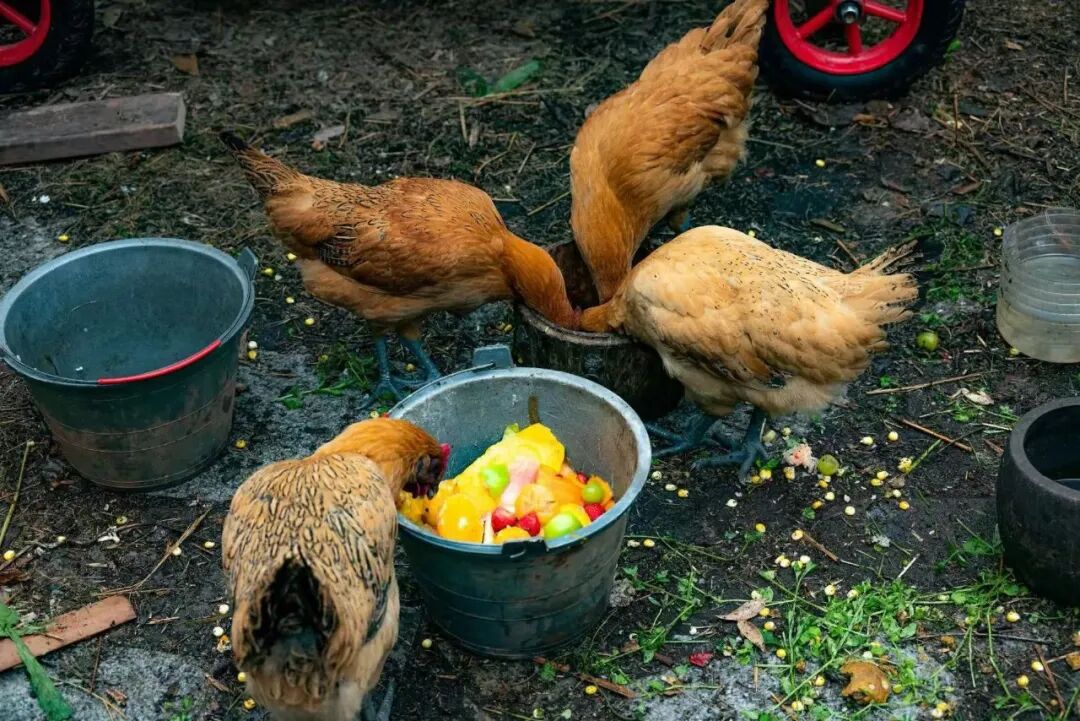
◉The chicks are busily tucking into the trimmings discarded by a fruit shop. Image source: WeChat official account “Ecological Art Action”
All of this has now come to nothing. Speaking to Foodthink, Xu Lingni said she was disheartened: ‘It’s been quite a blow. I’m not going to keep managing the cooperative. If anyone is willing to take over, I’ll certainly still be happy to help—after all, I’m more experienced with the treatment and feeding.’
However, a statement subsequently issued by Healing Garden announced that the university no longer permits poultry on campus.
The statement further noted: ‘During the mediation process, we learned that these summer campus maintenance workers had been working at high intensity for extended periods under the August heat, with limited food and lodging provisions. Some, trying to save money, often made do with instant noodles. This drew our attention to a group that bears the burden of maintaining the campus’s physical infrastructure, only to quietly withdraw once the work is done—along with the obscured working conditions hidden beneath the polished surface of campus life.’
Some students were deeply unhappy with this passage. In their view, ordinary caged chicken on the market is so cheap that the thieves were certainly not unable to afford chicken — they were after the flavour of free-range birds. If that were indeed the case, it would push the theft toward an even more ironic reading: the industrialised chicken farming that Jin Lipeng has previously criticised is precisely what even the workers, themselves caught up in alienated labour, refuse to consume.
In earlier external introductions of the project, the cooperative had emphasised that the university was growing ever more commercialised, commercial activity displacing spaces that could be freely transformed and green areas, and students becoming consumers of campus space rather than co-inhabitants of a natural environment. “At most universities, labour education is confined to a purely formal level, whereas the cooperative, through labour that is physically and personally invested, can address the most glaring absence in our current labour education — responsibility, empathy, and long-term care,” said the cooperative’s members.
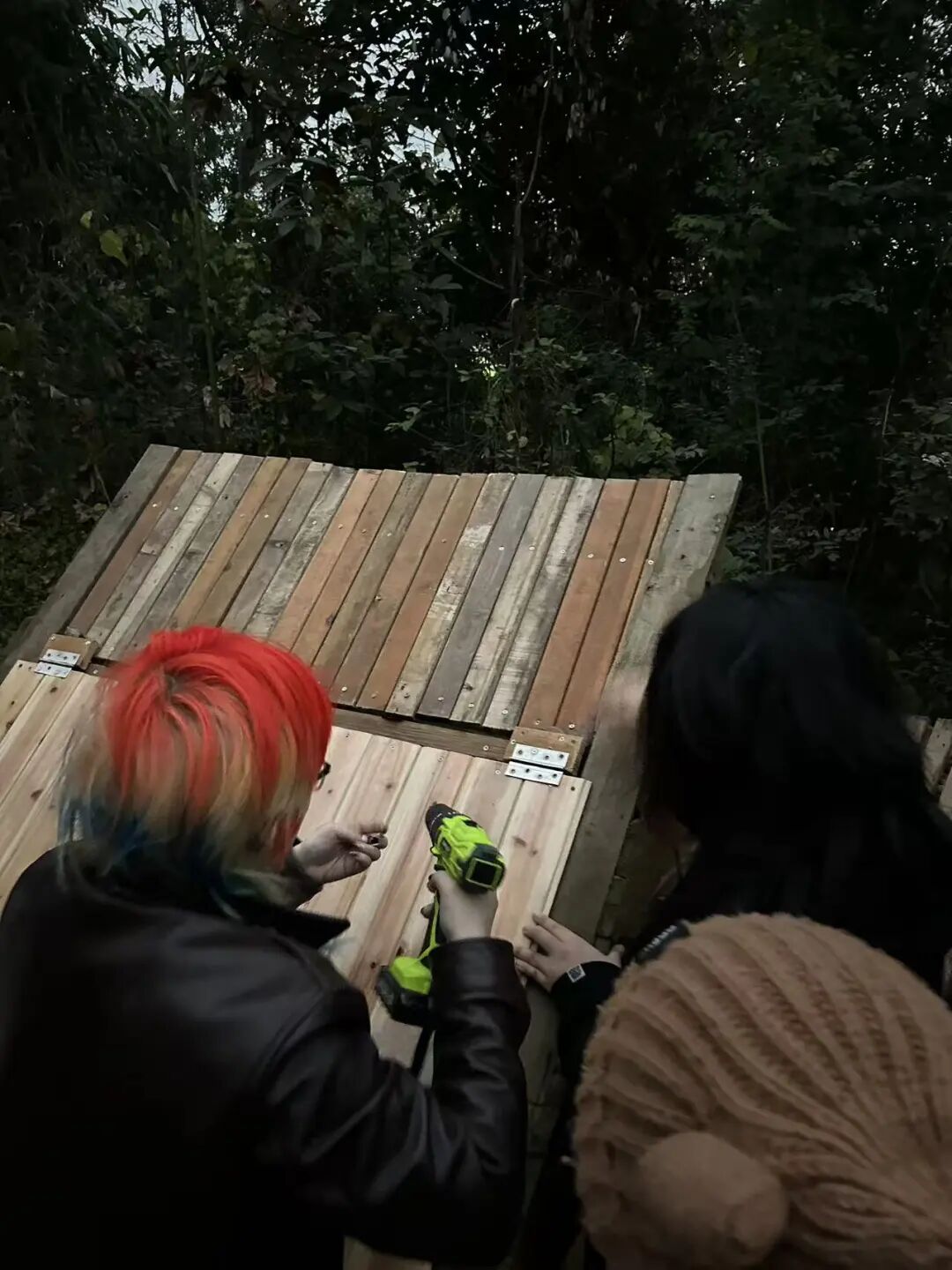
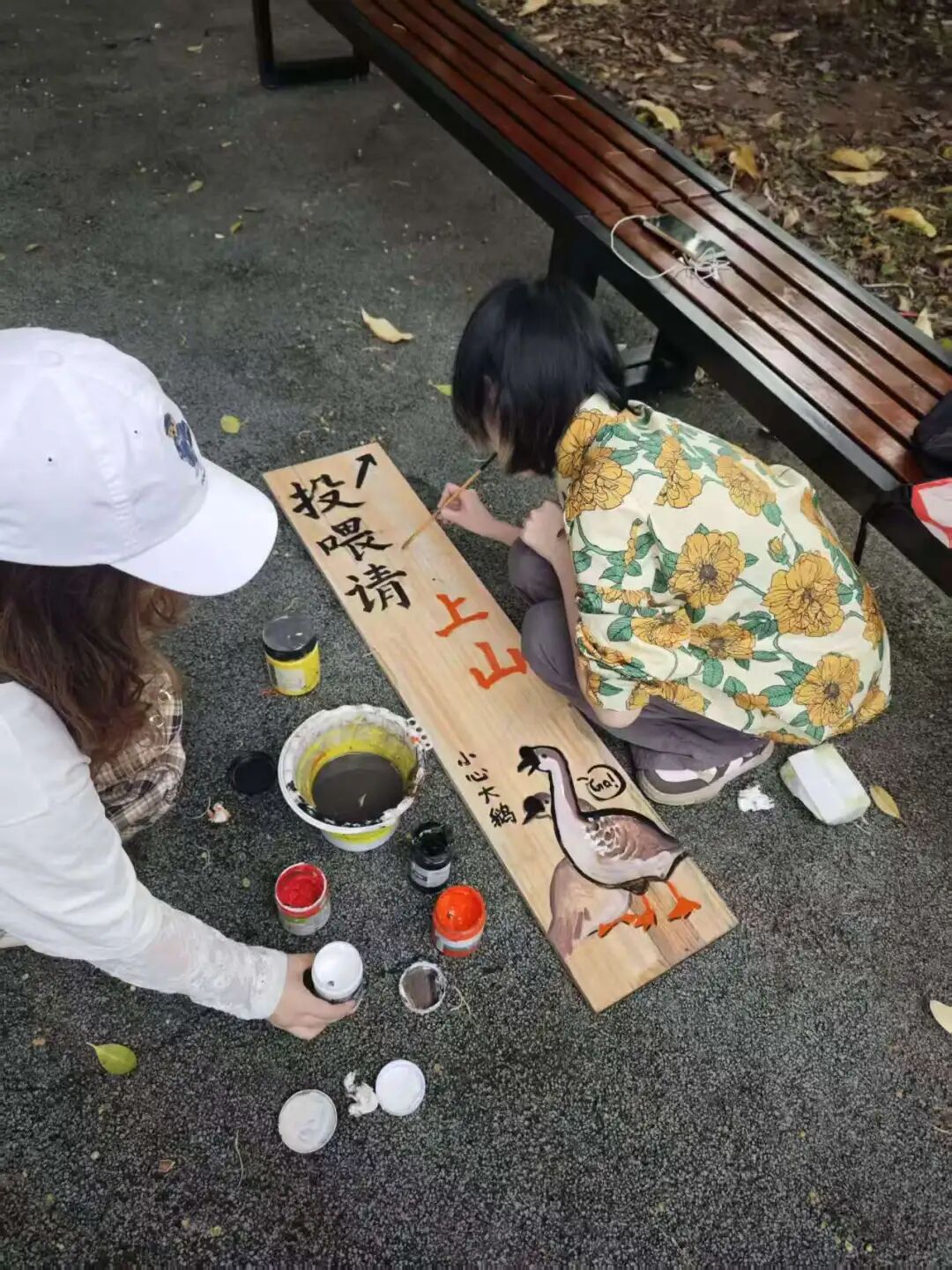
◉ The cooperative’s members hold that, through their shift-based labour, they have carved out of the margins a sustainable ecological space open to anyone who wishes to take part — and that this is in itself a form of resistance to the consumified campus. Image: Xu Lingni
According to the article Jin Lipeng has published, in his vantage point the campus is an eco-village, a food system, and a circular economy system. Did the campus eco-village system as he previously understood it include workers who, facing food scarcity, might resort to stealing chickens? Probably not. Can this accident become the fulcrum of the “art process,” prompting students and staff to re-examine the disorder and complexity of the real world when art intervenes in it?
And were those free, romantic days of raising chickens in the past nothing more than a game—stripped of harsh reality, viable only within the ivory tower? Or is it precisely by allowing such a game to exist that a university upholds its most precious value?
The aftermath of the stolen-chicken incident has been, at times, a cause for quiet lament. Diverging perceptions of the event among the various parties once gave rise to secondary harm among the victims in the public sphere. What emerged was a self-referential paradox: the cooperative’s ideal is to cultivate trust and affection by rebuilding the relationship between humanity and nature through collective labour — and that is precisely what has become a rarity in today’s public discourse.
“Avant-garde ecological practice is inherently accompanied by trial and error and waiting. We will review and consolidate our experience, continue to deepen our existing work, and wait for the right conditions before resuming our exploration.” So the Healing Garden announcement put it.
The only surviving wǔhēi chicken had been given a very anime-style name by the members: “Death Barrier Among the Spider Lilies.” After the incident, she was relocated to a student’s home for protection. Before long, she settled into her new surroundings and began laying eggs every day again.
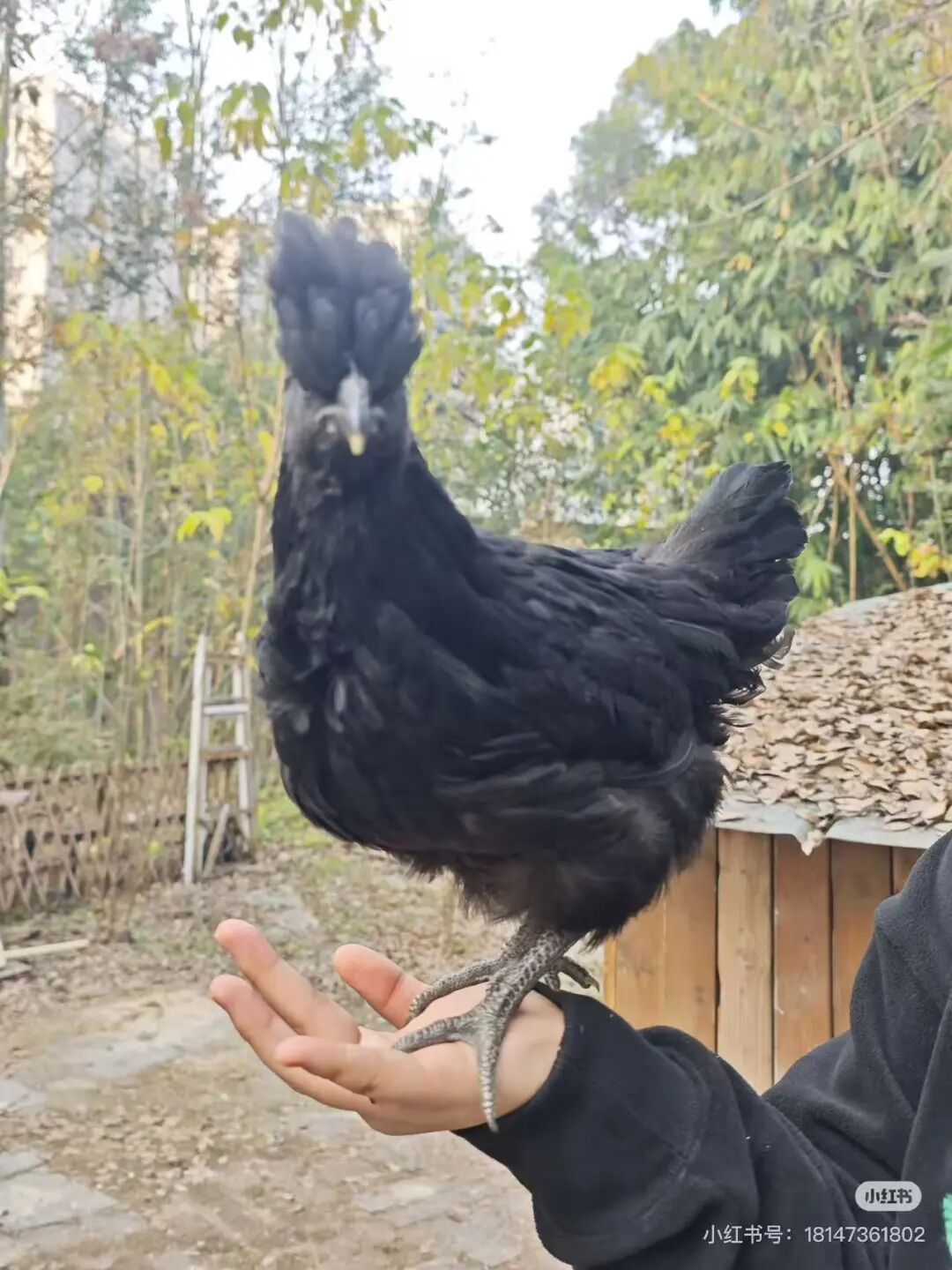
◉ The only surviving Five-Black chicken. Image source: Xiaohongshu, ‘Chuanmei Happy Chick Feeding Cooperative’
– This is Foodthink’s 839th original article –

Foodthink
Author
Kong Lingyu
Director of Foodthink, former environmental journalist
Editor: Tianle
Layout: Xiaoshu
Scan to tip and support original food writing
▼

▼
Click the image to read related articles

▼
Click a keyword to explore more article collections
Seeds|Farming Techniques|Policy|Fermentation|Nutrition|Fruits|Fisheries|Events|Jobs|Food Delivery|Wet Markets|Livestock|Food Talk|Sharing Sessions|Book Club|Harvest Festival|Smallholder Stories|Climate Change|Rural Development|Cooperative Economics|Urban Farmers|Food Safety|Digital Technology|Biodiversity|Pandemic and Food|False Solutions|Ecological Farming Internship Programme
Beijing|Hebei|Shanghai|Guangdong|Guangxi|Henan|Sichuan|Jiangxi|Xinjiang|Shaanxi|Hong Kong|Chongqing|Zhejiang|Jiangsu|Guizhou|Taiwan|Inner Mongolia|Philippines|Canada|Russia|Mexico|Italy|United States|United Kingdom|Germany|Netherlands|Thailand|Sweden|Japan