Don’t Let Crop Straw Become the Last Straw for Village Officials

Peak Straw Burning Ban Season
It was clear to everyone that the crop straw burning ban had suddenly meant business.
Set in 2025, Village A is located in the heart of the Dongting Lake basin in Hunan Province. The flat terrain makes it a major rice-growing area. Spanning several thousand *mu* (≈0.067 hectares) of land, the village primarily grows a single crop of rice, planted in spring and harvested in autumn. Winter months are dedicated to raising crayfish and growing rapeseed. Roughly a third of the farmland lies fallow during winter, or is used for a small amount of double-cropping rice.
“The landowners are all calling me: __PLL_TARGET_QUOTE_PAIR_1__” Zhao Hai remembers vividly. He manages hundreds of *mu* of land for others in Village A. In the past, he would see officials coming to the fields every year to make announcements and mobilise farmers, but the burning always happened anyway.
Sun Weimin, the village’s veteran party secretary, also knows this year is different. Although a national crop straw burning ban has been in place for more than ten years, enforcement has varied from strict to lenient across regions. Village A was always in a more relaxed area. Previously, the county would issue notices to village offices, allowing townships to burn in an orderly, staggered schedule. For years, that was simply how things were managed.
However, from 2022 to 2024, Hunan Province’s air quality indicators failed to meet assessment targets for three consecutive years. This caused the province to “decline in rankings and lose points in the comprehensive high-quality development performance evaluation under the Central Government”s Fight Against Pollution assessment’. By the end of 2025, Hunan’s number of heavy pollution days had surpassed the national threshold, and officials declared that the “situation for atmospheric pollution prevention and control is extremely severe”.
In June 2025, Hunan Province released a plan that, for the first time at the provincial level, designated zones for complete burning bans and restricted burning. Changsha, along with Yueyang, Yiyang, and Changde in the Dongting Lake basin, were all classified as Class I control zones. The proportion of arable land under a complete ban is “in principle, no less than 90 per cent”.
Village A falls squarely within a Class I control zone. By late August, the county where Village A is located issued a notice to tighten the rules: burning is banned across all arable land in the county, with no exceptions allowed “at any time, under any meteorological conditions or air quality circumstances”. The notice is valid for five years, and joint inspections will be organised by the county’s Ecological Environment Protection Commission Office.
The pressure was passed down layer by layer. The township government also released a special work plan. The township’s comprehensive law enforcement brigade formed a dedicated anti-burning patrol team tasked with “immediately stopping” and “fining on the spot” any burning. Village A compiled a dedicated crop straw registry and put together a patrol team of five or six people. They recorded the planted area for every household and went door-to-door to have farmers sign a commitment letter pledging not to burn crop straw.
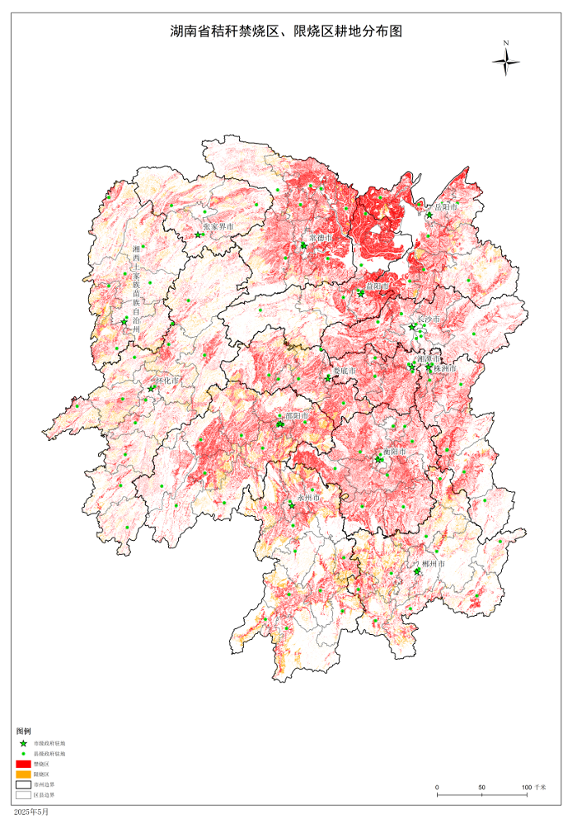
◉Map showing the distribution of arable land within Hunan Province’s crop straw burning ban and restricted burning zones. As can be seen, the plains-based staple grain-producing areas fall almost entirely within the ban zones, leaving no opportunity for staggered, time-phased burning. Image source: *Notice on the Designation of Zones Prohibiting Open-Air Burning of Crop Straw*
Patrols continued well into the night.
When the autumn harvest began in September, the patrol teams started heading out to the fields. Zhao Hai still vividly recalls how the village service team, the town agriculture office, urban management officials, and police all flocked to the village, turning it into a hub of activity. The old village secretary’s voice played on loop over the loudspeakers:
“Over the next couple of days, patrol teams will be out, so absolutely no burning—listen closely, absolutely no burning. You are not permitted to burn even between eight and nine tonight!”
Liu Xiao, a member of the village service team and a village committee cadre, took to patrolling the fields daily upon receiving the assignment. Whenever a hotspot was spotted, he would rush out to extinguish it. By the end of the day, the battery on his electric scooter was completely drained.
He would snap photos of himself working outdoors at 8 or 9 pm and post them in the official group chat, complete with timestamps and location tags. Sometimes the pictures only showed the road: it was too dark to make out the fields, but he needed proof that he was still on patrol.
Under policy requirements, two teams operate at the town level: one comprises county-level departments assigned to assist the town government, and the other is a dedicated inspection team from the Atmospheric Environment Protection Office (colloquially the “Blue Sky Office”). Both conduct daily village inspections. On top of this, municipal and provincial unannounced inspection teams occasionally carry out surprise raids.
At the grassroots level, satellite remote sensing and tower-based video surveillance have long been established technologies for monitoring changes in agricultural land use, making them ideal for tracking straw burning. The former captures thermal anomalies across a radius of up to a hundred kilometres as satellites pass overhead. The latter employs 24-hour high-definition cameras scanning fields within a few kilometres, triggering alarms for suspected fires. This system has effectively become the town’s law enforcement brigade’s primary tool for monitoring real-time hotspots.
The process for real-time monitoring and extinguishment typically unfolds like this: around 6 pm, an on-duty town official posts a photo in the work group chat, @village cadre: “Fire spotted to the north-east of Tower Number [X] in [Village Name]. Please attend to it.” The official simultaneously shares another photo with the note, “Cameras have been moved away”—presumably to avoid generating an official hotspot record. Within ten minutes, two village cadres reply in unison: “Dealt with.”
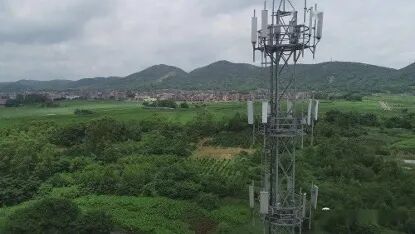
◉The “Iron Tower Sky Eye” surveillance system, developed by China Tower Corporation. Image source: C114 Communication Network
If even a minor hotspot appears in a village, officials at every level risk disciplinary action. Feedback from the Hunan Provincial Ecological and Environmental Protection Inspection between 2023 and 2025 reveals that numerous cities and counties have been publicly reprimanded and summoned for talks due to inadequate hotspot management. Near Changsha, it is reported that because one town recorded three hotspots while another had only two, the municipal inspection team, seeking to make an example, dismissed an official from the agriculture department. Meanwhile, in the county hosting Village A, two section-level officials have already been removed from their posts.
“You can sanction the township and the village, but you are powerless when it comes to the locals; there are no real constraints,” said Sun Weimin.
Ultimately, all the pressure falls on the village committee. Sun Weimin even keeps his phone close at hand while sleeping, with notifications enabled, so that whenever a new message arrives in the group chat, he can quickly check whether the tower in the photo is the one in his own village.
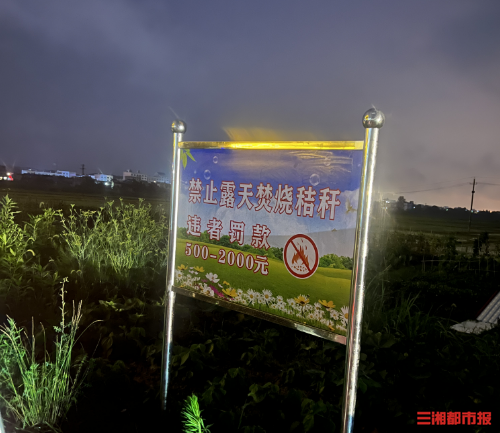
◉A warning sign detailing fines for burning crop straw in a city in Hunan Province. Source image: Sanxiang Metropolis Daily
Although the policy explicitly stipulates fines ranging from 500 to 2,000 yuan, Sun Weimin says that ultimately, each village can only detain one or two individuals just to go through the motions. There was even a farce in which an 80-year-old man was held, only for his son to keep delaying his release. Despite countless rounds of mediation and even a summons for the village committee, they still failed to collect a single fine.
The veteran party secretary’s repeated loudspeaker warnings that “you absolutely must not burn between eight and nine o’clock” were certainly well-founded. At that hour, a day’s sunlight had dried the crop straw until it was loose and highly flammable, and the patrol guards had already gone home for dinner. Sometimes, the surveillance cameras had also quietly swivelled out of view. And so, by eight o’clock, flames would once again flicker up across the fields.
“Can I be honest? They burned it all in the end.”, said a villager. Liu Xiao, who was in charge of the patrols, also admitted that the few mu of land his family owned were ultimately burned as well.
Yet the arduous, futile patrols dragged on for three full months. Hiring someone to patrol the village for a single day costs at least 100 yuan. A village group leader explained that as long as a patrol was organised, the village had an answer for government inspectors: they could claim personnel were on duty and the job had been done properly. “They were set on burning it; I couldn’t stop them.”
Zhao Hai went further, noting that at both the village and township levels, sending people out to patrol was little more than a formality. “If there wasn’t even anyone out patrolling, we’d be getting reprimanded. They’re not making it easy on themselves, so we ought to show some understanding.”
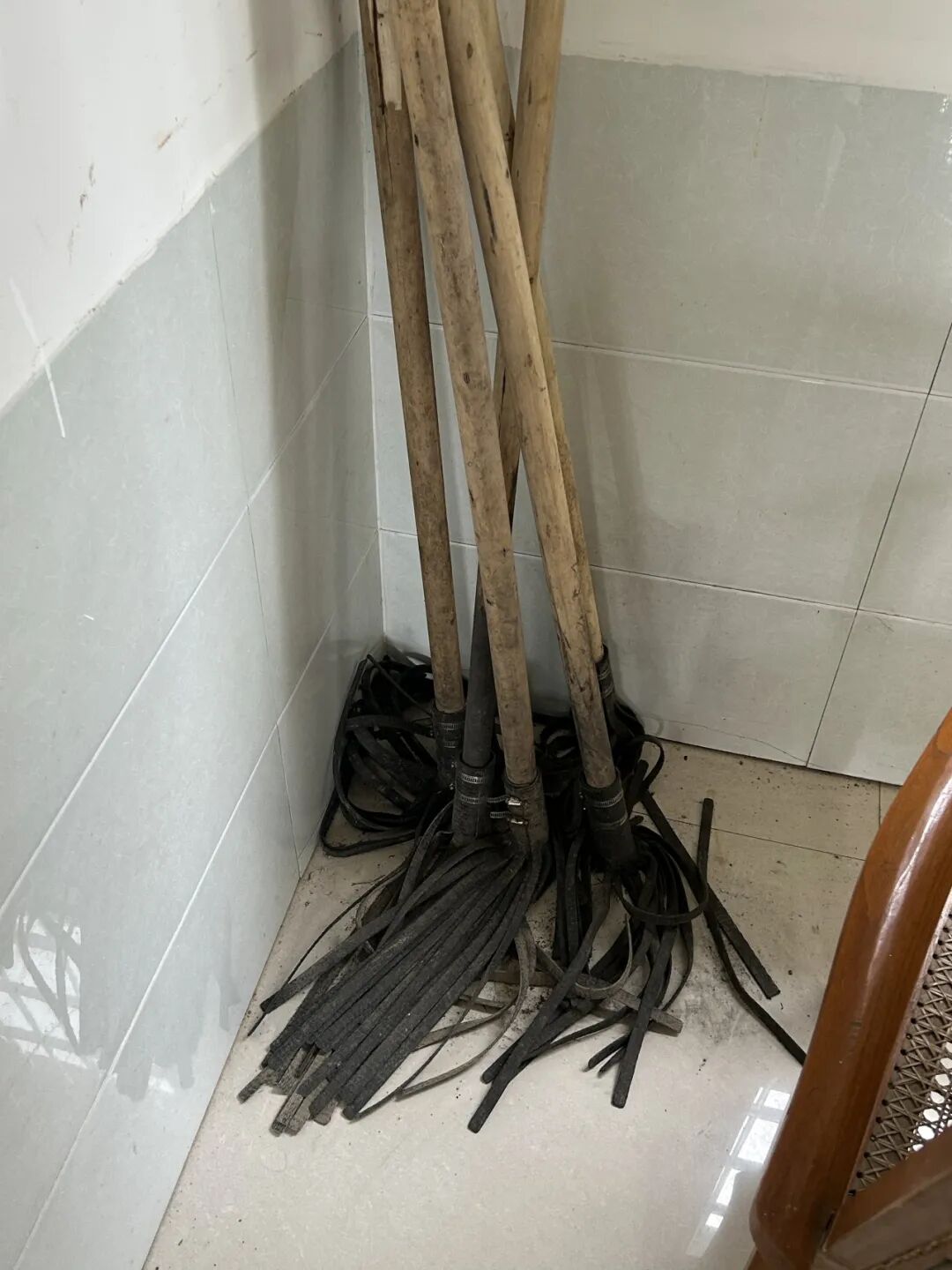
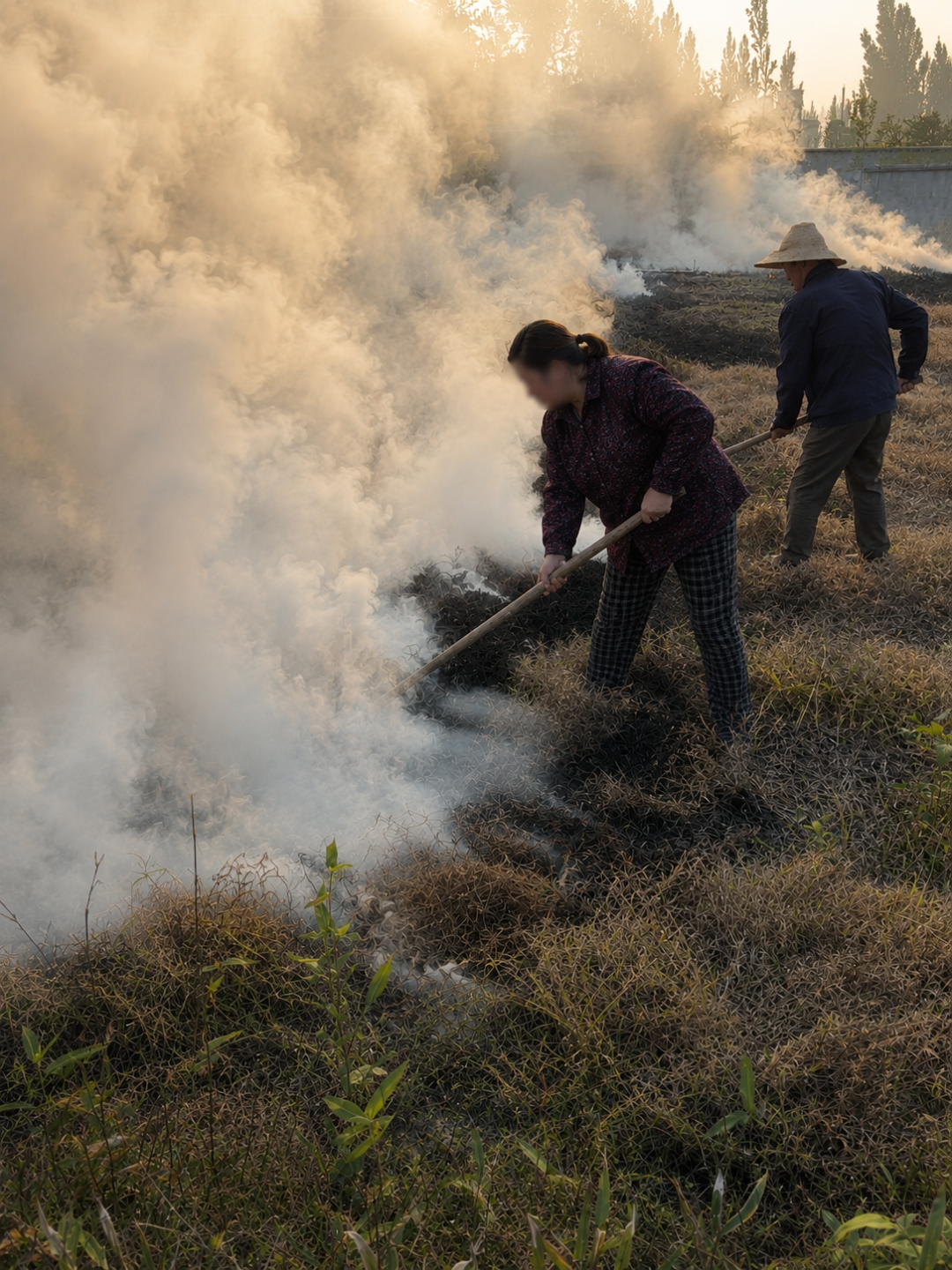
◉Left: brooms used by the village patrol to extinguish fires; Right: a village committee member in charge of finances assisting with firefighting (to protect the interviewee’s privacy, the right image is AI-generated from a photo provided by them).
What to do with the rice straw?
Village and township officials were also grappling with how to dispose of the crop straw. In Village A, the primary task during the 2025 autumn harvest was to coordinate with buyers and agricultural machinery operators to clear the straw away.
One approach is to bale the straw and haul it away; the other is to shred it and till it into the soil or leave it to cover the ground surface. In technical terms, these methods are referred to as “field removal” and “field incorporation”.
Village A initially opted for baling and field removal. Baling machinery arrived in September, but ultimately only covered around two or three hundred mu of land.
In promotional videos online, large baling machines seem to clear fields spotless in a matter of minutes, with some integrated models capable of harvesting and baling simultaneously. Yet, in Zhao Hai’s view, the machines brought to his village were “nowhere near that sophisticated”. They frequently broke down during operation, requiring workers to manually clear the straw from inside.
Smallholder farmers also operate on different harvesting schedules. Although it is all single-season rice, planted in April and harvested in September, some households have already finished harvesting and drying, waiting to flood their fields for crayfish farming (around a third of the village’s arable land is dedicated to crayfish, representing the most vital income source for locals), while adjacent plots may only just be starting. By the time a baling machine arrives, a single rain shower can ruin the straw for collection, leaving operators to return empty-handed once again.
Furthermore, although the agricultural machinery operators receive subsidies for baling, they are not responsible for the straw’s transport or sale. Consequently, large quantities of straw end up piled around houses and along field tracks. The village committee engaged an agricultural company building a local straw collection and storage centre, agreeing that the straw would be processed into feed and sold to livestock farms.
At that stage, however, the agricultural company informed Sun Weimin that the shredding machinery was broken and required a transformer upgrade. Once the technical issues were resolved, the company claimed the market had dried up. The village had little choice but to transport the straw collected from more than 100 mu to the company’s yard. By then, the site was already stacked with bales of all sizes from several neighbouring villages. This straw remained unsold even by the summer. Sun Weimin noted that straw from several such collection points had ultimately failed to find a buyer.
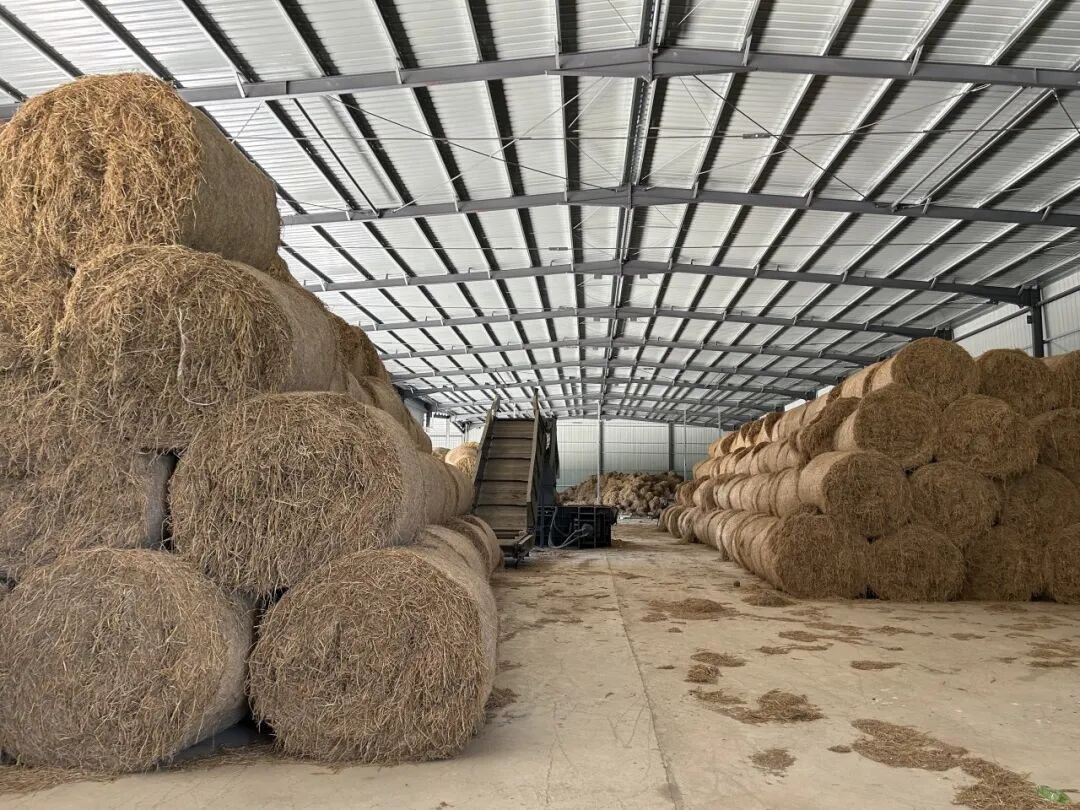
◉Inside the agricultural company’s warehouse, the steel roof is brand new; large stacks of crop straw are stored in a concrete-paved open area constructed over land allegedly designated as basic farmland.
The farming season waits for no one. By early October, rapeseed planting machinery had arrived at the fields. The company stepped in to help again, transporting the remaining straw bales from roughly 150 mu of field margins onto the village road. During the National Day holiday, the village spent another thousand yuan or so hiring a tractor to drag the straw to the open ground behind the village committee office. The committee found itself racing against the clock day by day.
The hardship involved is hard to describe without having experienced it firsthand. One farmer recalled that, despite having only three or five mu of land, it still took him three days to haul the crop straw home himself in his vehicle, and the weather was still sweltering at the time.
Unfortunately, the weather failed to cooperate. Soon, days of relentless rain set in, causing the unbailed straw to rot in the fields and turning the ground to mud, making it impassable for vehicles. Sun Weimin still recalls how a local crayfish farmer, whose straw had not yet been cleared, came to the village committee every day to lodge complaints. Meanwhile, with straw piled outside the committee building, the offices and warehouses soon became infested with vermin.
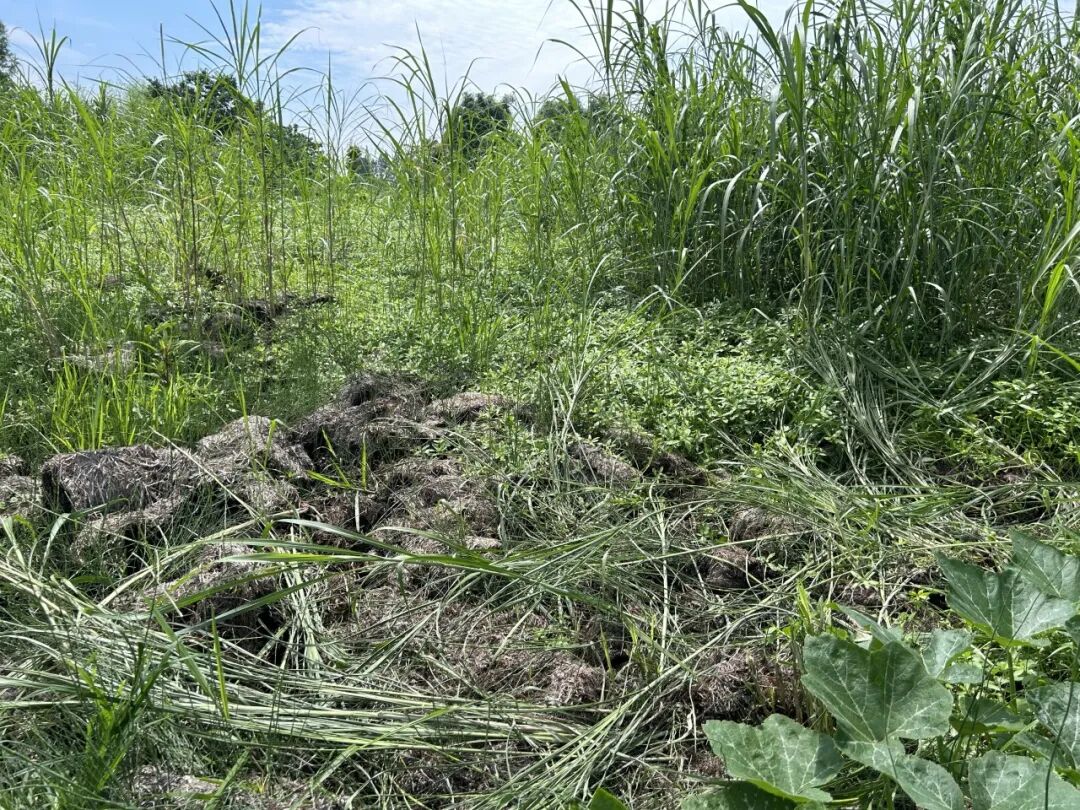
◉Early June 2026. At the village entrance, the rotting straw pile is surrounded by wild grass taller than a person.
After waiting impatiently for the skies to clear, villagers, fearing delays to the next season’s planting, found themselves burning crop straw once more. The village committee hurriedly deployed a straw shredder dispatched by the town to prepare the fields. But complaints were widespread: the straw was too thick to shred effectively; the timing was too late, delaying rapeseed sowing and threatening the harvest; and the heavy balers, combined with straw bales weighing over a hundred jin (500 g each), had compacted the soil so thoroughly that planting became impossible…
Meanwhile, the straw pile outside the village committee building had started to rot, with weeds pushing through. One day, it suddenly caught fire. A neighbouring town had once seen a massive straw stack burn for an entire week; whether the blaze was deliberately set or an accident, no one could say.
This time, however, only black smoke billowed out. The straw had been soaked by rain and packed tightly during baling, refusing to catch properly. With little choice, locals quickly hosed it down and hired labourers to level the pile.
“Watching them go about it, I’d just want to laugh, but there was nothing I could do,” Zhao Hai sighed.
By this stage, of the village’s several thousand mu of farmland, only two or three hundred mu had undergone field removal, and just over a thousand mu had completed shredding and field incorporation. Vast quantities of crop straw still lay piled in the fields, yet October was already half over. Growing impatient, villagers began burning intermittently.
“Monitoring blind-spot”
Then, quite suddenly, a chance emerged.
As noted earlier, the high-definition cameras mounted on China Tower Corporation’s towers can sometimes be swivelled away. Though no official guidelines specify when or by whom this is done, villagers know full well that these monitoring blind-spots tend to appear regularly.
A rumour, allegedly circulating within government circles, spread quickly. “We’ve got a few hours today!” The village committee immediately notified the heads of each village group, who relayed the message to individual farmers desperate to clear their straw storage, ready to sow rapeseed and flood fields for crayfish. The instruction was blunt: the cameras would be averted between set hours, so burn it now!
The rain had ceased days prior, leaving the unbundled straw thoroughly dried out. Neat lines of dry straw stretched across the fields. It only took someone to ignite one end, and the flames would quickly spread, engulfing the entire stretch.
A village ten kilometres away struck the first match, followed by Village A, and then another settlement to the south. “It sparked off everywhere all at once!” “You could see it from dozens of kilometres away in the county town. Plenty of police turned up, but what could they do? The law doesn’t punish the many,” villagers remarked.
The scale in other villages remains unclear, but in Village A alone, at least 1,000 mu of farmland went up in flames, burning for three to four hours. Villagers described the sky as burning a vivid red.
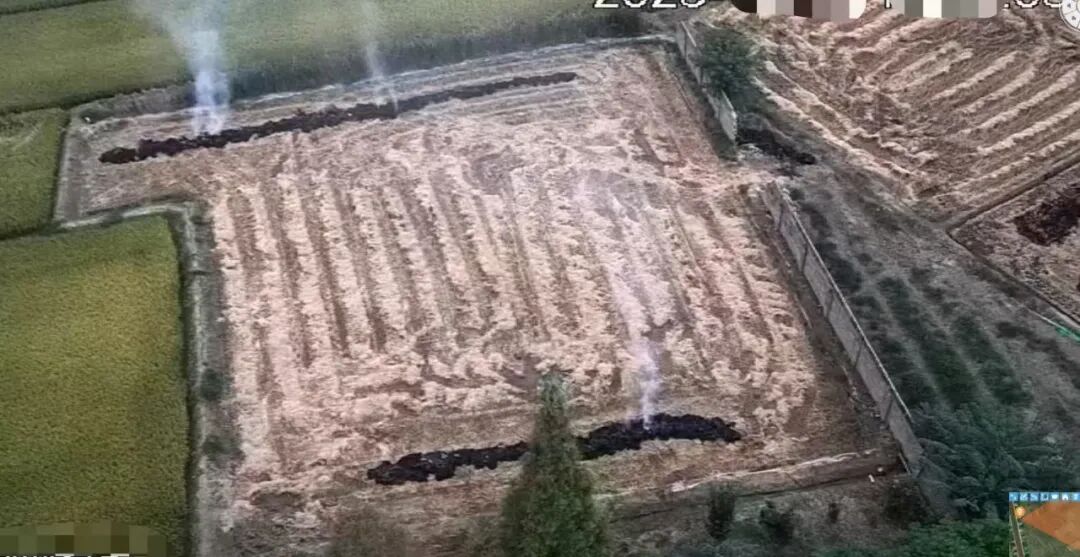
◉In a photo from another tower-mounted surveillance camera, the traces of burning are clearly visible. Image source: interviewee
Hearing people say “the villagers are grateful to you,” Sun Weimin’s mood turns sour. He has worked on the village committee for decades, witnessing the era of agricultural taxes and weathering flood relief efforts. He is accustomed to spending entire days in the party branch office, dozing off in his chair and being interrupted at any moment to handle or mediate matters for the locals. But when it comes to the crop straw burning ban, he has little more to say; it simply gives him a headache.
Predictably, officials from above came down. By the following evening, the village to the south had barely burned for two hours before being ordered to halt. Fortunately, Village A had already finished. It was then they learned that provincial inspectors would be arriving the very next day.
This time, however, it was not as easy to bluff past as the tower-mounted cameras. Provincial verification relies on satellite imagery, meaning vast swathes of scorched black earth would be laid bare under the satellite’s unblinking eye. The town government hurriedly conferred with Village A, organising 16 large rotary tillers overnight to churn the burnt topsoil back into the fields. The operation cost 60,000 yuan in a single night, reportedly footed by the town government. At last, the crisis had passed.
But Sun Weimin’s work was far from over.
By late October, rain had fallen across the town. In the crop straw burning ban work group, one member quipped: “Finally, I can get a proper night’s sleep! If anyone is so “diligent” as to burn in the rain, they really ought to be heavily commended.”
By December, rapeseed had been sown and young crayfish were beginning to thrive, yet villagers, enjoying the winter lull, still wanted to burn off grass in the fields and around their homes to curb next year’s pests, or to clear away rubbish, dead branches and fallen leaves, or even to set off firecrackers. Yet all of this was strictly forbidden: according to the monitoring metrics used by China Tower and the environmental authorities, any flame that breaks out is registered as a hotspot.
Messages continued to flood the group chat:
“On X December, the provincial authorities reported X hotspots across our city. Today, the meteorological bureau has issued a yellow haze warning, forecasting heavy haze over the next 24 hours. The current situation is extremely severe.”
“An inspection team seconded by the municipal bureau moved in last night. At 10 p. m., they conducted spot checks on duty rotations at both the X town and village levels. Patrol and duty staff at both the town and village levels are requested to intensify patrols during key periods…”
“I urge everyone to overcome difficulties, strictly maintain duty shifts, strengthen patrols and controls, and completely eliminate open-air crop straw burning. The municipal authorities will dispatch undercover inspection teams. I ask that no one let their guard down; let us hold firm for these final five days and protect the results of over three months of hard work.”
“Only three days remain of the annual burning ban campaign!”
Who will foot the bill?
Sun Weimin reckoned that Village A alone spent 400,000 yuan this year on crop straw management. This covered baling, hiring patrols and monitors, transporting straw, shredding it, and the overnight hire of 16 rotary tillers to churn the fields. It also included a further 80,000 yuan spent in late October on a new small-scale baler for the village—though it ultimately went unused. Most of the funding came from higher-level governments, but “that is still taxpayers’ money,” he lamented. Why couldn’t those funds be put towards building roads and bridges, or improving infrastructure?
Factoring in the yield of crop straw per *mu*, and drawing from his own experience of paying to transport it away, he estimated that the agricultural company operating the aforementioned straw collection and storage centre would face transport costs alone exceeding 4 million yuan.
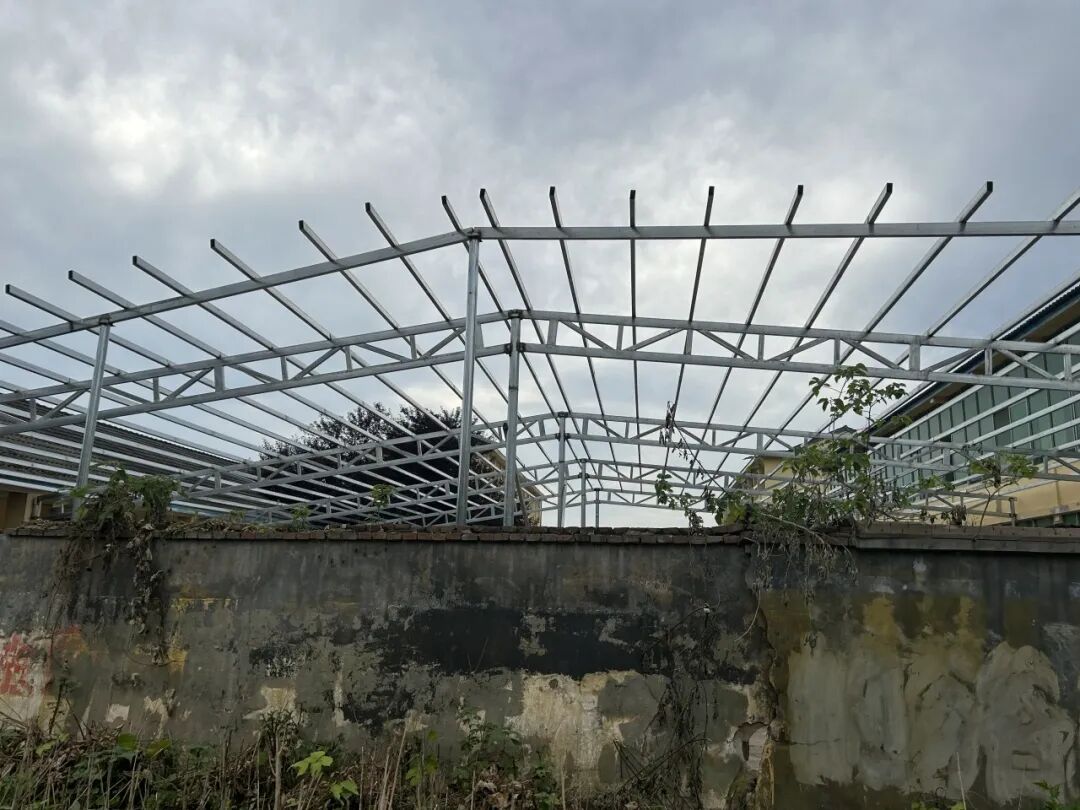
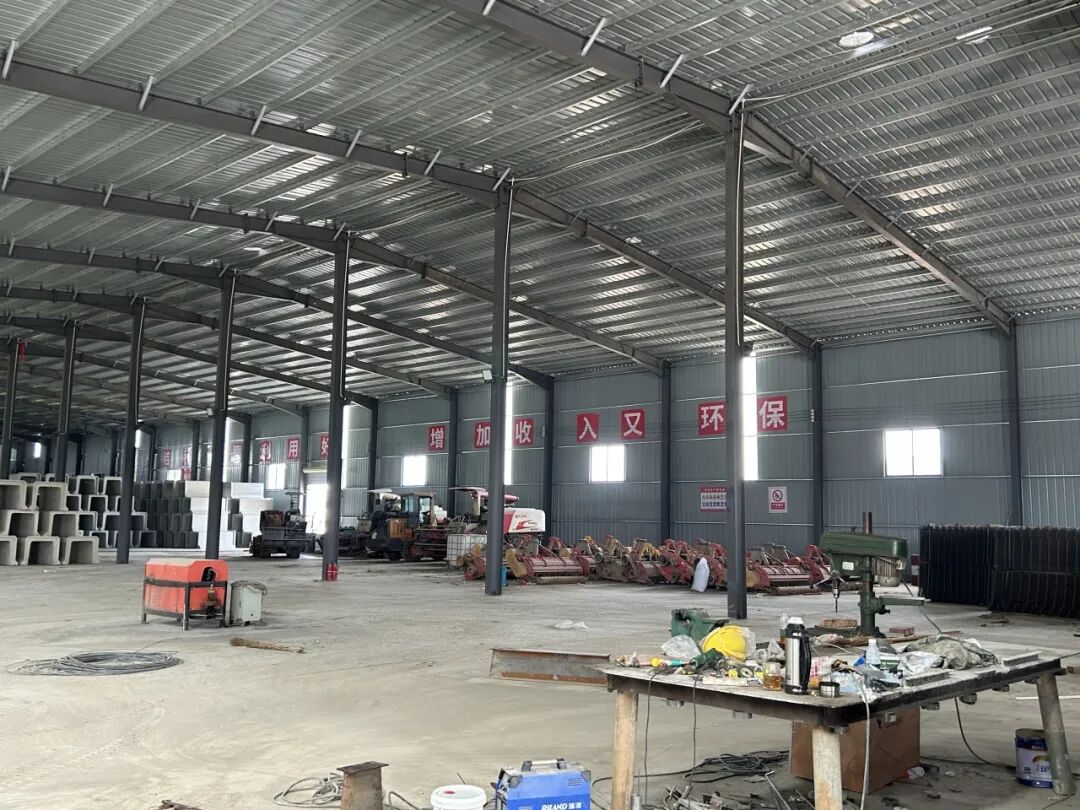
◉(Top) Another large-scale crop straw storage site in the town where Village A is located. Locals say that a larger volume of crop straw was piled here last year. It has since been cleared, but the steel shed framework remains unfinished. (Bottom) A crop straw collection and storage centre in another county in the lake district. The crop straw has reportedly been transported away, and the site is temporarily rented out for storing precast construction components.
However, more than a decade into the crop straw burning bans, experiences from across numerous provinces exploring field removal have consistently shown that, given crop straw’s low calorific value and nutrient density alongside its sheer volume, enterprises such as power plants and livestock farms have little interest in purchasing it, let alone bearing the high cost of transportation.
Chen Jing, Associate Professor at Northwest A&F University, conducted field research on crop straw field removal in Anhui. He discovered that most collection and storage centres could not even recycle 30 per cent of the straw within their designated areas, and that government subsidy incentives consistently failed to stimulate demand, ultimately because the profit margins were simply too thin.
When companies fall short of “collecting all available straw”, Sun Weimin has heard that two villages in the town independently secured their own buyers. Yet, merely transporting the straw from the fields onto the purchasers’ trucks resulted in losses amounting to tens of thousands of yuan.
Furthermore, crop straw field removal remains heavily reliant on subsidies. Given that many local authorities are under financial strain, scholars estimate that such support will be difficult to sustain over the long term. This aligns closely with our own findings. Two interviewees confirmed that a local company specialising in crop straw collection and storage has yet to receive its full subsidy payments. Meanwhile, farmers in Village A and another locality near Changsha who participated in field removal and incorporation operations applied for subsidies last year, yet as of early June this year, neither the county nor the city authorities had processed their approvals.
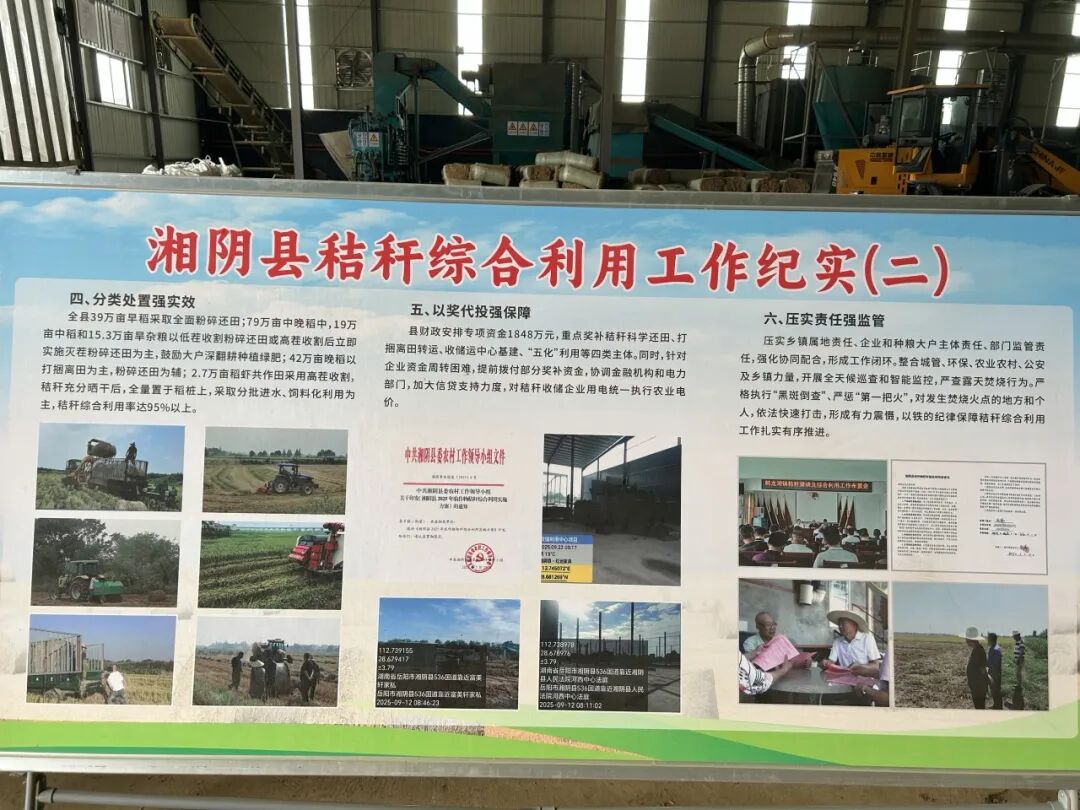
◉A promotional notice at a crop straw collection and storage centre in Xianyin County, Yueyang City. The owner says its collection volume exceeds 10,000 tonnes, with this year’s selling price at 650 yuan per tonne.
In fact, in January 2025, the Standing Committee of the Hunan Provincial People’s Congress passed the *Provisions on the Comprehensive Utilization of Crop Straw in Hunan Province*. As the first provincial regulation nationwide to govern comprehensive crop straw utilization, it explores “orderly burning”. Specifically addressing the pest outbreaks triggered by years of field incorporation in Hunan, it states: “For crop straw in burning ban zones carrying quarantined pests or diseases that require incineration, open-air burning may be permitted once the county-level agricultural, rural, and ecological environment departments have implemented safe and controllable measures.” Some commentators view this as a constructive attempt to shift straw-burning management from an outright ban to restricted burning, introducing a more controlled relaxation.
However, a township agricultural official disclosed that the *Provisions* had barely come into effect before being sidelined within the government apparatus due to pressure from environmental oversight. Hunan has now entered its strictest-ever phase of crop straw burning restrictions.
April 2026 brings the rapeseed harvest. Village A’s crop straw burning ban, patrols, and mobilisation efforts begin all over again. The village committee has bound a fresh record book and placed it in the office, ready for inspection by higher authorities.
– This is Foodthink’s 819th original article –

Foodthink
Author
Pei Dan
A writer who has returned to her craft, focusing on the individuals affected by climate change, ecological shifts, and broader societal transitions.
Zhao Hai, Sun Weimin and Liu Xiao are pseudonyms used in this article.
All photos are by the author unless otherwise credited.
Editor: Ling Yu
Layout: Ming Lin
Scan to donate and support original food journalism.
▼

▼
Click the image to read related articles.
▼
Click on keywords to browse more article collections
Seeds|Farming Techniques|Policy|Fermentation|Nutrition|Fruit|Aquaculture|Events|Recruitment|Food Delivery|Wet Markets|Livestock|Food Talk|Sharing Sessions|Book Clubs|Harvest Festival|Smallholder Stories|Climate Change|Rural Development|Cooperative Economy|Urban Farmers|Food Safety|Digital Technology|Biodiversity|Pandemics & Food|False Solutions|Agroecology Internship Programme
Beijing|Hebei|Shanghai|Guangdong|Guangxi|Henan|Sichuan|Jiangxi|Xinjiang|Shaanxi|Hong Kong|Chongqing|Zhejiang|Jiangsu|Guizhou|Taiwan|Inner Mongolia|Philippines|Canada|Russia|Mexico|Italy|United States|United Kingdom|Germany|Netherlands|Thailand|Sweden|Japan