Yearning for Nature in the City, Yearning for Air Conditioning on the Land: Modern People

After completing my undergraduate degree in 2025, I did not rush into a stable job. Instead, I wandered, exploring what I believed a good life might look like. As I grew older, I began to realise—I, who had grown up between cramped buildings and concrete—that nature could soothe me, hold me. Stepping into nature meant ease; yet the moment I stepped back out, a sense of weight would settle upon me, and the anxiety that pervades human society would flood through my body all at once.
Among all trades, agriculture is relatively close to nature. So I enrolled in Foodthink’s 2026 Ecological Agriculture Internship Programme and arrived at Baicao Garden in Guigang, Guangxi, in early March this year.
Does the Peach Blossom Spring Exist?
Within Baicao Garden, a small ecological Peach Blossom Spring had taken shape: kitchen scraps and manure served as composting material; plastic waste was carried to town to be discarded; all toiletries were eco-friendly products, so when washing up, one could simply let the suds flow unselfconsciously down with the water, following the slope of brick and stone into the land, entering the soil runoff; neither crops nor fruit trees were treated with pesticides or chemical fertilisers, left to grow “savage” and wild.
Yet at the very edge of the wogan mandarin grove at Baicao Garden, separated by no more than a few metres, lay another orchard — another world.
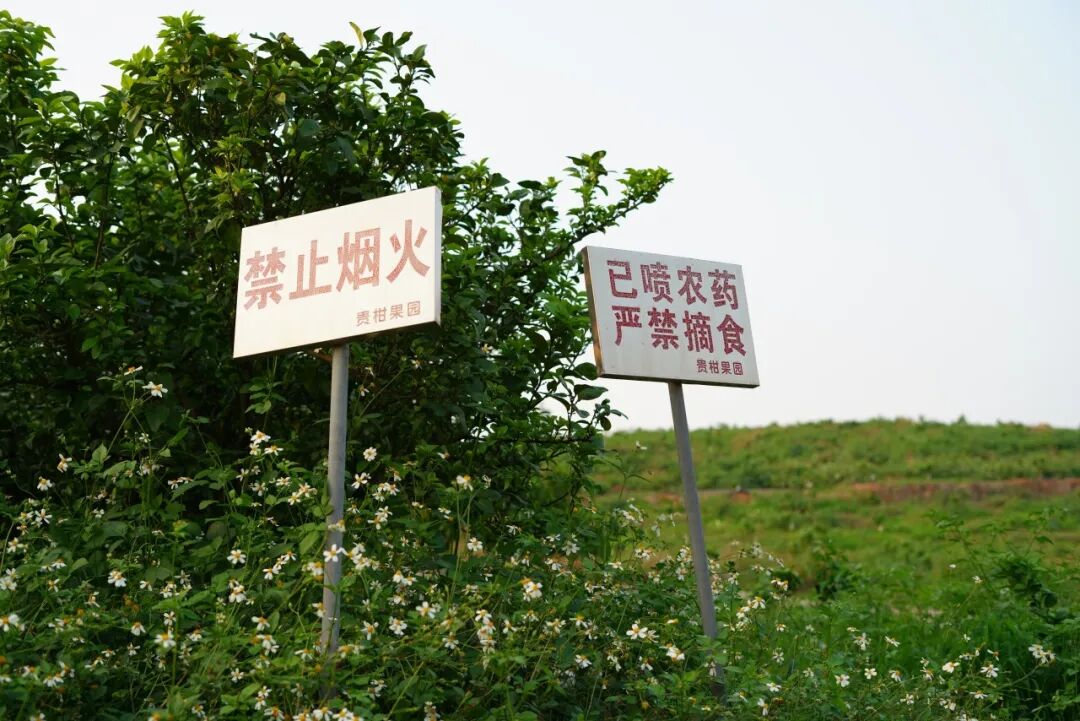
◉ The signboard of the neighbouring orchard.
Golden, plump fruit hung thick on every branch of the conventional trees, and the ground at their edges was nearly bare — a stretch of bleak, sun-scorched yellow. By contrast, the fruit trees at Baicao Garden bore only a few rough, unmarketable fruits left behind, with weeds crowding the base of each tree — some sprouting right beside the roots, their stems winding between the fruit branches. This was the most obvious visual contrast I could perceive between conventional and ecological cultivation here. What was subtler was the difference in taste. The conventional wogan mandarin leaves a cloying sweetness lodged in the throat, sticky and clinging, unable to sink into the body; the wogan from Baicao Garden are clean-sweet and pleasant, soaking gently into one’s insides without leaving a trace. Such differences must be savoured slowly, turned over on the tongue, felt with the whole body.
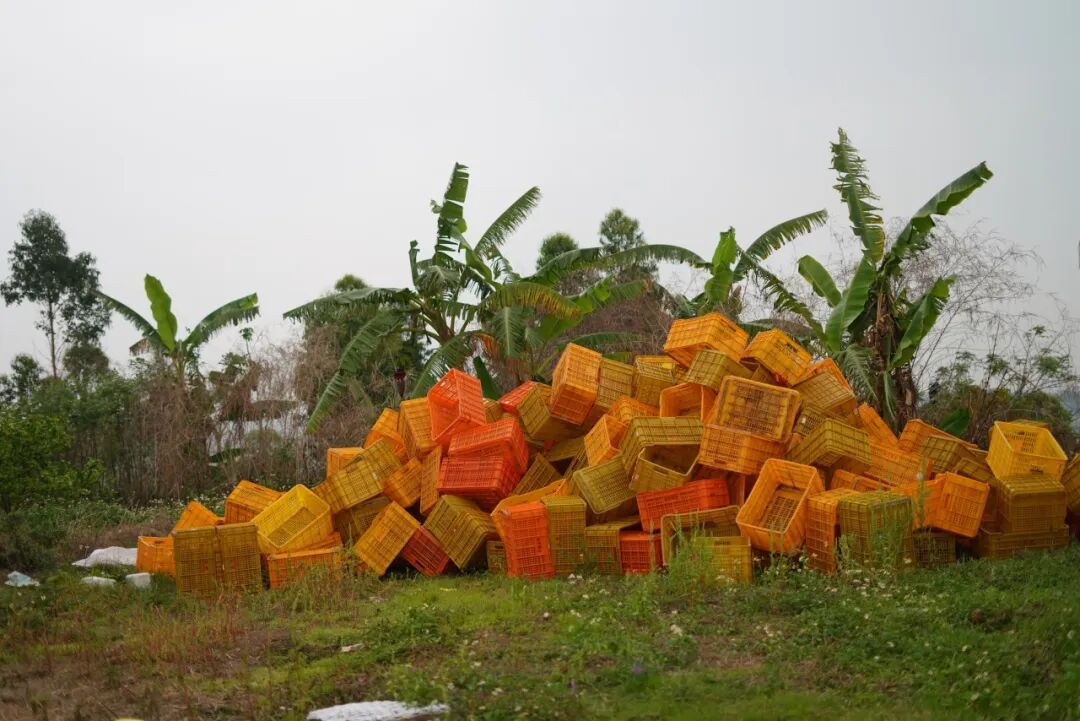
◉ The fruit crates of the neighbouring orchard.
On another small hillside not far from Baicao Garden, every tree and every blade of grass had been uprooted, annihilated. In the end, the same bleak, bare yellow remained. In April, fruit trees were planted on this land; drip-irrigation pipes criss-crossed the ground, and the plastic waste buried in the soil lay exposed.
One morning, we were clearing a new plot of land that Sister Yan Ping had just rented, and the first thing we did was pick up litter. The waste in the soil consisted mainly of plastic film, plastic bags, plastic bottles, pesticide and fertiliser sacks, and woven polypropylene sacks. Some rubbish had been buried so deep that one could not sense where it ended. Some was a tangled knot that resisted both cutting and untangling — as you pulled it upward, it crumbled slowly, and countless white flecks burst from the broken edges. Collecting rubbish is a sorrowful task. The plastic waste in farmland can never be fully cleared; I joke that I am Sisyphus the litter-picker.
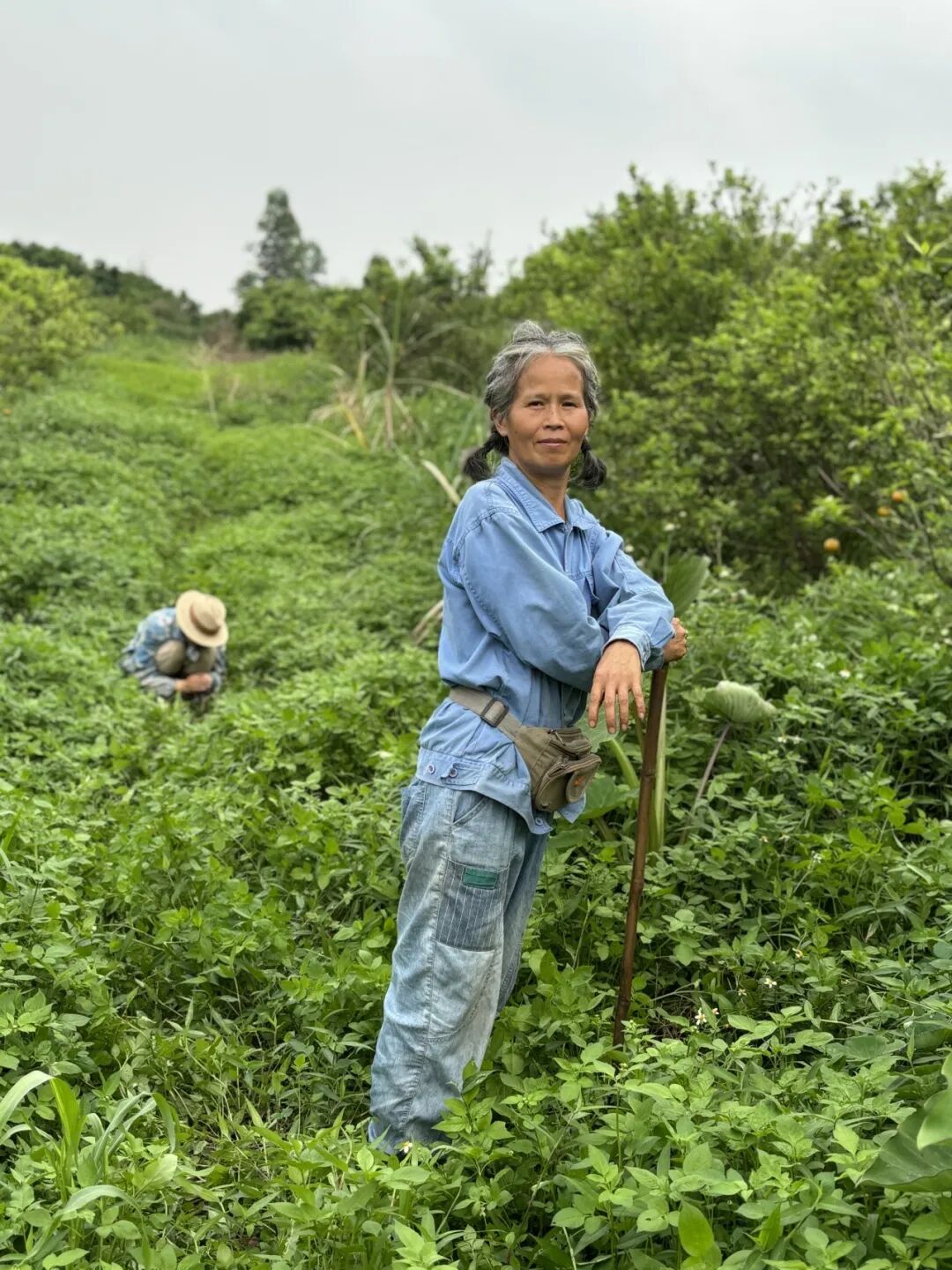
◉ Sister Yan Ping at work. Photo: Chen Yujun
Sisyphus and the Slowness of Agriculture
When I first started doing farm work, I often felt like Sisyphus too. At the beginning, farm work struck me as repetitive, tedious, slow, and endless.
Hoeing at Baicao Garden was the first time I had ever held a hoe. I did not know how to grip it, how to swing it, and could only watch Sister Yan Ping’s or Xiaona’s movements in silence, trying to learn by observation. Then I would lift the hoe awkwardly and hoe the soil awkwardly, feeling entirely out of sorts throughout. Under such ungainly movements, the hoe went every which way, and it was nearly impossible to dig a proper pit. Before long, my body was weary and a faint sense of frustration began to creep in.
Agriculture is inherently a slow affair. When I was working the land, my slowness came from not yet having truly mastered the technique; the skilled farmers, by contrast, could set a seedling in the ground in just a few seconds. Their speed was in fact built upon a long, slow accumulation of skill.
Yet not all slowness is the same.
There is a kind of slowness that is low in quality. When the mind is elsewhere and one is not fully engaged in what one does, time grows diffuse and tedious. Time stretches out, yet nothing settles, nothing deepens; one never enters the task itself. This slowness is, at its core, a form of drift and depletion. And then there is a good kind of slowness. Like pacing slowly, letting thoughts unfurl unhurriedly; like working without haste or rush, with body and attention both fully present. This slowness is time with density. The question, then, is never whether things are fast or slow, but whether one has truly entered time itself.
Later, as my body gradually forged a good partnership with the tools, I would occasionally feel a lightness — lifting the hoe gently, then letting it fall under its own weight. The soil would dip, giving way to a small opening, and with a slight pull toward the body, a little hollow would appear. A small sense of achievement followed.
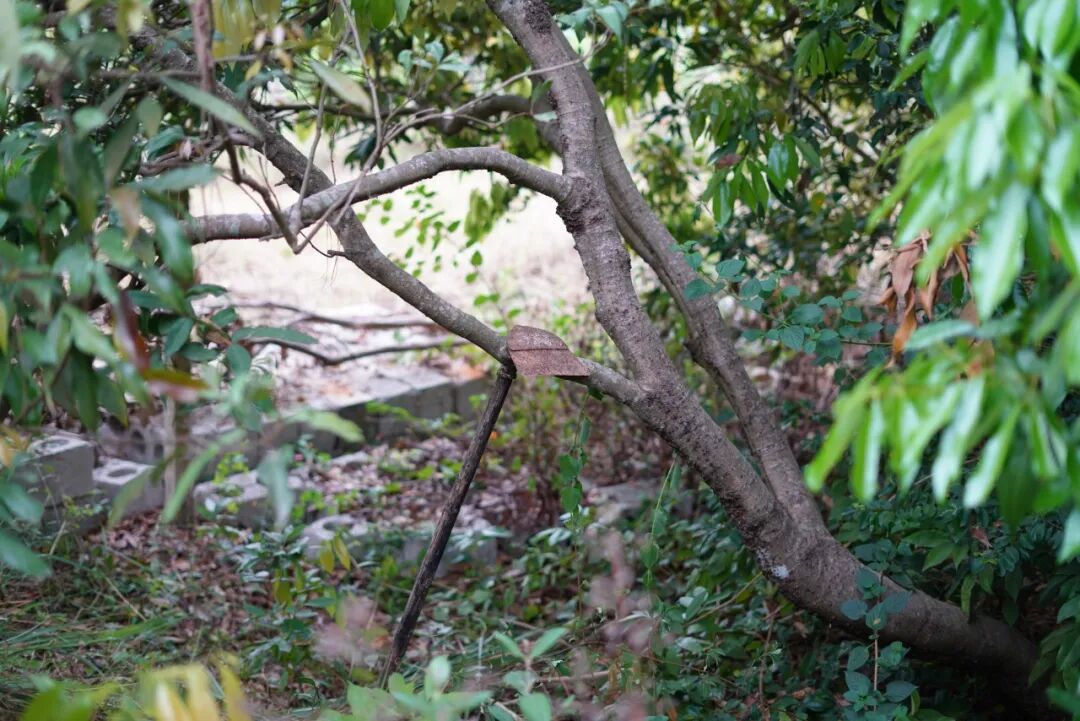
◉ An old, discarded hoe.
But the land would always present other difficulties. Sometimes the hoe would strike a stone buried in the soil. If it was a small one, a slight tilt of the angle could pry it out; if it was a large one, you either retreated, acknowledging defeat, or stepped back, dug the earth away from it, exposed the stone fully, and then moved it out by hand.
With stones, brute force is useless. So it is with many other things.
After a while of adapting, I found that when I worked the land, time seemed to stretch. Occasionally a calm, quiet flow would emerge. Attention held on the soil was no longer constantly fragmented, and farm work came to carry a sense of mental ease.
At Baicao Garden, I used a carrying pole for the first time. The rounded surface of the bamboo pole pressed against my right shoulder, while the curved hooks at either end caught two small half-filled buckets. Standing in the middle, I crouched down, my left hand steadying the front and my right hand gripping the back. I rose — slowly, so slowly. A faint ache shot through my right shoulder, and then I shuffled my feet, each tentative step matching the next, inching forward.
It was physical labour, certainly. But when I realised that my body was not frail or feeble — that I could, in fact, carry water — a quiet sense of contentment and trust in my own body settled over me.
The only mechanical tool at Baicao Garden was a brush cutter. To use it, you had to rest one end across your shoulder, raise the blade end to a certain height, and walk forward slowly.
The brush cutter was heavy to me, and it roared. Sister Yan Ping was often the one wielding it to clear a path. When the brush cutter was running, I needed to put in earplugs or simply keep my distance to dull the noise.
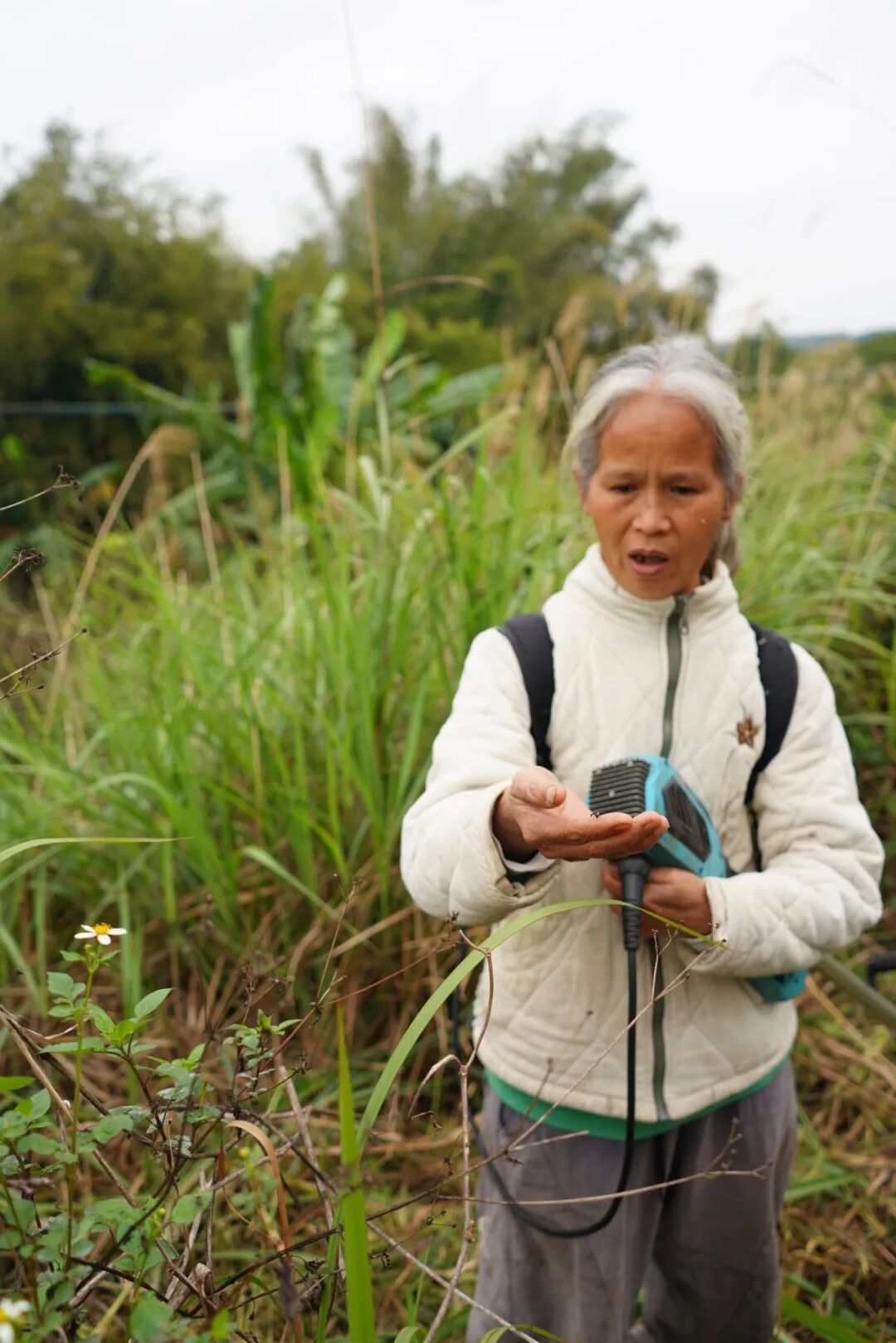
◉ Sister Yan Ping spotting an ant nest while clearing grass.
I would even go so far as to say that a mechanical tool like the brush cutter demands more of the body than a traditional one. It must remain fixed and motionless on the body; the only thing moving is the blade — and this places enormous strain on the shoulders. After days of using the brush cutter in succession, Sister Yan Ping began to feel a pain in her shoulder. I helped her hold the handlebars of the three-wheeled motorcycle, and together we went into town to see a doctor.
With a traditional tool like a hoe, however, the body and the tool work as one integrated whole. Force flows continuously between body, tool, and soil in a shared rhythm; the person moves to the tool’s cadence, and the tool, under the person’s guidance, cooperates more gracefully with the earth. Once you learn to do farm work without strain, your body ceases to ache and tire easily — instead, you may even feel light and at ease.
Surrender to Nature
At Baicao Garden, I experienced a way of living utterly unlike anything I had known before. When life draws so close to nature and the land, the body must inevitably surrender — to the beggar-ticks that cling to shoe-tops, to socks, to trouser hems; to the marks left by insect bites on one’s arms; to sudden downpours laced with fierce wind; to prolonged drought; to the weight of the carrying pole laden with water; to the rough, treacherous slopes; to the wild grasses blanketing every hillside; to the rats leaping on the roof beams and the cockroaches scurrying through the rice jar; to the fungal colonies that set food to ferment and to mould — and yet, I will not surrender to the plastic mulch film buried in the soil, nor to the rubbish beside the graves.
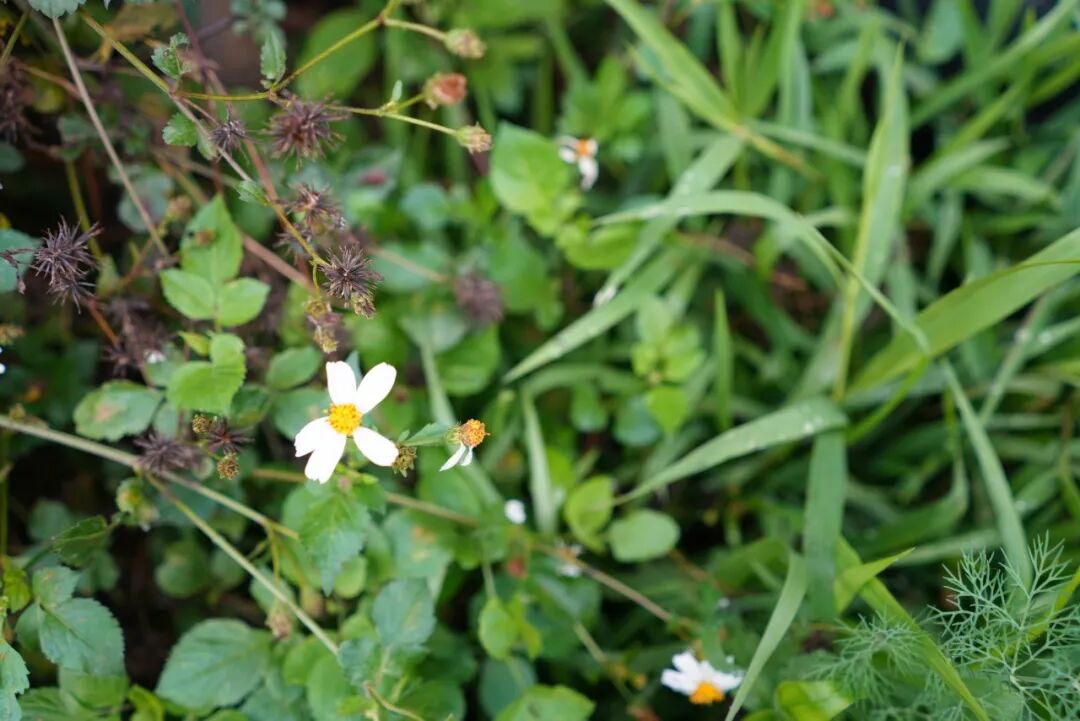
◉ Beggar-ticks.
Looking back now, what stays with me most vividly is that sudden, unexpected day of downpour. This is the scene I wrote that afternoon:
“After the thunder and lightning, the sky changed in an instant — it darkened, turned grey. The sound of rain and wind merged into one; the plants bent and swayed in every direction. I hurried to gather the clothes hanging on the tree branches outside and bring them in. The rain that blew into the house was fine and chaotic; the wooden floor sprouted patches of damp. A clamminess settled on my skin, spreading with a faint, creeping chill.”
“Several aunties who worked on the farm next door took shelter at the doorway and began singing mountain folk songs. Sister Yan Ping warmly invited them inside. They set out small wooden stools and sat in a row. The rain grew heavier, and everyone’s movements grew frantic — hurriedly gathering the mulberries and Job’s tears stalks drying under the eaves, drawing the bamboo curtain, retreating further in, and huddling around the fire. The wind blew the flames askew, and people scurried aside. In that small space, bodies pressed together in an instant. Someone was singing mountain folk songs, someone was chatting, and all through it ran the drumming of wind and rain. My hearing began to falter; my ears, my auditory nerves, my brain teetered on the edge of collapse. I raised the camera, trying to capture it all, and it seemed to work. Through the lens I watched the people, the plants, the wind and rain, the fire, and slowly I grew calm.”
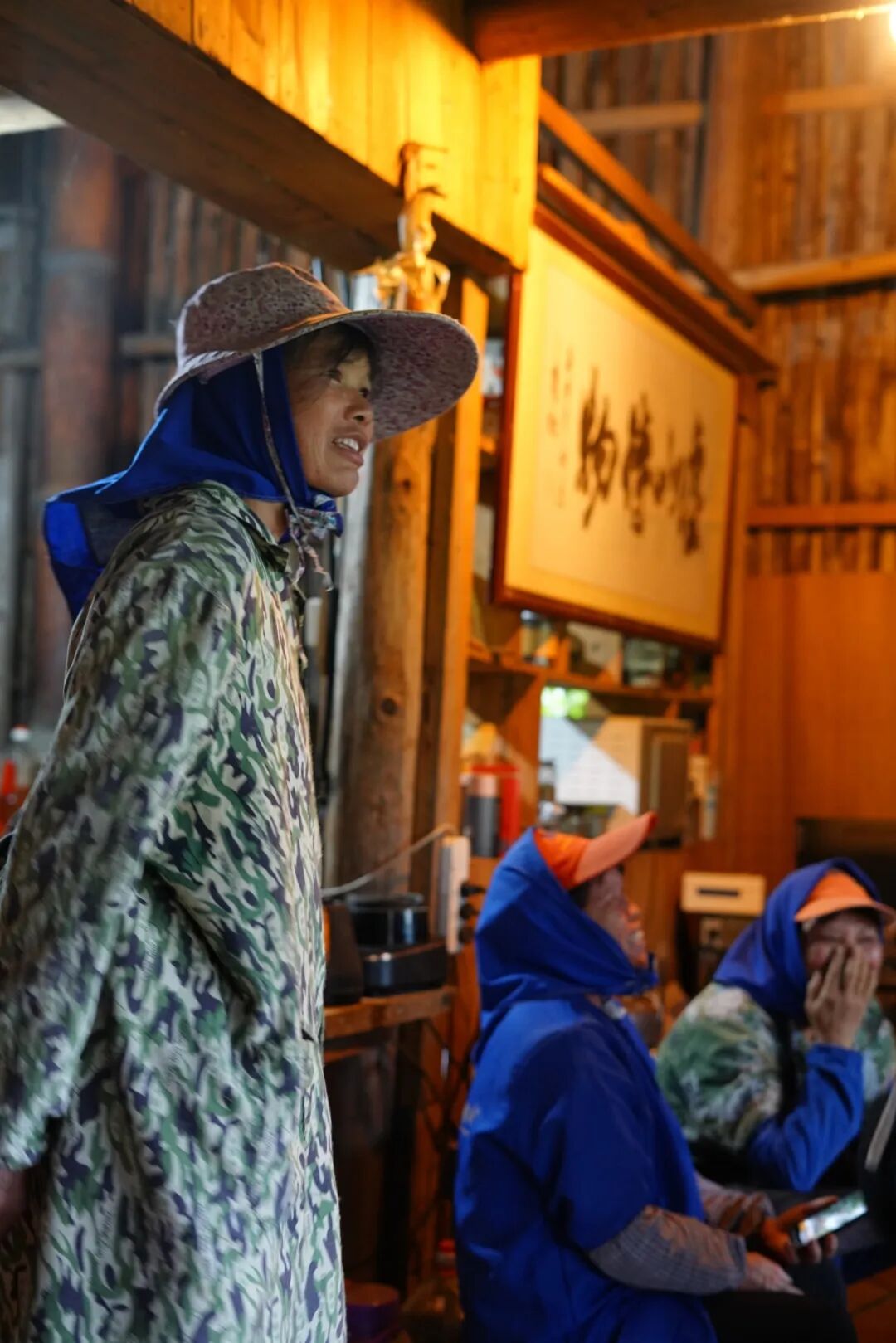
◉ The aunties sheltering from the rain.
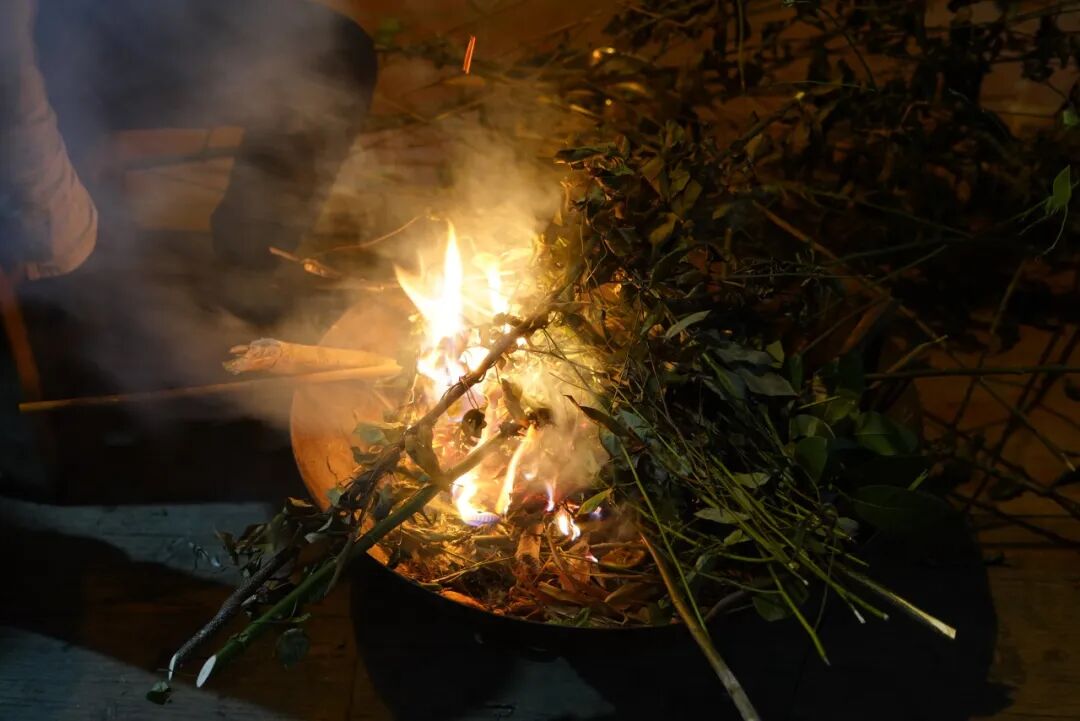
◉ By the fire indoors during a downpour.
There was another downpour later, deep in the night — sudden as always. The sound of rain flooded into my whole ear, pressed flat against the pillow. I woke instantly and could not return to sleep. I made my way down the wooden ladder and found the floorboards drenched; the odds and ends left on the table were damp too. I hastily gathered them up and carried them to the smaller, relatively drier room.
After such experiences, one rediscovers a sense of reverence for the natural world.
Here, too, I came to feel something close to the role of a producer. Food was foraged, cultivated, or traded with fellow farmers; three meals a day were made by my own hands, sometimes starting from the kindling of a fire. Every journey was within reach of the electric three-wheeler — fetching a parcel from town, or heading to nearby Yulin to tend another plot. The essentials of life — food, clothing, shelter, travel — shrank back to a smaller scale.
In a remote corner of the countryside, people take on the work of production, whether willingly or by necessity. In the city, one’s time is sliced up by labour, and one becomes a consumer largely by default.
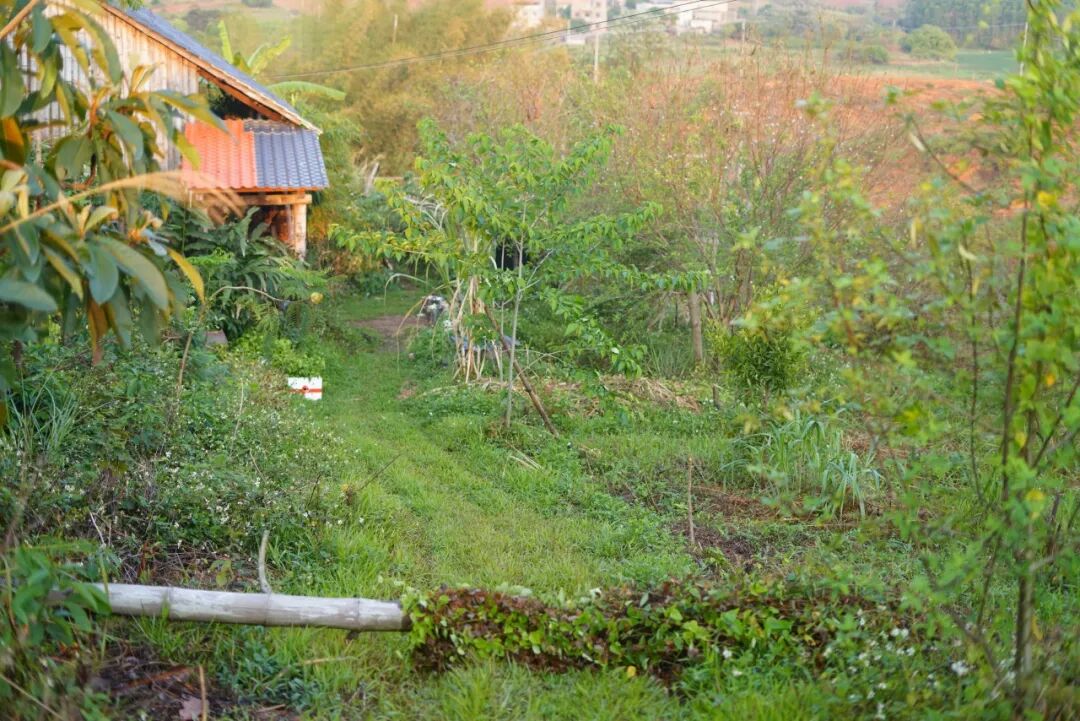
◉ A corner of Baicao Garden.
The Day I Left
After a month of living and working on the farm, I decided to leave, unable to bear the heat.
On the day I left, Sister Yan Ping drove me to the high-speed rail station on the three-wheeled motorcycle. The afternoon was stifling, the sunlight blinding. As the speed picked up, a breeze gradually rose and scattered some of the heat. Halfway through, Sister Yan Ping and I swapped seats and I took the handlebars. Light bouncing off the road fell straight into my eyes; I squinted and fixed my gaze ahead. The driver’s experience is nothing like the passenger’s.
I remember the first time I rode the three-wheeled motorcycle — Xiaona and I practised in turns. Setting off from the wooden cabin, a narrow ramp lay ahead with a bamboo scaffold alongside. Further down came a slightly wider slope. Turn left, drive a short stretch more, and the flat ground of the village appeared. The slope was bumpy; I wobbled precariously, holding fear at bay, keeping the speed in check, inching forward — slowly, so slowly. Then came the stretch linking the slope to the flat ground, and the vehicle began to jolt violently. I steadied myself as best I could. Trusting myself, trusting the stability of this three-wheeler, I finally made it safely onto the flat.
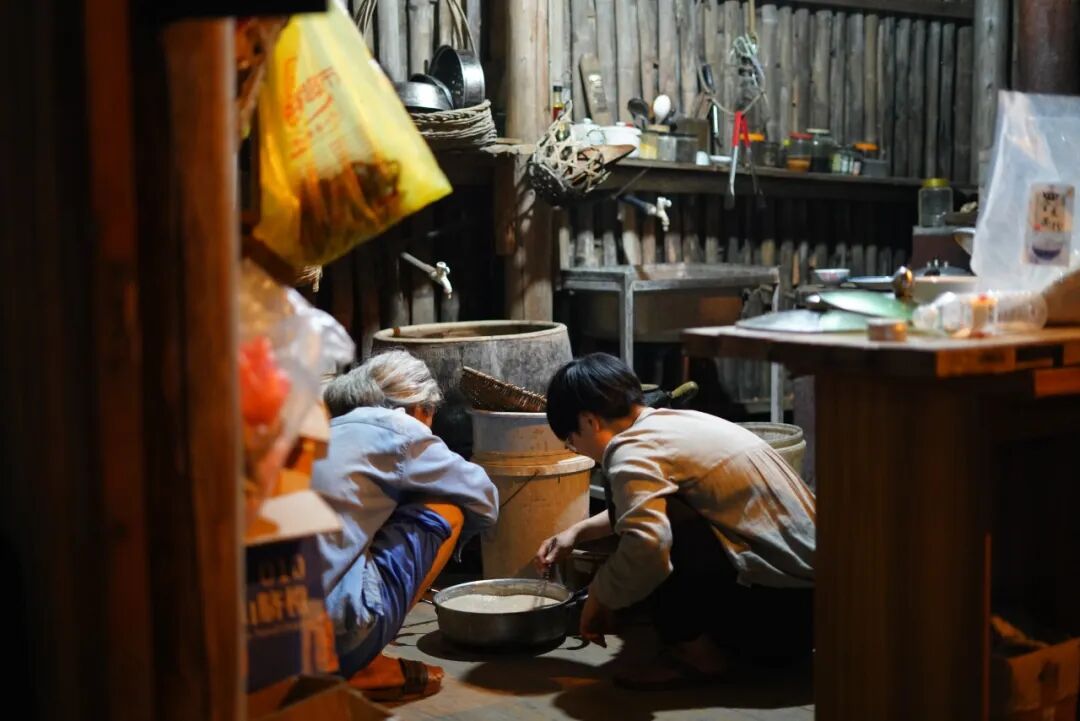
◉ On the right, Xiaona is observing the bean paste that has been fermenting for several days, alongside Sister Yan Ping.
Then it was Xiaona’s turn. I stood to one side and watched her suddenly accelerate — before I could register what was happening, the vehicle shot ahead, about to turn into a narrow lane. Sister Yan Ping and I hurried after her. Once she swung into the fork, she still had not got the speed under control. In a flash, the vehicle had crashed into a tree by the roadside. Xiaona had probably failed to manage the fear inside her, and that tension had made her movements panicked — hence the accident. It seems, after all, that going slow has its merits.
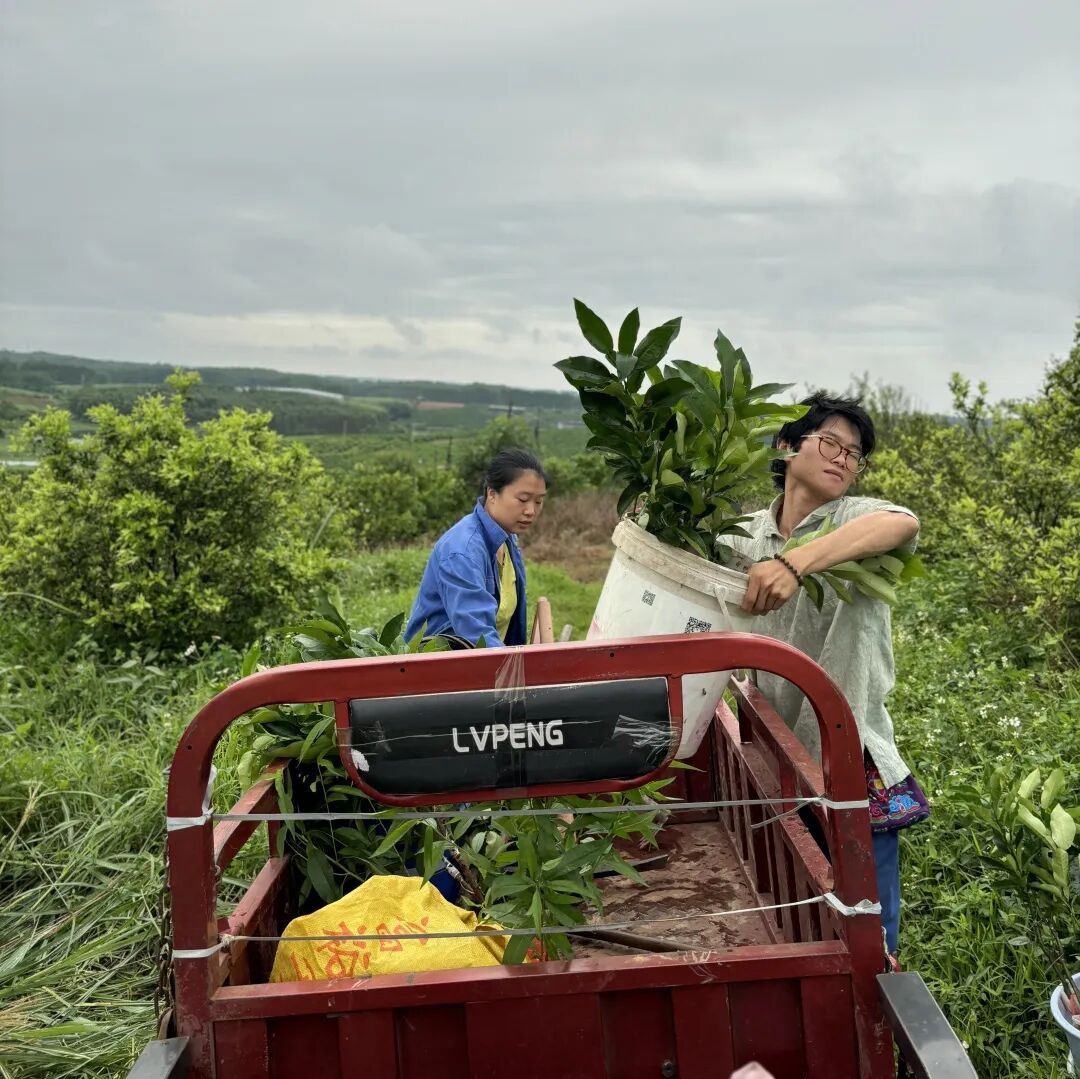
◉ The three-wheeled motorcycle at Baicao Garden. Photo: Chen Yujun
Driving on the flat road to the high-speed rail station, however, was well within my comfort zone. As long as there was no oncoming traffic, I would ease up to top speed. If a vehicle approached, I would slow down in advance, yielding wherever I could. But I am someone who cannot abide the heat. For the final stretch, Sister Yan Ping took the handlebars again, and I dozed beside her.
By April, Guangxi had already turned into a steamer. In those last days at Baicao Garden, the scorching heat sealed my head shut. My consciousness felt clouded, my body sluggish and heavy — almost unbearable, like a brain fog triggered by extreme heat. It was not the emptiness of mind during physical labour; rather, it felt more like a lump of blazing paste lodged in my skull. I think my brain and nervous system truly need the right environment to function.
Postscript
Modern People Who Yearn for the Land
As I write these words, I have returned to the cramped, congested spaces of the city. The shift from nature to urban life strikes me instantly — at Baicao Garden, there was no gap between person and nature; in the city, one must seek carefully curated nature in parks, in man-made constructs. The city is a vast top-down system: one’s time is handed over to it, and, removed as one is from first nature and from the sites of production, one gradually loses sensitivity to the weather, to the rhythms of the natural world.
And yet, during my time on the farm, I often felt adrift. It seemed to me that apart from working, the only hours left were for cooking, eating, resting, and sleeping. I no longer had time for reading, writing, or studying — I could only seize scraps of time, absorbing words with a desperate, starving hunger. Occasionally, I feared that perhaps I was wasting my time.
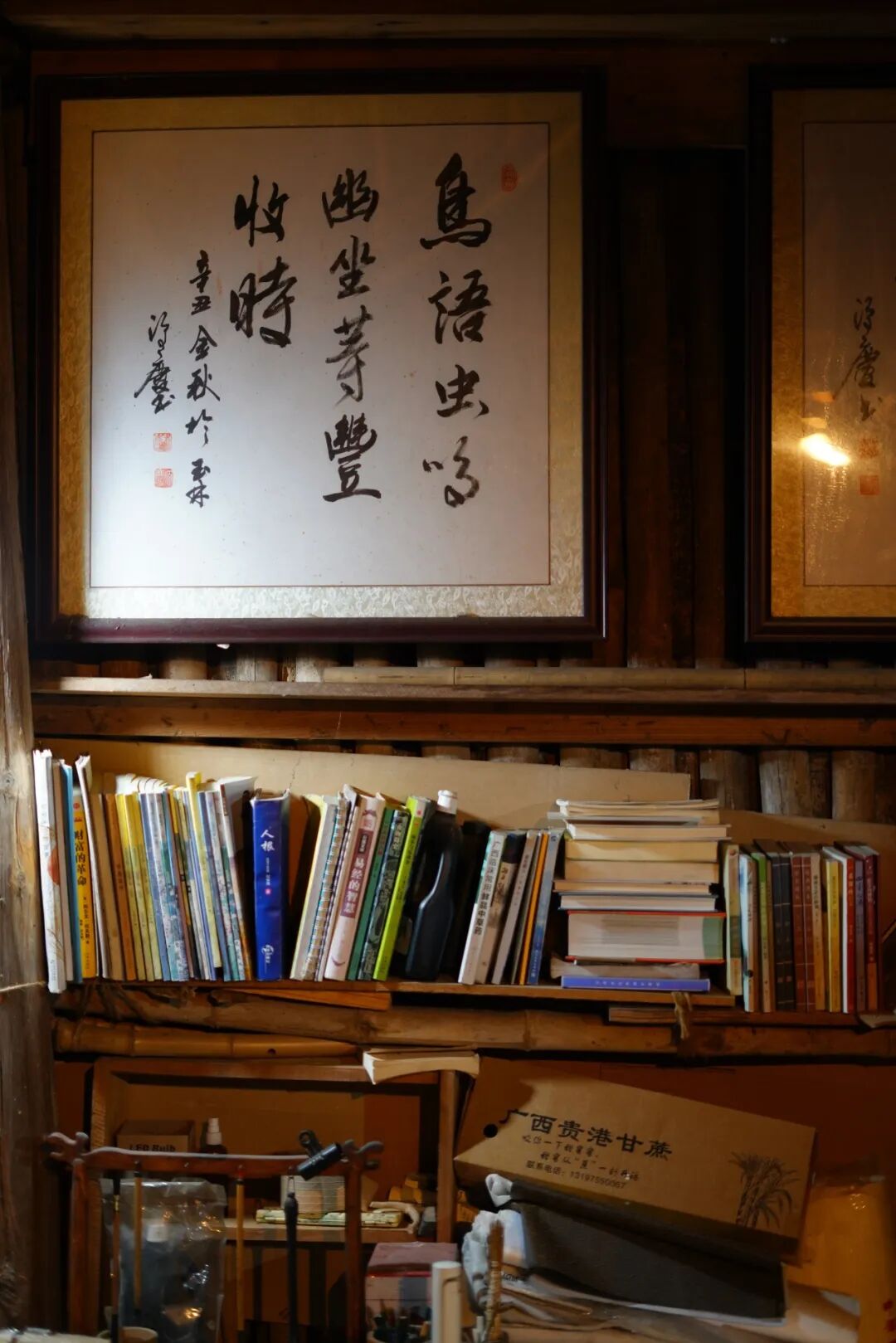
◉ A corner of the desk.
Farm work is a continuous, repetitive cycle that offers a certain immediacy of feedback — plant one seed, then plant the next. But the growth of crops takes time, and I find that silent, patient growth unfamiliar to me. I often wonder how farmers endure plant life-cycles stretching over months or even years.
I cannot draw feedback or emotional fluctuation from the growth of crops. To me, it does not constitute “meaning”.
I have never regarded the eco-farm as my final settling point; it is one possible component of the life I envision. During my time on the farm, I was still juggling other work simultaneously. Sister Yan Ping would say, “Don’t divide your mind.” For now, I cannot hold firm in one place the way Sister Yan Ping does. I long to do things with my whole heart too, but at this stage of my life, I must extend different feelers to better reach the life I want. For now, I cannot hold firm in one place the way Sister Yan Ping does.
Looking back now on my time at Baicao Garden, I think it allowed me to taste, faithfully and freshly, in body and spirit, what it means to live and labour as a person within nature. It deepened my appreciation for how precious food is, and how hard-won. And I have come to realise that I am still a modern person, not a creature of the natural world — I cannot do without air conditioning and the city; I cannot truly live as a farmer does. But I will, in my own way, explore a good way of living in the crevices between town and countryside, tradition and modernity, consumption and production.
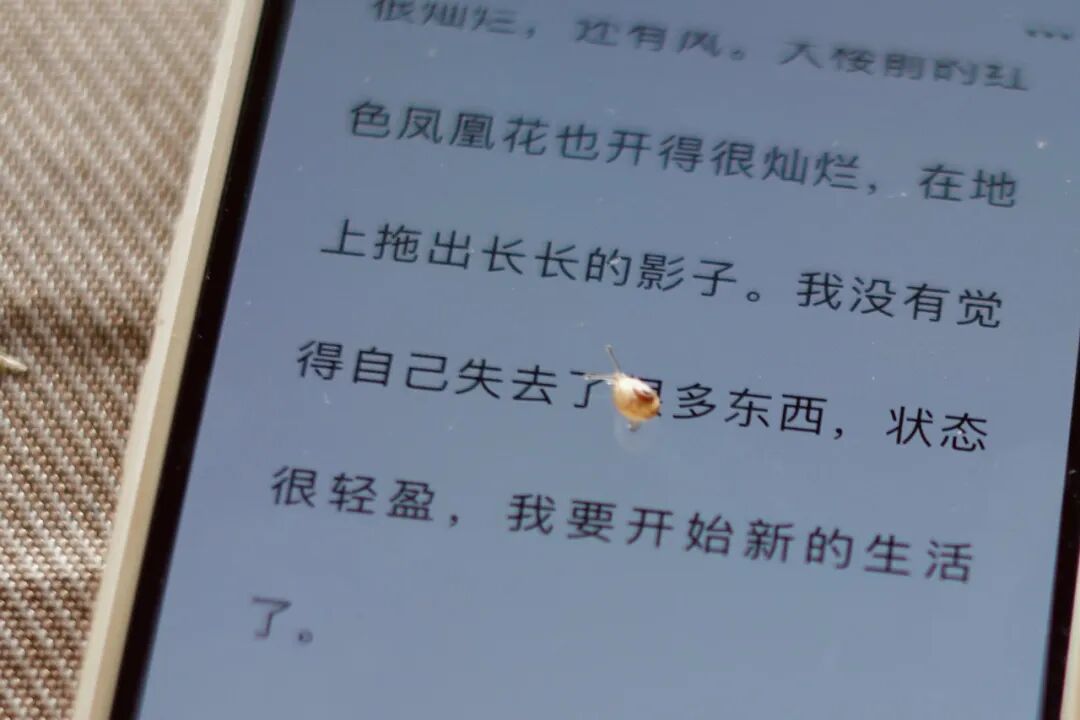
◉ Reading at Baicao Garden — a tiny snail crawling between the words.
– This is Foodthink’s 821st original article –
Foodthink
Author:
chisel
Walking slowly through the world, writing and observing.
Unless otherwise noted, all photographs are taken by the author.
Editor: Yuyang
Layout: Minglin
Scan the code to show your support for original food writing
▼

▼
Tap the image to read related articles.
▼
Tap a keyword to browse more article collections.
Seeds | Agricultural Technology | Policy | Fermentation | Nutrition | Fruits | Fisheries | Events | Jobs | Takeaway | Wet Markets | Animal Husbandry | Food Talk | Sharing Sessions | Reading Groups | Harvest Festivals | Smallholder Stories | Climate Change | Rural Development | Cooperative Economy | Urban Farmers | Food Safety | Digital Technology | Biodiversity | Pandemic & Food | False Solutions | Ecological Agriculture Internship Programme
Beijing | Hebei | Shanghai | Guangdong | Guangxi | Henan | Sichuan | Jiangxi | Xinjiang | Shaanxi | Hong Kong | Chongqing | Zhejiang | Jiangsu | Guizhou | Taiwan | Inner Mongolia | The Philippines | Canada | Russia | Mexico | Italy | The United States | The United Kingdom | Germany | The Netherlands | Thailand | Sweden | Japan