Fresh-Grocery Pickers Puncture the ‘Paid Weight-Loss’ Myth

Foodthink Says
After a customer places an order on platforms such as Xiaoxiang, Hema (Alibaba’s fresh-grocery retailer), or 7Fresh (JD.com’s fresh-grocery platform), somewhere in the same city, a picker must start running—darting and weaving between narrow, cramped shelves to select and pack items for the customer, then hand the bag to a delivery rider.
Many people think that fresh-grocery e-commerce picking is a new kind of job that doubles as “paid weight-loss”. Some media have even playfully dubbed supermarket picking fresh-grocery e-commerce’s “most aggressive weight-loss product”—a “mental massage room” where white-collar workers can keep their heads down and run without having to navigate social niceties, a “tidying-and-packing mini-game” that lets working people clear their minds through physical labour, or the “Hyrox (a global fitness-race franchise) best suited to office workers”…
Against these romanticised descriptions, Foodthink has previously found—through dialogues and commissioned writing with pickers—that pickers are kept under sustained pressure built on algorithms, data, and piece-rate pay, maintaining the platform’s high-efficiency operation at the cost of their own physical health.
What is it really like? This edition presents a dialogue between two pickers, laying bare experiences that resist simplification.
– Picker –

Yakou|Picker at both Hema and Xiaoxiang. No full-time job — just odd jobs that engage both mind and body. Recently restarted fieldwork and creative work. In a world full of regrets, this is a small light no one can snuff out.

Zhigǔ|Worked as a picker at Hema for three months. Picking was the first time my toe bones ached — hence the name Zhigǔ (toe bone).
The True Labour Intensity of Pickers
Zhigǔ: I work as a picker at a Hema store in the Yangtze River Delta that operates an integrated store-warehouse model — the site is divided into a front-of-house supermarket (the area where customers shop) and a back-of-house warehouse. I do part-time shift work.
Yakou: I’m usually based in the Pearl River Delta. Early this year I went to work at Meituan’s Xiaoxiang Supermarket for a few days, also picking. Xiaoxiang only has a back-of-house warehouse, no front of house. I later went to Hema for a few days as well.
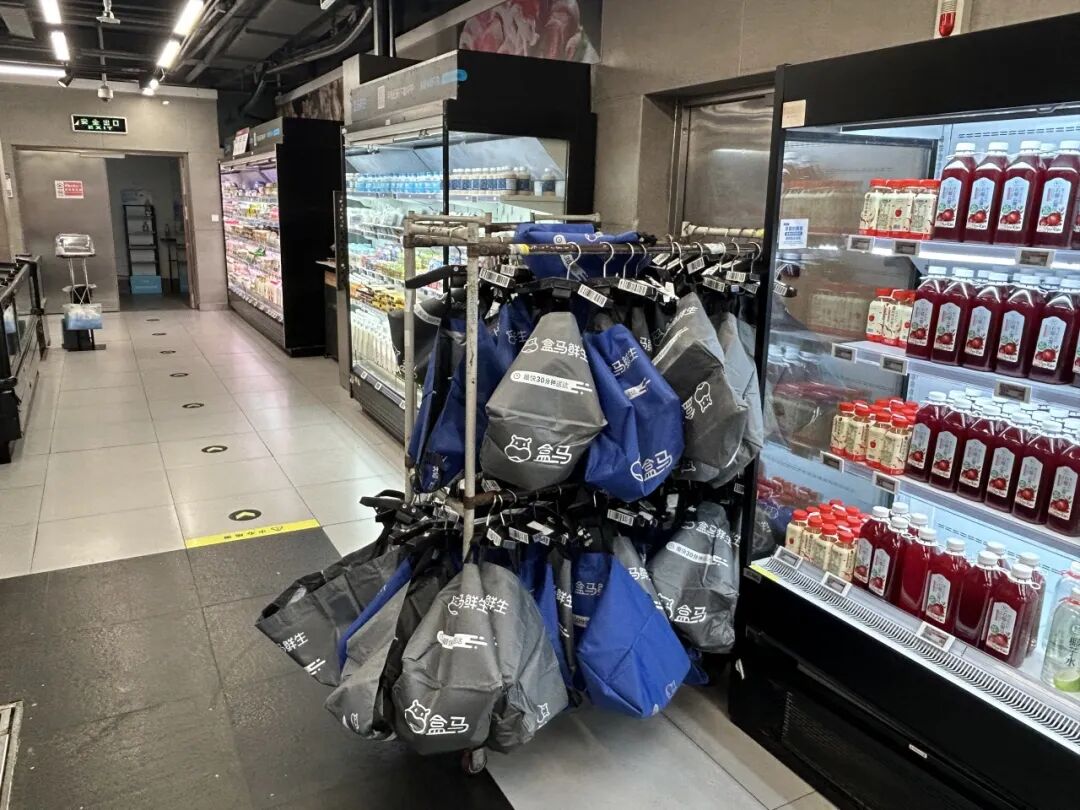
◉If you frequent Hema, you might notice a pile of cloth bags in a corner of the store — those are the bags pickers use to collect items from the front-of-house supermarket. Photo: Yuyang
Zhigǔ: Talking with colleagues, I’ve noticed a lot of people treat picking as just a stopgap. Some are looking for other jobs and haven’t found them yet, so they do this for a while first, planning to quit once they get an offer elsewhere — they don’t want the gap to have zero income. Others have been staying at home, and their family wants them to get out and work, so they found this job.
I’ve also seen a lot of people online saying they want to come lose weight, and I’ve met them in person too. A new colleague who started said she wanted to lose weight, that being tired was fine — but she lasted only a few days before the exhaustion drove her out. Online, I’d say roughly a fifth of the questions about this job are asking ‘will I lose weight doing this?’ It’s genuinely bizarre.
Yakou: Do people really come with that expectation?
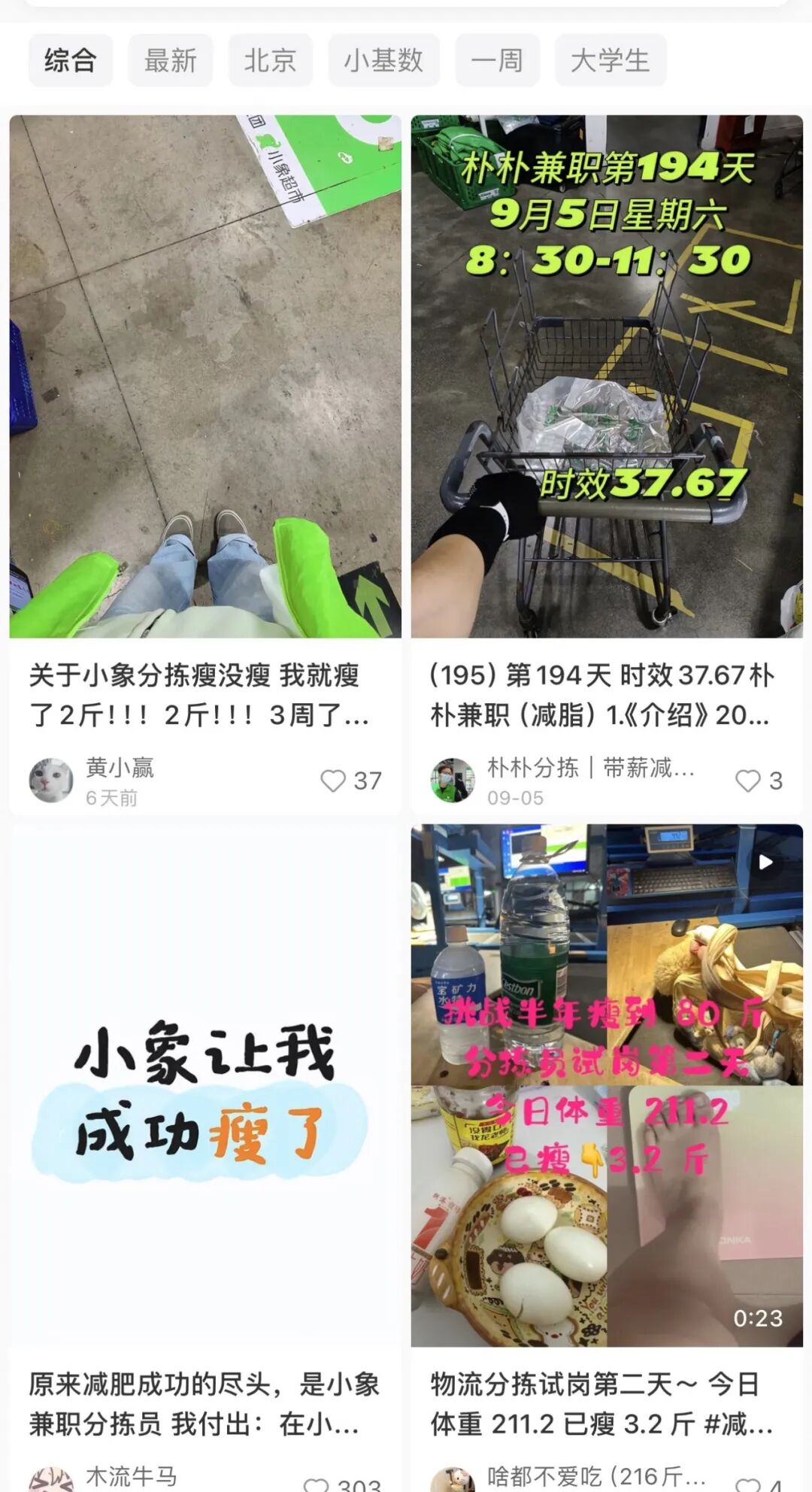
◉Posts about losing weight through picking, published on Xiaohongshu. Source: Xiaohongshu screenshot
Zhigǔ: I don’t know, but the people who come haven’t expected the physical intensity to be this high either. I work six days a week. My fixed shift is seven hours from afternoon into the evening, with no breaks — those seven hours contain no rest and no meal time at all. I walk roughly twenty thousand steps a day.
When I was still a newcomer, I messaged the group to say I was going to have a meal, and got scolded when I came back — they said there’s no meal time scheduled for that shift block. I said, ‘Then how was I supposed to know there’s no dinner time between 3 pm and 10 pm?’ The reply was:‘Part-time shift workers don’t get meal time. Come back after you’ve eaten.’ I shot back, ‘So I’m supposed to have finished dinner before 3 pm?’ In the end I managed to get a meal slot by claiming a stomach ache. I was basically the only picker eating dinner.
Yakou: I asked the store manager at Xiaoxiang the same question. I said I needed to eat, and the manager looked surprised, saying there’s no meal time. I asked, what about everyone else? They said the others don’t eat.
Zhigǔ: Yeah, it’s absurd. Full-time workers do six days a week and barely eat at all. Full-time shifts are twelve hours a day — 6 am to 7 pm, or 9 am to 10 pm. Full-time workers do get a rest period. For example, 6 am to 7 pm is thirteen hours in total, but you’re paid for twelve, with one hour of rest in between.
Yakou: Is that hour of rest a fixed time slot, or do people find it themselves?
Zhigǔ: You find it yourself — you can only go eat when the order volume is low. If you go when orders are piling up, you get scolded for picking that moment to eat, causing a backlog.
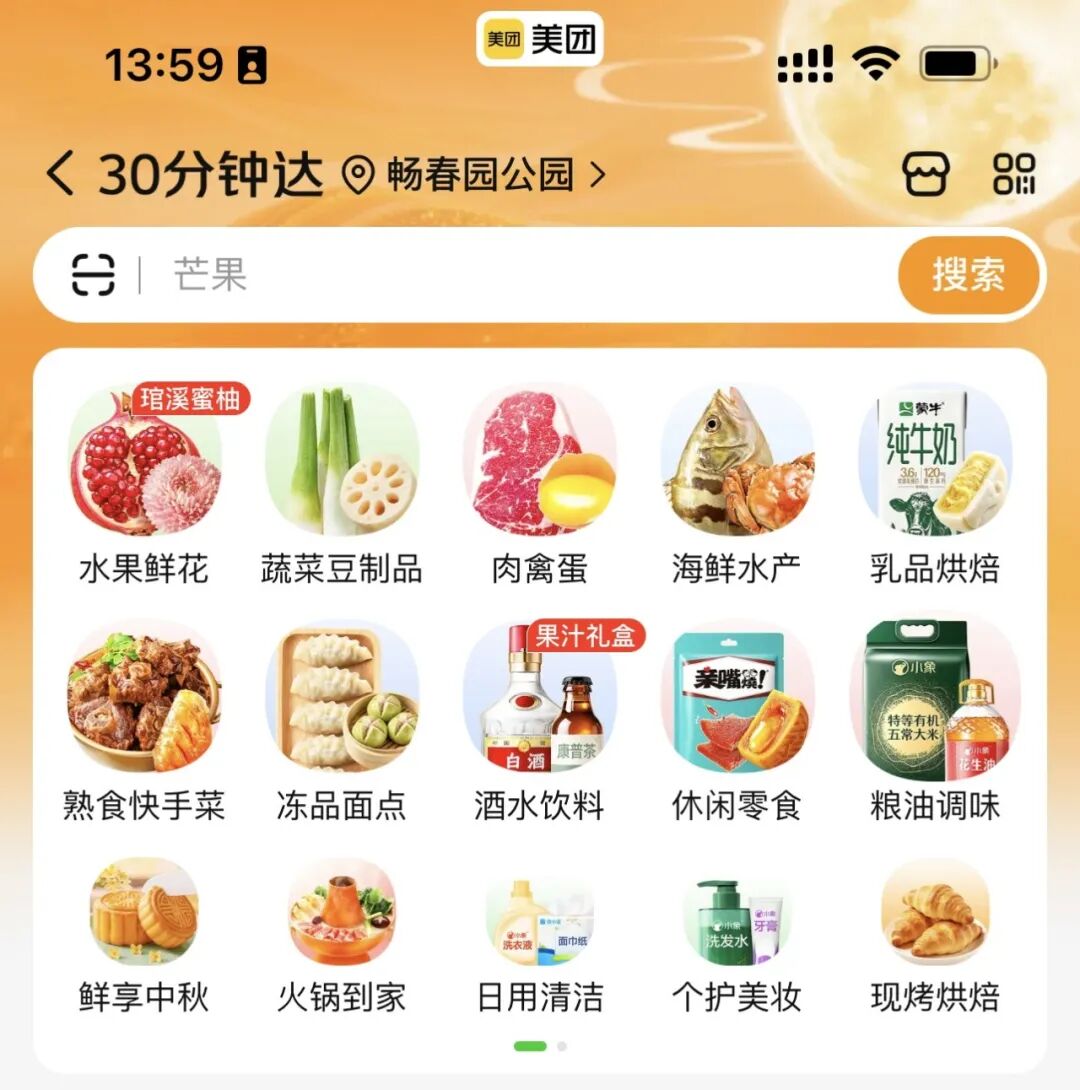
◉Whether Xiaoxiang or Hema, both advertise their ’30-minute delivery’ efficiency, which relies on the front-warehouse model’s increasingly tight control over pickers. Source: Meituan app screenshot
Yakou: I’ve gone into the back of house a few times and seen people eating between tasks. At the Hema store I’m at, there’s a tiny break area in the back-of-house warehouse — a long table and a few chairs. When it’s not too busy, you’ll see pickers sitting there eating the packed lunch or bread they brought, or having a milk tea.
Zhigǔ: I sometimes eat in the staff break room. It has tables like a cafeteria, plus a water dispenser, sink, dish soap, microwave, and fridge. But most of the people eating there aren’t pickers — they’re the employees working the supermarket counters, and they basically all bring their meals to eat there.
Yakou: When you go to the toilet, does that time count as working time?
Zhigǔ: To use the toilet, you have to tap ‘short break’ on the PDA and then go yourself. We’re in a shopping mall, so we just head straight to the mall toilets. Most people are back within ten minutes. If you take longer, a senior picker who notices you’ve been gone a while will assume you’re slacking off.
If you happen to hit a backlog—during which you can’t see the real-time order count—and the kanban operator or supervisor notices your status is set to ‘short break’, they’ll just tag you straight in the group chat: ‘xx, done with the toilet or what? Get back to picking.’
No rest between orders
Yakou: At the Hema store where I’m based, the gap between orders can sometimes be quite long – I’ve even gone over five minutes without one coming in. When there’s nothing to do, everyone basically just scrolls through their phones; some even play games. I once saw someone wearing earphones the entire shift, which I found pretty surprising, because when I was working at Xiaoxiang, that was completely impossible.
Zhigǔ: Things are different between the front-of-house and the back-of-house. In the front-of-house, you’re constantly communicating with the section staff. A lot of items are hard to locate, so you need to check with them before heading to the right spot. You end up talking to people all the time. Wearing earphones all day is no problem – no one will say anything. You can listen to music or podcasts if you like.
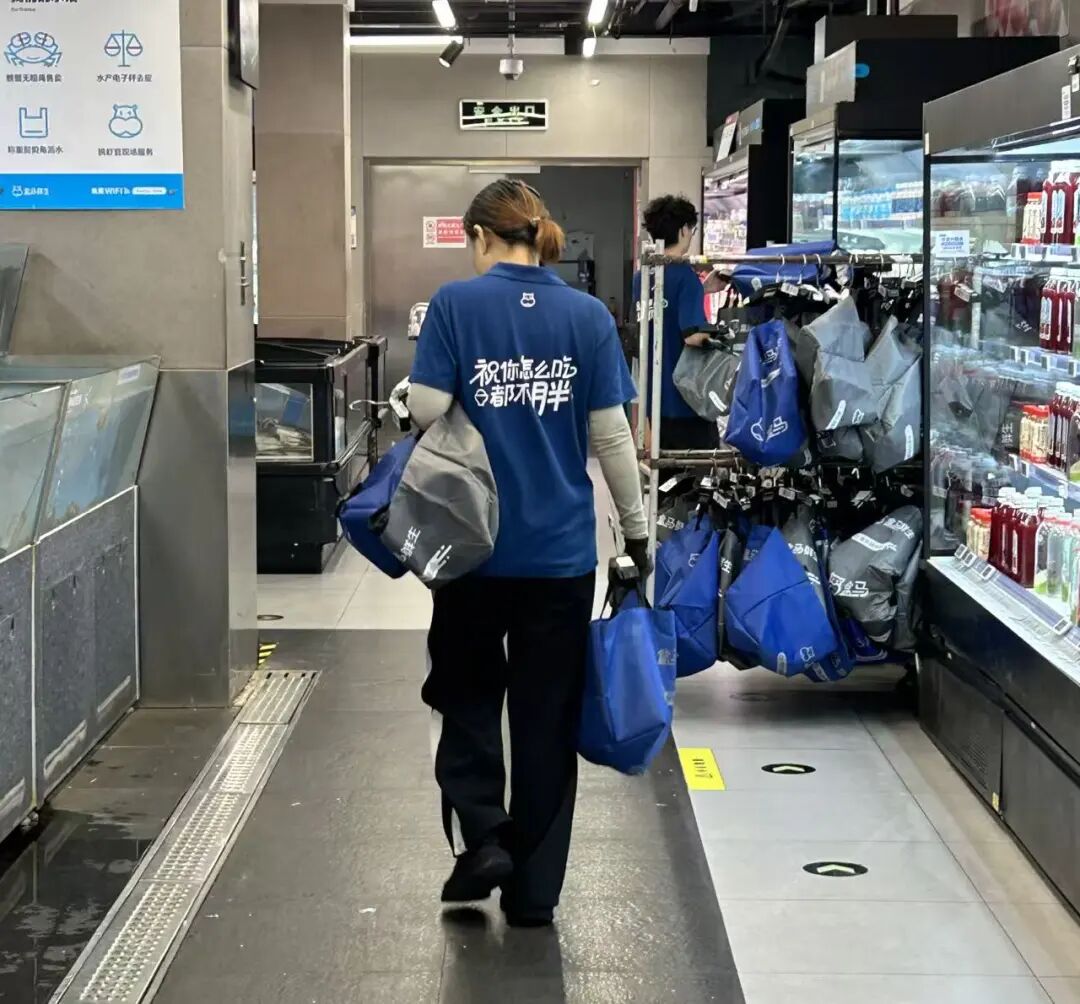
◉Hema pickers moving swiftly through the front-of-house supermarket, selecting items. They move considerably faster than customers or regular store staff. Photograph: Yuyang
Zhigǔ: But the back-of-house is different. The space where I worked was very small, and the kanban operator could see every seat at a glance. Maybe our location was a bit unusual – some of the longer-serving employees, if they saw you sitting there while everyone else was picking, or if they noticed orders blinking on your PDA and you weren’t taking them, they’d give you this judgmental look. So I didn’t really dare decline orders either. Generally, if one came in, I’d just take it.
Sitting between orders doesn’t even feel like a break to me – it’s just filling the time. Even going to the toilet has to be quick in and out. One evening there was a constant order surge and the backlog built up for over an hour. As soon as an order came in, it was dispatched straight to your device, and the moment one finished, the next was already there. Those two hours didn’t have a single second of pause. I really needed the toilet and I really wanted a rest. After running nonstop for an hour without a break, your legs start aching. If you could get five minutes’ rest, they’d hold on a bit longer. So I pressed ‘short break’, but I was so exhausted I couldn’t even get to my feet – I just wanted to sit for ten seconds or so – and immediately the boss @-mentioned me, telling me to ‘go’ (get back online and accept orders).
Yakou: You said the gaps between orders don’t count as rest – I completely agree. At Hema, even when there was a lull between orders, it felt more like being ‘on standby’. The moment one came in, you had to be on your feet and picking straight away. There was nothing else to do but scroll through your phone, which definitely doesn’t count as real rest.
When I was at Xiaoxiang, there was basically no gap between orders — absolutely no breathing room. They even came up with a so-called ‘effective working-hours rate’ for this. A low rate usually points to one of two things: either you’ve been on a long break, in which case the station manager might come have a word with you, or — because we don’t want to time out — we tap ‘picking complete’ before we’ve actually packed the order. From that moment it counts as waiting time between orders, so if packing takes a while, the effective working-hours rate drops too. But I’m plainly still working, which is absurd.
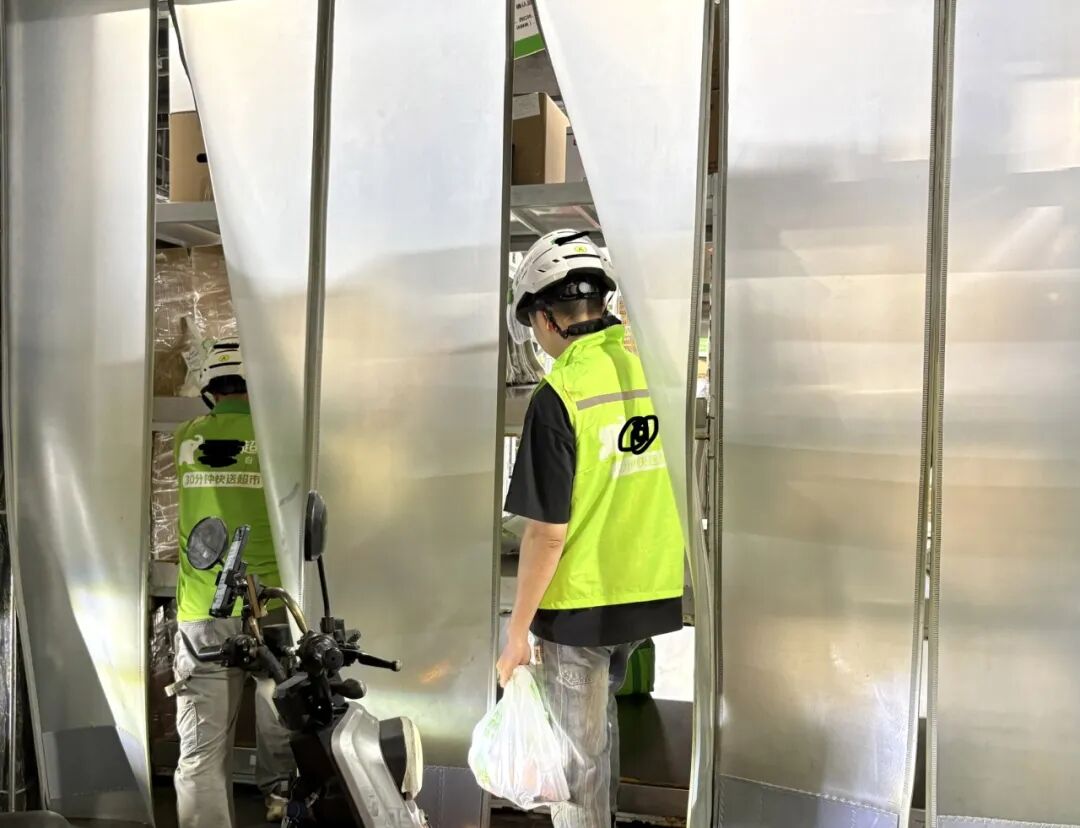
◉ A delivery rider waiting for orders outside Xiaoxiang Supermarket. To reduce the risk of a timeout, pickers often press ‘packing complete’ before they have actually packed the bag. Once that happens, the rider receives a pickup alert for that order, and the time pressure that has just lifted off the picker is transferred straight onto the rider. Photo: Yakou
Zhigǔ: You just said that as soon as one order finishes, a new one comes in. That’s essentially the same backlog situation I described at Hema. If every order is dispatched directly to a picker’s device, doesn’t that create a pile-up? Wouldn’t that affect the three-minute warehouse exit?
Yakou: There is a backlog, but it’s usually cleared quite quickly. Xiaoxiang’s peak-hour forecasting is probably more accurate. They specifically schedule part-time workers for peak periods. Outside those hours, order volume drops noticeably and staffing is scaled down accordingly, which tells you they have some kind of predictive algorithm that assigns different numbers of staff to different time slots based on data.
Zhigǔ: That’s incredible. You don’t get any break time at all. I think I’m starting to understand why the per-order rate at Xiaoxiang feels so low, yet people still say the pay is reasonable. You’re essentially working every single second. That’s an enormous workload. How many steps do you cover in a day?
I don’t count my steps. I just know I’m always on the move. It does feel a bit more gruelling at Xiaoxiang. In the front-of-house at Hema, there’s at least a chance to sit down — sometimes when you’re waiting between orders, you can wander a little. The experience is genuinely quite different.
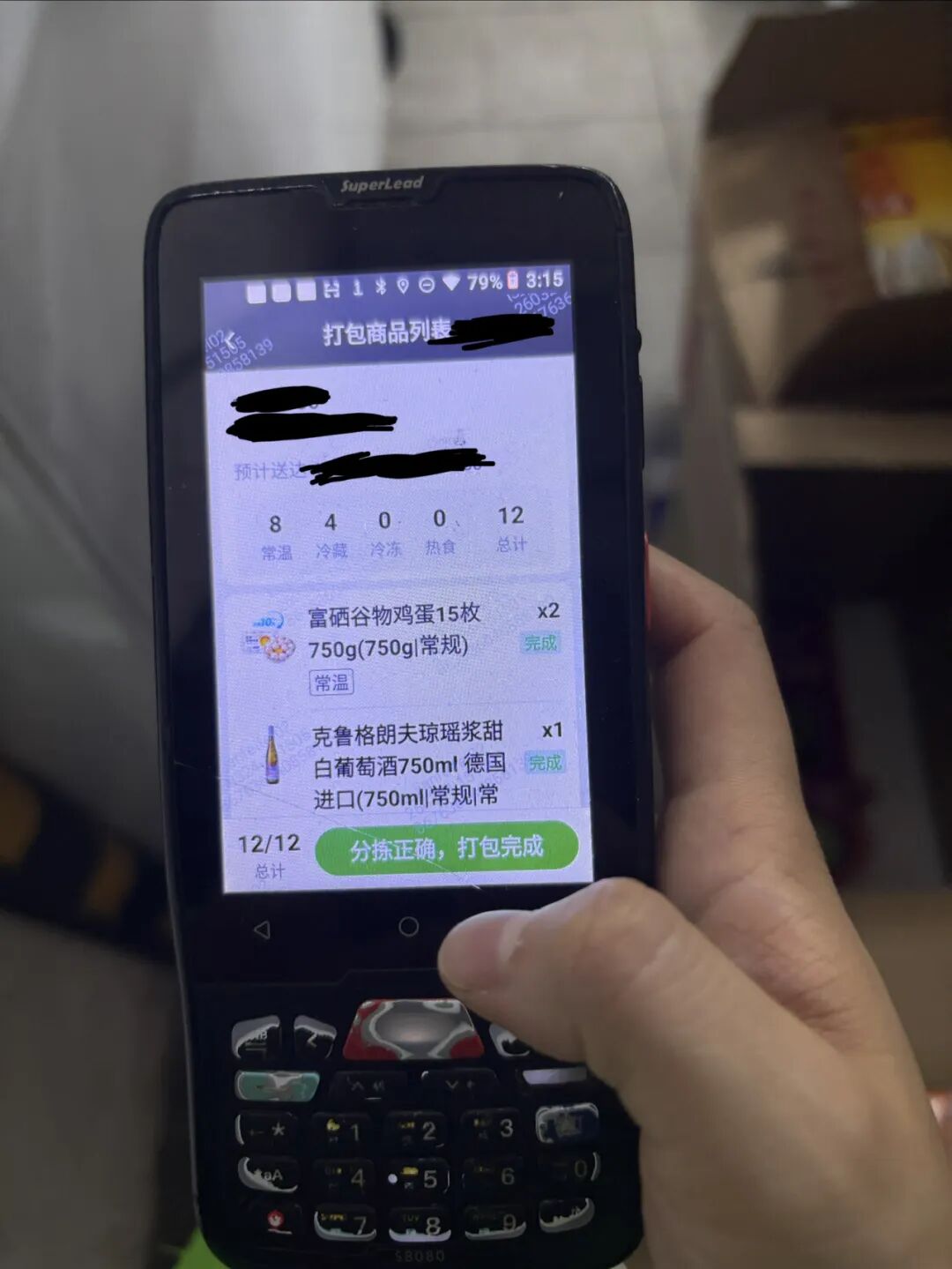
◉ In a fresh-grocery supermarket, the PDA functions like a conveyor belt in a factory, dictating the speed and direction of a picker’s movement and the goods they handle, guiding them through tens of thousands of steps. Photo: Yakou
Tiered pay: an upgraded version of piece-rate pay
Zhigǔ: Our part-time pay works like this: if your average hourly picks across the day hit a certain threshold, you get a base rate of 20.5 yuan. The standard is calculated by dividing total daily picks by the number of hours.
Yakou: How is full-time pay calculated, do you know?
Zhigǔ: I don’t know the exact figures, because even the full-time employees don’t. Our store never publishes the pay structure. Even with piece-rate pay, they won’t tell you how many items to pick for how much. In the early days, it was straight piece-rate — a few mao per item. More recently, full-time staff are paid by tier: you need to hit a certain number of items per hour to reach a tier, and each tier has a corresponding hourly rate.
But you won’t know what the threshold actually is — whether it’s 700 items, 710, or 720 before you hit the next pay tier. There’s no way of knowing. All you can do is look at how much you made the day before, use that as a rough guide, and factor in whatever you’ve picked up from talking to other pickers.
Yakou: It’s actually the same at Xiaoxiang. I clearly remember going to ask the store manager how wages are calculated. They showed me a spreadsheet on their phone — it’s tiered: pick enough per hour and you get one hourly rate, pick more and you get another. They told me this spreadsheet can’t be made public.
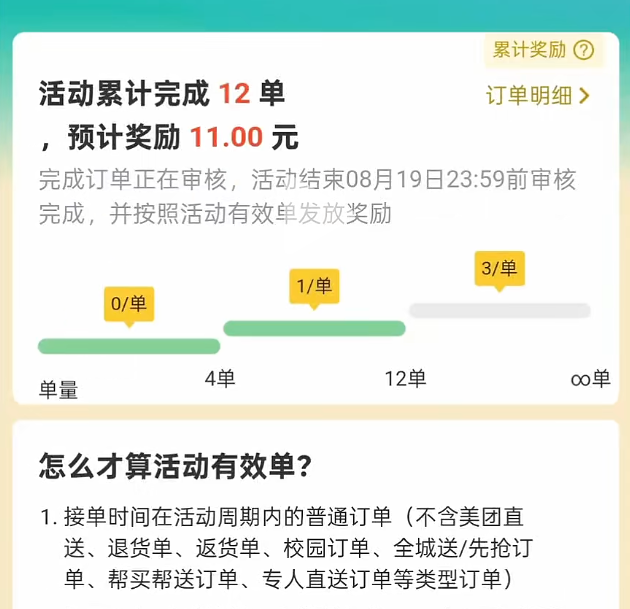
◉ Tiered pay has become widespread in the platform gig economy. Foodthink found in earlier research that food delivery riders also operate under a tiered pay structure for both wages and high-temperature allowances. Photo credit: WeChat Video Channel @Wen Ranxu
Zhigǔ: Hema is the same — it seems only management can see it, and it can’t be shared either. On tiered pay, going back to the example I just gave — it’s not very precise, but for instance, picking 400 items in a day gets you 120 to 150 yuan, while you need to hit 700 to get 200 yuan. The gap in the middle is enormous, and most people get stuck somewhere between 500 and 600. It’s as if the company is extracting a portion of unpaid labour.
This tiered pay structure may not look like a direct pay cut, but it effectively is one. I felt this clearly during the time I was there. It started as pure piece-rate pay, but after switching to tiers, a lot of people left. And it creates this sense of incentive, as though you should be pushing yourself to reach the next tier. If you don’t, you start blaming yourself — wondering if you spent too long on the toilet that day — but if you can’t pick enough, you can’t pick enough. Most of the time, it’s simply an objective matter.
Yakou: The piece-rate model is always pushing you to work faster. For the company, the faster you pick, the more it earns. For employees, there’s a sense that working fast means earning more for yourself. To earn more, you keep accelerating, and the company keeps raising the bar based on everyone’s average speed or the speed some people can reach. In effect, this is constantly feeding data back to the company so it can recalibrate the standard, making it harder for slower pickers to earn enough.
This is a very clear survival-of-the-fittest mechanism, but the company is the biggest beneficiary, not the workers. Even if you work fast, you’re just getting closer and closer to your limit, more and more exhausted. One day you’ll be replaced by someone younger, quicker on their feet.
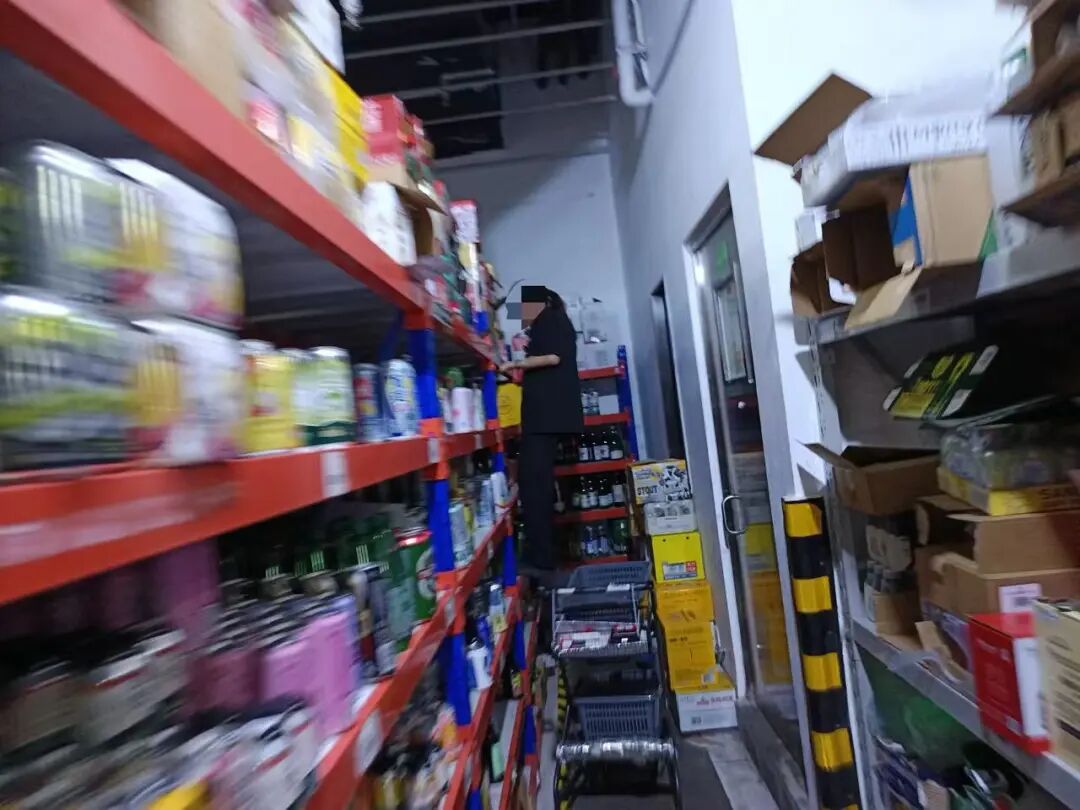
◉Warehouse shelves are typically marked ‘No Climbing’, but under the very real pressure of time overruns or performance targets, pickers are forced to risk climbing up to retrieve items. Photo: He Siqi
Zhigǔ: I feel the same way. For a while, the company raised the picking volume requirement for part-time workers. After the adjustment, I was below target half the time — in the front-of-house, I couldn’t hit it a single day. Completely absurd. When the company adjusts this standard, they don’t actually know whether people can reach it. They just feel that too many people were hitting the target in the previous period and the pay was too high, so they push the bar up.
And the company’s drive for speed also shifts costs onto the workers. This happens all the time. Say it’s a holiday — the company is worried about an order surge and schedules plenty of staff to cover it, but the surge never comes. Most of the time there are no orders and everyone is just standing around idle. Nobody earns enough, which means each person is effectively absorbing the company’s costs, and yet they can’t just walk away.
Our efficiency, your performance
Zhigǔ: Hema’s “kanban” is the most direct management role over pickers here. Hema doesn’t have a big screen showing real-time efficiency like Xiaoxiang does — all the spreadsheets and data are on the kanban operator’s computer. The kanban operator is responsible for judging whether it’s peak time, how to allocate staff, pushing you to work when there’s a backlog, going to push packing when it’s about to time out, and handling “find item” requests on the PDA. Basically, it’s about keeping the picking operation running smoothly and coordinating all sorts of things.
Above the kanban operator sits a role called “supervisor”. Supervisors also take on some of the kanban operator’s duties, in addition to handling recruitment, shift scheduling, and other people-management matters — a bit like the station manager role at Xiaoxiang.
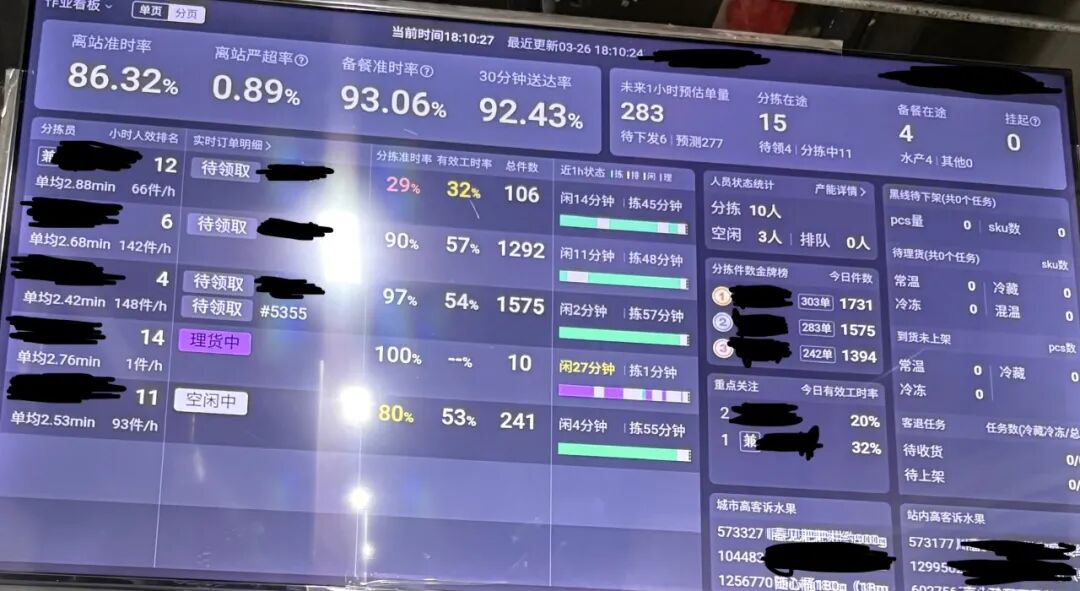
◉ At Xiaoxiang Supermarket, all the data generated by everyone sprinting around the warehouse is updated in real time on a large screen. Photo by Yakou
Yakou: Could you walk me through Hema’s organisational structure, from headquarters down to store level? What does competition between stores look like?
Zhigǔ: As far as I know, below headquarters there are regional offices, and below the regional level, individual stores are managed. At the regional level, there may be both oversight of stores across different regions and a distinction between production-line and non-production-line roles. At store level, the business is split into online and offline: the online side is run by a store-warehouse manager, who sits above a supervisor, who in turn sits above the kanban operator, who manages the pickers and packers.
There’s definitely competition between stores. One thing you can feel is when they start shouting at us — that’s usually when their own performance is on the line. For example, a backlog affects metrics like the 12-minute warehouse-exit rate. If that rate drops too low, they’ll get shouted at by their superiors in their own group chats.
Pickers’ average efficiency is also a competitive metric. Supervisors will berate people — @ new starters: ‘Do you realise you’re dragging down half our store’s efficiency? Pull it up, now!’ They’ll also @ veterans: ‘How can you, a long-time employee, be holding us back so much?’
Yakou: You mentioned the 12-minute exit rate earlier. That’s a requirement set by Hema—if it’s not met, what happens?
Zhigǔ: It could affect the supervisor’s and the kanban operator’s performance—effectively it counts as an efficiency metric for the whole store. But that’s not something we pickers are responsible for, because the 12-minute exit isn’t just about picking; it also covers downstream stages like packing.
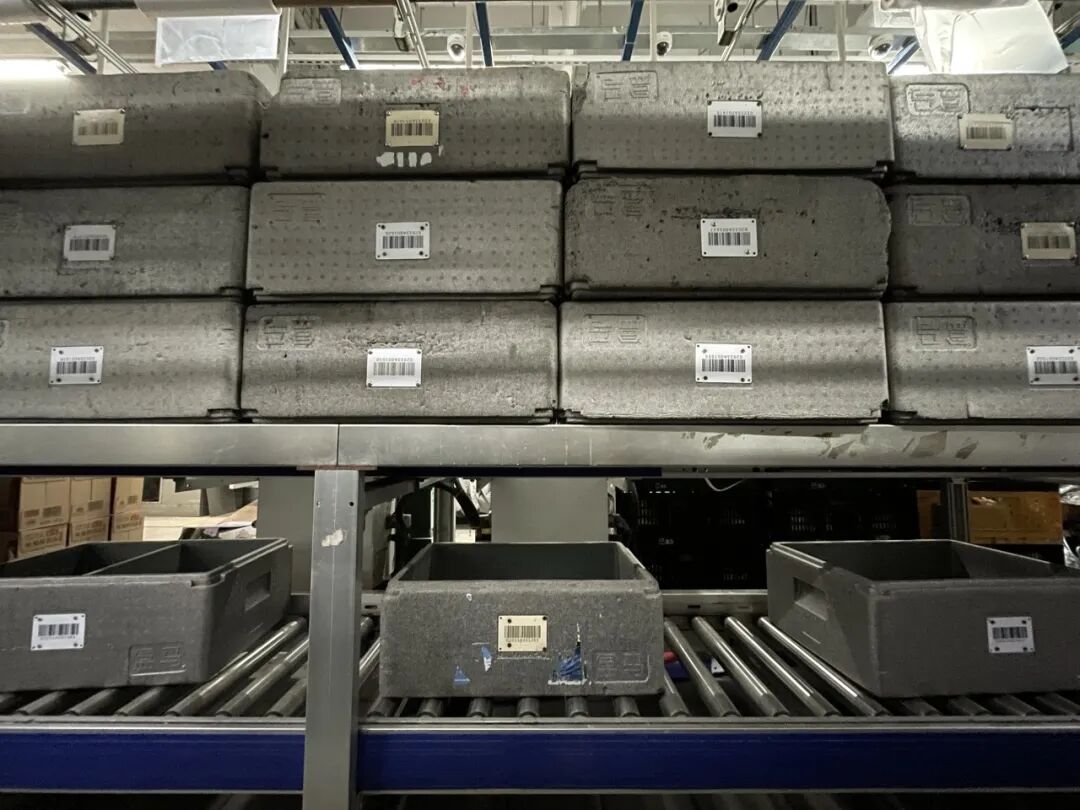
◉Boxes used to transfer goods at Hema’s packing station. Photo: Zhigǔ
Yakou: At Xiaoxiang, if I didn’t meet the efficiency target, I’d still be allowed to leave on time—it’s just that I get paid at a lower hourly rate, I think around 13 yuan an hour. But at Hema, when I went for the interview, the supervisor said that if my average picking volume didn’t meet the requirement, they might have me clock out but then keep working until the average picked count reaches the target. They said it was for my own good, because I’d still get the standard hourly rate rather than the reduced one. I haven’t actually experienced it myself, so I’m not sure whether that’s how it works in practice.
Zhigǔ: We’ve had extended shifts too, but it’s not the same as what you’re describing. After the extension, you not only have to make up the shortfall from before, but you also have to pick enough to cover the extra time itself—so overtime basically never works out in your favour. I’ve seen someone before who didn’t hit their target; they were given extra time, and they still didn’t hit it during that extended period, so they ended up working an extra half hour for nothing. It sounds like our two systems might operate quite differently.
Is picking a game of running free?
Yakou: Hema doesn’t have a big screen like Xiaoxiang showing everyone’s real-time efficiency and individual metrics, but we can see the rankings on our PDA. When I see the person in first place, I think: how are they doing it? Their rate is several times mine. It’s hard to imagine — even once I’m more experienced, I don’t see how I’d reach that level. You must pick quite fast. I’m curious how you manage it?
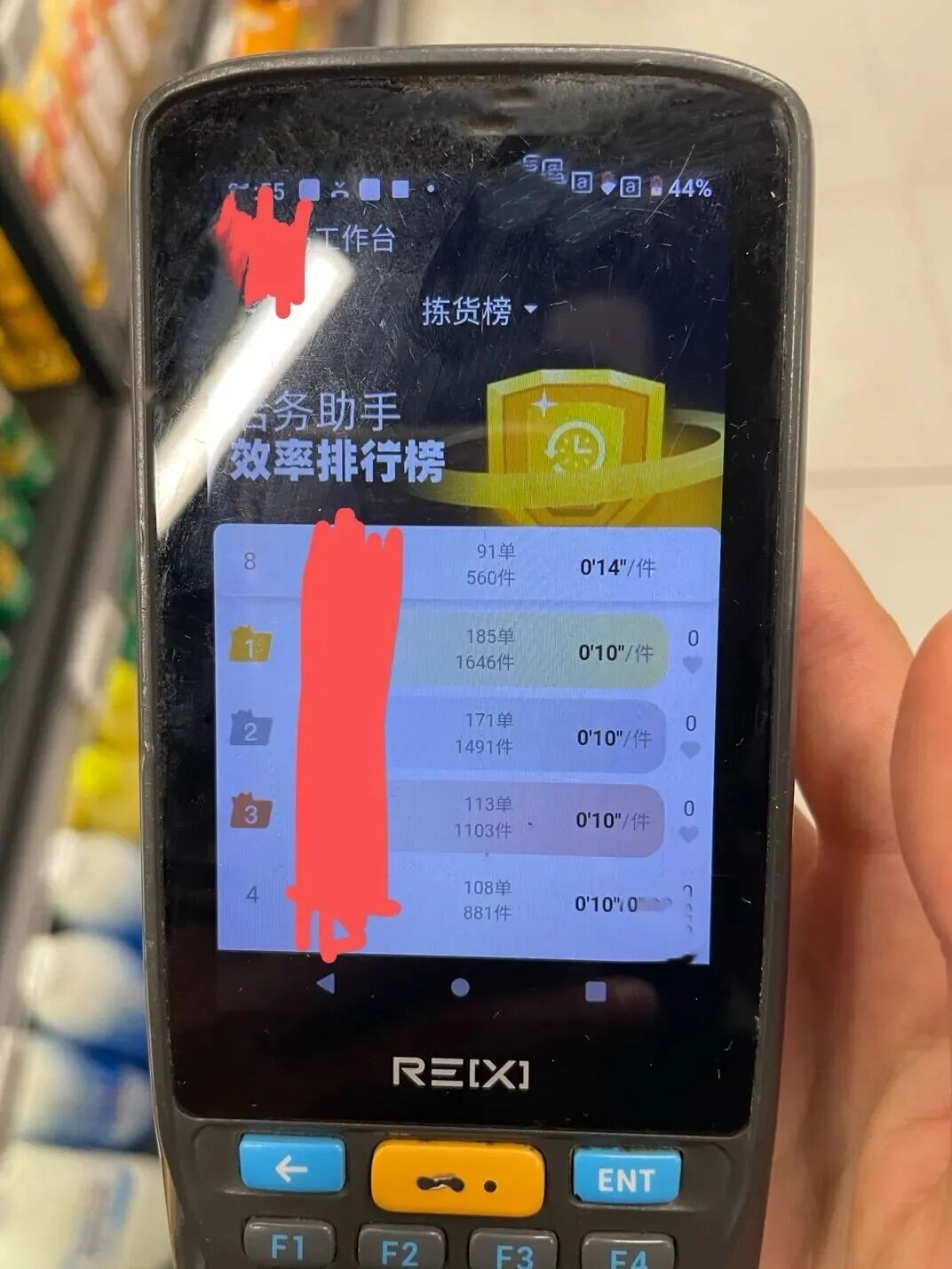
◉ The efficiency leaderboard on the PDA. Photo: Zhigǔ
Zhigǔ: Let’s start with the back-of-house. Once you’ve been picking in the warehouse long enough and get familiar with the layout, your rate does improve. For example, in the back-of-house an item takes an average of 10–12 seconds to pick. If one item can’t be found and you spend two minutes searching, your rate basically doesn’t recover — it might halve entirely. Experienced workers, if they can’t find something, will just tell the kanban operator, ‘Could you scan this one for me first?’ That way their rate isn’t affected. Sometimes an item isn’t in its bin location — it might have been put in the adjacent slot by the shelf-stocker, or the shelf-stocker hasn’t had time to put it away yet and it’s still in the box nearby, or in the top or bottom box.
Yakou: I often can’t find items. At first I’d just keep searching, maybe for four or five minutes, and by then I’d already been over time for a while and still couldn’t find it. Eventually the experienced colleague who was training me told me I absolutely had to ask, and that’s when I learned to go to the kanban operator. But it still felt like a psychological barrier for me. The kanban operator is so busy, and sometimes I felt like they weren’t giving me a good face.
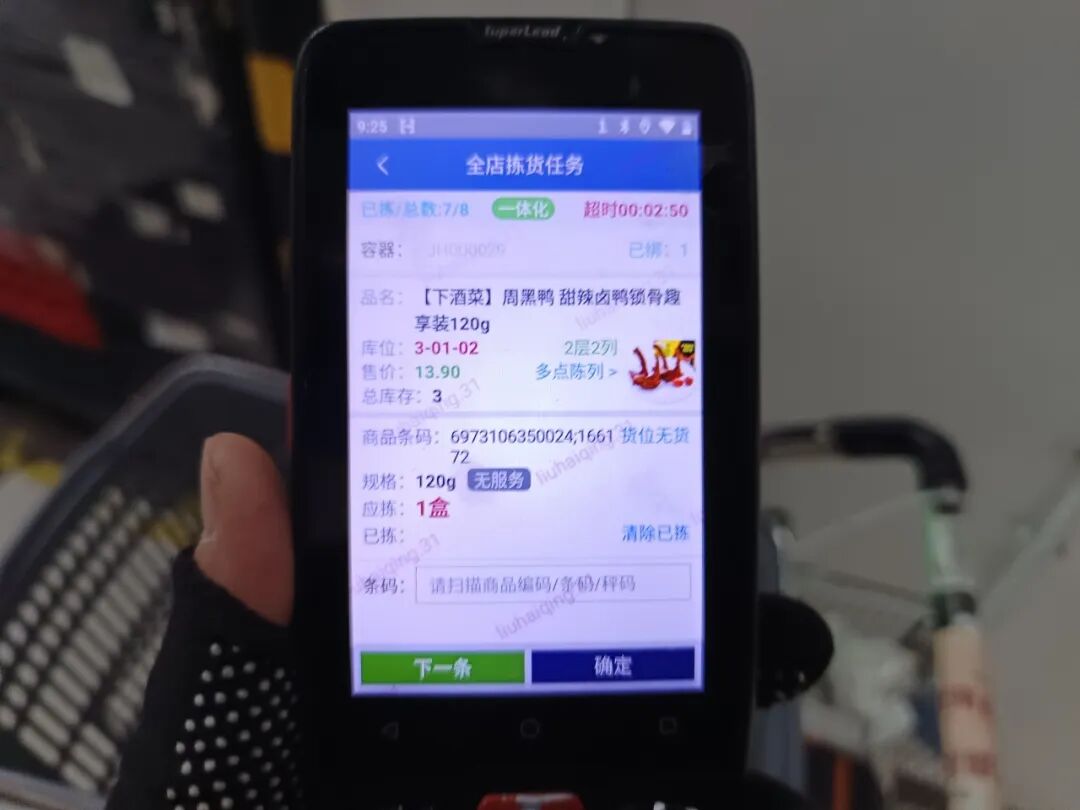
◉ The top right corner of a picker’s PDA screen constantly displays the overtime elapsed. Photo: He Siqi
Yakou: When you can’t find something and you’re not familiar with the area yet, they’ll say, ‘Isn’t it right here?’ or just kick it with their foot to show me where it is. That made me feel so much pressure. Sometimes I’d rather keep searching a bit longer myself, unless I truly couldn’t find it, in which case I’d ask for help. Over time it got a bit easier once I got used to it. If I’d learned these tricks sooner, I wouldn’t have wasted so much time on certain orders.
Zhigǔ: It was the same for me at first. The kanban operator on my side was quite aggressive too. They’d say things like, ‘Isn’t it right here? Are you blind?’ So at first I’d double-check and triple-check before I dared to ask. But then I just stopped caring. If I can’t find it and ask, I get told off. If my rate is low, I get told off. Either way, I’m getting told off. So I decided: as soon as not finding something starts affecting my rate, regardless of whether I missed it myself, I’d just go straight to them for help. After a while, once I got more experienced, I became more confident in my judgement — I knew for certain it wasn’t my fault; that item genuinely wasn’t there.
Yakou: Speaking of asking the kanban operator. I remember once I was picking in the front-of-house and couldn’t find an item. The kanban operator happened to be right next to me, looking for something else, so I asked them. They rolled their eyes with such contempt, pointed in the direction, but I still couldn’t see it. They just shoved my whole body that way, and I felt so disrespected. They were shoving me with anger. I was a bit angry too, but I was in a hurry to finish that order, so I didn’t say anything.
Zhigǔ: The pressure from the kanban operator is really intense. You mentioned rolling their eyes — I can picture it instantly. The kanban operator on my side loved rolling their eyes. I’d say it really isn’t there, and they’d say something like ‘I don’t believe you.’ That happened all the time. But later there were some satisfying moments too — when I truly couldn’t find something and kept insisting it wasn’t there, they’d follow me over to check, and no matter how they looked, they couldn’t find it either. When they had to admit I was right, I genuinely felt quite smug about it.
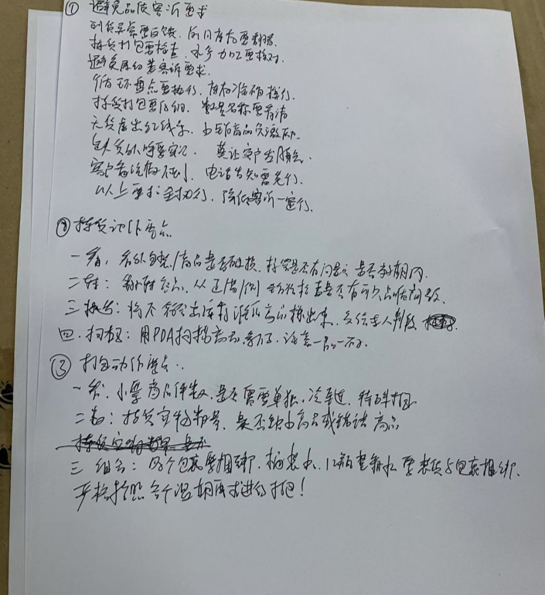
◉ 7Fresh requiring pickers to copy out the packing standards by hand. Many people assume pickers just need to mind their own business and keep running orders. In reality, store-level control over pickers is extremely direct, blunt, and unforgiving. Photo: He Siqi
Yakou: Although my picking rate was very low at first, I noticed it got a little higher every day. By the third day especially, I was hooked — after picking one or two orders I’d check whether my ranking or my per-hour score had changed. But I wasn’t really concerned about the pay. During the new-start period, the rate I was achieving didn’t seem to affect my wages much. It was more like a gamer’s mindset — I wanted to see my ranking go up. That felt quite bizarre to me.
Zhigǔ: I check the rankings too, mainly depending on how I’m feeling. Sometimes when I’m bored, I’ll suddenly go on a run and clear a few orders in a row, feeling like I’m in great form, wanting to see if my ranking climbs. It really is like a game. But when I’m tired, I completely stop caring and just lie flat. Sometimes the supervisor looks at these rankings. They have a more detailed table on their end that shows each person’s efficiency and position for the day in that role, and they post it straight into the group chat, tagging the people at the bottom to berate them. Sometimes they’ll say things like ‘Bring out your competitive drive’ or ‘Show some fighting spirit’ — the moment I hear that, I want to lie flat even more.
Is there a fixed ‘order king’ in the store? From what I’ve seen it’s not exactly fixed, but there’s a group who basically stay in the top five all the time – they’re the longest-serving workers. They’ve got more experience, so they’re better at reading what’s coming. Then there’s another type: people with loud voices who spot an item that’s out of stock from a distance and just shout over to the kanban operator, ‘This one’s gone, can you find it for me?’ It’s like they’re pushing the process forward before they even get there, so efficiency goes up a bit. Not me – I usually only say ‘find it’ once I’m actually at the kanban desk, and that makes a difference. Some people hold themselves to a certain efficiency standard and will just walk straight over and scan the code themselves.
Overall, the people who tend to rank at the very top are usually one of two types: those who are desperate to make money, and young people with good stamina.
Yakou: Actually, everyone still tries to push their efficiency up as much as they can.
Zhigǔ: Right, it’s not entirely about the rankings that drives people to be more efficient. It’s more about making money. The people who want to earn the most are the most efficient. Some people don’t really know how many points or what tier they need to hit, and they don’t bother doing the maths either. They don’t care whether they’re working for free for the company. As long as there’s an order, they take it immediately. If they can avoid a break, they do. They don’t think about anything else—they just work flat out, and in those circumstances, efficiency naturally goes up.
– This is the 843rd original article from Foodthink –
Edited by Yuyang
Layout by Xiaoshu
Scan to tip and support our original food writing
▼

▼
Click the image to read related articles
▼
Click a keyword to browse more articles in this collection
Seeds|AgTech|Policy|Fermentation|Nutrition|Fruit|Fisheries|Events|Jobs|Food Delivery|Wet Markets|Livestock|Food Talk|Sharing Sessions|Book Club|Harvest Festival|Smallholder Stories|Climate Change|Rural Development|Cooperative Economics|Urban Farmers|Food Safety|Digital Technology|Biodiversity|Pandemic and Food|False Solutions|Organic Farming Internship
Beijing|Hebei|Shanghai|Guangdong|Guangxi|Henan|Sichuan|Jiangxi|Xinjiang|Shaanxi|Hong Kong|Chongqing|Zhejiang|Jiangsu|Guizhou|Taiwan|Inner Mongolia|Philippines|Canada|Russia|Mexico|Italy|United States|United Kingdom|Germany|Netherlands|Thailand|Sweden|Japan