“You’d Need to Put Hats on the Ducks to Get Them to Work the Paddy!”

In 2026, the solar terms in Guangxi seemed to have been knocked off their moorings by an invisible hand. The year opened with a warm winter that refused to release its grip; fruit trees that should have lain dormant, banking energy for blossom, lost all sense of timing. In March and April, dense hailstorms lashed the highland areas without warning. By June, as the rainy season set in, two powerful typhoons struck head-on in quick succession, devastating many parts of Guangxi. The jasmine-growing district of Hengxian suffered severe damage, drawing national attention.
Not until the day before the autumn equinox in September could the rumble of thunder still be heard overhead in Nanning. The subtropical high on the typhoon’s periphery sat like a deathly shroud over the land of Bagui. The people of Guangxi witnessed the full ferocity of the “autumn tiger”—a fierce late-season heat wave—as summer’s grip refused to loosen. Media warnings that “the strongest El Niño in recorded history would arrive in 2026–27” were inescapable, tightening everyone’s brow: Things have already been this brutal through three quarters of the year—will what comes next be even harder?
From 25 to 28 September, the Nanning Urban Farm Fair hosted a bustling Mid-Autumn market. Several civil-society organisations focused on small-scale farming and climate change seized the opportunity to invite eight fellow ecological farmers to sit down together, share their real-life encounters with this year’s extreme weather, and talk about the hard-won wisdom of living alongside the sky—the survival craft pieced together in the soil since they turned to ecological agriculture.
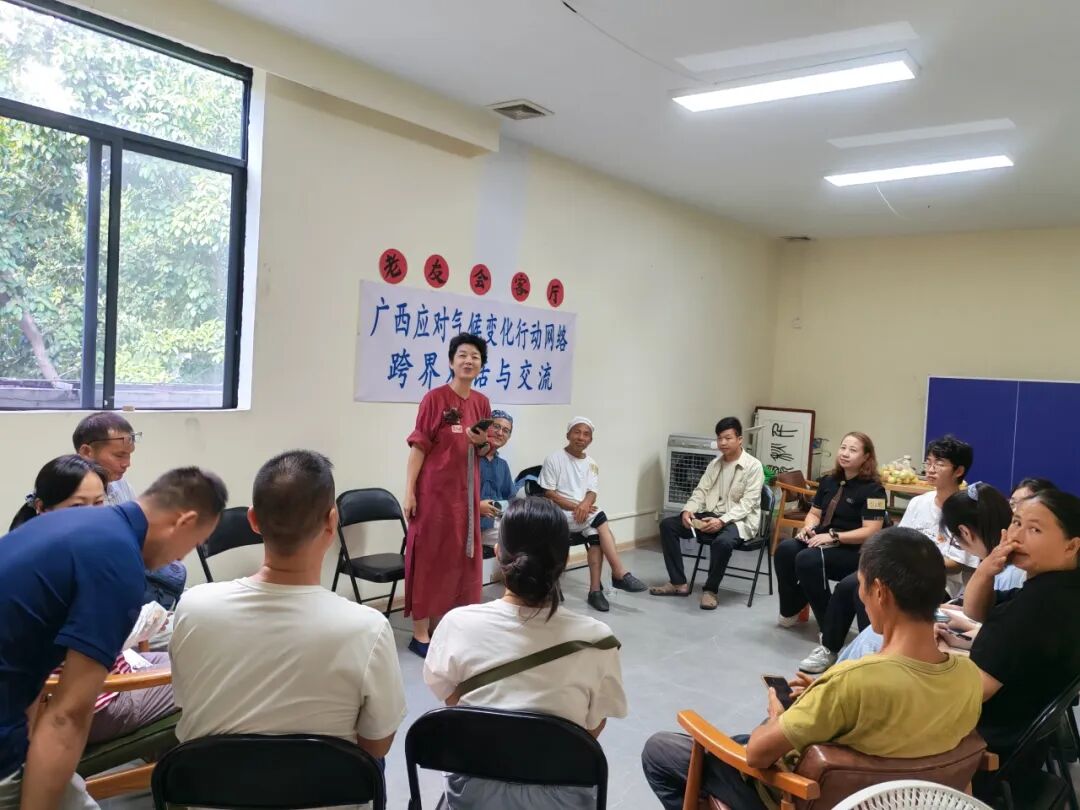
◉Fellow ecological farmers share their experiences of this year’s extreme weather and how they coped. Photography: Meng Fang
After the Typhoon: Burst Fish Ponds and Steadfast Paddies
Qing Shoubai, an ecological farmer at Nanning Boyi Eco-Farm, did not take part in the Mid-Autumn market—he had been hit so hard this year that he had nothing to sell. He came specifically to join this exchange, and to see his old friends while he was at it.
In early July, the torrential rain brought by Typhoon Meisake nearly erased the boundaries of Nanning Boyi Eco-Farm altogether. “The floodwaters cascaded downhill along the land’s contours,” Qing Shoubai said, “the water rose and rose until my fish pond and the neighbour’s merged into one expanse of murky water—you could no longer tell whose pond was whose, or whose fish belonged to whom.” Days of relentless overcast drizzle followed the downpour, and the dozens of chicks that had just hatched could not withstand the suffocating dampness; one after another, they collapsed in the mud.
And this was not 2026’s first warning shot. The warm winter at the start of the year had thrown the rhythm into disarray: lychee trees in the village had nudged out scattered buds far too early, and it happened to be a lychee off-year across the whole region. The village’s trees bore almost no fruit—nothing short of total crop failure.
“Whether it’s human-caused or the planet’s own great cycle, the most pressing question sitting in front of me is simply: how do I keep farming through it?” Qing Shoubai shuttles constantly between his orchard-vegetable plot and his fish ponds, forever caught in a dilemma. When a downpour looms, he drains the ponds early to guard against flooding—only for the skies to clear into sustained scorching drought, leaving the ponds bone-dry and the fish dead just the same. But if he doesn’t drain them and the flood hits, water overtops the banks, the fish escape, and everything is lost all over again.
These days he reads the sky both ways—scrolling weather-radar images on his phone, yet also reaching back to the old farmer’s art of judging the weather by the clouds. After the flood, he formed the vegetable beds into high ridges, dug deeper drainage channels, and repaired the fish ponds’ spillways and in-and-out water systems, searching for a balance between flood defence and water retention: “You can’t dodge a natural disaster, so build the channels and field bunds properly—leave the land more room to absorb the blow.”
A hundred-odd kilometres from Nanning, in Guigang, Gan Juzheng of the Shande Integrated Farming Farm was also putting the land’s resilience to the test. After Typhoon Meisake passed, floodwaters surging from upstream swamped the broad flat paddies into a lake. Once the waters receded, neighbouring farmers’ rice lay flattened in swathes, beaten into the mud, facing total crop failure. Gan Juzheng’s ecological rice paddies alone—caked with slime—still held their stalks ramrod straight, standing firm in the shallows.
Insurance loss-assessors waded through the silt to the paddy’s edge, shook their heads in disbelief, and in the end granted this “miraculously still-standing rice” its insurance payout.
Gan Juzheng told the group with quiet confidence that the rice standing firm owed nothing to luck—the secret lay in the weeds and ditches that most people despised. He insisted on digging deep drainage channels all around the paddies and forming high ridges, deliberately leaving a strip of weeds along the field edges and ditch banks. “Those weeds act like a natural windbreak,” he explained. “When the flood comes roaring in with debris, they snag the floating rubbish and the heavy silt first. The weeds topple into the ditch without crushing the rice; the roots left anchored in the soil dig deep and the stems stay tough—they form a natural scaffold that holds the rice upright.” That same ring of weeds solved the apple-snail problem too—snails love to climb the ditch-bank weeds to lay their pink egg clusters, so they leave the rice alone, and he simply pinches off the eggs as he walks his fields, keeping snail damage low.
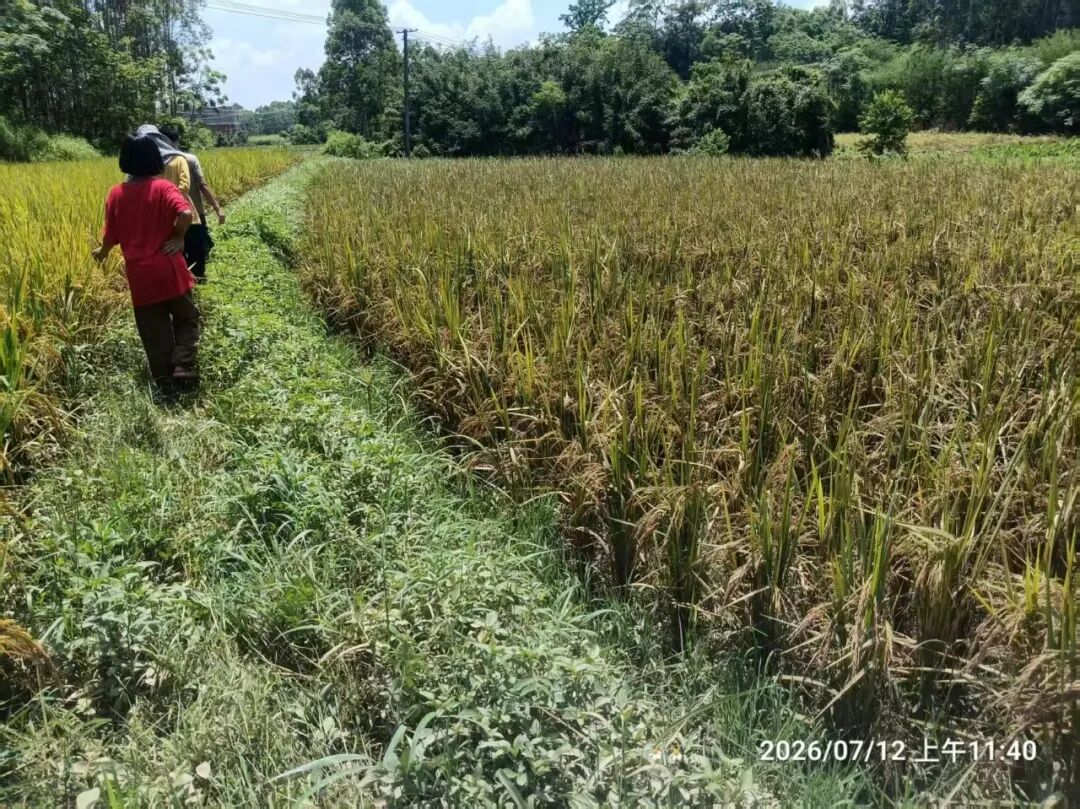
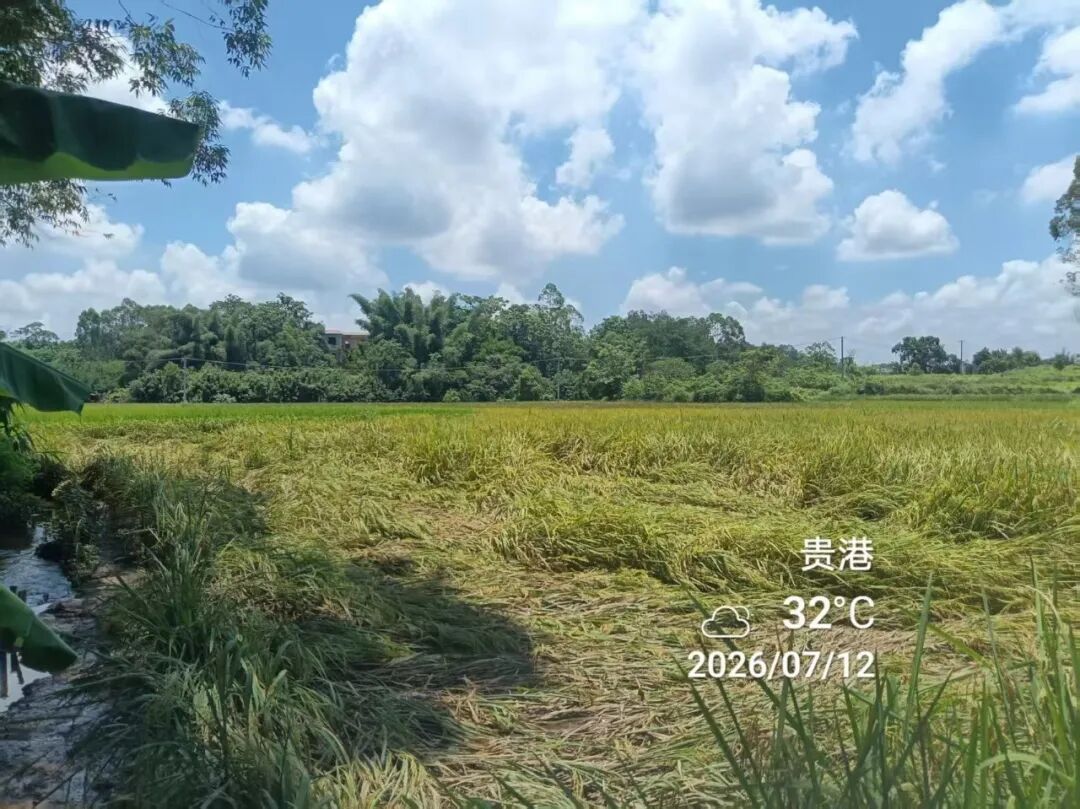
◉After the downpour, Gan Juzheng’s rice paddy still stands firm behind its screen of field-edge weeds (top), while the neighbouring crop lies flattened in swathes (bottom). Image courtesy: Gan Juzheng
Yet dodging the typhoon was one thing; dodging the extreme heat was another. He let his ducks loose in the paddy to eat pests and trample weeds, only to find the midday temperature soaring into a suffocating blaze. The paddy became a steamer. He put in a dozen or more ducks; in the end, only a handful survived.
“If we can barely bear it ourselves, what chance do the ducks have?”
The heat reshaped the rhythm of work—you go out to the field in the cool of early morning or late evening, and always take a hat for shade. At some point, someone tossed out a quip: “Teacher Gan, you’d need to put hats on the ducks to get them to work the paddy!” The room roared with laughter, but underneath it sat a bitter, helpless ache. Gan Juzheng said the heat and humidity had driven pest outbreaks that laid waste to nearly one of his trial plots—almost total crop failure.
Gan Juzheng accepted it all. After years of ecological farming, he no longer agonised over much. He carried on following the logic of ecological practice—clearing crop residue, deep ploughing, composting to nourish the soil—turning his energy towards the next crop. Compost the land, save your own rice seed, stagger varieties’ ripening times, then process the grain further into rice noodles and sweet fermented rice wine. His mental ledger was crystal clear: “You can’t stop the sky from raining, but how the field is tended—that’s in your own hands.”
With floods caused by extreme weather growing more frequent, Gan Juzheng noticed that many local farming families, weary of the floods and the thick sediment left blanketing their fields afterwards, were gradually abandoning the low-lying paddies and trying to shift their rice cultivation uphill onto the hills.
What Saved the Fruit Trees Was the Weeds
High in the mountains at Caowang Mountain, Leye County, Baise, ecological farmer Tian Hai had always kept a wary eye on the uplands’ mercurial microclimate. Yet nature’s moods still exceeded all expectations. In March and April, right at the critical window of kiwifruit flowering and pollination, the sky unleashed two devastating hailstorms, one a mere week after the other. Other townships in Leye County were struck as many as four times. Across the county, kiwifruit yields fell by nearly half this year.
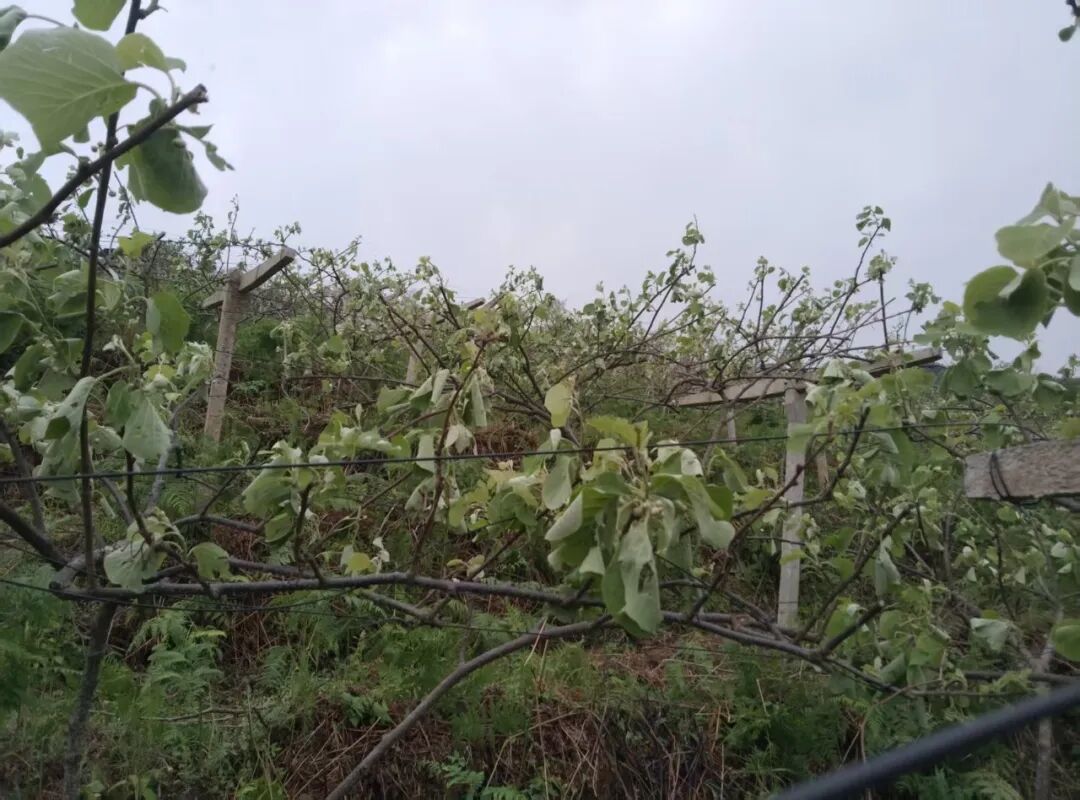
◉A kiwifruit orchard battered by one hailstorm after another. Image courtesy: Tian Hai
What left Tian Hai even more helpless than the hail itself was the tangle of insurance claims. Back in March, the local government had organised fruit growers to file for agricultural insurance, but through a series of handover mishaps the paperwork never reached the insurer. By the time the hail actually struck and he went to follow up, he discovered the policy had not yet completed its statutory process. The crushing loss was one he could only swallow in silence.
Tian Hai’s orchard practice looks “heretical” on the surface—he flatly refuses to strip out the weeds between the rows and instead lets them grow—but it proved its worth under abnormal weather. Highland orchards sit on steep slopes, and hailstorms are almost always followed by concentrated downpours. It was precisely those weeds, their roots left undisturbed, that gripped the soil like a thousand hands cradling the ground, stopping the orchard from being carved up by soil erosion. The kiwifruit’s deep root systems were saved. And in the dry season, the grasses in the orchard did a fine job of conserving soil moisture and moderating the microclimate.
Since turning to ecological agriculture, Tian Hai has gradually released his grip on the fixation of a bumper harvest every year: “When disaster strikes, there’s nothing else to do but guard the soil and nurture the trees. Sturdy, stress-resilient fruit trees are the true foundation of a life lived long and well.”
Relying on the same strategy of protecting grass and soil on steep highland slopes to ride out disasters, Zhou Zuyu, a camellia oil planter in Nandan, Hechi County, had watched the first half of the year with cautious optimism. Rainfall in Nandan had been generally moderate, and his camellia oil-tree forest was thriving, with an oil-extraction rate that pleased him. But in June, a four-hour bout of howling wind and lashing rain pushed the rain-swollen hillside beyond its breaking point: a landslide tore free, churning sand and mud flattened the fish ponds below, and stands of oil trees were toppled in swathes. More harrowing still, two houses in the village downslope were swept away, and a young villager lost his life.
That disaster carved a new understanding of ecological forest management deep into Zhou Zuyu’s bones. In the past, when he told people he didn’t weed under the trees, it was to prove to consumers that no herbicides were used and that his camellia oil was pure and ecological. Now, holding firm to the no-weeding rule—cutting back only to a moderate degree—it is so that the grass roots and oil-tree roots weave together underground into a net, gripping the hillside’s topsoil and minimising soil erosion and the deadly risk of landslides.
Confused Flowering Seasons, Tainted Rice Wine
On the classic karst limestone of Du’an County, Hechi, Wei Guanghai runs the Yaoshan Hong Ecological Family Farm. The soil over the rock is startlingly thin; he plants red-fleshed pomelo, passion fruit and oil trees in the crevices and gentle slopes between the stone. The warm winter at the start of this year brought him a brief, unexpected joy—passion fruits on the vine, which in normal years would have been picked long before, carried on ripening all the way into January. For this Mid-Autumn market trip to Nanning, he made a point of bringing a box of his own passion fruit to share with everyone.
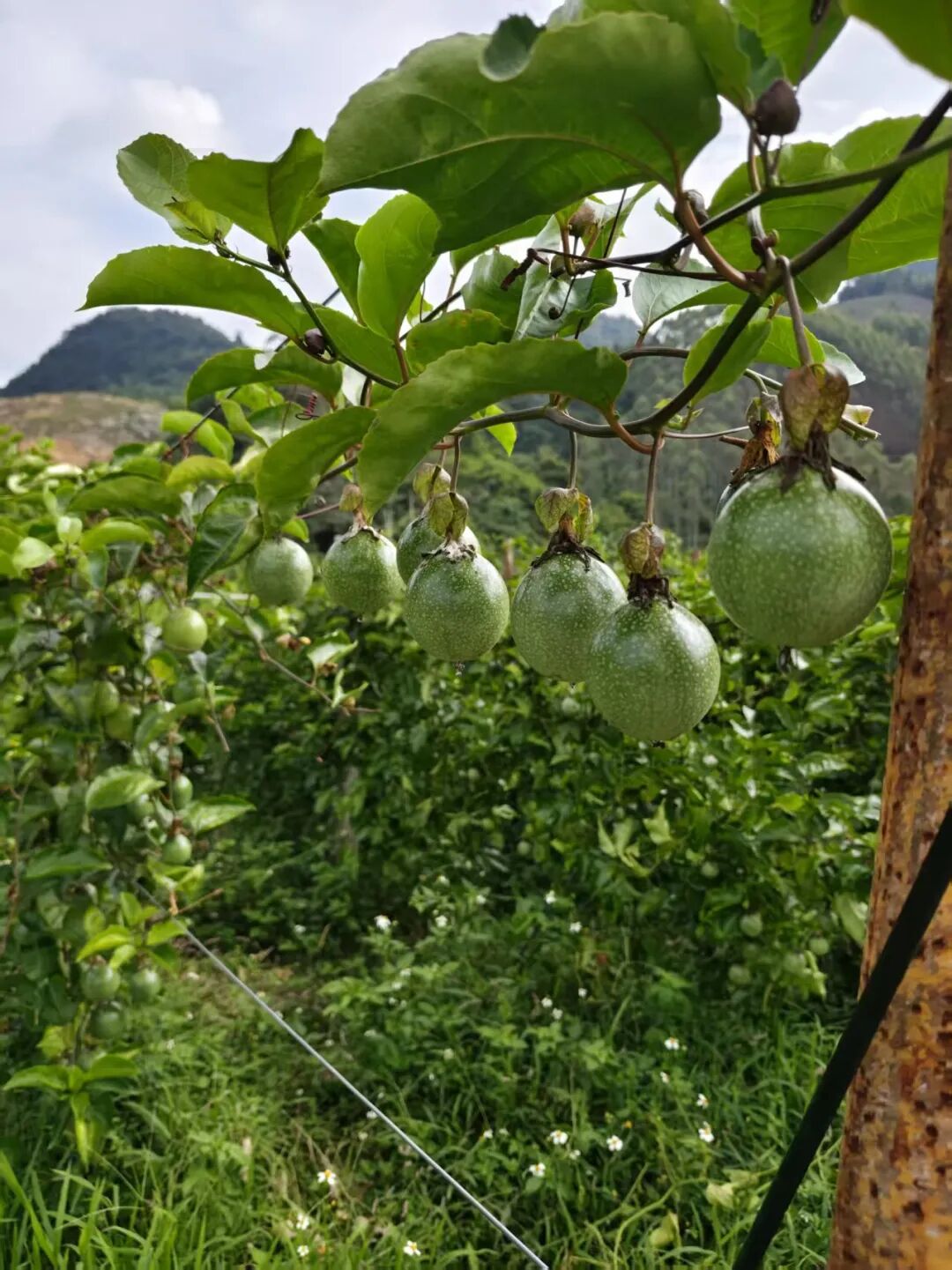
◉Passion fruit thriving, thanks to the warm winter. Image courtesy: Wei Guanghai
But the little surprise was quickly proved to be “too soon to celebrate”. The warm winter had scrambled the phenology, and the backlash landed squarely on the farm’s flagship crop, the red-fleshed pomelo: winter temperatures stayed too high, and the trees never banked enough resources for proper cold dormancy. Growth rhythms went haywire—a few stray buds emerged early in February, and by March, when the trees should have been in full bloom, the branches were bare and sparse.
Wei Guanghai’s heart sank: “There’s no hope. Even if a few fruits hang on, they’ll be sour—impossible to sell.” Pomelo care is intensely labour-hungry; during flowering each blossom must be hand-pollinated one by one. Seeing that the pomelo was a lost cause for the year, he made a swift call: abandon that year’s routine pomelo management entirely and pour every saved hour of labour and all the organic fertiliser into the passion fruit.
On the thin soil above karst rock, he always keeps ground vegetation in place for soil stability and moisture conservation: “Extreme weather is growing ever more unpredictable—you can’t bank on any single crop delivering a good yield every year. Plant more kinds, leave yourself more avenues of livelihood, and a small farm can weather the storm.”
The sharpest senses for disrupted phenology belonged not only to fruit trees, but also to the native Chinese honeybees at Huangxin Ecological Farm in Pingnan, Guigang. Beekeepers Meng Lina and her husband spend the entire year chasing the bloom. Around the Dragon Boat Festival, typhoon-driven floods swept through Pingnan, drowning the riverside stretches of nectar-bearing flowers in turbid brown water. With nothing left to forage in the wild, the colonies in the hives plunged into crisis, barely scraping by on the honey still stored within.
Meng Lina opened a hive and noticed the queen was visibly smaller than in previous years. Years of beekeeping had taught her to read the colony’s quiet wisdom: when nectar sources outside grow desperately scarce, the bees instinctively reduce their own consumption, as though the whole community were reminding one another to ration. Even facing a severe drop in honey yield, she held one line firm: rather than take more, she would leave the colony enough stores to survive the winter lean months, protecting the vitality of the indigenous Chinese honeybee population.
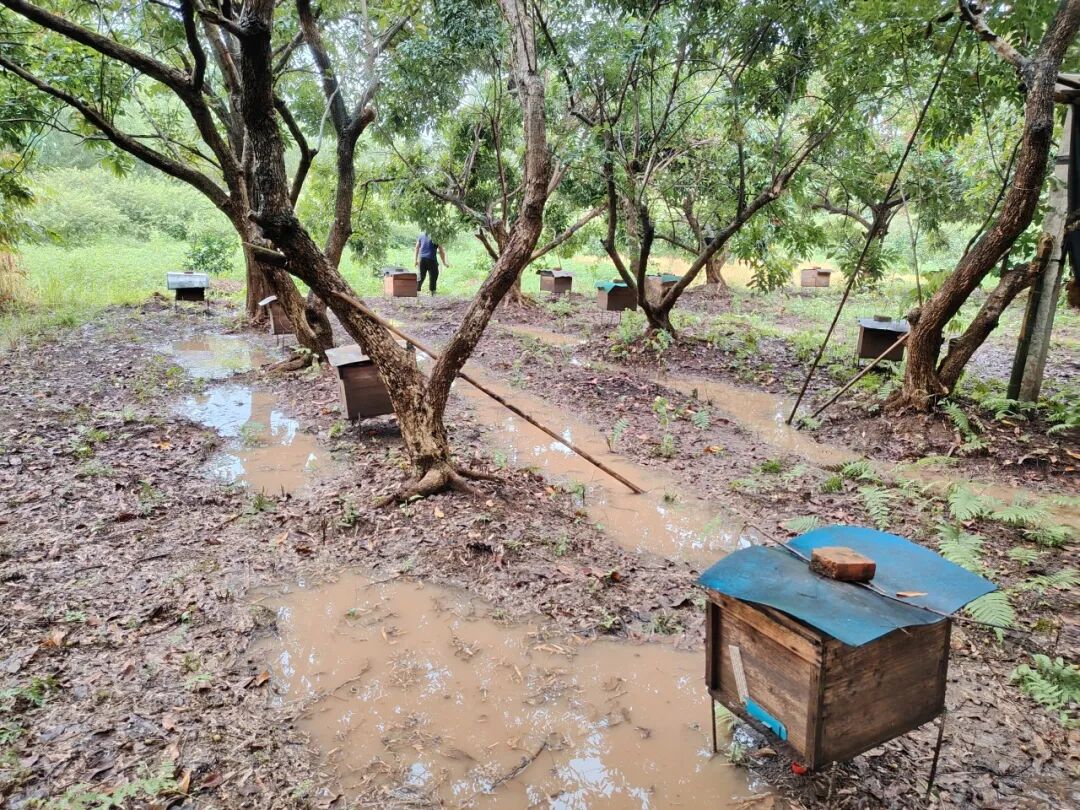
◉The flood submerged the flowers; the bees were forced to go hungry. Image courtesy: Meng Lina
“Trees die when uprooted; people thrive on the move.” Watching the local nectar sources dry up, Meng Lina made a swift call: gather the colonies and relocate to “chase the bloom” elsewhere. These days, a cross-region migration can’t rely on the old almanac alone—erratic climate makes flowering schedules in other areas just as unpredictable. Hauling a truck, setting up camp, every cost is hard cash, and a false start means losing your entire investment. Before each departure, she phones old friends far away, confirming the state of the hillside blooms and the scale of the nectar sources time and again before she dares load the hives. This year, she hauled them down to Yangshuo, Guilin, and found the mountain flowers in full blaze; the honey she harvested didn’t just cover its costs—it more than made up for the losses back home.
Living so closely with the bees, she reads from these tiny creatures the deep resilience woven into nature: after a long, punishing drought, all it takes is one soaking rain, and the mountain plants burst into a retaliatory, concentrated bloom—even plants that have fallen ill strain every fibre to open abundant blossoms.
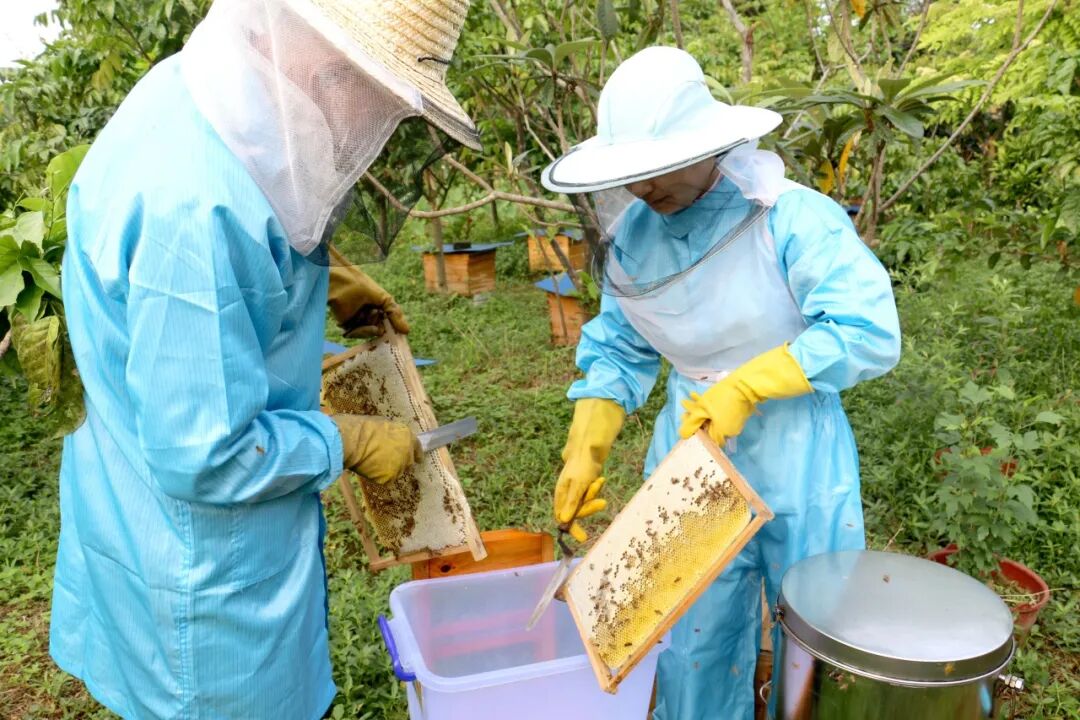
◉Faced with climate change, beekeepers must understand plant-resource distribution across a much wider area so their bees have enough to eat. Image courtesy: Meng Lina
Extreme weather also reached the Bingdingshan Distillery in Luocheng County. Before coming to this gathering, distiller Tang Hongsheng had never thought of his craft as having anything to do with climate change. But the invitation prompted him to look deeper. Outsiders used to assume brewing was a safe indoor trade—no wind to worry about, no rain to fear—yet looking back, he had come to realise that from a single grain of glutinous rice to a vat of fine wine, every step hinges on the sky’s whim. This year’s climatic aberrations sent local glutinous rice quality swinging wildly, with empty grains and impurities markedly on the rise. Just sourcing decent brewing grain at the origin proved an exhausting quest.
At the fermentation stage, temperature becomes a matter of life and death. The golden window for sweet fermented rice wine and huangjiu is around 25 °C, but this year the weather swung between extremes—when the heat spikes, the liquid sours and spoils; when temperatures plunge, the fermentation starter slows or stalls entirely. Without a modern temperature-controlled workshop, Tang Hongsheng falls back on old ways: in the height of summer, he drags the heavy wine vats—hundreds of jin apiece—to the shaded, breezy base of the north-facing wall; when the chill returns, he hauls them back to the south-facing side to soak up the sun’s warmth. He envies, just a little, the better-off distilleries that can move their wine jars into a karst cave whose temperature stays natural-steady, ageing the wine in the stone’s cool embrace.
Brewing cannot do without good water. Tang Hongsheng lives year-round in Nanning, but every brewing season he rushes back to Luocheng, drawing only from the spring he has favoured for years. In the driest years, the spring’s flow drops sharply, and whether he is collecting water for brewing or neighbours are filling jugs for drinking, everyone must expend extra effort and care.
To keep his raw materials steady, he proactively built a mutual-aid network with neighbouring ecological farmers: they swap goods and intelligence in everyday life, and he always has a clear picture—which plot’s paddy is growing strong, which batch of glutinous rice is dependable—long before the season turns.
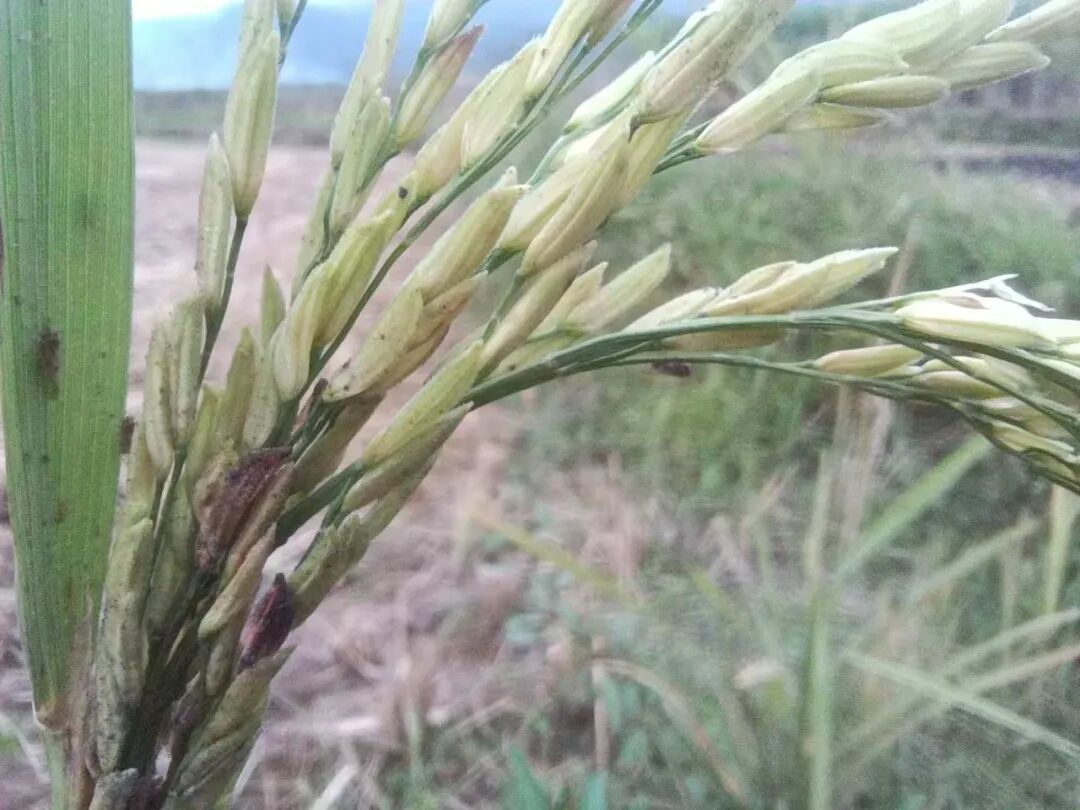
◉Aberrant climate has brought a marked rise in empty grains and impurities in this year’s rice, which will also affect brewing quality. Image courtesy: Tang Hongsheng
Traditional Intercropping and Ancient Reverence of the White Trousers Yao
As the farmers took turns pouring out stories of hair-raising escapes and cut yields, Li Youming from the Nandan White Trousers Yao team delivered an unexpected answer—he “felt quite good” about this year’s harvest.
It wasn’t that Nandan had enjoyed benevolent skies. This year, even the township government’s seat suffered severe waterlogging. Li Youming’s home sits high on the mountain and luckily escaped the flood; combined with rain and heat falling in sync, the upland rice looked reasonably well. But the highlands have their own hardships—after every rain came a blazing sun, and an outbreak of rice planthoppers cost him a full sack of grain.
Why still feel good about losing a sack? The answer lies in the mountain farming tradition passed down from White Trousers Yao ancestors: at spring sowing, a handful of seed is paired with a handful of farmyard manure. Within that handful, maize takes the lead, but it is also blended with sweet potato, Chinese cabbage, red amaranth, pumpkin, cucumber, yardlong bean, and industrial hemp, among others.
In Li Youming’s eyes, the method left by the forebears holds profound ecological wisdom—it means the least possible disturbance and damage to the thin upland soil. Across the whole year the land is tilled and sown just once, at the onset of spring, sparing the gossamer-thin soil layer the wear of repeated ploughing; yet “one planting yields many harvests”—red amaranth ripens first and heads to the table, then quick greens, pumpkin shoots, cucumbers and so on, and once the maize is in, the last stretch of space is left for industrial hemp.
In the past, this traditional intercropping was valued mainly for the diversity of the harvest. Seen through the lens of climate change today, it has come to mean a reduction in risk. Even if drought, flood, or pests wipe out one or two crops, the others remain to hold the line.
This traditional planting system squeezes time and space to their utmost and is a masterclass in mutual aid among crops: deep and shallow root systems interlace below ground in staggered tiers, tall stalks and short plants capture sunlight in separate layers above; maize stems serve as natural trellises for climbing bean vines, while red amaranth, Chinese cabbage, and the broad leaves of pumpkin carpet the soil surface so tightly that precious moisture is sealed in and weeds are suppressed.
Yet fewer people turn to these old ways. Many villagers have left for migrant work, no longer pouring heart and effort into tending the land, nor observing the planting timetable set by the Plough-Opening Clan. The Plough-Opening Clan is the family in each White Trousers Yao village entrusted with opening the plough. Each spring, after the first clap of thunder, he must perform the opening-the-plough ceremony first and then announce that others may begin; until he has done so, no one else is permitted to start.
Besides holding firm to this dryland tradition, Li Youming has been absorbing outside ecological farming techniques. After returning to the village in 2008, he learned through a public-interest project about the importance of seed and set about trialling varieties to find the best fit for his land. More than a decade on, he has screened over a hundred varieties and developed his own selection method: foreign varieties are first shortlisted in bucket tests, promising ones move to a trial plot, selection continues for three consecutive years, and only after weathering local drought, flood, and pest pressure are the best candidates scaled up as the main crop in the open fields. This approach blends lessons from experts at the Rice Research Institute and beyond with the hard-won wisdom of White Trousers Yao elders: when saving your own seed, observe “trim both ends, keep the middle”—selecting only plants of middling vigour.
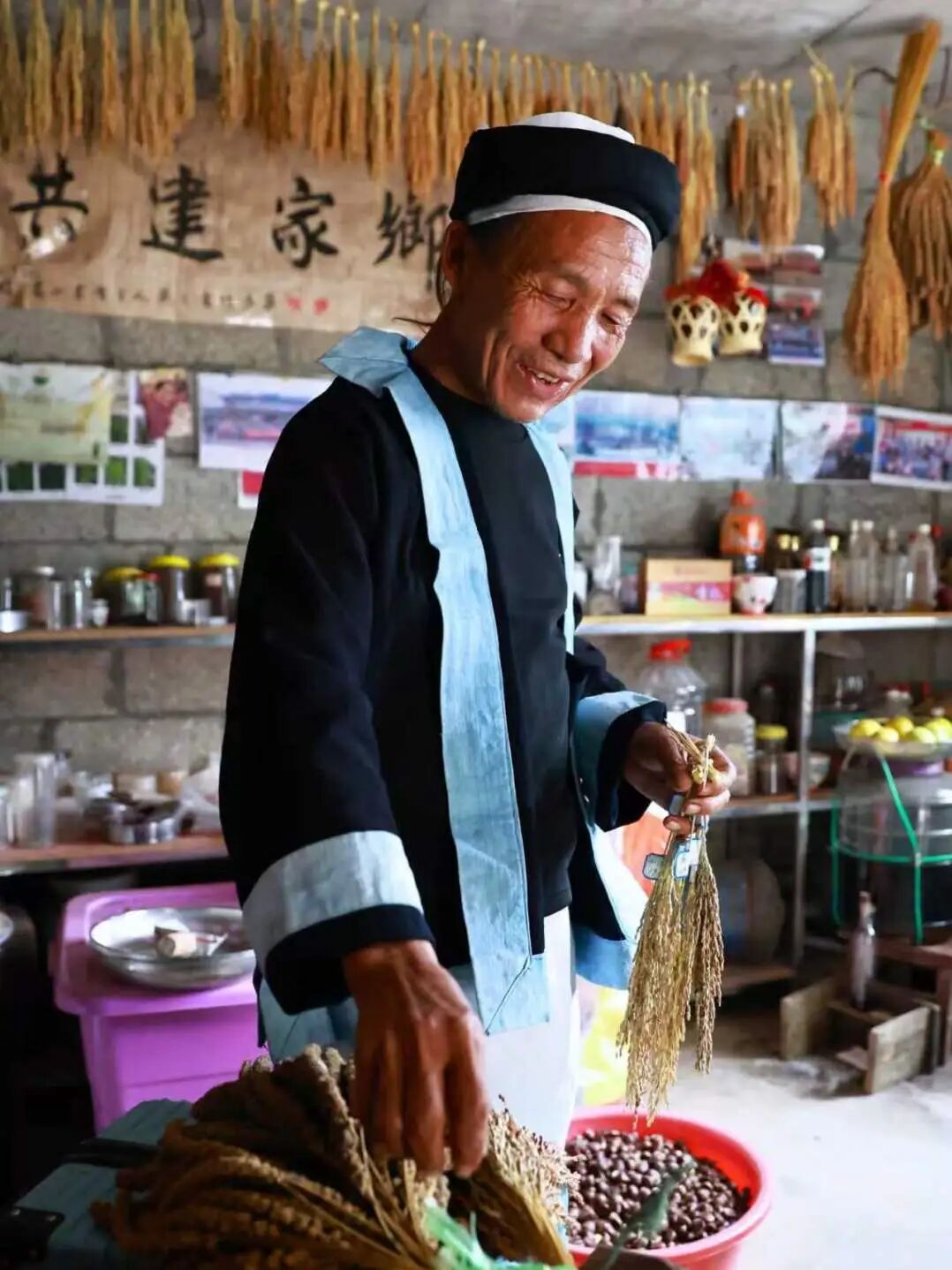
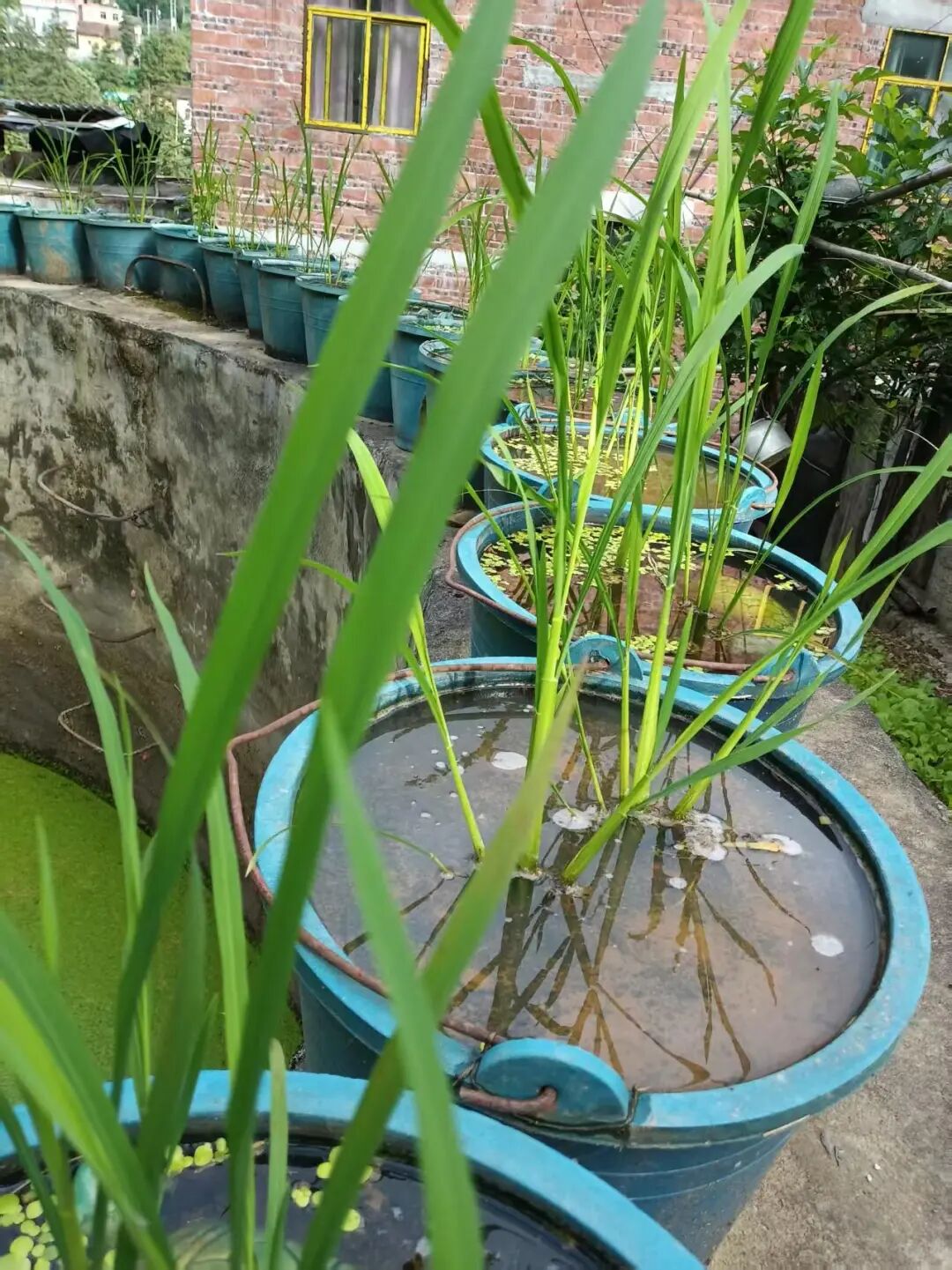
◉Li Youming (left) has screened over a hundred rice varieties (right). Image courtesy: Li Youming
As he shared these hard-earned truths, Li Youming turned to heaven and earth. The White Trousers Yao vocabulary has no word for climate change; the closest he finds is “heaven and earth.” His voice was quiet, “We used to say ‘wrestle with heaven, wrestle with earth,’ then believed technology could conquer nature. The moment humans truly think they can best heaven and earth, punishment follows.”
After the Storm: The Ecology of Soil, Seed and Soul
This year, extreme weather swept across Guangxi in a shifting cast of warm winters, typhoons, hail, and torrential rain. On the eight farmers, the impact varied—moments of brief relief, more often resignation—yet it also confirmed the slender margin that ecological farming can hold. If one were to distil the lesson, it might settle into three dimensions: soil, seed, and soul.
Soil Is the Foundation: Whether it is the White Trousers Yao practice of “sowing just once a year” and disturbing the topsoil as little as possible, or the shared resolve among ecological farmers to mow the grass while leaving the roots in the ground, every measure is about preserving the fertility and structure of the soil. Loose earth with roots still holding means it can soak up water when the rains are fierce and retain moisture in a drought—the land must find its own footing before crops can weather anything.
Seed Is Hope: On one end, diverse planting structures break a livelihood into many small streams, denying extreme weather the chance to wipe everything out in one stroke; on the other, old varieties long adapted to the local land and climate—they remember the temperament of their patch of earth—and in the worst years, they are the ones that hold the bottom line for the farmer.
Soul Is the Homecoming: From the White Trousers Yao reverence for heaven and earth to the farmers’ considerate stance towards weeds and bees, what fills their hearts is no arrogance about human will conquering heaven, but a quiet acceptance of impermanence and the simple duty of steady tilling. That care flows outward to one another: on platforms like the Nanning Urban Farm Fair, farmers’ produce finds new routes to market, and charitable organisations and urban consumers step into the fields. Scattered smallholders sit together and huddle for warmth; isolation becomes the resolve of neighbours watching over one another.
The strongest El Niño has already arrived, and the climate challenges ahead may prove even more severe. Modern agriculture is always selling the mirage that human will conquers heaven, yet these eight farmers remind us: faced with a fickle climate, bending down to “work with the earth” may be a more honest and longer-lasting way to live than “wrestling with heaven.”
As the gathering wound down, everyone gathered round to taste a crate of passion fruit that Wei Guanghai had brought from Du’an, and all said it was delicious. Guanghai was beaming. “A friend in Beijing told me it was the best passion fruit she had ever eaten,” he said. Having lost his pomelo income, he had not only found a measure of financial security in passion fruit but regained the dignity and confidence of an ecological farmer.
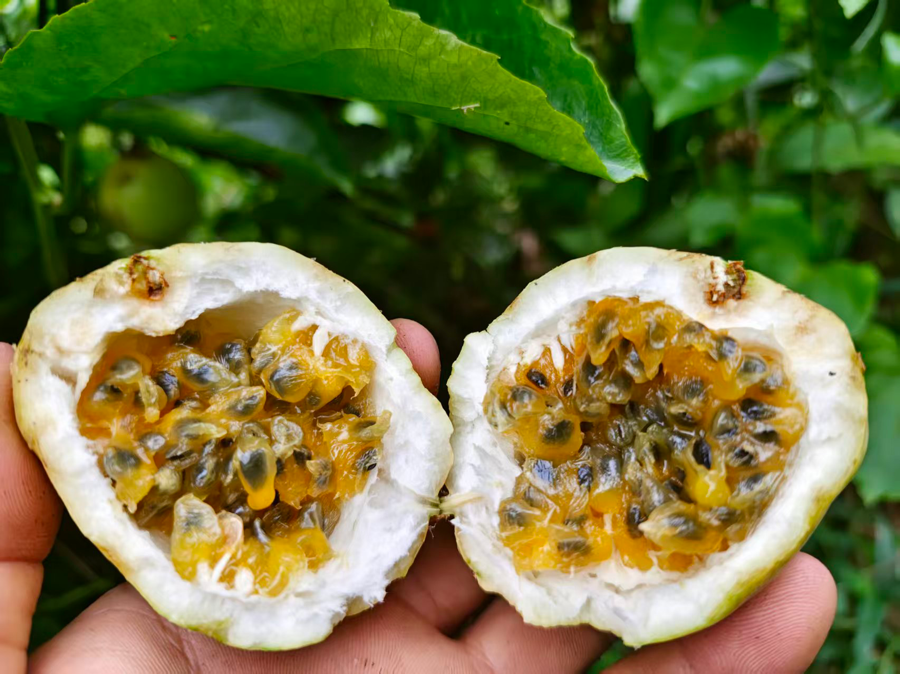
◉ Guanghai’s passion fruit. Image courtesy: Wei Guanghai.
*This discussion was organised by the Nanning Meinong Social Work Service Centre, planned by the Guangxi Climate Change Action Network, with the assistance of the Nanning Urban Farm Fair, and thanks are due to the Nanning Tusheng Liangpin Restaurant for hosting the event. AI tools were used during the compilation and writing of this article.
– This is the 858th original article by Foodthink –

Foodthink
Author:
Wang Jian
A social worker born in the 1980s, working long-term on rural community development in Guangxi.

Foodthink
Author:
Zhou Ting
A postgraduate student in Social Work at Guangxi Minzu University, researching environmental social work and grassroots governance in borderland areas.
Edited by: Tianle, Lingyu
Layout by: Xiaoshu
Scan the QR code to tip and support original Foodthink writing
▼

▼
Click the image to read related articles
▼
Click a keyword to browse more article collections
Seeds | Farming Techniques | Policy | Fermentation | Nutrition | Fruit | Fisheries | Events | Recruitment | Takeaway | Wet Markets | Livestock | Food Talk | Sharing Sessions | Book Club | Harvest Festival | Smallholder Stories | Climate Change | Rural Development | Cooperative Economy | Urban Farmers | Food Safety | Digital Technology | Biodiversity | Pandemic and Food | False Solutions | Ecological Agriculture Internship Programme
Beijing | Hebei | Shanghai | Guangdong | Guangxi | Henan | Sichuan | Jiangxi | Xinjiang | Shaanxi | Hong Kong | Chongqing | Zhejiang | Jiangsu | Guizhou | Taiwan | Inner Mongolia | Philippines | Canada | Russia | Mexico | Italy | United States | United Kingdom | Germany | Netherlands | Thailand | Sweden | Japan