Like a Rider, Barreling Through the Supermarket

A note from Food Communications Society
Whether it’s “Flexible employment is a privilege” or “Supermarket picking lets you lose weight on the clock”, people tend to hold a romanticised view of gig work. In reality, however, precarious employment relationships often subject gig workers to more severe exploitation, and their bodies to more serious harm.
In this dialogue, two pickers explain how, despite the daily risk of injury they face while working flat-out to complete orders for fresh-food e-commerce platforms, some of them exist in a “pure business-cooperation relationship” with their stores.
No longer places of consumption, Xiaoxiang Supermarket (Meituan’s fresh-grocery brand) and Hema (Alibaba’s fresh-food supermarket) have become factories filled with the sounds of labour and machinery. Directed by algorithms, pickers race recklessly through the front of the supermarket like delivery riders, existing in a parallel timeline to the customers they brush past.
Picking items for online customers – work that looks deceptively simple but in reality involves all manner of unspoken hardships. And yet the pickers still feel the urge to huddle together, to comfort one another, to create a little warmth in their transient lives.
These experiences are happening every day, in real time, in a fresh-food warehouse in some corner of the city. No one is entitled to reduce gig workers to objects onto which they project their romanticised imaginings.
– Picker –

Yakou|Order picker at both Hema and Xiaoxiang. No full-time job – I work with both head and hands on the gig economy. Recently picked up fieldwork and writing again. A small light that no one can take away in this flawed world.
Zhigu|Worked as a picker at Hema for three months. Picking made my toe bones ache for the first time, so I went by the name Zhigu – toe bone.
“Like a delivery rider, racing recklessly through the supermarket”
Yakou: At Xiaoxiang, you’re just picking your own orders in a warehouse. But at Hema, especially in the front-of-house area, customers are also shopping, so sometimes you need to interact with them. When I’m in a real rush picking, a customer will come up and ask something. I used to deliberately avoid customers – if I could sense someone was looking for something and was about to ask me, I’d run off to pick something else. I wonder if you have similar experiences when working in the front-of-house area?
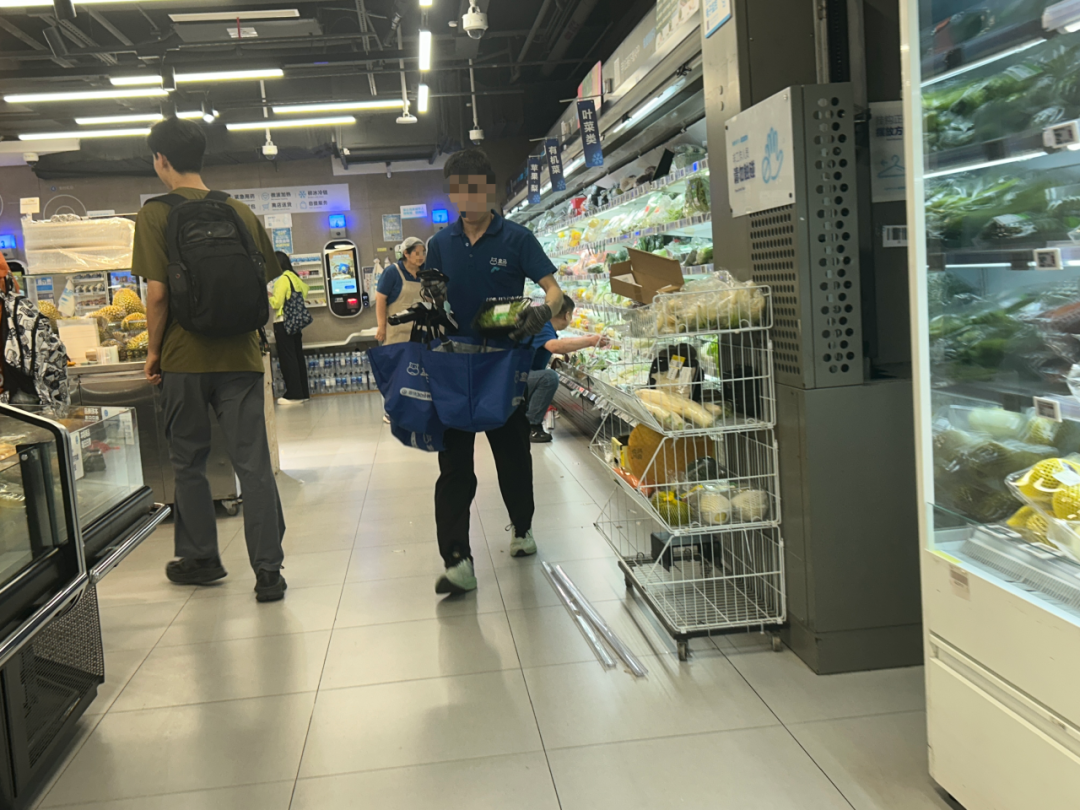
◉If you shop at Hema regularly, you might notice a group of people weaving quickly through the shelves and the crowd – they are the pickers. Photo: Yuyang
Zhigu: When I work in Hema’s front-of-house area, I completely ignore the in-store customers – to me, they’re just obstacles to navigate around. I don’t make eye contact with any of them. But even so, people still grab hold of me and ask questions. If I’m busy, I just decline outright. Sometimes I want to explain, so I’ll say, “We handle the online orders and we’re on a tight schedule,” and show them the countdown on my PDA (handheld scanning device) that I never actually look at during normal work. I can tell they’re completely baffled, even carrying a kind of wordless judgment: “Isn’t your job essentially about serving customers? And yet you say you don’t have time?”
But what can I do? I’ve thought about it since, and I think it’s really that Hema mixes different operations in the same space – we live in parallel realities. I only need to be accountable to my data. My job is to find the items I need to pick in the supermarket, and the efficiency demands don’t allow me to exist in the in-store reality. I charge recklessly through the supermarket, much like a delivery rider charges recklessly down the road – this “race for your life” is actually part of the job. The only things in your head are orders and routes; you don’t have time to register what’s happening around you.
So I hope consumers can understand that asking a picker in the store for help is a bit like pulling over a delivery rider on the road to ask for directions. I’ve bumped into customers more than once. I’m genuinely sorry every time, but in the moment, I feel the way a rider feels: I’m sorry, but I have to keep running. Sometimes I feel like I’m out of my body, especially when orders pile up. My mind is racing, and all I can see are the orders in my hands. The store’s shift patterns mean sometimes there are few orders, sometimes many. The front-of-house area often lets orders pile up for an hour, and then I have to pick like mad during that hour – sometimes there are only two of us picking in the entire front-of-house area, and all we can do is charge about and run as fast as we can.
Hema feels like a factory
Yakou: Customers who shop Hema’s front-of-house would probably find it hard to imagine what the back-of-house (the warehouse area customers cannot see) is like. In the back area, Hema feels like a factory.
My overall impression of working in the back-of-house is that during peak times it is incredibly busy, as if everything is in motion. The overhead conveyor runs from the front-of-house all the way through to the back-of-house, with something always moving overhead. The sound of the conveyor turning, pickers running, people putting packages down, the grinding of various machines, the hum of fans, the rush of air from the air conditioning – it all floods into your ears.
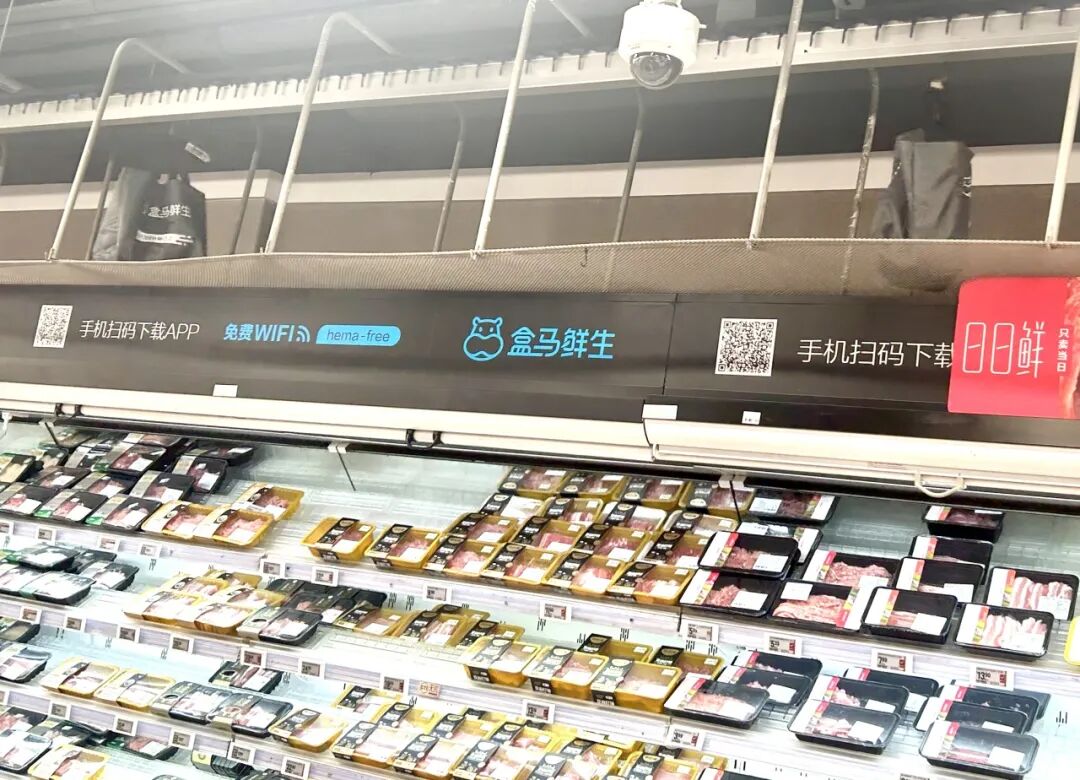
◉An overhead conveyor carrying totes at speed runs above the shelves in a Hema supermarket, stretching from the front-of-house all the way into the back-of-house warehouse that customers can’t see. Photo: Yuyang
Yakou: The moment you step into the back-of-house, you can smell a strong dusty odour – probably from all the boxes and machines. Spend an afternoon or an evening in the warehouse and your eyes start to feel uncomfortable, because it’s quite dark overall and a sealed environment. I had a similar experience when I was working at Xiaoxiang.
Zhigu: When I first started working in the front-of-house, I’d occasionally go into the back-of-house and often thought the people there moved impossibly fast. After I got used to the pace of the back-of-house myself, when I went back to the front-of-house, I was still moving very quickly – especially around customers, I’d often dart in and out beside them. Everyone had settled into an extremely fast rhythm and learned how to keep from falling in all kinds of positions.
Another typical sound in the back of house is the clatter of freezer cabinet doors. With so many freezers, people yank the doors open at speed to grab what they need, then let the door swing shut on its own, so it’s a constant thumping. And then there’s the sound of that thick curtain being shoved aside when you go in and out of the cold room: in—*thwack!*; out—*thwack!*
The mechanical hum of the conveyor belt is almost constant. I even recorded a short clip of it at one point – I felt it was a sound unique to that environment. All the fans are running non-stop too, including the extraction fans in the ambient-temperature zone and the dedicated fans in the cold storage. Once, a fan in the cold storage just blew out with a sharp, explosive crack – I nearly lost my hearing. It gave you a strange feeling: the whole place seemed about to blow up, and you had no idea whether it actually would, but the order in your hands was already being picked, so you just had to keep going.
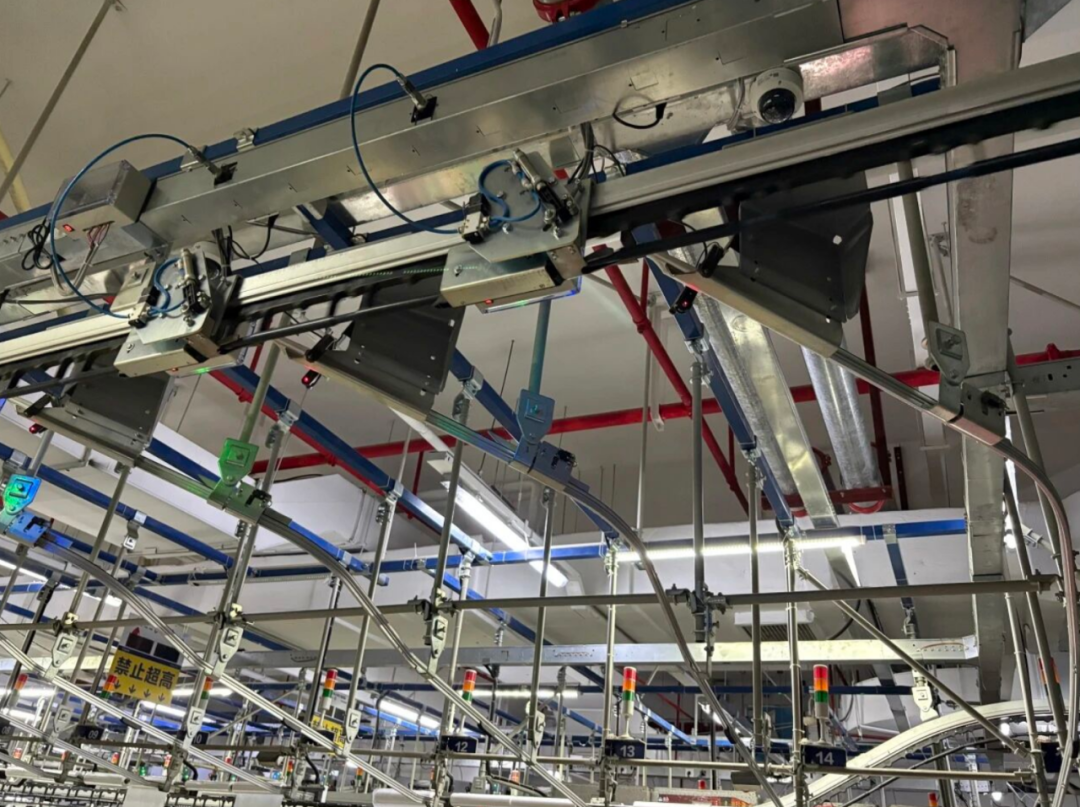
◉ Various conveyor machinery in the back-of-house warehouse. Photo: Yakou
Yakou: You mentioned before that an employee who was very kind to you was deaf. Does Hema have any specific requirements for hearing in recruitment, or are there dedicated posts set up for people with hearing impairment?
Zhigu: I’m not sure. In the back-of-house, I’ve seen two or three employees with hearing impairment. Back-of-house work basically doesn’t require any speaking at all, and two of the highly efficient ‘order kings’ (单王) I mentioned – the top pickers by volume – were actually these two colleagues with hearing impairment. They were extremely efficient and capable. But in the front-of-house, it would be a problem. They used to work in the front-of-house, and when communication was needed, no one assumed they couldn’t speak, so they’d get scolded for it – even faced situations that carried the undertone of physical threat.
From that angle, picking is like an assembly line that doesn’t really require much verbal communication. I mentioned last time that a friend of mine said some supermarket or McDonald’s employees are a bit like assembly-line workers disguised as service staff.
Zhigu: The job is more like a combination of platform labour and factory management. The factory element shows up in the way managers pressure you directly – telling you what to do, with strict attendance requirements and all sorts of rules and regulations. But there’s another layer of pressure on pickers. I’ve observed that very few people are actually dismissed outright. More often, it’s the system’s pricing structure: if you pick fewer orders, you earn almost nothing, you can’t support yourself, so you leave on your own. This is really the logic of a lot of platform work – very similar to riders. Do less, earn less. An order comes in, you take it, then you just stop somewhere at random to rest. Picking at Hema has this feeling of suffering both the platform’s grind and the factory’s grind at once.
Yakou: There’s one more thing that comes to mind, about hygiene. When we pick, we throw everything into the same reusable bag, which means other items pick up that smell. I find it pretty unsanitary. Some people buy pre-cut fruit – if that’s the case, there’s a risk of bacterial contamination too. Some bags smell really bad. At first I thought they couldn’t be used, but a colleague nearby said it was probably from seafood they’d previously held, and that it was fine to keep using.
Zhigu: Yes. And not only that – during packing, everything goes into the same packing box, and that box truly reeks. The cold packs and ice packs smell too. They just press those ice packs straight onto the outside of whatever packaging the fruit and vegetables come in, so everything you handle has that smell on it. It’s so bad that I have to wash my hands every single time after packing. I think this is actually a serious hygiene issue, but at my store, every single order is handled this way.
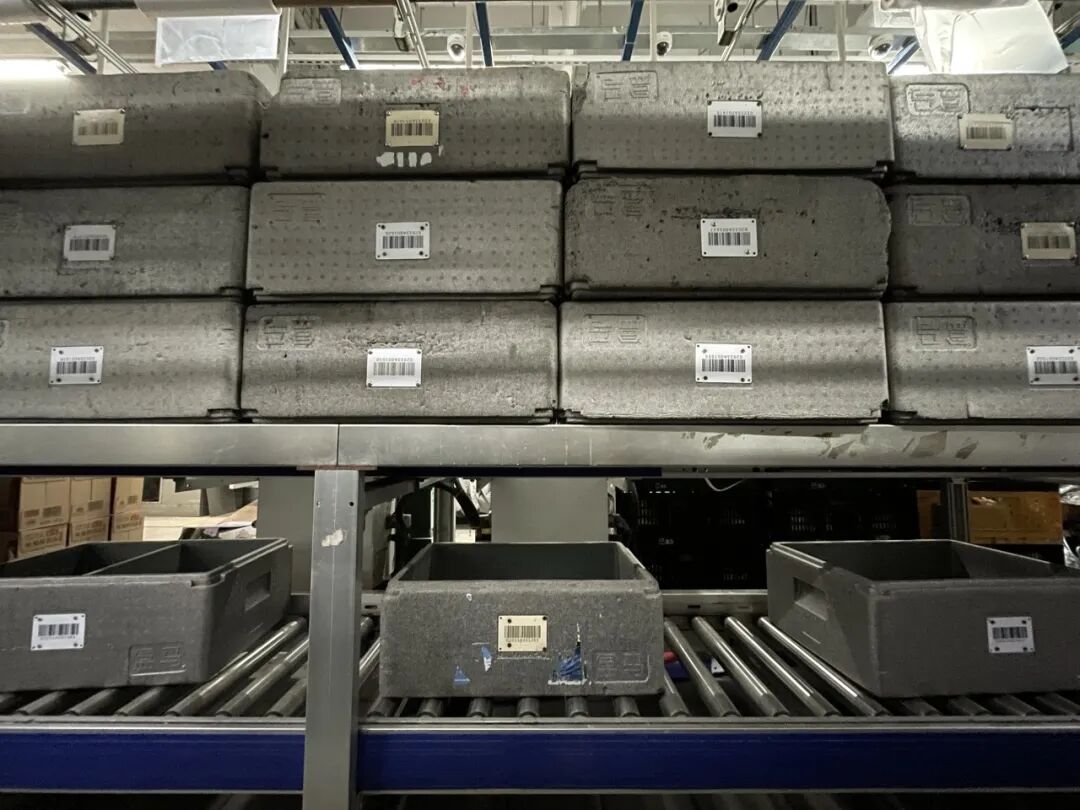
◉ Packing boxes used on the conveyor at Hema’s packing station. Photo: Zhigu
Zhigu: I find it really funny – some people say they prefer online shopping because it looks clean, and they think wet markets are dirty. They really ought to know – it’s just that fresh-food platforms have the ability to hide all the dirty bits.
Yakou: Yes, even though we’re dashing around right next to customers, no one actually bothers to smell what our reusable bags smell like.
“Injury Is Inevitable”
Zhigu: Do you have to go into the cold storage to pick up all the frozen items?
Yakou: Yeah, because you have to go in and out to grab items in a very short time, with constant shifts between hot and cold, it’s quite easy to fall ill. I probably got sick because of that.
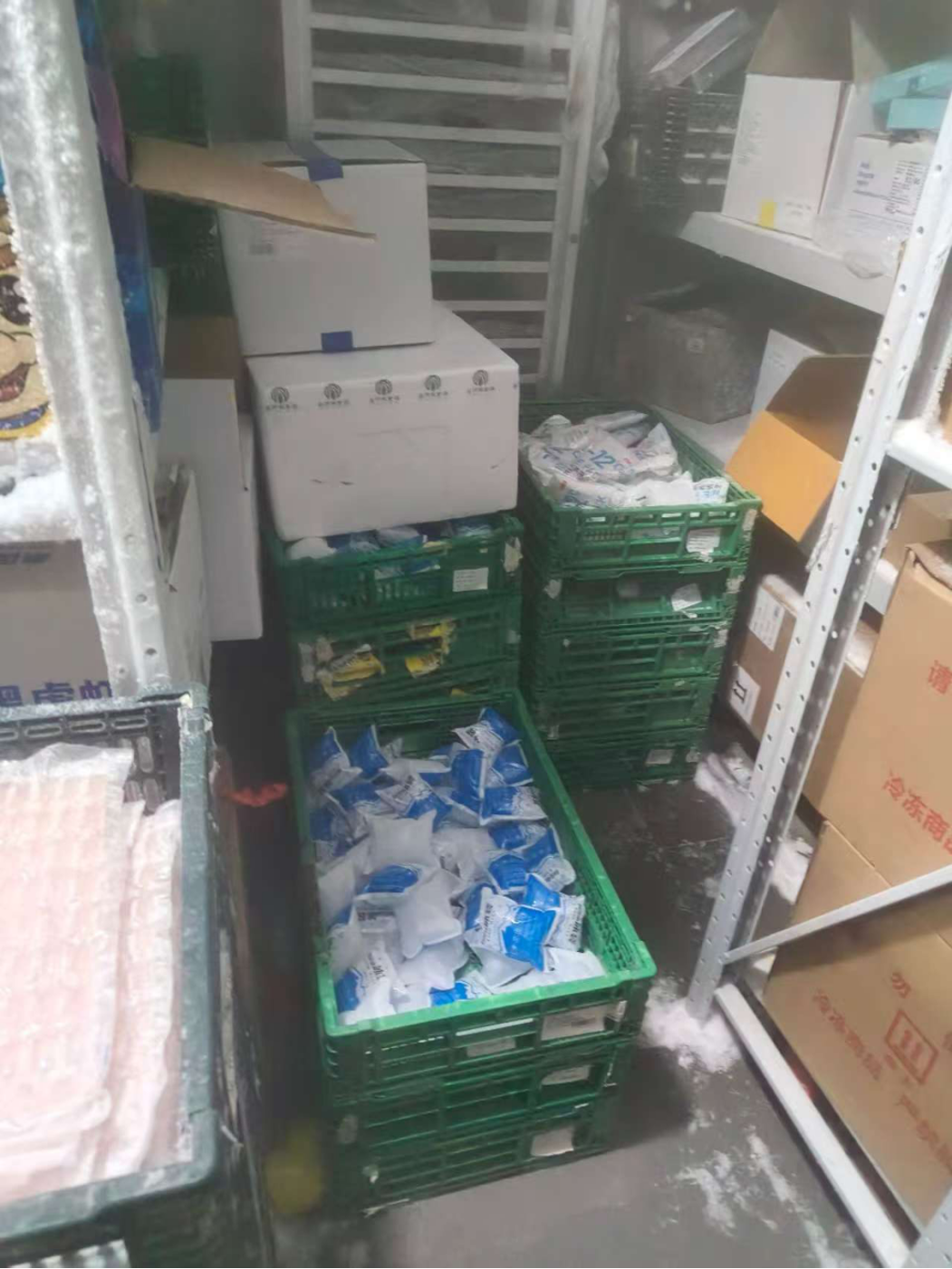
◉The cold storage in the back-of-house area is extremely cold, and many pickers are reluctant to go in. Photo: He Siqi
Zhigu: At the Hema store I work at, if I’m lucky, there might be stretches of an hour or two during the day where I don’t need to go into the cold storage even once.
There are a lot of freezers in there. Most of the frozen goods – ice cream, dumplings, and things like that – are kept in the freezers, so you just open the door and grab what you need. But once you actually go into the cold storage to find an item, you often end up staying quite a while. Two minutes is perfectly normal. The bin locations in the cold storage are completely unreliable. Most of the time you’re rummaging through boxes in sub-zero temperatures, sometimes having to pull boxes down from overhead, and sometimes boxes will crash down on you. It’s quite chaotic.
Yakou: That sounds terrible. Two minutes in the cold storage sounds absolutely unbearable.
Zhigu: So I used to tap “find item” on my device. I don’t feel I have the right to be asked to search for that long inside. If the bin locations aren’t organised properly, that’s not my responsibility. Once I tap “find item,” the kanban supervisor (the person who monitors the floor) takes over and comes to find it.
Yakou: You mentioned earlier that the floor is wet. Doesn’t that pose a safety hazard?
Zhigu: I often worry about falling. Because from the day I started, I knew that if I fell, I’d have to bear the consequences myself. This place won’t provide any support, and I might even lose my job because of it. I’m also worried it could affect my future ability to work and move. I’m extra careful when I’m working, but I did fall once.
When the floor got slippery from water, I somehow stayed on my feet countless times. Even carrying heavy loads and having to rush through wet patches and stop dead — I suppose it was luck. The one time I actually fell was when I was rushing into the cold room. There’s a thick curtain at the entrance that drags along the floor, and that day the temperature difference had made the ground especially slippery. I caught my foot on the curtain and went face-down on the floor, landing on my knees.
Yakou: So have you ever been injured?
Zhigu: Just bruises, nothing serious after that. When I talk to other staff about similar experiences, there was a young guy who suddenly rolled up his trouser leg and showed a bleeding cut. He said the picking area is full of totes, and when you fall, it’s easy to scrape against the edge. That time his trousers tore open too, just as wide as the wound underneath. As he was talking, a middle-aged woman who’d been working there a long time said from nearby: “What’s a little cut like that?” Her arms were covered in bruises of all shades, and she casually mentioned she’d also fallen to the ground before when coming out of the cold room. Several other senior staff had similar stories. I was thinking at the time – surely everyone gets injured, so why do they all act like nothing’s wrong?
Yakou: That reminds me of when I was at Xiaoxiang. The cold room floor is slipperier than outside, and the senior staff member who was showing me around specifically warned me to be careful. Another big safety hazard when I was working at Xiaoxiang was climbing the shelves. The shelves are quite tall, so to get something from the top shelf, you either go and fetch a step stool (which takes time), or you step onto the bottom shelf and reach up, or you simply pull the top shelf down towards you – but if you lose your grip, the whole box comes crashing down. I don’t know if this happens in Hema’s back-of-house area where you work?
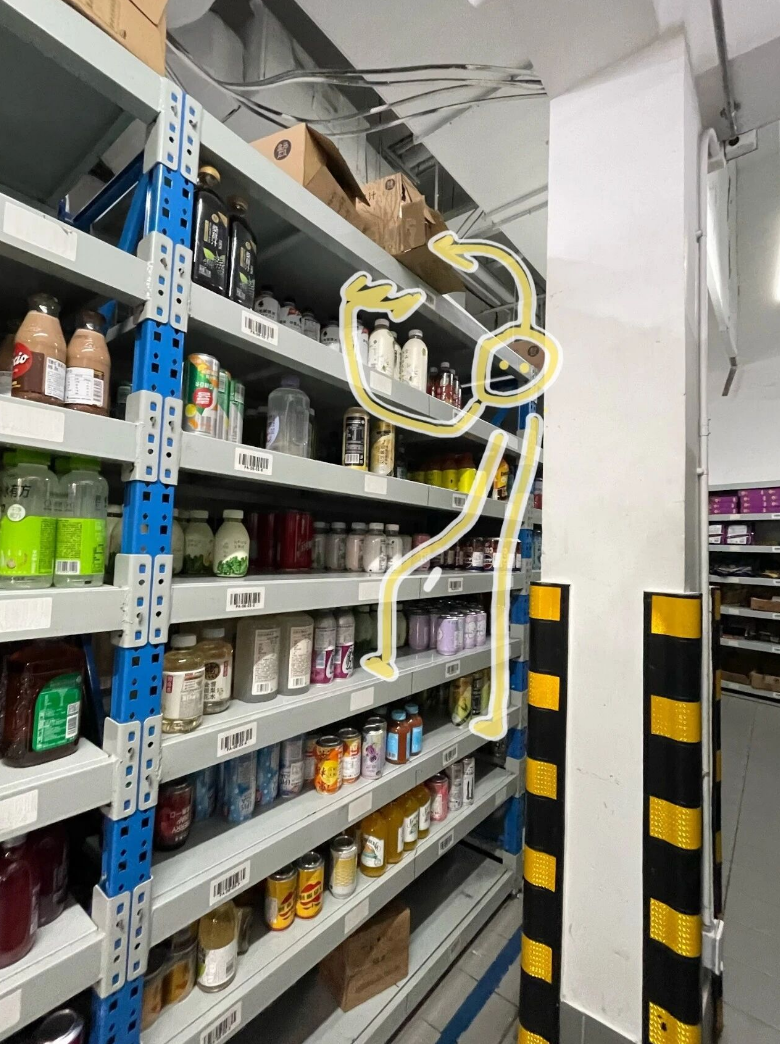
◉ A diagram showing a picker taking the risk of climbing high to retrieve items. Source: Zhigu
Zhigu: When I read your piece about climbing shelves, I just laughed – so everyone’s doing this. The senior staff climb with ease: one hand hooks, one foot steps up, grab the item, and they’re back down. The whole sequence is fluid, like a dance. At first, I had to set down the heavy bag I was picking, put the PDA on the shelf, and free both hands to climb. I even felt that climbing shelves wasn’t really much of a safety hazard anymore, because it had become part of my routine. Well, saying it like that actually makes it sound even more dangerous.
Yakou: If the shelves were made shorter, it might mean needing more of them. For example, if you removed the top tier, you’d need more warehouse space. For the company, that means higher rent; for the pickers, the walking distance increases, and if the time limits stay the same, the problem remains.
Zhigu: I don’t think the company has ever considered this problem. They just assume everyone can manage, when in reality everyone’s barely keeping up at all. The things I eventually felt I’d “overcome” – for a lot of the people who left, those might have been things they simply couldn’t or wouldn’t overcome.
I used to keep saying to the veteran pickers, ‘How did this one get dropped again?’ or ‘That’s not reasonable,’ and they wouldn’t even bother to engage with me. They’d just say it was all perfectly normal – you get used to it. Now I feel like I’m starting to talk the same way…
Nothing about any of this is written down when they recruit, but in reality you need to be able to: walk that many steps every day; have sufficiently strong leg muscles; be in good physical shape; have a stomach that can handle skipping meals; be able to climb the shelving; cope with all manner of pressure… Fall short on any one of these and you simply can’t keep going.
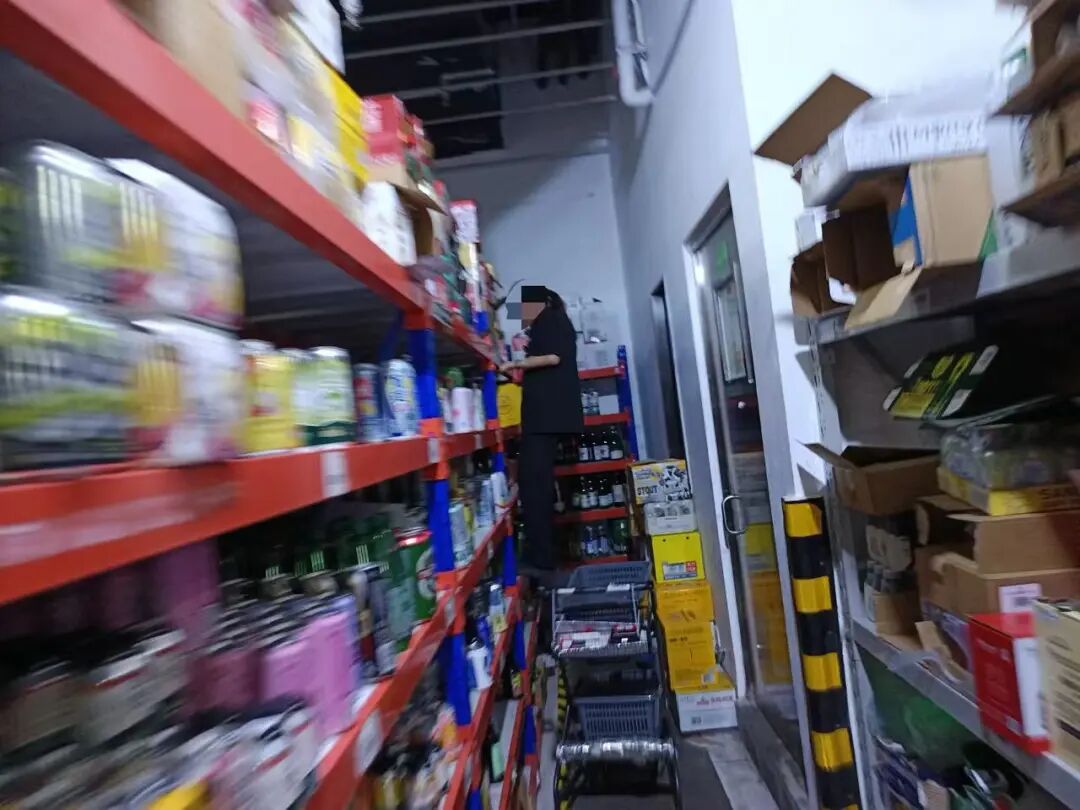
◉ A 7FRESH (JD.com’s fresh-food supermarket) order picker climbing up to retrieve items from a high shelf. But driven by the same pursuit of efficiency and market share, different platforms push pickers into the same dangerous actions. Photo: He Siqi
Yakou: Yes, but what these actually cause is very direct physical harm. I think it could entirely be classified as a workplace injury – it’s just that it will never be written into the contract.
Zhigu: What really gets to me is that the way people get injured in picking is different from working in a factory. In a factory, if your hand gets caught in a machine, it’s clearly a workplace injury – whether you get compensated is another matter, but at least it’s obvious. But in picking, I believe injury is almost inevitable for everyone. And people would just say you tripped while running, or you weren’t paying attention and bumped into something. The risk is pushed entirely onto the individual, and on top of that it doesn’t look like a direct, violent kind of harm.
One person told me they fell while running, and the doctor said their ligament would have completely torn if they’d been a little later, but they just kept pushing through and kept coming to work. Another person was picking orders while running, getting more and more lame, their efficiency dropping further and further, until one day they simply disappeared.
I’d had a minor hairline fracture in my ankle before. The longer I kept doing this picking work, the more that old spot started to ache — then another part of the ankle, then another — it felt like every part was reaching its breaking point. Some colleagues wore blisters on the soles of their feet, popped them, and kept going.
This level of intensity has already pushed many people to their limit. It’s just that everyone’s weakest point is different: for some it’s their joints, for others their airways, for others their stomach. But at this intensity, any injury or pain may not have time to recover, and there are long-term risks.
“pure business-cooperation relationship”
Yakou: I’d like to move on to the work agreement. I’m bringing this up because when I signed my agreement with my Hema store, I noticed some similarities with Xiaoxiang Supermarket’s. I actually signed the contract with a staffing agency, and it states that the relationship between me and the dispatch company is a “pure business-cooperation relationship” between “equal civil subjects.” If anything happens, the Civil Code applies, not the Labour Law. Xiaoxiang says the same thing.
Hema requires us to buy commercial insurance. I’ve asked my supervisor, and they said it won’t be deducted from my pay, but I’m not entirely sure about the specifics. Also, the agreement mentions a six-month ‘business observation period’ – it says that if they find I don’t meet their requirements, they can terminate the agreement. It’s a bit like a probation period, isn’t it? Just with a different name, and six months is a very long time. What’s your agreement like?
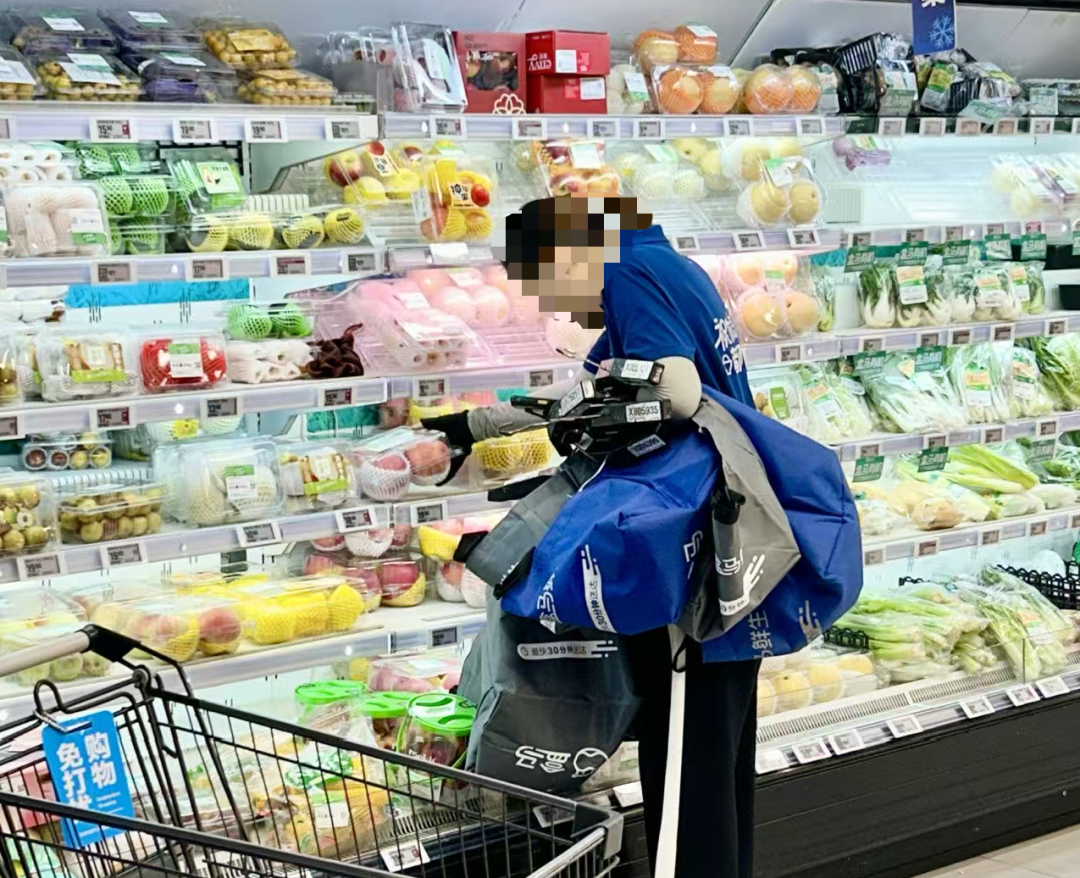
◉A picker carrying four to five bags at once while picking orders. Photo: Yuyang
Zhigu: My contract is of the same nature as yours – it’s a contracting and service-outsourcing agreement. The contract explicitly states that it is an ‘equal commercial-cooperation relationship that does not constitute any form of labour relationship, employment relationship, or labour dispatch relationship.’ One clause says ‘Party B, as an independent contractor, is not subject to labour management by Party A,’ and the very next one requires me to pledge to comply with all work arrangements set by Hema, observe work standards, and diligently complete picking, packing, and other tasks. It’s truly amusing – one clause asks me to pledge to complete picking, packing, and other work for Hema, and the very next one asks me to pledge that no labour or service relationship exists between us.
The Hema store I work at has two types of contract: the crowdsourced contract and the tri-partite contract. Staff who’ve been there a while get upgraded to a tri-partite contract, which counts as a bit of a safety net for them – it includes triple pay on public holidays, though there’s no weekend allowance. Mine is classified as crowdsourced, not even tri-partite. It’s a bit like being a Meituan crowdsourced rider, except not only are my shift times fixed – I can’t choose which days I work – I can barely even get leave.
Yakou: How long do you have to work before you get upgraded to a tri-partite contract?
Zhigu: Part-timers definitely won’t get upgraded. Full-time workers might, but only a very small proportion. The ones I’ve seen are all veterans who’ve been there over half a year.
Going back to the insurance you mentioned — on my end, the commercial insurance is deducted straight from my wages, 35 yuan a month. Your supervisor said it doesn’t come out of your pay, but it’s possible that each company works with a different staffing agency and they set different rules. Either way, they told me it’s taken from my wages.
Yakou: This is actually a bit like the food-delivery riders – the insurance is deducted from what’s rightfully yours.
Zhigu: My agreement doesn’t mention a business observation period. We do have a protection period for new starters here – during that time you can earn a reasonably decent wage. I’ve seen people muddle through a month without being let go.
Yakou: Is the protection period a month?
Zhigu: The period keeps changing: one moment it’s a month, the next it’s fifteen days, with no advance notice – they just change it. Before I left, it changed again. The protection period now runs on a tiered pay basis. Originally, within those thirty days, you just had to meet a standard slightly lower than everyone else’s to get the protection-period wage. Then it became: on day one you have to pick this many, on day two that many, on day ten, day twenty… the standard keeps rising, all the way up to day thirty, forming a staircase.
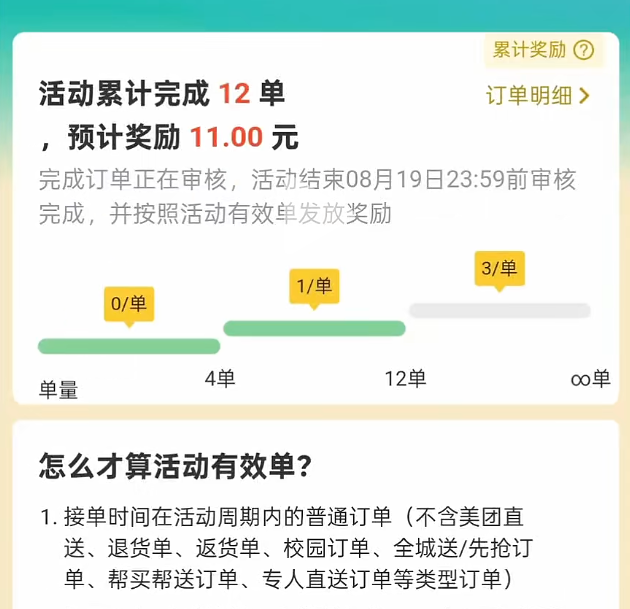
◉In the previous post, Yakou and Zhigu mentioned the tiered wage structure that fresh-food e-commerce platforms apply to order pickers – where different order volumes correspond to different pay brackets. This is effectively a disguised pay cut. Tiered wages have become widespread in platform gig work. In earlier research, Foodthink found that food-delivery riders are also subject to tiered wage structures in terms of pay and high-temperature subsidies. Image source: WeChat Video Account @Wen Ranxu
Warmth Amid the Flux
Yakou: I think different work setups create quite different atmospheres. Overall, at Hema—at least in the front-of-house—I feel more willing to ask colleagues for help. For example, if I can’t find an item, I’ll go ask a stocker or the kanban supervisor. I worry about being judged, of course, but I still go ask. The senior employee who was training me really stressed the importance of speaking up.
At Xiaoxiang, where I used to work, you could spend an entire afternoon without saying a word and still get through your shift alone. One thing that unsettled me about Xiaoxiang: when I couldn’t find an item or accidentally knocked something over, hardly anyone would offer to help. And I was too afraid to ask for help myself. It made me wonder—had someone else been in the same situation, would I have stepped in?
At Hema, something happened that I found genuinely warm. One day I had an order with quite a few items—over a dozen—and they were heavy. I was struggling to carry the bag. While I was still picking, another picker came over, handed me a new bag, and said, ‘This one’s full—you can switch to another.’ Then they showed me how to swap the container on the machine. The person who first trained me had never shown me how to do that. They saw me struggling and came over on their own to teach me.
I was so grateful at the time, because I hadn’t asked for any help at all – I hadn’t even noticed them. Of course, this isn’t to say that the staff at Xiaoxiang are bad or selfish. It’s just that the working atmosphere at Xiaoxiang carries a strong sense of competition.
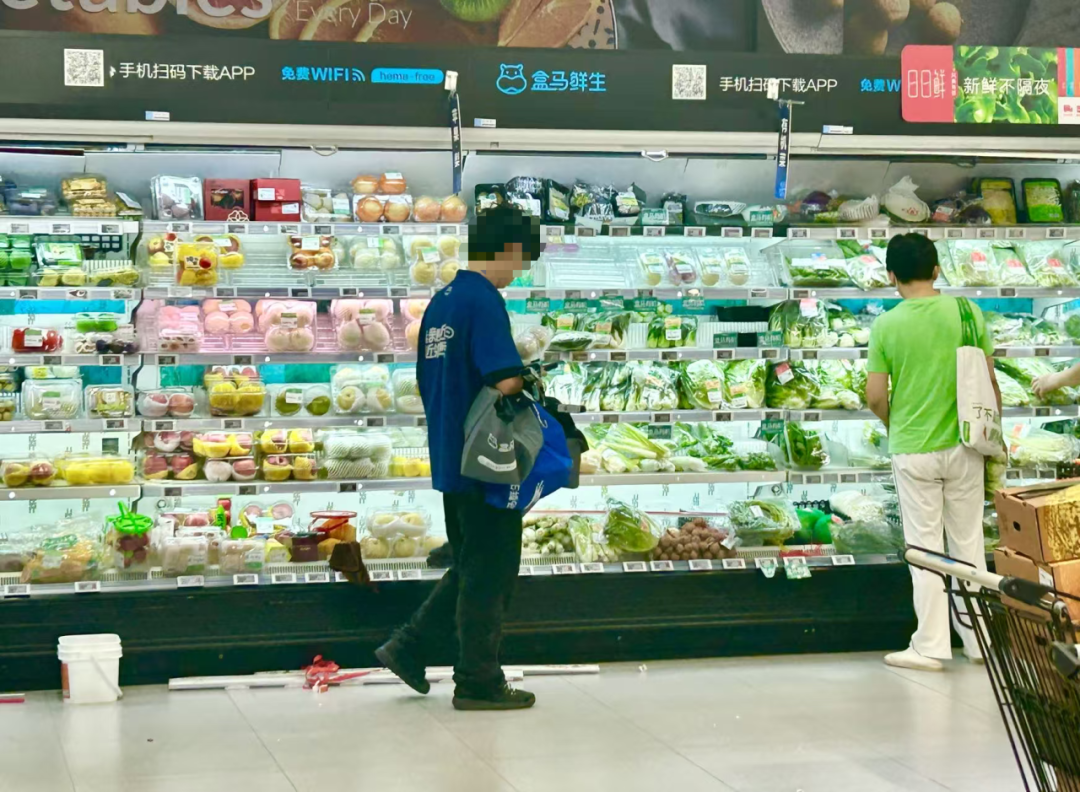
◉An order picker searching for items in Hema’s front-of-house area. Photo: Yuyang
Zhigu: We do have to work with others. Communication among front-of-house pickers is quite common. Back-of-house actually requires communication too – it makes it impossible to fully immerse yourself in your own world. It’s a bit the opposite of what you might expect. In my experience, relationships among front-of-house staff feel a little colder, while back-of-house is warmer.
Why is that? The front-of-house area is the whole supermarket – a big space. Pickers are a bit like personal shoppers, each working independently through the store with a certain degree of freedom. You can listen to music; you don’t need to have much interaction with colleagues. Everyone’s working in parallel. But in the back-of-house, the space is much smaller, and if people are sitting together, all sorts of interactions happen.
And turnover is different between the two areas as well. The front-of-house pays less and has a higher turnover rate. In the back-of-house, a lot of the people have been there for over six months – long-serving staff. The relationships between them are closer; many have become friends and even arrange to meet up outside work. Everyone’s bonds are tighter, and helping one another out is much more common.
When I first started in the front-of-house, it felt like everyone was on their own. No one spoke to me. I was apprehensive about even asking a question, as if I were wasting their time, and no one would ever come over on their own to help. But the moment I got to the back-of-house, I found that the instant anyone noticed I couldn’t find something, they’d immediately pick up on it and come over to ask what I was looking for.
The kindest person to me was a deaf colleague. They couldn’t really form complete sentences and would make some kind of sound to signal me. Sometimes they’d even just grab my PDA, check what I was looking for, and help me find it. I didn’t even know how to thank them. I could only keep smiling, and they’d smile back and walk off.
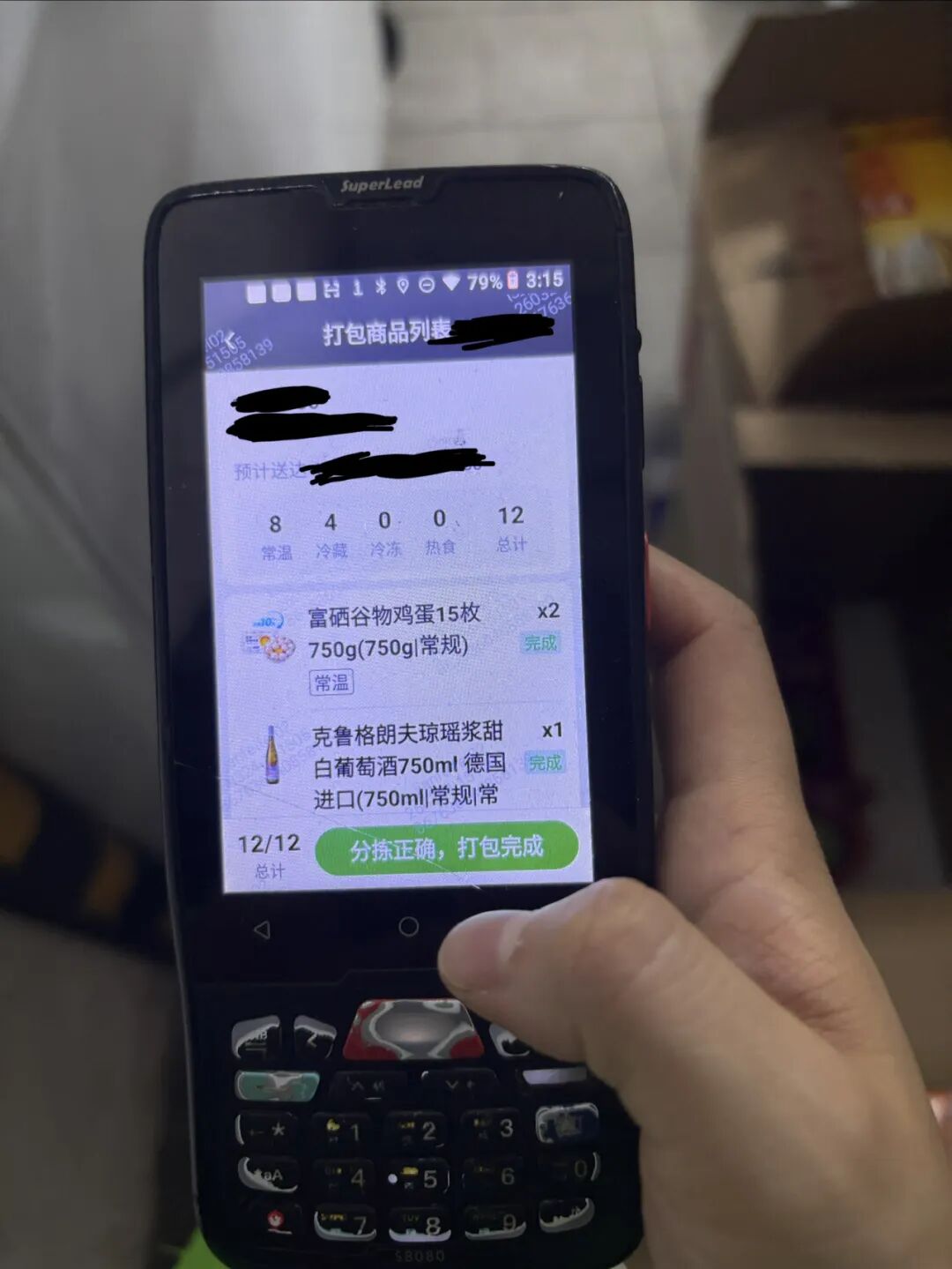
◉ In a fresh-food supermarket, the PDA is like a conveyor belt in a factory, dictating the speed and direction of the picker’s body and the goods, guiding them through tens of thousands of steps. Photo: Yakou
Zhigu: The warmth in the back-of-house nearly made me faint when I first arrived. In reality, the efficiency requirements in the back are higher than in the front: in the front-of-house, the average picking time per item might be over twenty seconds, while in the back-of-house it’s only ten to twelve seconds. For them to spend those extra ten-plus seconds helping me is actually a significant efficiency loss, yet they were still willing to help, and I found that truly moving. It’s the front-of-house that strikes me as odd – you’re walking past so many shelves, you could easily glance at things along the way, but very few people ever offer help on their own. I find that quite strange.
Later on, because I’m the kind of person who gets shuffled back and forth between the front and back of house, when the front of house was short-staffed I got moved back again. By then I was already considered one of the ‘older’ ones, so I’d proactively ask the newcomers what they were looking for. A while after that, I noticed that once those same newcomers had become ‘veterans’ themselves, they too would start asking others. So after a few rounds of turnover in the front of house, things actually warmed up again – people started asking each other, ‘What are you looking for?’ So I suppose it’s not quite that black and white: once someone offers a hand, the person who was helped will consider helping others in turn.
Yakou: You just mentioned that your back-of-house colleagues make plans to hang out together privately and form friendships. I’ve been quite curious about that: so much work these days has very high turnover – in that kind of environment, do people still end up becoming friends with their colleagues? Can you build relationships outside of work?
Zhigu: I haven’t attended any of their activities. What I know is that most of these people are fairly outgoing, longer-serving staff who are willing to make the first move. I was surprised at first too, because my expectation of this place was that everyone was a gig worker, unsure how long they’d stay – it felt like being someone working alone in a big city. But there are genuinely some connections between them, and I think that’s a good thing. It probably just comes down to whether people are willing to form friendships with each other.
– This is the 844th original piece from Food Communications Society –
After reading these two instalments of our dialogue with fresh-food e-commerce order pickers
what are your thoughts?
Feel free to leave a comment below
Other pickers are also welcome to share your working experiences
Editor: Yuyang
Layout: Xiaoshu
Scan to tip and support original food knowledge writing
▼

▼
Click the image to read related articles
▼
Click a keyword to explore more article collections
Seeds|Ag Tech|Policy|Fermentation|Nutrition|Fruit|Fisheries|Events|Careers|Food Delivery|Wet Markets|Livestock|Food Talk|Meetups|Book Club|Harvest Festival|Smallholder Stories|Climate Change|Rural Development|Co-operative Economy|Urban Farmers|Food Safety|Digital Technology|Biodiversity|Pandemic and Food|False Solutions|Sustainable Farming Internship
Beijing|Hebei|Shanghai|Guangdong|Guangxi|Henan|Sichuan|Jiangxi|Xinjiang|Shaanxi|Hong Kong|Chongqing|Zhejiang|Jiangsu|Guizhou|Taiwan|Inner Mongolia|Philippines|Canada|Russia|Mexico|Italy|United States|United Kingdom|Germany|Netherlands|Thailand|Sweden|Japan