The Anthropologist Who Sold Fish at a Wet Market Stall | New Book Excerpt & Event Preview

Foodthink Says
Not long ago, through Foodthink’s ‘Eat Well’ story submission column, we received a great many fresh observations and reflections about wet markets from our readers. So, what do wet markets signify through the eyes of an anthropologist?
To grasp the vitality and challenges of China’s wet markets, anthropologist Zhong Shuru once worked as a ‘fish vendor’. On summer nights in an island town, she wore wellington boots and braved the strong fishy odour, hauling and selling fish while embedding herself in the everyday lives of market stallholders. Starting from a fish stall in Hainan, she travelled to over two hundred wet markets across more than fifty cities nationwide. With her feet, her hands (and, of course, her taste buds), she absorbed the markets’ flavour and vitality, their toil and reward, the fine line between subsistence and commerce, the interplay of community bonds and street smarts, as well as the constant change and underlying uncertainties. These observations and reflections on food spaces, social structures, and the everyday rhythms of life around wet markets ultimately crystallised into her new book, *Chinese Wet Markets*.
In this new book excerpt, we follow Dr Zhong back to the starting point of her ethnographic fieldwork, immersing ourselves in the authentic, vibrant rhythms of daily life at the wet market.

Book events hosted by the publisher, Guangqi Press, will take place on the evening of 14 August 2026 in Shanghai and on the evening of 22 August in Beijing. On the morning of the 22nd, Dr Zhong will also visit the Beijing Organic Farmers’ Market to live stream as she browses. Please refer to the event preview at the end of this post for registration and booking details.
*This excerpt is taken from the prologue of *Chinese Wet Markets*. We thank the publisher, Guangqi Press, for granting permission.
A slight cool breeze stirs on a tropical summer’s night, but the air feels increasingly thick and clinging. The sharp, complex odour of fish from the wet market, mingled with sweat, has seeped into the fibres of my short-sleeved shirt and refuses to wash out. At 8 p. m., fresh from a day selling mackerel at Yefeng Market, I trudge back to my rented room, utterly spent. With every step, the water and sweat inside my rubber boots make a heavy squelching sound.
I disappear into the bustling crowd, entirely unnoticed. My clothes, paired with the heavy “market smell” clinging to me, make me a proper fishmonger through and through. Very few would guess my true identity: an anthropologist carrying out ethnographic fieldwork in the wet market.
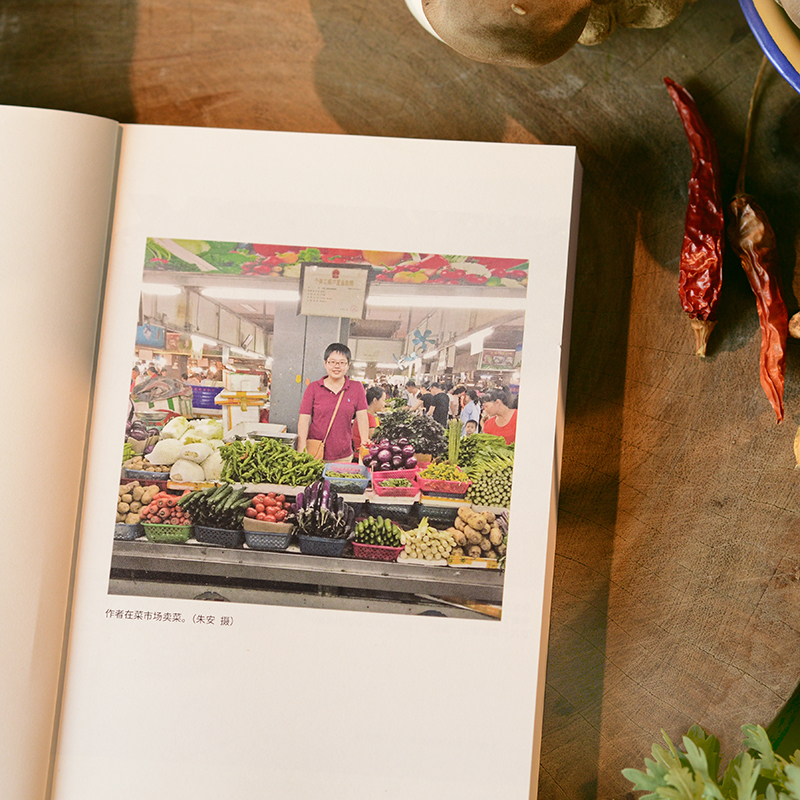
◉The author selling vegetables at the wet market.
In June 2016, having just completed my doctoral qualifying exams and still finding my footing, I flew from Texas to Hainan to begin my fieldwork, never expecting my stay to stretch to fourteen months. A close friend, Xiaogua, offered me a room at her place to help me save money. I was deeply touched, but I genuinely did not want to impose on her for such an extended period.
Under the scorching summer sun of City Y, I anxiously searched for a flat. On the streets, everyone hurried past. Already feeling the alienation of a newcomer, I wished I had an extra pair of legs to keep up, to walk briskly enough to shrink back and disappear into the crowd. I had never realised before that the city centre was packed with so many “handshake buildings”. Local landlords in City Y rented entire blocks to letting agents from the north-east of China, who ran budget guesthouses charging between 30 and 50 yuan a night. A few landlords managed their own properties: they lived with their families on the ground floor, while the upper five or six floors were subdivided into tiny rooms of just over ten square metres. These were let to the “ant tribe”—young migrants working in manual labour nearby—at monthly rents ranging from 700 to 1,000 yuan.
I, too, became part of the ant tribe, attempting to feel the city’s most vital pulse from a position of everyday struggle.
With Xiaogua’s help, I eventually settled on a small, street-facing room with a balcony. Compared to the space I had initially booked on the second floor of a restaurant—which reeked of cooking fumes and never saw sunlight—this flat was truly flawless. Outside the window, a rosewood tree four or five storeys high stood within arm’s reach, rustling in concert with the sea breeze morning and evening—though I later discovered the tree also served as a handy shortcut for rats heading to my room. I have never cared for the feeling of drifting, yet the course of my studies had been a constant series of moves, and this year-plus of fieldwork seemed destined to be nothing more than a transit point. Even so, I still needed to settle in and make a home.
My flat was just a ten-minute walk from City Y’s largest wet market. A straight, tree-lined avenue led there past a few street corners, which was precisely why I chose to live here. Picking up daily essentials was equally convenient, given the variety of shops around the market. For days on end, I scurried like a worker ant, running back and forth to collect everything needed to set up a life. The tropical midday sun was merciless. With a mop bucket, a washbasin and a bamboo mat in my hands, I was completely overloaded; I had to stop every few paces, inching my way back to my flat. Only after I’d bought a single-burner stove, a wok and a gas cylinder did my mind finally settle. As long as I had a small kitchen to keep myself fed, I had the energy to carry on. In the days that followed, in a kitchen without even an extractor fan, I continually engaged with practice theory. Seafood goes by a bewildering array of names. To truly know them, you cannot rely on written labels alone; you must engage your sense of smell, touch and taste to forge a deeper sensory connection—a rule of thumb I call “once it passes through the stomach, it is never forgotten.” In that little kitchen, I cooked a flounder gifted by vendor friends and invented a batch of mackerel fish balls so fresh they were absolutely divine. On the rare evenings I gave myself a break, I’d pick up a couple of swimming crabs from the market, steam them plainly, and have them as a snack while watching a match. When old friends Liu You and Lin Li came to visit City Y, my tiny kitchen never constrained the standard of my hospitality. To this day, they still fondly talk about our meals in City Y, particularly the giant, roe-filled mantis prawns.
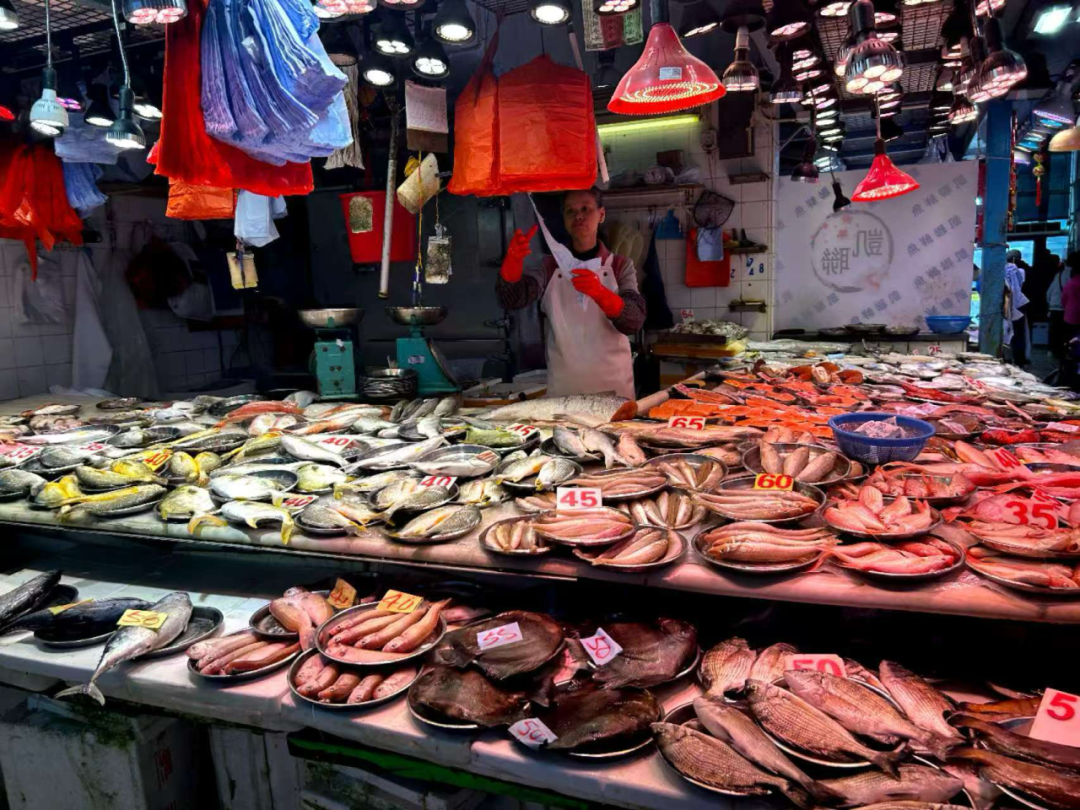
◉Sea fish at Hong Kong’s Tai Po Market in summer.
The landlord couple were locals who lived on the ground floor with their two daughters and did not have regular jobs. The landlord also acted as the building’s caretaker and maintenance man. The second floor, where I stayed, was surprisingly packed with four rooms. The corridor was dim, with puddles from hanging laundry and scattered cigarette butts. During my year-long stay, I only ever saw the tenant in the room next to mine.
The first group consisted of four young women who had come to City Y for work. They worked as waitresses at a nearby restaurant, which had rented the room as staff accommodation. The cramped space of just over ten square metres was packed with two sets of double bunk beds, creating a stifling atmosphere. Their room had no external windows, so they often left the door ajar for ventilation. Even without looking deliberately, I would often catch sight of them lying in bed, scrolling through their phones. One day, all four vanished; the restaurant must have gone out of business.
Soon after, a woman from Hunan Province moved in, taking on casual work to make ends meet. In her fifties, she was very kind, and we occasionally exchanged fruit. Because her son was ill and needed money, she was always looking for ways to earn extra cash. Her room was stacked with recyclables, as scavenging was one of her sources of income. One day, she said her son’s condition had worsened and she needed to return to her hometown, and that she probably wouldn’t be coming back.
Some time later, a middle-aged couple from Jiangxi Province became my neighbours. They had previously run a barbecue stall at the night market, having taken over the business directly from a fellow townsman who had quit. They worked late nights and returned home early, preparing skewers under the shade of the trees on the ground floor—this was the time we usually met and exchanged greetings. Later, they rented a storefront on a busy street for 5,000 yuan a month, but still couldn’t escape the “harassment” from urban management officers (chengguan). Enforcement had become much stricter; in the past, even if their street-occupying barbecue carts were confiscated, a bribe of fifty or a hundred yuan was usually enough to get them back. However, due to the “Twin City, Twin Repair” urban renewal policy, even when they offered money, the officers were too afraid to take it, resulting in several barbecue carts being impounded.
This street perfectly captured the lazy, tropical atmosphere, with little distinction between day and night. By day, under the tree shade at the intersection, about thirteen shoe repairmen from Jiangxi would line up side by side, waiting for trade. All from the same home county and familiar with each other, they silently followed an unspoken rule: stall spots were not fixed, but rotated daily among them. Near the shoe stalls, in the afternoons, a few “masters” would also turn up. Compared to the quiet cobblers, these men were celebrities; within moments, rings of onlookers would form around them, listening as they spoke animatedly—spitting as they went—while passionately predicting or analysing the winning numbers for the current draw of the underground private lottery.
As night fell, City Y finally came alive. The open-air eateries were the first to pick up on the receding heat, pulling out pink and bright yellow plastic side chairs that were soon filled with hungry diners. After finishing Hainanese home-style dishes, Sichuan hotpot, or Northeastern Chinese cuisine, those wanting to extend the evening could stay on the same street, as itinerant stalls selling barbecues, fried rice noodles, and Hainan ice jelly would pop up from all directions. Some clever late-night vendors would seamlessly take over the open-air eateries’ space for the second half of the night, solving the location problem perfectly while splitting the rent. Different stories unfolded in these barbecue stalls every night: drunken revelry, laughter, and the occasional argument.
The crisp clinking of beer bottles had barely settled before it was picked up by the hawking cries of the morning itinerant stalls. Every day, just outside my window, a few vendors would appear with wooden carrying poles and woven bamboo baskets to sell fresh sea fish. Their prime stock was saved for early risers. After 8 a. m., the urban management officers (chengguan) would clock in, and the “cat and mouse” game would begin. On occasion, I’d select a fish, and before I could even hand over the money, the vendor would take off running. However, after spending entire mornings standing on the pavement to watch this unfold a few times, I noticed that the dynamic between the itinerant vendors and the officers wasn’t always adversarial; it actually resembled a commensal relationship. Without the itinerant stalls, the urban management officers probably wouldn’t exist either.
* * *
In the early stages of my fieldwork, I was caught up in the thrilling “culture shock” phase, finding everything novel and fascinating. Even wandering through different market streets each day was endlessly entertaining. The old fishing harbour wharf was close to my accommodation; after slurping down a bowl of rice noodles for breakfast, a short walk to aid digestion would bring me there. The wharf was scheduled for relocation, and the shoreline had already been cordoned off with wire fencing. Against the backdrop of the five-star Peninsula Hotel on the opposite side, it looked more desolate and run-down than ever. The convenience store owner told me that by the time I arrived, the busiest hours had already passed.
At three or four in the morning, the fishing boats would return, and the seafood trade would be bustling and lively. I was in no rush, knowing I would be visiting often before the relocation. This was City Y’s oldest fishing harbour. In the air, the dirty water from the dawn trading, rotting fish, and damp, salty seawater mingled together, releasing a fishy stench so overpowering that even I found it hard to bear. Because of the impending move, hygiene conditions were also a concern: fish entrails were thrown about on the ground, dead fish and rubbish littered the puddles, and the floor had been stained an inky black. By eight or nine in the morning, only three or five retail fish stalls remained. The stallholders wore the typical outfit of fishing women: pointed bamboo hats, tight-fitting floral long-sleeved tops (for sun protection), and rubber boots.
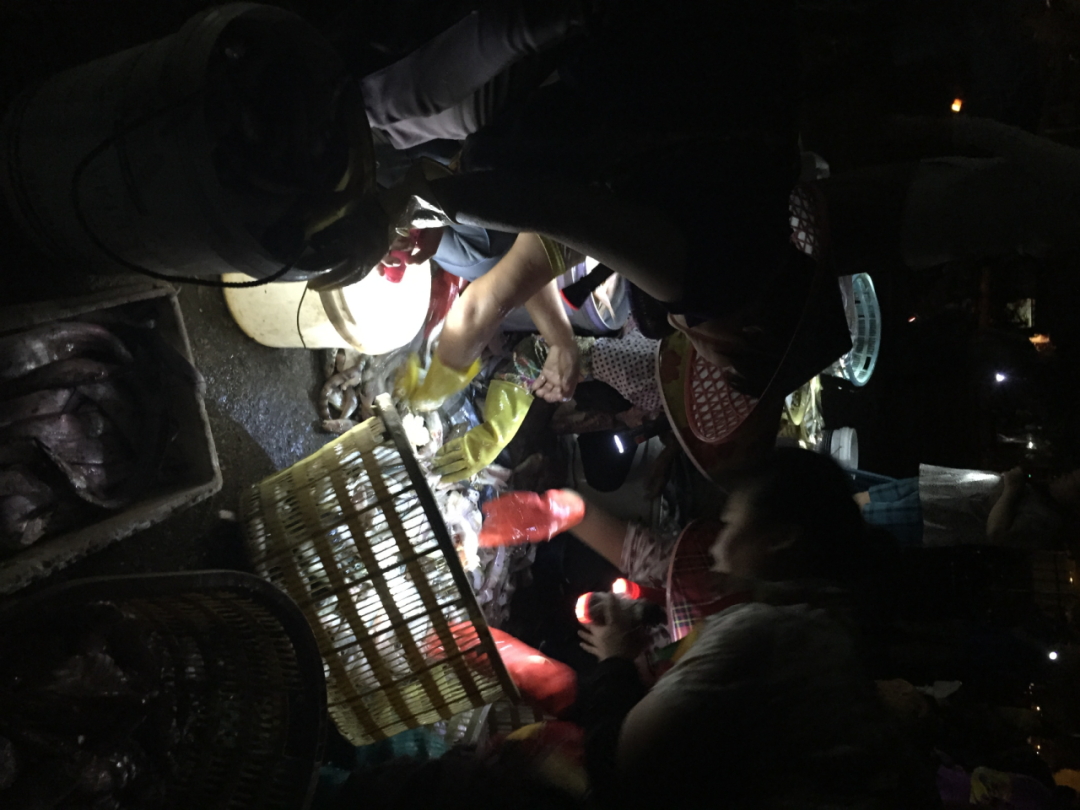
◉Hainan’s docks awaken at midnight. Before dawn breaks, the female fish vendors already have torches clamped between their teeth as they sort through the catch.
During my fieldwork, I was mistaken for all manner of people, a journalist among them. Two women selling fish at market stalls took me for a reporter and hastily drew me in to air their grievances. They were brothers’ wives; one had cut her hand while filleting a few days prior and still had her hand bandaged. The other was keen to speak out. As she talked at a rapid pace, I immediately regretted not having improved my poor Hainanese sooner. Her Mandarin was just as limited as my Hainanese, and seeing me nod along, she grew even more animated, leaving me both anxious and helpless. Fortunately, the younger of the two picked up on the awkwardness, stepped in, and broke the tension. It transpired that they were deeply dissatisfied with the planned relocation of the fishing harbour.
The old fishing harbour is a natural harbour situated right in the city centre, now slated for clearance to make way for tourism. The new harbour lies more than 40 kilometres out, is entirely artificial, and prone to silt buildup. Beyond being less practical, the move would substantially raise transport costs for city-based seafood traders, severely hitting their livelihoods. They typically run wholesale operations alongside retail, but a relocation to the new site would make retail trading virtually unviable. Veteran fishermen had already collectively petitioned the local authorities against the move, to no avail. Consequently, they hoped I might help them draft some reports and amplify their voices to preserve the old harbour.
Anthropologists routinely encounter requests like this during fieldwork, but overpromising is strictly avoided. Once I candidly explained that I was merely a student, they were not unduly disappointed, and I breathed a sigh of relief. The brothers’ wives then murmured to each other about how gruelling life is for women in Hainan, how exhausting it all is. I came to hear this refrain again and again in the fieldwork that followed, and by observing their everyday lives, I slowly began to grasp the profound weight behind it.
During the first two months of fieldwork, I spent most of my time observing the wet markets in City Y. I carefully wandered through more than thirty markets of all sizes across the city. Some suburban markets were so remote that a round trip would consume an entire day. As I visited and observed, I seized every opportunity to speak with those willing to chat. Initially, I did not stick to a fixed interview guide; instead, I relied on my presence and fragmented conversations to begin piecing together a complex mental map. I am by no means a social butterfly, so my usual tactic was to purchase something from a stall to break the ice. It never failed to work—the only downside was the toll it took on my weight, as I simply had to eat my way through all the food I bought from the markets each day!
Yefeng Market, the closest to my accommodation, was City Y’s most renowned and oldest market, and the main fieldwork location I had planned to focus on. Yet my initial experiences there left me completely in the dark. The market contains over three hundred stalls, with the busiest zones dedicated to sea fish and live seafood. Local shoppers tend to prefer sea fish, assuming that live offerings such as lobster and abalone are strictly for tourists. It was only later that I discovered most of City Y’s live seafood actually originates from aquaculture farms in Zhanjiang or from Guangzhou’s Huangsha Seafood Market. Consequently, Guangdong visitors who travel all the way to City Y are quite likely just eating seafood from back home. In the mornings, the sea fish section buzzes with activity while the live seafood area is quiet; by lunch and dinner time, however, the latter is packed with tourists flocking in, shoulder to shoulder. As I walked through the market, I was naturally taken for a visitor, and was repeatedly pulled aside by “seafood ladies” asking whether I wanted to buy some seafood to have cooked.
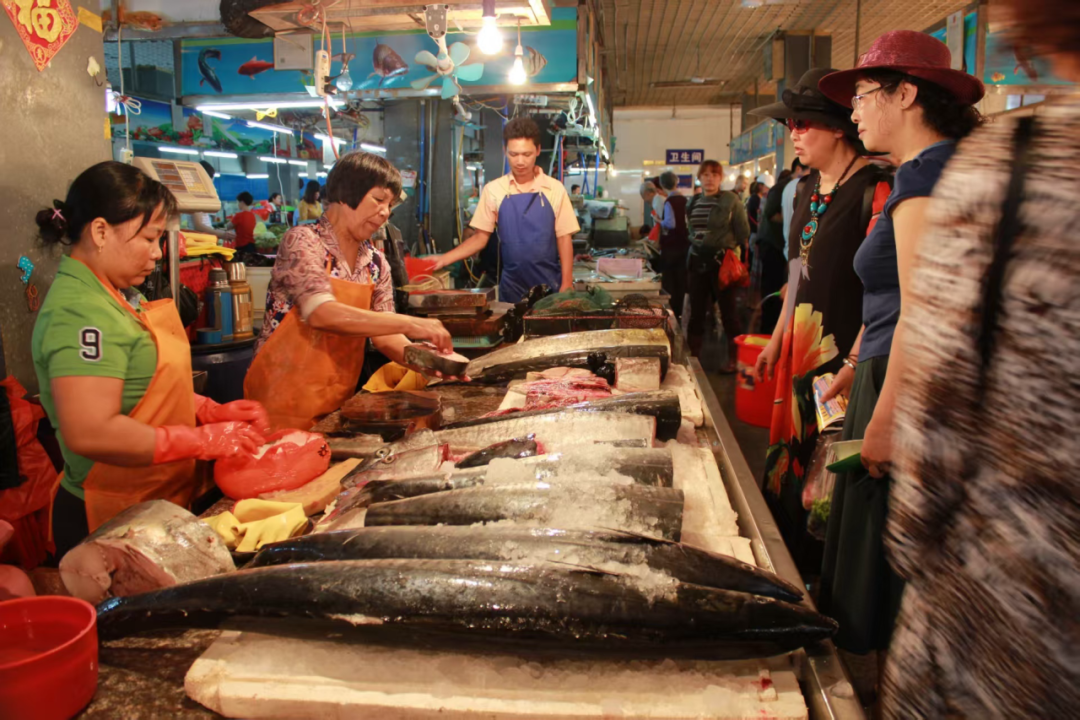
◉Fish stall at Yefeng Market (Hainan, 2016)
In this market, beyond the distinct wet market aroma of fishy odour, meaty fragrance, damp earth and fresh greens, the air seemed to carry a faint undercurrent of tension. At first glance, trust between people appears remarkably low. City Y’s seafood traders are notoriously known for overcharging visitors. I have seen tourists bring spring scales to weigh their purchases; some clutch bags of shelled prawns, squeezing them repeatedly to wring out excess water, while others openly challenge vendors over short weight. In response, vendors often feign anger: “These shells are heavy to begin with! There’s an official scale at the entrance—if you don’t trust me, go check it yourself!” Most tourists, intimidated by the display, keep quiet. Vendors gauge their customers closely. When they spot someone less wary or looking like an “easy mark,” they move swiftly, weighing the seafood along with its plastic crate before the customer can react, effectively skimming on the weight so you pay for a jin but only receive eight liang. Even when caught staring at the digital scale, vendors remain utterly unfazed; they simply deduct the tare weight and carry on as if nothing happened.
The women selling abalone retail from small plastic basins move with surprising speed; no matter how quickly I walk, they always manage to catch up. “Miss, fancy some abalone? Three for ten yuan,” one says. She explains she buys her stock from a seafood shop just outside the market at 60 yuan a jin—roughly twenty abalone. Selling them at ten yuan for three, she claims to make only a few yuan profit per jin. My instincts tell me not to take her at face value; gross margins in the seafood trade are hardly that thin. She laments, “Business is tough. The distance I cover in the market every day could easily take me back to my hometown. I’m not always keen to keep doing this.” Yet every time I visit Yefeng Market, I still run into her, and I’ve even seen her squabble with other abalone sellers over customers. The more I observe these scenes, the more questions pile up in my mind.
In the early stages of my fieldwork, I faced indifference, rejection, and even mockery almost daily. Being a highly educated young woman only seemed to erect more barriers within the wet market environment. To the vendors, anyone not making a purchase brings no profit and may even be of dubious origin—a reason for maximum caution. The tactic of striking up a conversation through a casual purchase did not work in Yefeng Market. Their business was simply too brisk; a few curt replies were enough to dismiss me, as they were too busy attending to a steady stream of new customers.
However, as I kept turning up at Yefeng Market, the shopkeeper at the general store near the entrance began to recognise me and grew rather curious. After a brief chat, I casually asked what the monthly stall fee was. She instantly grew wary, finally voicing her suspicion, and asked: “So, are you here to do business?”
At the time, my short hair gave me a businesslike appearance, so she assumed I was planning to run a wholesale business in the market or rent a stall to compete with them. I quickly clarified my identity, explaining that I was a postgraduate student interested in market consumption, here to conduct social research and understand people’s livelihoods. Finding a way to convey my anthropological aims as honestly and accurately as possible proved tricky. I had repeated this explanation time and again during the first two months across various field visits, yet almost no one truly grasped what I was actually trying to do. Strolling around with no commercial interest at stake simply did not fit into their mental framework. They probably couldn’t fathom it either: what knowledge could there possibly be in the day-to-day wet market?
I also endured a personal shopping Waterloo. When my attempts to conduct interviews went nowhere, I decided to simply satisfy my appetite first. I picked out two sea urchins from a young vendor from Zhanjiang, hoping to savour this culinary treat with reverent excitement. But the moment I slit them open, I was dumbfounded: they were nothing but foul, muddy water, with absolutely no roe inside. I wrote off the first as bad luck, but didn’t expect the second to be identical. This thoroughly put me off sea urchins, and I finally understood why the seafood processing stalls could only serve steamed egg with urchin roe: apart from empty shells, there was virtually no substance to be found.
I went to confront the young vendor from Zhanjiang. He insisted that all the sea urchins in the market were like that, and I would find the exact same thing at other stalls too. Still fuming, I pressed him on where he sourced his stock. He replied dismissively: “I’m not telling you, and it’s none of your business.” That response pricked the “dignity” of an anthropology scholar. After all, getting to the bottom of things is a core professional skill of the discipline. If he refused to tell me, did that mean I couldn’t uncover the truth through my own research? One day, I will find out exactly who stole my sea urchin roe. This is a dual vow I made to myself, as both a consumer and a researcher.
To me, the bustle of Yefeng Market remained locked away at first. The barrier of trust with the vendors, coupled with the sea urchin incident, made me realise that the trading networks, cooperation and competition, business tactics, and everyday lives of stallholders behind the market’s lively surface were, in reality, shrouded in a thick fog. The method of observational fieldwork had reached its limits, leaving me unable to uncover any deeper insights. It was time to take another step forward…
How did Dr Zhong go on to “embed” herself in a wet market fish stall?
Did she eventually track down the “sea urchin thief”?
Why are Chinese people so fond of visiting wet markets? Do younger generations still frequent them?
How have Chinese wet markets managed to withstand the wave of the “supermarket revolution”?
What social structures and everyday wisdom do wet markets bring together?
Explore the resilience and vitality of Chinese wet markets through Dr Zhong’s new book!
*Chinese Wet Markets*
Author: Zhong Shuru
Guangqi Press | Publishing July 2026
Ten years, over 50 cities, more than 200 wet markets…
Based on panoramic observation and ethnographic fieldwork of urban wet markets across various regions,
it explores the history of wet markets, vendor communities, the supply chains behind them, food consumption culture, urban public management, and more.
– Table of Contents –
– About the Author –

Associate Professor at the School of Tourism, Sun Yat-sen University; PhD in Anthropology from Texas A&M University.
With a long-standing focus on wet market culture, sustainable food systems, and gastronomic tourism, she continually explores through research and practice how food can serve as a medium to reconnect people with their food, nature, society, and place.
– Event Preview –

All images in this post are illustrations from the book.
Layout: Xiaoshu
Scan the QR code to tip and support original food writing.
▼

▼
Click the image to read related articles.


▼
Click keywords to browse more article collections
Seeds|Agricultural Technology|Policy|Fermentation|Nutrition|Fruit|Fisheries|Events|Careers|Food Delivery|Wet Markets|Livestock|Food Talk|Sharing Sessions|Book Clubs|Harvest Festival|Smallholder Stories|Climate Change|Rural Development|Cooperative Economics|Urban Farming|Food Safety|Digital Technology|Biodiversity|Pandemic & Food|False Solutions|Agroecology Internship Programme
Beijing|Hebei|Shanghai|Guangdong|Guangxi|Henan|Sichuan|Jiangxi|Xinjiang|Shaanxi|Hong Kong|Chongqing|Zhejiang|Jiangsu|Guizhou|Taiwan|Inner Mongolia|Philippines|Canada|Russia|Mexico|Italy|US|UK|Germany|Netherlands|Thailand|Sweden|Japan