Villains’ Valley Turns Five: Believe in Beauty, Make Beauty Real – Grandma Kouzi

On 16 June 2026, Villains’ Valley turned five. The rain had stopped and the sky cleared, so I hurried up to the roof to take photos. The forecast had promised nothing but rain. The ten days before and after the Festival are what the old saying calls the “Dragon Boat rains”, and the rainy season doesn’t usually let up until well after the Dragon Boat Festival.
The heat, plus all that rain, sends everything in Villains’ Valley into a frenzy of growth. Every morning on my rounds through the garden there’s something new – the changes overnight are plain as day. My dragon fruit, growing for two years now, adores the heat and thrives in it. People wilt in the heat; dragon fruit puts on a show. One day it’s just a bud, and the very next day you come back to find an enormous bloom bowing its head under its own weight. Wild growth isn’t all good, though. Leave the weeding for a few days and the grass declares independence and founds its own nation – before you know it, there’s no path left for a human to walk.
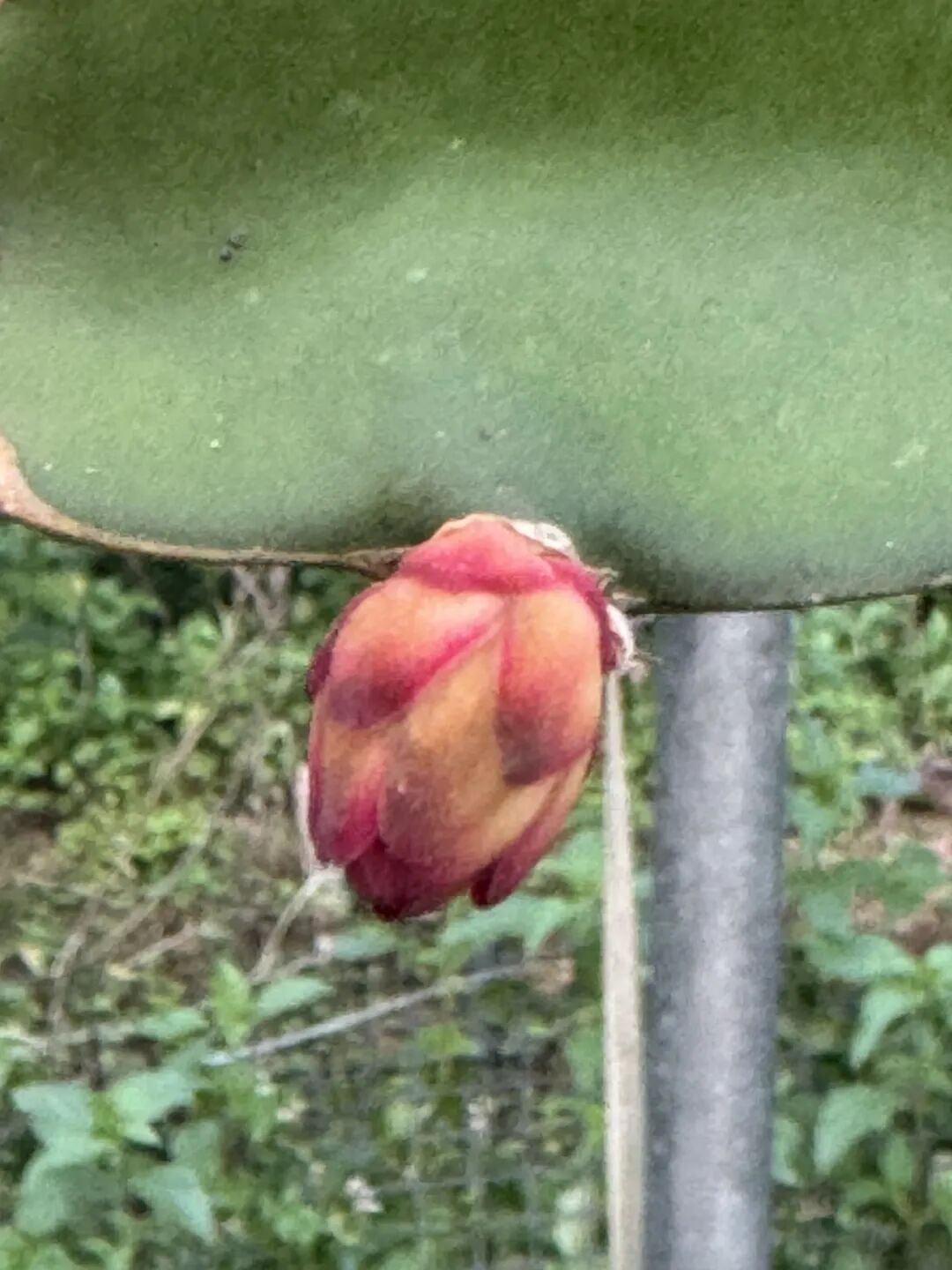
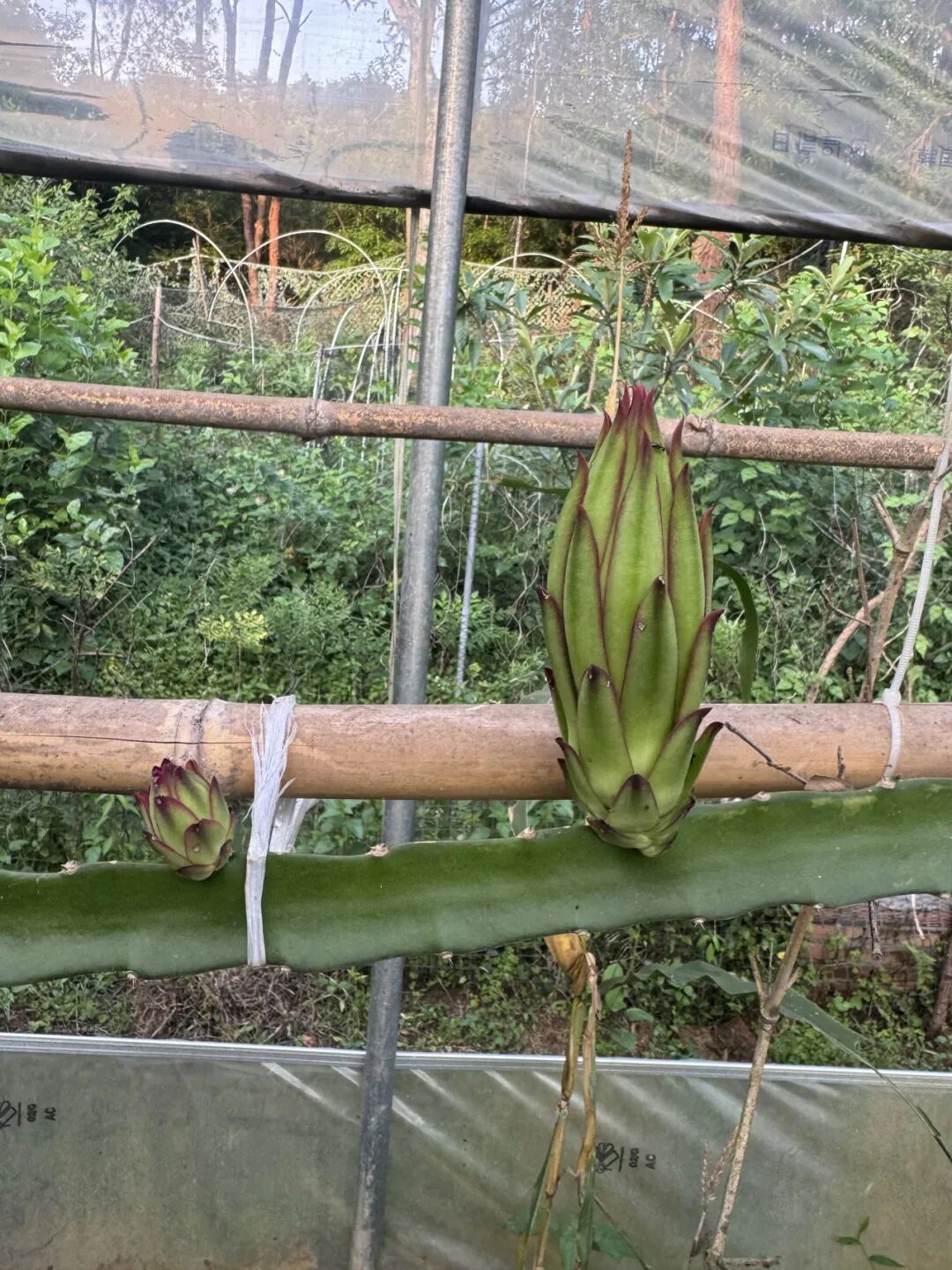
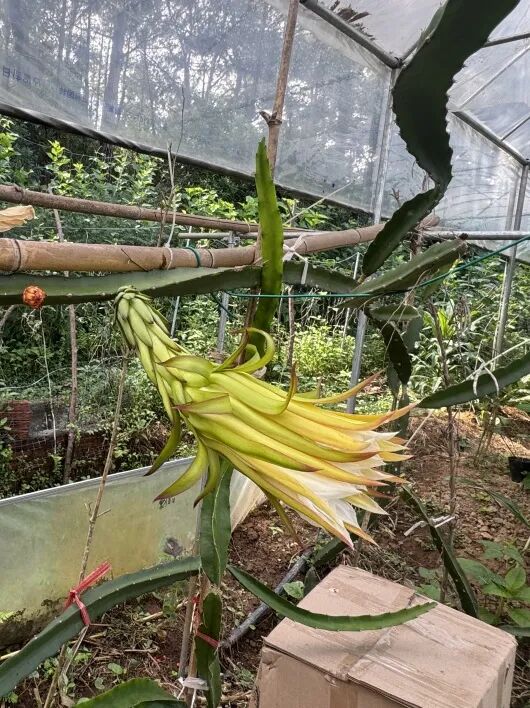
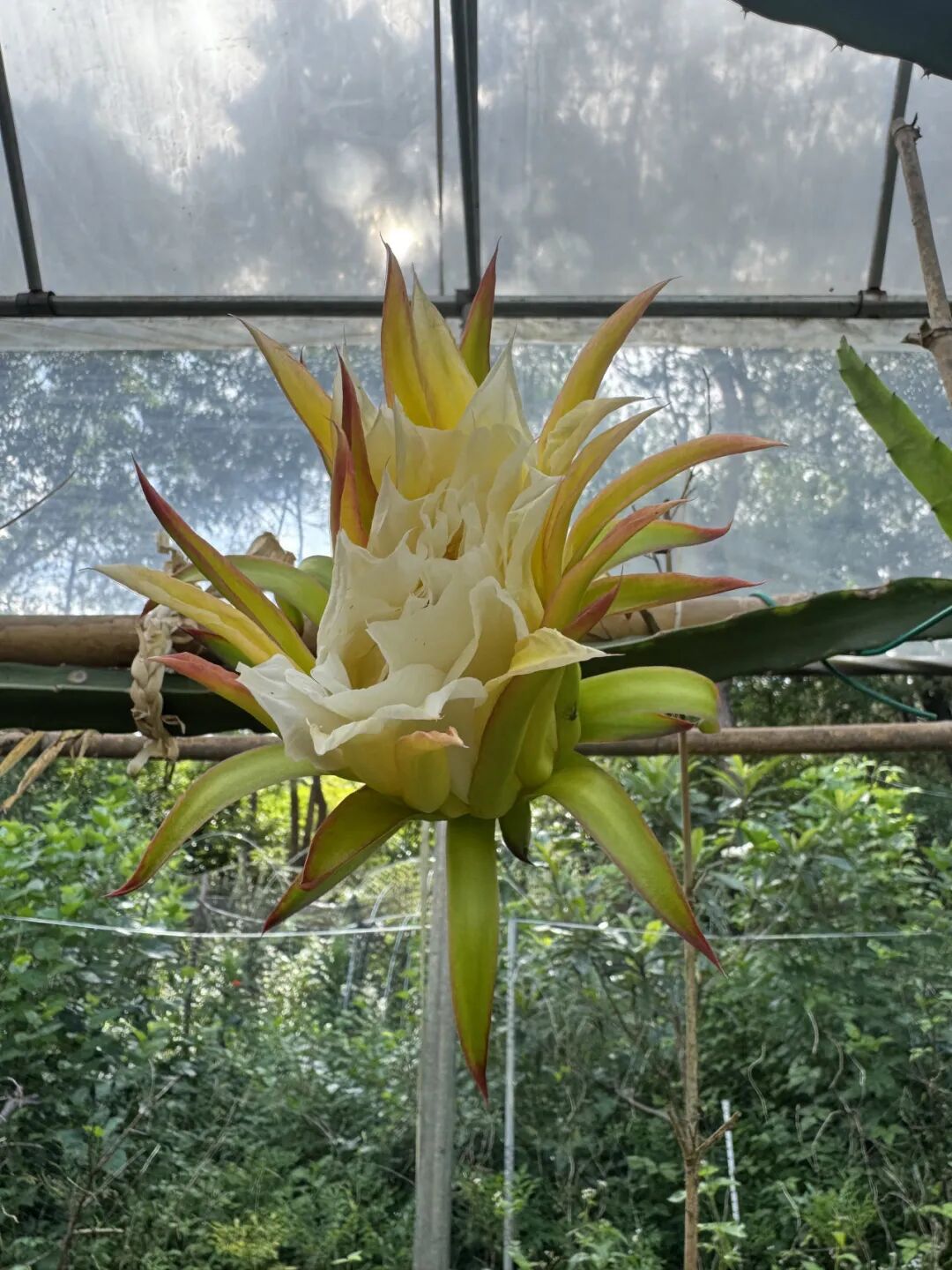
◉ In just a few days, the dragon fruit flower went from a tiny bud to full bloom. Please God, may it set sweet fruit.
These days, Villains’ Valley needs to buy nothing but salt. Well, even the salt is optional, really. On the hills around us grows Chinese sumac, and in autumn its berries come coated with a fine layer of salt. You could gather them, soak them in water, and make your own – if you fancied the bother. I don’t.
Over five years, I haven’t just built a self-sufficient solo farm – my health indicators have gone from strength to strength, too.
From Construction to Refinement
Looking back to when I first arrived at Villains’ Valley and broke the ground, there was a stretch when things changed almost day by day. I came with three years of growing experience from both sides of the strait – no longer a farming novice. I already had a plan for a one-person farm and could picture a self-sufficient homestead taking shape on this barren land.
But after a year of digging trenches, raising slopes, planting trees and setting out flowers, the very first thing I did come the second spring was call in the excavator again. My growing experience from Taiwan and from Dawudi, where I had farmed for a year before that, still needed to reconcile with the realities of Villains’ Valley. Road layouts and irrigation channels follow the contours of the land, so those needed little changing. But after surviving my first rainy season I learned that a northerner like me had only the most superficial grasp of “drainage”. The whole system had to be redesigned and redug. Keeping chickens on the sloping ground by the road made perfect sense, and the mesh fencing around them was fine in itself – but chickens have wings, and they can fly. They’d stand on the slope, give a couple of wingbeats and sail clean over the lower stretch of fencing. An easy jailbreak. While raising the fences I had no choice but to call the excavator back to ease the steep slopes. Later, to realise my “chicken-centric design” – free-ranging chickens confined to a small area – I called in the full “excavator + front-end loader + big truck” combo, hauling over a dozen loads of rich fish-pond mud to soften the slopes and enrich the soil at once, then planting in zones shaped around what the chickens needed.
Five years have brought many stories much like this one. This year’s fine-tuning centres on the water lily pond. My original plan was to surround it with roses – every variety imaginable, seedlings and mature plants alike, and over five years I’d spent no less than a thousand yuan. The survivors could be counted on one hand.
Roses are plagued by pests and diseases, and I refuse to spray. Add the heavy moisture around a pond and they simply don’t belong here. This year I finally accepted reality and decided not to replant. Instead I went around the pond with daylilies. The original starts I had dug out by hand from a friend’s garden and brought home on my bicycle – not many, as you can imagine. Over a few years those few starts multiplied dozens of times over and have become quite a spectacle in Villains’ Valley. Daylilies are tough, easy-going, and they love water. Ring a pond with them and you’ll soon have a vast golden garland.
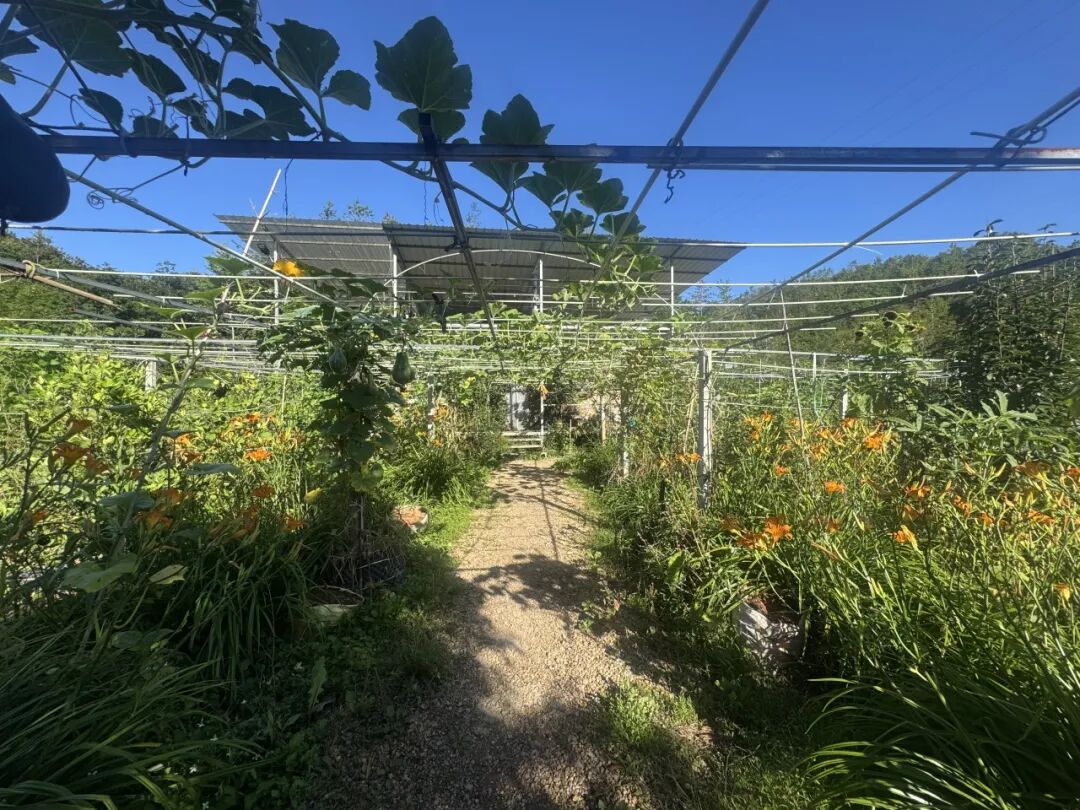
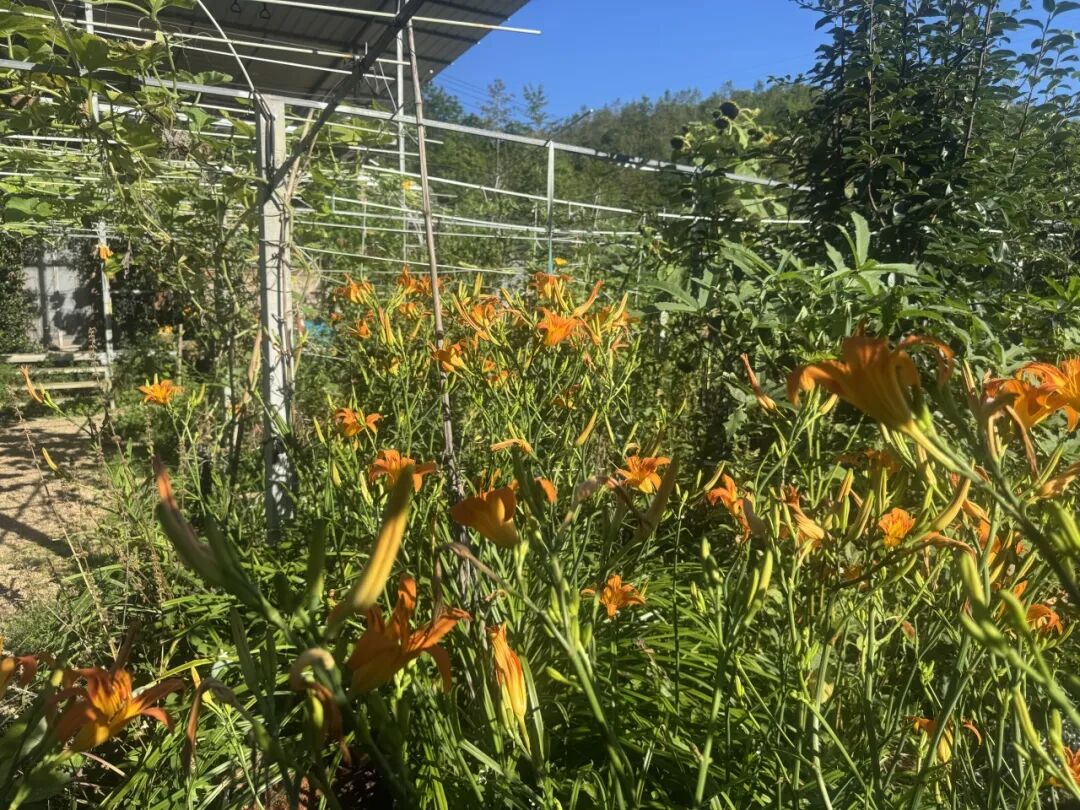
◉ These daylilies by the roadside at my gate – when I first planted them, it was just one tiny sprig.
The ditch and its lotus pond have finally started to look the part. Beneath those lotus leaves lies three years of sunk cost. I started planting lotuses in this water three years ago – starts and seeds shipped from all over, all of them sinking here, defeated again and again, fighting on regardless. It was not until last year that my surviving red lotuses began to form a proper colony. This year, at last, the white ones have taken root.
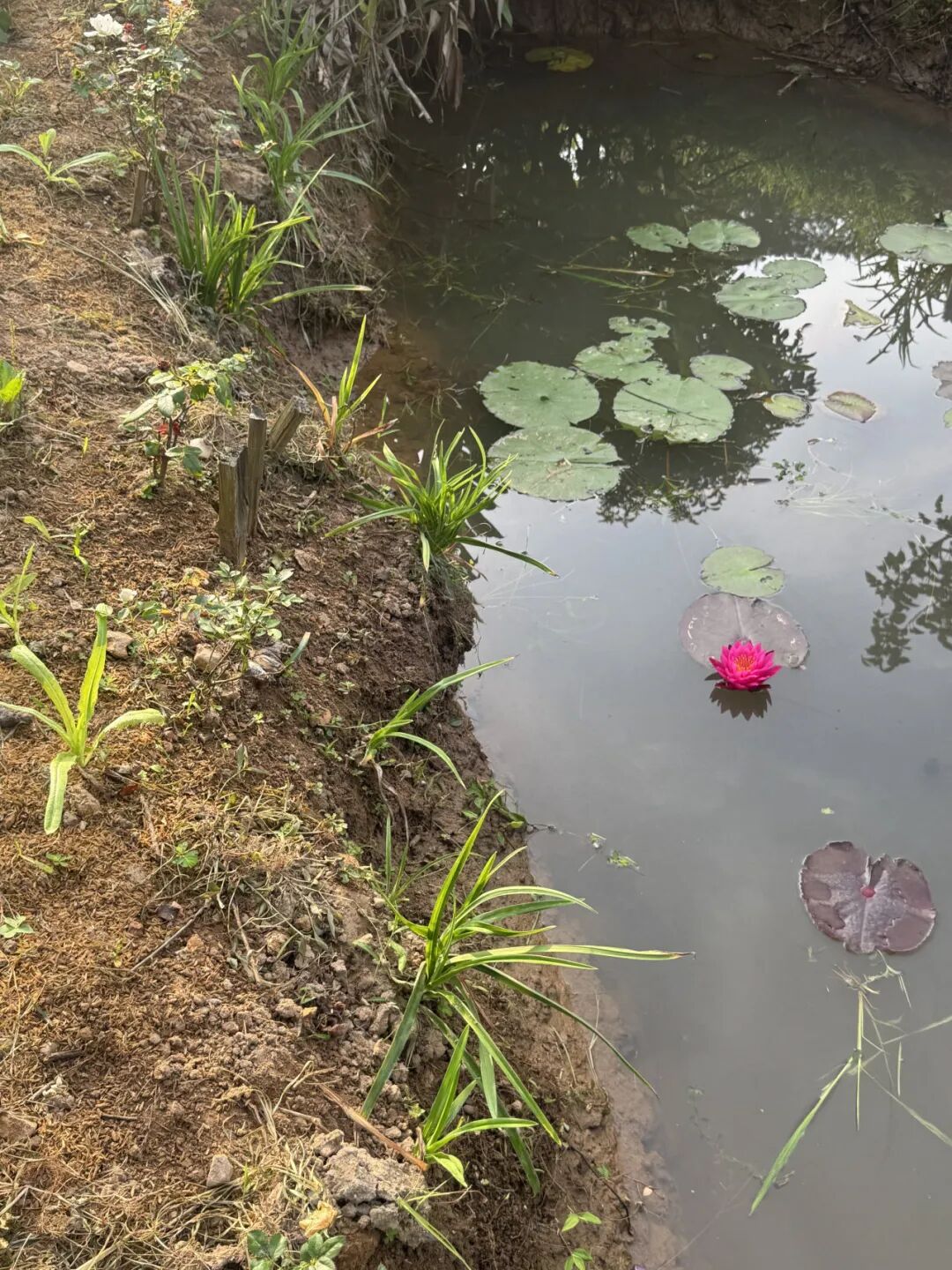
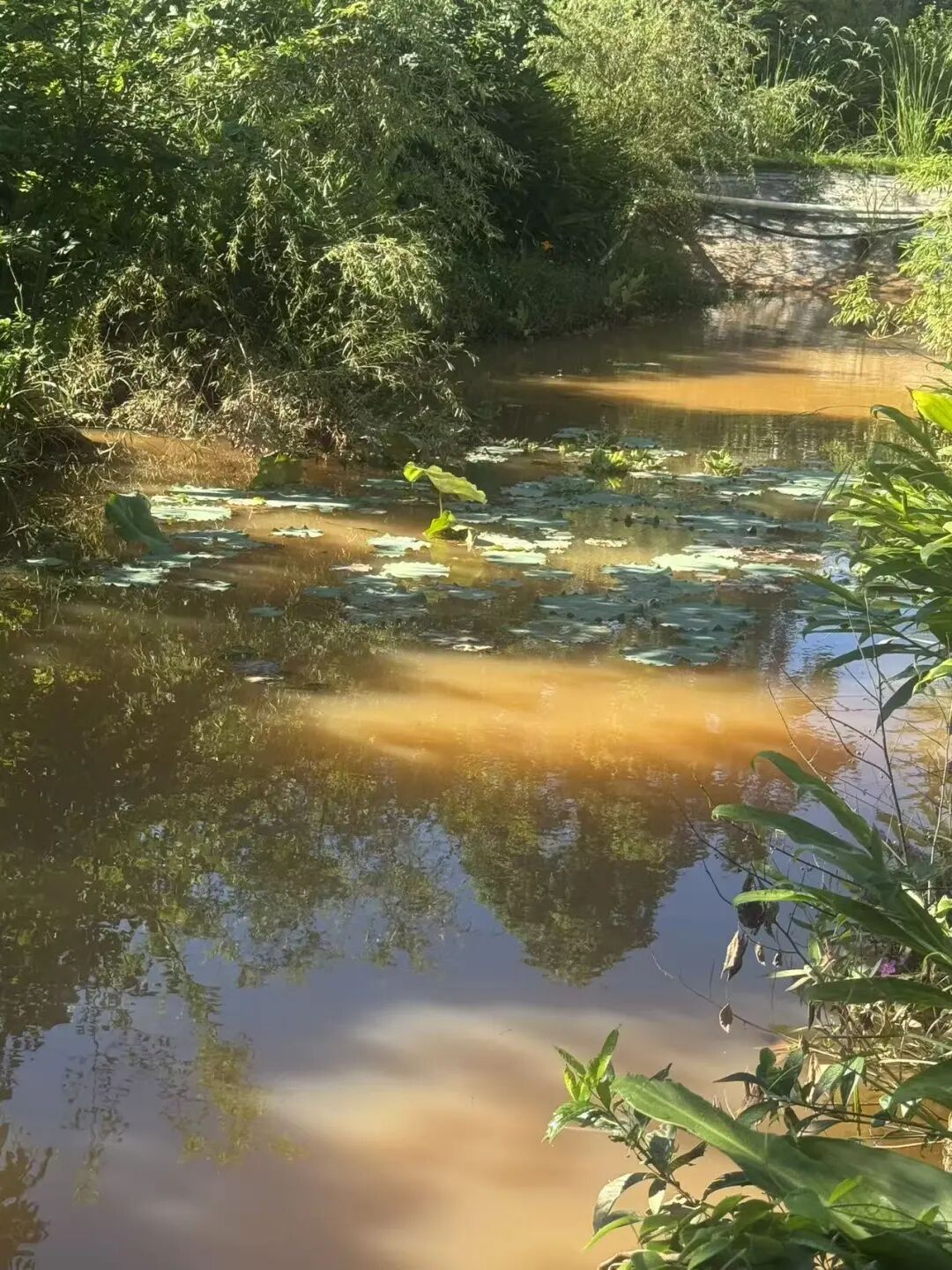
◉ Water lilies in full bloom, daylilies along the bank. The ditch is finally beginning to look like a lotus pond. It’s a wild ditch overrun with apple snails; when heavy rain comes the current rushes through, and it used to be the local ducks’ playground – every last one of them a lethal enemy to a tender lotus tip. The fact that I’ve managed to protect these leaves this year is, I’d say, quite an achievement.
Then there are the problems I simply can’t overcome. Citrus is the fruit that suits this land – pomelo, sweet mandarin, jelly orange, navel orange… I’ve planted over twenty trees, and in spring the whole garden fills with their fragrance. Citrus blossom is white and headily sweet, the kind that sets your heart rippling. But the pests arrive right behind it and strip every leaf to bare wood. I don’t spray, so I can only grit my teeth and wait – until the pests have gorged themselves, mated, dropped their eggs into the soil and pupated, and the denuded branches push out fresh shoots.
Last year the hibiscus put on a spectacular show, and I assumed this year would be just as glorious. Clearly, I was dreaming. The bugs arrived before the buds – great fat red worms I hadn’t seen in years, carpeting the leaves in dense ranks. Once again, the only answer is to tough it out. Being a plant in Villains’ Valley means no pesticide to call on; you just toughen up alongside me. Survive, and you earn your place on this soil. Don’t, and you’re done.
These sweeping, all-or-nothing adjustments ground on for three years before I could shift to fine-tuning. By Villains’ Valley’s third anniversary the basic version of self-sufficiency was already in place, the core infrastructure for the living and production areas complete. The task ahead shifted from “construction” to “refinement”. The guiding word from the third year to the fourth was “polytunnel”. From the fourth year to now it has been “making the most of sunlight” – perfecting the trellis system.
All things grow on sunlight. Last year I built a trellis over the path I have to walk every day, and it proved a brilliant idea. Plants stretch and scramble to reach the sun, while I’m perfectly happy to dodge it, sun-shy and shade-seeking. A perfect win-win. Last year the pumpkins on the trellis did well. This year I started early, tidying the hastily thrown-together frame into something proper – no more haphazard patchwork; now it’s all level lines and square angles, neat and tidy. The pumpkins sprawl freely, my eyes rest easy, and it’s win-win again. Pumpkin season is now in full swing – give it a month and the vines will blanket every inch of trellis, heavy with fruit.
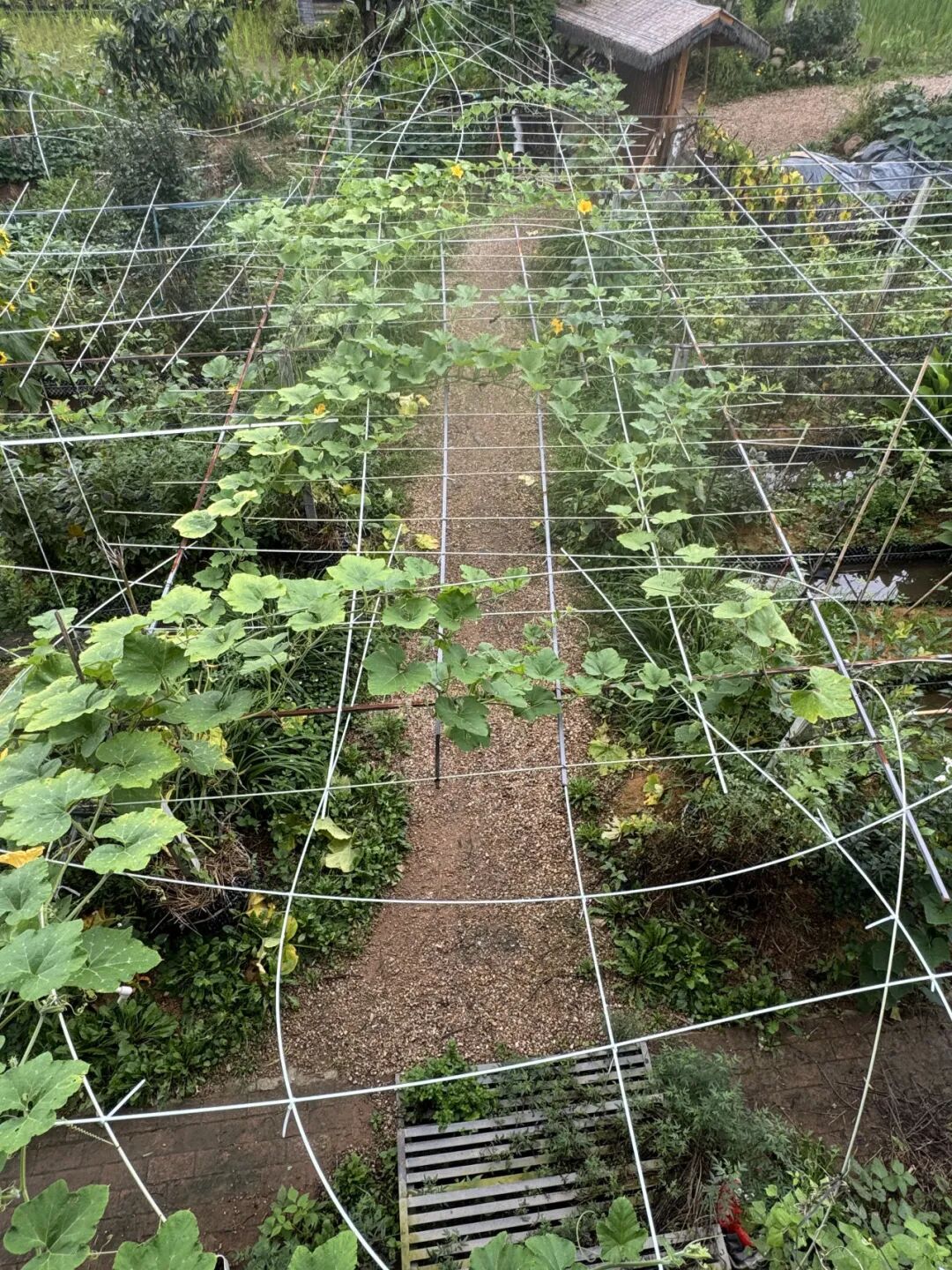
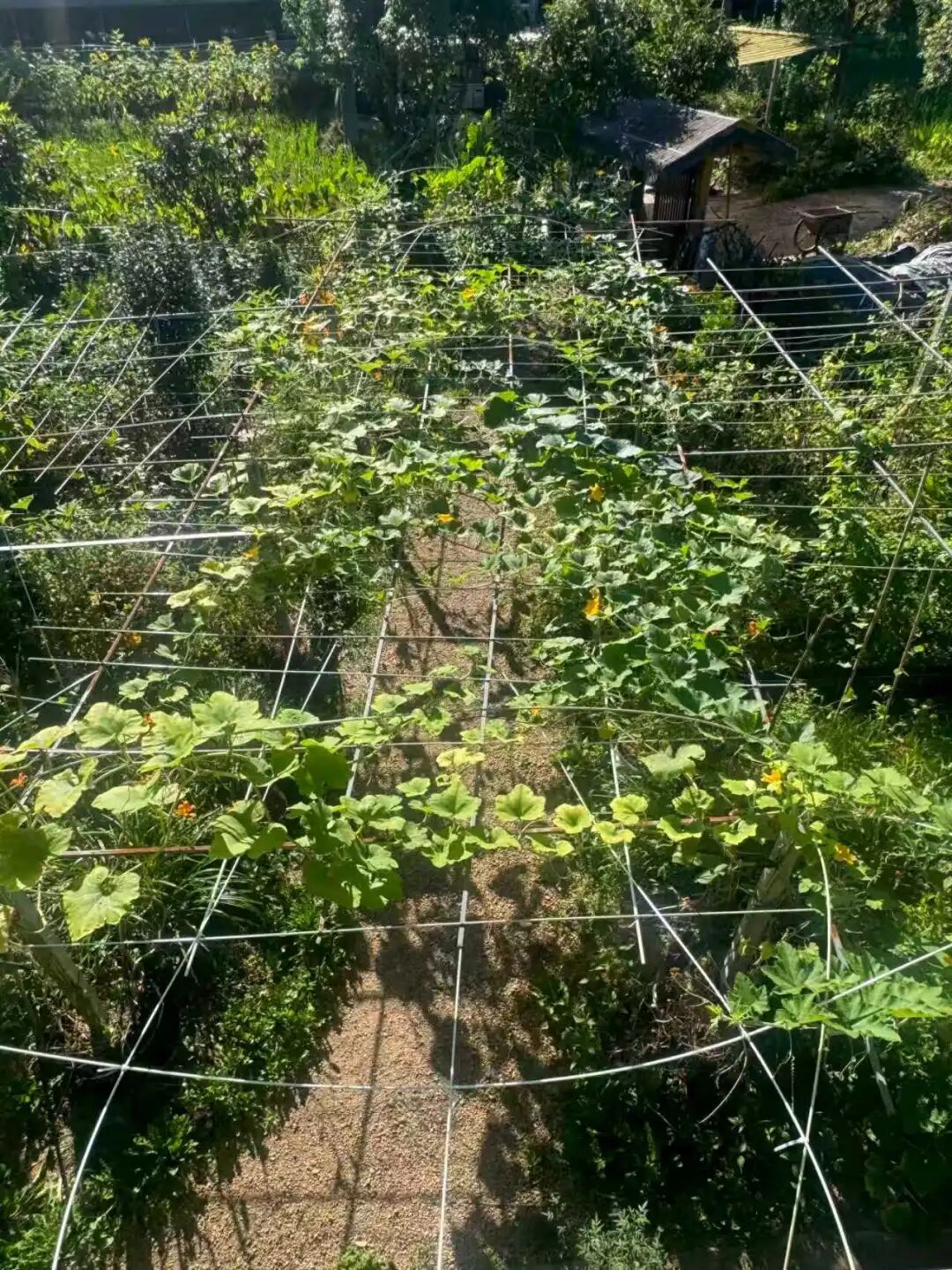
◉ The left image shows the trellis grid by my gate on 16 June, the first clear day after endless rain. Ten days later, it had become the right image.
There are no major projects left in Villains’ Valley. Beyond sowing and harvesting the main crops, I’m in the daily cycle of routine upkeep – weeding, for instance. It’s something I do every single day all year round, and it never ends. But even so, every weed I pull improves things just a little. You might not see much difference, but if I stopped pulling them, wild grass would take over everywhere – you might not even find a place to set your foot. There’s a sense in which this kind of labour is a practice – a practice fuelled by belief. Belief that I am making myself just a little better.
Five years, and just little by little, Villains’ Valley has grown softer, fitting me more and more – like a well-worn cotton shirt.
No Longer a Modern Person Living in the Industrialised Food System
Pumpkins have been living in the “can’t-eat-them-all” era since last year. This year’s new crop is already here, and there are still dozens of old pumpkins from last year, big and small. I love the feeling of a home with pumpkins to spare – so abundant, so extravagant. We pumpkin-munching spectators: every time we crack open a new one, we taste a slice, and at the drop of a hat the rest goes to the chickens. The daylilies are the same this year – buds upon endless buds, foretelling a season when flowers will be almost too much of a good thing.
I set out to find a place to put a self-sufficient solo farm into practice, and yes, that was largely driven by ideals and a philosophy of living in tune with nature – a goal ahead pulling me forward. But there was also something behind me I desperately wanted to flee. As a flesh-and-blood modern person in my forties and fifties, this body had racked up its share of problems. Life’s one-way road had already turned downhill.
From around forty on, it started – qi and blood running low, digestion struggling, sleep poor… nothing major, but a constant drip of little complaints. I went to hospital, I took medication; it neither improved nor got any worse. The doctor called it “perimenopausal symptoms”. I looked around at my peers – seemed about the same for everyone. The doctor added that urban malaise is the common lot of modern city folk, and I supposed there was sense in that too.
I worried that this slow decline would spiral beyond my control, and I wanted to see whether I could be the master of my own life for once. So at forty I quit my public-sector institutional job and became an ageing Beijing drifter doing charity work, because I believed life should come down to one’s own choices – that a person should be her own master and could choose to go up. But at fifty my immune system collapsed, and both mind and body sank to rock bottom. I even thought of Hawking. I knew perfectly well I didn’t have Hawking’s iron will. If I couldn’t escape a state of life where my own body was no longer my own to command, I would choose to end it all. If I want to go up but the body won’t cooperate, then first – stop going down.
As it turned out, I took a third path. Two years farming in Taiwan, and I met the love of my life – and I, with zero rural background, discovered I was apparently a farmer heaven had chosen. Ever since I started tilling the soil, my lower back stopped aching, my stomach stopped complaining, and sleep came easy. Gone were the philosophical worries about whether to live or die – my head was full now of the very real question of how to live better.
I also wondered at the time: could a farming numpty like me have survived in the countryside simply because Shengou Village in Yilan – Taiwan’s first organic farming village – was too well set up, with a full support network of over two hundred farming neighbours close by? So I wanted to put myself to the test: go back, find somewhere new, start from scratch, and see whether I could scratch a living from bare earth by my own two hands, with none of that safety net.
I wanted to see whether a person pushing sixty could still send life upward. If even someone like me, starting from raw earth, could build a self-sufficient homestead entirely by hand, then surely many others could do it better still.
Five years ago today, I came to Villains’ Valley. Five years in Villains’ Valley – not only a self-sufficient solo farm, but health indicators growing better and better. It seems lifestyle can change a modern person’s physical condition.
My checkup two years ago had three arrows on it: total cholesterol a touch high, high-density lipoprotein high, low-density lipoprotein low. The doctor said that as long as high-density lipoprotein is high and low-density lipoprotein is low, cholesterol is an essential “building material” for the body, and a slightly elevated reading is no problem.
A recent recheck showed total cholesterol had actually come down. The change is probably down to eating more eggs. I’d always been told to keep eggs to no more than two a day, the restriction blamed on cholesterol in the yolk. But lately quite a bit of evidence suggests eating more is perfectly fine – most cholesterol is synthesised by the body itself, and more eggs may actually help lower it. There are even cases of people eating twenty-plus eggs a day over long stretches. I’m not that extreme – my own chickens and ducks lay five or six eggs a day, and if it dips below four I top up with protein powder. The simplest reason I eat eggs is that there are too many to waste, so might as well. By a happy accident, it seems, the latter theory checks out.
Now I farm and keep chickens with the greatest of ease. Everything tastes glorious and I’m in tip-top shape – “all four test papers graded A+”. My health indicators are better than they were twenty years ago. Growing old doesn’t necessarily mean the body breaking down. Modern people don’t have to be riddled with modern ailments. Even with modern life closing in from every direction, there are still choices to be made – you can use your own choices to shape your life.
In an era when both the food system and the way we live have been thoroughly industrialised and commodified, those of us living inside it need, at the very least, to see the problem clearly before there’s any hope of making a choice. Villains’ Valley can shut its gate and let me live under my own sky, standing apart from the elephant in the room that is the modern industrialised food production and supply system. But now that I’ve at last achieved self-sufficiency here, I feel none of the smug relief of watching a fire from across the river. I can’t shake the feeling that I must do something.
This past year, amid the endless fine-tuning of every little detail in Villains’ Valley, I also ticked off a smaller wish: I wrote a series reflecting on the modern food system – something I’m not exactly gifted at. It flags the harms and also offers real examples and methods of avoiding them. From refined vegetable oil to refined carbohydrates, to sugar and sugary drinks, snacks, fruit – writing my way through all of it, and then topping it off with “food additives”, feels like a natural stopping point. Modern people, navigating the real world, can steer clear of harm and move toward good starting from daily life – from every vegetable, every meal. I’ve done what I can. What a reader takes from it, what changes they make, how it shapes their life – that is each person’s own fortune.
I shall retreat back to Villains’ Valley and tend my own small life in the comfort zone. I’m far gentler with myself now – in so many ways, I’ve learned to let myself off the hook.
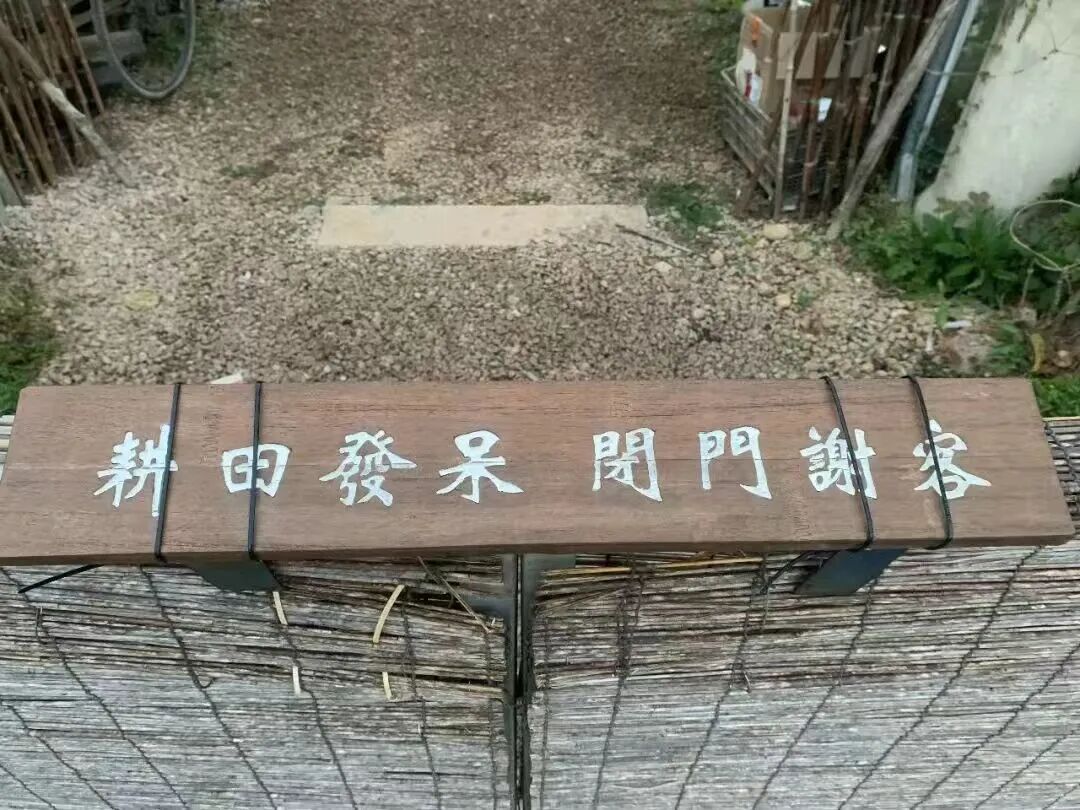
◉ “Till the fields and daydream; close the gate and turn visitors away” – this sign hangs at the entrance to Villains’ Valley.
Facing Thugs with Equanimity
In the past year, there’s been one other rather significant matter: Baidu AI flinging excrement and spreading lies.
Baidu AI “sentenced” me to “extortion… fixed-term imprisonment of ten years and three months”. I have to admit I got a bit heated at the time, because the fabrication listed my birthplace, hometown, years of public-service work, and personal writings all in a row – tying me to the post and parading me for public humiliation.
A dog bit me – I’m hardly going to bite back like a dog, but neither can I let the utterly unscrupulous run riot. So I hired a lawyer to take Baidu to court.
Suing a company with no bottom line like Baidu is a gut-wrenching ordeal. Facing a thug who flings excrement while brandishing a stick for stirring up shit – whoever gets stuck with it feels sick to their stomach. Almost a year now, and Baidu hasn’t admitted fault, hasn’t apologised, hasn’t paid a penny. Instead, they’ve spun a fresh lie and gone on smearing.
Thankfully I’m holding up – mind at peace, emotions steady.
I must admit there was a stretch when it was truly awful – couldn’t eat, couldn’t sleep. I knew I couldn’t let a thug’s tricks wreck my life, but I couldn’t help being dragged into the whirlpool. The good news is I’ve weathered it: life’s back to normal, and I’ve filed a fresh lawsuit over Baidu’s latest rumour.
This year, lawsuit or no lawsuit, I’ve kept working as usual – spring harvest, spring planting. I’ve reaped a dozen kilos or so of rapeseed and several dozen kilos of wheat, and sown maize, peanuts, soya beans, black beans, and every kind of bean. The peanuts in the garden are looking splendid right now – another month and they’ll be ready to pull. It was the very day last year I dug up peanuts that I spotted Baidu’s lie online. This past year, between lawsuits, I’ve also tried my hand at new side ventures – filing complaints and reports with the relevant departments and suchlike. Thanks to Baidu, past sixty and I’m unlocking yet more new skills.
Looking back on this year’s madcap odyssey, I’m fairly pleased with myself. Even faced with something so bizarre, I still believe in beauty and still have the capacity to create it.
– This is Foodthink’s 820th original article –
Foodthink
author
Kouzi
Farmer, long-distance walker, village brewer. Full-time foodie, part-time farmer, amateur writer.
Unless otherwise noted, all images are provided by the author.
Editor: Xiaodan
Layout: Minglin
Scan the QR code to tip and support original food wisdom
▼

▼
Click the image to read related articles.
▼
Click a keyword to browse more article collections
Seeds | Farming Techniques | Policy | Fermentation | Nutrition | Fruit | Fisheries | Events | Jobs | Takeaway | Farmers’ Market | Livestock | Food Talk | Sharing Sessions | Book Club | Harvest Festival | Smallholder Stories | Climate Change | Rural Development | Cooperative Economy | Urban Farmers | Food Safety | Digital Technology | Biodiversity | Pandemic & Food | False Solutions | Agroecology Internship Programme
Beijing|Hebei|Shanghai|Guangdong|Guangxi|Henan|Sichuan|Jiangxi|Xinjiang|Shaanxi|Hong Kong|Chongqing|Zhejiang|Jiangsu|Guizhou|Taiwan|Inner Mongolia|the Philippines|Canada|Russia|Mexico|Italy|the United States|the United Kingdom|Germany|the Netherlands|Thailand|Sweden|Japan