Dunhua Underwater: The Biggest Flood in Northeast China’s Living Memory

Between 06:00 on 14 July and 06:00 on 15 July, the county-level city of Dunhua City in the Yanbian Korean Autonomous Prefecture of Jilin Province—situated along the banks of the Mudan River—shattered local historical records for 24-hour rainfall. Water levels across several local rivers rose relentlessly before eventually overflowing. Roughly one third of the urban area was submerged, and numerous surrounding townships remained underwater for days.
The deluge was the result of warm, moist air masses carried by Typhoon Bavi colliding with an upper-level westerly trough over Northeast China and a subtropical high-pressure system to the east.
Situated on the upper reaches of the Mudan River, which flows north-east from here into Heilongjiang Province, the basin-wide flooding significantly expanded the affected area. This prompted authorities across numerous townships in Heilongjiang to launch evacuations and emergency flood relief operations.
In late July, Foodthink travelled to Dunhua to document the real-world impact of the disaster on this small city and its surrounding rural communities. For many residents of Northeast China, it was the worst flood in living memory. Homes were inundated, crops destroyed, and ginseng plantations submerged. Yet for this region of black soil, the deluge may have been only the beginning: the climate is shifting, and Northeast China is bracing for a new set of challenges.
Floodwaters inundate the city
Markets submerged
Days of relentless heavy rainfall swelled into a raging torrent. On 14 July, water levels on the main stem of the Mudan River in the Dunhua section surged rapidly to 494.64 metres, approaching the design flood level—the absolute limit at which the levee system can operate safely. At 20:00, Dunhua City declared a Level I flood emergency. An hour later, the municipal government issued an urgent evacuation advisory, warning of an impending extreme flood peak on the main channel. Inevitably, the waters overtopped the levees and breached into the city.
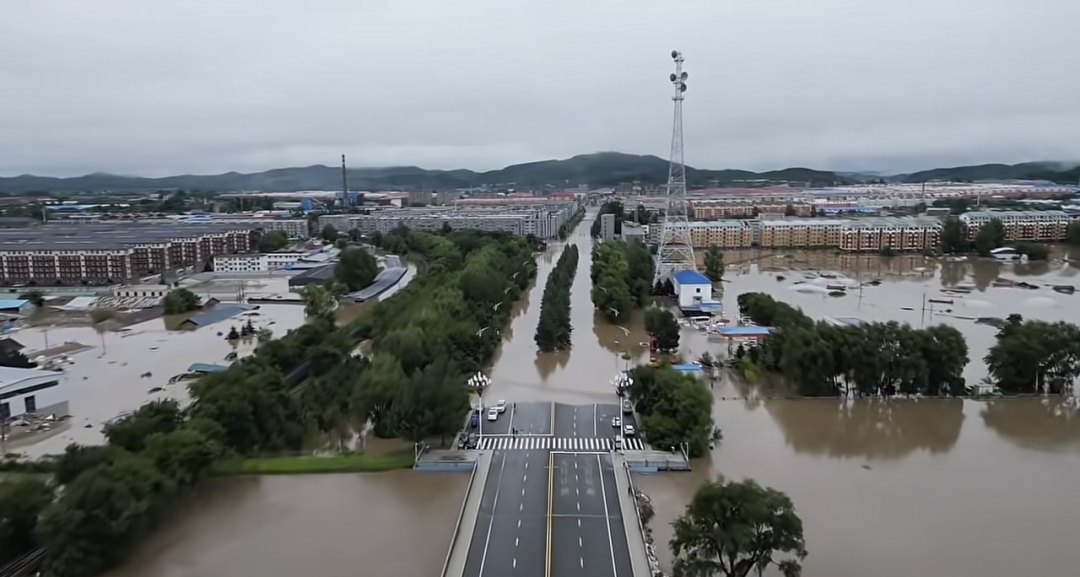
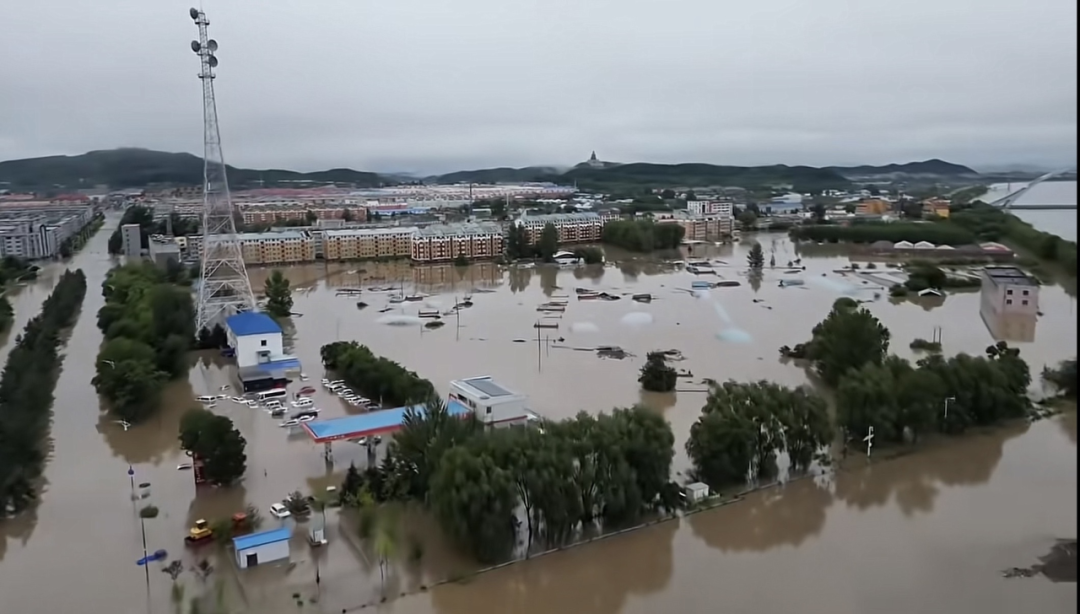
◉Widespread flooding in Dunhua City’s urban area. Image source: Douyin
Ms Juan, a wholesale trader of dried goods, experienced the flood peak firsthand. By the afternoon of 14 July, water in the Kanghui Agricultural and Trade Wholesale Market had already risen to waist height for adults.
The water surged again in the middle of the night. Fearing for her stock, Ms Juan stayed behind at the market to guard it rather than evacuating with the others. In less than half an hour, the floodwater in her shop rose from knee-deep to chest-high. She and her husband frantically shifted the remaining goods, hoisting lighter items such as dried mushrooms, wood ear fungus, and dried fish onto the corrugated iron roof. The more valuable ginseng gift boxes, however, were beyond saving and were all swept away. They only gave up when the roof collapsed under the weight on one side.
By the time Ms Juan and her husband evacuated, the entire market was fully submerged and strewn with debris. The water stood at over a metre deep, choked with floating wreckage. Objects repeatedly struck Ms Juan in the chest, making it impossible to move forward. She could only slowly make her way out, leaning on her husband, who stood at 1.8 metres tall.
The rain fell relentlessly through the day and night. By 06:00 on 15 July, floodwaters had breached the design flood level by 1.21 metres, leaving waterlogged housing estates, roads, and underground spaces across the urban area. The downpour only eased by 09:00, yet the water level continued to climb.
The Mudan River cuts through the heart of Dunhua City. The downpour inundated large swathes of the city’s eastern bank. Footage posted on 16 July by a local user showed vast housing estates swallowed by floodwaters, leaving the city looking as though it had been left to soak. A local resident told Foodthink that at least a third of Dunhua City suffered widespread waterlogging, with first and second floors submerged in some low-lying districts.
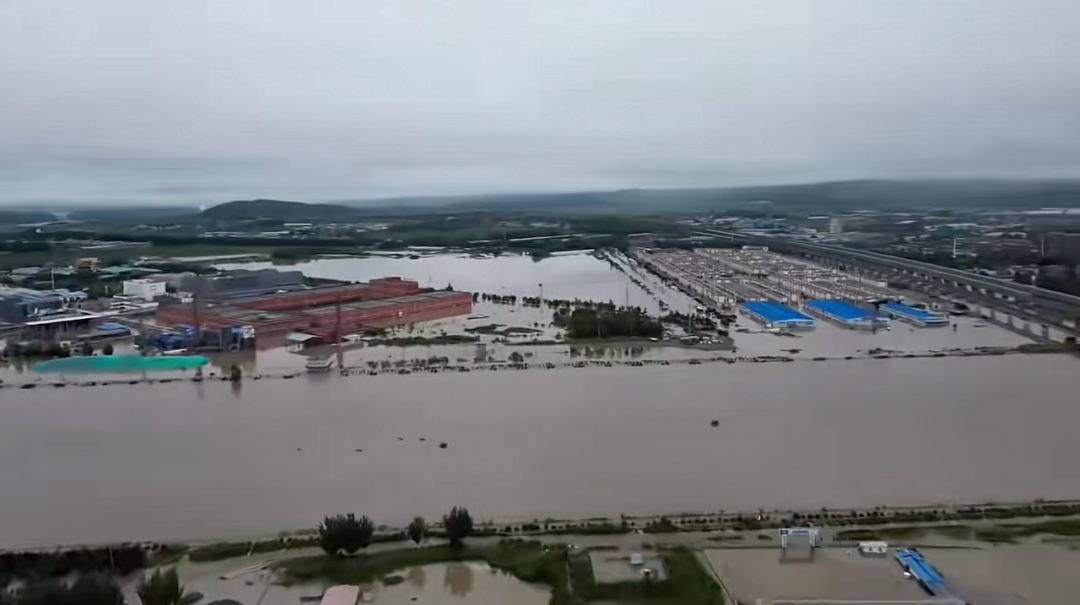
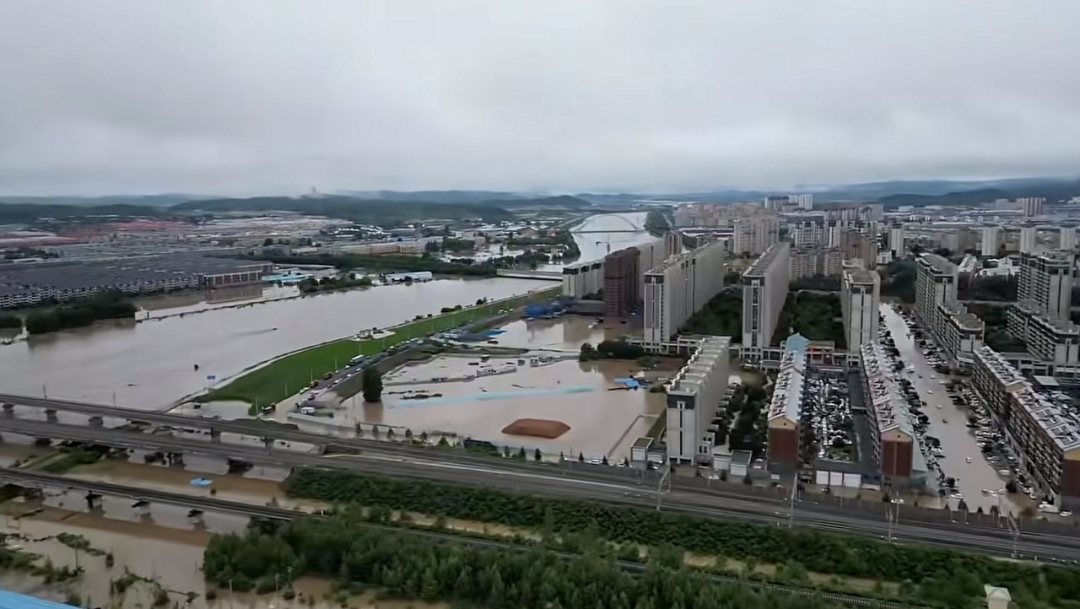
◉Floodwaters inundated large residential areas in central Dunhua. Image source: Douyin
Floodwaters remained at peak levels for over two full days, only beginning to recede slowly on the 16th. On the 17th, Dunhua City launched city-wide drainage and silt-clearing operations. Thick layers of mud coated numerous streets as dump trucks shuttled continuously back and forth. Some residents remained trapped. Ms Juan’s cousin and her child were stranded on the fourth floor without water or electricity. It was not until the fourth day that a rescue team arrived by kayak to evacuate them. As late as the afternoon of the 20th, many residents reported that power had still not been restored to their residential compounds. With basement water too deep to pump out effectively, they were forced to rely on generators for electricity at night.
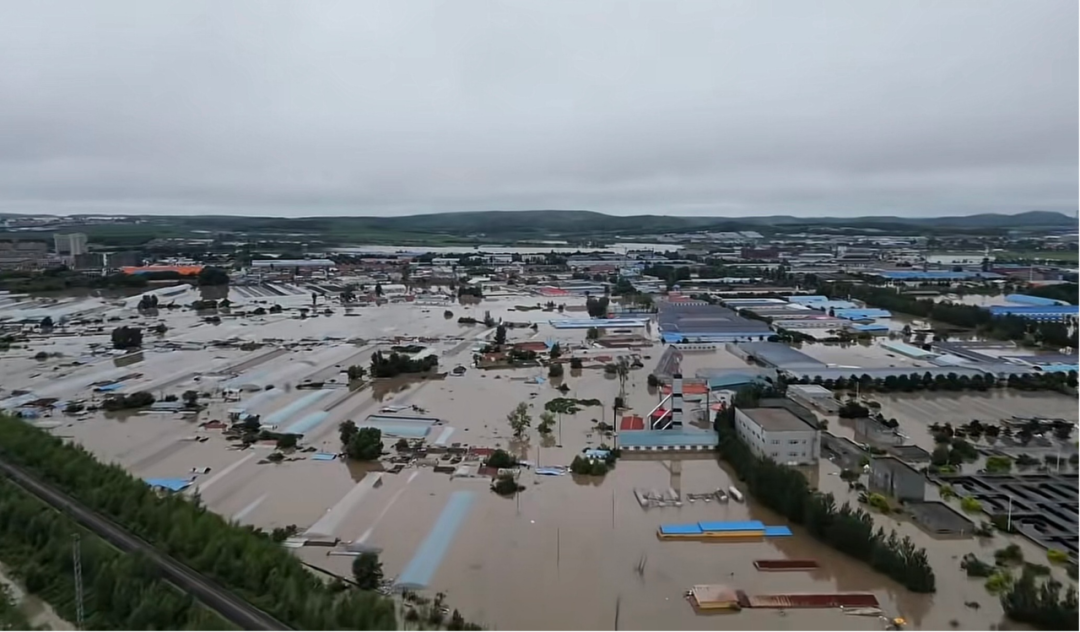
◉Floodwaters surged into the wholesale market. Image source: Douyin
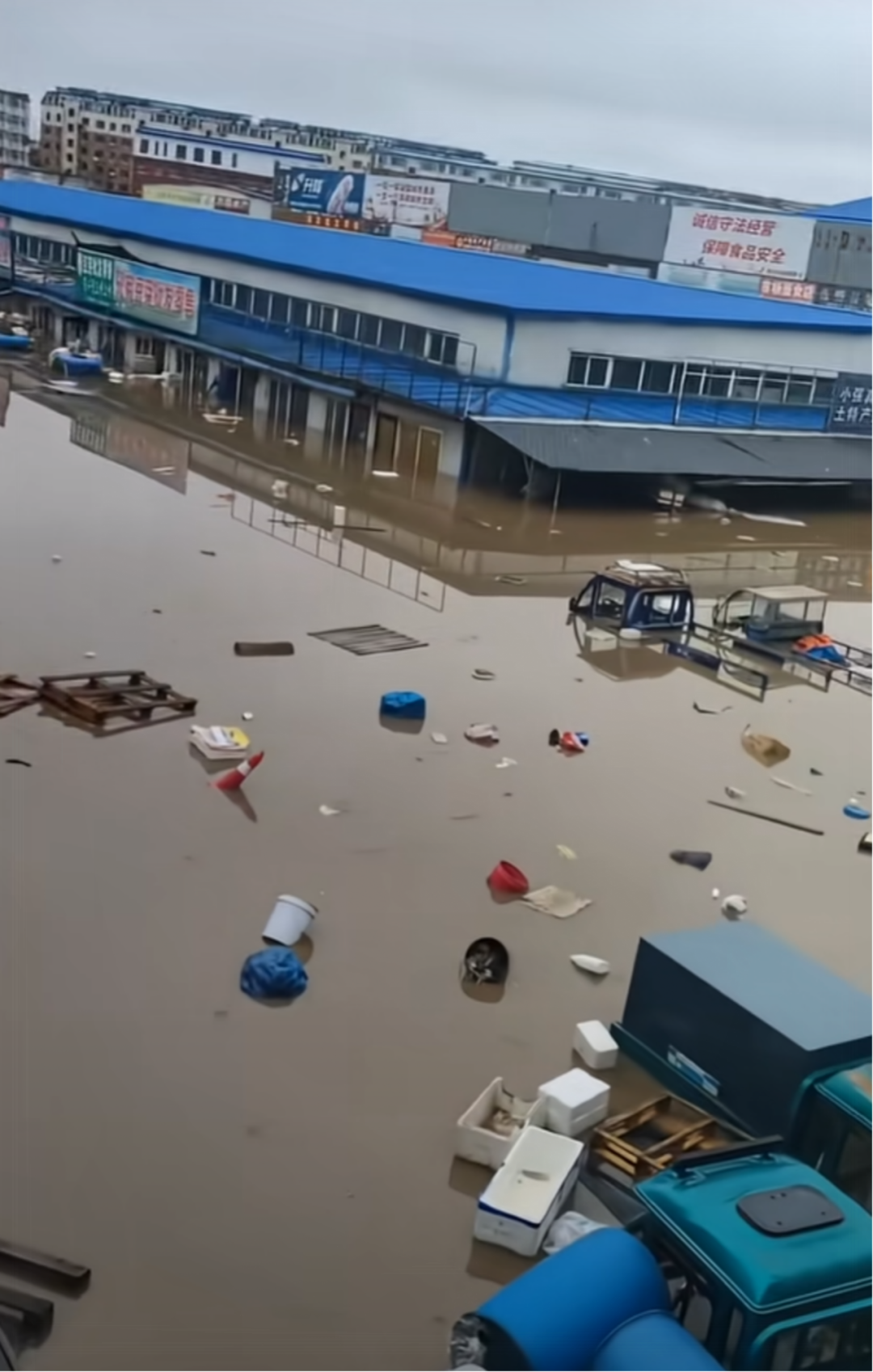
◉Local traders captured the wholesale market as it was inundated by floodwaters. Image source: Douyin
On the 20th, as Foodthink reporters entered the wholesale market, a pungent odour was immediately in our faces. The fishy stench of the silt mixed with the sour, rotting smell of meat and vegetables that had fermented in the heat, all blending with the sharp tang of disinfectant to make our eyes water. Mud covered the ground as far as the eye could see. Outside a shop on the left, thousands of water-logged soy sauce bottles lay on their sides, caked in yellow mud. Further ahead were the seafood stalls, where freezers were stacked haphazardly. Wheelbarrows and refuse trucks came and went without pause. Hundreds of wholesale traders had lost their usual bustle, swallowed up by the foul odour.
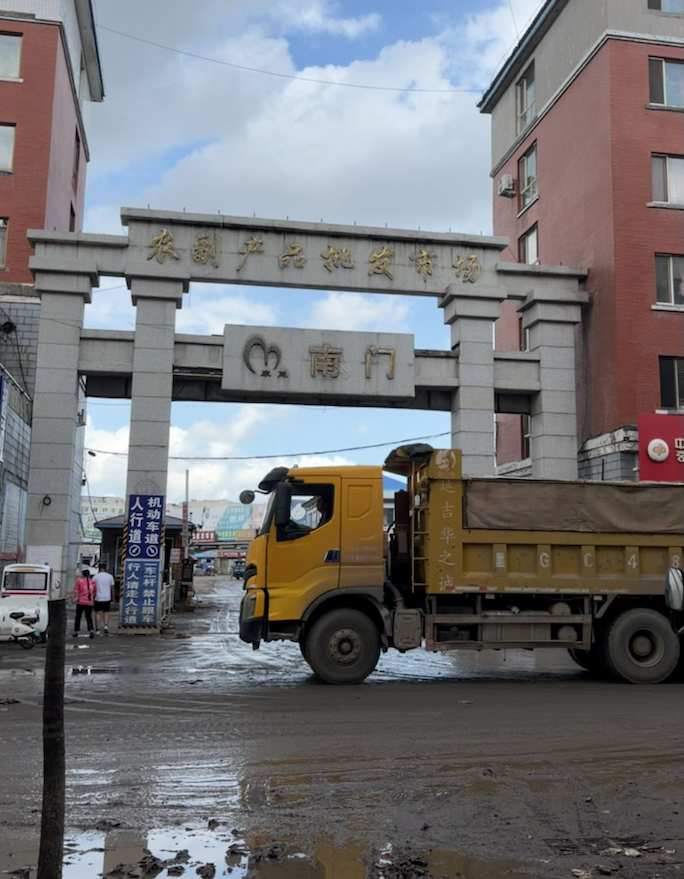
◉Clearing silt from the Kanghui Agricultural and Trade Wholesale Market after the waters receded.
A stallholder in the vegetable section told Foodthink that he had just unloaded a large lorry of onions at the market on 13 July, only for floodwaters to rush in on the 14th, ruining thousands of kilograms of stock. He said, “Had I known the floods would be this severe, I never would have placed that order.”
The scale of the flooding also left Chen Yuan, a wholesale egg supplier, stunned. “In all these years, I have never seen waters this high,” he said. When he returned to the market, he found his shop so submerged that he could barely see inside. Hundreds of cartons of eggs, along with boxes of health supplements, had been left soaking in the floodwater, resulting in losses exceeding 100,000 yuan.
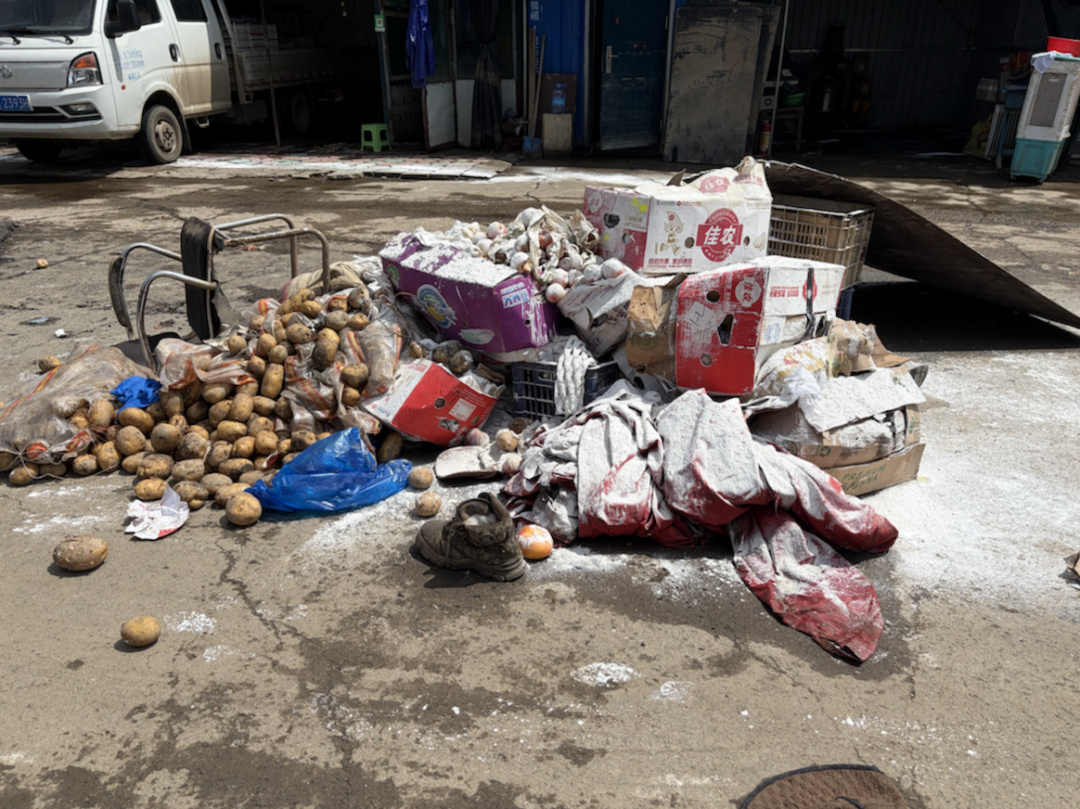
◉Water-soaked food at the Kanghui Agricultural and Trade Wholesale Market awaits disposal.
The impact extends beyond the owners of the wholesale market; food supplies in Dunhua have also been disrupted over the past few days. A staff member at the market told Foodthink that Kanghui Wholesale Market is the region’s largest agricultural produce hub, distributing nearly half of all farm goods in Dunhua. Because of the high volumes and lower prices, wet markets in several nearby county towns also source their stock from here. The recent closure has left some traders unable to restock, causing a brief ripple in vegetable prices. While some items have become more expensive, the overall market remains relatively stable. Meanwhile, major supermarkets rely on their own supply chains and modern logistics networks, so their prices have not seen significant fluctuation.
A vegetable trader told Foodthink that they typically stock local produce during this season. However, with many surrounding towns and townships affected by the flooding, numerous greenhouses destroyed and roads cut off, they have had to turn to sourcing smaller quantities from further afield, including Beijing and Changchun.
Pork is also temporarily out of stock. Wholesale stalls in the market typically sell more than ten whole pigs a day, but because the local slaughterhouse has also been impacted by the flooding and some of their supply partners have been affected, they have only received two or three pigs daily over the past few days. These are fully pre-ordered by mid-morning.
The village was completely submerged for three full days.
Outside the city, numerous riverside towns and townships across Northeast China have been struck by the flooding. In many areas, roads and bridges have been washed away and homes swept off their foundations, yet rescue efforts and public attention have been far less prompt than those directed at the city.
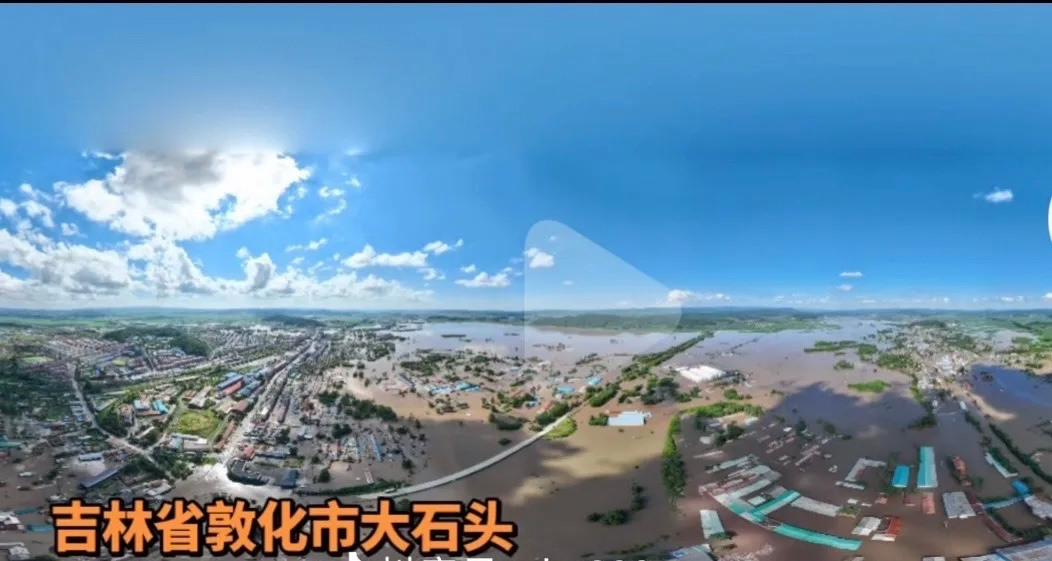
◉Social media post: severe flooding in Dashitou Town. Image source: Douyin
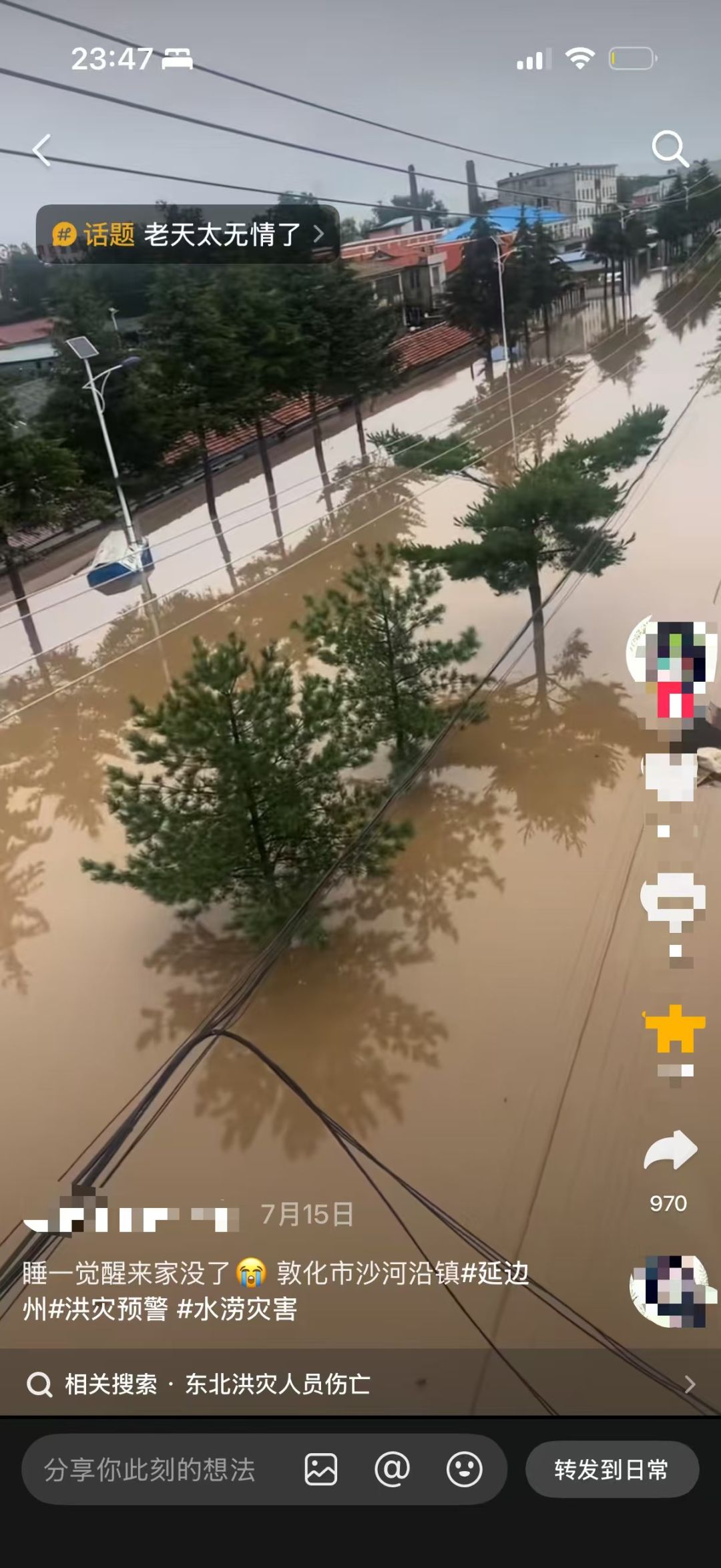
◉Social media post: severe flooding in Shaheyuan Town on 15 July. Image source: Douyin
On 14 July, following torrential rain in Dunhua City, Dashitou Town and Shaheyuan Town—located 30 kilometres from the city centre—were suddenly cut off, effectively becoming “isolated islands”. Numerous users took to social media saying they had been unable to contact their families, hoping their posts would draw attention to the crisis. Several individuals also told Foodthink that videos depicting the flood damage were quickly ordered removed by local authorities shortly after being posted online.
Many residents in these towns are elderly and lack the digital skills to seek help online, leaving them with no choice but to wait for rescue amid cut water and power supplies and no mobile signal.
Yet these areas also suffered the worst of the flooding. In Shaheyuan Town, the Sha River—one of the main tributaries of the Mudan River—flows from south-east to north-west, forming an S-bend near the Sha River Bridge. Due to the local topography, when the flood peak arrived, the water rapidly overtopped the banks in this stretch, inundating a surrounding area spanning hundreds of metres.
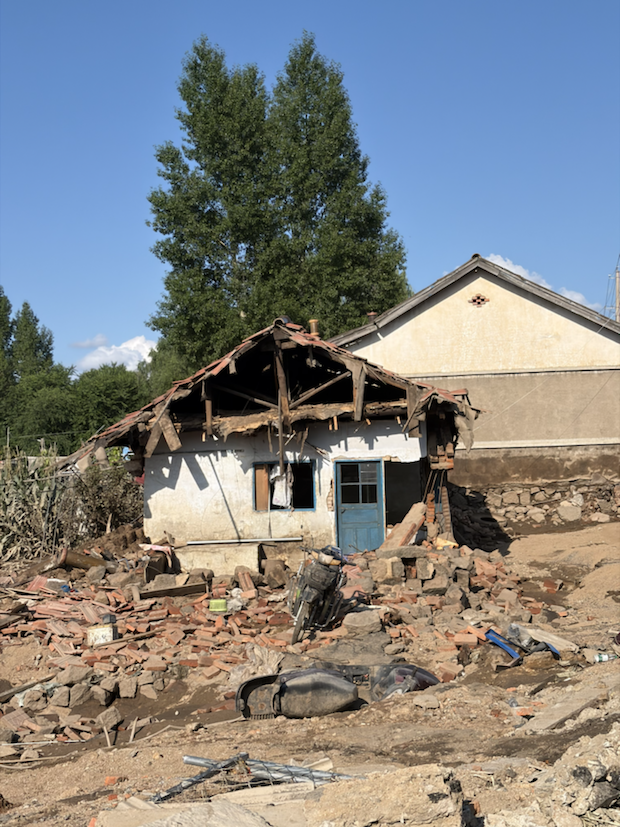
◉Severe damage at the bridgehead in Shaheyuan Town, with some houses completely washed away.
The bridgehead bore the brunt: an old house and several greenhouses were swept away completely. A nearby two-storey building was spared, but floodwater still reached three metres deep. The building housed a hair salon. The owner, Ms Qiao, told Foodthink that the area had flooded last year, but water levels only reached around 40 centimetres. This time, she moved appliances such as the fridge onto waist-high tables in advance, and she and her family retreated to the second floor. But that night, water flooded the ground floor, cutting off power and mobile signal within moments. Stranded upstairs, she waited five or six days before managing to contact her children to let them know she was safe.
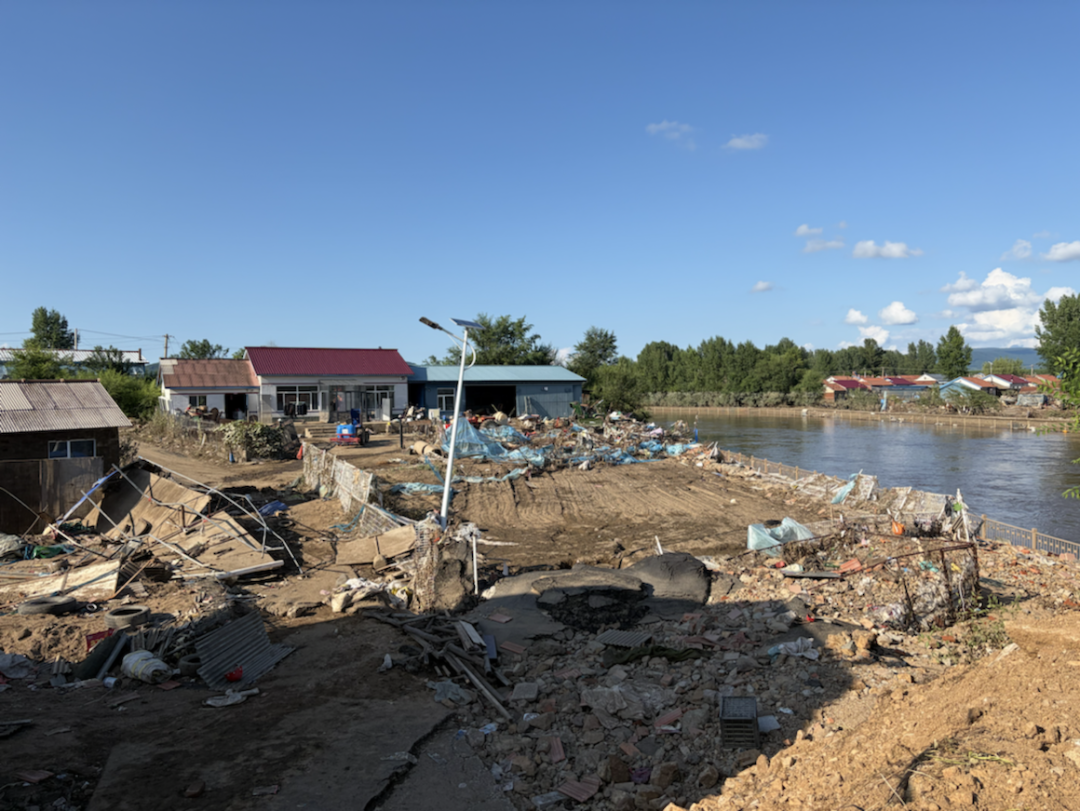
◉Riverfront houses and greenhouses swept away in Shaheyuan Town.
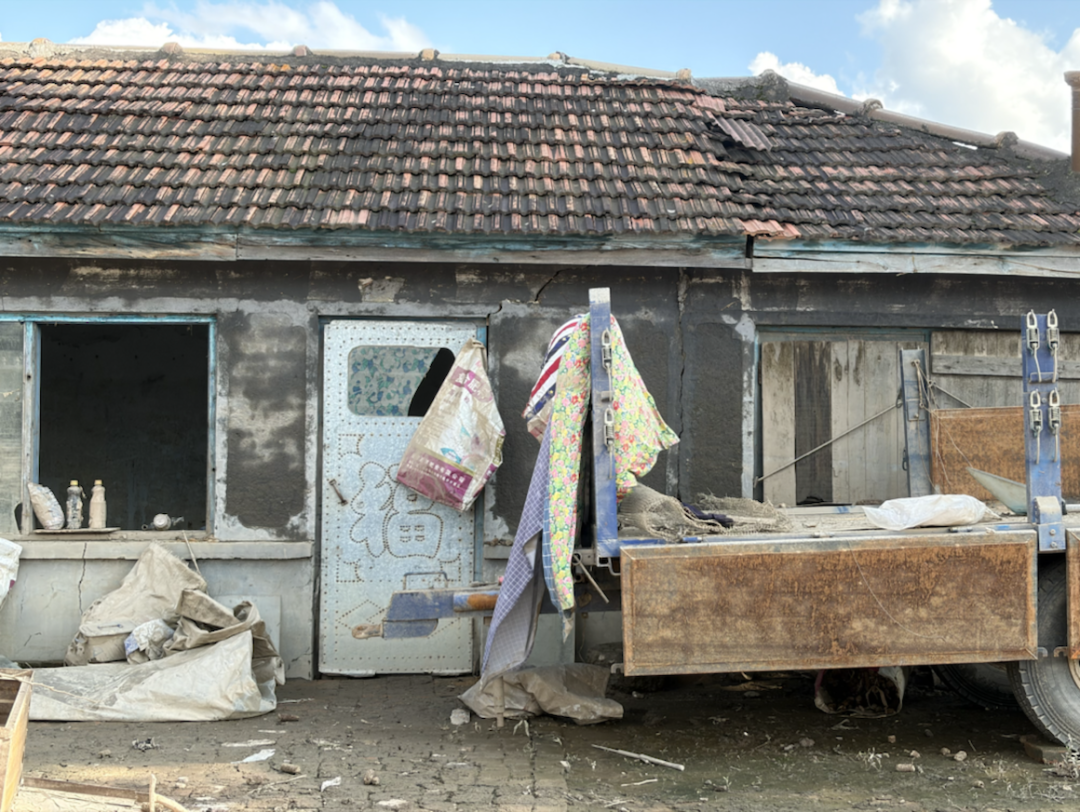
20 July. On that afternoon, by the main road in Shaheyuan Town, Mr Wang was crouched at his doorway clearing machinery, the entire gate coated in silt. On the afternoon of the 14th, he had been doing carpentry work outside when he suddenly saw water surging in from the south of the town. In less than half an hour, it had reached his knees. Seeing the floodwaters approach, Mr Wang evacuated quickly. Behind him, the water was “chasing people away.”
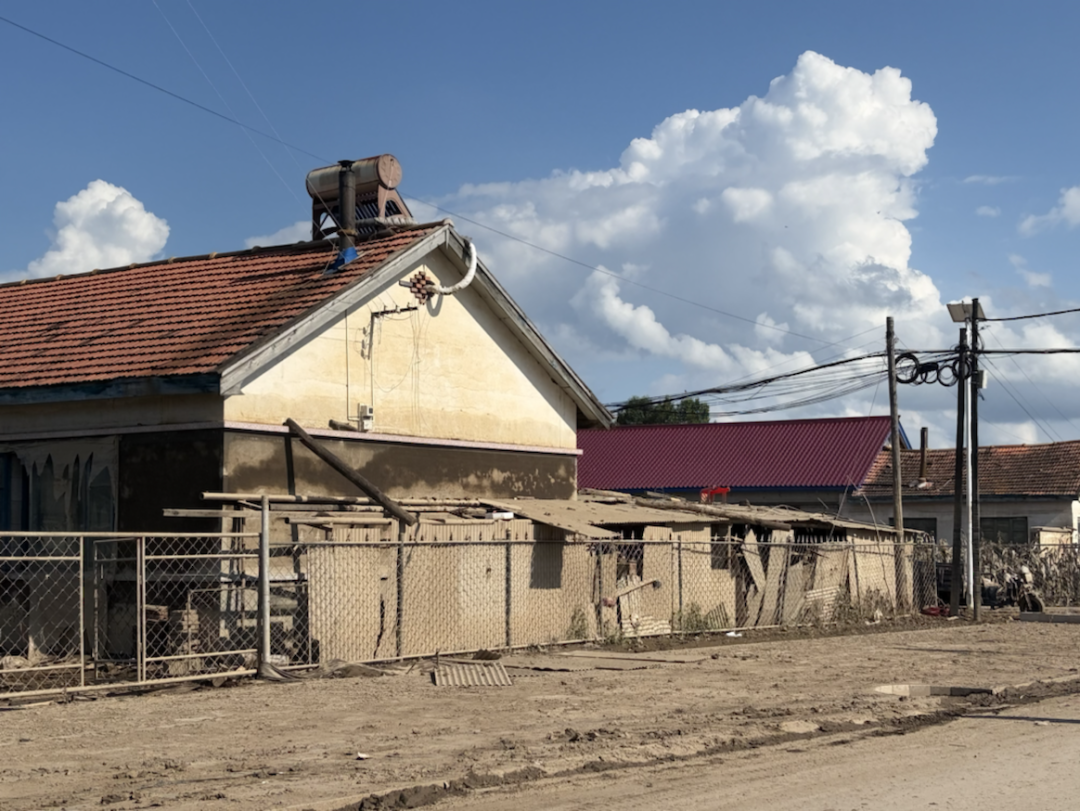
◉Water marks and silt remain on houses in Shaheyuan Town after the floodwaters receded.
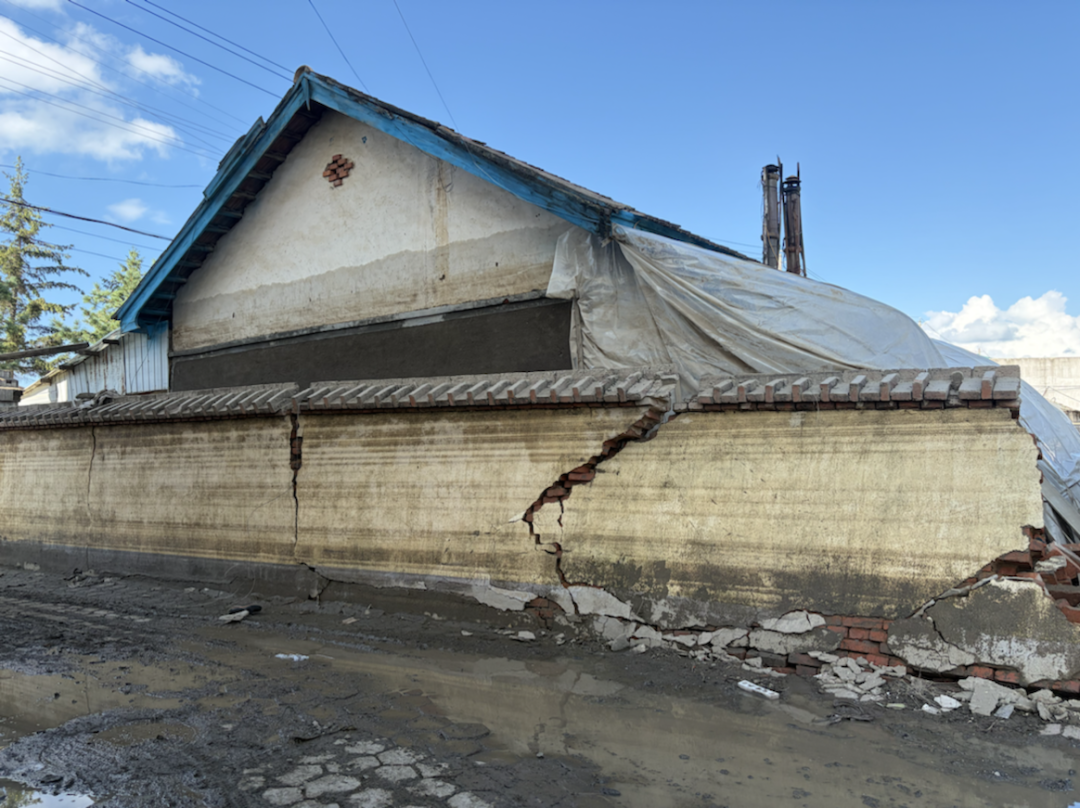
◉A villager’s boundary wall washed away by the flood in Shaheyuan Town.
Fortunately, Mr Wang’s 85-year-old mother had already been evacuated to a school serving as an emergency centre. Even now, recounting the day’s events leaves him shaken. “How could I not be terrified?”
The evacuation was so rushed that Mr Wang managed to bring nothing with him. That night at the school centre, each person was issued only a plastic sheet, on which he and his mother lay down to sleep.
At 60, he has weathered three floods: the earliest dating back to the 1950s, followed by one in 2018. This event was the most severe, leaving the entire village submerged for three full days. A putrid smell hung over the settlement, emanating from drowned livestock. Disinfection crews were out in force throughout the area, working to prevent any subsequent disease outbreaks.
When the waters receded three days later, Mr Wang stepped back into his courtyard. The storage shed had been washed away and his farming equipment left waterlogged. Water supply had only just been restored, but power remained cut. He washed his clothes and shoes, hanging them at the door to dry. Now, his greatest worry is the house itself. The brick dwelling was built 30 years ago; if left unrepaired after the flooding, it would be uninhabitable, yet fixing it would require a substantial outlay. “If the waters rise again in a few years, no one can say for sure,” he said.
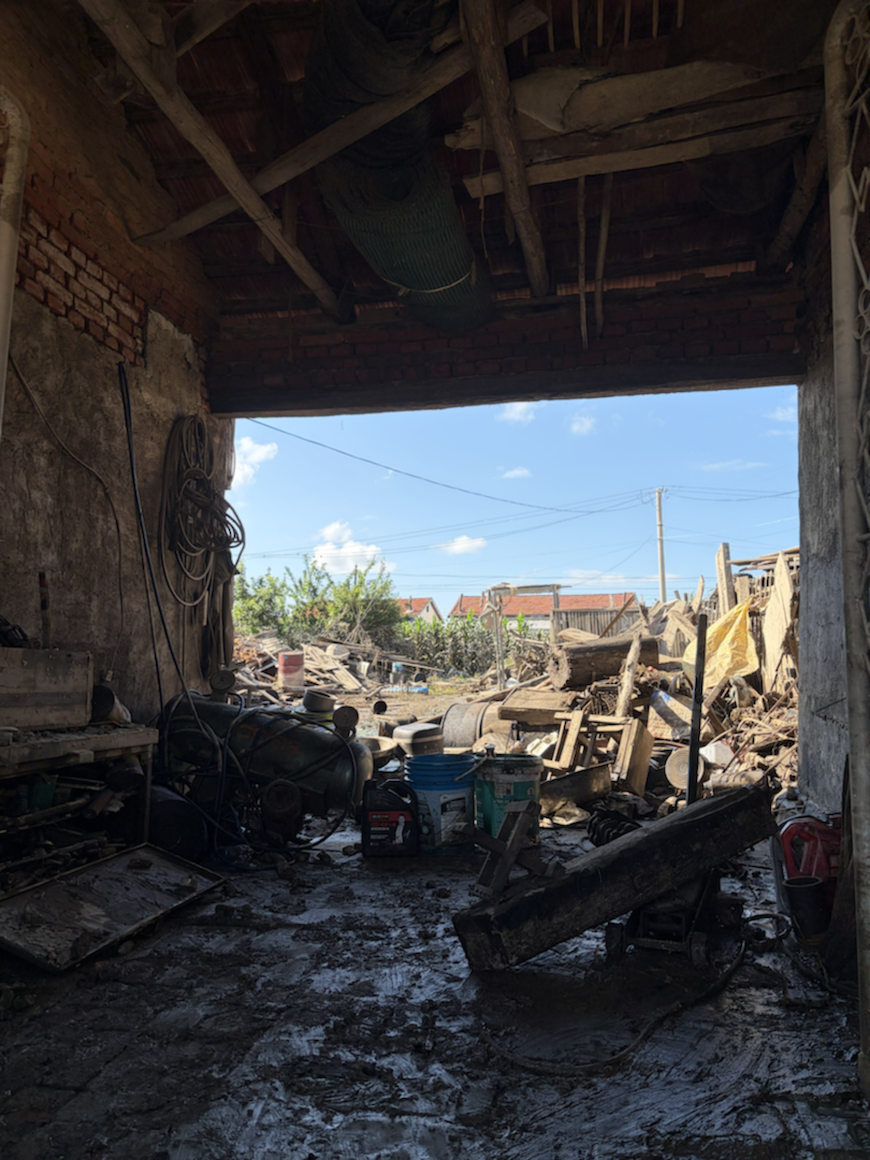
◉The flooded courtyard and home of Mr Wang, a villager in Shaheyuan Town.
Fortunately, the villagers had all evacuated in time. During the visits, several residents told Foodthink that there were no fatalities among locals, though in Changle Village, some outsiders lost their lives after failing to realise the extent of the flooding. Villagers said that a group of young people were sharing a car to Yanji for exams and to visit relatives. With the motorway closed and the driver unfamiliar with the roads, they took a wrong turn and drove straight into the floodwaters, with the car and everyone inside swept into the river. Residents who witnessed the rescue and recovery efforts said that neither the driver nor the passengers survived.
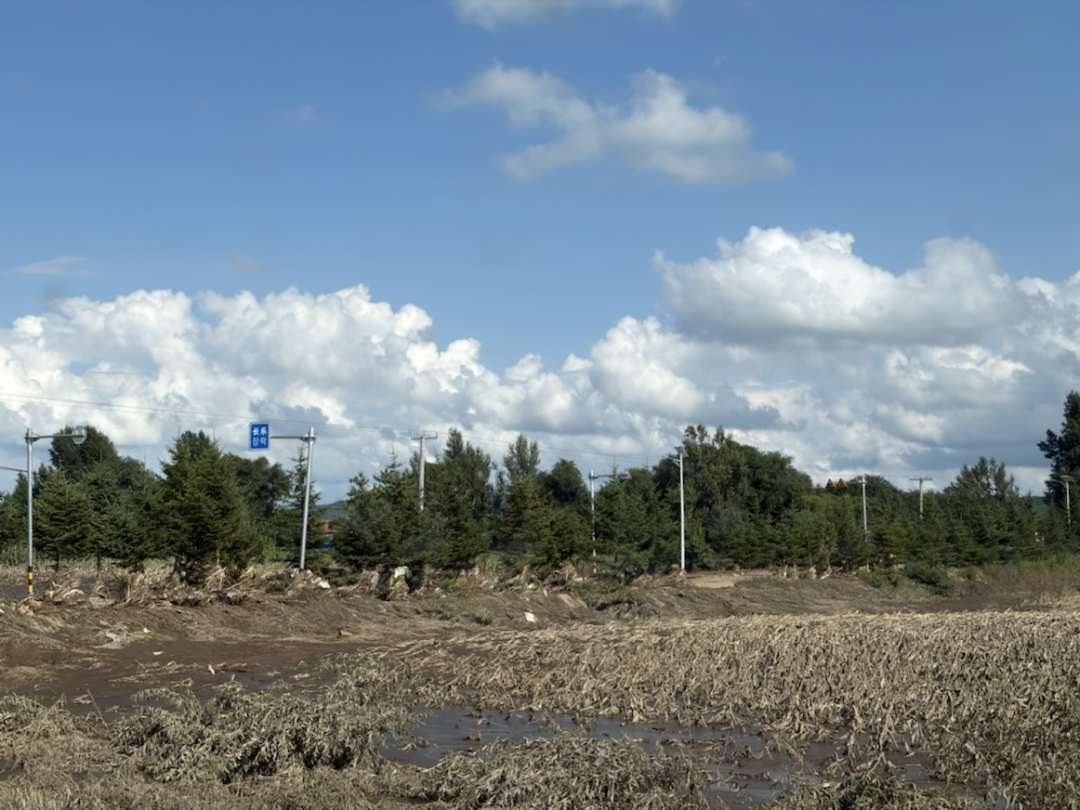
◉In Changle Village, Shaheyuan Town, overflowing river waters have flooded large areas of farmland.
As Foodthink passed Changle Village, rescue teams were visible at the bridge. Those deployed to the surrounding towns and villages were primarily local volunteer groups, alongside Communist Party vanguard units and officials temporarily reassigned to grassroots posts.
Shortly after 6 pm, as the sun went down, rescue teams in Shaheyuan Town began heading back. Mobile communication vehicles also withdrew, leaving the area without a signal once again.
With electricity still out, the villages were plunged into darkness as the rain began to fall again.
Two months of relentless rain and waterlogged fields
The rain had been falling for nearly two months. In Dunhua, maize is typically sown in mid-to-late May. Mr Wang recalls that he had already planted his crops and finished applying the pre-emergent herbicide before the seedlings emerged. Just as he was preparing for the second round of spraying, the downpour began.
Ms Chen, who is based in the city, also recalls that between May and July, there were only a handful of clear days. The rain was never particularly heavy, but it fell almost continuously. In previous years, this period would only see a few days of rain.
A water resources expert, who wished to remain anonymous, explained to Foodthink that Northeast China is not a drought-prone region and receives substantial rainfall during the normal wet season. Over the past two to three decades, precipitation across northern China has indeed increased. Coupled with climate anomalies, the rising frequency of extreme rainfall events has led to locally unprecedented downpours that exceed drainage capacities and exacerbate flooding.
Xu Xiaofeng, president of the China Meteorological Service Association, noted the unusual weather patterns in Northeast China this year. He explained to Foodthink that from May onwards, the Northeast cold vortex interacted abnormally with northward-flowing warm, moist air, creating a persistent and intense rainband across the region. This early, heavy rainfall significantly saturated the soil. When Typhoon Bavi made landfall, it delivered another surge of moisture, triggering extreme rainfall in localised areas, causing river levels to surge and placing sudden pressure on flood management infrastructure. Although Bavi moved through quickly, the pre-existing rainband remained strong, compounding the damage.
Vast tracts of farmland were devastated by the floods. As Foodthink walked along the riverbanks, it was clear that extensive maize fields near the riverbends were submerged. In the aftermath, the crops lay flattened and caked in mud.
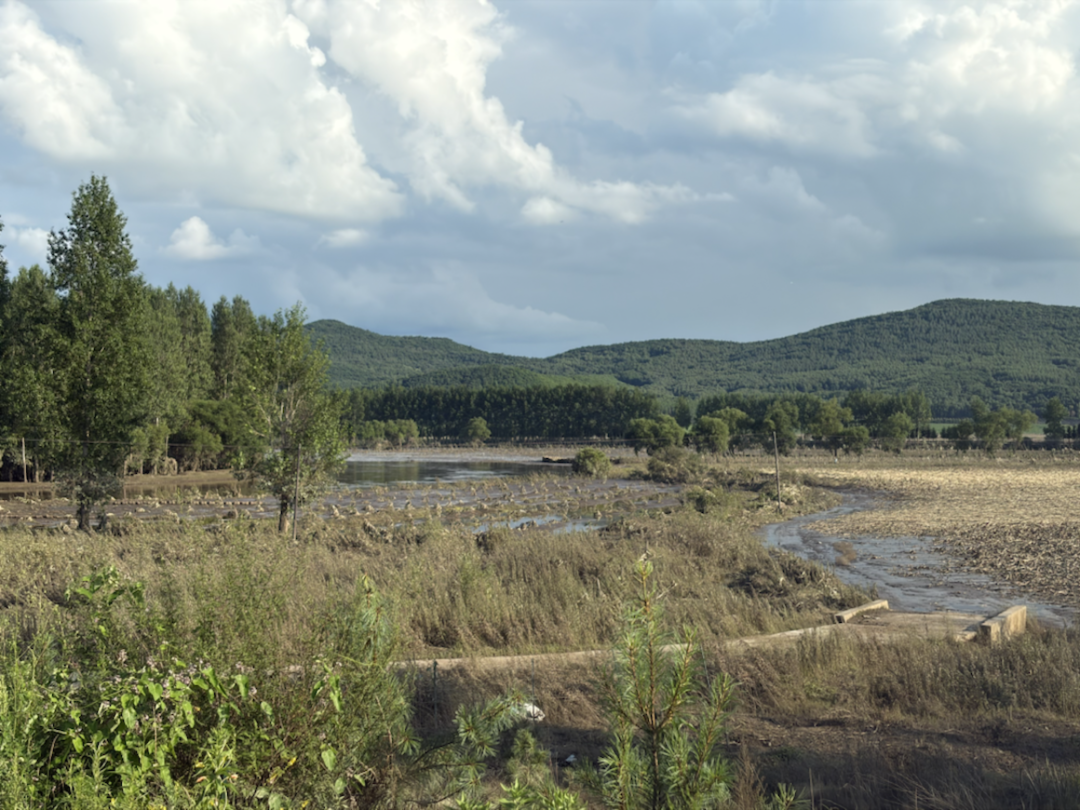
◉Flooded farmland in Shaheyuan Town, with some areas waterlogged.
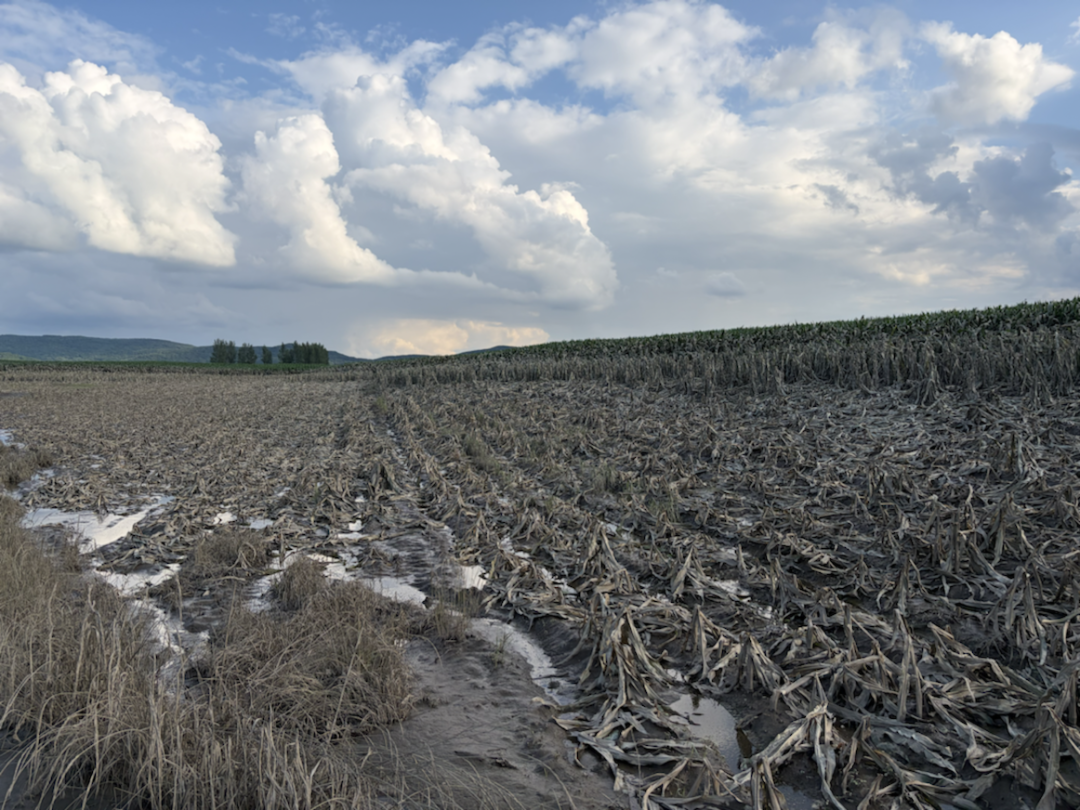
◉Flooded farmland in Shaheyuan Town, with corn crops lying flat on the ground.
This year, Mr Wang rented 20 mu (1.33 hectares) of land to grow corn, half of which was submerged in the floods. Even selling the remaining harvest would barely cover his costs. Another villager from Zhongxin Village told Foodthink that around 6 hectares of their land was flooded, resulting in a loss of tens of thousands of yuan in rent alone.
The persistent rainfall has not only stunted the growth of crops and vegetables but has also severely impacted the local ginseng industry. In Dashitou Town, Dunhua, numerous netizens have posted that vast ginseng plantations have been affected and submerged. Several local industry insiders have also confirmed to Foodthink that many ginseng farmers in Dunhua, Antu, and other areas have suffered severe losses.
As the foremost of the ‘Three Treasures of the Northeast’ (traditionally ginseng, musk deer, and sable fur), ginseng is widely cultivated in Jilin Province. In 2025 [sic], the output value of Jilin’s ginseng industry exceeded 100 billion RMB, ranking first nationwide in both production and trading volume, with Tonghua, Dunhua, and Baishan being major production areas.
As early as early June, numerous ginseng farmers in Jilin posted about their plantations suffering from waterlogging. By July, as multiple areas prepared for heavy rainfall brought by Typhoon Bavi’s landfall, several reservoirs began releasing water. According to China Jilin Network, on 13 July, Dunhua pre-emptively discharged water from 11 small and medium-sized reservoirs to create additional capacity, cumulatively freeing up 3.11 million cubic metres of storage.
However, the rainfall on 14 July still placed pressure on local rivers and reservoirs. From 06:00 on 14 July to 06:00 on 15 July, the average precipitation in Dunhua City reached 109.1 mm, with 24-hour rainfall shattering local historical records. By 06:00 on 15 July, ten of the city’s 38 small and medium-sized reservoirs had exceeded their flood limit water levels, seven rivers had surpassed warning levels, and six had exceeded design flood levels.
The floodwaters rushed towards villages along the banks. In Dashitou Town and Qinggouzi Township, Dunhua, large areas of ginseng plantations near the river were submerged.
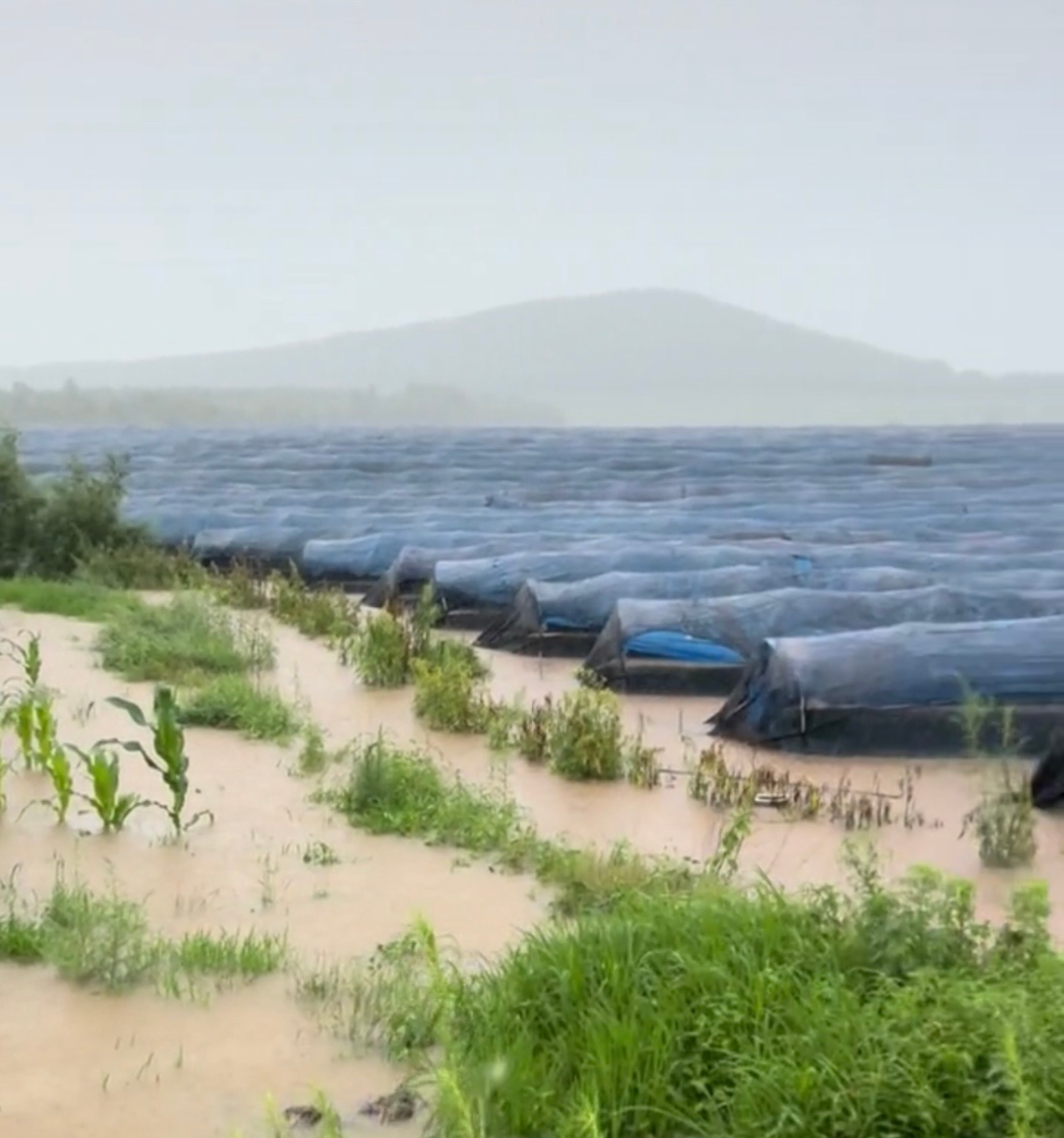
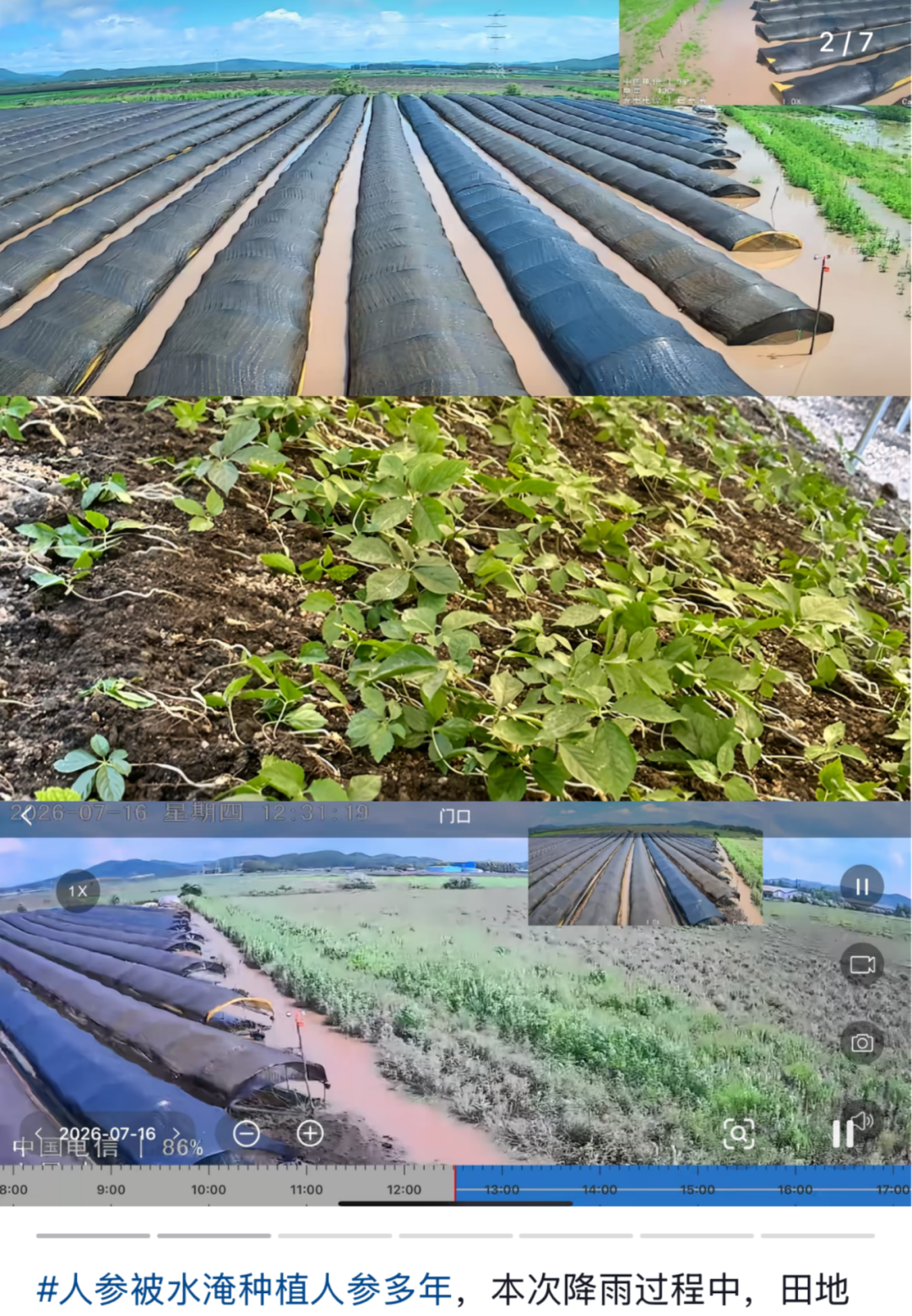
◉Multiple ginseng farmers in Dunhua posted that their ginseng fields were flooded. Source: Douyin
A ginseng farmer from Dashitou Town in Dunhua, Ms Mei, said that river water had backwashed into her 1-hectare field of three-year-old ginseng, causing losses of over 500,000 RMB. Although the harvest season had not yet arrived, she had no choice but to harvest the fresh ginseng and sell it cheaply at just over 7 RMB per jin. Another ginseng farmer from Qinggouzi Township in Dunhua told Foodthink that excessive flood discharge from an upstream power station caused the river to overflow into three villages, flooding their ginseng plots. Yet another farmer’s 0.7-hectare field was completely washed away, resulting in losses of more than 100,000 RMB.
Li Qi, a ginseng farmer in Tonghua, Jilin, told Foodthink that ginseng farmers originally grew the crop on mountainsides, where the excellent drainage naturally benefited the water-sensitive roots. However, deforestation for planting led to severe soil erosion, and following the introduction of national afforestation policies, this practice was banned. Many farmers were forced to relocate to lower ground, converting their own agricultural plots and flatlands for ginseng cultivation. Flatland plantations are highly vulnerable to flooding; if drainage is poor and the fields are submerged for just two days, pathogenic fungi proliferate, severely stunting growth. Ginseng roots are extremely intolerant of waterlogging. When soil moisture becomes excessive and the root system cannot breathe, the plants essentially suffocate.
Liu Bing, who has traded wild ginseng for over 30 years, noted that in recent years many local farmers have been eager to convert their farmland for ginseng cultivation. He crunched the numbers: growing maize yields just over 1,000 RMB per mu, whereas ginseng farming lowers management costs. Provided there are no frosts or floods, a favourable market can net farmers tens of thousands of RMB per mu. Among the ginseng farmers he knows, hardly anyone purchases commercial insurance, as they generally believe the climate in Northeast China is stable enough that such cover is unnecessary.
Yet the climate has shifted, and weather-related challenges for ginseng farmers are becoming increasingly frequent. Li Qi has observed that May and June, which used to be relatively dry, have turned into a distinct rainy season over the past couple of years, “as wet as the south”. The weather has also grown milder, with spring seemingly skipped altogether. Winter ends, and within days the region plunges straight into a hot, rain-soaked summer. When a typhoon struck Northeast China last July, many ginseng farmers suffered flooding. Li Qi’s own fields were badly inundated, “though fewer cases were reported to higher authorities”.
In early July, upon learning that a typhoon was expected to make landfall, Li Qi immediately began digging deeper drainage ditches and establishing runoff channels as emergency measures. Thanks to these preparations, his ginseng fields were spared from flooding despite days of heavy rain.
Regarding the future of ginseng farming, she holds a mindset bordering on resignation. “It’s like trying to fight the heavens; how can you possibly win? There’s no way to overcome it. We can only accept nature’s will.”
The “上山下滩” Land-Use Dilemma
Many netizens have taken to social media to question whether improper local flood discharge practices were responsible for the damage.
In response, the aforementioned water conservancy expert explained that the primary objective of reservoirs and other hydraulic infrastructure is to ensure their own structural safety. During heavy rainfall, water must be discharged in advance to prevent levels from exceeding the dam’s design flood level. Authorities typically notify downstream communities before releasing water to facilitate evacuations. Due to the high population density and limited arable land, many traditional flood channels have been encroached upon by residents and even local governments for development. Consequently, most of the areas evacuated during the recent downstream flood discharges in Northeast China were, in fact, designated flood passage and storage zones.
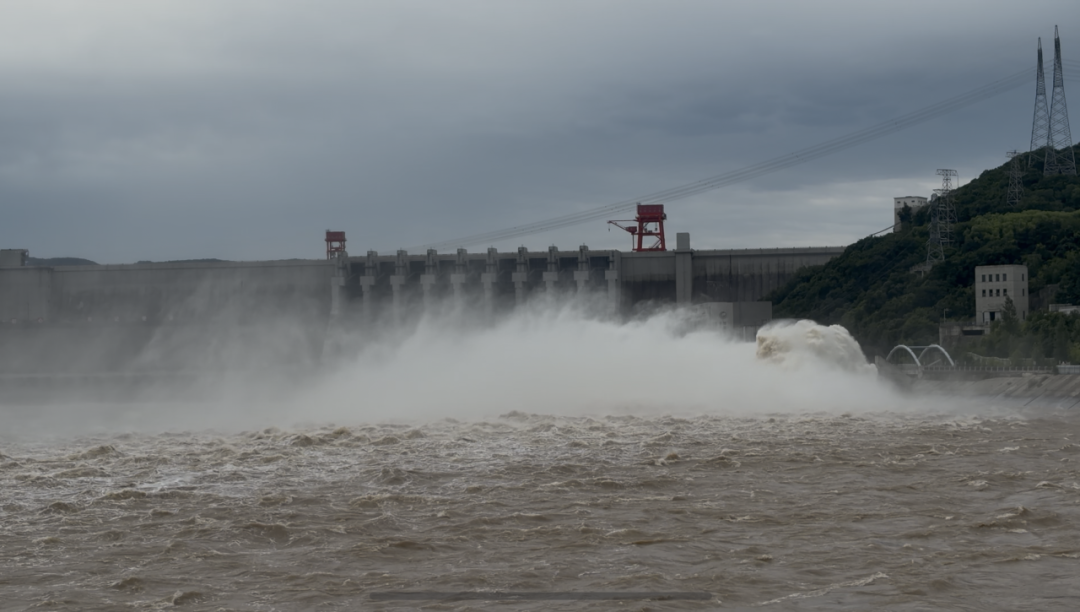
◉Fengman Reservoir in Jilin releases floodwater, 19 July.
Such a situation is far from uncommon. He noted that in the Yangtze River basin, people continue to farm and reside in certain flood storage and detention areas, even those designed to withstand a once-in-a-century flood. These tracts are typically rich in fertile soil, making them highly suitable for cultivation provided major floods are avoided. Over the past few decades, land surrounding urban centres has been extensively developed. To uphold the national arable land red line of 120 million hectares and adhere to the balance of occupation and compensation (China’s policy to maintain arable land quotas), significant portions of basic farmland have started to shift onto hillsides and riverbanks. Consequently, in many areas, stretches of riverbank that have remained dry for decades have been progressively converted into basic farmland.
The pressing question is whether rural water infrastructure can withstand the increasingly frequent periods of heavy rainfall and the flooding they may trigger in the future. He told Foodthink that urban embankments generally meet established standards and are unlikely to encounter serious problems. However, rural areas cover vast territories with dispersed river systems, meaning flood defences cannot all be constructed to high specifications. The majority are only capable of withstanding floods expected once every ten to twenty years.
Flood awareness across northern China also requires strengthening. Song Xianfang, a researcher at the Institute of Geographic Sciences and Natural Resources Research, Chinese Academy of Sciences, observes that the expansion of human activity over recent decades has led people to “forget where the floodwaters used to run, blur the boundaries, and leave places that were always destined to be inundated to naturally suffer disaster.”
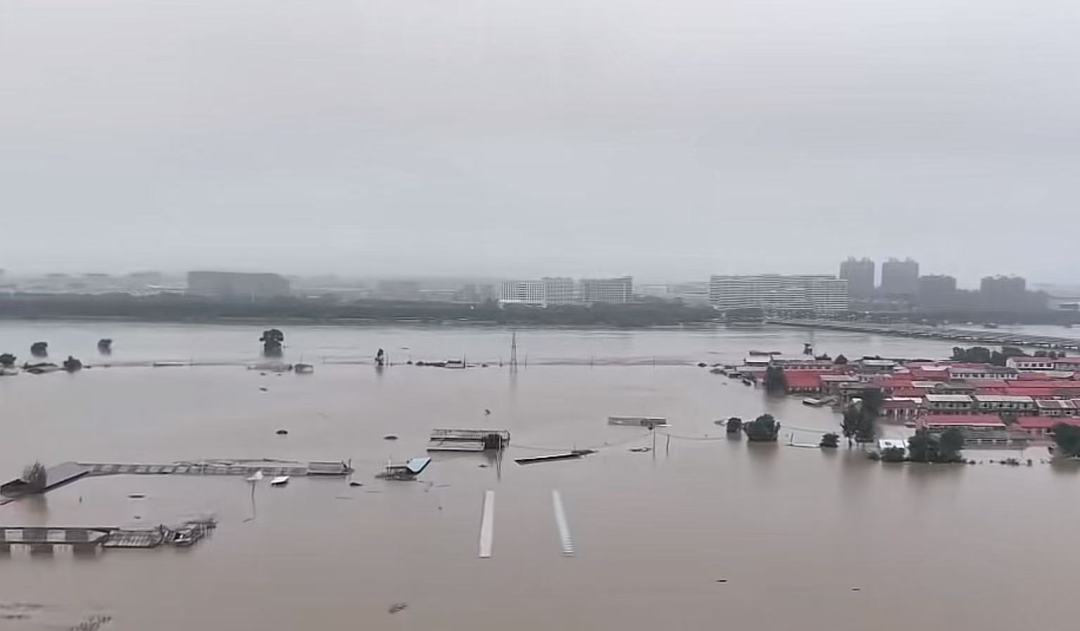
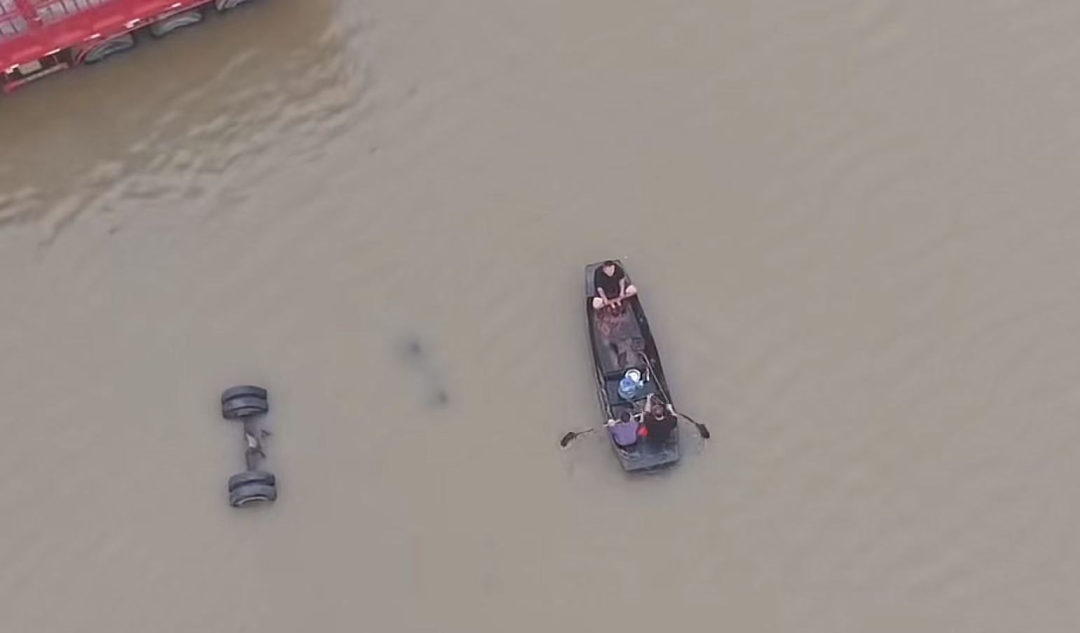
◉Tonghua in Jilin Province, along with Fushun and Tieling in Liaoning Province, were also severely affected. Huinan County in Tonghua was flooded, prompting residents to organise self-rescue efforts. Image source: Douyin
When Song Xianfang conducted field research in eastern Jilin in 2024, he also experienced a flood at first hand. Speaking to Foodthink, he noted that many hard-hit areas still lack adequate emergency measures. He cited how the long absence of major flooding had encouraged the development of water-based recreational facilities. When the Qili River in Xingtai flooded in 2016, the disaster caused significant casualties and swept away every attraction. Similarly, it was only following the 2023 floods in Zhuozhou that local authorities began building reservoirs and reinforcing river channels.
As the water management expert previously noted to Foodthink, during the 1950s and 1960s, local farmers would undertake water conservancy work and dredge river channels every winter. Today, however, with much of the rural workforce having moved to urban areas, relying entirely on professional crews is simply not feasible.
He also stressed that flood management cannot rely on infrastructure alone; it must be complemented by non-structural measures. When faced with floods that exceed design capacity, the priority should be controlled release rather than absolute containment. Relying exclusively on engineering solutions intensifies competition for space between infrastructure and natural waterways, carries high costs and risks, and can trigger catastrophic losses should defences be overtopped. He argued that a non-structural approach is far more pragmatic. This involves strengthening early warning systems, enforcing strict land-use planning, and avoiding the placement of high-value assets and advanced manufacturing in flood plains. Furthermore, he advocated for wider uptake of commercial crop insurance, with payouts from insurers and state disaster relief covering farmers’ losses.
Even though the peak flooding has receded, these efforts remain critically urgent. Xu Xiaofeng pointed out that Northeast China remains under the influence of the rain band. With the region’s standard July rainy season approaching, flood conditions could worsen, and some areas may face secondary inundation. Continued vigilance is essential.
Several days after the waters receded, Dunhua City is still in the throes of reconstruction. On 20 July, as Mr Chen was bailing out the standing water in his shop, he was caught in another downpour, with rain streaming noisily from the roof. He stepped out to rinse his mop in the runoff, remarking that without the brief two-day stretch of fine weather, there would have been no way to clear the shop floor.
Meanwhile, forecasts indicate further rainfall over the coming week. According to a bulletin issued by the China Meteorological Administration on 23 July, precipitation is continuing across Northeast China, with heavy to torrential rain expected in central Heilongjiang, northern Jilin, and eastern Liaoning. The western region is also forecast to experience severe convective storms, including thunderstorm gusts of force 8 or higher or hail.
The rain is not letting up.
– This is Foodthink’s 827th original article –
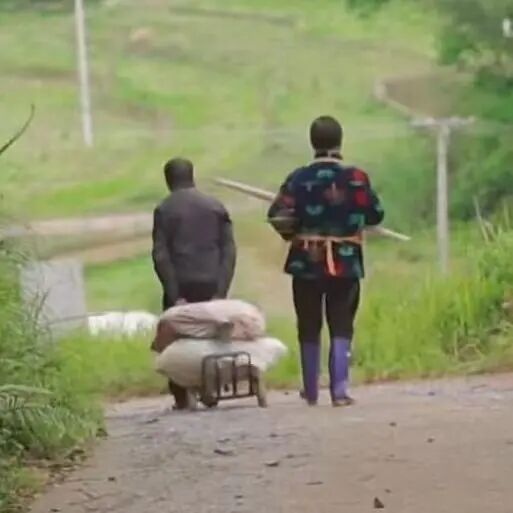
Foodthink
Author
Lin Jixia
The countryside is far from a pastoral idyll; life is overlooked, fractured, forgotten, and coated in dust. Independent writer focused on climate, rural communities, and labour.
Unless otherwise stated, all photographs in this article are by the author.
The interviewees Chen Yuan, Li Qi, Liu Bing, Ms Juan and Ms Qiao are pseudonyms.
Editor: Xiao Dan
Layout: Ming Lin
Scan the QR code to donate and support original reporting.
▼

▼
Click the image to read related articles.
▼
Click on keywords to browse more articles in this collection.
Seeds | Farming Techniques | Policy | Fermentation | Nutrition | Fruit | Fisheries | Events | Careers | Food Delivery | Produce Markets | Livestock | Food Talk | Sharing Sessions | Book Club | Harvest Festivals | Smallholder Stories | Climate Change | Rural Development | Cooperative Economy | Urban Farming | Food Safety | Digital Technology | Biodiversity | Pandemics and Food | False Solutions | Agroecology Internship Programme
Beijing|Hebei|Shanghai|Guangdong|Guangxi|Henan|Sichuan|Jiangxi|Xinjiang|Shaanxi|Hong Kong|Chongqing|Zhejiang|Jiangsu|Guizhou|Taiwan|Inner Mongolia|Philippines|Canada|Russia|Mexico|Italy|USA|UK|Germany|Netherlands|Thailand|Sweden|Japan