From Scheduling Specialists to Shared Store Managers: How Does McDonald’s Turn People into the System’s “Flesh”?

Foodthink’s Note
If Part One took us into McDonald’s kitchen and revealed a small factory running in 90-second cycles, this article will show us how that factory is managed and kept going.
From price anchoring in meal deal design to ever-shrinking store spaces; from Scheduling Specialists to Shared Store Managers, and on to intelligent systems that attempt to predict everything, McDonald’s is maximising efficiency through a highly precise operational framework.
But within this system, people remain the greatest variable. Standardised processes, digital tools and KPIs make every employee part of the machine, yet cannot fully replace human judgement, experience and on-the-spot adaptability.
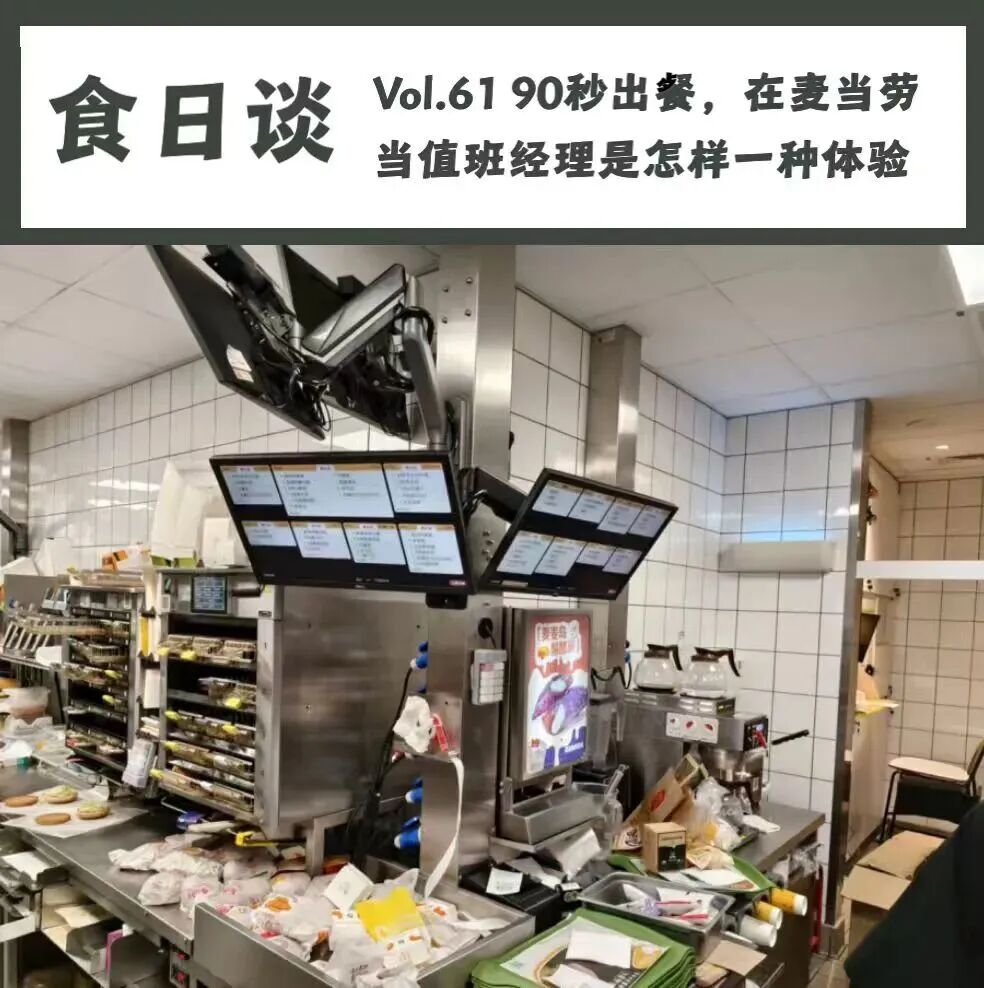
This article is adapted from episode 61 of the Food Talk podcast. We are joined once again by Jiang Ke, formerly a Shift Manager at McDonald’s, to discuss the business logic behind a portion of fries and a rota, and how, in a fast-food system built on efficiency above all, workers are counted, managed and yet learn to coexist with it. Behind each quick order we place and every meal we collect on time, we are also connected to the countless labours within this vast system.
This Episode’s Guest

Jiang Ke|A novice in the food-and-beverage industry who loves analysing stores, food and operations, and usually watches Yong Ge’s videos over meals
This Episode’s Hosts

Yuyang|Foodthink editor, who as a child was “beaten up” for stubbornly insisting on eating McDonald’s

Li Ye|One ADHD, who has played Airplane Chef on iPad, rolled Shawarma and run a breakfast shop
Large, Medium or Small – Which Fries Should I Choose?
Yuyang: Did you come across the cost of McDonald’s ingredients during your work?
Jiang Ke: Actually, as a Shift Manager you already have access to the cost price of every ingredient – they are consistently low. Why not name an item you particularly enjoy?
Li Ye: Fries.
Jiang Ke: Fries are actually a bit tricky to work out, because the amount each employee serves can vary. The standard is that once you’ve filled the bag, there should be no gap left at the top. But in practice, customers tend to end up with less than that suggests.
Li Ye: Here’s my favourite question – large, medium or small, which fries give the best value?
Jiang Ke: If you’re ordering à la carte, none of them are really great value. The selling price might be twelve or fourteen yuan, but the cost is probably just over one yuan. In terms of pure ingredient cost, it’s still very low. If you get them as part of a meal deal, though, it works out to maybe seven or eight yuan per portion, which is slightly better value.
Li Ye: Is the difference in quantity much between the large, medium and small?
Jiang Ke: It depends on each person’s scooping technique. Student part-timers, for instance, just keep stuffing fries into the bag. A lot of Shift Managers see that and think, “Goodness, that’s enough for two portions!”
Yuyang: That really upends my assumptions. I always thought McDonald’s was a place of strict standardisation – surely only a little neighbourhood restaurant or a university canteen would have a serving aunty or uncle who can’t keep a steady hand. I never expected McDonald’s to have that kind of inconsistency too.
Jiang Ke: Exactly. There are standards in place – how much goes in each portion of fries, roughly how heavy each ice cream should be, all of that. But it really comes down to training. If the staff training isn’t up to scratch, they figure, “I’ll just cram this bag full” or “I’ll just overfill the ice cream until the lid won’t close.”
Li Ye: Right, well, we’ve got the university students to thank for that.
From One Burger to a Four-Piece Combo: McDonald’s Pricing Psychology
Yuyang: Let me ask a rather practical question – how do we order at McDonald’s in the most cost-effective way?
Jiang Ke: At McDonald’s, it’s really best to avoid ordering à la carte – it’s just too expensive. Say you order a burger, a Chicken Burger might cost 22 yuan, a Coke seems to be around 10 yuan, and fries are 12 yuan – those three items alone already add up to 36 yuan. And in reality, very few people do order à la carte. Everyone generally goes for a meal deal, and you feel like you’ve saved a great deal of money. Take the Three-piece combo we just mentioned – if you order it as a meal deal and add a portion of Chicken McNuggets, it still comes to only thirty-something yuan. But you think to yourself, a portion of Chicken McNuggets is 12 yuan on its own, so it’s as if you’ve saved over ten yuan out of thin air!
The idea is essentially to inflate the single-item price so that the meal deal feels like an incredible bargain, thereby driving up the purchase rate. This is a very important concept in psychology – price anchoring. Many chain restaurants use similar single-price inflation strategies to encourage spending. You might have only wanted one burger, around twenty-something yuan, and fancied a sip of Coke – but à la carte, burger plus Coke already comes to thirty, so why not add a few more yuan and get a Four-piece combo, right?
Secondly, if you really do eat there every day, the Maika (McDonald’s membership card) is worth buying. But if you only go a few times now and then – perhaps once a week – and you want to try a wider range of items, let me recommend a hack: order through Xianyu or Taobao, where someone will order on your behalf, and you can get Gold Maika prices.
Li Ye: And through this price anchoring effect, it also boosts customer satisfaction. Everyone’s happy when they order a meal deal – the business makes money, and the consumer feels they’ve got a good deal too.
Yuyang: A little while ago, McDonald’s raised the price of its Suixinpei combo – the Double Cheeseburger and the Filet-O-Fish are now 14.9 yuan.
Li Ye: Some people said McDonald’s should just start making macarons, with burgers the same size as macarons. Others said they feel the patty inside has gone thinner too – is that actually true?
Jiang Ke: I’m not quite sure about this recent wave of price increases, since I’ve already left. But what I did know before is that the patties are actually all the same – whether it’s the meat in a Double Cheeseburger or a Big Mac, it’s the same beef, the same cut, the same thickness. The reason people feel they’ve shrunk may be that the source manufacturer started making them smaller; I think there’s a possibility of that. But there’s another, much more likely explanation: the patty no longer meets the Golden Quality Standard (the Golden Quality Standard means that if a burger sits unsold for more than 10 minutes, or fries for more than 7 minutes, it gets discarded). A patty is at its largest the moment it’s cooked; once it goes into the warming cabinet, it just keeps shrinking. The moisture evaporates, the meat turns darker or drier, and it gets smaller.
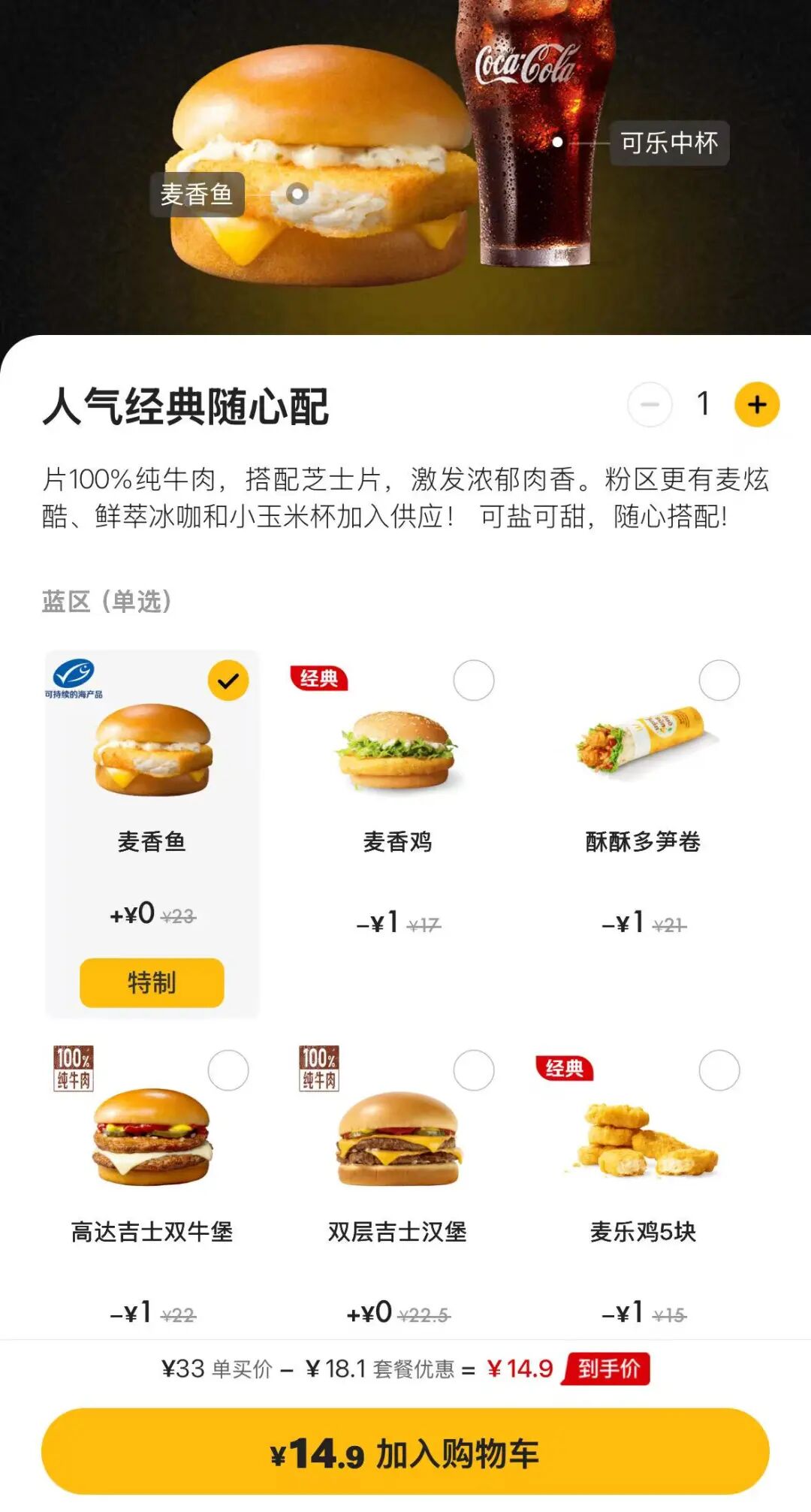
◉ The Suixinpei combo, now up to 14.9 yuan.
Yuyang: I seem to remember that many years ago, the Suixinpei was 11.9 yuan, then it went up to 12.9, then 13.9, and now it’s 14.9.
Jiang Ke: Right, the Suixinpei is essentially McDonald’s cheapest combo, because ordering a Double Cheeseburger à la carte costs 23 yuan, right? But if you go for the Suixinpei, it’s only 14.9 yuan, which still sounds like a great deal.
Li Ye: I know why I used to think one Grilled Chicken Burger could fill me up as a child – it’s because I was little, and my stomach was small, so back then one was enough. Now I feel it’s gotten smaller – partly, maybe it really has; and partly, maybe it’s just that I’ve grown up.
Why Are McDonald’s Toilets Disappearing?
Li Ye: And in recent years I’ve noticed that a lot of McDonald’s branches no longer have toilets – you have to go to the public ones in office buildings. Is that also a cost-saving measure?
Jiang Ke: Yes. The old impression of McDonald’s was – wow, this restaurant is so big, so many seats, so clean. Now McDonald’s needs to reach the lower-tier market, needs to open more stores, and its positioning has shifted too – from that flagship feel it used to have to something more like an everyday necessity, and store sizes have been scaled back accordingly. Before, the dining area plus the front counter might have been five or six hundred square metres; now it’s likely just over 200.
If a store is really tiny, there simply isn’t room to fit in a toilet. And for stores that do already have one, opening it to the public means you need more staff to keep it clean. If it isn’t cleaned promptly, customers can file a complaint. On top of that, McDonald’s has strict cleaning standards for toilets – at least one check every fifteen minutes – which is quite demanding in terms of staffing. So removing toilets is also part of its cost-cutting and efficiency improvement strategy.
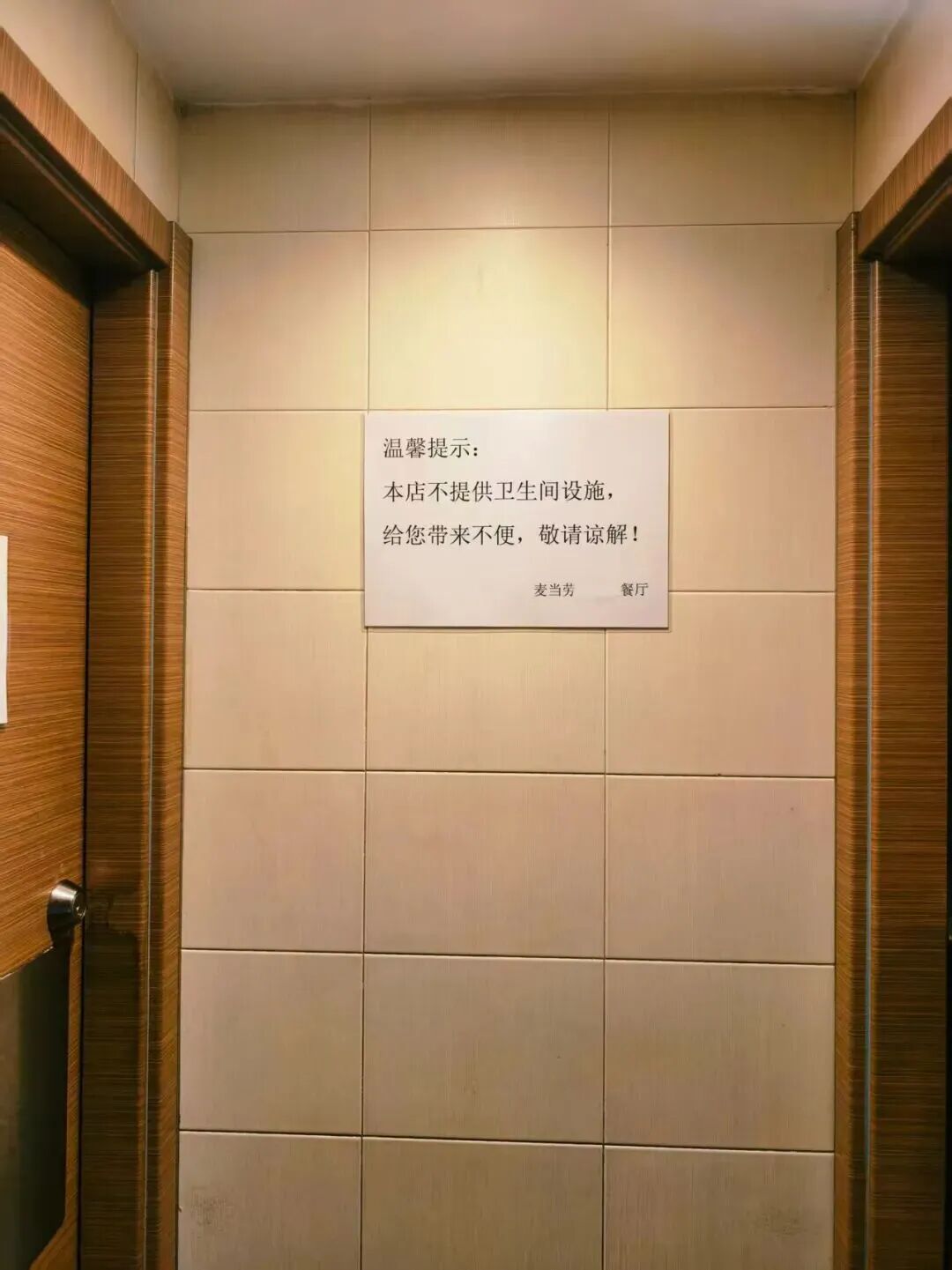
◉ Some McDonald’s restaurants used to have toilets but no longer open them to the public. Photo source: Jiang Ke
More Stores, Fewer Store Managers?
Yuyang: During peak hours, who arranges the staffing inside a McDonald’s?
Jiang Ke: McDonald’s staffing setup is fairly complex, because the company has not just Shift Managers but also full-time employees, and beneath the full-time employees there are many part-time workers – it’s a very intricate staffing hierarchy.
McDonald’s has a role called the “Scheduling Specialist”. We create the roster once a week, and all staff assignments are adjusted according to turnover – that is, scheduling is based on projected turnover for each time slot each day in the coming week. Say tomorrow’s projected turnover is 20,000 yuan; you calculate how many labour hours you need based on that, say 150 labour hours. Then, subtracting the on-duty Shift Manager and the full-time employees who are fixed to their shifts, you work out which part-timers can come in. Different time slots will naturally have different arrangements – for instance, if one hour at lunchtime is projected to bring in 3,000 yuan, then that 3,000 yuan has to be matched to the corresponding labour hours. So it goes: turnover to labour hours, and then labour hours to full-time and part-time employees.
So for a given store, the variable is turnover. You can estimate it based on historical data, but in practice it’s really hard to predict accurately, especially when something unexpected happens – for example, the school next door is holding its sports day that day. These sorts of things happen fairly often. On top of that, the projected productivity is calculated on the assumption that one person will do the work of more than one – there’s a per-capita productivity ratio concept built in. It stipulates that a person is expected to do the work of around 1.1 or perhaps 1.2 people, and that’s the minimum threshold. Even the benchmark for one person doing one person’s work is set by the company, so it’s hard to say just how low or how high that standard really is.
Li Ye: That ties into the 90-second service standard, doesn’t it.
Jiang Ke: Right, it’s a very important metric for the entire restaurant’s operations – it’s tied to bonuses and so on.
Yuyang: When things get too hectic during peak hours, have you ever had to request extra staff?
Jiang Ke: Yes, of course. If you’re swamped during a rush, you can say, “I need more people tomorrow” or “more people next Friday” – you feed that back to the Scheduling Specialist, and they adjust the roster based on whether your turnover has genuinely increased.
Yuyang: How much mobility is there among part-time employees? Do they tend to work at one store fairly consistently, or do they move between several locations?
Jiang Ke: The big push now is the Shared Staff concept – it’s not just part-timers; even full-time employees may be shared among several nearby stores. If those stores assign you to work at another one, you go. For instance, a brand-new store might not have enough employees of its own yet, so the neighbouring stores will send staff to support it.
And it’s not just ordinary staff – managers and more senior leaders are subject to the same sharing arrangements. Within the McDonald’s system, this sharing concept is called “NGO” – Shared Store Managers and Shared Staff. How does it actually work? In the old days, each store had one Store Manager. But as McDonald’s expanded rapidly in recent years – for example, its target for 2025 was to open 1,000 new stores in China – my thinking when I joined was, well, 1,000 stores means hundreds of new Store Managers, so their Management Trainee development programme must be pretty solid, and I signed up. But in the end, I found that there were actually fewer Store Managers than before – one manager had to oversee several stores. That’s the Shared Store Manager model, and the title itself changed to “Super Store Manager”. More stores, fewer managers.
Yuyang: Has there been any change in pay?
Jiang Ke: Apparently, taking on one extra store earns you around 1,000 to 2,000 yuan more, on top of a base salary of just over 10,000 yuan for managing a single store. But it varies from region to region.
Li Ye: So when they reduced the number of “Store Manager” positions, did they create new roles underneath to pick up some of their former duties? After all, a Super Store Manager has to oversee many stores at once.
Jiang Ke: That’s where the adjustments across every tier of the NGO system come in. A Super Store Manager has to look after several extra stores, but if you go by the workload a single Store Manager used to handle, it’s simply not possible to cover everything. So those tasks have to be redistributed to the other management levels within the store. Directly beneath the Store Manager are the Salaried Managers, who take on more of what the Store Manager used to do. And the work Salaried Managers used to do gets pushed down one more level – the Shift Managers (Hourly Managers) absorb a portion of it. So across the board, everyone’s workload has increased.
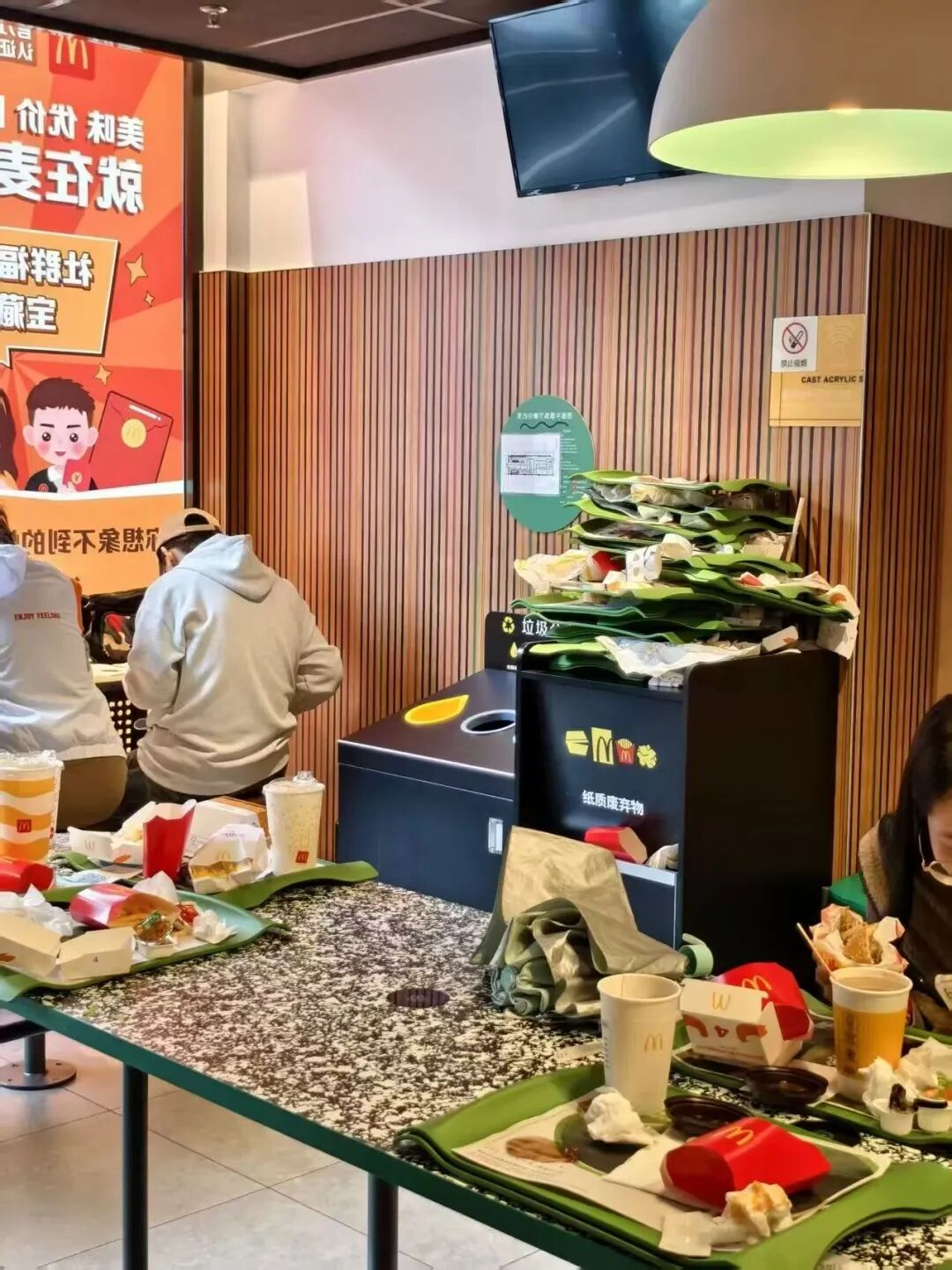
◉ Today, trays pile up more easily in McDonald’s waste bins than they used to. Photo source: Jiang Ke
Yuyang: So it really is a cost-cutting and efficiency improvement strategy – the roles being reduced are the mid-to-senior-level ones. Store Managers earn considerably more, so cutting their numbers and pushing the work down onto Shift Managers on lower pay brings overall costs down.
Jiang Ke: Exactly. Hiring a brand-new Store Manager for a new outlet might cost 10,000 yuan in salary, but if an existing Store Manager simply takes on the extra role, you only need to pay them an additional 1,000 to 2,000 – the store still runs perfectly, and you save on staffing costs. Then there’s the scheduling work itself. In the past, each restaurant handled its own scheduling, but later they felt that having a dedicated scheduling role at every single store was too costly in terms of headcount. Now, say you group 20 stores in one area, you assign a single Scheduling Specialist to cover them all – it sounds like it saves staff. But in practice, this specialist can’t schedule around individual staff strengths and weaknesses; they can only work from the information in the system, so the rosters they produce rarely match the real operational needs of each restaurant.
Yuyang: It feels as though McDonald’s is following an operations research approach, trying to maximise efficiency and profit through macro-level resource allocation. But in the actual working day, once the Scheduling Specialist has finished their roster, don’t you then have to fine-tune it again in your own store – which may even take more time overall?
Jiang Ke: From a scientific standpoint, having a Scheduling Specialist is probably the better approach. But in practice, the specialist can only build the roster based on what the system has flagged for each employee. The system records which courses an employee has completed in McDonald’s internal training platform – pouring drinks, frying fries, wrapping burgers, for example – and that is treated as proof they have acquired those skills. So the Scheduling Specialist can assign them to those stations.
McDonald’s expects new employees to get through the basics of four or five stations in around ten days. In reality, that’s simply not achievable in ten days, especially for part-time workers. Employees are required to complete the theoretical material on paper, and they tick “Completed” in the system, but in truth they may not have actually mastered those skills at all. That creates an information gap – and the Scheduling Specialist has no way of knowing it exists, so they can only schedule based on what the system shows, assuming that a completion mark equals competence. So you get extreme situations where a shift is scheduled and not a single person on it knows how to wrap a burger.
So each restaurant’s so-called management team has to allocate extra time and energy to adjust what the Scheduling Specialists should have been doing in the first place. But no labour hours have been allocated to managers on the system for this – they can only carve out time from their own workload to get these extra tasks done. And this work comes with no additional pay; the budget for it has already been set aside separately to cover the specialist’s salary, having been deducted from the restaurant’s labour costs.
Yuyang: You mentioned earlier that a lot of metrics affect bonuses. Are there corresponding KPI requirements – for instance, does turnover have to hit a certain threshold before you qualify for a bonus?
Jiang Ke: Yes. Bonuses are simply a management tool, because there’s nothing else left to manage you with. So the bonus depends on things like: has the restaurant met its turnover target? There’s also the complaint rate across the entire restaurant, the product waste rate – all of these fall within the bonus evaluation criteria. It’s a very detailed scorecard.
Yuyang: So for you, controlling waste at the store is crucial. How does waste typically occur?
Jiang Ke: If a store strictly follows the Golden Quality Standard, it will discard a great deal – fries, meat, and so on. Anything that falls outside the Golden Quality window must be thrown away. In practice, if you relax the standard, waste comes down a bit. For example, if fries have been sitting for half an hour after frying and are completely inedible, that gets logged as waste. Meat patties that have been sitting too long after grilling also get discarded. Each restaurant may enforce things slightly differently, but in principle everything should be discarded and recorded in the system – how many beef patties were lost, roughly how many portions of fries, and so on.
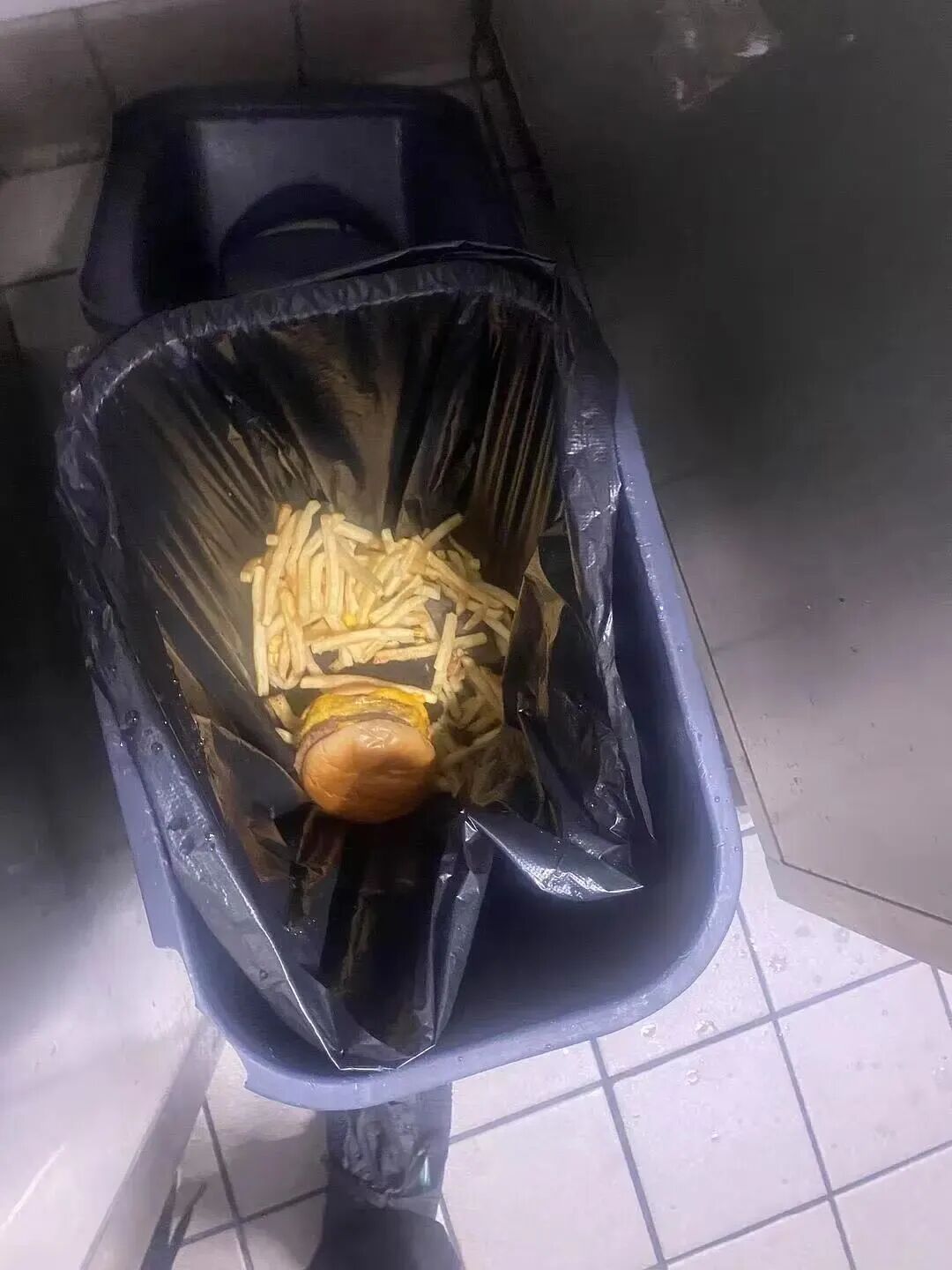
◉ Fries and burgers discarded in the bin. Photo source: Qingtai Yinwu
Li Ye: Can this be called food waste? Is a lot of food wasted this way?
Jiang Ke: In practice, the amount of food wasted each day is not all that much by the restaurant’s standards. It’s usually measured in semi-finished products – not how many burgers are discarded, but how many meat patties. If the meat is well managed, it might only be a dozen or so patties. Fries will be a bit more, but that’s still because we don’t strictly follow the Golden Quality Standard. If we did, the volume of discard would be enormous.
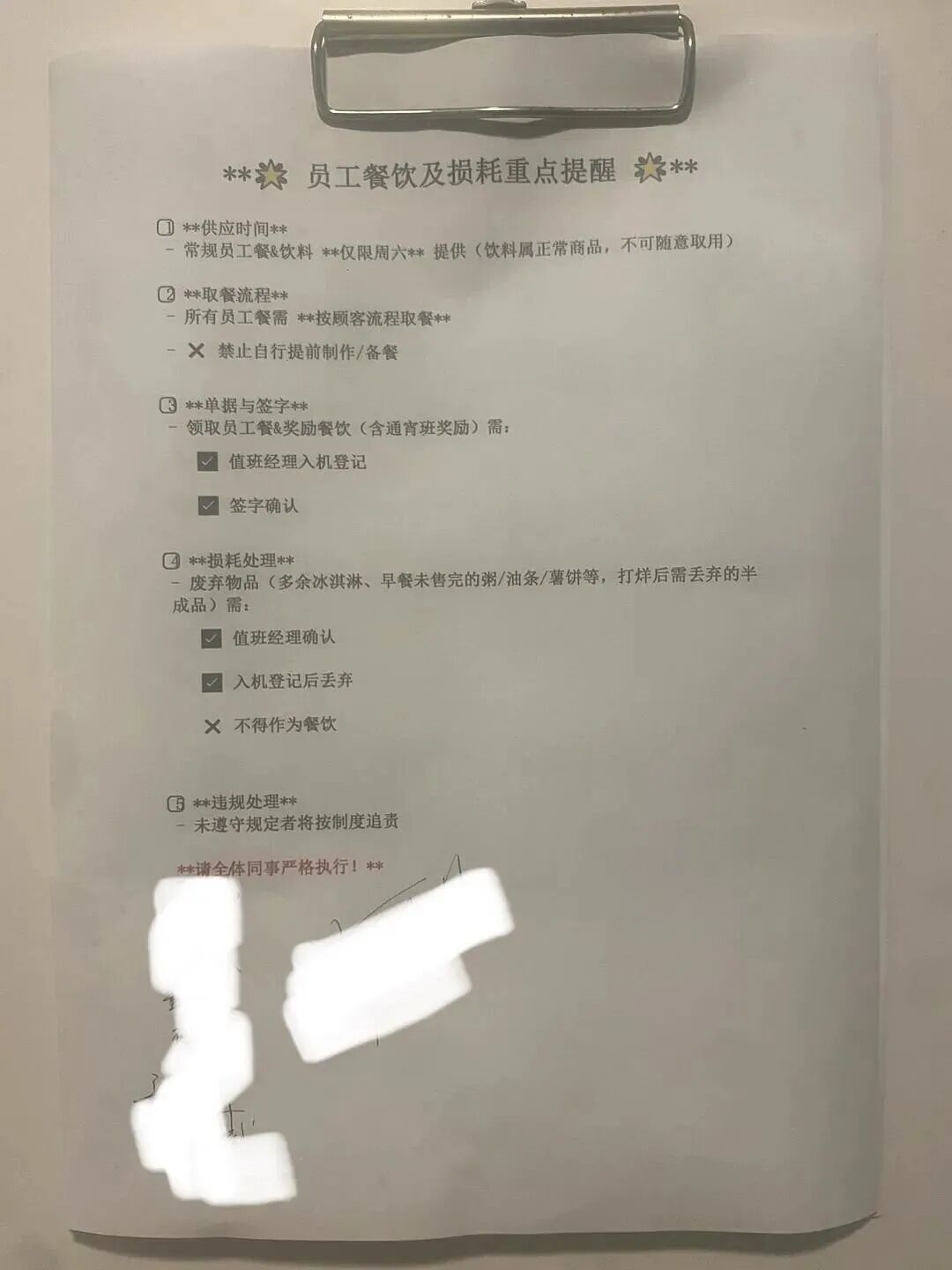
◉ The store has strict rules on staff meals and leftover food handling. Photo source: Qingtai Yinwu
Yuyang: I noticed that McDonald’s once ran a soft advert about McMcAgronomy, inviting farmers to come and talk about how they grow their produce, telling you how McDonald’s brings fresh food from field to table behind the supply chain. But in reality, the raw ingredients a store receives are all semi-finished products – “fresh” means something entirely different from what a traditional restaurant would call fresh.
Jiang Ke: Exactly – all the vegetables are pre-cut and vacuum-sealed before delivery. And no matter how healthily they advertise the produce was grown, when you look at the ingredient list, it’s always a very, very long string of additives used to maintain the texture. No matter how much they boast about how fresh their raw materials are or how premium their potatoes are, there are a great many food additives in the fries.
Li Ye: So promoting the ingredients as healthy and fresh is a bit of a bait-and-switch. How can something loaded with this many food additives – these ultra-processed foods – possibly be healthy? The way it’s made simply isn’t healthy to begin with.

◉ An advertisement for the Regenerative Agriculture Programme on a McDonald’s tray.
Yuyang: But I find this rather contradictory. On one hand, we resist ready meals, which shows we want to eat fresh food. On the other, we can accept ultra-processed food like McDonald’s. We hold two conflicting views on what food should be.
Jiang Ke: I suppose it comes down to a trade-off between flavour and convenience. If you cook every day, that takes a lot of time. But at McDonald’s, you can get your food in 90 seconds – that’s remarkably convenient. Maybe that’s one of the really nice things modernisation has brought us.
Are McDonald’s Smart Systems Really Smart?
Jiang Ke: Speaking of modernisation, McDonald’s has lots of smart systems, but in actual operation I’d say they’re only marginally useful at best. There’s a data-driven forecasting system called the Smart Production System, and every store is equipped with one. It generates a forecast every 15 minutes – estimating the turnover and the items customers are likely to order in the next 15 minutes – so staff can prepare food in advance. For example, if the system predicts someone will order a Spicy Chicken Burger in the next 15 minutes, then my stock should already have a patty for one ready. But we know all these information systems lag behind reality, and they forecast on the assumption of more staff than you actually have. The system might think the store has five people on shift and simulate accordingly, but in reality there might only be two, and meeting the forecast becomes very difficult.
So it sounds like this system must cost a fortune, but to my knowledge, not a single store actually uses it. Everyone works from experience. Staff will ask the manager how many chicken patties to fry, and the manager will do a rough calculation – three should do – without ever looking at the system.
Besides the Smart Production System and the scheduling system, McDonald’s has ordering systems and many others. Building all these standardised systems essentially lowers the bar for people – the idea is to cut down the human workload. But in practice, first, the systems aren’t that easy to use; second, the forecasts aren’t that accurate; and third, the standards aren’t enforced that strictly. If there were a dedicated person supervising whether staff actually follow the Smart Production System’s protocols, with a rigorous oversight structure, people would probably make more use of them.
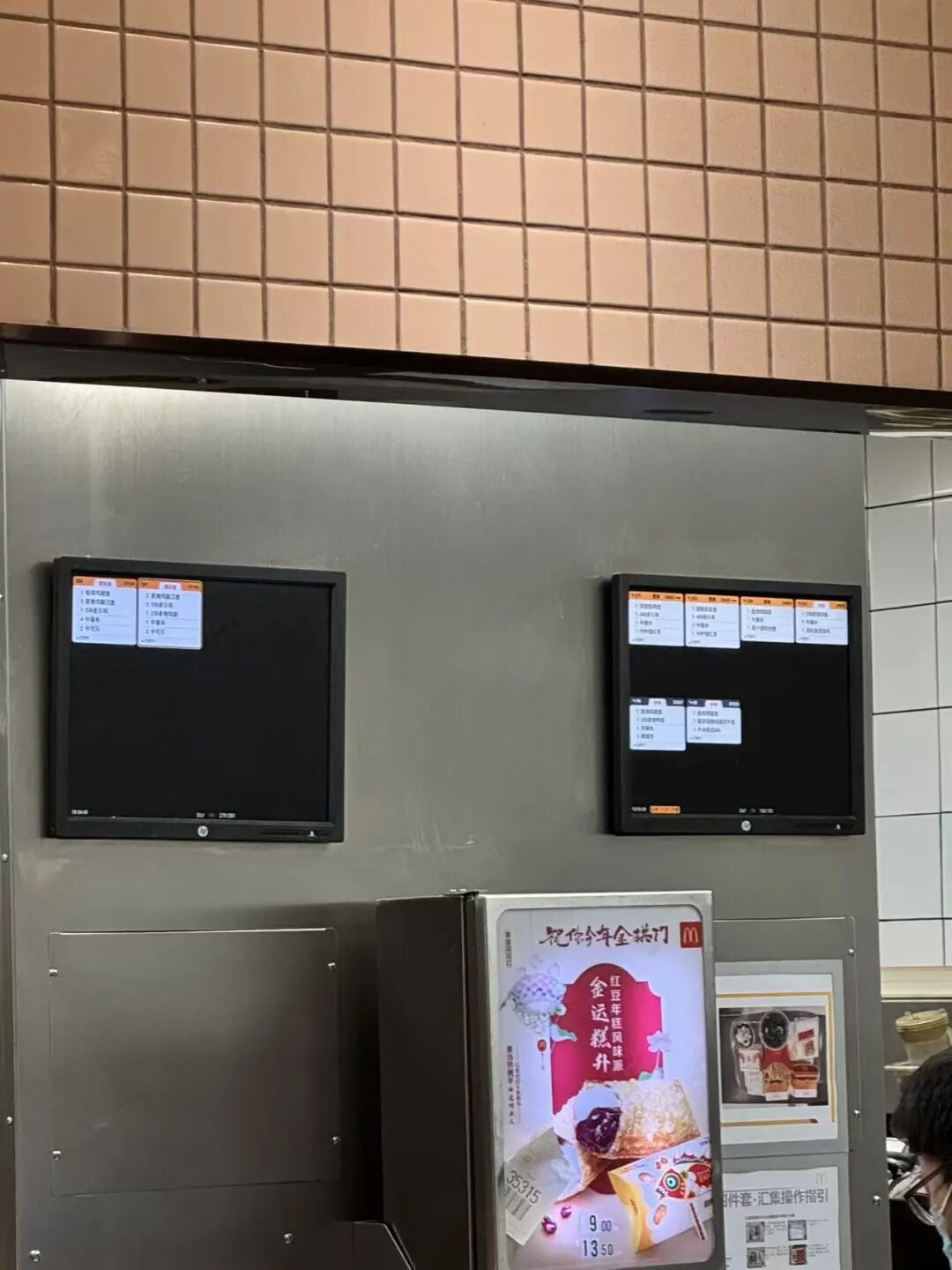
◉ The two panels McDonald’s staff need to monitor: McDelivery on the left, dine-in and takeaway on the right.
Li Ye: This system seems to slot each person into their own niche. The manager has to learn the Smart Production System and oversee how each of their employees produces. And whoever’s on the fries station has to fry to the Golden Quality Standard, so that accountability is clear and management is easier. But in reality, people are the biggest variable.
Jiang Ke: Yes. The whole point of designing the system is to remove dependency on people, to eliminate as much of that non-standardised variability as possible. But in reality, every manager has their own standard. Some managers feel that fries that have been sitting too long shouldn’t be sold; others think they still look fine and sell them to avoid waste. So it really comes down to the person. In practice, cost pressures and human factors make it very hard to enforce the system fully.
Li Ye: It feels a bit like turning people into an extension of the system, or the system’s flesh – but so far, it seems very hard for people to actually merge with it.
Jiang Ke: Yes. But it does still serve a purpose sometimes – the ordering system, for instance, is easier to forecast and works better than the others. Think of your AI: to meet demands that align with real-world standards, it needs enormous amounts of training data and constant computation, and the cost is very high. You can’t just build a good system and keep using it forever – you need to keep updating and refining the algorithms to forecast the future more accurately. I actually think McDonald’s may have noticed that people aren’t really using it, so their investment isn’t that high either, but the digitalisation process itself has been ongoing all along.
Yuyang: McDonald’s actually started its digitalisation quite early. I read a book once that said McDonald’s began investing in this kind of digitised production line back in the 1950s, developing alongside computer technology.
Jiang Ke: Right, McDonald’s management really is remarkably advanced. It might not be that useful yet, but you have to acknowledge what sets it apart from other food service businesses – how genuinely committed it is to using systems for control. Take the ordering system: if you can order the right quantities, the restaurant runs smoothly. So it’s certainly more efficient than relying purely on people – it just hasn’t become as efficient as they imagined.
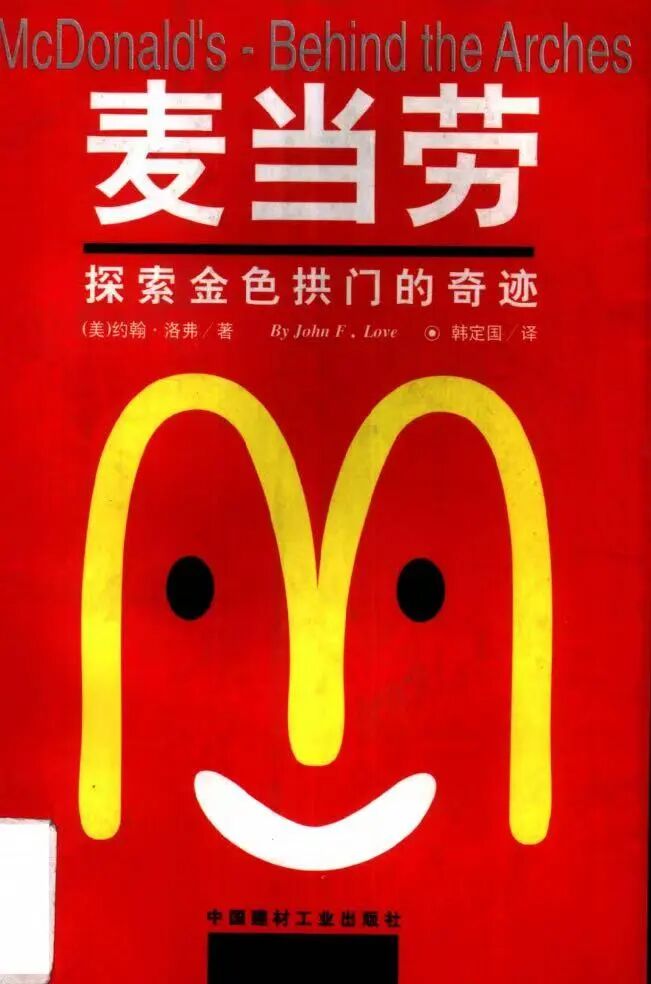
◉ McDonald’s: Behind the Arches chronicles how McDonald’s was born amid the mobility-driven modernisation of the United States, and its journey from a single drive-in restaurant into a global fast-food empire.
McD’s, Living in Memories
Yuyang: If we were talking back in the 90s or 2000s, I would have said McDonald’s was a truly wonderful place. When I was little, I’d tug at my grandma’s sleeve and beg her to take me there. There used to be those indoor play areas as well – basically a place where you could park your kid for a while. I even had classmates who held their birthday parties at McDonald’s. But now when I walk into one, I feel a certain heaviness. Sometimes the reason I pop into a McDonald’s to sort out a meal is really that my life is being squeezed – I just don’t have time to cook for myself.
And I feel that so many things are bound up with one another. When I go to McDonald’s as a customer and I feel my time being squeezed, that demand for quick service inevitably transmits itself to the workers, who naturally find themselves in a very fast-paced, high-intensity working environment.
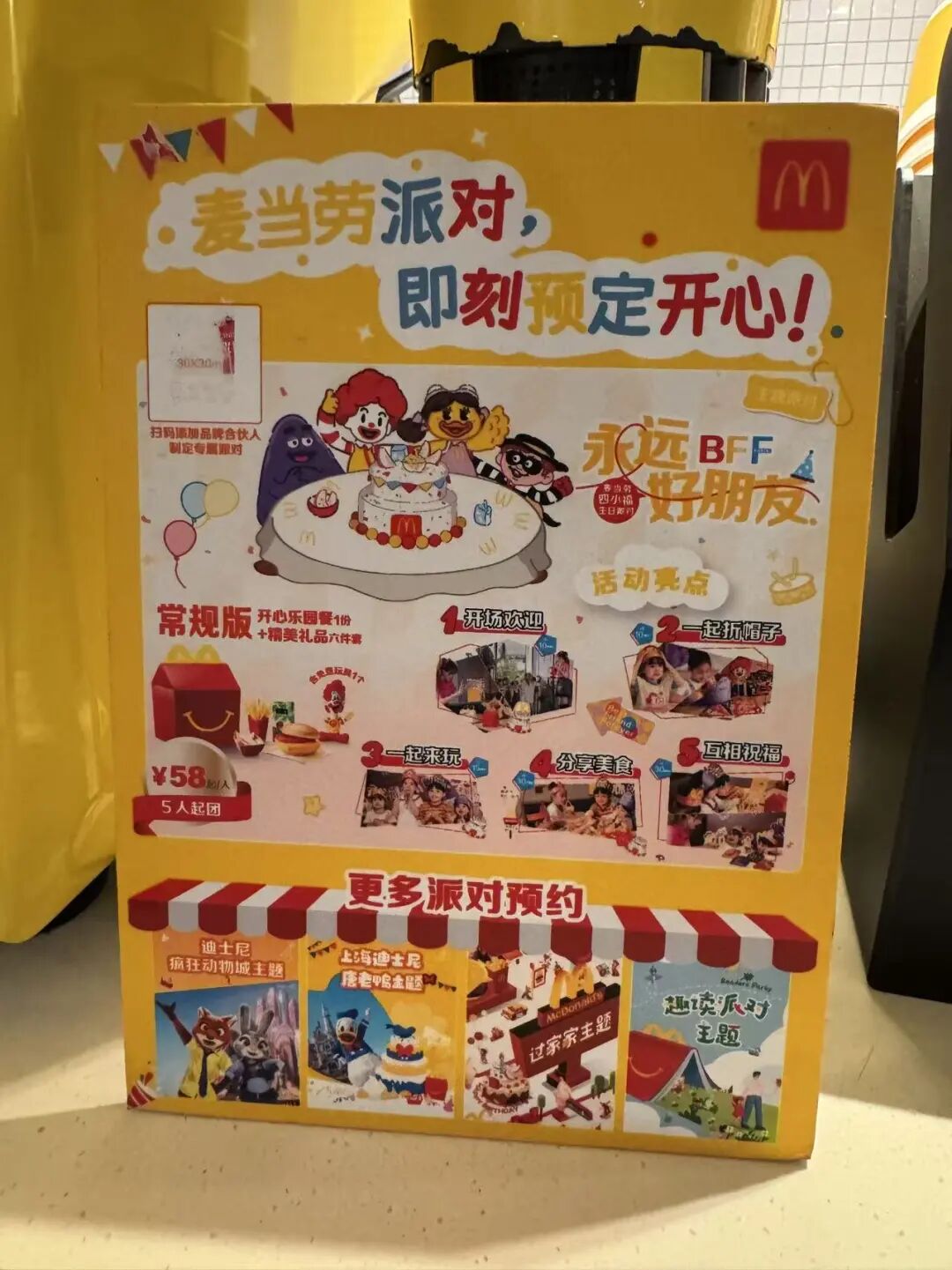
◉ McDonald’s still hosts birthday parties and similar events nowadays, though staff say nobody books them anymore.
Jiang Ke: I feel it’s a transformation at McDonald’s – it has become more fast-food than ever. That sense of companionship and togetherness has migrated from the physical outlets to the internet. Online, there’s endless discussion about McDonald’s fandom, and every time a new product drops loads of people rush to try it, then post a review, then interact with fellow fans – it’s become a kind of shared memory.
Li Ye: When I was a kid, you’d see people doing homework at McDonald’s all the time. Now everyone’s either got a laptop out or is glued to their phone – in a meeting, doing sales, hawking insurance – it’s all just people working inside McDonald’s. And you can often see a delivery rider slumped over a table, exhausted, waiting to pick up the next order. Add in the dim yellow lighting inside and the whole place feels lifeless. You just want to grab your food and leave.
Yuyang: When McDonald’s first entered Hong Kong or Beijing, it was really a symbol – a symbol of family togetherness. Then in the last couple of years, with Dreamcore trending, McDonald’s has become one of the recurring nostalgia images for people born in the 90s, longing for their childhood. Like the clown mascot that used to decorate the place, or those 9.9-yuan vouchers – everyone digs them out and turns them into little keepsakes of memory.
So why do people love McDonald’s? I think nostalgia accounts for a huge part of it. Even if, in years to come, plenty of burgers turn out to taste better, it’ll be very hard for anyone to take McDonald’s off its current perch in the market.
Li Ye: Yes, and one thing I remember is that chain fast-food restaurants like this operated on a completely different model from any other restaurant. You could see straight into the kitchen, and McDonald’s was an open space – you could watch the staff inside. When I was little, I genuinely thought they were robots. Everyone was just frying fries and wrapping burgers nonstop. I figured it must all be machines doing the work – otherwise, who would fry fries day after day like that?
Jiang Ke: Working inside, I feel like I’m a robot too – just one that has to handle far more complex tasks than a regular robot. Because the job demands the precision of a machine, yet also the flexibility and judgement of a human being.
– This is Foodthink’s 828th original article. –
Editor: Li Ye
Layout: Xiaoshu
Scan the code to tip in support of original Zhishi content
▼

▼
Click the image to read related articles

▼
Click a keyword to explore more article collections
Seeds | Agri-Tech | Policy | Fermentation | Nutrition | Fruit | Fisheries | Events | Recruitment | Takeaway | Markets | Animal Husbandry | Food Talk | Sharing Sessions | Book Clubs | Harvest Festivals | Smallholder Stories | Climate Change | Rural Development | Cooperative Economics | Urban Farmers | Food Safety | Digital Technology | Biodiversity | Pandemic & Food | False Solutions | Agroecology Internship Programme
Beijing | Hebei | Shanghai | Guangdong | Guangxi | Henan | Sichuan | Jiangxi | Xinjiang | Shaanxi | Hong Kong | Chongqing | Zhejiang | Jiangsu | Guizhou | Taiwan | Inner Mongolia | Philippines | Canada | Russia | Mexico | Italy | United States | United Kingdom | Germany | Netherlands | Thailand | Sweden | Japan