In Search of Musang King: Malaysia’s Flavour and Business

This summer, Malaysia is in the grip of a “durian tsunami” of oversupply. Bumper harvests across major durian-growing regions such as Johor, Penang and Perak, compounded by the concentrated release of capacity built up in previous seasons, have sent durian prices tumbling. A report in the Sin Chew Daily showed that in some parts of Malaysia, prices for lower-grade Musang King have plummeted to an all-time low of 9 ringgit per kilogram (RMB 14.96) — roughly one-tenth of the previous peak retail price.
And yet just two years ago, the story was almost the exact reverse.
Two years ago I was living in Thailand. One evening, my Thai landlord came across a video of a Chinese woman selecting produce at a durian factory, the cargo about to be shipped out to China. After watching it, she grumbled: “All the best durians get bought up by the Chinese.” What she meant by “best” was those durians that look well-shaped, large and plump.
It sparked my curiosity: was that really the case? Just how enormous is China’s appetite for durian? What do locals make of it all? And could the durians eaten in China genuinely be better than what is available in Thailand itself?
The durian originated in the rainforests of the Malay Peninsula and Borneo, and the English word “durian” derives from the Malay “duri”, meaning “thorn” — a nod to the sharp spikes on its rind. Malaysia is the fruit’s birthplace and is widely acknowledged as producing the highest quality. The country has more than two hundred officially registered durian varieties, its planted area has expanded beyond 90,000 hectares, and output has been climbing steadily.
The celebrated Musang King durian hails from Malaysia, where its distinctive interplay of bitter and sweet flavours has made it the star among durian varieties. Malaysian authorities even introduced a dedicated certification label to distinguish genuine, China Customs–approved Musang King from impostors. Yet for most Chinese consumers, the name had long existed only in durian-flavoured desserts made with fruit jam. It was not until August 2024 that fresh, ready-to-eat Musang King first entered the Chinese market. In 2024, Malaysian durian accounted for less than 1% of China’s durian imports, while Thailand and Vietnam held shares of 57% and 42% respectively.
And so, in August 2024, we set off south from Beijing for the heart of Musang King country — the Malaysian states of Johor and Pahang — at the very moment the first batch of fresh Malaysian durian was on the verge of being cleared for import into China. We wanted to see for ourselves what the orchards there truly look like.
Large-Scale Durian Orchards
The flight from Beijing to Kuala Lumpur takes just over six hours. The cheap red-eye left our whole bodies aching, but we could barely contain our little surge of excitement — that very afternoon, we would be eating fresh Malaysian durian.
Before August 2024, there was no way to get fresh Malaysian durian in China. The only form available was frozen imported Musang King and Black Thorn, each fruit retailing at 300–400 yuan or even more — three to four times the price of Thai durian.
Yet preliminary research done before the trip showed that durian locally was far cheaper than back home. Misshapen fruits or small ones could be snapped up for just forty or fifty yuan!
Moreover, frozen durian was said to be no match for fresh in terms of flavour, the latter boasting a far more intense aroma. Although August marked the tail-end of the season, we heard that we would still get to try at least five or six varieties: aside from the famous Musang King and Black Thorn, there would also be Tekka, Red Prawn, Super XO, Sultan, and more. Photos posted online by social media users opened our eyes — some had orange-red flesh with a looser, almost runny texture, while others were pale yellow with a soft, glutinous bite. Durian is a tropical fruit, and such a rich range of flavours and textures felt wonderfully fresh to people who have spent their lives in northern China.
Public transport around Kuala Lumpur is hardly convenient, so upon landing we splashed out a small fortune — 800 yuan — to hire a private car. After roughly two hours on the road, we arrived at the gate of a large local durian orchard: LKE.
LKE Group is one of Malaysia’s major agricultural developers. By the time we reached the park’s entrance, quite a few local families with children in tow had already turned up to try their hand at picking, treating the place as something of a tourist attraction.
Brian, a Malaysian alumnus of mine, was there to host us. He had studied agriculture overseas and, on returning home, joined LKE. The orchard spans roughly 200 mu (about 13 hectares) — just the main groves took an age to walk through. It was also remarkably modern: an automated sprinkler system, insect-repellent installations, and all the trimmings. After seeing the principal durian trees, we climbed to the top of the park’s tallest building to take in the canopy below. Brian pointed to groves in the distance: some newly planted, others already towering tall. August is the monsoon season, and even up high the heat was stifling, our backs soaked with sweat.
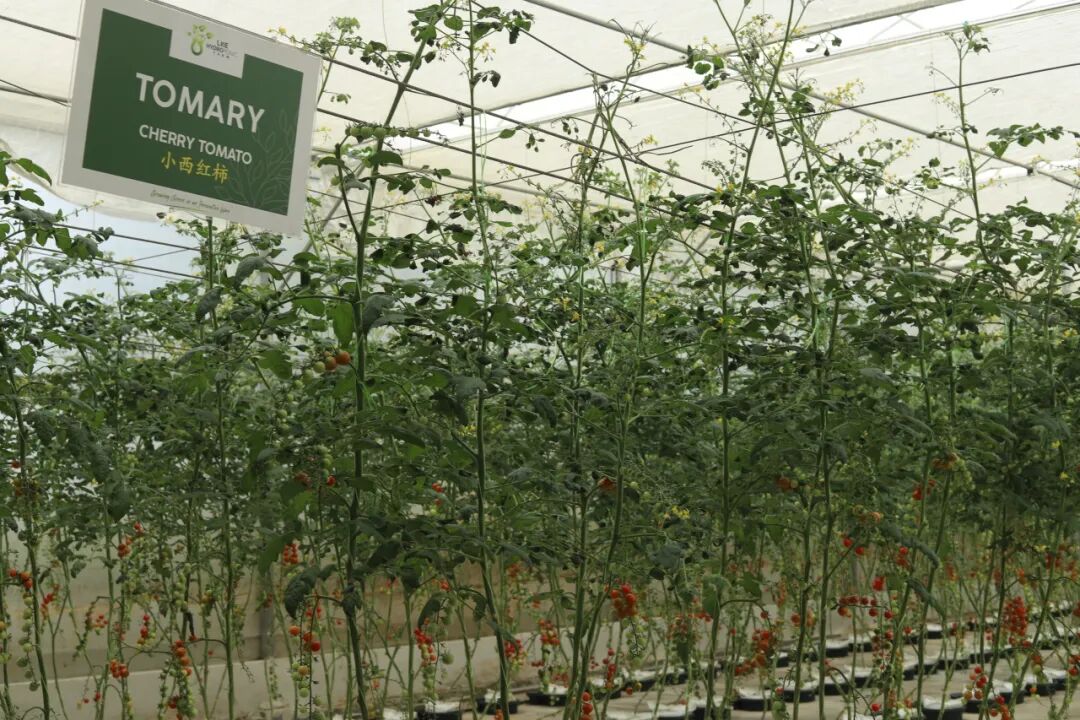
◉ LKE also has some greenhouses for growing vegetables.
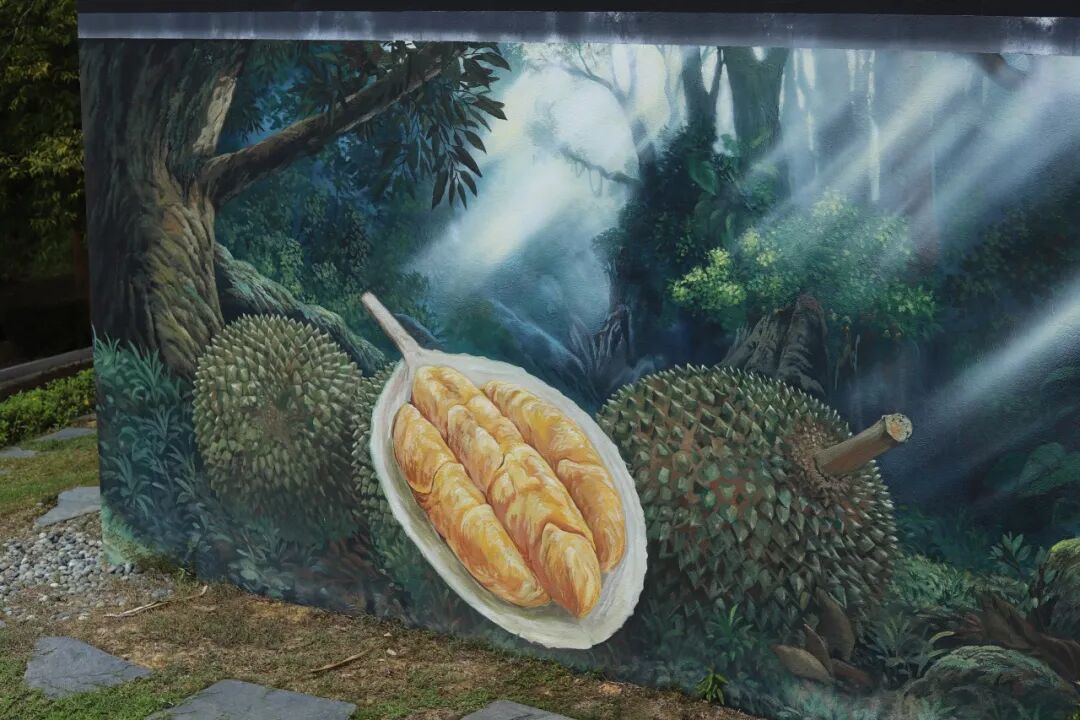
◉ A durian mural at the LKE park.
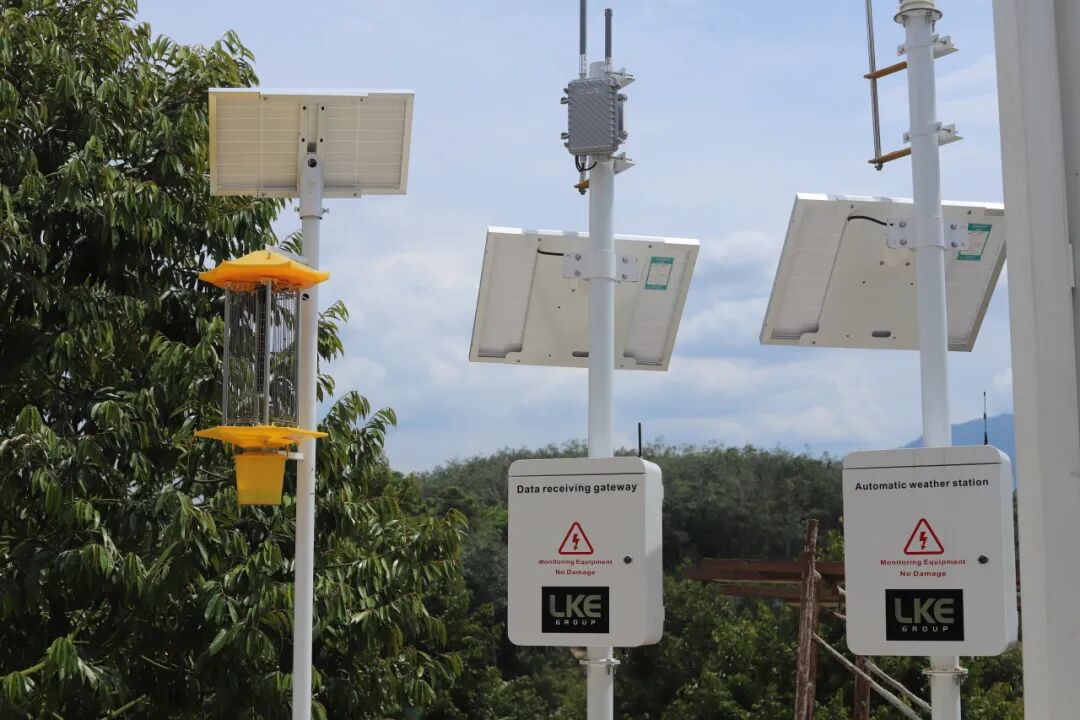
◉ LKE’s smart-farming system: insect light traps for pest collection, field data sensors, and compact weather stations that gather local meteorological information — all powered by on-site solar panels.
Durian trees are true indigenous species of the Malay Peninsula. Ancient specimens can grow so wide that two or three people would need to join arms to encircle them, and they can tower close to 100 metres. Commercial orchard durian trees, however, typically stand just over 20 metres tall. From the day a sapling goes into the ground, it takes seven years before it bears fruit fit for sale. The tree thrives on both flat ground and gentle hillsides.
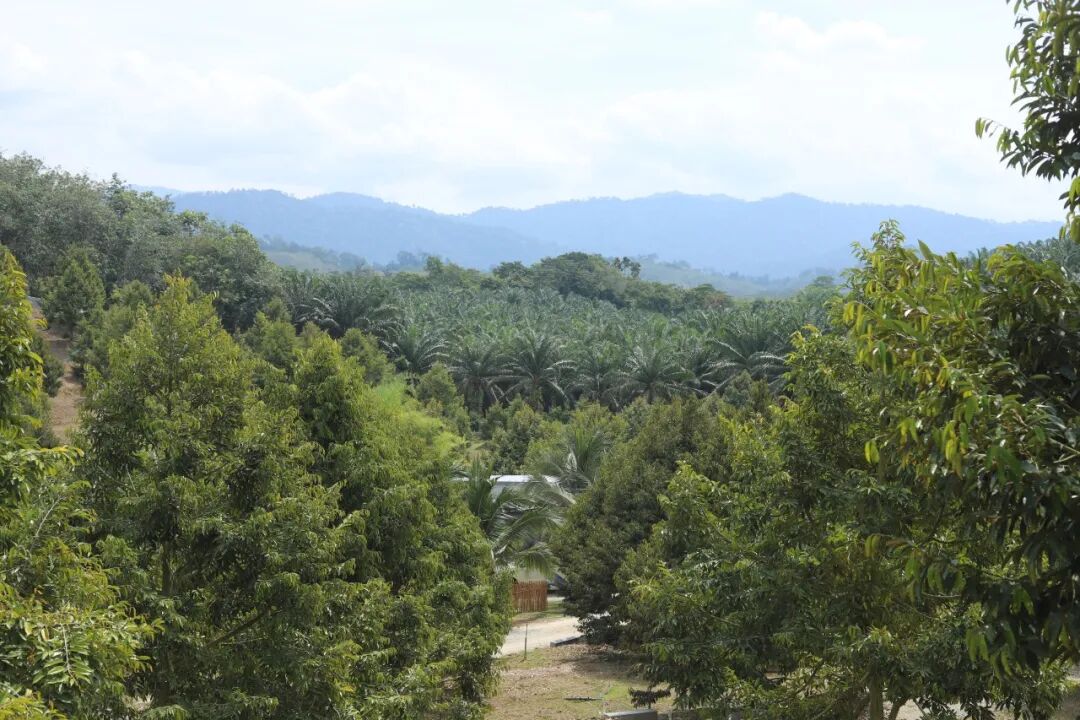
◉ The LKE park covers a vast area.
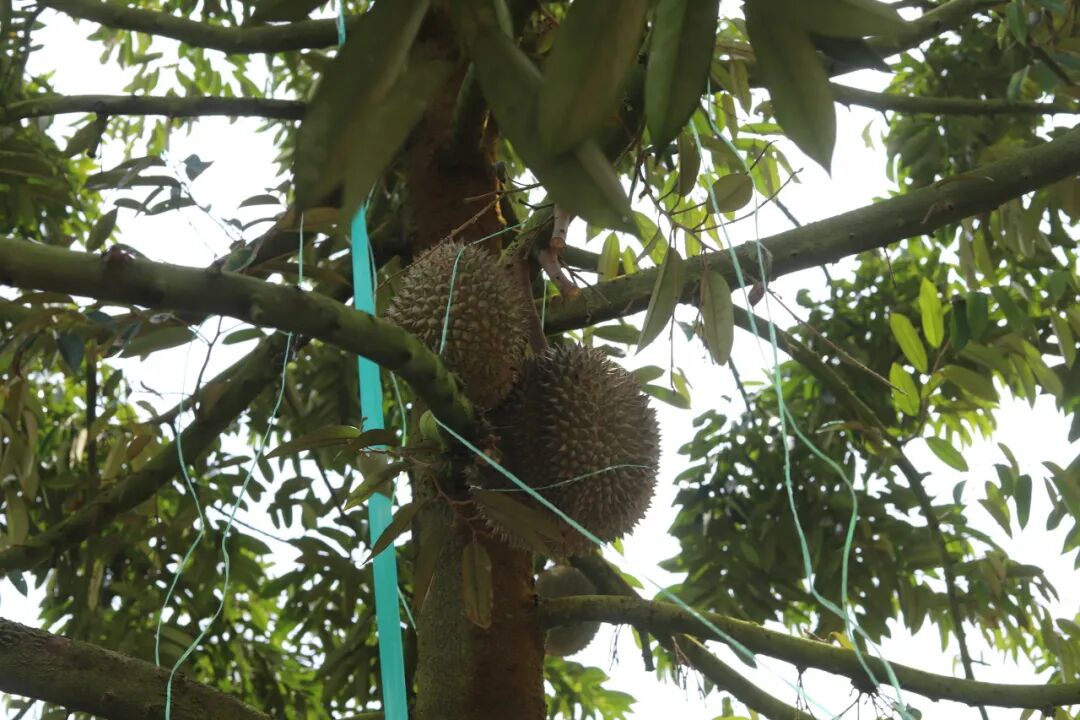
◉ Durians are tied with rope to the branches so that, once ripe, they do not plummet straight to the ground.
That day LKE was hosting a public event, with a talk on the company’s history and the ever-booming durian investment market. Judging by their appearance, the audience included Muslim women in hijabs as well as people of Chinese descent; the presentation was delivered in English, and everyone listened intently.
Next came the durian-tasting session. The investors who had attended the talk settled at small tables. The orchard sits well outside town, and many had driven there especially for the occasion. By the hygienic standards of a city dweller’s eye, this was hardly an ideal place to eat — flies buzzing about, no air conditioning, and the tables and chairs far from spotless. But the durian had just been plucked from the orchard, and that first-rate freshness had guests scrambling to help themselves.
Brian also bought four durians out of his own pocket to treat us to. For a northerner who can’t tell one crop from another and has a sluggish tongue, all I could sense while eating was the faintest difference in texture between varieties — something I simply could not put into words.
Before leaving Kuala Lumpur, we also visited SS2, the local consumer-facing durian market. The market is about a twenty-minute drive from the city centre and is quite unlike a Chinese wet market: it consists mostly of individual vendors’ stalls, each selling only durian in its various varieties. Fruits are weighed and opened on the spot — you can sit down and eat right there, or have them packed into clear plastic tubs to take home.
The cheapest durian cost no more than twenty or thirty yuan a fruit, the pricier ones one or two hundred. People of different ethnic backgrounds stood weighing fruits and paying. I thought to myself: durian truly transcends race and geography — wherever you go, there is someone who loves it.
A small durian means less flesh, ideal for a solo meal — a couple of pieces the size of an adult palm, enjoyed at their freshest. A large durian, by contrast, looks about the size of an adult’s head. We spent 90 ringgit (around 150 yuan) on a nicely proportioned Red Prawn; between the two of us girls, we finished it feeling just a little cloyed.
All in all, Musang King at source is not expensive. The retail price in China runs roughly ten times higher than at origin.
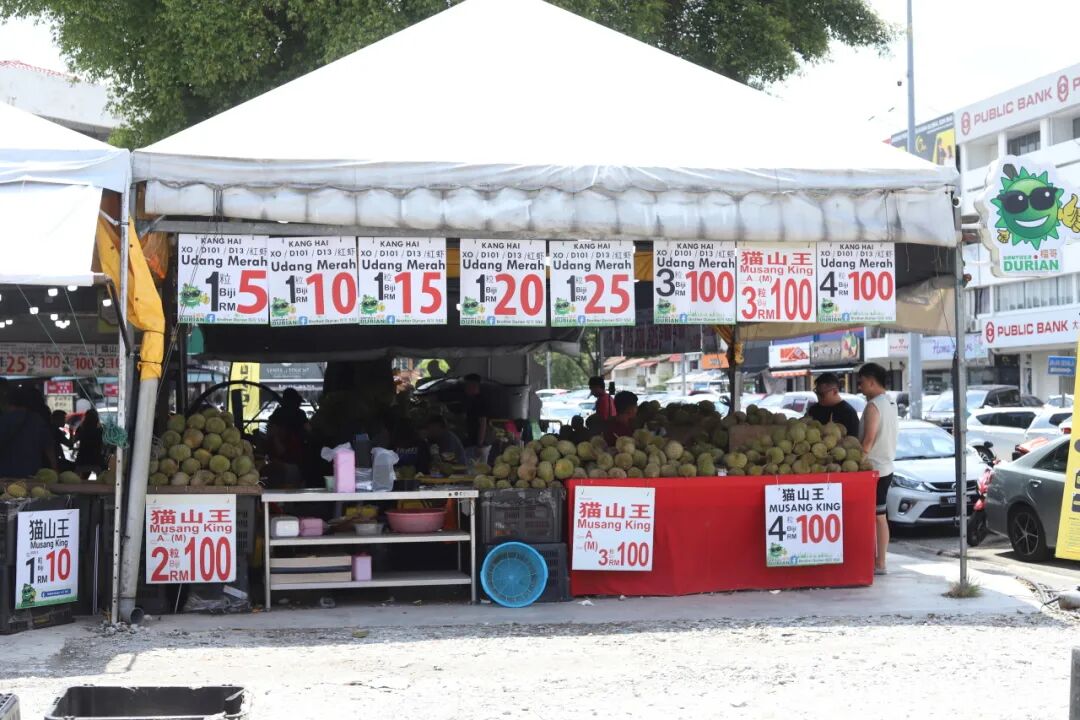
◉ SS2 market has numerous durian stalls. Prices shown are August 2024 rates; 100 ringgit = 165.76 yuan.
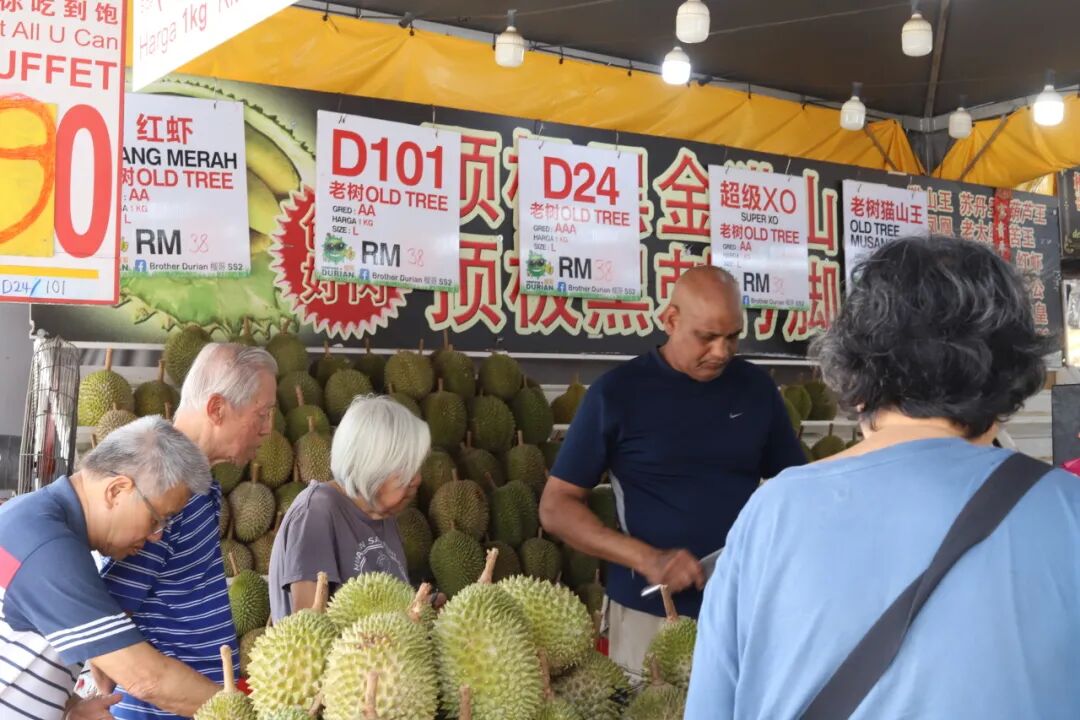
◉ Residents of the areas around Kuala Lumpur picking out durian at the SS2 market.
From Modern Estates to Local Orchards
Our second task was to head to Muar to find Lin, who was in the durian trade.
Muar is a small city in Malaysia’s Johor state, roughly two hours’ drive from Kuala Lumpur. We stayed in the centre, where just over ten yuan could buy a bowl of char siu wonton noodles or steamed noodle rolls. Malays, Chinese and Indians all lived in the city, and there were crucifix-topped churches, but no cinema — to find a sprawling shopping mall, you had to head north to Malacca. The Muar River cut through the town, making it a quiet, commercially undeveloped place. In the same Johor state, compared to the high-rise-studded Johor Bahru right on Singapore’s border, Muar felt like an old man in his twilight years.
Lin was thirty years old, a second-generation durian heir: his parents’ generation had made their first fortune in cross-border durian trade, and the business had eventually passed into his hands. His child had just turned one, and he couldn’t spare much time for childcare — making money in the fruit trade meant working night shifts, living on a different clock to his child.
Arranging our meeting with Lin turned out to be a saga of its own. He ran a fresh-durian wholesale export business. After we added each other on WeChat, he hardly ever replied to messages. I worried he might not be interested in our visit, but when we finally met, nothing could have been further from the truth. Lin kept an unusual schedule: up at three in the morning, working until ten, home for a sleep, then off again in the afternoon to supervise the frozen fruit purée workshop.
A little after five in the morning, before the sky had fully lightened, Lin sent a location pin. He was already at “the company”. We sprang out of bed at the guesthouse, hailed a ride, and raced towards the spot. After a little over ten minutes on the road, we stepped out onto quiet streets lined with two-storey houses. Dawn was barely breaking, and inside “the company”, durians were being loaded onto trucks.
There were five or six people on site, mostly Chinese. Lin didn’t usually get his hands dirty, but a Chinese man in his fifties had stripped off his shirt and was sorting, weighing, and loading. ‘This is Musang King, this is Red Prawn, D24, D101.’ One look and one weigh in the hand, and they knew exactly which variety it was. By then the season was already in its tail end, and the south offered few fruits; this batch had been harvested in Pahang and trucked to Johor, waiting to be exported to Singapore. The varieties included, alongside the best-known Musang King, Tekka, Red Prawn, and other varieties common in the area.
Durian freshness simply could not wait. Lin ran an export business: durians picked at the crack of dawn had to reach the tables of neighbours in Singapore by the same afternoon, by road, which meant another three or four hours on the journey. To fetch a good price, there was no choice but to weigh, sort, and load without a minute to spare.
This was also the hallmark of Malaysian fresh durian. Unlike Thailand, Malaysian durian was sold only after the fruit had ripened naturally and fallen from the tree, whereas Thai durian was typically picked at seventy or eighty per cent ripeness to facilitate transport and keep fresh for export.
Thai durian was cheaper, and better logistics had sharpened competition across Southeast Asia, yet Malaysians held firm to their own way. But that meant they had to speed up transport — a durian was best eaten within three days of dropping from the tree and would spoil and become inedible within a week. On the day we met, the three trucks of durian were worth around 100,000 ringgit (roughly 160,000 yuan). They would head south and, after three hours, arrive in Singapore to be distributed to stalls.
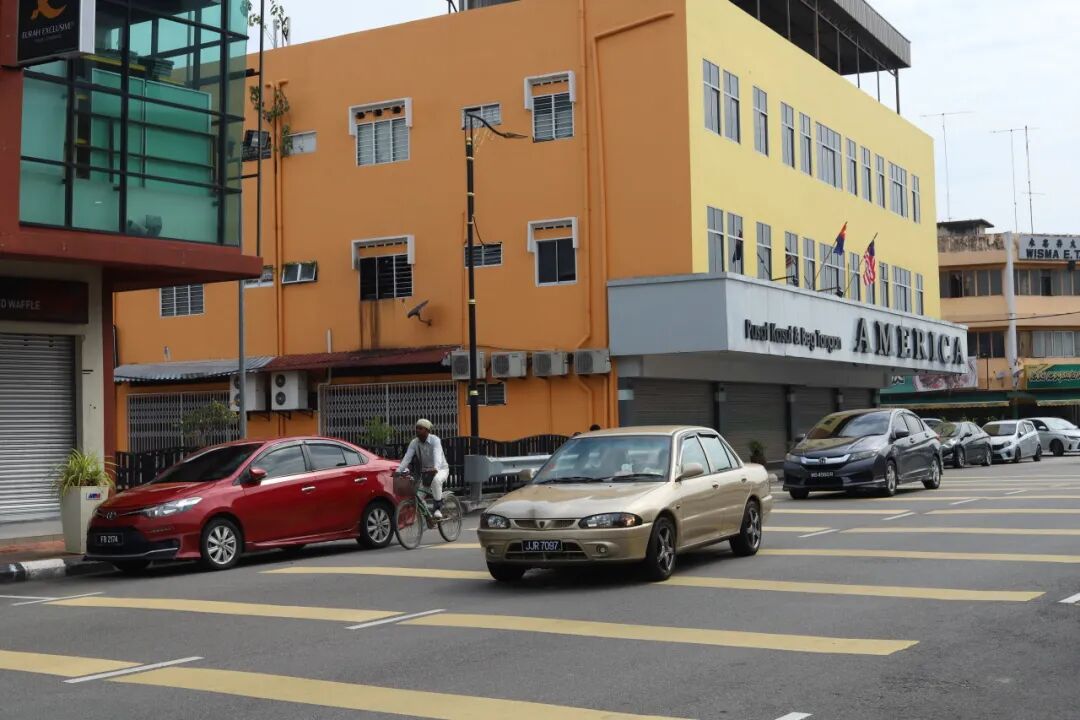
◉ Muar town centre.
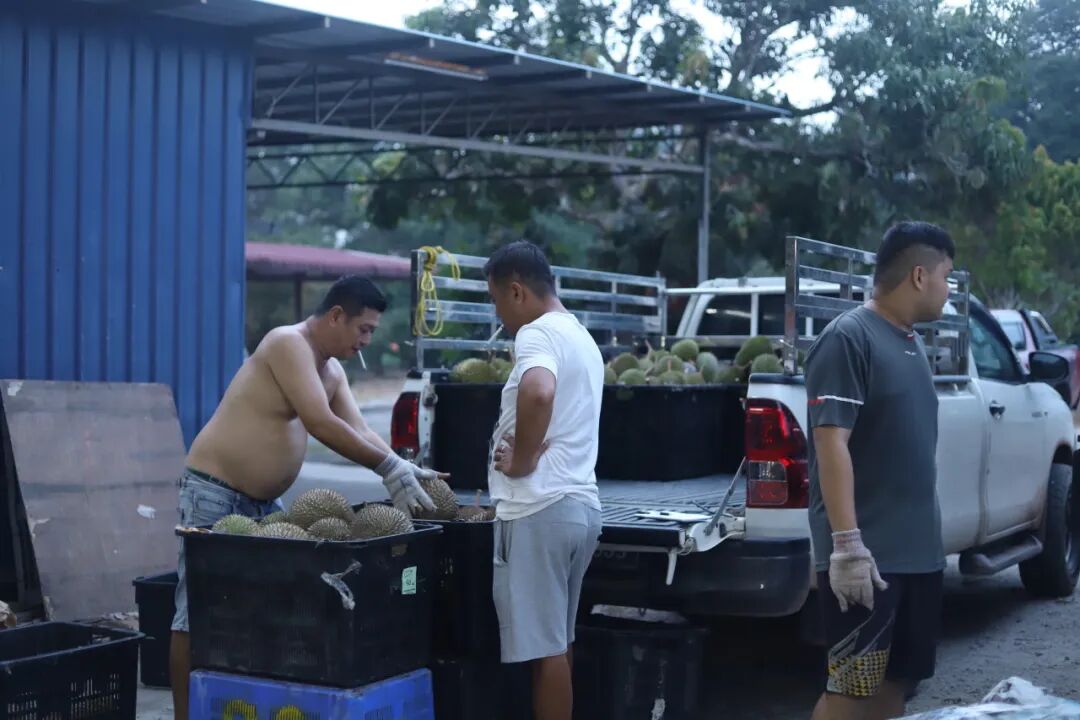
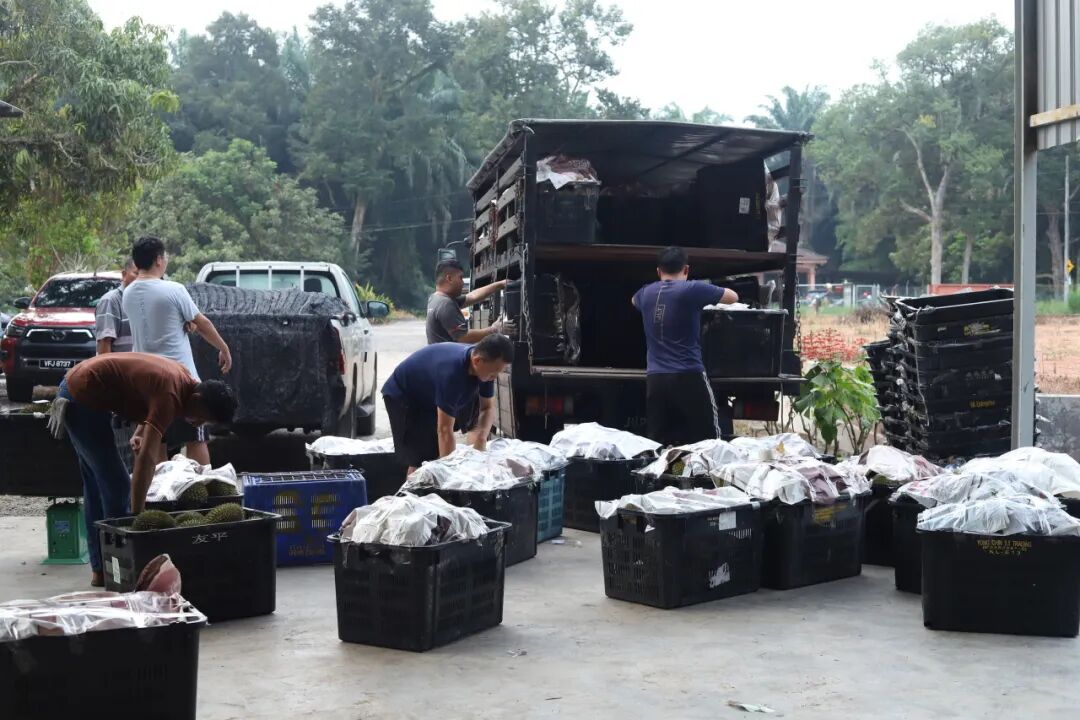
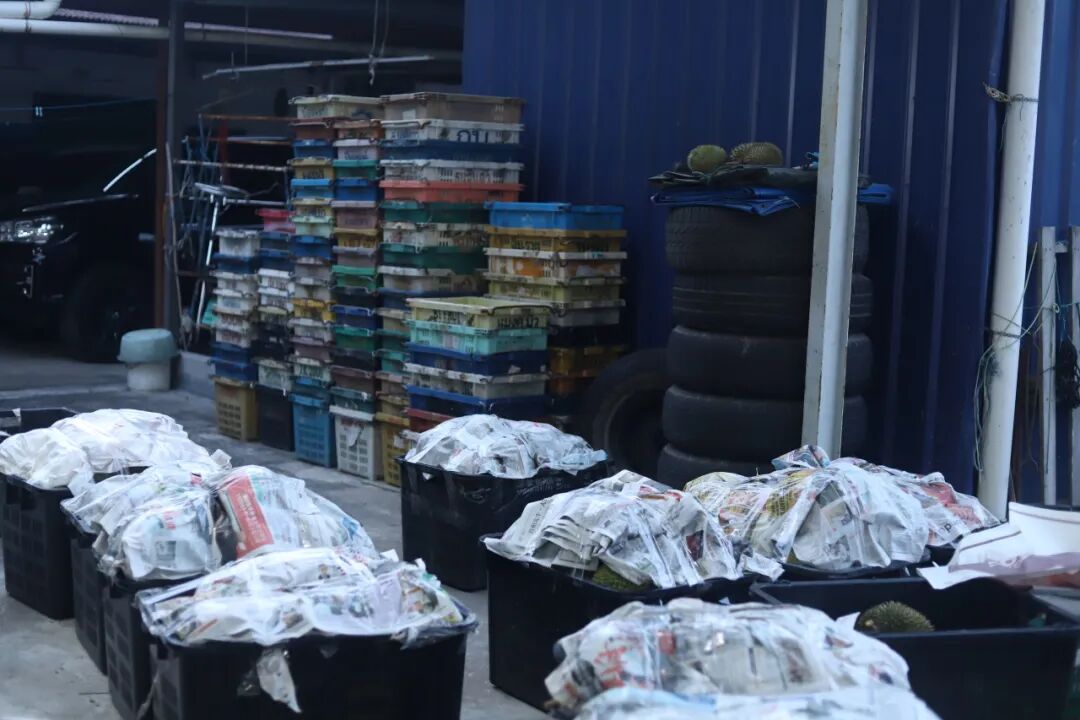
◉ Workers at Lin’s company sorting and loading durians.
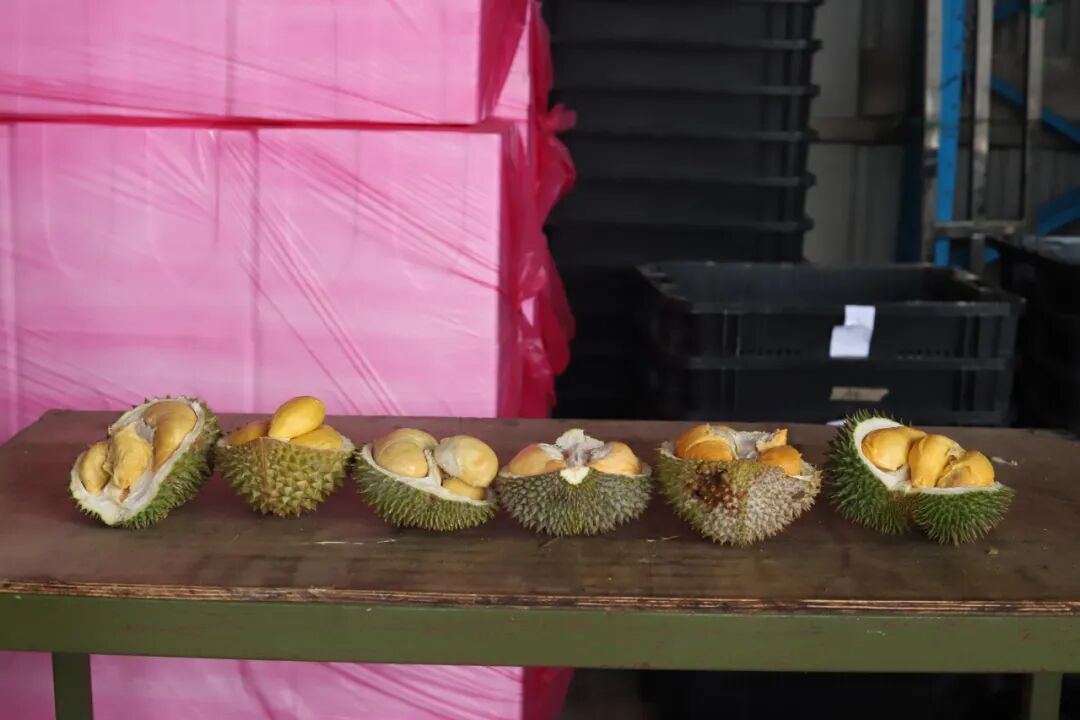
◉ This row of durians are all different varieties.
Lin invited us to eat durian on the spot. When I protested that it was too much trouble, they said that some fruits had scars on the skin, a misshapen form, or splits, which meant they couldn’t command a good price for export and had been tossed into the reject bins. I knew it was a kind way of putting it — in the local market, such durians still found buyers, just at a lower price.
Lin had taken over the business from his father, and his elder brother was a veteran hand too. He said that when he was a child, the family’s fields also had durian trees, but they almost never needed to spray pesticides or apply fertiliser. These days, the trees had to be sprayed and fed almost every single month. The changing way of farming showed us how much the modern appetite for good-looking, sweet fruit had reshaped the production side of the business.
The elder brothers worked efficiently, loading up the whole truck before daybreak. The off-grade fruit was handled separately and sent to be made into purée. The frozen purée factory stood directly across the road. It was called a processing plant, but the equipment was basic, and foreign workers lived in the very same building. When we arrived, they had just woken up, and the room was packed with sealed tubs of frozen durian purée.
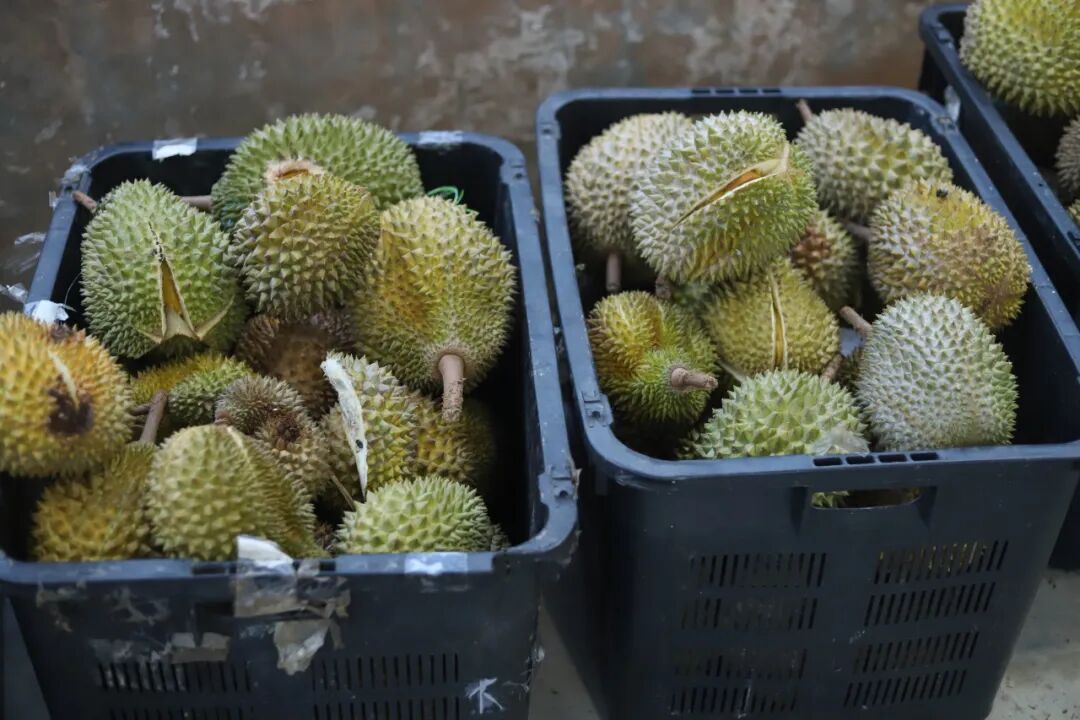
◉ Some split-open durians sorted out separately.
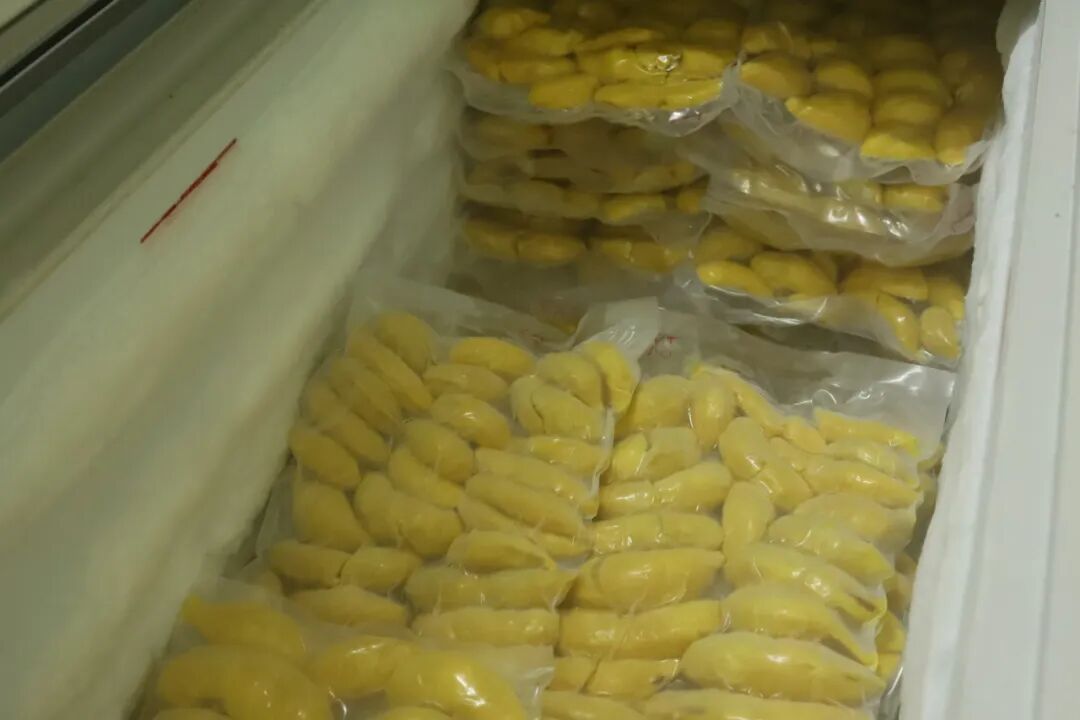
◉ Frozen blocks of durian flesh.
Business had been far from easy for Lin in recent years. Competition grew fiercer, with price wars and battles for territory. He had once set off on his own to Singapore, hitting markets, stalls, and pitches with ground-level promotion, hoping every vendor would carry durian sourced through his hands. On other occasions he had lost tens of thousands when itinerant market traders failed to settle the remaining balance on goods.
The company’s sales and revenue were out of step, and profits were dismal. After downstream customers paid a deposit, Lin shipped the goods and then collected the balance once the stock sold through. In time he found that small-scale buyers simply ran off too often, and the remaining payments never came back. Durian is a premium fruit among consumers, and the moment the economy slowed, wholesalers could feel the sales stagnation directly.
From 2019, Malaysia began exporting frozen durian to China, and more and more players rushed onto the local durian scene. Fierce competition squeezed the profit margins of small growers and small-scale traders. Across the whole of 2023, the company’s turnover was 30 million ringgit (around 49.66 million yuan), and after Lin paid his workers’ wages, there was barely any profit left.
The cut-throat competition and sluggish economy were pushing Lin to change the business model handed down from his father’s era. From 2024, he carved out a space of over a hundred square metres to process frozen durian. The move was mainly to cut waste. Only durians with a well-formed shape, no visible bruises or scars on the skin, and no cracks could be exported. The rejected fruits had their flesh extracted or were puréed and then frozen for storage — otherwise, fresh fruit would last barely a few days before rotting in hand.
Lin planned to invest 1 million ringgit (around 1.66 million yuan) to build a small frozen-durian processing plant. For now, though, he was still waiting on a protracted government approval, with the earliest possible commissioning next year. He said he couldn’t afford a large-scale processing plant: liquid nitrogen systems, freezing equipment, and the continuous power supply a cold-storage warehouse demanded would put the upfront investment at 10 million ringgit (16.55 million yuan).
After the tour, we chatted in the courtyard for a while. He warmly fetched us some mangosteen. It was only nine in the morning, but he was about to lead his workers off shift for breakfast.
From Palm to Durian
After a brief stay in Muar town, we prepared to head for Marcus’s orchard. It sat 44 kilometres from Muar’s town centre, roughly an hour’s drive away. We could not find a taxi, and pinning the location on the map was almost impossible. On Google Maps, the route ran along a rural road called Jalan Raya, flanked on either side by stretches of unlabelled grey.
Durian cultivation demanded a long-term commitment. In Malaysia, a durian tree needed at least six or seven years from planting to full bearing. A Musang King durian took around 120 days from blossom to ripeness, and the maturation cycle of Thai Monthong durian was similar.
The slow pace of growth had long kept the durian industry in a fairly stable, traditional state. Yet as China’s demand for durian surged, the cultivation methods and industrial ecology of Malaysia’s durian-growing regions were undergoing a dramatic shift. Marcus, who worked in agriculture in Muar, had experienced this transformation first-hand.
Marcus was past forty, a Malaysian Chinese whose ancestors had joined the Nanyang migration from Guangzhou. His family had been farming in Muar for generations. They had started out in the rubber trade, then gradually expanded into more popular and lucrative crops — oil palm and durian.
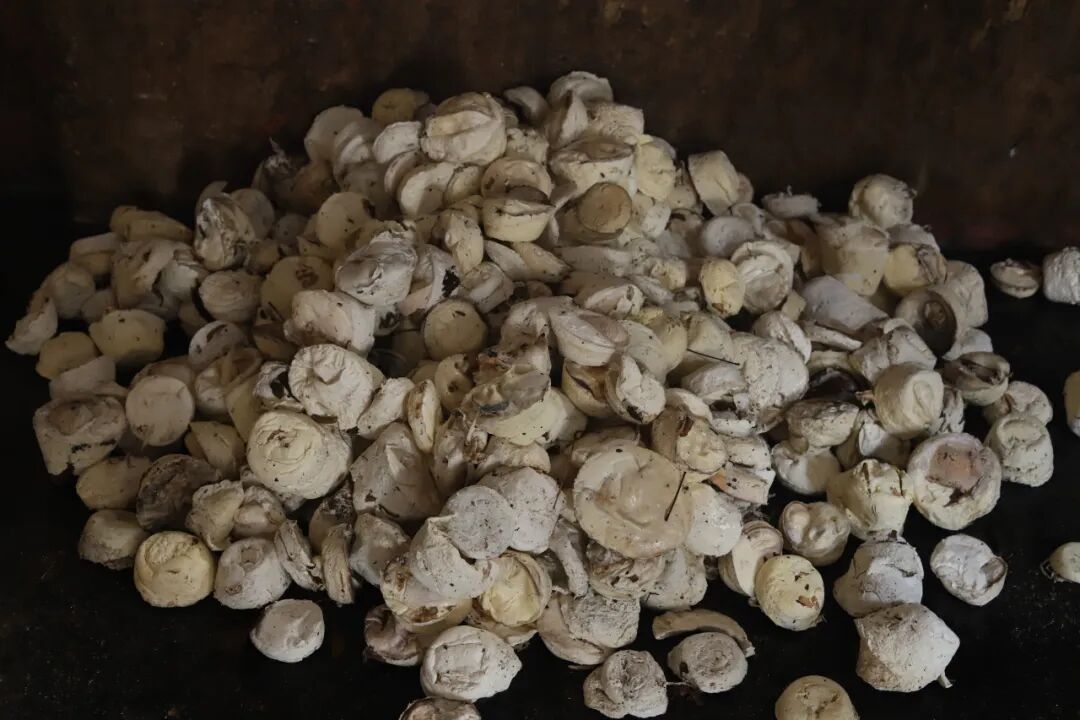
◉ Harvested rubber stored in the warehouse.
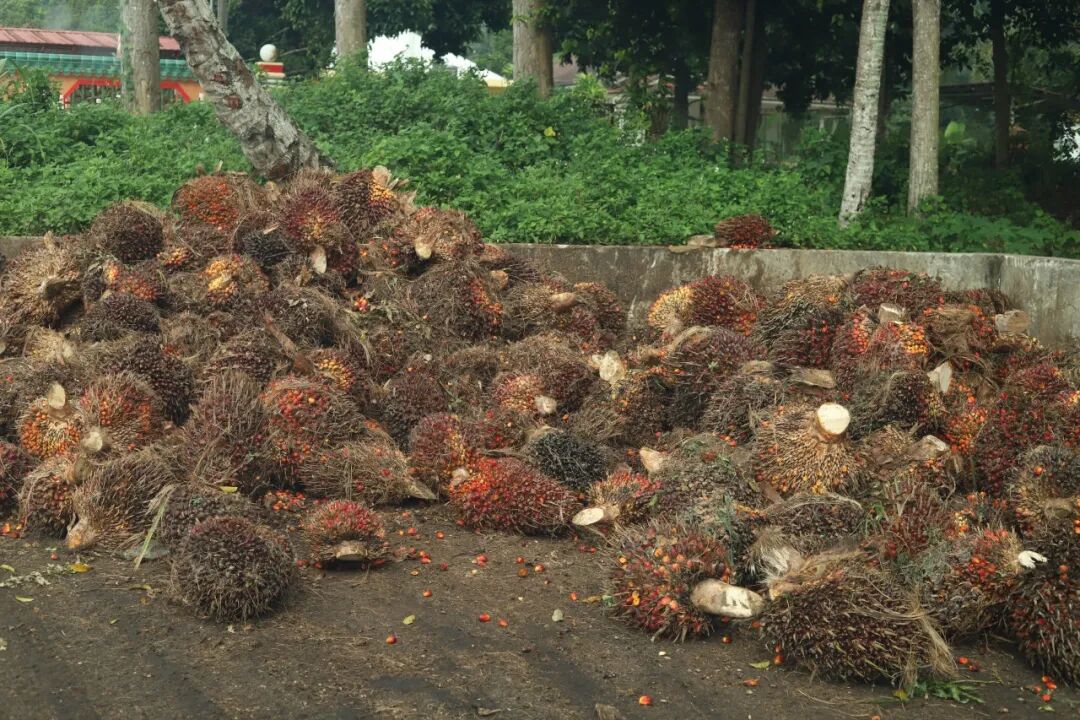
◉ Scattered oil palm fruit bunches.
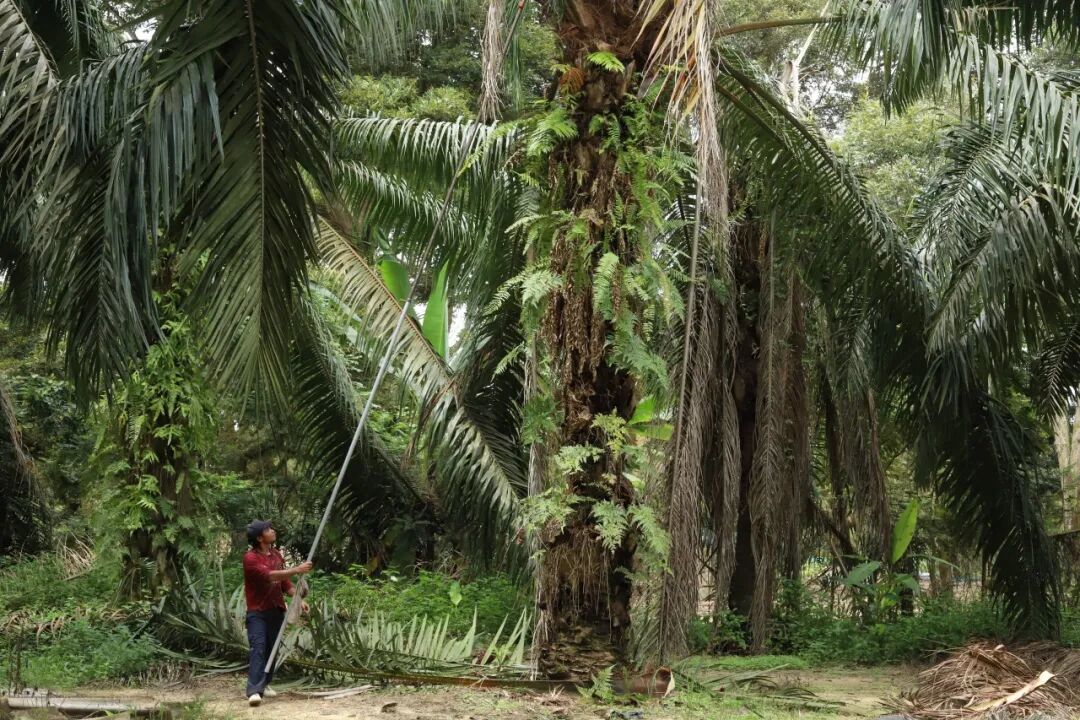
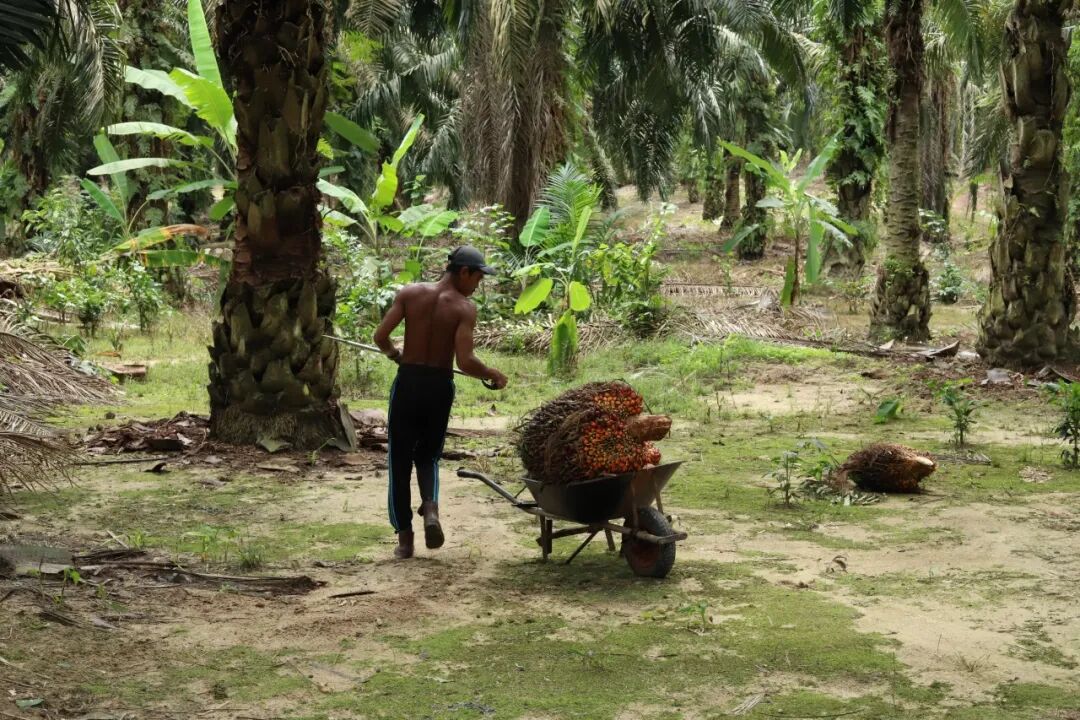
◉ Workers harvesting oil palm fruit.
Every morning, Marcus’s father, well past eighty, would go out to “work” alongside his son, sitting in the rubber trading office chatting with friends. In the small storeroom behind the office lay that morning’s freshly tapped rubber, piled only up to an adult’s ankle. Marcus said not as many people were in the rubber business as before.
It was a natural progression — whatever paid, that was what you did.
Marcus’s main business was oil palm. Durian was a venture he had only entered in the past two years. He had contracted a new durian orchard, bought two liquid nitrogen units, and put up a small frozen processing plant. But too many newcomers had flooded into the durian trade, and his investment — a little over one million yuan — had yet to earn anything back.
When we first met Marcus, he was driving a black tipper pickup truck. He said most people in local agriculture drove vehicles like this, because the open bed easily held farm tools and made loading harvested fruit far simpler.
From the day a seedling was planted, it generally took seven or eight years before the tree bore saleable, good-quality durians. In the meantime, water shoots that sprouted after rain had to be pruned; if insects ate the leaves, the trees had to be sprayed; if the fruit grew too densely, nutrient concentration suffered and the fruit had to be thinned by hand. Once the durians fruited, ropes or nets had to be hung to prevent the ripe fruit from crashing to the ground. Malaysia’s daytime temperatures exceeded 30 degrees Celsius year-round, and farmers laboured outdoors in the heat.
Beyond all that care, there was the constant investment. Marcus had 80 mu of durian orchards in total, and a single round of pesticide spraying — labour included — cost 2,000 ringgit (around 3,315 yuan). Each mu held roughly 20 to 30 durian trees, and irrigation equipment cost five or six thousand ringgit per mu (about eight or nine thousand yuan). Fertiliser, pesticides, and irrigation gear were all paid for by the growers themselves — there were no government subsidies.
In Malaysia’s heat, clothes were soon drenched in sweat. Marcus did not fuss over his appearance, but he was by no means hard up — every time he travelled to China, he would buy thick clothing online beforehand and have it delivered to his hotel’s front desk. The town was a small Chinese-majority community with a rapidly ageing population, and Marcus rarely saw outsiders.
In Marcus’s durian grove, what stayed with us most was one ancient durian tree, its great branches spread wide like outstretched arms, and another that had been struck by lightning in a thunderstorm and split clean in two. As we walked among the trees, Marcus would sometimes pause to check whether a wild durian had sprouted, or point at a fruit and say, ‘This one’s good to eat.’ The southern peak season had already passed, and only the occasional one or two fruits hung on the trees, some lying fallen on the ground. Marcus picked a few unnamed varieties from the local seed-grown durian plot, loaded them onto the pickup truck, and brought them for us to try.
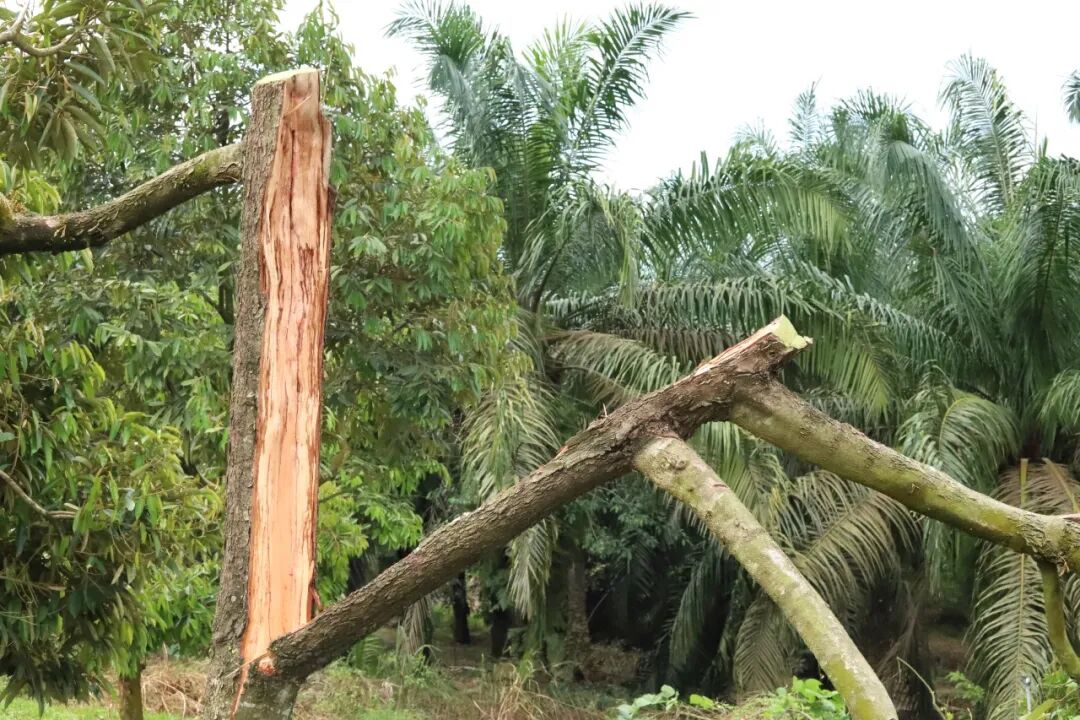
◉ A durian tree split in two by lightning.
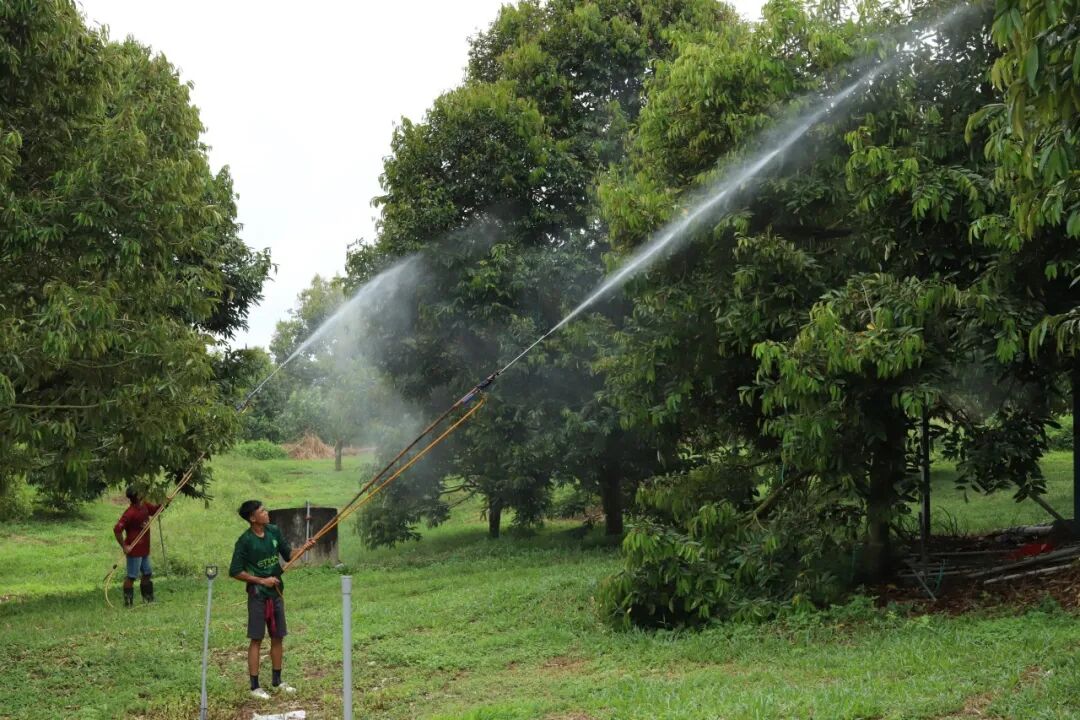
◉ An Indonesian migrant worker spraying pesticide in the durian orchard.
These fruits were cheap, but the flavour was far from poor. The reason they could not command a high price, Marcus explained, was mainly the lack of a memorable brand name, and inconsistent sweetness and aroma. He said that neither he nor the Chinese friends who visited paid much attention to local seed-grown durians. We could not eat many more, and I worried about waste, but he assured me there was no concern — ‘They’ll all be turned into fruit purée later.’
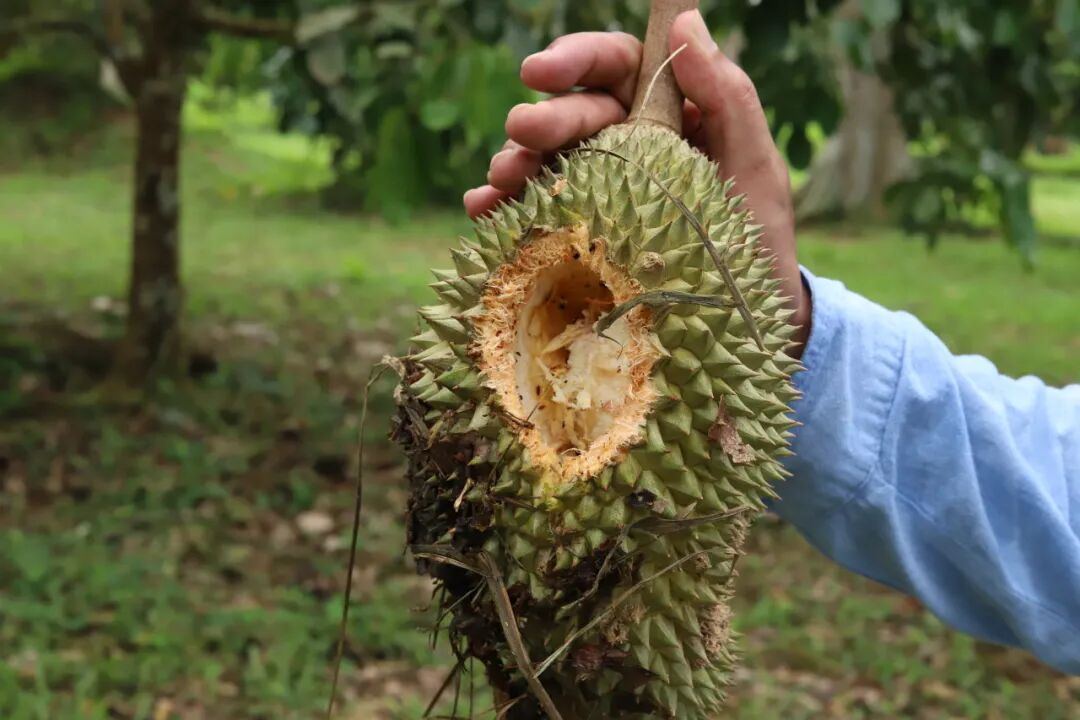
◉ Local seed-grown durians.
The shelled flesh would be frozen and exported to China; on JD.com and other e-commerce platforms, one could buy Malaysian frozen Musang King flesh. Many people felt that frozen durian did not taste as good as fresh, that its fragrance was not rich enough, but I found it had a texture like ice cream. Fruit meant for liquid nitrogen freezing had to be a whole, intact Grade A durian — anything with a crack did not meet the export standard.
He showed us the cold room. I could barely stand inside before I was shivering all over; once I stepped out, my lenses and the camera both fogged up heavily, and it took a while for the mist to clear. Marcus took two durians out of the freezer — a Musang King and a Black Thorn — still in their original, pre-export state. I thought that in China these could fetch a thousand yuan apiece, yet here they simply lay on the ground.
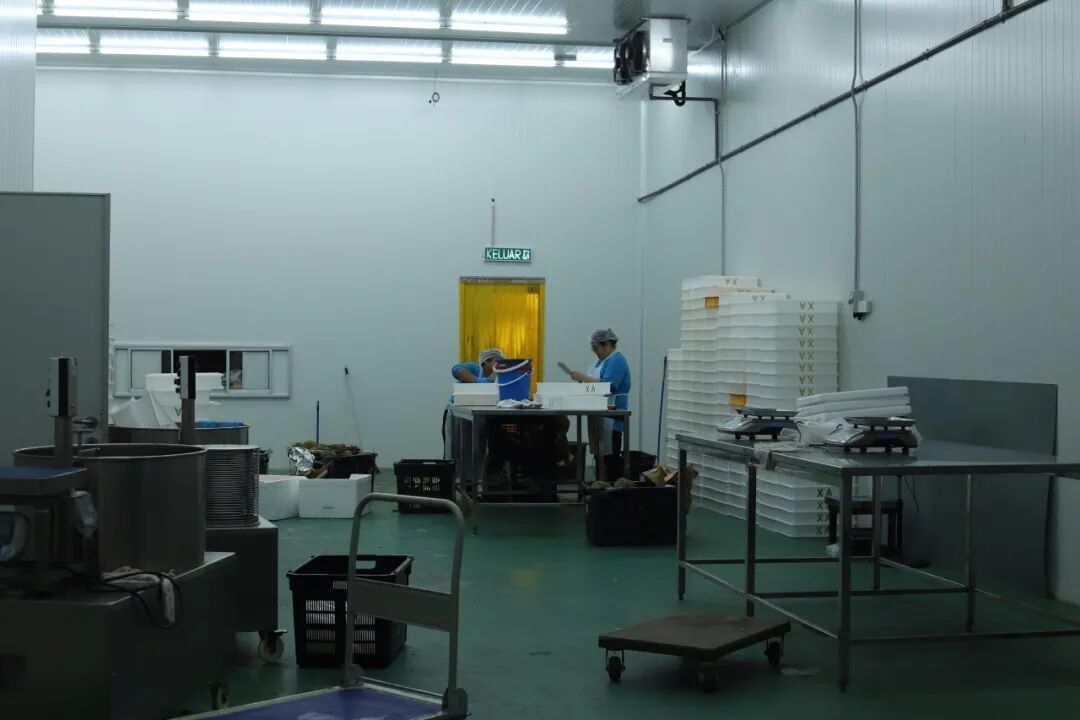
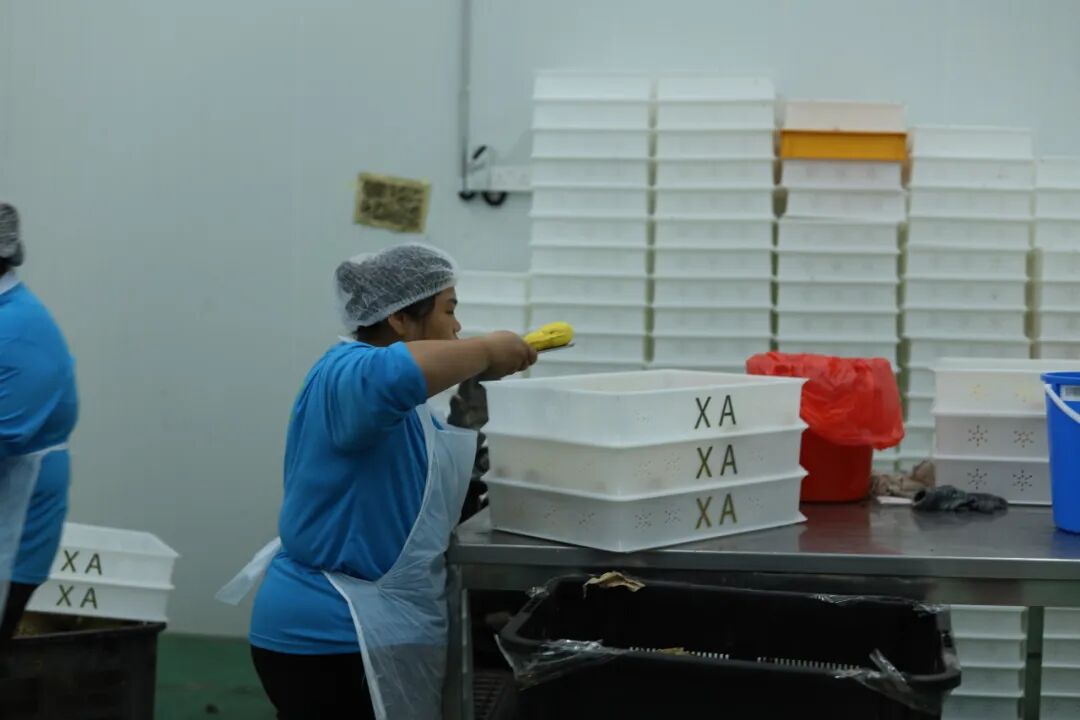
◉ Workers processing durian flesh.
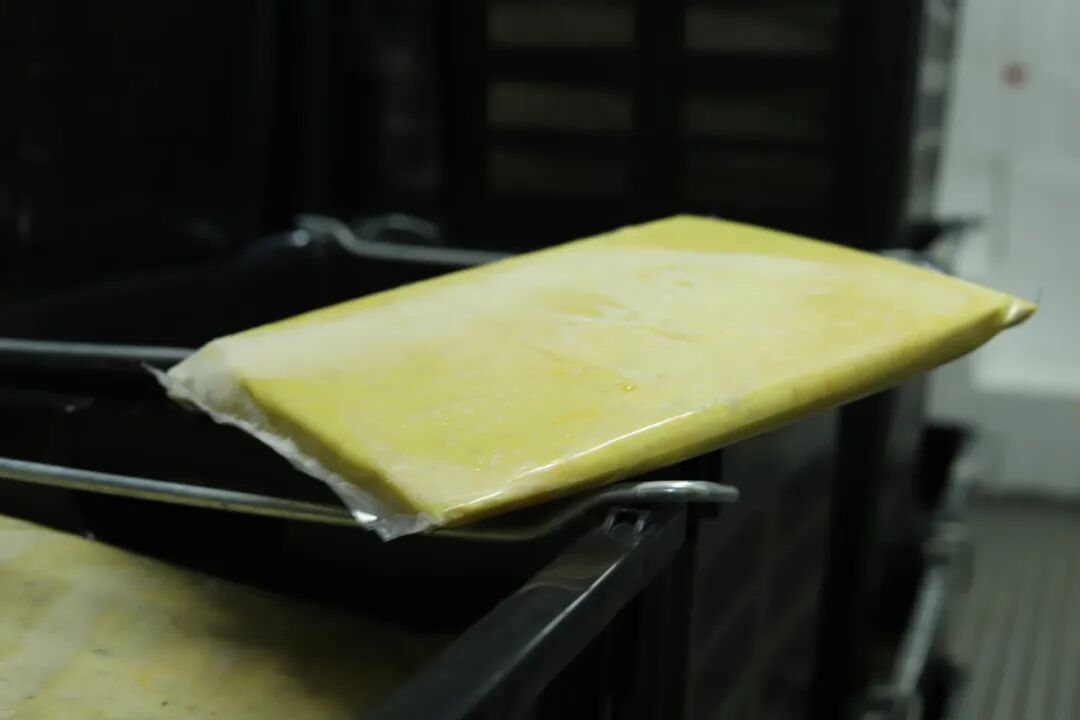
◉ Frozen durian fruit purée.
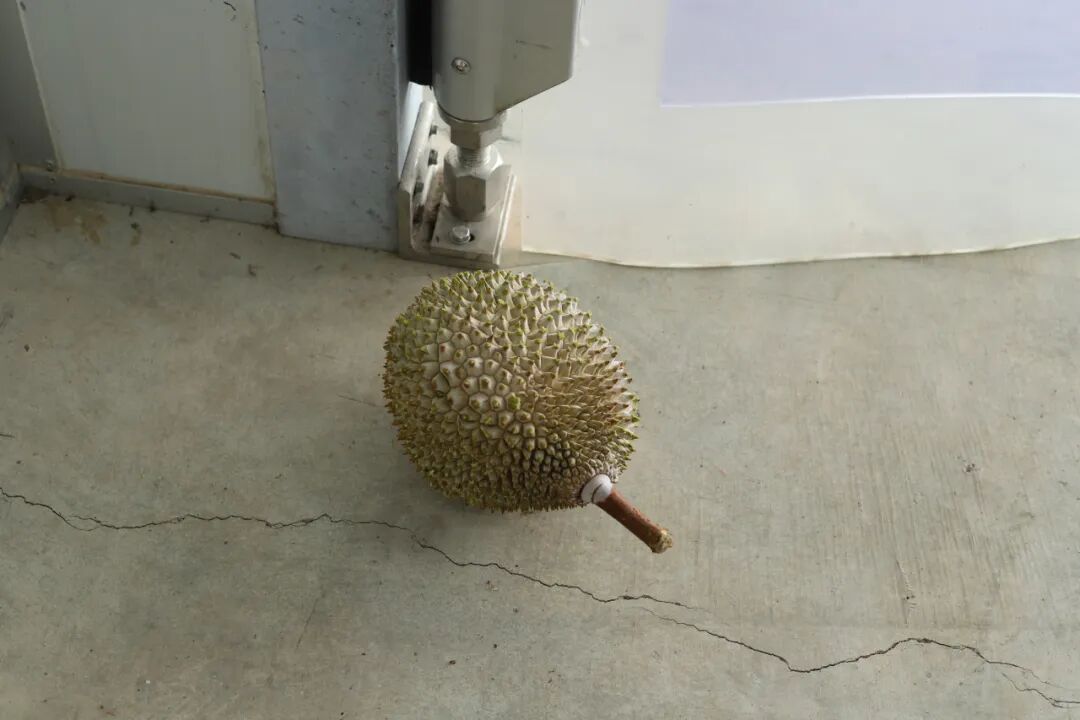
◉ Liquid nitrogen-frozen durians on the factory floor.
Durian’s Financial Markets
From the modernised LKE estate to smallholders’ orchards to the busy Chinese buyers, everyone was pushing this fruit towards the market at their own pace.
Had we arrived in Malaysia a little earlier, in July or August, we would have caught peak season, when the entire chain is stretched to breaking point. One Chinese buyer told us that during the season he covered four or five hundred kilometres a day visiting orchards, all to lock down supply — Grade A durian. The Grade A fruit that Chinese consumers favour means quality you can see with the naked eye: a flesh yield above 30 per cent, a thin rind with generous flesh, and a well-formed shape.
Yet the value of durian extends well beyond fresh fruit and frozen fruit purée. There is also the promise of long-term returns on investment.
Thinking back to our first day, the durian we ate at LKE was no ordinary tasting session — it was, in fact, a durian investment pitch.
The Chinese male presenter and self-styled “investment consultant”, TOM, was not particularly tall but spoke fluent Chinese and English. In keeping with local custom, he also spoke Malay, the national language, along with a southern Chinese dialect. His linguistic range gave him a natural confidence as he addressed the crowd of two or three dozen with a smile, speaking with easy fluency. To present the group’s newly launched scheme, he had travelled all the way from his office in Kuala Lumpur to the durian orchard. The group had invited veteran members — those who had already invested — to gather and eat durian together: nominally a thank-you event, but in reality a pitch for a new scheme.
A large part of the presentation concerned durian investment. The investment schemes fell into two broad categories: investing in an entire tree, or investing a set monetary amount.
In 2020, LKE launched its first project in Pahang, the heartland of Musang King durian. Early projects accepted small investments, with a minimum threshold of 5,000 ringgit (about 8,200 yuan) on a 15-year contract. LKE’s investment consultant explained that in the early schemes, investors had to wait three to six years before earning any return, because it took roughly seven years from planting a sapling to producing saleable fruit. In the latest project, developed in 2024, each tree served as a single investment unit, with a minimum outlay of 28,000 ringgit (around 45,000 yuan) on a 12-year contract. The difference was that whole-tree investment could begin generating returns as early as the second year.
Treating a single fruit as an asset held over a decade or more — the bet was simply that China’s appetite for durian would keep growing. And that is precisely what everyone along this chain is counting on. China’s ever-rising demand for durian is the opportunity that growers across Malaysia and the wider region can all see.
What if one day Chinese consumers simply stopped liking durian? Lin struck a positive note about the domestic durian trade. At present, he pointed out, the bulk of Malaysia’s durian was still sold at home and had yet to enter the export system at any significant scale. To put it in perspective, Malaysia’s total durian cultivation area was around 90,000 hectares, with an annual output of roughly 500,000 tonnes — yet exports accounted for less than 10 per cent. China’s import policies were spurring Malaysian investors into the industry at pace, and wealthy Singapore was another important destination for exports. But in truth, 90 per cent of this country’s fresh durian stayed at home — locals remained the most enthusiastic durian consumers, and Malaysia had always been the world’s leading country by per-capita durian consumption.
– This is Foodthink’s 828th original article –

Foodthink
Author:
Wu Bingcong
Jiemian News reporter, loves Malaysian durian

Foodthink
Author:
Liu Yi
Loves Black Thorn durian
About the Lianhe Creative Programme
To understand the realities of food and agriculture today, and to support more people in exploring the complexities behind food and farming, Foodthink partnered with several charitable and media organisations in 2024 and 2025 to jointly launch the Lianhe Creative Programme, funding media creators and researchers to carry out investigations in the field of food and agriculture and to complete content for a general audience.
Following multiple rounds of interviews with assessors, the Lianhe Creative Programme supported 18 creative projects in 2024 and 20 creative projects in 2025. Some of the funded works have now been completed and published:
“Auntie Mei the Cleaner Wants a Proper Meal | The Working Person’s Table”
“In Malaysia, Chinese Buyers Only Want Grade A Durian”
“Fake Meat” Crowds Out the Real Thing: Herders, the Table, and the Amazon
Watermelons Guarantee Sweetness; Growing Them, Bitterness
From the Guoshan Yao to the “Chosen Foragers”: The Termitomyces Frenzy
Mulan in Shenzhen, with No Meal Companion
Why Has the Sweetness of Childhood Disappeared?
Why Can Guizhou Not Do Without Sour Soup — and Sour Soup Without Guizhou?
Who Drove Away the Wet Markets?
Will Fresh Produce E-Commerce Make Wet Markets Disappear?
When Drones Become New Farm Tools: Who Is Defining “Scientific Farming”?
A Braised Goose in a Qiaopi Letter, Worth a Hundred Thousand
Photography: Liu Yi
Edited by: Auntie Xiong
Layout: Xiao Cun
Scan to tip and support original Foodthink content
▼

▼
Tap the image to read related articles
▼
Tap the keywords to explore more article collections
Seeds | Agricultural Technology | Policy | Fermentation | Nutrition | Fruit | Fisheries | Events | Recruitment | Takeaway | Wet Markets | Livestock | Food Talk | Sharing Sessions | Book Club | Harvest Festival | Smallholder Stories | Climate Change | Rural Development | Cooperative Economy | Urban Farmers | Food Safety | Digital Technology | Biodiversity | Pandemics and Food | False Solutions | Agroecology Internship Programme
Beijing | Hebei | Shanghai | Guangdong | Guangxi | Henan | Sichuan | Jiangxi | Xinjiang | Shaanxi | Hong Kong | Chongqing | Zhejiang | Jiangsu | Guizhou | Northeast China | Taiwan | Inner Mongolia | Philippines | Canada | Russia | Mexico | Italy | United States | United Kingdom | Germany | Netherlands | Thailand | Sweden | Japan