In Search of Musang King: The Taste and Business of Malaysia

This summer, Malaysia is experiencing a veritable durian glut. Bumper harvests across major growing regions such as Johor, Penang and Perak, compounded by a recent surge in supply from mature orchards, have driven prices sharply down. According to the Sin Chew Daily, some lower-grade Musang King fruit has fallen to a record low of nine ringgit (14.96 yuan) per kilogram—roughly one-tenth of its previous peak retail price.
Just two years ago, however, the situation was almost exactly the reverse.
Back then, I was based in Thailand. One evening, my Thai landlord stumbled across a video showing a Chinese woman inspecting durians in a packing facility, preparing a shipment for export to China. After watching it, she sighed, “All the best durians are being snapped up by the Chinese.” Her definition of “best” was straightforward: fruit that looked symmetrical, large and full.
It piqued my curiosity: was this really the case, and just how vast was Chinese demand? What were the locals’ views on it all? And could the durian available in China truly be better than what was grown and sold right here in Thailand?
The durian hails from the rainforests of the Malay Peninsula and Borneo. Its English name, “durian”, is derived from the Malay word duri – meaning “thorn” – a nod to the sharp spikes covering its husk. As the fruit’s point of origin, Malaysia is widely regarded as the home of the highest quality durians. The country boasts more than 200 officially registered cultivars, with planted acreage now exceeding 90,000 hectares and output climbing steadily year on year.
The renowned Musang King durian originates in Malaysia, where its distinctive bitter-sweet flavour has established it as a top-tier variety. The Malaysian authorities have even introduced a dedicated certification label to distinguish genuine, China Customs-approved fruit from impostors. Yet for the majority of Chinese consumers, the name has long been associated solely with desserts made from processed durian paste. Fresh Musang King did not enter the Chinese market until August 2024. In 2024, Malaysian durian accounted for less than 1% of China’s durian imports, compared with 57% and 42% for Thailand and Vietnam respectively.
So, in August 2024, we travelled south from Beijing to the heartland of Musang King production – Johor and Pahang in Malaysia – just as the first shipment of fresh Malaysian durians was poised to enter the Chinese market. We wanted to see for ourselves what the local orchards actually looked like.
Large-scale durian orchards
The flight from Beijing to Kuala Lumpur takes just over six hours. Budget red-eye flights leave you feeling achy all over, but it was hard to keep the excitement at bay, knowing we would be tucking into fresh Malaysian durians by that very afternoon.
Prior to August 2024, fresh Malaysian durians were not available in mainland China. The only options were imported frozen Musang King and Black Thorn varieties, with a single fruit commanding three or four hundred yuan, or more – three to four times the price of Thai durians.
Yet, our preliminary research before the trip revealed that durians locally were far cheaper. You could pick up a misshapen fruit or a smaller one for just forty or fifty RMB.
Besides, frozen durians are said to differ in flavour from the fresh fruit, the latter boasting a far richer aroma. Although August marks the tail end of the season, we were told we would get to taste at least five or six varieties. Alongside the renowned Musang King and Black Thorn, there are Chini, Kao Maeo, Super XO, Sultan, and more. Photos shared on social media were eye-opening: some feature orange-red flesh with a looser, runnier consistency, while others are pale yellow yet remarkably soft and custardy. For someone who has spent years living in the north, such a wide array of tropical varieties and textures felt utterly fascinating.
Public transport around Kuala Lumpur leaves much to be desired, so after landing, we splurged on a private car hire for 800 RMB. After a drive of roughly two hours, we arrived to visit a large local durian estate – LKE.
The LKE Group is one of Malaysia’s major agricultural developers. By the time we reached the gates, numerous local families were already bringing their children in to experience fruit picking, treating the estate more like a tourist attraction.
My Malaysian university alumnus Brian met us. Having studied agriculture abroad, he joined LKE upon returning home. The estate covers roughly 200 mu (approximately 13 hectares), and it took quite a while just to walk through the main orchard blocks. The operation is also highly modern, complete with automated irrigation systems and pest-repellent devices. After inspecting the primary durian trees, we climbed to the highest building on the premises to take in the view over the canopy. Brian pointed out towards the distant groves: some saplings had been planted only recently, while others were already towering. August falls squarely in the monsoon season, and even from that elevated vantage point, the stifling heat and humidity left us drenched in sweat.
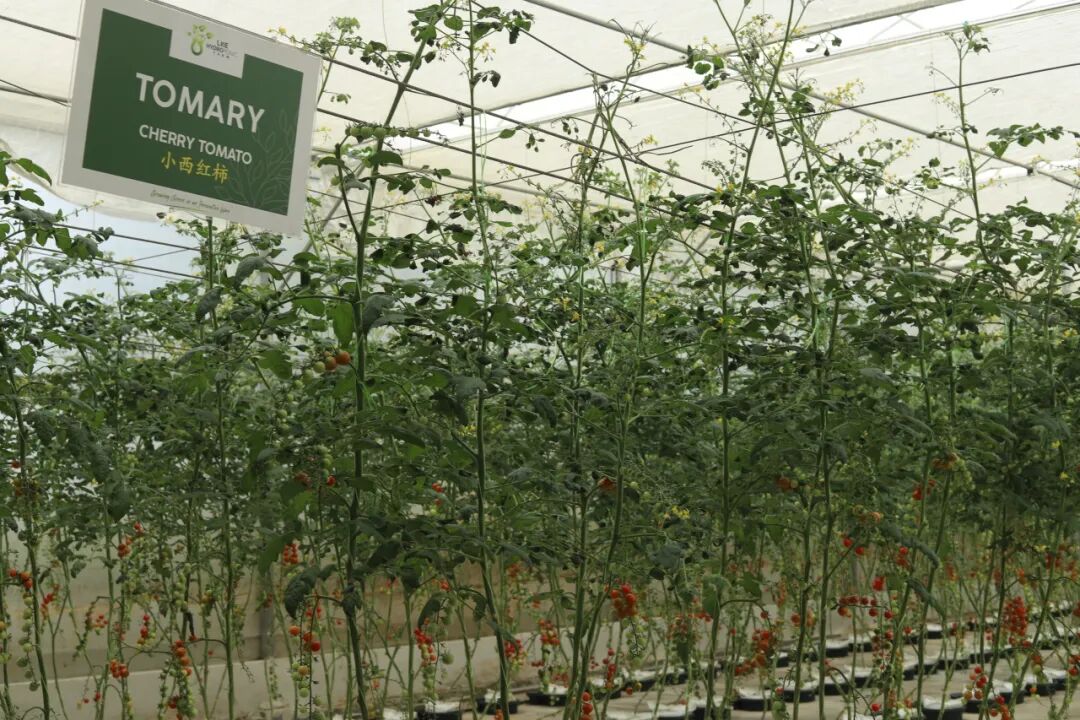
◉There are also vegetable greenhouses at the LKE estate.
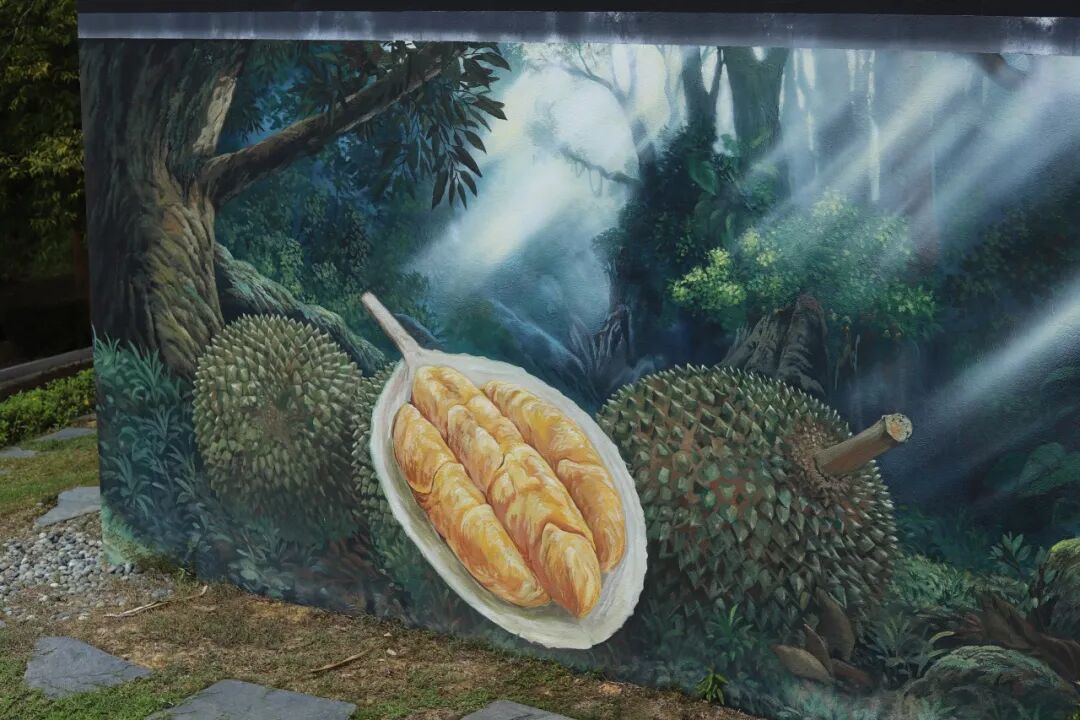
◉A durian mural at the LKE estate.
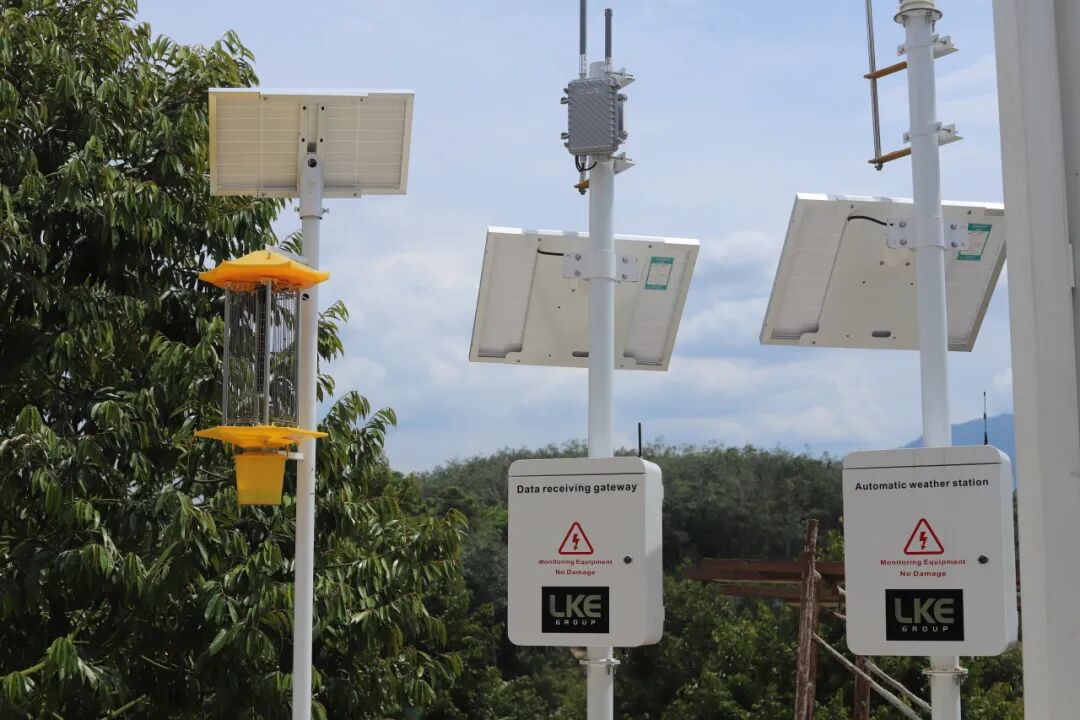
◉LKE’s smart agriculture system: insect-trapping lights, field data sensors, and small weather stations for collecting weather data, all self-powered by solar panels.
The durian tree is a genuine native of the Malay Peninsula. Ancient specimens can grow to a girth requiring two or three people to encircle, reaching heights of nearly 100 metres. In commercial orchards, however, cultivated durian trees typically stand just over 20 metres tall. From planting a sapling to producing marketable fruit takes around seven years, and the crop thrives equally well on flat ground or small hills.
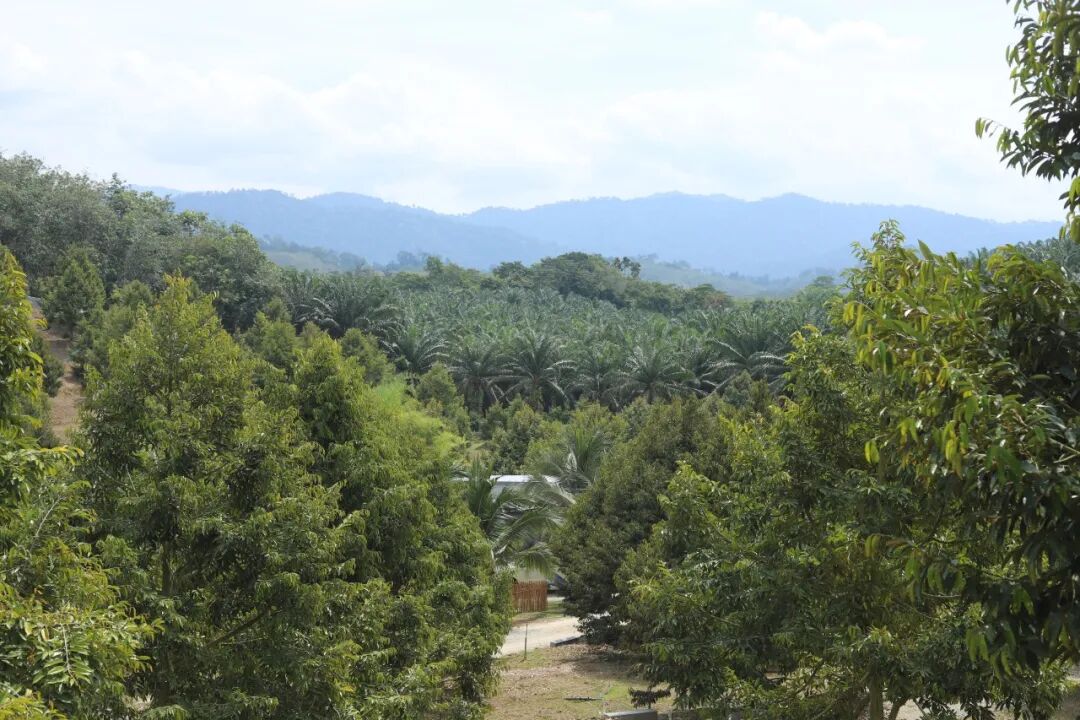
◉The LKE estate covers a vast area.
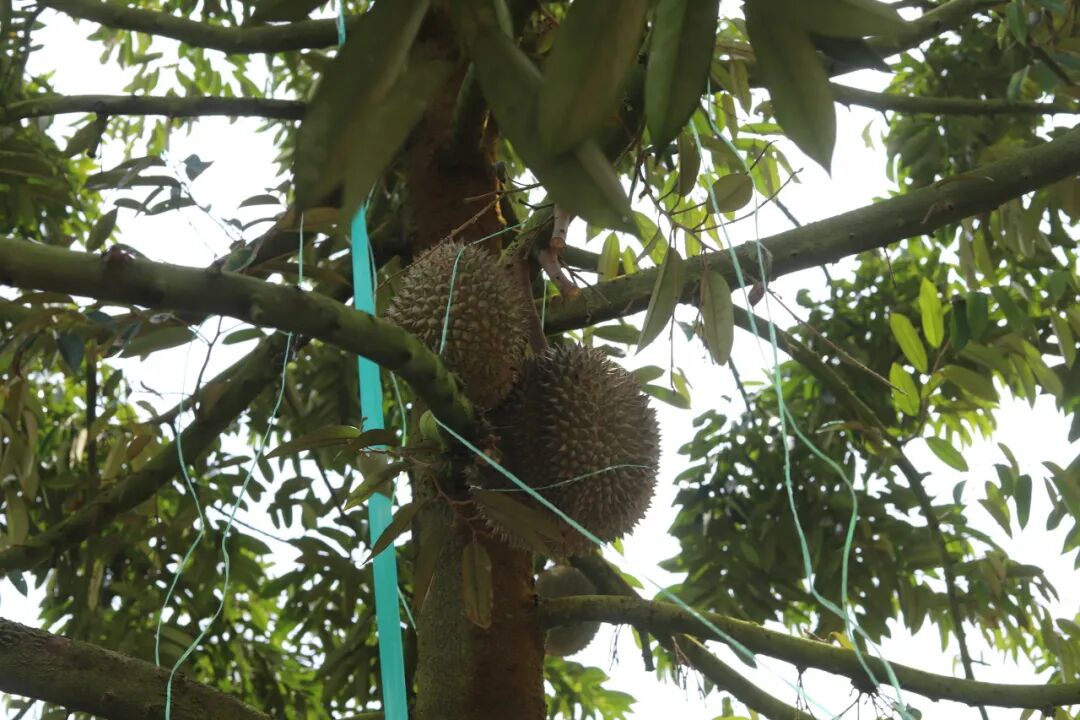
◉The durians are secured with ropes so they do not fall straight to the ground when ripe.
LKE was hosting a public event that day, featuring a presentation on the company’s development history and the rapidly growing durian investment market. The audience was visibly diverse: Muslim women in hijabs sat alongside Chinese attendees and others. The session was conducted in English, and the room listened intently.
The event was followed by a tasting session. Investors who had attended the presentation took seats at small tables. The site is a considerable distance from the city centre, and many visitors had driven specially for the trip. Judged by the exacting hygiene standards of city dwellers, it was hardly an ideal place to eat. Flies buzzed about, there was no air conditioning, and the tables and chairs were far from spotless. Yet the fruit had been picked straight from the orchard, and its exceptional freshness had the guests eagerly reaching for their portions.
Brian also bought four durians at his own expense for us to sample. As a Northerner with little agricultural background and a relatively untrained palate, I could only sense the subtle differences in texture and flavour as I ate, though I found it difficult to describe them with precision.
Before leaving Kuala Lumpur, we visited the SS2 market, a local hub for consumers looking to buy durian. Just a twenty-minute drive from the city centre, it differs considerably from Chinese wet markets. The space is made up of individual vendor stalls, and they deal exclusively in various durian varieties. Fruit is weighed and opened on the spot, and customers can either sit down to eat immediately or have their portions packed in clear plastic containers to take away.
The cheapest durians cost around 20 to 30 Chinese yuan each, with pricier varieties fetching between 100 and 200. Shoppers from various ethnic backgrounds weighed their selections and paid at the counters. It struck me then that the fruit truly transcends race and geography, finding admirers across all communities.
A smaller durian contains less flesh and is ideal for a solo meal. It typically yields two or three segments roughly the size of an adult’s palm, perfect for sampling the fruit fresh. Larger specimens, by contrast, appear to be about the size of an adult’s head. We spent 90 Malaysian ringgit (roughly 150 yuan) on a well-proportioned Kao Maeo durian. For two women, it was a substantial quantity that could easily become slightly cloying.
Taken as a whole, Musang King is hardly expensive at its place of origin. The retail price in China is roughly ten times higher than the local cost.
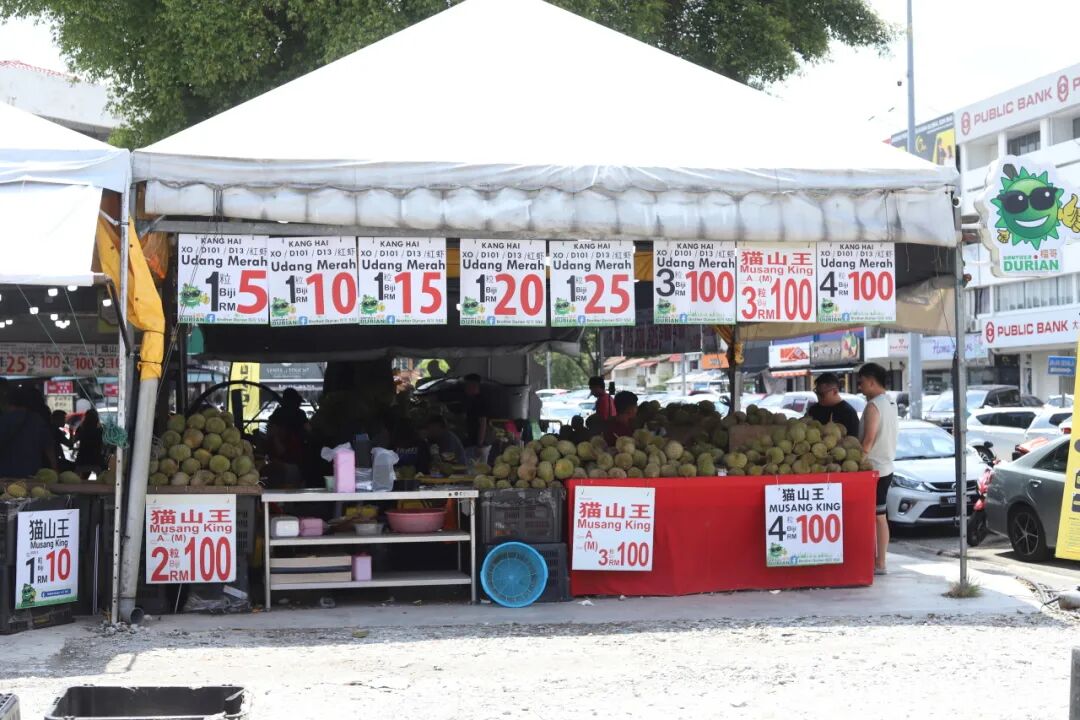
◉The SS2 market has numerous durian stalls. The image shows market prices as of August 2024 (100 Malaysian ringgit = 165.76 Chinese yuan).
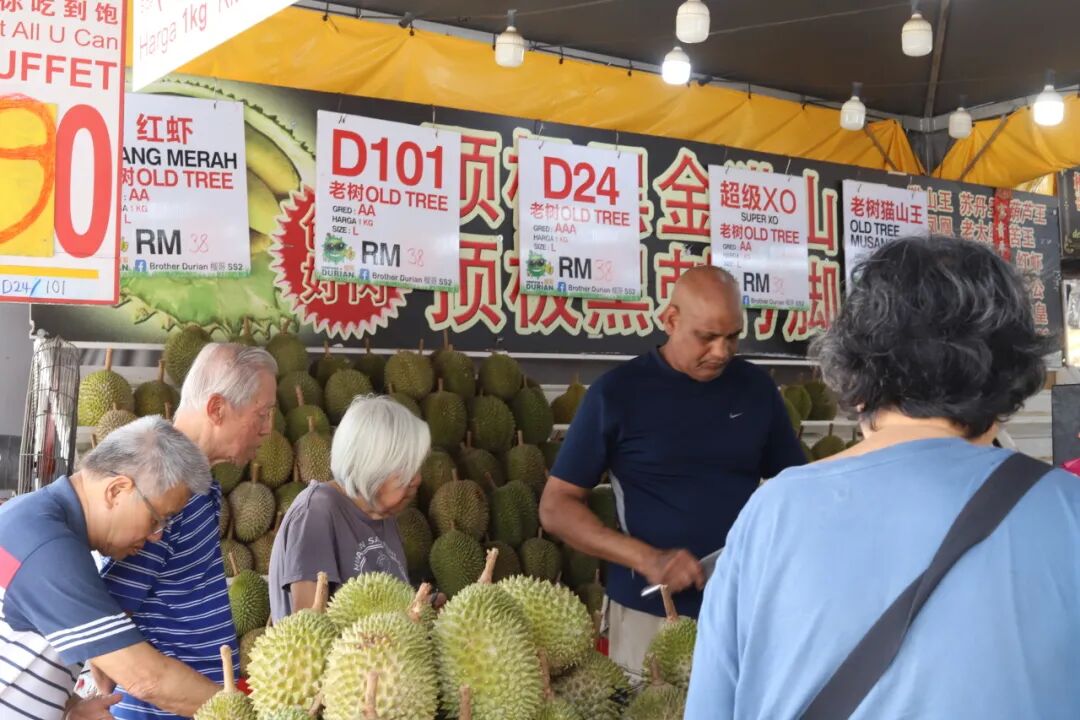
◉Residents from around Kuala Lumpur select durians at the SS2 market.
From Modern Agribusiness Parks to Local Orchards
Our second assignment was to travel to Muar to meet Lin, a durian trader.
Muar is a small town in Malaysia’s Johor state, roughly a two-hour drive from Kuala Lumpur. We stayed in the city centre, where a bowl of char siew wonton noodles or flour noodles cost just over ten yuan. The town is home to Malays, Chinese and Indians, and features churches with crosses, though there are no cinemas. To find bustling shopping centres, you have to head north to Malacca. The Muar River winds through it, making for a quiet, commercially modest settlement. Compared to Johor Bahru, with its high-rises just across the border from Singapore, Muar feels like a weathered elder.
At thirty, Lin is a second-generation durian trader. His family’s elders made their initial fortune from cross-border durian trade, and the business eventually passed into his hands. With a child just over a year old, he has little time to share in the parenting duties. To make a living in the fruit trade, he works nights, putting him out of sync with his child’s daily routine.
Arranging our meeting with Lin proved rather difficult. He specialises in the wholesale export of fresh durians; after exchanging WeChat contacts, he rarely replied to messages, leading me to worry he had little interest in our visit. Meeting him, however, proved the exact opposite. Lin’s daily rhythm differs markedly from most: he rises at 3 a. m., works until 10 a. m., returns home for a sleep, and spends the afternoon supervising a frozen durian pulp processing workshop.
Just past 5 a. m., with the sky still dark, Lin sent a location pin: he had already arrived at the “company”. We jerked ourselves out of bed, hailed a car and headed straight for the coordinates. Ten minutes later, we stepped out to find ourselves surrounded by quiet streets and two-storey houses. Dawn was just breaking as durians were being loaded inside the “company”.
There were five or six people on site, predominantly of Chinese descent. Lin typically does not handle the fruit himself; instead, a shirtless Chinese man in his fifties oversaw the sorting, weighing and loading. “This is Musang King, this is Kao Maeo, D24, D101.” A quick glance and a gentle lift were enough to identify the variety. We had reached the tail end of the durian season, and fruit was scarce in the south. This batch had been harvested in Pahang, transported to Johor, and was waiting to be exported to Singapore. As well as the widely recognised Musang King, the varieties included Chini and Kao Maeo, alongside other local favourites.
When it comes to durians, freshness is everything. Lin’s export business relies on a tight schedule: fruit picked at dawn must reach Singaporean dinner tables by the afternoon via road transport. With a three- or four-hour journey ahead, every second counts if he wants to secure a good price. Weighing, sorting and loading must be done quickly and efficiently.
This is a defining feature of Malaysian fresh durians. Unlike their Thai counterparts, which are typically harvested at seventy to eighty per cent ripeness to facilitate transport and preserve freshness during export, Malaysian durians are allowed to ripen fully and fall naturally before being sold.
Thai durians are cheaper, and advances in logistics have intensified competition across Southeast Asia, yet the Malaysians remain steadfast in their approach. That commitment comes with a trade-off: transport must be swift. Durians are best eaten within three days of falling from the tree, and they begin to spoil after a week. The three trucks we witnessed that day, carrying fruit valued at roughly 100,000 ringgit (about 160,000 yuan), would head southbound. Three hours later, they would reach Singapore, where the fruit would be distributed to individual market stalls.
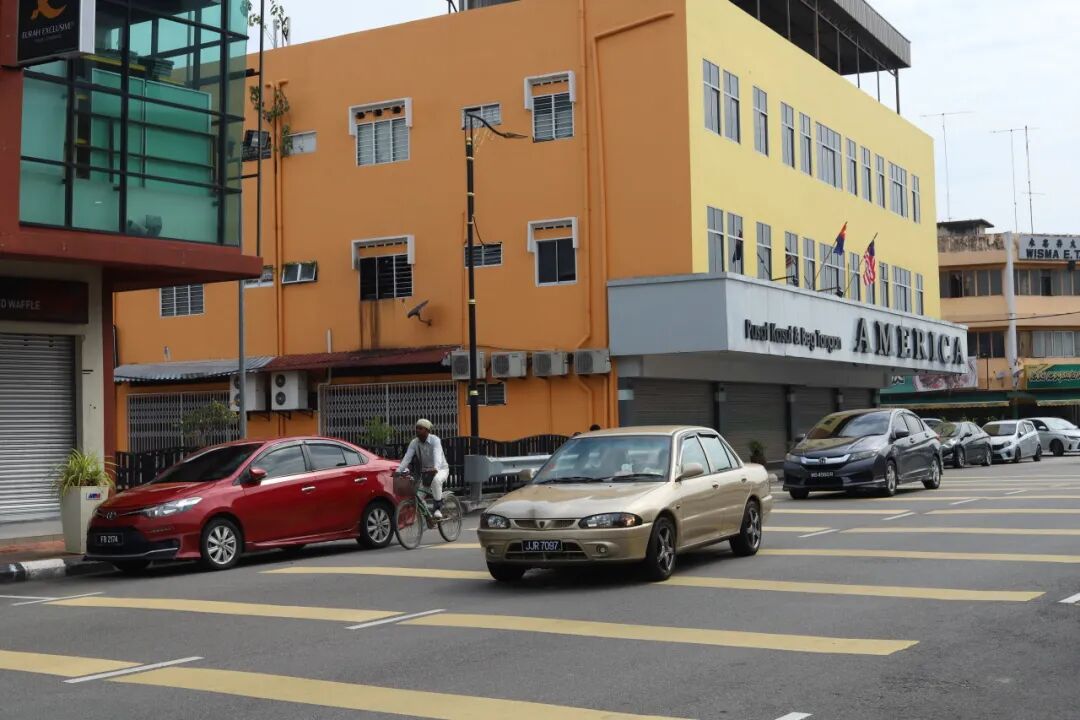
◉Muar city centre.
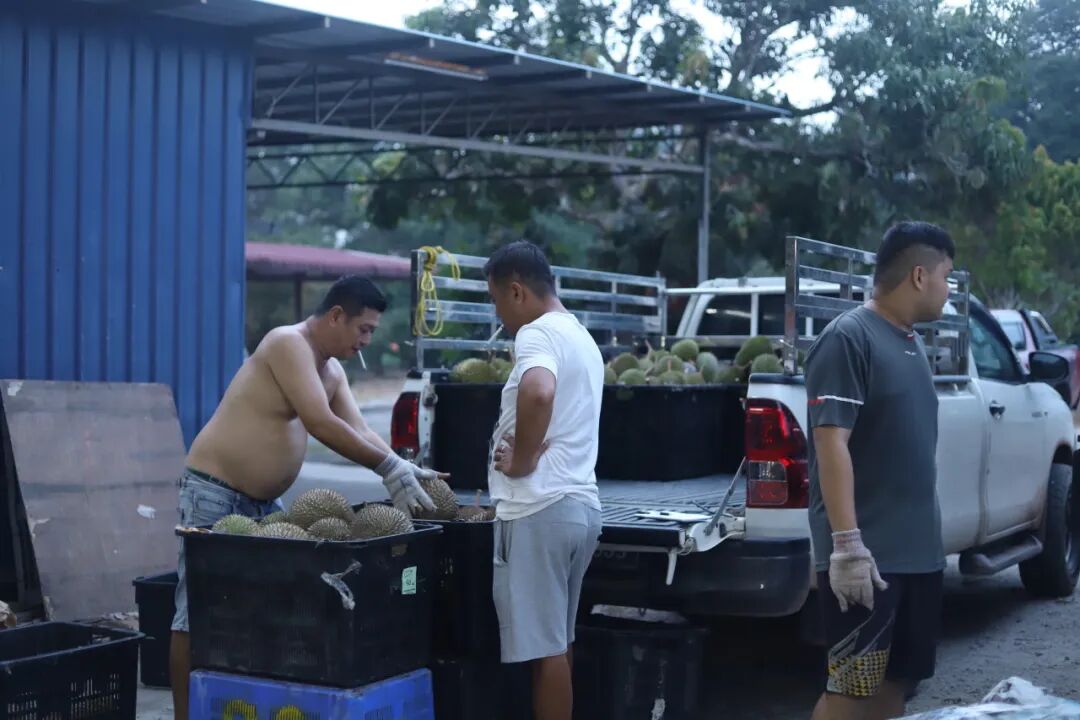
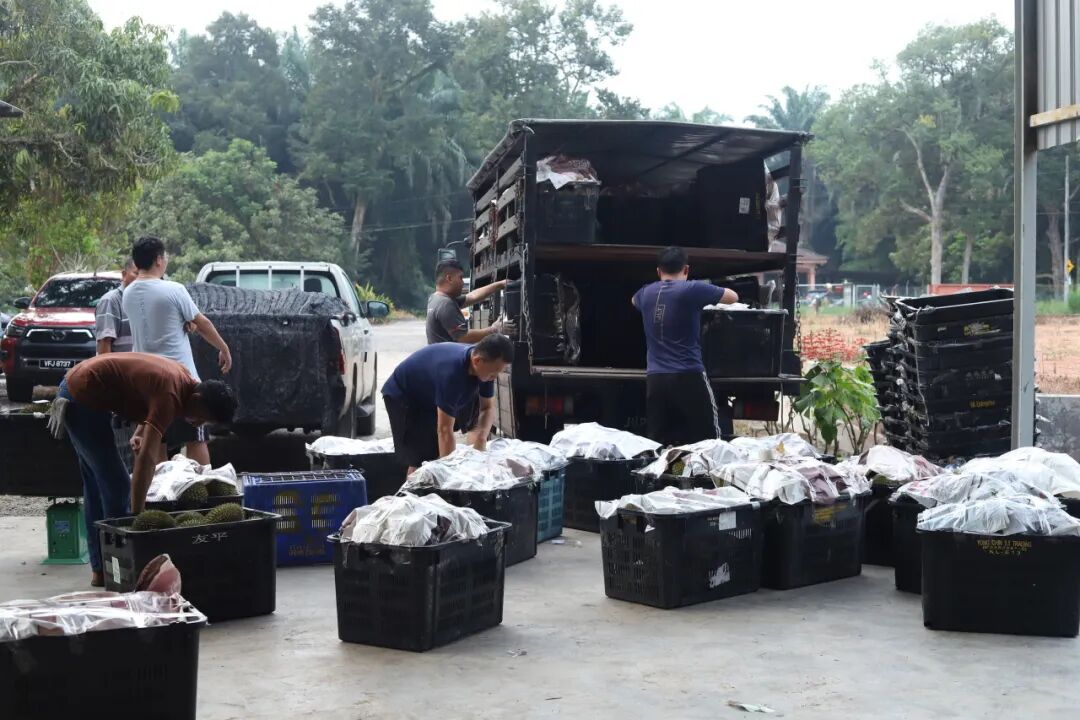
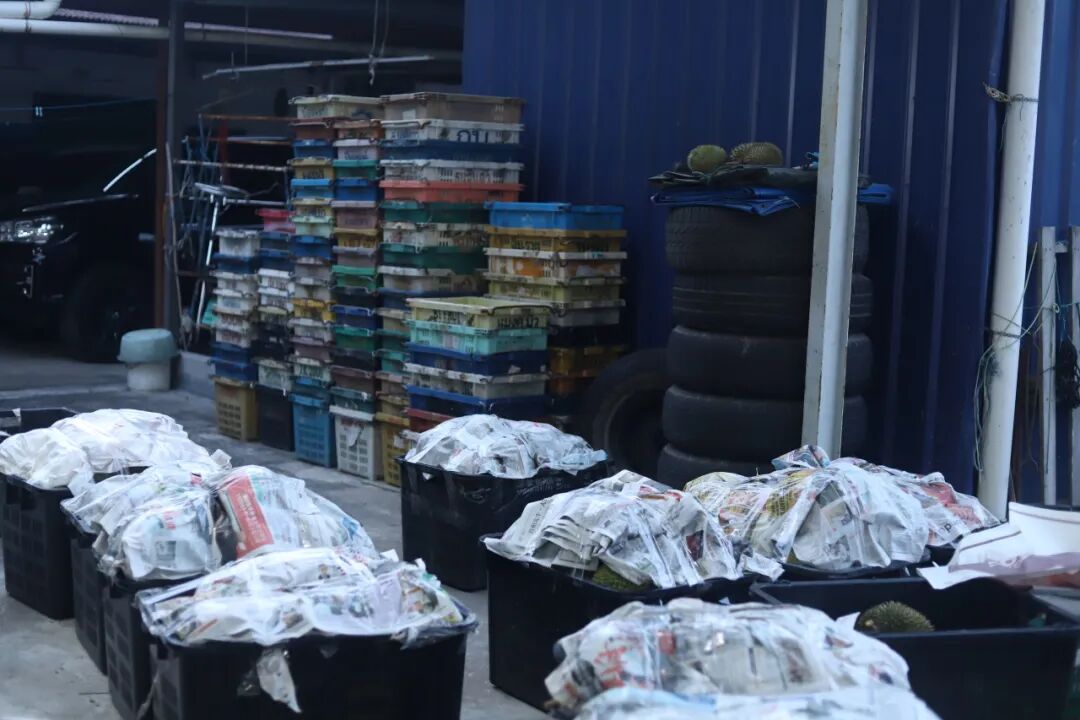
◉Staff at Lin’s company sorting and loading durians.
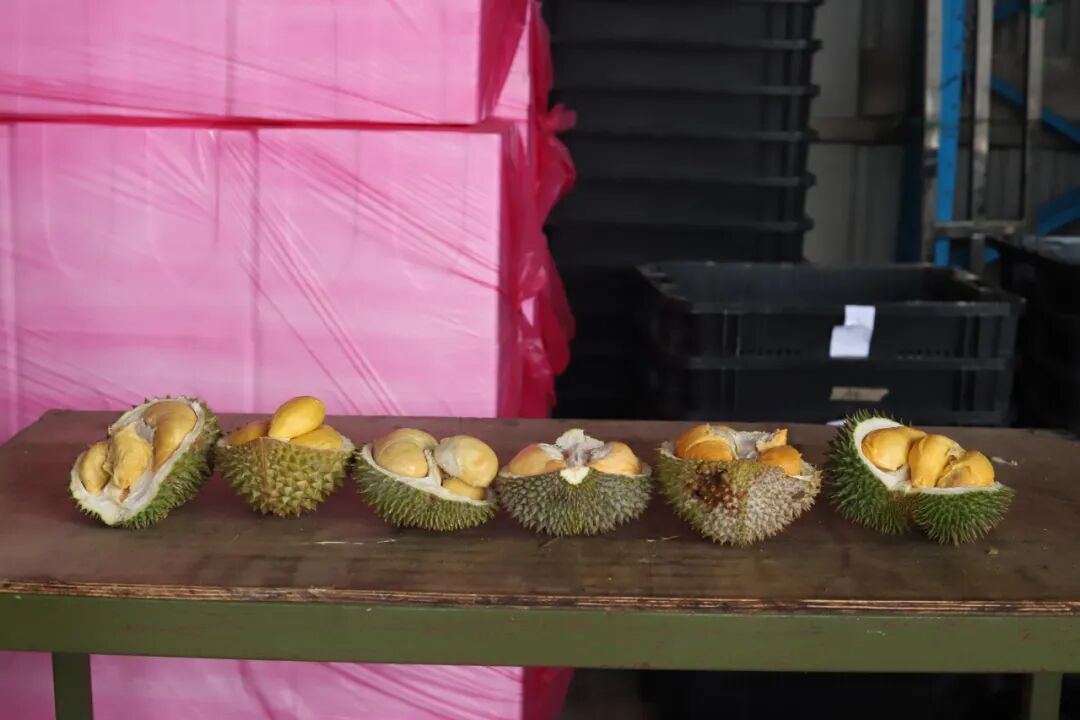
◉The durians in this row are all different varieties.
Lin invited us to eat some durian right there on the spot. When I hesitated, feeling somewhat awkward about accepting, they explained that these were fruits already set aside: scarred, misshapen, or split durians that would not fetch a good price on the export market, and had therefore been sorted into the rejects bin. I recognised this as a polite excuse—such fruits still find buyers in the local market; they simply sell for less.
Lin took over the business from his father, and his older brother is also a long-serving employee. He recalled that as a child, there were durian trees on the family plot, but they hardly ever used pesticides or chemical fertilisers. These days, applications are needed almost every month. This shift in farming methods highlights how contemporary consumers’ preference for visually appealing, sweet fruit is reshaping production practices.
The workers move efficiently, sorting and packing a whole truckload of durians before dawn. Fruit with cosmetic blemishes is set aside and sent to be processed into pulp. The frozen pulp factory is just across the road. Though billed as a processing plant, its equipment is quite basic, and the migrant workers live in the same building. By the time we arrived, they had just woken up, and the room was already stacked with sealed packages of frozen durian pulp.
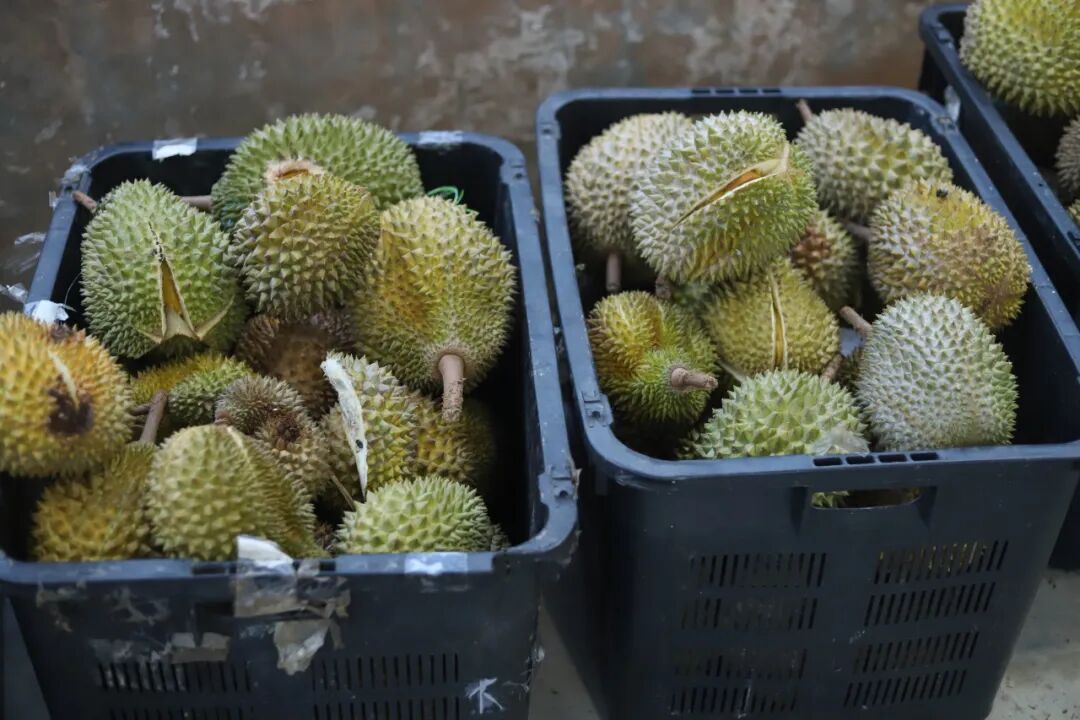
◉Cracked durians are sorted separately.
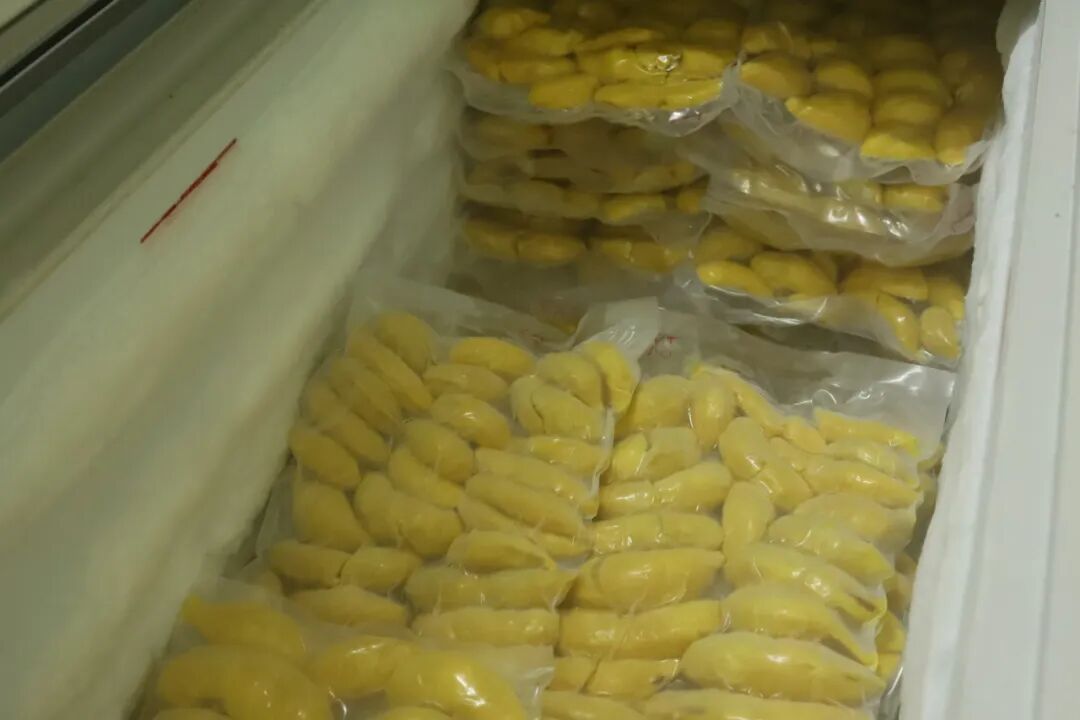
◉Whole pieces of frozen durian pulp.
Business has been tough for Lin in recent years. With competition intensifying, the sector is locked in price wars and a fierce scramble for territory. He has often gone it alone, travelling to markets, stalls and shops across Singapore to sell his durians directly, hoping to place his stock in every possible outlet. He has also lost tens of thousands of yuan after failing to collect outstanding balances from itinerant vendors.
The company’s sales volume and revenue do not align, and profits are even thinner. Lin would ship the stock once downstream clients paid a deposit, collecting the balance only after the goods were sold. He soon found that too many small-scale traders defaulted, leaving the final payments unrecoverable. Durian is a premium fruit; when the economy falters, wholesalers immediately feel the brunt of sluggish sales.
Since 2019, Malaysia has begun exporting frozen durian to China, attracting more entrants to the local market. Fierce competition has squeezed the profit margins of smallholder farmers and independent traders. In 2023, the company’s annual turnover reached 30 million ringgit (roughly 49.66 million Chinese yuan), but after paying his staff, Lin was left with virtually no profit.
Fierce market competition and a sluggish economic climate have prompted Lin to shift away from the business model inherited from his father. Starting in 2024, he set aside a space of over 100 square metres for processing frozen durian, primarily to minimise waste. Only fruit with a regular shape, free from obvious blemishes, scars, or splits, qualifies for export. Any durians that fail to meet the grade are either peeled for their flesh or turned into pulp, then frozen for storage; otherwise, the fresh fruit would only keep for a few days before rotting.
Lin is planning to invest 1 million ringgit (roughly 1.66 million Chinese yuan) to build a small frozen durian processing plant. However, the project is still subject to a lengthy government approval process, meaning it will not be operational until next year at the earliest. He notes that a large-scale facility is simply out of reach: liquid nitrogen systems, freezing equipment, and continuous power for cold storage would demand an upfront investment of 10 million ringgit (16.55 million Chinese yuan).
After the tour, we chatted for a while in the courtyard, where he kindly brought out some mangosteen for us. It was just past nine in the morning when he headed out with his staff for their morning break.
From Palm to Durian
After a brief stop in the town centre of Muar, we set off for Markus’s orchard. The orchard is 44 kilometres from the city centre, roughly an hour’s drive. It is difficult to locate, and getting a taxi or rideshare is next to impossible. On Google Maps, the route follows a rural road named Jalan Raya, flanked by stretches of undeveloped land.
Cultivating durian is a long-term investment. In Malaysia, a durian tree takes at least six or seven years to reach full production after planting. From flowering to maturity, a Musang King durian requires around 120 days, while the Thai Monthong variety follows a similar maturation cycle.
The slow growth cycle historically kept the durian industry in a relatively stable, traditional state. However, as demand from China has surged, farming practices and the wider industry landscape across Malaysia’s durian-growing regions are undergoing significant change. Markus, who works in agriculture in Muar, has experienced this transformation firsthand.
Markus is in his forties, a Malaysian Chinese whose ancestors migrated from Guangzhou to Southeast Asia. His family has been farming in Muar for generations. They initially made their living from rubber, but gradually diversified into the more popular and lucrative oil palm and durian sectors.
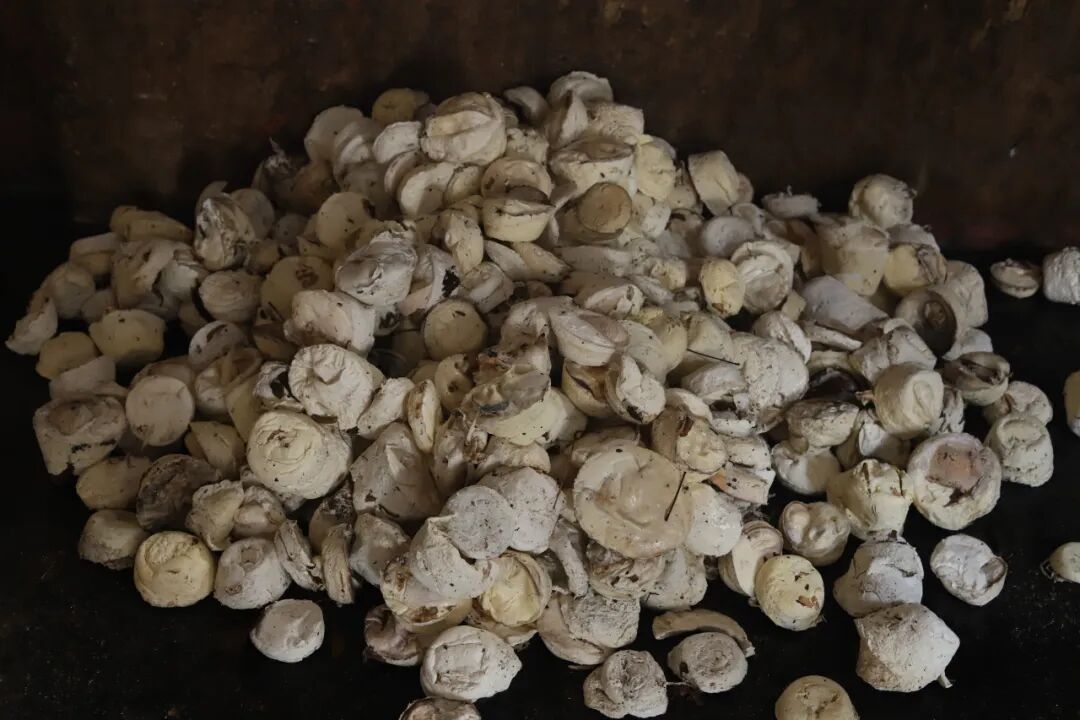
◉Harvested rubber in the warehouse.
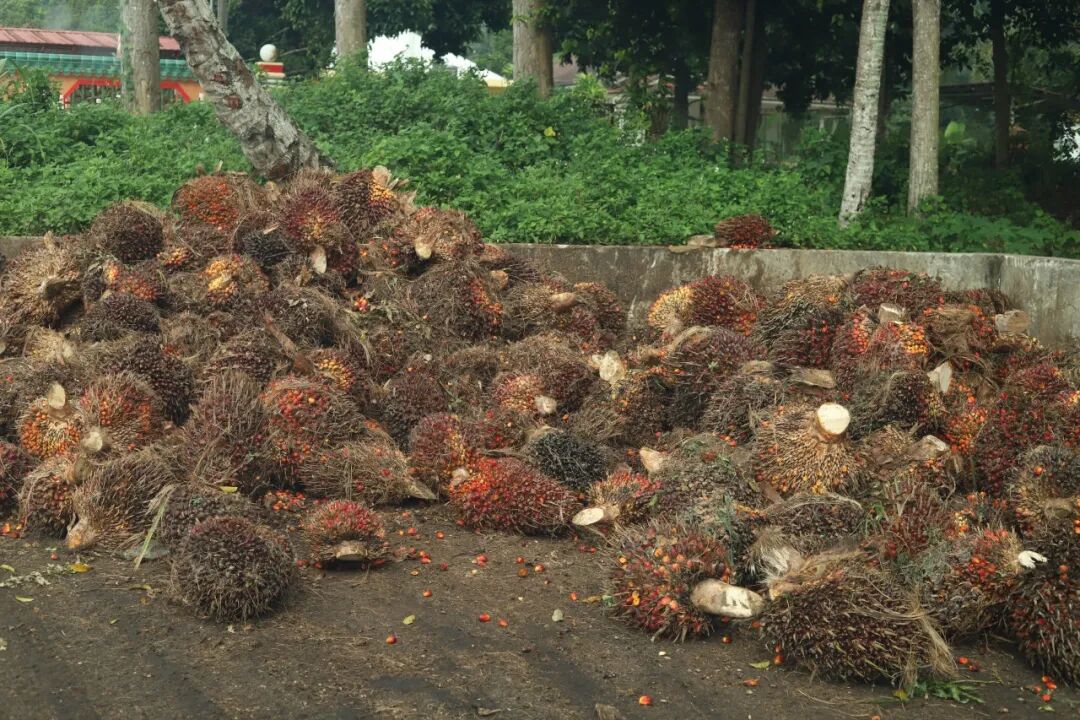
◉Scattered oil palm.
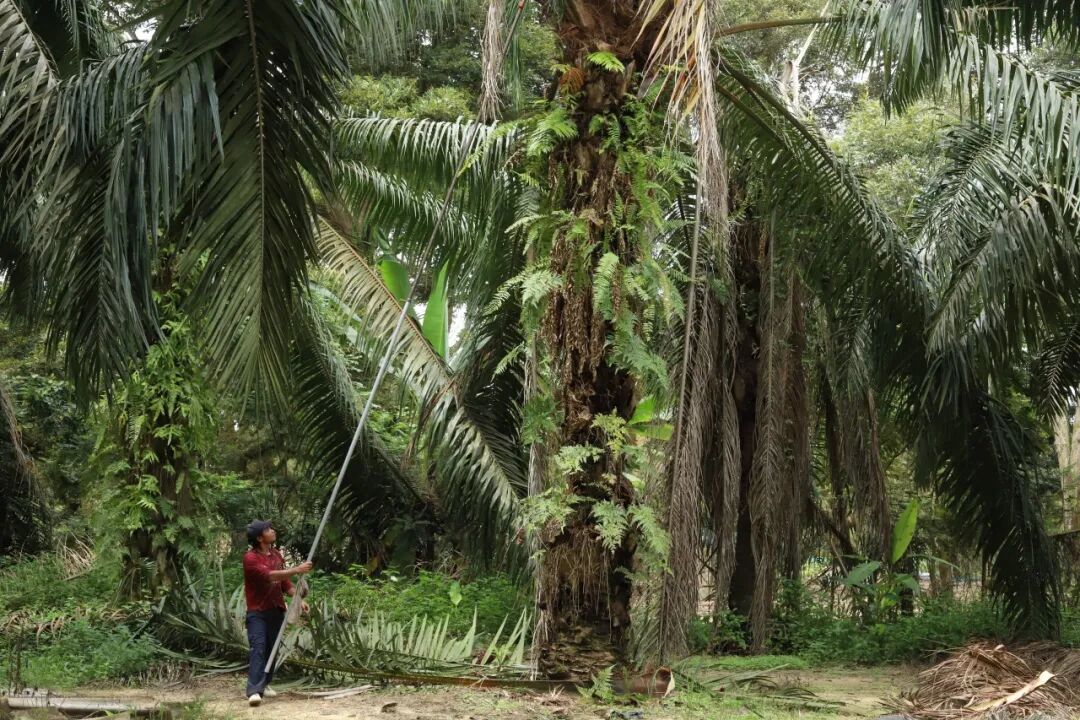
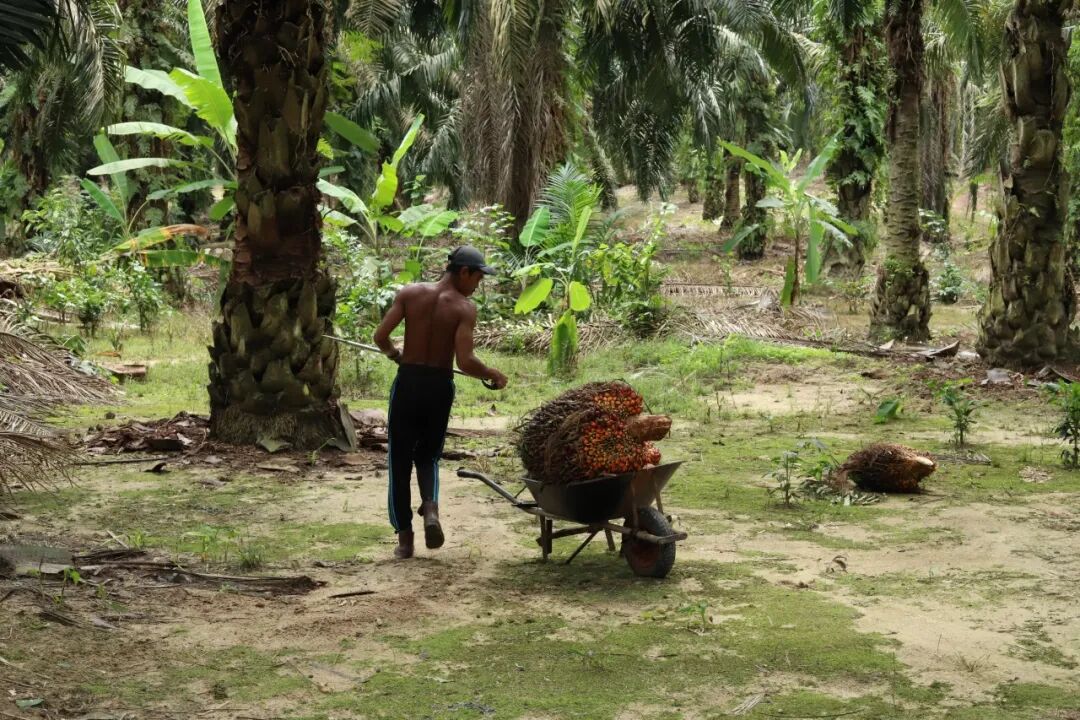
◉Workers harvesting oil palm.
Every morning, Markus’s father, now in his eighties, heads out with him to “work”, settling into the rubber trading company’s office to chat with friends. Behind the office, a small storehouse holds the rubber tapped that morning, piled no higher than an adult’s ankle. Markus notes that fewer people are left in the rubber trade around here than in years past.
It is a natural evolution: farmers simply switch to whatever proves most profitable.
Markus’s core business is palm oil; durian is a new venture he only picked up over the past two years. He has leased a new durian orchard, bought two liquid nitrogen processing units, and constructed a small frozen-processing facility. Yet with so many newcomers flooding the durian market, his investment of over one million yuan has yet to break even.
When we met him, Markus was driving a black pickup with a dump bed. He explained that most local farmers use this type of vehicle, as the open bed is practical for stowing tools and loading harvested fruit.
It generally takes seven or eight years from planting a sapling before a tree yields market-grade durian. In the meantime, rapid growth spurts triggered by rain require pruning, and pest control is needed to protect the foliage. When fruit clusters grow too dense, growers must manually thin them to ensure adequate nutrient distribution. Once the trees bear fruit, ropes or catch nets are installed to prevent mature durians from falling to the ground. With daytime temperatures in Malaysia consistently exceeding 30°C year-round, farmers spend long hours working outdoors in the intense heat.
Beyond time and effort, the work demands continuous capital investment. Markus, who manages 80 mu of durian orchards, says a single pesticide application—including labour—costs 2,000 ringgit (roughly 3,315 yuan). At a planting density of 20 to 30 trees per mu, the cost of irrigation equipment runs to between 5,000 and 6,000 ringgit per mu (approximately 8,000 to 9,000 yuan). From fertiliser and pesticides to irrigation systems, all expenses fall squarely on the growers, with no government subsidies to offset them.
In Malaysia’s heat, clothes quickly become soaked with sweat. Markus pays little attention to his appearance, though not out of financial hardship: on every trip to China, he orders warm clothing online in advance and has it delivered to his hotel reception. He hails from a small town with a predominantly Chinese and notably ageing population, and he rarely encounters outsiders.
Two sights stood out during our visit to Markus’s orchard: an ancient durian tree with branches spreading like outstretched arms, and another that had been split clean in half by lightning during a thunderstorm. As we walked through the grove, Markus would occasionally pause to check for wild durians, or point to a specific fruit and say, “This one’s ready to eat.” The peak season for southern durians had long since passed; only a solitary fruit or two clung to the branches, with others already fallen to the ground. He gathered a handful of lesser-known native varieties, loaded them into the pickup, and offered them to us to try.
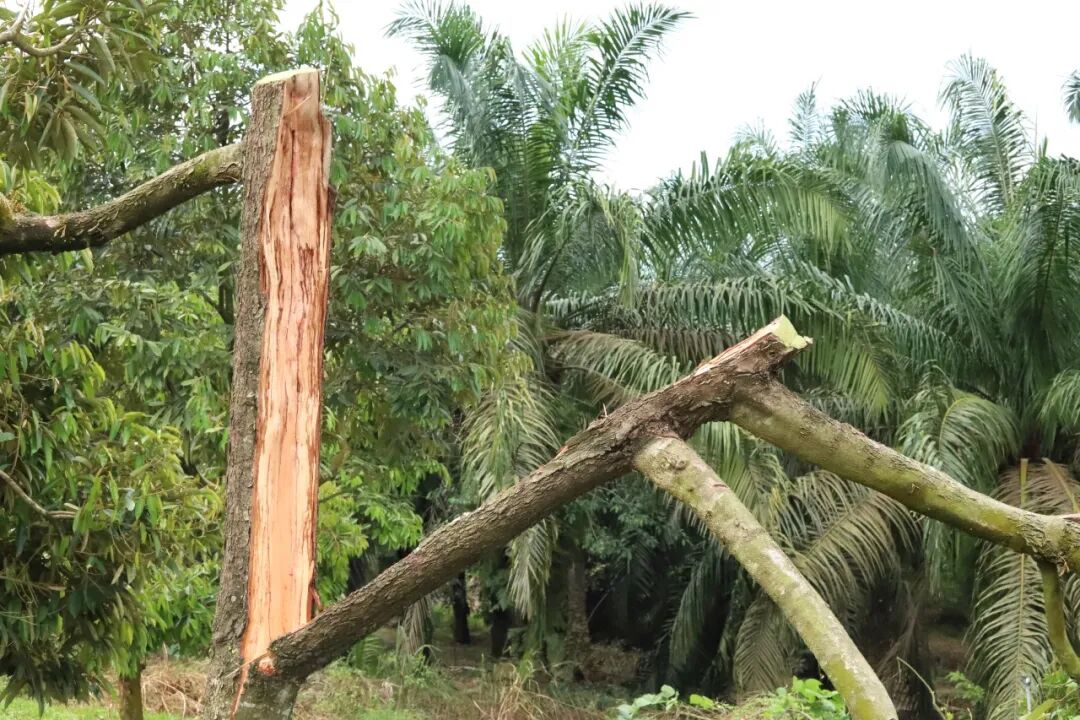
◉A durian tree split in half by lightning.
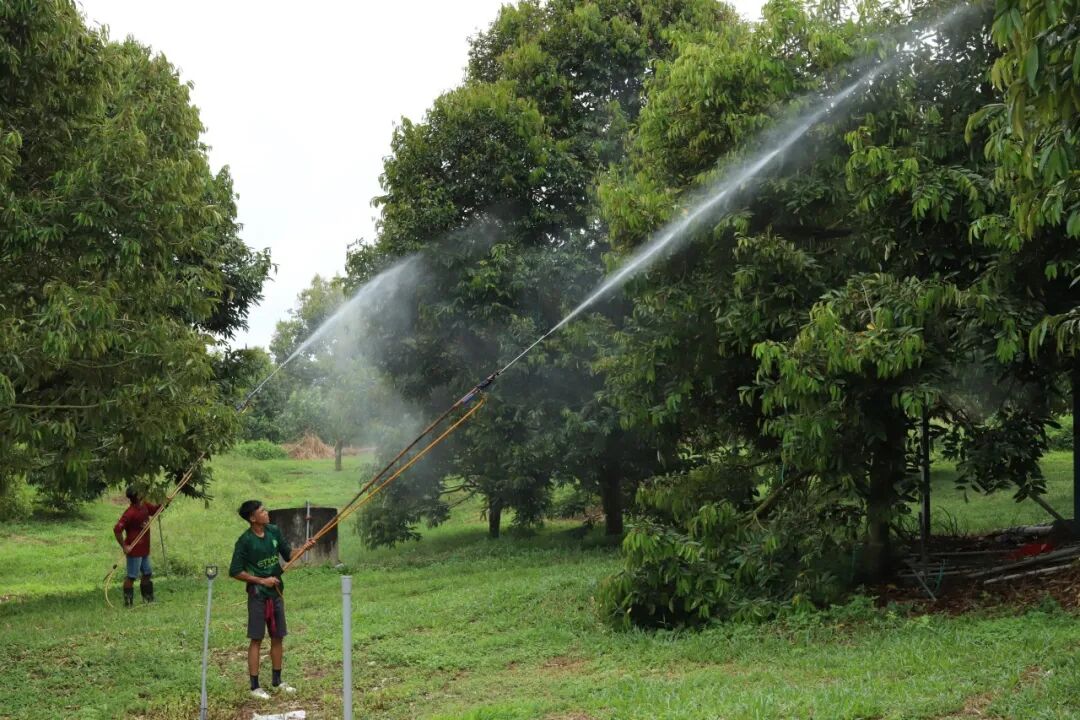
◉An Indonesian migrant worker spraying pesticide in a durian orchard.
These fruits are inexpensive, yet the flavour is hardly compromised. They fail to command premium prices mainly because they lack a recognisable brand, and their sweetness and aroma lack consistency. Markus says that neither he nor his visiting Chinese friends are particularly invested in these native varieties. When we remark that we won’t be able to eat our way through them and worry about waste, he reassures us that won’t be an issue: “they’ll all be turned into durian pulp later on.”
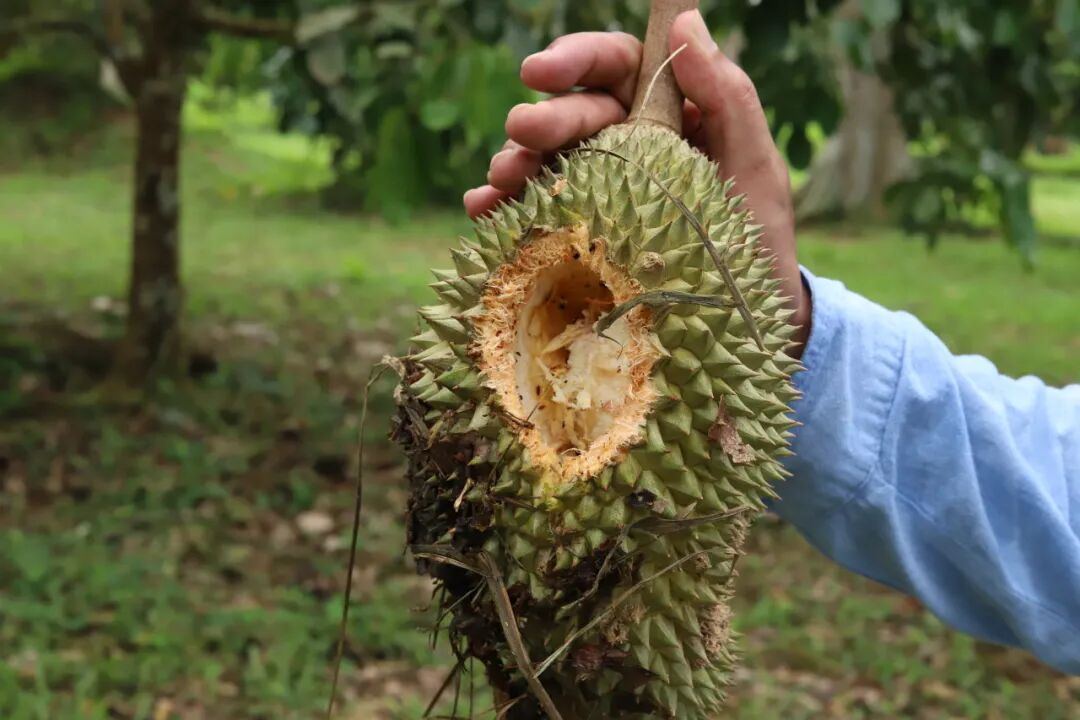
◉Local native durians.
The peeled flesh is frozen and exported to China, where Malaysian frozen Musang King pulp can be purchased on e-commerce platforms such as JD.com. While many argue that frozen durian falls short of the fresh fruit in both flavour and texture, I find it has a wonderfully smooth, ice-cream-like consistency. Only whole, unblemished A-grade fruit qualify for flash-freezing in liquid nitrogen; any with splits or cracks are deemed unsuitable for export.
He gave us a tour of the cold storage facility. I hadn’t stood inside for long before I was shivering from the cold. Stepping back out, my glasses and camera lens were coated in a thick layer of condensation that took several minutes to clear. Markus retrieved two durians from the freezers—a Musang King and a Black Thorn—still in their pre-export condition. I knew that in China, each could easily fetch around a thousand yuan, yet here they lay scattered casually on the floor.
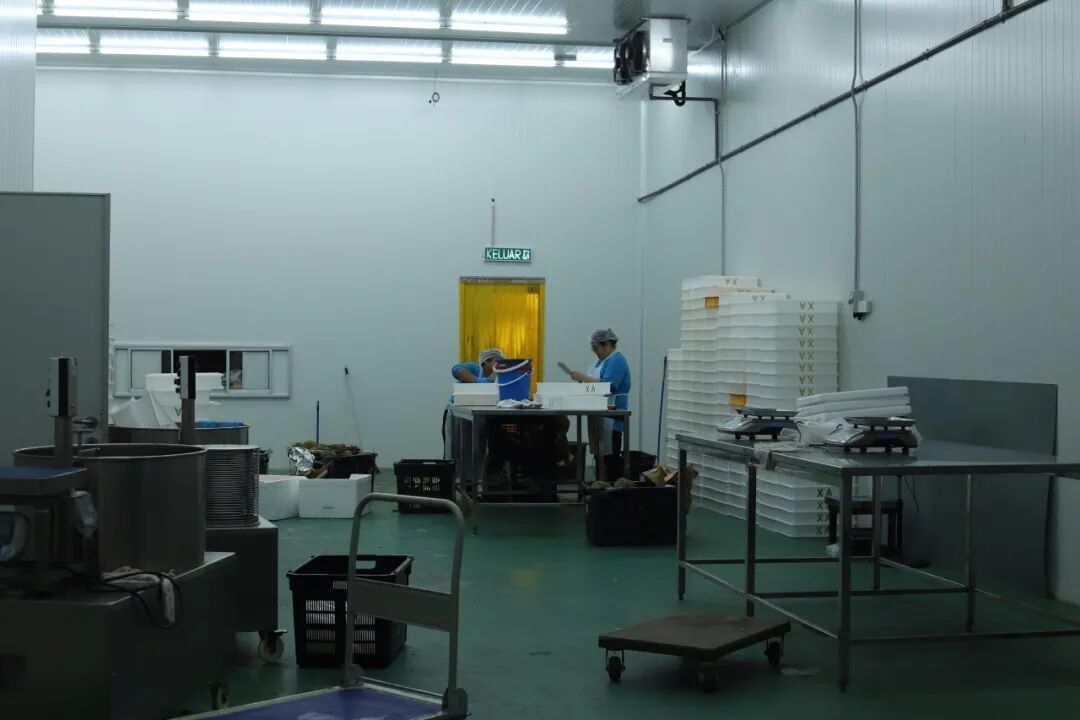
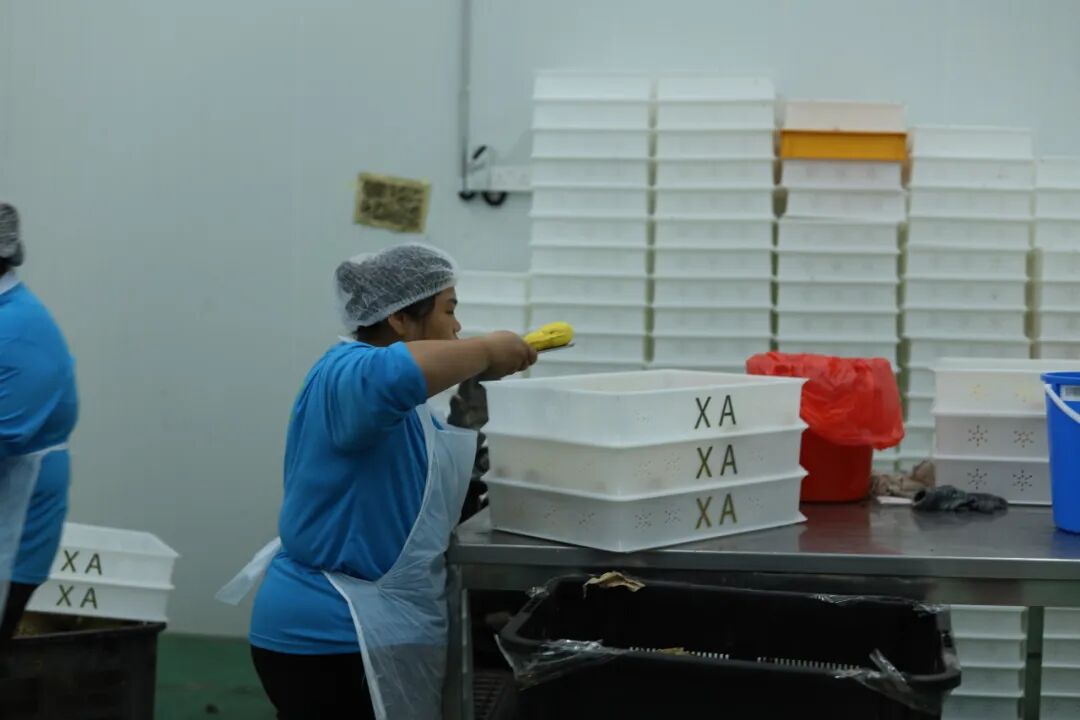
◉Workers processing durian flesh.
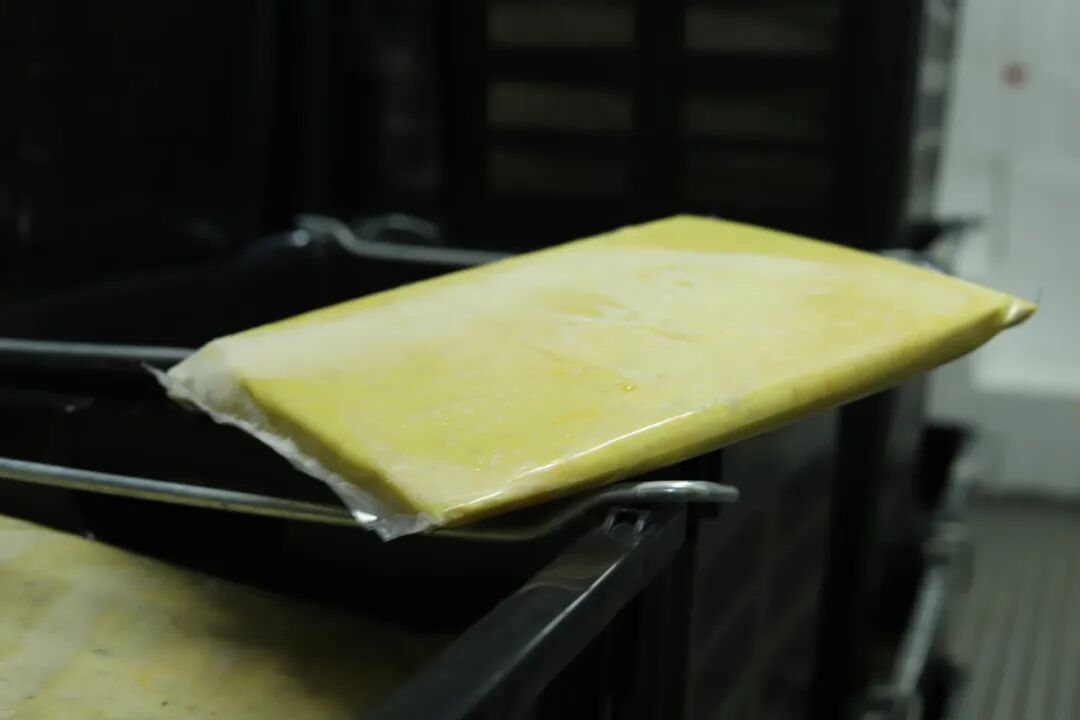
◉Frozen durian pulp.
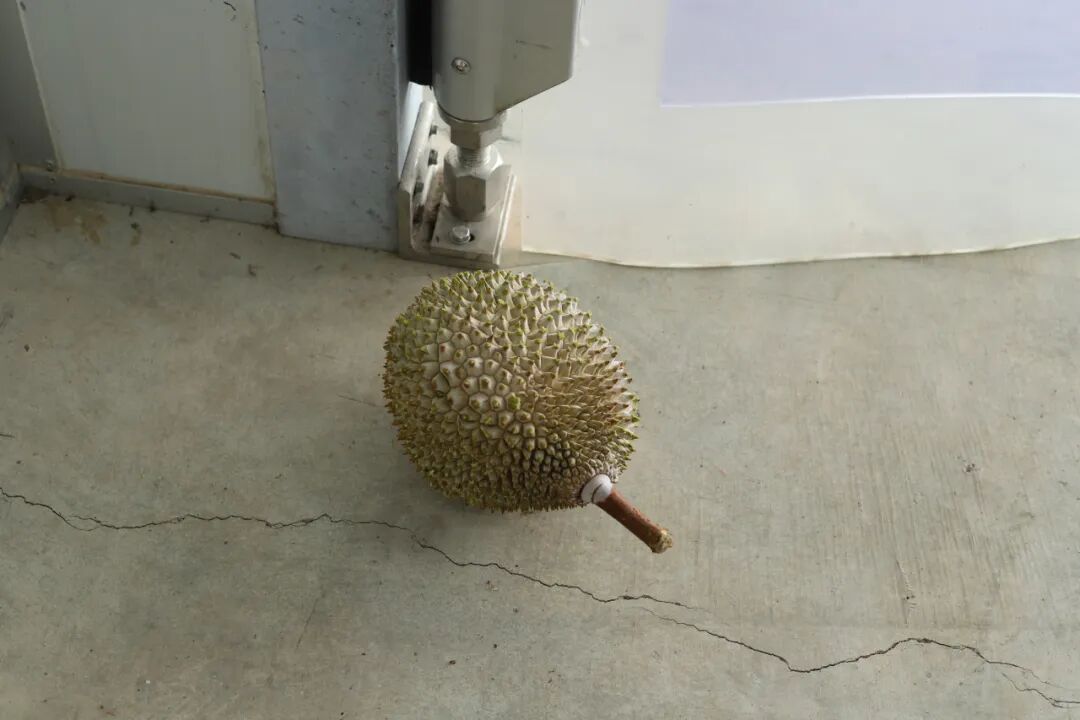
◉Liquid-nitrogen-frozen durians on the factory floor.
The Financial Market for Durian
From the modern LKE campus to smallholders’ orchards, and on to the hardworking Chinese buyers, each player operates at their own rhythm, collectively driving this fruit to market.
If we had visited Malaysia a month or two earlier, in July or August, we would have arrived right in the middle of the harvesting season, when the entire supply chain would be in full swing. A Chinese buyer told us that during peak season he covers four to five hundred kilometres a day visiting orchards, simply to secure a reliable supply of A-grade durian. The A-grade fruit favoured by Chinese consumers promises visible quality: a flesh yield of over 30%, a thin husk packed with generous pulp, and a consistently neat shape.
Yet the value of durian extends beyond fresh fruit and frozen pulp. It also encompasses the promised long-term financial returns of investment.
In retrospect, our first durian meal at LKE on day one was not a routine fruit-tasting session, but an investment presentation for durian.
Tom, the Chinese Malaysian presenter and “investment advisor”, is a compact man, but he speaks fluent English and Chinese. In keeping with local norms, he also handles Bahasa Malaysia and a southern Chinese dialect with ease. This linguistic advantage lends him a natural confidence; before an audience of two or three dozen, he addresses them with a steady smile, speaking smoothly and persuasively. To roll out the group’s latest venture, he made the special journey from the Kuala Lumpur office to the durian orchard. The company had invited seasoned investors to gather for a durian feast, ostensibly as a token of appreciation, but in reality to pitch a new investment scheme.
Much of the presentation revolved around durian investment. The schemes are split into two broad categories: buying into an entire tree, or committing a set sum of money.
In 2020, LKE developed its inaugural project in Pahang, the heartland of Musang King durian cultivation. These early schemes accommodated smaller investments, starting at 5,000 Malaysian ringgit (roughly 8,200 yuan) with a 15-year contract. According to LKE’s investment advisors, investors in the early projects had to wait three to six years before seeing returns, as it takes approximately seven years from planting a sapling to produce market-ready fruit. In the latest schemes rolled out in 2024, each tree stands as an individual investment unit. Investors must commit a minimum of 28,000 ringgit (around 45,000 yuan) per purchase, with a 12-year contract. The notable difference is that whole-tree investments start generating returns in the second year.
To treat a single fruit as a multi-decade asset is to place a bet on China’s appetite remaining insatiable. That is precisely what everyone along this supply chain is counting on. The surging Chinese demand for durian is the opportunity that growers in Malaysia, and across Southeast Asia more broadly, have latched onto.
What if Chinese consumers lose their taste for durian one day? Lin offered a reassuring perspective on the domestic durian trade, noting that the majority of Malaysia’s durians are still sold locally and have yet to enter the export market on a large scale. To put this in perspective, Malaysia cultivates durians across roughly 90,000 hectares, producing around 500,000 tonnes annually, yet exports account for less than 10 per cent of that total. While China’s import policies are rapidly driving Malaysian investment in the sector, and wealthy Singapore remains a key export destination, 90 per cent of the country’s fresh fruit actually stays at home. Locals remain the most avid consumers, and Malaysia has consistently ranked as the nation with the highest per capita durian consumption worldwide.
– This is Foodthink’s 828th original article –

Foodthink
Author
Wu Bingcong
Journalist, loves Malaysian durian

Foodthink
Author
Liu Yi
Loves Black Thorn durian
About the Lianhe Creation Project
To understand the current state of food and agriculture, and to encourage wider exploration of the complexities behind food and farming issues, Foodthink partnered with several charitable and media organisations to launch the Lianhe Creation Project across 2024 and 2025. The initiative supports media creators and researchers in conducting investigations within the food and agriculture sector, providing funding to help them produce public-facing content.
Following several rounds of interviews with the selection panel, the Lianhe Creation Project supported 18 creative projects in 2024 and 20 projects in 2025. To date, several of the funded works have been completed and made publicly available:
Cleaner Amei Wants a Proper Meal | The Worker’s Table
In Malaysia, Chinese Buyers Only Want A-Grade Durian
“Fake Meat” Drives Out Real Meat: Herders, Dinner Tables and the Amazon
Guaranteed Sweet Watermelons, Guaranteed Bitter Growers
Malan in Shenzhen, Without a Dining Companion
Why Has the Sweetness of Childhood Disappeared?
Why Guizhou Can’t Live Without Sour Soup, and Sour Soup Without Guizhou?
Who Drove the Local Markets Away?
Will Fresh Food E-commerce Make Local Markets Disappear?
When Drones Become New Farm Tools: Who Defines “Scientific Farming”?
Photography: Liu Yi
Editor: Auntie Xiong
Layout: Xiao Cun
Scan to tip and support original food journalism.
▼

▼
Click the image to read related articles
▼
Click on a keyword to explore more articles
Seeds|Farming Techniques|Policy|Fermentation|Nutrition|Fruit|Fisheries|Events|Recruitment|Takeaway|Wet Markets|Livestock|Food Talk|Sharing Sessions|Book Clubs|Harvest Festival|Smallholder Stories|Climate Change|Rural Development|Cooperative Economy|Urban Farmers|Food Safety|Digital Technology|Biodiversity|Pandemics and Food|False Solutions|Agroecology Internship Programme
Beijing|Hebei|Shanghai|Guangdong|Guangxi|Henan|Sichuan|Jiangxi|Xinjiang|Shaanxi|Hong Kong|Chongqing|Zhejiang|Jiangsu|Guizhou|Northeast|Taiwan|Inner Mongolia|Philippines|Canada|Russia|Mexico|Italy|US|UK|Germany|Netherlands|Thailand|Sweden|Japan