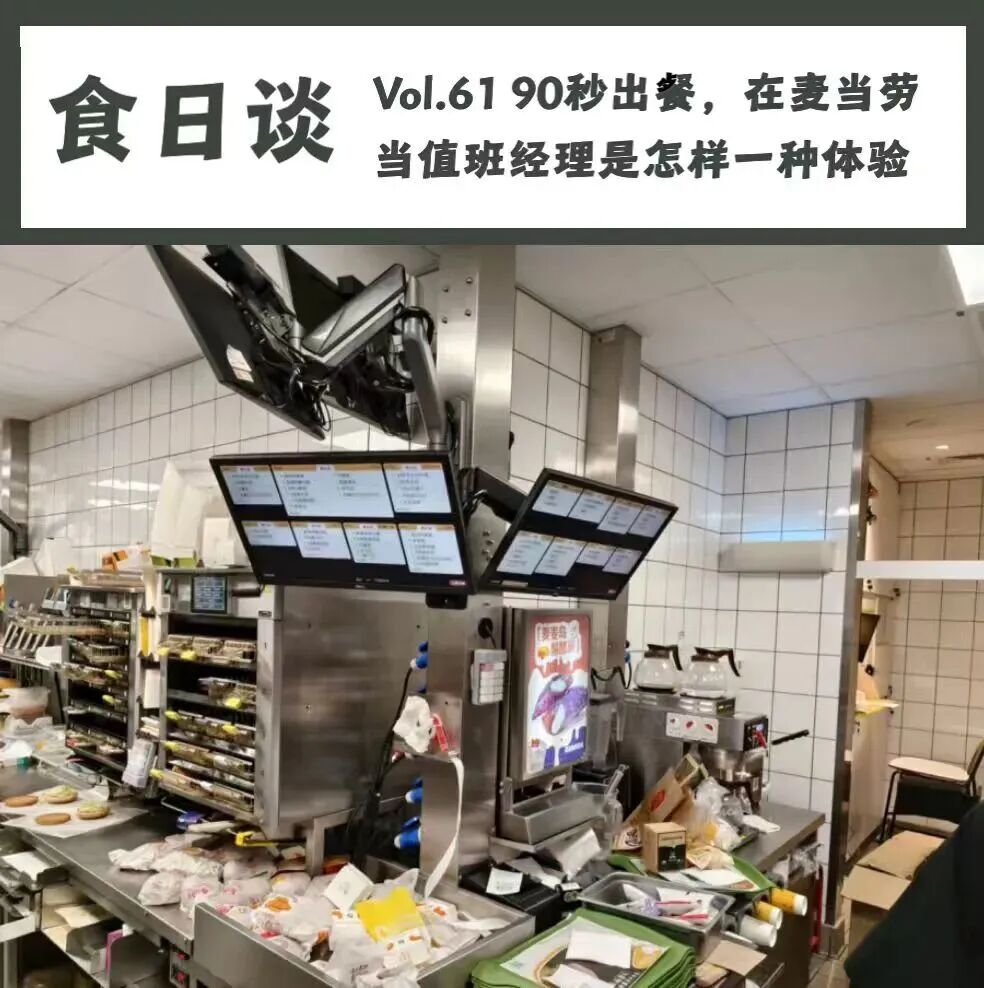
From Scheduling Experts to Shared Store Managers: How McDonald’s Turns People into the System’s “Flesh and Blood”?

Foodthink says
If the previous part took us inside the McDonald’s kitchen, revealing a high-speed mini-factory operating in 90-second intervals, this instalment will explore how that factory is managed and maintained.
From price anchoring in combo meal design to ever-shrinking store footprints; from Scheduling Experts and Shared Store Managers to intelligent systems that attempt to predict everything, McDonald’s is pursuing maximum efficiency through a highly refined operational framework.
Yet within this system, human beings remain the most significant variable. Standardised processes, digital tools and KPIs integrate every employee into the structure, yet they cannot entirely substitute for experience-based judgement or on-the-spot problem-solving.
This article is adapted from the 61st episode of the Food Talk podcast. We continue our conversation with Jiang Ke, a former McDonald’s shift manager, to explore the business logic behind a serving of fries and a staff roster. We examine how, within an efficiency-driven fast-food system, workers are calculated and managed, and how they navigate coexistence with the system. As consumers, every quick order placed and every meal collected on time is underpinned by the countless labour woven into this vast network.
THIS / EPISODE’S / GUEST

Jiang Ke|F&B newcomer with a passion for analysing store staff, food and operations; regularly watches Yong Ge’s videos to go with meals
This Episode’s Hosts

Yu Yang|Foodthink editor, once got a “good hiding” as a child for insisting on McDonald’s

Li Ye|An ADHDer who’s played Airplane Chef on the iPad, worked a virtual shawarma stand, and run a breakfast shop
Large, medium or small fries – which size should I go for?
Yu Yang: While working there, were you ever made aware of the cost of McDonald’s ingredients?
Jiang Ke: Actually, as a shift manager you’d already have access to the cost prices for all the ingredients. They’re consistently low. Just pick a single menu item you like to eat as an example.
Li Ye: Fries.
Jiang Ke: Fries are actually quite tricky to pin down, because the amount each team member scoops tends to vary. The official standard is just to pack them until there’s no visible empty space left in the bag. But in reality, if you stick to that, the portion the customer receives is actually quite small.
Li Ye: Now we’re getting to my favourite question: large, medium, or small fries— which one actually gives you the best value?
Jiang Ke: If you order them separately, they’re quite poor value. If the menu price is 12 or 14 yuan, the actual ingredient cost is only just over one yuan. So purely on food cost, it’s very low. But if you get them as part of a combo, the price works out to around seven or eight yuan per serving of fries, which is relatively better value.
Li Ye: So, is there actually much difference in portion size between the large, medium, and small fries?
Jiang Ke: It really depends on how each person scoops them. Especially with student part-timers, they’ll keep piling fries into the bag until it’s overflowing. A lot of shift managers will look at it and think, “Good grief, that’s enough for two portions.”
Yu Yang: That really turns my assumptions on their head. I always pictured McDonald’s as a place of absolute standardisation. I figured you’d only find that kind of shaky-portioning from the aunties and uncles in small takeaways or university cafeterias. I never expected to hear about such inconsistencies at McDonald’s.
Jiang Ke: Exactly. In reality, there are strict standards for how much goes into each bag of fries and roughly how much weight each ice cream scoop should be. But it all comes down to staff training. If the training hasn’t quite sunk in, employees will just think, “I’ll just pack this bag until it’s full,” or “I’ll keep scooping the ice cream until the lid won’t shut.”
Li Ye: Fair point. I suppose we should be grateful to university students, then.
From a Single Burger to a Four-Piece Combo: McDonald’s Pricing Psychology
Yu Yang: Let’s get down to a more practical question: how can we order at McDonald’s to get better value for money?
Jiang Ke: At McDonald’s, it’s best to avoid ordering à la carte—it’s simply too expensive. Take a burger for example: that chicken burger might be 22 yuan, a cola 10 yuan, and fries 12 yuan. Those three items alone add up to 36 yuan. In reality, very few people order individually; most go for combo meals and feel like they’re saving a lot. Taking the three-piece meal I just mentioned, if you order it as a combo and add some chicken nuggets, it’ll still only be in the 30s. But you’ll think, “Nuggets on their own cost 12 yuan, so I”ve basically saved over ten yuan out of thin air!’
In essence, it’s about inflating individual prices to make combo meals feel like a bargain, thereby boosting order volume. This is a key psychological concept: price anchoring. Many chain restaurants use similar single-item markup strategies to drive sales. Maybe you only wanted a burger for around 20 yuan and just a quick sip of cola, but ordering them separately already costs 30 yuan. Why not just add a few extra yuan to get a four-piece meal instead, right?
Secondly, if you’re genuinely eating there every day, buying the McCard is still worth it. If you only go occasionally—say, once a week—but still want access to a wider selection, I’d suggest an unofficial workaround: have someone place your order directly through Xianyu or Taobao, so you can pick up the McGold Card pricing.
Li Ye: Furthermore, this price anchoring effect also boosts customer satisfaction. When people order set meals, everyone’s happy: the producers make money, and consumers feel they’ve got a bargain.
Yu Yang: A while back, McDonald’s “Sui Xin Pei” (Pick-Your-Own) combo had a price hike. The Double Cheeseburger and Filet-O-Fish are now 14.9 yuan.
Li Ye: Some people have joked that McDonald’s ought to start selling macarons instead, given how small the burgers are now. Others say the meat patties feel thinner than before. Is any of this actually true?
Jiang Ke: I’m not entirely sure about this latest round of price hikes, as I’ve already left the company. But from what I know, the patties are actually all identical. Whether it’s the meat in a Double Cheeseburger or a Big Mac, it’s the same type of beef, cut to the same thickness. If people feel they’ve gotten smaller, it might be because the suppliers made them smaller from the outset; that’s a possibility I’d guess at. But there’s another, more likely explanation: they’re being discarded under the Golden Quality Standard (a freshness discard policy where burgers are thrown away if unsold after ten minutes, and fries after seven). Fresh off the grill, the patties are at their largest, but they shrink as they sit in the warming cabinet. As the moisture evaporates, the meat darkens or dries out, causing it to shrink.
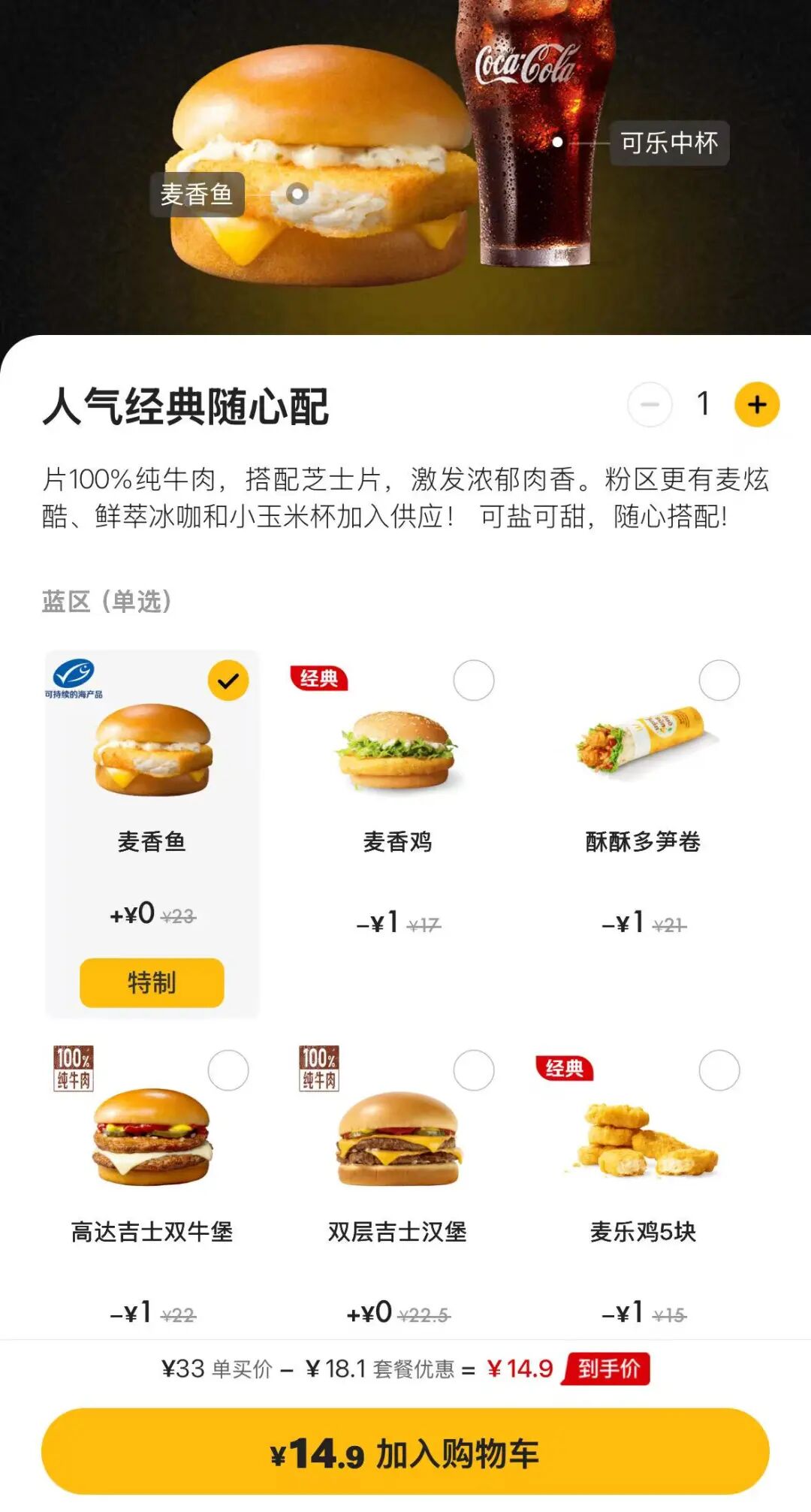
◉The Pick-Your-Own combo, now priced at 14.9 yuan.
Yu Yang: I think it used to be 11.9 yuan years ago, then it went up to 12.9, then 13.9, and now it’s 14.9.
Jiang Ke: Right, the Pick-Your-Own combo is essentially McDonald’s cheapest meal deal. If you order a Double Cheeseburger à la carte, it’s 23 yuan, isn’t it? But with the combo, it’s only 14.9, so it still sounds like quite a bargain.
Li Ye: I know exactly why I used to think a single Roasted Chicken Burger was enough to fill me up when I was a kid: I was small, my stomach was small, so one was plenty. Now that I think it’s gotten smaller, it’s probably partly because it actually has shrunk, and partly because I’ve grown up.
Why don’t McDonald’s have toilets anymore?
Li Ye: I’ve also noticed in recent years that a lot of McDonald’s branches have done away with their toilets, so you end up having to use the public ones in office blocks. Is that another cost-saving move?
Jiang Ke: Yes, people used to picture McDonald’s as, “Wow, this place is huge, there are loads of seats, and it”s so clean.’ Because the chain now needs to reach lower-tier markets and open more outlets, its positioning has shifted. It’s gone from that flagship feel to being more of an everyday necessity, so store sizes are being scaled down accordingly. A branch used to cover five or six hundred square metres for the dining area and counter combined, but now it might just be over two hundred.
If a shop is too small, there’s simply no room to fit a toilet, and for locations that do have them, keeping them open means dedicating more staff to cleaning. If they aren’t cleared regularly, customers will complain. On top of that, McDonald’s has strict standards for toilet maintenance: they need to be checked at least once every 15 minutes, which places a fairly high demand on staffing. So doing away with toilets is just another part of the drive to cut costs and boost efficiency.
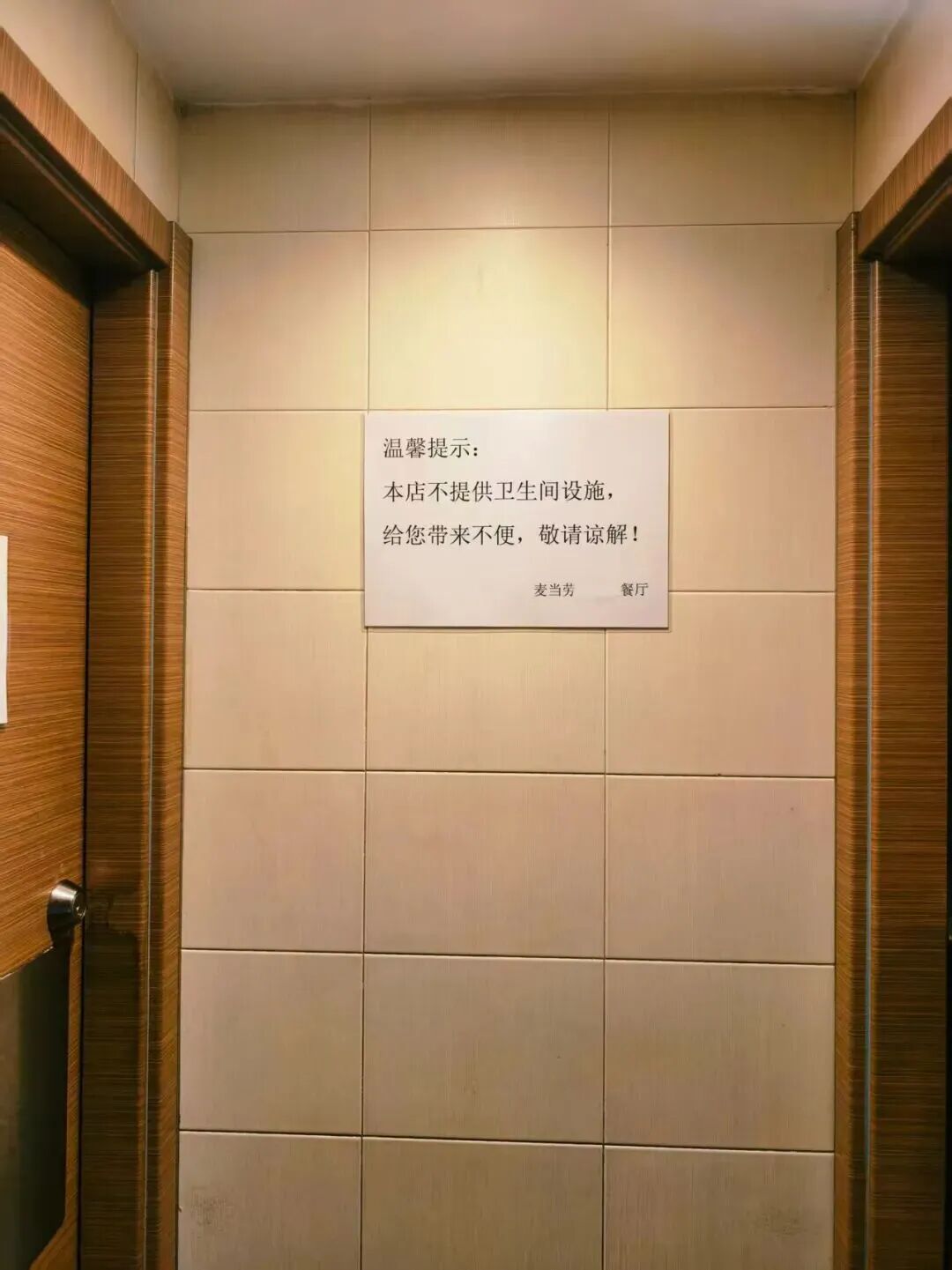
◉Some McDonald’s branches used to have public toilets but no longer do. Image source: Jiang Ke
More stores, fewer store managers?
Yu Yang: Who is responsible for staffing McDonald’s stores during peak hours?
Jiang Ke: Staffing at McDonald’s is quite complex. Beyond the shift managers, there are full-time employees, and beneath them, a whole layer of part-time staff. It’s a highly intricate workforce structure.
McDonald’s has a role known as the “Scheduling Expert”. We draw up the roster once a week, and all staffing arrangements are adjusted based on sales—specifically, scheduled according to the projected figures for each time slot across each day of the coming week. For instance, if we forecast tomorrow’s sales at 20,000, we calculate the required labour hours from that, say 150 hours. After accounting for the shift manager on duty and the full-time staff on fixed shifts, we figure out which part-timers are available. Different time slots will obviously require different setups. Take the midday hour: if projected sales are 3,000, that 3,000 needs to be matched with 3,000 labour hours. It’s essentially a direct mapping: sales dictate labour hours, which in turn dictate the mix of full-time and part-time staff.
So for a store, the variable is revenue. You can use historical data to forecast sales, but it’s actually very hard to predict accurately, especially when unexpected events occur. For instance, if a nearby school holds a sports day, that kind of thing happens quite often. Moreover, the labour productivity forecasts are based on the assumption that one person will do more than one person’s workload; there’s a concept called the labour productivity ratio. It dictates that one person should handle the work of about 1.1 or 1.2 people, and that’s the minimum standard. Even if one person just does one person’s share of work, the standard is still set by the system, and it’s hard to say whether that benchmark is set too low or too high.
Li Ye: You could refer to the 90-second service time standard.
Jiang Ke: Yes, it’s a crucial metric for the entire restaurant’s operations and is tied to bonuses and other incentives.
Yu Yang: Then, when you’re too busy to cope during peak hours, have you ever requested additional staff?
Jiang Ke: Yes, we have. If we’re swamped during peak hours, I can say, for example, “I need more people tomorrow, or next Friday,” and feed that back to the Scheduling Expert. They’ll then adjust the roster based on whether your revenue actually justifies the extra demand.
Yu Yang: How is the turnover for part-time staff? Do they tend to stay fixed at one store, or do they shuttle between several locations?
Jiang Ke: Currently, they’re pushing a shared staffing model. It’s not just part-timers; full-time staff can also be shared across a few nearby stores. If those stores assign you to move over, you have to go. For example, if a new outlet opens and is still short-handed, nearby locations will provide staff support.
It’s not just regular staff, either; managers and higher-level executives are part of this sharing arrangement too. Within McDonald’s system, this shared concept is called NGO – a shared staffing model for store managers and employees. How does it work in practice? Previously, each store had its own Store Manager. But with McDonald’s rapid expansion over the past few years – for instance, its target to open 1,000 new stores in China by 2025 – I initially thought that meant thousands of new Store Managers. I figured their management trainee programme must be quite robust, so I joined. But I ended up discovering that the number of Store Managers had actually shrunk even further. One manager is now expected to oversee several stores. This is the shared Store Manager concept, and their title has been upgraded to “Super Manager.” More stores, fewer managers.
Yu Yang: Has there been any change in terms of salary?
Jiang Ke: Rumour has it you get an extra 1,000 or 2,000 yuan for each additional store you oversee. Managing a single store probably paid just over 10,000 yuan originally. But it varies by region.
Li Ye: When cutting the number of “Store Manager” roles, did they create new positions at the lower levels to take on some of those former responsibilities? After all, a Super Manager has to oversee multiple stores simultaneously.
Jiang Ke: So it involves adjusting every tier within the entire NGO structure. A Super Manager has to oversee several stores, which means they simply can’t handle everything one manager used to. Those duties have to be pushed down to other management levels in the store. Below the Store Manager are the monthly-paid managers, who now take on more tasks that were previously the Store Manager’s responsibility. The work the monthly-paid managers used to do is then pushed down another level, meaning shift managers (hourly-paid managers) have to shoulder a portion of it. Ultimately, everyone’s workload has increased.
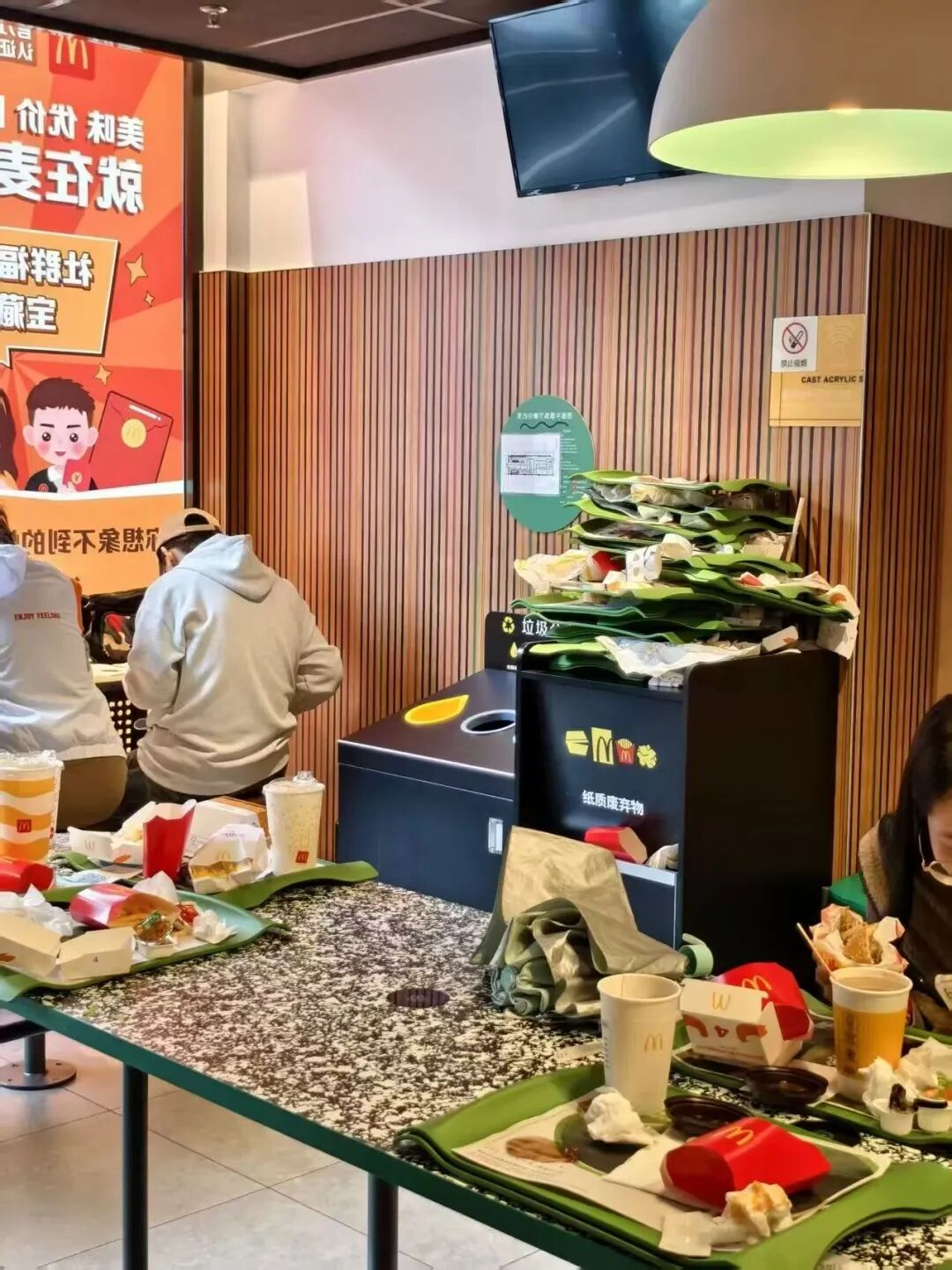
◉These days, plates on the waste bins at McDonald’s pile up more easily than before. Image credit: Jiang Ke
Yu Yang: At its core, it’s still a cost-cutting and efficiency-boosting strategy, targeting mid- and senior-level roles for reduction. Since store managers naturally command higher salaries, cutting their numbers and shifting the workload onto lower-paid shift managers drives down overall costs.
Jiang Ke: Yes. If you open a new store and hire a manager, the salary could be around 10,000 yuan. But if an existing manager covers an extra store, you only need to pay them an additional 1,000 or 2,000, and the place still runs, saving on labour costs. Take scheduling, for instance. Previously, each restaurant handled its own shifts. But management realised that dedicating a role to scheduling in every store was too costly. Now, for a region of about 20 stores, they appoint a Scheduling Expert. On paper, it seems like a labour-saving measure. In practice, however, this expert cannot schedule shifts based on individual staff traits; they can only rely on system data. As a result, the generated schedules rarely align with the actual operational needs of the restaurants.
Yu Yang: It feels like McDonald’s is taking an operations research approach, trying to maximise efficiency and profit through top-down optimisation. But in day-to-day operations, once the Scheduling Expert has set the roster, don’t you still have to readjust it at store level? That could even end up wasting more time.
Jiang Ke: In theory, having a Scheduling Expert makes sense from a scientific standpoint. But in practice, they can only build rosters based on the tags attached to each employee in the system. The system logs which courses a staff member has completed through McDonald’s training platform—say, preparing beverages, cooking fries, or assembling burgers—and treats that as proof of competency, allowing the Scheduling Expert to assign them to those stations.
McDonald’s expects new hires to complete training for four or five basic stations within just ten days. In reality, that’s highly unlikely, particularly for part-time workers. When management demands completion of the theoretical coursework, employees will simply mark “completed” in the system, even if they haven’t actually grasped the skills. This creates an information gap. The Scheduling Expert, unaware of this discrepancy, relies entirely on the system tags to build the roster, operating on the assumption that completing the training equates to full competency. In more extreme cases, this can result in a shift being scheduled where not a single person actually knows how to assemble a burger.
So that means the so-called management at each restaurant has to carve out extra time and energy to adjust the work that these experts should have done in the first place. But the system doesn’t allocate any paid hours for managers to handle this; they just have to squeeze time out of their own duties to get it done. And on top of that, this work is completely unpaid. The budget for it has already been set aside and paid to the experts, taken straight out of the restaurant’s labour costs.
Yu Yang: As you mentioned earlier, many metrics affect bonuses. Are there specific KPI targets, such as a minimum sales turnover required to earn a bonus?
Jiang Ke: Right. Bonuses are essentially a management tool, given there isn’t much else to manage you. The bonus assessment covers things like whether the restaurant meets its sales targets, along with the overall complaint rate and product waste rate. It’s all laid out in a rather detailed spreadsheet.
Yu Yang: So for you, controlling waste at the store level is quite critical. How does waste typically occur?
Jiang Ke: If stores strictly follow the Golden Quality Standard, a lot of items get discarded. For instance, fries or meat that fall outside those standards must be thrown away. In practice, however, relaxing the standards keeps waste lower. Take fries that have been sitting out for half an hour after frying: they’re completely inedible, so that portion is recorded as waste. Patties that have been cooked too long are discarded as well. Each restaurant might apply different enforcement standards. In theory, everything should be disposed of and logged in the system—recording exactly how many beef patties or portions of fries were thrown out.
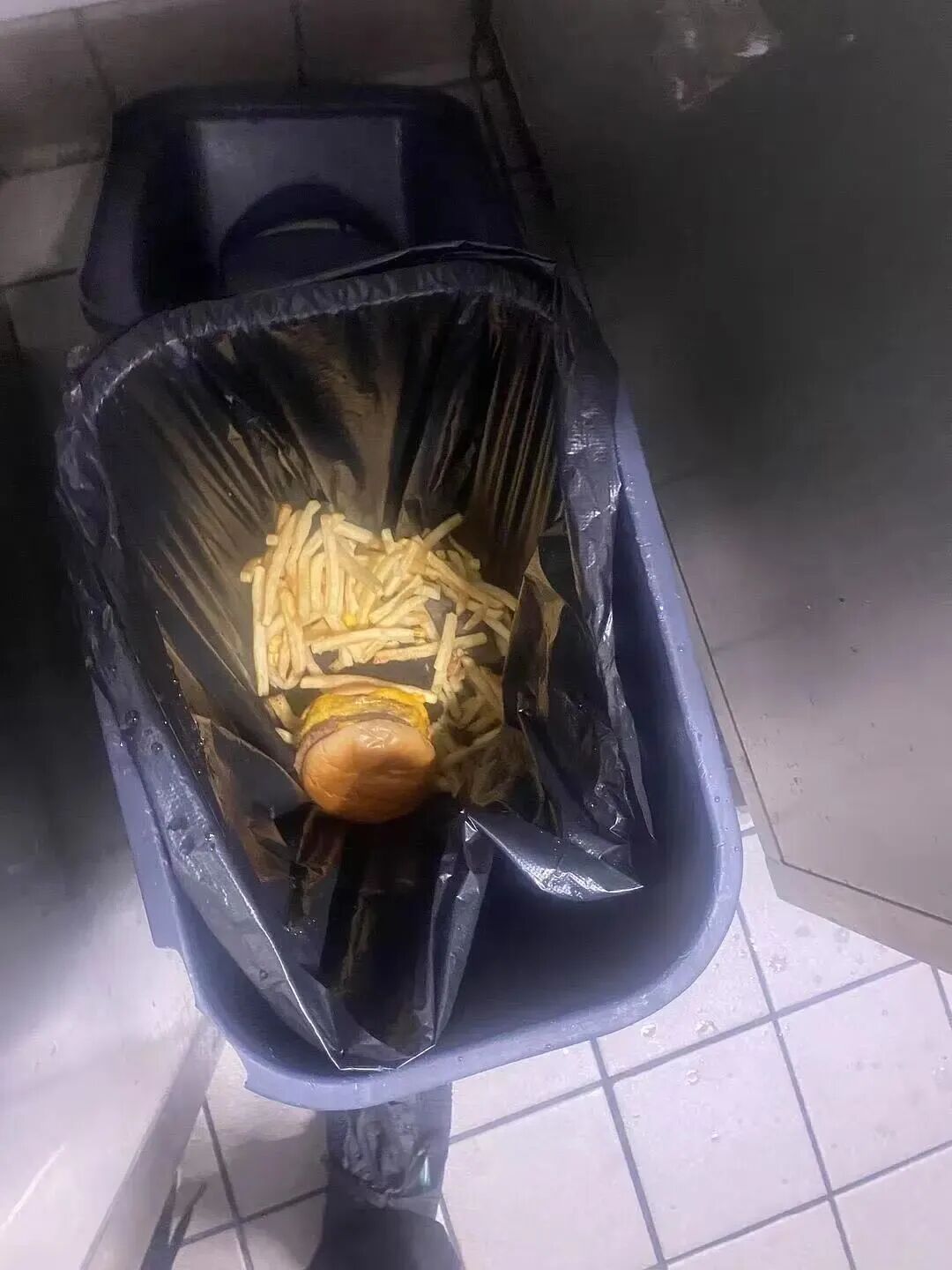
◉Fries and burgers discarded in the bin. Image source: 青苔音无
Li Ye: Would this be considered food waste? Is the amount of waste significant?
Jiang Ke: Actually, by this restaurant’s standards, daily food waste isn’t that high. It’s usually calculated in semi-prepared portions rather than complete meals—so we’re talking about discarding a few slices of meat, not whole burgers. If meat portioning is tightly controlled, it might only be a dozen patties. Fries might be higher, but this is still because we aren’t strictly adhering to the Golden Quality Standard. If we followed the Golden Quality Standard strictly, the volume of discarded food would be enormous.
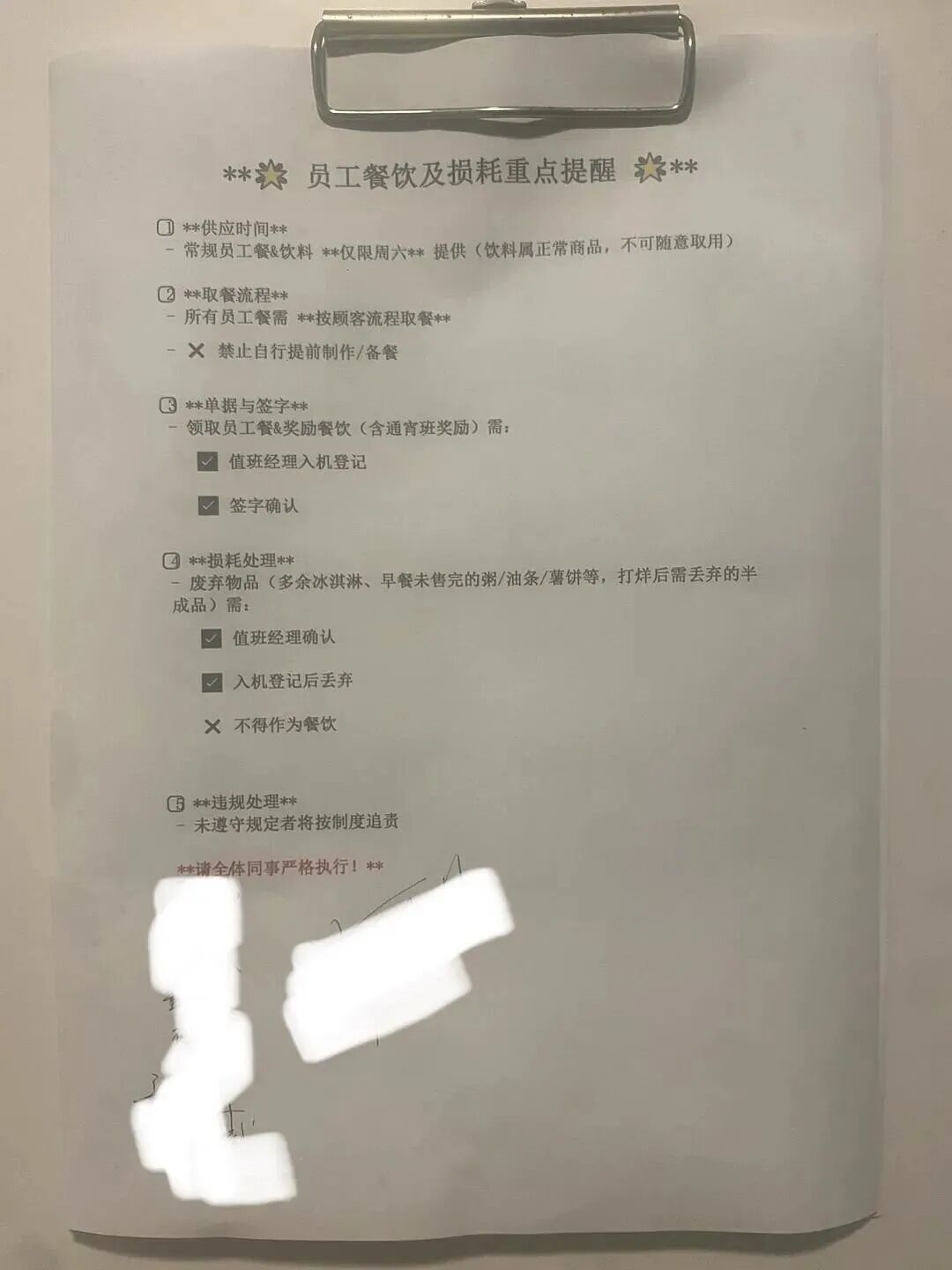
◉Strict regulations govern staff meals and the disposal of leftover food in the restaurant. Image source: 青苔音无
Yu Yang: I saw an advertorial from McDonald’s a while back about “McAgriculture,” where they invited farmers to explain their growing methods, illustrating how McDonald’s brings fresh food from farm to table behind the supply chain. But in reality, the ingredients received by stores are already semi-processed. It’s a completely different concept of “fresh” compared to traditional restaurants.
Jiang Ke: Exactly. All the vegetables are pre-sliced and vacuum-packed before delivery. And no matter how healthy they claim the ingredients were “in life,” a quick look at the ingredients list reveals a very long chain of additives used to maintain texture. Regardless of how fresh they market their raw materials or how premium they claim the potatoes are, the fries are packed with food additives.
Li Ye: So marketing the ingredients as healthy and fresh feels a bit like a bait-and-switch. How can ultra-processed foods loaded with so many additives possibly be healthy? The production method itself is inherently unhealthy.

◉An advertisement for the Regenerative Agriculture Initiative on a McDonald’s tray.
Yu Yang: But I find this quite contradictory. On one hand, we resist pre-prepared meals, showing a desire for fresh food. Yet on the other hand, we readily accept ultra-processed products like McDonald’s. It seems we hold two distinct attitudes towards food.
Jiang Ke: I suppose it comes down to a trade-off between flavour and efficiency. Cooking at home daily takes a considerable amount of time, whereas with McDonald’s, you can pick up your meal in 90 seconds. That’s incredibly convenient. In a way, that’s one of the wonderful aspects modernisation brings.
Are McDonald’s smart systems really smart?
Jiang Ke: When it comes to modernisation, McDonald’s has plenty of smart systems, but in practice, I’d say they’re only of limited use. They have a digital forecasting tool called the Smart Production System, which every store is equipped with. Every 15 minutes it generates a forecast, estimating sales volume for the next 15 minutes and predicting what customers are likely to order, so staff can prep food in advance. For example, if the system predicts someone will order a spicy chicken burger in the next 15 minutes, my storage should already have a chicken patty ready for it. But as we know, all these information systems lag behind real-time conditions, and their projections are modelled on a larger headcount. The system might assume the store has five people on shift and run its simulation accordingly, but in reality there might only be two. Trying to meet those forecasts then becomes very difficult.
So it sounds like the system is quite expensive, but as far as I know, none of the stores actually use it. Everyone just relies on their own experience. Staff will ask the manager how many chicken patties need frying, the manager’ll just do a rough estimate – “fry three, then” – and won’t bother consulting the system for work.
Alongside the Smart Production System and the scheduling system, McDonald’s has plenty of others, such as the ordering system. The idea behind rolling out these standardised systems is to lower the skill threshold for staff and cut down on manual workload. But in practice, the systems aren’t particularly user-friendly to begin with, the forecasts aren’t that accurate, and the standards aren’t strictly enforced. If there were dedicated personnel monitoring whether staff were actually following the Smart Production System, backed by a rigorous oversight framework, they’d probably see much wider adoption.
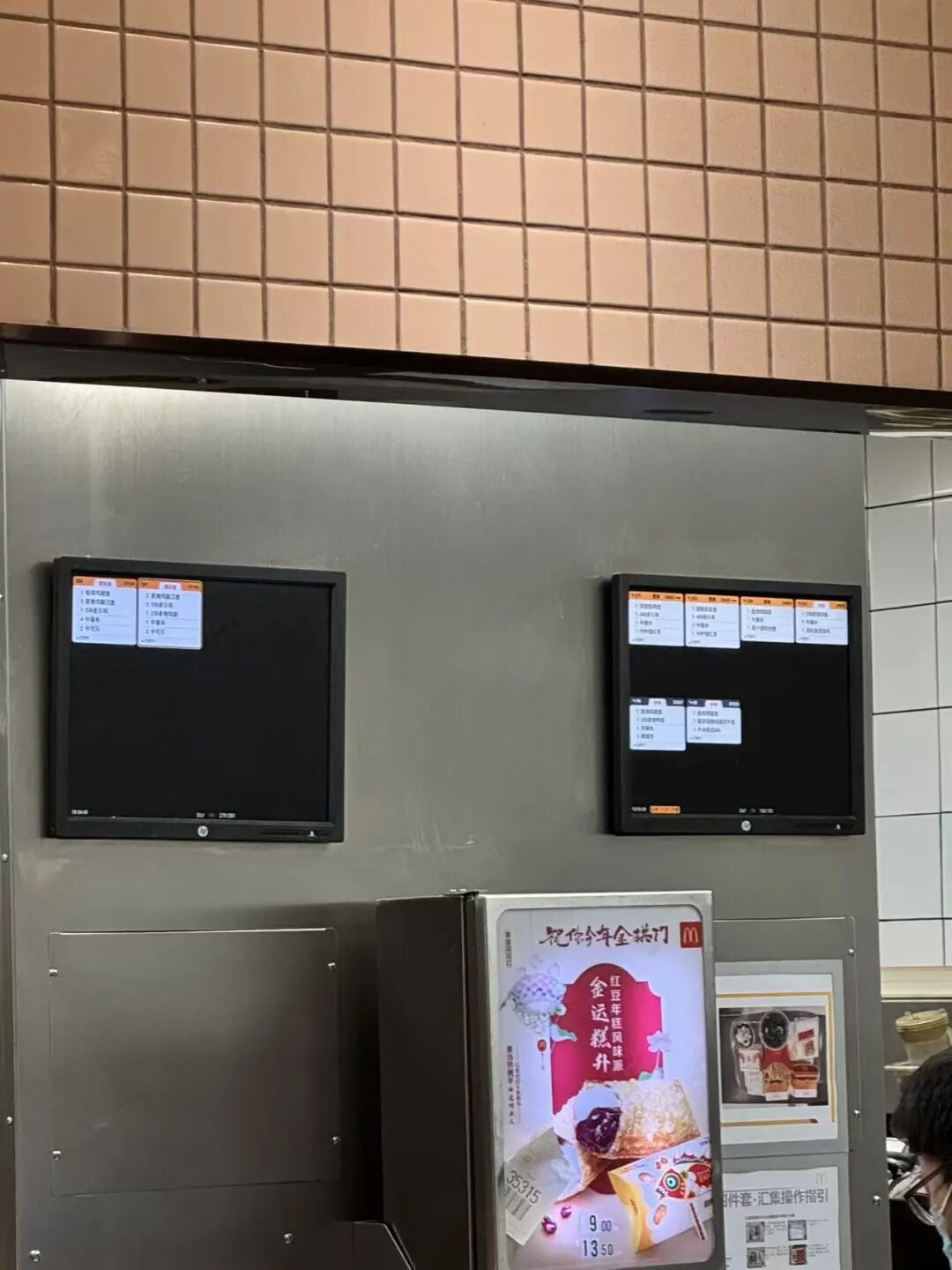
◉The two dashboards McDonald’s staff need to monitor: Mcdelivery on the left, and dine-in and takeaway on the right.
Li Ye: It’s as if the system slots everyone into their designated role. Managers have to learn the Smart Production System to oversee how each staff member handles production. The person frying the chips must follow the Golden Quality Standard, which makes accountability straightforward and management easier. But ultimately, people remain the biggest variable.
Jiang Ke: Yes. The whole point of designing these systems is to remove reliance on people and eliminate these non-standardised variables as much as possible. But the reality is that every manager has their own standards. Some managers feel that chips that have been sitting out too long shouldn’t be sold, while others think they look fine and sell them to avoid waste. So it really comes down to the individuals involved. In practice, it’s very difficult to enforce completely due to cost and human factors.
Li Ye: It feels a bit like turning people into extensions of the system, or even its flesh and blood. But it seems that, for now, people are still very difficult to fully integrate with it.
Jiang Ke: That’s right. But they can still be useful in certain areas, like the ordering system, which is easier to predict and generally more practical than the others. It’s like with AI: to meet real-world standards, it requires vast amounts of data for training and constant processing, which is extremely costly. You can’t just build a system and leave it running forever; the calculation methods need constant updating and iteration to forecast the future more accurately. I suspect McDonald’s has also noticed that staff aren’t using these tools much, so investment in them hasn’t been particularly high. Nevertheless, their digitalisation process is ongoing.
Yu Yang: Actually, McDonald’s started its digitalisation quite early. I read a book that mentioned they began investing in information systems back in the 1950s, developing them in parallel with computer technology.
Jiang Ke: Exactly. McDonald’s management is genuinely advanced. It might not be proving that useful just yet, but we should acknowledge what sets it apart from other restaurants: its genuine commitment to using systems for control. Take the ordering system, for instance: if the right amount of stock is ordered, the restaurant’s operations run smoothly. So it’s definitely more efficient than relying purely on human labour, even if it hasn’t reached the level of efficiency initially envisioned.
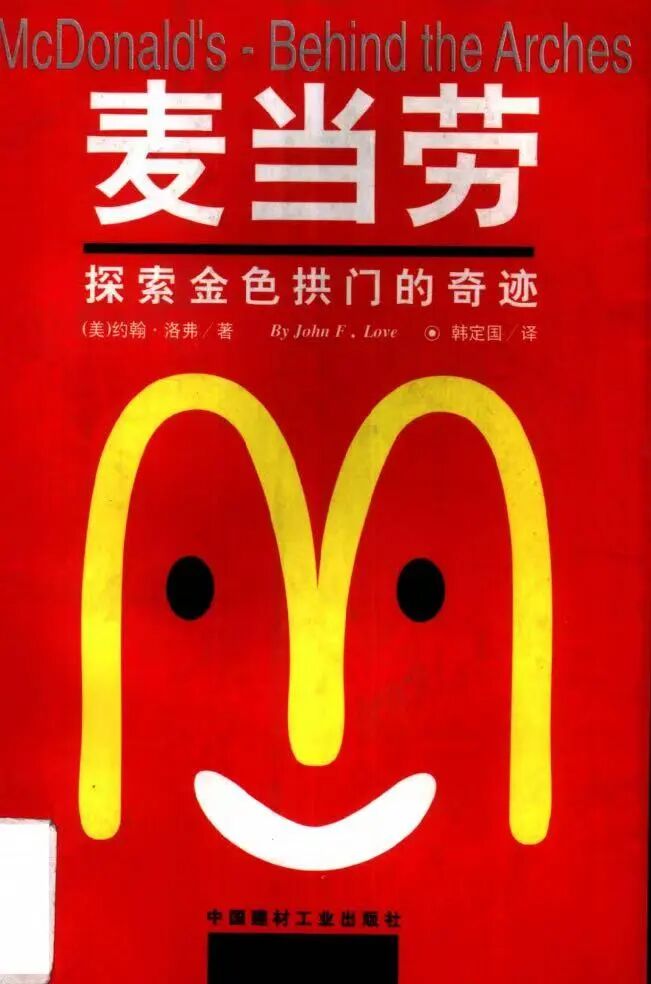
◉The book *McDonald’s: Exploring the Miracle of the Golden Arches* chronicles how the brand emerged from America’s mobile modernity, tracing its evolution from a single drive-in restaurant to a global fast-food giant.
The McDonald’s of Our Memories
Yu Yang: If it were the 1990s or early 2000s, I’d say McDonald’s was a wonderfully magical place. As a child, I’d drag my grandma along, begging her to take me there. Back then, they had play areas like the Playplace to keep kids occupied, and classmates would even hold birthday parties there. But going to McDonald’s now leaves me feeling a bit stifled. Sometimes I just go to grab a quick meal, but that actually reflects how squeezed my life has become—I simply don’t have the time to cook for myself.
And I feel many of these things are deeply intertwined. When I go to McDonald’s as a consumer and feel my own time is being squeezed, that demand for quick service inevitably passes on to the workers. They naturally face a breakneck pace and grueling working conditions.
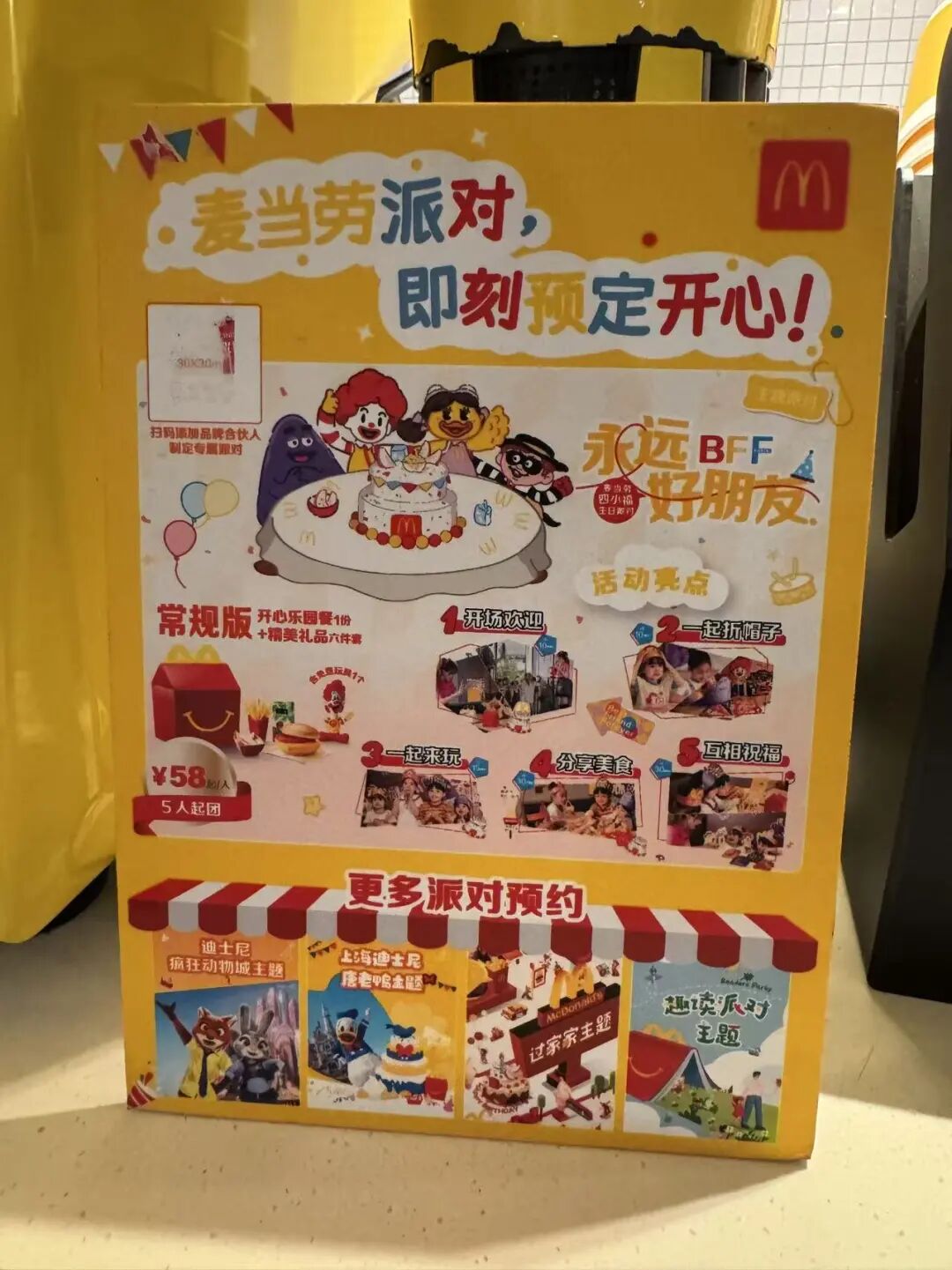
◉McDonald’s still offers birthday parties and other events today, though staff note that bookings have become rather rare.
Jiang Ke: I feel it’s a transformation for McDonald’s. It has become much more purely fast-food. That sense of companionship and community we used to have has shifted from the physical store to the internet.Online, there’s endless discussion about the McDonald’s online fandom (“Mai Men”). Whenever a new item launches, plenty of people try it, post reviews, and interact with like-minded fans. It’s become a kind of shared collective memory.
Li Ye: When I was a child, you’d see loads of people doing their homework at McDonald’s. Nowadays, everyone has a laptop or is glued to their phone—they’re on conference calls, working in sales, or pushing insurance policies. It’s basically become a third workspace. You’ll also frequently spot delivery riders slumped over tables, utterly exhausted, just waiting for their next order. Combine that with the store’s dim, yellowish lighting, and the whole place gives off a rather lifeless vibe. It practically begs you to order your food and leave straight away.
Yu Yang: When McDonald’s first arrived in places like Hong Kong or Beijing, it was really a symbol of family-oriented life. Over the past couple of years, with the rise of the Dreamcore aesthetic and the post-90s generation’s nostalgia for their childhood, McDonald’s has become a recurring touchstone for those memories. Things like the old clown mascot decorations, or those ¥9.9 vouchers from back in the day, keep getting dug up and cherished as nostalgic keepsakes.
Jiang Ke: So why do people love McDonald’s so much? I think nostalgia accounts for a huge chunk of it. Even if other burgers turn out to be far tastier down the line, they’ll struggle to match the market foothold McDonald’s holds today.
Li Ye: Exactly. And one thing I’ve always felt is that the chain fast-food model I remember was completely different from other dining establishments. You could see straight into the kitchen. McDonald’s was such an open space, and you could watch the staff working inside. As a child, I honestly thought they were robots—just constantly frying chips and wrapping burgers. Surely that kind of work had to be done by machines? Who would otherwise stand there frying chips all day?
Jiang Ke: When I worked there, I felt much like a robot myself—though one programmed to handle far more complex situations than a standard machine. The job demands that machine-like precision, yet it still requires the kind of flexible, on-the-spot problem-solving that only a human can provide.
– This is Foodthink’s 828th original article –
Editor: Li Ye
Layout: Xiao Shu
Scan to tip and support original food content
▼

▼
Click the image to read related articles

▼
Click keywords to explore more article collections
Seeds | Ag Tech | Policy | Fermentation | Nutrition | Fruit | Fisheries | Events | Careers | Food Delivery | Wet Markets | Livestock | Food Talk | Sharing Sessions | Book Clubs | Harvest Festival | Smallholder Stories | Climate Change | Rural Development | Cooperative Economy | Urban Farming | Food Safety | Digital Technology | Biodiversity | Pandemic & Food | False Solutions | Agroecology Internships
Beijing | Hebei | Shanghai | Guangdong | Guangxi | Henan | Sichuan | Jiangxi | Xinjiang | Shaanxi | Hong Kong | Chongqing | Zhejiang | Jiangsu | Guizhou | Taiwan | Inner Mongolia | Philippines | Canada | Russia | Mexico | Italy | United States | United Kingdom | Germany | Netherlands | Thailand | Sweden | Japan