A Norwegian Scholar on China’s Dining Table: Who Decides What We Eat?

A new book titled Meat, Milk and Modern Food in China: Animal Foods and the Constitution of Demand (Chinese title: Zhongyang zhi Guo de Yinshi zhi Dao) is soon to be published by Routledge, exploring the unique dietary shifts China has undergone during modernisation—shifts quite unlike those experienced in Western countries.
The project is led by Marius Korsnes, an associate professor at the Department of Interdisciplinary Cultural Studies at NTNU (the Norwegian University of Science and Technology), whose Chinese name is Ma Li. During his master’s, doctoral and postdoctoral studies, he carried out visiting research in China. His earlier work focused mainly on renewable energy, particularly offshore wind energy and solar power. A keen lover of Chinese cuisine, he noticed during his time there the public debates over food safety issues such as “fake eggs” and substandard produce. He also followed news reports of farmers dumping dead pigs into rivers, where the carcasses drifted all the way to Shanghai’s Huangpu River. All of these experiences fuelled his fascination with China’s food system and ultimately led him to shift his research focus to this field, assembling a research team spanning countries and disciplines to investigate the salmon, dairy and live-pig industries, and to understand how modern dietary consumption in China is shaped.
Why these three foods? What new findings has the research uncovered? Compared with the rest of the world, what do China’s dietary shifts and consumption demands share in common, and where do they differ? Marius recently visited Foodthink to share his team’s research with us. After the interview, he sat down to a working lunch made entirely from ingredients supplied by ecological smallholder farmers.
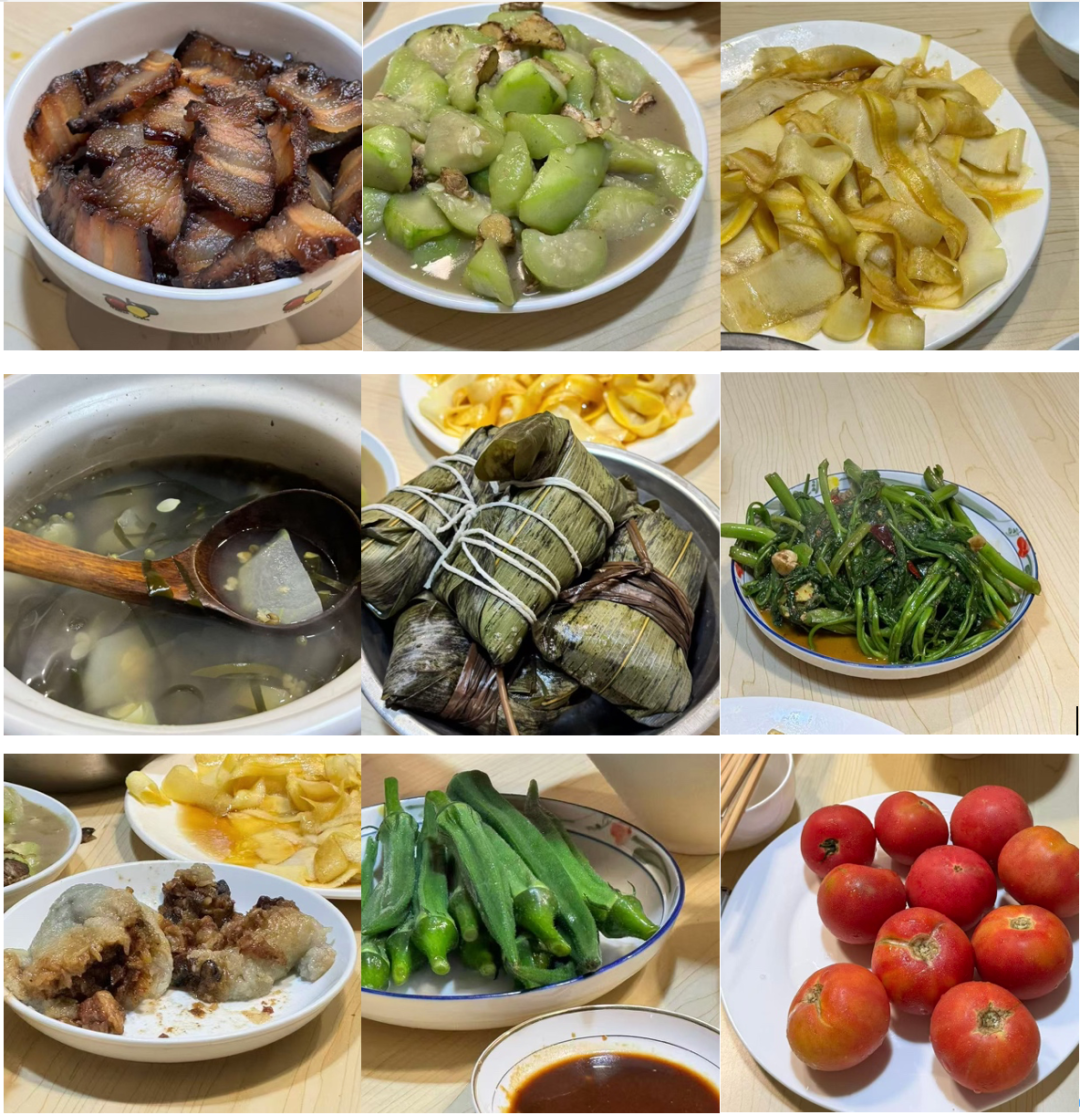
◉ After the interview, Foodthink treated Marius to a working lunch at the office. Every ingredient came from ecological smallholder farmers at the Beijing Organic Farmers’ Market, and the authors pitched in with home-wrapped zongzi (sticky rice dumplings) and soy sauce cured meat.
Does Affording Meat Equal a Good Life?

One of the core premises of your research is that people’s demand for food is shaped rather than innate. Norway is one of the world’s leading producers of salmon. How did this food become a new addition to Chinese dining tables?
Marius: You have to go back to the 1990s, when the Norwegian Seafood Council began promoting salmon. They started in Japan, gradually establishing salmon as a key ingredient in sushi. Before that, Chinese people hardly ate salmon at all. But now, it has been linked to modern living and healthy eating, evoking associations with a good life, good parenting, middle-class status…
These associations were built on Omega-3 (omega-3 fatty acids). This type of polyunsaturated fatty acid, with its anti-inflammatory, antithrombotic, blood-lipid-lowering and vasodilating properties, is regarded as an essential health product—and is a major reason Norwegians themselves consume salmon. The DHA within it has been marketed in China as “brain gold”. Then land-based recirculating aquaculture system (RAS) salmon farms were introduced to China, a technique that farms salmon onshore by artificially controlling salinity to simulate a marine environment. My PhD student and team researcher Tarjei Brekke (Bei Haoyang) is currently conducting fieldwork at a salmon farm in Ningbo. The salmon chapter in this book is based on his doctoral dissertation.
Through the complete chain of international capital, a transnational salmon supply chain and Chinese supermarket and retail marketing, salmon found its way onto Chinese dining tables. Although it still accounts for a very small share of national per capita consumption, it is already quite common among middle-class families in major cities. In our household interviews, many respondents said they eat salmon one to two times a month.
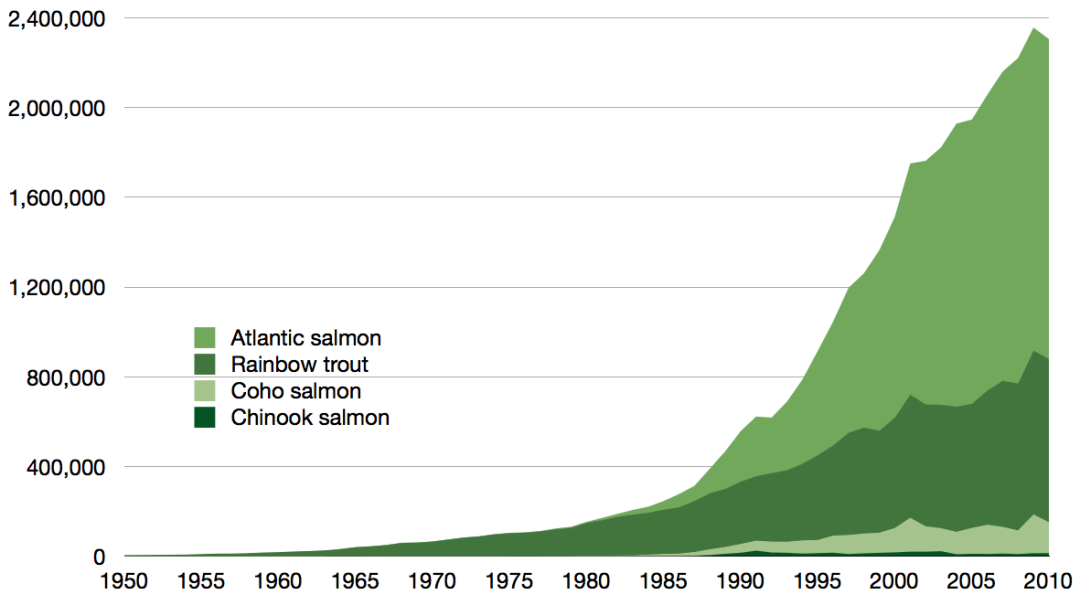
◉The chart shows the global production of four major farmed salmonid species (in tonnes), from top to bottom: Atlantic salmon, rainbow trout, coho salmon and Chinook salmon. Atlantic salmon farming experienced explosive growth after the 1980s, surging from under 100,000 tonnes to over 2 million tonnes by 2010. Image source: Wikipedia; data source: FAO Species Fact Sheets.
Is there a similar construction process behind China’s consumption of other animal proteins?
Marius: China’s current per capita daily protein supply ranks among the highest in the world, even exceeding that of the United States. Many scholars argue that the improvement in Chinese people’s quality of life is linked to increased animal protein intake. But it is worth noting that the dietary tradition of obtaining protein from plants—soya milk, tofu and the like—has still not been displaced.
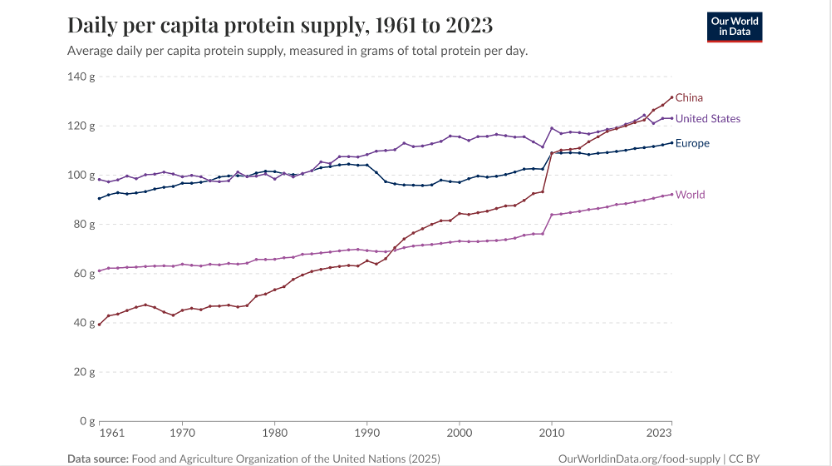
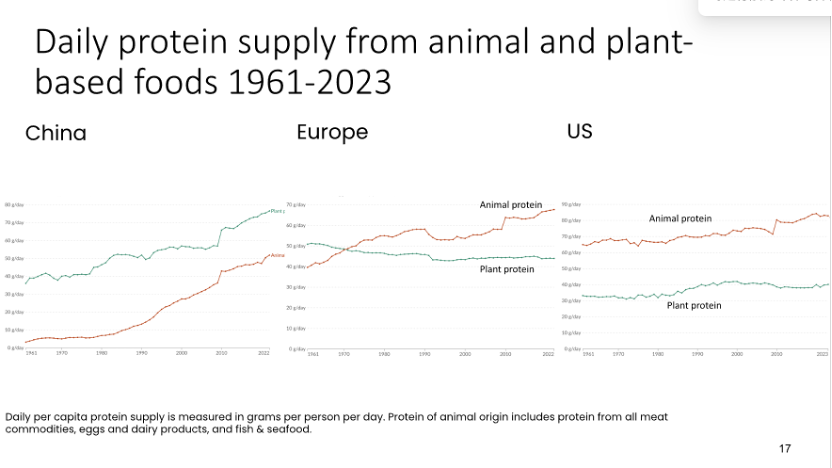
◉China’s per capita protein supply overtook the United States around 2020, yet plant protein remains the mainstream. Image courtesy of Ma Li.
China’s current per capita daily animal protein intake is only 45 grams, whereas plant protein stands at 75–80 grams. Since the 1990s, per capita protein intake in China has risen significantly, and during that period both sources increased. In Europe, per capita animal protein consumption is 50 grams, while the United States is off the scale at 80 grams.
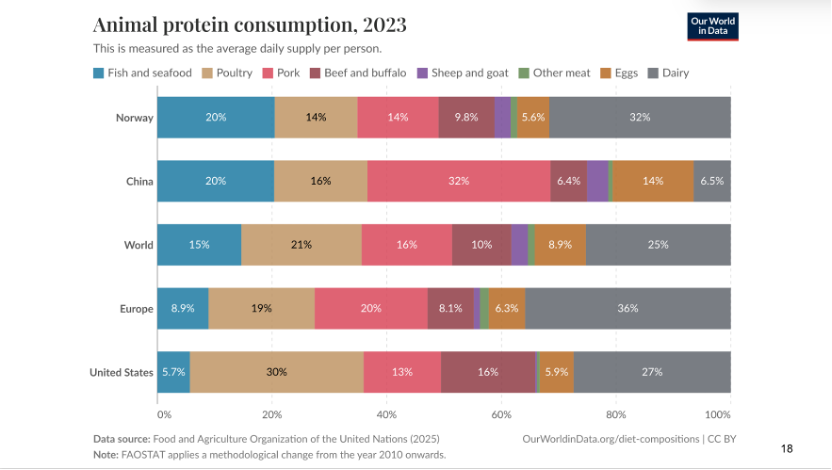
◉Among animal protein consumption, pork is China’s largest source at 32%. Image courtesy of Ma Li.
Why has animal protein risen so sharply while plant protein consumption has not decreased? This is a question our research seeks to explore. It shows that even as a Westernised modern lifestyle spreads around the world and per capita incomes rise across societies, different societies still develop along distinct paths. China’s food demand follows its own distinctive logic of construction.
In your research and interviews, have you also noticed a preference for animal protein? How prevalent is the narrative that “eating more meat makes you stronger” in China?
Marius: Among middle-class families in particular, people want to ensure their children get the highest quality of protein so they can perform better at school and in sports. For them, that means eating meat. They regard veganism as unhealthy. For them and their children, eating meat has already become part of a “good life”.
The government has also contributed to building this narrative. In April 2006, Wen Jiabao, the Premier at the time, inscribed a message during an inspection visit to the Guangda Dairy Science and Technology Park in Chongqing: “I have a dream—that every Chinese person, children first, can drink half a kilo of milk every day.” Many other governments, like China’s, also support the livestock sector, for instance through subsidies.
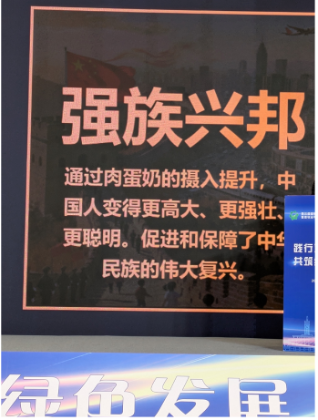
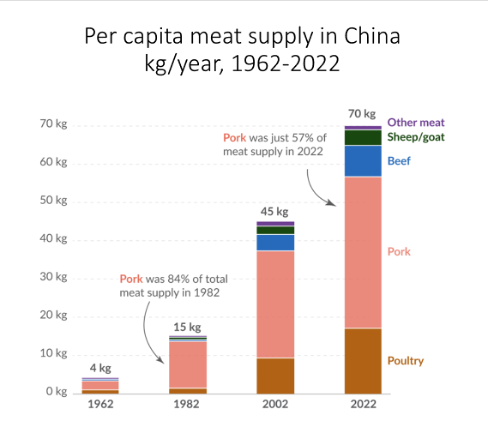
◉(Left) A speech by Jin Weidong, Chairman of Hefeng Food Co., Ltd., at the 3rd Changsha Conference on Green, Low-Carbon and High-Quality Development in the Livestock Industry and Summit Forum on Methane Emission Reduction, held in Changsha in October 2025, linked meat, eggs and milk to strengthening the nation and national rejuvenation. (Right) From 1962 to 2022, per capita meat supply in China rose from 4 kg to 70 kg, with a wider variety of meat choices; pork accounts for 57%. Images courtesy of Ma Li.
I think one of the reasons animal protein is so highly prized is that it can provide fairly comprehensive nutrition. Milk, for example, supplies vitamins, calcium, protein and various other nutrients. Simply by drinking milk, you can obtain nutrients that support bone development. This does not mean milk is the only way to get those nutrients, but it is undoubtedly the simpler and more convenient choice.
Nutritionists have confirmed that the sources of a healthy diet are diverse and that animal protein is by no means essential. A look at history makes the argument even more compelling: during the Republic of China era, Sun Yat-sen, in his book The International Development of China, encouraged obtaining protein directly from soya beans and advocated a vegetarian diet.
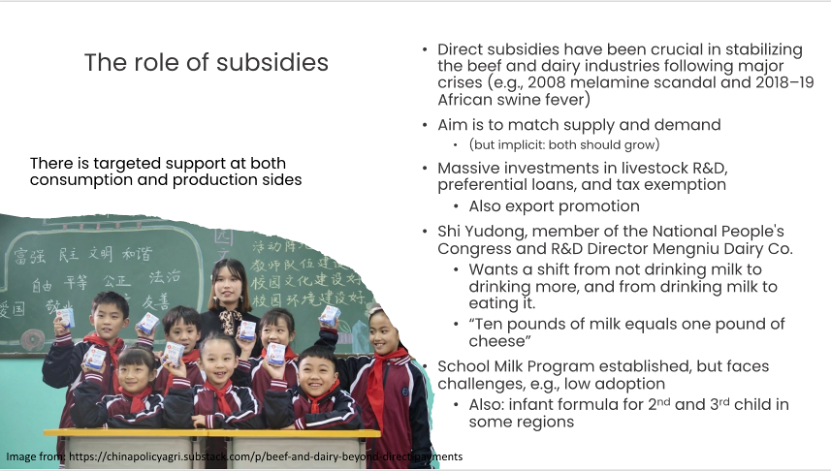
◉At a seminar held at Tsinghua University in late June, Ma Li presented on government support policies for beef cattle farming and the dairy sector. Image courtesy of Ma Li.
Where Has the Cost of Eating Meat Been Hidden?
Was this perhaps because China’s national strength was not yet sufficient at the time to support meat consumption? Encouraging people to eat a plant-based diet—consuming soy products made directly from soybeans rather than using soybeans to rear livestock on a large scale for people to eat—may well have been a more realistic approach for the government at that time?
Marius: The question is: as national strength increases, will people necessarily eat more meat? Is it inevitable that history follows this path? India offers an interesting point of comparison. India’s population is comparable in scale to China’s. According to FAO data, the per capita daily protein supply in 2023 was 74.57 grams, far below China’s 130.99 grams. Indians also eat very little meat. According to data from Voiceless, an Australian animal welfare organisation, meat protein accounts for just 11.7% of the Indian diet, while dairy protein makes up as much as 80%. The organisation has also calculated that meat protein constitutes only 11.7% of the Indian diet, with roughly two land animals slaughtered per person per year—less than one-fifth of the global average.
This difference in dietary structure is also reflected in the soybean industry chain: India’s soybean production is far lower than China’s, and India is a major soybean meal exporter. According to USDA data, in 2023/24 India produced approximately 9.04 million tonnes of soybean meal, the by-product of extracting soybean oil and used primarily as animal feed. Of these 9.04 million tonnes, around 1.97 million tonnes were exported. China, by contrast, imports vast quantities of soybeans every year. This may well be linked to dietary structure: many Indians are vegetarians, though that too is changing.
From the 1990s, China began shifting towards large-scale imports of Brazilian soybeans, which once sparked considerable controversy on Chinese social media. Public data from the National Bureau of Statistics of China and other sources show that in 2024, domestic soybean production was approximately 20 million tonnes, while imports reached 105 million tonnes. These imported soybeans are used for animal feed (soybean meal) and oil extraction. How should we make sense of imports on this scale?
Marius: In our expert interviews, some international relations scholars offered a very interesting perspective: China was once a major global soybean exporter—why has it now become a key soybean importer? China’s livestock industry has made enormous resource investments: using imported soybeans on a large scale to rear pigs, then consuming the pork. From a food security standpoint, this also implies a degree of dependency.
But in reality, Norway also imports soybeans from Brazil, and so does the rest of the world. This is a form of “food outsourcing”—using another country’s land and resources to feed a different nation. Another academic concept is that of “ghost hectares”: the notion that a country relies on agricultural land abroad to sustain its food consumption, yet that land appears nowhere in its own national territory or agricultural statistics.
On the surface, intensively reared chickens and pigs are all housed indoors, giving the impression that they require relatively little land. But this tells you nothing about how much land the domestic livestock sector actually consumes, because all those resources are located overseas.
This kind of outsourcing takes place in every corner of the world. It is a collective behaviour—or rather, a collective denial of the facts. Clearly, the resources of other places are being exploited; everyone is implicated, yet everyone looks the other way. Ordinary people simply do not mind, because everyone is doing the same. If they truly did mind, they might well start to rethink how much meat they eat.
Too Much Meat: Overweight Becomes a Problem Too
China’s dietary guidelines actually encourage diverse food sources rather than relying solely on animal protein. In the food pyramid, emphasis is placed on eating more grains.
Marius: But in every country, people tend to ignore what the nutrition guidelines say. People eat however they please, and in big cities in particular, they are more susceptible to consumption trends on social media.
Notions of health and quality are always shifting. At one point, Chinese consumers wanted imported formula milk from Germany or other countries; now they are far more accepting of domestic formula. Supermarkets have become more “specialised,” and more people are beginning to trust platforms such as fresh food e-commerce, while traditional wet markets are fading away.
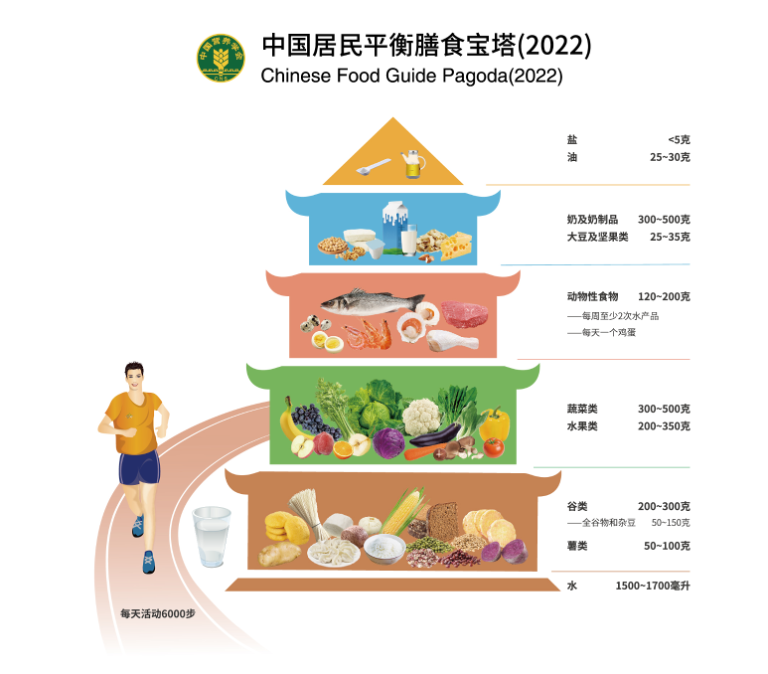
◉The 2022 Dietary Guidelines for Chinese Residents recommend a balanced diet based on grains, with fish, poultry, eggs and lean meat to be consumed “in moderation.” The image above shows the daily dietary recommendations from the guidelines. Source: http://dg.cnsoc.org/
In the Chinese households you studied, is excess nutritional intake common? And is there any gender dimension to it?
Marius: Malnutrition used to be something the Chinese worried about enormously. When food was scarce and people were malnourished, their bones simply would not grow. But average height in China has been increasing since 1978. Now, China is starting to worry about being overweight and about an excess of food supply.
In 2016, China’s Dietary Guidelines for Chinese Residents put forward, for the first time, the principle of “balance between eating and exercise for a healthy weight,” making body weight a key indicator for assessing nutritional and health status, and listing both overweight and malnutrition as health risks for Chinese residents. An official from the National Health and Family Planning Commission explained at the press conference: “Malnutrition persists in certain regions, while the problem of overweight and obesity is becoming increasingly prominent. Chronic diseases related to diet and nutrition pose an ever-greater threat to the health of our residents.”
As for health, we found that more respondents were concerned about fat. For instance, more than one mentioned a preference for beef over pork, mainly because beef has a lower fat content.
Does that hold up from a nutritional standpoint?
Marius: That is not my area of expertise, and I would not say so myself—at the very least, one cannot claim that one type of meat is healthier than another. Rather, from an environmental perspective (carbon emissions), beef is clearly worse. People in cities such as Shanghai and Jinan all mentioned a preference for beef.
Have you ever tried sharing that perspective with your respondents?
Marius: We also asked them how they felt about environmental issues and animal welfare. People always seem deeply concerned about the environment and hope things do not get worse. Many expressed worries about takeaway packaging. As for animal welfare, they do not think about it much.
Coming back to salmon—what is the situation in Norway? Is farmed salmon also the norm there?
Marius: People still eat a great deal of it. Norway’s story has more layers to it. At first, people favoured wild salmon and distrusted farmed salmon. In the 1980s and 1990s, there was severe overuse of antibiotics. After that, the government stepped up regulation, treating antibiotic use as a serious matter and enforcing strict controls. Companies began working hard to improve their image, presenting themselves as a “responsible” industry. Now, Norwegian consumers all eat farmed salmon.

◉In salmon farming cages, salmon—an animal with keen sensitivity—is kept at extremely high stocking densities. Source: ABC News
I have long been deeply critical of the salmon farming industry in Norway, Australia and elsewhere. It is enormously profitable, and many Norwegians have made fortunes from it, but the living conditions for farmed salmon are appallingly poor, raising serious ethical concerns. On top of that, antibiotics and other drugs severely pollute the sea water. In short, there are problems galore.
I have an uncle who sea-angles for salmon, and he absolutely despises farmed salmon. When farmed smolts escape and mingle with the habitats of wild populations, they cause chaos throughout the stock. They also interbreed with wild salmon, thereby destroying the population.
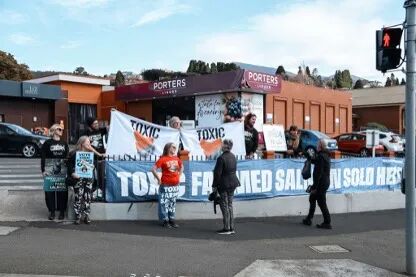
◉A protest by residents of Tasmania, Australia, against the local Tassal salmon farming operations. Source: Bob Brown Foundation
But a critical attitude like that must still be a minority view in Norway, surely?
Marius: Yes. Most people simply do not think about these things. I am vegetarian, and sometimes strictly vegan. When I go back to China, I am asked “why?” a great deal. To them, it is a bit of an oddity.
Who Can Afford to Eat Well?
Your team is also conducting a research project called the “Just Urban System”—what does it have to do with food systems?
Marius: This is a new project that launched in April and will run for four years; it is only just under way. We will be working with urban planners and architects in Norway to explore how food systems intersect with urban planning, and how city systems can be made more just and fair.
Take Oslo today, for instance, where there is a vast inequality between east and west. People in Oslo West have a life expectancy ten years longer than those in Oslo East. Why? Beyond work and stress, access to healthy, sustainable food and to urban green spaces are significant contributing factors. East Oslo has far more fast-food outlets than West Oslo, while organic restaurants and urban green spaces are more common in the west (which is also more heavily gentrified). These factors interact—stress, for example, also contributes to being overweight, and that is more pronounced in Oslo East.
– This is the 844th original article from Foodthink –
Interviewee | Marius Korsnes: Associate Professor in the Department of Interdisciplinary Cultural Studies at the Norwegian University of Science and Technology (NTNU), Principal Investigator of the ERC (European Research Council) MidWay project. His research focuses on science, technology and society (STS), with particular attention to urban food systems in China and Norway, new energy use and sustainable transitions. Portrait photograph: Elin Iversen

Author | Pei Dan: A self-styled “word-farm worker” back on the right track, with an interest in climate change, ecology and real people navigating upheaval.

Editor: Xiao Dan
Layout: Xiao Cun
Scan the QR code to tip and support original food writing
▼

▼
Click the image to read related articles
▼
Click a keyword to browse more article collections
Seeds | Agritech | Policy | Fermentation | Nutrition | Fruit | Fisheries | Takeaway | Events | Jobs | Markets | Livestock | Food Talk | Talks | Reading Groups | Harvest Festival | Smallholder Stories | Climate Change | Rural Development | Cooperative Economy | Urban Farming | Food Safety | Biodiversity | Pandemic & Food | False Solutions | Agroecology Internship Programme
Beijing | Hebei | Shanghai | Guangdong | Guangxi | Yunnan | Henan | Sichuan | Jiangxi | Xinjiang | Shaanxi | Hong Kong | Chongqing | Zhejiang | Jiangsu | Guizhou | Taiwan | Inner Mongolia | Philippines | Canada | Russia | Mexico | Italy | United States | United Kingdom | Germany | Netherlands | Thailand | Sweden | Japan