
74-Year-Old Grandma Combs Eight Mountains Just to Earn 3,000 Yuan for Her Pension

My grandmother, Yang Xiuying, is seventy-four years old. Weighing under 40 kg and standing less than a metre and a half tall, she began heading into the hills each day ahead of the Qingming Festival to dig for and gather bamboo shoots. She combed through seven or eight nearby slopes, working non-stop for over a month. Once back home, she would straight away set to curing the shoots into dried bamboo, never daring to rest for a moment. She relies entirely on this harvest to earn a year’s pension.
Into the mountains
A little past six in the morning, the sky still barely light, Grandmother skips breakfast, changes into a worn set of grey clothes, pulls on her wellies, and meets up with Deng Lian, a 70-year-old from the same village. This tall-and-short silver-haired pair sets off at once, a striped sack and a sickle slung over their shoulders.
Our home sits at the foot of the high mountains. The main ridge slices down from the north-east to the south-west, followed beneath the primary peak by a series of lower spurs, dotted with sweeping patches of bamboo. Much of the bamboo does not grow on flat land, but springs up untamed in clusters along valleys, stream beds, and rocky crevices. Every spring, these bamboos yield the mountains’ most abundant “harvest”. Grandmother says, “At Qingming, it’s chaos; by Guyu, it ceases. The moment Qingming arrives, shoots push through the soil and sprout wild everywhere.” And so, too, do the footsteps of the mountain folk grow frantic.
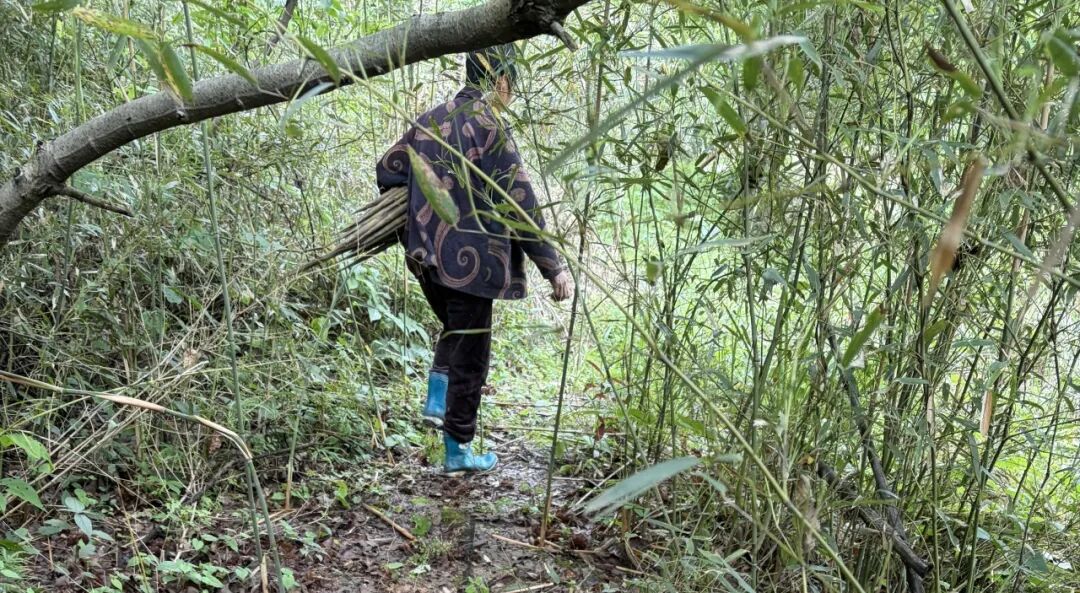
◉Grandma on the mountain path.
During the May Day bank holiday, I went back home and accompanied my grandmother and aunt on two trips into the hills.
To anyone looking from the outside, the low hills appear as an impenetrable tangle of trees and undergrowth, with not a path in sight. Yet this does not daunt my grandmother in the slightest; she can find a way in or out at any point. She simply slips into a mountain fold and knows exactly how to work along a hidden track. In her head, she carries a detailed map of the spring shoots: the young ones appear first on Boluo Ridge; the bamboo groves by the little pond near Dongcun are on flat ground and easy to harvest; Bazao Mountain yields shoots, but you have to push your way through dense brambles to get them; the steep slopes above the pond have fewer shoots, but they are much larger.
There are hardly any proper paths in the hills, and the terrain is a constant series of steep ascents and descents. Trailing behind her, I was in my twenties but still couldn’t keep pace with the 74-year-old. She would grab onto branches and vines, hauling herself up near-vertical slopes in one fluid motion, and move swiftly between spotting and harvesting the shoots. She could clear a small bamboo grove in ten minutes or so. While I was still lingering in the undergrowth, she had already crossed over several patches of forest.
The hardest part is not finding the shoots, but carrying them out of the valley. A single person can harvest two or three hundred jin of fresh shoots in a day, relying entirely on physical strength. The first time I tried it, I only carried a single bundle, but it nearly buckled my shoulder as soon as I hoisted it up; I had to grit my teeth and force it out. Meanwhile, my grandmother, despite the cuts on her fingers, carried three sacks, while my aunt carried four. Along the way, we clung to the woven sacks slung over our shoulders with one hand, used our other to pull ourselves along on tree branches, and painfully inched our way along the slick mud track.
Carrying the shoots down the mountain is not only exhausting but dangerous; as my grandmother puts it, it’s “all too easy to get hurt.” The complex, slippery terrain means you have to haul yourself up and down by gripping bamboo branches and vines, and keeping your balance with a heavy load slung over one shoulder is incredibly difficult. It took those two trips with my grandmother for me to truly grasp what it entailed. On one occasion, I lost my footing and slipped, landing hard on a sharp bamboo stump that left a long gash. I had to pretend it was nothing, hoist the sack back up, and keep walking, leaving the wound to be dealt with only once we were back home.
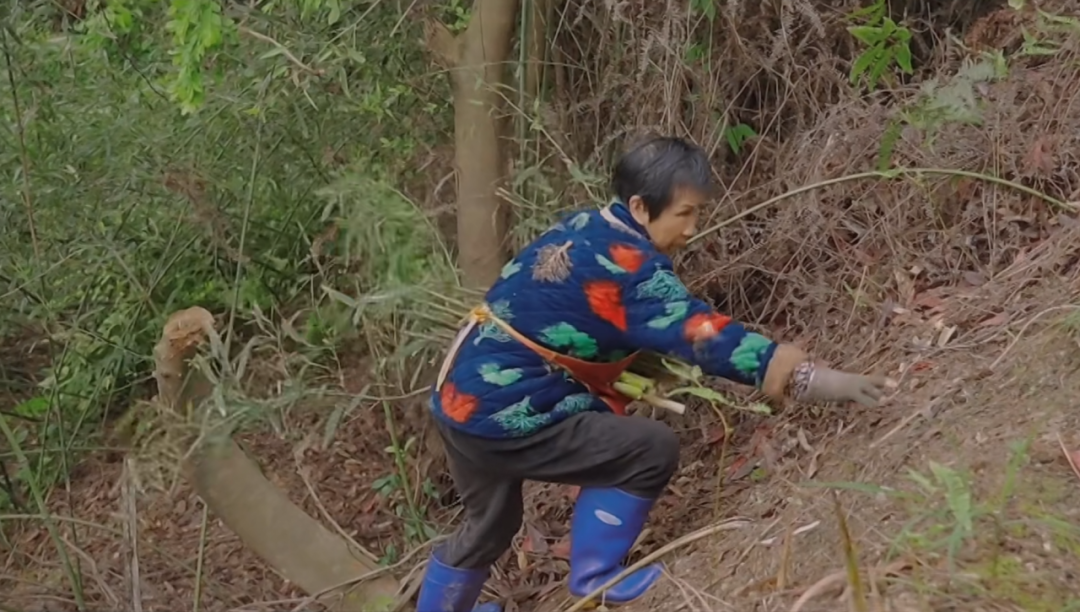
◉ Descending the slope by clutching bamboo branches.
Despite careful technique and caution, physical injuries and scrapes are simply unavoidable. In 2022, while harvesting shoots up the mountain, a bamboo branch drove into Grandma’s right palm, opening a gash. She kept it from the family, applied a quick makeshift dressing, and carried on up the slope. Last year, while Grandma and Grandpa were digging for larger shoots on the mountain behind their home, the rain-slicked paths proved treacherous. Grandpa took a tumble, fracturing a bone and ending up in hospital. But loath to spend money, he popped a few cheap tablets and insisted he was perfectly fine. This year, Grandma injured herself again. While stripping shoots on the mountainside, she sliced off a small flap of skin from her right index finger. She bound it with a cloth strip, pressed on with her work, and was back up the mountain the very next day.
That day, three of us from my family filled eight woven plastic sacks. Combined with the shoots Grandma Deng Lian had harvested, the car’s boot and rear seats were crammed full, carrying a load of seven or eight hundred jin. Even my aunt, who shouldered the heaviest loads that day, later complained of aching legs. The following day, the three of us gathered at home to rub liniment on each other’s sore muscles.
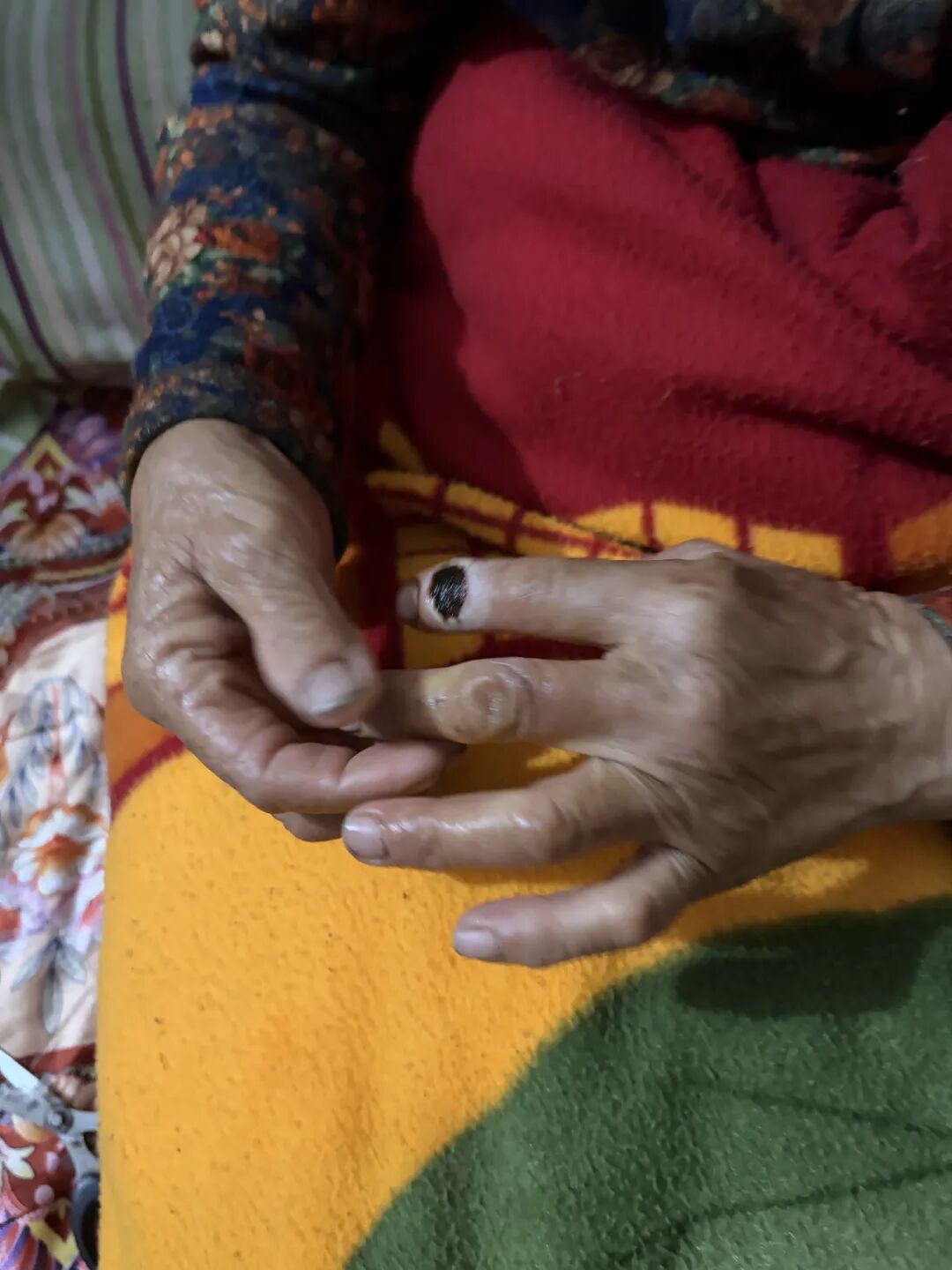
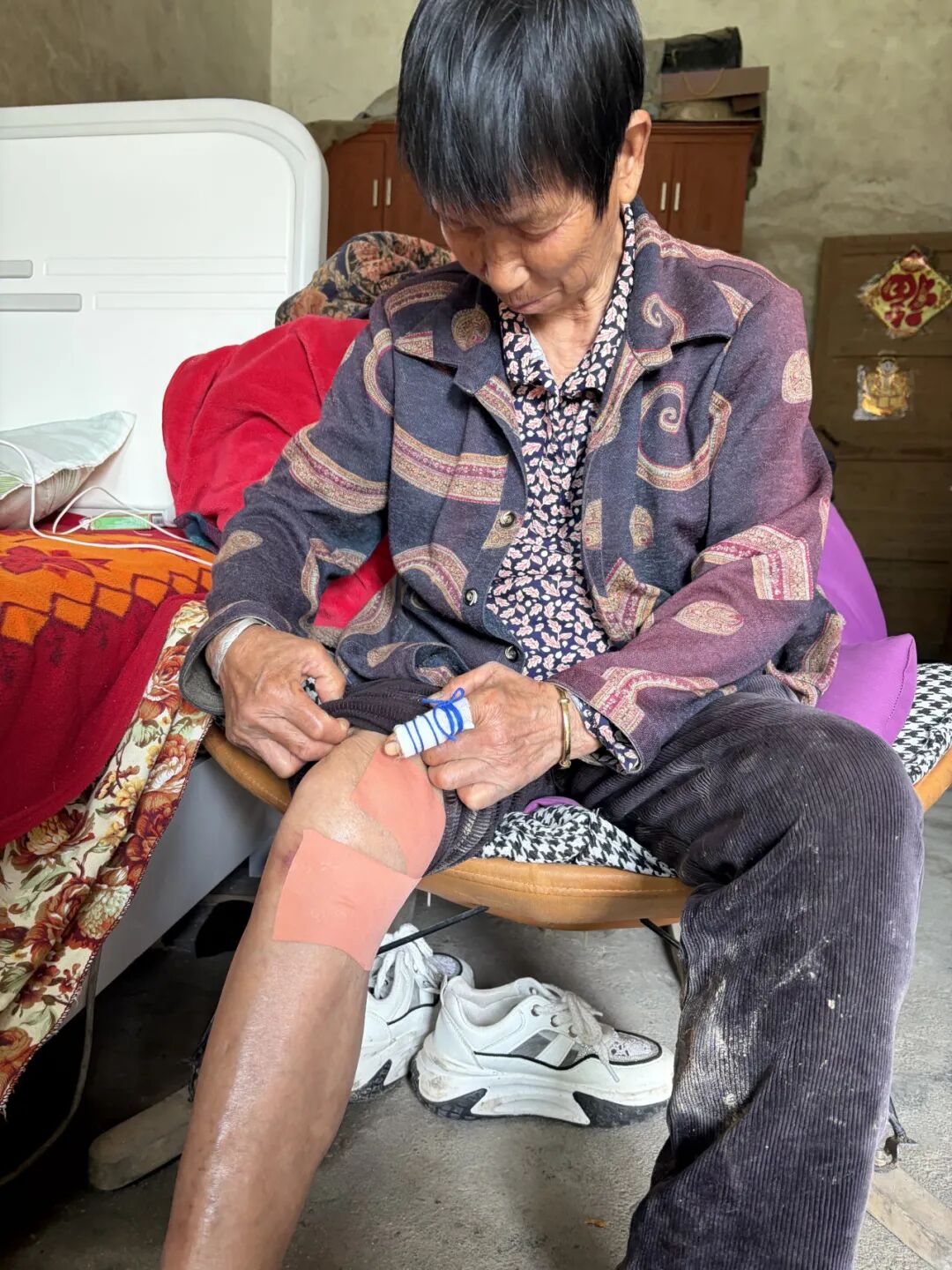
◉Harvesting bamboo shoots has left grandmother with injuries to both her hands and legs.
This was my day of “experience”. Meanwhile, Grandma and Grandma Deng Lian had already been at it for over a month. Villagers remarked how tireless they both were in hunting for shoots, while some of the older men found trekking into the woods too gruelling and simply gave up.
The Need to Earn
It is only in recent years that selling bamboo shoots has become Grandma’s main source of income.
In the years before, Grandma and Grandpa used to cultivate a small plot of land for rice, peanuts, and sweet potatoes. After deducting the cost of seeds, fertiliser, and their own labour, they would net around 4,000 to 5,000 yuan a year. When Grandpa reached 80 and Grandma 70, their children agreed on a pension arrangement, providing an annual allowance for their living expenses. From then on, Grandma scaled back her farming considerably. She grew just enough to feed herself, selling any surplus produce for a few hundred yuan.
But the allowance was never steady. For the first two years, each household contributed 6,000, but then the eldest aunt took ill, the grandchildren married, and construction wages went unpaid. Out of consideration for her children, she accepted a two-thirds cut, leaving her with just five or six thousand a year.
But expenses proved impossible to curb. Social obligations in the village run deep, and the cost of cash gifts for weddings and funerals alone approaches ten thousand a year. Mother found the strain unbearable and often argued about it. Grandparents, however, insisted on attending. They advanced the contributions for Father on several occasions, and by year’s end, two or three thousand yuan still came straight from their own pockets. On top of that, advancing age brought a succession of minor ailments. Ever since the village clinic shut down, they’ve had to travel to the town for treatment, racking up an extra thousand or two in scattered medical bills each year.
Grandmother had to find the money herself.
She tried growing maize, but the harvest was too heavy for her to bear. At eighty cents a jin, the crop brought in barely a few hundred yuan. Grandfather’s health deteriorated year after year, leaving him unable to manage the heavy manual labour required for rice and peanuts. With grain prices so low, and seeds, fertilisers, and every other input costing money, it was hardly worth the effort. They also experimented with raising more chickens and ducks, but the coop was cramped. Once the flock grew, illness spread easily and keeping them under control became a constant struggle.
Moreover, “the weather has gone bad” is a refrain the grandmother has often repeated over the past few years. Rainfall has become uneven; winters are drier, while springs bring excessive rain. These changes have made crops far harder to manage. She complains: plant peanuts, they die; plant sweet potatoes, they die; plant loofah, and even after the vines climb and bear fruit, they still wither. Last autumn and winter, she painstakingly watered her rapeseed just to keep it alive, but this spring, Hengyang in Hunan saw nearly a month of continuous rain. The rapeseed stalks rotted completely, and many vegetable seedlings and crops in the field were ruined. Pests have also become a greater threat. Last autumn and winter, the moment she turned the soil, insects devoured more than half of the sweet potatoes and peanuts. In the garden, even when the loofah is ripe, she now has to place multiple sticky pest traps just to keep them at bay. This year, when planting sweet potatoes, she began applying pesticide to the ground even during the seedling stage.
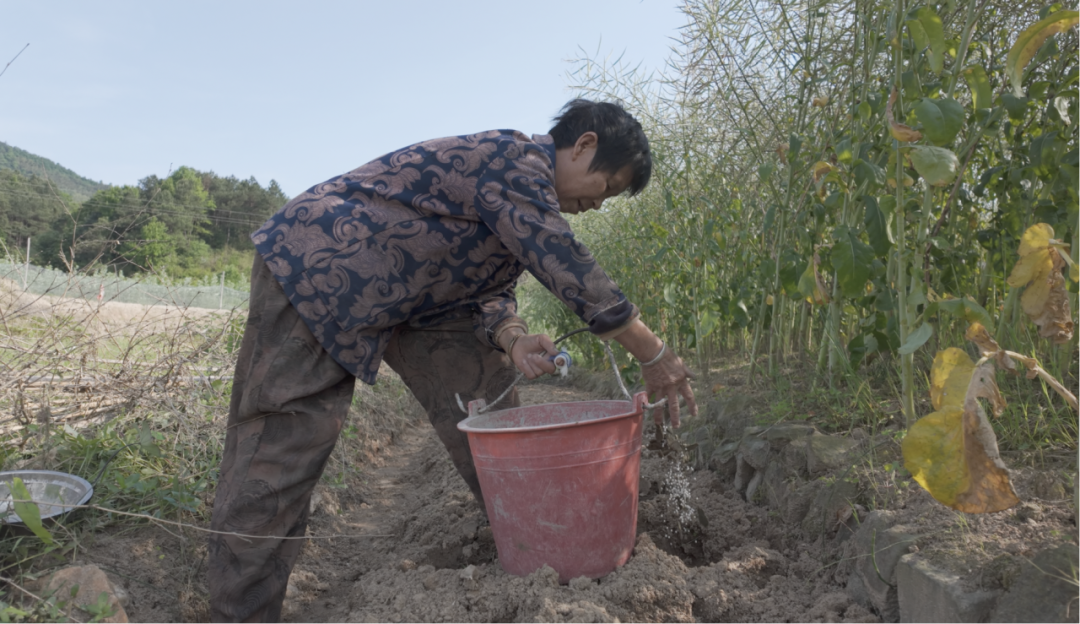
◉ The grandmother planting sweet potatoes, beside this year’s rapeseed crop, which suffered from collapsed stalks and a poor harvest.
In the end, she turned to bamboo shoots. They thrive in the wild; you simply need to venture into the hills to gather them. There’s no need to purchase seeds, fertiliser, or pesticides, nor any worry over irrigation; it simply comes down to whether you’re prepared to put in the graft. As grandma says: “Foraging for bamboo shoots is a sound choice. It demands no capital outlay, only your own labour.”
Put together, over the past four or five years, grandma has earned just under 10,000 yuan from selling dried bamboo shoots, drawing the admiration of many younger village men. In 2025, she sold dried shoots from larger specimens at 10 yuan per jin, moving over 100 jin for slightly more than 1,000 yuan. Relative Uncle Yang, mindful of her toil, purchased 30 jin at a generous 15 yuan per jin. Dried shoots from smaller specimens sold at 12 yuan per jin, bringing in over 1,700 yuan. Her total annual income from bamboo shoots came to roughly 3,000 yuan. In 2024, her total earnings from shoots stood at around 2,800 yuan, while the year before that yielded 2,000 yuan.
Grandma credits the rise in her bamboo shoot income over these years to her aunt; without that support, a yearly haul of 40 jin of dried shoots would already be considered a generous yield. Her aunt helps out for roughly ten days at a stretch, insisting that grandma retain all the proceeds. Yet, when you factor in a per-head share alongside transport costs, it hardly amounts to a financially sensible arrangement.
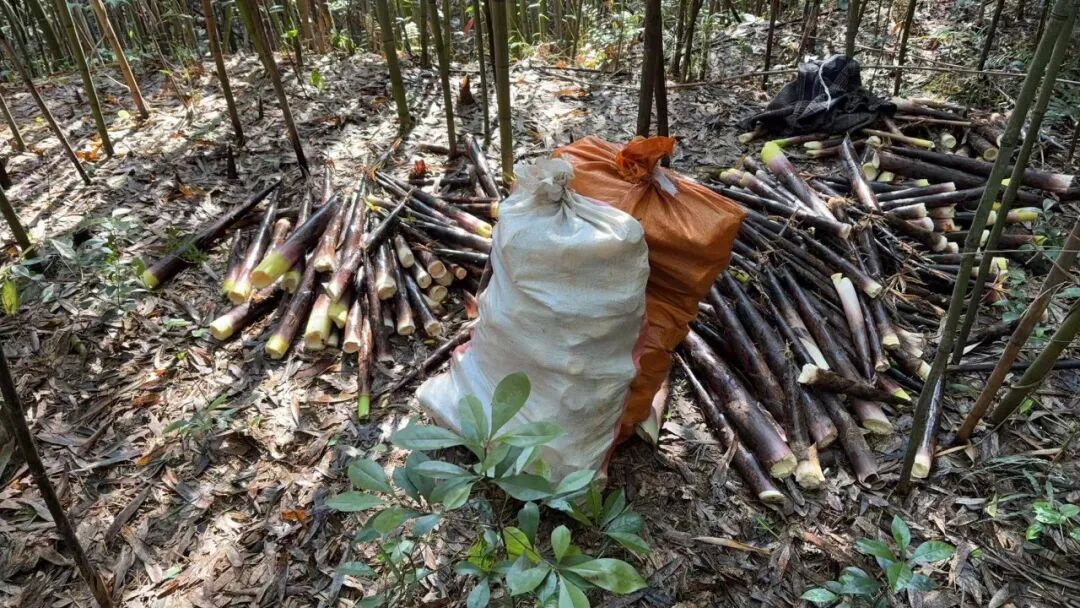
◉The bamboo shoots harvested on the mountain must be packed into woven plastic sacks and carried down on one’s back.
Loss
The shoots the family gathered with such tremendous effort still require lengthy processing and are subject to significant shrinkage and loss.
As the saying goes, “One basket of shoots, two baskets of shells.” Peeling is the first step: you have to twist off the tips, tear the shoots open, peel away the layers, and then carefully remove the fine white skin. By the end of a day’s work, fingers are swollen to the point of pain.
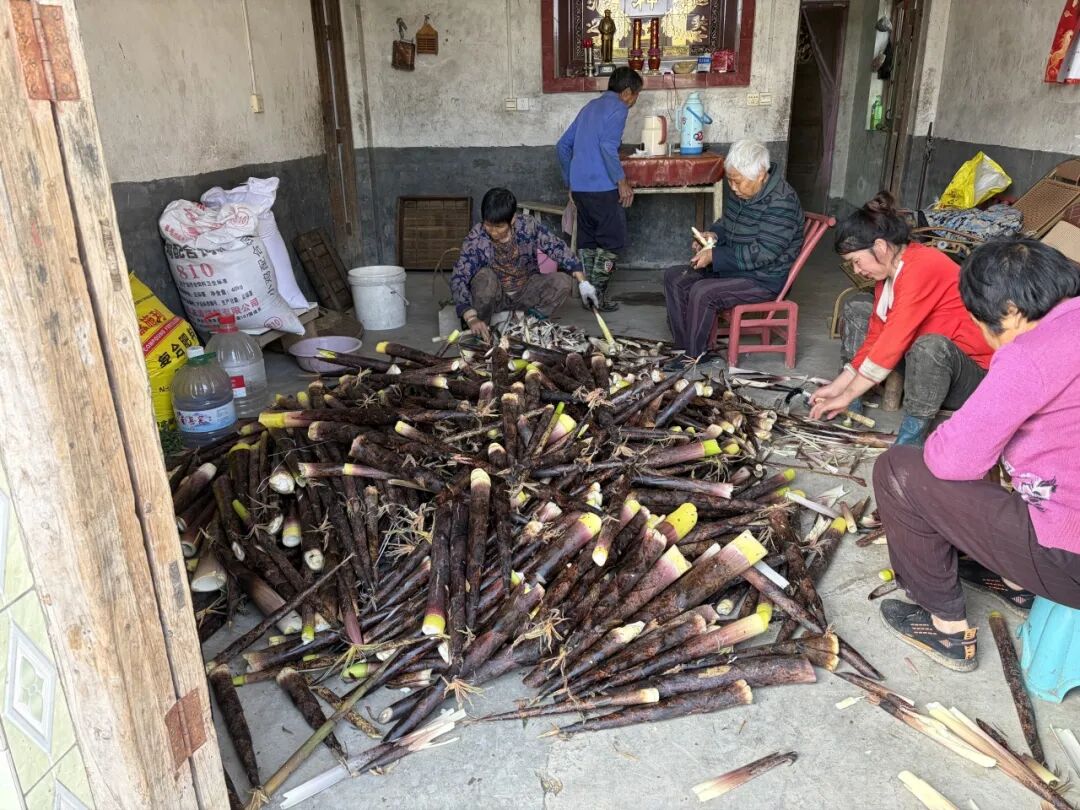
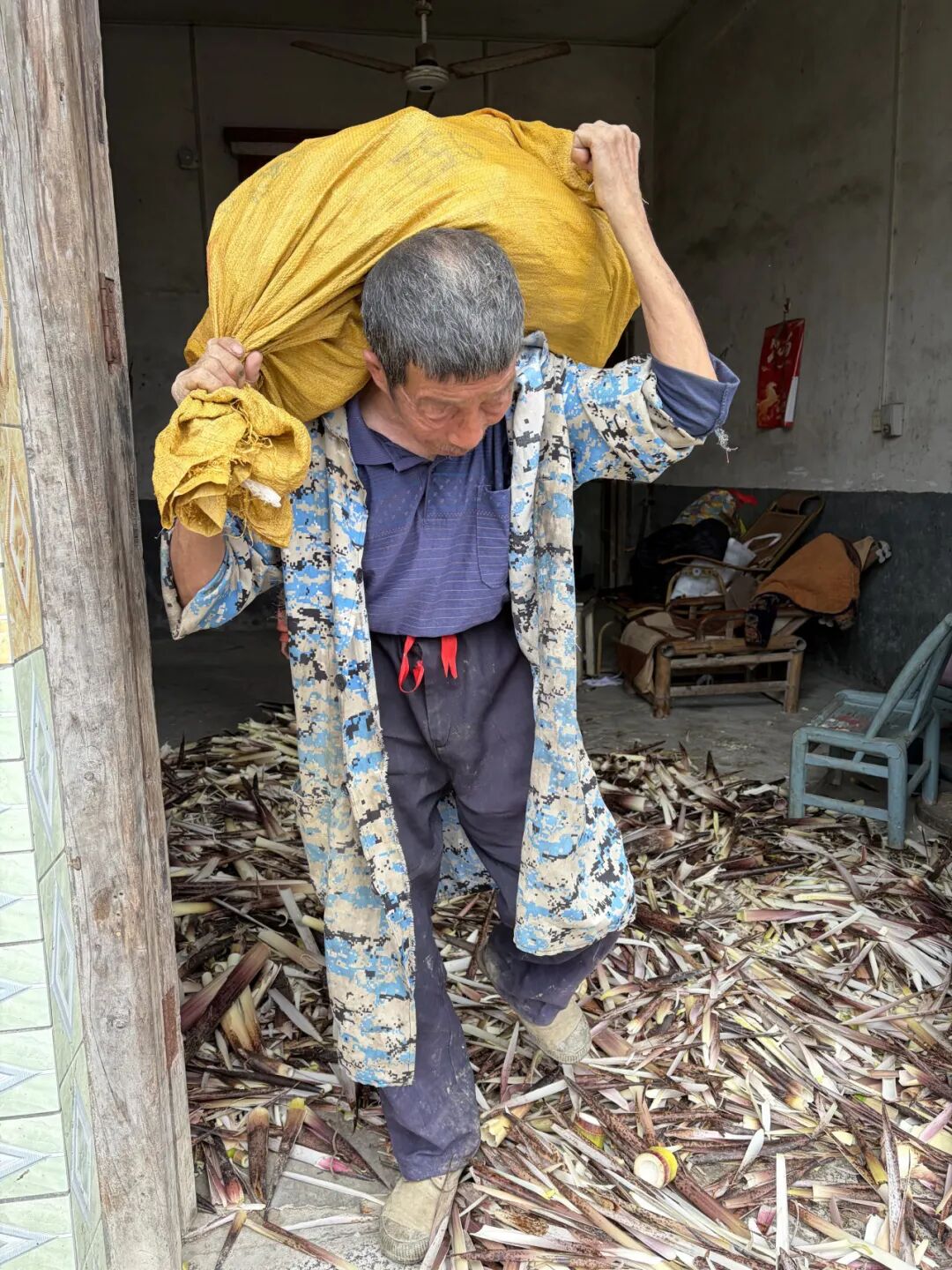
◉Peeling the bamboo shoots.
The peeled shoots are boiled in a large pot for over an hour until they turn yellow and are thoroughly cooked. While still hot, they are quickly plunged into cold water, then laid out individually on drying racks and turned over from time to time. On sunny days, two days of drying is all that is needed. But when the weather turns cloudy, it becomes a real hassle; the shoots must be repeatedly dried over a wood fire. All in all, processing fresh shoots into dried bamboo shoots takes several hours of work each day.
The grandmother says that after peeling 100 jin of fresh bamboo shoots, roughly 30 jin of edible flesh remains. Drying 10 jin of that yields at most 1 jin of dried shoots, with some of the smaller ones shrinking even further. On May Day, they gathered 400 or 500 jin of fresh shoots. The grandmother says the final yield of dried bamboo was less than 20 jin, fetching barely 100 or 200 yuan. Spread across three people and a full day’s labour of trekking through the hills, carrying, hauling, peeling, boiling, drying, turning, and collecting… an hourly wage is simply impossible to calculate.
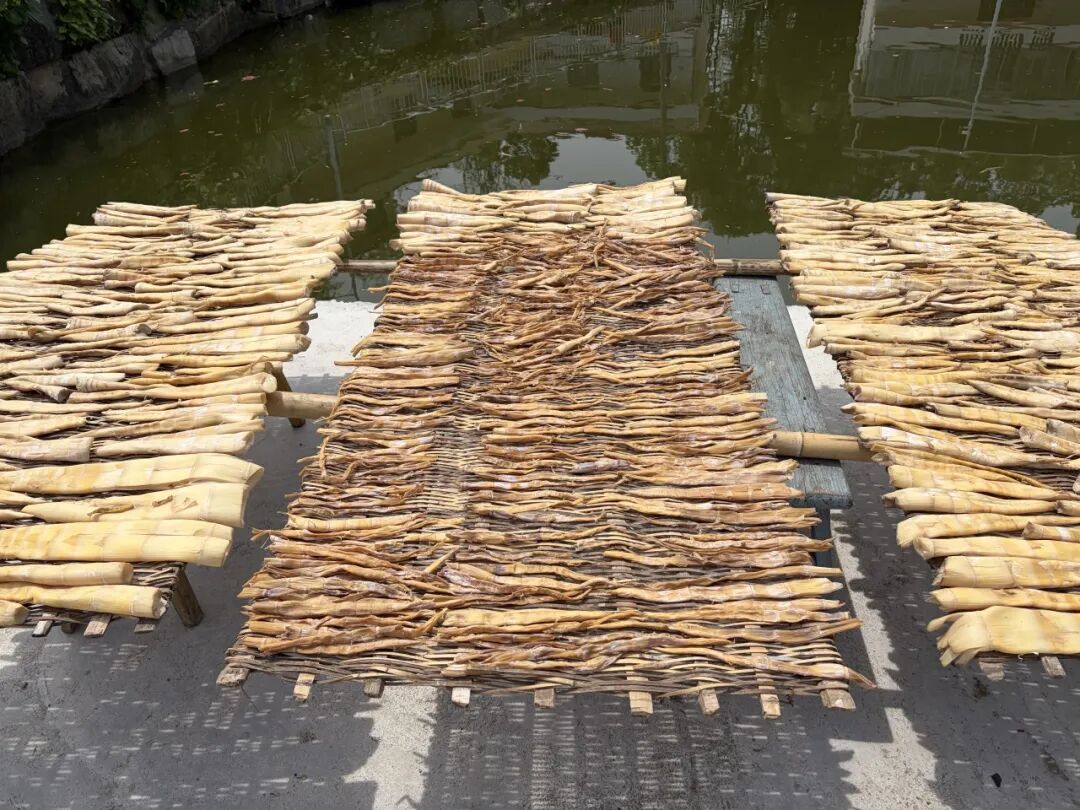
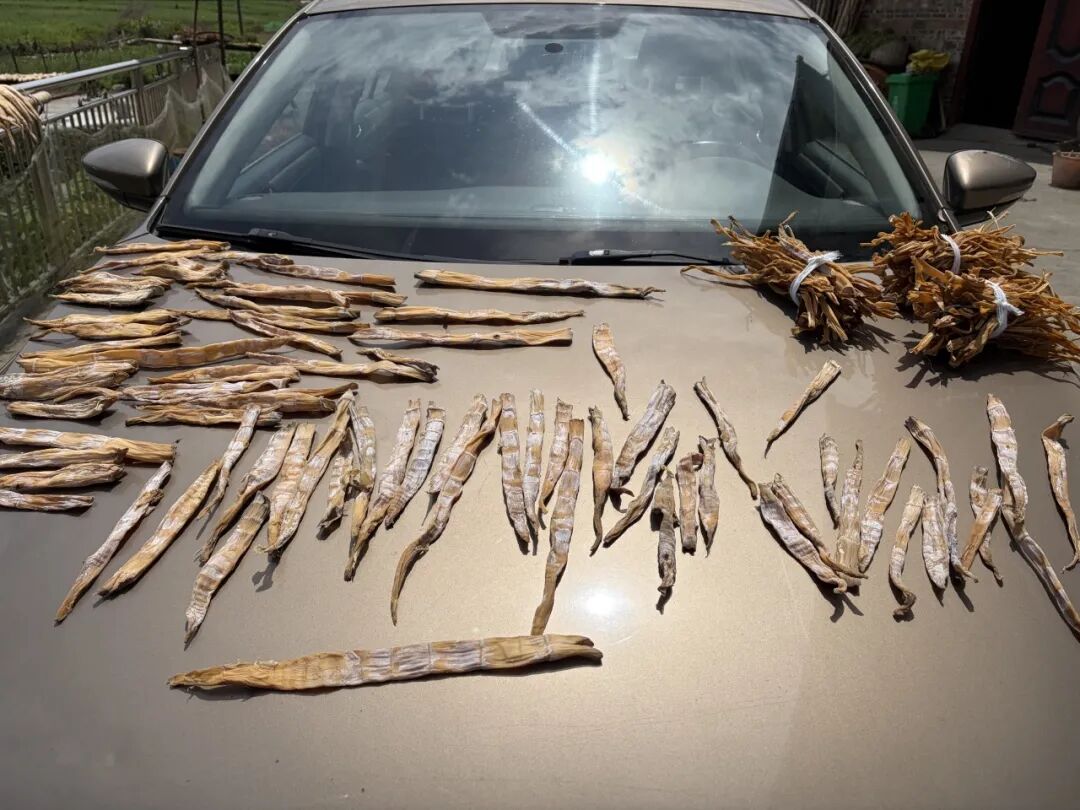
◉Drying the shoots demands a close watch on the weather. If rain sets in and a heavy downpour comes suddenly, failing to bring them in quickly means all the earlier effort goes to waste.
On e-commerce platforms, dried bamboo shoots typically go for around 30 yuan per jin, with free delivery included. Such prices remain far out of reach for grandmothers like her; they do not even know where the courier drop-off points are, let alone how to qualify for shipping discounts. Some villagers have the connections to sell directly to family, friends, and restaurants, fetching up to 20 yuan a jin. Those without such networks, however, can only sell at reduced prices to wholesale buyers.
The grandmother primarily works with Mr Chen, a regular purchasing agent in the village. He frequently drives his motorised tricycle into the village to collect mountain goods, farm produce, and herbal medicines; they have been working together for over ten years. The price he offers for dried bamboo shoots has fluctuated between 8 and 15 yuan over the past two years. Once he has taken delivery, he trims off the tough roots and sorts the shoots by tenderness. He says that when market conditions are favourable, he can sell them for around 22 yuan a jin.
When Mr Chen’s offer is too low, the grandmother sometimes holds out for a better price. Yet her choices are growing ever more limited. In recent years, buyers coming to the village have noticeably decreased. She used to travel to the town herself to sell the produce directly, but many residents have since left, and the pool of buyers has shrunk. To make matters worse, the village’s rural bus service was suspended last year. With no regular buses running, walking to town takes more than an hour, and hiring a motorbike taxi costs a further 12 yuan, making a round trip a considerable expense.
If buyers kept failing to show up, the mountain produce would simply rot in her hands. By 2025, the offer for her dried bamboo shoots had been squeezed down to just eight yuan a jin. Even at that price, the buyer was still reluctant to take them. Refusing to give in, she stubbornly held out until winter, before asking her aunt to drive her into town to find another purchaser.
The new owner initially offered eleven yuan a jin, but after flipping through the dried shoots, she remarked that the quality had suffered from the long delay and would only pay ten yuan a jin. Unwilling to drag things out any further, the grandmother sold 46 jin that day, bringing in 460 yuan. Beaming, she took me out to buy pork and ribs, saying she wanted to cook something special. The following day, she sold off the remaining several dozen jin, finally lifting a weight off her mind.
Growing Old
This kind of work—harvesting bamboo shoots with its “low returns, high intensity and demand for patience”—is generally not something the men in the village are keen to do. Yet women willingly take it up, each hoping to earn their own income rather than wait for their husbands to hand over money.
“In the countryside, where on earth can you find work that pays over two thousand yuan?” Grandma Deng Lian remarked to me with a sigh.
There is no one to help Grandmother Deng Lian; she must handle the entire process single-handedly, from climbing the hills to gather the shoots to processing them into dried bamboo shoots. Over the years, Grandfather’s health has steadily declined, so she no longer asks him to help with household chores or farm work. The lion’s share of the burden has fallen on her.
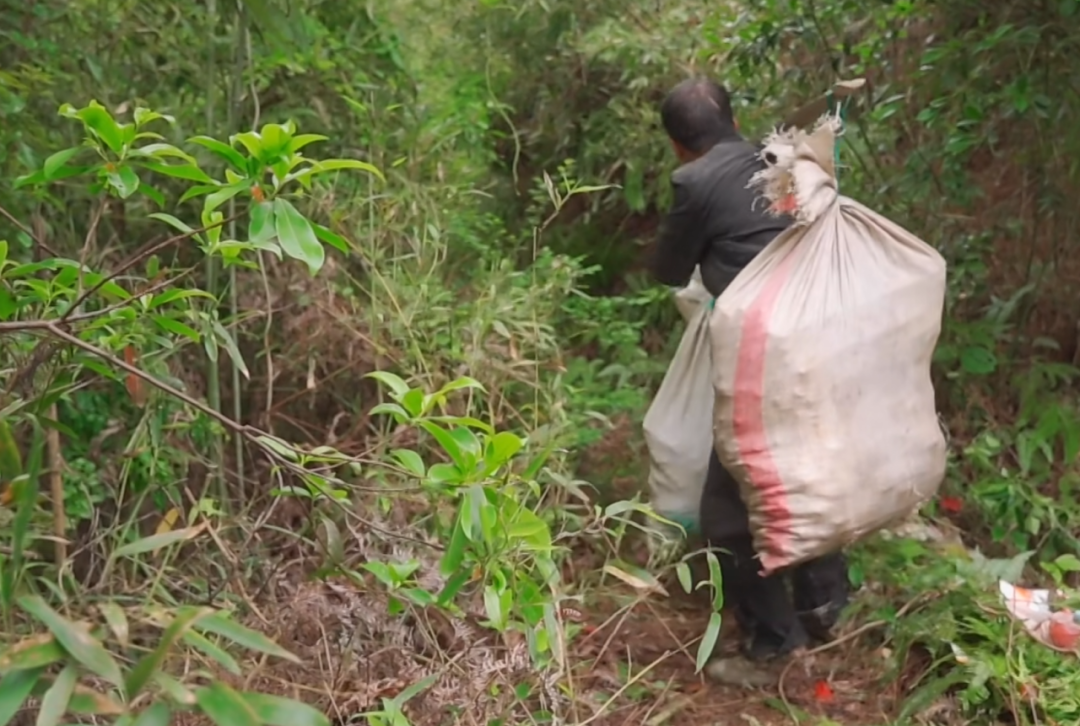
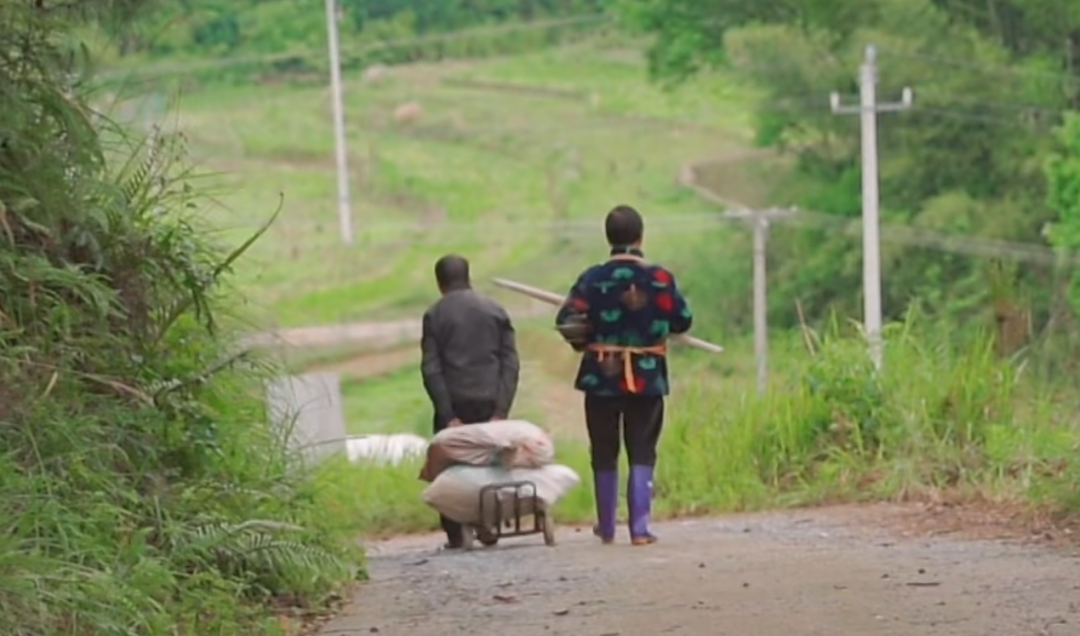
◉During the 2022 bamboo shoot season, Grandpa could still help carry a little. Now the bulk of the farm work falls entirely on Grandma’s shoulders.
But grandmother is ageing relentlessly, and the whole village is ageing alongside her.
The minibus that used to be packed shoulder-to-shoulder on market days now runs with more than half its seats empty. The houses have grown more modern, yet their doors remain shut for longer stretches. Streetlights have been installed, but the villagers who once gathered at night to chat have vanished. In the second half of last year, the village’s regular bus service was discontinued due to heavy losses, sounding like a final, quiet note for the elderly left behind.
Our village hamlet consists of just over thirty households, yet only around ten now live here year-round, and merely seven or eight still work the fields. More than a decade ago, the trek up the mountain to harvest young shoots was a lively affair. Over a dozen middle-aged and elderly women would make the climb with their children, chattering the whole way. Grandmother used to have four or five companions on each outing, but one by one, they left. When our neighbour, Grandmother Yang, passed away in spring, the shoots from their final harvesting trips together had not yet been dried, and they all went mouldy.
These days, only six or seven women in the hamlet still head up the mountain to harvest shoots. The eldest is 84-year-old Grandmother Da, but she only occasionally gathers a few on her way. The youngest is Xi, a mother left behind in her forties. The true backbone of the harvest now consists of just my grandmother, Grandmother Deng Lian, and Xi.
Fortunately, their daughters have returned home in recent years. Due to failing health, they can no longer work away on building sites. Now back home, these daughters now and then take on some of the farm work for their elderly mothers.
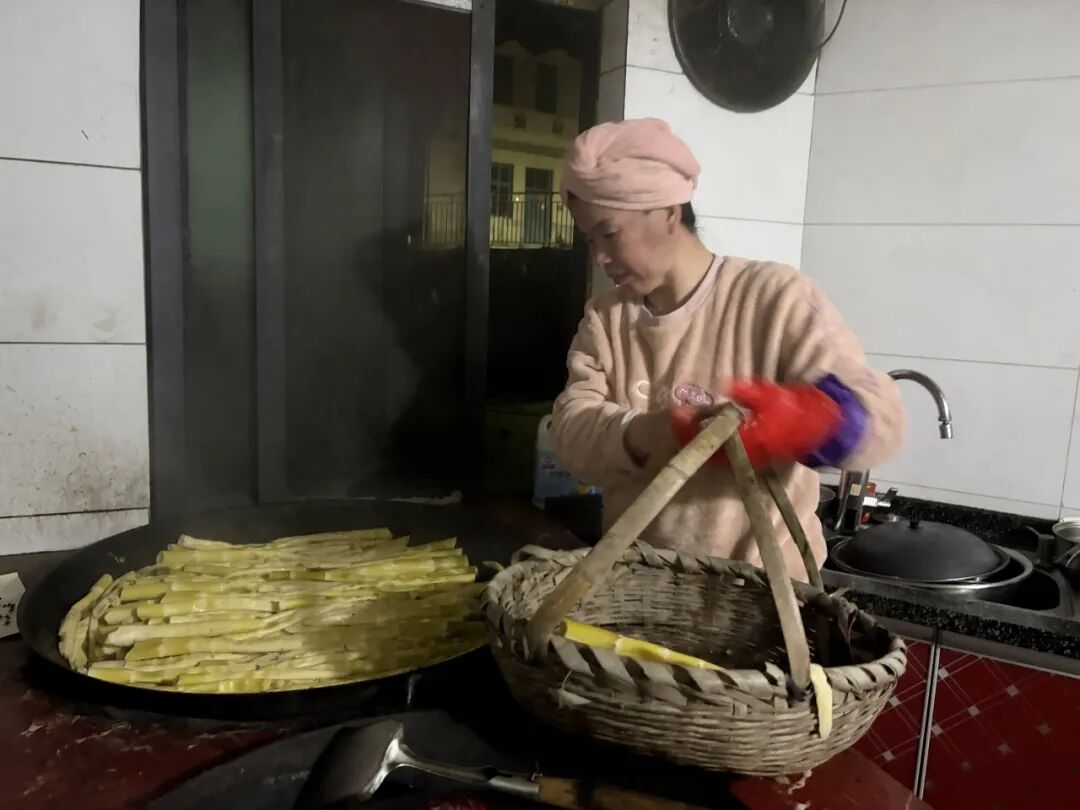
◉The aunt helping to cook the bamboo shoots.
Dignity
These bamboo shoots represent income, but not merely that. For my grandmother, they also mean dignity.
My grandmother, Yang Xiuying, has always been a fiercely proud country woman. She grew up in a household of nine children. Because her family’s surname was not native to the village, they were treated as outsiders and lived in particular poverty; none of the girls were permitted to go to school. After attending class for just two days and learning barely two characters, her grandfather called her back home. After all, a seven- or eight-year-old girl was old enough to gather fodder for the pigs and chop firewood.
In her youth, she would trudge across mountains and ridges before dawn, climbing over the 600-metre Leizu Ridge to reach Hengnan County. She’d search for fodder, firewood, and bamboo shoots, only returning home after dark. She told me that back then, she was one of the few village girls who could occasionally bring back a small bundle of shoots. Once peeled, that modest bundle would yield around half a kilogram of edible bamboo, yet it was still a rare treat for the family. The discarded shells were saved to feed the pigs, and every part was carefully treasured.
Grandfather also took notice of her grit and tireless work ethic. When he was younger, he worked in the village tallying work points and serving as the weighmaster. He observed that despite her petite frame, my grandmother consistently carried back the heaviest loads of fodder, proving her remarkable capability. During the early years of their marriage, the household relied on selling peanuts and sweet potatoes, and my grandmother was always the one to negotiate the prices. In those days, dried bamboo shoots were chiefly kept for family meals during festivals. The older folk had a particular fondness for pickled shoots stir-fried with pork, and my grandmother’s harvest was invariably the most prized.
It was my grandmother who kept the entire household going. When she was younger, Grandfather was assigned to railway construction and timber transport. His wages were meagre and he was frequently away for long periods, leaving my grandmother to single-handedly tend three or four mu of land, earn her work points, and raise three children. In the years that followed, she also took on the responsibility of looking after my brother and me. Never being able to leave the village for work remains a lifelong regret for her. “If I’d had the chance to attend school and learn even a few characters,” she often remarks, “I know I could have made a go of a small business. I’m not inferior to anyone else.”
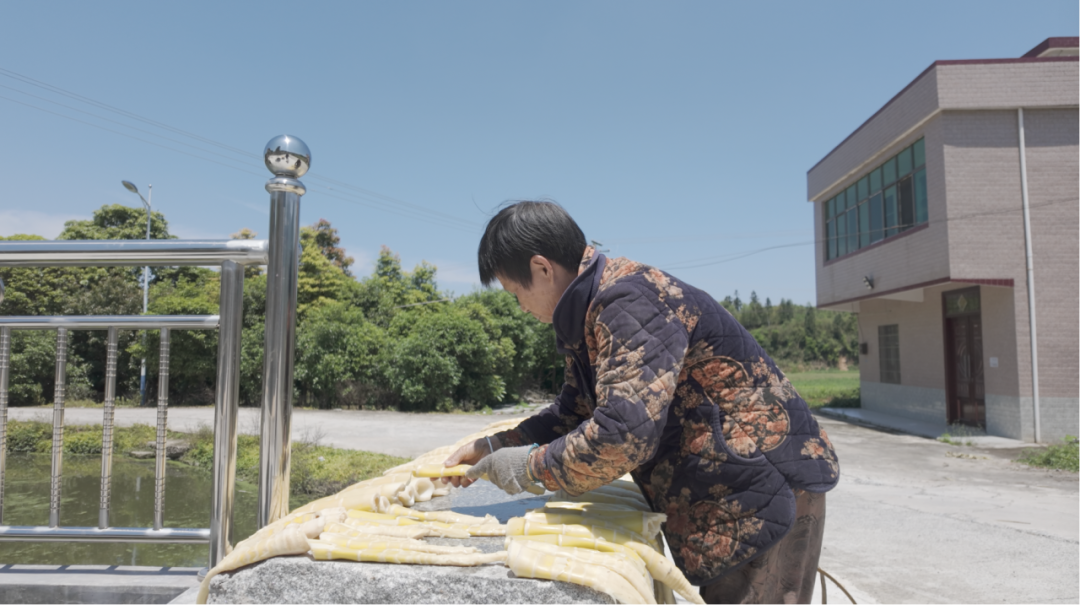
◉Grandmother drying bamboo shoots, adapted to local conditions.
Time shows no mercy. From my high school and university years through to my working life, my grandmother has remained in that small mountain village. Relying on experience alone, she trades familiar, hard labour for a meagre income. As she has grown older, her ailments have multiplied: chronic stomach trouble, a removed bile duct, anaemia, cerebral arteriosclerosis… Last year, when she fell ill, treatment cost over 3,000 yuan. Stubborn as ever, she insisted on paying nearly 1,000 of it herself, unwilling to spend her children’s money.
In developing mountain towns, everything is changing. The village is left behind by the city, and the elderly by the young. Yet year after year, my grandmother still heads up the hills to harvest shoots.
The small dried shoots hold a lifetime of memories for her. They are also the product of years of accumulated mountain wisdom, providing her with both an income and a sense of security. To her younger kin and relatives, the dried shoots are ‘her own stock’—something she can proudly present. She always generously shares some dried shoots and sweet potato vermicelli with every relative who comes to visit.
Some relatives gladly accept her mountain produce, complimenting my grandmother on the quality; others find it a bit of a hassle, but she still sets some aside each year. Over the past few years, she has also mastered preserving shoots. She blanches newly picked young shoots in boiling water, places them in a glass jar with a little brine, and seals it for over half a year. This way, when her children and grandchildren return for the Lunar New Year, they can enjoy tender, white fresh shoots.
End of the shoot season
A complete shoot season lasts roughly 45 days, typically running between the Qingming and Xiaoman solar terms. This year, it spanned from early April to late May.
The shoot season falls into two phases. First, ahead of Qingming, “large shoots” emerge in the moso bamboo groves. Though the visible tips are merely a few centimetres long, the underground portion runs deep. The base is tough and cannot be pulled by hand; a hoe is essential, demanding sharp eyesight and considerable stamina. Unearthing a single large shoot can take nearly twenty minutes. Rainy days make it even more arduous; a bag of harvested shoots often turns out to be mostly heavy yellow mud. As the large shoot season draws to a close, younger shoots begin to sprout across the hillsides. The first to appear are the downy shoots, followed by the water bamboo shoots, and finally the hemp-shell shoots. The thickness of the flesh varies by type. While hemp-shell shoots are less tender when cooked, their meat is substantially thicker, making them the most economical variety to harvest and sell.
Barring heavy rain or days consumed by fieldwork, my grandmother spends just over a month of continuous labour in the hills. Each expedition requires at least two or three hours of navigating the undergrowth, and by the time she emerges, her back is weighed down by several bulging woven sacks.
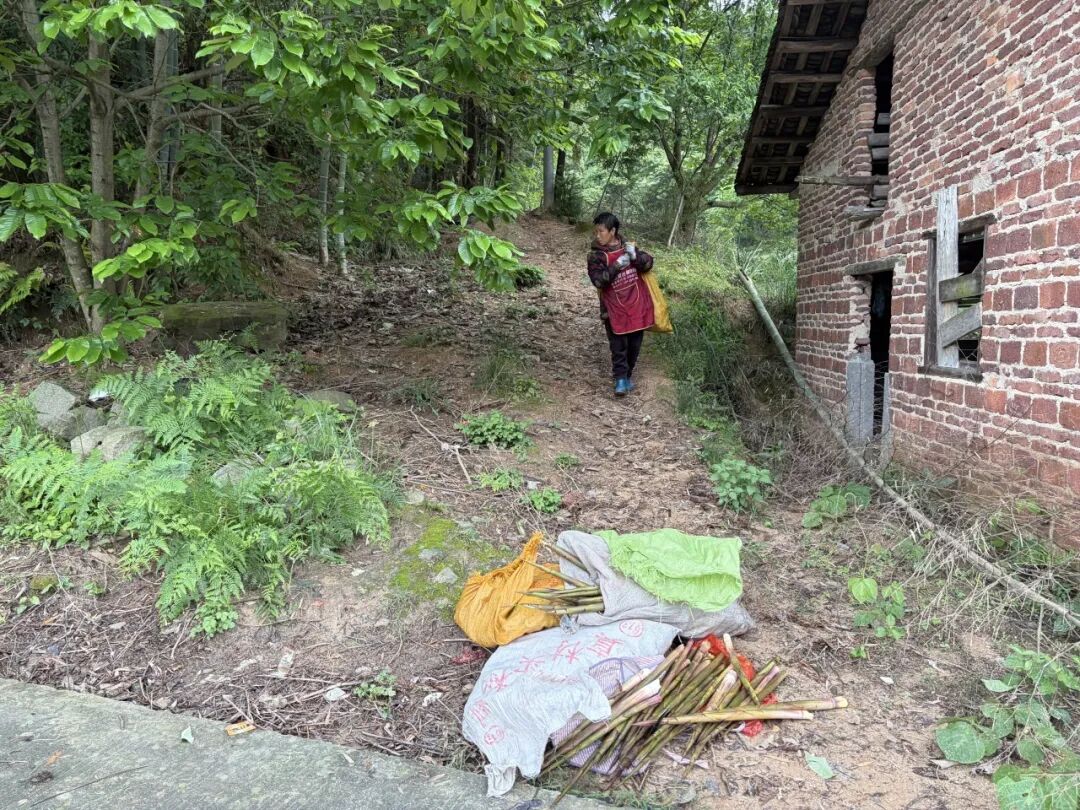
◉The grandmother with several bags of harvested bamboo shoots.
When the holiday ended and I returned to work, another heavy downpour hit home. Grandma said the rain was coming down like a waterfall, but fortunately, most of the shoots at home had already been dried out.
At the time, she gave me her solemn word that she had had enough and was finished for good.
But two weeks later, on 15 and 16 May, she headed back up the mountain. Setting out at 5 a. m. and returning by 8 a. m., she carried back a heavy load of fresh shoots and spread them across two bamboo drying racks. She said she wanted to take advantage of the dry weather to preserve some fresh shoots in a jar for me, so I would have them ready to eat as soon as I returned.
The long bamboo shoot season, running from late March to 16 May, has now drawn to a close. This year’s yield for Grandma wouldn’t exactly be described as a “bumper harvest”. She told me that last winter was unusually dry, which took a toll on the hillside bamboo and left this year’s shoots rather scarce. In the end, she gathered less than she did the year before.
The end of the shoot season does not mark the end of the work. Even after dark, Grandma is still busy. She sits by the lamplight, gathering the dried shoots, smoothing them out in her hands one by one, and tying them into neat bundles. She sorts them carefully, setting aside the finest ones for the children to enjoy when they return for the Lunar New Year.
Outside, a sudden night rain begins to fall. The shoots left behind in the dense mountains will grow into new bamboo thickets, the cycle repeating itself. Next year, the groves will send up fresh shoots once more, waiting to be gathered.
– This is Foodthink’s 815 th original article –

Foodthink
Author
Ashy Zhang Qiuqiu
A girl from the countryside who moved to the city for work. Enthusiast of plants, food and a laid-back lifestyle. I gather fragments of everyday life and write stories about the world around me.
About the “Her and the Land” Column
This year marks the United Nations’ International Year of Women Farmers. Foodthink is launching the “Her and the Land” column to focus on women within agricultural and food systems. We will step into fields, markets, fishing ports, pastures, kitchens, laboratories and city streets to highlight the women who are often overlooked yet ever-present. Involved in production, research, cooking, distribution and care, their labour and wisdom underpin our everyday lives. They are not only cultivators of the land but also key builders of rural communities and food systems. Through interviews, essays and workshops, we aim to share their stories, examine how women’s participation shapes our food systems, and invite everyone to discuss how a fairer, more dignified future can be realised for women working in food and agriculture.
Unless otherwise stated, all images are provided by the author.
Editor: Xiao Dan
Layout: Xiao Shu
Scan the QR code to tip and support original food insights
▼

▼
Click the image to read related articles
▼
Click on the keywords to explore more article collections
Seeds|Agritech|Policy|Fermentation|Nutrition|Fruit|Fisheries|Events|Careers|Food Delivery|Markets|Livestock|Food Talk|Sharing Sessions|Book Clubs|Harvest Festivals|Smallholder Stories|Climate Change|Rural Development|Cooperative Economy|Urban Farmers|Food Safety|Digital Technology|Biodiversity|Pandemic & Food|False Solutions|Lianhe Creative Programme|Ecological Agriculture Internship Programme
Beijing|Hebei|Shanghai|Guangdong|Guangxi|Henan|Sichuan|Jiangxi|Xinjiang|Shaanxi|Hong Kong|Chongqing|Zhejiang|Jiangsu|Guizhou|Northeast China|Taiwan|Inner Mongolia|Philippines|Canada|Russia|Mexico|Italy|United States|United Kingdom|Germany|Netherlands|Thailand|Sweden|Japan







🌟🌟🌟 Star us so you never miss an update
“Like” “Share” “Read” “Comment”
▼ Share food insights