Why Did Two Billion Bees Vanish?

Foodthink says
In March this year, pesticide spraying in oilseed rape fields caused devastating losses among beekeepers, and bee deaths briefly made headlines. But beyond the visible “death”, there is a more insidious disappearance: bees do not die en masse in their hives; instead, entire colonies simply leave, and all that remains is an empty hive with no bodies in sight. This phenomenon is known as Colony Collapse Disorder (CCD).
Research by Professor Chensheng Lu of Harvard University, author of The Vanishing Bees, together with beekeeper Kenneth Walhol and entomological toxicologist Richard Callahan, has found that sustained ingestion of low doses of neonicotinoid insecticides impairs the mitochondrial health of bees and ultimately leads to CCD. As seed coating technology has been rolled out, systemic pesticides enter plants from the seed stage and spread further into soil, water and air, affecting insects large and small along the food chain — until they finally end up on human dining tables and enter the body.
The 20th of May is World Bee Day. We have selected excerpts from The Vanishing Bees, beginning with Professor Chensheng Lu’s experiments and the empty hives left in the wake of the bees’ disappearance, to re-examine the relationship between modern agricultural technology and ecology.
With thanks to Shanghai Translation Publishing House for authorising this article.
When our field experiment concluded — one that confirmed 15 colonies had been lost to Colony Collapse Disorder caused by the ingestion of very low doses of neonicotinoid insecticides — we began to clear the apiary site. The results were a solemn tragedy: every hive standing upright was empty, stripped of bees, like a tombstone. We sacrificed 15 colonies to uncover the toxicity of neonicotinoid insecticides that we should have known about but had been kept in the dark.
Although the premise of our experiment was that the ingestion of low doses of neonicotinoid insecticides by bee colonies would trigger the toxic phenomenon of CCD, witnessing this devastation in person shook me to the core. Anyone unfamiliar with this experiment who stands before these empty hives would surely feel overwhelming bewilderment and dread.
Bewilderment, because why would a colony that was perfectly healthy before winter arrive all hollow by midwinter? Dread, because if the cause of the bees’ disappearance were to affect us as well, would humanity also vanish?
But as I moved from a vibrant, buzzing hive — the control colony — to the next dead-silent, empty hive just a metre away, I realised I was living through another “Silent Spring”. Hives that had succumbed to CCD over the winter sat unnervingly still in the heart of spring. This silence was more suffocating than the calm before a storm.
Compared with the “Silent Spring” of the twentieth century, the protagonist of the twenty-first-century “Silent Spring” has shifted from songbirds to bees, and the culprit from DDT to neonicotinoid insecticides. Yet both are new ecological crises wrought by pesticides — a hidden pesticide toxicity that has created a silence in spring that should never have existed.
Humanity has walked this “Silent Spring” time tunnel for more than 60 years. Once we grasped the toxicity of DDT and recognised the importance of protecting wildlife, environmental awareness rose in more progressive nations, and government bodies akin to an environmental protection agency were set up one after another.
More than 60 years later, the heavy use of yet another class of pesticide has produced another Silent Spring, as though the end of the twentieth-century time tunnel of environmental protection were nothing but the beginning of the twenty-first. The ecological crisis spawned by new pesticides seems to have set us back to that starting point 60 years ago, as we watch helplessly while bees struggle and perish.
Opening the Pandora’s Box of Seed Coating
From the results of two CCD experiments at Harvard University, we might conclude that the culprit behind CCD is the ingestion of very low doses of neonicotinoid insecticides — imidacloprid and clothianidin — by bees through high-fructose corn syrup. It is the transgenerational toxic effect of neonicotinoid insecticides on mitochondrial DNA that causes the generations of bees which most need to generate energy to survive the winter in the hive to suffer functional damage to their mitochondrial DNA and age prematurely, triggering CCD on an unprecedented scale.
The fact that neonicotinoid insecticides cause CCD in bees is beyond doubt, but the route by which they do so is a relatively little-known agricultural innovation — seed coating.
The shift from traditional pesticide spraying to seed coating has changed not only the way pesticides are applied. Deliberately or otherwise, we have altered the impact these systemic insecticides and fungicides have on the survival conditions of non-target organisms and on environmental biodiversity.
The pesticide manufacturing industry has hailed the combination of systemic pesticides with seed coating as a major milestone in the development of agricultural technology in the late twentieth century, proudly proclaiming that plant protection could now be as precise as human medicine. But the mass disappearance of bees worldwide led the European Union to indefinitely restrict the three most widely used neonicotinoid insecticides, puncturing that grand boast.
The advent of seed coating is in fact a strategic development for the pesticide manufacturing industry. On the surface, seed coating offers farmers a one-stop service for purchasing seeds and pesticides; in reality, it has also substantially increased the industry’s revenues.
Coated seeds do not contain only neonicotinoid insecticides; they can also be coated with systemic fungicides, plant growth regulators, nutritional additives, and the like. So, how many types and how much of neonicotinoid insecticides and systemic fungicides are actually on a single maize seed — I believe even government regulatory bodies cannot say with certainty.
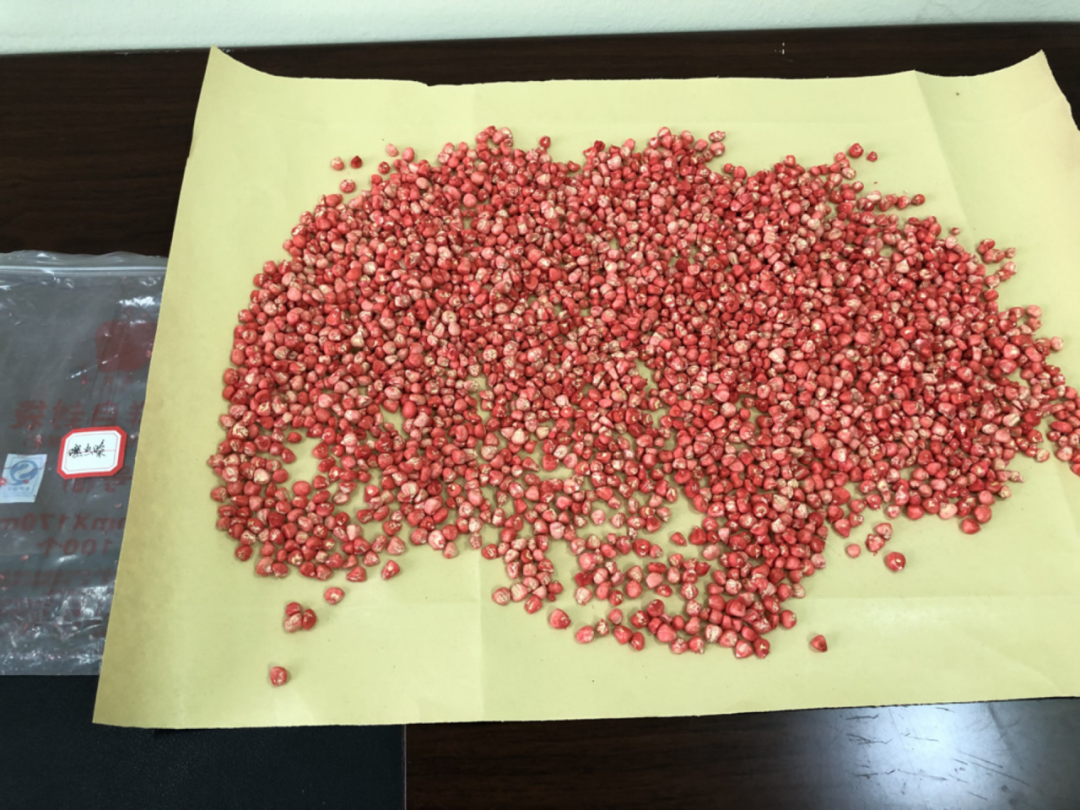
◉ Maize seeds coated with neonicotinoid insecticides. Photograph: Chensheng Lu
But ever since I personally conducted the CCD experiments, witnessed the terrifying ecological crisis of the bees’ disappearance, gained a deeper understanding of the transgenerational toxicological effects of mitochondrial DNA damage caused by the ingestion of low doses of neonicotinoid insecticides, and come to appreciate the harm coated seeds inflict on the environment and ecology, I have felt compelled to speak out against the very existence of neonicotinoid insecticides and the legitimacy of seed-coating treatments before my career draws to a close.
Neonicotinoid Insecticides Have Reached Our Dinner Tables
A great many experimental results have shown that a large proportion (80–98%) of the pesticides on the exterior of coated seeds leach directly into the soil, from where they enter surface water and groundwater. The remaining 2–20% enters the plant after germination and, owing to the hydrophilicity of systemic pesticides, grows alongside the crop — right through until the crop is harvested and enters the human food chain.
In other words, the very act of sowing coated seeds treated with neonicotinoid insecticides renders these insecticides omnipresent in the environment and in food.
While coated seeds contaminate the soil and surface water with neonicotinoid insecticides, a small fraction is absorbed by the plant’s roots, translocated upward from the seed, and drawn into the plant’s own vascular system. It is then delivered to every part of the plant, including the pollen and nectar within its flowers, before finally being released into the air.
Naturally, the organisms that suffer most from this pollen-borne route of ingestion are the pollinating insects themselves, bees above all, since pollen is their primary source of protein. Yet the creatures harmed by pollen ingestion are not confined to these vital pollinators. In the flowering season of spring, whether or not we are admiring the blossoms, simply being outdoors means inhaling pollen indiscriminately. Some people suffer severe allergic reactions; others are unaffected. But because neonicotinoid insecticides are used so widely across agriculture, urban greening, parks, and domestic gardens alike, the annual pollen season has become a peak period of neonicotinoid ingestion — particularly for those who relish venturing out to take in the spring flowers.
Owing to the hydrophilicity of systemic pesticides, the vividly coloured seeds treated with neonicotinoid insecticides can, in theory, shield a plant from sowing through to harvest against both below- and above-ground pests, thereby safeguarding food production. From the standpoint of plant protection, coated seeds would seem to play an indispensable role.
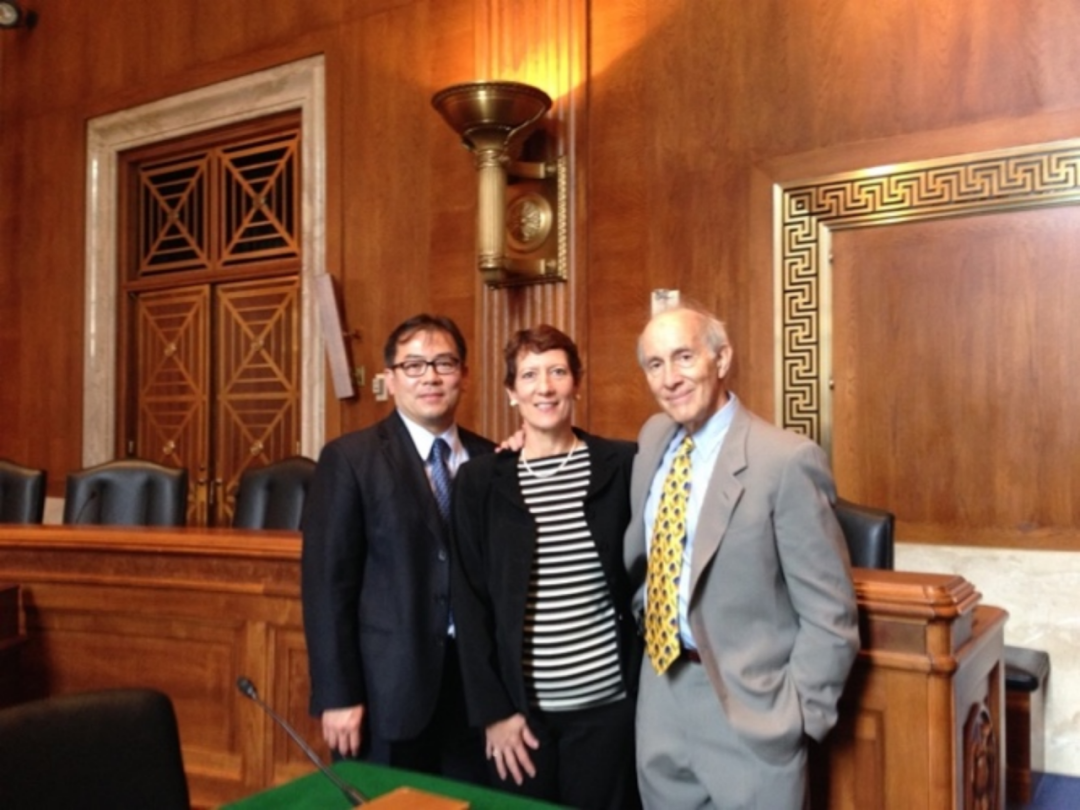
◉ Professor Chensheng Lu and two of his research colleagues, invited in September 2014 to a US Congressional joint hearing on “how to address the decline in bee colony numbers”. Right to left: Dr Eric Chivian (Professor at Harvard Medical School and one of the recipients of the 1985 Nobel Peace Prize), Dr Melissa Perry (Professor at the School of Public Health, George Washington University), and Dr Chensheng Lu (Associate Professor at the Harvard T.H. Chan School of Public Health).
But agriculture cannot concern itself solely with crop growth and yield, for crops are themselves part of the ecosystem, breathing the same air, drinking the same water, and relying on the resources that soil provides to sustain our lives. Agriculture, therefore, is entitled to no special privilege, still less to hiding perpetually behind “ensuring food security” as a shield for doing whatever it pleases.
The history of pesticides in human society tells us that their misuse breeds only resistance. Pouring millions of kilograms of insecticides into the soil year after year is itself an act of abuse — a reckless dumping of toxic chemicals, a pursuit of agricultural output by any means necessary.
By the time we are left with no tools whatsoever to combat agricultural pests, it will be too late to ask whether seed coating was ever a sustainable plant protection tool in the first place. This is no alarmist prophecy; it is something that will happen sooner or later.
When a Beekeeper Cannot Keep Their Bees Thriving
Mr Walhol told me that this year (2023) should be the last year of beekeeping in his life. He said: “If I cannot even keep bees thriving, then all the knowledge passed down about beekeeping is a lie. There are ever more threats in the environment preventing the entire hive from growing healthy and strong.” This filled him with a deep sense of grief and powerlessness.
Mr Walhol said: “I tried selling organic honey, because organic honey retails at two to three times the price of ordinary honey. But every year, neonicotinoid insecticide residues were detected in the honey, so I could not do it.” Mr Walhol added: “The spread of neonicotinoid insecticides in the environment has been faster and far more widespread than I imagined — it caught me completely off guard. Continuing beekeeping has become a struggle, and it no longer makes any economic sense.”
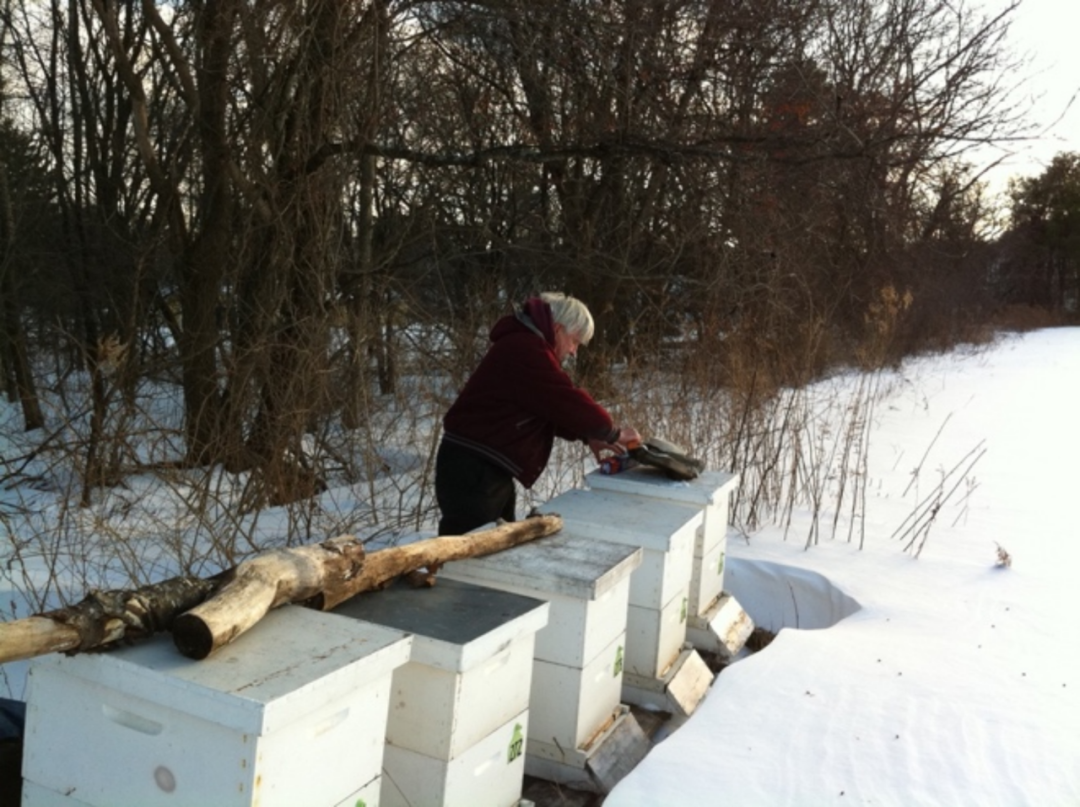
◉ Inspecting an experimental hive during overwintering. Photograph: Richard Callahan
Mr Walhol is not peddling anxiety, nor is he seeking sympathy. In June 2023, the Associated Press, a leading US news agency, reported: “Sixty per cent of US beekeepers lost a large number of colonies in 2022, rendering their income unsustainable.”
The Associated Press report makes no mention whatsoever of the impact of neonicotinoid insecticide ingestion on bee survival. It holds that climatic factors are the primary cause of colony deaths brought about by the Varroa mite, and that beekeepers of every scale — from people’s back gardens to professional apiaries — attribute “severe weather” as the main cause of colony mortality. The Associated Press presents a wealth of evidence showing that, as the climate changes, bees and many of the flowers they pollinate are falling out of synchrony, with serious consequences for both. Yet the Associated Press neither connects, nor can connect, the burden of the Varroa mite with the difficulties bees face in foraging for pollen and nectar as a result of climate change.
Cherish the Bees You See
Between peddling anxiety and stating facts, there really is only a gossamer veil. Is the disappearance of bees peddling anxiety? Is the importance of bees to humans and to the ecosystem peddling anxiety? Are the irreversible health effects of mitochondrial toxicity peddling anxiety? Is the environmental harm wrought by neonicotinoid insecticides and seed coating peddling anxiety? The phrase “peddling anxiety” is a charge that demands no accountability, the cheapest possible rebuttal, a placating sentence that buries the truth.
The causes and consequences of the bees’ disappearance are already an undisputed scientific fact. Deliberately downplaying the ecological disaster brought about by neonicotinoid insecticides and seed coating merely hurtles human civilisation towards an abyss. That mitochondrial toxicity affects the health of cross-populations and their offspring is likewise a scientific fact — and what we as a species now face is a vast global biological experiment to verify it.
By the time sufficient scientific evidence confirms that our current understanding of neonicotinoid mitochondrial toxicity and the environmental harm of seed coating is correct, it may already be too late — or the price already too high.
Whether agriculture in the twenty-first century must continue to rely on chemical pesticides is a deeply contested question. Since the advent of DDT, no widely used pesticide has stood unshakable; every one has ultimately been phased out. Most have been banned because of their known toxicity and the environmental resistance they engender.
We need to think from multiple angles and confront the ecological and health risks of pesticide use with caution. Until we find a balance that simultaneously safeguards agricultural production, ecological protection, and population health, “whether pesticides are needed” is not the urgent question. What we truly need are pesticides that inflict the least harm on the ecosystem and on people.
The vanishing of the bees has disproved our twenty-first-century choices — neonicotinoid insecticides and the technology of seed coating. I believe we still have a sliver of precious time to rectify the mistakes we have made, and this may well be our last opportunity. So please cherish your next unexpected encounter with a bee in the wild or in a park. Who can say whether it will be the last bee you see in your lifetime?
▼
Click the image to read related articles