Can Carbon Trading Save the Earth? No — It May Be Draining Farmers Dry

Previously, farmers sold grain; now, someone is starting to tell them that the “carbon” in their soil can be sold for money, too.
Simply by changing their farming practices as required by the project — enabling the soil to store more carbon, or reducing methane emissions from rice paddies — these “carbon reductions” could potentially become carbon credits, sold to the companies at the other end who need to offset their emissions.
But when “carbon” truly becomes a business, who is setting the rules, who is making the money, and who is bearing the risk?
In May this year, GRAIN, an international organisation that has long focused on smallholder farmers and biodiversity, published a report, The Carbon Credit Trap: A New Danger for Farmers in Asia, seeking to answer these questions. The report examines carbon credit projects that are rapidly penetrating rural Asia, and in particular the new problems these projects are creating for farmers. Foodthink has been authorised by GRAIN to compile and publish this article.
What Are Carbon Credits, and What Is Carbon Trading?
First, we need to understand what carbon credits and carbon trading actually are.
If a company emits one tonne of carbon dioxide, and a project somewhere plants trees, protects a forest, or changes agricultural practices so that one tonne of carbon dioxide is reduced or absorbed, then in theory the company can buy that tonne of “emission reductions” to offset its own emissions.
This tradable “emission reduction” is what we call a carbon credit. The platform where such carbon credits are bought and sold is the carbon market.
The carbon market was originally intended to use market mechanisms to put a price on carbon emissions — making it costly to release greenhouse gases, thereby encouraging companies to cut their emissions voluntarily, and ultimately slowing climate change.
However, when we talk about the “carbon market”, we are actually referring to two quite different systems.
One is the mandatory emissions trading scheme. Take China, for example: the government allocates a set number of emission allowances to major emitting companies according to established rules. Come the reporting deadline, companies must “hand in their homework” — if the allowances in hand fall short of actual emissions, they must go to the market and buy extra allowances from companies that have a surplus; those with allowances to spare can sell them on. In 2021, the national emissions trading market launched with the power generation sector as its starting point; in 2025, steel, cement and aluminium smelting were brought into the fold. What is traded on the national carbon market today are precisely these allowances.
The carbon price is not fixed either; it rises and falls with market supply and demand. In 2025, the average transaction price of allowances on the national carbon market was 62.36 yuan per tonne.
Take the cement industry as an example. The bulk of carbon emissions in cement production comes from clinker production: producing one tonne of cement clinker releases roughly 0.8 tonnes of carbon dioxide. If a cement company exceeds its allowance by 0.8 tonnes of carbon, it needs to buy the corresponding extra allowances from the market. At the average price of 62.36 yuan per tonne, that would cost roughly 50 yuan. Of course, how many allowances a company actually needs to buy also depends on how many the government has allocated to it and on the prevailing carbon price, which together determine the final bill.
The other is the voluntary carbon market. For instance, if someone plants a stretch of forest, or changes rice paddy irrigation methods to cut methane emissions, a set of rules is used to calculate “exactly how much carbon has been saved”; after verification, carbon credits are issued and can then be sold on the market.
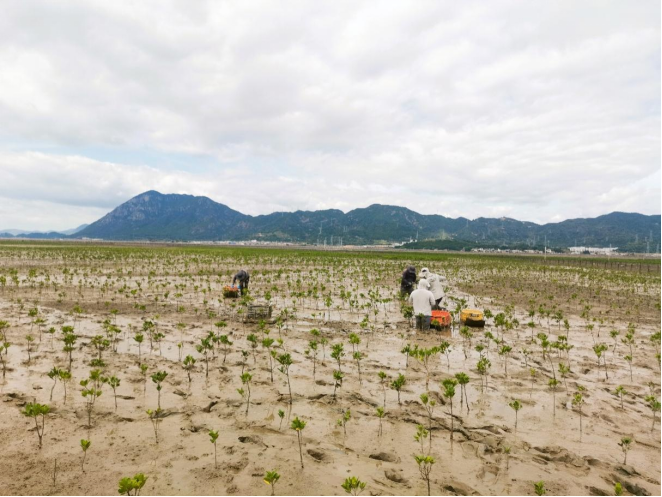
◉ This March, the “Mangrove Vegetation Restoration Project in Yantian Township and Changchun Town, Xiapu County, Fujian Province” officially passed review by the relevant national authorities and completed its registration, becoming the country’s first mangrove creation carbon sink project under the national Voluntary Greenhouse Gas Emission Reduction (CCER) scheme. Image source: Third Institute of Oceanography
These calculation rules are what we call the “methodology” that so often appears in the carbon market. Put simply, it is a set of formulas and operational guidelines: what qualifies as an emission-reduction project, how much would have been emitted without the project, how much is reduced with the project, and how monitoring should be carried out — all of it must follow the rules laid down by the methodology.
Carbon Credits Are Entering Asia’s Forests, Farmlands, and Pastures
Asia has become a key region for the expansion of carbon credit projects. Data cited by GRAIN shows that Asia already generates more than half of the world’s carbon credits, with East Asia accounting for 50% of Asia’s carbon credit output, South Asia for 31%, and Southeast Asia for 12%. By 2030, the annual value of carbon credits generated in Asia is projected to approach $10 billion.
The most common type is forest carbon credit projects — REDD+, or “reducing emissions from deforestation and forest degradation”. In simple terms, these projects aim to cut carbon emissions by protecting forests and preventing deforestation, then convert those emission reductions into carbon credits.
But GRAIN points out that some projects view traditional agriculture — particularly shifting cultivation — as a cause of deforestation, and as a result restrict local communities’ access to forests for farming, gathering, hunting, fishing, and grazing. Yet at the same time, commercial logging, industrial agriculture, and large-scale plantations — the activities that actually drive widespread deforestation — receive far less attention and scrutiny.
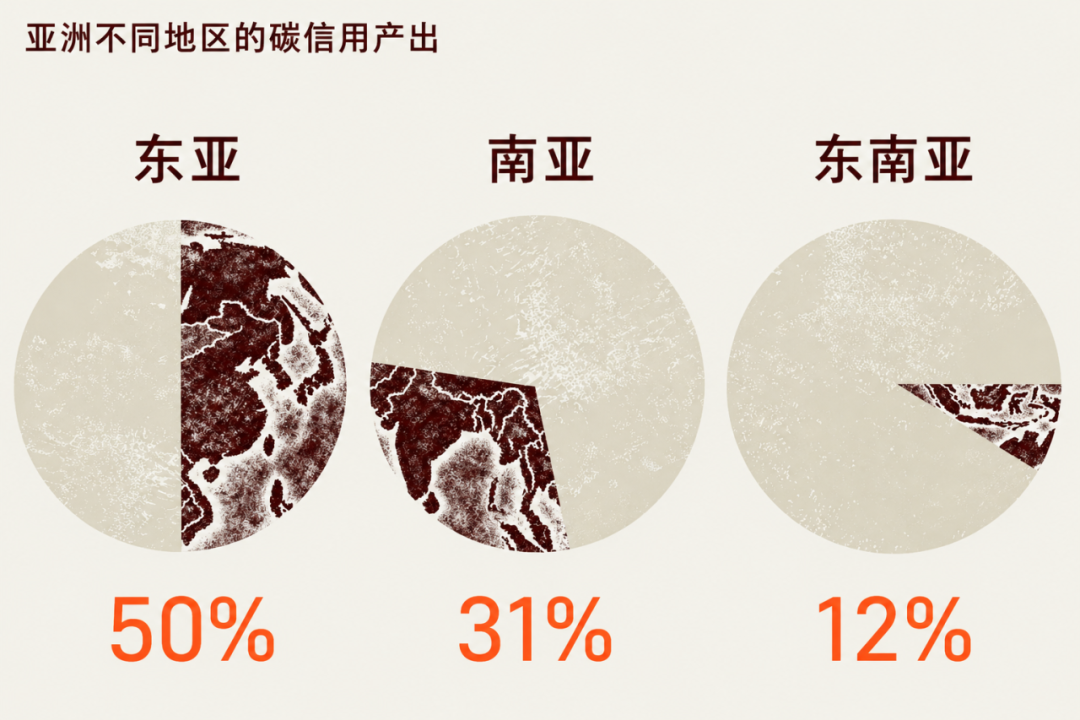
◉ Asia already produces more than half of the world’s total carbon credits. Within Asia, East Asia accounts for 50% of carbon credit output, South Asia for 31%, and Southeast Asia for 12%.
Something similar is happening to mangroves.
In 2022, the Thai government signed an agreement with 17 companies — including Thai Oil Public Company Limited, PTT Global Chemical Public Company Limited, and Shell Thailand — entrusting these firms with the management of 7,000 hectares of mangroves in southern Thailand and granting them exclusive rights to the revenue generated by those forests. Reports cited by GRAIN reveal that since 2023, more than 34,000 hectares of mangroves in Thailand have been registered as carbon credit projects, and some communities only discovered later that the mangroves their families had used for generations had already been enrolled in the national carbon credit system.
For people living near mangroves, these forests have always been a source of livelihood — they may fish there, gather shellfish, or collect timber. Once access is restricted, carbon credit projects may also change the lives of local people.
The second type of project involves planting trees. Companies may secure large tracts of land to establish plantation forests, or sign long-term contracts with farmers or communities, having them plant trees on their own land while surrendering the rights to the carbon stored in the soil to the company. Yet some of these projects do not create complex, biodiverse forests at all — they produce monoculture plantation forests that fail to consider the broader ecosystem or existing local land-use practices. The end result is damage to biodiversity, and a failure to support both wildlife and the livelihoods of local communities.
The third type of project brings agrichemical giants such as Bayer and Cargill right into the field, promoting their “soil carbon projects” and encouraging farmers to use no-till methods, crop rotation, cover crops, and adjusted fertilisation practices to keep more carbon in the soil. The report poses the question: under the banner of helping farmers, could these schemes become a new means of exploiting and controlling them?
Why Should Farmers Be Wary?
At first glance, this looks like a win-win deal: companies gain carbon credits, farmers adjust their farming practices, and everyone wins — emissions fall while farmers earn extra income. Yet each of the projects described above may harbour a trap, whether for the farmers themselves or for the emissions-reduction goals.
First, while many carbon credit projects do not buy farmers’ land outright, they acquire the rights to the “carbon” in that land through contracts spanning several decades. As a result, farmers and communities are contractually bound to plant trees, tend the land, or farm in prescribed ways for the next several decades. Throughout this process, farmers and communities are largely excluded from project decision-making and resource management — effectively losing control and management rights over their land, and potentially giving rise to land disputes.
This control over the land extends further into day-to-day agricultural production, giving agrichemical companies an opportunity to exert influence over both farmers and farmland.
Second, to verify exactly how much carbon a piece of land stores, companies must collect data on an ongoing basis. This means farmers need to register on the company’s digital platform, upload information about their farming activities, and submit to continuous monitoring of their practices.
But the data is not used simply to calculate carbon. When a project dictates no-till practices, crop rotation, fertilisation, irrigation, or even which crop varieties to plant, these agrichemical companies are effectively stepping into the territory of shaping farmers’ agricultural decisions. In its report, GRAIN stresses that particular vigilance is needed when large seed, fertiliser, and pesticide companies such as Bayer and Syngenta enter the carbon agriculture market, as this would further entrench their market dominance: on one hand, they sell pesticides, fertilisers, and seeds; on the other, they help determine how farmland is farmed, all the while using “low-carbon agriculture” as a pretext to push their products.
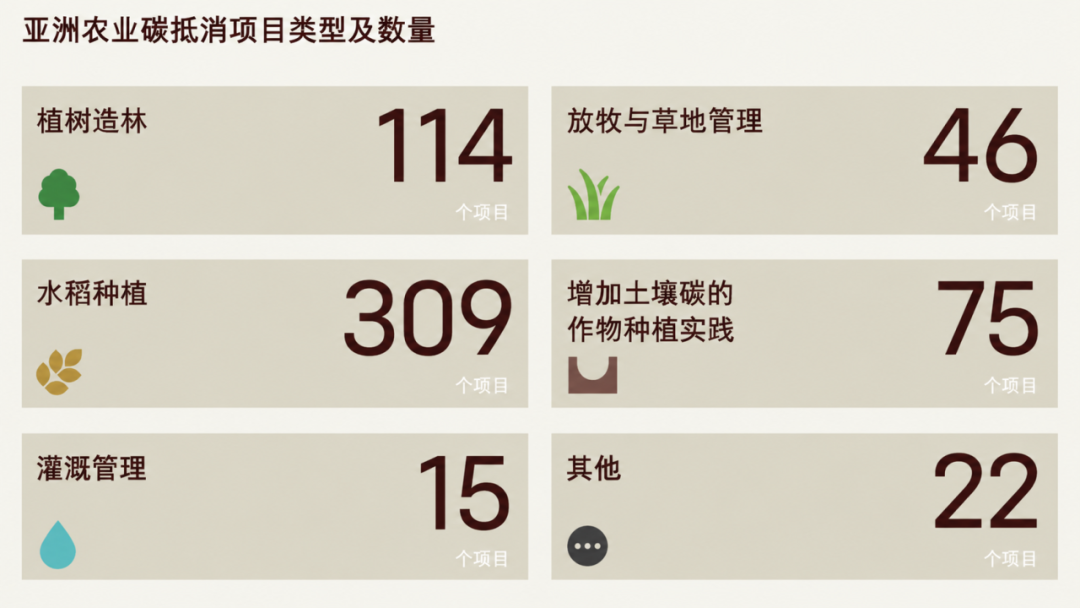
◉ Types and numbers of agricultural carbon offset projects in Asia.
In fact, this is already happening. The farming methods prescribed by these companies’ carbon credit projects “happen to” require exactly the seeds, pesticides, and technologies that these agrichemical firms sell. Carbon credit projects are becoming a new sales channel for agricultural inputs.
Rice, meanwhile, is another rapidly growing frontier for carbon credits.
The vast majority of the world’s rice is grown in Asia. According to available statistics, Asia accounts for roughly 89% of the global area harvested for rice. Rice has therefore become one of the key targets for agricultural carbon projects in Asia. Currently, rice projects account for 53% of registered agricultural carbon projects and issued carbon credits in Asia, concentrated primarily in China and India.
Take rice as an example. To cut methane emissions, carbon projects require rice to stop sitting in standing water for long periods and instead undergo periodic drainage — a practice known as “alternate wetting and drying” (AWD). But once the water drains away, weeds grow more easily, meaning farmers may need more herbicides. Some projects also promote hybrid rice varieties suited to direct seeding — seeds that, as a rule, farmers must keep buying each season.
In 2023, Bayer launched The Good Rice Alliance (TGRA) in India, which now covers 11 Indian states and has enrolled more than 10,000 farmers, reducing methane through direct seeding and alternate wetting and drying (AWD) irrigation.
Farmers joining the project must use Bayer’s digital platforms such as FarmRise. Bayer has also partnered with Microsoft, which stores and processes the data the project collects. GRAIN points out that these platforms do not merely record methane emissions — they also shape what farmers grow, what inputs they buy, and how they sell their produce. Under the TGRA project, farmers are simultaneously encouraged to use Bayer’s hybrid rice seeds and herbicides.
In other words, farmers thought they were joining a project that would put money in their pockets, only to find themselves “harvested” by the agribusiness companies.
So can farmers actually make money? Not necessarily.
GRAIN’s analysis of carbon project contracts reveals that when carbon credits are sold, not all the revenue reaches the farmers. Project developers typically take a 20–30% cut first; the remainder must then cover certification and verification, staff wages, consulting fees, administration, and a host of other costs. In a typical revenue distribution model presented by GRAIN, farmers receive only about 10% of the final payout.
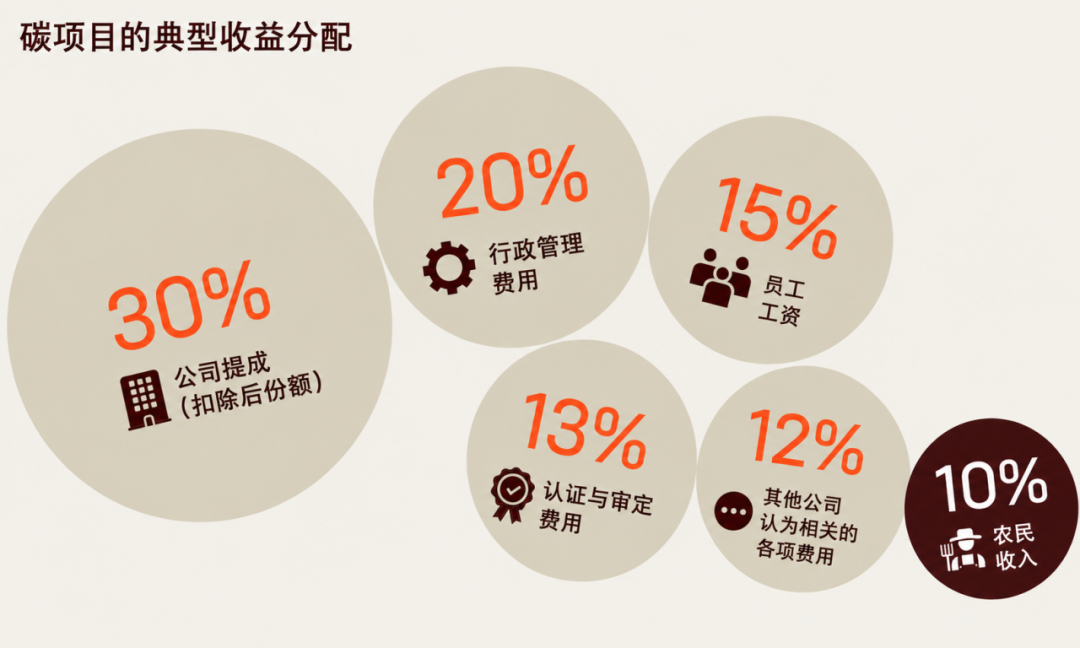
◉ Typical revenue distribution in carbon projects: farmers receive only 10% of the profits.
What is more, farmers find it very hard to know how the money is actually calculated, and they have little say in deciding where the project should spend its funds.
How much farmers ultimately take home also depends on the market price when the carbon credits are sold. If the carbon price falls, their income falls with it — but the equipment they purchased and the labour costs they absorbed to participate in the project do not simply vanish.
A study in India covering two states found that 99% of surveyed farmers received no monetary benefit from carbon credits, and many reported declining yields. After the second year, more than a quarter of farmers withdrew from the project. If these projects are destroyed by unforeseen events such as fires — causing the stored carbon to return to the atmosphere — farmers bear both legal and financial responsibility and may even be required to hand back income previously received.
So while carbon credits may represent a new money-making venture for companies, for farmers they mean staking their land, production costs, and decades of future farming practices against the risk.
As carbon credit projects proliferate, voices of opposition are emerging in various parts of the world.
In Karnataka, India, the National Bank for Agriculture and Rural Development (NABARD) and Rabobank recruited approximately 3,500 farmers to grow crops and mango trees for the purpose of generating carbon credits. Local farmers’ organisations, arguing that the initiative commodifies nature and pressures farmers to change how they manage their land to serve corporate carbon businesses, have launched a campaign to block the project.
In the run-up to COP30, this year’s UN climate change summit in Brazil, a coalition of indigenous peoples, Afro-descendant communities, and organisations of farmers and fishers from South American and Caribbean countries issued a joint statement rejecting carbon markets. The statement cited more than 80 land deal cases, pointing out that these transactions have forced communities to relocate or even lose ownership of their land.
Buying Carbon Credits: Do Emissions Actually Fall?
Ultimately, carbon credits must answer the most fundamental question of all: have emissions actually been reduced?
Let us first return to the essence of emission reduction: high-emitting companies should find ways to cut their own emissions at the source. But the carbon market offers a different game — allowing companies to continue emitting while paying for carbon reduced or stored elsewhere, which they then use to “offset” their own emissions.
But is offsetting the same as reducing?
GRAIN argues that the greatest danger of carbon credits lies precisely here. Oil companies can continue to extract and sell fossil fuels — so long as they purchase enough carbon credits from rice paddies, forests or grasslands, they can claim to have “offset” their emissions. The very parties that ought to be cutting emissions are handed an “indulgence” that lets them keep polluting, making it harder still to find the will to reduce at the source.
Moreover, the carbon counted towards these “offsets” is not necessarily calculated accurately.
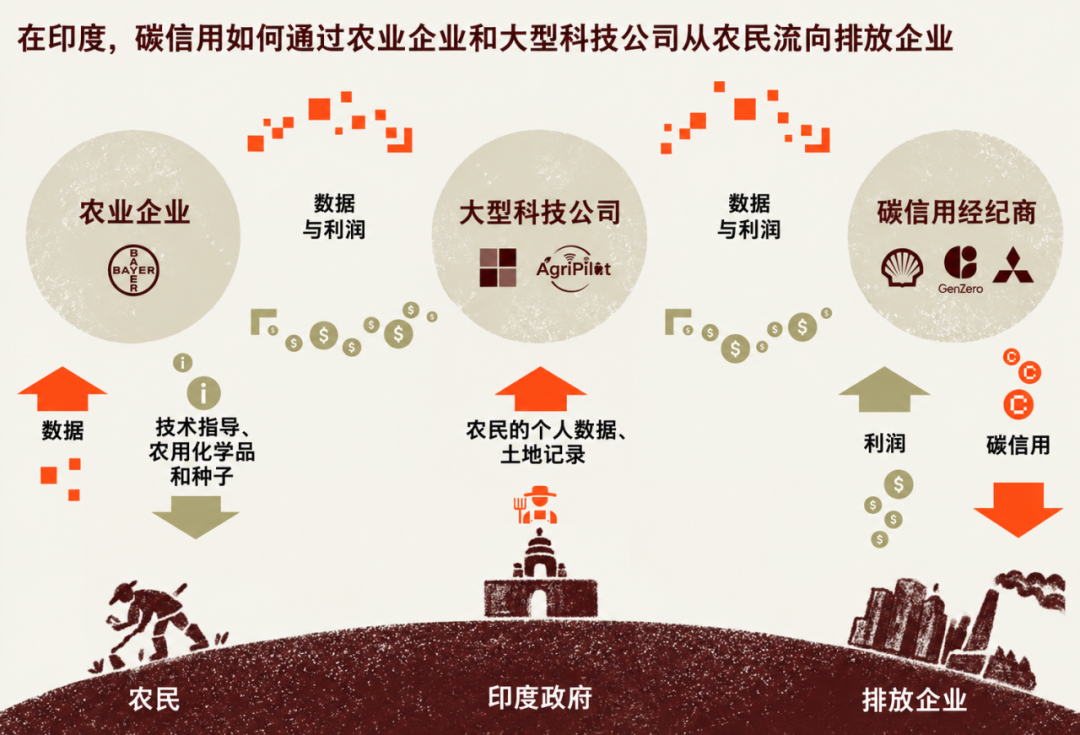
◉ Agrichemical companies partner with tech firms to run carbon credit projects in the field. In the process, the companies gather data from farmland while simultaneously selling farmers seeds, fertilisers, pesticides and other products. GRAIN urges farmers to be wary of this new kind of “bundling”.
For a project to generate carbon credits, it must first prove that, without the project, the emissions reductions would not have happened.
For example, a tree-planting project must demonstrate that, absent carbon credits, these trees would not have been planted. Likewise, an agricultural project must show that, without the project, farmers would not have adopted these more ecologically sound practices.
But in reality, farmers may already have been practising crop rotation, planting trees, using less fertiliser or improving their soil. Drawing a clear line between what genuinely came about because of a carbon credit project and what would have happened anyway is extremely difficult.
Even if carbon is stored, that does not mean it stays put forever.
Forests face fires and floods; trees die; land use changes. Once the carbon locked in forests and soil re-enters the atmosphere, how should we account for carbon credits that have already been sold — or even used by companies to “offset” their emissions?
According to a report published this year by Southeast Asian media outlet HaRDstories, in 2022 a Thai cement company planted approximately 64 hectares of native trees in Mae Ping National Park, projected to generate carbon credits equivalent to 380 tonnes of CO₂ per year. In November that same year, flooding struck the area, and satellite imagery showed more than 40% of the planted zone was inundated. The project had originally promised inspections every four months and timely replanting, yet as of July 2026, the damaged areas remain unrestored.
The accounting itself can also go wrong.
Similar disputes have surfaced in China’s rice carbon credit projects. In 2023, the international carbon credit standard body Verra identified problems with a methodology for rice methane reduction — including the absence of a standardised approach to measuring methane — and permanently retired the methodology. Verra then went on to review Chinese projects using that methodology and found issues such as inflated project areas and insufficient proof of additionality. In 2024, Verra ultimately rejected 37 Chinese rice projects, 25 of which had previously been issued a total of 4.56 million carbon credits, and required project developers to compensate for the excess credits issued.
This means that although a carbon credit may look like a precision-to-the-tonne commodity, the calculations behind it rest on a vast web of assumptions, inadequate monitoring and rules susceptible to manipulation. Once the rules or the accounting are compromised, whether a tonne is truly a tonne may need to be recalculated from scratch.
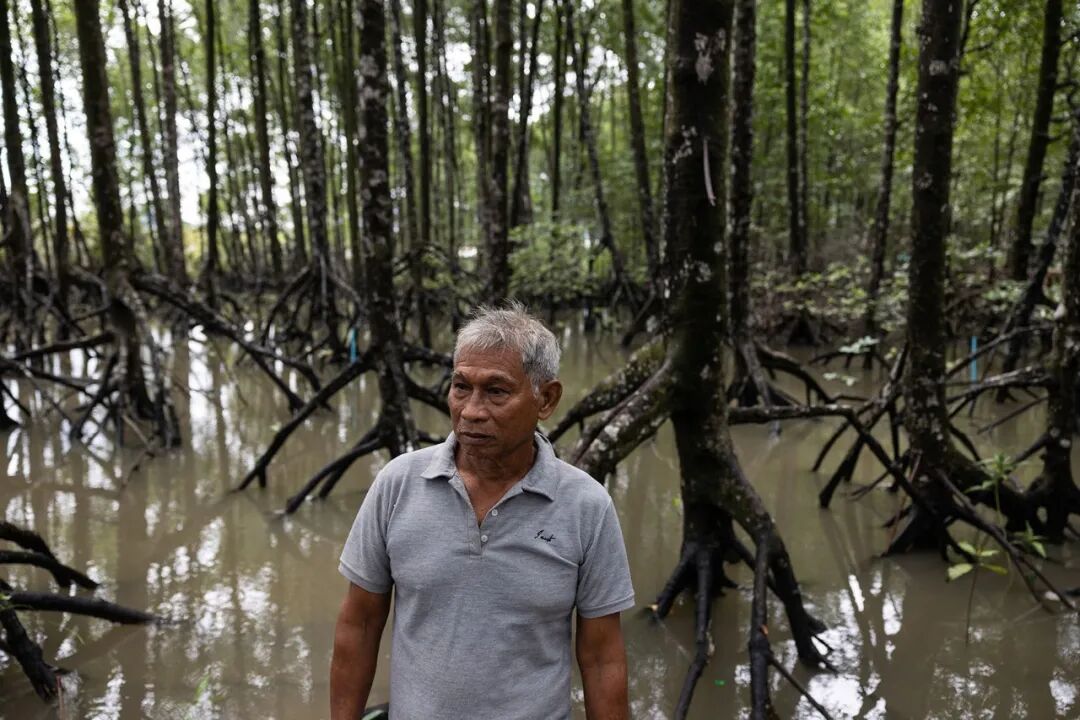
◉ Mangroves in Ranong Province, Thailand. Thailand plans to restore 500,000 rai (approximately 80,000 hectares) of mangrove area by 2031 to generate carbon credits. Image source: HaRDstories.
The risks of project failure can ultimately fall back on the shoulders of farmers and communities.
In fact, smallholder farmers and communities across Asia have long practised ways of farming that coexist with forests and land — agroforestry, nurturing traditional local varieties, crop rotation, or experiments in agroecology. All of these enhance ecosystem resilience and help soils and vegetation store more carbon. Yet the current carbon market mechanism is clearly incapable of incorporating these genuinely low-carbon practices or recognising the farmers who are making real contributions to emission reductions.
If climate change truly is one of the great challenges facing humanity, the solution should not simply be letting companies write a cheque for their emissions. Supporting agroecology and local seed systems, protecting biodiversity, safeguarding the land rights of farmers and communities, and respecting the land-use practices shaped by generations of local communities — all of these should form part of the response to climate change.
And for those companies that are genuinely behind the bulk of emissions, the solution has always been simple: cut emissions at the source — rather than paying to make the problem go away.
– This is Foodthink’s 842nd original article –
Click the link to download the report
Unless otherwise noted, all images are from the original GRAIN report.
Compiled by Kairui
Edited by Tianle
Layout by Xiaoshu
Scan the QR code to tip — support original food writing
▼

▼
Click the image to read related articles.


▼
Click a keyword to access more article collections
Seeds | Farming Techniques | Policy | Fermentation | Nutrition | Fruit | Fisheries | Events | Careers | Takeaway | Markets | Livestock | Food Talk | Sharing Sessions | Book Clubs | Harvest Festival | Smallholder Stories | Climate Change | Rural Development | Cooperative Economy | Urban Farmers | Food Safety | Digital Technology | Biodiversity | Pandemic & Food | False Solutions | Agroecology Internship Programme
Beijing | Hebei | Shanghai | Guangdong | Guangxi | Henan | Sichuan | Jiangxi | Xinjiang | Shaanxi | Hong Kong | Chongqing | Zhejiang | Jiangsu | Guizhou | Taiwan | Inner Mongolia | Philippines | Canada | Russia | Mexico | Italy | United States | United Kingdom | Germany | Netherlands | Thailand | Sweden | Japan