When a Historian Takes Up Growing Vegetables | Reading I Live at the Tail of the Yangtze

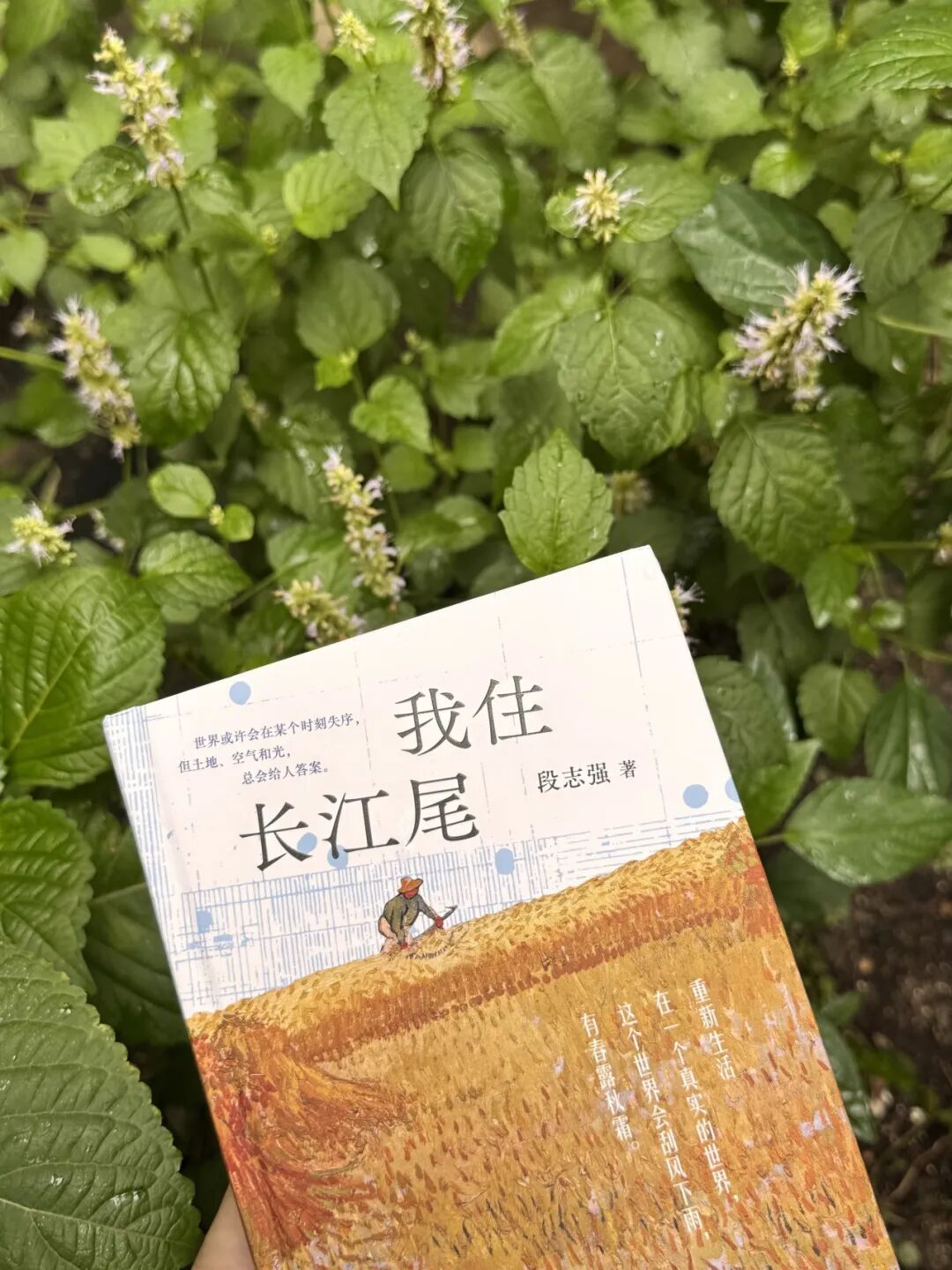
Historian Duan Zhiqiang has written a book of reflections on growing vegetables on Chongming Island in Shanghai — I Live at the Tail of the Yangtze.
The day I received the book, Beijing was in the grip of Typhoon “White Dolphin” and had a rainstorm warning in effect. The typhoon had made landfall in Zhejiang, swept across Shanghai (Professor Duan’s watermelons took a beating), and in turn brought rain to Beijing. I couldn’t help but think to myself: Oh, I live at the dolphin’s tail.
What connected us before even the typhoon did was our shared love of growing vegetables. So we share a special label: we used to call ourselves “urban farmers (ladies)”, and these past couple of years a new moniker has popped up — “city bumpkins”.
The scale of city bumpkin-dom in Beijing and Shanghai is rather different, too. I live in Beijing’s CBD, and apart from a “one-metre garden” just outside the ground-floor door, the closest I get is a suburban polytunnel an hour’s drive away. Professor Duan is better off, with four plots both inside and outside the courtyard. Following the instructions laid down in Song Xu’s Song Family Rules from the Ming dynasty, he has compiled a “land register” and given each plot a name with a historical ring: step out the door and you first arrive at “the Mainland”, then comes “the Subcontinent”, and a few hundred metres on, you reach “the New World” — which is really just a vegetable garden, some fruit trees, and a small field. And a 5-square-metre patch, cordoned off by a concrete path running through the yard, holds only a single peach tree and a few small plants, yet has been solemnly christened “the Offshore Island”.
So you can see that even if we are both “city bumpkins” — never mind our skill at growing vegetables — just naming a vegetable plot after a historical quip is enough to make you think it’s brilliant and hilarious, and leave me miles behind. Professor Duan is not just a PhD in history and a researcher at the Institute of History and Philology, Fudan University, who grapples with the big questions of his field; he is also a history populariser who regularly appears at all manner of cultural events — on the Kanlixiang app, for instance, with programmes such as A Global History from China, Travels in the Silver Age, and New Readings of Ancient Texts, guiding his audience to explore the overlooked yet vividly particular people and stories of history.
So how, exactly, would Professor Duan the historian fill an entire book’s worth with the subject of growing vegetables? I am most eagerly looking forward to finding out.
A High-Five with Fellow Vegetable Growers Across a Thousand Years
The Chinese love of tilling the soil is ancient — so ancient that at one point it was elevated to the level of a genetic trait among the Chinese people. But “city bumpkin” vegetable growing is a topic that has only recently burst out of its niche to become a mainstream talking point.
The urban growers I know tend to fall into one of a few categories: those who grow purely for wholesome food, those who work in environmental or sustainability roles, those exploring rural development and the relationship between people and the land, those doing it to enrich their children’s upbringing, and those dear, enterprising residents who squeeze edible plants into every crack and cranny of a back alley or housing estate. Yet, oddly enough, none of the cultural figures in my circle had ever spoken about their own experience of growing things in the ground.
But the “Great Planting Enterprise” described in Professor Duan’s book is something that, as a fellow city bumpkin, I know well enough myself. There is indeed no grand significance or abstract theorising in his prose — just one concrete little task after another. And in them I can see myself: the same enthusiasm for collecting every available variety of a single crop — four watermelons (Lazybones, Texiaofeng, Black-Skin and 8424), four potatoes (golden, black, baby and rainbow) — and the same eagerness to hunt down every expert online, quiz the neighbours, and trawl through old agricultural manuals, all in the hope of arriving at the perfect method of cultivation through experiment.
He threw himself into experimenting with every conceivable way of supplementing nitrogen and trace elements, including composting — both anaerobic and aerobic. He tried buying in bagged fertiliser, and even went so far as to explore closing the nutrient loop within the household (a venture that came to nothing). Of course, his organic trial ending in failure did not, in my view, prove that agriculture cannot do without chemical pesticides and fertilisers; rather, it reflected a fundamental insight of ecological agriculture: what we must restore is the vitality and resilience of the agricultural ecosystem as a whole, not merely keep our own little plot free of sprays and synthetic feed.
Professor Duan also tracked down classical sources for every theme he cared about. For the chapter on manure alone, he combed through the Classic of Agriculture and Sericulture, Essential Techniques for the Common People, the Complete Treatise on Agricultural Policy, the Baodi Guide to Encouraging Agriculture, Recollections of Hu Shi, and The Peony Pavilion, and he firmly believed the old saying: “If you farm without raising pigs, or if a scholar refuses to read, he simply will never get anywhere.”
A university lecturer himself, Professor Duan could not escape the academic reflex of caring deeply about “peer review”. Take the year his stem lettuce was a disaster and a neighbour asked, “Professor! What’s that thing that looks just like stem lettuce but is as thin as a thread?” He nursed that slight for two whole years, until he grew sweet potatoes so impressive the neighbours marvelled — only then could he finally breathe out: “Everyone finally believes I really am a professor!” Growing vegetables alongside plots of maize planted as straight and precise as the flag-raising guard, with four neighbours on every side — Professor Duan, we feel your pressure!
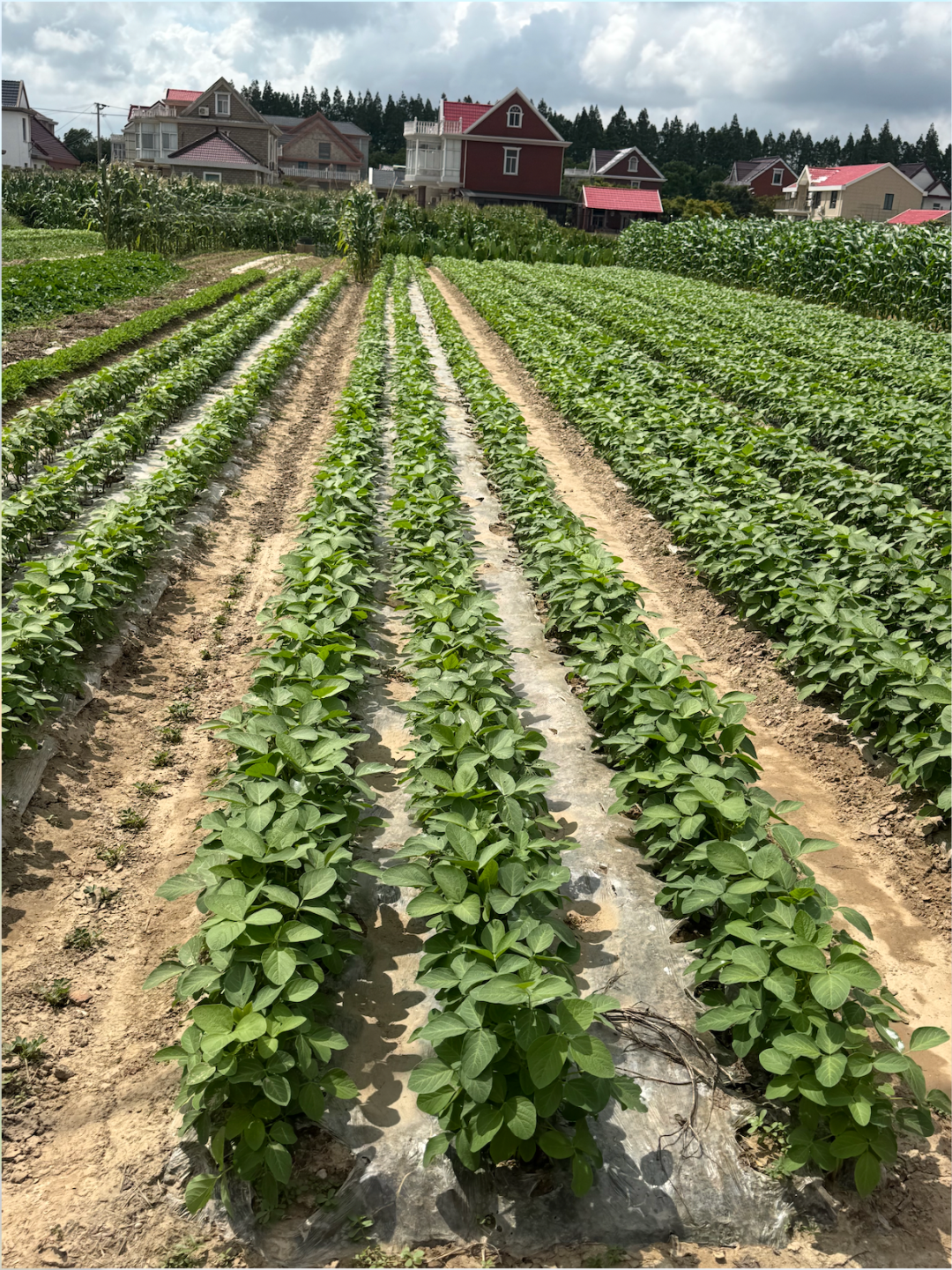

◉ Professor Duan’s neighbours’ cornfield, so neat and perfectly aligned, once sent him into a spiral of self-doubt — until he was rescued by James C. Scott’s critique of “agricultural geometry” in Six Theses on Spontaneity.
In the book, Professor Duan also gathered historical material that helps us understand not merely the “knowing” of gardening, but the deeper affections of “loving” and “delighting in” it. Su Shi once recorded his younger brother Su Zhe’s fondness for “strolling in the kitchen garden”: “How can such trifling things be worth a glance, yet you alone watch them tirelessly”; “Now you are otherwise again — sometimes you come to admire the melon vines.” Lu You was a kindred spirit: “So greedy for the sight I forget my meal at home, just like a child lingering after school.” It turns out that the joys and fixations we share, the ancients had long since savoured for themselves.
Unlike Su Dongpo or Lu You, who could only admire the nearest kitchen garden, Professor Duan and I can share from afar. This year my harvest filled an entire trailer-load of small watermelons, and I sent Professor Duan the photos deliberately — not just to apply a little peer pressure, but because a harvest only truly delights when it is shared with someone who understands the toil behind it. I have also quietly grumbled that Professor Duan really needn’t grow so many potatoes and watermelons, but then I catch myself thinking — how exactly do I explain my own grape vines, which keep multiplying yet refuse to produce a single bunch? Indeed, the very day after returning from his place, I planted jingjie (a pungent Chinese herb), tried making jingjie-stuffed dumplings (delicious), and have been itching to grow day lilies ever since…
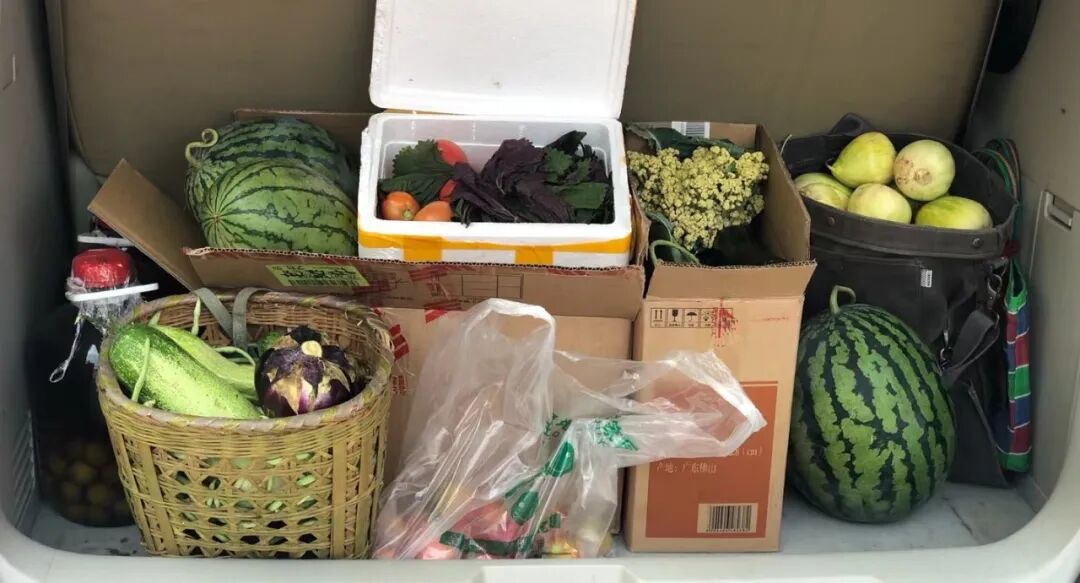
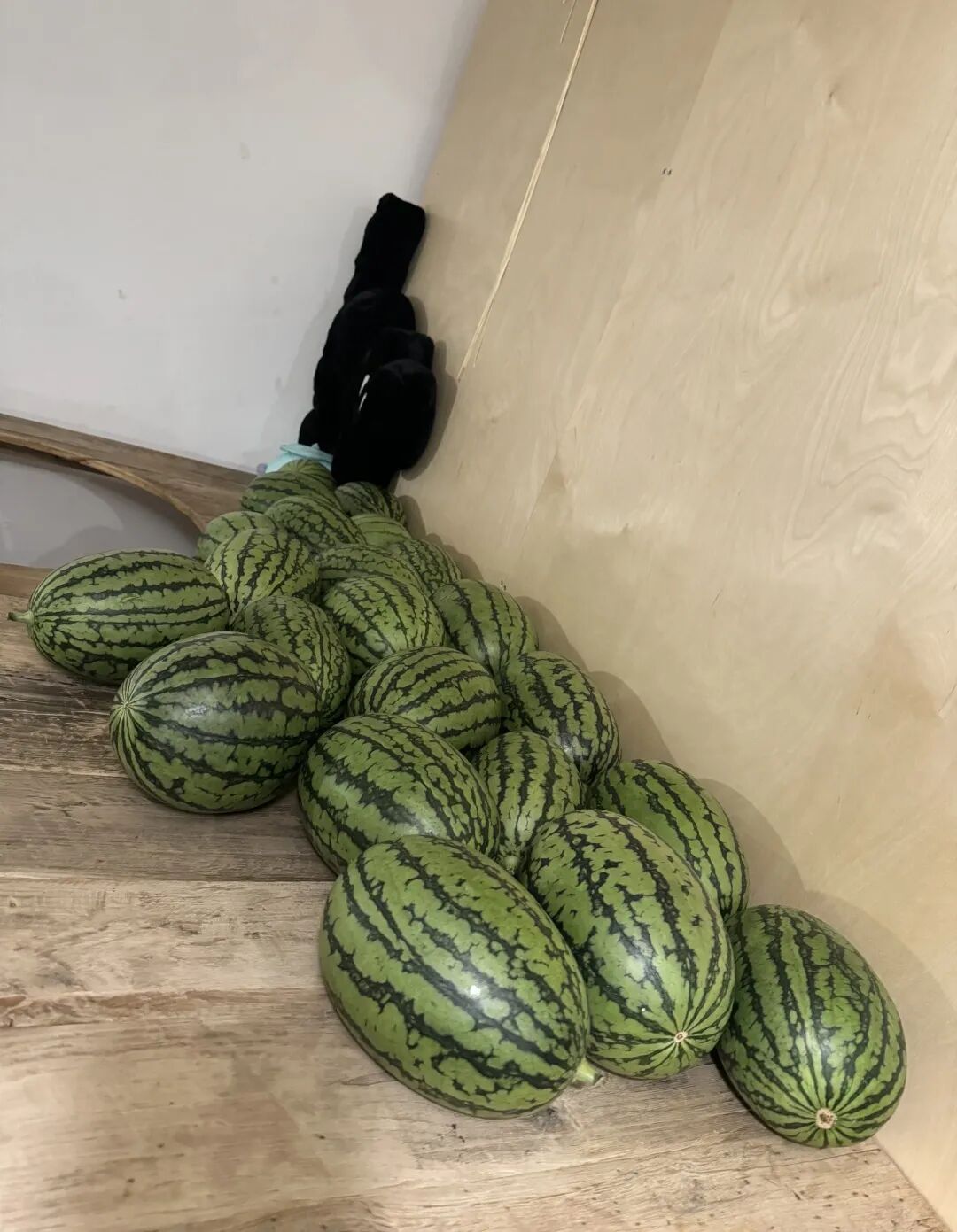
◉ (Left) My harvest from the suburban polytunnel. (Right) This year’s bumper crop of watermelons — a special “Victory Bulletin” sent off to Professor Duan.
From “Paradise for the Socially Anxious” to “The Battle of the Watermelons”
I Live at the Tail of the Yangtze is organised on a “general-to-specific” logic. It opens with an overall picture of the geographic and cultural background, then traces the several phases of farm work across a year — the swallows’ return, Qingming, typhoon days, harvest time, the depths of winter — before breaking each phase into “chapters”: the many little episodes that make up the business of growing vegetables. So we enter his world of cultivation through his plots and the geography of Chongming Island in Shanghai, where he lives: first Chongming’s position on the map, how one commutes to and about the island, a study of its traditional house styles, the various details tied to growing things, and the radius within which his “Red Hare” (an electric tricycle) lets him gallop freely.
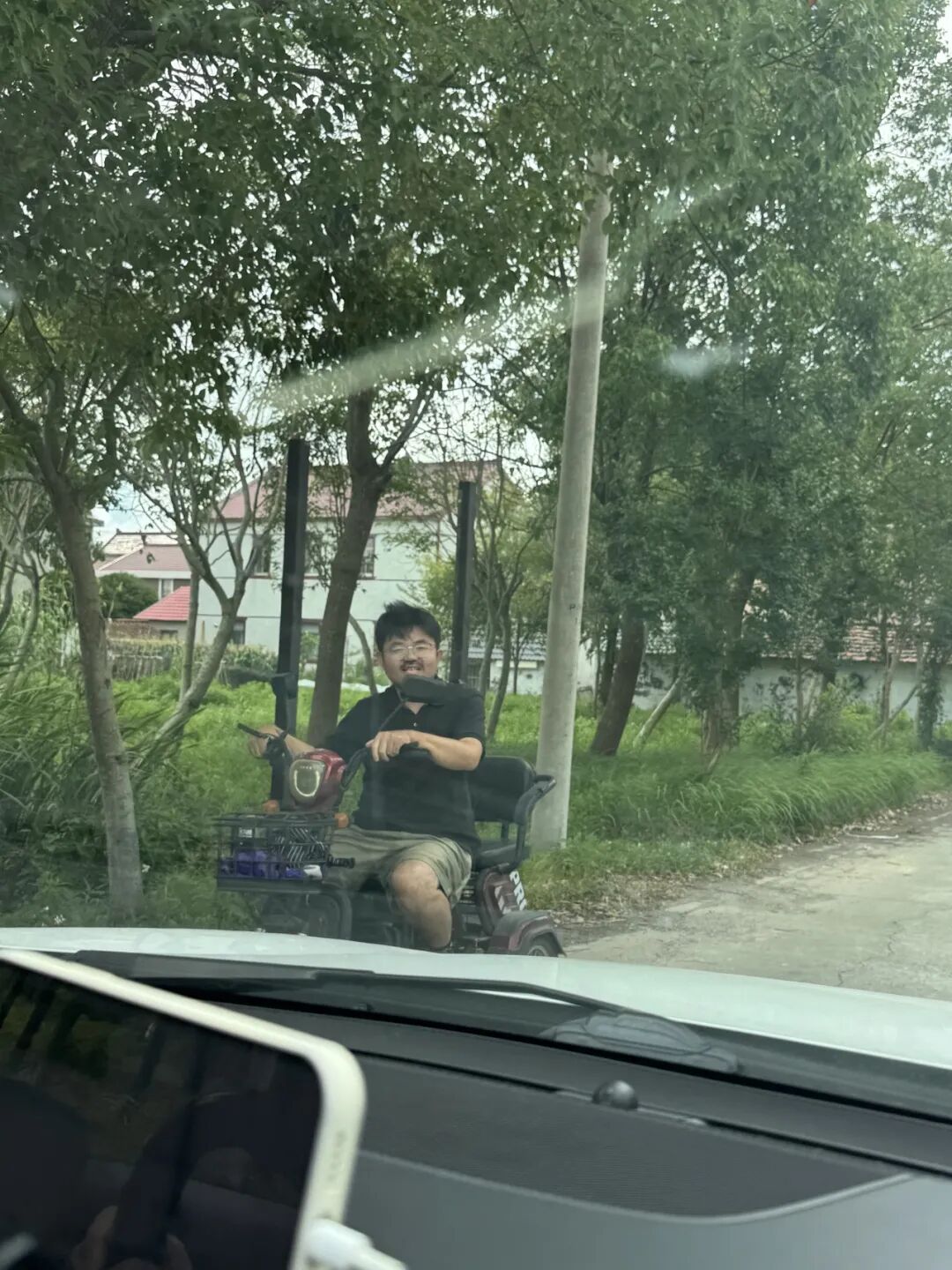
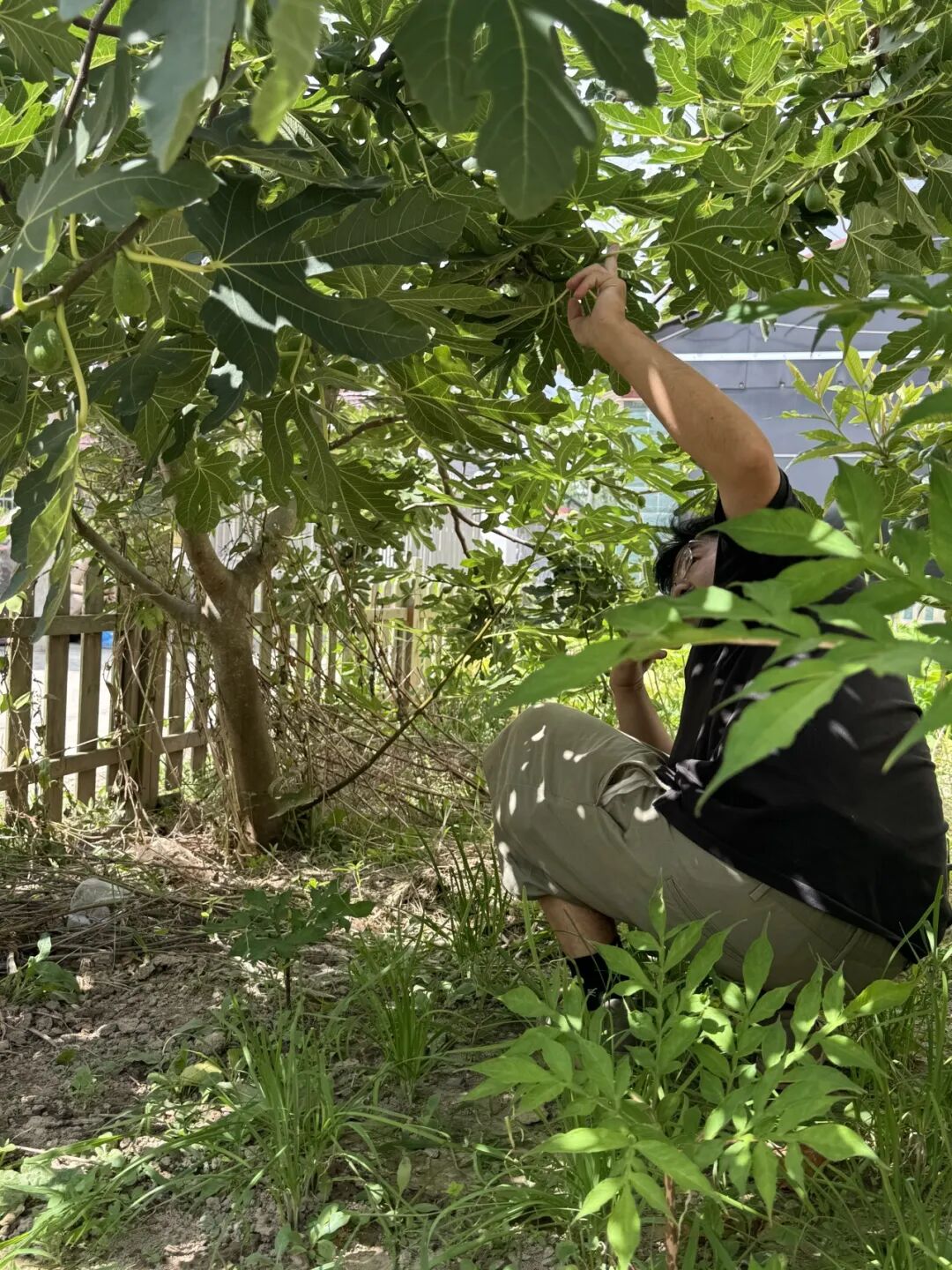
◉ (Left) Professor Duan arriving to collect us on the Red Hare, aka his three-wheeled agricultural vehicle. (Right) Professor Duan picking figs on “the Subcontinent”.
Then comes the “Monthly Ordinances” section: the arrangements a grower must make through the year. After that, he unfolds his hands-on practice slowly, season by season, chapter by chapter. With self-deprecating, lively prose, he vividly recounts one experiment after another, one “battle” after the next.
A friend once joked that Professor Duan was “Clarkstrong” — a riff on the star of the British documentary Clarkson’s Farm, and a wink at Duan Zhiqiang’s own name — meaning he is the biggest celebrity among China’s city bumpkin growers.
As I see it, beyond publishing a book and actively sharing his growing experiences, Professor Duan and Clarkson differ greatly: Professor Duan is far more grounded. He conducts experiments steadily with small investments, discovering infinite delight in the minute details, rather than constantly declaring “I have an idea”, splashing out a fortune, and losing his shirt.
You can see this for yourself in the book’s account of how he chose his electric vehicle. Beyond the two models that dominate the island — two-wheeled electric scooters and large three-wheeled agricultural vehicles — he eventually found, tucked away in the corner of a dealership, a small three-wheeled electric trike with a passenger seat that fits just one person, for the grand bargain of 1,200 yuan. A full charge gives this “Red Hare” enough range to gallop up to 30 kilometres in every direction from his doorstep.
After all, when Clarkson first burst out of his niche, it was because the moment he started farming, he bought a Lamborghini tractor (yes, luxury car marques actually got their start making farm vehicles) — and it brought him nothing but endless headaches. Compared with that, Professor Duan is clearly the wiser man.
Professor Duan’s delicate sensibilities show, too, in how he copes with the plum rains. In the chapter “Plum Rains (Continued)”, he records a “Battle to Defend the Watermelons and Muskmelons from the Plum-Rain Season”. He describes his plants’ plight with personification: no matter how diligently he erects canopies and lays covers, his crops cannot escape the ferocious assault of days of heavy rain, and in the end can only endure — just endure. Even if they survive, the melons lack flavour, the tomatoes refuse to set fruit, like specific individuals helpless before an entire downturn cycle.
During those few days marked in the chapter as the onset of the plum rains, I happened to be at an event in Qingshan Village in the hills outside Hangzhou — the very village Professor Duan mentions in his book. I watched him, brimming with enthusiasm, segue from his home-grown watermelons all the way to climate change, and everyone happily shared the melons he had brought along. Now, reading his descriptions in the book alongside my memory, I am sure we were eating “Texiaofeng”. What I did not know then was that, though physically at the event in Hangzhou, his heart remained fiercely tethered to Chongming Island.
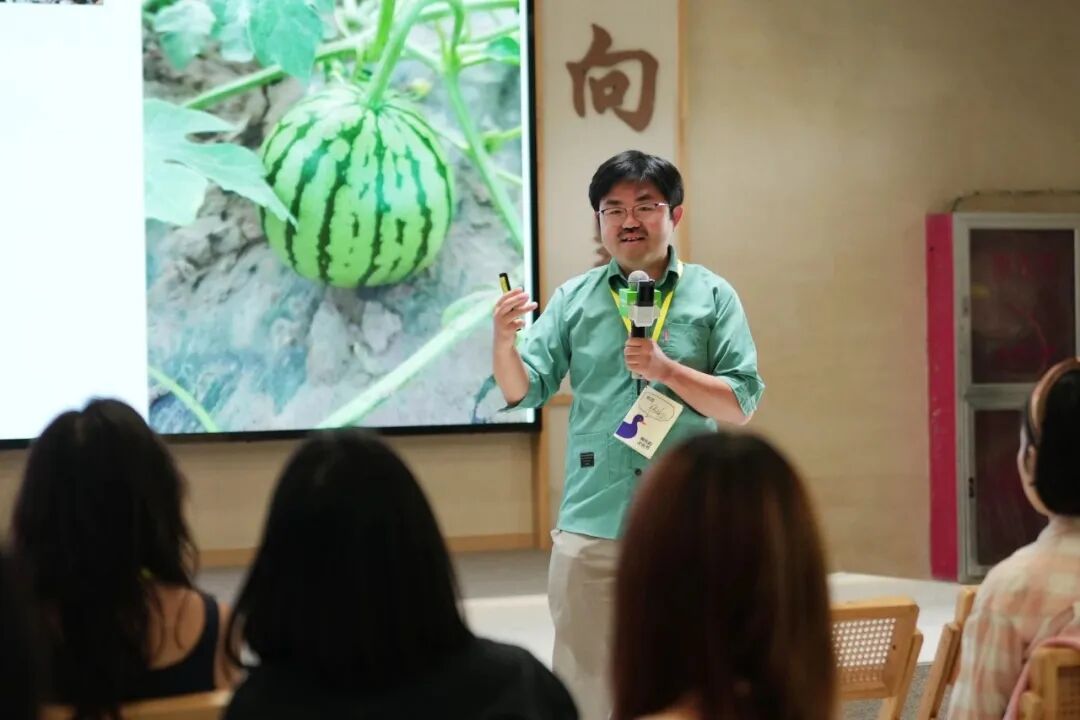
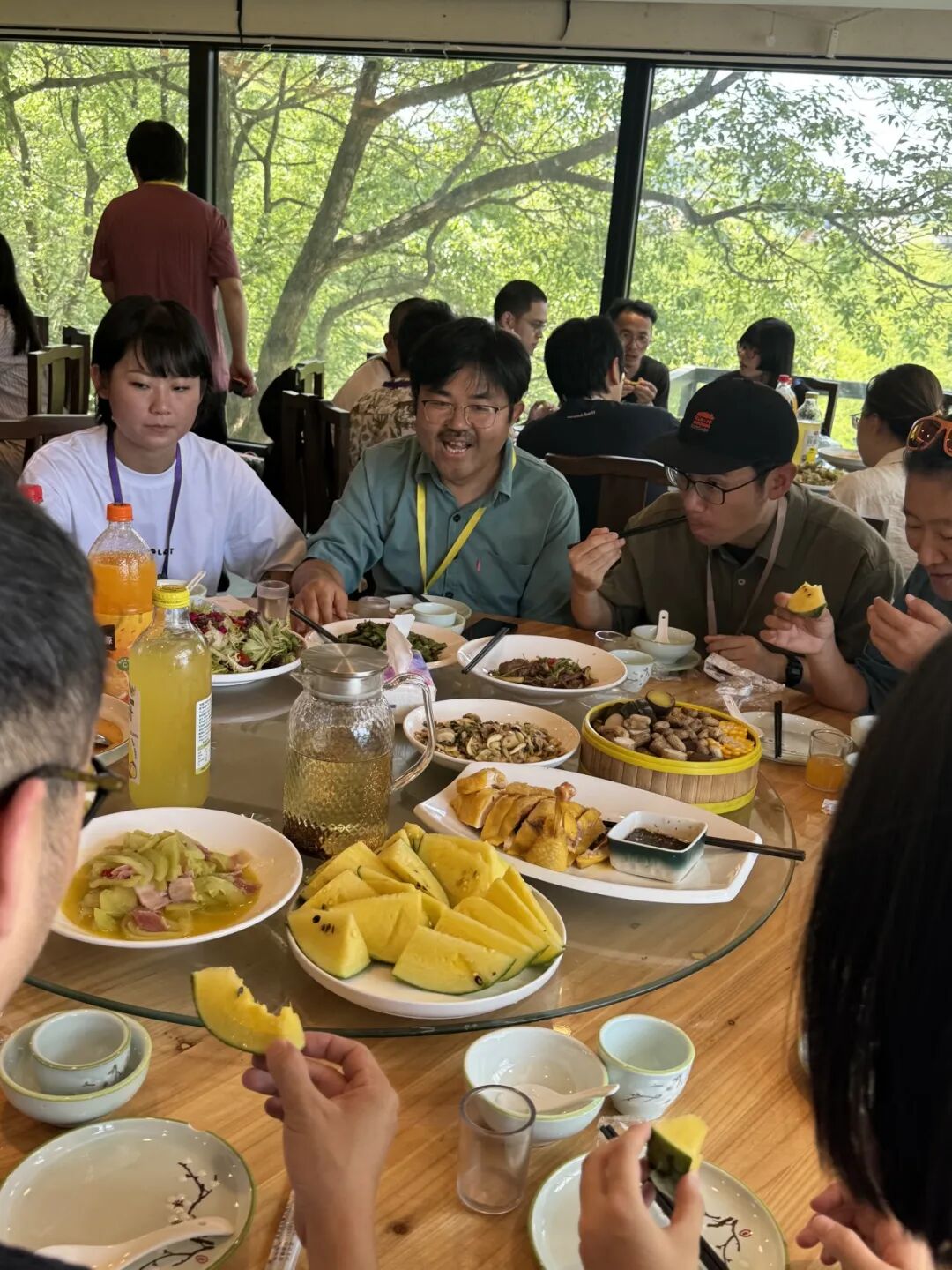
◉ (Left) Professor Duan talking with young artists and climate activists in Qingshan Village. (Right) Beyond the talk itself, he had deliberately brought his home-grown “Texiaofeng” watermelons to share — the plate of yellow-fleshed slices in the foreground.
The Bond Between People and Land: A Basic Necessity
The world we inhabit today runs on a food system that is already an industrial apparatus, and the fashionable discourse around it is often a language of finance far removed from nature. Yet some are trying to forge alternative paths: the historian Professor Duan gets his hands dirty to grasp what is real; the anthropologist Zhong Shuru studies wet markets to reveal the flexibility, community links and diversity that small vendors provide; and restaurants pursuing a “from-scratch aesthetic” are beginning to show diners transparently which dishes are ready-made and which are not.
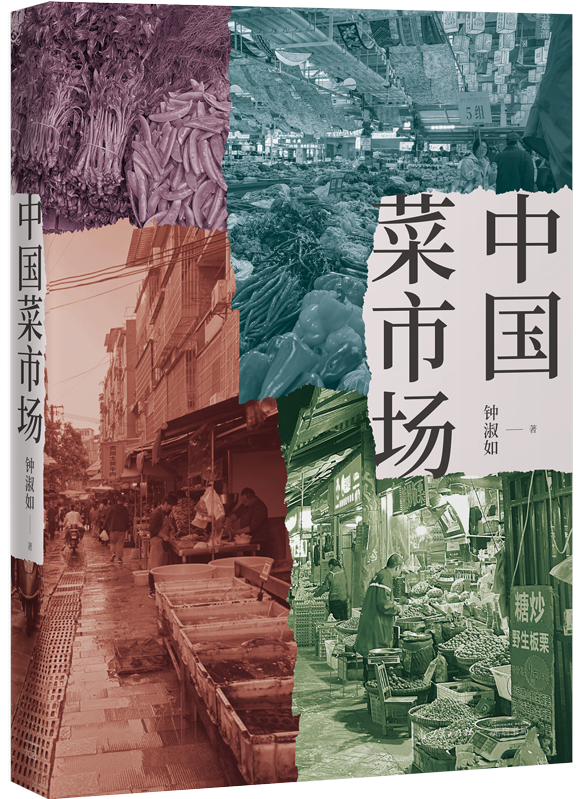
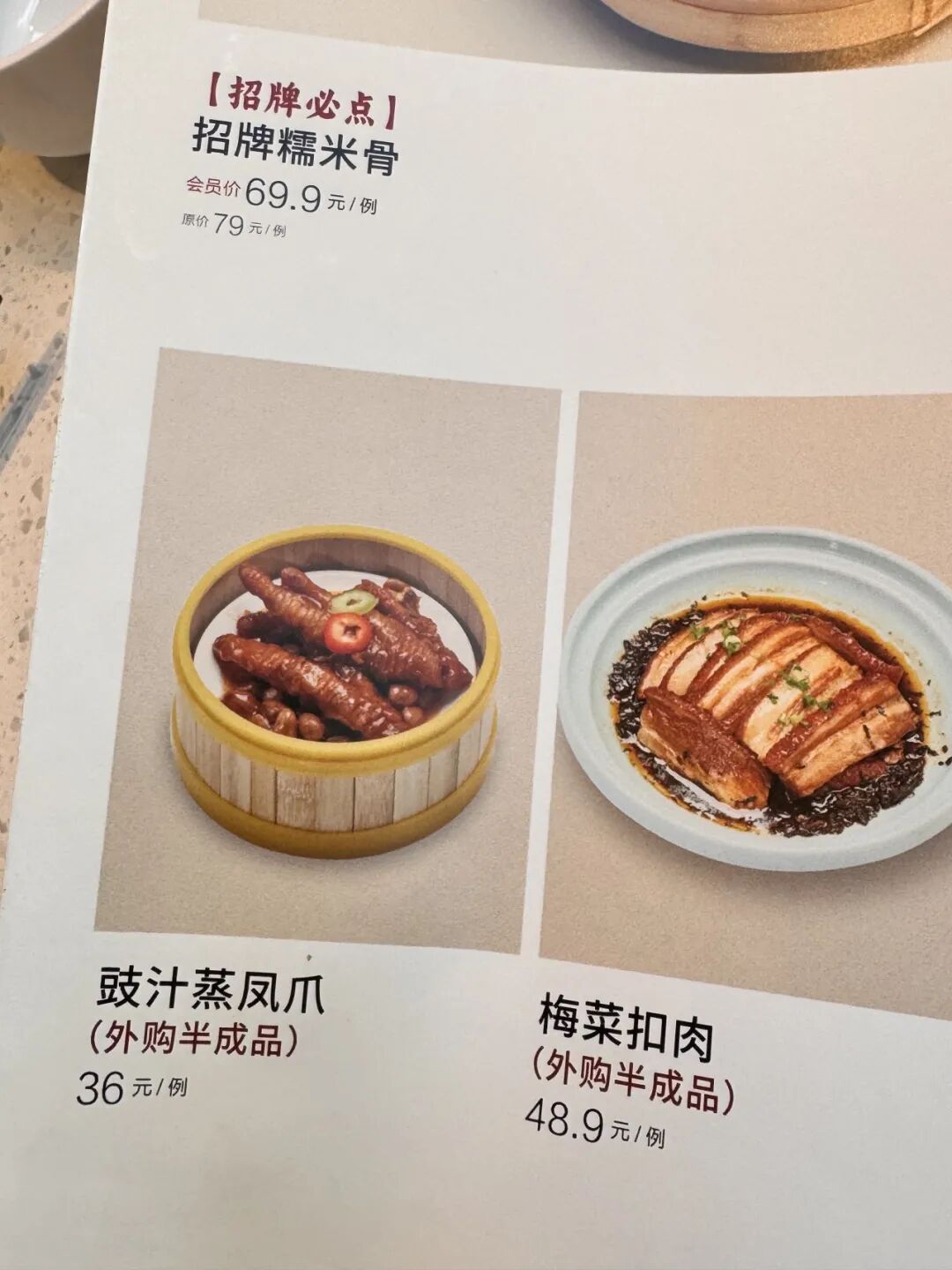
◉ (Left) Professor Zhong Shuru, an anthropologist at Sun Yat-sen University, distilled a decade of research into Chinese Wet Markets — click the image to listen to her introduce her work on Foodthink’s podcast. (Right) A restaurant menu that clearly marks which dishes are ready-made.
This still-fringe hobby — growing vegetables — is drawing in more and more converts. Among them are plenty of amateur growers just like me: light on theory, thin on practice, yet no less relentless in their enthusiastic fumbling.
Could the bond between people and land be an absolute necessity? Professor Duan’s reply: “An absolute necessity.”
A Book That Puts a Smile on Your Face
Back to the reading experience, then. I haven’t finished the book yet — the chapters arranged season by season, I’d rather save them up and savour them slowly, too precious to gulp down in one go just to rush out a review.
Professor Duan writes in the plainest prose, unhurried, unfolding things slowly. For all the historical research woven through, there is not a hint of pedantry. What delighted me especially: the “Moat Courtyard” I had seen in person — featured in the “Paradise for the Socially Anxious” chapter — turns out to have a “previous-life story” in the book: its old name, “Siting Zhaigou”. As I read, my mind automatically supplies Professor Duan’s voice to the words, and I even find myself wanting to reply:
Nodding along: “Yes, yes, yes — I’m just the same!”
Marvelling: “I had no idea it could be done like that?!”
And occasionally wanting to chip in: “Professor Duan, have you considered this and this…”
In the less than a week since the book arrived, I’ve been totting it around to exhibitions and to work. I’ve noticed that from a sun-tanned middle-school girl to an ecology PhD, the moment anyone cracks it open, a smile creeps unbidden onto their face.
– This is Foodthink’s 841st original article –
Foodthink
Author
Wang Youzao
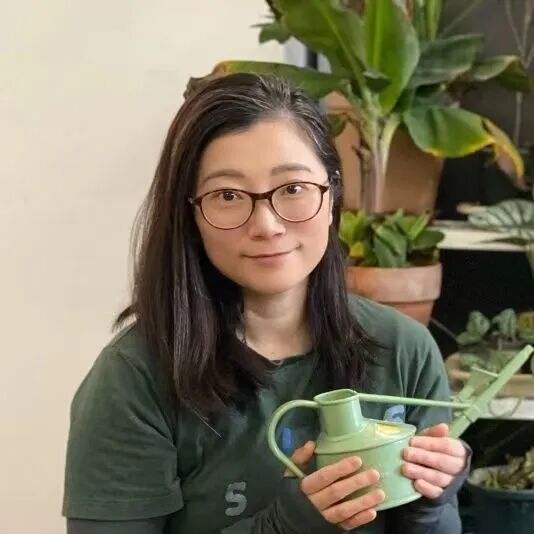
Documentary director and amateur vegetable grower. His work includes the documentary Wen Dao (Questions for the Rice), which chronicles the changing lives of ethnic-minority rice farmers. He tends a daily plot in his “CBD Metre-Square Garden” (which has a video account under the same name) and shares a vegetable polytunnel in the suburbs of Beijing with friends.
Edited by: Tianle
Layout by: Xiaoshu
Scan the QR code to tip and support original food-knowledge writing.
▼

▼
Click the image to read related articles.
▼
Click the keywords to explore more article collections
Seeds | Farming Techniques | Policy | Fermentation | Nutrition | Fruit | Fisheries | Events | Vacancies | Takeaway | Markets | Livestock | Food Talk | Sharing Sessions | Book Clubs | Harvest Festivals | Smallholder Stories | Climate Change | Rural Development | Cooperative Economy | Urban Growers | Food Safety | Digital Technology | Biodiversity | Pandemics and Food | False Solutions | Ecological Agriculture Internship Programme
Beijing | Hebei | Shanghai | Guangdong | Guangxi | Henan | Sichuan | Jiangxi | Xinjiang | Shaanxi | Hong Kong | Chongqing | Zhejiang | Jiangsu | Guizhou | Taiwan | Inner Mongolia | Philippines | Canada | Russia | Mexico | Italy | United States | United Kingdom | Germany | Netherlands | Thailand | Sweden | Japan