Carbon Trading Saves the Planet? No, It May Be Draining Farmers Dry

Once, farmers sold their grain. Now, people are telling them that the “carbon” in their soil can also be sold.
By changing their farming practices as the project requires—storing more carbon in the soil or reducing methane emissions from rice paddies—this “reduced carbon” could become carbon credits, sold to companies on the other end that need to offset their emissions.
But when “carbon” truly becomes a business, who is setting the rules, who is making the money, and who is bearing the risk?
In May this year, GRAIN, an international organisation that has long focused on smallholder farmers and biodiversity, published a report titled *The Carbon Credit Trap: A New Danger for Farmers in Asia*, attempting to answer these questions. The report focuses on carbon credit projects rapidly entering rural Asia, particularly the new problems they pose for farmers. Foodthink has obtained permission from GRAIN to compile and publish this article.
What Are Carbon Credits, and What Is Carbon Trading?
First, we need to understand what carbon credits and carbon trading are.
If a company emits one tonne of CO₂ and, at the same time, a project reduces or absorbs one tonne of CO₂ through tree planting, forest protection, or changes in agricultural practices, then in theory the company can purchase that tonne of “emissions reduction” to offset its own emissions.
This tradeable unit of “emissions reduction” is what is known as a “carbon credit”. The marketplace that facilitates such transactions is the “carbon market”.
The carbon market was originally conceived as a way to put a price on carbon emissions through market mechanisms: making the release of greenhouse gases costly, thereby encouraging companies to voluntarily reduce their emissions, with the ultimate aim of slowing climate change.
However, what we commonly refer to as the “carbon market” actually encompasses two rather different systems.
One is the mandatory emissions trading scheme. Taking China as an example, the government allocates a set quantity of carbon emission allowances to major emitting enterprises according to established rules. At the end of the compliance period, companies must “hand in their homework” based on their actual emissions: if they hold insufficient allowances, they must purchase additional ones from companies with a surplus; companies with remaining allowances can sell them. In 2021, the national carbon emissions trading market first launched with the power generation sector; in 2025, the steel, cement, and aluminium smelting sectors were added. Currently, what is traded on the national carbon market is precisely these allowances.
Carbon prices are not fixed either; they fluctuate with market supply and demand. In 2025, the average transaction price for allowances on the national carbon market was 62.36 yuan per tonne.
Take the cement industry as an example. The primary carbon emissions in cement production come from clinker manufacture, with approximately 0.8 tonnes of CO₂ emitted per tonne of cement clinker produced. If a cement company exceeds its allowance by 0.8 tonnes of carbon, it would need to purchase the corresponding allowances from the market. At the average price of 62.36 yuan per tonne, this would cost approximately 50 yuan. Of course, how many allowances a company actually needs to purchase also depends on how many the government has allocated to it and the prevailing carbon price, which together determine the final cost.
The other is the voluntary emissions reduction market. For instance, if a forest is planted or if rice paddy irrigation methods are changed to reduce methane emissions, the amount of carbon reduced can be calculated according to a set of rules. Once verified, these reductions are formed into carbon credits and can then be sold on the market.
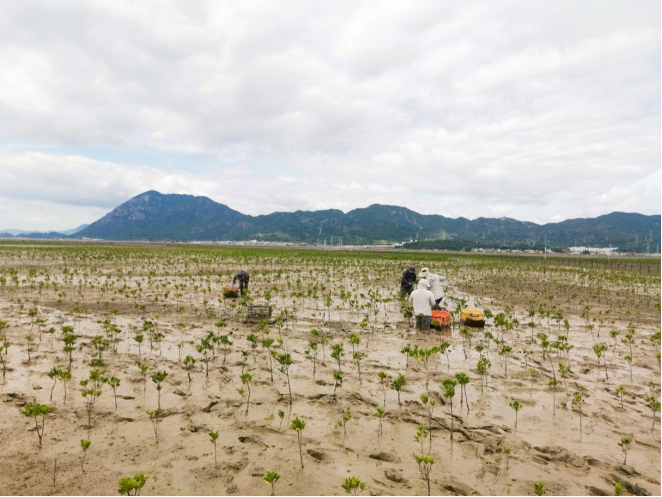
◉ In March this year, the “Mangrove Vegetation Restoration Project in Yantian Township and Changchun Town, Xiapu County, Fujian Province” officially passed review by the national competent authority and completed registration, becoming the first mangrove afforestation carbon sink project under the national voluntary greenhouse gas emission reduction (CCER) scheme. Image source: Third Institute of Oceanography
This set of calculation rules is what is commonly referred to as “methodology” in carbon markets. Simply put, it is like a formula and set of operating instructions: what counts as an emissions-reducing project, how much would have been emitted without it, how much is reduced after implementation, and how to monitor it—all must be calculated according to this methodology.
Carbon Credits Are Entering Asia’s Forests, Farmland, and Pastures
Asia has become a key region for the expansion of carbon credit projects. Data cited by GRAIN shows that carbon credits generated in Asia now account for more than half of the global total, with East Asia representing 50% of Asia’s carbon credit output, South Asia 31%, and Southeast Asia 12%. By 2030, the value of carbon credits generated annually in Asia is projected to approach US$10 billion.
The most common type is the forest carbon credit project—REDD+, which stands for “Reducing Emissions from Deforestation and Forest Degradation”. In simple terms, it works by protecting forests and preventing them from being cut down to reduce carbon emissions, then converting that reduction into carbon credits.
However, GRAIN points out that some projects view traditional agriculture, particularly shifting cultivation, as the cause of forest loss, and therefore restrict local residents from entering forests to farm, gather, hunt, fish, or graze. Yet at the same time, the activities that truly drive large-scale deforestation—commercial logging, industrial agriculture, and large-scale plantations—have not received adequate attention or regulation.
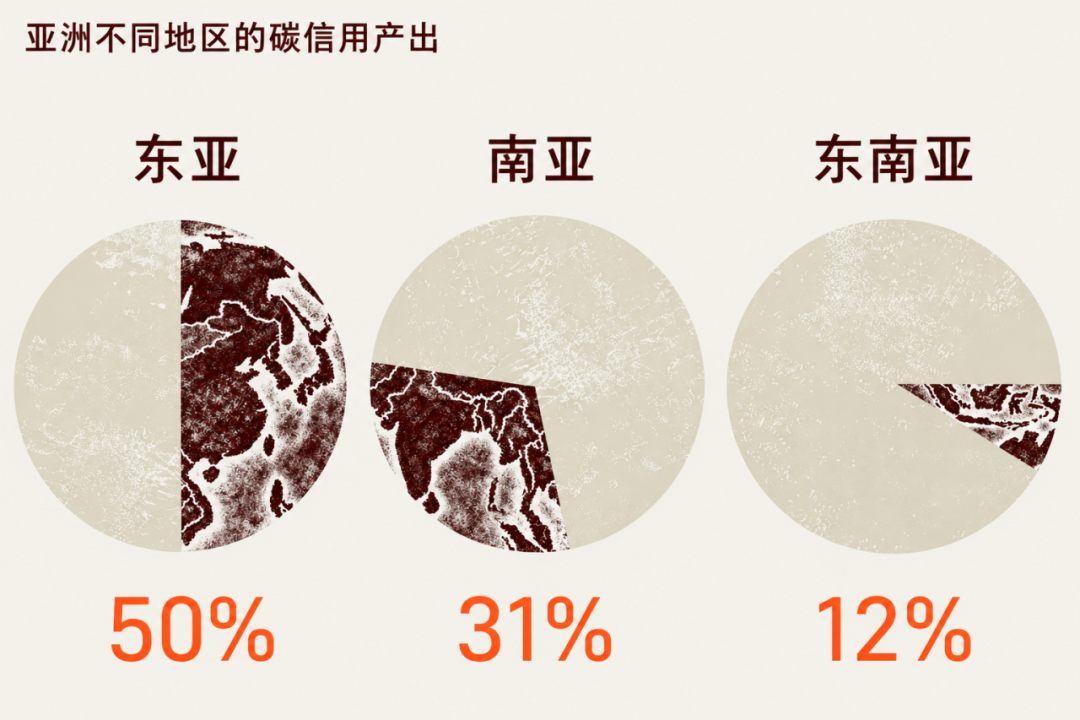
◉ Currently, carbon credits generated in Asia account for more than half of the global total. Of this, East Asia represents 50% of Asia’s carbon credit output, South Asia 31%, and Southeast Asia 12%.
A similar situation is unfolding in mangrove ecosystems.
In 2022, the Thai government signed an agreement with 17 companies, including Thai Oil, PTT Global Chemical, and Shell Thailand, granting them the right to manage 7,000 hectares of mangroves in southern Thailand and to exclusively benefit from the revenue generated by these forests. According to reporting cited by GRAIN, since 2023, more than 34,000 hectares of mangroves in Thailand have been registered as carbon credit projects. Some communities only later discovered that the mangroves they had used for generations had already been registered in the national carbon credit system.
For those living near the mangroves, these forests have long been a source of livelihood—they may go in to fish, collect shellfish, or find timber. Once access is restricted, carbon credit projects can also alter the lives of local communities.
The second type of project is tree planting. Companies may secure large tracts of land to establish plantations, or sign long-term contracts with farmers or communities to plant trees on their own land, transferring the rights to the carbon stored in the soil to the company. But some projects do not plant diverse, complex forests; instead, they establish monoculture plantations. This approach fails to consider the broader ecosystem or the land-use practices of local communities, and ultimately undermines biodiversity while failing to support both wildlife and the livelihoods of local communities.
The third type of project sees agrochemical giants such as Bayer and Cargill entering the field to promote their “soil carbon projects”, encouraging farmers to retain more carbon in the soil through no-till farming, crop rotation, cover crops, and adjusted fertilisation. The report asks: will these projects, pitched as helping farmers, become a new means of exploiting and controlling them?
Why Should Farmers Be Wary?
At first glance, this appears to be a win-win deal: companies gain carbon credits, farmers change their farming practices, and in reducing emissions they also earn additional income. But each of the projects described above may contain pitfalls—both for farmers and for the emissions-reduction goals themselves.
First, many carbon credit projects do not purchase farmers’ land, but they do secure the rights to the “carbon” in the soil through contracts lasting several decades. As a result, farmers and communities are required to plant trees, maintain the land, or farm in specific ways as stipulated in the contract for the coming decades. Throughout this process, farmers and communities have little say in project decisions or resource management, effectively losing control over their land, which can also lead to land disputes.
This control over land extends into specific agricultural production as well, giving agrochemical companies an opportunity to exert influence over both farmers and farmland.
Second, to prove how much carbon a piece of land actually stores, companies need to continuously collect data. This requires farmers to register on the company’s digital platform, upload information about their agricultural practices, and submit to ongoing monitoring of their farming methods.
But data is not used solely to calculate carbon. When a project prescribes no-till practices, crop rotation, fertilisation, irrigation, or even which varieties to use, these agrochemical companies are in effect beginning to influence farmers’ agricultural decisions. GRAIN emphasises in the report that particular vigilance is needed as major seed, fertiliser, and pesticide companies such as Bayer and Syngenta enter the carbon agriculture market, because this will further consolidate their dominant market position: on one hand, they sell pesticides, fertilisers, and seeds; on the other, they help shape farming practices, using the banner of “low-carbon agriculture” to push their products even further.
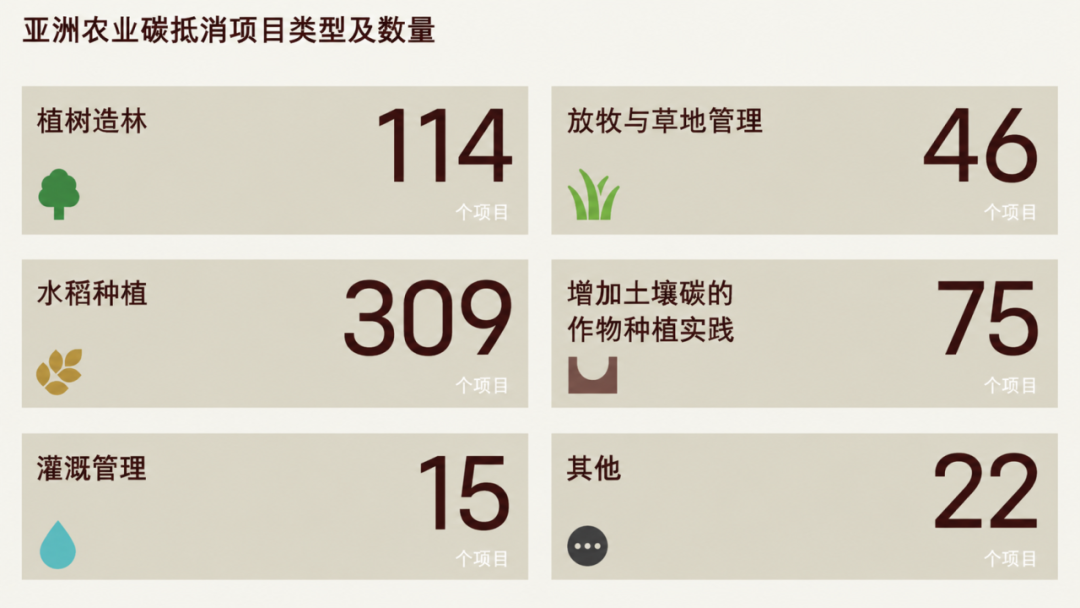
◉ Types and numbers of agricultural carbon offset projects in Asia.
In fact, this is already happening. The farming practices used in these companies’ carbon credit projects “happen” to require precisely the seeds, pesticides, and technologies that these agrochemical companies sell. Carbon credit projects are becoming a new channel for these companies to sell agricultural inputs.
Rice is another rapidly growing area of carbon credits.
The vast majority of the world’s rice is grown in Asia. According to available statistics, Asia accounts for approximately 89% of global rice harvest area. Rice has therefore become a key focus of agricultural carbon projects in Asia. Currently, rice projects account for 53% of registered agricultural carbon projects and issued carbon credits in Asia, concentrated mainly in China and India.
Take rice as an example. To reduce methane, carbon projects require that rice paddies no longer remain continuously flooded but are instead drained periodically—a practice known as “alternate wetting and drying”. But once the water recedes, weeds grow more easily, and farmers may need more herbicides. Some projects also promote hybrid rice varieties suited to direct seeding, which typically require farmers to keep buying new seeds.
In 2023, Bayer launched the Good Rice Alliance (TGRA) in India, which now covers 11 Indian states and has enrolled over 10,000 farmers, using direct seeding of rice and alternate wetting and drying irrigation to reduce methane.
Farmers participating in the project are required to use digital platforms such as Bayer’s FarmRise. Bayer has also partnered with Microsoft, which stores and processes the data collected by the project. GRAIN points out that these platforms do not merely record methane emissions; they also influence what farmers grow, what inputs they buy, and how they sell their produce. Under the TGRA project, farmers are simultaneously encouraged to use Bayer’s hybrid rice seeds and herbicides.
In other words, farmers may believe they are participating in a profitable project, only to find themselves “harvested” by agribusinesses.
So can farmers actually make money? Not necessarily.
Carbon project contracts analysed by GRAIN show that once carbon credits are sold, not all the money goes to farmers. Project development companies typically take a 20–30% share first, after which costs for verification, staff salaries, consulting, administration, and other expenses are deducted. In a typical revenue distribution illustration provided by GRAIN, farmers ultimately receive only around 10%.
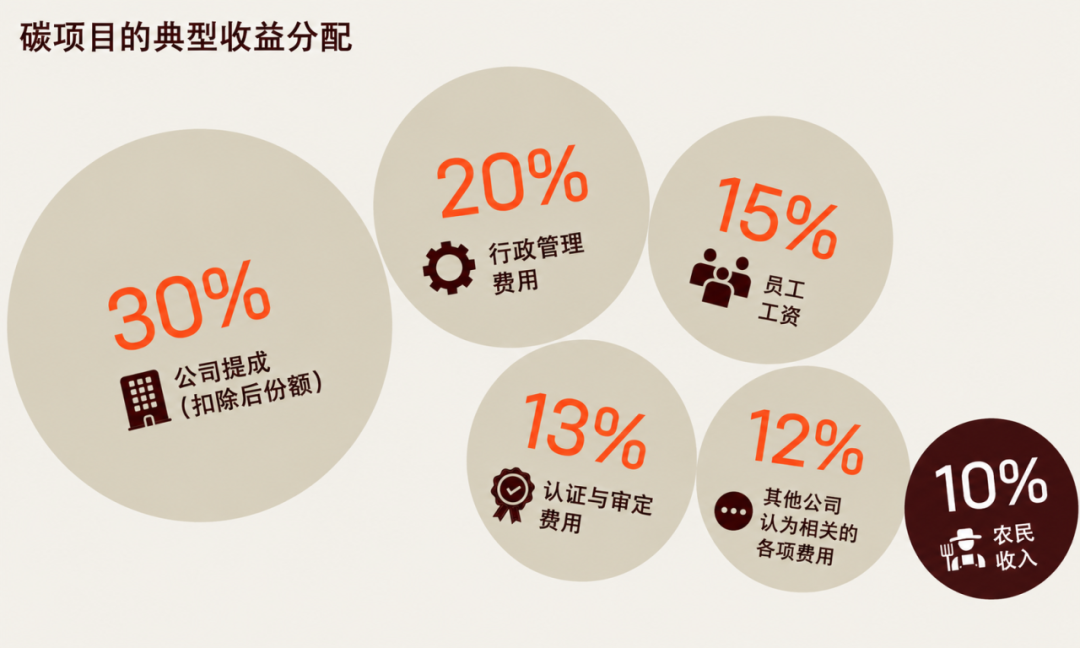
◉Typical revenue distribution in a carbon project: farmers receive only 10% of the profit.
Moreover, farmers have little idea how these figures are actually calculated, and little say in how the project should allocate its funds.
How much they ultimately receive also depends on the market price when the carbon credits are sold. When carbon prices fall, farmers’ income falls with them; but the equipment purchased and labour costs incurred to join the project do not simply disappear.
A study in India covering two states found that 99% of the farmers surveyed had received no monetary benefit from carbon credits, and a considerable number also reported declining yields. After the second year, more than a quarter of farmers had dropped out of the project. If the projects are disrupted by unusual factors such as fire, causing carbon to return to the atmosphere, farmers bear both legal and financial liability and may even be required to repay previous earnings.
So while carbon credits may be a new profitable venture for companies, for farmers they mean putting their land, production costs, and many years of farming practices at risk.
As carbon credit projects multiply, opposition is beginning to emerge in various regions.
In Karnataka, India, the National Bank for Agriculture and Rural Development and Rabobank recruited around 3,500 farmers to plant crops and mango trees to generate carbon credits. Local farmers’ organisations argue that this is turning nature into a commodity, forcing farmers to alter their land management practices for the sake of corporate carbon business, and have mobilised to block the project.
On the eve of this year’s COP30 climate summit in Brazil, an alliance of indigenous, Afro-descendant, farming, and fishing organisations from South American and Caribbean countries issued a joint statement rejecting the carbon market and citing more than 80 cases of land deals that have forced communities to relocate and even stripped them of their land ownership.
Buying carbon credits — but have emissions actually been reduced?
At the end of the day, carbon credits must ultimately answer the most fundamental question: have they actually led to even a small reduction in emissions?
Let us return to the essence of emissions reduction: high-emitting companies should find ways to cut their own emissions at the source. But the carbon market offers a different arrangement — one that allows companies to keep emitting and then spend money purchasing carbon reduced or stored elsewhere to ‘offset’ their own emissions.
But is offsetting the same as reducing?
GRAIN believes that the greatest danger of carbon credits lies precisely here. Oil companies can still continue to extract and sell fossil fuels; as long as they buy enough carbon credits from rice paddies, forests, or grasslands, they can claim to have “offset” their emissions. The party that is supposed to be cutting emissions is handed an “indulgence” to keep on emitting, and companies become even less motivated to cut emissions at the source.
Moreover, the carbon used for “offsetting” is not always precisely accounted for in the first place.
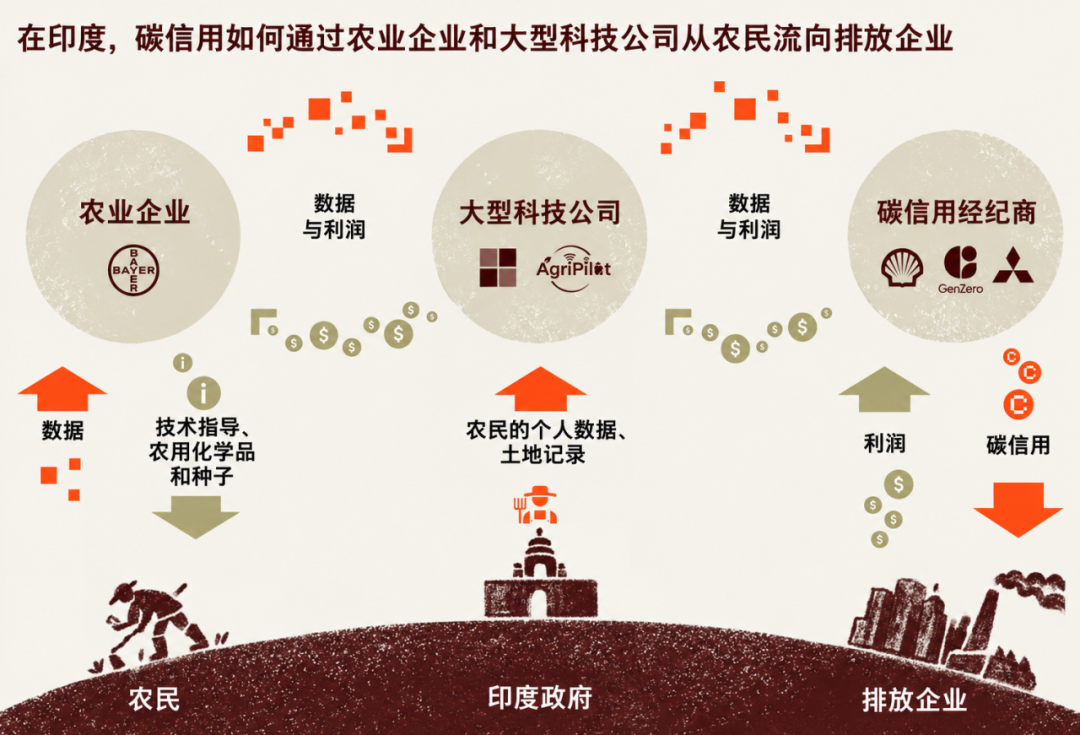
◉ Agrochemical companies are partnering with technology firms to run carbon credit projects directly on the ground. In the process, they gather field data from farmers while simultaneously selling them seeds, fertilisers, and pesticides. GRAIN argues that farmers need to be wary of this kind of “new bundling”.
For a project to generate carbon credits, it must first demonstrate that the emissions reductions would not have occurred without it.
For instance, a tree-planting project must prove that the trees would not have been planted without carbon credits; an agricultural project must demonstrate that farmers would not have adopted these more ecologically sound practices without the project.
In reality, farmers may already be crop-rotating, planting trees, reducing fertiliser use, or improving soil health. Drawing a clear line between what changes are genuinely attributable to a carbon credit project is difficult.
Even if carbon is truly stored, there is no guarantee it will stay there permanently.
Forests face fires and floods; trees can die; land use can change. Once carbon in forests and soils is released back into the atmosphere, how do you account for the carbon credits that were already sold—or even already used by a company to “offset” its emissions?
According to a report this year by the South East Asian media outlet HaRDstories, in 2022 a Thai cement company planted approximately 64 hectares of native trees in Mae Ping National Park, projected to generate carbon credits equivalent to 380 tonnes of CO₂ per year. In November of that year, floods struck the area, and satellite imagery showed more than 40 per cent of the planting zone was inundated. The project had promised inspections every four months and timely replanting, but as of July 2026 the damaged areas had still not been restored.
The accounting itself can also go wrong.
China’s rice carbon credit projects have also faced such disputes. In 2023, the international carbon credit standards body Verra found problems with a rice methane reduction methodology, including the absence of a unified methane measurement protocol, and permanently retired the methodology. Verra subsequently conducted further reviews of Chinese projects that had used it, finding issues such as inflated project areas and insufficient proof of “additionality”. In 2024, Verra ultimately rejected 37 Chinese rice projects, 25 of which had already been issued a combined 4.56 million carbon credits, and required the project developers to compensate for the excess credits issued.
This means that while carbon credits may appear to be a commodity measured precisely to the tonne, the calculations behind them are in fact built on a large number of assumptions, a lack of monitoring, and rules susceptible to manipulation. Once the rules or the accounting goes wrong, whether one tonne is truly one tonne may need to be recalculated.
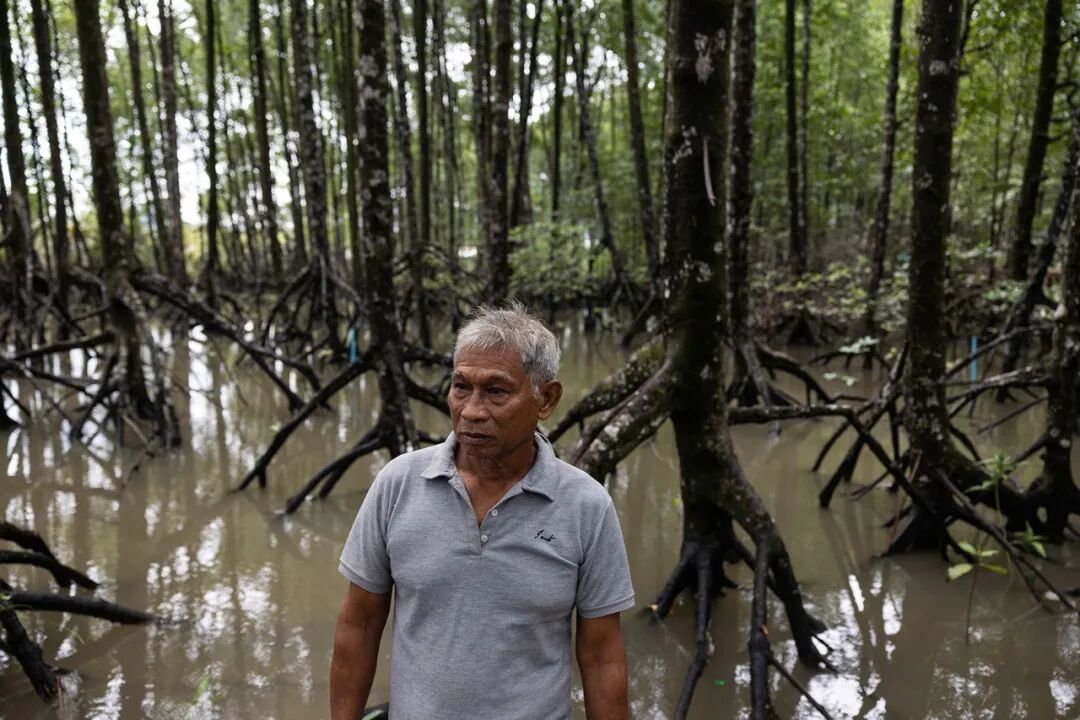
◉ Mangroves in Rayong Province, Thailand. Thailand plans to restore 500,000 rai (approximately 80,000 hectares) of mangrove area by 2031 to earn carbon credits. Image source: HaRDstories.
The risks arising from project failure may ultimately fall back on farmers and communities.
In fact, smallholder farmers and communities across Asia have long practised many ways of farming that have coexisted with forests and land over time—such as agroforestry, conserving local heirloom varieties, crop rotation, and other agroecological approaches. All of these can enhance ecosystem resilience and help soils and vegetation store more carbon. Yet it is clear that the current carbon market mechanism is wholly unable to incorporate these genuine low-carbon practices, or to recognise the farmers who are making a real contribution to carbon reduction.
If climate change is truly a challenge facing humanity, then the solution should not be limited to companies spending money on carbon credits. Supporting agroecology and local seed systems, protecting biodiversity, safeguarding the land rights of farmers and communities, and respecting the land-use practices that local communities have developed over generations—these too should be part of the response to climate change.
As for the companies that are genuinely generating large volumes of emissions, the solution has always been straightforward: reduce emissions at the source, rather than simply paying to make the problem go away.
– This is Foodthink’s 842nd original article –
Click the link to download the report
Unless otherwise stated, all images are sourced from the original GRAIN report.
Compiled by: Kerry
Edited by: Tianle
Layout by: Xiaoshu
Scan to tip and support original food knowledge
▼

▼
Click the image to read related articles


▼
Click on keywords to explore more curated articles
Seeds|Farming Techniques|Policy|Fermentation|Nutrition|Fruit|Fisheries|Events|Careers|Delivery|Wet Markets|Livestock|Food Talk|Sharing Sessions|Book Club|Harvest Festival|Smallholder Stories|Climate Change|Rural Development|Cooperative Economy|Urban Farmers|Food Safety|Digital Technology|Biodiversity|Pandemic and Food|False Solutions|Organic Farming Internship
Beijing|Hebei|Shanghai|Guangdong|Guangxi|Henan|Sichuan|Jiangxi|Xinjiang|Shaanxi|Hong Kong|Chongqing|Zhejiang|Jiangsu|Guizhou|Taiwan|Inner Mongolia|Philippines|Canada|Russia|Mexico|Italy|United States|United Kingdom|Germany|Netherlands|Thailand|Sweden|Japan