
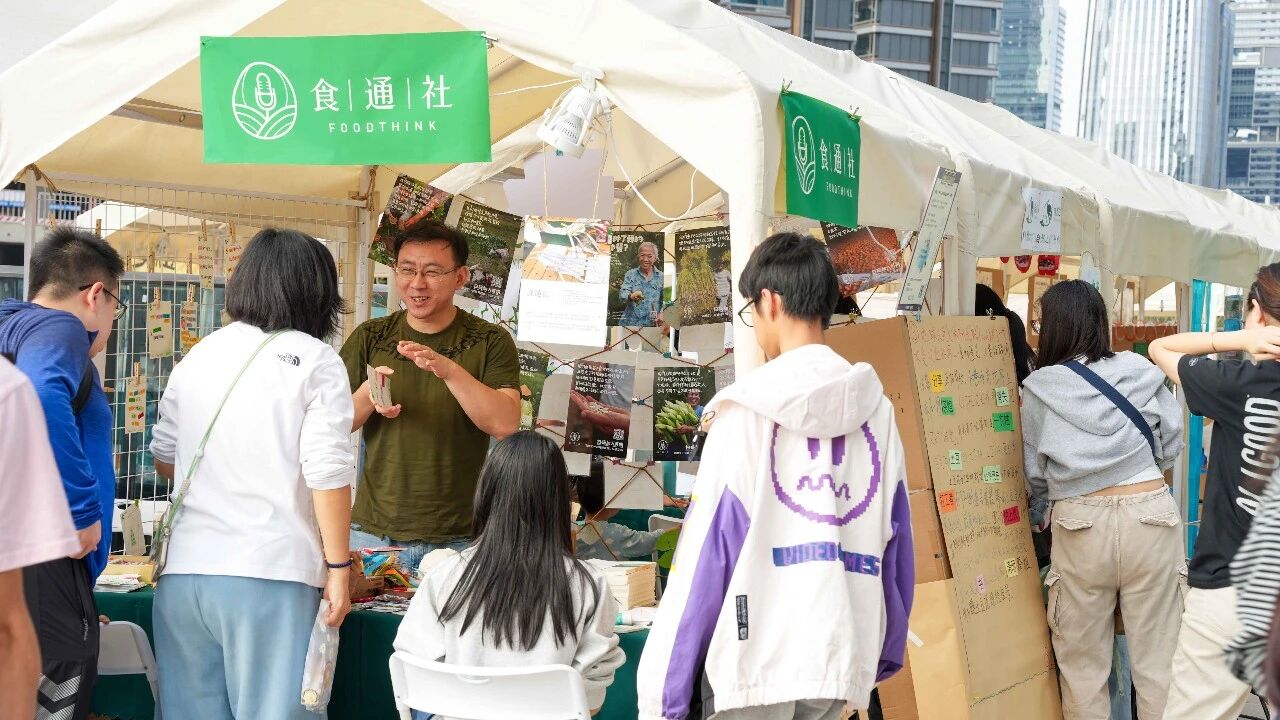
At Guangzhou’s Harvest Festival, Foodthink had nearly a hundred readers relay-write eight climate fiction (cli-fi) stories from article titles, screen a documentary on imported beef and lamb hitting the Qinghai pastoral area, and discuss fields and dining tables under extreme weather with fellow growers and documentary filmmakers.
Where farming guarantees a loss and processing a profit, Wuwei’s returned young farmer Yin Fahua makes noodles from purchased gravel-covered Hongguangtou wheat — only to hold the line on pesticide-free ecological farming, and to hold on to that fragrant handful of fried chickpeas along his childhood field edges.
From Beijing to Yunnan, the practice of more than a dozen ecological farms across the country shows that weeds are not enemies to be conquered but partners in mending soil and building ecology; how weeds are managed reveals the fundamental difference in how farmers relate to nature.
In 30 mu of foothill fields, hail wipes out apricots and rain washes away autumn crops. Wenzizi and Changjiaoling learn the craft from old farmers, sow more seeds, and over ten years have gathered two books and a way of living alongside the sky.
Through Foodthink’s Ecological Agriculture Internship Programme, Jianing came to Yinlin Farm in Conghua. Among hens, goats, rain-thinned maize and old lychee trees planted by the older generation, she relearned to recognise the land and the farmers behind the food.
Drawing on her organic farming experience in Shengou Village, Taiwan, Kouzi spent four years at Erren Valley practising self-sufficiency – grappling with cogon grass, purifying wastewater with banana plants and water lilies – and ultimately confirmed that humans can be a link that nourishes the land.
Sili partners with agricultural technology stations and social organisations across Yunnan to promote ridging-and-furrowing low-water rice cultivation. From Yilong Lake’s shores to the Hani Rice Terraces, the same approach has grown into different forms, shaped by differences in subsidies, water conditions and varieties.
During three months pulling weeds, catching insects and raising seedlings at Xiqing Farm in Daxing, Beijing, Tianyi—participant in Foodthink’s Ecological Agriculture Internship Programme—came to realise that the moments when body and land are honestly joined are far more precious than the harvest itself.
In Villain Valley, Fujian, Grandma Kouzi builds this permaculture system through layered planting, duck-shelter symbiosis and perennial herbaceous crops — plant once, eat for a lifetime, and the primary task of humans is simply to harvest.
On the edge of Brazil’s Atlantic Forest, farmer Louis spent 16 years transforming a banana monoculture into an agroforestry “forest”; philosophy graduate Zhang Zhiwei, who laboured on African and Brazilian farms for nearly a year, now plans to bring this method back to Yunnan.


