Since returning home in 2011, Yu Jiangang has resumed ecological cultivation of Hangzhou white chrysanthemum in Zhenghebang, Tongxiang. Six years of typhoons, extreme heat and a partner’s total crop failure have left only this one mu still farmed by a villager.
Environmental advocates Li Jiacheng and Mao Da, drawing on the book Where Does the Garbage Go?, point out that Japan’s incineration-dominated system is not the best model: in at least 10 Chinese provinces and regions, incineration capacity has already exceeded waste collection volume.
More than ten young people in Foodthink’s 2023 cohort in the Ecological Agriculture Placement Programme have given their answers: some to reclaim the childhood taste of vegetables, some to master growing knowledge at the front line, some to understand agriculture and the land anew through their bodies.
Ma Yanwei, a Beijing Normal University ecology master’s graduate, has grown muskmelons in the Tengger Desert for eight years. Lei Tiantian, who left Shanghai, interned on the farm. The three chat under a tree in Alxa about drought, running the farm, and how one melon improves the desert.
Supported by Friends of Nature’s Linglong Programme and Foodthink, the team visited 30 ecological smallholder farmers across five provinces and municipalities, recording their practices for responding to extreme weather and the external barriers—funding, insurance—they face, filling a research gap on Chinese smallholder farmers’ active climate adaptation.
Between Yangcheng Lake and Kuilei Lake, Kunshan’s Yuefeng Island Farm manages 101 rice and 113 dryland farm varieties through zoned trials and growth-stage records. Extreme weather prevented 25 varieties from producing saved seed; the farm is now turning old seeds into table products to sustain conservation.
Lei Tiantian, who fled Shanghai to intern at Zhiliangtian Farm, chats with founder Ma Yanwei in the Tengger Desert: growing pumpkins, picking shacong (sand leek)—what kind of life do this generation of ‘new farmers’ actually lead?
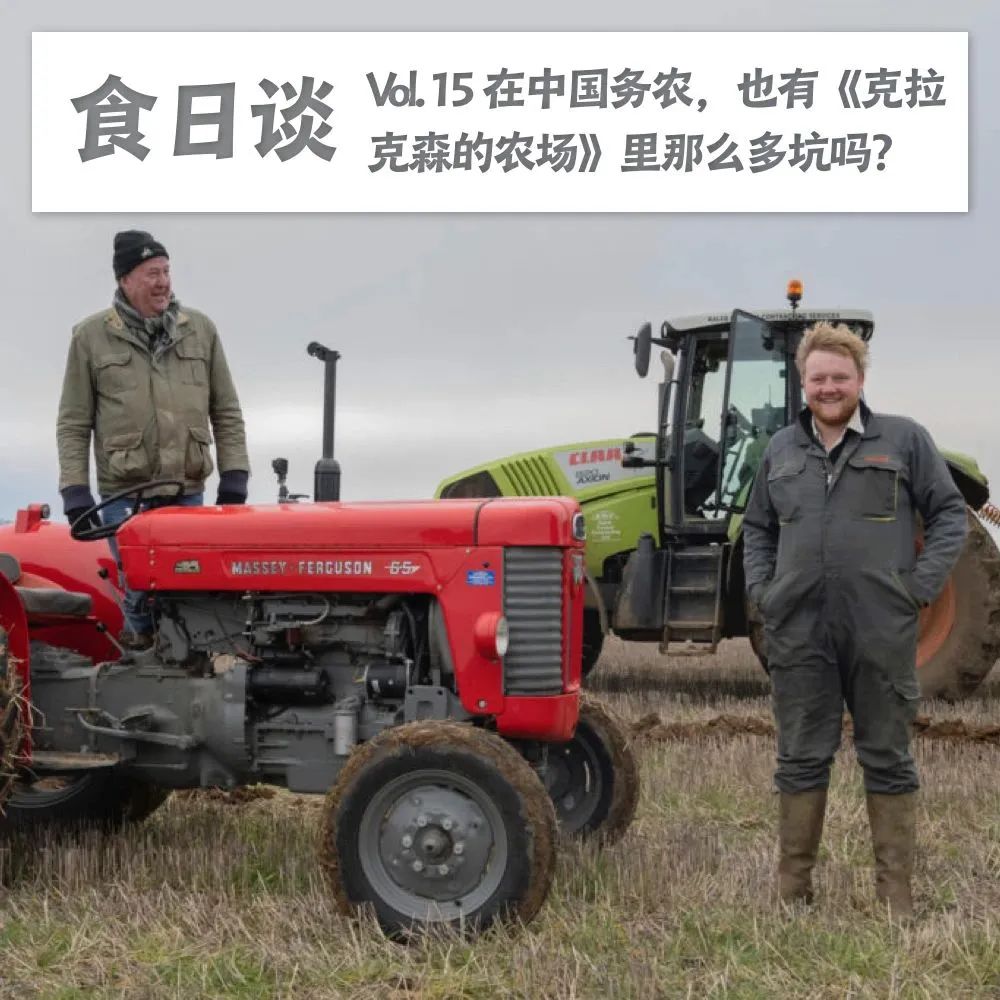
Jeremy Clarkson ploughs with a Lamborghini tractor, herds sheep with drones, yet his annual net profit is just £144 – do the same pitfalls await farming in China? And how does the UK’s social support for agriculture compare with Chinese farmers’ circumstances?
Extreme heat has left strawberries all leaf and celery tough and stringy; continuous rain has flooded Pingren Farm three or four times. At Changping and Lingqiu, farmers sow grass to stabilise slopes, raise natural enemies in polytunnels, and apply biofertiliser after flooding — adapting to increasingly unpredictable weather.
Through nearly 100 articles, 13 podcast episodes and more than 40 events, Foodthink recorded ordinary people’s food struggles during the pandemic and ecological smallholders’ climate adaptation practices, and sent its first cohort of young interns to 12 farms – leaving solid traces amid uncertainty.