Sister Yan Ping at Baicao Garden, Guigang, Guangxi, refuses herbicides on fifty mu of Wogan mandarins, making labour a practice of nurturing body and mind; Uncle Youming of the White Pants Yao in Nandan keeps a seed bank for heirloom rice, preserving his people’s rootedness in the land.
Gannan herders call imported grain-fed meat “fake meat,” yet with local yak prices steadily falling since 2020 — a single adult yak fetches just over 6,000 yuan — many are forced to buy “fake meat” themselves.
Research Fellow Wang Xiaoyi (Institute of Sociology, Chinese Academy of Social Sciences) unpacks the contradiction between pasture-fattened yaks that “can’t fetch a fair price” and local meat that herders “can’t afford”. After marketisation “disembedded” beef and mutton from pastoral life, he asks how to “re-embed” them into the community.
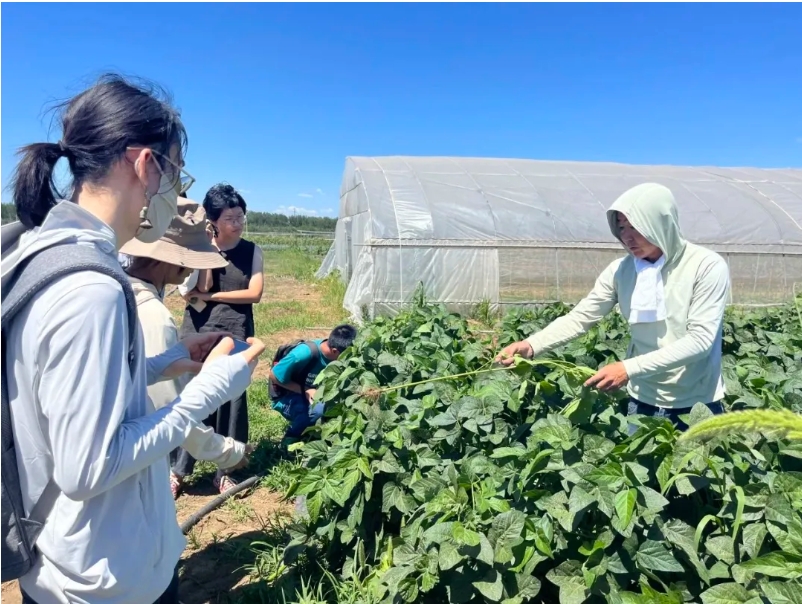
Among the more than ten ecological farms Foodthink visited, new-generation farmers bring wildly diverse professional backgrounds. Above the shared bottom line of no chemicals, from five mu of intensive cultivation to a garden-style life, every farm is the embodiment of its owner’s ideals.
Qiaoyi’s family in Ruyuan, Shaoguan, moved from the deep Nanling Mountains to beside Danxia Airport. In summer, colony after colony of wild termite mushrooms lets the Guoshan Yao carry on their days living with the mountains and forests in the gaps of urbanisation.
Zejun refused the mainstream path of life. In spring 2024, a three-month internship at Guixinyuan Farm in Huizhou, Guangdong—from weeding and feeding ducks to visiting multiple farms across the two Guangs—gradually revealed that ecological agriculture has no standard answer but a spectrum.
Sangje, a herder settled in the county town driving a sanitation truck, cannot afford his own yak meat—he boils imported frozen meat with sheep intestines in one pot. Cheap JBS-chain beef is driving live livestock prices into loss, from Gannan to Brazil, and burning the Amazon’s forests.
A Foodthink intern at Zhiliangtian Ecological Farm in Alxa confronts the risks of farming at the mercy of the weather and the frictions of communal living — yet among the plants, birds, and beasts beneath the Helan Mountains, discovers the quiet confidence to keep tending the land.
A Community-Supported Agriculture farm in Fengxian, Shanghai—20 mu of arable land held up by four farmhands in their seventies, members unwilling to share yield-loss risks, organic fertiliser still bought in—three months of farm life have reconciled ecological farming’s ideals with its realities, entry by entry.
Foodthink’s Lianhe Programme sent five young people to Lüwo Farm in Jingyang, Shaanxi, where their days went far beyond planting vegetables and pulling weeds — raising seedlings, driving a tractor, working on the biscuit production line, attending biodynamic farming classes.