Eat Your Bamboo Shoots Before It’s Too Late

If bamboo is the spiritual totem of the Chinese people, then bamboo shoots are the very soul of China’s foodies. Curiously, while the total area of bamboo forests worldwide reaches 30.1 million hectares, spanning Europe, Asia, Africa and beyond, China alone accounts for 70 per cent of global fresh bamboo shoot consumption. From the southeast to the southwest, though cooking methods and ways of eating may differ, people across China share the same devotion to the fresh, delicate flavour of bamboo shoots. What manner of natural flavour is this, so deeply rooted in terroir and human warmth?
Jiangnan’s Bamboo Shoots and Meat
When it comes to eating bamboo shoots, the most celebrated ambassador is Su Dongpo. A man who lived by the principle of “ banished wherever, eating wherever,” Dongpo was the very first spokesperson for what we would today call A Bite of China. On his first arrival in Huangzhou, he penned the verse: “ The Yangtze winds round the town walls — I know the fish are fine; lush bamboo crowds the hills — I sense the shoots are sweet.” How many men of letters could dare admit that the sight of bamboo made them think, not of elegance, but of the shoots on their plate?
That famous line — “ Better to eat without meat than to live without bamboo” — takes on another meaning too. Master Dongpo was not setting bamboo and meat against each other; he was reminding us to widen our thinking.
A culinary genius of rarest calibre, Dongpo could summon the patience to coax a great slab of fatty pork through the lowest, gentlest simmer — the flame barely lifting — living by the creed: “ Let it cook of its own accord; do not hasten it; when the heat has done its work, perfection arrives by itself.” Thus he claimed the very top of China’ s culinary canon with Dongpo pork. Surely, then, it never escaped him that simmering bamboo shoots alongside meat lets the silken richness of pork and the pristine elegance of bamboo shoots elevate one another.
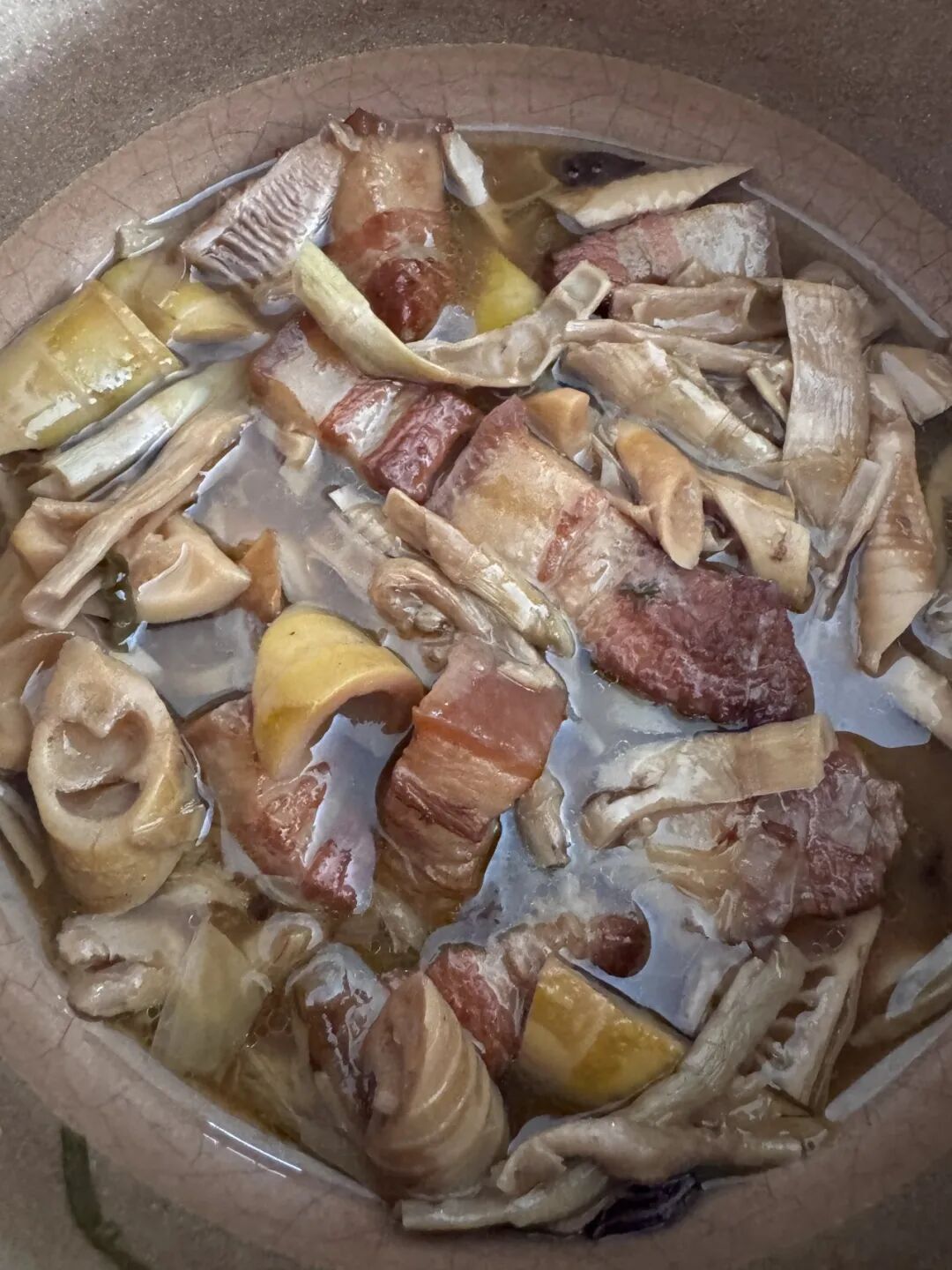
◉ Braised pork with bamboo shoots.
And so “ better to eat without meat than to live without bamboo” earns a fresh annotation: if the day’ s meal happens to be meatless, a quick stir-fry of bamboo shoot slices will do nicely. Planting bamboo beside his little studio — well, that was Master Dongpo’ s shrewd way of killing two birds with one stone. A Sichuanese uprooted by banishment for the better part of his life, he chose to end his days in Jiangnan. The reason, I suspect, is that the bamboo shoots here are the finest of all.
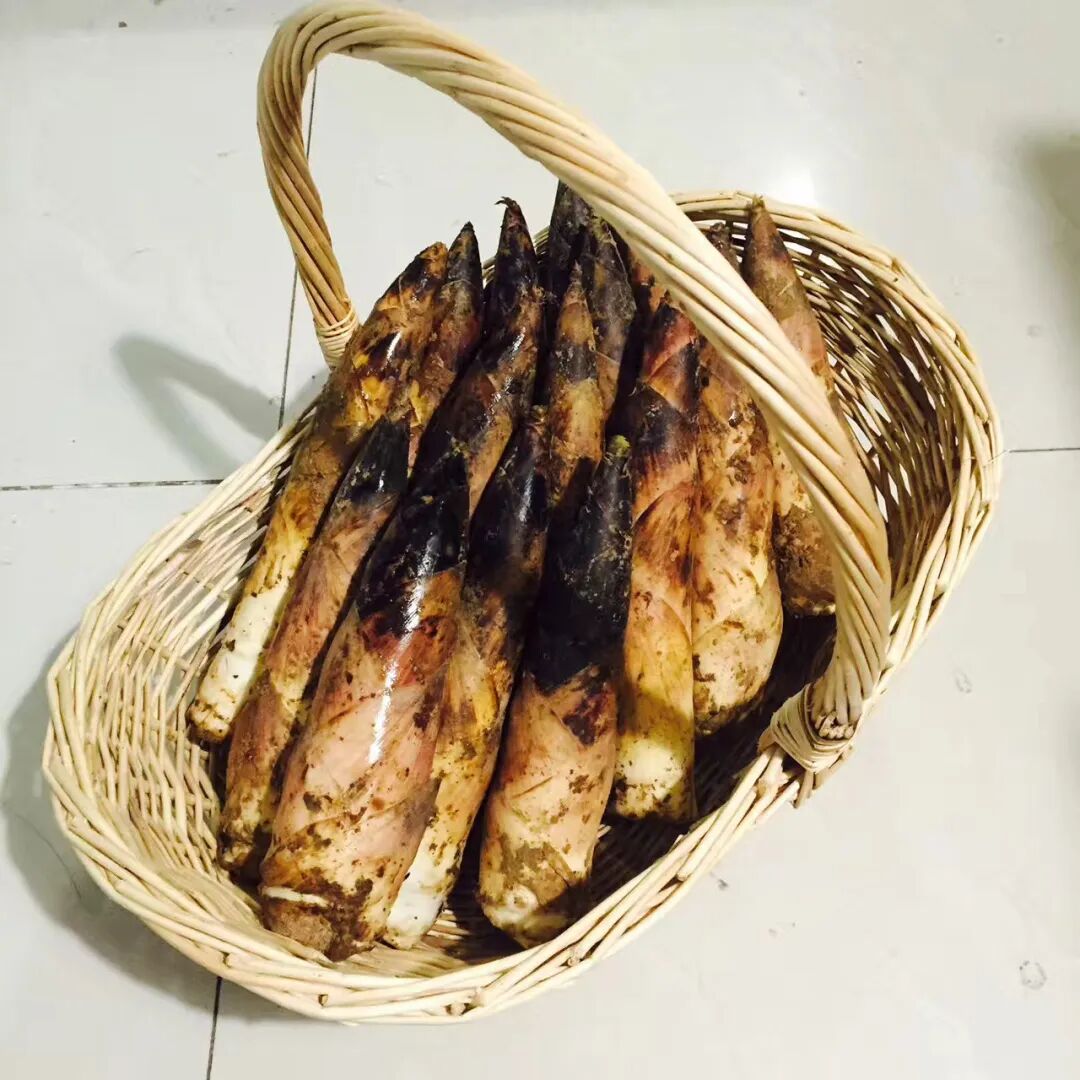
◉ Thunder bamboo shoots from Hangzhou, sent by my friend Yifan.
Anyone who has lived in Jiangnan will find it hard to forget the bamboo shoots of that land. My mother-in-law, for instance, grew up in Wuxi, though she came north with her parents while still very young. Yet the dishes she reaches for most often at any family table remain oil-braised bamboo shoots, Yan Du Xian (a slow-simmered stew of bamboo shoots and cured pork), and vegetarian chicken.
Speaking of Yan Du Xian, I must confess a Hunanese woman’ s misunderstanding of Jiangnan flavours.
Once, scrolling through WeChat Moments, I spotted a plea from Tianle, a Shanghai friend, asking if anyone had any salt-cured pork. I immediately sent her a private message: I had a piece of smoked pork at home, and it was quite salty. She told me that smoked pork and salt-cured pork were entirely different things — to make Yan Du Xian, only salt-cured pork would do. I simply could not understand. In a Hunanese eye, surely smoked pork and bamboo shoots are the natural pair?
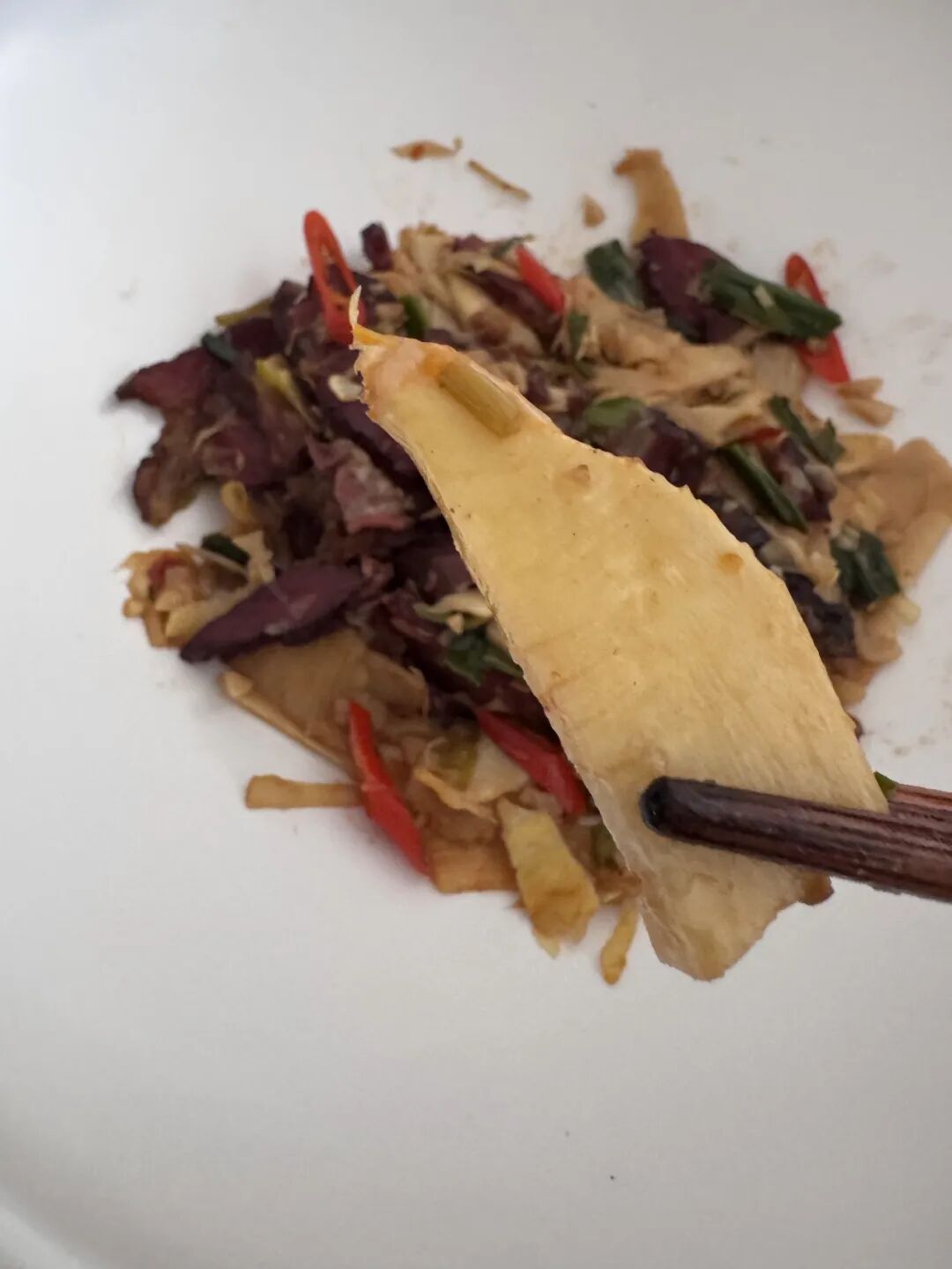
◉ My stir-fried winter bamboo shoots with smoked pork.
It was not until one Spring Festival, when my mother-in-law made a trip back to Wuxi and brought home salt-cured pork to cook us a proper pot of Yan Du Xian, that I finally understood what Tianle had insisted on all those years ago.
Unlike smoked pork, which needs at least one to two months of smoking, salt-cured pork can be made and eaten almost at once. You rub pork belly with Sichuan peppercorn salt, hang it by the windowsill to air-dry, and in about a week it is ready. Stash it in the freezer and wait for spring bamboo shoots to come to market; then take it out, wash it, cut it into chunks, and simmer it with the shoots. Smoked pork does not take well to a long braise, but salt-cured pork grows more fragrant the longer it cooks. When my mother-in-law makes Yan Du Xian, she also adds salt-cured duck leg and green bamboo shoots. Even the tofu-skin knots are her own — she ties them from the thousand-layer tofu sheets she carries back from the Wuxi market, sheets so thin you could read through them like a cicada’ s wing.
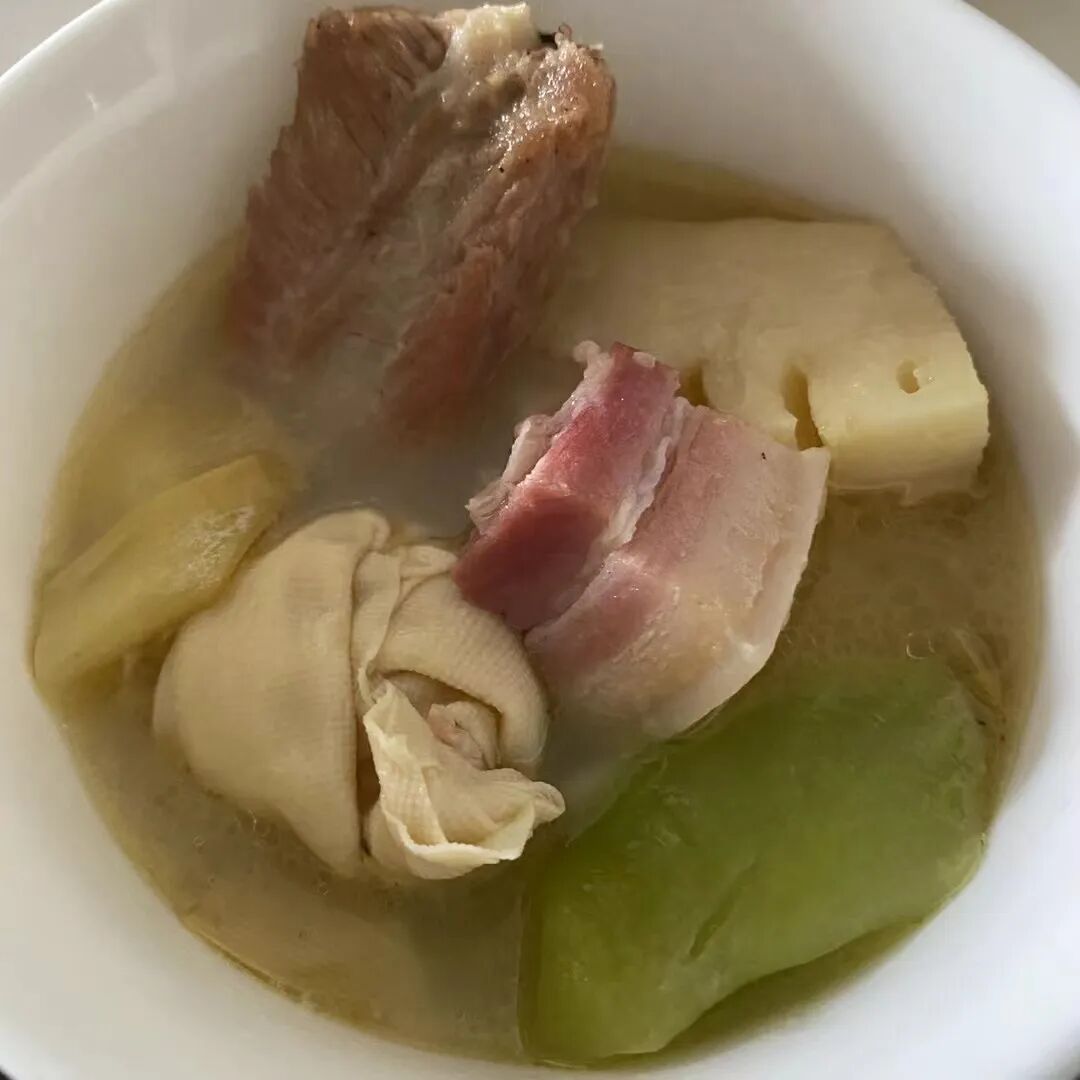
◉ My mother-in-law’ s Yan Du Xian, enriched with green bamboo shoots.
These top-tier treasures need a full two or three hours in the claypot, until the salt-cured pork fades to a pale pink and the bamboo shoots, brimming with rich broth, reduce the meat to a mere supporting player. Just be careful not to eat too hastily — that scalding broth has a way of catching your tongue.
Dried Bamboo Shoots from Anji
My mother-in-law adores bamboo shoots, but never overindulges, for they are rich in insoluble dietary fibre, and those with a delicate stomach are prone to triggering old ailments. What is one to do? Well, bamboo-shoot-loving folk in Jiangnan have their tricks for getting around that.
At Qingtao Restaurant, beside Hupao Spring in Hangzhou, I once tried a bamboo shoot dish said to be gentle on the stomach. Its name is Mao Sun Bao — a claypot of fresh Moso bamboo shoots from Anji, slow-simmered with aged salt-cured pork and pickled mustard greens for five or six hours, until the thick layers of fat have melted into the broth and tenderly permeated every fibre of the shoots. Each bite felt like the fluffy tenderness of young meat. I thought to myself: “These shoots must have cast some soul-snatching spell — they wear the body of a bamboo shoot, yet harbour the soul of meat.”
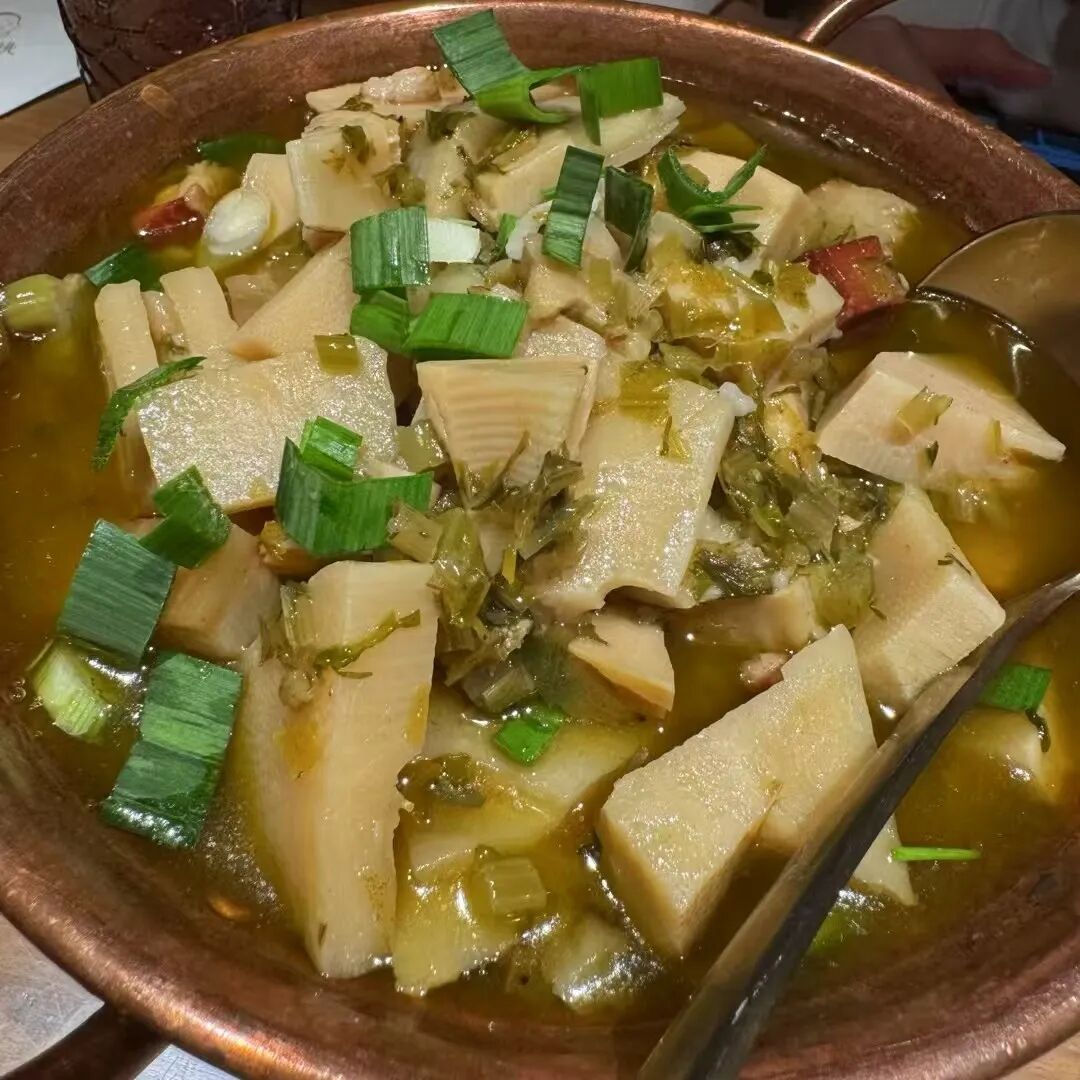
◉ Mao Sun Bao from Qingtao Restaurant.
Anji County lies in northern Zhejiang, and the bamboo shoots there are as much a regional hallmark as the xiangfei (Chinese torreya nuts) of Zhuji or the mountain walnuts of Lin’an — signature foods of the Jiang-Zhe region.
Fresh bamboo shoots are notoriously perishable; even in the fridge they keep growing, their texture turning tough. Turning them into dried shoots is a necessary compromise. While most dried shoots inevitably lose some of their flavour, the taste of dried shoots from Anji is a rare case that surpasses even the fresh.
The dried bamboo shoots were sent to me by Xiaoyezi, who once worked at Beijing’s organic farmers’ market. She is a rocker — by day she helps fellow growers at the market stall, and by night she shuttles between underground rock gigs. Her writing carries the same fierce energy as her life.
Seven years ago she left Beijing to return to her hometown of Anji, Zhejiang, and ever since, bamboo shoots have never been absent from her table in the weeks between spring and summer. All manner of wild baby shoots burst forth in the hills: small water bamboo shoots with a faint green sheen on their husks, the most tender of all; small stone bamboo shoots with black speckles on their shells, tender with a pleasant chew; and red bamboo shoots with purplish-red husks, firm and long-lasting in the pot.
In May 2019 she sent me a packet of dried wild Pen-stalk bamboo shoots — the first time I had ever tasted dried shoots of that kind.
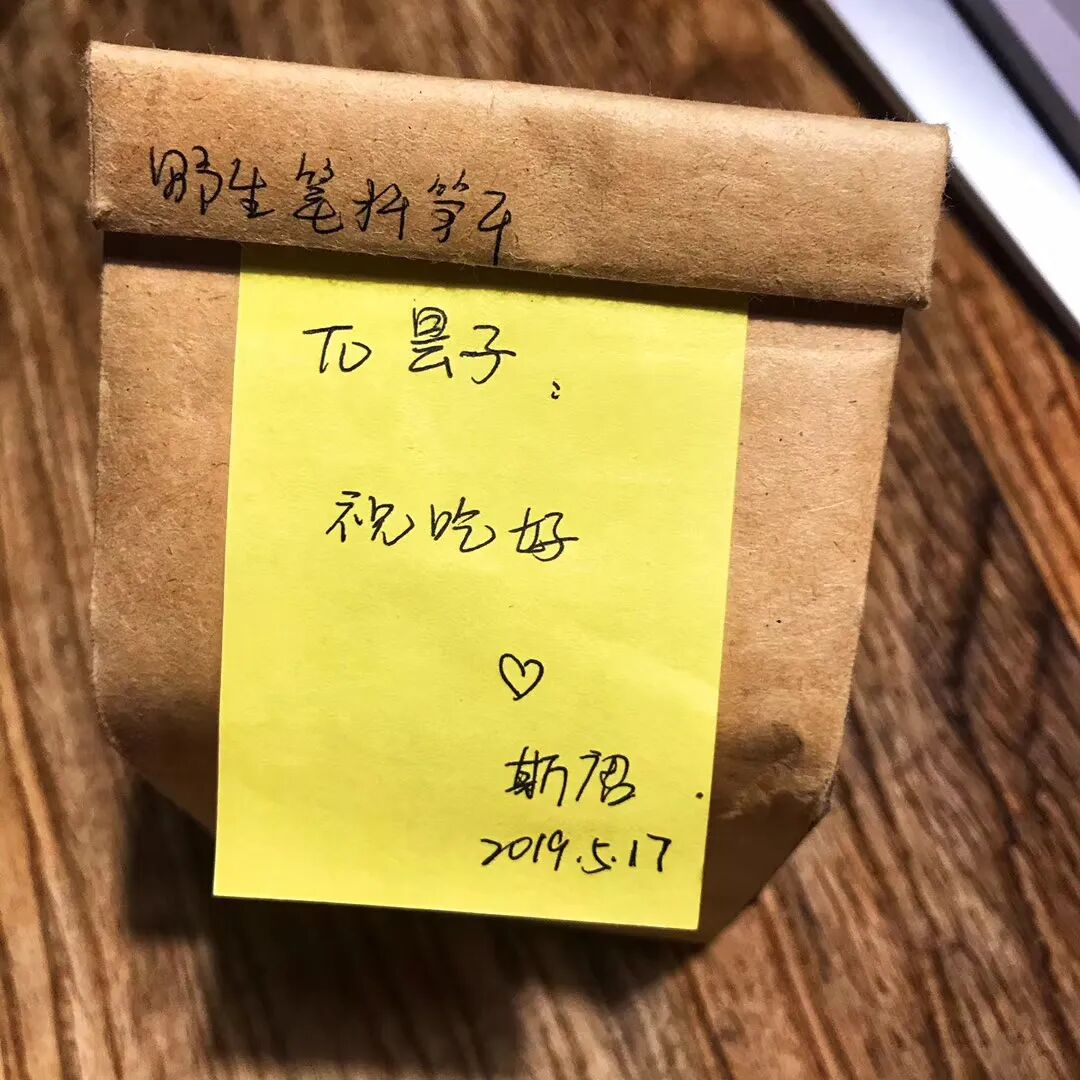
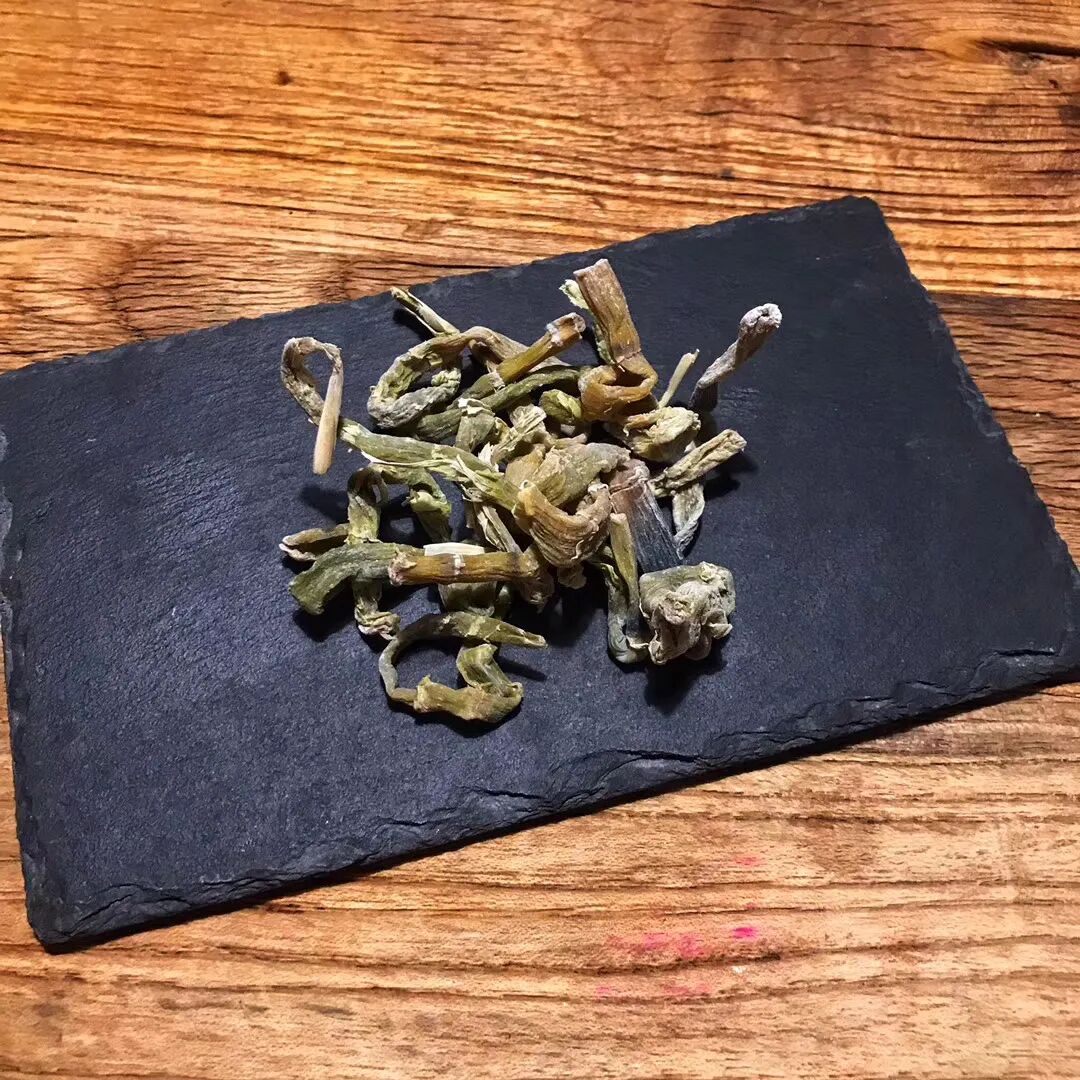
◉ Pen-stalk bamboo shoots from Xiaoyezi; the right photo shows them before rehydrating.
Each piece of this dried shoot is made from a whole baby shoot: the husks are stripped, the shoot boiled, then salt is worked in by hand and the moisture squeezed out — just as tea leaves undergo rolling and fixation. Air-dried, rolled again, dried again, until a fine crust of salt blooms on the surface and each shoot curls into a tiny ball. Soak in cold water for two hours, then chop fine or tear into strips; stir-fry or stew, either will do. But in my heart the very best pairing remains braised pork belly.
Pork belly in a seven-to-three ratio of fat to lean, cut into chunks and dry-fried with slices of ginger until lightly golden. Remove the meat, leaving the base oil in the wok, then add garlic, shallots, or spring onion whites, and fish them out once the aroma has reached its peak.
The next step is the key that determines the colour and character of the braised pork — chao tang wu, what northerners call caramelising the sugar. Low heat, a slick of hot oil, rock sugar added and crushed with the back of the ladle until it dissolves into a syrup; keep stirring as it deepens to amber, then pour in the meat at once, coating each piece in a glint of gold.
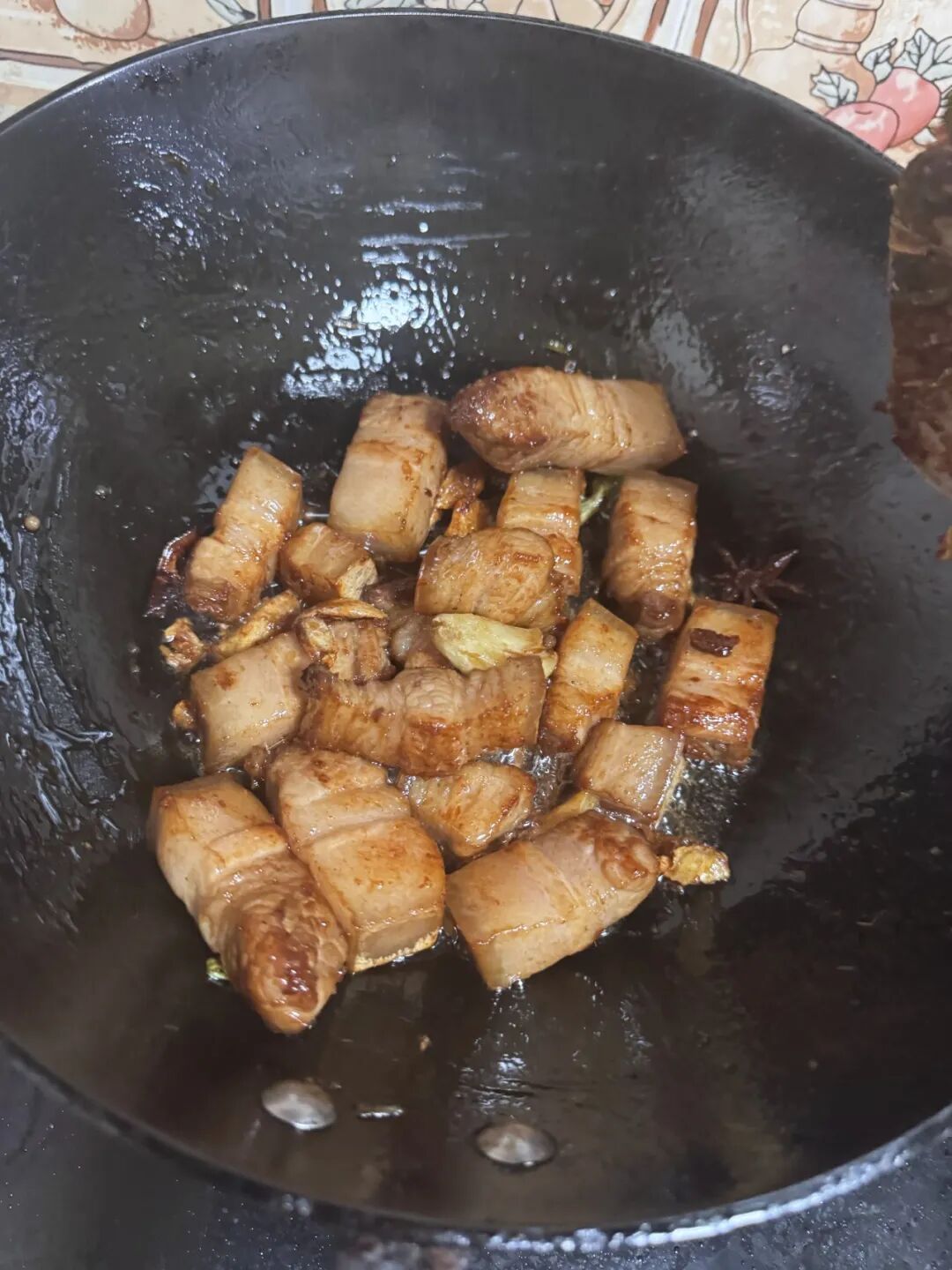
◉ Chao tang wu — caramelising sugar.
The rehydrated dried bamboo shoots go in at this point too. Splash rice wine and soy sauce around the hot wok to send up a heady fragrance, then add fresh water and bring to a rolling boil. Skim the froth, transfer to the claypot, and leave it to braise gently. Heed Master Dongpo’s teaching: do not lift the lid until at least three or four hours have passed. The result — dried bamboo shoots braised with pork belly — yields melt-in-the-mouth pork that is never cloying, while the shoots have drunk up every drop of meaty richness from the broth, glossy and springy to the bite.
Digging Bamboo Shoots in the Hometown Bamboo Grove
As a return gift, I sent Xiaoyezi a packet of Peach Blossom dried bamboo shoots made by my father. I do not mind being laughed at, but for a very long time I believed bamboo shoots grew only in Hunan.
My hometown lies nestled among a sea of bamboo. Every year around the Spring Festival, children follow the adults carrying hoes into the hills to dig winter bamboo shoots. These shoots hide deep underground; without experience they are nearly impossible to find, and coming home empty-handed is a regular occurrence.
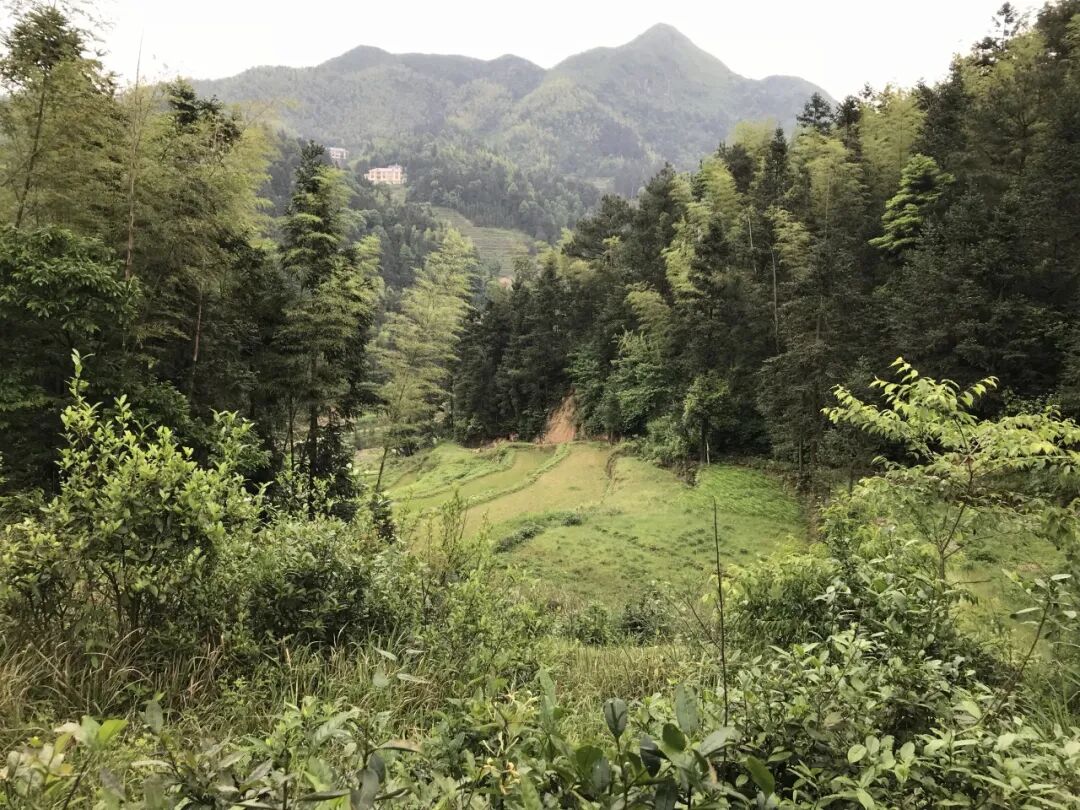
◉ The sea of bamboo back home.
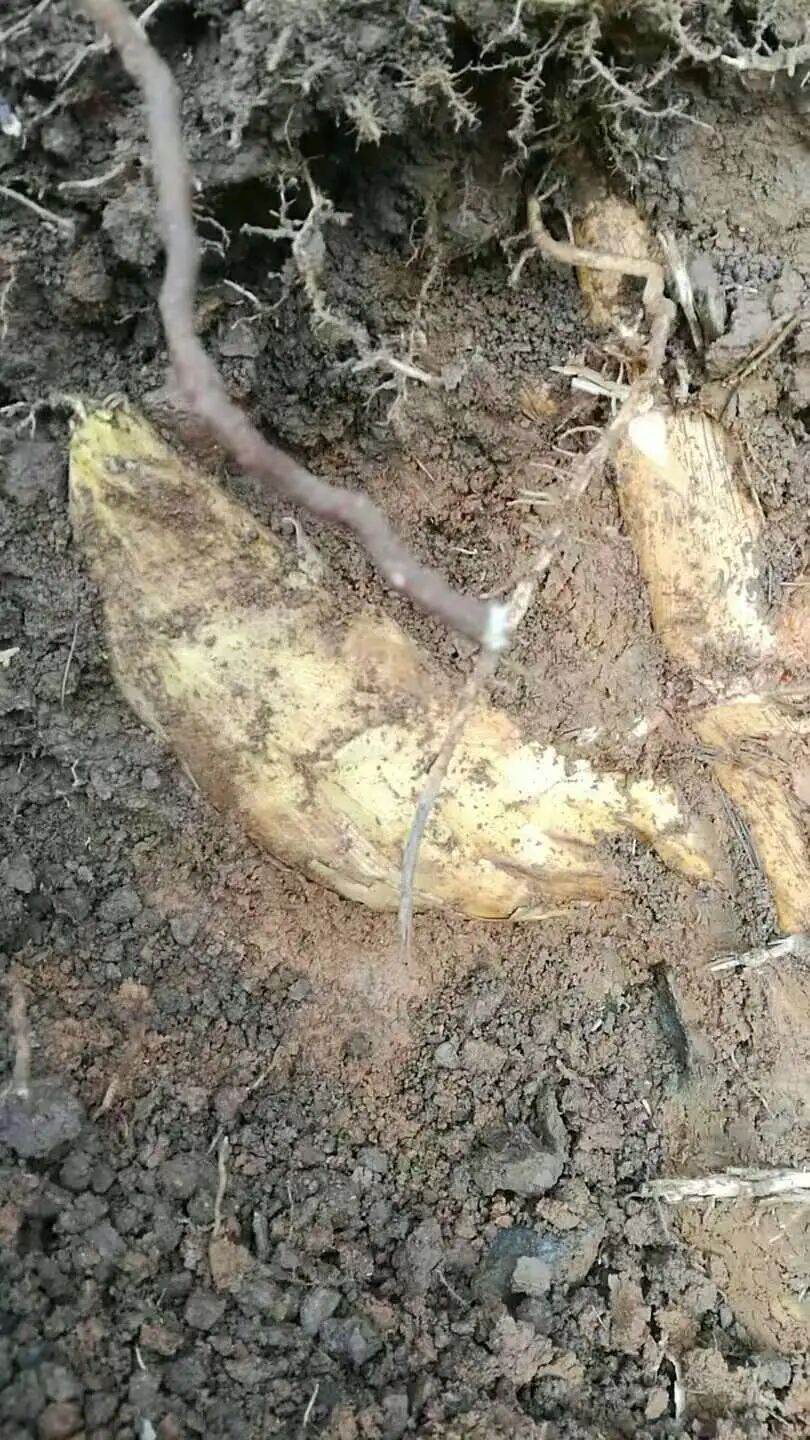
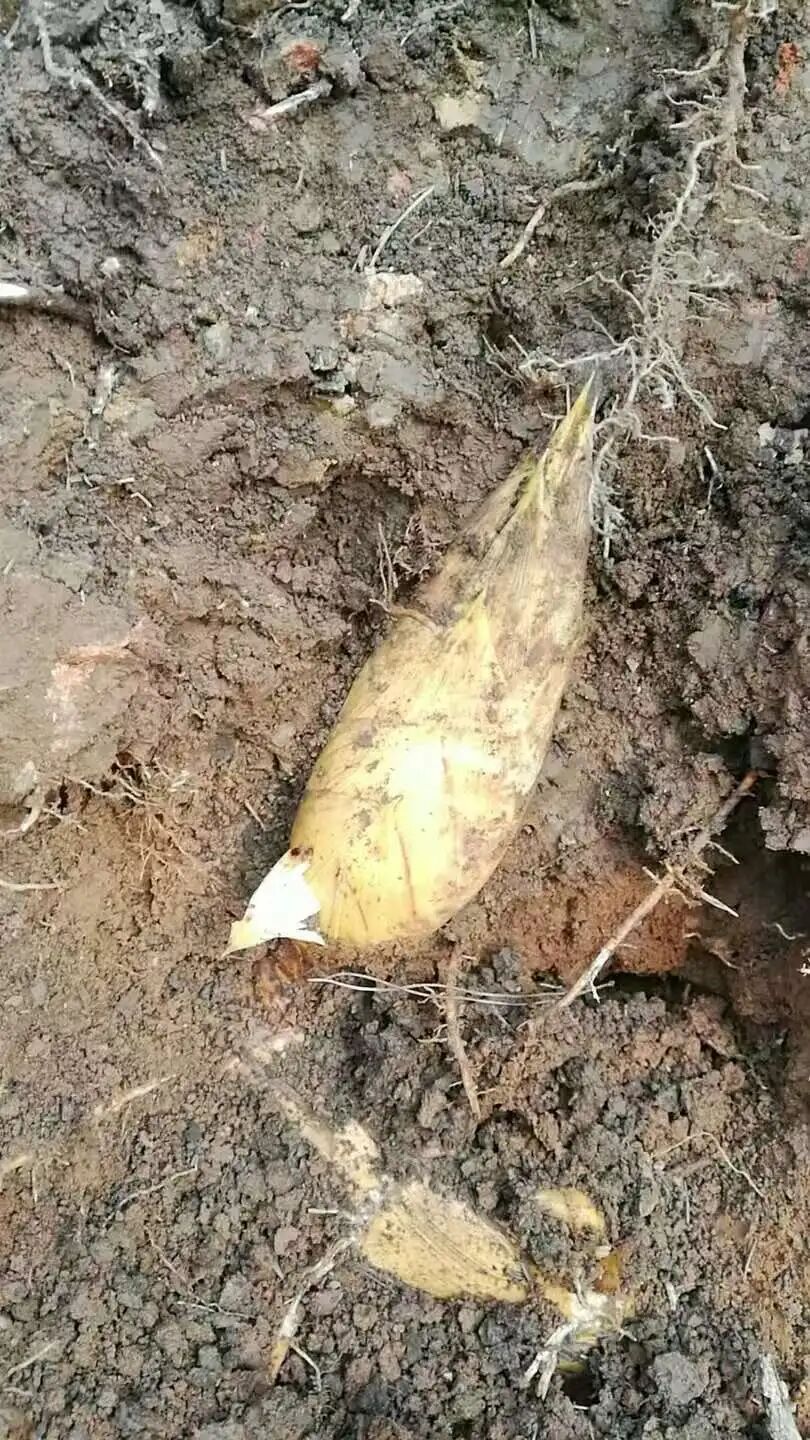
◉ Digging winter bamboo shoots requires carefully excavating the whole shoot before severing it. Photography: Luo Shunhua
My third aunt’s husband can tell which stretch of bamboo grove yields the most shoots just by reading the colour of the leaves and the thickness of the culms. Then he studies the arc of the soil’s swell to gauge the direction of the bamboo rhizome’s growth, and digs along its path — he never comes home empty-handed.
Winter bamboo shoots are small, their flesh so tender it is almost criminal — a rare delicacy, and handing them to a poor cook is a grievous waste. Fortunately, my uncle not only knows where to dig but cooks with real flair. He braises a pot of five-spice lamb, skin on: the winter shoots are husked, their tender sheaths left on, then sliced; lard heats in the wok, in go green garlic leaves and chopped pickled chillies, all stir-fried until fragrant, then simmered with the sliced lamb. The shoots turn clean and sweet, the lamb rich and tender — the dish everyone fights over at the table, and the shoots always vanish before the meat.
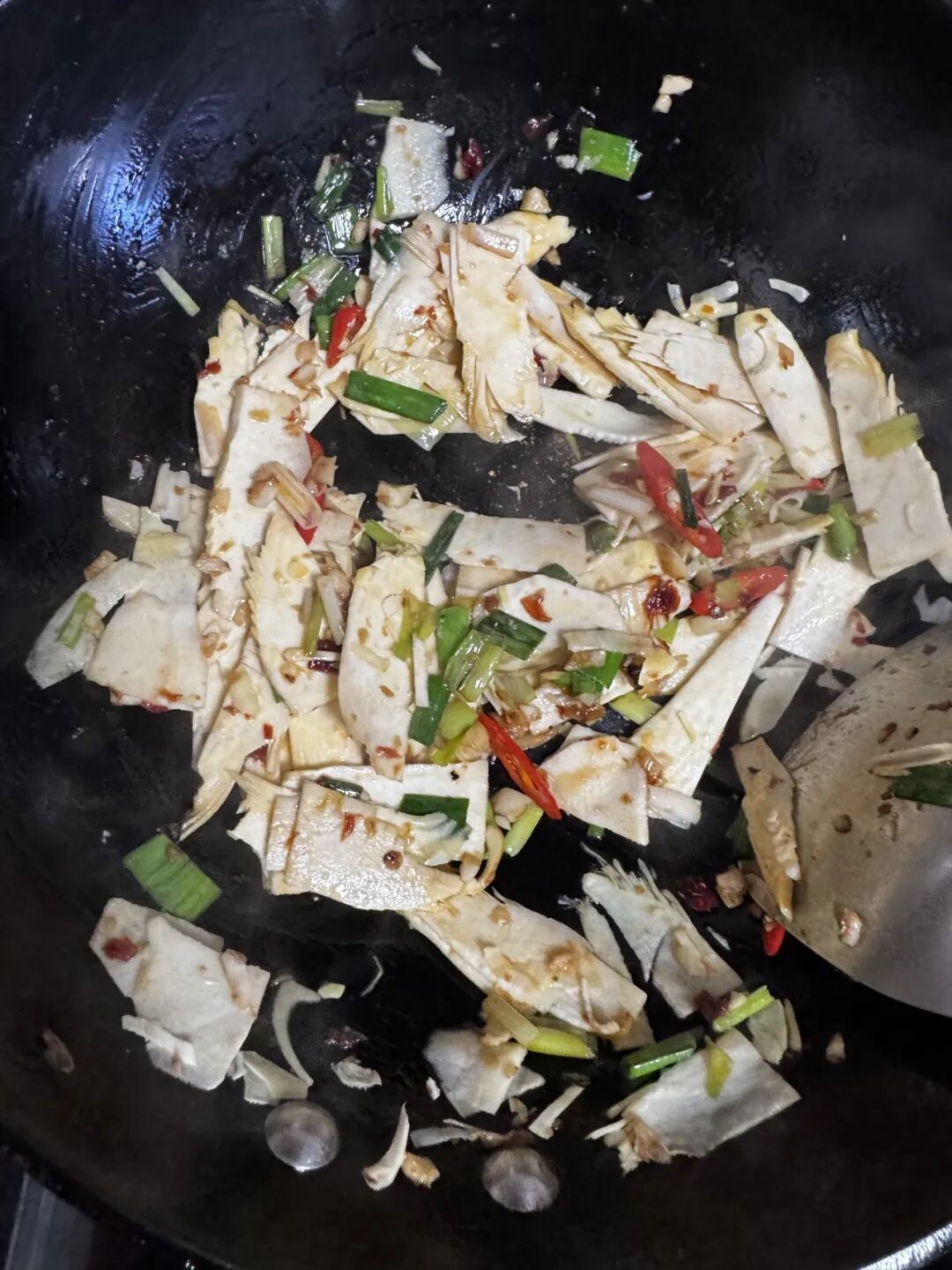
◉ Stir-fried winter bamboo shoot slices.
Spring bamboo shoots that break the surface around the solar term of Awakening of Insects, just as the peach blossoms first open, are also called “ Peach Blossom bamboo shoots” — and they are ideal for drying.
By now the shoots have pushed above ground, yet most of their bodies still lie buried in the soil; a sharp-eyed hand drives one strike of the hoe and levers up a fat, plump shoot. Tray after tray is carried down the hill, and the aunties husk them with practised hands, halve them lengthwise, and pour them headlong into a great pot of boiling water. A thick layer of white froth rises to the surface; the half-tender shoots are lifted out, spread on bamboo winnowing trays to dry in the shade, or hung above the stove fire to smoke.
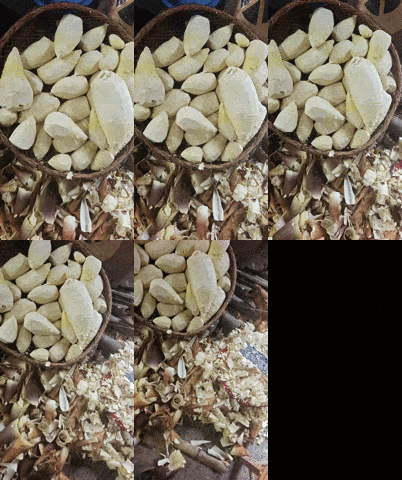
◉ Husking shoots to make dried bamboo shoots.
Should the dried shoots reabsorb moisture and soften, mould sets in easily; they must be steamed and sun-dried again, over and over, until they shrink to a seventh — sometimes a tenth — of their original bulk, turning rigid and deep brown like ancient fossils. Only then is the job truly done.
The humid southern air makes dried shoots prone to re-moistening and mould, and even when bone-dry they weigh so little they barely fetch a fair price by the scale. What is sold outside is not above suspicion — smoke keeps goods from spoiling, so it is sometimes used to cut corners. That is why every dried bamboo shoot our family eats is made by my father himself.
In 2016, while I was selecting products for Wuyong Zhenwei, I wanted my team to taste the dried bamboo shoots from home, so I mentioned it offhandedly to my dad. He went and made a good five kilos of Peach Blossom dried bamboo shoots and posted them to me. Thank goodness dried shoots keep well — but even so, we nibbled through them over several years, and I carried them through every house move.
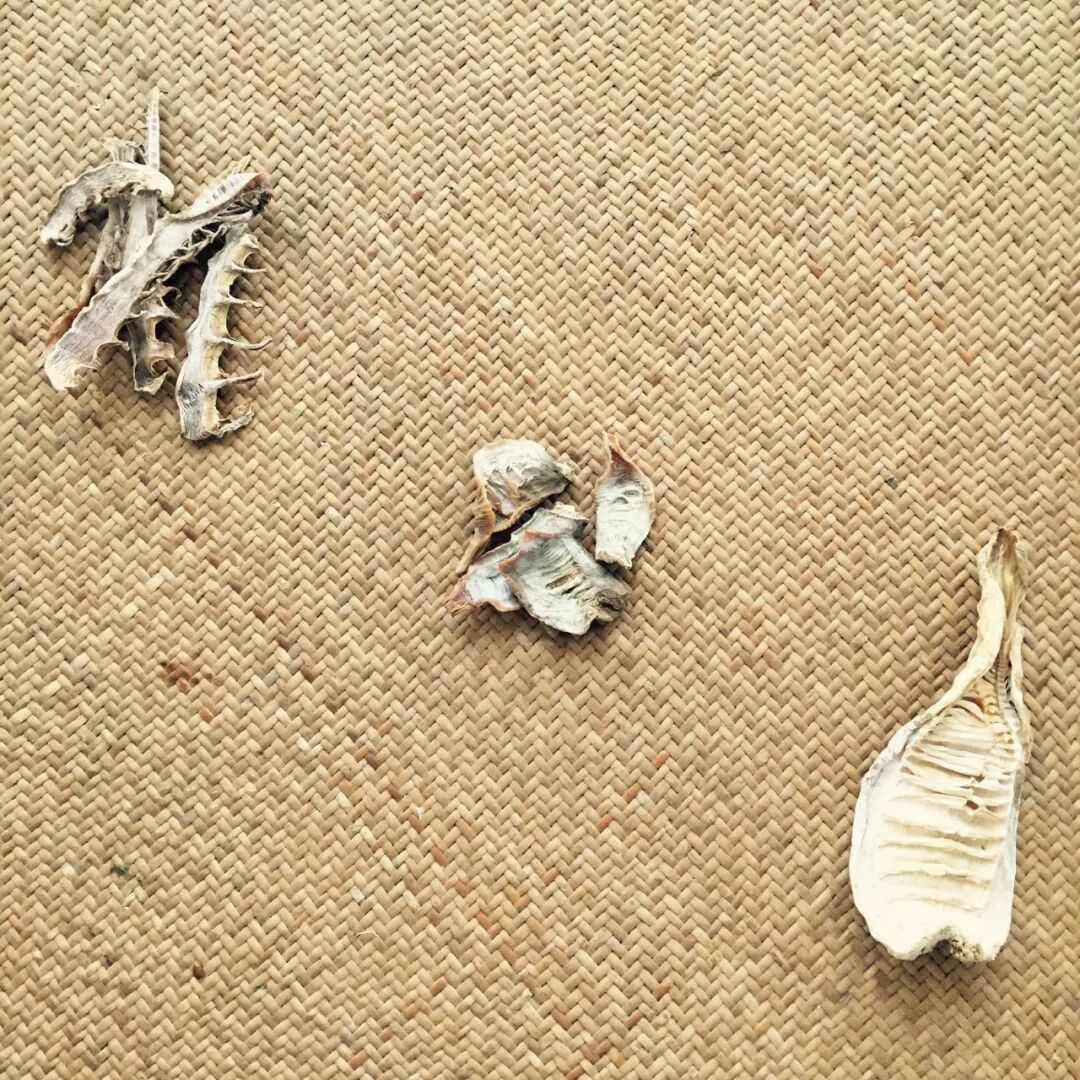
◉ The tiny one in the centre is my father’s Peach Blossom dried bamboo shoots.
This kind of dried shoot needs thorough rehydration. I follow the method my father taught me: soak in rice-rinsing water for one to two days, changing the water each day. Pour the shoots and their soaking water into a pot and simmer for fifteen minutes; once they turn soft and springy, lift them out — slice and stir-fry, or add to soup, either will do.
Eat Your Bamboo Shoots Before It’s Too Late
I once tasted another delicacy from my hometown — a fire-baked bamboo shoot cake. The shoots are boiled until tender, chopped fine, then mixed with chilli and salt, pressed firm and flattened into a round, dried slowly over the stove, and steamed through when it is time to eat. Ugly to look at, but wonderfully good with rice. An elderly relative, a generation above my parents, used to make them. I have had them only once or twice and have never seen them at the local market. I fear they are gone for good.
The loss of a traditional flavour always stirs a pang in those of us who cling to the past, and yet it seems inevitable — as one food documentary put it: survival is a stroke of fortune; disappearance is destiny.
Anji bamboo shoot and peanut snacks are much the same. The first time I tasted a jar Xiaoyezi had sent me, I was struck by a flavour I could not quite put into words. The bamboo shoot had become, entirely, a different food.
Tender young shoots are boiled soft in salted water, then cut into segments and simmered with peanuts, dried tangerine peel, spices, rock sugar and salt until the liquor reduces and the flavours sink right in, then dried in a draught. The more you chew, the more the shoots and peanuts yield their fragrance; the dried tangerine peel whets the appetite, sweetness edged with a whisper of salt — the kind of snack children grab in fistfuls and stuff into their pockets.
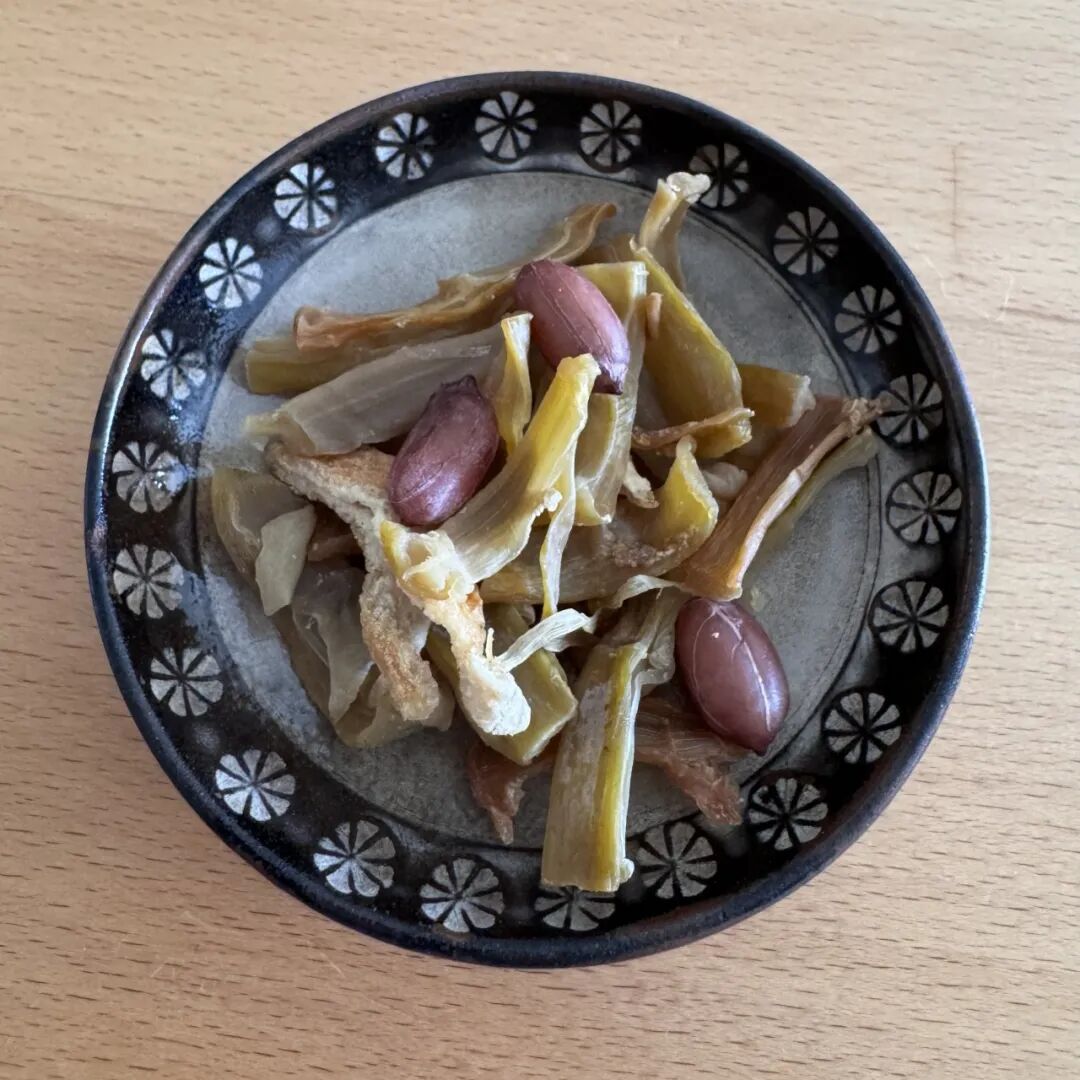
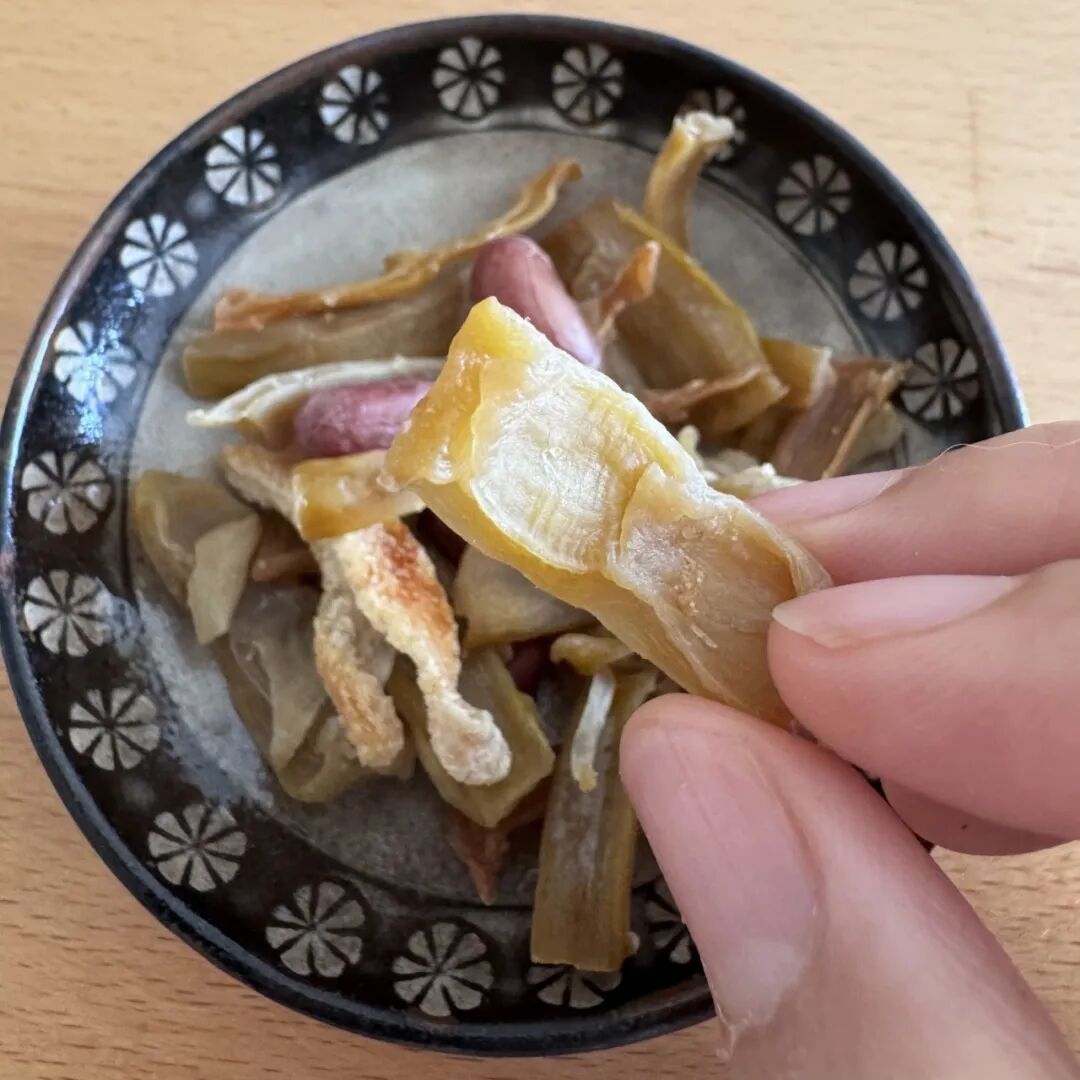
◉ Anji bamboo shoot and peanut snacks.
Easy to describe, a proper fuss to make. Xiaoyezi says only one elderly lady in the village gets them right. She used to make two varieties, but now, approaching eighty, her hand no longer gauges the texture quite as well, so she makes only the sweet kind.
I suspect most people have long since lost their appetite for humble rural snacks. But for some, the stubborn, tender pursuit of a taste of home carries on regardless — Xiaoyezi, for instance, and my father.
After Xiaoyezi received the dried bamboo shoots my father had made, she posted these words to her WeChat Moments:
“The younger generation must never look down on local specialities, dismissing anything sun-dried or pickled in the countryside as a no-name, no-standard product, as though rural produce could never grace a proper table. It is precisely these local foods that allow our customs and culture to pass from one generation to the next, that let the flavours of countryside and field find their way to the dinner table in their truest form.
While we chase the globalisation of food culture and every new school of nutrition, we might also turn and look at how these traditional Chinese foods are made — at the flavours of natural, honest food hidden in mountains and plains, in market towns and villages, carried down through folk hands for a hundred years.”
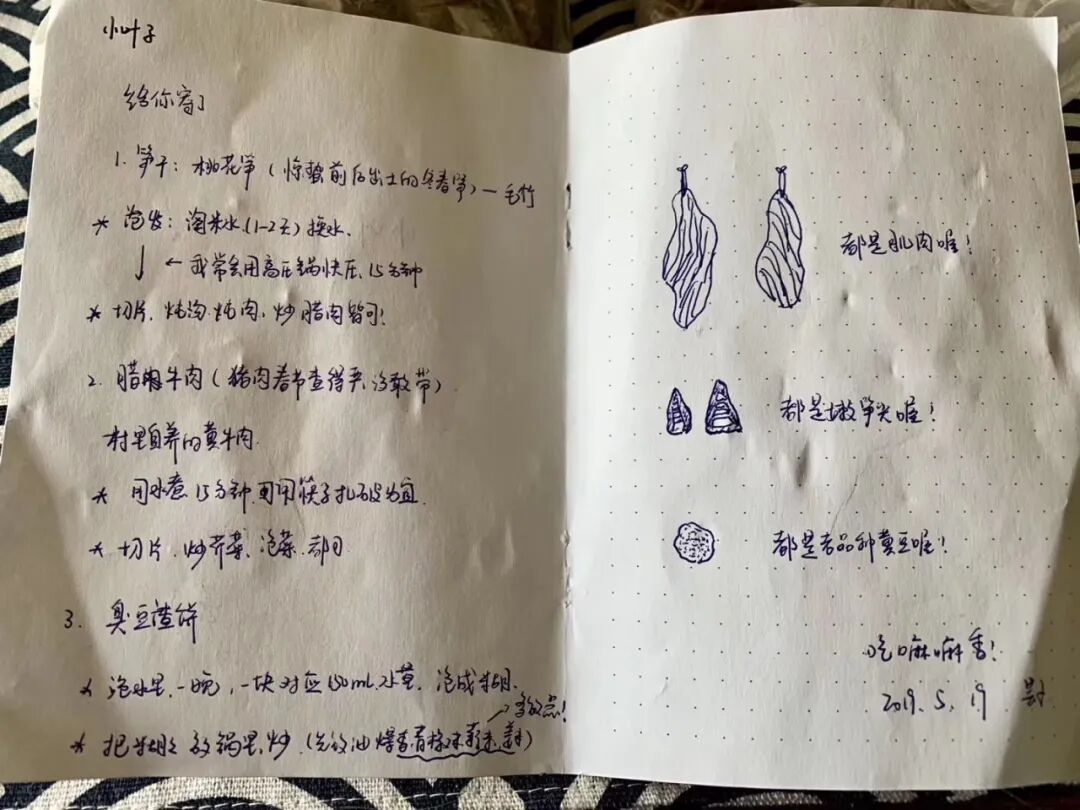
◉ I tucked a short guide on how to prepare them into the parcel of local specialities I sent Xiaoyezi.
Since October of last year, my father has been in Beijing receiving treatment for a health condition. Nearly every day he longs to go home, saying the food here is not good. In February this year, a cousin from back home sent up a box of cured meats and winter bamboo shoots.
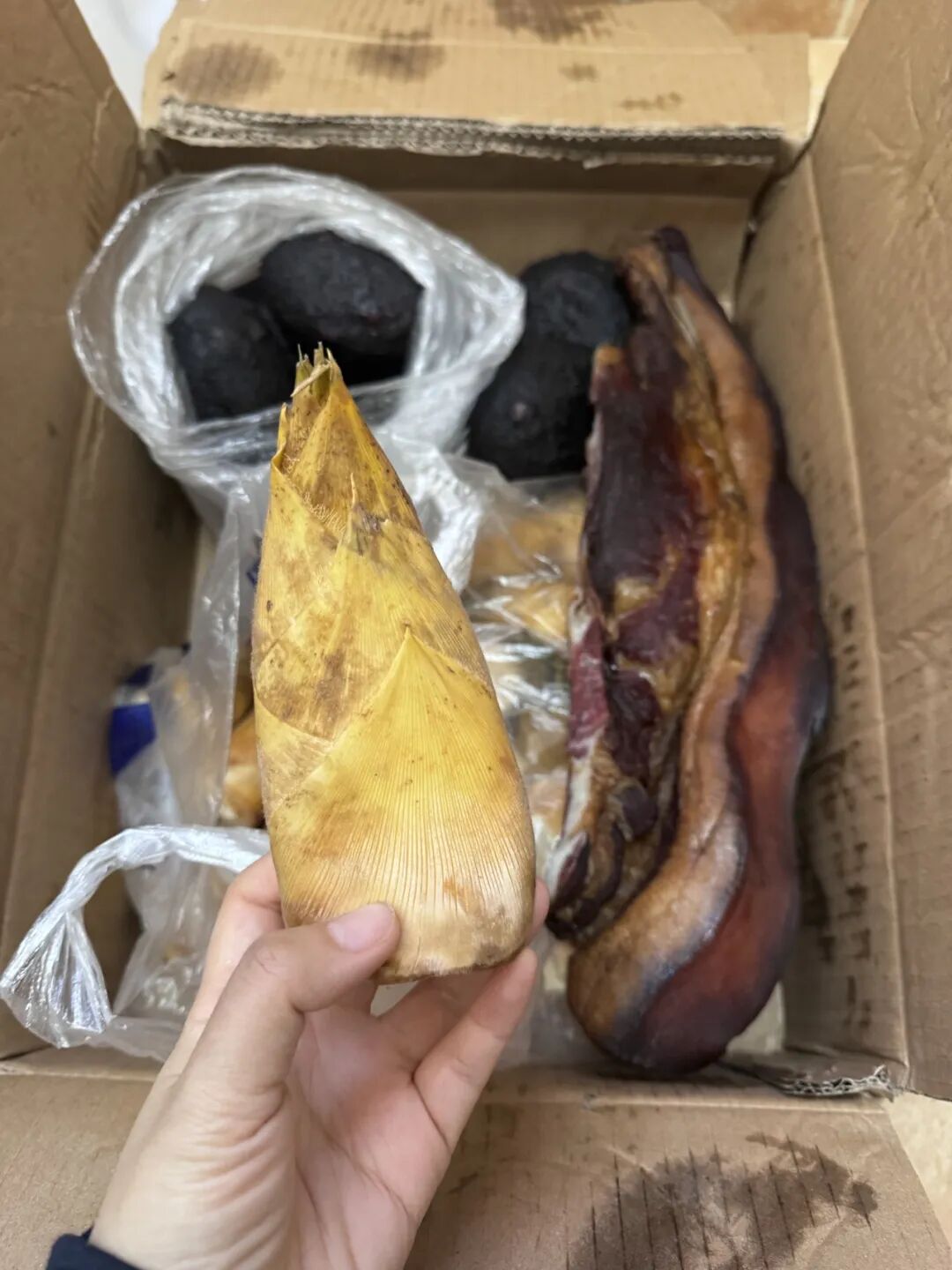
The moment my father saw the shoots, it was as if he were greeting old friends. Smiling, he placed them one by one into a bag, weighing each in his palm as he went. One day I noticed a row of brown shapes lined up on the radiator, and on closer inspection — dried bamboo shoots!
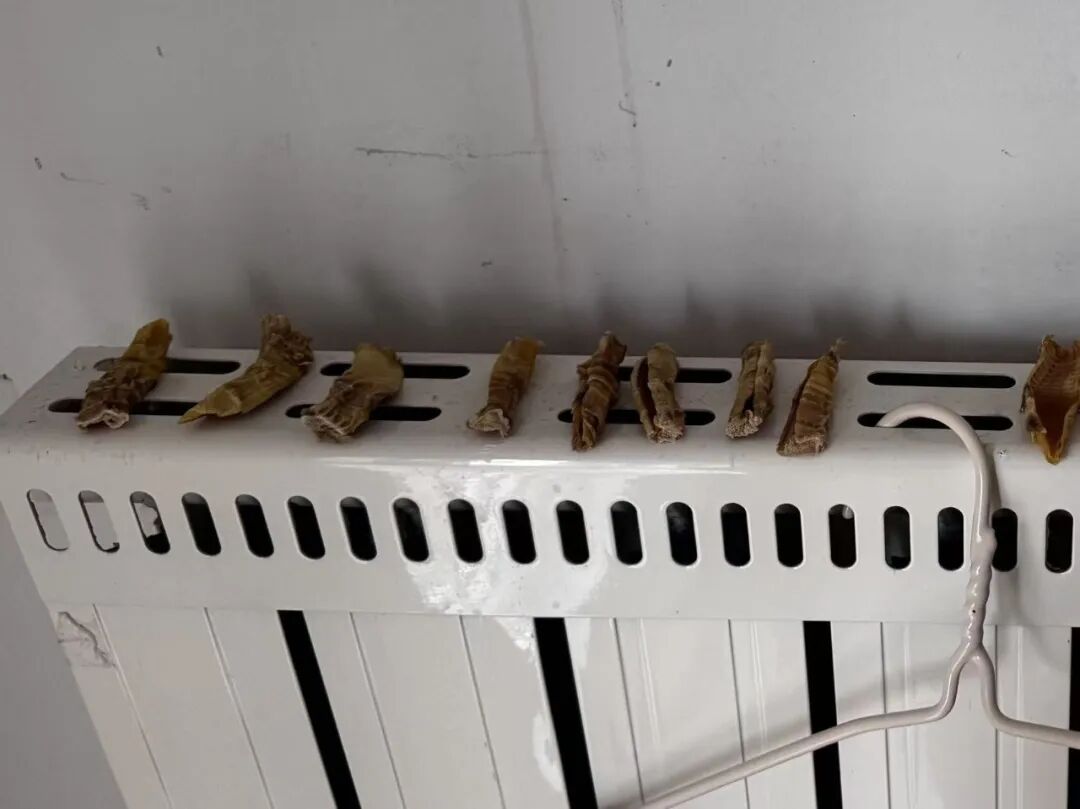
I was still standing there blinking when my father came over, gave one a squeeze, judged it thoroughly dry, and gathered them all into a bag. A whole large sack of fresh winter bamboo shoots had yielded just this small bag of dried. He gave it a little weight and said, “Just over a hundred grams, made from a kilo of fresh shoots — enough for two meals.”
I knew — Father was longing for home again. What he missed was not the apartment block in the county town but the old timber house nestled among bamboo groves, where Grandpa and Grandma had lived and where he had been a child.
From a shoot pushing through the earth to a bamboo pole twenty metres tall takes only sixty days. From one bamboo to a mountainside of emerald forest takes only six years. My father, now sixty-four, looks back and says the happiest moment of his life was at nine years old, herding cattle, when he walked to the high part of the hill and gazed out over the distant groves: “So wide open — the wind would come, the bamboo would sway, and even the shape of the mountains seemed to change.”
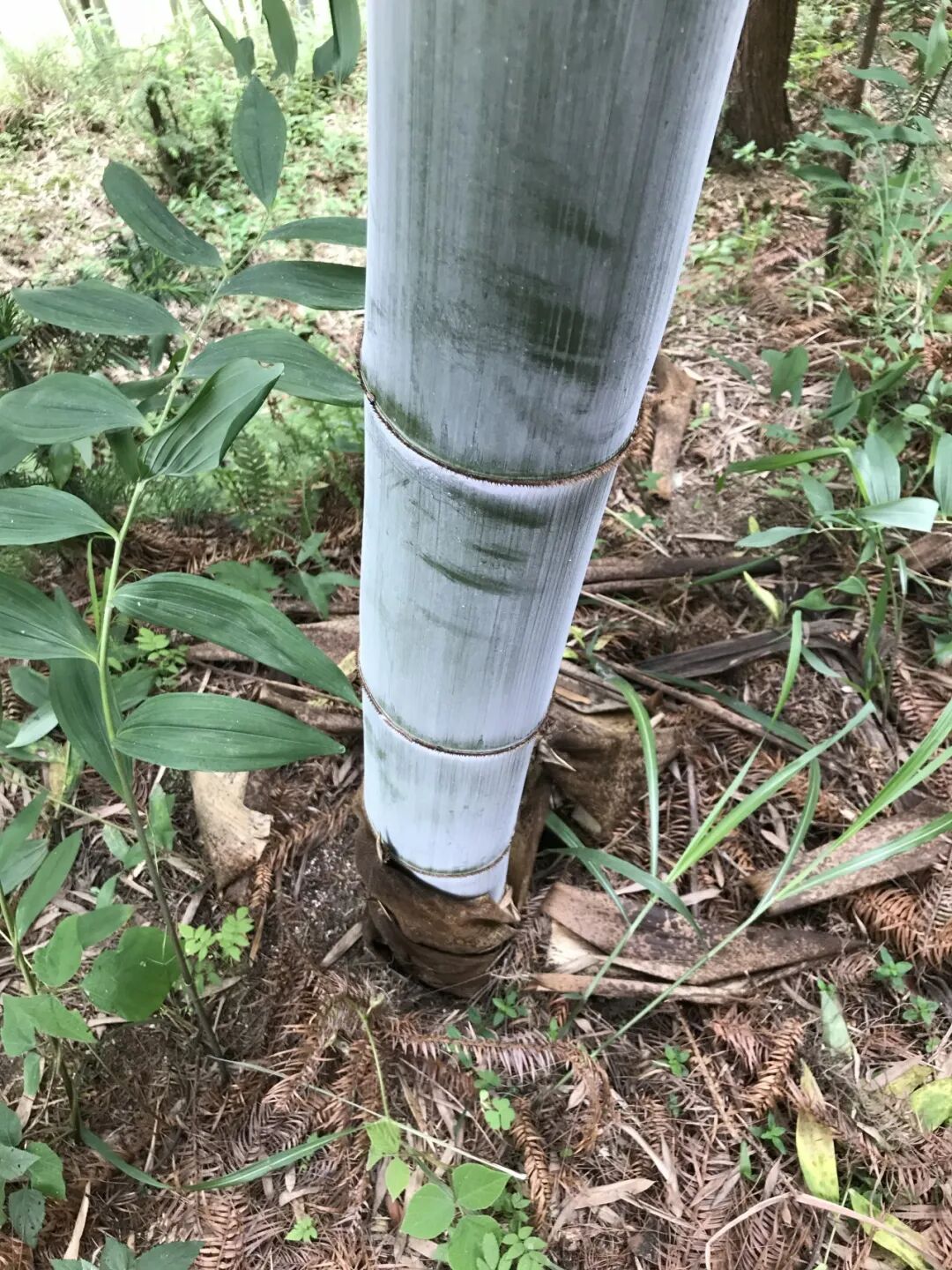
◉ A young bamboo still wearing its shoot sheaths is already as thick as a bowl’s rim.
Every year brings new shoots. In this world there are those who take their pleasure fresh and crisp, seizing each moment to the fullest, and those who turn the spring’s young shoots into dried ones to savour slowly over time. But whichever you are, eat your bamboo shoots before you grow old.
– This is Foodthink’s 811th original piece –

Foodthink
Author:
Tanzi Chile Wo
A working wanderer of this world, head turned toward the stars, who believes all things carry their own quiet strength. On most days I also write for the public account “Tanzi Chile Wo”.
Unless otherwise noted, all photographs are by the author.
Editor: Yuyang
Layout: Xiaoshu
Scan to tip — support original food writing
▼
Click the image to read related articles