Eren Valley’s Fifth Anniversary: Believing in Goodness, Realising Goodness | Grandma Kouzi

16 June 2026 marked the fifth anniversary of Evil Valley’s founding. The skies had just cleared after the rain, so I rushed up to the roof to take photos. The forecast called for continuous rain—ten days before and ten days after. The old way of putting it is that this is the “Dragon Boat rains”; the rainy season typically doesn’t end until after the Dragon Boat Festival.
The heat, combined with the abundant rain, has set the plants in Evil Valley growing wildly. Every morning when I make my rounds through the garden, there’s something new to discover—overnight, the changes are visible to the naked eye. The dragon fruit I’ve been tending for two years loves the heat; when people get hot, they wilt, but when dragon fruit gets hot, it blooms. One day it’s still a bud; the next day I go back and the enormous flower has already bowed its heavy head. But the wild growth isn’t all good news. Leave the weeding for just a few days and the grass declares its independence, founds its own nation, and leaves no path for anyone to walk through.
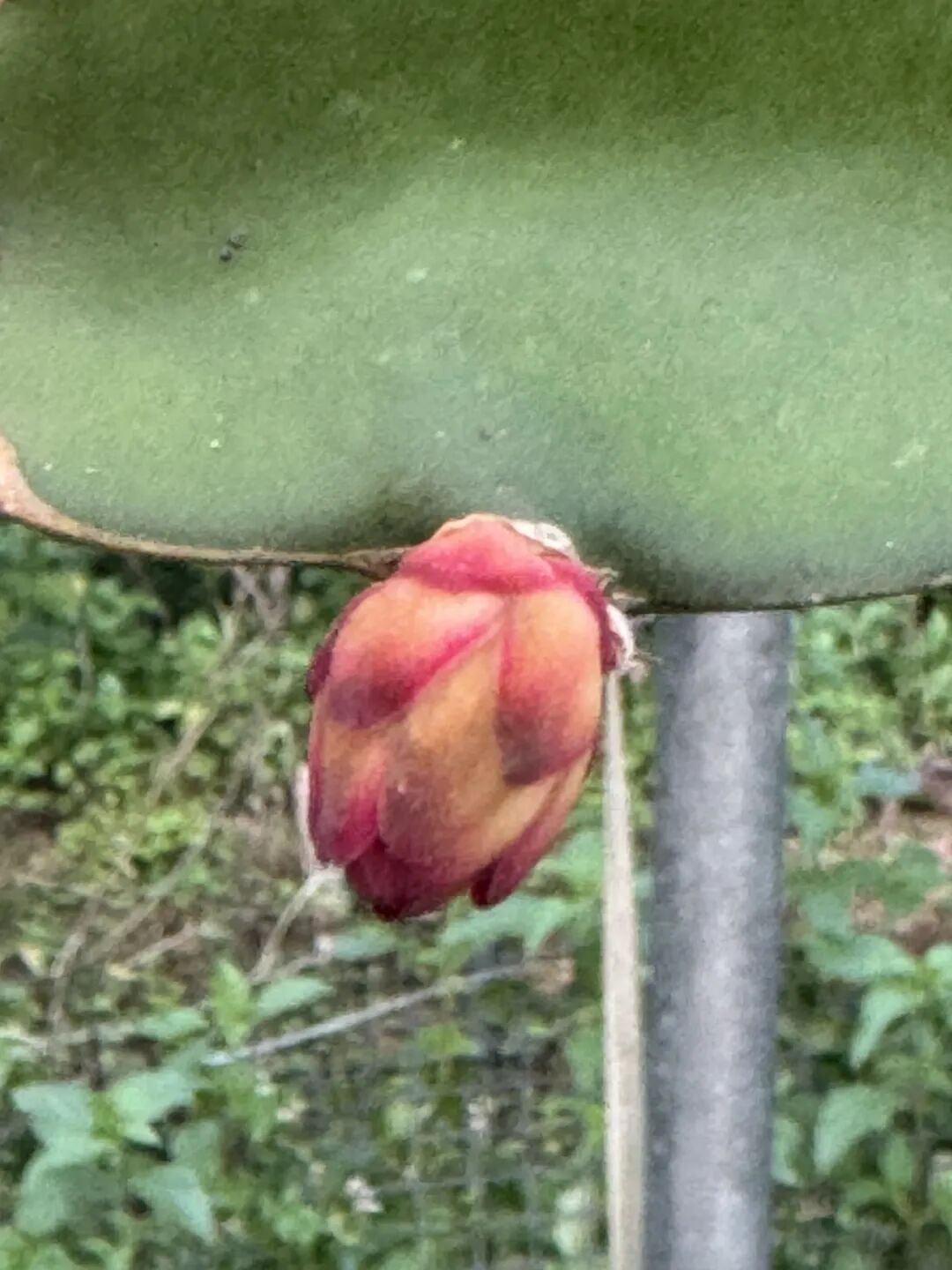
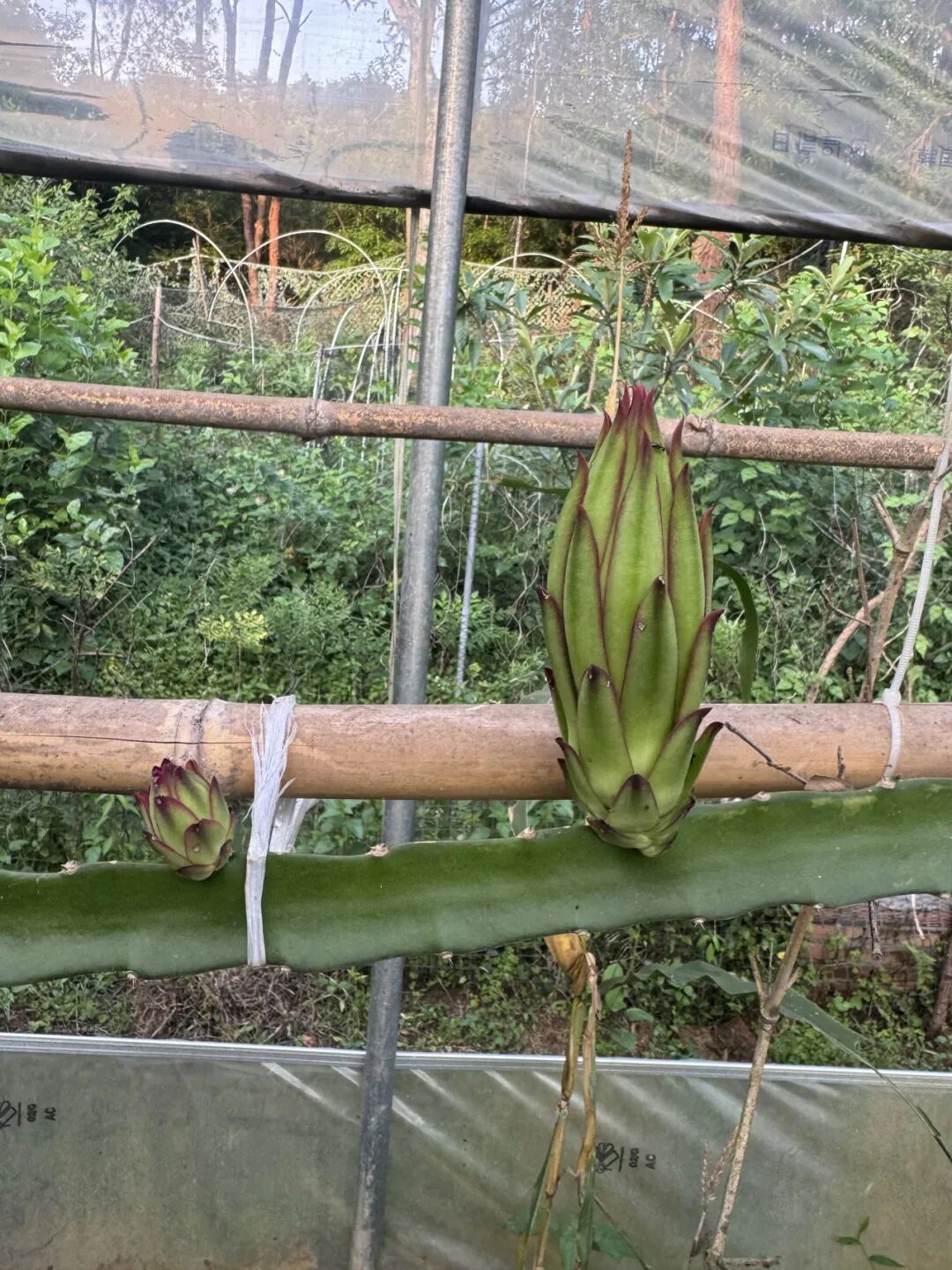
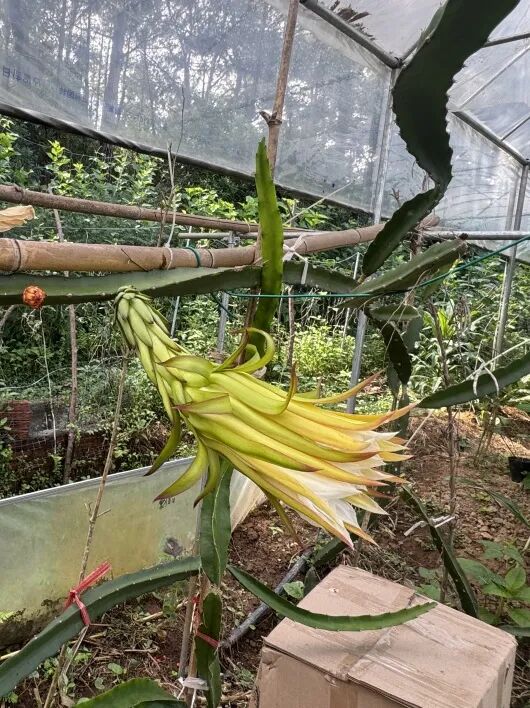
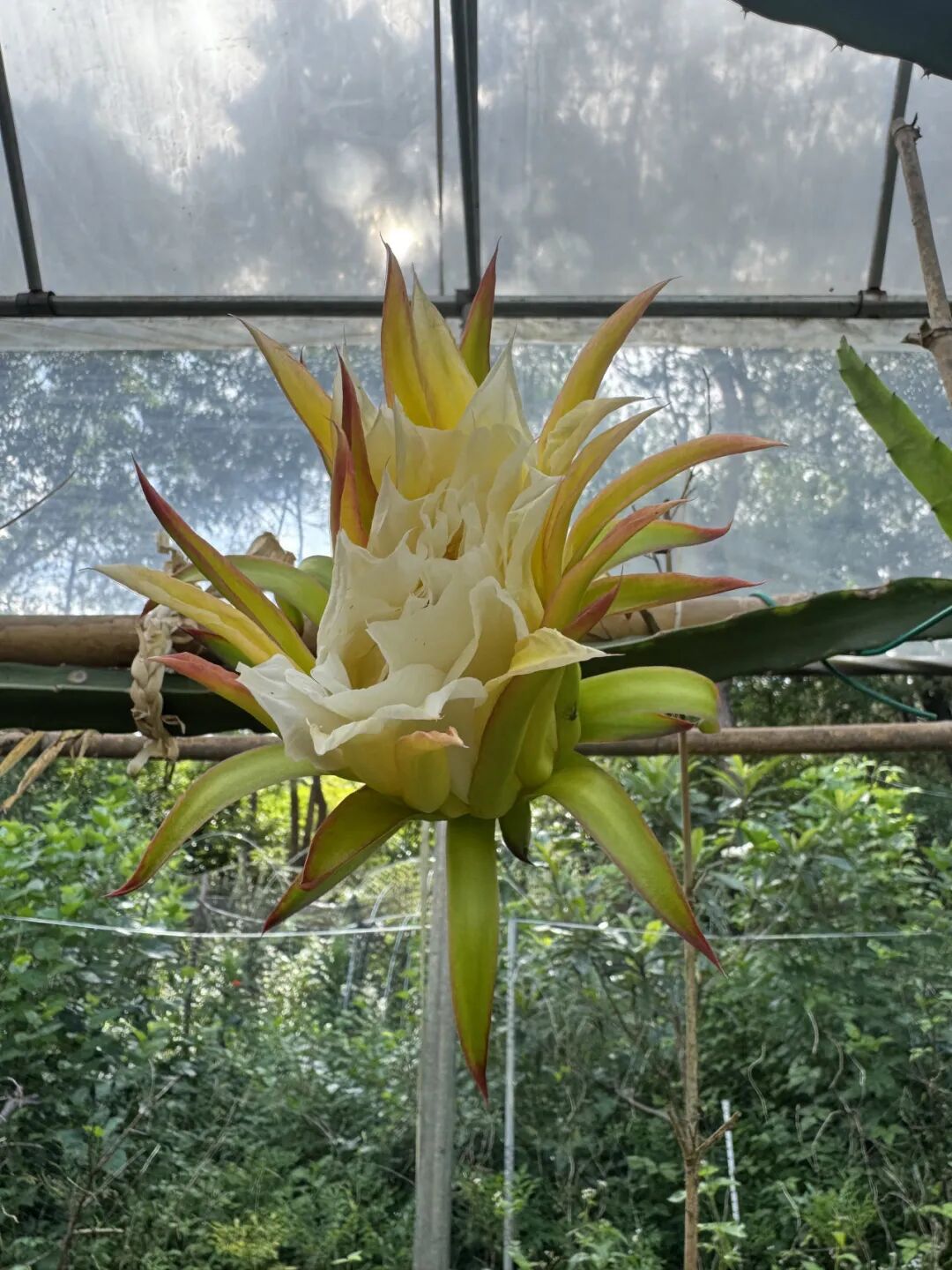
◉ In just a few days, the dragon fruit flower went from first bud to full bloom. May heaven bless it with sweet fruit.
Nowadays in Evil Valley, there’s nothing I need to buy except salt. Though even salt is optional—the surrounding hills have staghorn sumac, and in autumn the fruit is coated in a layer of salt. If you don’t mind the effort, you can pick them, soak them in water, and make salt from the brine. But I do mind the effort.
Over five years, I’ve not only achieved a self-sufficient one-person farm; my health indicators have been improving steadily as well.
From building to refining
Looking back on those first days in Evil Valley, the initial clearing of the land, there was a period of rapid change, day by day. I arrived here with three years of growing experience from both sides of the strait—I was no longer a greenhorn in agriculture, and I already had a plan for a one-person farm, enough to sketch out a self-sufficient home on this barren stretch of land.
But after a year of digging ditches, forming ridges, planting trees and flowers, the first thing I did when spring came the following year was to hire an excavator. My growing experience from Taiwan and the year I’d spent farming in Da Wu still needed to be worked out against the realities of Evil Valley. Framework decisions like road planning and irrigation channels are based on the terrain and don’t really need changing. But after experiencing the first rainy season, I realised that my understanding of “drainage”—as a northerner—was far too shallow. The drainage system had to be replanned and re-dug. Keeping chickens on the hillside by the road was fine in principle, and the surrounding fencing was adequate enough. But chickens have wings; they can fly. A chicken stands on the slope, flaps its wings, clears the lower wire, and is off—jailbroken with ease. While raising the fence, I had no choice but to call in the excavator again to grade the steep slope into a gentler one. Later, to implement what I call “chicken-based design” for free-ranging in a small area, I brought in the full crew—excavator, loader, and lorry—and had over a dozen loads of rich fish-pond silt hauled in. This simultaneously softened the steep slope and improved the soil, allowing me to zone the planting around the chickens’ needs.
Over five years, I’ve had many similar stories. This year’s adjustments have centred on the water lily pond. My original plan was to surround it with roses in full bloom. Over five years, I’ve spent well over a thousand yuan on roses of various types—both established plants and seedlings—and the ones that survived can be counted on one hand.
Roses are plagued by too many pests and diseases, and I insist on not using chemicals. On top of that, the moisture around the pond is too heavy for them. This year I’ve finally accepted reality and decided to stop replanting. Instead, I’ve simply planted a ring of daylilies around the pond. The original plants were dug up by hand from a friend’s garden and brought back on a bicycle—you can imagine how few there were. Over a few years, those first plants have multiplied dozens of times and now make quite a sight in Evil Valley. Daylilies are tough, easy to keep alive, and love water. Planted around the pond, they’ll soon form a huge golden wreath of blooms.
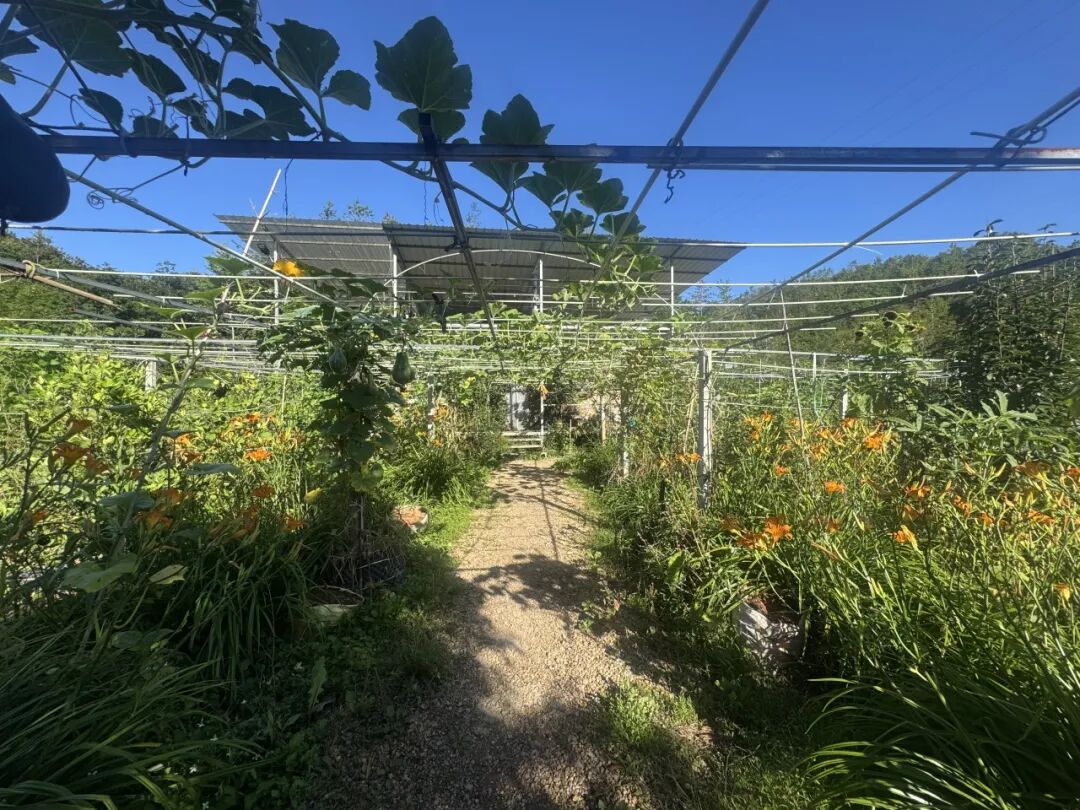
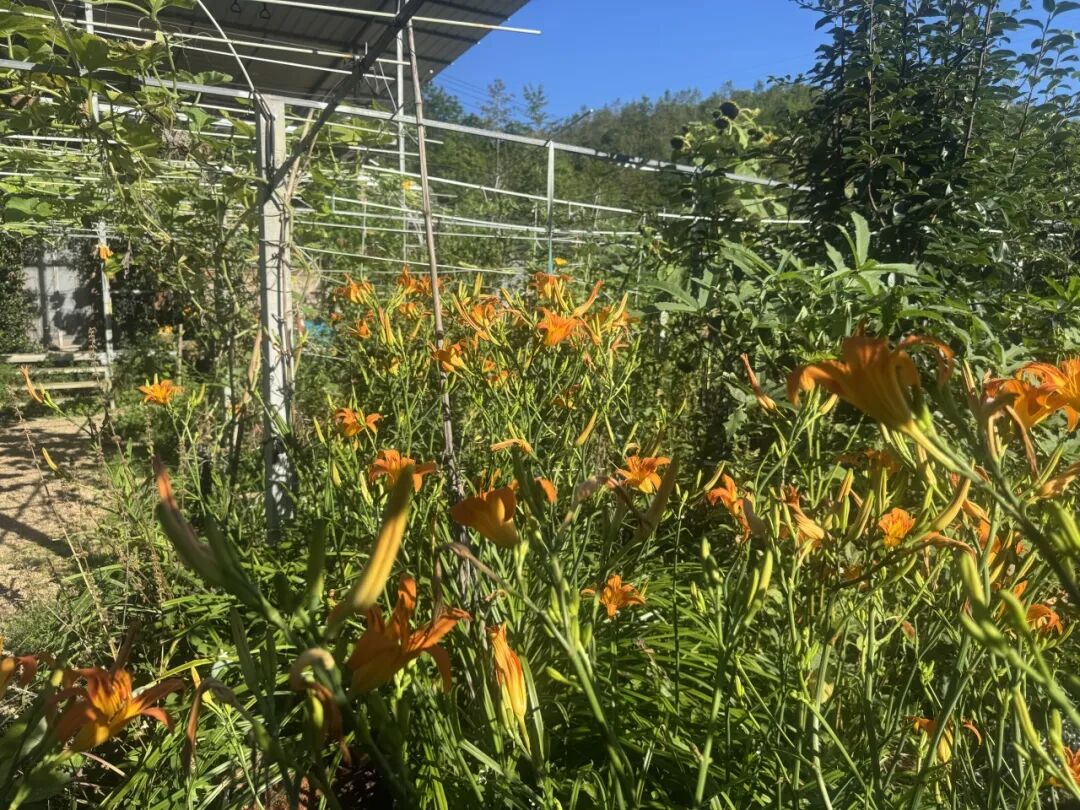
◉ The daylilies now by the roadside at my gate were just a small clump when I first planted them.
This year, the lotus pond in the ditch finally begins to look the part. Beneath the lotus leaves lie three years of sunk cost. I started planting lotuses in this water three years ago — seedlings of every kind from all over the place, all manner of lotus seeds, all of them sunk here. I tried and failed, tried and failed again. It wasn’t until last year that the surviving red lotuses began to form anything resembling a proper patch. This year, the white lotuses have finally taken hold too.
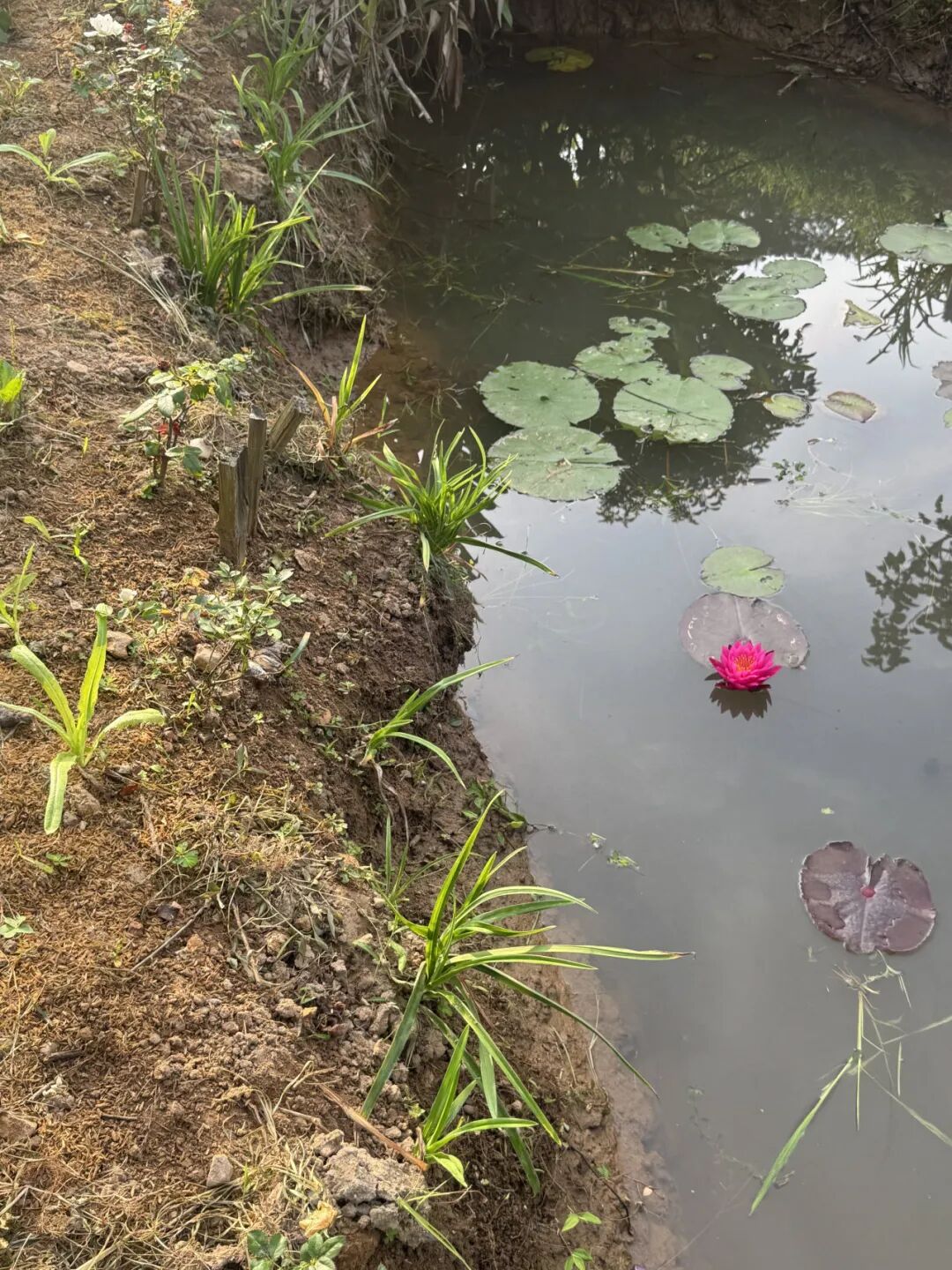
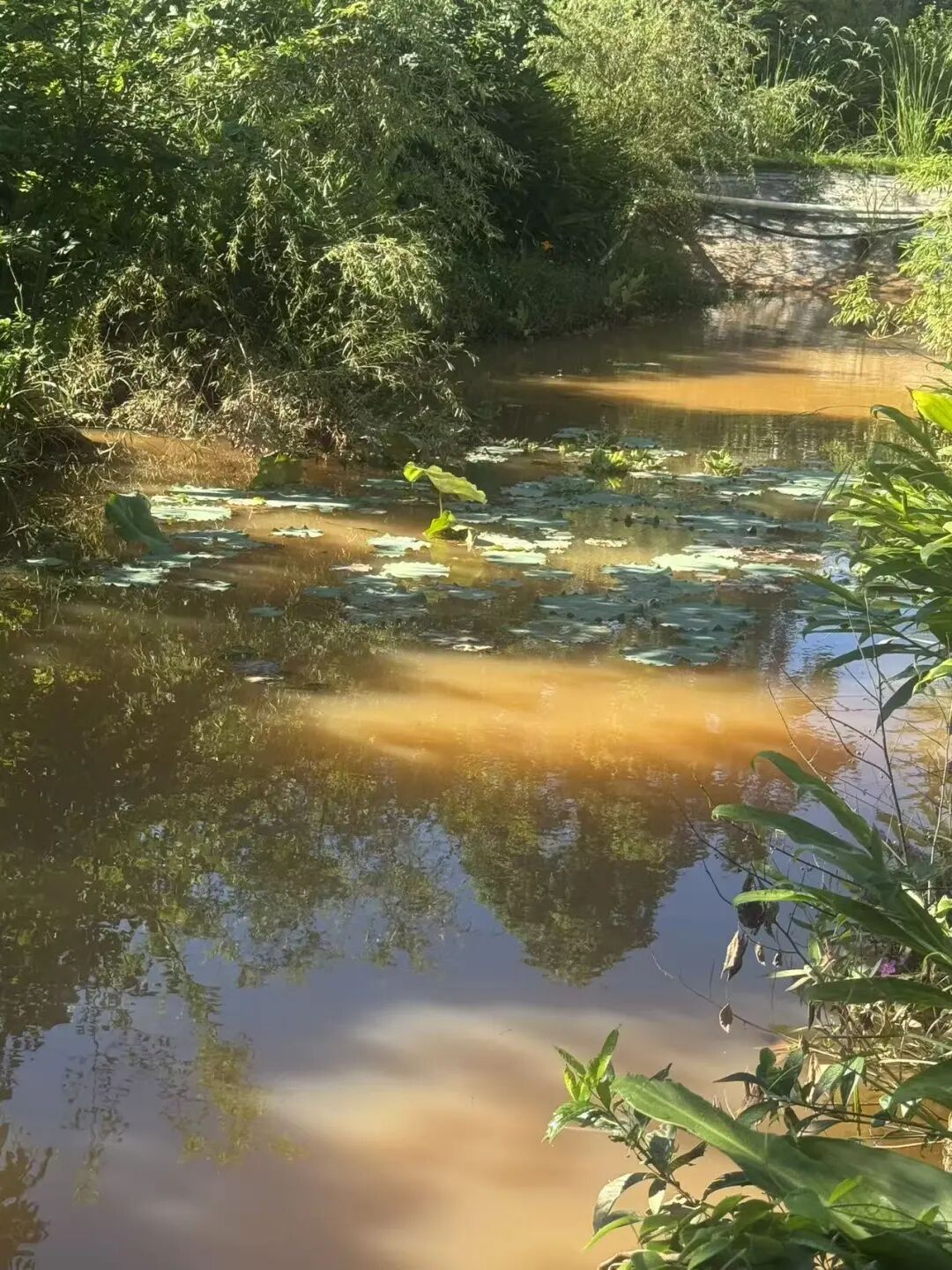
◉Water lilies in full bloom and daylilies along the bank. The ditch has finally started to look a bit like a lotus pond. This is a wild stream – apple snails are rampant, the current runs fierce when it rains hard, and it was also the neighbours’ ducks’ playground. All deadly enemies of the pointed lotus buds. This year we finally managed to keep these lotus leaves alive, which I’d say is quite an achievement.
But there are difficulties that cannot be overcome. Citrus is a fruit well suited to this land – pomelos, honey mandarins, jello oranges, navel oranges – I’ve planted over twenty trees, and in spring the blossoms fill the whole garden with fragrance. Citrus flowers are white and intensely sweet-smelling, the scent so powerful it stirs the heart. But then the pests arrive, and they strip every leaf bare. I don’t use pesticides; I can only endure, waiting until the pests have had their fill, mated, and laid their eggs, the larvae burrowing into the soil to pupate. Then the stripped branches push out new growth.
Last year the hibiscus put on a spectacular display, and I had assumed this year would be just as glorious – but I was clearly thinking too highly of things. This year the insects arrived before the buds: a kind of enormous red beetle I’d never seen in all the previous years, thick across every leaf surface. There was nothing for it but to endure. To be a plant in Woren Valley, you can’t count on pesticides to help; you can only follow me in practising the art of endurance. Those that make it through stay on this land; those that don’t are culled.
A sweeping, all-encompassing period of breaking in – it took three whole years before the work shifted to fine-tuning. In truth, by the third anniversary Woren Valley had already achieved a basic level of self-sufficiency, with the core infrastructure of both the living and production areas in place. The task from there on was to move from ‘building’ to ‘refining.’ Between years three and four, the focus word was ‘polytunnels.’ From year four to the present, it has been ‘harnessing the sun’ – perfecting the arbour system.
All growth depends on the sun. Last year I built an arbour over the only way in and out. It has proved a good move: plants compete fiercely for sunlight, while people want to dodge the sun and avoid the heat – a perfect win-win. Last year the pumpkins on the arbour grew well. This year I started earlier, carefully improving the hastily put-together structure, no longer the ramshackle make-do of before – now level and straight, neat and proper. The pumpkins grow free and at ease, it is a delight to look at, and once again, a win-win. The pumpkins are now in their vigorous growing season. In a month’s time the vines will have climbed the entire arbour, and the pumpkins will be laden with fruit.
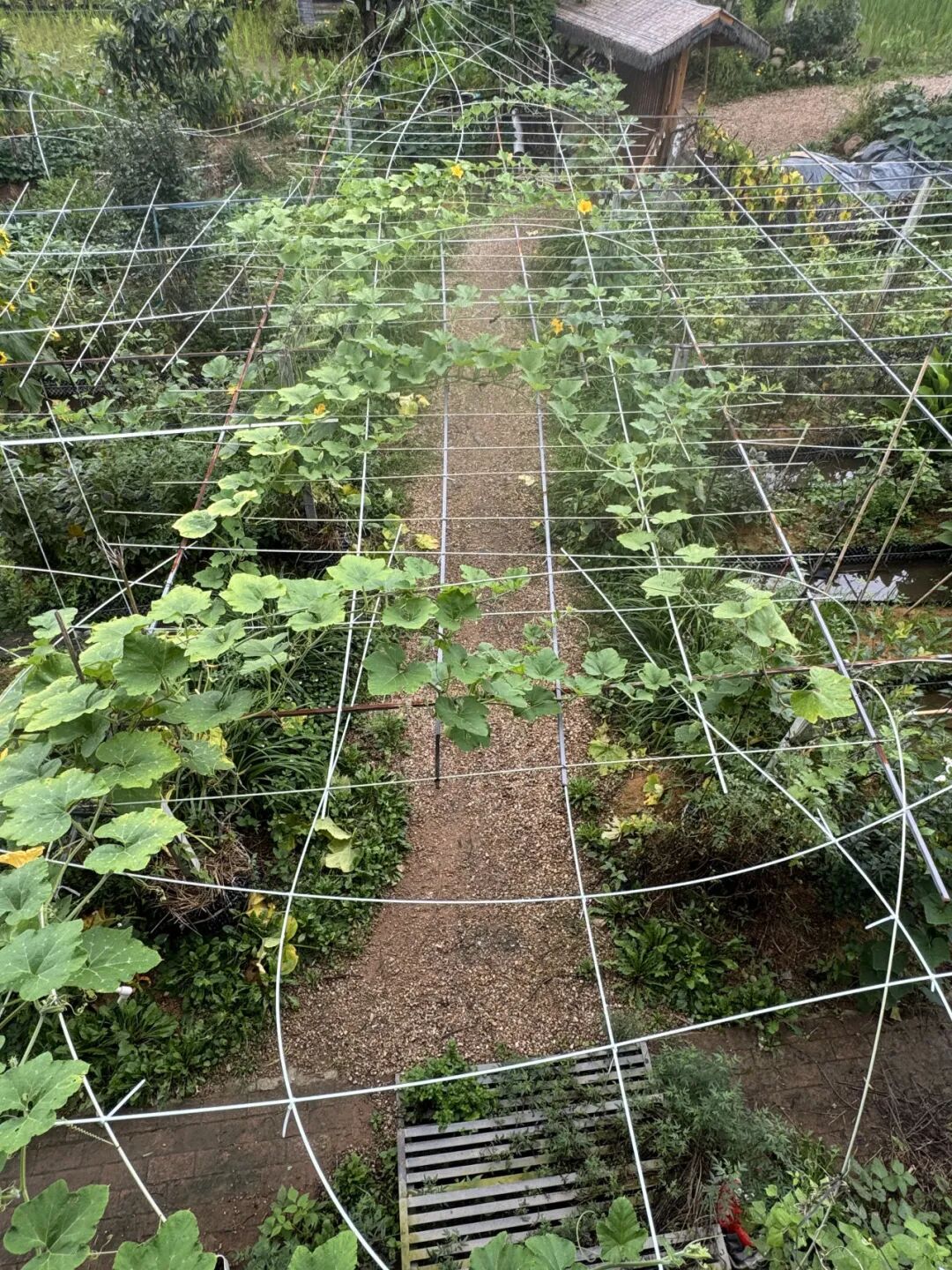
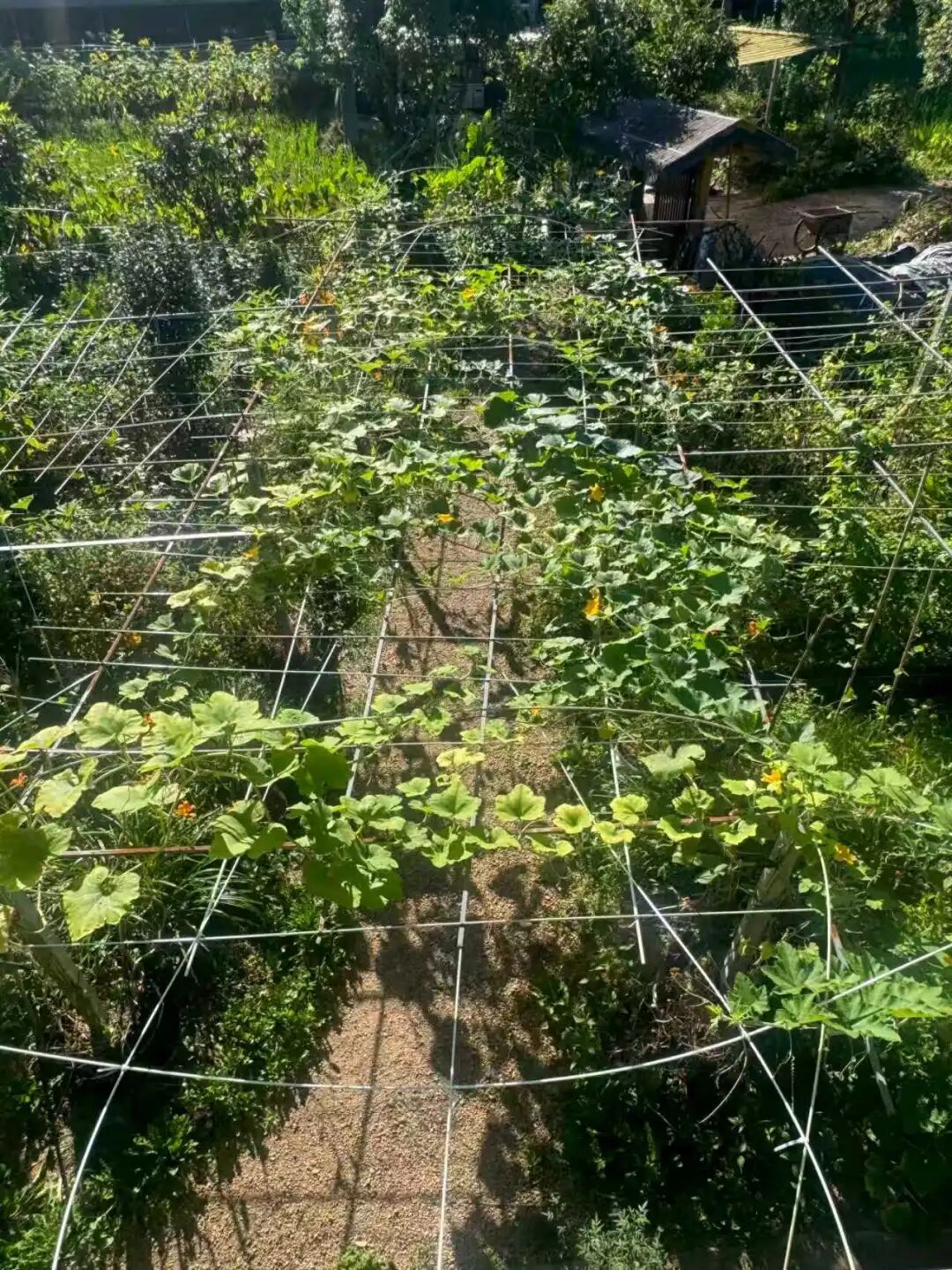
◉ The image on the left shows the trellis grid at the gate, photographed on 16 June when the sun finally broke through after a long spell of rain. Ten days later, it had become the scene on the right.
Woren Valley is past its big construction days now. Apart from sowing and harvesting the main crops, life has settled into a daily cycle of routine management — weeding, for instance. This is something I do every single day, all year round, and it never seems to get done. But whatever else one might say, each weed pulled is a small improvement in itself. Though the change may be invisible to the naked eye, if I didn’t pull them, wild grass would surely take over and perhaps grow so thick there’d be no footing left to walk on. Work of this kind is a kind of practice in a deeper sense — a practice driven by ‘believing,’ believing that I am making myself just a little bit better.
Five years of this, bit by bit, and Woren Valley has grown softer, fitting me more and more like an old cloth shirt.
No longer being a modern person living within the industrial food system
Pumpkins entered the ‘never-finish-eating era’ last year. This year’s new crop has already made its appearance, and there are still dozens of old pumpkins from last year, large and small. I love the feeling of being a household with pumpkins — so plentiful, so indulgent. The onlookers each cut open a new one for a taste test, and if they don’t take to it, off it goes to feed the chickens. This year’s daylilies are the same — an endless supply of buds promising a season that will be overwhelmed by flowers.
When I first set out to find a place to practise a self-sufficient one-person farm, it was of course largely driven by ideals and a philosophy of natural living — there was a goal ahead that drew me forward. But on the other side, there were things behind me I wanted to escape. As a modern person in real life, in my forties or fifties, this body has accumulated its fair share of problems, and the one-way street of life has entered its downward slope.
From around the age of forty, symptoms began to appear — qi and blood deficiency, poor digestion, restless sleep… No major problems, but a constant stream of minor ones. I went to the hospital, took medication, but nothing improved and nothing worsened either. The doctor said these were ‘perimenopausal symptoms’ — looking at people my age around me, it seemed about the same. The doctor also said that modern people’s ‘urban diseases’ were universal, which did sound plausible.
I was deeply worried about this downward slide spinning out of control and wanted to see if I could, for once, be the master of my own life. So, at the age of forty, I quit my post at a state-run institution, became an elderly drifter in Beijing doing charitable work, believing that life should involve having choices of one’s own — that a person should be their own master and could choose to go upward. But at fifty, my immune system collapsed, and both body and mind sank to rock bottom. At that point I even thought of Stephen Hawking, though I was well aware I did not possess a will as strong as his. If I could not break free from this state of life beyond my own control, I certainly would have chosen to end it myself. When I wanted to choose to go upward but my body refused to cooperate, I decided at least to halt the downward slide.
In fact, I took a third path. I spent two years farming in Taiwan, encountered true love, and — a person with no rural life experience at all — discovered I was somehow a farmer chosen by heaven. Since I started farming, my back stopped aching, my stomach stopped hurting, and falling asleep was no longer a struggle. The philosophical questions of whether to live or die no longer troubled me; my mind was full instead of practical questions about how to live better.
At the time I also wondered whether a farming oaf like me could survive in the countryside simply because the conditions in Shenggu Village, Yilan — known as Taiwan’s first organic farming village — were so good, with a complete support system built up by more than two hundred fellow farmers in the vicinity. I wanted to test myself: see if, coming back, I could find a place and start from scratch, whether I could survive on my own two hands, scraping a living from the soil without any surrounding support.
I want to see whether, in one’s approach to sixty, life can still go upward. If even someone like me can, starting from raw, unbroken ground, handcraft a self-sufficient home, then surely many more people can do the same.
Five years ago today, I arrived at Valley of the Wicked. Five years in Valley of the Wicked have brought me not only a self-sufficient one-person farm but also steadily improving health markers — it seems lifestyle can change how modern bodies fare.
Two years ago, my health check-up report had three arrows flagging values outside the normal range: total cholesterol slightly high, HDL high, LDL low. The doctor said that as long as HDL is high and LDL is low, there’s nothing to worry about — cholesterol is an important “building material” for the body, and a slight elevation is no problem.
A recent retest showed my total cholesterol had actually come down. The change is probably from eating more eggs. I’d always been told not to have more than two a day, the restriction being the cholesterol in the yolks. Lately, a fair amount of evidence suggests there’s no harm in eating more — most cholesterol is produced by the body itself, and eating more eggs may actually help lower cholesterol levels. There are even cases of people eating more than twenty a day over long periods. I’m nothing like that. I eat five or six of my own hens’ and ducks’ eggs a day; if I drop below four, I top up with protein powder. The most direct reason I eat so many eggs is simply that there are too many to waste — if I’m not going to eat them, what’s the point? By a happy accident, this seems to have borne out the latter theory.
The me of today farms and raises chickens with ease and joy. I eat well, I feel strong — all four of my “test papers” come back with an A+. My health indicators are better than they were twenty years ago. Growing old doesn’t have to mean falling ill. Modern people don’t need to carry a whole catalogue of modern ailments. Even in a lifestyle that surrounds us on all sides with hidden threats, we still have choices, and we can use those choices to shape our lives.
In an age when both the food system and our way of life have been fully industrialised and commodified, those of us living inside it need at least to see the problems before we can make any real choices. Here at Evil Person Valley, I can shut the door and face the sky, placing myself outside the modern industrial food production and distribution system — that elephant in the room. When I finally achieved self-sufficiency here, I didn’t feel the relief of watching a fire from the safety of the opposite bank. I’ve always felt I must do something.
This past year, apart from the ongoing refinement of the finer details at Evil Person Valley, I also fulfilled a small wish — I did something I’m not naturally good at: writing a series of pieces reflecting on the modern food system. They point out the harms and offer examples and methods for avoiding them, moving from refined vegetable oils and refined carbohydrates through sugar, drinks, snacks, and fruit, and finally wrapping up with “food additives.” That brings the series to a close. Modern people, seeking what’s beneficial and avoiding what’s harmful in the real world, can make changes that begin in everyday life — in each vegetable, each grain of rice. I’ve done what I can. What readers take away, how they choose to change, and what effect it has on their own lives is up to each person’s own circumstances.
I’ll retreat back to Evil Person Valley, live my small life in my comfort zone. I’ve become much gentler with myself lately, and in many ways I’ve learned to let myself off the hook.
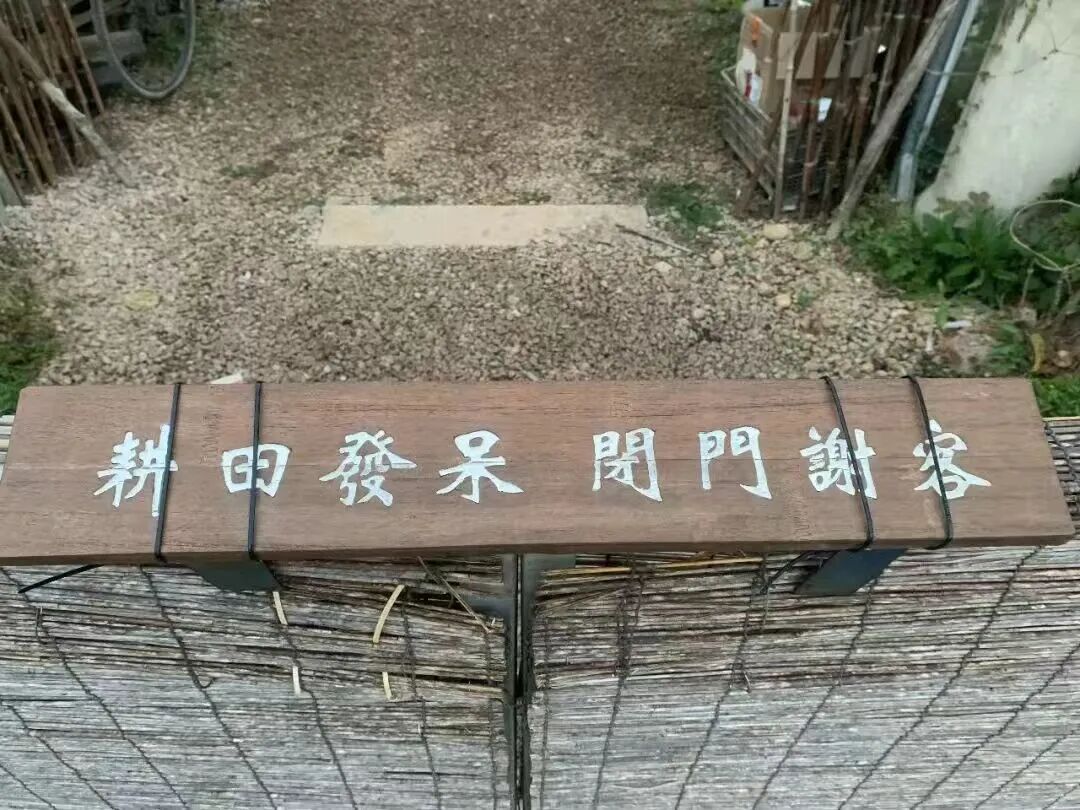
◉“Tilling fields, spacing out; the door is shut to all” — this sign hangs at the entrance of Evil Valley.
Facing the Bully with Equanimity
Another rather significant event over the past year: Baidu AI’s mud-slinging and outright fabrication.
Baidu AI handed me a ‘sentence’: ‘extortion… ten years and three months in prison.’ I’ll admit I was a bit rattled at the time. The rumour listed my birthplace, my charitable work, my published writings — all paraded alongside the false conviction for public display.
If a dog bites me, I can’t bite back like a dog, but I can’t simply let those without limits run amok. So I hired a solicitor to take Baidu to court.
Taking on a company as unprincipled as Baidu in court is exhausting. Going up against a mud-slinging rogue who waves a stick in the stew — anyone faced with that would feel the same revulsion. It will soon be a year, and Baidu has not acknowledged any wrongdoing, offered an apology, or paid compensation. On the contrary, they’ve conjured up fresh rumours and kept the smear going.
Thankfully, I’m holding up well — calm and steady.
I must admit there was a period that was pretty rough — I couldn’t eat or sleep. I knew I couldn’t let a bully’s tricks ruin my life, but I still found myself pulled into the vortex. The good news is I’ve weathered it, returned to normal, and filed a new lawsuit over Baidu’s latest rumours.
This year I’ve been fighting the lawsuit while carrying on with the work as usual — spring harvest and spring planting. I gathered a few kilos of rapeseed and over twenty kilos of wheat, and planted corn, peanuts, soybeans, black beans, and all manner of beans. The peanuts in the garden are growing well right now; another month and they’ll be ready to harvest. Last year, the day I was harvesting peanuts was the same day I saw Baidu’s rumour. This past year, besides the lawsuit, I’ve also tried picking up a new skill — filing complaints and reports with the relevant authorities, for instance. Thanks to Baidu, I’m past sixty and still unlocking new abilities.
Looking back on this year of strange and bizarre experiences, I’m reasonably satisfied with how I’ve handled things. Even with something so absurd landing in my lap, I still believe in what is good, and I still have the capacity to create it.
– This is Foodthink’s 820th original article –
Foodthink
Author
Kouzi
A tenacious farmer and village brewer. Full-time foodie, part-time farmer, and writer on the side.
Unless otherwise stated, all images are provided by the author.
Editor: Xiaodan
Layout: Minglin
Scan to tip and support original food knowledge
▼

▼
Click the image to read related articles

▼
Click a keyword to explore more articles
Seeds|Ag Tech|Policy|Fermentation|Nutrition|Fruits|Fisheries|Events|Recruitment|Food Delivery|Wet Markets|Livestock|Food Talk|Sharing Sessions|Book Club|Harvest Festival|Smallholder Stories|Climate Change|Rural Development|Co-operative Economy|Urban Farmers|Food Safety|Digital Technology|Biodiversity|Pandemic and Food|False Solutions|Organic Farming Internship
Beijing|Hebei|Shanghai|Guangdong|Guangxi|Henan|Sichuan|Jiangxi|Xinjiang|Shaanxi|Hong Kong|Chongqing|Zhejiang|Jiangsu|Guizhou|Taiwan|Inner Mongolia|Philippines|Canada|Russia|Mexico|Italy|United States|United Kingdom|Germany|Netherlands|Thailand|Sweden|Japan