How Much of Chinese Social Life Can One Grand Feast Hold?

Foodthink Says
In *Welcome to the Dragon Restaurant*, Shen Teng plays a Chinese chef who rallies a dozen or so kids into a makeshift troupe, setting up a grand feast in a foreign land. Stir-fried, deep-fried, braised, slow-simmered in a cast-iron pot — you can almost smell the wok hei through the screen.
The Chinese love to eat, and they love to eat together. Grand feasts are no exception: a single table holds the produce of a region, the bonds between people, and the turning of an era. In the eighth issue of Foodthink’s ‘Eat Something Good,’ we asked our readers to share their stories about feast-dining, and we have turned memories gathered from every corner of the country into this spread.
The stove fires are roaring, and the stories open with the tastes of home and childhood. Bàba feasts, bǎi jiǔ banquets, làorè tables — different names, different origins, but each one carries the flavour of its soil to the table.
What exactly do feasts look like in different parts of the country? Is a table set by hand by family and friends, organised by a rural chef’s service team, or simply a pre-made packet opened, heated, and served in bulk? Red envelopes, seating order, toasts, lectures, face, and competition — when a younger generation’s sense of personal boundaries collides with the rules of the feast table, how many undercurrents stir beneath the surface? People have left the villages, and the feasts have moved into the cities. In another twenty years, will the grand feast still exist?
Everyone, please take your seats — the feast is about to begin!
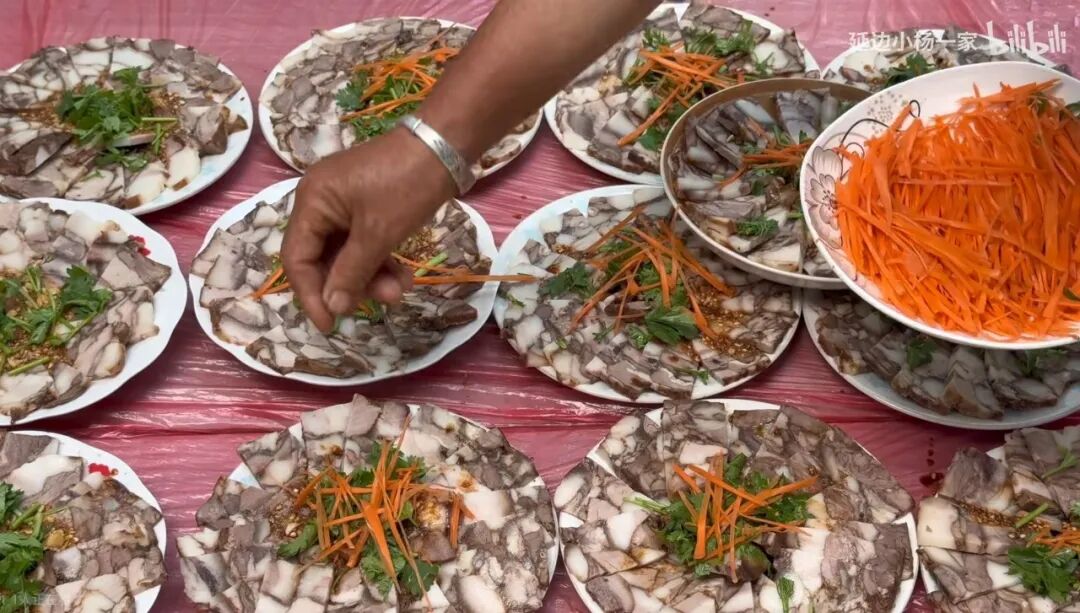
◉A self-organised large banquet in Northeast China, with food still being prepared. Image source: Bilibili UP @延边小杨一家.
That Feast Back Home
For many people, their first impressions of a feast were formed at an age when they were still too short to reach the lazy Susan. The stew bubbling away in the big pot, the meatballs still scalding hot straight from the kitchen, every new dish set on the table drawing a chorus of excited cries. Memories of feasting are also memories of home and childhood.
@小刘 (Baoding, Hebei)
I loved going to feasts as a child. Now, thinking back, it’s all the freshly fried fish, the big steamed buns straight out of the steamer, the stew bubbling away, the roast chicken delivered from a shop nearby, the peanuts and sunflower seeds freshly roasted — a little burnt, a little scalding, but that’s just the taste.
@汤汤 (Xi’an, Shaanxi)
My hometown is in Lantian. We have the famous shao shao ke chefs here — rural cooks who traditionally carried their cooking equipment on a shoulder pole — and they really do cook well. You can clearly watch a dish transform from raw ingredients into something delicious. When the village throws a banquet, the neighbours pitch in to help each other get it done. The host family prepares towels and soap as gifts for everyone who lends a hand. All the people prepping in the kitchen are familiar family members, and they’d always let me sneak a bite while the meatballs were frying. When I was little, I thought the bride was the most beautiful person in the world, even more beautiful than the celebrities in pictures — I’d always jostle my way to the front row to get a look. I don’t have that same feeling anymore.
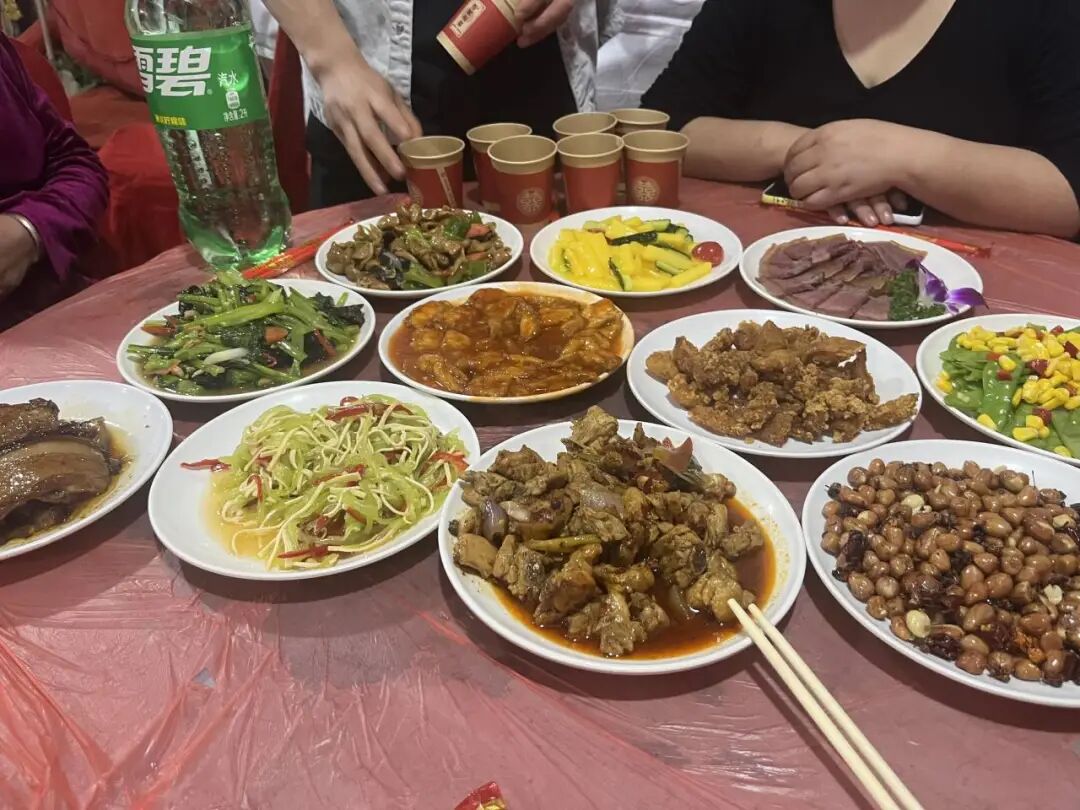
◉A wedding banquet in Shaanxi. Photo: Tangtang
@鹞鹞 (Sichuan)
Sichuan’s most iconic form is the 坝坝席 — ‘坝坝’ refers to an open, outdoor space. On the third day of the Lunar New Year, my family goes to my eldest aunt’s for the banquet. The food at her banquets is wonderful — every ingredient is fresh, and my aunt and the relatives helping in the kitchen are all accomplished cooks. They slaughter a free-range chicken on the spot; the cured pork, sausages, and cured pork trotters are all made that same year. A large wok stands nearby, steaming and stir-frying as they go — no risk of ‘pre-prepared meals.’Because everyone who comes is close family, my aunt puts a great deal of care into this particular feast. When I was a child, the banquets were lively too. We would dash about and play with everyone, but I had to keep myself from ripping the plastic tablecloth. My aunt used to have acres of farmland, and after the meal we would head out to the field paths, build small fires, and chase the ducks — we could be out there all afternoon.
@乐乐 (Heilongjiang, Harbin)
In the old days at a banquet, the food hadn’t even been served yet, but from the moment chopsticks were handed out, people were already looking forward to what was about to land on the table. Every dish that came out was met with a collective gasp. The dishes at a proper banquet always tasted better than anything in a restaurant. The guobaorou and liu rouduan I’ve had at restaurants in the Northeast are, of course, delicious too, but they always fall just a little short of what a banquet has to offer. I can’t quite put my finger on why — is it the cook, the ingredients, or the wok?
@林 (Heilongjiang)
Eating at a classmate’s admission banquet was the most fun. We were seated at a special table, and the dishes went beyond the restaurant’s standard banquet fare – braised pork belly, pork knuckle, prawns, scallops – to include fried chicken, burgers, and grilled cold noodles that kids love. To top it all off, they brought out a large cake with real cream. Can you imagine what that means to a child who loves sweets! The whole class must have adored him! We also got to hear his parents share funny stories from his childhood, revealing a side of him we’d never seen at school: it turned out that even someone so reserved and refined used to climb trees and walls as a kid.
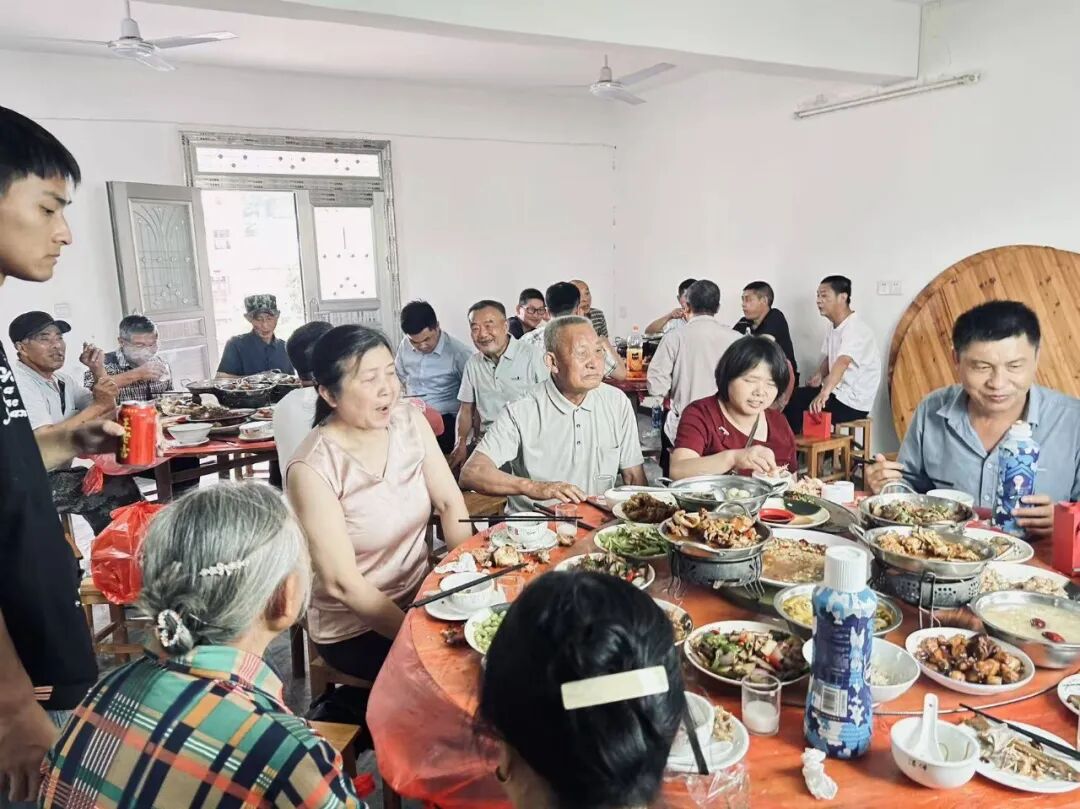
◉A rural running banquet in Jiujiang, Jiangxi. Photo by Guoguo
Every Feast, a Local Flavour
In Wenzhou, the bàijiǔ is on; in Chaoshan, the nàorè zhuō is in full swing; in Shaanxi, the banquet begins at first light with a bowl of saozi noodles. In Ganzhou, chestnuts and wild pears follow the autumn harvest onto the table. In the water towns, fish is never absent. In the flatbreads of the Production and Construction Corps, past hardships and present sweetness are folded in between layers of dough. China is vast—when banquet dishes from every corner are laid out one by one, they form a culinary map.
@汤汤 (Xi’an, Shaanxi)
🍝 No matter where people from Shaanxi go, they can never be far from a bowl of noodles. Here, at weddings, funerals, and other family occasions, the morning meal must always start with a steaming bowl of saozi noodles, the topping a medley of finely diced chives, daylily, wood ear mushrooms, tomato and egg, meat, and radish. The noodles are mostly hand-rolled, thin and cut to the width of chive leaves. A drizzle of vinegar and chilli oil on top — you simply can’t imagine how good they are! The final course at the banquet is a bowl of meatball soup; once the soup is served, the feast is complete, carrying the wish for wholeness and abundance. Shaanxi also follows the tradition of eight cold and eight hot dishes — no matter how cold the day, eight cold dishes must be served first!
@超超 (Tianjin)
The dish I remember most is a “sùhuìr” — a stew of assorted vegetables, primarily brine-curdled tofu, red sweet potato starch sheets, tofu skin, coriander and minced ginger, with fermented tofu as the essential seasoning. Each outlying county makes it slightly differently, and these days it’s basically only something you’d find at a continuous banquet like this.
@韩柳 (Shihezi, Xinjiang)
Shihezi is a corps city, home to migrants from all corners of the country, so the food here is a blend of northern and southern traditions. In my memory, the banquets were mostly stir-fried dishes, interspersed with a few local Xinjiang specialities. The most distinctive was a dish called Corps Reclamation Stuffed Bun (or at least that’s what it was probably called) — essentially a large round steamed bun filled with chilli stir-fried meat. It is said to have originated as the tastiest dish the corps members could think of during the material shortages of the early years, which gives it a certain ‘remember the bitter, savour the sweet’ quality.
Shuiguoyan (Ganzhou, Jiangxi)
Before I left home, I might get to attend three or five banquets a year. The autumn harvest banquets were the best, because new produce came in — wild chestnuts, steamed wild pears, sand-roasted tang pi, hairy chestnuts — ingredients that needed no special seasoning and could be served straight to the table. The weather was just right, and appetites were perfectly in tune. Each season’s banquet had its own menu: in winter, braised bamboo rat; in summer, fried purple sweet potato balls, fried fish slices, and fried small crucian carp.
@娜娜 (Wenzhou, Zhejiang)
In Wenzhou, we call it “chī bǎi jiǔ” – turning up for a banquet. Growing up, the banquets were mostly held at our family house, out in the courtyard, and everything on the menu was a Wenzhou speciality. Take the Wenzhou-style pickled radish, for instance – we call it cài tóu – sweet and tangy, absolutely delicious. There was also sesame oil duck, zhā yáng, and a fried fish you dip in a sweet sauce like condensed milk.
@鹞鹞 (Sichuan)
I remember a dish — pork large intestines braised with peas — that was simply stunning. Both the peas and the intestines were stewed until extraordinarily tender and full of flavour (tender being “ba” in Sichuan dialect, meaning soft). You could tell at once it was the work of a highly skilled veteran cook; you simply can’t find such a dish anywhere else.
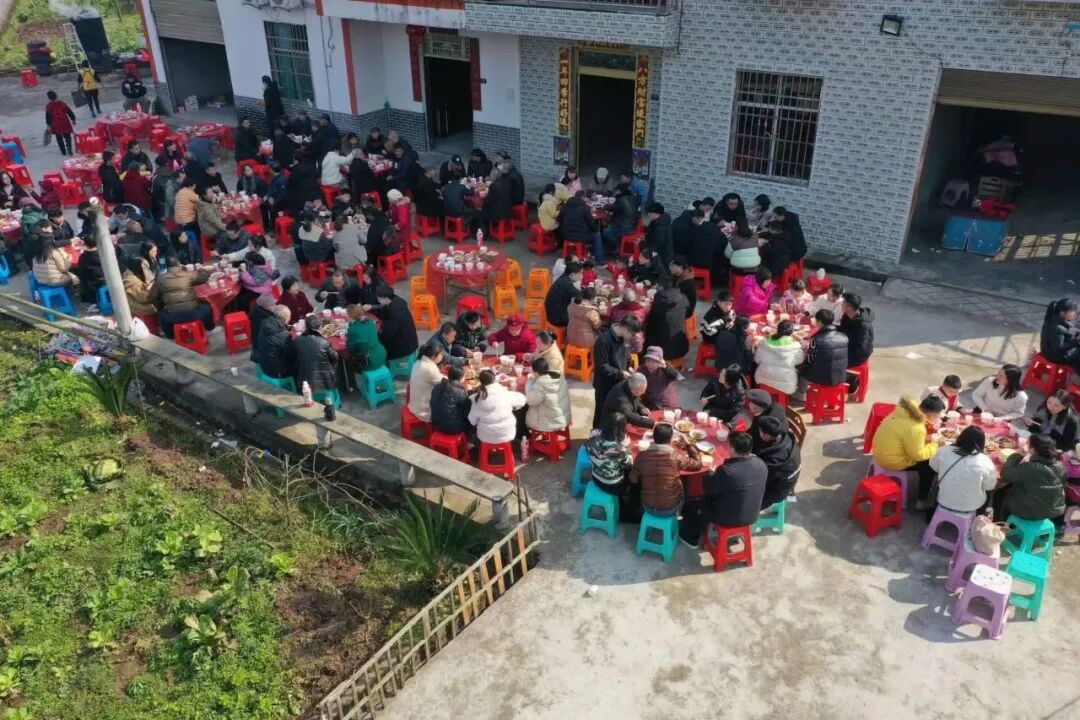
◉On the first day of the Lunar New Year, after the ancestral rites, fellow clan members in the village would set up an open-air banquet near the ancestral graves. Photo by: Yaoyao
@Morry (main urban area of Hangzhou, Zhejiang & suburbs near Jiaxing)
We have a dish called “Rou Geng” — it’s a dialect name. The method is actually quite simple. Bamboo shoots (or water bamboo) and chicken gizzards are essential. The other ingredients are more flexible — shiitake mushrooms, pressed tofu, that sort of thing. Everything is diced into very small cubes, about half the size of a grain of rice. Then you make a broth, thicken it with a heavy starch slurry, and season to taste. The flavour is a plain, unadorned savouriness, but the chicken gizzards and water bamboo have a wonderfully satisfying chew — the texture is lovely.
@阿青 (Chaozhou, Guangdong)
I was born and raised in Chaozhou. In our area, eating at a communal feast is called “shí zhuō” (literally “eat table”), and organising one is called “zuò zhuō” (“make table”). The Chaoshan region has a particularly distinctive type of feast event, called “nàorè zhuō” (the fair feast). Every year during the naorè, the village organises a team to bring out the deities they worship for a procession. People form drum-and-gong ensembles, folk music bands, and flag-bearing squads to escort them through the streets — a lively deity procession. On the day of the naorè, most households in the village set up a naorè zhuō, hosting their relatives and friends. The more guests, the merrier, to secure better luck for the year ahead. The naorè deity procession also ties in with local geography and agricultural resources — for instance, Xikou Village in Linxin Town has historically produced abundant sugarcane, so sugarcane becomes the main prop in the procession on the sixteenth day of the first lunar month. Villagers cut down the cane, hang lanterns from the tops, and carry them through the lanes — a tradition known as “chuān zhè xiàng” (passing through the sugarcane alley).
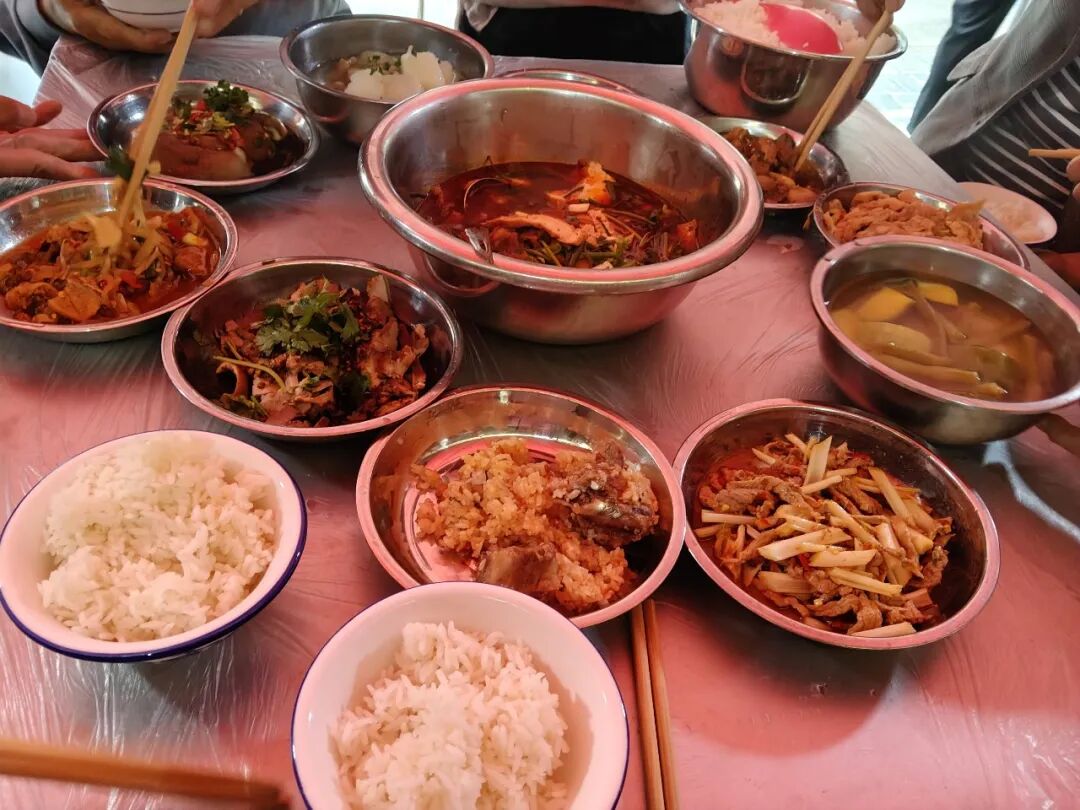
◉A wine feast in Renhuai, Guizhou. Photo by: Xiao Li
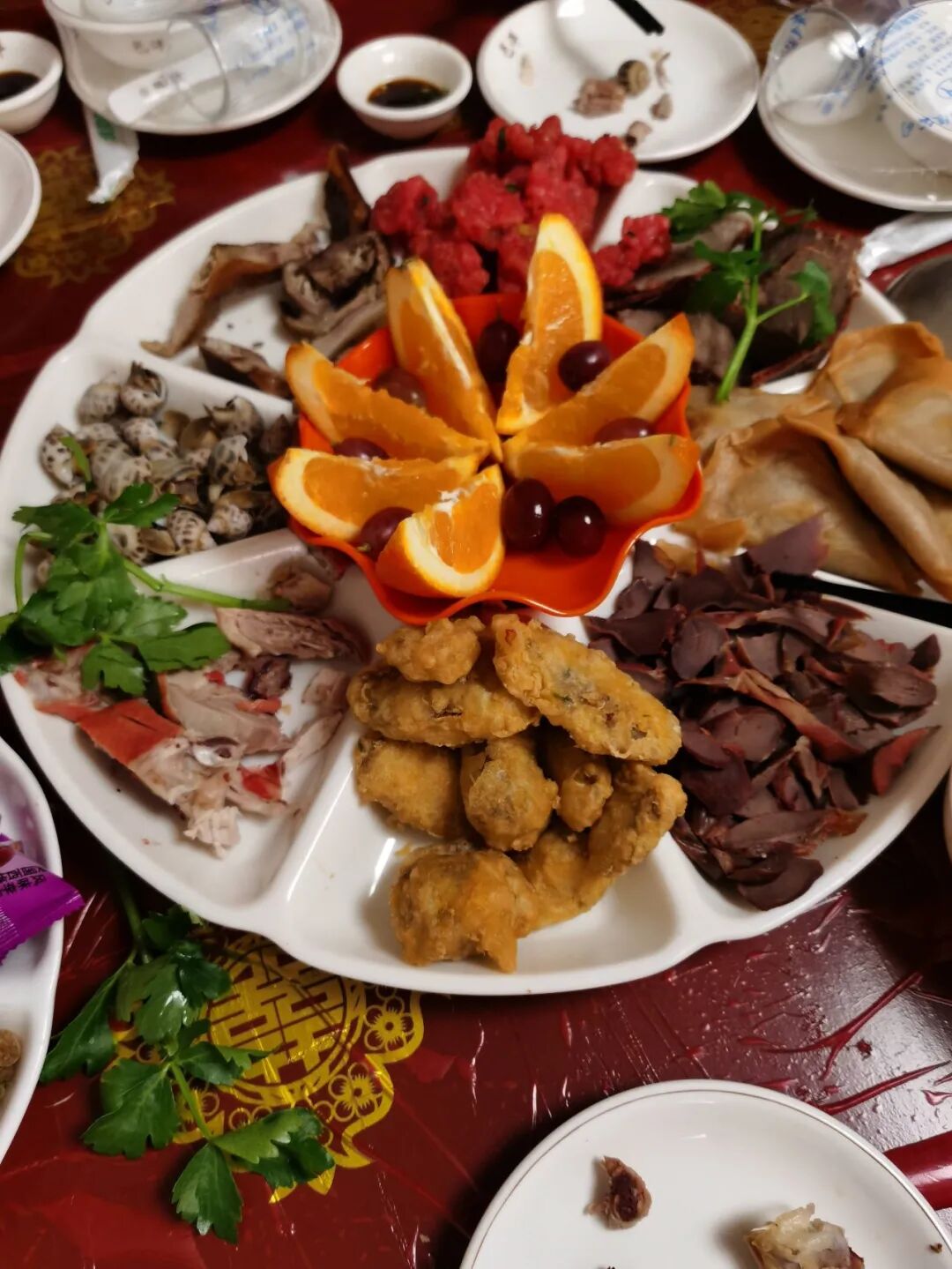
◉A platter of braised and fried dishes at a grand Fuzhou feast. Photo by: Lu De
The Evolution of the Feast
From scratch, outsourced, or pre-made? The feast itself lasts only a few hours, yet preparation begins long before. From neighbours lending a hand, to paying hired workers, to pre-made dishes dominating the scene – the production relations and modes of labour behind a single banquet have shifted several times over.
@果果 (Jiujiang, Jiangxi)
When I was a child, material goods were scarce, and it was only at banquets that you could eat more and better food. In the countryside, banquets were always a matter of neighbours and kin helping one another — your family brought the bowls and chopsticks, mine brought the stools, and everyone worked together to wash, chop, and cook. The atmosphere was lovely.
@Rita (Hunan)
Last year, when my father held his birthday banquet, I helped out with some of the preparations. Back home these days, people generally hire village chefs to cater the feast. There are dedicated teams, usually three people: one chef and two assistants. The chef is typically male, while the assistants are female. It’s certainly more convenient and hassle-free, but I always feel like something is missing.
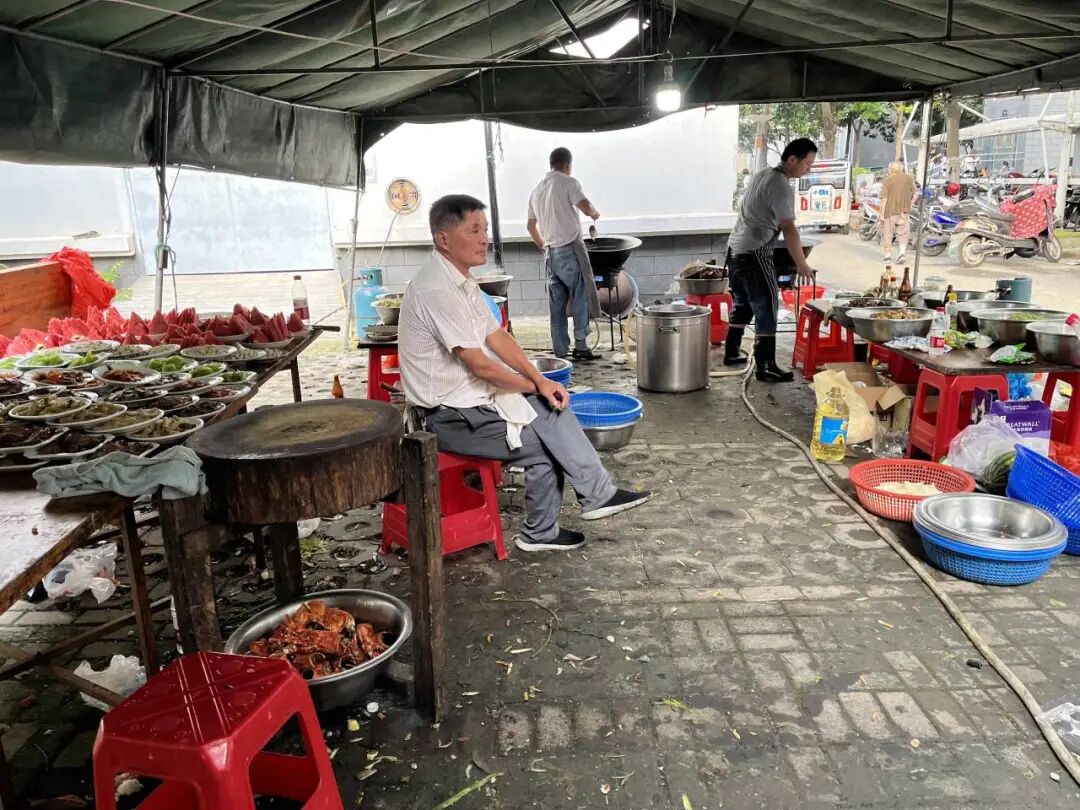
◉Suzhou: village chefs preparing a wedding banquet, cooked dishes stacked and waiting. Photo by Wanfeng.
@阿青 (Chaozhou, Guangdong)
I’ve spoken with some rural cooks. Back when money was tight, much of the banquet fare in Chaozhou wasn’t as lavish as it is now — the emphasis was on handmade craft. Fish balls, for instance, had to be made from local fish, deboned and pounded into a paste; it took considerable effort. Although these handmade dishes have carried over to today’s tables, they are now almost all mass-produced by factories.
@汤汤 (Xi’an, Shaanxi)
Rural banquets used to be a collective effort — relatives and neighbours all pitching in. Now a chef arrives with a team of four to six, and everything is produced on an assembly line. In recent years, pre-prepared food has become common in restaurants too; some dishes are still partly frozen when they reach the table.
@小刘 (Baoding, Hebei)
Hospitality at hotels these days just doesn’t feel right. Saying it tastes like chewing wax is a stretch, but calling it all the same is hard to argue with. The table no longer has dishes like fried fish, fried prawns, or prawns stir-fried with Chinese cabbage — simple ones that still need to be cooked fresh on the spot. There are more showy dishes than when I was a child, like steamed crab and blanched prawns, but they still don’t taste as good. Apart from the undisputed king of pre-prepared dishes — steamed scallops with garlic vermicelli — even the staples feel entirely pre-made: all manner of bean buns, steamed buns and pastries; brightly coloured cakes with sharp, precise edges; glutinous corn; dates and chestnuts.
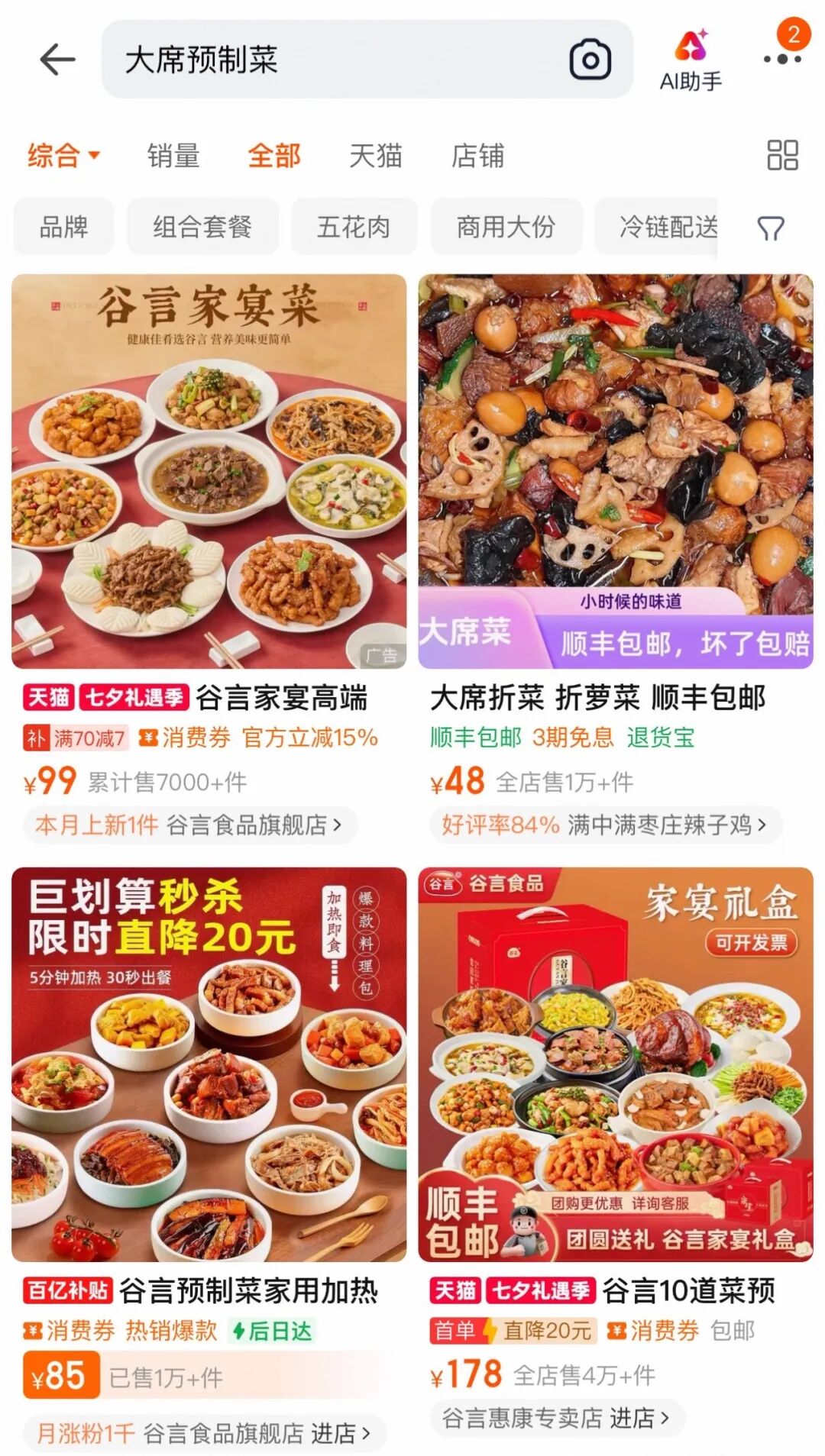
◉Pre-prepared banquet dishes for sale on Taobao. Image source: screenshot from an e-commerce platform
@小庄 (Zhoukou, Henan)
Even now I remember from when I was small: apart from the cook, nearly everyone working busily in the kitchen and around the tables was a woman — Grandma, Mum, my aunt, and the village mothers, older sisters, and sisters-in-law. When the feast was being prepared, they’d prep the ingredients and lend a hand; once the tables had been cleared, they’d wash the dishes and scrub the pots. They chatted as they worked and seemed happy enough, but even then I felt an inexplicable weariness, as though I were already glimpsing my own future.
A few years ago I got married and hosted my own feast. I’d originally just wanted to book a hall at a city restaurant — less hassle, and no need to trouble the family. But Father insisted on going back to the village for another one, saying that the relatives and neighbours had all watched me grow up and it only felt proper if we all sat down and ate together. I hired a service team — one cook with five assistants who handled the entire operation from start to finish. The relatives and neighbours still gathered around the tables to eat, chat, and catch up, and Father got his “everyone witnessing it” moment. It was only then that I realised: without all this so-called “collective labour”, the collective can still come together — and that’s the feast I wanted.
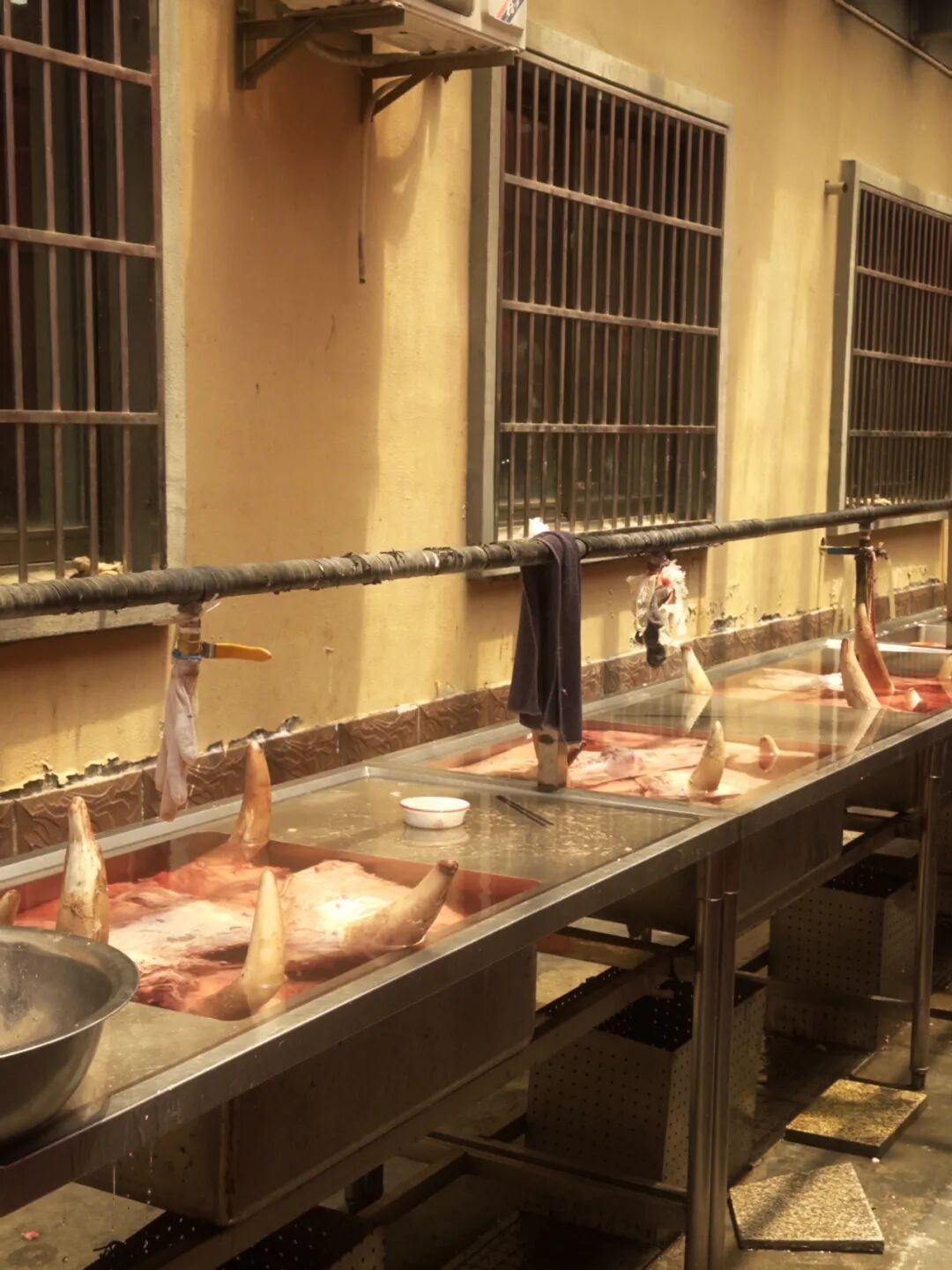
◉Back kitchen of a wedding feast — a neatly arranged ox head soaking in blood water. Source: Xiaozhuang
One region, one feast, one custom
Every feast has its own unwritten rules. How much to put in a red envelope, how many to send from each family, who sits at which table, when to raise a glass — each region has its own way of doing things.
@浩一 (Ganzhou, Jiangxi)
Here, each household at the village banquet contributes a 20-yuan red envelope. Households in the same village but of different surnames send one person to attend; those of the same surname may send one or two. All close relatives attend. Villagers observe local customs and village bylaws of their own volition — it is genuine feeling that springs from the heart, not an external obligation. Most people make no fuss over the details, and warmth runs through every aspect of the occasion.
@Rita (Hunan)
If it’s a wedding banquet, the groom’s side collects tea money (an amount not included in the social gift register), and every guest at the banquet is expected to contribute. Close relatives tend to give a larger sum, while more distant relatives usually give 50 or 100, depending on the situation. Occasionally there’s a round of ‘joking tea money’ — asking the same person to pay again after they’ve already contributed. If it’s the bride’s side giving away their daughter, no tea money is collected, though this custom has loosened somewhat.
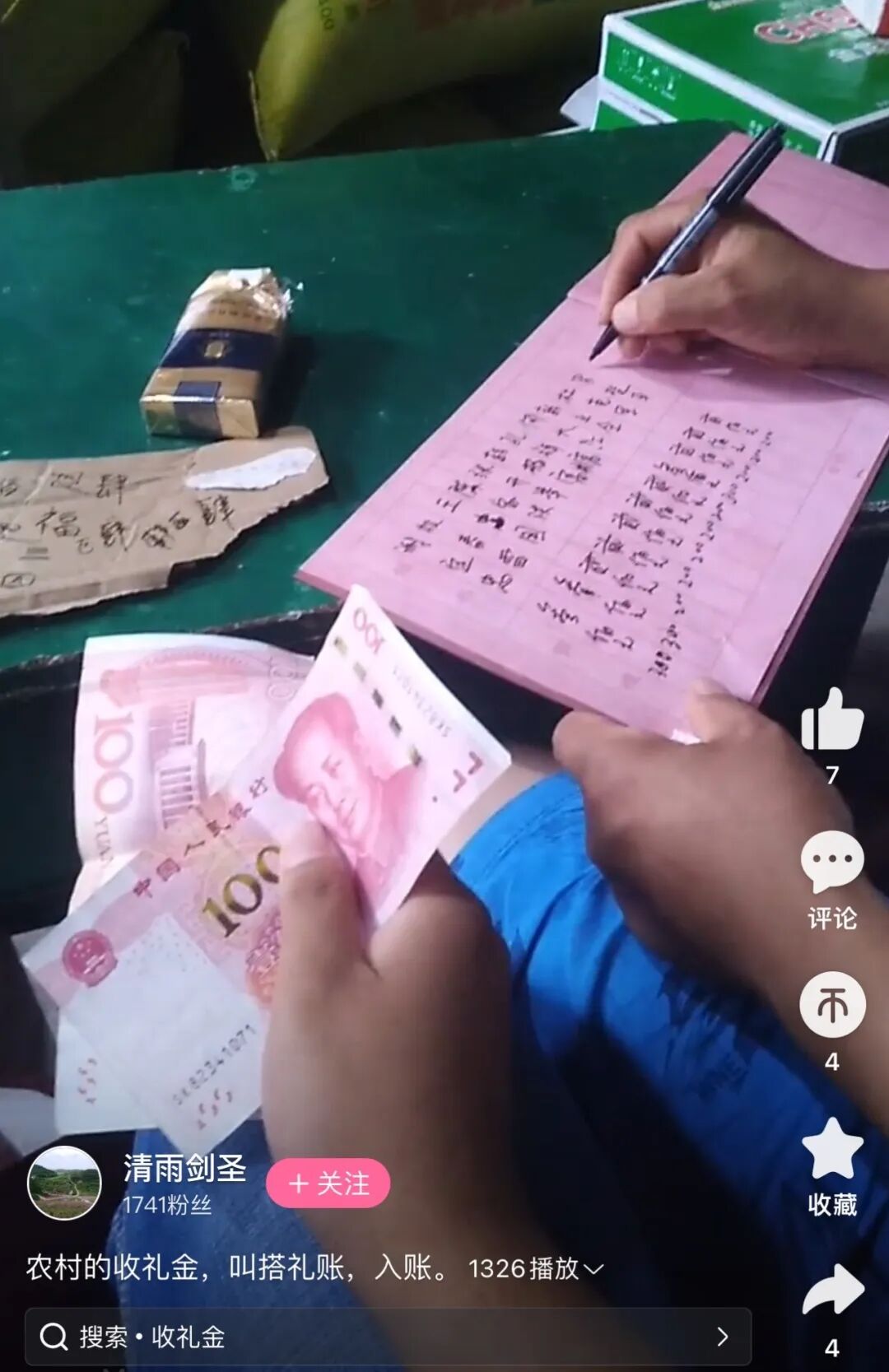
◉Wedding gift money being tallied — some netizens have dubbed the record-keeper ‘Minister of Rites.’ Image credit: 清雨剑圣 @ Bilibili
@阿青 (Chaozhou, Guangdong)
I feel that the tables organised by different communities each have their own character, depending on who is doing the organising and who is livening things up at the table. Some people are big on drinking and smoking, so they will urge everyone to have a drink; others are more laid-back, and a can of Wang Laoji is just as good. There are also unspoken conventions about seating — for example, the elders and those of higher social standing sit at one table, the children and mothers at another, and the young people at a third.
@sanv (Guizhou, Qiandongnan)
During a funeral, those keeping the wake are served vegetables stir-fried in vegetable oil; it is only on the last day that meat dishes appear.
@乐乐 (Heilongjiang, Harbin)
These days, to stop people from immediately raiding the tables and boxing food up to take home, chopsticks are usually served last—at least that’s how it works in my hometown of Harbin.
True Colours at the Table
A banquet has always been inextricably linked to social obligation, and beneath the surface of the feast, an unspoken code of conduct moves from table to table. After a few rounds of drinks, job and salary, marriage and prospects all become fair game, and deeply rooted notions alter even the flavour of the meal. Faced with the pronouncements of the ‘been-there types’—’Don’t take it the wrong way’ and ‘It’s all for your own good’—younger people find their boundaries under constant assault.
@小晓 (Jiangxi, Shangrao)
A banquet is ultimately about face. The scale must be grand, and the more guests who show up, the better connected the family is said to be. Wealthier families tend to prefer hotels—despite the food being nowhere near as good as what the village chef can produce, and at a higher price—because it is precisely the expense that signals the family’s prosperity.
@kkk (Guangxi)
My own college acceptance banquet was a rather underwhelming affair. In name it was a celebration of my admission; in substance, it was a networking exercise and status display within the clan back home. Each family centred everything on its senior male relatives and threw a three-day bash. In the small hours, the men were still drinking heavily, playing drinking games and talking loud, with not a care in the world for whether the women and children at home needed to sleep. Table after table of people I had never met — I was made to pose for group photos as though I were some NPC, and then lectured on the importance of gratitude, because the neighbours who had come to help had worked so hard.
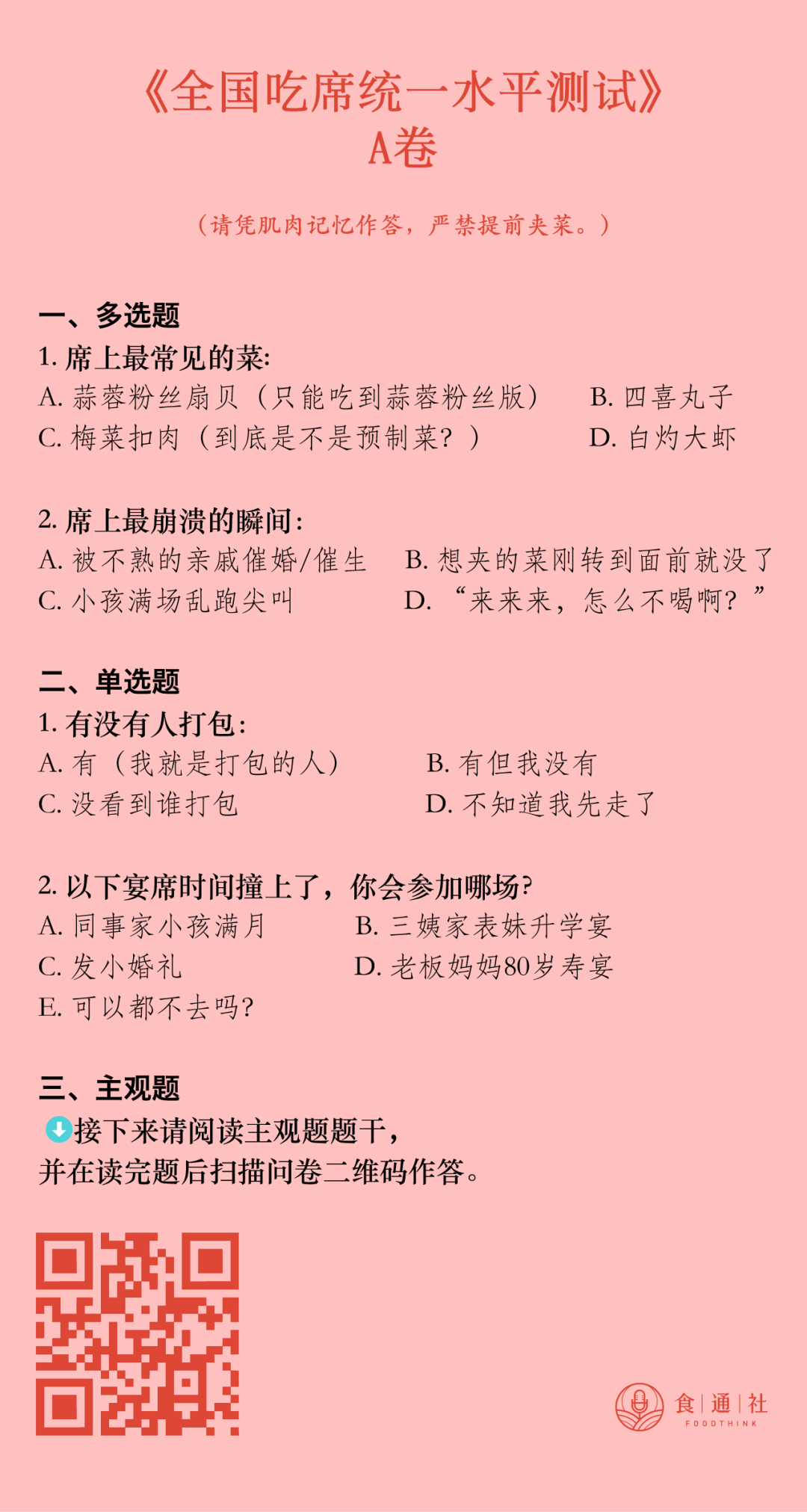
◉ The banquet survey Foodthink previously published. What other moments at a banquet have completely undone you or brought you to breaking point?
@韩柳 (Shihezi, Xinjiang)
At the banquet before I started university, there was a man I had to call ‘uncle’ despite no blood tie between us. Perhaps it was because his daughter had put down roots in Beijing, built a career, and found stability. That day, he first gestured for me to stand, then called over a few of the younger guests, making a point of singling out his daughter. After that, he began ‘planning our futures’ for each of us, as though, in his telling, each of our lives already had its course set.
@蔬果鉛 (Gannan, Jiangxi)
One time I was pressured by family to give a toast. I didn’t want to do it at first. I stood there, frozen in awkwardness, for over ten seconds while the whole room was enjoying the show. My older cousin poured my drink and egged me on to go, but once I’d finished toasting, my younger cousin looked at me with open contempt and demanded to know why I just went whenever they told me to. It affected me more than I expected. Other people’s glances and words come so easily. One thing: some people see it as a matter of dignity, others don’t think it matters at all. And neither the ones who encourage you nor the ones who look down on you will bear any of the cost. In that moment, I felt an intense sense of isolation.
Favours Too Heavy to Swallow
Now that living conditions have improved and hosting banquets has become easier, why has it grown harder to find the same satisfaction in a banquet as before? From simply showing up to eat to paying out of pocket and giving monetary gifts, the ‘new new generation’ who used to be brought to banquets by their elders have grown up, gradually learning to hear the deeper meaning behind the laughter and teasing at the table.
@韩柳 (Xinjiang, Shihezi)
As a child, once my parents had brought me to the table, I would mostly stare at the dishes on the round table and look for whoever was turning the lazy Susan. Slowly, through a child’s eyes, I developed a habit of observation, noticing that people seated in different positions spoke differently. Now I feel more of an exchange of information and a bond that sustains certain relationships. Whether it’s a family gathering, a meal among friends, or attending someone’s major life event, the emphasis always lands on the money and face carried in people’s words.
@浩一 (Gannzhou, Jiangxi)
At a village banquet, neighbours all pitch in to help. There is laughter and chatter, arguments and commotion; children and dogs alike simply are themselves, and the whole setting lets people drop their guard. A hotel banquet locks everyone into a grand hall, each taking their seat, whispering to those beside them or scrolling through their phones. With no open space and no freedom to let loose, it feels as though some invisible urban system is holding people in a grip — the experience is deeply stifling.
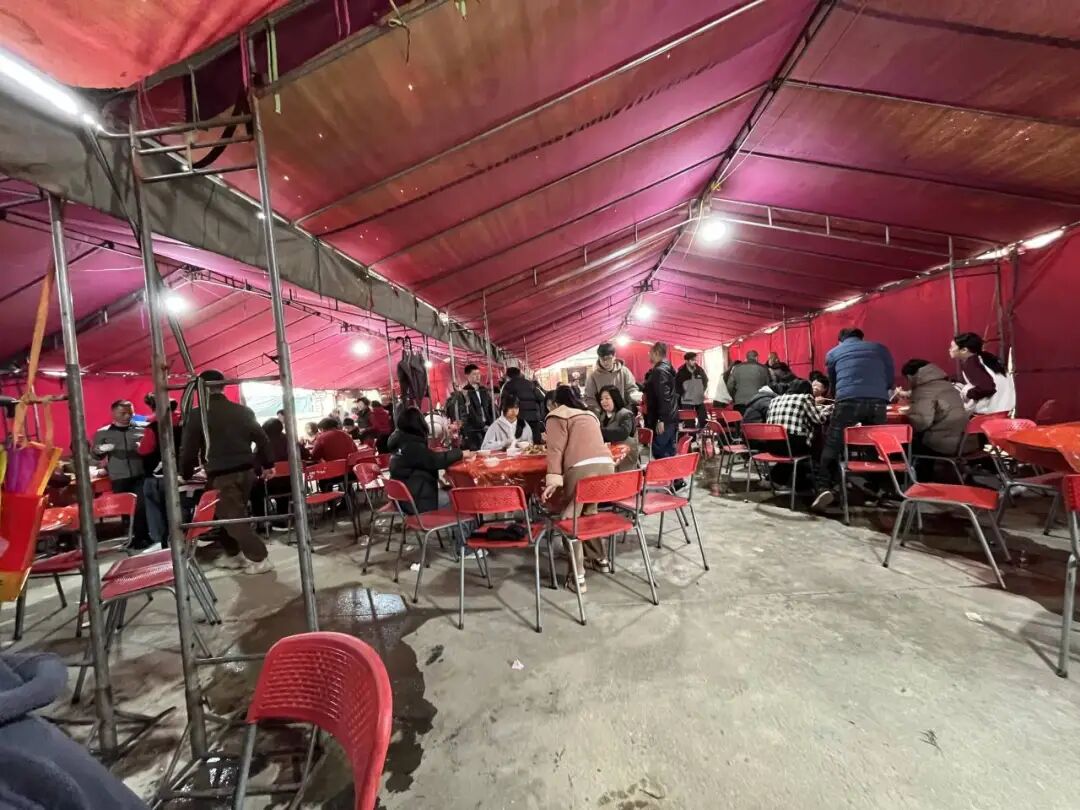
◉A rural banquet in Ganzhou, Jiangxi. Image: Haoyi
@Rita (Hunan)
Now that I work away from home, I rarely attend banquets, and the occasional one is actually quite enjoyable. But if I were living in my hometown, it would become a burden — the ever-rising cost of gift money and the sheer frequency of banquets do place a certain financial strain.
@蔬果鉛 (Ganzhou, Jiangxi)
The deeper reason I dislike attending banquets is my commitment to remaining single. I suddenly found myself envious of Taylor Swift’s wedding, where the hosts can set rules — no photography, no plus ones — which is important for protecting privacy and breaking free from the web of social expectations. If it were a banquet elsewhere, I’d still go along out of interest in the food. The flavours back home have become a bit ‘set in stone’, as if they’ve been ‘pre-made’ in my mind.
@林(Heilongjiang)
As a child, I’d be tucked under my mum’s arm like a shoulder bag and off we’d go to banquets. After greeting every auntie and uncle in turn, I’d become the springboard for small talk: ‘Your child is so well-behaved! What extracurricular classes have you signed them up for?’ ‘So-and-so’s family just had their second — shouldn’t you have another?’ I turned a deaf ear to the drama at the table; all I did was sneak a few more scallops with vermicelli while I could. I’d never bother with the prawns — far too fiddly to peel.
Now that I’m older, it’s a whole different meal. “Is work keeping you busy? Don’t let it get in the way of finding a partner!” “A girl should settle down early—have a baby first and then you can really throw yourself into your career!” Mayday Mayday! Intruder detected breaching the boundary! I haven’t taken two bites but the small talk is already done. Could these questions wait until everyone’s nearly finished eating… I already sent my contribution… I’m so fed up I’m full.
Perhaps the banquet has always been like this—it’s just that I’ve grown up, and I can finally read the deeper meaning behind the looks and the words. I now carry “weights” of my own that can be measured, compared, and laid out on the table for all to see—having inherited the same system by which one generation pries into and trades details of each other’s lives.
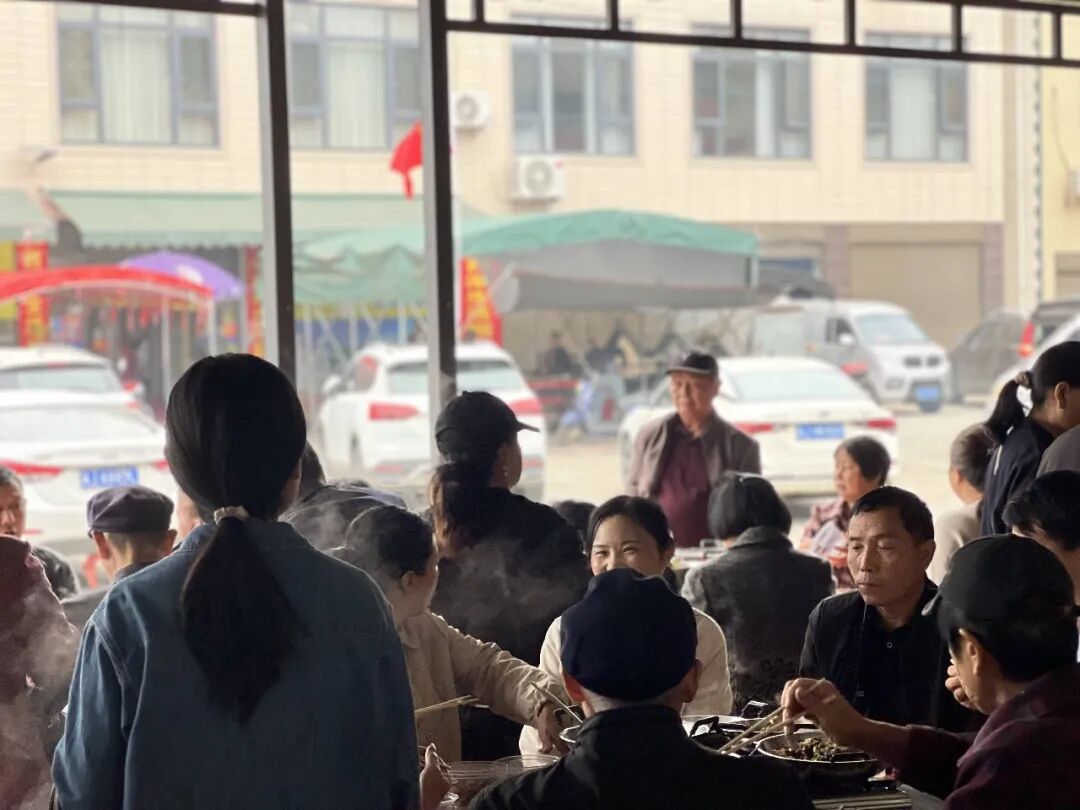
◉A hundred scenes at the table. Photo: Rita
Will the Grand Feast Disappear?
The traditional village feast depends on more than just the stove and the cook — it also needs a relatively stable village and neighbours who come and go frequently. As the elders age and urbanisation drives people to move, such village feasts are becoming rarer. In twenty years, will the Grand Feast disappear?
@超超 (Tianjin)
Every year around Qingming Festival, the suburban counties of Tianjin set up rolling banquets in the villages, charging per head to provide a lunch for all relatives who come to pay their respects and tend the graves. Nowadays, many people have moved from the countryside into resettlement housing, so if you see large marquees going up in suburban residential compounds around Qingming Festival, it’s a fair bet the whole compound was relocated from an entire village and still keeps the old village customs.
@Morry (Central urban Hangzhou, Zhejiang & suburbs near Jiaxing)
Banquets are becoming increasingly scarce. Relatives in the central urban area tend to host theirs at restaurants. As for relatives in the suburbs, they are all growing older by the year, and the younger generation seldom puts on a feast.
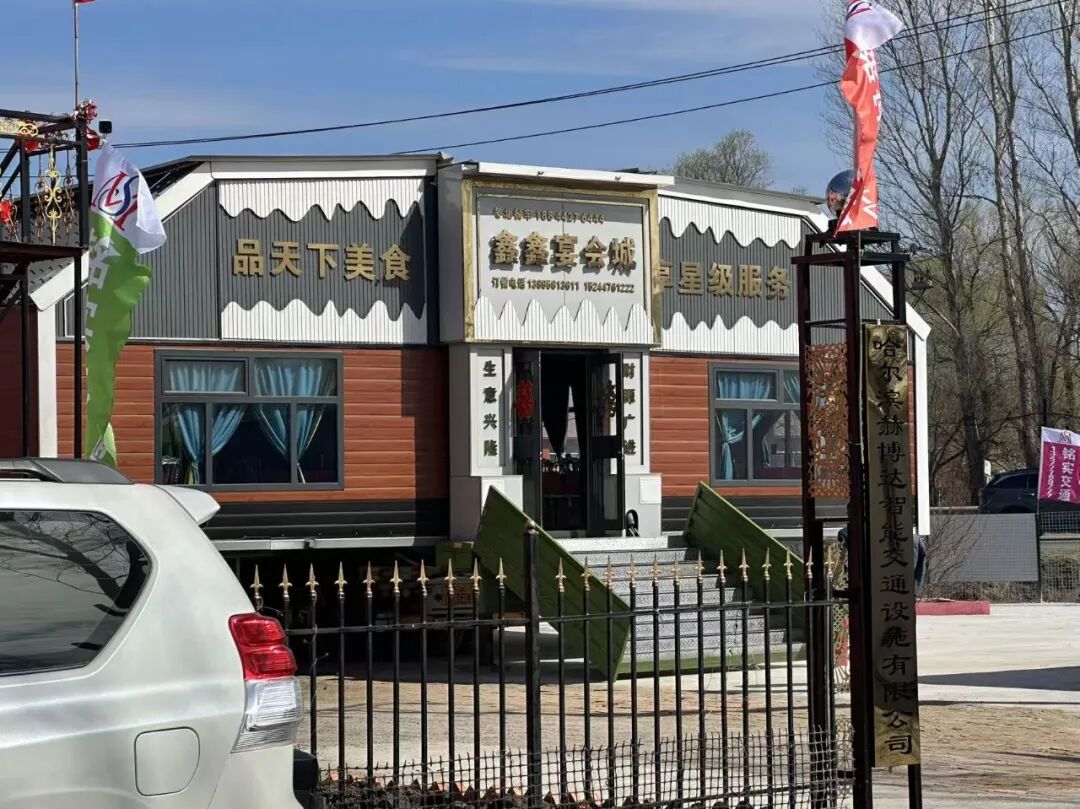
◉The image shows a mobile banquet van, which is quite popular in rural northeast China. In the context of rural outmigration, such a vehicle can drive directly to the host family’s open ground and, once set up, becomes a banquet hall, providing one-stop service covering everything from venue and kitchen to tables, chairs, chefs, service staff, and waste clearance — greatly reducing the host family’s workload and the burden of social obligation. Image source: Kong Lingyu
@阿青 (Chaozhou, Guangdong)
Communal feasts (zhuo) aren’t held very often in the city, mainly because hosting one requires space, and urban areas lack public grounds or open space in front of ancestral halls. In the countryside, they’re more common — some communities have ancestral halls, and individuals may host them in their own factory buildings or on the ground floor of self-built rural houses. I probably attend one or two a year. I used to go to far more as a child, but once I grew up and moved away, they became less frequent.
@林 (Heilongjiang)
Besides the location of banquets shifting from villages to cities as people migrate, the way they are hosted has also changed dramatically. I recently attended a university classmate’s wedding, which almost entirely dispensed with the usual banquet formalities: the couple hosted the entire ceremony themselves, choosing as their venue the restaurant where they had their first meal together. Only close friends were invited, the menu was decided in advance by an online vote among guests, and even different tables had different dishes – so people could simply choose a seat based on which dishes appealed to them.
@小庄 (Zhoukou, Henan)
I hardly go back to the village for a banquet these days. Most of the friends I grew up with have moved to the city for school or work, and the elders in the village have one by one passed on. Occasionally someone still puts on a banquet, and the notice still gets posted in the group chat, but when I see a name, I sometimes have to pause and try to remember whose family it is for. My life has also reached a stage where I don’t really need to host a grand banquet — there are fewer and fewer occasions that would bring people back to the village.
Village banquets may indeed be slowly fading away—after all, once the relationships are gone, the rituals that confirmed and sustained them no longer need to exist either. I don’t know whether banquets twenty years from now will still be called grand banquets, but I think the tradition will probably endure. It may be smaller, freer, more intentional and inclusive. Perhaps it will simply be friends, partners, or kindred spirits sitting down to a meal together.
Urbanisation and marketisation have driven population movement and the dissolution of rural communities, steadily eroding the social foundations on which the traditional grand banquet depends. People leave their villages, families scatter across the country, and the bonds once held together by kinship, locality, and mutual familiarity are loosening. Yet a new generation of hosts is translating the old rituals into forms that reflect contemporary values. The rural world may be receding, but perhaps we still need moments when we become “us” again.
🗣️
Do you think the grand banquet will disappear?
If you were the host,
what kind of banquet would you put on?
Feel free to leave a comment and share your ideas!
Unless otherwise noted, all images are submitted by readers.
Edited by: Li Ye, Lele
Layout by: Minglin
Scan the code to send a tip and support original Foodthink content
▼

▼
Click an image to read related articles
▼
Click a keyword to explore more articles in the collection
Seeds|Agricultural Technology|Policy|Fermentation|Nutrition|Fruit|Fisheries|Delivery|Events|Careers|Wet Markets|Livestock|Food Talk|Sharing Sessions|Book Club|Harvest Festival|Smallholder Stories|Climate Change|Rural Development|Cooperative Economics|Urban Farming|Food Safety|Biodiversity|Pandemic & Food|False Solutions|Agroecology Internship Programme
Beijing|Hebei|Shanghai|Guangdong|Guangxi|Yunnan|Henan|Sichuan|Jiangxi|Xinjiang|Shaanxi|Hong Kong|Chongqing|Zhejiang|Jiangsu|Guizhou|Taiwan|Inner Mongolia|Philippines|Canada|Russia|Mexico|Italy|United States|United Kingdom|Germany|Netherlands|Thailand|Sweden|Japan