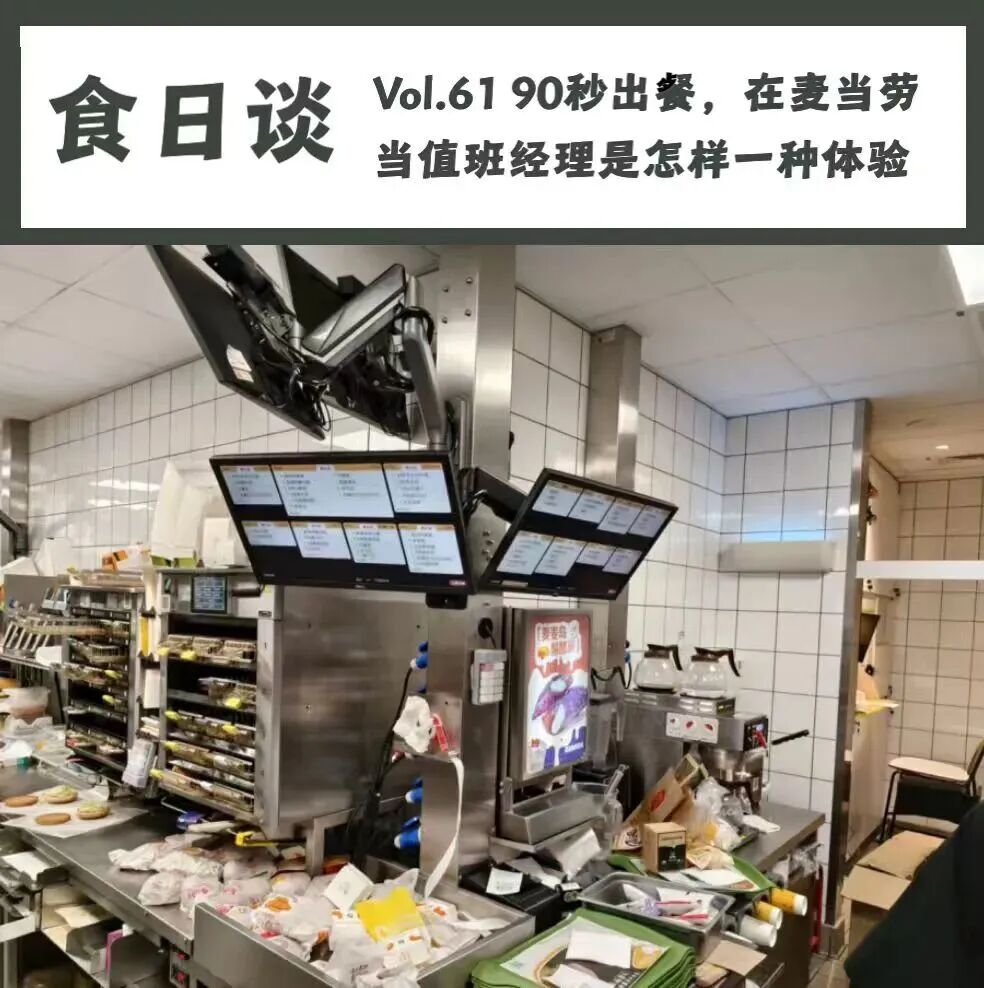
From Children’s Playground to Drudge Restaurant: McDonald’s 90-Second High-Pressure Cycle

Foodthink Says
McDonald’s has two faces. It was once the children’s playground we adored; now it is a drudge restaurant that quickly keeps young people fed. It is both a place to spend and a small-scale factory.
McDonald’s kitchens are open-plan, yet we can see none of the highly precise “Production Battle” unfolding inside. In the mythology of the fast-food empire, everything is standardised: chicken thigh fillets thawed at 1–4°C, fryers held at a constant 160°C, bag after bag of vacuum-packed lettuce strips, and the shrill, ear-piercing beep of kitchen timers.
A serving of chicken nuggets, a burger—utterly commonplace fast-food fare to any consumer. So why does it trap staff in a 90-second high-pressure cycle? Should crispy fries come with ketchup? How can such a seemingly trivial question provoke a furious complaint?
In episode 61 of the Food Talk podcast, we welcomed Jiang Ke, who worked as a Shift Manager at McDonald’s for seven months. She joined with a passion for running restaurants and studying food-service operations, yet under the strict 90-second service target she lived each day with the pressure of “human–machine unity”. This article has been compiled from that episode.
This/Episode’s/Guest

Jiang Ke | A food-service newbie passionate about analysing the people, food and operations behind a restaurant; watches Yong Ge videos over meals every day
This/Episode’s/Host

Yu Yang | Foodthink editor who, as a child, was “thrashed” for stubbornly insisting on eating McDonald’s

Li Ye | An ADHD-er who has been an in-flight chef on an iPad, rolled shawarma and run a breakfast shop
From Children’s Playground to Drudge Restaurant
Jiang Ke: I have always been fascinated by the food industry. When I was looking for a job in March 2025, I even asked DeepSeek how I could systematically learn about restaurant operations. It recommended a few major fast-food chains—McDonald’s, KFC, Yoshinoya, Lao Xiang Ji, among others—and told me that McDonald’s was known as the “Whampoa Military Academy” of the restaurant world. Around the same time, I spotted a McDonald’s job listing on a recruitment app, so I decided to give it a go.
I have lots of friends who absolutely love McDonald’s, but I would not call myself a card-carrying McDonald’s devotee in the traditional sense—I probably only eat there a few times a year. Before I started working at McDonald’s, my knowledge of the brand was quite limited; my main impression was simply that it was a very popular restaurant. It was only once I actually worked there and got involved in day-to-day operations that I realised just how vast its scale really is, and that gave me a much clearer understanding of its status as the world’s largest restaurant company.
Yu Yang: I haven’t eaten at McDonald’s all that many times either, but during my childhood it genuinely felt like a vibrant, modern space—there were loads of children playing there, McDonald’s aunties looking after them, and clown performances. In recent years, though, I feel McDonald’s has turned rather quiet and desolate. The corporate drudge says nothing and just silently shovels down their meal. Now that you have actually been inside working at McDonald’s, what was it like?
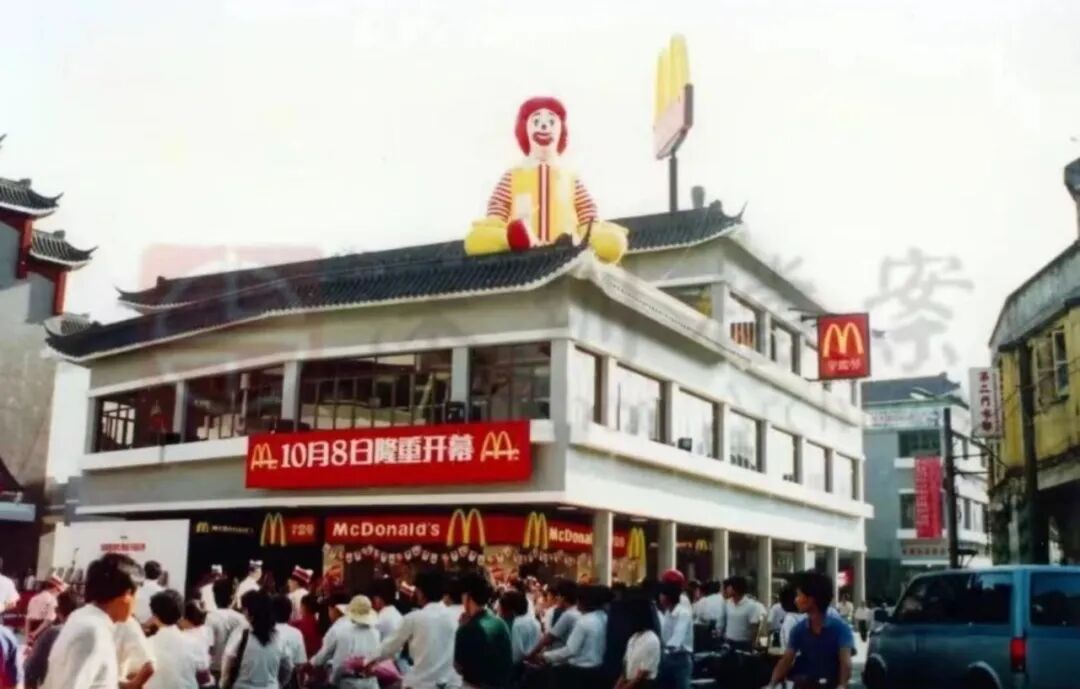
◉ On 8 October 1990, mainland China’s first McDonald’s opened on Guanghua Road in Shenzhen. At the time, McDonald’s represented a vibrant, modern lifestyle for Chinese people. Photo: McDonald’s official website
Jiang Ke: Yes, I think over the years people’s feelings about McDonald’s have converged. When you were little, going to McDonald’s was a treat you earned by doing well on an exam. Why did I say I used to eat there less often? Well, my hometown is a small county in Guangxi, and McDonald’s was very rare in that part of the country back then. There were plenty of knock-offs, though—places with names like “Mai xx” and so on. Ever since a proper McDonald’s arrived, I have noticed that the average spend per person is quite high. A meal there used to cost over twenty yuan. You can still get a meal for around twenty yuan now, of course, but prices across the board have gone up, so for the same amount of money you are certainly getting a very different level of service. McDonald’s positioning is not what it was either. Back then, it felt like a warm, welcoming community restaurant.
Yu Yang: Now it feels more like a drudge restaurant.
Jiang Ke: That generation has grown up, and they have become the new corporate drudges.
Li Ye: McDonald’s in the old days was a bit like Xibei today—it was the go-to choice for this generation of parents. Both positioned themselves as family-oriented brands, with staff specifically dedicated to keeping children entertained in the play area. That is why the prices were a little higher.
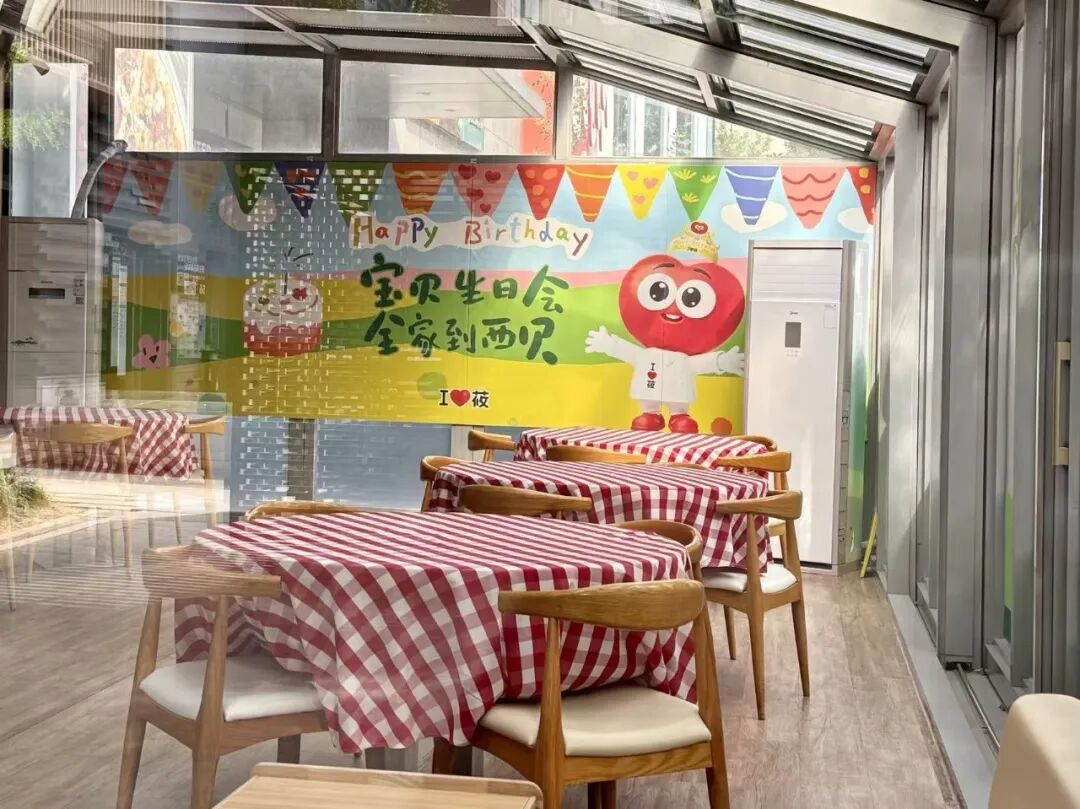
◉ A “child-friendly” atmosphere was once one of Xibei’s marketing strategies. Photo: Xiaojing
Jiang Ke: Exactly. All of those extras come with a price. If you want to carve out a dedicated children’s play area inside a restaurant, you have to factor in rent and the opportunity cost of that floor space. On top of that, you need one or two staff members stationed there to supervise the children—all of which adds to the overheads. Seen in that light, none of it is really viable any more.
So It Turns Out McDonald’s Is a Small-Scale Factory
Yu Yang: McDonald’s kitchen is designed to be open-plan—customers can see in from outside. In your actual workflow, what does that space feel like from the inside? How many zones can a McDonald’s floor plan be divided into?
Jiang Ke: The simplest role is front-of-house work—interacting with customers, clearing trays, mopping the floor, taking orders, or asking for positive reviews. Beyond the dining area, the first station a new hire learns is making drinks, which in McDonald’s jargon is called the “C-line” (beverage station). Pouring drinks is actually quite complex—five or six different beverages, varying ice levels, and you have to keep pace with the service speed. Some employees in their sixties, for instance, might not be assigned to the beverage station. It is a fast-paced role. Because virtually every order at McDonald’s includes at least one drink, when it gets really busy, you are almost constantly pouring drinks.
Besides the beverage area, the most important is our production area—the station for assembling burgers, and the fry station where the chicken wings are cooked. Roughly speaking, that is how it is laid out, but during particularly busy periods the zones can be subdivided even more finely. Within the fry station, because McDonald’s chicken wings are freshly coated on-site, there is a dedicated wing station for the battering, and another position for frying fries, called the fries station.
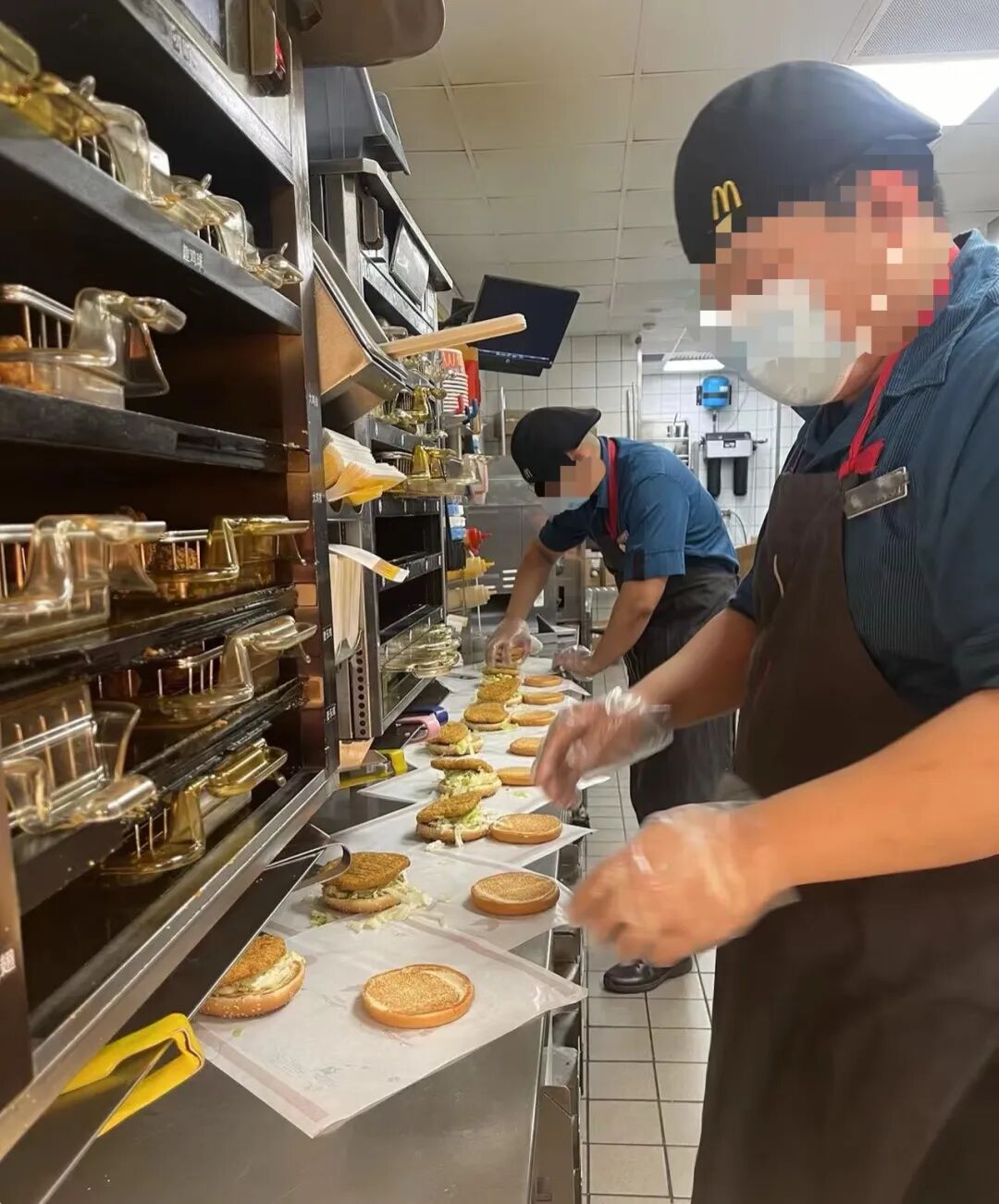
◉ At peak ordering times, staff at a McDonald’s rush to assemble burgers. Photo: Xiaohongshu user @大黄跟小展还有阿铭
For instance, the production area might have three people: one places the different buns in the bun toaster based on the orders—this station is called the “starter”; another grills the meat, at what is called the grill station; and the third assembles the burger. This is McDonald’s most standard assembly line. But in practice this ideal setup is rarely achieved—if it is not busy, one person does it all.
Yu Yang: As a Shift Manager, do you stay at one station throughout your shift, or do you oversee the bigger picture?
Jiang Ke: In principle, a Shift Manager should never get locked into a single station—say, stuck coating chicken wings all the time. You need to maintain a bird’s-eye view of everything. The most suitable station for a Shift Manager is what we call the presentation or hand-off point. From there, you can see both the customers and the kitchen.
Yu Yang: In terms of the daily workflow, what do you do first thing in the morning to kick off the day?
Jiang Ke: When we arrive at five in the morning, there is only the Shift Manager and one other staff member. To keep labour costs in check, not everyone needs to be on shift yet. At that hour orders are few, so the Shift Manager handles some administrative tasks, while the one all-purpose employee works the production side. First, all the machines and equipment have to be switched on—they need a warm-up period. The coffee machine, for instance, requires thirty minutes of warming before it can run properly. The grills and fryers all need a heating-up phase as well.
The Shift Manager must take temperature readings in all the freezers, cold-storage rooms and refrigerated food items—roughly a dozen or more separate measurements—and then upload those temperatures to a system to verify that the equipment is meeting standards. For example, to check whether a thawed item is up to standard, you measure whether its temperature falls within the 1–4°C range. Items like the grilled chicken thigh, chicken wings and the McSpicy Chicken Burger’s chicken thigh all need to be thawed.
Once the equipment has finished warming up, our grill operator cooks the breakfast patties—pork sausage patties, beef patties and chicken patties—grilling and frying them as needed, and these foods also require temperature checks at this stage. Every item has a target temperature standard; for chicken, it must reach 165°F. Once that standard is met, the data is likewise uploaded to the system to prove the grill is operating normally. In the event of a food-safety issue, we can point to a full set of standards being enforced, complete with data records.
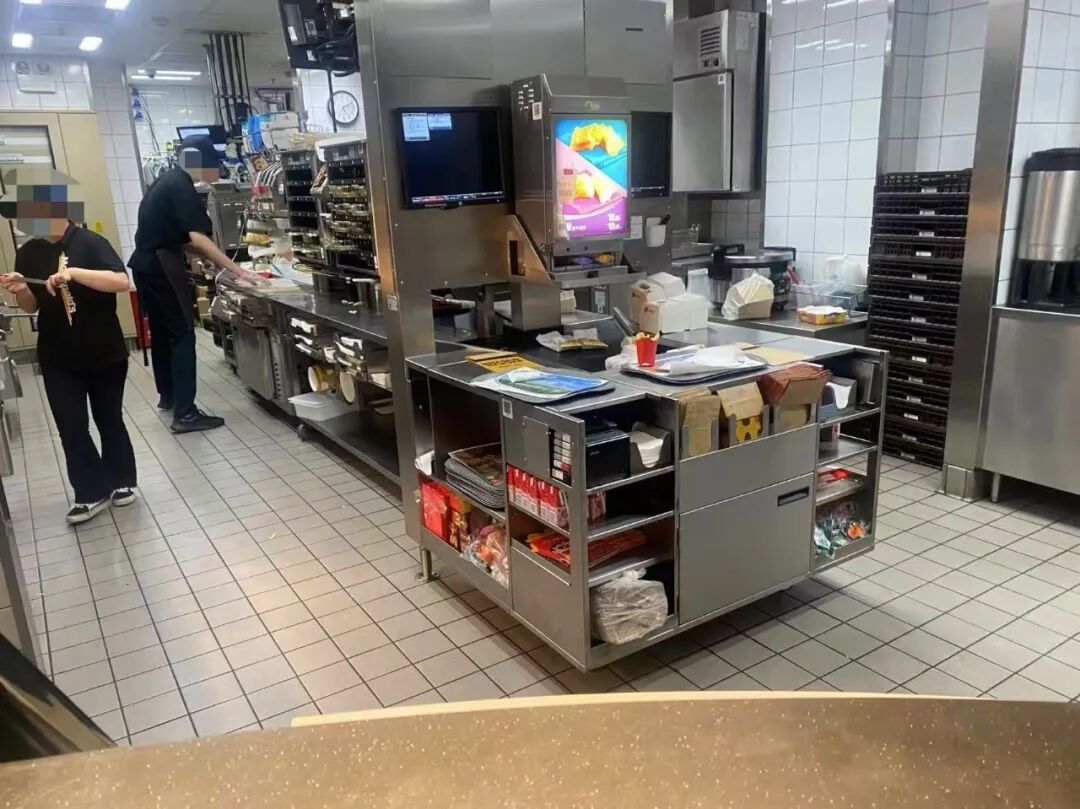
◉ Compared with a manufacturing plant, McDonald’s kitchen may be a cramped space, but it is almost entirely made up of automated machines and electronic equipment. Photo: Qingtai Yinwu
Li Ye: From what you are describing, McDonald’s expects its Shift Managers—or really all its staff—to be multitaskers, juggling many jobs at once. So would someone like me, with ADHD, whose attention already wanders, actually be great at this kind of work.
Jiang Ke: The work may be fragmented, but your head has to stay on top of it. While you are doing one step, you need to have already planned the next one, and even the one after that—knowing exactly what you are going to do.
Take, for example, the 10 p.m. to midnight window: just one staff member plus the Shift Manager on duty, during what is still a busy stretch. By then, closing time is approaching, so you would not have prepared a large stock in advance. You need to keep track of how much you have on hand, and if it is not enough, you need to know how long each item takes to prepare—say, three minutes for chicken nuggets, seven for chicken wings, three for fries. In other words, you have to organise your workflow around the orders coming in and the varying prep times for each food item.
Li Ye: So you need a mental plan in your head, knowing what to fry first and what to grill next, so everything runs smoothly and you do not spiral into a panic.
Jiang Ke: Yes, many customers simply cannot understand why there are no chicken wings available. They may not realise the wings are freshly coated and fried on-site. They just think: “Wow, you call this fast food, and I have to wait over ten minutes just to order? That is absolutely unreasonable.”
Li Ye: Are there customers who actually want their food straight out of the fryer and are happy to wait?
Jiang Ke: Quite a lot of customers have that expectation. McDonald’s has a concept called Golden Quality—fries, for example, must be sold within seven minutes of coming out of the fryer; beyond that, they are supposed to be discarded. But from a practical operations standpoint, I do not think a single McDonald’s in all of Beijing, let alone all of China, has actually met this so-called Golden Quality standard. The time window is simply too tight: frying a basket of fries takes three minutes, and you only have seven minutes of sell time—there just is not enough staffing to have someone stationed there watching the fries.
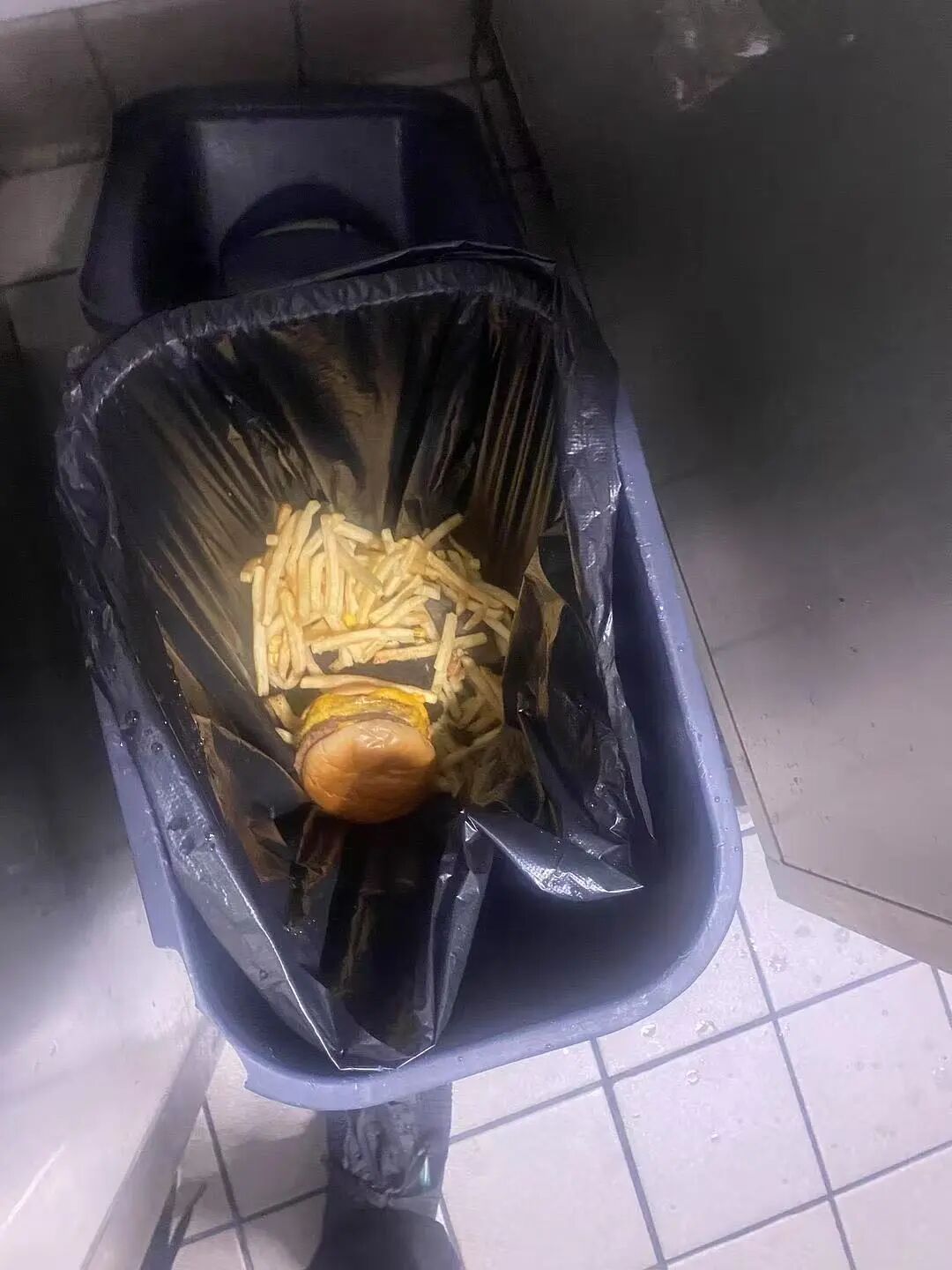
◉ Fries and burgers thrown into the bin. McDonald’s once claimed it could improve service efficiency by predicting customer demand—food was prepared before the customer had even placed their order. A burger unsold after ten minutes, or fries after seven minutes, would be discarded. Photo: Qingtai Yinwu
Yu Yang: It sounds like every step of working at McDonald’s is a standardised operation in partnership with the machines, yet in practice it really tests how well you can manage your own workflow. You mentioned earlier that the fryer temperature is fixed—when things get particularly busy, does anything ever end up burnt in the fryer because it was left in too long?
Jiang Ke: McDonald’s equipment is fairly intelligent—there are seven or eight different fryers, each set to its own temperature and timer. For instance, fries are timed at three minutes at 160°C. When the timer goes off, it beeps—a sound like “beep-beep-beep-beep” or “VerVerVerVer”—and at that point you need to lift the fry basket out of the oil.
This puts a certain psychological pressure on us, because the sound is extremely piercing—the kind of klaxon you hear in many factories. The idea behind it is to safeguard product quality. But if you spend a long time at the fry station, you start to feel a bit dizzy, because those shrill alarms are constantly going off.
Yu Yang: It sounds like McDonald’s kitchen is essentially a small-scale factory, and a remarkably automated one at that.
Jiang Ke: McDonald’s really is like a factory—not the kind of ordinary kitchen most people picture. This touches on a rather fascinating piece of McDonald’s lore. One day a customer brought in a fruit and asked, “Could you help me peel it?” We told them, “Sorry, we don’t have a knife here.” Yes, there are no knives in a McDonald’s. By the time the lettuce reaches us, it already arrives as vacuum-cut strips, sealed in packaging. For tomatoes, for instance, there is a dedicated tomato slicer to do the cutting.
“Crispy Fries Come Without Sauce”
Yu Yang: What proportion of a McDonald’s store’s total orders come from delivery?
Jiang Ke: By volume, a store might do seven to eight hundred dine-in orders, with one hundred to two hundred delivery orders alongside that. But in terms of revenue, because the average dine-in ticket sits at around 27–30 yuan, while delivery orders average roughly 50 yuan—my figures may not be exact, but the per-order gap is substantial—delivery accounts for somewhere between a quarter and a third of total revenue.
The minimum order value for delivery is set relatively high, so you would never have a situation where someone orders just a Coke or a single burger for delivery. And certain discounted combo meals are simply not sold online at all—the super-budget combos that everyone loves, for instance, cannot be ordered through the app.
◉ Delivery orders flooding into a McDonald’s on a rainy day. Photo: Qingtai Yinwu
Yu Yang: I used to see plenty of red-uniformed McDonald’s delivery riders, but I have noticed far fewer recently. Does McDonald’s still have its own delivery riders?
Jiang Ke: McDonald’s used to promote having its own delivery riders, and many customers still assume we do. But in practice, on cost grounds, we now work primarily with third-party platforms like Meituan, JD.com and Ele.me. These platforms assign stationed riders to McDonald’s—a set group of riders who regularly take orders at our store. But their commitment level is certainly not as high as when we had our own in-house riders.
What happens frequently is that during a heavy downpour, a stationed rider is offered the same rate for our order as on a normal day—perhaps 6.50 or 7.20 yuan. But it is raining, and per-delivery rates everywhere else are skyrocketing, so why would he bother picking up a McDonald’s order? A lot of stationed riders simply refuse ours in that weather, and we end up facing a severe shortage of delivery capacity. At that point, McDonald’s does what every other shop does: it puts the orders out on all the platforms.
There was one time when hailstones fell, and not a single rider wanted to make the run. Sometimes an order sat unclaimed for an hour, while our orders were piling up. All we could do was ring each customer one by one, apologise, and ask whether they wanted to cancel or would like to keep waiting. The customers would say, “Just have one of your own riders bring it over, then!” And we would have to explain from scratch that we no longer have riders of our own.
Yu Yang: Do you ever get complaints from delivery customers?
Jiang Ke: With delivery factored in, we handle around a thousand orders a day, so complaints are a regular occurrence. The most common kind is a customer telling you face to face, “I think these fries are a bit off,” or “The meat is a little cold.” That means we have failed to meet the Golden Quality standard we mentioned earlier, so we immediately remake the order for them—the Shift Manager has the authority to do that. If a delivery customer calls to complain, we might offer them a coupon as a goodwill gesture.
None of those incidents touch McDonald’s official complaint system. Complaints that do enter the system fall into three tiers. The first tier: every time a customer places an order through the Mini-program or the app, they receive a service feedback prompt, and any complaint lodged there is flagged in our internal McDonald’s system. If someone reports a hygiene issue, it gets routed through that channel to head office, and it drags down the store’s rating—which in turn affects the store manager’s bonus. You may have noticed staff asking customers to leave a positive review; that is precisely to keep the store rating up.
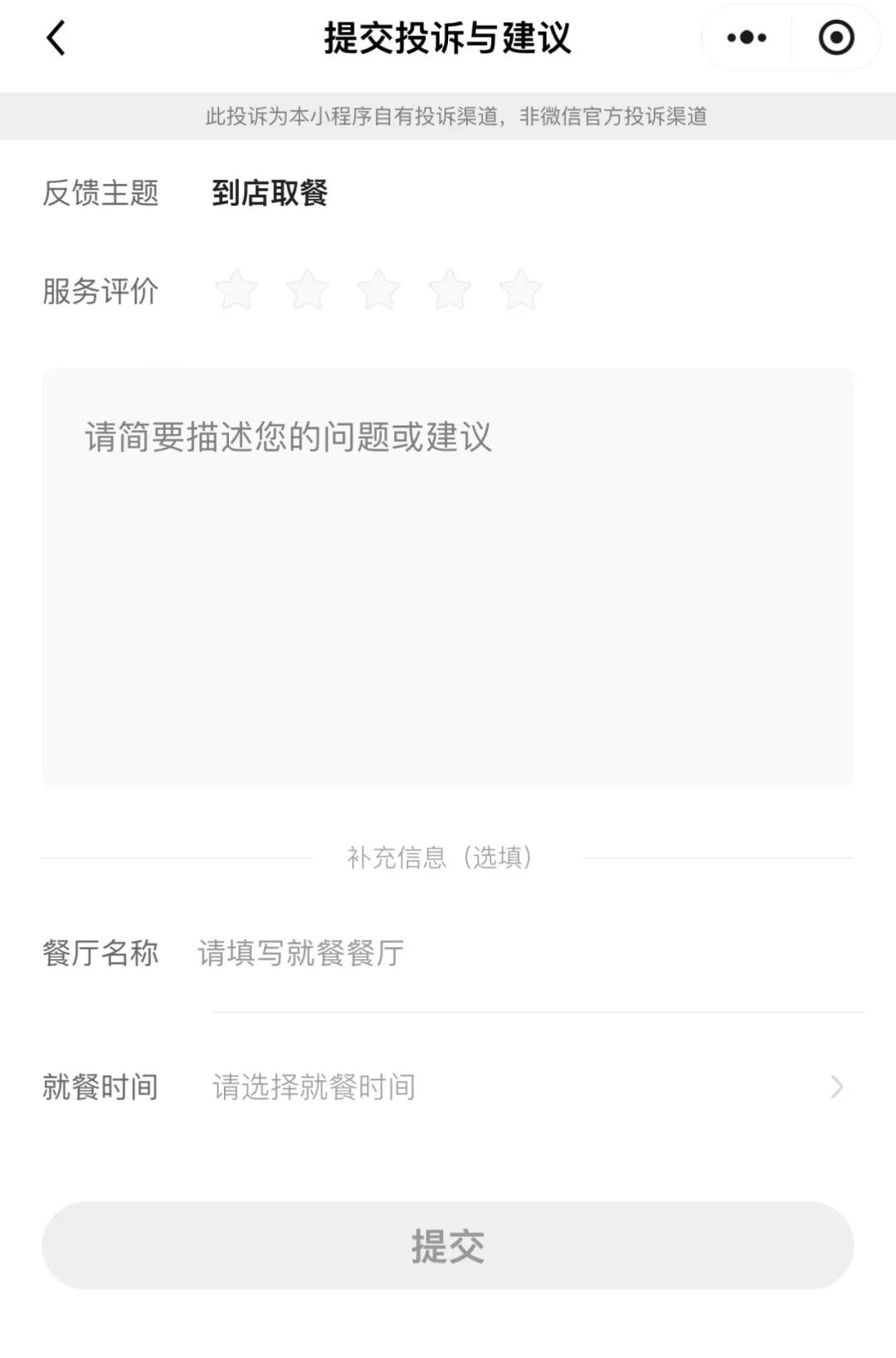
◉ The complaints page on the McDonald’s Mini-program.
Jiang Ke: The second tier is complaints filed on delivery apps or Dianping, where we actively manage our ratings. The higher my rating on the delivery platform, the more visibility and recommendations we get—so it directly affects delivery revenue.
The third tier is calling McDonald’s dedicated complaints hotline. Internally, that is treated as urgent and requires immediate investigation and resolution. Once I had a customer complain that I had not put sauce with his fries—but he had ordered Crispy Fries, which by definition come without sauce. I explained that Crispy Fries come without sauce, and offered that if he wanted sauce, he could add a note next time for however many sachets of tomato ketchup he needed, or that I could send a rider over right away with some on the house. He would not let it go and threatened to file a formal complaint. Sure enough, we received a call from head office about it almost immediately. In the end the matter was resolved—as long as you have the facts on your side, head office will not flag it as the store’s responsibility in the system.
Yu Yang: It sounds as though McDonald’s is comparatively reasonable when it comes to handling complaints—at least more so than some restaurants these days, such as delivery-only kitchens or tea and coffee shops.
90-Second High-Pressure Cycle
Yu Yang: Every time I order at McDonald’s, watching the staff coordinate to get meals out gives me this inexplicable surge of excitement—it feels as though you are all fighting a battle together. Perhaps others feel the same way. But the truth is, we have no real idea what pressure you are under during the mealtime rush.
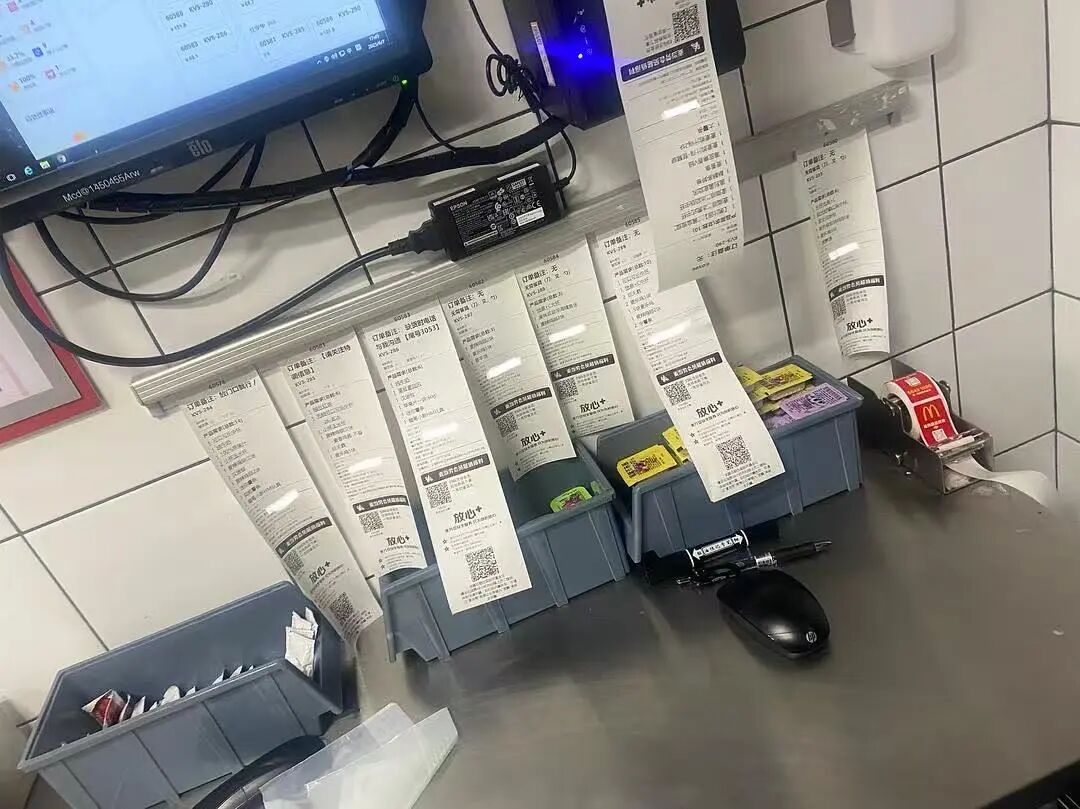
Jiang Ke: Peak periods really do feel like a battle. There are two kinds: one you can predict, and one that hits you completely out of the blue. The predictable ones are, say, breakfast from 7 to 9, lunch from 11 to 1, and dinner from 5 to 7. During these busy windows, we first schedule extra staff and prep more stock—things like lettuce and meat get set up in the adjacent fridge. We might fry extra batches of fries, pre-fill more cups of Coke, or bread more chicken wings ahead of time. With these contingency plans in place, everything comes together quickly, and we can get the food out to customers at the front almost immediately. The whole process feels smooth and satisfying.
But if ten orders suddenly flood in and you find you cannot locate a burger and there are no fries left, everything grinds to a very painful halt. A standard batch of fries takes three minutes. If there are no fries left at all and everyone coming to McDonald’s wants them, those three minutes mean every single order is stuck.
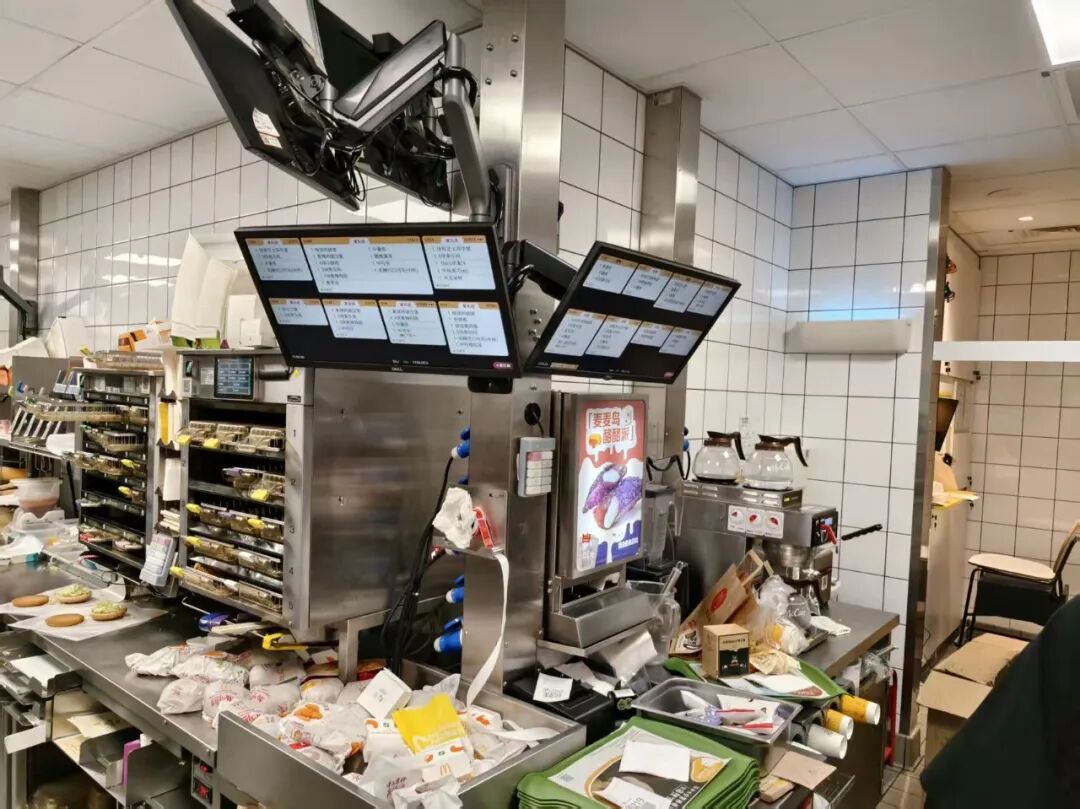
◉ The chaos at Jiang Ke’s store after a sudden surge of orders—both screens filled with tickets waiting to go out, enough to push any McDonald’s worker to breaking point. Photo: Jiang Ke
J iang Ke: McDonald’s has a service-time standard of ninety seconds. You may have experienced this yourself—your phone tells you the order is ready, but when you reach the counter it has not actually been made yet, and a staff member says, “No worries, come back when I call you.” That is because the system requires the order to be completed within ninety seconds, so to meet that target, all I can do is mark it as ready first, and then call you over once it is actually done. If the customer is in a hurry, it feels like being deceived: “It’s not ready—why are you calling me?” This rule gives customers a genuinely unpleasant experience.
Li Ye: It is not friendly to the worker either, really. The employee notifies the customer first, and then the customer turns around and pressures the employee to rush—there is a sense of the conflict being shifted onto both the worker and the consumer.
Jiang Ke: It does spark friction, especially during peak periods, but there is no way around it. Those ninety seconds are effectively a hard standard. The only time you can breach the ninety-second rule is if you are already completely overwhelmed that day.
Yu Yang: It sounds as though you are operating at full capacity every single day. What is the pay like?
Jiang Ke: Five thousand yuan before tax, and after the social insurance and housing fund contributions come out, you are left with just over four thousand. Honestly, that is still quite low for Beijing. The hourly rate is around 21 to 22 yuan—it may have gone up once at the end of 2025, to roughly 23. But your monthly hours cannot exceed 200, so in practice you end up earning just over four thousand.
This article is a written transcript of the first half of this episode of the podcast; the second half will be published this weekend—stay tuned. Jiang Ke will discuss how a small change in McDonald’s toilets can reveal shifts in the company’s market positioning over the years, how McDonald’s uses price anchoring as a psychological game with consumers, and how it keeps food costs in check, among other fascinating topics.
– This is Foodthink’s 826th original piece –
Edited by Yu Yang
| Layout by Ming Lin
Scan the QR code to tip and support original food writing
▼

▼
Click the image to read related articles
▼
Click a keyword to browse more article collections
Seeds | Farming Techniques | Policy | Fermentation | Nutrition | Fruits | Fisheries | Events | Recruitment | Food Delivery | Wet Markets | Animal Husbandry | Food Talk | Sharing Sessions | Reading Groups | Harvest Festival | Smallholder Stories | Climate Change | Rural Development | Cooperative Economics | Urban Farmers | Food Safety | Digital Technology | Biodiversity | Pandemics and Food | False Solutions | Agroecology Internship Programme
Beijing | Hebei | Shanghai | Guangdong | Guangxi | Henan | Sichuan | Jiangxi | Xinjiang | Shaanxi | Hong Kong | Chongqing | Zhejiang | Jiangsu | Guizhou | Taiwan | Inner Mongolia | Philippines | Canada | Russia | Mexico | Italy | United States | United Kingdom | Germany | Netherlands | Thailand | Sweden | Japan