
The Fungal Network Connects Nature and People | American Farmers’ Market Notes
I.
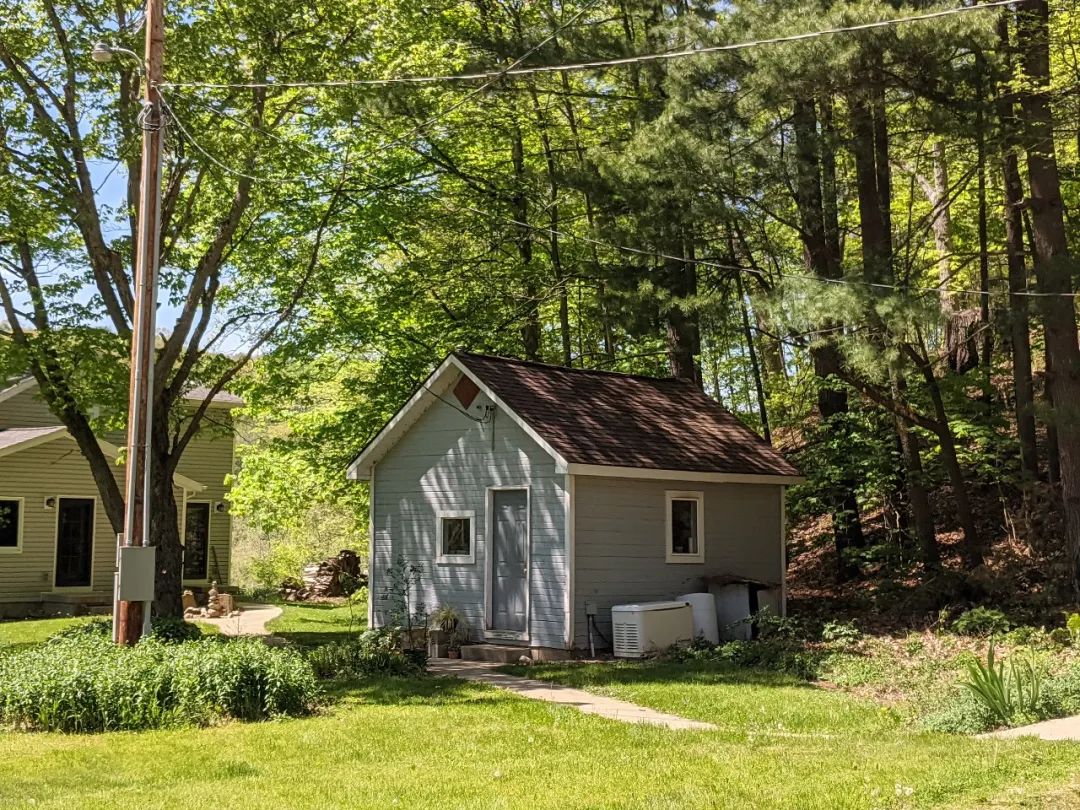
Xiaotang and Xiaowen’s home sits in a creek valley. The stream is not large—perhaps half a metre deep—but it runs year-round and can be found on maps. It flows south, joining several other waterways along the way before feeding into the Ohio River, which runs east to west, joining the Mississippi River several hundred kilometres to the west. Their farm covers roughly a hundred acres, a little over 600 mu. The mushroom house, the vegetable garden, and their little home occupy only a very small portion; most of the land is woodland.
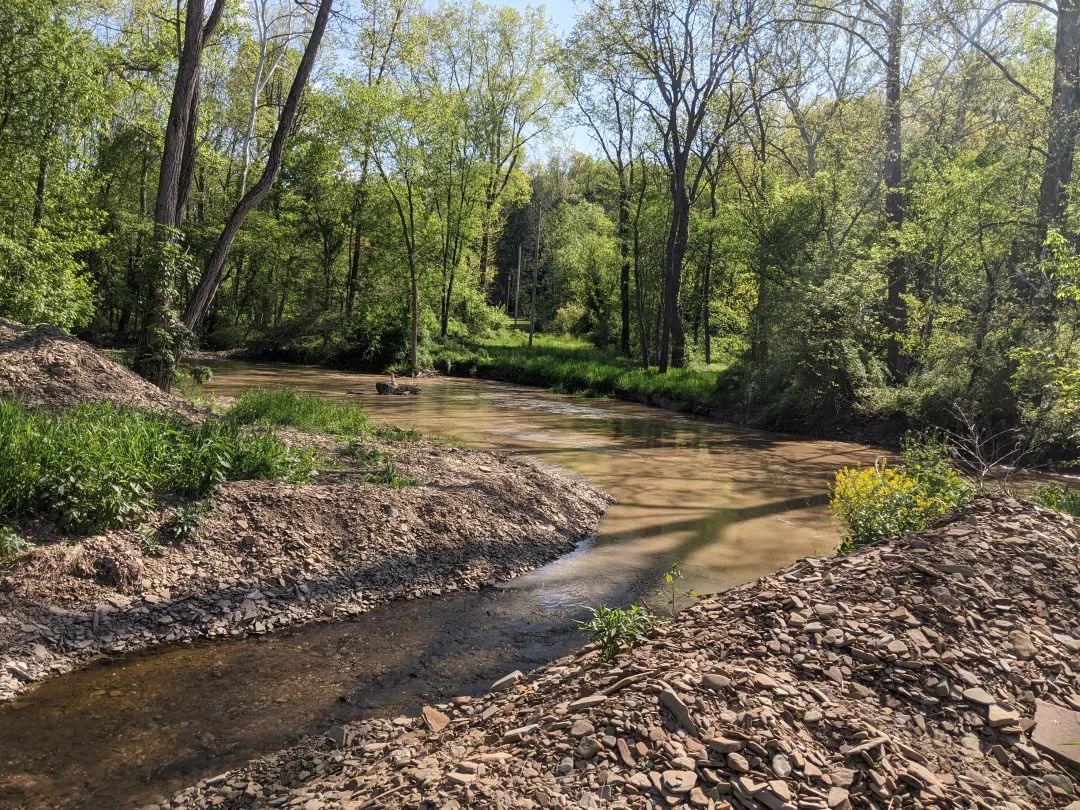
“The trees here were actually all cut down originally – it was all farmland. Then a Conservation Reserve Program came in, and basically, if your land is next to water and you’re willing to convert the cropland back to woodland, the government will pay you rent on that plot. Because soil by the water is especially prone to erosion, and if you’re growing crops you’re bound to use a lot of fertiliser, which washes downriver all the way to the Gulf of Mexico.”
The Conservation Reserve Program that Xiaowen mentioned originated in the Soil Bank programme, introduced after the Second World War. The idea behind it was that soil is a resource that regenerates very slowly: while the land area itself doesn’t shrink, the quality of the topsoil can decline, even be exhausted, and so it needs protecting.
American agriculture, for all its industrialisation, doesn’t operate quite like industry. It follows its own logic. If a particular car model isn’t selling and the price keeps dropping, the manufacturer will quickly pivot to producing something else. But when crop prices fall, farmers – in order to maintain their income – actually produce more, trying to make up for the drop in per-unit profit with sheer volume. This peculiar logic would take another piece entirely to unpack, but all I can say is that for two centuries now, this rule has held true.
And so, in the decades after the war, agricultural efficiency soared, grain prices fell, and the scale of land being brought under the plough became ever more out of control. Farming takes a heavy toll on the soil; in temperate climates, once the crops are harvested, the bare earth sits exposed to wind and rain for half the year, with incalculable amounts washing and blowing away. Against this backdrop, the United States introduced the Soil Bank programme, whose central aim was to protect soil and water, since the two are inseparable. If you protect the soil, water quality improves naturally; and if you ignore soil erosion, talk of protecting water resources is mere empty words.
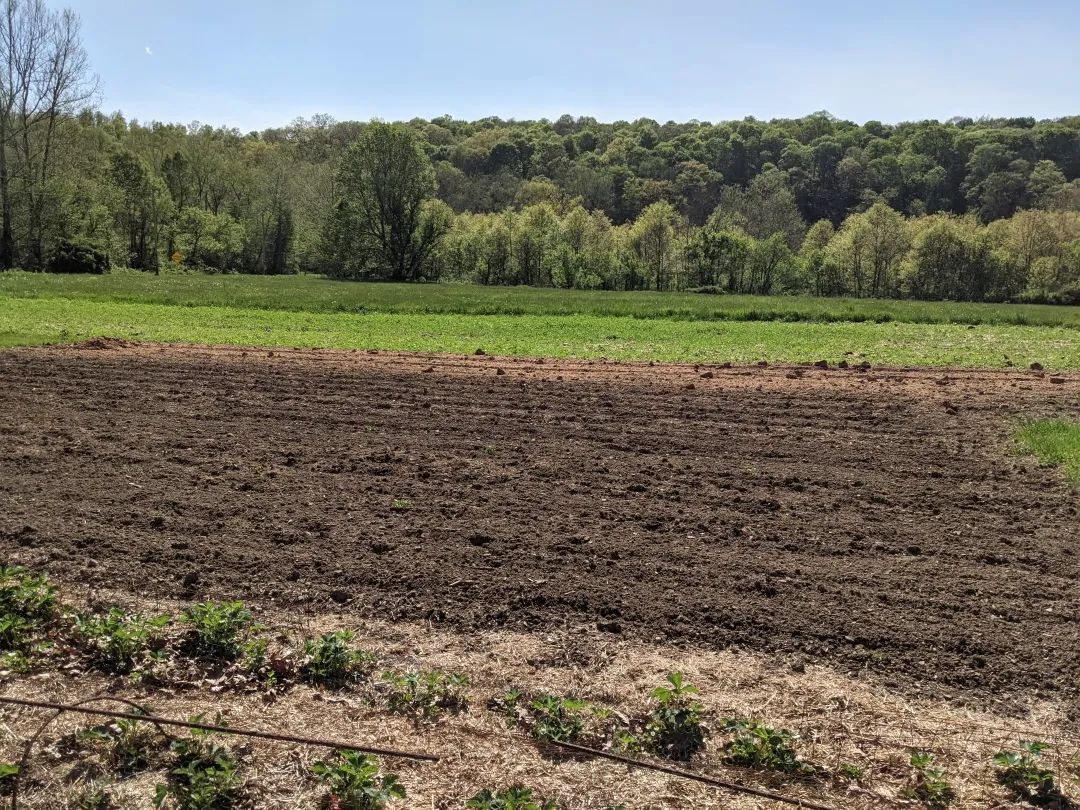
The US Farm Bill is revised every five years, and as one of its core components, the Conservation Reserve Program grew out of the Soil Bank and has been continually refined and expanded – from the conversion of cropland to woodland, to grassland, to wetland – with its goals broadening from the protection of soil and water, resources so vital to farmers’ livelihoods, to the protection of wildlife and entire ecosystems.
In an earlier piece in this series, “Farmer Lao Kai”, I mentioned the concept of an “easement” – a term rooted in medieval English law – which holds that land ownership can be divided. For instance, the government or a conservation trust might hold the rights beneath the surface, ensuring a parcel cannot be destructively developed, while the farmer retains rights of grazing and gathering above ground. These rights can be bought, sold, or passed to the next generation – in short, a mechanism that protects the environment while allowing farmers to benefit.
The Conservation Reserve Program is not the same as an easement. It does not touch land ownership; it is a different kind of arrangement, essentially the government renting land from a farmer to plant trees or restore other ecosystems, typically on ten- to fifteen-year contracts. When the contract expires, the farmer can renew, decline, or simply return the land to farming – it is still their land. Purely from an environmental standpoint, it may not be ideal, but because the overwhelming majority of land in America is privately held, it is a more flexible, more practical approach: protect what you can, however much that turns out to be.
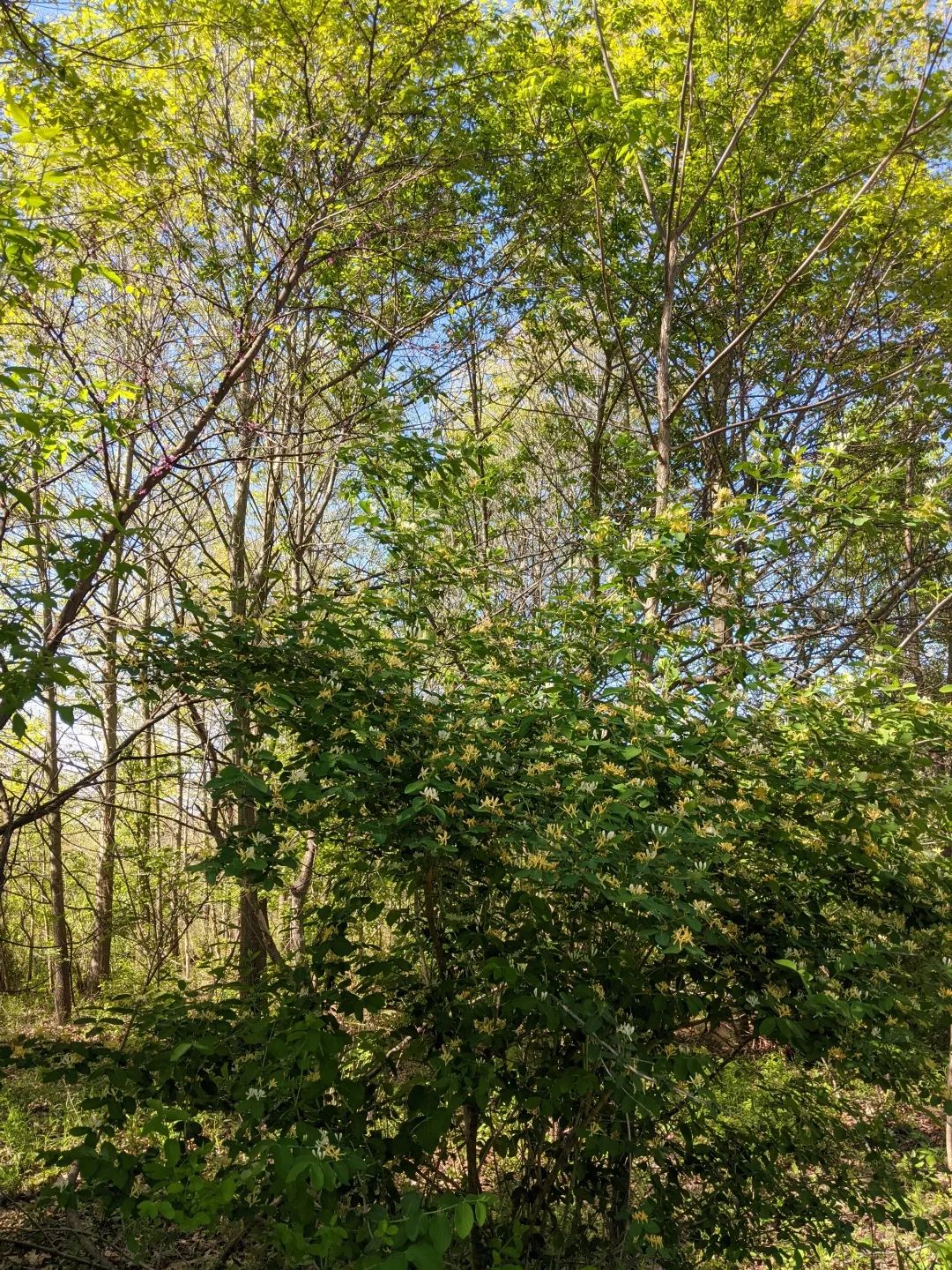
“Can you smell the honeysuckle! These trees were mostly planted by Xiaotang’s father when he was a boy. He loved honeysuckle and Canadian redbud, so the whole outer ring of the wood is these two species – in spring, you walk that path and it’s all scent. We’ve expanded the woodland a bit since then. There are wildflowers everywhere in there; I pick an armful every week for the house.”
“Does the payment for planting trees match what you’d earn from crops?”
“Not exactly. Their principle is to pay market rate. Each time we renew with the Department of Agriculture, they set a benchmark using current farmland rental rates, and they test the soil quality and water quality of your specific plot. If your soil is good, they pay more. In practice, though, with all the deductions and adjustments thrown in, farmers are bound to lose out a little. But we still prefer the trees. It’s our creek, after all – we want to keep it clear. And Xiaotang has always loved trees…”
“If the woodland catches fire or gets hit by a pest outbreak, do they fine you?”
“They have forestry specialists who come and check regularly. They’ll advise you on which species to mix to guard against pests and keep fires from spreading, and if a fire does hit, they’ll tell you what to do – which species to replant, what to prioritise.”
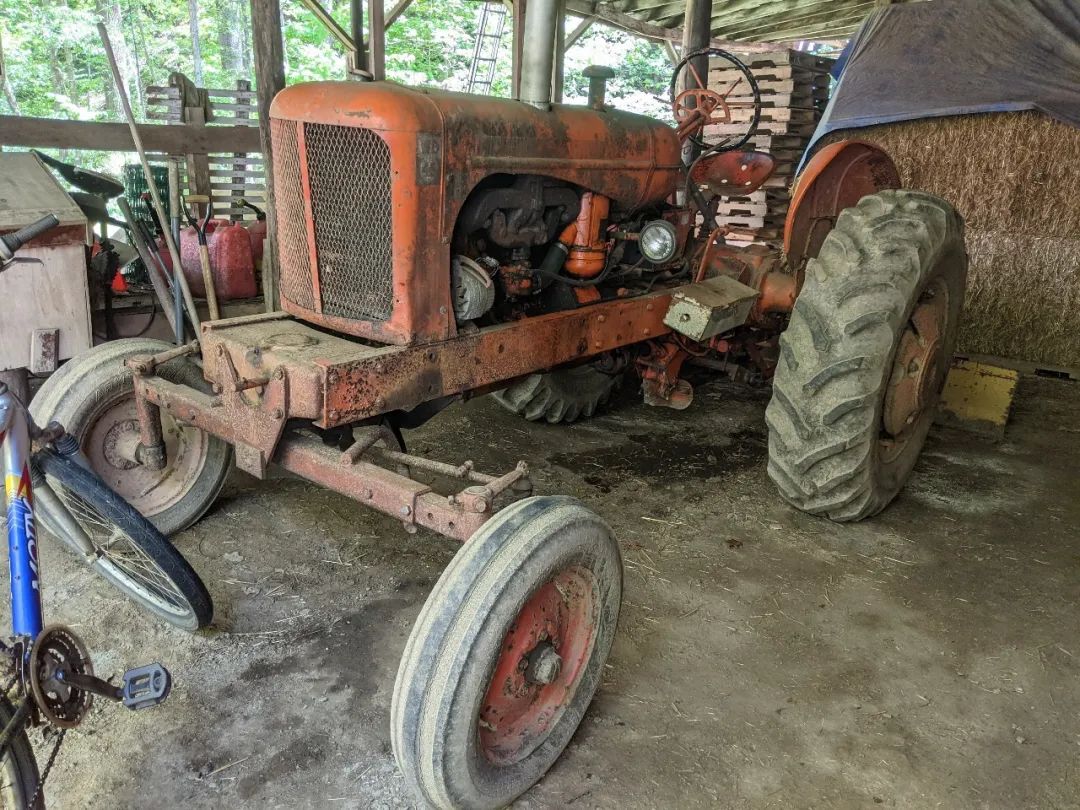
Farmers are conservative by nature – I suppose that’s true everywhere – they prefer to keep the old things: the old house, the old machinery, the old trees… They’d sooner let things run than replace them unless they absolutely must. Xiaowen’s lab has plenty of new-fangled kit, such as the laminar flow cabinet (clean bench) Xiaotang built for her, but directly opposite the lab is an 1890s cow barn. The shiitake room inside that converted barn houses a rather magnificent autoclave (an enormous pressure cooker), and parked at the door is a 1945 tractor – an Allis-Chalmers. Xiaotang uses it on a small plot to grow potatoes, and when the harvest is too much for them, he sells the surplus at the market. I’ve bought his potatoes, never realising they’d been grown by a tractor the same age as my parents.
“Oh right, you know old Tom who sells meat at our market? He’s always picking up second-hand farm machinery, fixing it himself, then selling it on.”
“I know of him, but we’re not close. Fixing old tractors is a massive trade. Farmers like us who don’t grow much land could never afford a new tractor – we all buy old machines. At the rural festivals, many of the tractors parading down the street in their bunting are nearly a century old.”
Xiaotang and Xiaowen’s mushroom business is one of a kind at our little market – no competitors. And every election, the candidates they back don’t match those the majority of farmers support. After all these years at the market, they don’t seem to be close with just anyone either; there’s always a faint air of being set apart. But when they get talking about matters that concern farmers, you can see in their quiet certainty that they’re speaking about people of their own world.
Just then, mid-tractor-chat, their son Little J came back. The boy had only just finished university, hadn’t settled on what he wanted to do, so he’d moved back in with his parents, learning the mushroom trade and the business side, juggling a few jobs. Mr Fatty Tiger, unable to hide a city-dweller’s innocent bewilderment, blurted out: “Tractors have gears too, don’t they? Are there automatic ones?”
I glanced nervously at the family of three, half expecting a snigger, but no one was laughing – they were all earnestly considering the question. Little J gave the most empiricist answer: “I used to work on another farm, driving fairly new tractors, and they were all manual too. Work machines need a higher degree of operator control – manual’s probably the right call.”
II
About ten years ago I suddenly developed an allergy to Xiaotang’s shiitake – a mild form of poisoning, really. Mushroom toxicity is another of those things that are wonderfully unpredictable. A mushroom that countless people eat without a second thought may prove toxic to certain individuals; indeed, the same species may be poisonous when grown in one environment and perfectly harmless in another.
Xiaotang’s shiitake look very different from the ones at the Chinese supermarket – much more slender and delicate, nowhere near as fragrant as the dried variety, but in my memory impossibly tender and silky. I was rather addicted to that texture at the time. Over the past decade Xiaotang’s output across all varieties has been steady, and apart from me, I’ve not heard of anyone else reacting badly. Beyond selling at the market stall, they supply roughly ten local restaurants. Unlike most of the farmers at our little market, the couple have no second job or side income – they farm mushrooms full-time and put their two children through the state university.
And yet just fifty years ago, not a single fresh shiitake could be found anywhere in the United States. The Department of Agriculture had barred imports of shiitake spawn, reportedly because they’d confused shiitake with a lookalike called Neolentinus lepideus. In English, Neolentinus lepideus has a common name – the “train wrecker” – because it loves to grow on railway sleepers, where it breaks down the lignin into sugar until, bit by bit, the wood collapses into pulp. During the Civil War, this shiitake cousin destroyed several railway systems in the South, which, by all accounts, was one small factor that helped tip the balance in the North’s favour.
Shiitake is rather a difficult mushroom to cultivate. Its mycelium takes a very long time to grow, and the timing of fruiting is almost impossible to predict. In ancient China they used what is called the “flower-cutting method”: you carve a pattern of notches into a length of log and wait for mysterious spores in the forest to find their way in, or alternatively pound up fresh shiitake into a paste and smear it into the wounds, then wait two or three years – you might get a crop, or you might not. In the twentieth century, Japanese researchers developed various inoculation techniques that could guarantee mycelium growth, but knowing when an inoculated log colonised through with mycelium was ready to fruit remained a mystery. For a long time, East Asia relied on the ancient Chinese “startle-the-spawn” method: once you reckoned the mycelium had matured, you’d choose a full moon and hammer the log hard – a good beating, they said, could coax out the mushrooms.
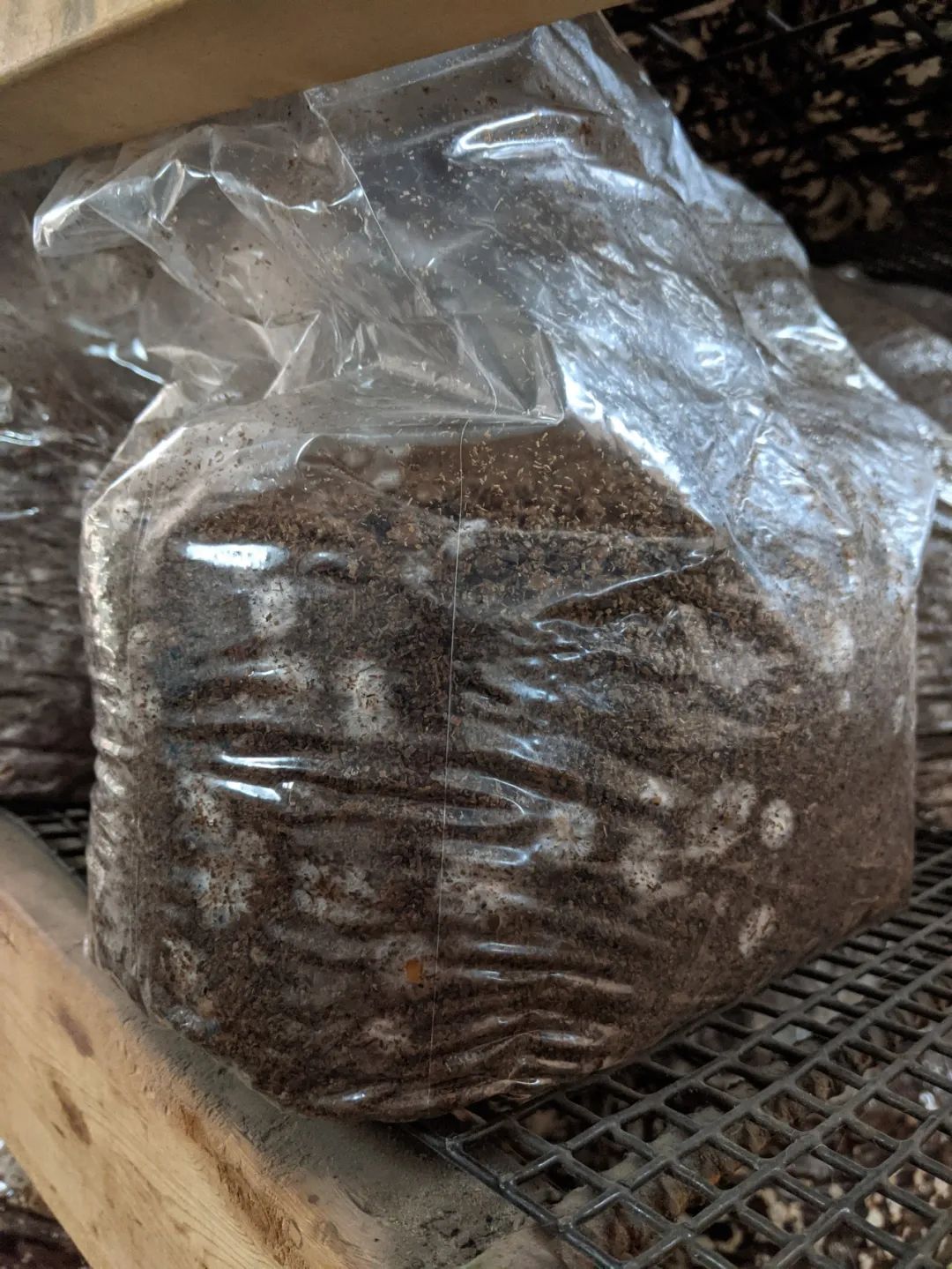
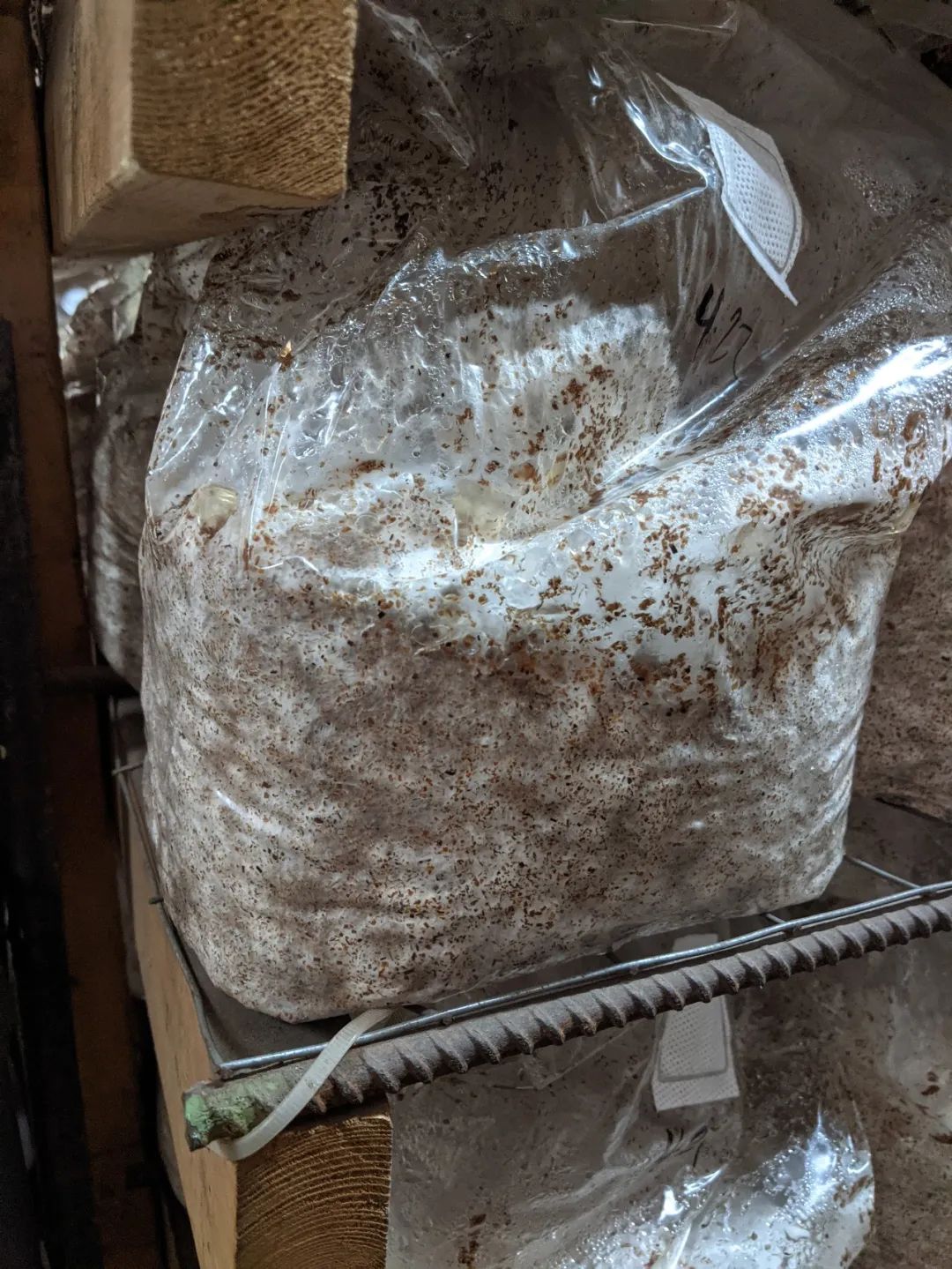
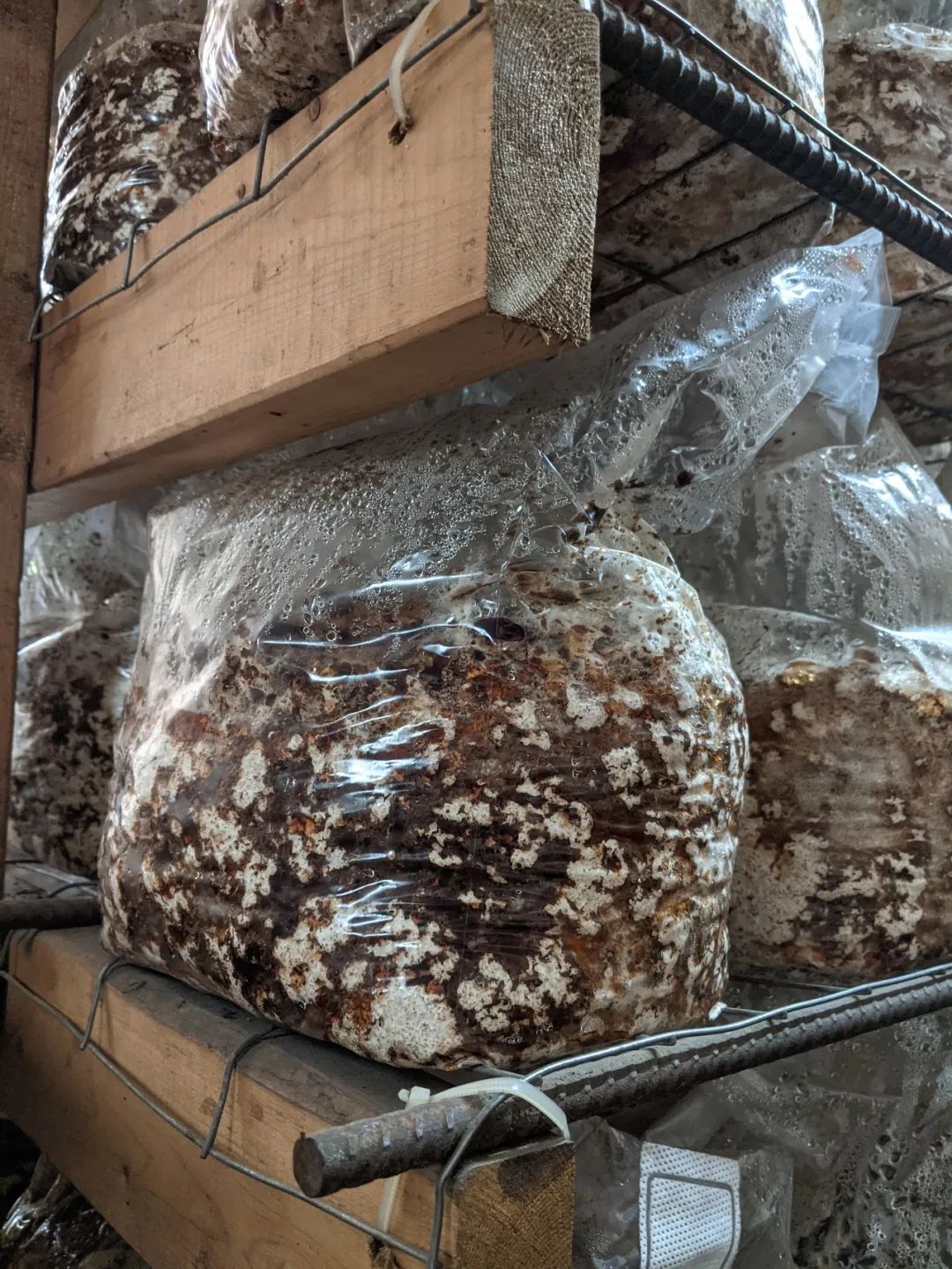
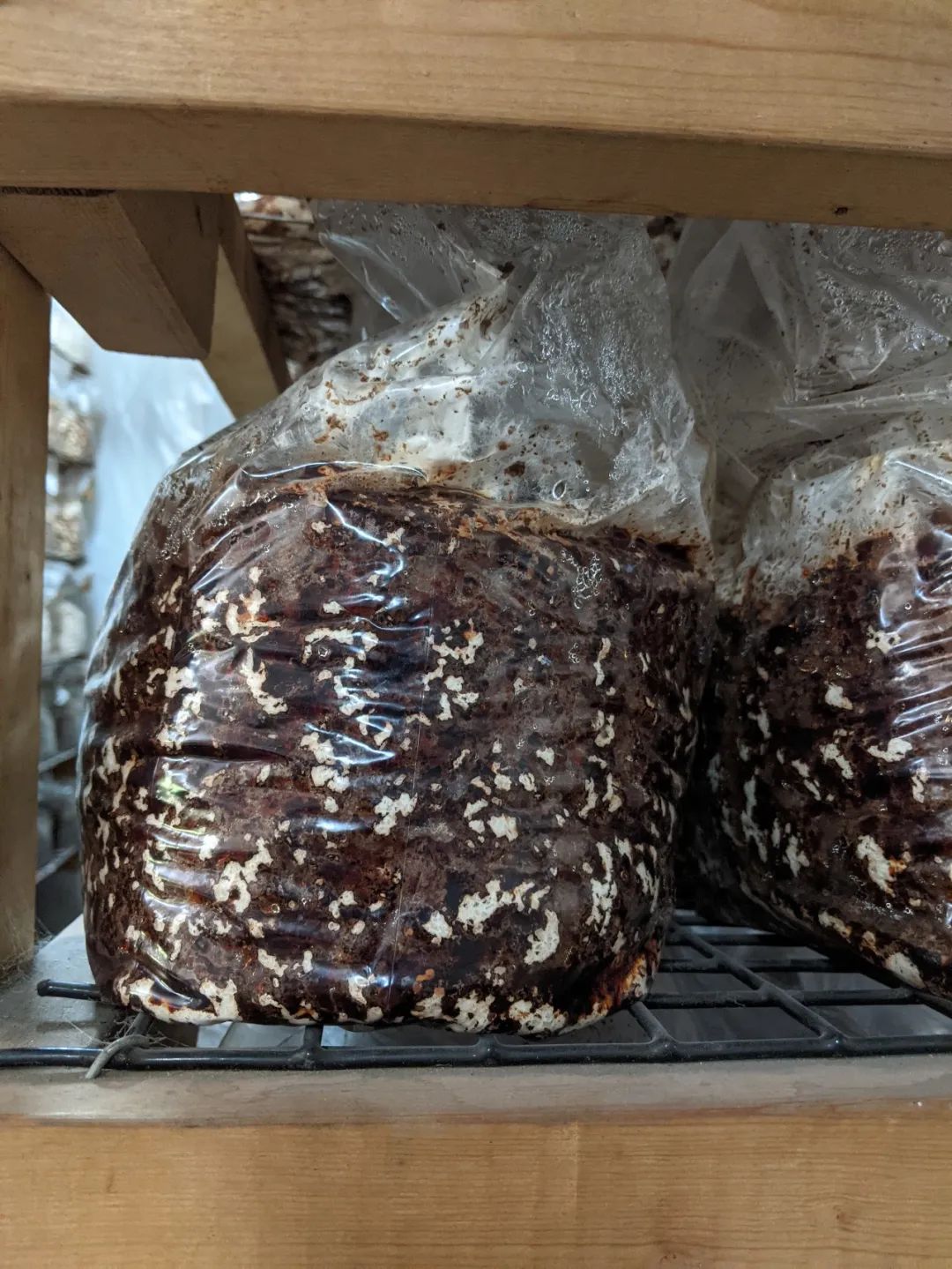
Xiaotang’s farm uses the sawdust cultivation method developed in the 1970s by Lambert Spawn, the American spawn company. Sawdust is mixed with grain to make the substrate, spawn is added, the whole thing is sealed in a plastic bag, left to incubate for a while, and then the bag is removed entirely – de-bagging. By then the mycelium has bound the originally loose sawdust into a solid block, a near-solid piece of wood exposed to the air. A thin brown “bark” will even begin to form on the surface; once that bark covers the block completely, it is ready to fruit. The trick to fruiting is really a temperature drop – move the block into a room below twenty degrees Celsius and shiitake will appear. The whole cycle takes about three months.
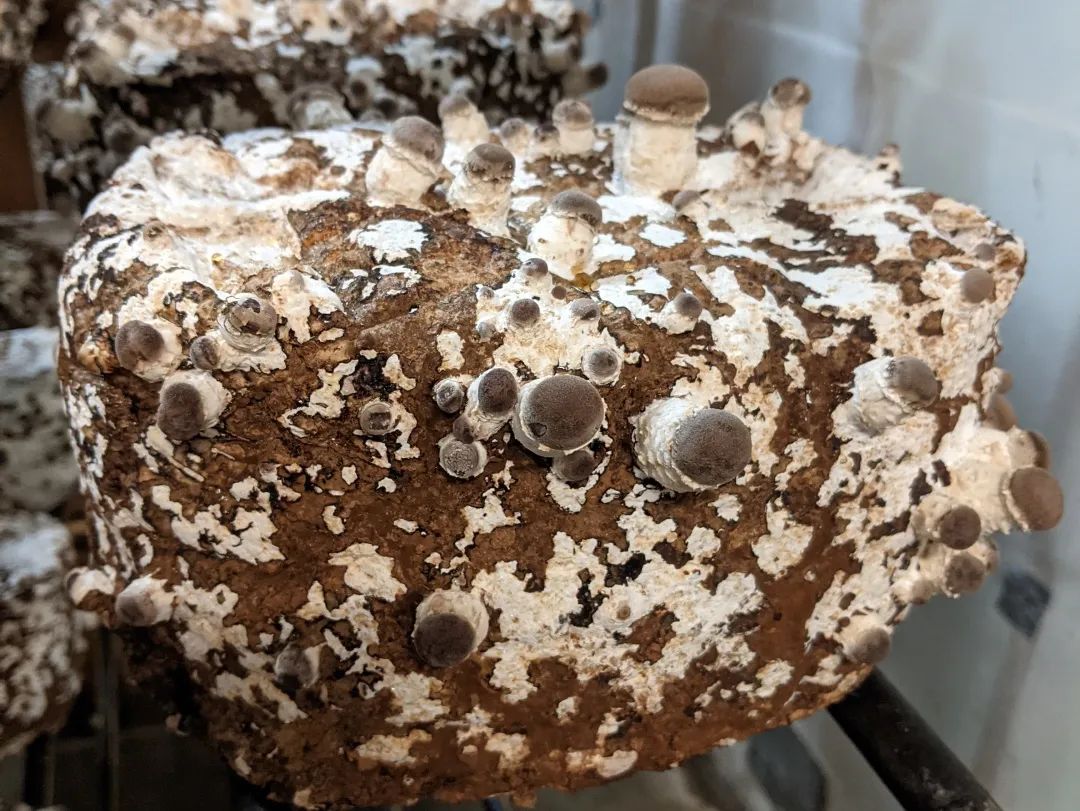
Xiaotang also has a few logs by the creek inoculated with shiitake. These ones are thicker and more fragrant, and people are willing to pay a premium for them. The whole process takes a year and a half, but a single bucket of cold water thrown over the log will trigger fruiting. After a log has produced a few flushes of mushrooms, its lignin is fully broken down – so soft and rotted you could tear it apart by hand.
“So which mushrooms, in the end, simply can’t be cultivated?” I asked Xiaowen.
“Broadly speaking, saprotrophic ones can be cultivated; mycorrhizal ones can’t. Wild mushrooms probably taste better because of exactly that – they must grow alongside a living tree. Dead matter cannot satisfy their nutritional needs, but that means there’s no way to farm them commercially. People are trying, but it’s enormously complicated. A single tree alone won’t do it – the fungus needs a whole stand of trees. If the trees are too large, the inoculation won’t take; if they’re not yet large enough, it won’t fruit. It has to grow up with those trees, so you’d have to inoculate seedlings and then wait for them to reach full size – and that’s the question of whether you can afford to wait.”
A fungus forms a symbiotic relationship with a plant by wrapping its mycelium around the root tips. This intertwined underground structure is called a mycorrhiza. Wherever there is vegetation, below the surface there is usually a vast, interconnected web of mycorrhizae forming a trade network: the mycelium uses its extraordinary ability to break down everything it touches to obtain nitrogen and minerals, which it trades with the plant for sugars; plants also exchange nutrients with one another through the mycorrhizal network, and in doing so the mycelium, acting as middleman, probably takes a commission.
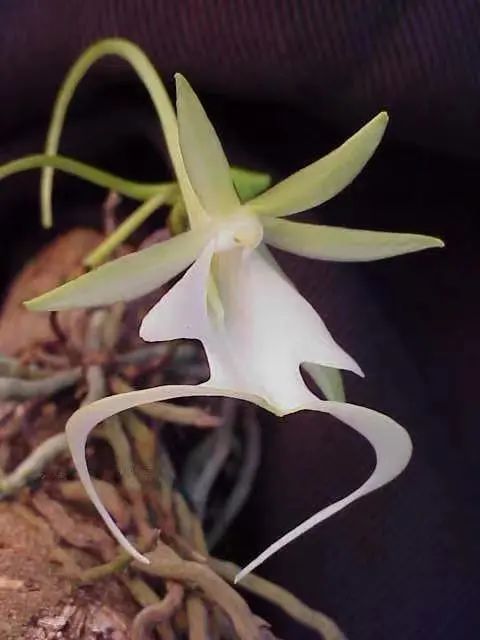
I learned the name of a plant from Xiaowen’s T-shirt – a pure-white plant called the ghost plant. She told me it emerges in the woodland in summer, ghostly, having no chlorophyll of its own; it grows on the mycorrhiza and is entirely sustained by the mycelium shuttling nutrients from other plants to feed it. I once also spotted, deep in California’s towering redwoods, a sapling showing albinism – standing tall and graceful, almost certainly raised the same way, coaxed upward by the neighbouring mature trees and the fungi threading through the soil beneath.
Of course, nature is indifferent; biological evolution has not arrived at this point to do charity. Within the fungal kingdom there are all manner of livelihoods – for instance, forming a symbiosis for a while before killing the partner host and immediately switching to a saprotrophic existence. That is well within their repertoire. Then there is tremella, which I once mentioned to Xiaowen. I had always thought it was just a white version of wood ear, but they are entirely different things. Tremella appears to grow on wood, but in fact it is parasitic on other saprotrophic fungi. The way the techniques for cultivating tremella developed step by step to their present state – the very thought makes my head spin.
So perhaps the reason many mycelium technologies are developing so slowly, and costs refuse to come down, is simply that market demand has not yet reached the tipping point. Mycelium, at different points in its growth cycle, can shape a pile of loose material into form or break down a solid structure entirely. Exploiting this property, some researchers are packing agricultural waste such as cottonseed hulls and wheat bran into moulds, inoculating them with fungi, letting them grow to a set density, then extracting them and heat-inactivating them to fix their shape and hardness – producing biodegradable packaging shells as alternatives to polystyrene foam, even building materials – though a compostable house remains a bit of an imagination stretch. These technologies are still far from mature, but if market clamour ever reaches the urgency of a populace demanding tremella and shiitake on their tables, breakthroughs will probably be just around the corner, don’t you think?
III.
“So were we! Though our high school was so big, we barely knew each other back then.”
“We got together in high school. After that I went to our state university right nearby, while Xiaotang went off to university in New York State. We drove back and forth so many miles between us – and there’s something that might seem hard to believe now: we used to write each other actual paper letters…”
“Ha! We wrote letters for two years too. He was in America, I was in China – there was no VoIP back then, and an international call cost a dollar a minute.”
“Oh my, we were never separated by anything that far. We got married right after we graduated – I work at a hospital, Xiaotang’s an engineer.”
“What do you do at the hospital?”
“Laboratory work – haematology, chemistry, microbiology – I’ve done them all. So when it came to mushroom spawn, I picked things up rather quickly, heh. Xiaotang studied mechanical engineering, minoring in electrical engineering. All the underground pipework on our farm is his handiwork.”
“My sister followed them both, into the sciences,” Little J chipped in from the side.
“I remember she was thinking of applying to our art school here back then.” We old regulars who’ve been shopping at the little market for well over a decade have watched this generation of children grow up.
“That’s right, but art school was far too expensive – we genuinely couldn’t afford it. She liked science anyway. I’m the only humanities student in our family – history.”
“American history?”
“European history. Though our state’s public university has a rule: history majors, no matter which region they specialise in, must earn a certain number of credits in local history.”
“Do you know old Lou who sells chicken and beef at the little market? He’s a history graduate too, and he’s on the board of our local archaeological society. They give a talk every month, and the October lecture is always about local archaeology. We never used to go to the October one, but increasingly I find the history right here, around me, fascinating.”
“I know Lou – I’ll ask him about the lecture next time. I do enjoy local history myself, actually.”
“So how did you set up the farm in the end?”
“I was exhausted from the hospital work, and Xiaotang didn’t enjoy his job either. We saved for a few years, bought some land from his parents, and just then a friend gave us a book about growing mushrooms. We started planning it in ’95, came back every weekend to do the groundwork, grew our first crop of mushrooms in ’99, applied for the farmers’ market – and then at last we could quit our jobs!”
“Mum, look – the kiwi vine is flowering!”
“You can grow kiwi fruit in our climate?”
“It’s a cold-hardy variety – the fruit comes out about the size of grapes, a Chinese cultivar. Little J loves kiwi fruit, so we planted them last year. We don’t know if they’ll bear fruit – the birds ate almost all our blueberries and raspberries last year.”
“If they actually ate them, I could bear it, but the truly infuriating thing is they don’t even really eat them – they peck a tiny hole in each fruit to taste it, and then the whole lot just rots.”
“Fruit growers have it so hard – fighting these birds every single day. Even netting doesn’t work; lots of birds can squeeze right through the mesh. Mushroom growers like us have it much easier in that respect – everything’s indoors.”
“And people like us who only know how to eat – even easier. Take a pair of binoculars to watch the birds, then buy fruit at the supermarket.”
“Ha! Actually we love watching birds too. If you don’t enjoy wildlife, living out here would be rather hard. Little J and his sister have loved animals since they were little.”
“Once when I was small, my sister caught a whole bucket of snakes and carried them home to show Mum. She left the bucket in the kitchen and went to find her – by the time they came back, the bucket was empty.”
“Did you catch all the snakes in the end?”
“Let’s just say – I’m pretty sure there are no snakes in the house now.”
“I came into your kitchen for the loo earlier – it’s gorgeous!”
“Mum made all the kitchen tiles – fired them herself.”
“Didn’t you also fire some vases to sell at the market? They were really special!”
“Those pieces were fired right here in this pit. There’s no glaze – the colour comes from yeast.”
“From what?”
“It’s really much like raising bread dough – a bucket of water, add sugar and yeast, a bit of flour, and leave it to ferment for a few days. I use the clay from by our creek. After shaping a piece, I heat it in the pit; at the peak of the heat I pull it out with tongs, dip it a few times in the fermented liquid, then plunge it into clean water. Many clays simply crack at that stage. Our clay is very similar to Shigaraki clay from Japan – it can take a fair amount of handling. I quite like the way they turn out: sometimes the surface looks like animal fur, sometimes like plant grain. The pattern varies depending on the temperature, or how you dip the piece. They say it’s protein that leaves the pattern – as for the exact science behind it, I couldn’t tell you.”

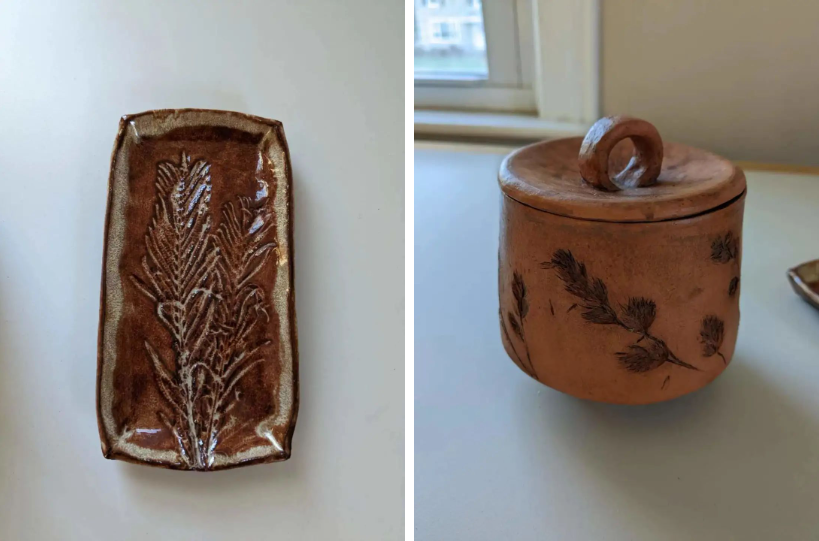
Clay pots, coloured by the fungi in the earth – quite extraordinary. This is a technique from the medieval Baltic region. Far from advanced, one might say, but eight centuries on, someone in an Ohio Basin creek valley still knows how to use it, someone’s shelves hold pots like these. There’s something rather wonderful in that – much as I savour my kumis every day, wholly unaware that I owe a quiet debt to the Turkic peoples who first perfected it.
History is a vast mycorrhiza, linking every person to every other. You cling to a single thread of mycelium and in a flash are transported to who knows when, who knows where. I’ll stop here for now and leave it to another day to go on tracing how nutrients travel through this infinitesimal yet boundless network – symbiosis and saprotrophy, inheritance and variation.
Author’s Note: My husband Mr Fatty Tiger and I live in a small town in the Great Lakes region of the American Midwest. Our local farmers’ market has been running for nearly thirty years; we have been part of its story for more than a decade. This series is an attempt to record the stories of the farmers we have come to know at the market, along with a few of my own observations on American agricultural economics.
Unless otherwise noted, all images are by the author
Editor: Tianle