An Art Experiment Ended by Chicken Thieves

In late August, Xu Lingni (pseudonym) discovered that the 10 chickens and 2 geese raised on the hill had gone missing.
This was a chicken-raising cooperative initiated by staff and students at the Sichuan Fine Arts Institute, located on its Huxi Campus in the western outskirts of Chongqing. The campus, set among hills and alongside water, is renowned for preserving its original pastoral farming landscape. Members fenced off an area on the hillside for the coops. Before heading home for the summer holidays, the cooperative’s president, Xu Lingni, installed an infrared camera. Surveillance clips she later posted on Xiaohongshu showed the following scene: at night, several men walked into the coops with torches in hand, cigarettes between their fingers; as they emerged, each clutched one or two flapping chickens.
The sight left the staff and students in the cooperative utterly heartbroken. Xu Lingni said she had barely slept in those days. She eventually chose to report the matter to the police.
This was not the first time trouble had befallen the chickens.
Last summer holidays, two of the five chickens were already lost—one to illness, one vanished. Open the cooperative’s Xiaohongshu page and obituaries for individual chickens appear intermittently along the timeline. Some had died from animal attacks; others from hypothermia brought on by torrential rain. While students found solace in raising chickens, they also had to endure the grief of watching these fragile lives pass. Rebuilding genuine bonds between people and nature, between humans and animals, and indeed between people themselves is the very core of the chicken-raising cooperative as an artistic process.
“The road has not been smooth. We have weathered summer farewells and losses, and come to recognise more deeply that coexisting with living beings means embracing uncertainty.” In September 2025, a recruitment post publicly released by the chicken-raising cooperative read thus.
But this time, the wholesale theft of the chickens and geese exceeded the staff and students’ expectations of “uncertainty”.
The chicken-theft incident first gained traction online and grew into a public outcry. Chongqing police launched an overnight investigation and ultimately established that seven workers on an on-campus summer construction project had seized the chickens and geese and already shared them out for eating off site. The workers involved were temporarily detained, and the head of the construction project paid on their behalf the chicken-raising costs plus 7,000 yuan in compensation for the students’ emotional distress.
A greater blow followed. The incident once again provoked voices questioning whether poultry should be kept on campus, and the school decided to no longer permit chicken-raising. This meant that China’s first-ever university chicken-raising cooperative, sustained for a year and a half, was brought to a halt.
Tilling Chickens
The cooperative’s full name is the Happy Chickens Raising Cooperative. It forms an important part of the Yuyuan Project. Yuyuan began life as a corner piled high with construction debris. Six or seven years ago, Jin Lipeng, a lecturer at the School of Experimental Art, led students in repurposing the rubble to lay paths and build raised planting beds. He hoped to turn wasteland into a nursery for healing—healing nature as much as healing people.
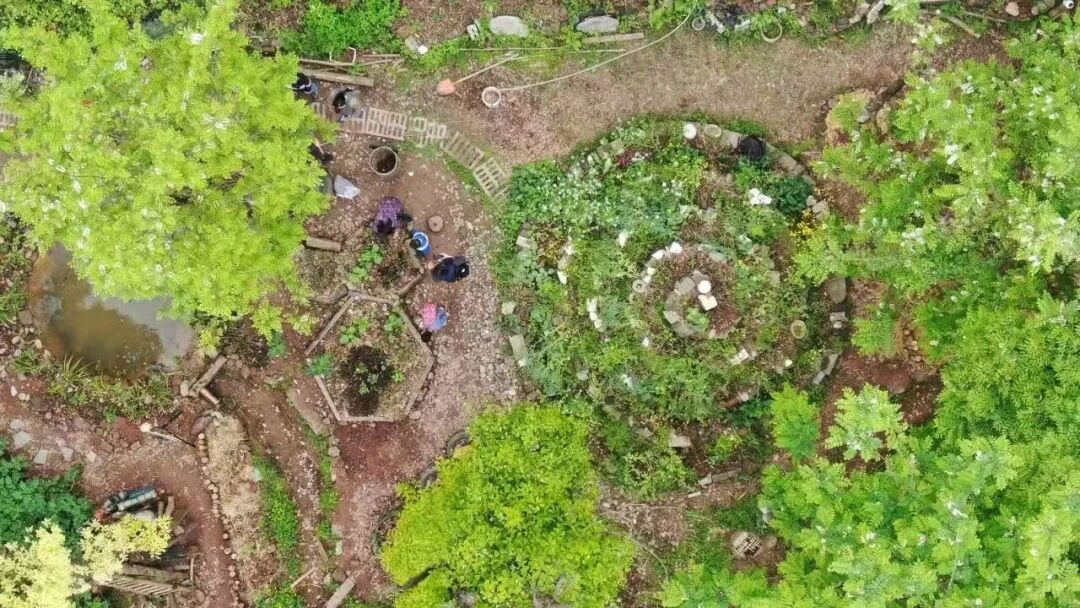
◉ An overhead view of Yuyuan. Photo: Xiaoshu
Jin Lipeng has long taught ecological art, concerned with how direct action might respond to the ecological crisis. To that end, he and his students have stood outside parcel lockers discussing where their food comes from and what it does to their bodies. They have visited waste-sorting stations to inspect the mountain of takeaway containers, asked maintenance workers to lift the septic-tank lid and explain the Blackwater system, and followed cleaning staff as they foraged for edible wild plants… He wants to awaken a somatic awareness of food, environment and climate change in his students, then let that knowledge flow between people through communal labour.
Before the Yuyuan Project took shape, the university canteen produced several hundred jin of raw food waste each day, which was hauled unsorted alongside plastic waste to a refuse station, compacted there, and then carted to an incineration plant dozens of kilometres away. Seeing nutrition that could have returned to the soil go up in smoke, staff and students began composting at their home base, Yuyuan. In the years since, roughly 40 tonnes of food waste have been converted into fertiliser. Through composting by hand, students come to understand soil and material cycles.
Yet this composting cycle seemed to be missing something. Last spring, Jin Lipeng supervised a postgraduate student’s thesis project on a “mobile chicken coop.” Its central idea, “Tilling Chickens,” drew on Permaculture: chickens play multiple roles in an ecosystem—aerating the soil, catching insects, clearing weeds, converting food waste into manure for further composting, and, of course, providing eggs. In short, having identified the many ills of the long-chain, industrialised food system outlined earlier, “Tilling Chickens” became the solution Jin Lipeng and his students wanted to put into practice within the campus space.
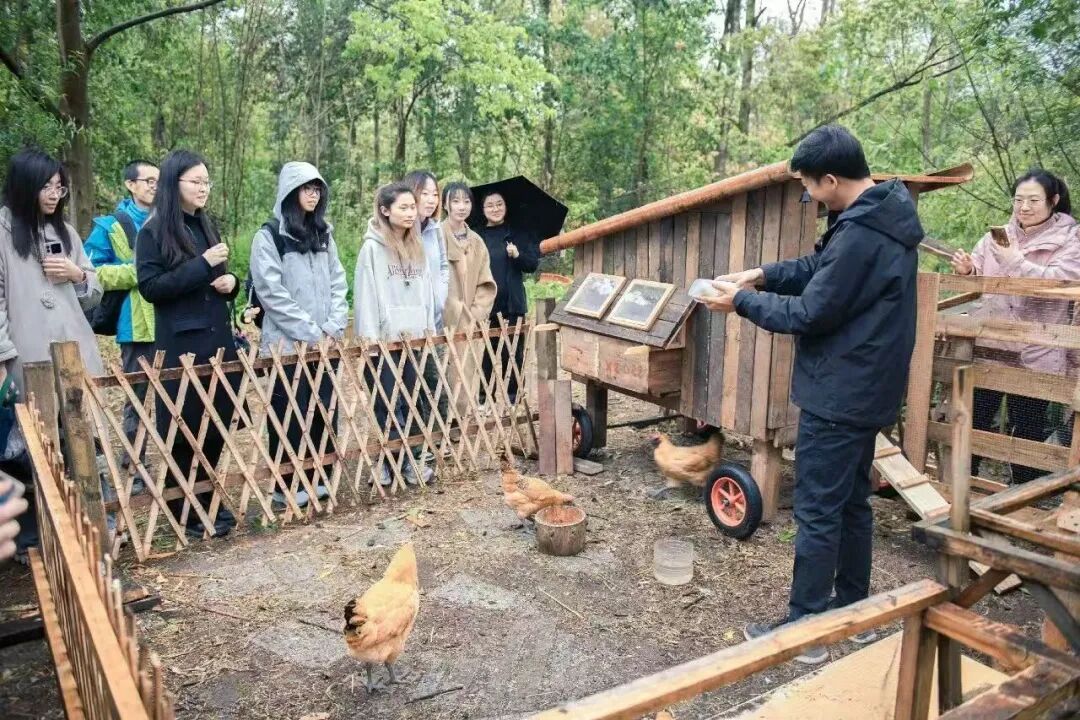
◉ Postgraduate Deng Jun and Lü Miao, a furniture-design student, designed the coop’s key components, which were then assembled with participants at a workshop. Image source: WeChat official account “Eco-Art Action”
The five local Chongqing red-crowned, black-skinned chickens that the student had bought for the graduation project thus became the earliest flock on campus. Undergraduate Xu Lingni, who had been taking part in Yuyuan activities, met the chickens then. She adores animals; as a child she dreamed of opening a zoo, and her present career ambition is to work for a wildlife-protection charity—nothing to do with her sculpture major, as it happens. She began looking after the chickens of her own accord, buying grain out of her own pocket and taking them to the vet when they fell ill.
Last summer, too, was a turning point. Throughout August in Chongqing, temperatures exceeded 40 °C for days on end. People retreated indoors with the air conditioning cranked to full blast. The staff and students who still had to go outside to tend the chickens were confronted by a harrowing sight: the vast air-conditioning and temperature-control system of the art museum roaring ceaselessly; the campus ponds, starved of water, needing constant replenishment with mains supply. It made them reflect: with climate change intensifying, how long could this way of getting through summer, so utterly dependent on artificial systems, be sustained?
That summer, one chicken died of heatstroke and another vanished. Of the three remaining, two more disappeared. Worried that the lone bird would be too lonely, Xu Lingni went to the wet market and bought another. But no sooner had she brought the new arrival home than one of the missing chickens wandered back.
The coop was back to three chickens. A few days later, Xu Lingni opened the coop to find six unfamiliar young chickens inside. After asking around, a cleaning lady eventually confessed that she had bought them, stowed them in the coop, and meant to fatten them up for the table. The students had a word and bought the six birds from her. Meanwhile, another student spotted chicks being sold at a ring-toss booth while out shopping, felt sorry for them, and brought them back to the coop.
They named this chick “Tricycle.” But Tricycle was too young, and the older chickens would have nothing to do with her. She ran down the hill on her own to fend for herself and accidentally ate rat poison. Xu Lingni rushed her to the vet for stomach pumping and surgery, then took her home to convalesce for a spell. The medical bill of seven or eight hundred yuan was covered by a student crowdfunding drive.
To help Tricycle integrate into the flock, Xu Lingni also bought a Luhua chicken and a Five-black Chicken. She kept the three of them together in a large cage, hidden away in a classroom for nearly a week, and only let them back onto the hill once they had grown accustomed to one another.
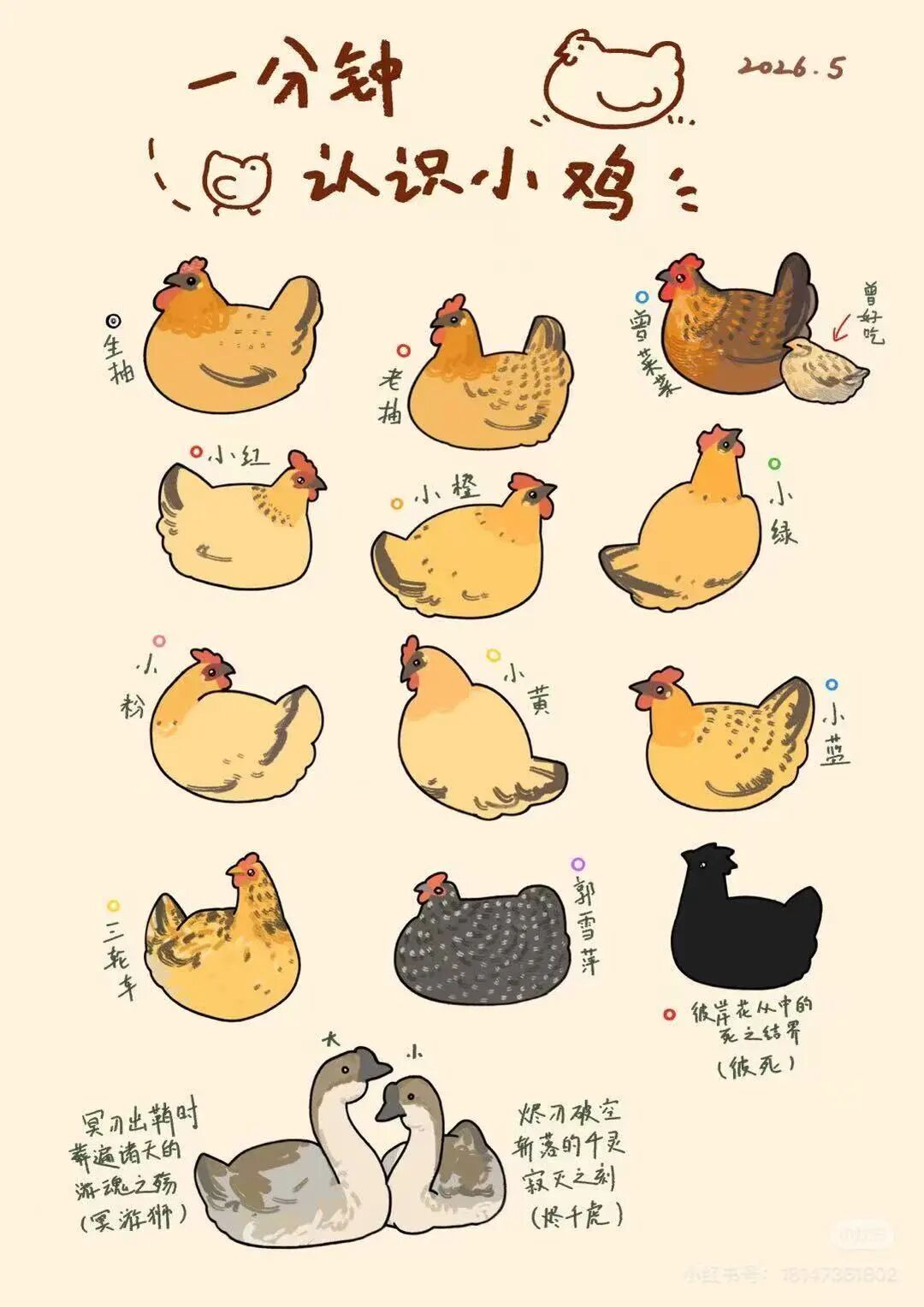
◉ Xu Lingni’s hand-drawn illustrated guide to the flock. Every chicken has its own name. Image source: Xiaohongshu “SFAI Happy Chickens Raising Cooperative”
This is the story of every chicken’s origins by the time of the theft. Apart from the Five-black Chicken, which perhaps went unnoticed as its dark plumage melted into the night, all 10 of the others were stolen.
Healing Chickens
By then the flock had kept growing, the eggs had become too plentiful to eat, and more and more students had fallen in love with the chickens. Jin Lipeng, who had long been interested in labour issues, proposed setting up a chicken-raising cooperative. He asked Xu Lingni if she would be willing to serve as its president, and she agreed without a second thought.
Neither of them had the slightest idea how a cooperative should be run. So they trawled the internet for references and, drawing on common sense, forged their own rules: members took turns looking after the chickens, selling creative merchandise, and dividing tasks between design, writing and managing social media accounts. This past June they even sent a student with strong spoken English to an international conference to share the cooperative’s practices. Member perks included collecting eggs for free and buying the cooperative’s creative merchandise at cost.
The cooperative’s core members are all women. Finding healing through caring for the chickens is perhaps the single biggest reason they joined—and also the reason the project has won so many students’ hearts. One girl has an especially deep emotional bond with the birds, often buying feed with her own money to tend them, and fellow members have even seen her crying with a chicken cradled in her arms. ‘So the theft hit her particularly hard, and she wasn’t the only one who suffered psychologically,’ said Xu Lingni.
Some said they had had virtually no social life before joining the cooperative—now they had friends, something to do, and a sense of purpose in life. “Raising chickens is a form of labour; she makes friends through the labour itself, and changes herself through being with animals.” Xu Lingni believes this is what sets the cooperative apart from hobby clubs where students simply sing and dance.
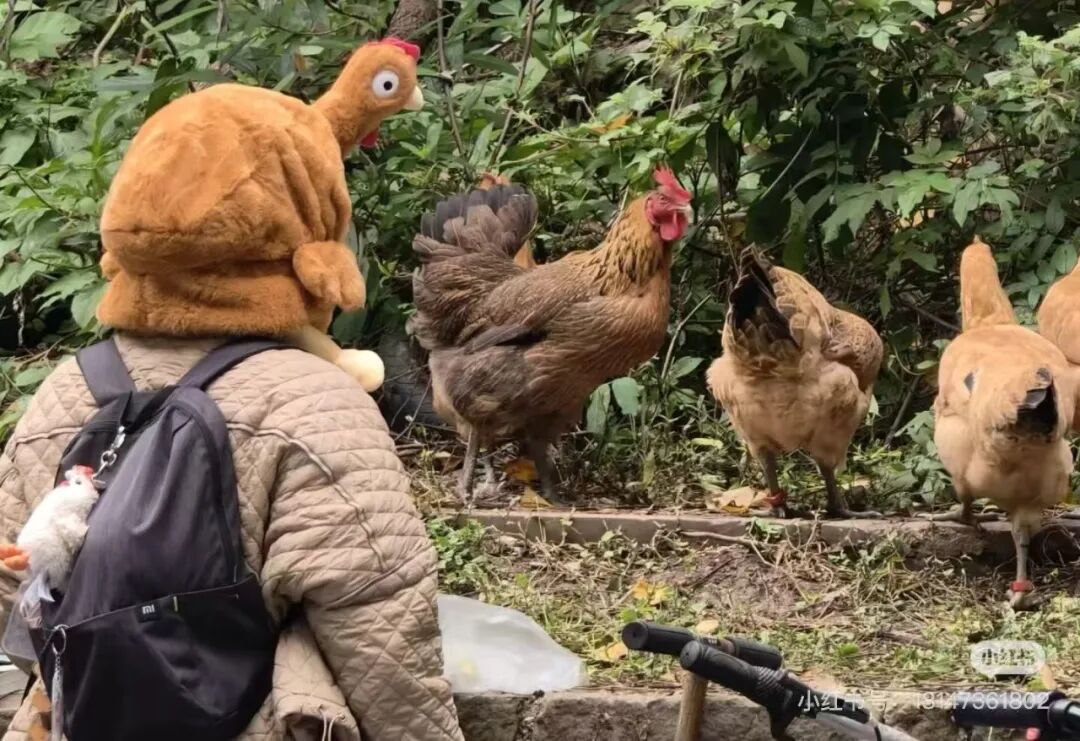
◉ Many students have found healing in caring for the chickens. Image source: Xiaohongshu “SFAI Happy Chickens Raising Cooperative”
Xu Lingni is equally frank, admitting she doesn’t share Jin’s lofty ideals—she started raising chickens simply because she loves them, and it was only while looking after the birds that she gradually came to understand topics like Permaculture and climate change, which once seemed so remote yet turned out to be deeply personal.
Every morning at eight or nine, the first shift of duty members arrives to feed the chickens. The feed is a mix of various ingredients—vegetable leaves and fruit peels that Jin Lipeng brings back from the canteen, grain bought by the students, and shell powder added for calcium. After classes end at noon, the second shift heads up the hill to clear out the droppings and compost them on the spot together with any leftover food waste. The resulting organic fertiliser is used to grow the vegetables and ornamental plants the chickens and geese eat.
“University students generally have no idea where eggs come from, or where our food waste goes, or why we burn rubbish. Plastic waste from food delivery piles up around our dorms. Delivery riders are at real risk of heatstroke in extreme weather. Yet students have little awareness of the link between all this and drought, extreme heat, and carbon emissions.” During a public presentation of the project, Xu Lingni said, “What we are doing is making people feel, in their own bodies, the pressure and causes behind climate change—and showing that, through campus-based Community Supported Agriculture, we can stage a small act of resistance.”
On fair days the cooperative can collect eight eggs a day; on poor days only one or two. Most of the flock are red-crowned, black-skinned chickens, which lay relatively few eggs. The smallest of them all, the Five-black Chicken, lays almost every day—though her eggs are tiny.
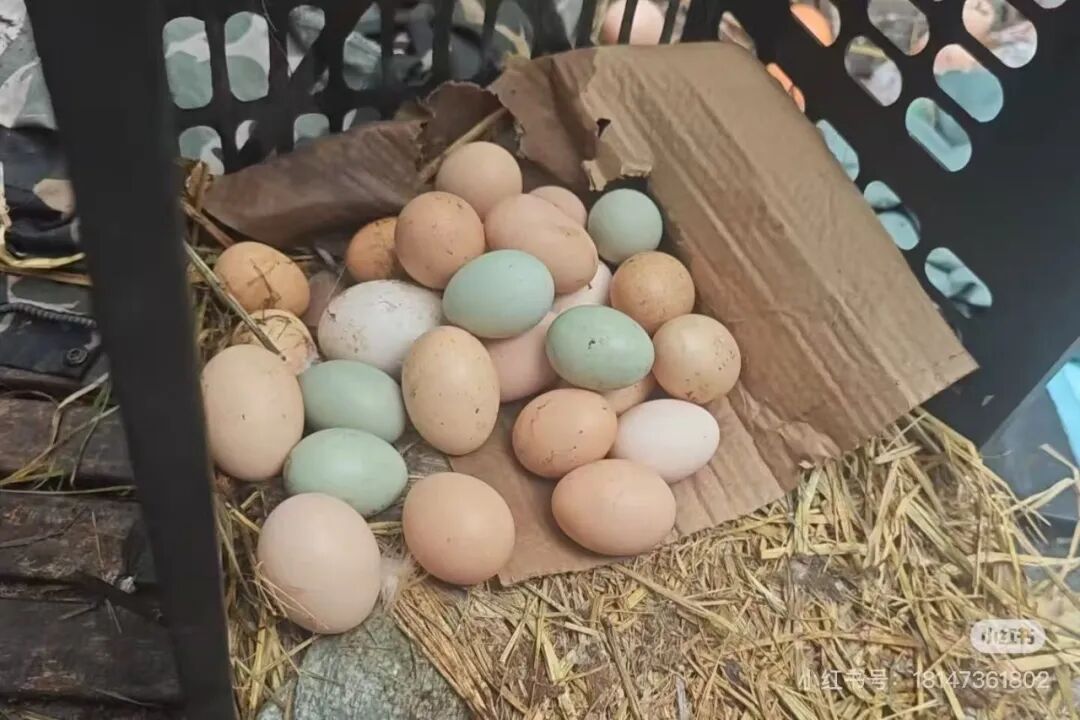
◉ Named, identified eggs—the cooperative’s important assets. Image source: Xiaohongshu “SFAI Happy Chickens Raising Cooperative”
Xu Lingni rents an apartment off campus, where a fridge keeps the eggs fresh. Once she has built up a batch, she drops a message in the WeChat group of several hundred members, then hops on her electric moped to make the deliveries. Since most students live in dormitories where they cannot cook, her customers are mainly teachers and nearby residents. “Our eggs are delicious—boiled plain, there’s no fishy flavour,” said Xu Lingni, who is a fussy eater and can clearly tell them apart from ordinary shop-bought eggs.
Each egg sells for 1.5 to 2 yuan, which counts as a premium price in suburban Chongqing, so the eggs don’t sell easily. Xu Lingni worked out that, in total, she has earned just over 500 yuan from selling eggs.
Chickens at Risk
In October 2025, the students registered a Xiaohongshu account to share the daily goings-on with their chickens. Close-ups of chicken heads, bottoms, and fluffy feathers easily rack up hundreds of likes—evidence that netizens, too, find healing in the birds. Many have become devoted fans, commenting with envy that SFAI is truly a place of freedom and romance.
Not everyone agrees. The most common complaints are from students about the geese pooping on the pathways. One commenter wrote under a Yuyuan WeChat public-account post: two geese waddling along, dropping as they go, then leaving a calling card right at the dormitory door. “Lots of students are walking and looking at their phones and step straight in it, then track it inside the building,” the comment read.
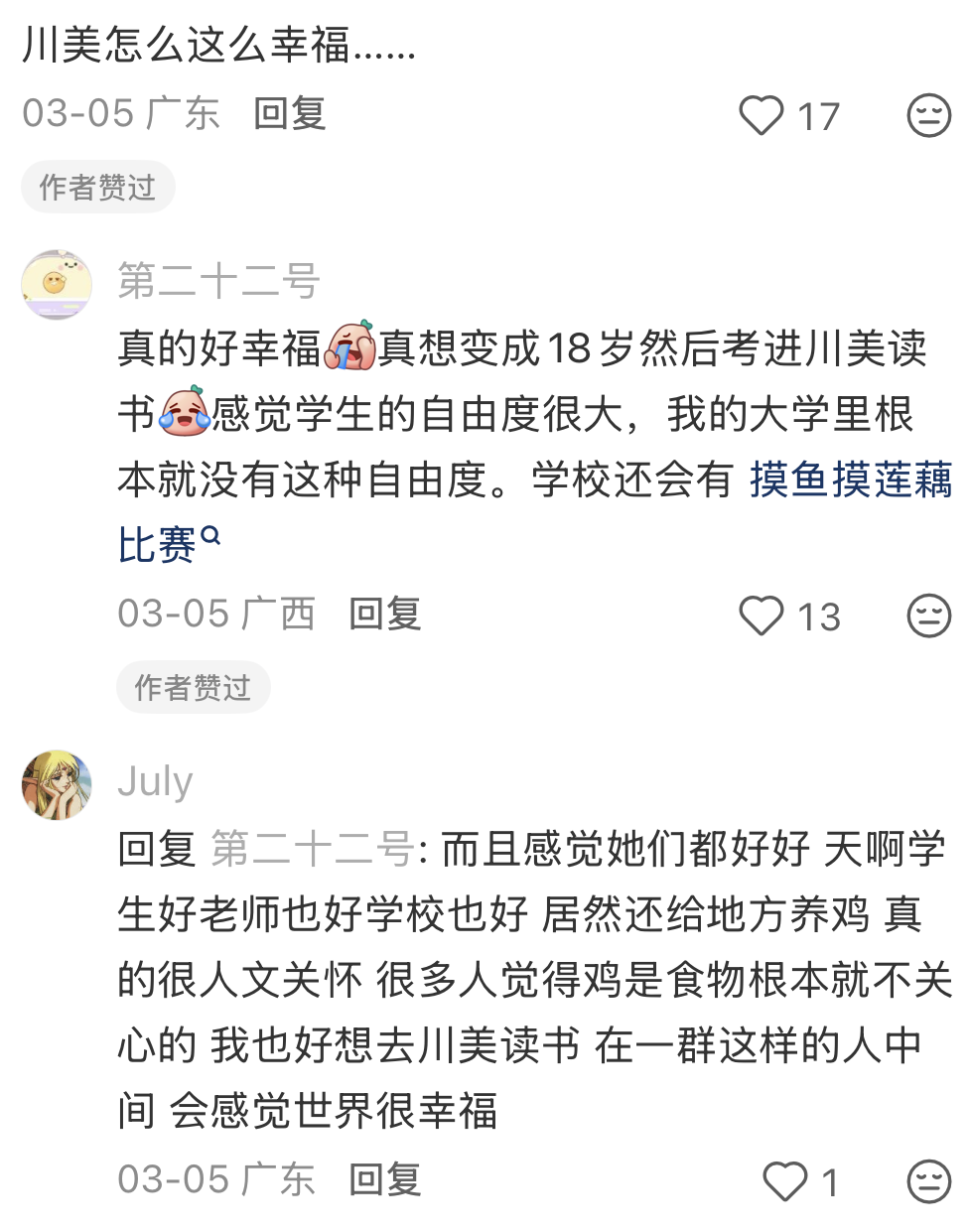
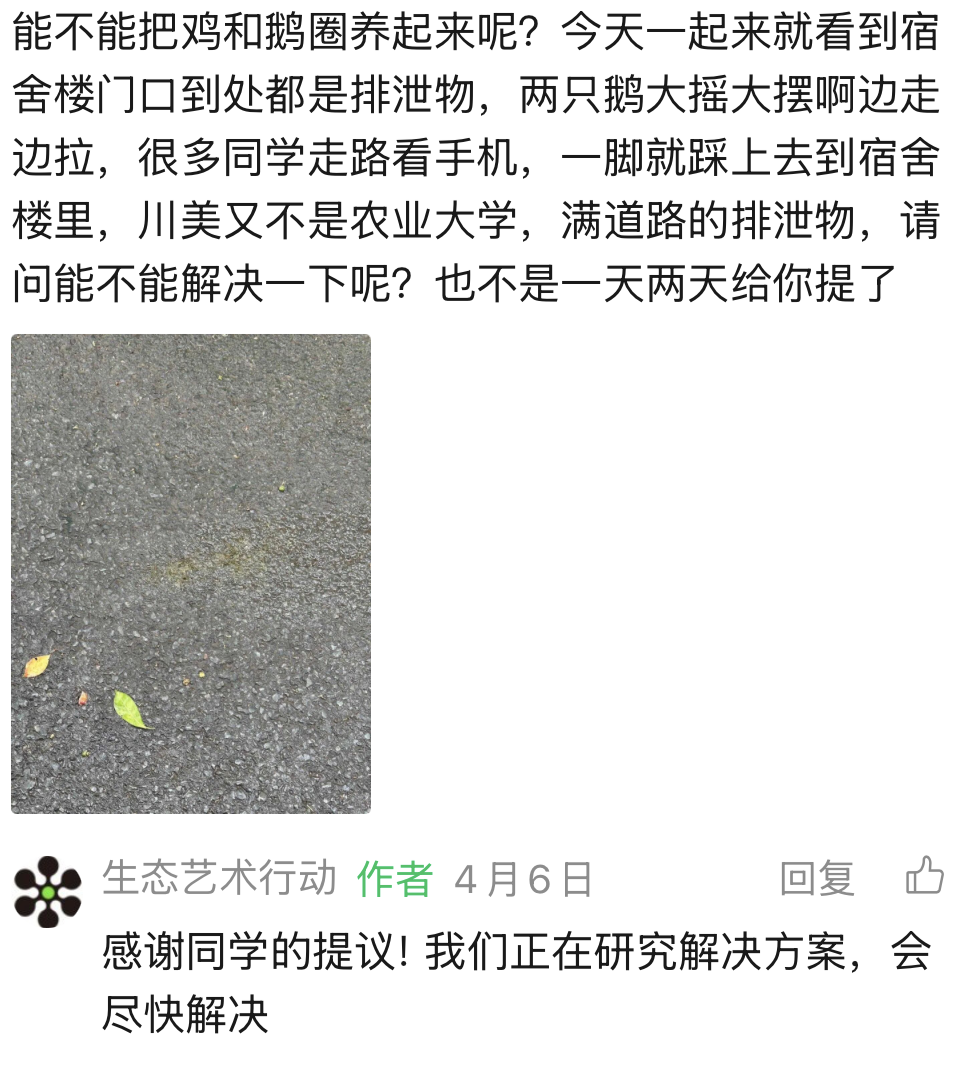
◉ Keeping chickens on campus divides opinion: some love it, others find it a nuisance. Image sources: Xiaohongshu “SFAI Happy Chickens Raising Cooperative” (left); WeChat public account “Ecological Art Action” (right)
“But wild birds poop on the paths too,” Xu Lingni pointed out.
Can chickens actually be raised on campus? The most recent relevant regulation that can be found is the Chongqing Central Urban Area Poultry and Livestock No-Rearing Zone Delimitation Plan, published in 2022, which designates cultural, educational, and scientific-research areas as no-rearing zones. However, the threshold it sets for the scale at which a no-rearing rule kicks in is a poultry and livestock farm with a year-round standing stock of 200 or more pig-equivalent head, and the plan even encourages smallholder backyard keepers (year-round stock of fewer than 20 pig-equivalent head) to carry out on-site resource recovery of their livestock waste.
The dozen-odd chickens and geese kept on the SFAI campus as an art experiment clearly fall short of farm scale, yet their purpose is not the same as that of a smallholder either. Foodthink learned that complaints about the chickens have been filed not only with the school but also with the relevant authorities of the Chongqing municipal government. On matters falling in this regulatory grey area, the university has long maintained an open and tolerant stance, but has asked staff and students to ensure proper enclosure and separation.
So the cooperative bought tall mesh fencing and supplemented it with old picket fencing, enclosing the chickens within the hillside. But the students never locked the fence. “Everyone can come and go freely, because it’s a public-interest project on campus—if a student wants to play with the chickens, they can go in any time,” Xu Lingni explained.
The cooperative took precautions against external threats, too—they bought two young geese and raised them to full size, hoping the birds would serve as guards for the coop. “They bite pretty fiercely. One time I went up the hill in a raincoat; they didn’t recognise me and bit me,” Xu Lingni said. The only marauders the students had imagined were stray cats, stoats and the like. Thieves had never crossed their minds. The two geese, naturally, were stolen too.
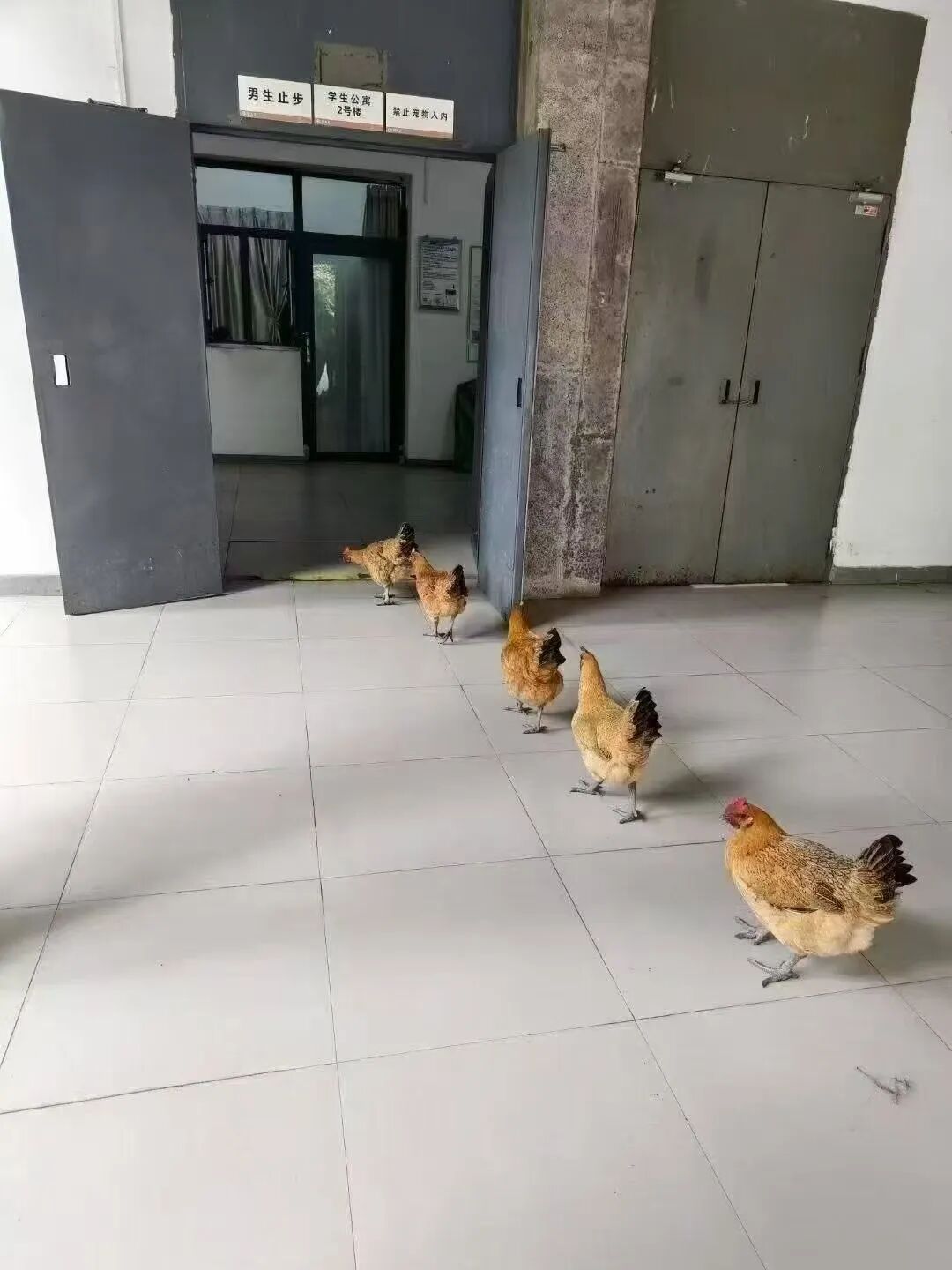
◉ This photo of “chickens queuing to enter a dormitory” has spread widely online. Reactions split into two diametrically opposed camps: supporters think the chicks are adorable and prove the school has a big heart; opponents argue that poultry should not be kept on campus. Image source: Xiaohongshu “SFAI Happy Chickens Raising Cooperative”
As the one who deals with the school administration, the questions Jin Lipeng must answer are far weightier than chickens fouling the paths: when poultry is kept on campus in close contact with students and staff, how do you manage the safety and hygiene risks?
Jin Lipeng’s doctoral research focuses on animal ethics and contemporary art, and he has long been a critic of industrialised farming—he is himself a vegetarian. He has written pieces arguing that industrialised farming not only threatens animal welfare but also precipitates crises for the environment and human health. As far back as 2012, he created the large-scale art installation “The Chicken Project” as an artistic response to the industrialised harm inflicted on farmed animals. Since then, through his art and teaching, he has continued to lay bare problems invisible to the public eye, such as antibiotic dependency and the breakdown of natural flock behaviour in poultry under intensive farming conditions.
In his view, the widespread belief that industrialised farming systems are more hygienic, safer, or healthier than free-range poultry is simply a misconception.
“Jin is a bit more idealistic; I tend to think more practically,” Xu Lingni said. “Only by making sure the chickens are alive and living well—healthy and safe—can we prove the cooperative’s worth.” She spends half an hour each day climbing the hill to inspect the coop, and plans ahead for the winter and summer breaks: who takes duty shifts, how to keep the coop warm or cool, and how to guard against avian influenza during peak seasons. The vice-president’s mother happens to work as a dormitory manager at an agriculture-and-forestry university, and she helps the members reach out to veterinary students to ask which medicines to give a sick chicken.
Chickens as Creative Merchandise
The eggs don’t bring in much, but after all, this is SFAI—the cooperative’s main income comes from selling chicken-themed creative merchandise. Their Xiaohongshu account has nearly 6,000 followers and 120,000 combined likes and bookmarks. Members have designed merch including fridge magnets, tote bags, and scarves. Some students have used the chickens as subjects for their graduation projects, which the cooperative then turns into creative merchandise. All the chicken-themed goods are spread thickly across the tabletop, and one can push a two-wheeled cart with a single hand to take the stall on the road. Encouraged by enthusiastic inquiries from netizens, they have also started selling by mail online.
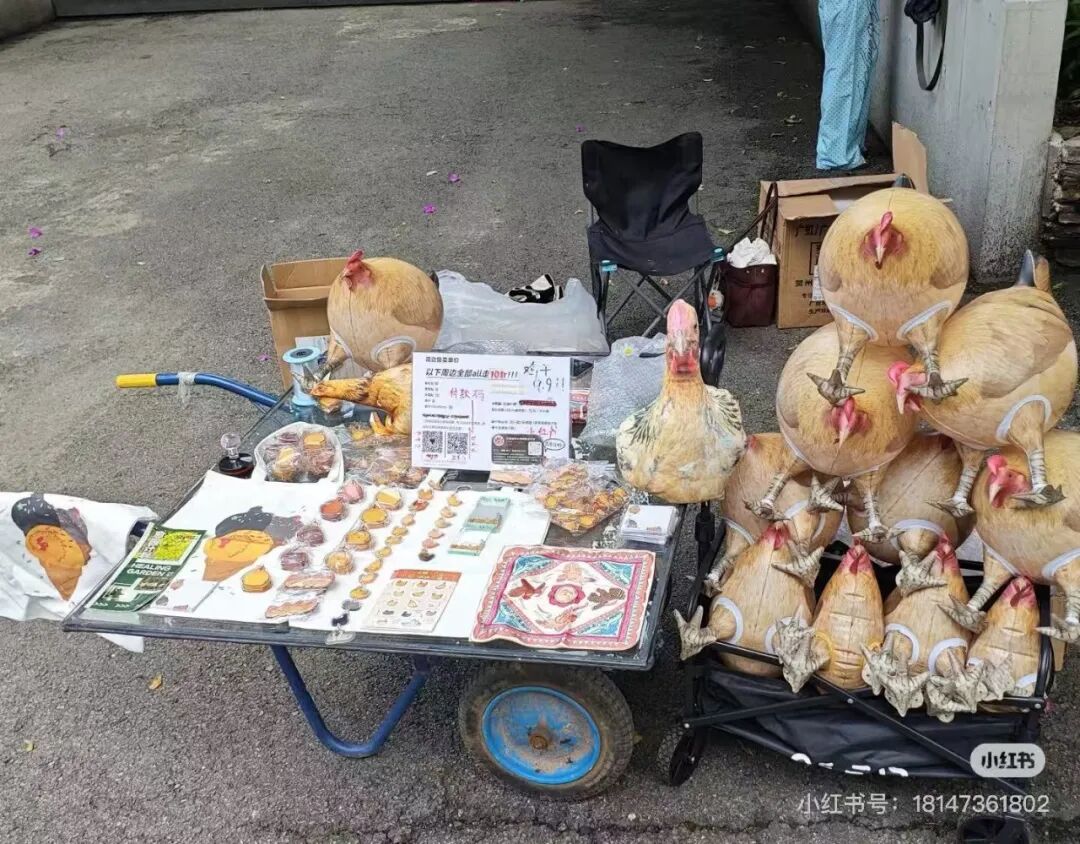
◉ The cooperative made a small profit from chicken-themed creative merchandise. Image source: Xiaohongshu “SFAI Happy Chickens Raising Cooperative”
The cooperative’s chickens have clearly become a small internet-celebrity IP. Not only did they quickly break even; as of now, the chicken creative merchandise has netted a profit of 1,000–2,000 yuan. Of course, this is also built on Xu Lingni’s self-exploitation as president—she designed most of the merchandise but takes no commission.
This modest profit doesn’t satisfy her. “If one or two chickens need surgery, the money’s gone in no time.” Still, she isn’t particularly worried. “Our project leans towards the therapeutic—students feel the chickens belong to everyone, and if a bird needs help, they’d all do their best to look after it.”
This is also why, once the theft broke, students flooded online with angry posts: “Give our chickens back!” “Bring the chickens home!” “My babies are gone!” … The public outcry may have pressured the police to solve the case swiftly, but it also became the push behind the school’s poultry ban.
The Future of Chickens?
Had the chickens and geese all survived, there would have been so much still to do, according to the plan drawn up by staff and students: sharing egg-based food beside the food-delivery lockers to prompt reflection on excessive plastic use; compiling weekly “birth records” for each batch of eggs, detailing feed sources and the volume of food waste converted, and publishing the carbon footprint. They also hoped to write a reproducible Campus CSA Action Handbook, encouraging other universities to establish their own CSA communities.
*Note: CSA stands for Community Supported Agriculture—a model in which producers and consumers work directly together. Consumers pay in advance before the growing season begins, sharing both the risks of cultivation and the seasonal harvest.
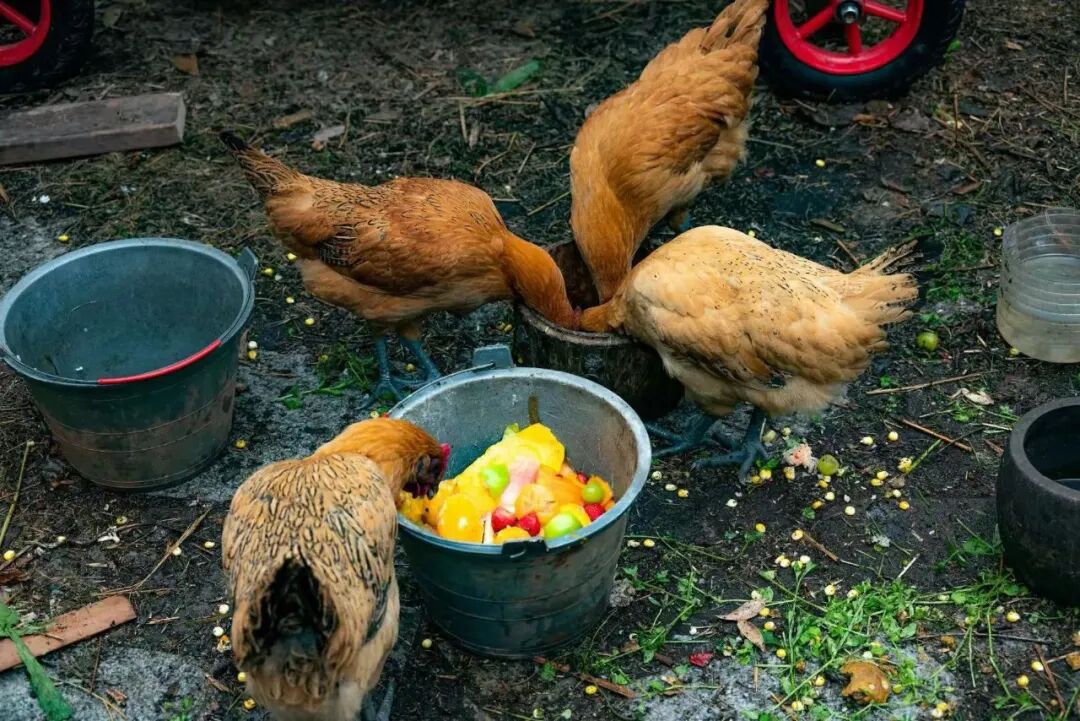
◉ The chickens dig into scraps discarded by the fruit shop. Image source: WeChat public account “Ecological Art Action”
All of that has now come to nothing. Speaking to Foodthink, Xu Lingni said she felt hollowed out: “The blow was pretty hard. I won’t be running the cooperative any more. If someone wants to take it on, of course I’d still help—after all, I’m more experienced with the vet work and the feeding.”
But Yuyuan’s subsequent announcement stated that the school would no longer permit poultry on campus.
The announcement further noted: during the mediation we learned that this group of summer campus-maintenance workers had been engaged in prolonged, high-intensity labour through the August heat, with limited accommodation and meals. Some had been cutting costs by surviving on instant noodles. This drew our attention to a group that shoulders the physical upkeep of the campus and then quietly disappears once the job is done—and to the conditions of labour obscured beneath the glossy surface of campus life.
Some students were deeply dissatisfied with this passage. They argued that ordinary cage-reared chicken from the market is extremely cheap—the thief could have easily afforded chicken. What he craved was the flavour of free-range chicken. If that truly was the motive, it pushes this theft towards a far more ironic reading: the very industrialised poultry farming Jin Lipeng has criticised is not even something workers trapped in the same predicament of alienated labour are willing to consume.
When introducing the project externally, the cooperative had stressed that universities are becoming increasingly commercialised, with commercial activity displacing spaces and green areas that could once be freely reimagined, and students reduced to consumers of campus space rather than co-inhabitants of a natural environment. “In most universities, labour education stays purely at the formal level,” members said, “by doing the actual work ourselves, the cooperative can fill the part most missing from our labour education today—responsibility, empathy, and sustained care.“
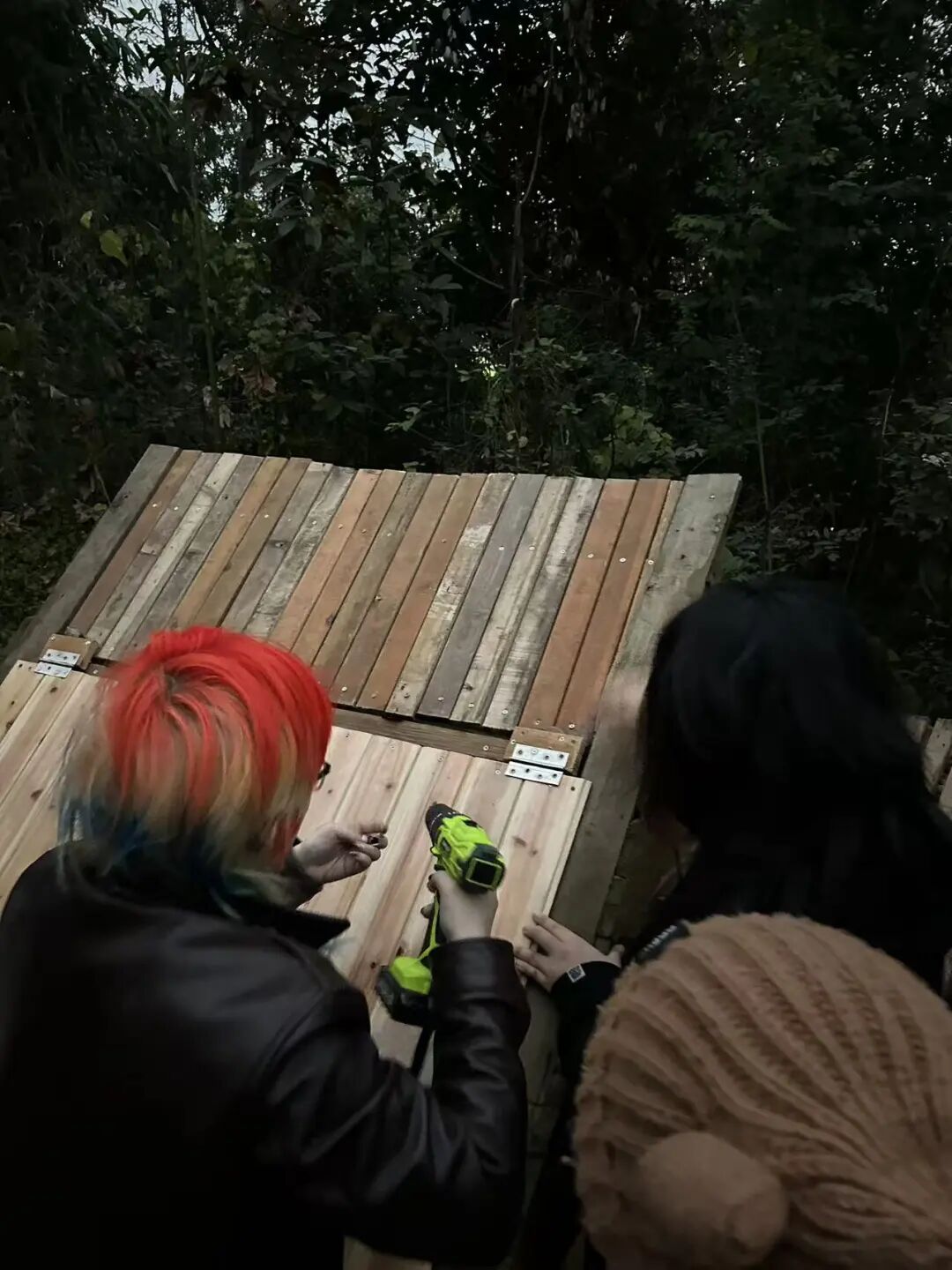
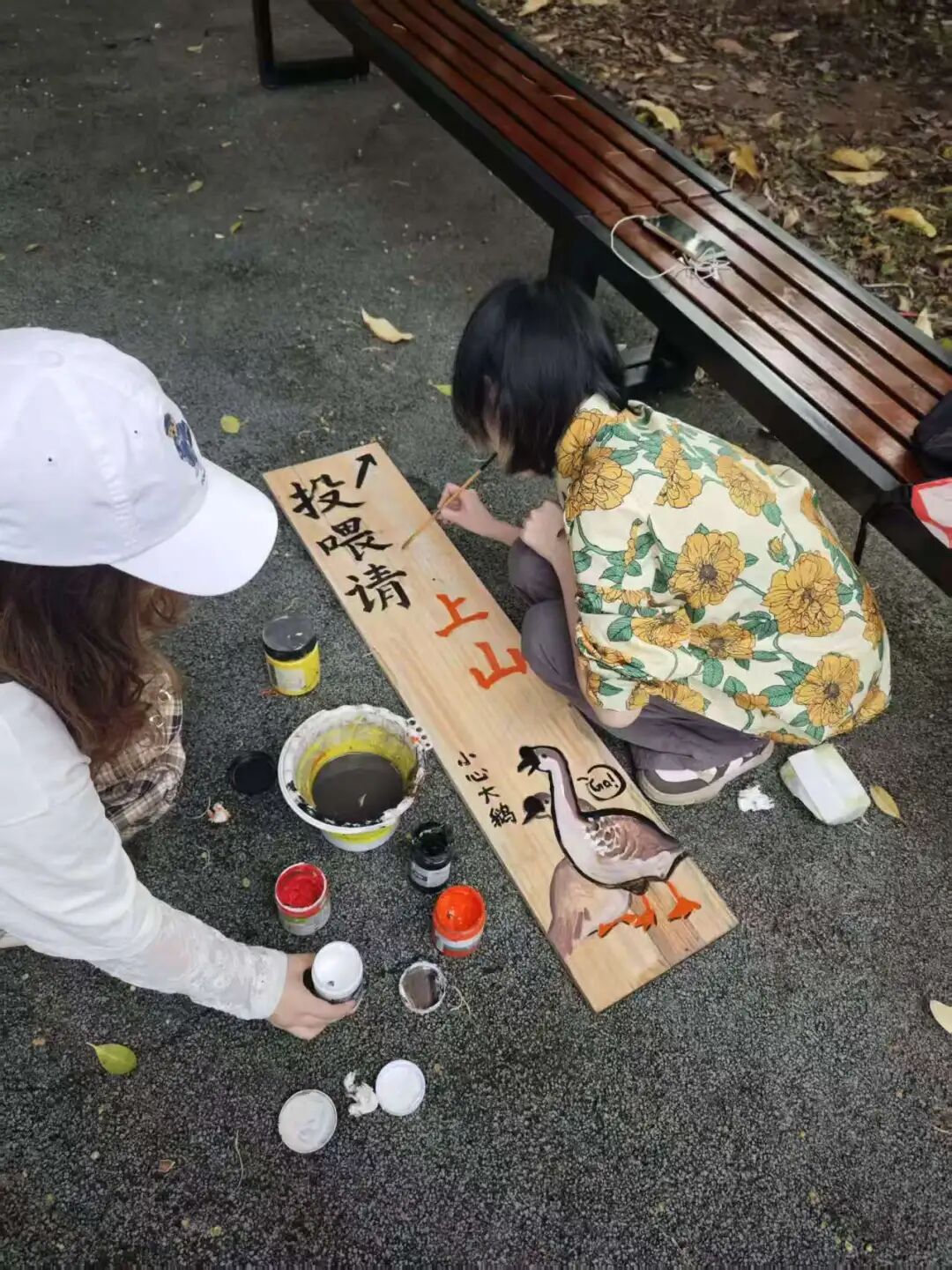
◉ The cooperative’s members believe that through their rotational shifts, they have carved out a participatory, sustainable ecological space within the margins—resistance-building in itself against the consumption-driven campus. Image source: Xu Lingni
According to articles published by Jin Lipeng, in his vision the campus is an ecovillage, a food system, and a circular economy. In the campus-ecovillage system as he had previously conceived it, was there room for workers who might resort to stealing chickens out of hunger? Probably not. Could this unexpected incident become the pivot of an “art process”, prompting staff and students to re-examine the disorder and complexity of the real world when art intervenes in it?
And were the carefree, romantic days of raising chickens not simply a game stripped of harsh reality, one that could only survive inside the ivory tower? Or is it precisely the permission to let such a game exist that represents the university’s most precious value?
The aftermath of the chicken theft also invites a measure of rue. Because the various parties held fundamentally different perceptions of what had happened, public discourse briefly spiralled into a second layer of harm between the victims themselves. A self-referential paradox emerged: the cooperative’s ideal—nurturing trust and affection through rebuilding the bond between humans and nature and through shared labour—has become precisely the rarest thing in today’s discourse.
“Avant-garde ecological practice has always come hand in hand with trial, error, and waiting. We will carry out a thorough review and consolidation, continue to deepen our existing work, and resume related exploration once the right conditions return,” Yuyuan’s announcement concluded.
The sole surviving Five-black Chicken had once been given a gloriously over-the-top anime name by the members—”The Barrier of Death Among the Spider Lilies”. After the incident, she was moved to a student’s home for safekeeping. Before long, she had settled into her new surroundings and was laying eggs again every day.
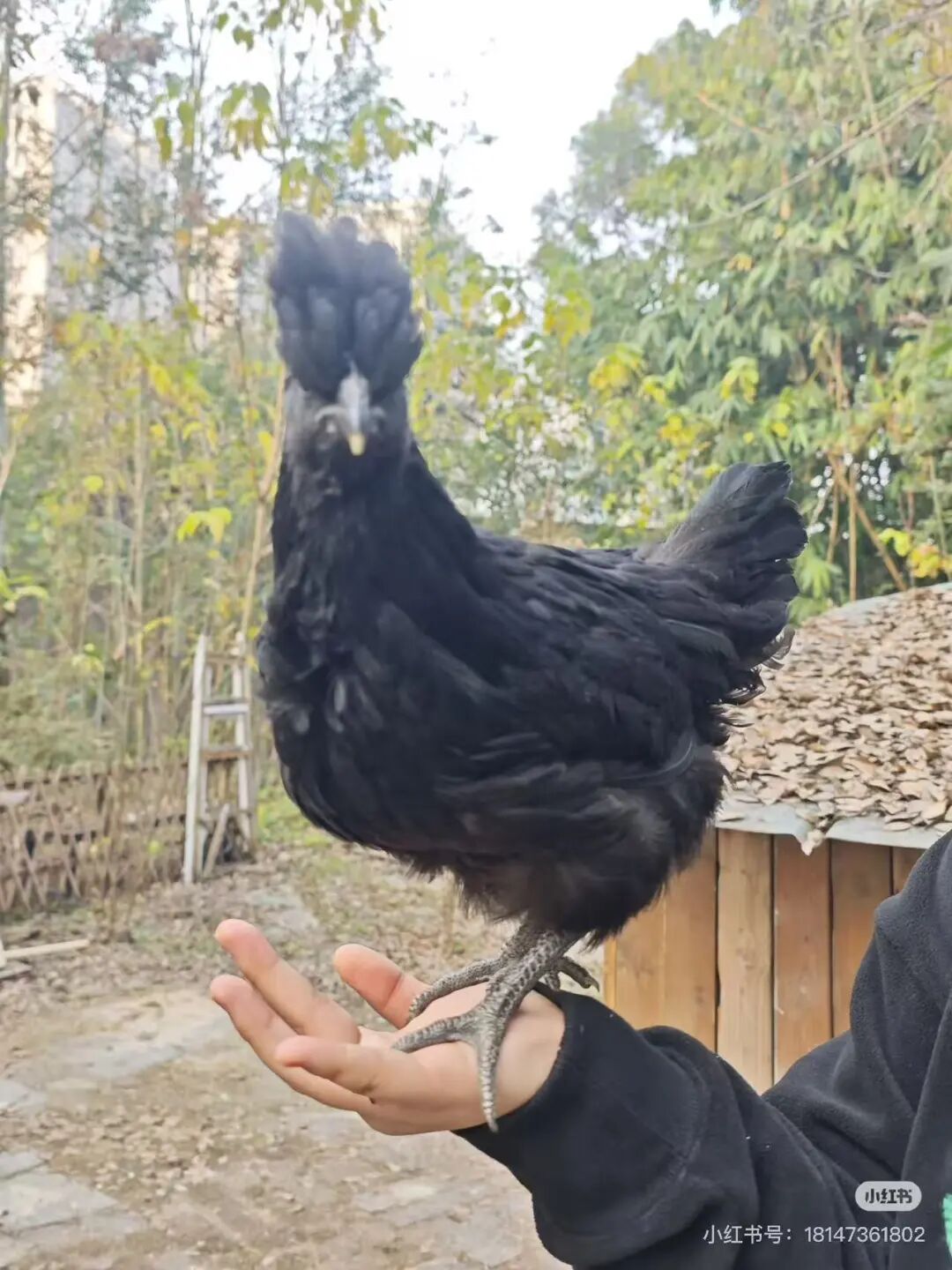
◉ The sole surviving Five-black Chicken. Image source: Xiaohongshu “SFAI Happy Chickens Raising Cooperative”
– This is Foodthink’s 839th original article on food knowledge –

Foodthink
Author
Kong Lingyu
Foodthink Project Director, former environmental journalist
Editor: Tianle
Layout: Xiaoshu
Scan the QR code to tip—support original food knowledge
▼

▼
Click the image to read related articles

▼
Click a keyword to access more article collections
Seeds | Farming Techniques | Policy | Fermentation | Nutrition | Fruit | Fisheries | Events | Jobs | Food Delivery | Wet Markets | Livestock | Food Talk | Sharing Sessions | Book Clubs | Harvest Festival | Smallholder Stories | Climate Change | Rural Development | Cooperative Economy | Urban Farmers | Food Safety | Digital Technology | Biodiversity | Pandemics and Food | False Solutions | Agroecology Internship Programme
Beijing | Hebei | Shanghai | Guangdong | Guangxi | Henan | Sichuan | Jiangxi | Xinjiang | Shaanxi | Hong Kong | Chongqing | Zhejiang | Jiangsu | Guizhou | Taiwan | Inner Mongolia | Philippines | Canada | Russia | Mexico | Italy | United States | United Kingdom | Germany | Netherlands | Thailand | Sweden | Japan