Adong’s Fruit Season in Wenchuan: Fruit to Sell, Skits to Film

In June, I returned to Koushan Village in Wenchuan County. In the past, I had come here for the shibi – the traditional priests of the Qiang ethnic group – the sheepskin drum and the polyphonic folk songs of the Qiang. But this time, I came to take part in the farm work at a friend’s home.
It was the peak of the local sweet cherry season, and my Qiang friend Adong was in the thick of the family’s fruit work. We first met on the Sichuan–Tibet Highway, where he had been my driver-guide. The Adong family tends a vast orchard, growing five varieties of sweet cherry, five varieties of plum and two varieties of European plum.
The village was rebuilt on its original site after the 2008 Wenchuan earthquake, perched on the sun-facing mid-slope at an altitude of 1,500 metres. Long hours of sunlight and a wide swing between day and night temperatures give the area a natural gift for growing fine fruit. During my days in Koushan Village, I spent most of my time helping pack fruit, and in the moments that remained, I filmed short videos to help Adong sell the harvest.
June in this traditional Qiang village has been claimed by the sweet cherry, an introduced species.

◉ Koushan Village.
Dispatch
The first sweet cherry variety to ripen is Red Lantern. By the time I arrived, a batch had taken on a colour so deep you could almost call it “Black Lantern”. Red Lantern is a sweet-and-sour sort. At this level of ripeness, the fruit’s acidity has faded away entirely, and a cherry picked straight from the tree leaves nothing on the tongue but a rich sweetness and a generous fruit flavour – wonderfully straightforward.
The cold chain has made it possible for these high-altitude sweet cherries, which once could barely leave the mountains, to reach customers right across the country. When they flood the market in bulk, one courier dispatch goes out at 11 a.m. and another at 4 p.m. Once the fruit reaches a higher stage of ripeness, only the morning run is kept, so the parcels can get straight on a flight to their destination and avoid spending the night in an airport warehouse, where the stuffy conditions might spoil them. Miss the early flight and they simply have to wait until the next day. To guarantee dispatch within forty-eight hours, the entire sequence – picking, packing, boxing, slapping on shipping labels – is long, breathless, and timed to the second.
The Adong family started growing sweet cherries in the late 1980s – the first family in the village to do so. His grandfather was village head then, and he had brought home a few saplings after a meeting. A few years later, the government launched a bigger push to plant them. The trees the family put in those early years have been growing for more than three decades now, their branches lush and far-reaching. The orchard yields roughly two tonnes of sweet cherries a year.
Years of growing have built up a loyal base of long-standing customers, and all of Adong’s sweet cherries go out at retail – no market stalls, no wholesale. Before he turned to livestreaming and short videos, the split was simple: “Sixty per cent shipped by courier, forty per cent customers come to the orchard to pick and take away.”
Now the internet lets him reach more new customers. If a regular hasn’t come back for this year’s crop, a new buyer steps in to fill the gap, and he has sold better than in any previous year.
Adong livestreams while he sorts and packs, his hands working and his mouth talking at the same time. The ‘Russian No. 8’ sweet cherries are big – “top-of-the-range for gifting”, he says. The Bing cherries are sweet – “like biting into white sugar”, he says. I laughed at how crude the comparison was, and he fired back, in front of the livestream: “What are you laughing at? I’m telling the truth.”
Yet no matter how good or how swift the cold chain, it still cannot guarantee that cherries at the Black Lantern stage leave the mountains without a mark. From tree to parcel, every single cherry is inspected. Damaged fruit is set aside, sizes are graded, and the smaller ones are kept for the family’s own table or to feed the chickens. Some have splits – sweeter where they crack – but they cannot go out either. The ones that make it into a box must be well shaped, firm to the touch, with a stem standing proud. Black Lantern can only be enjoyed here among the mountains and has become a reason in itself to come and pick at a hillside orchard. There is a farmstay, and there is farmhouse cooking to go with it.
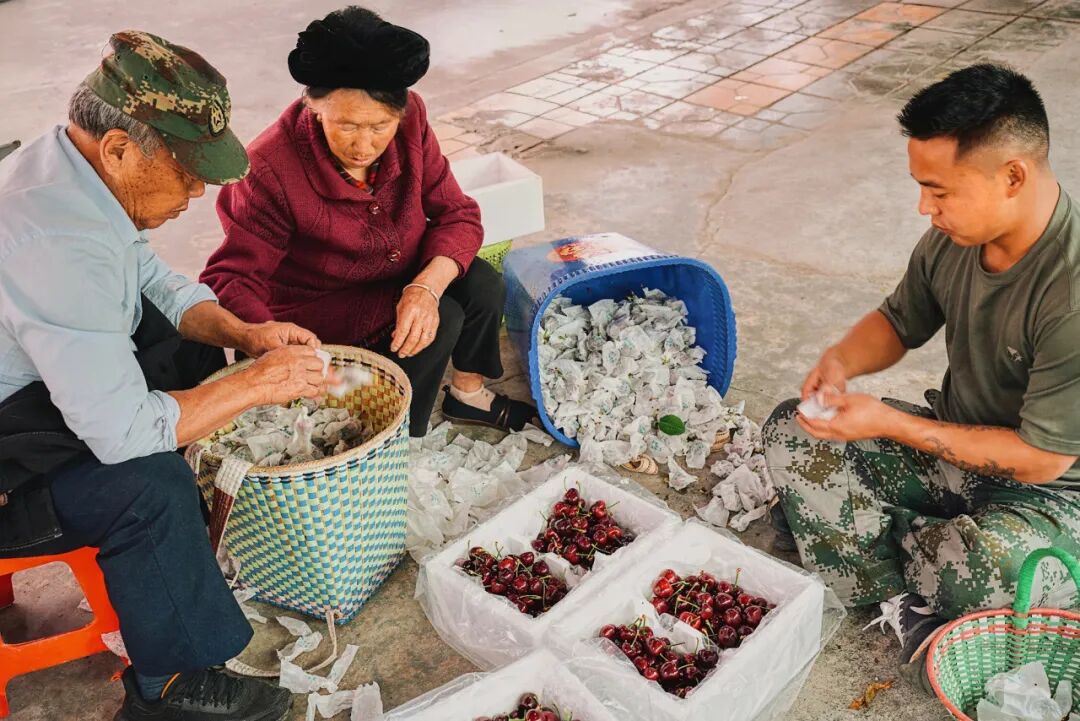
◉ Adong removes the fruit bags and sorts the cherries with his grandparents.
To help more fruit pass this inspection, fruit bagging is pretty much a must. While the cherries are still small, Adong slips a protective bag over each one, shielding them from rain and insects and letting them grow on and ripen inside the bag.
“Putting little clothes on the cherries.” That was how Adong once described it to me. At first I thought the phrase was full of pastoral poetry. It was only when I tried it myself that I realised the hard work behind it. The orchard sits on a steep slope: to get in, you first climb up onto a roof, then scramble up a stretch of ladder, and finally work your way up the incline. Adong zipped up in a few swift strides while I stood at the bottom sizing it up for ages, until I had to admit I could never follow him and sheepishly called up for help. In the end, clutching his carrying basket for leverage, swearing all the way, I finally hauled myself up.
The orchard is so thick it feels like a jungle, with just a path narrow enough for one person, and you have to stoop to go any deeper. None of this slows the fruit growers a jot as they check and pick among the branches. They have long been used to moving through spots where I cannot see a path at all, light on their feet. Standing on that slope, you feel the weight behind the offhand remark – bagging season costs several thousand yuan in wages, three or four temporary workers hired for about ten days.
The extra labour of bagging threads through picking, sorting and boxing – it goes far beyond the one task of slipping paper bags over the young fruit. The cherries come off still in their bags, and those bags have to be removed by hand as well. I asked him why he would put up with something so time-consuming and back-breaking. His answer was refreshingly practical: “You want to fetch a good price – people only take notice of quality.”
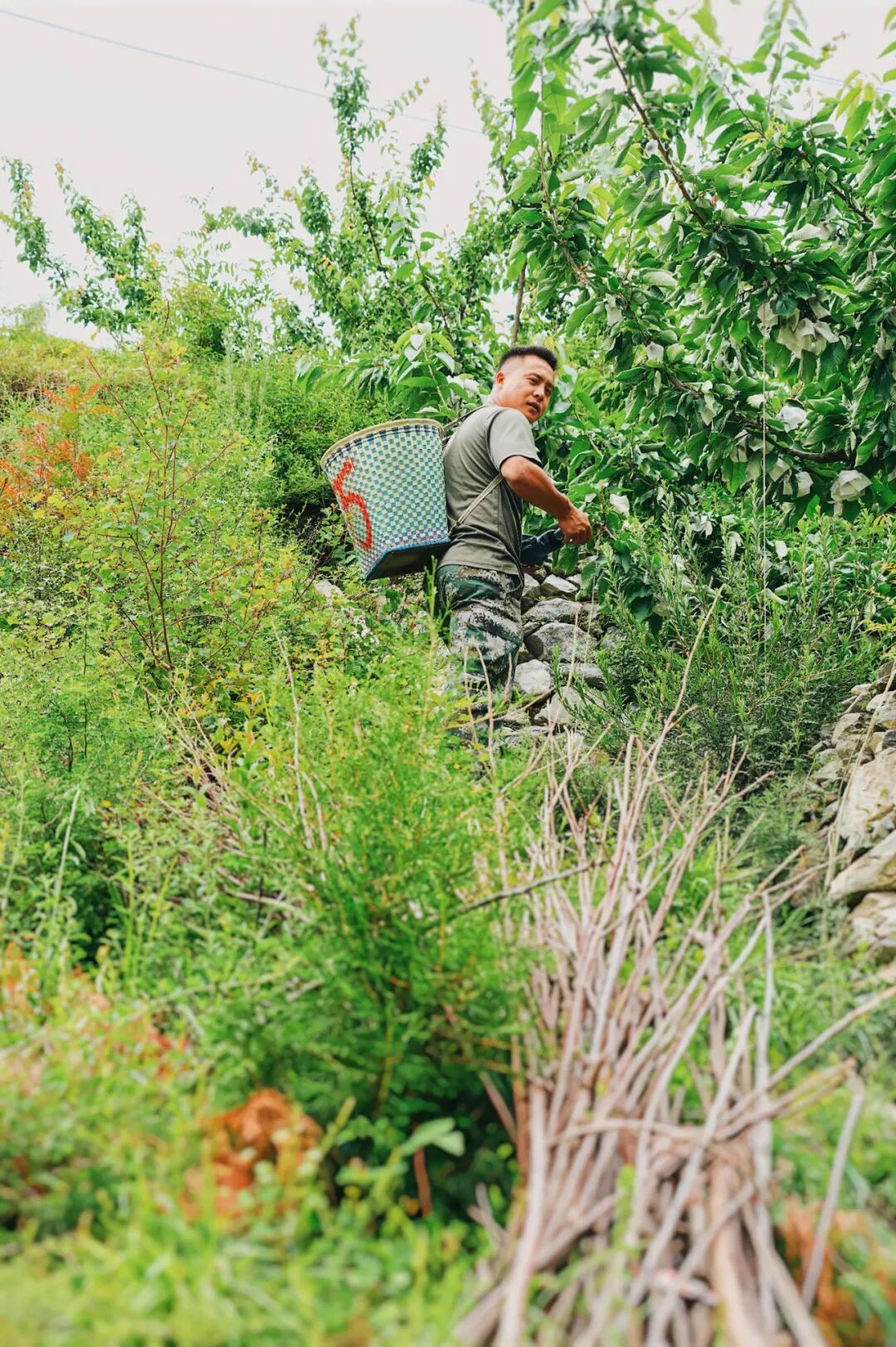
◉ Adong among his sweet cherries on the hillside.
The Fruit Farmer Jokester and His Livestream Room
Adong has always loved selling things. Now, with the internet and short videos, he can market his family’s produce far better. Where at eighteen or nineteen he yearned for the thrills of the outside world, he now finds more joy in the countryside and in farming. Even so, he still drives the tour bus: when there is work out there, he heads off; when it is done, he comes back to the orchard.
Wenchuan’s fruit carries a thunderous reputation within Sichuan Province – a fruit stall at the gate of Jiuzhaigou Valley even advertises that its produce is “tastier than Wenchuan’s”. Adong’s own village, Koushan, sits in an even finer growing region, yet few people beyond the province know it. That was something Adong discovered as he built his presence on self-media. So he made it his mission to “let more people beyond these mountains know about and taste this exquisite flavour”, and that is why he turned to livestreaming and short videos.
His short-video account is not just about fruit. He uses a string of skits to introduce the character of each variety and to depict rural life. In videos lasting anywhere from a few dozen seconds to just over a minute, there are punchlines and twists. During my time in the village, if I was not packing fruit, I was shooting and editing to Adong’s direction.
One skit was built around a single promise. Adong had told his co-parent-in-law – the father of his goddaughter – that if the sweet cherries sold well, he would treat him to a brand-new BMW. But once the Red Lanterns had sold out, the promise still lay unfulfilled. So his co-parent-in-law came to hold him to account and, on the spot, christened him “Bing-ge” – Flatbread Bro, the man who specialises in “drawing big flatbreads”, the colloquial way of saying you never meant to keep the promise in the first place. With that, he swung onto his moped and rode off, face like thunder.
The camera cut back to Adong, walking out from between the cherry trees. He explained that although the Red Lanterns had sold out, there were still ‘Russian No. 8’ and Bing, two varieties to come, and once those sold well too, he would keep his word, absolutely. Then, with natural ease, he drew in the audience: if you want to know whether the car gets exchanged, follow him and watch what happens next.
The cherry varieties and their order of ripening had found their way into a skit. We kept cracking up on set – Adong and his co-parent-in-law would start the take again while I chimed in with ideas. These people who work side by side in the orchard and eat at the same table are also actors in each other’s videos, and the easy familiarity between them makes every punchline land as naturally as breathing.
His viral hits rack up millions of views, yet many of the ones that take off are, in his words, “not the key video – no use at all”.
“What is a key video?” I asked.
“The kind that makes people believe you.”
The skits are funny, but making them is no easy feat. How do you keep producing them? Adong hits a wall just like every other creator, yet he carries a calm that many lack. Asked what he does when the ideas dry up, he answers with blunt simplicity: “Think it over slowly – the idea will come eventually.”
He is always learning too, watching how others shoot on social media and breaking down the methods of other video creators. Of course, he tried generating scripts with Doubao as well – only to find “it was all a load of bollocks. You can tell at a glance it is just what the algorithm churned out, the same thing every single time”.
When it comes to content, you can always hone your craft. Traffic, though, is pure mysticism. Once, Adong livestreamed and racked up over ten thousand likes that evening, yet the platform offered no boost. Everyone knows that vertical, 4K 60fps videos are more likely to be recommended and that traffic peaks after nine in the evening – but following every rule still does not guarantee a single extra view.
For a spell, Adong felt that landscape-oriented videos had a richer feel. “Everyone says horizontal video never breaks through, but I wanted to take on the challenge,” he said. “These days it is not just about traffic – the skit and the storyline have to be worth watching. It is incredibly hard.”
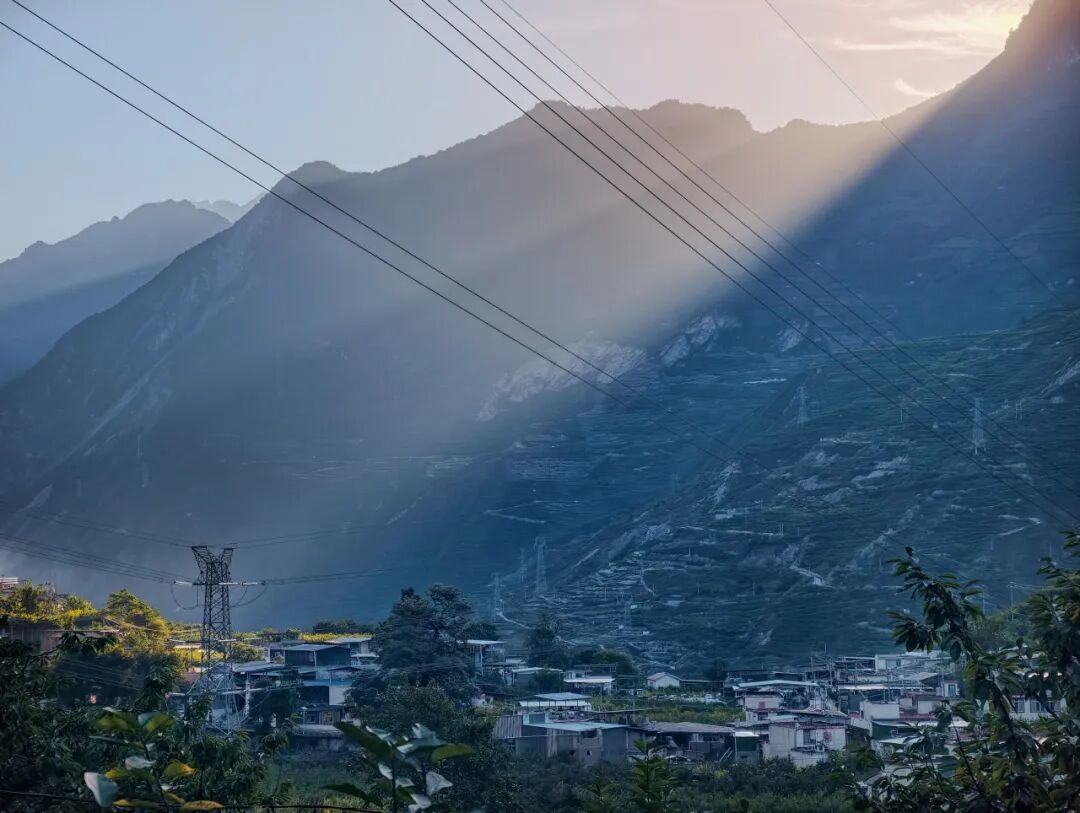
◉ Early morning, on the way to the orchard. Photography: Adong
Another “Language”
Between the end of sweet cherry season and the mass arrival of plums there is a brief gap. Adong and I use it to tidy up the orchard and prepare our application for a Participatory Guarantee System (PGS) inspection. A PGS emphasises the active participation of producers, consumers and other stakeholders, building trust through understanding, communication and review of the production process, and offering smallholders a route to quality assurance distinct from third-party certification.
The first step of the application is filling in forms. Adong asked me to help. The forms must be completed on a computer; a phone simply will not do. For fruit growers who are used to running their whole business from a smartphone, that alone is a hurdle. The application also requires a written introduction to the orchard and its owner: the prose must be clear and orderly, and the photographs complete, covering farm work, crops and scenes from the orchard.
Adong and I divided the work with perfect clarity: I organised the text and photos, he checked and confirmed. At the end I added a table of contents and compiled everything into a PDF, so that the reviewing staff could find what they needed more easily. Being a former reporter and editor, organising materials is my strong suit – yet getting this application out of the door still took a solid two days.
A few days later, we received a reply from the staff asking for supplementary information. Where does the irrigation water come from? Mountain spring and Min River water – that part was easy to add. The number of temporary workers was straightforward too. But the section asking how the orchard implements “sustainable management practices” used phrasing that simply was not in Adong’s vocabulary.
By watching and piecing things together in the field, I learned that this year they had switched to more durable rain covers rather than single-use ones; that the rejected and undersized fruit sorted out after picking went to feed the chickens they keep themselves, so nutrients were cycled back through the farm; that they weeded by hand, then spread the weeds over the tree discs, where they rotted down into fertiliser; that irrigating with mountain spring water was a way of cutting energy consumption; that bamboo baskets and other containers made from natural materials were used for picking, and existing plastic buckets were reused for moving produce around inside the orchard…
On one occasion I overheard him telling someone else that his family had just over thirty mu of orchard. That figure, too, was one we had worked out while filling in the form. Things you can see and describe plainly while working in the field become something else entirely when they must be rendered into a written submission for review – you need to switch to a different language altogether.
The patience demanded by a large review body is nothing like the patience needed for bagging fruit. Staff within the body may not communicate promptly with one another, each person holding different information, so the fruit farmer is asked about the same question over and over. For a smallholder like Adong, the application is likely to stall at precisely this kind of step.
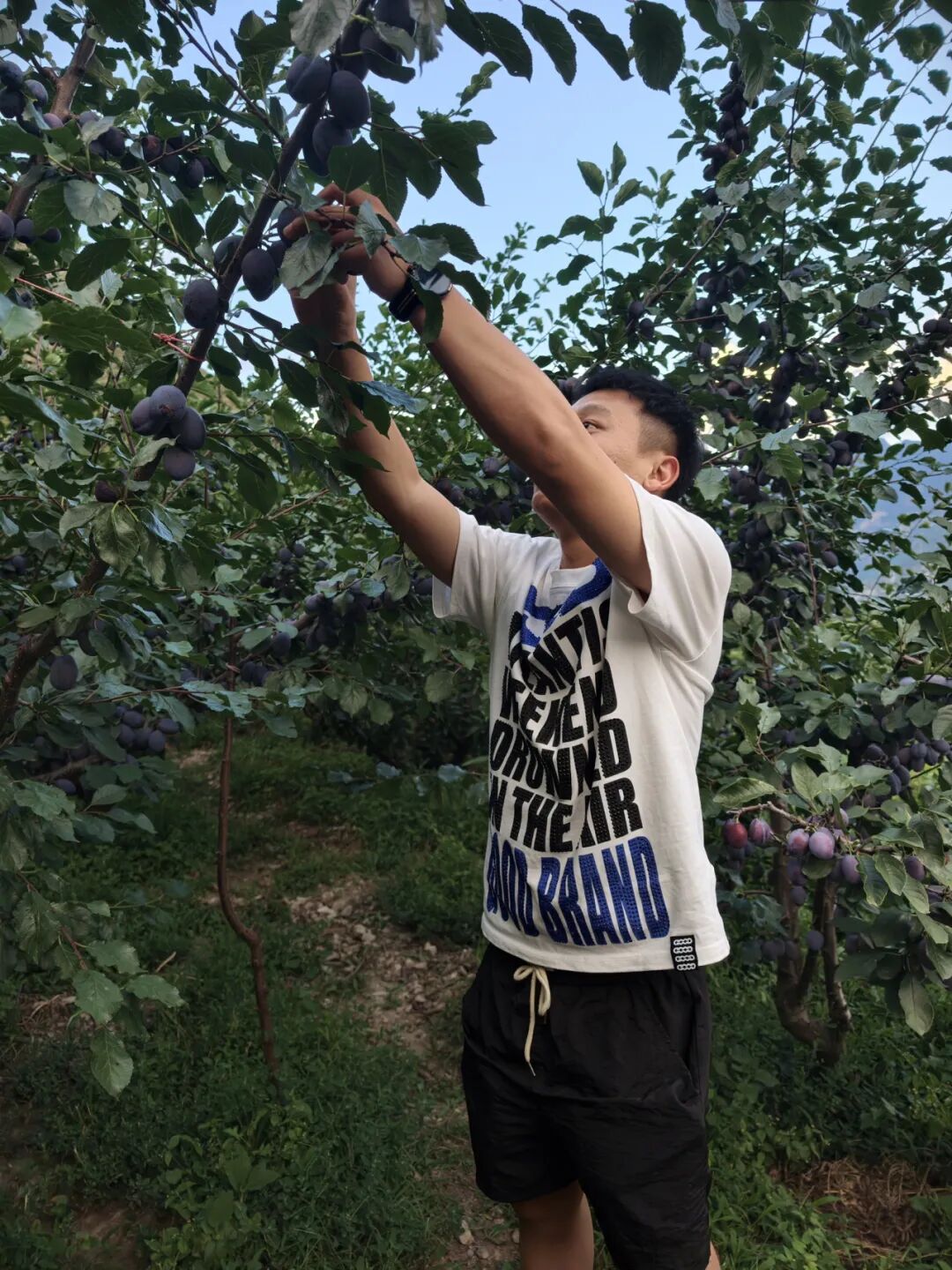
◉ During the European plum harvest.
Peak Farming Season on a Phone Screen
After I got back to Shanghai, Adong told me to head to the supermarket, grab some plums and give them a try, then sent me some of his for comparison. — Of course, in texture and fruit flavour, his family’s plums win hands down.
The “May Crisp” plums are first to come to market, followed by “Green Crisp”, “Honey Sugar” and “Xishi”, and then the “French” and “Blue Honey” European plums in quick succession.
The Cuihong plum is the last variety to come from their orchard, not reaching the market in volume until late August or early September. It is also the variety Adong’s family grows the most, with production exceeding 25 tonnes. They still rely mainly on wholesale, with only about a tonne or two sold retail through short-video platforms.
Every household in the village grows Cuihong plums, and at harvest they take turns helping one another. I watch Adong’s first-person livestream: from six in the morning, picking, packing, loading the truck – he works until the job is done, with no rest to speak of. The next day he heads to another family’s orchard to swap labour, working even harder than on his own ground, and keeps going like that for over a week straight.
I took on the task of writing descriptions for the fruit: the “May Crisp” is purple, wrapped in a pale layer of natural bloom, and is also called the Fenghuang plum – clean-sweet and crisp, its yellow-green flesh so full of juice it looks almost translucent; bite into the flesh of a “Green Crisp” plum and it snaps with a clean, decisive crispness – one pure, refreshing mouthful; the French-variety European plums are petite, a cultivar hailing from France, good two ways: still firm to the touch, they are crisp and sweet; once they soften, they burst with honeyed juice.
A Cuihong plum at perfect ripeness: the purplish-red skin is not a flat, even wash of colour, but scattered with tiny yellow-green speckles of varying density. The fruit is firm and plump, showing no give under the lightest press. The first bite snaps with clean, decisive crispness. The flesh is fine-grained and dense – tender, yet with a slight spring. The skin is thin, carrying a bright, natural fruit acidity that perfectly lifts the sweetness of the flesh and draws out a fresh, savoury depth, giving the whole bite a three-dimensional, layered quality.
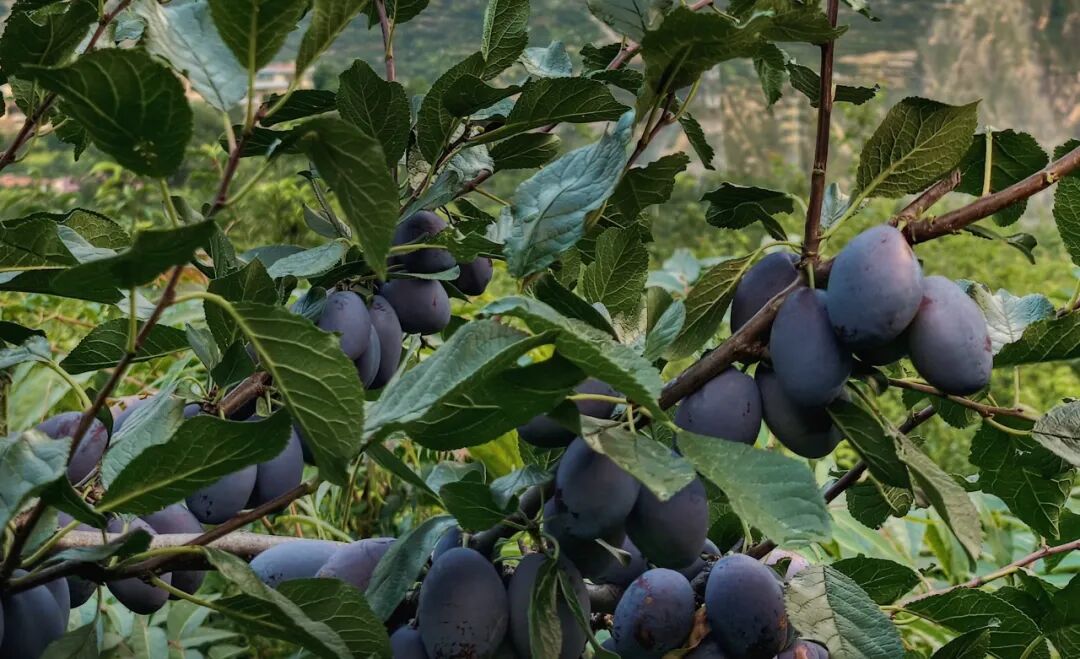
◉ High-mountain European plum. Photography: Adong
During the busy farming season, I occasionally contribute a skit script or two. Most of the time, though, I just watch Adong’s livestreams and short videos – sometimes roaring with laughter, sometimes still wanting more.
After truck after truckload of fruit – each carrying over five tonnes – had set off to every corner of the country, Adong came down with a bad cold. Once he was on the mend, he posted a short video, sighing, “You really can’t push yourself too hard!”
This time, the video may hold no twist. The reversal comes in life itself. The very next day, he would be at it again, pushing himself hard – a job driving a tour coach had long since been lined up.
– This is Foodthink’s 850th original article –

Foodthink
Author
Wu Yifan
A freelance writer, long immersed in the cultures of indigenous peoples and ethnic minorities around the world. Author of Singing Where the Reindeer Gather.
Unless otherwise noted, all photographs in this article were taken by the author.
Editor: Xiao Dan
Layout: Xiao Shu
Scan the code to tip and support original food knowledge
▼

▼
Click the image to read related articles
▼
Click a keyword to browse more article collections
Seeds | Farming Techniques | Policy | Fermentation | Nutrition | Fruit | Fisheries | Events | Careers | Delivery | Market | Animal Husbandry | Food Talk | Sharing Sessions | Book Club | Harvest Festival | Smallholder Stories | Climate Change | Rural Development | Cooperative Economy | Urban Farmers | Food Safety | Digital Technology | Biodiversity | Pandemic & Food | False Solutions | Ecological Agriculture Internship Programme
Beijing | Hebei | Shanghai | Guangdong | Guangxi | Henan | Sichuan | Jiangxi | Xinjiang | Shaanxi | Hong Kong | Chongqing | Zhejiang | Jiangsu | Guizhou | Taiwan | Inner Mongolia | Philippines | Canada | Russia | Mexico | Italy | United States | United Kingdom | Germany | Netherlands | Thailand | Sweden | Japan