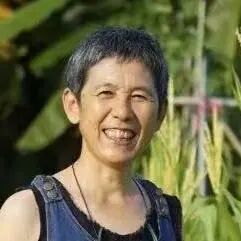
A Woman’s Pastoral: From Impossible to Possible | Grandma Kouzi

I. Women’s Lives
In the 1990s, when I was thirty, all manner of fin-de-siècle allegories swirled in the air.
Whether in novels or on film, whether saving or destroying the world, the central figure, the hero of every apocalyptic tale, was male – so grand, so perilous, that a humble woman like me could neither keep pace nor even care to follow.
As a woman, a mother of a frail little child, what my eyes searched for and what my mind clung to was the treachery of women’s fates amid the tempest of the end times.
I have long forgotten the title of that most harrowing fin-de-siècle novel, and the name of its protagonist, but the fates of three women remain unforgettable.
The leading man in every apocalyptic tale is inevitably the saviour, a god – saving the world, battling demons, scarred and bloodied, growing fiercer with every blow. In such stories, gods do not die.
In those fictional epics of doomsday, women, as supporting players to the god, appeared and perished like images on a revolving lantern.
The first to die was the male lead’s wife. She never truly “appeared” at all – she had already died before the story began, of cancer caused by environmental pollution.
The second to die was the first love, killed in the earliest days of the turmoil. Every upheaval brings hunger with it, but she did not die of hunger – she died for food, defending the grain; the very food meant to save lives took hers.
The third to die was the male lead’s moonlight – his idealised first love – a scientist who had discovered a doomsday food that could save humanity, killed by rape at the hands of a rioting mob.
Men save the world, men destroy the world. Women are destroyed within it. This is no apocalyptic allegory – it is the very condition of women in this world: their fates and their lives are but a part of men’s lives, of men’s narratives.
II. Women’s Pastoral
Upon the land, is it possible for a woman to live a life of independence and free choice? Or, to put it more bluntly: Can a woman live alone in the pastoral life?
In the primitive era, in the agricultural age, neither is possible – the level of productive forces determines all.
As social animals, humans formed society both through active choice amid natural selection and because survival demanded it – we were thrust into society simply to stay alive. The lower the productive forces, the larger the group needed to sustain life. Early peoples could survive only as part of a clan, men and women alike.
As productive forces grew stronger, the smallest unit of survival upon the land shrank – first to the clan, then to the family. Occasionally there are tales of solitary independence, such as Robinson Crusoe, but they remain mere legends, and the protagonist of those legends is a man.
I loved reading Laura’s Little House on the Prairie, which depicts the real lives of Americans in the frontier era. The West was vast, sparsely populated, and rich in resources – a pastoral paradise written into the landscape. The basic unit of survival was the household, each one a complete ecosystem. The men felled trees and built houses, cultivated the fields and hunted; the women fed and milked the cows, ground grain and baked bread, churned butter and made soap by hand. Every household had to sustain the full chain of clothing, food, shelter, and travel to survive. Many tasks deemed “women’s work” could be done by men – if one set aside questions of quality of life, a single man might endure – but a woman could not. A woman had to lean, at the very least, on a man, on the family.
“The women bear baskets of food, the children carry jugs of drink, all walking on to bring meals to the fields where the strong men labour on the southern ridge.” In China, it was the same. “His ageing wife sketches a chessboard on paper; his little boy hammers a needle into a fishhook” – in the Chinese pastoral narrative, women, too, are merely helpers and supporting players.
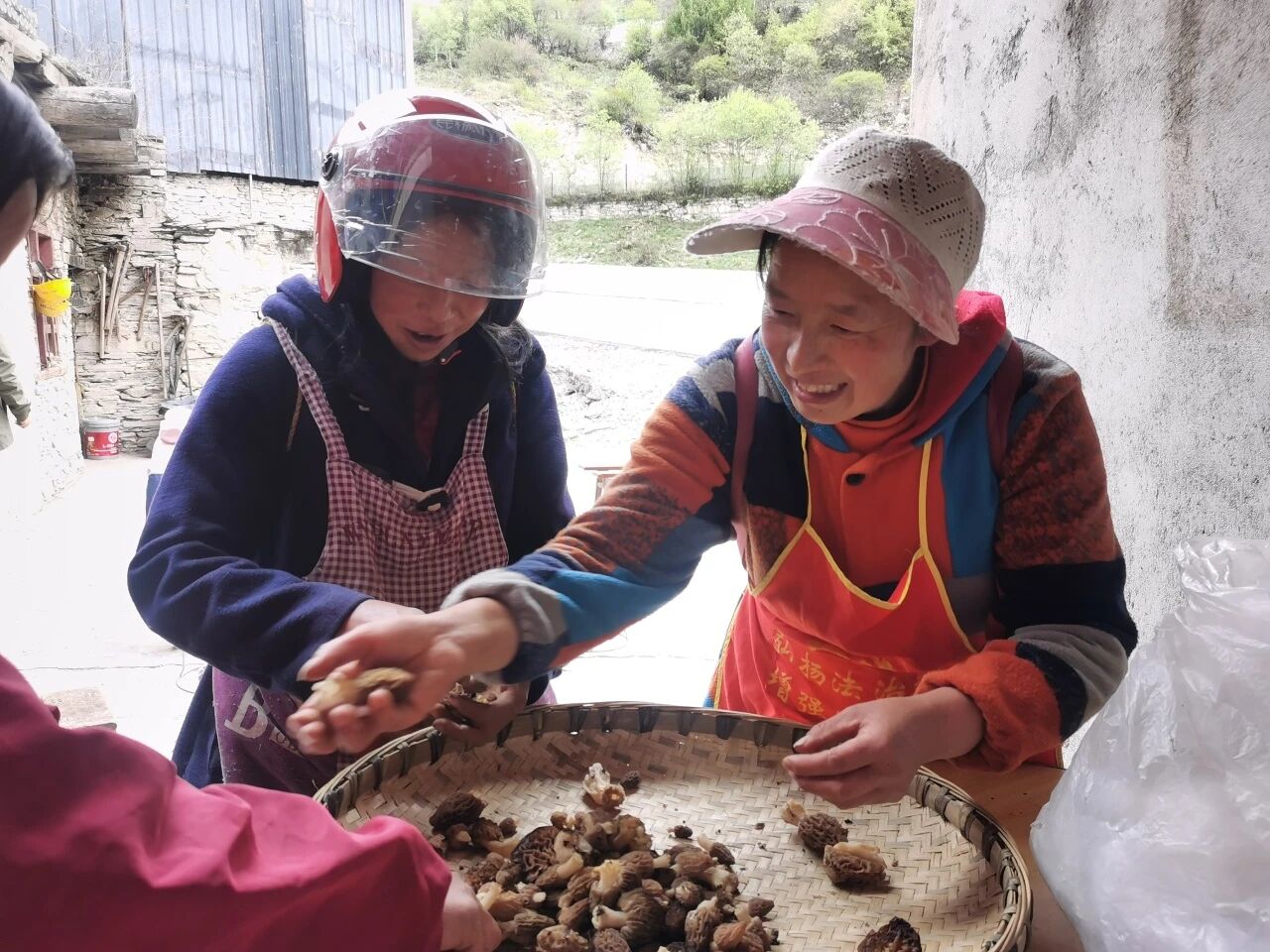
In 2006, 2007 and 2008, I made a documentary in a small village called Chezhu, in Zhongdian County (now known as Shangri-La) beside the Jinsha River. Every household there had a complete system of survival: paddy fields by the river were harvested twice a year, yielding wheat and rice to feed the people; dry plots on the hillside grew mulberry trees and beans, producing maize to feed cattle and pigs; dozens of acres of forest on the heights supplied firewood for warmth and cooking, as well as timber and stone for building houses.
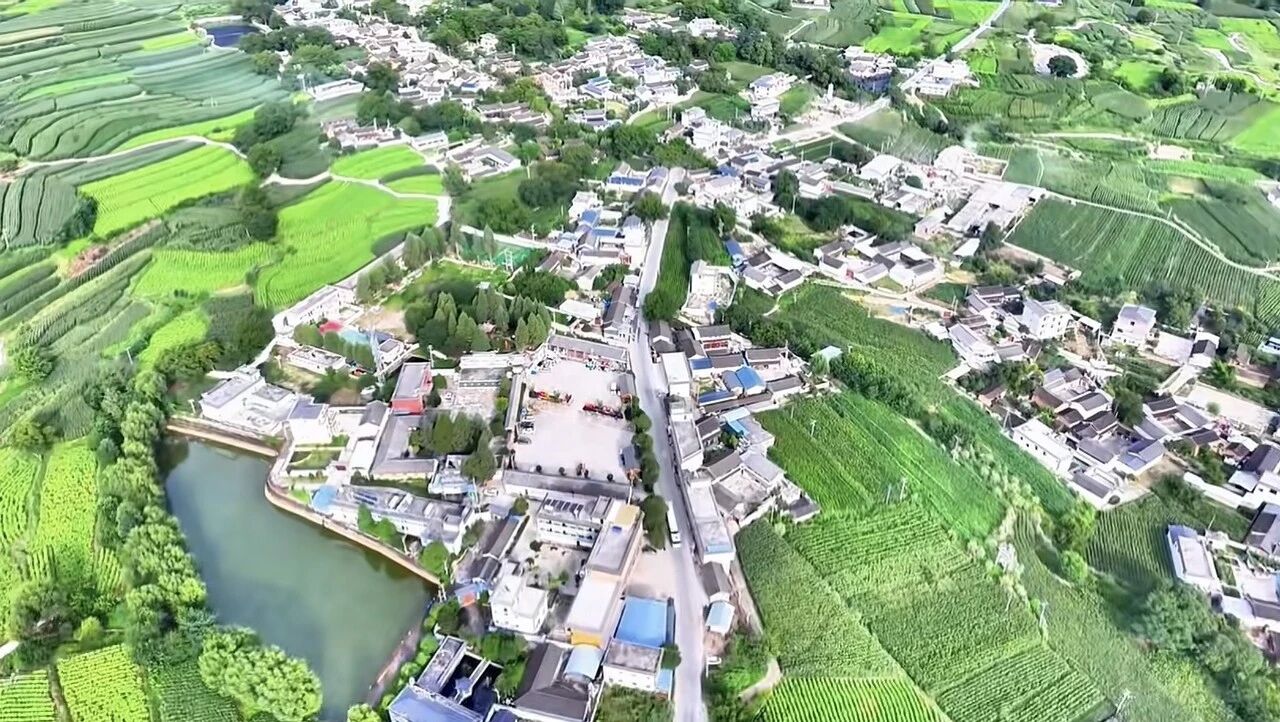
Fifty years ago, the smallest survival unit here was the extended family, because daily life still encompassed planting mulberry trees, raising silkworms, boiling cocoons, silk reeling, spinning yarn, weaving cloth, embroidering, and tailoring garments – two people alone could not bear so immense a workload. Once people no longer had to make their own clothes, the extended family shrank into the nuclear family.
How I loved that place, how I loved the life there. But I also knew how much my love was Lord Ye’s love for dragons – a delight in the painted likeness, unable to bear the living thing. I was all too clear-eyed: my strength could not shoulder such a life. I believed that for a woman to survive alone upon the land was a fool’s dream.
At that time I did not yet know that a woman could already, by her own hands, possess a pastoral life of her own.
On another beautiful island, Taiwan, a real woman was walking toward the land – not toward death, but toward life. For life itself, for living, for a ceaseless dream that belongs to women and to the earth. Her name is Li Baolian, and we call her “Abao”.
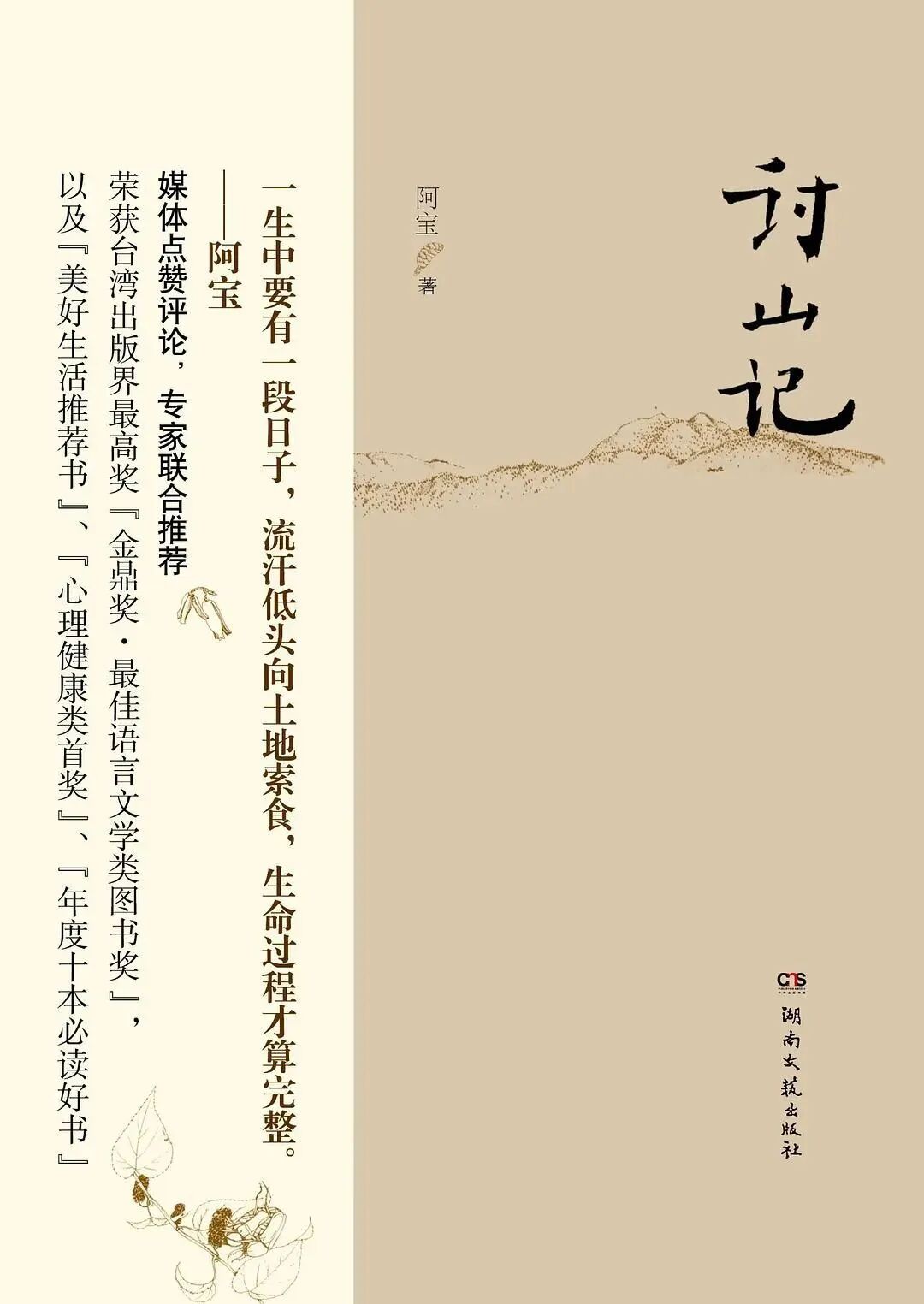
Abao has written her years of living alone upon the land into Tao Shan Ji, its content comparable to “China’s Walden”.
From the standpoint of survival, Walden was merely a two-year performance piece – philosophical meditation far outweighing any real subsistence practice. The later classics of nature writing, Alone in the Wilderness and the Walnut Farm Notes, are what truly describe long-term, self-sufficient solitary living. The protagonists of the latter two are both men, and extraordinary ones – “a real-life male superman”.
I have quoted many times a Bosnian survivor of the Bosnian War, who said that those who lived through the chaos had all “turned into beasts”. Borrowing his formulation, everyone who lives alone in the wild is a formidable man – or has become one.
Environmental pollution, food-safety crises, the spectre of doomsday – every modern person must face these. And nearly every one poses yet another test for women. Women perhaps need a patch of earth even more, or rather, women need, more than ever, to draw direct sustenance for their lives from the land. At the same time, the realities of survival demand more of a woman’s capacity to draw that sustenance from the soil.
What I want to know is whether ordinary people can, through their own labour and limited resources, choose their own lives – and especially the women among them. Abao’s story gave me that inspiration.
Abao was once a wandering woman, carrying a roll of canvas across ten thousand rivers and a thousand mountains. She believed that a person should, at some point in life, have the experience of “bending to the yellow earth, scraping a living from the land”, in order for life to feel complete. After turning thirty, this longing grew more urgent still. In 1999, heeding the land’s call, she walked up to Lishan and learned to become a fruit farmer. For more than twenty years, Abao has lived her creed in every action.
III. Women’s Ways of Living
During my two years farming in Yilan in 2018 and 2019, the farmhouse I rented happened to be the very one Abao had lived in.
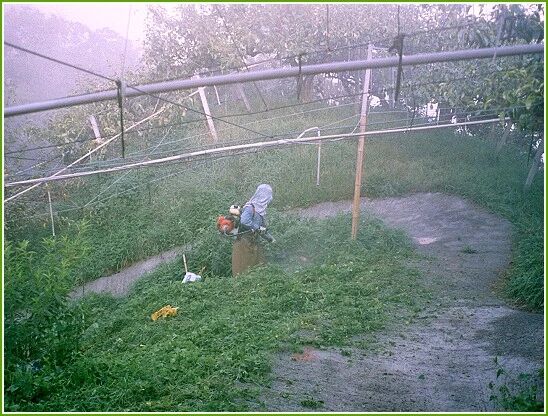
Now Abao lives permanently on Lishan, and she will go on living in the mountains. During her years of solitary life in the wilds, Abao cleared land and grew vegetables, learned carpentry to mend the house, and handled all manner of plumbing and electrical problems herself. The last time I visited Lishan before leaving Taiwan, she was dismantling the wooden cabin piece by piece, racing to finish the insulation layer and structural reinforcement before winter arrived. Lishan sits at high altitude; in winter, heavy snow can seal the mountain passes. She is warming the winter with her own two hands.
The Abao of old had not the strength to even grip a pair of secateurs properly – she even wrote about that embarrassment in her book. Though she has now developed remarkable grip strength, her hands remain slender. Abao is an artist and artsy soul; even her work apron has an artistic flair, its fabric and cut thoroughly Bohemian. Abao is still that slim southern woman, speaking in a low, unhurried voice. She lives in the wilds, shouldering every direction single-handedly – but she has not become a man.
That Abao became the first one-person farm on Lishan owes much to Taiwan’s social service system. Lishan is remote, but public buses run there, and ever since courier services existed in Taiwan, packages have been delivered straight to the village. Add the spread of the internet, and one can market across the entire island without stepping outside. Abao’s fruit is renowned across Taiwan; she need not be distracted by sales. As long as she keeps the orchard at a manageable scale, she can manage it entirely on her own. Machinery and tools help people break through their limitations, and they have helped women of slight physical strength in particular. Abao has a three-wheeled cart, and she is something of a tool enthusiast: a rather impressive tool wall hangs in her workshop, decorated with an artsy, literary flair – she has drawn the silhouette of every single tool in cartoonish lines on the wall at its corresponding hook.
Those who practise natural farming often hold many reflections and criticisms of modernity, and yet modern human society has also given ordinary people the possibility of independent living – and a woman’s one-person farm in particular is built upon a stable social environment, a comprehensive social service system, the proliferation of machinery in the post-industrial age, and online shopping with courier delivery.
Abao has been alone on Lishan for over twenty years now and has bought the mountain and forest she has been tending for all that time; she will continue living here. She has not only redefined her own life upon the land – she has given more women the possibility of redefining theirs, carving out a space of “possibility” through practice. The better she does, the wider the space that opens up behind her. Many have benefited, myself included. At the end of 2017, I became a “new farmer” in Yilan. Before me, there were already more than twenty women’s one-person farms – some full-time farmers, some Half-farming, half-X.
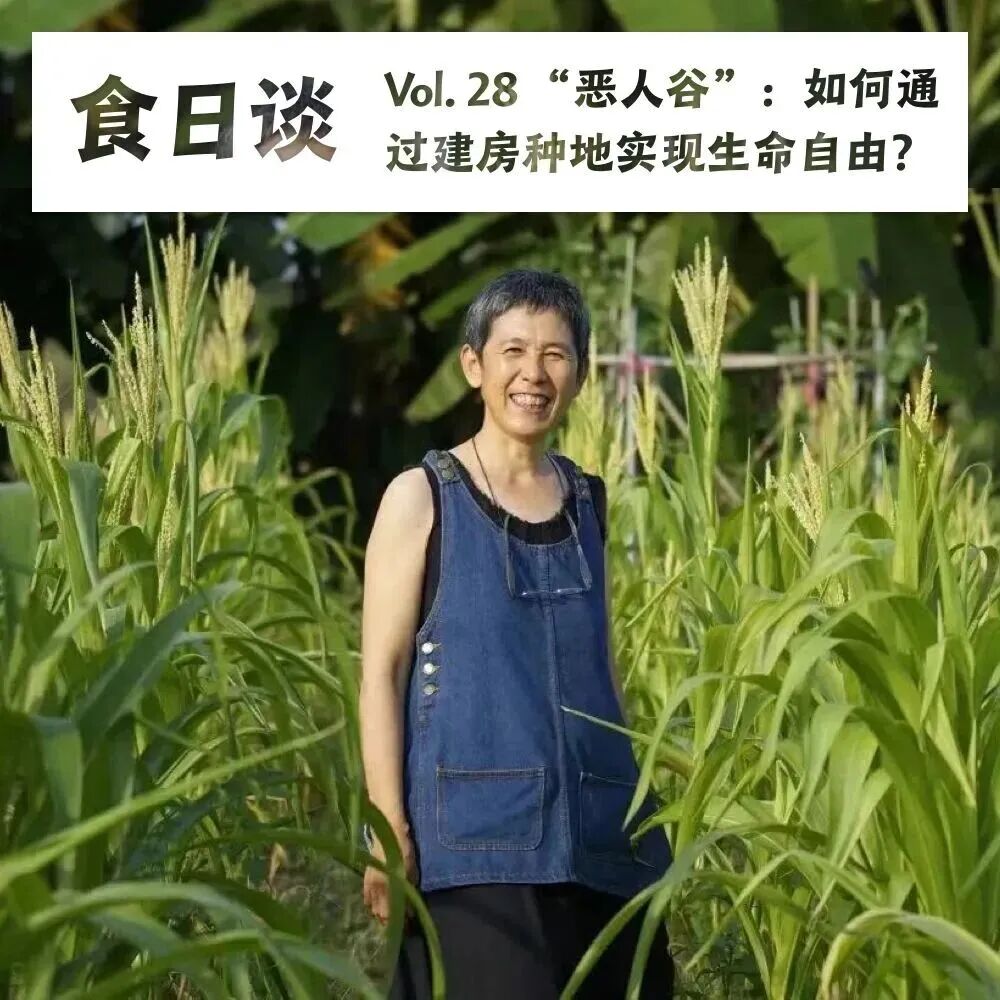
Though Abao and I are the same age, I started twenty years too late. By the time I finally found Valley of Villains, I was already approaching sixty. From the very beginning, it has been an individual modern-life experiment – a woman’s, with clear physical boundaries, a measured return to the pastoral.
IV. Living Single-Handed in the Pastoral
My farming is subsistence-oriented – no commercial produce, no scaling up. I grow food only for my own three meals a day. The Valley of Villains may be small, but it has everything I need; I plant whatever I want to eat, aiming for the highest standard of living.
Too timid to live alone in the wilderness, yet unable to bear the “zero distance” of close-knit village life – building my hut among the haunts of men, at just the right remove from the village, within cycling distance of both the town and the swimming pool, suits me far better.
I know my own limits – I could never learn Abao’s carpentry. From the very start of clearing the Valley of Villains, I simply hired builders to make the house, and paid a considerable tuition fee in the process. If only “what if” were a real thing in this world – it would have saved me at least 200,000 yuan. But you, dear reader, no longer need a “what if”, because I am here: I have already walked the minefield ahead of you and written you a guide to dodging the traps.
I spent 500,000 yuan. Armed with my lessons, you can manage for 300,000. And if you are not, like me, afraid of village life but willing to rent a place there, you can certainly achieve self-sufficiency in southern China within five years for under 200,000 yuan.
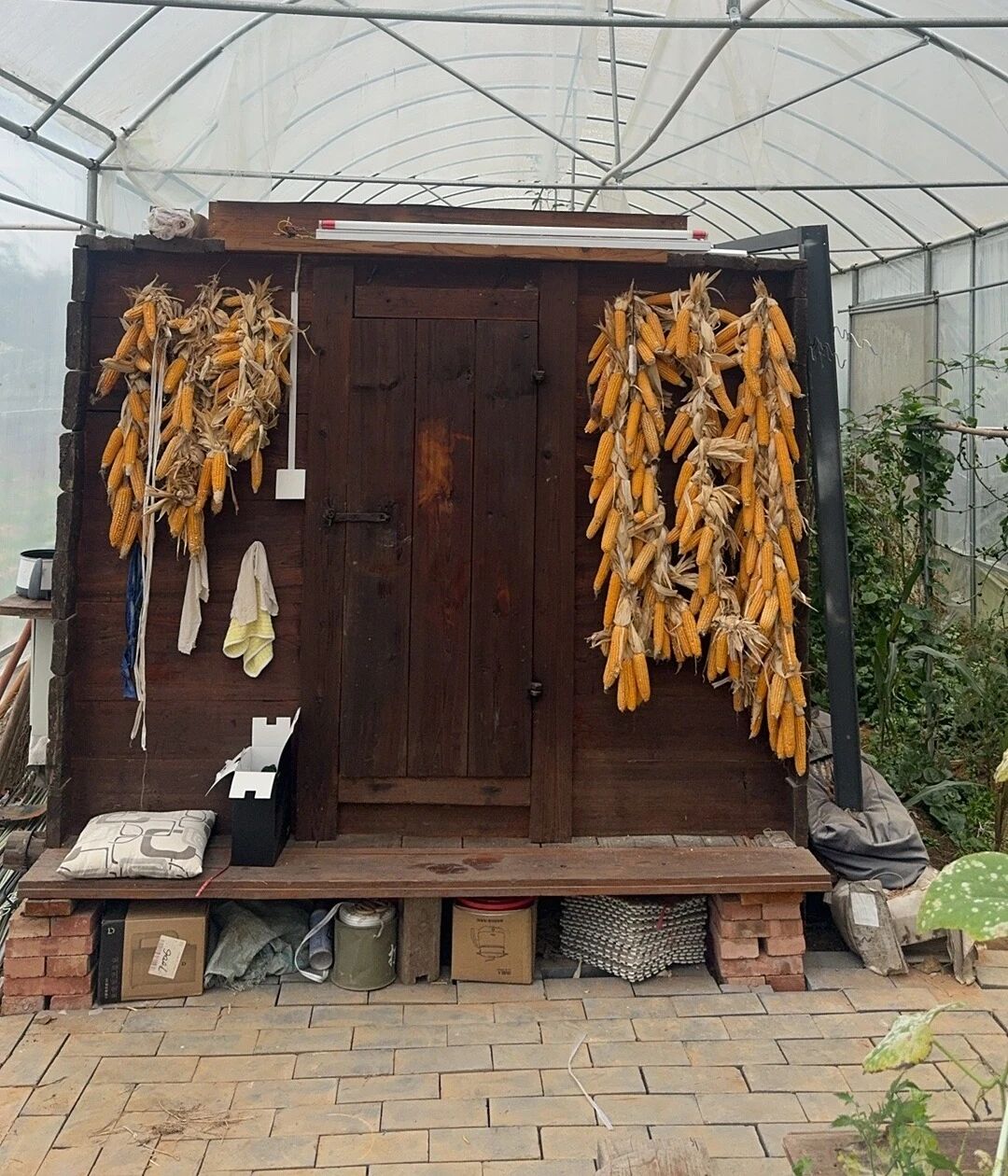
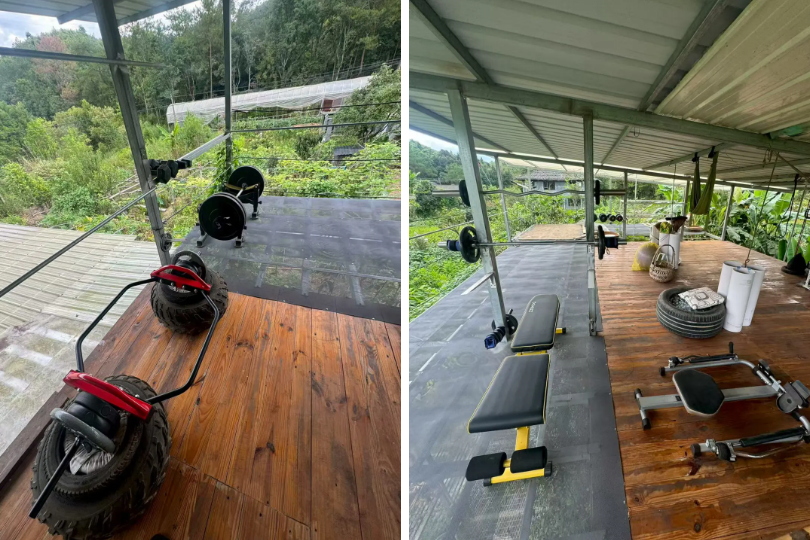
If, like me, you also uphold the strict “three-free” philosophy – no chemical fertiliser, no pesticides, no herbicides – Meicuntou in Liancheng, Fujian, opens its doors to people like you and provides public services, meaning the cost could come down further: a one-person farm for just over 100,000 yuan.
From knowing nothing about farming and having zero confidence in my ability to do physical labour, to being perfectly at ease in the Valley of Villains; from the sub-health of an urban middle-aged woman to an across-the-board turnaround in my health-check results – I have reached the first stage of “not a single bite from outside”. By the fifth year, the Valley of Villains is fully self-sufficient apart from salt. This year I harvested twenty to twenty-five kilograms of rapeseed, over fifty kilograms of peanuts in the shell, over fifty kilograms of maize, over fifty kilograms of assorted grains, over fifty kilograms of assorted beans, and more than a hundred pumpkins. The figures are mostly that vague “over fifty” – because once the harvest exceeds what survival requires, I stop weighing and counting; it simply goes straight to feed the chickens and ducks.
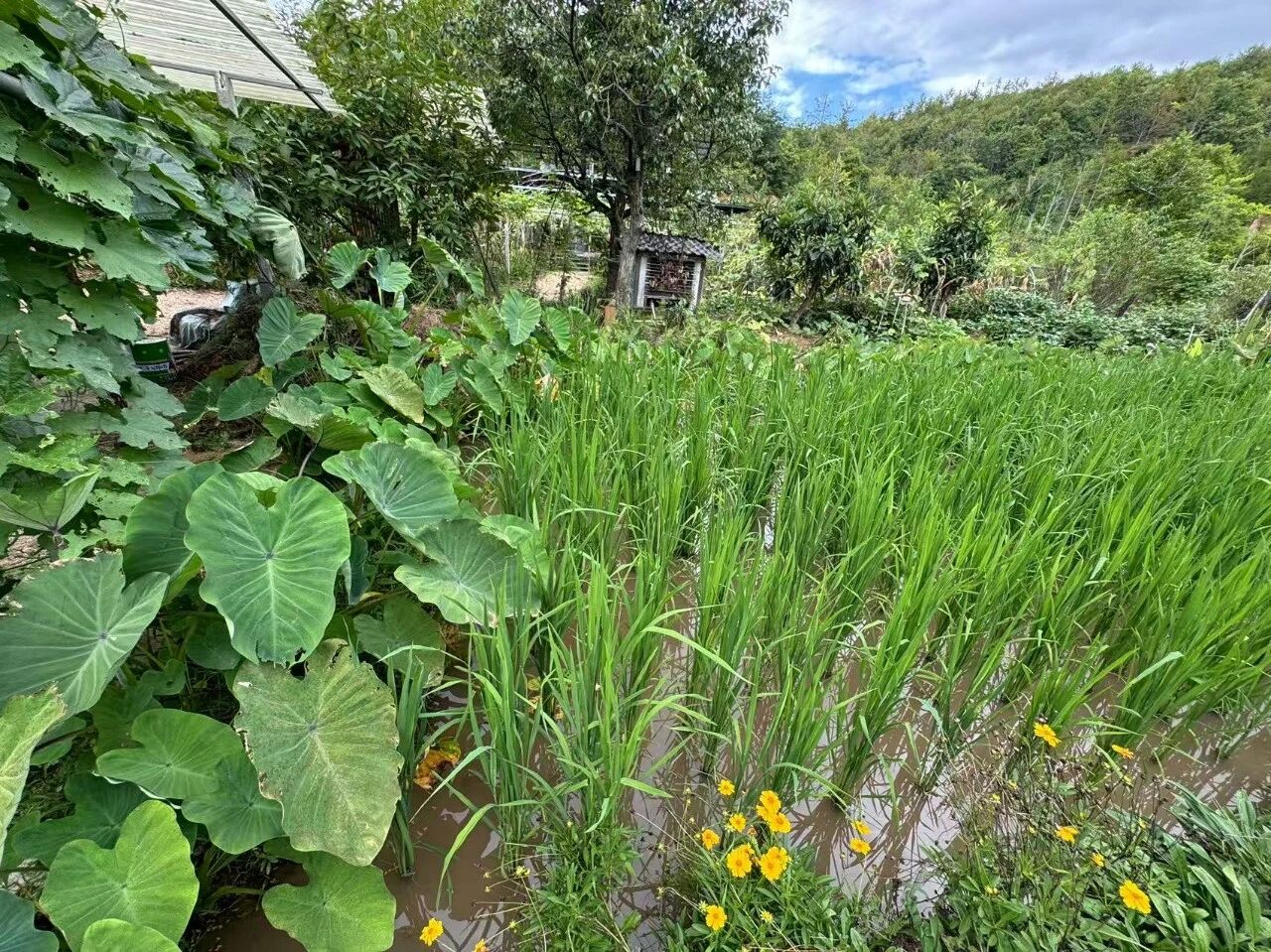
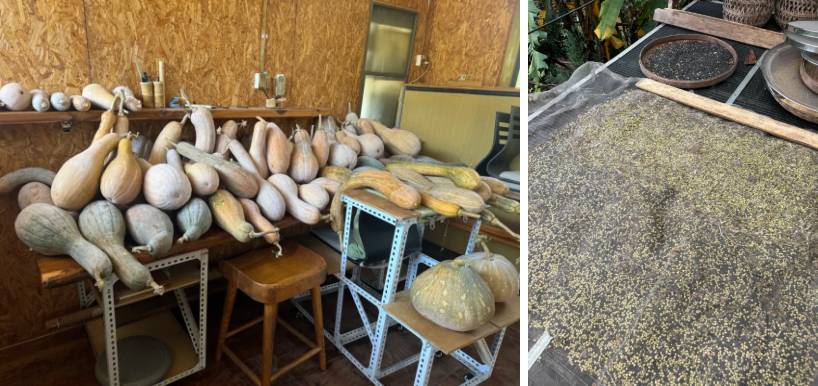
This is a life created by a woman in her sixties through her own labour, her own two hands. The dreams of foremothers – independence, autonomy – have been made possible by the fulfilment of technology and the progress of the age.
In 2025 I achieved a minimum level of fruit self-sufficiency, and I have now begun raising fish. I am exploring “chicken-centred design” – a sustainable, self-cycling system of growing and rearing centred on the needs of chickens, within the half-mu plot. With the same egg output and the same number of birds, I am confident I can halve feeding inputs by 2027. I will also implement “duck-centred design” in similar fashion, along with an integrated chicken–duck–fish system.
I want to explore the ultimate expression of “closing the door and living above the clouds” – above all, the ultimate expression of a woman living single-handedly in the pastoral. By the age of seventy, I will have built a complete living system including self-sufficient water and electricity, completed all soil amendment, gone fully no-till, finished constructing a food forest across the entire property, and entered a true permaculture state. Not only will I be eating better and living more comfortably here, but the whole system will also better match the working capacity of an elderly woman and respond more fully to the needs of daily life.