From the crackdown on ghost delivery outlets to crops irrigated with “red groundwater”, questions about food and agriculture tend to enter public view only fleetingly when safety crises are exposed. If attention remains fixed solely on these moments, many deeper problems will go unnoticed. It is against this backdrop that Foodthink hopes to document and understand our food and agricultural system in a more sustained and multidimensional way. In 2024, Foodthink, together with a number of public-interest and media partners, launched the “Lianhe Creative Programme”, both to understand the current state of food and agriculture and to support more people in examining the complexities behind food and agricultural issues. The Lianhe Creative Programme supports creators and researchers in conducting research in the food and agriculture field, funding the completion of public-facing content. Over the past year, AI developments have far exceeded expectations, and digital technology and platform capital continue to move into the food and agriculture space, bringing new impacts. We recognise that a great many questions behind food and agriculture remain to be seen and answered, and our questions have always tried to capture changes in the real world, hoping to offer better answers for the future of food. So, at the end of 2025, Foodthink decided to launch the Lianhe Creative Programme once more — to keep racing against these changes, to give it another go; this time, what can we capture?This round of the Lianhe Creative Programme received 197 applications in total. Written works made up the majority, though submissions also included video, podcast, photography and exhibition formats. After initial screening, 49 creators were shortlisted for interviews. Following a relay-style interview conducted by six judges, we decided to support 20 creative projects, one of which is supported by Mao Meng and Foodthink.Compared with the 2024 edition of the Lianhe Creative Programme, applications this time nearly doubled, noticeably increasing the difficulty of screening and interviews. At the same time, we were thrilled to find that a growing number of people are observing and documenting food and agricultural issues in varied ways, delving deeper into the phenomena behind them. Looking at the applications, several clear shifts emerged this year. First, more works are turning their attention to the workers behind food — migrant labourers, the women and elderly left behind in rural areas, and delivery riders, among others. Second, the tension between place of origin and market is being seen by more people. For example, the rise and fall of certain “star produce” items and the impact this has on producing regions and farmers’ livelihoods; in the fruit sector in particular, the rapid turnover of varieties has become a major focus. Many applicants observed varietal changes from the consumer end and wanted to understand what forces are shifting consumers’ tastes and demands — then headed to the places of origin to understand how shifts in consumption bear on the land and the farmers, connecting a chain from soil to market to table. In addition, the number of works focused on pastoral regions and herders has also increased. This may well be linked to the research project “Imported Meat on Herders’ Dining Tables” from the 2024 Lianhe Creative Programme. This year also marks the United Nations’ “International Year of Rangelands and Pastoralists”, and whether it concerns herders’ livelihoods or the ecology of the rangelands, many vital topics have yet to be brought into deeper discussion. Through these applications, we felt with even greater clarity that food and agriculture is not merely farming, forestry, animal husbandry, sideline production and fisheries in themselves — it is also the product of the interplay of labour, technology, capital, environment and culture. A great many concrete, real-world questions still await attention, documentation and action. Foodthink is not the only actor or supporter; in truth, everyone can become an actor and supporter in the way they do best. Finally, our thanks to these nearly 200 applicants, and to our judging panel, co-creation partners and media partners. We thank everyone who has ever paid attention to food and agricultural issues — even the most passing glance is a form of care, a question asked. We are especially grateful to the readers who have followed Foodthink over the years: it is your clicks, reading, comments, shares and discussions that give these works their lasting vitality.The following are the selected works from the second Lianhe Creative Programme (in no particular order, grouped by theme):
Chasing Fruit in Southeast Asia
Yes, We Will Eventually Run Out of Bananas
Dai Minjie
The author will write about a group of Chinese banana-industry workers operating in Vietnam, tracing the journey of bananas from Vietnamese soil all the way into the Chinese market, and examining how a system so heavily reliant on cross-border production and a single market shapes people’s lives, the functioning of a city, and the way we understand food.
Searching for the Next Durian Plantation in Laos
Xochitl
Starting from a single durian being endlessly “force-ripened”, I will trace how it leaves its original growing context, following the routes charted by capital, into a cross-border boom in cultivation and investment. As domestic demand continues to intensify, this crop — one that once depended on particular climates and traditional know-how — is being reimagined as an opportunity that can be replicated, scaled and strategically positioned.
When Markets Cool and Farmers Ebb
When the Numbing Fragrance Recedes
Xiong Renkai
In the southwestern mountain village where I do my voluntary teaching, the main cash crop is green Sichuan pepper. Come summer, the numbing, fragrant scent drifts across every hill and slope, and students are often at home pruning pepper branches during the school holidays. Yet the history of pepper cultivation in this area is not all that long. A little over a decade ago, it was flagged as a priority project for industrial poverty alleviation and rolled out on a large scale across the surrounding region; at the time, a price of roughly 50 yuan per jin (half a kilogram) gave farmers a real glimpse of a way to get ahead. Today, the purchase price has slumped to just over 10 yuan, stockpiles from two years ago have yet to be cleared from the market, and the irrigation channels the government paid good money to build have been abandoned by many households because the cost of water simply outweighs any profit. In this “ebb” of the “numbing fragrance”, what roles do policy, the market and the grassroots level play? And when even this slender thread of hope for getting rich through farming comes under threat, what does it mean for the students of this mountain village and their families?
Twenty Years Like a Dream: A “History of Tree Speculation” on the Guanzhong Plain
Baogusan
The work takes the White Deer Plateau area in Xi’an, Shaanxi, as its core field site, tracing the “lacebark pine craze” over its twenty-year rise and fall, and focusing on the ordinary farming families who took part in it and the fate that followed. From the original get-rich-quick myth of “whoever plants it will turn their fortune around”, to the predicament after the market turned, when “no one would look at it — it could only be burned as firewood”, the work sets out to trace how “a single piece of information” pushed farmers to the very bottom. What it hopes to explore is not simply the boom and bust of a timber economy, but the loosening of the bond between farmers and their land, the disintegration of expectations for the future, and the abandonment of fields born of distrust in the soil. By recording real individuals and pivotal moments, it presents a rural transformation now underway — and the shifting of the people within it.
After Cordyceps
Jiao Xiaofang, Qiongwu · Danzeng
In the highland pastoral areas of Yushu, Qinghai, Cordyceps once served as a high-value resource that linked herders to the market economy, briefly reshaping their way of life and their vision of the future. Yet since 2024, as Cordyceps prices have slumped and ecological pressures mounted, this fragile fulcrum of a livelihood has begun to slip. A growing number of families who once left the grasslands are being forced back to the pastoral regions, but the world they return to is no longer a stable one. The director will follow 2–3 families of returning herders, using long-term observational footage to record the daily rhythms of Cordyceps harvesting, herding labour and household decision-making, laying bare the choices and dilemmas people face amid fluctuating resources. The film seeks to ask: once an economic path that drew people away from the land ceases to deliver, how will the ties between people, their land, their livestock and the market be reorganised?
Seeing What’s Behind the Food
When Abalone Swim Back to the Dining Table: The Overlooked Seaweed Workers
Lin Qiuming
In the coastal regions of Fujian, a seaweed called Gracilaria sustains the abalone aquaculture industry, yet those who harvest and process it are mostly coastal labourers who have long been overlooked. The work will follow the path of an abalone swimming back to the dining table, retracing the hidden chain of labour beneath it. Through on-site interviews and observation, it will document the daily work and survival strategies of these sea workers, revealing how they are locked into and worn down by industrial structures and gendered divisions of labour — offering a perspective closer to the individual for understanding the logic by which the ocean economy operates.
I, Too, Want to Sell My Peaches at a High Price
Soybeans, heartleaf mountain black beans
Among the peach orchards of Pinggu, Beijing, a single big peach conceals the farmer’s most guarded hopes and fears. Box after box of big-peach gift sets makes its way into the city, and what we see is not just the joy of a bountiful harvest, but the widening gap in livelihoods between neighbours in the very same village — born simply of their different ways of selling peaches. Between selling well and selling poorly, is it skill, connections, or some invisible barrier that makes the difference? Confronted by the ageing of agriculture and the all-consuming tide of e-commerce, how do peach farmers carrying such different life stories find themselves facing such vastly different circumstances? We hope this research will unfold the fold between the city’s dining table and the village orchard, so that consumers might truly see the sweat and longing of those who grow the fruit, hear the yearning behind the words “I, Too, Want to Sell My Peaches at a High Price”, and reconsider our connection to food and to the land.
The Business of Geese
ChenSicheng
The work focuses on Shitou Goose farming and the development and current state of the braised-goose industry in the Chaozhou region, hoping to capture the real-life circumstances of goose farmers, as well as the stories hidden within the various chains of braised-goose production and the braised-goose market.
Grower Agency and Multispecies Observation in Yunnan Coffee Cultivation
Guo Hui
As a coffee lover, I enjoy using my senses to savour the flavours of different coffee varieties, and I try to understand the cultures of cultivation and consumption behind them. Gradually, I came to realise that consumers’ pursuit of coffee flavours is, alongside factors such as global trade and climate change, reshaping the lives of growers and their cultivation techniques. In Yunnan, whether commercial or speciality, coffee growers’ agency in choosing varieties and cultivation methods is also being affected by uncertainties in consumption and the environment. Is this the result of an active choice, or of passive acceptance? I will walk into these plantations and attempt to explore the various connections and shifts in relationships — between coffee, people and non-human species — that have already occurred and are still unfolding.
“Alternative” Cultivation
Growing Vegetables on Abandoned Mines: Another Life After Resource Depletion
Chi Yuan
A coal city — one whose century-long history of extraction has left it drained of resources, riven by ground subsidence and scarred by pollution. Towards the close of the last century, enterprise reform triggered a vast wave of redundancies, and hundreds of thousands of residents drifted away. With the mines now silent, ecological restoration, industrial transformation and clean energy have become the watchwords of urban renewal and economic growth. It is against this backdrop that “urban agriculture” has proliferated across the city. On the fringes of former mining districts, on derelict industrial plots, atop coal-gangue mounds and within ageing residential estates, ever more residents are spontaneously growing vegetables and root crops, cobbling together makeshift shelters from discarded materials. Yet in public opinion, such practices are routinely dismissed as uncivilised behaviour. Under the prevailing framework of ecological governance, residents’ tending of the land earns no recognition — it instead collides with so-called ecological restoration. Who exactly are the residents who are farming, and why? How do they turn barren wasteland into arable soil? And how does this informal, patchwork urban agriculture keep growing, vanishing and resurfacing in the interstices between mining-area governance and the recapitalisation of land?
From the Hundred-Herb Garden to ____
Zejun, Chouchou
The work centres on the eco-agricultural practices of the Hundred-Herb Garden, a farm in Guangxi. Through the farm owner’s personal history, the rhythms of daily life on the farm, and its ties to a nationwide ecological network, it explores how eco-agriculture might offer an ordinary woman a path toward the ideal life she seeks in present-day China. Fusing the anthropologist’s research writing with the comic artist’s visual design, the project will produce a zine. Through art made accessible to a general audience, we hope to lift a corner of the veil on the situation of China’s smallholder eco-farmers — particularly the ways it intersects with urban–rural structures and questions of gender — so that eco-agriculture ceases to be an abstract, remote term and becomes instead a craft worked in the soil of real life, one that holds both ideals and warmth within it.
When Food Is “Computed”
Computed Lives: How Digital Agriculture Reshapes Our Understanding of Food, Labour, and Ecology
Chen
In the context of digital agriculture, life is being continuously monitored, computed and optimised. The work will take Zhejiang’s freshwater fisheries as its field site, tracking the flow of a single fish from pond to market to observe how people, fish, equipment and data interact in everyday practice. What interests me extends beyond the technology itself; it is how these technologies reorganise the relationships between human and non-human lives: how farmers make judgements between sensor readings and their own experience, how a fish’s growth is translated into computable metrics, and how markets and platforms intervene in the rhythms and value of living things. Through depictions of concrete scenes — farming, harvesting, transport and trading — the work seeks to present a food-production process woven from multiple lives, infrastructure and institutions. I hope to share with readers that food is not simply a commodity but a product of a network of relationships. Once life is drawn into a system of computation, our understanding of care, efficiency and cost is quietly shifting, too.
When a Night Market Has Three Exploded Squid Stalls: Can We Still Find Distinctive Street Food?
Zhang Huiyi
Street food is a living vessel of urban culture, the capillaries of community economies, and the meeting point where individual memory and collective identity converge. Yet globalisation and commercial efficiency are dissolving all of this: the street scenes once rich in regional distinction are being replaced by standardised, chain-like, homogeneous stalls. In Changsha — a “food IP city” repeatedly superheated by online attention — how has street food, under the layered intervention of outside capital, traffic algorithms and regulatory standards, been stripped of its cultural core and compressed into a fast-consumption symbol? And how do those individuals who stand as the “operators” of their stalls keep finding fresh, playful and creative ways to respond amid this torrent of homogenisation?
Climate and _____
“North-to-South Mushroom Transfer”: New Shifts in Yunnan’s Wild Mushroom Supply Chain
Li Ruijun (Junjun)
Yunnan has long been regarded as one of the most abundant sources of wild fungi in China, but amid the climate anomalies of recent years, this “centre” is shifting. The work begins at Kunming’s wild-mushroom trading markets and follows the mushrooms’ distribution routes into production areas across Yunnan, extending even to some sources beyond the province, to track the ongoing phenomenon of the “North-to-South Mushroom Transfer”. Through observation and interviews with foragers, traders and the structures of the market, the work will reveal how climate change concretely affects the growth rhythms and supply structures of wild mushrooms, and further reshapes local food systems and supply-chain relationships. Through this work, I hope to pull climate change back from the realm of abstract debate and into the concrete experience of food and daily life — to present a Yunnan in the midst of transformation, and to offer a fresh lens on contemporary food origins and regional interdependence.
Tuanzhou Polder After the Disaster: How Climate Risk Reshapes Farmers’ Livelihoods
Guo Ruomei
Weather disasters tend to attract intense public attention in a brief window of time, yet the lives and livelihoods of the villagers left in their wake are seldom reported once the spotlight fades. In July 2024, the levee at the Tuanzhou polder on Dongting Lake in Hunan province breached. Most villagers have since completed their relocation. How do the farmers who left the Tuanzhou polder go about reacquiring land, and what livelihoods and sources of income are available to them? The larger question I wish to explore is this: when climate change brings more frequent, abrupt swings between drought and flooding, turning them into risks that demand long-term management, what structural changes have taken place in the living systems of Dongting Lake farmers? How should policymakers, grassroots cadres and villagers respond, and can we hope to reach a consensus going forward?
Tea Farmers’ Lives Through the Lens of Climate Change
Shengsheng
Tea is a climate-sensitive cash crop and one of the most important sources of income for many farming families across China’s mountainous regions. Existing research shows that climate change affects tea-growing areas, yields and quality alike, while tea farmers’ livelihoods also face potential climate risks. I will venture into the Liubao tea core production area in Wuzhou, Guangxi — Liubao town and its subordinate villages — exploring the specific impacts of increasingly frequent extreme weather such as droughts, storms and heatwaves on local tea cultivation and tea farmers’ lives. I will dig into these farmers’ climate stories, hoping that the resulting work can draw attention to the tea-farming community and their climate-resilience building.
When Growing Melons Becomes an “Adventure”: Tianxing Island Melon Farmers’ Dilemma
Duan Qi, He Zongling
Wuhan’s Tianxing Island watermelons boast a century-long cultivation history — sweet, high-quality and commanding premium prices, they are a signature agricultural product of the area. Yet fewer and fewer people are growing melons today. After the catastrophic floods of 1998, Tianxing Island was designated a flood discharge area; residents relocated one after another, the island’s ecological functions were reinforced, and agricultural production was gradually marginalised. The work seeks to show how, against the backdrop of climate change, shifting water levels, weather patterns and institutional arrangements have heightened production risks and passed pressure down, layer by layer, to the melon farmers — and, faced with ever-rising uncertainty, how they choose, adapt and respond.
The Invaders and the Invaded
Wild Boars Have “Turned Spirits”: Conflict, Conservation and Institutional Narratives in a Tibetan Mountain Village
Wu Dan
“Could you write a bit more about the wild boars?” This is a question I have been asked time and again in the field, and it is the villagers’ earnest charge to me. At night, the valley echoes with the clanging of gongs, the crack of firecrackers, the barking of dogs and the “sounds of slaughter” blared through electronic loudspeakers — yet come dawn, villagers can only salvage from the fields the corn left gnawed and broken by the boars. On their limited terraced plots, crops such as potatoes and maize are laid waste across wide stretches, yet the villagers are almost entirely powerless. It is precisely within such everyday predicaments that the wild boar has become the villagers’ most pressing and most complex concern — one that has given rise to this investigation’s observations and discussion of how the animal’s legal status has shifted over time, how the villagers–boar relationship is being renegotiated, and who, in the end, bears the costs of ecological conservation.
Who Is Eating the Trash? The Multispecies Health Predicament in Tibetan Regions
Li Yuqiu
The work will focus on the relationship between people, bears and trash in Yushu Tibetan Autonomous Prefecture. For the past decade, human–bear conflict has been a major problem across Tibetan regions, with bears raiding garbage near residential areas being one key cause. Wildlife conservation organisations have tried reinforcing residents’ homes or managing the waste, but I find myself asking: when did this trash first arrive here? Through preliminary research, I discovered that the predecessors of this waste are often referred to by local Tibetans as “junk food” — a term used to describe the harm that these heavily processed, plastic-packaged products do to the body. Through my collaboration with Foodthink, I hope to continue investigating and writing about the shared health threat that “trash” and “junk food” pose to both people and bears.
Jointly Supported by Mao Meng and Foodthink
Introduction to “Mao Meng”: Its full name is the Chongqing Jiangbei Feidi Mao Meng Ecological Science Communication and Conservation Centre, a non-profit organisation dedicated to the conservation of wild felids in China. Since 2008, the team has conducted in-depth field surveys of wild felids; in 2017, the organisation was formally registered. Upholding the principle of science-based conservation, Mao Meng focuses on China’s twelve native wild felid species to safeguard the biodiversity of the country’s terrestrial ecosystems. In response to the threats facing wild felids, Mao Meng actively conducts scientific research and conservation work on their populations and prey species.
Take the conservation of the North China leopard — a leopard subspecies endemic to China — as an example. From launching the “Leopard Eats Cattle” ecological compensation scheme a decade ago, to advocating key habitat protection and proposing the “Bring the Leopard Home” ecological corridor vision, and now to pioneering the “Leopard Homeland Fields” model in “the First County for North China Leopards”, integrating community development with ecological restoration — Mao Meng’s explorations have evolved continuously in step with shifting conservation needs.
In a Village Where Leopards Are Neighbours, What Can One Field Change?
Yan He
A group of “wildlife conservation practitioners” walked into a village deep in the Taihang Mountains. They did more than carry out animal protection work — they also rented farmland and farmed alongside the villagers, attempting to bring ecological conservation and local livelihoods together. The farmland has served as a bridge between the very different logics of conservation and development, but also as a mirror, reflecting how people relate to one another and how humans and animals can coexist amid difference. As the “Leopard Homeland Fields” project — initiated by the wildlife conservation organisation Mao Meng — enters its fourth year, I will travel to its project site in Mafang Township, Heshun County, Jinzhong City, Shanxi Province, for a village-based field study. Through writing, sound and other media, I hope to document what this project has truly brought to a village grappling with an ageing, hollowing-out population.Selected works will be published throughout this year. If a content or media platform is interested in the selected projects and willing to offer a publishing platform, please feel free to contact Foodthink. Once again, our heartfelt thanks to the judges, co-creation organisations and media partners of the 2025 Foodthink Lianhe Creative Programme for their support!
– Lianhe Creative Programme Judges –
Fang Chengcheng
Associate Professor and Programme Director of the Master of Journalism at the School of Journalism and Communication, The Chinese University of Hong Kong. He completed his undergraduate and master’s degrees at Peking University and earned a PhD in Communication from the University of Pennsylvania. Before entering academia, he worked as a reporter for Southern Weekend. Fang Chengcheng is the founder of NewsLab and has opened a physical space in Hong Kong called “Filter Bubble Studio”.
Zhong Shuru
Associate Professor at the School of Tourism, Sun Yat-sen University, with a PhD in Anthropology from Texas A&M University. She has long been engaged in research on fresh-market culture and sustainable food systems, dedicated to promoting healthy eating practices and fostering green, sustainable development across food and agriculture systems. Since 2016, she has conducted in-depth field research in more than two hundred fresh markets and ecological farms across the country. She has published over twenty papers in high-level academic journals both in China and abroad. Her research has been covered by Foodthink, Yixi, China Newsweek, Southern Weekend and other media outlets, generating over one million total reads and sparking widespread public discussion. She has published Sustainable Food Consumption in China: Changing Foodscapes, Values, and Practices, and her book China’s Fresh Markets is forthcoming.
Feng Xiaojun
Associate Professor at the College of Humanities and Development Studies, China Agricultural University, primarily engaged in research on labour sociology and agricultural sociology. In the field of labour, he has published the monographs The Making of Labour Precarity in China since 1949 (Cambridge University Press, 2026) and The Labour Implications of Technological Upgrading in China (ILO, 2020). In the agricultural domain, his main areas of focus are smallholder livelihoods, technology and agricultural product distribution.
Liu Min (Auntie Bear)
Long-form journalist and editor, and host of the podcast “Bear’s Living Room”. She previously worked at Sanlian Life Weekly, GQ and Esquire magazines, and has twelve years of experience in the media industry, winning numerous national and international journalism awards. She has long focused on issues including climate change, wildlife conservation, women’s rights and internet innovation.
Huang Yajun
General Director of Shen’geng Social Work Service Centre in Conghua District, Guangzhou. Since 2006, she has been engaged in rural community work, continuously exploring practical directions such as cooperative development and urban–rural mutual support. Shen’geng Social Work has long been working on the front lines to explore pathways for sustainable rural development and to foster urban–rural social dialogue.
Chang Tianle
Founding Editor of Foodthink and Convener of the Beijing Organic Farmers Market


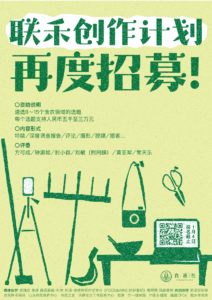 This round of the Lianhe Creative Programme received 197 applications in total. Written works made up the majority, though submissions also included video, podcast, photography and exhibition formats. After initial screening, 49 creators were shortlisted for interviews. Following a relay-style interview conducted by six judges, we decided to support 20 creative projects, one of which is supported by Mao Meng and Foodthink.




