For Northern Shaanxi, Eating ‘Bitterness’ Was Never a Choice

Bitter greens, scientifically known as sow thistle and in herbal medicine as Chinese rue. A few decades ago, I would never have imagined that the bitter greens once dug up by people in northern Shaanxi merely to fill their stomachs would now be prized by the market for their nutritional value, or that foraging for wild greens would become a new form of socialising and leisure in city life.
As a child, in the small mountain village of Langhaogou in Yanquan County, Shaanxi Province, eating bitter greens was never a choice—it was a survival strategy born of material scarcity. Digging up bitter greens had been a fixed chore for our family through spring and summer.
Bitter Greens for Humans and Pigs Alike
A single song, <em>Loess Plateau</em>, says it all about the barren bleakness of the northern Shaanxi highlands. Wolf Howl Gully is small and remote, tucked away in the mountains with only twenty or thirty households. If someone stood at their courtyard gate and called out, the whole village would probably hear them.
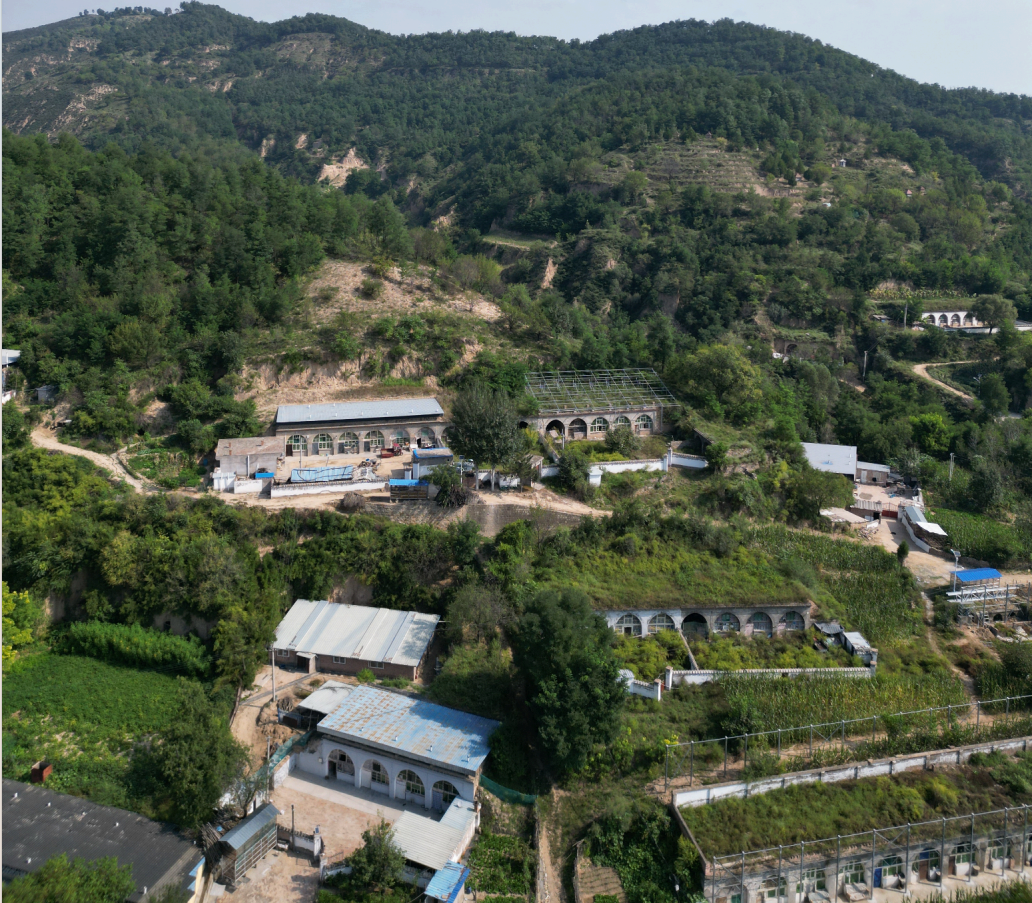
◉The small village of Langhaogou is a microcosm of the northern Shaanxi Loess Plateau, a land of countless gullies and ravines. Photo by Liu Xu
That was the 1970s, when every ingredient came from one’s own fields or the hills and fields beyond. The Loess Plateau is barren, dry, and short of rain; crops struggle to take hold, and yields are meagre. Yet the land has never been lacking in wild green life. Bitter vegetable was the most ubiquitous wild plant, its roots deep in the loess. People would spend half a day or more in the hills digging up bitter vegetable and drying it, all so that when the old grain had been consumed and the new crop had not yet come in, they would not go without food.
Every time the warm breeze of early summer blew, I would take my little sister by the hand—she was a few years younger than me—and we would set off for the wilds with a bamboo basket. Along the cliff edges, in the gullies, on the riverbanks, great stretches of glossy-green wild vegetables spread out before us, a sight unique to the Loess Plateau: bitter vegetable unfurling its serrated leaves, purslane hugging the earth in a blanket of pale green, and goosefoot clustering in soft tufts at the field edges.
The riverbanks, rich in moisture, produced bitter vegetable with thick, fleshy leaves and stout roots—the prime spot for digging. You would crouch down, part the tangled weeds, grip the base of the plant, and pull gently upward; a whole bitter vegetable, complete with its white roots, would drop into the basket. Of what we dug up, only a small portion was kept for our own table; the vast majority went home to feed the pigs. Our household’s coarse grain barely kept us fed, and pig feed was even scarcer. The pigs went hungry year-round, grunting and snuffling in the pen all day long.
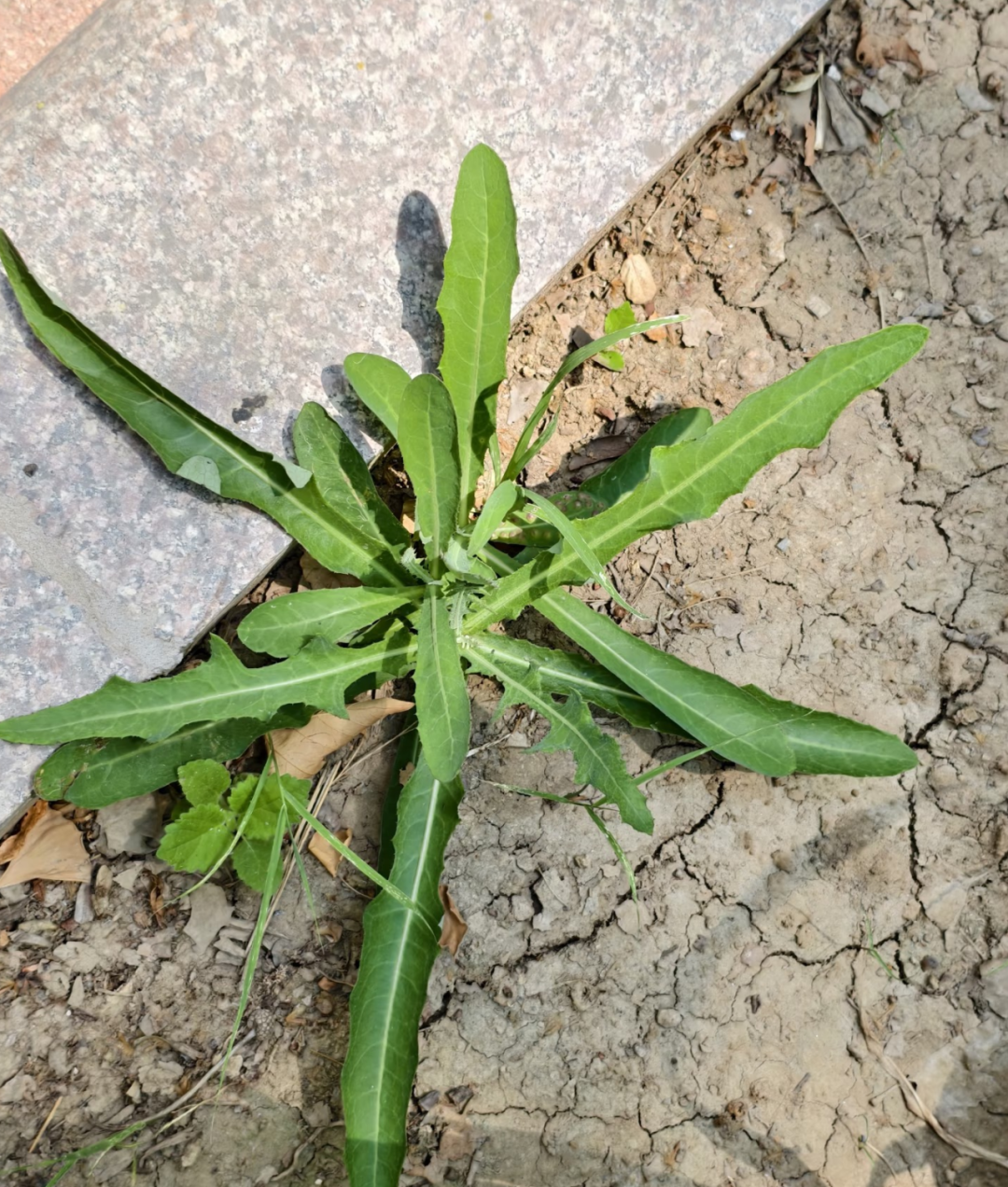
◉ Bitter vegetable, scientifically known as Sonchus oleraceus, goes by several regional names including jumaicai, qumacai, kumacai, and kumaicai. Image source: Xiaohongshu @有容本草
My little sister was by nature a romper, endlessly playful and fond of looking pretty; her mind was never on the digging. A single butterfly skimming past would send her dropping the basket and chasing it far off the path, where she would pick a few small wildflowers, tuck them into her hair, and stand on the slope twisting this way and that, secretly pleased with herself. To get more greens into the basket, I would always suggest a race — first to fill theirs wins. But the moment a wriggling worm surfaced from the soil, she would go deathly pale, fling the greens from her hands, and back away in a fright, not daring to reach in again for the longest while. By the time we trundled home at dusk, she would hang her head over her meagre handful of greens, sulking. I always felt sorry for her — so young, so given to play — and every time I would quietly slip most of the bitter greens I had dug into her basket to cheer her up.
Back home, Mother would take the bamboo basket heavy with bitter greens and, with careful hands, turn it into a meal of the warmest, most homely kind. She would pick out the tenderest hearts, wash them clean and chop them fine, then add them to a pot with silken tofu and let everything simmer gently. The clear broth would begin to bubble, the fresh, clean taste of the greens blending with the soft, yielding texture of the tofu. The soup was light and clear, with a gentle sweetness lingering after the first bitterness — one spoonful and it was as though the whole summer hillside had been distilled into a single bowl. Not a single unnecessary seasoning, yet enough to soothe the weariness of a long day’s work.
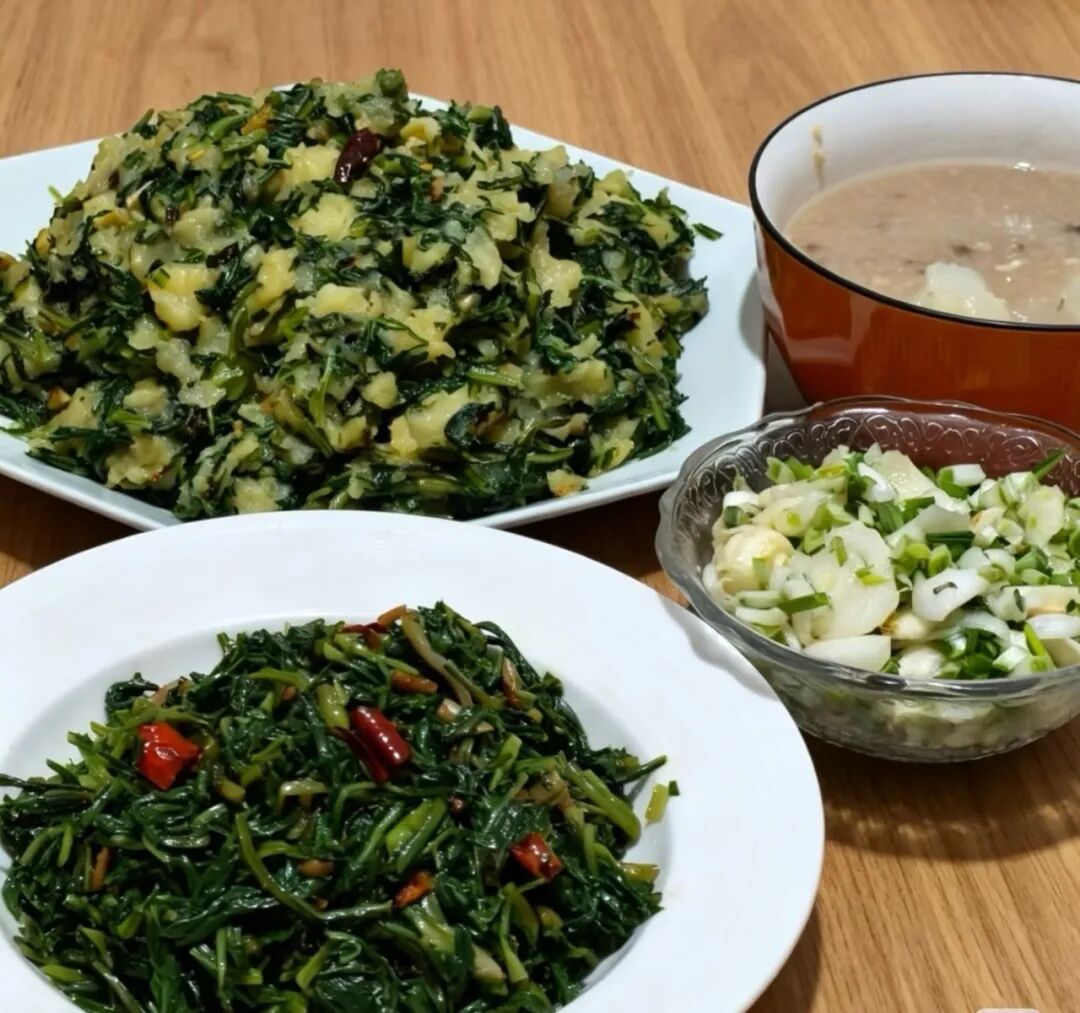
◉The bitter greens dishes kids in northern Shaanxi love most. Top left: bitter greens with shaved potato; bottom left: cold-tossed bitter greens. Image source: 卷卷不卷怎么卷
Whatever bitter greens we couldn’t eat, we’d chop up, mix with bran, and feed the pigs. The animals buried their snouts in the trough, gulping it down, grunting away nonstop. We were content, the pigs were full—and in those lean years, that was the simplest, most complete happiness.
Packaged Bitter Greens
This summer, my mother, now in her eighties, came to stay in Yan’an for a while. True to form, she brought along a large bag of fresh bitter greens, picked that morning from the loess slopes of northern Shaanxi—roots still clumping with damp earth, leaves a vivid, living green. The moment I breathed in that crisp, clean scent so particular to the hills, the familiar bittersweet taste rolled over my tongue, and the images of my childhood—kneeling on the field paths digging for greens, my mother at the stove coaxing wild vegetables into a pot—unspooled in my mind, frame by frame, like an old film.
The Shaanbei people’s devotion to bitter greens runs deep, firmly rooted in both history and the present day. To us, this humble plant carries stories that never seem to end. In former times, when famine followed famine and the grain fields yielded nothing, *A Herbal for Famine Relief* ranked bitter greens among the essential wild vegetables for survival, and countless common people endured their hunger on the bitter greens growing wild and abundant across the hillsides.

◉ *Jiu Huang Ben Cao* (A Treatise on Plants for Famine Relief) is a botanical work compiled in 1406 by Zhu Su, Prince of Ding of the Ming dynasty, primarily documenting common edible wild plants of the period.
During the Jinggangshan struggle period, Nationalist forces imposed a tight blockade around the base, ring after ring. Red Army soldiers had no choice but to rely on bitter vegetable soup—made from the plants growing wild across the hillsides—to stave off hunger. The soup discouraged quite a few soldiers. Mao Zedong walked over to the food barrel, ladled out a large bowl of bitter vegetable soup, and drained it in one go. He smiled and said the flavour was quite passable, then asked for another bowl. The leader sharing the same bitter food as his soldiers put an end to all the grumbling. This episode was later set to music in the household red song *Comrade Mao and We Were Together*.
However, once the wellness consumption boom took hold, the story of bitter vegetable took on a different flavour. One time, I was visiting a friend’s home. He mysteriously brewed a pot of tea for me to taste and launched into a lengthy explanation of what made it so special—ranging from its wellness benefits to its medicinal properties—culminating in the claim that the tea could actually prolong one’s life. I stood there, dumbfounded. I took a small sip and couldn’t help but blurt out, ‘Isn’t this just plain bitter vegetable tea?’ My friend was clearly displeased with my dismissal, convinced I had no appreciation for the finer qualities of bitter vegetable tea.
Profit-seeking merchants have relentlessly wrapped bitter vegetable in all manner of gimmicks, loudly touting its food therapy benefits and processing it into an array of derivative products—canned goods, beverages, wellness teas, and more. What was once an inexpensive wild vegetable, growing abundantly in the mountains and picked at will, has seen its value skyrocket under the influence of slick packaging and marketing rhetoric. Dried bitter vegetable tea alone can command a price of several hundred yuan per jin.
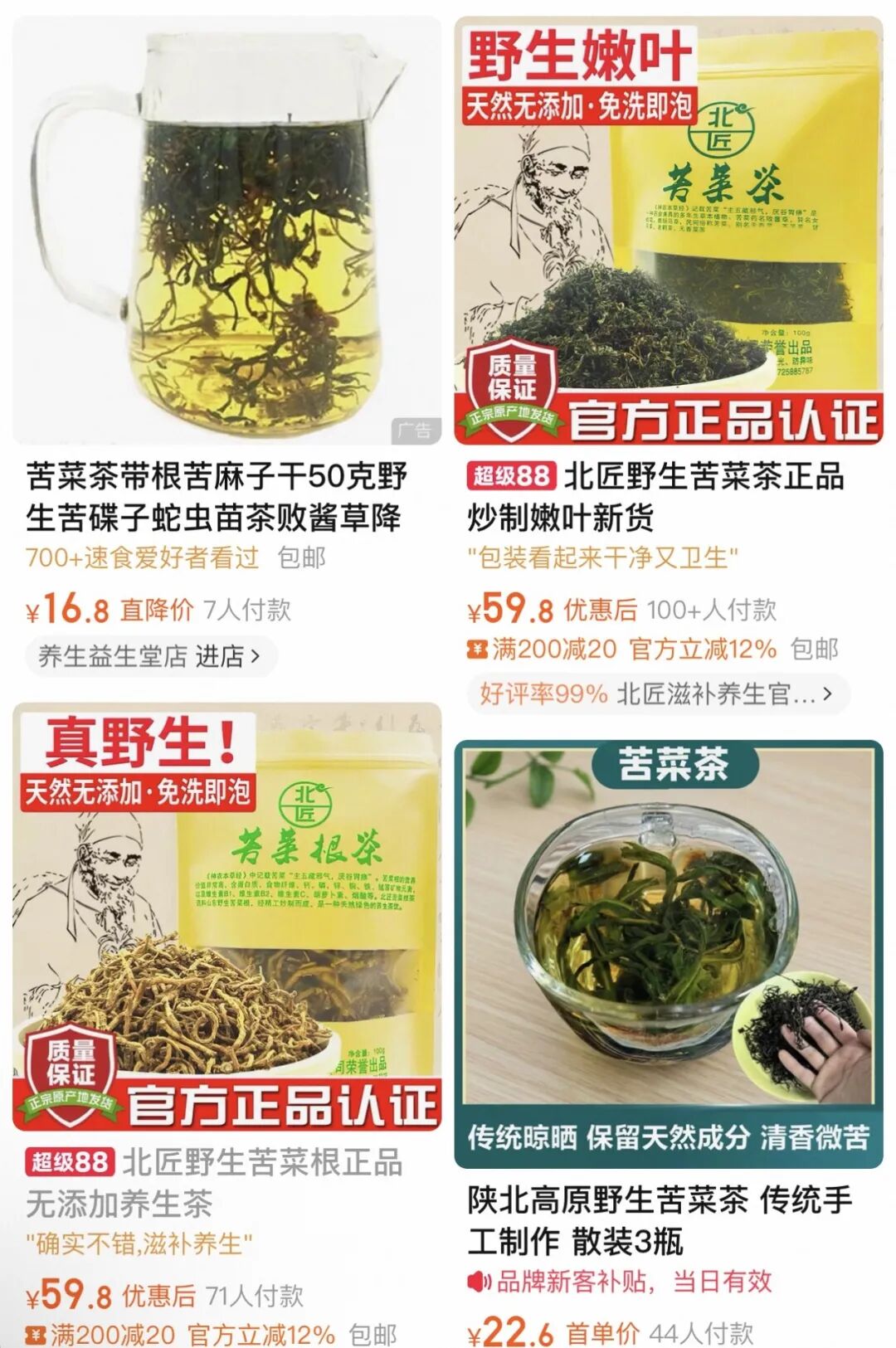
◉Bitter green tea sold on e-commerce platforms.
Of course, I am well aware of the nutritional and medicinal value of bitter vegetable. Li Shizhen called it Tiānxīangcǎo — ‘Heavenly Fragrant Grass’ — in his classical texts, a time-honoured substance of shared medicinal and culinary origin. Cold in nature and bitter in taste, it enters the heart, spleen, stomach, and large intestine meridians, and is credited with clearing heat and detoxifying, cooling the blood and arresting bleeding, and clearing the liver and brightening the eyes. Rich in vitamins, iron, potassium, and dietary fibre, it serves the dual purpose of sustenance and wellness.
But food is more than a set of nutrients; it is deeply bound up with our culture and way of life. The older generation in northern Shaanxi holds an unshakeable devotion to bitter greens, one rooted in a weighty story interwoven with famine, revolution, and longing for home. I suspect those who followed the hype purely for the wellness benefits merchants tout will, before long, cast bitter greens entirely from their minds once they discover it is far from the miracle cure they were promised.
Do Young People Still Eat Bitter Greens?
Bitter greens have long served as a medium of emotional connection among people from northern Shaanxi. One winter, you return home, and your mother quietly sets a plate of wild greens before you. You are taken aback and ask where she found wild greens at this time of year. She tells you, beaming with pride, that she foraged them in summer and kept them in the fridge. You will surely feel an overwhelming sense of happiness.
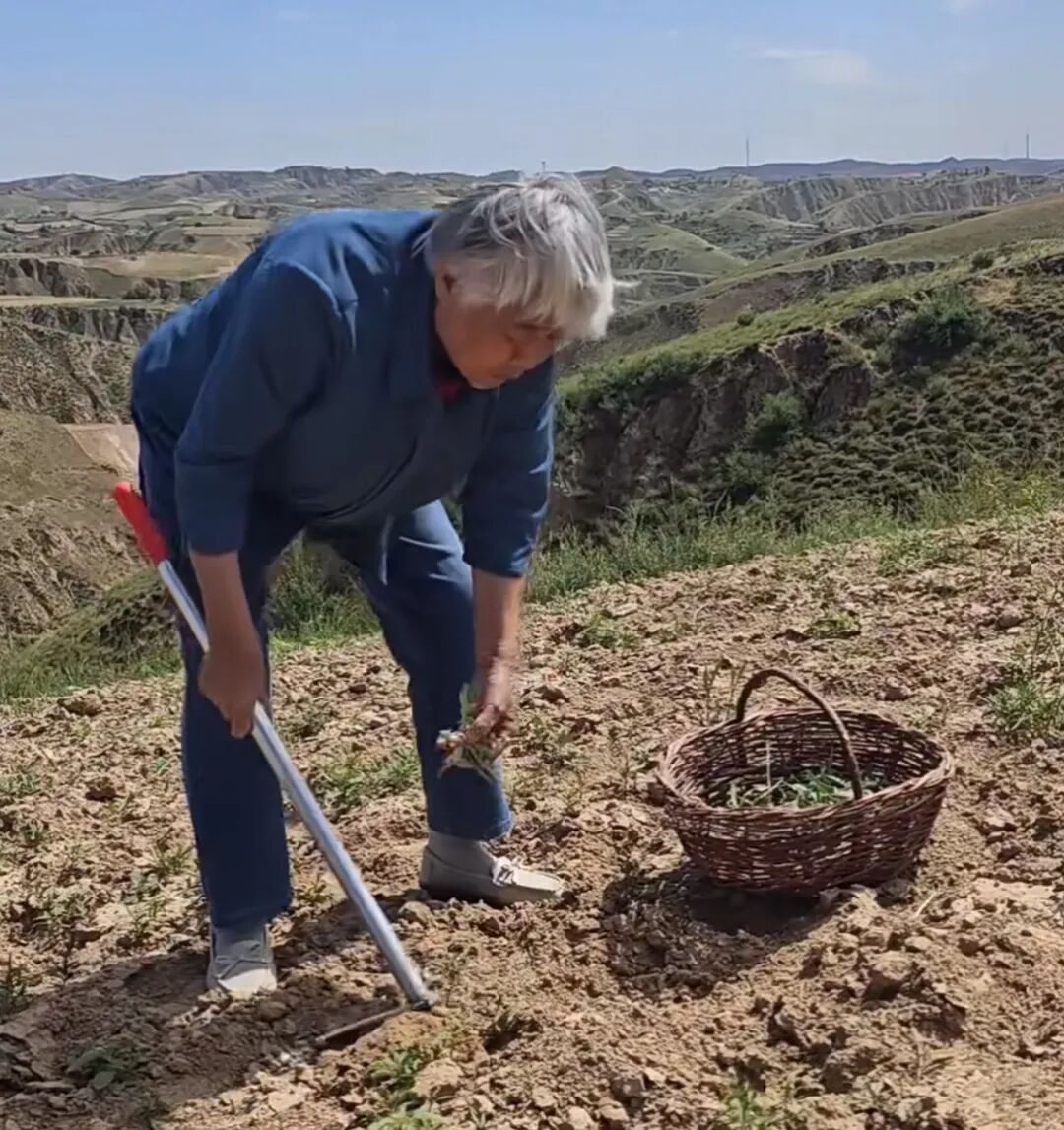
◉ Most of the older generation from northern Shaanxi came through lean years, well aware of the time when wild greens were all that carried them through hunger and cold. They favour the plain, understated flavour of bitter greens — the kind where bitterness gives way to a lingering sweetness. Their approach to food carries an undercurrent of contentment with little and a fondness for recalling the bitter to savour the sweet. Image source: Director Liang’s Retirement Life on Xiaohongshu
But my youngest daughter bluntly said the bitter greens were too astringent to swallow, quipping that we’re not rabbits—why bother eating weeds that are so hard to get down?
For the younger generation, having grown up in an era of material abundance with a year-round supply of meat, fish, and seasonal produce, there is no need to rely on wild greens to fill gaps in the diet. Accustomed to the rich, intense flavours of takeaways, fast food, and oil-heavy, spicy meals, why would they spare the time to savour the understated taste of bitter greens?
Besides, given the demanding pace of modern work, efficiency and convenience are what urban office workers need most when it comes to eating. Unlike rural life in the past, when people had plenty of free time and were willing to spend hours heading into the hills to forage wild vegetables, then wash, soak, and slow-cook them.
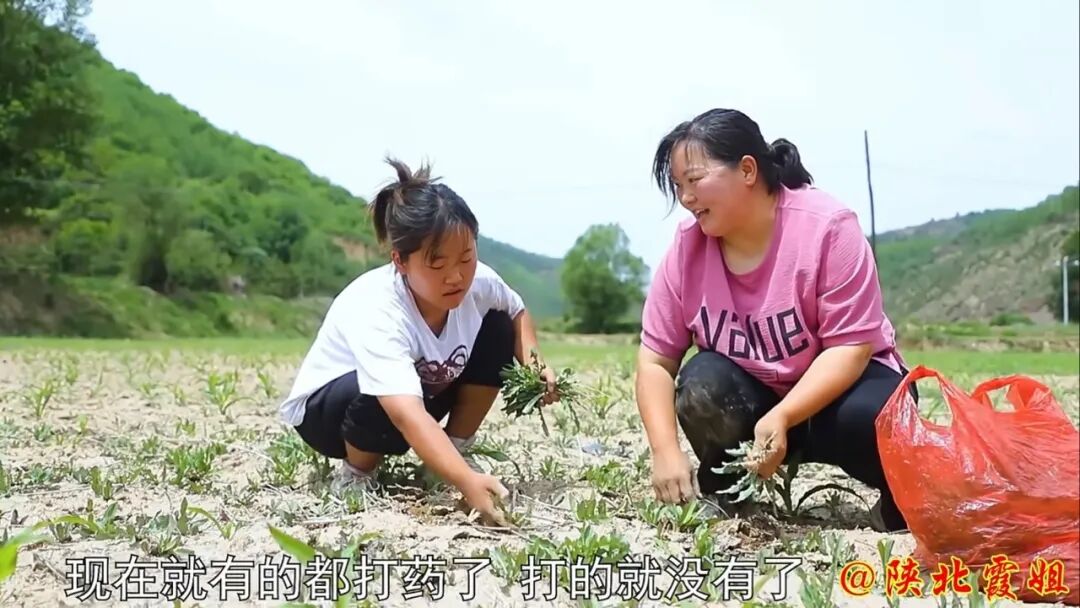
◉A short video creator lamented that, due to pesticide use, some cornfields in the countryside no longer yield any bitter greens. Image source: short video screenshot from Xiaohongshu @陕北霞姐
Some shrewd vendors have adapted the way wild greens are sold, pre-washing bitter greens repeatedly, blanching them to remove the astringency, stripping away dirt and the raw, astringent bite, and vacuum-sealing them alongside a pre-mixed seasoning sauce. Consumers need do nothing but bring them home, open the package, give them a toss, and straight to the table — not unlike the ready meals now popular on the market.
This kind of processing does spare the entire tedious routine of preparing wild greens, yet something of the hills’ unique pleasure is lost in the process. Every step reduced to a single click, any connection to soil and nature severed — younger people, more accustomed to identifying food by its label, can no longer feel the warmth and joy of foraging in the wild and handling greens with their own hands.
Sometimes I find myself wondering: if we lose our closeness to nature and rural life, will young people of the future still eat bitter greens? Then again, I’ve heard that a foraging craze has recently swept the internet, with many young people who order delivery food regularly saying they’ve developed a case of ‘green vegetable anxiety’ — and that has made me a little more optimistic.
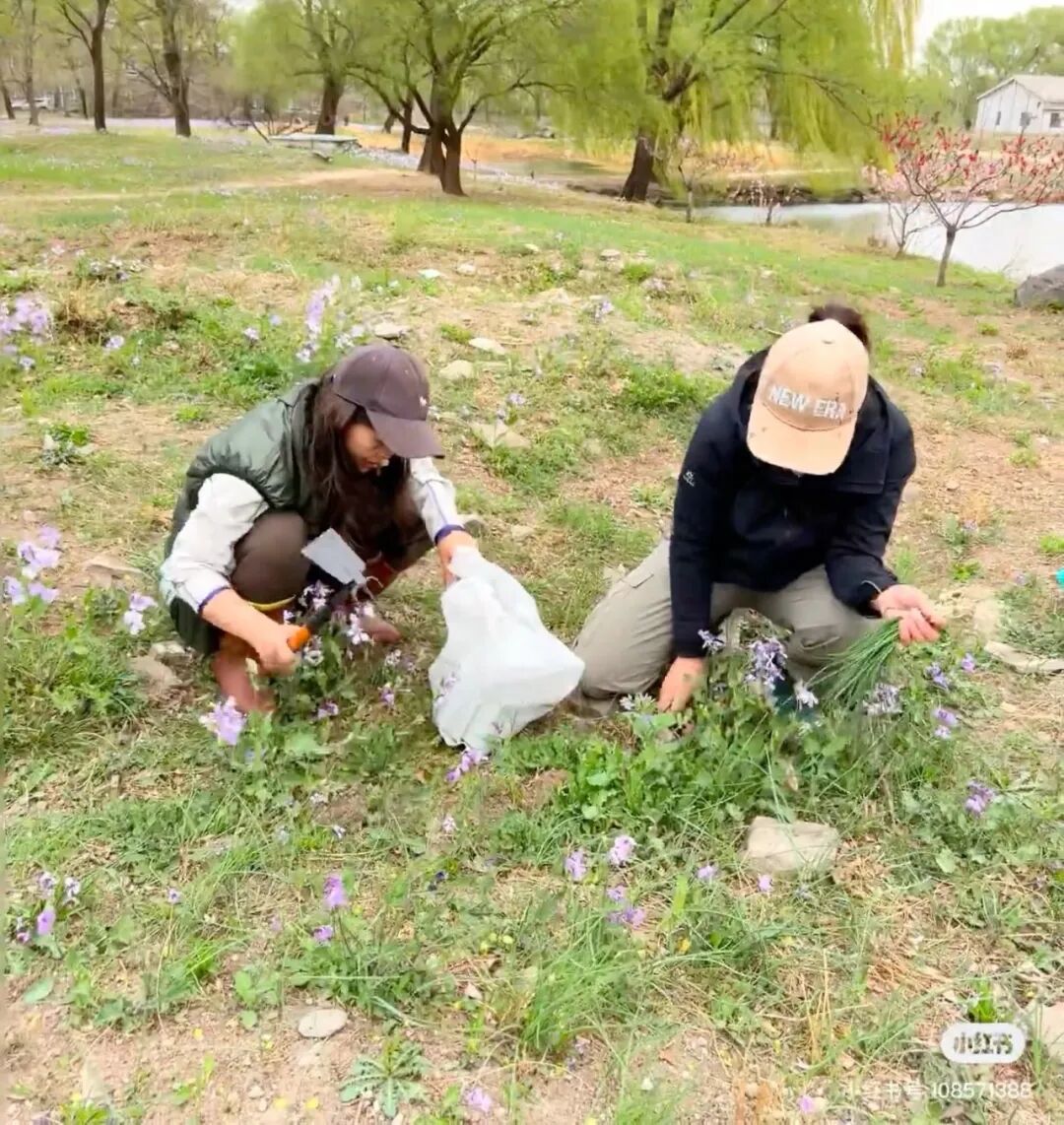
◉Many young people in cities see foraging for wild greens as a way to temporarily escape the office, ease their stress, and reconnect with nature. Image credit: Vodka999@RED
The world changes faster than we can follow. Industrialization and urbanization have completely rewritten the pace of everyday life and the way people eat. Bitter greens are long past being a necessity for survival, yet the desire to eat them has not been drowned out by the tide of hearty meat dishes, takeaway, and ready-meals. This summer is almost over; next summer, the bitter greens on the hillsides will be green once more. I am glad to see so many people still finding ways to seek out bitter greens whose taste has remained unchanged for a thousand years.
– This is the 840 th original article from Foodthink –

Foodthink
Author
Liu Xu
A farmer who longs to fly higher. Enjoys doodling, writing what the heart feels, pressing forward across mountains and rivers, leaving behind an ode to life.
Edited by: Tianle
Layout: Xiaoshu
Scan to send a tip and support original food knowledge
▼

▼
Click the image to read related articles


▼
Click a keyword to explore more article collections
Seeds|Agronomy|Policy|Fermentation|Nutrition|Fruit|Fisheries|Events|Careers|Delivery|Markets|Livestock|Food Talk|Sharing Sessions|Book Club|Harvest Festival|Smallholder Stories|Climate Change|Rural Development|Cooperative Economy|Urban Farmers|Food Safety|Digital Technology|Biodiversity|Pandemic & Food|False Solutions|Ecological Agriculture Internship Programme
Beijing|Hebei|Shanghai|Guangdong|Guangxi|Henan|Sichuan|Jiangxi|Xinjiang|Shaanxi|Hong Kong|Chongqing|Zhejiang|Jiangsu|Guizhou|Taiwan|Inner Mongolia|Philippines|Canada|Russia|Mexico|Italy|United States|United Kingdom|Germany|Netherlands|Thailand|Sweden|Japan