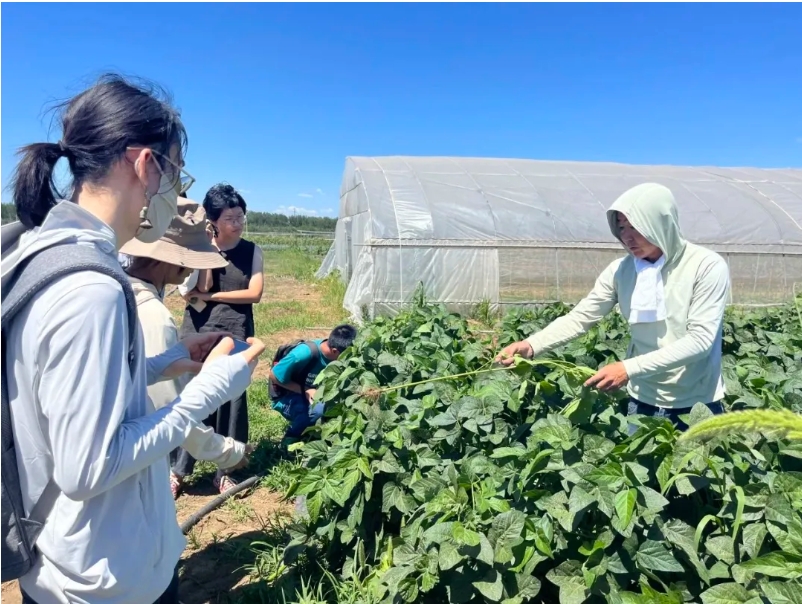
Through Foodthink’s Ecological Agriculture Internship Programme, Jianing came to Yinlin Farm in Conghua. Among hens, goats, rain-thinned maize and old lychee trees planted by the older generation, she relearned to recognise the land and the farmers behind the food.
During three months pulling weeds, catching insects and raising seedlings at Xiqing Farm in Daxing, Beijing, Tianyi—participant in Foodthink’s Ecological Agriculture Internship Programme—came to realise that the moments when body and land are honestly joined are far more precious than the harvest itself.
Through Foodthink’s Ecological Agriculture Internship Programme, Chengzi took root for three months at Lexiangu Community Farm in Fengxian, Shanghai—growing vegetables, repairing roofs, leading goats and feeding ducks, running a market stall—and grew the courage to explore out of her uncertainty about the future.
Sister Yan Ping at Baicao Garden, Guigang, Guangxi, refuses herbicides on fifty mu of Wogan mandarins, making labour a practice of nurturing body and mind; Uncle Youming of the White Pants Yao in Nandan keeps a seed bank for heirloom rice, preserving his people’s rootedness in the land.
Zejun refused the mainstream path of life. In spring 2024, a three-month internship at Guixinyuan Farm in Huizhou, Guangdong—from weeding and feeding ducks to visiting multiple farms across the two Guangs—gradually revealed that ecological agriculture has no standard answer but a spectrum.
A Foodthink intern at Zhiliangtian Ecological Farm in Alxa confronts the risks of farming at the mercy of the weather and the frictions of communal living — yet among the plants, birds, and beasts beneath the Helan Mountains, discovers the quiet confidence to keep tending the land.
A Community-Supported Agriculture farm in Fengxian, Shanghai—20 mu of arable land held up by four farmhands in their seventies, members unwilling to share yield-loss risks, organic fertiliser still bought in—three months of farm life have reconciled ecological farming’s ideals with its realities, entry by entry.
Foodthink’s Lianhe Programme sent five young people to Lüwo Farm in Jingyang, Shaanxi, where their days went far beyond planting vegetables and pulling weeds — raising seedlings, driving a tractor, working on the biscuit production line, attending biodynamic farming classes.
Men leave for work; the women of Stone City stay to farm, tend old and young, and run guesthouses. He Xiuqin’s plot grows twenty to thirty crops across the seasons; Zhang Xiuyun keeps over a dozen heirloom maize varieties. This uncelebrated labour connects field to table.
In the Jinsha River valley at Stone City, Lijiang, villagers whistle to call the wind for winnowing wheat, wait for rain to plant maize. Old varieties like Tunmai and chicken bean live on the hillside from generation to generation, sustained by household seed saving and exchanges among neighbours.