
From the US to a Guizhou Dong Village: A Beijing Girl’s Career and Life Choices

Foodthink Says
Can urban professionals rebuild their lives and careers in the countryside? Chen Xi, a former consultant who grew up in Beijing and spent ten years living and working in the United States, found her way to a Dong village in Guizhou during a water-quality survey. A steaming bowl of purple rice and a few fireside conversations at night inspired in her the idea of “building a house and staying”. She has since built a family here, and last year she also became a proud mother.
Over the past six years, Chen Xi and her husband Bangrong have organised local family members to grow rice in the terraced fields, preserving more than twenty indigenous varieties of rice and grains. They founded the brand “Zhaoxi She” to help more people discover and taste the heritage varieties of the Dong village. Through a charity sale of purple rice, they built a library and launched public events and educational practices in Yangdong Village.
Yangdong Village is changing, and she constantly shifts between multiple roles — farmer, mother, rural builder, and cultural communicator. How does she see and understand the countryside? And what does it truly mean to her to stay?
What follows is her own account, adapted from a women’s career-sharing event co-hosted by Foodthink and pushpull Bar&Space on 18 March.
This year, designated by the United Nations as the International Year of Women Farmers, Foodthink has launched the “She and the Land” content column, focusing on women in agriculture and food systems and telling their stories. This article is one of the “She and the Land” series.
From Beijing to America to Guizhou
I was born and raised in Beijing.
In my second year of high school, I was quite rebellious. I really disliked my form tutor and felt he was always trying to hold us down. One winter break, I told my mum I didn’t want to do my homework any more — I wanted to go and see the world. As it happened, I’d spotted a winter camp in the United States, so I signed up. I wasn’t thinking too hard about it; I just figured that wherever it was, getting out there came first.
Later, I found an opportunity to go to the US as an exchange student, and after that I just kept going — studying, graduating, working — eleven years in all. The political climate back then was different from what it is today. As a Chinese national, I was able to work in consulting within the US government after graduation, and I stayed in that role for five years. We even held our project celebration party inside the White House.
In 2018, I was hit by a double blow — both professionally and personally. I was caught up in a severe internal power struggle at work, and my health started failing; I needed treatment. Right at that moment, Anthony Bourdain — a chef and food writer I adored — took his own life. To me, it felt as though a food-loving dream I’d long admired had shattered. So I began to think seriously: perhaps I should stop and rest.
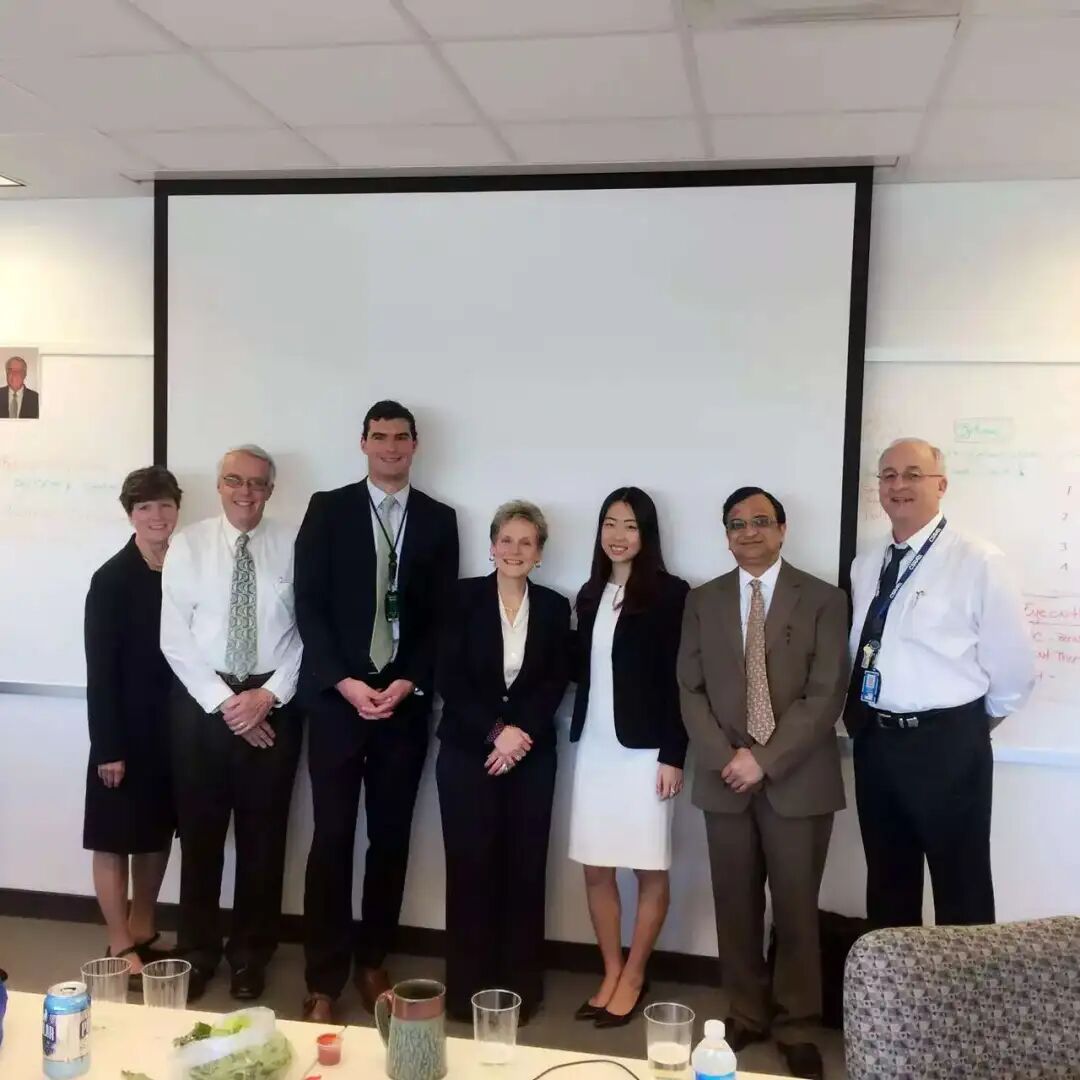
◉ Chen Xi, as a core member of a project advocating for the US federal government, poses with her team after fourteen days of intensive closed training and a final pitch presentation. Photo: Chen Xi
Looking back, in the thirty-plus years of my life up to that point, I had never truly rested — never truly lived. I was always chasing one target after another, as if ticking off KPIs. When I decided to take a break, the first thing that came to mind was going home to China.
I had left home at seventeen, and by the time I turned around, I realised I had missed the most rapid period of China’s development and had never really come to know this land. So after returning, I joined the Wushui Information Platform, a non-profit organisation, and started working on rural projects, hoping to understand my own country better. One of our project sites was in Yangdong Village, in the Qiandongnan Prefecture of Guizhou. It was from there that the real story of my life began.
On a winter’s day in January 2019, I arrived in Yangdong Village for the first time, serving as a project mentor.
I had never been to Guizhou before, and the first thing I felt was how impossibly long the journey was. The high-speed rail link to the village had not yet been built. Getting there required multiple forms of transport: a flight to Guizhou or Guilin, then the train to Rongjiang County, and finally a bus from Rongjiang into the village. The road was still unpaved, so the drive in was muddy and bone-rattling. When we stepped off the bus, our suitcases had turned grey.
But what left the deepest impression on that trip was, in fact, the rice. The first bite of rice I had in Yangdong Village, I knew straight away it was the best rice I had ever eaten. At first I wondered whether it was just because we were so tired and worn out from the journey. But we ate the same rice every single meal after that, and it was still delicious — even the students from Guangxi on our team felt the same.
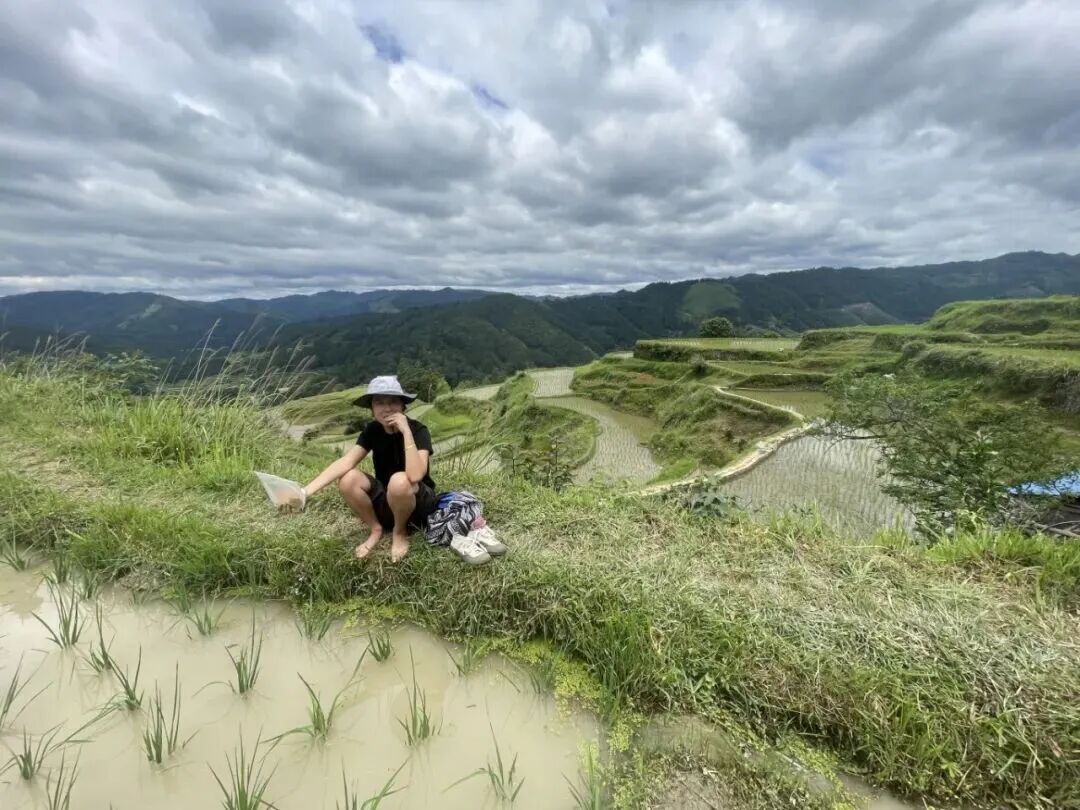
◉ Chen Xi by the paddy fields. Photo: Zhaoxi She
I grew up eating wheat-based foods and never paid much attention to rice. The most we had at home was the Northeast variety, and I knew nothing of Guizhou’s rice. So looking back now, in a way, my story with Guizhou began with that one bite of rice.
The following year, the pandemic hit. I was working from home — and, for the first time in over thirty years, living with my parents again. Cooped up for so long, I felt grass growing wild inside me.
It was around that time that a parcel arrived at our door, sent by my husband-to-be. The outside of the package was caked in mud. I opened it and found a box of spring bamboo shoots, posted all the way from Qiandongnan. They smelled incredibly fragrant, and I was deeply moved. It was during that stretch that I felt with absolute certainty: I had to get out! It had been so long since I’d left the house. One morning I climbed the Western Hills, but the smog that day in Beijing was terrible. Then a friend sent me a message on WeChat — a photo of the morning mist on the ridges above Yangdong Village.
On one side, the smog over Beijing; on the other, the mountain fog of Qiandongnan.
Because of those two things, I flew to Guizhou and spent a truly unforgettable summer there — a summer I call “the happiest holiday of my life”.
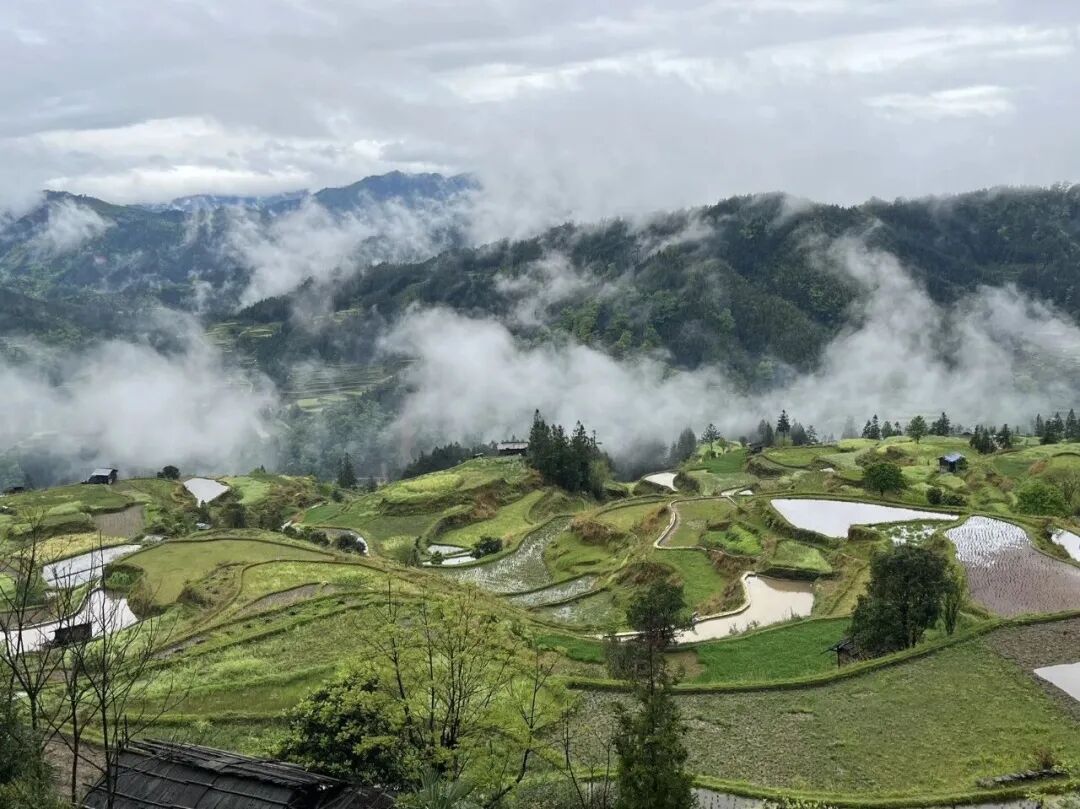
◉ The mountain views of Yangdong Village. Photo: Chen Xi
It was a feeling I hadn’t had in years — like a proper summer holiday, the kind you get as a schoolchild. I spent my days wandering the hills and wading in the water, cooking meals with my local friends. My wooden house was under construction at the time. I’d originally thought: once the pandemic is over, I’ll probably go back to working in Beijing, and I’ll only return to Guizhou during holidays.
But while the house was being built, my husband and I came together. We met on the terraced fields. He was a young man who had returned to his home village and worked as the manager of a cooperative’s rice-processing plant. We met because of the Yanzhi Purple Rice, and afterwards people joked that it should be called the Love Purple Rice.
In April 2021, the wooden house was completed. From that day on, we have lived here and never left.
Building a Library with Yanzhi Purple Rice
During my summers in Yangdong Village, I got to know some of the children there. I noticed that they had very few extracurricular options. Their parents had gone away to work in the cities, so they were mostly living with their grandparents, spending a great deal of time watching short videos on their phones. So I thought about building a library — somewhere the children could come during the winter and summer holidays to read, take part in activities, and have one more option in their lives.
But where would the money come from? I thought of the local Yanzhi Purple Rice — its quality was outstanding, yet the farmers struggled to sell it. So I decided to raise funds by selling the rice.
The whole fundraising effort was carried out during the winter. Many local high-school students and villagers came to help us pack and ship orders. It was also the first time I had truly been involved in selling agricultural produce, and it was through that process that I really got to know the Yanzhi Purple Rice. I researched its history, told its story, filmed videos, and showed people how to cook it. After that, I received so much feedback, and many people wanted to keep buying the rice. Later, when we started growing our own rice, a great deal of it came back to that experience.
While we were raising funds, we were also searching for a site for the library. We found an abandoned granary by the Yangdong River — the location was ideal, and it was close to the primary school. But it was so run-down that the locals all said there was no way it could become a library. We loved the wooden structure, though, and we wanted to preserve it.
In June 2021, the library opened. It was the first non-profit library in Qiandongnan, and over time it grew into a space serving the whole community. I have always been deeply grateful for the part that library has played in my life.
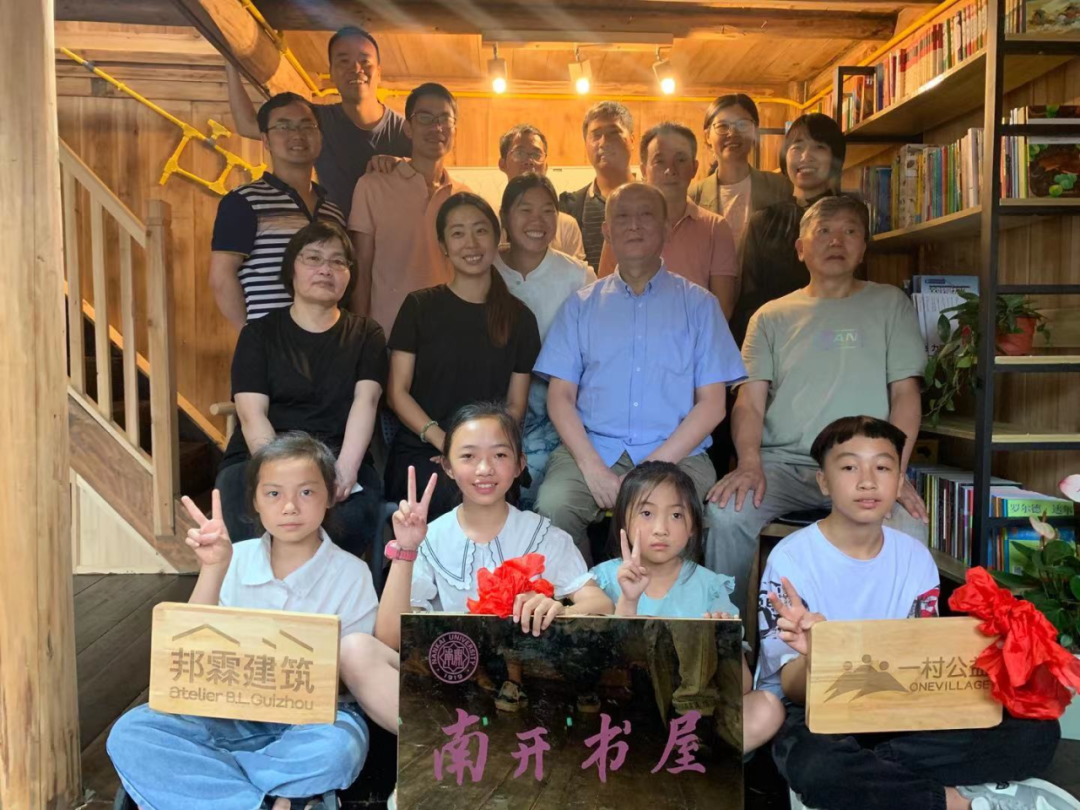
◉ On 3 July 2021, Liping County Yangdong Children’s Library officially opened its doors. Photo: Liping County Yangdong Children’s Library WeChat account
I usually teach English and yoga at the library. Volunteers from all over come to give classes too — courses on children’s emotional growth, flower arranging, nature education, and crafts. The poetry class is by far the most popular. I’ve come to see that every child is a born creator; they simply need a space where they feel accepted, and like a seed, they will sprout.
To help the library sustain itself, we compiled the children’s poems into collections and took them to Shanghai, Beijing and beyond for readings and exhibitions. That helped us raise a little more funding as well.
At the same time, I began designing courses based on what the village actually needed. Sex education and waste-disposal workshops, for instance — I’d noticed these gaps in everyday life, so I reached out to non-profit organisations and invited their teachers to run activities.
Because we are working to preserve heritage seeds, we wanted to start with the children. So the library has been preparing a “Seed Classroom”, giving children the chance to learn about the local plants and seeds.
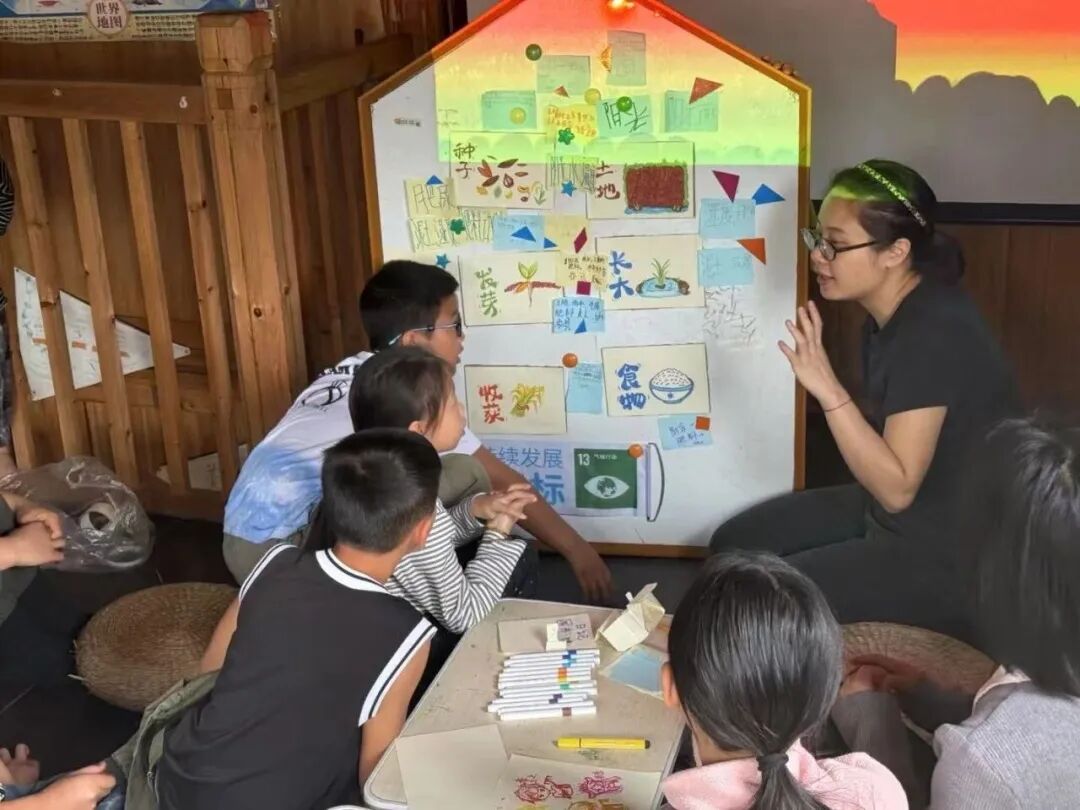
◉ In April this year, the children’s library invited Teacher Yihan to give a seed class. Photo: Liping County Yangdong Children’s Library WeChat account
Along the way, we have faced many challenges. The biggest one recently is that the library needs to move.
The landlord is determined to keep water buffalo on the site. I’ve spoken to the local government about it, but the Dong people have a bullfighting tradition — it is part of the local culture — and the government has stated clearly that they cannot prevent the landlord from keeping his cattle there. So this year, the most important thing is to relocate the library to a new site.
Beyond that, there have been some cultural clashes — things like a sense of contractual commitment and efficiency, whether in building a house or organising farmers to grow crops. My initial expectation was that we would have an agreement, whether spoken or written, and everyone would follow it. But in practice, that proved extremely difficult. People might not turn up because of a festival, family matters, or bad weather. Slowly, I came to understand that it is not about any one person — it is simply that the rhythm of life here is different. So I have adjusted my own expectations. And I have come to see that efficiency need not come first. In farming and in nature, there is so much uncertainty — you cannot plan the yield the way you would an office. I have started accepting that things will happen when they happen — a month early, a month late — and I no longer fight myself over it.
Yangdong Village’s Old-School Rice-Growing Methods
In the years I have lived in Yangdong, I have gradually gone from simply taking part to becoming deeply immersed in agriculture itself. On the one hand, my husband is passionate about farming and traditional tools; on the other, my attention is drawn to heritage seeds. We began to take a more active role in the growing, and drawing on our observations of life here, we have developed a philosophy of our own — to pass on, as faithfully as we can, the farming practices of the Dong people themselves.
Growing rice in Yangdong relies primarily on a rice–fish–duck co-cultivation system.
In every paddy we raise “paddy fish.” When we transplant the seedlings in spring, we release fry into the water; by the autumn harvest, we reap both rice and fish. Around this cycle, we have our own festivals: the Guangyang Festival, celebrating the completion of transplanting, and the Chi Xin Festival, celebrating a bountiful rice harvest. Before the Chi Xin Festival, we open the paddy and drain the water to catch the fish, then invite family and friends to a meal together.
Fish serve many purposes in the rice paddies. Their droppings enrich the water as natural fertiliser, and as they move through the water they stir up the current, discouraging the growth of weeds. The paddy is home not only to the fry we release, but also to wild field mussels, tiny shrimp, small fish, and river snails. Interestingly, in the Dong language every minuscule creature has its own distinct name, and farmed fry are clearly distinguished from wild fish. This speaks to the deep affection the local people feel for these creatures and the watery world they share. Take this, for instance: while my husband is ploughing, his ten-year-old nephew will already be scooping fish from the muddy water. Whatever he catches gets cooked straight away at lunchtime — and it is wonderfully fresh.
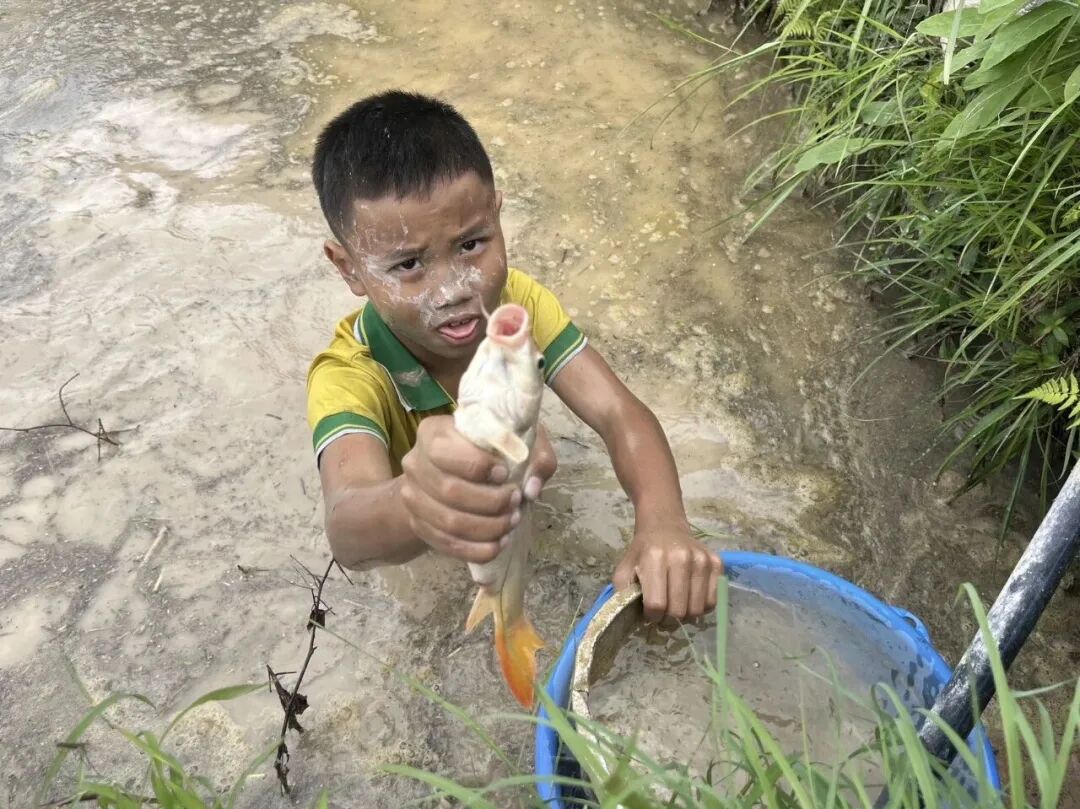
◉ Ploughing on one side, catching fish on the other — what they pull up is usually common carp. Photo: Zhaoxi She
The division of labour in the paddies is equally natural: the men plough, while the women take advantage of the stirred-up muddy water to scoop fish. What they catch is mostly small wild fish — common carp, crucian carp, and some species that have only Dong-language names I cannot even give in Chinese.
In addition, we replace chemical fertiliser with compost made from our own cattle dung and wood ash. The weeding, too, is a natural affair: cattle graze the grass on the bunds, while ducks and fish eat the grass growing in the water. When the grass on the bunds begins to crowd out the rice alongside, we pull it by hand.
Yangdong Village’s rice is grown on terraced fields ranging from 500 to 1,200 metres above sea level. There is one crop a year, with a growing season of over 150 days, irrigated year-round with flowing mountain spring water.
Thanks to the natural conditions here, the area is home to an extraordinary number of heritage rice varieties. At present, we maintain about nine varieties of rice and over a dozen types of coarse grains, consistently totalling around twenty each year. Nearly all the heritage rice sold under the Zhaoxi She name is farm-saved seed, including: Lüxiang Zhu Rice, Yanzhi Purple Rice, Xiaoma Red Rice, Five-Colour Banquet Rice, Jingshui Xiang Rice, Fragrant Sticky Rice, Mangling Japonica Rice, and others.
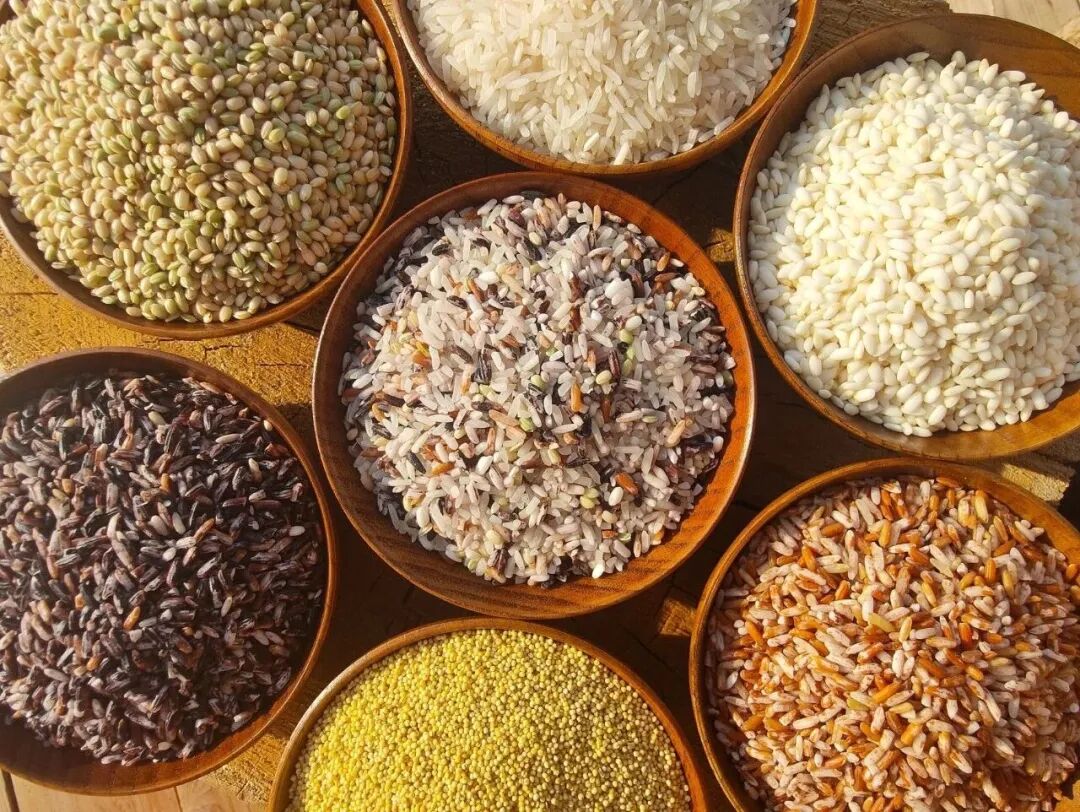
◉ Zhaoxi She’s “flagship rice” — a heritage variety native to Yangdong Village. Source: Zhaoxi She
Because the Dong people have no written script, only a spoken language, most of the historical records we can trace come from county gazetteers written after the Ming Dynasty. This is why we generally say that these seeds are at least 400 years old.
Each variety has its own character. Yanzhi Purple Rice, for instance, is used in winter to make ciba — glutinous rice cakes — to wrap zongzi, and to brew rice wine. Lüxiang Zhu Rice yields less than 150 kg per mu, making it our most precious variety and a favourite among Michelin-starred chefs. Five-Colour Banquet Rice is a blend of five rice varieties, drawing on the Dong tradition of red-and-white feasts for weddings and funerals: each family brings a handful of rice, and when they are cooked together, a whole spectrum of colours emerges. Mangling Japonica Rice is a variety we discovered in Mangling Village. Xianghe Nuo, meanwhile, behaves very differently from the others — it prefers cool, shaded conditions and must be grown in low-light areas close to water.
From Heritage Varieties to New Roles
Through preserving the region’s heritage varieties, I also entered the agroecology network. Since last year, I have been venturing out more. In October, I travelled with colleagues from Foodthink to Thailand to visit local agricultural communities, and I also took part in farmers’ markets and events in Beijing and Guangzhou. In January this year, I went to Germany to attend an agriculture and food forum there.
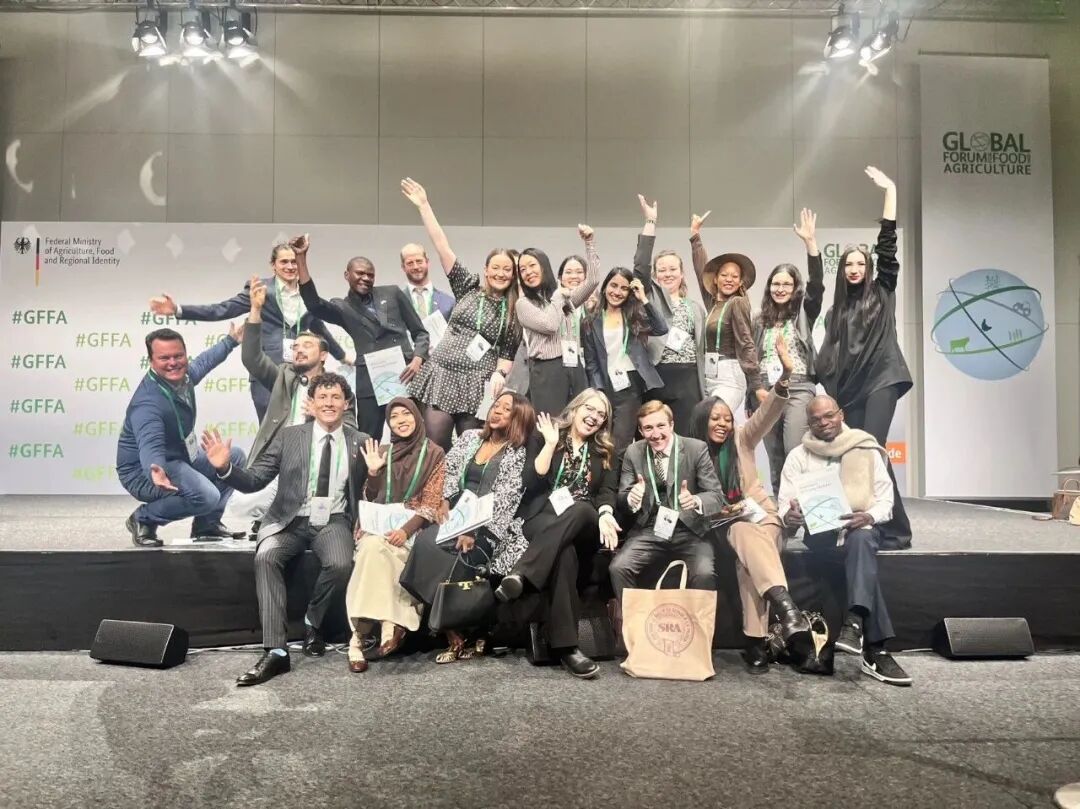
◉ In January 2026, invited by the German Ministry of Agriculture, Chen Xi travelled to Berlin as a young farmer representative to take part in the 2026 Global Forum for Food and Agriculture (GFFA). At these exchanges, she introduces Guizhou’s heritage rice varieties, giving more people the chance to truly taste and learn about them. Photo: Zhaoxi She
In fact, many people ask us: why don’t you livestream? You’d be great at it, and you have a wonderful venue. But we don’t see it that way.
From what I’ve observed, some farms, even though they practise ecological and organic growing, have adopted highly corporatised operating models — chasing yield, sales and growth. The founders are deeply anxious, constantly livestreaming, telling stories, answering questions, exhausting themselves.
The Zhaoxi She brand has always been rooted in my original intention — it must be intertwined with the way we live. That is the unspoken understanding between my husband and me. The moment we start livestreaming, we drift away from the ecological life we genuinely want to pursue, and I slip back into my old work mode — endlessly watching data, trapped in data anxiety, and my true self suffers.
So even though we have received many invitations — to expand our planting area, take on more orders, get certified, and so on — we are being quite cautious for now. Because the moment we make a commitment, it becomes very hard to sustain our current way of growing, which would mean switching varieties or finding other ways to meet yield and order demands.
Six years living in Guizhou, and I’ve come to see that rural areas genuinely bear some of the consequences of this era’s rapid development. In recent years, for instance, transport has become more convenient and all kinds of packaged snacks find their way into the village more easily. With them come plastic wrappers, polystyrene and all manner of waste. When I first arrived in Yangdong Village, this was almost unheard of. Now there is more rubbish in the mountains year after year, so we go out to pick up litter every week. By clearing waste ourselves and taking the children along, we try to make a small difference.
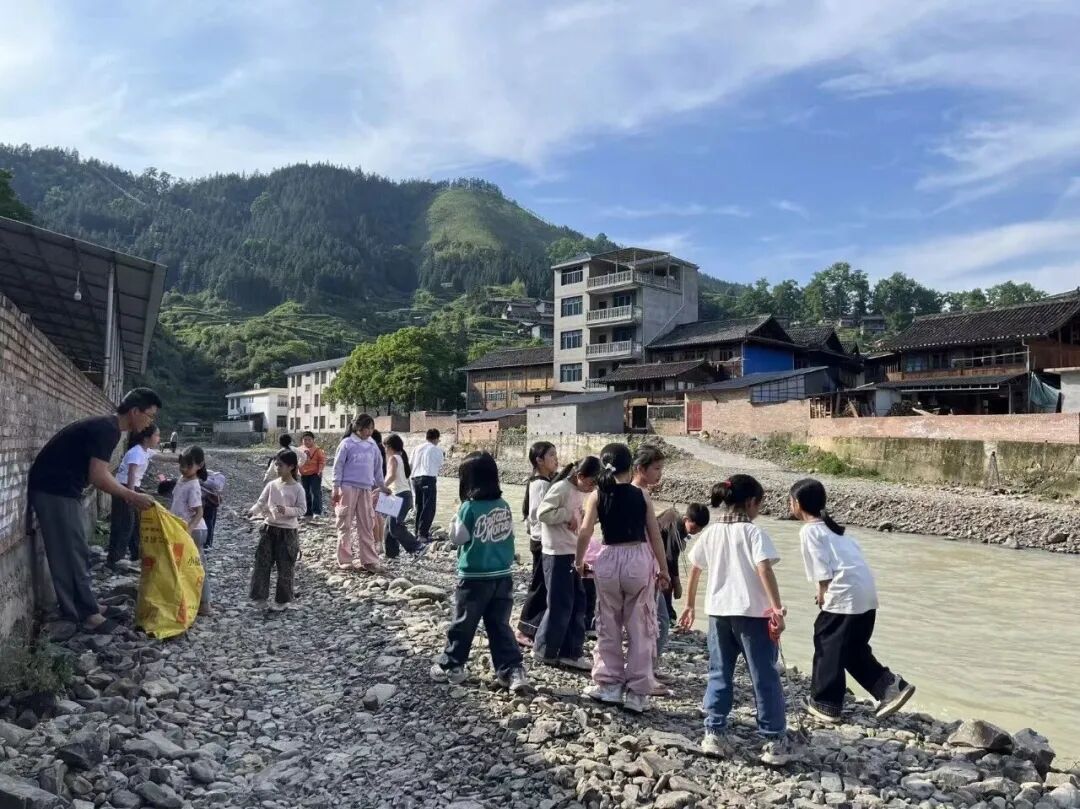
◉ Volunteers from the children’s library picking up litter with the children. Photo: Liping County Yangdong Children’s Library WeChat account
The push to sell chemical fertiliser has also been seeping into the village. Now there are vans driving through with loudspeakers blaring to hawk fertiliser — something that simply never happened before.
The ageing of the farming labour force is equally apparent. These days, most of those tending the fields in the village are over sixty.
Over the past few years, we have tried to involve more young people from the village in the growing. At present, my husband’s elder brother has come back from Guangdong to join us, though I am not sure how long he will stay. He seems to struggle to see the value I see in the land here, in the seeds, in the natural resources. I have also spoken to many people who have left for migrant work — their wages sound all right, but the cost of living in the city is high too. Farming is not a glamorous pursuit; whenever you talk about growing crops, it never makes as good a story as heading out to seek your fortune. Yet often, people leave for work simply to save face. They think they will earn plenty, but in the end, very little money actually makes it home.
The gender ratio is another problem. There are more single men than women in the village. When a family runs into trouble, the woman often leaves and the children are left in their father’s care. If the father then has to go out to work, the children end up living only with their grandparents.
Nowadays, many township and village primary schools are being merged, and some are disappearing altogether. People often ask me how long the library can last. Honestly, I don’t know. As long as Yangdong Primary School is still open, I want the library to stay. If Yangdong Primary School were to close, the library’s reason for being would go with it. Fortunately, Yangdong is a relatively large village, and when some of the schools in nearby Miao villages have shut down, the children are sent here for lessons — which has actually increased our pool of students.
In 2025, I took on a new identity — that of a mother.
A friend asked me whether I feel anxious about my child’s future education. Having a child has certainly made me think more deeply, but it has not made me anxious.
I believe there will be an approach to education that suits him. I simply don’t know what it is yet, but when that stage comes, I will find my answer naturally.
Looking back, going to America was also a wholly unplanned decision. There is a certain kinship between that and my eventual arrival in Guizhou — it was not after a rational comparison that I chose the place best fitting my criteria, but rather I followed a wild idea, to see whether I could make it real. Even if it didn’t work out, I would be content for having fought for it.
So I have never felt like someone who fled the city for the countryside. Right now, the countryside suits me and my nine-month-old baby perfectly. He settles down at the mountain’s sunset and sleeps more soundly. The difficulties each person faces and the ways we overcome them are all different, but what matters is that wherever you choose to live, you can stay true to yourself.
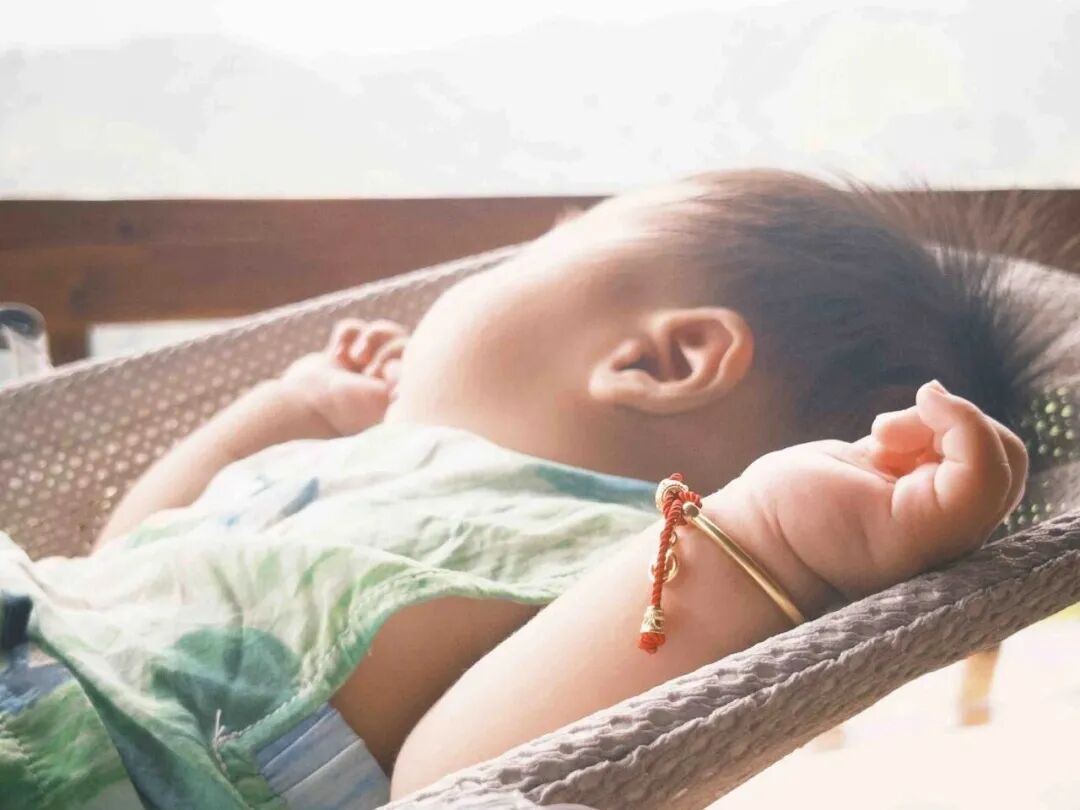
◉ On his first day back in the mountains, Chen Xi’s baby Croissant slept straight through the night in his own little bed, even with the temperature at 36 degrees. This is the magic of nature. Photo: Zhaoxi She
About the “She and the Land” Column
This year is the United Nations’ International Year of Women Farmers, and Foodthink is launching the “She and the Land” column, spotlighting women in the agri-food system. We will venture into the fields, markets, fishing harbours, pastures, kitchens, laboratories and city streets, to see the women who are often overlooked yet always present — women who take part in production, research, cooking, distribution and care, sustaining our daily lives through their labour and wisdom. They are tillers of the soil and vital builders of rural and food systems. Through interviews, writing and workshops, we hope to tell their stories, to understand how women’s participation shapes our food system, and to invite you to explore together: for women who labour in food and farming, how does a fairer, more dignified future come into being?
Editor: Kairui